News

Christians Give at Record Levels to Fund Israel Relief

The war has spurred millions in donations to ministries that provide everything from emergency supplies to security gear for future attacks.

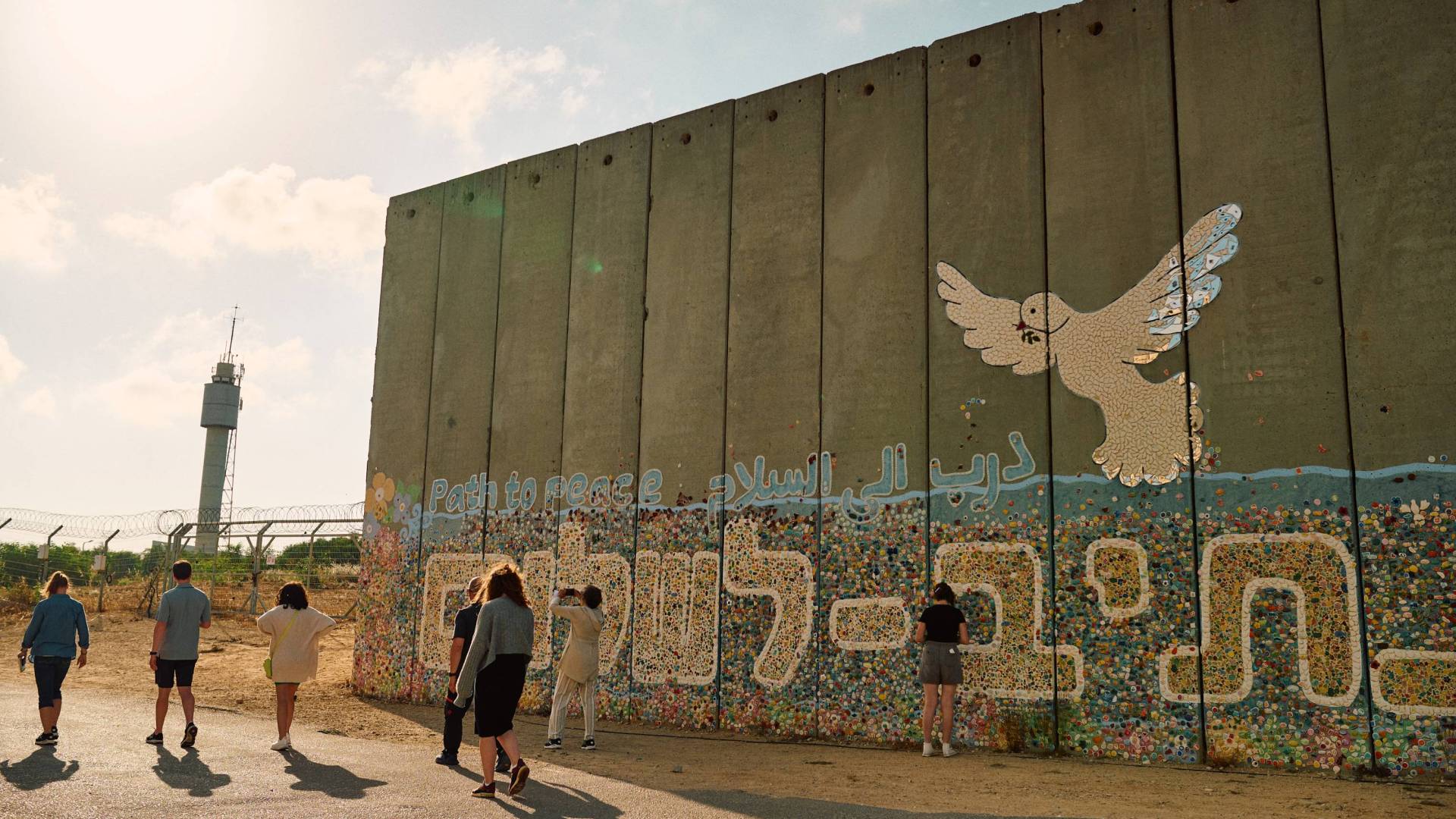
Passages and Philos Project are fundraising for Netiv HaAsara, an Israeli border community attacked by Hamas.

Passages and Philos Project are fundraising for Netiv HaAsara, an Israeli border community attacked by Hamas.

Christianity Today October 30, 2023
Courtesy of Philos Project

When war broke out in Israel, organizations and ministries working in the country put crisis plans into action. They called up trained workers and volunteers, retrieved supplies from stocked warehouses, and drove bulletproof vehicles to deliver aid to victims and gear to first responders.

And they looked to Christians in the US and around the globe to help fund their efforts.

The International Christian Embassy Jerusalem (ICEJ) has received millions in donations since the war broke out, more than any other two-week period in its history.

Christians United for Israel (CUFI), which calls itself the largest pro-Israel organization in the US, sent $1 million to fund first responders within days of the October 7 barrage and continues to fundraise.

And The Joshua Fund, founded by Christian author Joel Rosenberg, has collected over $685,000 in donations. The organization is operating 21 aid distribution centers, delivering pallets of toilet paper, bottled water, and other supplies.

“We’ve had literally thousands of new donors, and giving to our Rapid Response Fund has never been greater,” said executive director Carl Moeller. “So many of our donors just want to know how to pray—and to let people over there know that believers in the US are praying and giving to meet their needs.”

Around half of US evangelicals consider support for Israel and the Jewish people to be an important priority in their charitable behavior. For years, giving to nonprofits that work in the Holy Land has been on the rise. Some rank among the biggest Christian charities in the US.

“We were able to mobilize immediately because of the partnerships we have,” said Yael Eckstein, president and CEO of the International Fellowship of Christians and Jews.

Eckstein described how deliveries arrived as the terrorists were still attacking the villages along the Gaza border, and aid workers went to bomb shelter to bomb shelter delivering meals to survivors. While watching live news coverage, she said she even spotted one of the bulletproof vests they had handed out.

The organizations that have spent years working and building relationships in Israel have been positioned to respond quickly—but they also feel the pain of their proximity.

When Eckstein first texted her contacts to offer aid, one of the WhatsApp messages didn’t get a response. The recipient, the head of welfare in the Eshkol region, had been kidnapped by Hamas and taken to Gaza. One of the hardest things about rallying assistance this time is seeing the people who had been the leaders and helpers become the victims, she said.

ICEJ vice president David Parsons said that when Israel began naming casualties, he recognized the first one: Ofir Libstein, who led the regional council for the small communities—called kibbutzim—in the border area targeted by Hamas.

Two days before the attack, during its Feast of Tabernacles celebration, ICEJ had taken nearly 700 Christians from around the world to visit the area, where Libstein greeted them. Parsons said Libstein had asked if ICEJ would come back next year and then told them, “I promise to do everything I can to keep this beautiful area so you can visit us again.”

As Christian advocates for pluralism in the Middle East, Philos Project had also regularly visited the kibbutzim near Gaza, taking over 11,000–12,000 people there, including through its Passages Israel pilgrimage for college students.

“Over the years, we’ve gotten to know a lot of these people, so we wanted to raise money for those families, some of whom have lost loved ones, some of whom have loved ones in the hospital, some of whom have loved ones in Gaza,” said Robert Nicholson, the founder of the Philos Project.

Philos Project and Passages launched an online fundraiser for the couple hundred families who live in Netiv Haasara and Kfar Aza, both ransacked by Hamas. With a matching gift, they’ve raised around $325,000, and with donations from other foundations, they plan to give a total of $500,000 to be distributed by village leaders.

“It’s a great place to see what Israeli resilience looks like,” he said of Kfar Aza. “They’re obviously shattered right now, but I’m very confident that those people, when they can, will come back and somehow start over again.”

Evangelicals’ approach to Israel tends to be theological rather than political; those who believe Jews are God’s chosen people—51 percent of US evangelicals—are the most likely to make charitable support of Israel a priority, according to a 2021 survey from Grey Matter Research and Infinity Concepts. White and Latino evangelicals, charismatics, and regular Bible readers also showed higher levels of support.

Some Christian organizations continue to offer aid to Palestinians and others in the region, often through local partners, since borders to Gaza are blocked.

UK-based Christian Aid is funding a mobile health clinic, including a wound specialist and psychological care. The charity is raising funds to cover grants for hundreds of displaced families who fled to southern Gaza, where its partners are already providing mattresses, medicine, and meals.

Pastor Munir Kakish, president of the Council of Local Evangelical Churches in the Holy Land, told Baptist Standard that the war has affected ministry in the West Bank. Home of New Life, a ministry to vulnerable children, has seen the violence take a psychological toll on the kids it serves. And food distribution by RCO Ministries (formerly Ramallah Christian Outreach) has been disrupted by closed roads and travel difficulties. The ministry plans to resume its outreach in Gaza as soon as it can.

In addition to its work in Israel, Joshua Fund is helping Arab churches in parts of the West Bank and mobilizing to offer trauma counseling. World Vision is also operating in the West Bank and “other areas where displaced people need help,” providing safe spaces and psychological support for families.

The Southern Baptist Convention’s Send Relief has already funded more than $700,000 in aid to the region.

“With the fast-evolving nature of this crisis and the growing needs our partners are identifying daily among all peoples in the affected area, this response will require a high level of investment,” said Jason Cox, Send Relief’s vice president of international ministry.

The money these ministries raise covers the cost of basic needs after a disaster, things like food, housing, hygiene products, toys, clothes, and medical care for survivors and evacuees. Many Israelis who have left their homes are living in hotels, now emptied of tourists.

But the list of Israel’s needs right now also includes things like portable bomb shelters, bulletproof vests, armored vehicles, and tourniquets—grim reminders that this isn’t just another crisis, it’s a war zone. Aid efforts continue to focus on helping the displaced but also on bulking up security measures to prepare for possible escalation along the northern border with Lebanon.

The International Fellowship of Christians and Jews has distributed all 3,000 bulletproof vests it had and is awaiting an expedited order from overseas for 1,000 more. In the first couple weeks, the organization has placed dozens of portable bomb shelters (small buildings with reinforced walls and no doors—imagine a labyrinth entrance, like a public bathroom), but its supplier can only produce four a day. In addition to being placed in threatened areas in the north, the shelters are being set up in cemeteries so communities can bury their dead.

ICEJ had renovated 53 underground bomb shelters in Shlomi, a northern border town, and is working on fixing up another 20 that were hit by rockets back in April, Parsons said. The organization has also raised enough to purchase two ambulances and hopes to buy more with the backing of its US branch.
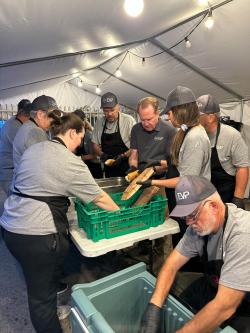
Volunteers with Texans on Mission prepare kosher meals from mobile kitchens.

Mobile kitchens are adjusting their location based on where they can serve hungry groups of evacuees or first responders on any given day as the threats shift.

Texans on Mission, which started partnering with Israel’s emergency volunteer program six years ago, feeds over 5,000 people a day from kitchens pulled on trailers. The volunteers have been trained in kosher food preparation and operate under the direction of a rabbi.

They’ve had to adapt their menu—falafel, kebabs, chopped salads—since produce is less available, but generally spend $10,000–$20,000 a day on food alone. It’s all covered by donations from individuals and churches back home.

“We felt like God was calling us to do this, step out on faith, put up the money first and just pray that God’s people would respond,” said John-Travis Smith, associate executive director of Texas Baptist Men, which organizes the co-ed Texans on Mission volunteers.

Smith arrived in Israel Thursday to check in on their ongoing work in places like Ashkelon, a coastal city near Gaza. He has scheduled 20-person teams to deploy for about two weeks at time through the end of 2024. They’ve had so much interest in serving in Israel that they’ve had to turn away volunteers.

The SBC’s Send Relief has offered aid through partnerships with local Christians. Baptist Village, a nonprofit working around Tel Aviv since the 1940s, is housing 400 displaced people.

At this point in the war, ministries are trying to begin to address the trauma people are experiencing while also continuing to meet basic needs. The Joshua Fund is offering support to Messianic pastors in Israel as well as bringing food and supplies to evacuees who have left Gaza and the north.

“The biggest challenges right now are to be a source of comfort and healing to the broken hearted, and to meet the physical needs of those that are suffering,” Moeller said.

Christians’ longstanding involvement in Israel and massive investment is significant: One investigation found evangelicals gave $65 million over a decade, not including volunteer work. It has drawn scrutiny among some Israelis, concerned about the evangelistic motivations or end-times beliefs bringing believers into the Jewish state.

But, as historian Daniel Hummel wrote for CT, “Christian Zionists have never been more organized and unified than in the last decade and a half,” and ministries in Israel rely on their support.

Parsons said the two weeks of giving to ICEJ’s Israel in Crisis Fund exceeded fundraising efforts for other crises, including the pandemic and the Ukraine war. And the fundraising has a global reach beyond American donors. He’s seeing gifts come in from Mongolia, Uzbekistan, and Nepal, as some ICEJ branches that have participated in prayer meetings or other activities are taking up a collection for the first time.

“We’re veterans of this country,” said Parsons, who has lived in Israel for over two decades. “We know how to stretch the dollar, the gift, to bring more benefit, and we always bring it to them with a testimony of Christian love and concern.”

The Fellowship is the largest Christian advocacy organization in the US, according to MinistryWatch rankings, with an annual revenue of $219.9 million. In addition to its own fundraising, it’s distributing $5 million in government aid to evacuees and displaced people.

“Jewish people having enemies is nothing new. We’ve gone through this from biblical times to today. What’s new is we now have millions of Christian friends who stand with us as watchmen at the wall, who do not slumber or sleep,” said Eckstein. “I don’t take that lightly.”

Theology

Remembering Abouna Samaan, Creator of Cairo’s Cave Church

US evangelical leaders and thousands of Copts honor an Orthodox priest whose mountain complex chiseled the glory of God into Egypt’s “Garbage City.”

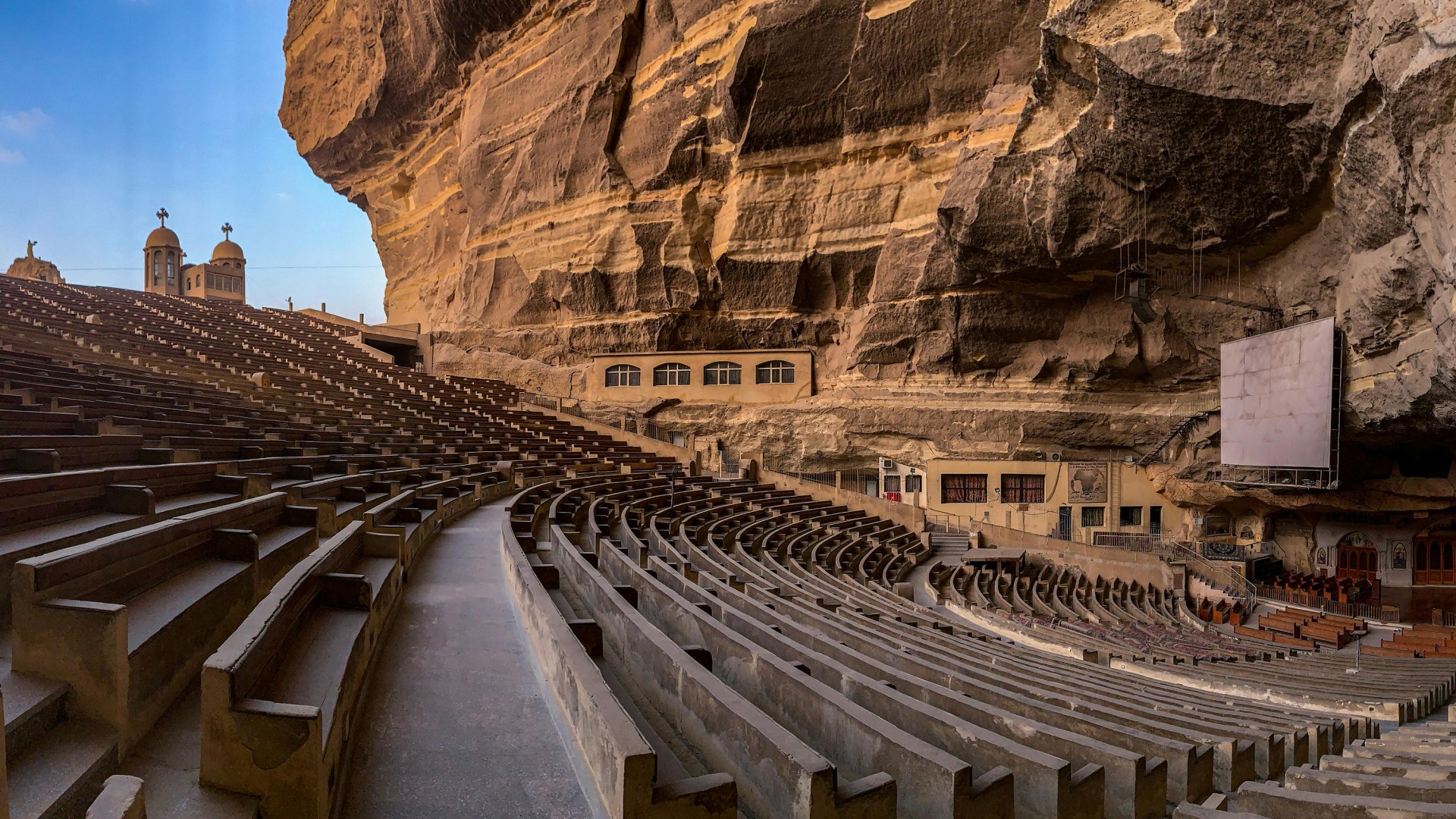
Cairo’s Cave Church

Cairo’s Cave Church

Christianity Today October 30, 2023
Kerollos Atef AL- Mansy / Pexels

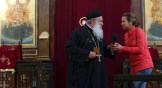
Over 40,000 people gathered at Cairo’s famed cave churches this month for perhaps the largest Christian funeral service in Coptic Orthodox history.

They honored Egypt’s beloved Abouna (“Father”) Samaan, founder of St. Simon the Tanner Monastery, who passed away October 11 at the age of 81.

His renown, however, stretched far beyond Egypt to include many luminaries in the Western evangelical world. And over the course of Abouna Samaan’s life, their endorsement helped popularize his “Garbage City” outreach, to the extent that Tripadvisor counts its Scripture-carved walls and chiseled biblical panoramas alongside museums, mosques, and the Nile River as one of the ten must-see sites in Cairo.

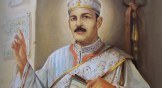
The black-robed and white-bearded priest was born in 1941 with the birth name of Farahat Ibrahim. An otherwise ordinary Egyptian Christian, he worked as a typesetter at the printing press of St. Mark’s Coptic Cathedral. Over time, he came to know the Lord in a personal way through the Society for the Salvation of Souls, a Coptic revivalist group that chooses to remain in the Orthodox church while reaching the unreached with the gospel.

Farahat became a diehard evangelist, urging an individual conversion to Christ.

In 1972, the newly married typesetter led Qidees, his neighborhood garbage collector, to the Lord. The young couple lived in Shubra, a Coptic-majority neighborhood of Cairo, and Qidees transported the area trash 13 miles east to a shantytown at the foothills of Egypt’s Mokattam Mountains. Three years earlier, a community of very poor Christians had migrated from Upper Egypt in search of a better life and eked out a living recycling useful waste and feeding pigs with the edible remains.

Muslims consider pigs unclean, so Garbage City consisted only of nominal Copts.

Like Qidees, most of these Christians had almost no knowledge of the Bible, with no church or pastoral care in their disease-infested slum. Many were alcoholics and drug addicts, and sometimes very violent. But after two years of discipleship, Qidees asked Farahat to visit and evangelize his family.

Farahat’s first reaction was fearful repugnance—but he went anyway.

By then 14,000 Copts populated the area, and after a few months, Qidees’ wife and seven children and many of their neighbors came to the Lord. Their weekly meeting soon outgrew its reed-roofed tin hut, and as numbers increased, Farahat convinced his well-off friends from the Society of the Salvation of Souls to build them a small church.

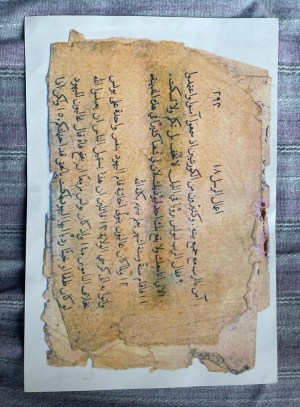
The people wanted him to become their priest. Reluctant, Farahat spent several nights in a small cave above the garbage village in prayer. As he was doing so, a scrap from an Arabic Bible blew by, torn from Acts 18. I am with you, and no one is going to harm you, he read, because I have many people in this city. He took this as God’s call to become their pastor.

Ordained in 1978, the young priest took Samaan—“Simon” in English—as his clerical name from a celebrated saint from Coptic lore who, as a simple tanner, worked a miracle in the same Mokattam mountains. But his early years were very difficult. Trudging through overflowing trash heaps with a pair of boots and a flashlight, one would-be disciple attacked him with a knife, another hid from the priest in a pigsty. There were no social programs in the area—only the flickering gleam of the Good News of Jesus.

The Arabic Bible passage that inspired Abouna SamaanCourtesy of Mariusz Dybich
The Arabic Bible passage that inspired Abouna Samaan

But as hundreds came to know the Lord, they also realized their dignity as children of the Creator of the universe. Over time, the whole village changed. Though still smelly, filthy, and garbage-infested, it became a unique island of Christian faith in Muslim-majority Cairo. By the early 1990s, it had grown to 70,000 inhabitants, as Christians from other areas favored a like-minded religious ethos over the discomfort they felt with their Muslim neighbors.

Shops opened, recycling factories were established, and the community mobilized to demand paved roads, water, electricity, and sewage treatment from the government. Today over 90 percent of the trash in Garbage City—now known as the recycling capital of Egypt—is reused, and NGOs market creatively designed garbage-turned-crafts.

The physical changes were dramatic. But the real change was in their hearts. Money no longer spent on alcohol or drugs was used to improve family life. Rather than living in one-story shacks shared with animals, residents built apartment blocks to live above the corralled livestock and collected garbage. And many centered their new life around the active and growing church.

My American wife Rebecca, born to missionaries to Haiti, first met Abouna Samaan in 1982. He told her of his difficulty evangelizing the illiterate and of his hope that the children could learn about and then read the Bible to their families.

From then on, she joined the fledgling church school project, and still volunteers twice a week at the now eight-story Center of Love for youth and special needs children. Early flannelgraph stories in the first school classroom were supplemented by the academic focus of her friend Laila Iskandar, who went on to serve as Egypt’s minister of environment and later as minister of urban development. Today both the church school and childrens’ center have mostly paid staff, who together have helped educate a generation of Bible-loving Egyptian Christians.

Western evangelical leaders lauded Abouna Samaan’s devotion to God and biblical knowledge.

“I was so impressed by [his] love of Scripture,” said Lindsay Olesberg, chair of Wycliffe USA. “I remember him telling our group that he was daily dependent on being fed by the Word.”

John Piper, chancellor of Bethlehem College and Seminary, noticed the same.

“I remember him sitting at the head of a long table, Bible open before him,” he said. “We sat sipping the juice he provided and feasted on his brief devotional.”

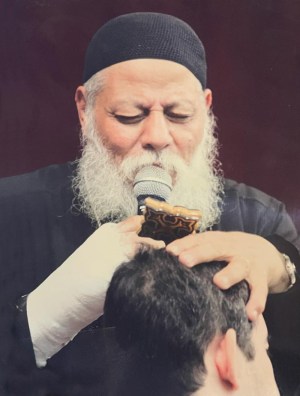
Abouna SamaanCourtesy of Mariusz Dybich
Abouna Samaan

Abouna Samaan held a regular Thursday evening service for the local community but imparted his biblical values through personal engagement and many teaching sessions throughout the week. Once, a then-atheist American visitor unknowingly dropped his Rolex watch, which was returned to him by a poor garbage-collecting child. Flabbergasted, he told the child its cost and how, if he had kept and sold it, it would have transformed his entire life.

The boy replied that it would have displeased his Lord and Savior, Jesus Christ.

In addition to Bible teaching and social work, once a week Abouna Samaan included a service of exorcism and healing. Christians (and some Muslims) came by the hundreds for prayer and deliverance, whether physical or spiritual.

“He had absolute confidence in the spiritual authority of every believer in Christ,” said Paul Williams, CEO of Bible Society UK, “over all the works of the enemy.”

Foreign awareness of the Garbage City ministry took off in 1990, when the first cave was converted into an auditorium seating 3,000 people. Rebecca and I marveled as rich and poor alike would navigate the pungent smells to reach the auditorium and worship together.

All of Egypt’s Christian denominations were welcome.

Ever expanding in service and rock-hewn beauty, the peaceful oasis now contains six cave churches and a 25,000-seat cathedral. Nearby is the special needs center and an 11-story state-of-the-art hospital. And 80 miles east, Abouna Samaan established a thousand-guest conference center in Wadi al-Natroun, on the desert road between Cairo and Alexandria.

Many evangelical leaders praised his ministry:

  • “He is someone we can truly call a hero of faith,” said his close friend Sameh Maurice, pastor of Kasr el-Dobara Evangelical Church in Cairo’s Tahrir Square. “He renounced his life by living among and serving the garbage collectors as one of them, to gain thousands and thousands for Christ.”
  • “What struck me most was that here was a man who cared for the least of these of whom Jesus spoke,” said Lindsay Brown, former director of the International Fellowship of Evangelical Students. “A man who had two loves: the Christ of the gospel, and all people—especially the people of the streets.”
  • “When I first visited the garbage village, the sights and smells and suffering overwhelmed me,” said Doug Birdsall, honorary chairman of the Lausanne Movement. “But when I met him, I was even more overwhelmed—this time with the love and compassion that I saw in his eyes, and with the aroma of Jesus … so much so that I did not want to leave.”

But all this came at a price, much more than the many financial, logistical, and legal challenges that he encountered in developing his extensive ministry. After becoming well-known and beloved by many, Abouna Samaan was opposed by some leaders in the Coptic hierarchy who accused him of “Protestant” tendencies. These accusations greatly discouraged him and his flock.

Humanly speaking, he only survived through his close friendship with Shenouda III, patriarch of the Coptic Orthodox Church. Their relationship began in the cathedral printing press, as Pope Shenouda was a prolific writer and publisher.

But after the Coptic patriarch passed away in 2012, a special diocese was created for the area, with a bishop appointed to oversee the monastery complex and several other local churches. Unfortunately, Abouna Samaan and the new bishop did not agree on many issues, impacting the latter years of his life.

Over these many years, Rebecca and I recognized Abouna Samaan’s ministry as a miracle of God, accomplished from very humble beginnings. We know of no other Christian endeavor—in Egypt or elsewhere—with which to compare it. A simple typesetter impacted the lives of hundreds of thousands of Coptic believers, ministered to Muslims, and brought many to the Lord.

And at the funeral, the Coptic Orthodox church honored his service. With tears in his eyes, Bishop Youannis, a leading member of the Holy Synod, delivered a remarkable eulogy in appreciation for Abouna Samaan’s ministry. Before the thousands looking on, the bishop recounted the life of his longtime friend, giving the praise and glory to God.

“If this historic gathering is your sendoff,” he stated, “I wonder what your welcome in heaven was like.”

Ramez Atallah was general secretary of the Bible Society of Egypt from 1990–2021 and currently serves as its senior advisor.

Theology

A Puritan’s Guide to Quieting Our ‘Inner Atheist’

Contributor

Even the most spiritual people can struggle with doubts about God. But how do they overcome them?

Christianity Today October 30, 2023
Illustration by Christianity Today / Source Images: WikiMedia Commons / Pexels

I recently had a conversation with a college sophomore who’s been struggling with his faith. He is a Christian who wants to believe, he said, but there are many days when he wakes up doubting that there’s enough proof to justify belief in God’s existence.

I sympathized with the young man’s struggle because I’ve experienced it myself. Like me, he seems to be an intellectually-driven person who longs for logical reasons to believe—not inexplicit feelings or even experiential evidence.

So I asked him, “On days when you wake up feeling like an atheist, what particular doubts do you find most troubling?”

He said he was particularly bothered by the discrepancies in the gospel accounts of Jesus’ resurrection—they seemed too great to be harmonized or explained away. And if they could not be trusted, he thought, what reason did he have to believe in God at all?

I was taken aback by his answer because he seemed to have come to a much more extreme conclusion than his doubt warranted. Discrepancies in the gospel accounts are certainly troubling—but even if there were some conflicting accounts that could not be harmonized, would atheism be the only logical recourse?

And yet that’s often how these kinds of doubts work. Whenever some premise upon which we’ve relied is cut out from under us, we begin to worry that we can’t depend on that foundation—which can ultimately lead us to the conclusion that there is no good reason to believe.

At first, we think we can combat our intellectual doubts by ignoring them (which rarely works) or by focusing intensely on the specific questions we think are at the root of our doubt. But when we don’t find the answers we’re seeking, our doubts only become more intense.

Perhaps it’s because we’re not asking ourselves the right questions. Even if a given skeptical argument were found to be true, would it really leave us with no foundation to believe? Most of the time, the answer to that question is no—because no atheist argument alone can lead someone to the conclusion that there’s no basis for believing in God.

Some Puritans in the 17th century realized this. While Puritans are often painted as holier-than-thou, some of the most thoughtful and spiritually minded Puritans wrestled with temptations to atheism, and in similar ways to many Christians today.

Puritans lived in a community where everyone was supposed to believe in God and the publication of blasphemous arguments was illegal. Yet they were exposed to religious pluralism and the skeptical ideas circulating in Europe—enough to wonder at times whether Christian faith claims could be wrong. Those who never witnessed a miracle or perceived God working in their own lives were especially prone to wrestling with whether it was rational to believe in God.

According to London Puritan minister Stephen Charnock, a “secret atheism” lay “in the heart of every man by nature,” because our sinful inclinations will always lead us to find reasons not to believe. And while the root of this temptation is a sinful wish to escape from God, it often manifests itself in an intellectual form—and thus requires a convincing intellectual answer.

Anne Bradstreet (1612–1672)—a published poet and lover of books who was also a devout Puritan, mother of eight children, and wife of a Boston merchant—struggled with skeptical questions that she couldn’t initially answer. Yet she ultimately found victory by questioning whether her doubts really made it probable that God did not exist.

Bradstreet’s doubts focused on areas that still trouble believers today. She wondered about the “verity of the Scriptures” and how she could know whether the Bible was really God’s true Word. She was also troubled by God’s apparent absence in her life. She had never witnessed a miracle and wondered if she could trust that the miraculous accounts in the Bible were not “feigned.”

And if she lacked proof that the Bible was true, how could she be certain of God’s existence?

Bradstreet was clearly troubled by these doubts because she confessed them only in a letter that she left for her children to read after her death. But this letter did not end in despair. Instead, it ended in the resolution of these doubts.

“That there is a God my Reason would soon tell me by the wondrous workes that I see, the vast frame of the Heaven and the Earth, the order of all things,” she wrote. “The consideration of these things would with amazement certainly resolve me that there is an Eternall Being.”

Bradstreet wrote these concluding lines for her adult children so that, when they were confronted with similar temptations, they would be equipped to gain spiritual victories over their own skeptical questions.

She said she overcame her doubts by first thinking about the intellectual foundation for believing in God. Regardless of her doubts about the Scriptures, she felt she could know that God existed by looking at the evidence of creation.

Today we have far more information about the universe than the New England Puritans had in the 17th century. Because of this scientific knowledge, we may view God’s process of creation differently than Bradstreet did. But this also means we have even more reasons than ever to be impressed with the “wondrous workes” of creation and the cosmic order.

The physical constants that shaped a universe that was capable of supporting life—and the immensely complex process that was necessary to develop and sustain life—cannot easily be accounted for in any sort of purely naturalistic framework. Which means we can remind ourselves in moments of our greatest doubt that creation itself infers the existence of a Creator.

That said, Bradstreet still had to address whether Christianity was true and whether she could trust its Scriptures. But as she compared the Bible to other religious texts of the ancient world, she realized that no other book in the world was quite like it—with its fulfilled prophecies, its miraculous preservation amid persecution, and its profound power to change lives.

If there were a creator God, which she felt the evidence of nature conclusively demonstrated, it made sense that this God would have revealed himself to humans in some way. And “if ever this God hath revealed himself, it must bee in his word, and this must be it or none.”

Through this process of logical reasoning, Bradstreet overcame her doubts. She may not have found a satisfactory answer to every skeptical question troubling her about miracles and God’s apparent absence, but she was able to arrive at convincing and sufficient reasons to believe despite those objections.

If she had allowed her lack of experience with miracles to drive her beliefs, she might have eventually decided, as some late 17th- and 18th-century deists did (including Thomas Jefferson, who famously removed all mentions of the miraculous from Scripture), that the biblical accounts of miracles were fallacious and could cause a person to give up Christianity altogether.

But she did not do that. Instead, she started with the essential evidence for a Creator, which she considered unassailable, and then continued to reason from that starting point.

Not every Christian today will find Bradstreet’s apologetic arguments convincing. Yet every believer who is plagued by intellectual doubts can still follow a similar method when seeking to rebuild their faith in the face of overwhelming skepticism. Like her, we can return to the core intellectual arguments of our faith and build upon them.

Even when we don’t have the answers to every skeptical question that troubles us, we can respond to the internal doubts of our “inner atheist.” And in the process, we may find that the cynical objections we’re wrestling with may not be so disturbing after all.

I think about that college sophomore struggling with doubts about the Resurrection accounts. It’s true that there are discrepancies between the narratives that, for many, cannot be satisfactorily explained, although some scholars have found ways to reconcile them.

But beyond that, the evidence that something happened to cause the early disciples of Jesus to believe that he rose from the dead is overwhelming. And so, one must account for that belief—regardless of what one thinks about some of the individual accounts themselves.

One must explain what prompted a group of monotheistic Jews to declare that a crucified man was their risen Lord and what prompted them to adopt a deeply countercultural declaration of bodily resurrection to explain what they were seeing. If Jesus was not raised from the dead, these facts are difficult to account for.

While returning to the facts we know can help us directly confront our doubts, overcoming our unbelief is ultimately not done through our own intellect but by the grace of God. As Bradstreet herself wrote, echoing the words of the apostle Paul, “I know whom I have trusted, and whom I have believed, and that he is able to keep that I have committed to his charge.”

No matter what, Bradstreet knew she could trust Christ to hold onto her even amid her doubts.

“That hath stayed my heart,” she wrote, “and I can now say, Return, O my Soul, to thy Rest, upon this Rock christ Jesus will I build my faith; and if I perish, I perish. But I know all the Powers of Hell shall never prevail against it.”

In the end, what we know is Jesus—and if we build our belief upon him, we’ll have the foundation we need to quiet our “inner atheist.”

Daniel K. Williams is a historian working at Ashland University and the author of The Politics of the Cross: A Christian Alternative to Partisanship. He is currently writing a history of American Christian apologetics.

News

New Report: IHOPKC Founder Mike Bickle Abused 17 Women, Including Teens

A third-party inquiry, though not endorsed by the Kansas City ministry, backs the allegations raised by former leaders back in 2023.

Mike Bickle

Mike Bickle

Christianity Today Updated February 4, 2025
Courtesy of IHOPKC

Key Updates

February 4, 2025

Seventeen women came forward in an independent investigation to say they were abused by Mike Bickle, the founder and longtime leader of the International House of Prayer Kansas City (IHOPKC).

Bickle would use prayer and prophecy to flatter women decades younger than him—including four who were abused as teenagers—and take advantage of their trust, according to a report released Monday, more than a year after the 24-7 prayer ministry cut ties with him. Firefly investigators also called out ministry leaders for repeatedly failing to address the allegations.

The report includes an account from a woman whom Bickle exposed himself to after showering when she was an 18-year-old intern, and another who spoke out last year about his sexual advances when she was a 14-year-old babysitter. Witnesses and survivors recounted repeated instances of kissing, grabbing women’s throats, rubbing legs, and ruffling hair.

The allegations span Bickle’s career, from previous churches starting in the mid-1970s to when he left IHOPKC in 2023. Top leaders at the ministry “were more focused on suppressing and minimizing reports of sexual abuse, misconduct, and rape rather than supporting the victims or staff who reported these incidents,” the report said.

Bickle did not participate in the investigation. He has previously admitted to some instances of misconduct but not allegations of “more intense sexual activities.”

Drawing from hundreds of interviews with witnesses and 6,000 documents, Firefly interviewed 32 survivors and identified 15 IHOPKC leaders who had been accused of sexual abuse. The investigators recommended the ministry develop new policies for addressing sexual abuse and offer support for those who have been harmed.

According to The Roys Report, the independent investigation was commissioned by Tikkun Global, a Messianic Jewish network, and is not endorsed by IHOPKC, which shut down its affiliated church last year but continues to run a prayer room in Kansas City.

October 29, 2023

Mike Bickle, the founder of the International House of Prayer of Kansas City (IHOPKC), is facing allegations of sexual and spiritual abuse spanning decades and involving multiple women.

Bickle, 68, has been accused of sexual misconduct “where the marriage covenant was not honored,” according to a statement released Saturday from a group of former IHOPKC leaders who investigated the claims.

They said, though they were initially shocked, they found the allegations credible based on the “collective and corroborating testimony” of “several victims.”

Bickle’s charismatic megachurch—which has offered round-the-clock prayer and worship since its founding in 1999—was informed of the allegations on Friday, according to The Kansas City Star, which obtained a recording of the announcement.

Stuart Greaves, executive director at IHOPKC, told staff that the leadership team is “taking the situation very seriously.”

The leaders who released the statement—former executive leadership team and board members Dwane Roberts and Brian Kim, along with former Forerunner Christian Fellowship pastor Wes Martin—said they first attempted to bring the allegations directly to Bickle, as the Bible instructs in Matthew 18. They said Bickle refused to meet with them and then tried to intimidate and discredit the victims.

The Kansas City Star reported that Bickle preached on false allegations last Sunday.

In the sermon, he discussed how, per Revelation 12:10, “Satan’s most effective weapon in the end times is accusation” and he turns “whispered innuendoes into hostile accusations that destroy lives and relationships,” according to sermon notes linked by The Roys Report.

Bickle also said that “the church is approaching the most glorious and challenging hour in history with the dragon (black horse) breathing on many to accuse and betray each other.”

Greaves referenced the line from his sermon during the announcement to staff, saying, “We ask that we not make reference to the ‘black horse’ in this situation, as a way of minimizing the pain of those affected. Our primary concern is for those who are suffering pain and trauma, our spiritual family, Mike and Diane, as well as the Bickle family.”
Bickle agreed to pause from preaching and teaching while the church engages “outside parties to assess and arbitrate the allegation,” IHOPKC leaders announced during Sunday’s service and on social media.

The leaders who investigated the allegations against Bickle said they believe his actions “fall short of biblical standards for leaders in the church” and include Bickle’s use of spiritual authority to manipulate victims. Their statement said the women who came forward “had nothing to gain by sharing their experience except the pursuit of truth, repentance, mercy, and grace.”
They said Bickle, who has not responded publicly to the recent reports, denied all allegations.

Bickle began his ministry as a pastor in Kansas City in the 1980s and 1990s; his church left the Vineyard denomination in the mid-90s as Bickle grew more charismatic and began to hold different views on prophesy and intercession. At the time, Bickle had been affiliated with local “prophets” including Paul Cain and Bob Jones. (Both ended up in scandal: Jones—no relation to the university—went on to admit to sexual misconduct and spiritual abuse, and Cain was disciplined over homosexual behavior and alcoholism.)

At IHOPKC, Bickle emphasizes fasting, prophesy, the spiritual realm, and the end times. Some consider his ministry a part of the independent charismatics, though he has rejected the “New Apostolic Reformation” label. He appeared on Charisma’s Strang Report earlier this month to share a prophetic word regarding the war in Israel, and earlier this year held a fast for the “salvation of Israel,” which Bickle says will bring about the Second Coming.

Staff at IHOPKC number around 2,000, all full-time missionaries who raise their own support, according to the ministry website. During the announcement from IHOPKC leadership, some called for more transparency, saying “there is more to be shared,” The Kansas City Star reported.

Roberts, one of the authors of the statement, now serves as a leader at the Florianópolis House of Prayer in Brazil. His church announced that it is distancing itself from Bickle for the time being.

“Our cry and prayer is that we will be strong and not allow these events to shake our faith, or discourage our hearts, in the journey of raising up a church that prays and waits for the return of the Bridegroom,” the church wrote [in Portuguese]. “We are committed to complete transparency and the Truth and will share more information as the facts are clarified.”

Some former IHOPKC members have said the church was coercive and cult-like; the church has stated that it’s elder-led, has checks in place for leaders, and is committed to safety against sexual, emotional, physical, and spiritual abuse.

More than a decade ago, the International House of Prayer came under scrutiny after alleged sexual assault and a death occured among a group of students who had formed their own “religious community.” It was also sued by IHOP for trademark infringement.

News

Argentina Takes Next Step in Officially Honoring Evangelicals. They Want More.

Protestants are grateful for Reformation Day celebrations—and wonder if they’ll ever get religious equality.

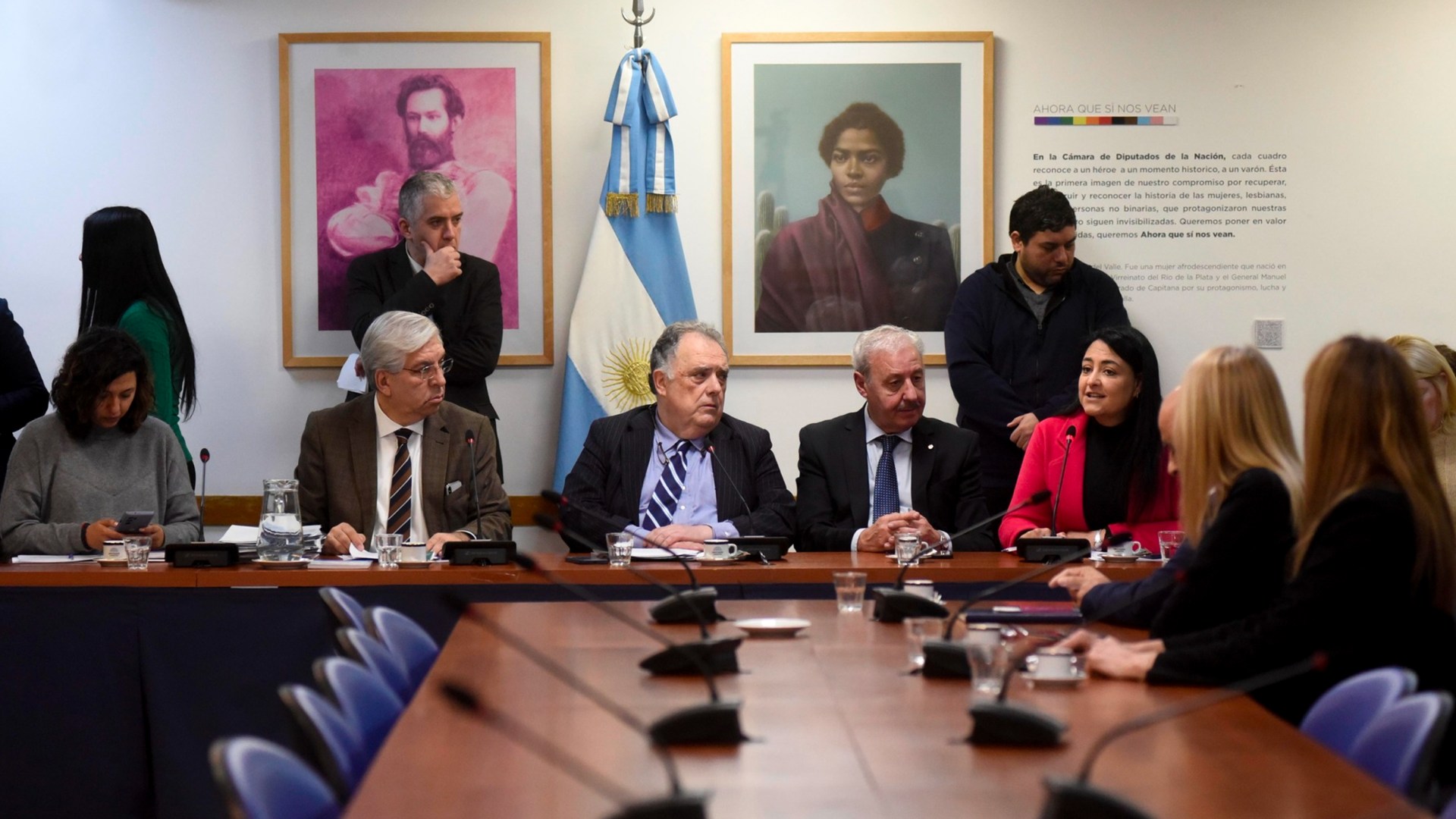
Eduardo Valdez (center), president of the ministry of foreign affairs and worship, and Guillermo Oliveri (right), ambassador of the Secretariat for Worship, at a meeting where a drafted bill proposing a national day for Protestants and evangelicals was approved.

Eduardo Valdez (center), president of the ministry of foreign affairs and worship, and Guillermo Oliveri (right), ambassador of the Secretariat for Worship, at a meeting where a drafted bill proposing a national day for Protestants and evangelicals was approved.

Christianity Today October 27, 2023
Courtesy of ACIERA / Edits by CT

This Reformation Day, 18 of Argentina’s 24 provinces will celebrate evangelical and Protestant churches.

Evangelical leaders hope that someday soon, the whole country will join in.

Last month the federal government moved closer to nationally recognizing October 31 in honor of these communities when the Chamber of Deputies approved a bill that has since headed to the Senate.

“For many evangelicals, appearing on the country’s public legislative agenda is very important. It responds to an aspiration for visibility in the community,” said Viviana Barrón, rector of Baptist school Seminario Internacional Teológico Bautista. “Years ago, many said that our churches were practically invisible to governments. That has been changing and is received with joy by many.”

“In our country, evangelical Christians are second-class citizens,” said Joel Issachar Stefanini, president and founder of the Federación Iglesias Pentecostales de Argentina.

“We have been fighting for more than 40 years, since democracy arrived again in our country, to be recognized as a Christian church and to have equal rights.”

Many evangelical leaders have been frustrated as to what they interpret as a 150-year-long state snub toward their community.

According to CONICET, Argentina’s national scientific research council, the evangelical community grew from 9 percent to 15.3 percent of the population between 2008 and 2019. The same report put the Catholic community at 62.9 percent. (Argentina has 46 million people.)

Argentina’s Supreme Court has ruled that the country has no official or state religion. But although its constitution guarantees freedom of religion, it also states that “the Federal Government supports the Roman Catholic Apostolic Faith.”

While this relationship has been renegotiated over time through various laws and court cases, its most lasting manifestation has been a national worship registry implemented in 1979 during one of the final years of the country’s dictatorship. Under this law, the Catholic church does not have to register with the government. Meanwhile, all non-Catholic religious groups must register in order to enjoy privileges such as not paying municipal taxes.

“The progress of the bill is good, but that only confirms that we have a very uneven dynamic with respect to the Catholic church, which is the one that holds religious political power and official support from the Argentine State,” said Ana Valoy, a pastor and political analyst from the northern city of Tucumán.

Argentina is known for its cultural and religious diversity, wrote Renata Viglione, a Christian psychologist who co-authored the current bill, in 2021.

“Therefore, it is inexplicable that several centuries after the arrival of the first Protestants in Argentine territory, [and given the] public recognition of the contributions made by the Argentine evangelical community as a whole, and the right to religious equality guaranteed by the national Constitution, we are still waiting for the first national evangelical commemorative day,” she wrote.

In 2017, Entre Ríos became the first province to institute an annual day of commemorating the Protestant Reformation—on the 500th anniversary of Martin Luther’s 95 Theses—thanks to the efforts of local Christian leaders.

“For the first time, we are officially recognized as a religion,” Carlos Duarte, a pastor in the Iglesia Evangélica del Río de la Plata (Evangelical Church of the River Plate) denomination, said at the time.

The current legislation began at the initiative of citizens like Viglione, who reached out to lawmakers all the way back in 2014. While numerous provinces and municipalities have since adopted their own proclamations and laws recognizing evangelicals, it took years for Viglione and her colleagues to educate the Argentine church about the proposed bill and for the different political parties to agree on what language they would support for the initiative.

“I am optimistic that the Senate will discuss the project in the next session and approve it,” said Dina Rezinovsky, one of three evangelicals in the 257-seat Chamber of Deputies, who co-sponsored the bill along with three of her Catholic colleagues.

For Argentine evangelicals, political recognition validates the nation-building work they have committed to for decades.

“Since the beginning of our nation, evangelicals have collaborated in the progress of the country through teaching principles and values that emanate from the Bible and through founding schools, nursing homes, orphanages, rehabilitation centers for drug addicts, and helping the most neglected sectors of society,” said Ciro Pablo Crimi, who leads Seminario Bíblico de Fe.

Among other things, Argentine taxes help support the salaries of bishops and priests, says Crimi, and evangelicals’ frustration with this arrangement has at various times led them to organize more formally in opposition.

In September 1999 at the obelisk in Buenos Aires, 250,000 evangelicals gathered under the motto Jesucristo por todos y para todos (“Jesus Christ for all and to all”). They requested a religious freedom law that would ensure equal treatment of faiths, notes Crimi. Two years later, 400,000 evangelicals gathered again in September under the motto “For my country, I want religious equality.”

“God’s justice demands equality without discrimination or exclusions,” he said.

While this type of recognition is validating to a community with a history as long as that of evangelicals, Jesus’ teaching cautions his followers about the danger of public recognition. Seeking the approval of others can disqualify people as ministers of Christ, and believers should seek to please God, not others, says Ruben del Ré, who is the head of the Sociedad Bíblica Argentina.

“Our purpose must be aligned with what our Lord clearly taught in the Sermon on the Mount: that men, seeing our good works, glorify God,” he said. “So it is not about public recognition of our work, nor about achieving greater social prestige. The church of Christ will never need that.”

Further, establishing a day celebrating Protestants and evangelicals is easier than changing the religious freedom law. Congress tried multiple times to do so from 2001 to 2019, noted Rezinovsky.

“Legislators do not want to deal with the reform of the religious freedom law that dates back to the 1970s. This type of decision can be seen as a way to calm the underlying discussions that have not taken place,” said Barrón. “We continue to wait for a country where belonging to a religious group does not give privileges to anyone. But there is a long way to go for that.”

Viglione sees the growth of October 31 celebrations and the current legislative success of her bill as a step forward in redressing the government’s imbalanced relationship with non-Catholic faiths.

In Argentina, “we freely profess our faith, we can freely speak on faith, we can organize gatherings. … In that sense, there is absolute freedom,” she said. “But we needed equality, and I think that’s what they finally realized.”

News

Palestinian Evangelicals Call Western Church to Repentance, Criticized in Return

Middle East Christians assert their rejection of violence as they relate frustration with lack of Western recognition of the reality of occupation and the collateral damage of bombing campaigns.

Search and rescue efforts in the historical Greek Orthodox Saint Porphyrius Church after an Israeli airstrike in Gaza.

Search and rescue efforts in the historical Greek Orthodox Saint Porphyrius Church after an Israeli airstrike in Gaza.

Christianity Today October 27, 2023
Ali Jadallah / Anadolu / Getty Images

Since the outbreak of war after unprecedented terror attacks on Israel by Hamas, Middle Eastern churches, councils, and leaders have expressed their outrage over the killing of thousands of innocent civilians.

Many Arab Christian groups have issued public statements. Most emphasized the Christian call to be peacemakers. Several have been criticized for what some see as calls not specifically addressing the suffering of civilian Jews targeted for death by terrorists.

Originating from Palestine, Egypt, Jordan, and Lebanon—with most prompted by the tragic bombing of the Anglican hospital in Gaza—the public statements range in focus and intensity. Some assert the international community overlooks the context of occupation by the Israeli state; others remind the global church of the continued Christian presence in the land.

CT studied texts from nine Arab and four Western organizations, most of evangelical conviction, and queried the perspective of an Israeli Messianic Jew and a Lebanese Armenian evangelical. The review found that few Middle Eastern statements have named Hamas as the perpetrator of terrorism, while many specifically criticize Israel itself.

One of the most recent statements is from Musalaha, which names both.

The Jerusalem-based reconciliation ministry works with Israelis and Palestinians from diverse religious backgrounds using biblical principles to engage the issues that divide them in pursuit of peace. After two weeks painfully watching the widespread carnage, its public statement centered on “lament” and called for a reconciling response.

“We lament people who, in the name of justice, have allowed rage to perpetuate the cycle of dehumanization and excuse bloodshed; as seen with Hamas’ attacks and the Israeli army’s response,” stated Musalaha. “We invite both Palestinians and Israelis to see the dignity and humanity of the other by non-violently co-resisting together for a better future.”

The region’s most representative Christian body, however, was bluntly specific about the suffering it asserts the Jewish nation-state is imposing on Gaza.

“What the Palestinian people are exposed to in Gaza is not a military reaction to a military action,” stated the Middle East Council of Churches (MECC), “but rather a genocide and ethnic cleansing, targeting the detainees of the largest prison in human history—and with premeditation.”

Its statement, the starkest of the nine Arab ones surveyed, called the war a “war of extermination,” and called for “all honorable people” to intervene.

Michel Abs, secretary general of the MECC, told CT he recognized that what he calls “the Zionist entity” was attacked and responded—and that it should have stopped there.

The MECC focused on denouncing Israel for cutting off water in the densely populated coastal strip, the destruction of medical infrastructure, and the collateral deaths of defenseless citizens. It called to stop the aggression, to lift the siege of Gaza, and to hold what Abs called “the occupying forces” accountable.

Member churches in the MECC include Catholic, Orthodox, and many Protestant denominations—most of which are called “Evangelical,” per local usage. Yet while “mainline” differences known in the American Christian landscape are not as distinct in the Arab world, the World Evangelical Alliance (WEA) incorporates bodies not represented in the MECC.

“We are generally in agreement [with the MECC statement], without necessarily adhering to each word,” said Paul Haidostian, acting president of the Union of Armenian Evangelical Churches in the Near East, a reformed church of pietistic expression and not a WEA affiliate. “But are there elements of extermination in the current war? I would think yes.”

Jack Sara, general secretary of the regional Middle East and North Africa evangelical alliance, helped craft the official WEA response to the “Holy Land conflict.” But he agreed with the MECC statement as well.

“With thousands of Palestinians dying nonstop, it clearly describes the facts on the ground,” he said. “If anything, it falls short in beseeching the world to intervene.”

Analysts have noted that Hamas embeds itself in civilian areas, and that the Israel Defense Forces (IDF) often issues warnings before striking residential structures. In preparation of an anticipated ground invasion, the IDF called on noncombatants to evacuate northern Gaza; Hamas told them to remain in place.

The United Nations, however, has stated that Gaza already represents a humanitarian catastrophe with more than 6,500 killed and a million displaced as of October 26, according to the Hamas-run Palestinian Health Ministry. Responding to Hamas terrorism and the deaths of 1,400 citizens, mostly civilians, Israel’s dilemma is stark, as the urban warfare necessary to pursue terrorist leaders in Gaza will further deteriorate local conditions and increasingly inflame much global opinion.

But watching many in the United States and wider evangelical world rally behind Israel, Sara’s Bethlehem Bible College (BBC) cosigned a Palestinian Christian statement of significant rebuke, calling “Western church leaders and theologians” to repent.

It opened by quoting the prophet Isaiah: Learn to do right; seek justice; defend the oppressed (1:17).

“Western attitudes towards Palestine–Israel suffer from a glaring double standard that humanizes Israeli Jews while insisting on dehumanizing Palestinians and whitewashing their suffering,” it stated. “With a broken heart, we hold [such leaders] accountable for their theological and political complicity.”

While grieving the “renewed cycle of violence” and condemning “all attacks on civilians,” it chided the failure of Christian leaders to mention the “wider context and root causes” of the war—including ongoing occupation and 17 years of the Gaza blockade. And three-quarters of the local population, it reminded, is descended from Palestinians displaced in the conflict that followed the 1948 establishment of Israel, which denies their proclaimed right of return.

Sara complained that in the months prior to the war, extremist Jews and Israeli settlers increased attacks on local churches, spitting at priests while international Christians said little. Believers, he said, often feel that they are a “nuisance” to Western proponents of End Times theology, or else of their government’s narrative on the region.

“We are praying that the church would be the church, and not a political body that takes sides,” said Sara in a YouTube message. “It is no longer the ethnic background that matters to God—Jesus is no longer only a Jew, he is everything to everyone.”

One Messianic Jewish leader called the joint statement “reprehensible.”

Not only did the Palestinian Christians fail to denounce or mention Hamas or terrorism, stated Michael Brown, host of the nationally syndicated Line of Fire radio program, their statement repeated “libelous claims” that Israel intentionally bombed al-Ahli Arab hospital on October 17 as well as St. Porphyrius Greek Orthodox church on October 19. (The IDF determined the hospital deaths were caused by a misfired rocket from Islamic Jihad militants, while acknowledging the church deaths were caused by one of its missiles targeted at a nearby building.)

Furthermore, Brown critiqued the statement for engaging in “standard leftwing tropes” that equate settler colonialism with the return of Jews to their ancient homeland.

“We want to show solidarity as brothers and sisters in Jesus,” said Brown, who has participated in BBC’s Christ at the Checkpoint conferences. “[But] repent of this deeply flawed call to repentance so that together, we can pursue righteousness, goodness, equity, and mercy.”

The president of the Evangelical Alliance of Israel compared signatories to a battered wife.

“Most Middle Eastern Christians are not at liberty to speak out and condemn Islamist violence,” said Danny Kopp. “The social, and often physical, cost is just too high to contemplate.”

Instead, they stay silent, deflect, or blame others. Traumatic abuse distorts the capacity for sound moral judgment, he said. But having witnessed the “worst mass murder of Jews in a single day since the Holocaust,” Arab believers are at a critical inflection point.

“At just the moment when Christians could have offered a rare ray of light of truth,” Kopp said, “the church has largely relegated itself to a state of moral decay and irrelevance.”

Egyptian evangelicals—however evaluated—spoke out from the beginning.

The Presidency of the Protestant Churches of Egypt (PCE), a member of both the MECC and WEA, was one of the first regional bodies to issue a statement. Only one day after the Hamas massacre on October 7, it issued a nonspecific condemnation of “all forms of violence and armed conflict between Palestinians and Israelis,” noting the attacks on innocent civilians.

A second statement, the PCE said, backed Egyptian government policy to supply humanitarian aid. But three statements next followed in quick succession, shifting the focus to Israeli abuses. The PCE condemned the bombing of the Gaza hospital, then rejected handling the Palestinian case with military tools. And following the attack that partially destroyed the Gaza church, it expressed “deep concern about the violence directed at residential areas, since the very beginning of the outbreak of events.”

Egypt was the first Arab nation to make a peace treaty with Israel. Israel’s criticism elsewhere may have led to a shift in certain statements.

What incensed many Arab Christians was that the hospital bombing took place on a day that the Patriarchs and Heads of the Churches in Jerusalem (PHCJ) called to devote for fasting and prayer. And two days prior, in response to Israel’s call to evacuate the north of Gaza, the PHCJ reflected an awareness of Jewish anger as it warned against a “new cycle of violence” that began “with an unjustifiable attack against civilians in Israel.”

The Jerusalem Christian leaders still did not denounce or mention Hamas, but this statement varied the language from their first reaction the day of the terrorist atrocities. With Israel still reeling from the deadliest day for Jews since the Holocaust, the PHCJ had advocated against any harm to “both Palestinian and Israeli civilians.”

Israel’s envoy to the Vatican was outraged by the “immoral linguistic ambiguity.”

Do Jordan’s evangelicals merit the same reply?

On October 14, the Jordanian Evangelical Alliance (JEC), a member of the WEA but not the MECC, issued a statement to endorse the PHCJ invitation to prayer. But reflecting the will of its five-church constituency, the JEC general assembly voted to avoid specific mention of either Israel or Hamas.

A strong minority wanted to name Israel.

Hamas, said Nabeeh Abbassi, president of the Jordanian Baptist Convention, a JEC member denomination, is viewed as a “liberator” by many Palestinians in Jordan, who make up a significant but contested percentage of the kingdom’s population. Wishing not to be viewed as against this sentiment, the evangelical alliance chose to “not go into politics” and instead focus on a common humanity.

The JEC statement condemned the current “cycle of violence and counterviolence,” though it specified “aggression against the Palestinian people.” Nonetheless, the Sermon of the Mount calls believers be peacemakers, with dialogue and negotiation the necessary means to end an ongoing but unnamed Israeli policy of settlement expansion.

“Violence begets violence,” the JEC stated, “occupation creates resistance, and siege results in explosion.”

This sentence is explanation, Abbassi explained, not justification.

“The one who started the trouble is Hamas,” he continued. “Israel has the right to defend itself. But then did much worse.”

Abbassi believes too many Western Christians support Israel from a faulty application of theology. A dispensationalist himself, the Jordanian pastor said that it is not the job of believers to hurry along God’s eschatological timetable.

He referenced Acts 1:6–8, in which the disciples asked the resurrected Jesus if he would then restore the kingdom to Israel. Abbassi pointed to Jesus’ refusal to answer the question, instead calling the believers to be his witnesses.

“If we want to help God, this is what we should do,” Abbassi said. “Not to take sides, but to love both, and share the gospel with all.”

But following what he said was a “brutal raid” on the Anglican hospital, Abbassi said his convention felt compelled to issue a statement of its own, and was later grieved by the strike at the Greek Orthodox church. It blamed an Israeli “war machine” policy that targets Muslims and Christians alike, without differentiating between civilians and military personnel.

“Hamas is a group, Israel is a state,” Abbassi said. “Hamas is expected to do anything, but I expect Israel to do the right thing.”

The Jordanian denominational statement, he said, came from a rare moment of local appreciation. Nearly all Jordanian media called the Gaza hospital “Baptist,” reflecting the popular sentiment established during its administrative identity in the 1967 war.

It was a moment to “show our heart” to the average Jordanian—Abbassi gave three TV interviews after the wake—as well as local Christian agreement with a government policy that defends Palestinian rights while maintaining peace with Israel, with King Abdullah’s Hashemite kingdom as the historic custodian of Muslim and Christian religious sites in Jerusalem.

Lebanese evangelicals had varying objectives.

“Some wanted a statement to show the government, some to show the Muslims,” said Joseph Kassab, president of the Supreme Council of the Evangelical Community in Syria and Lebanon. “But I wanted it simply to reflect our faith and theology.”

Encouraged by several local leaders to speak out after the hospital explosion, the Lebanese document referenced the “eye for eye” ethic repudiated by Jesus but present, Kassab said, among Jews and Muslims. According to such logic, the statement argued, Hamas’s terrorism might merit equal response, but not double. However Israel, he said, has upped it ten times in scale.

While deterrence through disproportionate response is part of basic Israeli military strategy, Kassab believes Christians should have a different metric.

“You cannot work for peace and reconciliation,” he said, “and give your unconditional support to anyone.”

Instead, in seeking to focus on the need for a just solution for the overall Israeli–Palestinian conflict, the Lebanese statement did not name either Israel or Hamas as adversaries.

What if Iran enters the war, Kassab said, or the United States?

Speculating the “sad and unfortunate” actions of Hamas were meant to disrupt the recent pattern of Arab normalization efforts with Israel—known as the Abraham Accords—Kassab stated clearly that neither Palestine nor the region has a future if Islamist ideology succeeds to rule.

Israel, however, has multiplied atrocities, he said. Kassab mentioned the thousands of Gazan apartment buildings destroyed, and the call for refugees—later revised—to “get out” and flee through the strip’s southern border to Egypt. Previous displacements of Palestinians in 1948 and 1967 have become permanent.

Even so, he said the MECC statement is not fully warranted.

“It might not be the intention of Israel to exterminate, but if they continue to act this way it will lead to that end,” said Kassab. “If you don’t like the word, substitute another—but this will not change the scale of violence.”

Munir Kakish, president of the Council of Local Evangelical Churches in the Holy Land (CLEC), a WEA affiliate, distanced himself from the MECC statement altogether.

“When we are invited to their meetings,” he said, “then I can put in an opinion.”

Emphasizing the calling to be a bridge of peace and reconciliation, his October 18 statement was non-specific in all directions. While focused on Gaza alone, it mentioned neither Hamas nor Israel and called for immediate humanitarian aid and a comprehensive peace treaty.

“What happened to hospitals and schools in Gaza is unacceptable by all international laws and customs,” stated the council, which then echoed 1 Timothy 2:2. “We appeal to all parties for an immediate cessation of the war … so that we may live a peaceful life in all piety and dignity.”

But also to preach the gospel. Kakish saw current events as part of the “wars and rumors of wars” that Jesus predicted before the end times. Evil is increasing, he said, as in the times of Noah—and the ark door will soon be shut.

“It is time for the church to wake up and fulfill the great commission,” he said, “instead of being distracted by other things.”

But Arab Christians are not the only ones to make statements.

Unlike their counterparts in the Middle East, the Southern Baptist Convention’s Ethics and Religious Liberty Commission (ERLC), the National Association of Evangelicals (NAE) in the US, and the WEA promptly condemned Hamas by name.

The ERLC issued the strongest pro-Israel pronouncement.

Recognizing varying theological positions on the relation between Israel and the church, the Southern Baptist–led statement recognized how the Jewish people have “long endured genocidal attempts to eradicate them and to destroy [their] state.” Citing Israel as a “rare example of democracy” in the region, the ERLC referenced Romans 13 in support for the Israeli government to “bear the sword” against acts of evil toward innocent life.

Furthermore, the ERLC statement recognized the “dignity and personhood of all persons living in the Middle East, and prayed for the “difficult ministry of Jewish and Palestinian believers who labor for the gospel.”

[Editor’s note: CT editor-in-chief Russell Moore, a former ERLC president, signed the statement alongside 2,000 other leaders.]

Counterparts in the Baptist World Alliance (BWA) focused on Palestine, noting the al-Ahli hospital’s Southern Baptist heritage as it “plead[s] for the protection of all citizens and the establishment of genuine peace.”

Counting 17 Baptist churches in Israel and 13 in the Palestinian Territories—including one in Gaza—the BWA called for “paths of peacemaking that unequivocally reject terrorism.” And “in the midst of complexity” it urged the “pursuit of restorative justice and peace.”

General secretary Elijah Brown offered the BWA prayer guide as an example.

“Believing that as ambassadors of peace we are not to emphasize approaches of political antagonism,” he told CT, “we must work to model a shared voice of common engagement.”

The NAE also recognized Israel’s right to defend itself. But it also warned Israel about undermining its own security by going beyond this to “take revenge” and inflict further suffering on innocent civilians. The WEA expressed “bewilderment” at demonstrations that appeared to rejoice over the initial killings, while encouraging all efforts to deescalate violence.

Both called for a just peace—a phrase not used by the ERLC—but neither have issued an evaluative statement since then. Given the NAE’s reiteration of the evangelical role to “constructively critique government leaders,” is it required now?

“The doctrine of just war, by its very nature, has a framework with limits on how war may be waged, including a prohibition on targeting innocent civilians,” ERLC president Brent Leatherwood told CT. “Our concern for the vulnerable has no borders, but we must remain clear-eyed about who is at fault in this conflict.”

NAE president Walter Kim also cited Christian tradition.

“Most evangelicals look to classic just-war principles in pursuing justice while restraining violence. Israel has the right to defend itself against Hamas, which continues its attack,” he said. “Other just war principles include just intent, limited retribution, long-term peacemaking, and protection of innocents.”

He left evaluation for the reader to decide.

Thomas Schirrmacher, general secretary of the WEA, already has.

“Israel is still in the parameter of self-defense,” he said. “As those attacking clearly state, they want to kill all Jews and wipe Israel off the map.”

Raising strong doubts about Israel’s culpability for the hospital bombing, Schirrmacher blamed Palestinian leaders—in the West Bank, governed by the Palestinian Authority, as well as in Hamas-controlled Gaza—for failing to build a functioning state. With Hamas committed to terrorism, in Gaza the two are mutually exclusive.

He emphasized, however, that all comments are offered in his personal capacity. The WEA represents national alliances and partnerships in 173 countries, including the ones led by Kakish, Kopp, and a second affiliate focused on Arab citizens of Israel.

The regional Middle East and North Africa alliance is at odds with the WEA’s regional European alliance over the specifics of an antisemitism definition, he said, while an alliance in Azerbaijan is pinched by WEA condemnation of the Caucasus nation’s human rights abuses against Armenians in a contested enclave.

He also tries to balance between fellow believers in Ukraine and Russia.

Balanced also is the aid provided. The WEA is working through its alliance in Israel to provide shelters in Ashdod and Ashkelon near the Gaza border. Partnering with the affiliated Synod of the Nile in Egypt, relief will be given at the crossing in Rafah. And with its Palestinian alliance, cash support is being provided to rebuild the Anglican hospital in Gaza.

“Before we speak, we engage all sides,” Schirrmacher said.

Theology

Meet the Christian Love Expert Giving Filipinos Hope About Dating

Pastor Ronald Molmisa set out to write “Lovestruck” for high school students with love woes. Now it’s a nine-book series and a parachurch ministry.

Christianity Today October 27, 2023
Cristina Ponciano / Unsplash

While ministering to high school students in Metro Manila in 2005, Ronald Molmisa found himself in recurring conversations with students about love and dating. Some students were serial daters who dated girlfriend after girlfriend. Others struggled to deal with their heartache after a break-up.

With sex and dating being taboo topics in the majority Catholic country, young Filipinos often turn to the internet or Western media to learn about love rather than the church. So Molmisa sought Christian resources to help his students.

At the time, Christian books about love from the United States—like Joshua Harris’s I Kissed Dating Goodbye—were popular, but Molmisa wanted a book that could speak to the lived experiences of Filipino students. While some Filipino authors had penned books on dating and love, he found them outdated and written in English, which many in the younger generation struggled to read. In everyday life, teens spoke, texted, and read articles in Taglish, a combination of Tagalog and English.

So Molmisa decided to write a book on relationships that would be both Bible-based and relevant to young people in the Philippines. With a background in research, he began conducting surveys and interviews to map out trends among Filipino teens. In 2010, he published Lovestruck: Love Mo Siya, Sure Ka Ba? (Lovestruck: Are You Sure You Love Her?), which mixes comical anecdotes on love and relationships with biblical stories and pastoral wisdom.

The short 80-page book, which was written in Taglish, quickly became wildly popular among young people in the Philippines. Lovestruck went on to become a nine-book series, including titles like Lovestruck: Sexy Edition, on sexuality and pornography; Lovestruck: Sakit Edition, on breakups and heartache; and Lovestruck: Shanaba? Edition on choosing a spouse. Molmisa also started the Lovestruck Movement, a nationwide ministry that includes seminars, conferences, and podcasts about relationships.

Molmisa believes Lovestruck’s success comes from the fact that he’s able to relate to young people by speaking their language, using humor and slang to distinguish himself from the stern and guilt-inducing stance on the topic that Christian authors have traditionally taken. (For instance, he opens Lovestruck with cheesy pickup lines suitors have sent over text, which he ties into a discussion about Jacob and Rachel in Genesis 29.)

He also sought to show how Christians could approach relationships differently from the secular world, which tends to portray romantic relationships as privatized and humanistic instead of communal and spiritual.

“I want it to feel like you are directly talking to me,” he said of his writing. “That is my voice as a pastor and counselor.”

Studying love from multiple facets

While Molmisa served in student ministry at Rizal High School from 2005 to 2013, he was also teaching political science at several local universities. His pastoral and academic background informed his approach toward his writing. As the pastor of Generation 3:16, a ministry that disciples Filipino youth and families, he deemed it important to respond with biblical truth that is Christ-centered. As a researcher, he made it a priority to back his statements with empirical evidence based on studies.

He found that many relationship problems among teens traced back to their upbringings. “The root of relationship problems is the family,” Molmisa says. “If your identity inside the house is complete, you don’t need to find your value elsewhere.”

In the Philippines, some families are separated as one or both parents work overseas to send back money to their families. Last year, the government recorded nearly two million overseas Filipino workers. Molmisa found that this often resulted in teenagers dating early as they didn’t have parents to support them emotionally.

This presents a challenge, since in the Philippines, dating has always been done in the context of family. The harana, a traditional mode of courtship starting in the 1800s, involved a man serenading a woman in the house of the woman’s family. It’s important to gain the family’s approval in order to further pursue a relationship. However, when the family unit is broken as parents work abroad, it can be difficult to find guidance in dating or marriage.

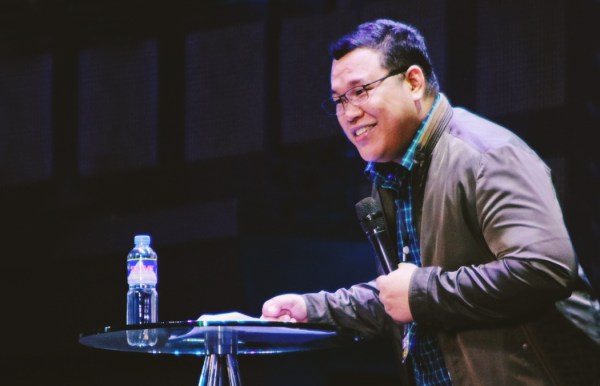
Ronald Molmisa, author and founder of the Lovestruck MovementCourtesy of Ronald Molmisa / Edits by CT
Ronald Molmisa, author and founder of the Lovestruck Movement

In Lovestruck, Molmisa adopts the tone of an older brother in addressing the causes of young people’s love woes. Since humans are holistic beings, Molmisa’s writing and ministry try to engage the soul, mind, and spirit.

“We approach the ministry with an integrationist perspective,” Molmisa said. “You cannot separate social science, theology, and pro-biblical psychology from each other in understanding human realities.”

This and the humorous and approachable tone caused his book to stand out when it was first published in 2010.

Reviews were overwhelmingly positive, praising Molmisa’s faithful and funny take on love in the Filipino context. The few negative reviews either criticized its orthodox Christian stance on sex and marriage or its use of Taglish, which was considered by some as too colloquial for literature at the time. The book went on to become a bestseller at the country’s largest bookstore chain, National Book Store, and has sold 100,000 copies to date.

“I like it because it gives a balanced content from testimonies, scientific studies, and a biblical point of view, and explains it in our language,” said 33-year-old Kennel Jane Pangaral, a campus minister for InterVarsity Christian Fellowship in Northern Mindanao. She finds it relevant for the college students she interacts with and often recommends it to them. Pangaral said this book challenged her to weigh her decisions when entering a romantic relationship by seeking advice from Christian mentors.

Meanwhile, the small book surprised Sara Jane Tantay-Mayorca, also 33, with how it could “correct and disciple” her. “It gave me clear biblical principles and practical guides about love, which, as a young person, became my source of emotional strength and stability,” said Tantay-Mayorca, now a youth pastor at Radiance of Christ Ministries International.

Since discovering the Lovestruck books, she has read the entire series and attended the Lovestruck Conference. “I credit my beautiful marriage now to this book because if not, I would have not chosen the right person and have not become the right person too.”

In his books, Molmisa writes about family, social issues, and other challenges that Filipinos face when it comes to love. While writing Lovestruck: Singles Edition, he held focus group discussions with women over 25 about why they are single. He found that some were their family’s sole breadwinner and, as a result, were too busy to find a husband. Another group of female students at the University of Santo Tomas, an elite Catholic school, said they were single because they felt called into singleness and destined to live a life of celibacy.

Starting the Lovestruck Movement

In 2013, Molmisa left his job as a professor to become a full-time pastor and started the Lovestruck Movement, which he desired to be a venue for “personal spiritual revival, reignition of love for God, and the promotion of righteous relationships.”

Through in-person conferences and online platforms, Molmisa encourages young people to set boundaries for themselves. He also holds Bible studies and lectures on different issues surrounding love and relationships. Molmisa encourages young people to pursue purity in the body, soul, and spirit; to practice accountability in community; and to trust in God’s power to escape from temptation.

“[Lovestruck] speaks to the core of the youth,” said Joyce Piap Go, a radio broadcaster, author, mental health counselor, and regular speaker at the Lovestruck Conference. “The Lovestruck Movement knows the needs of young people and addresses their issues head-on, guiding them to the Word of God and trusting the Lord Jesus Christ.”

Molmisa seeks to present youth with a hopeful message rather than guilt-tripping them into following God’s law. The ministry does not give away purity rings or make young people partake in oaths of chastity toward God during their conferences.

“I believe that Filipinos don’t need ceremonies for them to obey the Lord and prove that they live in purity and holiness,” Molmisa said. “The culture of the Philippines is very flexible [so] I don’t want to box them into a ritual.”

He added that he doesn’t want to pressure the teens, whose parents may be the ones pushing them to attend purity ceremonies. “I want them to grow in the grace and knowledge of God according to their commitments.”

As the Lovestruck Movement continues to grow, Molmisa has trained more than 50 seminar facilitators across the country to hold conferences on the Filipino islands of Luzon and Mindanao. Lovestruck partners with local churches to train volunteers to serve as staff during their gatherings. Around 3,000 young people attend their gatherings every year.

They have also extended programming to include parents and families in seminars on relationships and to provide scholarships for low-income elementary and high school students to attend school through their Love Scholar Project.

A new Lovestruck generation

Through his years of serving, Molmisa has seen the fruits of his ministry enrich his relationship with God and the people around him. He has learned to be open about his struggles with his wife and to find accountability with other pastor friends. Also, he finds it rewarding when some of the couples he married in the past now serve alongside him in the Lovestruck Movement.

Young people have different challenges today compared to when he first started ministering almost two decades ago. The Filipino youth are facing a severe mental health crisis. And due to the influence and pervasiveness of social media, they bring their problems online instead of to trusted mentors or friends. They get their information and attention from these platforms and, as a result, are shaped by the dominant ideologies present there.

To combat the worldviews students find on social media, the Lovestruck Movement has been active online since 2013, engaging with young people on Facebook, YouTube, Instagram, and TikTok. They also release podcasts on topics like how to deal with long-distance relationships, how to manage your emotions, and the root causes of adultery.

Today, Molmisa visits schools and universities to spread the Lovestruck message, giving a gospel presentation about how love is inseparable from the Creator of love. “The source of love is Love himself, Jesus Christ,” he said.

Molmisa believes that heart transformation will pave the way for the transformation that Gen Z wants to see in the world. “The heart of the problem is the problem of the heart,” he says. Although change cannot happen overnight, Molmisa knows it can happen as long as young people find their purpose from the Creator. “Only a generation that is changed by God can change a nation.”

News
Wire Story

Abuse Survivors ‘Disgusted’ by Southern Baptist Court Brief

Lawyers for multiple SBC entities argued against third-party liability under Kentucky’s new statute of limitations.

Christianity Today October 26, 2023
Jae C. Hong / AP

Abuse survivors, along with some members of the Southern Baptist Convention’s Executive Committee and the SBC’s abuse reform task force, have denounced a Kentucky court filing by Southern Baptist entities aimed at limiting their liability for sexual abuse claims.

A brief filed earlier this year by lawyers for the Executive Committee, Southern Baptist Theological Seminary, and Lifeway, an SBC publisher, argues that a Kentucky law that changed the statute of limitations for making civil claims over abuse—and allowing survivors to sue third parties such as churches or police—should not be applied retroactively.

“There are no mincing of words here. No holding back. This is disgusting,” abuse survivors Megan Lively, Jules Woodson, and Tiffany Thigpen said in a statement released Wednesday.

A group of Southern Baptist leaders working on abuse reforms also criticized the brief, saying the filing was “a choice to stand against every survivor in Kentucky.”

“This brief, and the policy arguments made in it, were made without our knowledge and without our approval,” the statement read. “Moreover, they do not represent our values and positions.”

Members of the Executive Committee, including Oklahoma pastor Mike Keahbone, expressed dismay at the brief, saying he and other members of the committee were blindsided by it. Keahbone, a member of a task force implementing abuse reforms in the SBC, said the brief undermined survivors such as Thigpen, Woodson, and Lively, who have supported the reforms.

“We’ve had survivors that have been faithful to give us a chance,” he told Religion News Service in a phone interview. “And we hurt them badly.”

The controversy over the amicus brief is the latest crisis for leaders of the nation’s largest Protestant denomination, which has dealt with a revolving door of leaders and rising legal costs in the aftermath of a sexual abuse crisis in recent years.

The denomination passed abuse reforms in 2022 but has been slow to implement them, relying mostly on a volunteer task force charged with convincing the SBC’s 47,000 congregations and a host of state and national entities to put those reforms into practice. Those delays have led survivors to be skeptical that things would actually change.

Earlier this week, ­the Louisville Courier Journal reported that lawyers for the Executive Committee, Southern Baptist Theological Seminary—the denomination’s flagship seminary in Louisville—and Lifeway had filed the amicus brief earlier this year in a case brought by abuse survivor Samantha Killary.

Killary was abused for years by her adoptive father, a Louisville police officer, the Courier Journal reported. She has sued two police officers who allegedly knew about the abuse and did nothing to prevent or report it, as well as Louisville’s city government, which employed them. Her suit was initially dismissed but was later reinstated after Kentucky legislators passed legislation that changed the statute of limitations for filing abuse claims.

That legislation also allowed survivors to sue third parties, “such as police, government units or religious organizations that violated their duties to children,” according to the Courier Journal.

Kentucky’s Supreme Court is now trying to decide whether third parties can be sued in cases of past abuse­ under the new law, known as KRS § 413 249.

A number of states, including New York and Maryland, have lifted or amended states of limitations for filing civil lawsuits in cases of abuse. That has led some Catholic dioceses to declare bankruptcy in the face of abuse lawsuits.

The brief filed by lawyers for the Executive Committee, Southern Seminary, and Lifeway argues that the Kentucky law should not apply retroactively to third parties. While those entities have no ties to the Killary case, they are being sued in a different case of abuse.

Lawyers for the SBC entities say their clients “do not dispute the laudable policy reasons for providing relief for victims of childhood sexual abuse.”

“But not even the most sacrosanct policy can trump the clearly expressed legislative intent and fundamental due process concerns presented in this and similar cases involving the attempted retroactive application of KRS § 413 249 to expired claims,” the brief claims.

Southern Baptist Theological Seminary president Albert Mohler declined to comment on any specifics of the brief.

“As is often the case in questions of law, significant constitutional and legal questions arise and require arguments to be made before courts,” said Mohler in a statement. “In such cases we must refer all questions to legal counsel. We respect the rule of law and must work through the process with legal representation, who must speak for us in this case.”

The Executive Committee and Lifeway did not immediately respond to a request for comment.

Taking sides against an abuse survivor—in a case that has no SBC ties­—was an act of betrayal, say the SBC survivors.

“Neither the SBC, Executive Committee, Lifeway nor SBTS are named in this lawsuit nor involved in this case, yet the SBC proactively chose to side against a survivor and with an abuser and the institution that enabled his abuse, arguing that Samantha should not even be given access to the court system—that statute of limitations reform does not extend to institutions,” they wrote in their statement.

A group of SBC leaders, including North Carolina pastor Bruce Frank, who chaired an initial task force working on abuse reforms, and Marshall Blalock, a past chair of the abuse reform implementation task force, said they were grieved at the decision to file the brief.

They wrote that opposing changes to the statute of limitations “is not an effort to honestly consider the facts and questions related to responsibility.”

“Rather, it is a deliberate effort to ensure those questions are never asked. Revising the Statute of Limitations does not alter the burden of proof, it does not impact evidentiary rules, it does not change laws regarding institutional Responsibility,” they wrote. “It simply allows survivors access to the justice system so that a full and fair hearing on the merits can take place.”

https://twitter.com/DrHeatherEvans/status/1717640385273414037

For decades, leaders of the Southern Baptist Convention have sought to protect the nation’s largest Protestant denomination from any liability for sexual misconduct at local churches.

That legal strategy led SBC leaders to downplay the scope of abuse in the denomination, to treat abuse survivors as their enemies and to stonewall attempts to address abuse on a national level for years. While the denomination’s annual meetings have apologized for the past behavior of leaders, the SBC has struggled to move forward with reforms while dealing with its legal challenges.

It’s unclear who approved the brief or how it came about.

Keahbone said he is calling for a special meeting of the Executive Committee to figure out what happened and to decide what to do next. He said there’s a difference between doing the right thing and doing what seems to be legally wise.

He said members of the Executive Committee want to do the right things. Then they keep taking steps backward.

“We can’t seem to get out of our own way,” he said.

Theology

How to Get Through 2024

Christians can’t know what’s waiting for us next year. But we can know what kind of people we hope to be when we get there.

Christianity Today October 26, 2023
Illustration by Mallory Rentsch / Source Images: Getty / Pexels

This piece was adapted from Russell Moore’s newsletter. Subscribe here.

The other day I was talking to a pastor who sighed and asked, “Are we really going to do this again?” After all the tumult and division of churches and families from the last two presidential elections, it’s exhausting to think another one is coming.

He asked, “Can you give me advice on how to get my people through 2024?”

And I said, “No.”

I was, of course, partly joking. But not entirely. Here’s why.

Many people assume that the election year of 2024 will be a reboot of 2020, especially since it seems we will have the same two candidates running as last time. It may feel like these sitcom reboots of late—Saved by the Bell or Roseanne or, now, Frasier. A show comes back 20 years later with the same characters, except all aged up, trying to throw out classic catchphrases the nostalgic old audience wants while trying to introduce new characters in an attempt to gain some new people. It’s a reasonable assumption to think of the 2024 elections this way—but it’s wrong.

Imagine if you had asked me this time of year in 2019 how to get through the 2020 election. I would have had no way to help you. I wouldn’t have known that a microscopic virus would kill countless people and shut down the entire world. I wouldn’t have known that the murder of George Floyd would transform the conversations and debates about racial justice. The list could go on and on.

In fact, we would not have known just one month ago that the Middle East would be plunged into war. We would have known that our political system here in the United States is messed up, but we would not have known how prescient Andy Warhol was when he said, “In the future, everyone will be speaker-designate of the US House of Representatives for 15 minutes” (or something like that).

None of us can prepare for 2024—if by “prepare” we mean to check off all the steps that can keep us from the mistakes and traumas of years past. That’s because no one knows what is out there ahead of us, waiting for us, in 2024.

Here’s what you can do, though. You can prepare yourself to step into the mystery of whatever will be 2024. What I mean is that you can start to prepare yourself to be the kind of person who can handle it, whatever it is.

Part of that has to do with reframing our own anxieties about what we can’t control. People without a Christian background who read the Gospels for the first time are almost always startled by the figure of Jesus. He just doesn’t sound like someone marketing a religion. Instead, he does things like telling his first disciples that they would be persecuted.

We would expect the founder of a market-savvy new religious movement to talk about all the benefits ahead while minimizing talk about bad things. I have little doubt that if I had been among the band of 12, I would have nudged someone at the fireside and grumbled, “Why does he have to keep bringing this stuff up? All I did was point out how cool the columns were, and he starts in on the end of the world again.”

But Jesus also said why he was talking about these dark future happenings. “I have told you this, so that when their time comes you will remember that I warned you about them” (John 16:4). Jesus was targeting the sort of panic that would have come if the disciples had faced the darkness ahead without knowing anything, thinking to themselves, “Lions? Who ever said anything about lions?”

The fact that Jesus saw all of it ahead of time—and wasn’t the least bit thrown by it—is one of the means the Holy Spirit used to bolster the faith and courage of those followers.

Jesus told them just enough about their futures to keep them from trying to find false solutions to the crises to come. The gist of it was: When all these things go down, there will be somebody out there claiming to be me. It won’t be. When I get back, you’ll know it (Matt. 24:3–31). Jesus said, “For false messiahs and false prophets will appear and perform signs and wonders to deceive, if possible, even the elect. So be on your guard; I have told you everything ahead of time” (Mark 13:22–23).

You don’t know what’s waiting for you in 2024—with the presidential election or a billion other things. But you can know what kind of person you will hope to be, by God’s grace, when you get there.

David and Nancy French, Curtis Chang, and I are working on a project called The After Party, a curriculum to help people work through issues of partisan polarization toward a better Christian witness. It’s not about the what of politics but about the how. As we were filming, something David said struck me, and I’ve thought about it ever since. He said, “If we could just do two things, and two things only, it would change everything.”

Those two things were: “I will not lie and I will not empower liars. I will not be cruel and I will not empower cruelty.”

Will that equip you exhaustively to “get through” a presidential election year that might be the wildest one yet? Of course not. But it can help you set a mindset ahead of time.

Well over a decade ago, when I first became president of an entity tasked with public policy questions, I said to my wife, “If you ever hear me say the words, ‘This is the most important presidential election of our lifetimes,’ here are the names of people you should call to come take the keys away.”

When we were dealing with an elderly friend who was moving into a smaller living situation—but wanted to keep all of her stuff—I said to my son, “Samuel, that will be me with my books. I want you to say, ‘Dad, here’s a message from 2021 Russell Moore: Stop being crazy and listen to Samuel.’”

Will that keep me from being an idiot when the time comes? Not necessarily. My older self might say, “Yeah, well, 2021 Russell Moore was the crazy one, not me!” And Samuel might say, “Dad, you both are crazy, because you are standing here literally arguing with yourself.”

You can know yourself well enough to predict what will be the most likely temptation for you in an election year like this one, whether it’s cruelty or apathy, panic or quarrelsomeness, and so on. And you can attend right now to the same old means of grace we’ve always had—prayer and worship and Bible reading and singing together and coming to the Table and so on.

You can’t predict a presidential election year. That means you can’t have a step-by-step game plan to “get through it.” But you can know, right now, what to ask for and what to walk toward when it comes to your own conscience, your own witness, your own love of neighbor and of enemy. And, at least for now, that’s enough.

Russell Moore is Christianity Today’s editor in chief and the director of the Public Theology Project.

News

Church of England Advances Plans to Bless but Not Affirm Same-Sex Couples

UPDATE: After Synod vote, services will soon be available on a trial basis.

General Synod at the Church House in London

General Synod at the Church House in London

Christianity Today October 26, 2023
Leon Neal / Getty Images

Update (November 16, 2023): Following a nine-hour debate, the Church of England’s General Synod voted on Wednesday to introduce special services asking for God’s blessing for same-sex couples “on a trial basis.”

The national director of the Church of England Evangelical Council (CEEC), John Dunnett, said that the proposals marked “a ‘watershed’ moment, in that it appears that the Church of England no longer sees Scripture as our supreme authority.”

Nikki Groarke, a senior member of the clergy in the diocese of Worcester and a member of Inclusive Evangelicals, wrote that she was “thankful … that we can be a welcoming and inclusive church for all. Recognise this step will be painful for some, but I believe it is the right one.”

The Synod’s lengthy discussion highlighted divisions over the legal process for the change. Bishops had suggested that “stand-alone” services blessing same-sex couples be subject to approval by the General Synod—a process that would not have been complete until 2025 and might not have met the threshold for approval. But this week, the Bishop of Oxford moved an amendment asking the bishops “to consider whether some standalone services for same-sex couples could be made available for use, possibly on a trial basis.”

This was passed by a narrow majority: by just one vote in the House of Laity, one of the three houses of the Synod. The two archbishops had already indicated that they would support the move.

——

Church of England clergy could soon be authorized to pray for God’s blessing over same-sex couples, though not quite affirming their unions as they would a marriage, according to a controversial paper set to be debated at an upcoming meeting of the church’s national assembly, General Synod. Services with liturgy to bless the couples wouldn’t take place until 2025.

In the 108-page document, bishops make the case for celebrating the “faithfulness, stability, fruitfulness, love, faith, grace” in same-sex relationships, with pastors “finding ways to help people move forward in holiness in a world that falls far short of ideals in every area, without giving up on the idea of the ideal altogether.”

They also speak of “acknowledging and celebrating what is good in same-sex relationships even if the Church is unable to commend every aspect of some relationships.”

Both conservatives and progressives have spoken out against the rationale for the proposals in the paper, calling it “bonkers theology” and “another fine mess.”

The report is the latest development in a lengthy and often painful process of discernment for the Church of England as it grapples with deep internal disagreement about same-sex relationships in what it describes as a “rapidly changing social context.”

In February, after eight hours of debate, the General Synod voted to welcome proposals by the church’s bishops to issue prayers to bless same-sex unions in church. This update, issued ahead of November’s gathering, sets out how difficult the bishops are finding it to bring the proposals to fruition.

The new paper explores how the prayers might be approved under canon law, the legal framework governing the Church of England. To authorize new liturgy, the bishops, clergy, and laity in the General Synod must approve it by a two-thirds majority in two houses. This process typically takes years to complete.

Or they could bypass General Synod. They could introduce the same-sex blessing services under a part of canon law that allows ministers to use forms of service that are “neither contrary to, nor indicative of any departure from, the doctrine of the Church of England in any essential matter.” Under another part of canon law, the archbishops can approve a service themselves.

After the February vote, the bishops indicated that they might opt for one of the alternative routes, prompting the intervention of a group of church leaders, including several high-profile evangelicals. The critics warned that bypassing the General Synod would be “unlawful, illegitimate and unconstitutional” and leave the church exposed to “significant legal challenge.”

The latest decision has left neither conservatives nor progressives happy. The bishops have decided to “commend” a collection of prayers, blessings, and readings (“Prayers of Love and Faith” or PLF) that ministers can use with same-sex couples during a regular church service. This is described as “pastoral provision.”

This collection will not need to be approved by the General Synod. The paper acknowledges that providing prayers of blessings for same-sex couples who may be in “sexually active relationships” might represent a departure from the previous understanding of the church’s teaching. But they argue that this would not be a departure from the doctrine of the church in an “essential matter”—a highly contentious conclusion.

When it comes to “stand-alone” services, where the blessing is the focus, the bishops have decided to seek approval of the General Synod. This might begin in February next year, but a vote on final approval wouldn’t take place until 2025.

Given that last February’s vote on same-sex blessings secured only narrow majorities in two houses, it remains uncertain whether the two-thirds threshold would be met.

It is clear from the paper that the bishops were anticipating criticism. The Bishops of London and Winchester, who wrote the introduction, explain:

We recognise that for some, pastoral provision represents far too little, and is considered deeply disappointing and distressing. We also recognise that others dispute the claim that this pastoral provision does not represent a change in doctrine.

But they argue that the fruit of their deliberations reflects “significant disagreement” within the church. They refer to offering “pastoral provision in a time of uncertainty,” noting that there exists “a consensus for change within the Church but not a consensus on what that change should be.”

Twelve bishops have already issued a statement earlier this month announcing that they are unable to support the decision to commend the prayers.

LGBT Anglicans and their allies have expressed disappointment at the content of the paper, with many describing it as a retrograde step for a church whose bishops recently publicly apologised for homophobia. Some suggested that for all its talk of “pastoral provision,” it offers no real change.

“It is almost unfathomable, yet entirely predictable, that we have ended up exactly where we started,” wrote Charlie Bell, a psychiatrist and priest in London. “Out of years and years of patient work, all we can do is pray for people like we already could do, and now we are specifically banned from holding special services for them.”

Other aspects of the work have also been pushed back, including guidance on whether clergy such as Bell can enter same-sex marriages, which is currently prohibited.

The motion approved in February was amended to stipulate that there would be no change to the church’s doctrine of marriage and that the final version of the prayers “should not be contrary to or indicative of a departure from the doctrine of the Church of England.”

The new paper repeatedly offers reassurance that the prayers do not equate same-sex relationships to marriage. It states that, in a service of blessing, rings should not be given or exchanged “to avoid the impression that the service is a marriage service” and emphasizes that the prayers “fall short of affirming a couple’s entire way of life as ‘made holy by God’ and ‘blessed’ as a marriage service would do.”

Helen King, a lay member of General Synod, suggested that the paper was “all about … conservative fear” and that “any sense of joy, of celebration, of welcome, of blessing, has now disappeared.”

The paper’s drafted “pastoral guidance” provides an idea of the sort of concerns that have been voiced by churches who will not use the prayers; it includes advice on how to communicate this decision to a couple and whether such churches could face legal action under secular equality legislation.

There is reference to establishing an “independent reviewer” who would hear disputes over the decision to use or not use the prayers. The paper also acknowledges that some Anglicans have called for “structural differentiation,” whereby churches who do not agree with the blessing of same-sex relationships might, for example, be overseen by bishops who share their convictions.

The paper has been published in advance of the meeting of General Synod in London next month, when members will simply be asked to recognize the “progress” made by the bishops since February and encourage them to continue their work on implementation.

LGBT Anglicans and their allies show signs of losing patience with the bishops after years—and ultimately decades—of discussion, consultation, and study.

“We have had enough,” wrote Bell this week. “We have been taken for granted in Synod, and you should know, bishops, that you are no longer guaranteed inclusive votes based on private assurances. You are called to ‘serve and care’ for your whole flock, and that includes us.”

For the majority of the English population, who do not attend church and no longer describe themselves as Anglican, the debate is unlikely to hold much traction. The “rapidly changing social context” to which the paper refers includes high rates of approval for same-sex marriage, while the majority of heterosexual weddings are now carried out in secular settings.

But for the Church of England and the Anglican Communion, the stakes are high. A statement issued on Monday, at the end of a meeting of Anglican leaders from the Global South in Cairo, applauded the stand taken by the 12 dissenting bishops and reaffirmed an earlier statement that said they were “no longer able to recognise” the archbishop as “first among equals.”

Among those present was Nicky Gumbel, a former vicar of Holy Trinity Brompton, a flagship evangelical church and pioneer of the global Alpha course. To date, Gumbel has sought to avoid taking a public stand on sexuality but was one of the signatories to the September letter warning that the bishops’ proposed process was unlawful.

For the bishops seeking recognition of their work to date, the plea is for understanding about the challenge of holding together a church riven by deep disagreement.

The Church of England is in a “complex space,” they argue, “in which we want change but without changing the doctrine of the Church; we lament and repent of the mistakes of the past but are uncertain about the future.”

Apple PodcastsDown ArrowDown ArrowDown Arrowarrow_left_altLeft ArrowLeft ArrowRight ArrowRight ArrowRight Arrowarrow_up_altUp ArrowUp ArrowAvailable at Amazoncaret-downCloseCloseEmailEmailExpandExpandExternalExternalFacebookfacebook-squareGiftGiftGooglegoogleGoogle KeephamburgerInstagraminstagram-squareLinkLinklinkedin-squareListenListenListenChristianity TodayCT Creative Studio Logologo_orgMegaphoneMenuMenupausePinterestPlayPlayPocketPodcastRSSRSSSaveSaveSaveSearchSearchsearchSpotifyStitcherTelegramTable of ContentsTable of Contentstwitter-squareWhatsAppXYouTubeYouTube