Ideas

Mormons Expect More of the Next Generation. Why Don’t We?

Columnist

Our youth need more than market-driven ministry efforts.

Illustration by Abigail Erickson / Source Images: Getty

When he was eight years old, my son Jonah joined me on a trip to Salt Lake City. I was meeting with leaders of the Church of Jesus Christ of Latter-day Saints about religious liberty questions that concerned both of our communities.

I thought Jonah would be bored, but I needn’t have worried. Everyone treated him with such kindness that I told my wife, “We have to get home soon. Jonah’s having such a good time that I’m afraid he’ll soon be on a bicycle handing out Books of Mormon door to door.”

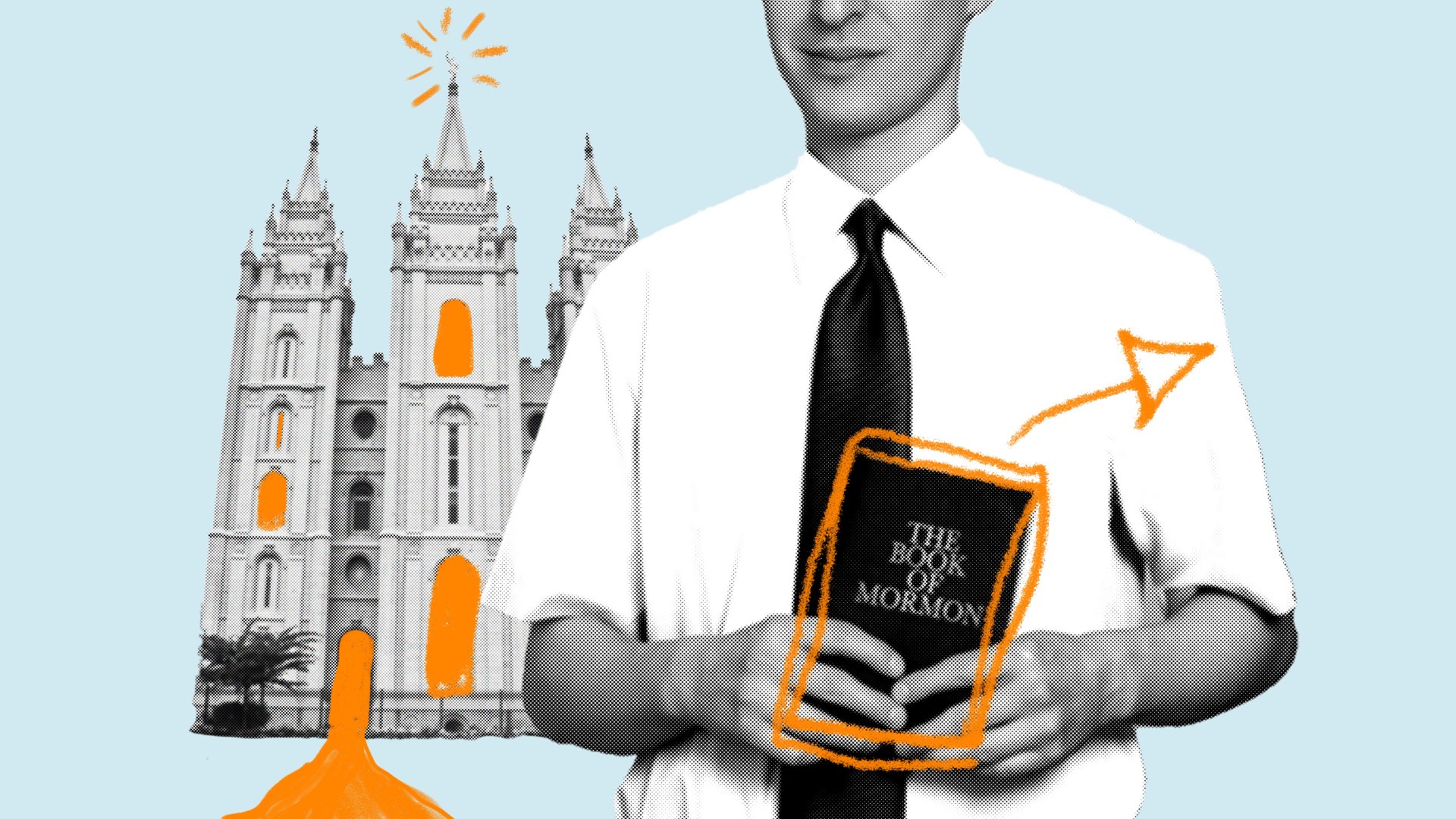
I was joking, of course. But it was true that the other children showing him such hospitality would one day spend two years somewhere in the world on a mission that the church expects of them.

For a long time, this struck me as a misguided use of time and resources. After all, have you ever met someone who embraced the teachings of Joseph Smith because a pair of barely-out-of-adolescence Latter-day Saints showed up at their door? But I was wrong in my evaluation, because I misunderstood what these missions are actually about.

In his book Nonverts: The Making of Ex-Christian America, Stephen Bullivant recalls a conversation with a couple of young Latter-day Saints just back from their missions. Neither had seen a single person converted to their faith.

“Yet interestingly, from the perspective of the LDS Church, this doesn’t mean that their mission trips have failed,” he writes. “The experience of spending two years trudging around rainy England, living in each other’s (name-badged) pockets, and trying to strike up meaningful conversations with secular Brits is nothing if not character building.” More importantly, he notes, “the odds of them returning home even more deeply committed to being upstanding lifelong Mormons … will certainly have risen appreciably.”

Bullivant contrasts this devotion with mainline Protestantism, which has bled out over the past 50 years—especially with youth. A key, he argues, is the eclipse of an emphasis on equipping young people to do personal evangelism. “If a church doesn’t inculcate in its members the feeling that what they have is something that’s worth sharing with others … then it sends the message that perhaps it’s not so essential for me either,” he writes. “Conversely, actively trying to evangelize others cements the value of it for oneself.”

The same is true for our evangelical Protestant world, regardless of how much we think we are committed to personal evangelism. The 2022 Census of American Religion by the Public Religion Research Institute showed that the median age of both white mainline Protestants and their evangelical counterparts was around 54, in contrast to a median age of all Americans of 48.

With these sorts of numbers, many will attempt to ramp up the same market-driven ministry to young people that’s failed for decades. But what if that’s not the solution and is, instead, a big part of the problem? Are we sending an implicit message to the next generation that we see them as consumers of a ministry product? Compared with the Latter-day Saints, are our expectations for the next generation way too low?

I am committed to Nicene Christian orthodoxy and I, of course, reject LDS theology on the most important matters of the faith—the Trinity, the Incarnation, the way of salvation, and so on. But when it comes to the sociology of high expectations for youth, I find something that resonates.

We may equip our young people to defend themselves intellectually—from naturalistic materialism, sexual hedonism, and so on—with a “Christian worldview.” But we are not doing as well at training them to authentically and persuasively share their faith as genuine good news and to expect that the Spirit actually can and does change hearts.

The biblical model of the church is one body with many members—and a critical aspect of membership is the use of one’s gifts to build up the church (1 Cor. 12). Too many of our young people are seeing a flawed vision of Christianity, not because they’ve concluded that they don’t need the church but because they’ve concluded that the church doesn’t need them. We need to communicate to our children that we will not only train them to carry on the faith but also trust them to do so. Our expectations for the next generation are just not high enough for these “latter days.”

News

A Washington Church Grows Great Commission Wheat

For decades, the small, rural congregation has turned a grain harvest into international ministry funding.

Illustration by Pola Maneli

When people at Onecho Bible Church talk about “the mission field,” they mean the many places around the world where Christians are sharing the love of Jesus. But sometimes, they’re also talking about a literal field in Eastern Washington, where the congregation grows crops to support the people proclaiming the gospel around the world and fulfilling the Great Commission.

The 74-member church, smack-dab in the middle of a vast expanse of wheat fields 80 miles south of Spokane, has donated $1.4 million to missions since 1965. They’ve funded wells, campgrounds, and Christian colleges. This year, they want to provide food and shelter to asylum seekers at the US-Mexico border.

“Being as isolated as we are, it’s our missionaries and this mission field that keeps us very focused worldwide,” said Brian Largent, Onecho’s volunteer farm manager. “This church is a very mission-oriented church—always has been.”

Onecho Bible Church traces its history back to Mennonite migrants in the 1890s and Methodist farmers 20 years before that. But the unique fundraising program started in the 1960s. One of the church elders, Gerhard Dyck, passed away at age 65 and bequeathed 180 acres to the church. He supported missionary work his whole life and considered that his legacy. He asked Onecho to use his land to continue the work of spreading the gospel.

The church decided it wouldn’t sell the field but would farm it with volunteers. The proceeds from the harvest would fund various missions. The first year, the harvest yielded $5,500. Revenue fluctuates, based on the success of the harvest. In 2021, the field earned $39,000. Last year, it was $178,000.

“We just put the seed in the ground,” Largent said. “Then … it’s all up to the weather and what God’s going to do to produce the money.”

It’s not uncommon for churches to have special fundraisers, said David P. King, professor of philanthropic studies and director of Indiana University’s Lake Institute of Faith and Giving. After direct giving, they are the second most common funding source for American congregations. But fundraisers are often bake sales or craft fairs. Farming is pretty unusual.

However religious people give to charity, they are extraordinarily generous, King said. Onecho is one example.

“You can’t underestimate the financial value the volunteers are contributing to the church, especially if they’re bringing their combines and doing some fairly significant labor,” King said.

Research shows that religious participation is the leading predictor of generosity. Congregational living encourages people’s better angels.

“In community,” King said, “you’re more likely to run across needs and run across positive peer pressure, social pressure, to get up and engage.”

And as congregations tell the story of their life together, such as recounting the work that goes into the field and planning for harvest, that adds positive reinforcement. King said it’s remarkable how that kind of religious practice changes people in measurable ways.

“In the midst of our growing polarization that’s threatening our communal life together,” he said, “there are stories that demonstrate how we take care of one another.”

Inside Onecho Bible Church, the story is recalled with framed photos of the mission field’s early beginnings. There are also plaques that commemorate Dyck, recalling the late elder as a gentle, humble, and generous farmer. According to one, “his generosity was born of a deep love for God’s work.”

One church member, Darrel Claassen, said those pictures always remind him of how mission work connects his family through the generations. Dyck was his great-uncle. His dad, Rudy Claassen, worked side by side with Dyck and ensured the farm was turned over to the church after he died. Now Darrel Claassen volunteers in the mission field, and his children and grandchildren are cheering him on.

“That’s a real delight for me to see that my children and my grandchildren have the vision of supporting missionaries,” he said.

It’s not just family, though. At Onecho, everyone is welcome to join in the vision. The congregation holds a gathering every year to celebrate the harvest, inviting friends, family, and people from the surrounding community. They often host international students from Washington State University in Pullman. One year, 62 came for rides on the combines.

The field helps the church reach out to neighbors. And it inspires them to look beyond the golden hills of wheat and think about what God is doing in faraway places.

By December, church members propose mission projects to the congregation. It doesn’t matter whether the missionaries are formally connected to the church. All suggestions are welcome, though the church generally favors one-time gifts over ongoing support. Then the missions committee looks at all the proposals and makes a decision. The money is typically given out in the spring. Over the years, it has supported more than 150 different projects.

In 2023, Onecho is partnering with the El Paso-Juarez Border Initiative Ministry. The Border Initiative was started by the Presbyterian Church in America a few years ago, and Gary Largent, Brian Largent’s brother and the chair of the missions committee, learned of it in a conversation about the immigration crisis with a pastor at a church near the border. The ministry helps 20 to 60 migrants a week at a small church in northern Mexico on their way to the border to apply for asylum. Gary Largent is leading a team of 18 people to visit and help with small construction projects and deliver food and clothing.

“We want to just do whatever we can to invite migrants, to work alongside them, so we can hear their stories and just show them the love of Christ in very practical ways,” he said. “They each have needs, and we wanted to get a firsthand look.”

Whether the church supports a school in South Africa or a migrant shelter in Mexico, Gary Largent said he’s always overwhelmed by the thought that a little church of farmers can have such a far-reaching impact on so many people’s lives.

Over the years, this approach to missions has come to shape Onecho Bible Church, too. Senior pastor Mike Nyholm says the mission field has given the church its sense of purpose. They start from what they’ve been given.

“God has us here, so why?” he said. “We can do something here that no one else can—because he’s put us here.”

Loren Ward is a journalist and storyteller in Arizona.

News

15 Percent of Churches Laid Off Staff in COVID-19. Many Are Still Looking for Work.

For some, pandemic firing prompted a turn to secular employment.

Illustration by Rick Szuecs / Source images: Unsplash

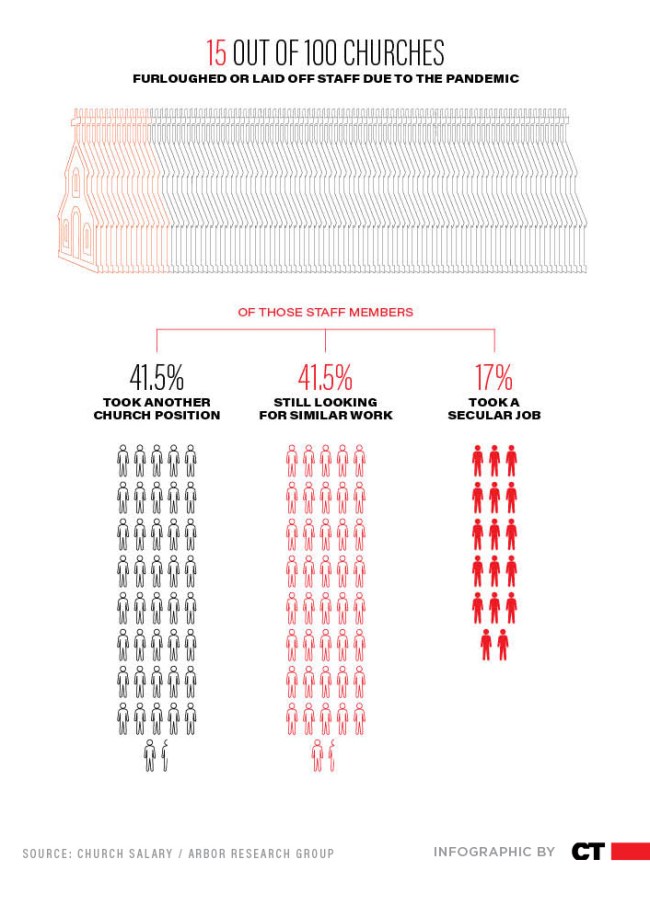
COVID-19 did not have the devastating impact on church finances that many feared it would. Most congregations did not have to seriously cut budgets or lay off staff during the uncertainty, anxiety, and week-by-week adaptation to the pandemic. Many did, however, have to find ways to tighten their belts. A study of more than 1,000 congregations by CT’s sister publication ChurchSalary and Arbor Research Group found that some churches cut administration costs (41%), some delayed building projects or repairs (28%), and some reduced giving to missions and benevolence (10%).

Around 15 percent furloughed or laid off employees. Across denominations and geographical regions, that works out to about 50,000 churches laying off associate ministers, youth ministers, discipleship pastors, worship leaders, administrative assistants, and other staff.

By the summer of 2023, signs of the havoc caused by the pandemic had mostly receded from congregational life in America. For some who once felt called to work for a church, however, the pandemic was a personal hinge point: Their careers have not returned to a prepandemic “normal.”

Not long ago I attended a conference held on the restored grounds of a century-old utopian community. As I ran my fingers over the fine workmanship of the buildings and read the plaques describing the daily lives of the true believers, I marveled at the energy that drove this movement, one of dozens spawned by American idealism and religious fervor.Many varieties of perfectionism have grown on American soil: the offshoots of the Second Great Awakening, the victorious-life movement, the communes of the Jesus movement. In recent times, though, the perfectionist urge has nearly disappeared. Nowadays we tilt in the opposite direction, toward a kind of anti-utopianism. The burgeoning recovery movement, for example, hinges on a person’s self-confessed inability to be perfect.I confess my preference for this modern trend. I find it far easier to see human fallibility than perfectibility, and I have cast my lot with a gospel based on grace. Yet in New Harmony, Indiana, I felt an unaccountable nostalgia for the Utopians: all those solemn figures in black clothes breaking rocks in the fields, devising ever-stricter rules in an attempt to rein in lust and greed, striving to fulfill the lofty commands of the New Testament. The mere names of the places they left behind are enough to break your heart: New Harmony, Peace Dale, New Hope, New Haven.The Catholic church has bred its share of perfectionism as well. I have studied the rule of Saint Benedict and read the stirring accounts of early Jesuit missionaries who sailed to Japan and China. Compared with such dedication, the current wave of short-term missions seems like a consumer fad.The Barrier Reef Of Original SinYet most utopian communities—like the one I was standing in—survive only as museums. Perfectionism keeps running aground on the barrier reef of original sin. A few years back a book by Douglas Frank, Less Than Conquerors, offered a perceptive analysis of why perfectionism fails. Charles G. Trumbull, a leader in the victorious-life movement, once said, “It is the privilege of every Christian to live every day of his life without breaking the laws of God in known sin either in thought, word or deed.” Such high ideals, observes Frank, paradoxically lead to despair and defeatism. Despite all good efforts, human beings don’t achieve a state of sinlessness, and in the end, they often blame themselves.Frank points out yet another flaw in perfectionism: too often it disintegrates into pettiness (one of the criticisms Jesus made of the Pharisees). In an attempt to dilute the delights of the flesh, Charles Finney’s Oberlin College banned coffee, tea, pepper, mustard, oil, and vinegar. The experiment did not last long, as any recent visitor to Oberlin can attest.I grew up in a climate of severe perfectionism from which I have spent much of life recovering, and I learned firsthand the pettiness of modern fundamentalism. My church debated the morality of bowling alleys (“Don’t they serve liquor?”) and roller skating (“They hold hands!”) but cared not a whit about human rights in South Africa or civil rights at home in Georgia.Still, despite a potent inoculation against the abuses of perfectionism, I feel this nostalgia, even longing, for the quest itself. I read with amazement Thomas Merton’s Ascent to Truth, which chronicles one man’s full-time search for mystical union with God. I burn with shame as I read the Russian classic The Way of a Pilgrim, which tells of a peasant who took literally the command to “Pray without ceasing” and prayed the Jesus prayer (“Lord Jesus Christ, Son of God, have mercy on me, a sinner”) 7,000 times a day.Grace AbuseHow can we in the church uphold the ideal of holiness while avoiding the consequences of disillusionment, pettiness, abuse of authority, spiritual pride, and exclusivism? Or, to ask the opposite question, how can we moderns who emphasize support (never judgment), honesty, and introspection keep from aiming too low? As an individualistic society, America is in constant danger of freedom abuse; its churches are in danger of grace abuse.With these questions in mind, I read through most of the Epistles this summer, in a different order than usual. First I read Galatians, with its magnificent charter of Christian liberty and its fiery pronouncements against petty legalism. “It is for freedom that Christ has set us free,” Paul declared (5:1). But three paragraphs later he added these words, “But do not use your freedom to indulge the sinful nature; rather, serve one another in love.”Next I turned to James, that “right strawy epistle” that stuck in Martin Luther’s throat. I was familiar with James’s stern admonitions, but I had not noticed his formula for obtaining holiness. James balanced each prodding to “Strive harder!” with the simple advice to depend on God (1:5, 17, 21; 2:24; 4:3, 7; 5:11). “Mercy triumphs over judgment!” he concluded.I read Ephesians and then 1 Corinthians, Romans and then 1 Timothy, Colossians and then 1 Peter. In every epistle, without exception, I found both messages: the high ideals of holiness and also the safety net of grace reminding us that salvation does not depend on our meeting those ideals. Ephesians pulls the two strands together neatly: “For it is by grace you have been saved, through faith—and this not from yourselves, it is the gift of God—not by works, so that no one can boast. For we are God’s workmanship, created in Christ Jesus to do good works, which God prepared in advance for us to do” (2:8–10, NIV).I took comfort that the church in the first century was already on a seesaw, tilting now toward perfectionist legalism and now toward raucous antinomianism. James wrote to one extreme; Paul often addressed the other. Each letter had a strong, correcting emphasis, but all stressed the dual message of the gospel. The church, in other words, should be both: a people who strive toward holiness and yet relax in grace, a people who condemn themselves but not others, a people who depend on God and not themselves.The seesaw is still lurching back and forth. Some churches tilt one way, some another. My reading of the Epistles left me yearning for a both/and church. I have seen too many either/or congregations.
Theology

Repentance Is Both Vertical and Horizontal

Our hearts aren’t prepared for the Lord until they are ready to love others.

Illustration by John Hendrix

The Book of Luke, more than any of the other Gospels, presents a sweeping look at Jesus’ teachings on ethics. Over half the parables we have from Jesus are unique to Luke. They cover topics like how to steward money and how Jesus sees people the world overlooks, such as the poor, the disabled, and women.

At the foundation of it all is Jesus and his preaching about the kingdom of God.

I have spent more than 40 years of my professional academic life in Christian vocational service and in the study of Luke’s gospel. Key texts in it have opened my eyes to the scope of Jesus’ mission in ways I rarely heard about as a younger Christian.

The first such passage is in Luke’s first chapter. Gabriel foretells the birth and calling of John the Baptist to his father, Zechariah, saying John will prepare the way for the Messiah.

He will turn many of the people of Israel to the Lord their God. And he will go as forerunner before the Lord in the spirit and power of Elijah, to turn the hearts of the fathers back to their children and the disobedient to the wisdom of the just, to make ready for the Lord a people prepared for him. (vv. 16–17, NET throughout)

One of the things I have learned about reading Scripture is to define its terms by asking questions of the text. Here the question arises, “What does it mean to be a people prepared for the coming of the Lord?” This text gives a two-part answer.

First, the expected part: John will turn people back to God. This reflects quite rightly what prophets are supposed to do.

The second component—which is also part of John’s call and what God seeks from people ready for deliverance—is what had eluded me in the past. Gabriel announces that John will turn people back to one another in two key spheres: relationships in the family (“the fathers back to their children”) and ethical wisdom exercised in public life (“the disobedient to the wisdom of the just”).

This shows a horizontal (human-to-human) direction for repentance, not just a vertical (human-to-God) one. Repentance is not one-dimensional.

Both my relationship with God and my relationships with others were in God’s mind as John received his calling to prepare a people for the coming of deliverance. Reconciliation and relationships were at the very center of what God was getting ready to do through Jesus.

The biblical term for repentance, turning, has one unified goal: bringing people back to God while also bringing them back to one another.

This text is about moving and living in such a way as to connect hearts, pursue love, and seek others’ good.

Illustration by John Hendrix

How is that done, and who takes the initiative? John the Baptist shows the way.

If there is any doubt about this holistic approach to repentance, a later text about John the Baptist’s teaching and baptism reinforces this goal.

People participated in John’s baptism as a response of repentance, saying, I am ready for the Lord to come.

Consider Luke 3:8–14 (I’m transliterating the Greek for certain terms to show the connections):

“Therefore produce [poiēsate] fruit that proves your repentance, and don’t begin to say to yourselves, ‘We have Abraham as our father.’” … So the crowds were asking him, “What then should we do [poiēsōmen]?” John answered them, “The person who has two tunics must share with the person who has none, and the person who has food must do likewise.” Tax collectors also came to be baptized, and they said to him, “Teacher, what should we do [poiēsōmen]?” He told them, “Collect no more than you are required to.” Then some soldiers also asked him, “And as for us—what should we do [poiēsōmen]?” He told them, “Take money from no one by violence or by false accusation, and be content with your pay.”

This text’s theme is John the Baptist’s theme: repentance. The different groups in Luke 3:10, 12, and 14 are responding to John’s call to live out (make fruit out of) their repentance. This is the application of the prophecy about John’s vocation of preparing for the Messiah.

Both the accounts in 1:16–17 and 3:10–14 are unique to Luke. It is the only Gospel making this point and linkage. If we flatten the Gospels, assuming they say the same things about John the Baptist, then we might miss this crucial Lukan emphasis.

English translations of this section in Luke 3 obscure the word echo in the newly baptized people’s questions and John’s exhortation in verse 8. The terms I transliterated in the passage are all variations of the Greek verb poieō, which means to “make” or “do.” The groups are asking how to apply the repentance John is calling for in their everyday lives. Remember: John is preparing the way for Jesus to build on this message.

A surprise awaits us in John’s replies. In each case, the application addresses not how I am responding to God but how I am responding to others in everyday situations.

I am to be generous with what God has given me (in the crowd’s case, with clothes and food) and in the role I have (in the tax collectors’ case, by not taking advantage of people financially; and in the soldiers’ case, by not abusing their power).

Surprisingly, God is not directly mentioned in any of John’s answers. The point is, repentance is not only about how I relate to God, but also about how I interact with others.

By turning to God, in the same measure I am also preparing to turn to others. It means I have a heart that takes the initiative in moving toward others. This is in spiritual preparation for the coming of the kingdom Jesus brings. Those who are ready for Jesus will take repentance to these lengths.

This brings me to the next text in the sequence: Luke 5:32. Here Jesus says, “I have not come to call the righteous, but sinners to repentance.”

The context is important (vv. 29–32). Jesus is having dinner with tax collectors while some religious leaders complain that he is doing so. Why have a meal with people whom many reject?

Jesus’ reply is that, like a doctor, he treats those in need. The implied reflection is: And who is not in need of God?

Jesus’ call to repentance appears in numerous Lukan texts (4:16–19; 14:7–24). By his own example, Jesus showed to whom his followers should pay attention. He demonstrated his priorities by ministering to and showing special concern for people who were often discounted.

We testify to a God who cares about reaching all people as we also show them care. Jesus, building on John’s point that repentance ought to produce fruit, calls us to take the initiative to repair relationships.

So how does this work? Perhaps one of the clearest examples of a holistic view of repentance is found in the story of Zacchaeus (Luke 19:1–10). It starts with Jesus’ welcoming encounter with the hated tax collector. This interaction leads to a changed heart, illustrated in Zacchaeus’s declaration of his intent to reverse his wrongs and reconcile with his community.

At the center of this holistic repentance is an encounter with Jesus. There was something about the way Jesus welcomed people in need of God that drew them to him. He then took the initiative by moving toward them as a way to show God’s care while also challenging them. Jesus invites us to follow this example and be ready to extend a hand of reconciliation and care. This is the heart behind the call of the coming kingdom.

Together, these texts in Luke changed me. They did not do it overnight, but quite gradually the full array of applications in new directions became evident.

This fresh mindset slowly removed a blind spot in how I saw repentance and gave me a vision of how comprehensive God’s program for salvation and personal transformation is.

The passages in Luke revealed a relational and ethical dimension to a term—repentance—that I had often privatized as being solely about my God and myself.

The connection to others floored me.

It opened up a whole sea of application I had been missing as I reflected on the corporate, social, and relational elements of repentance.

I felt a greater sense of conviction from these Scriptures about what kind of heart God sought from me and all those who seek to be kingdom-minded. The heart of someone prepared for the Messiah moves toward people, even those they might not be naturally inclined to move toward.

Did my repentance prepare me to be aligned with God’s heart in all the ways he was asking? Had I ignored some of the things God had indicated should accompany my response?

I had to reflect about how shallow my response had been and what it would mean to seek God’s forgiveness. His forgiveness was designed to take me not only to him, but to his heart for people.

Two more related themes then became clear to me as I studied Luke: how we are to forgive as God has forgiven us, and how we are to understand the Great Commandment.

The Lord’s Prayer includes the request to “forgive us our sins, for we also forgive everyone who sins against us” (11:4). I am to learn an approach to relationships that mirrors what God did for me when I did not deserve it. God shows a readiness to forgive us.

In our world, where we often keep score, this is a revolutionary idea. When we forgive, we model how God treats us. God’s forgiveness is complete and multifaceted. Understanding this helps us appreciate it even more and is intended to change us and our responses to others.

The Great Commandment is to love God with all your heart, mind, soul, and strength and to love your neighbor as yourself (Luke 10:27). This creates an ethical triangle—God, me, and others—exactly as Luke 1:16–17 and 3:8–14 highlight.

It isn’t just a New Testament idea. It is also in the Ten Commandments, whose first group of rules is dedicated to how I relate to God and whose second group is about how I relate to others.

Together, these texts make clear the ethical-relational center of how God wants to turn our hearts to him and others when we follow and mirror him.

The idea of love that Jesus taught explicitly includes enemies (Luke 6:27–36), something he argued should make Christians distinct. A love like that shows the character of God and shows that we are his repentant children. As we reflect his heart, the scope of our repentance is all encompassing.

I would suggest this idea of true repentance is one of the most comprehensive and revolutionary thoughts in Scripture. It is where God seeks to take believers as he changes our hearts, turning us toward him, our families, and our neighbors.

A people prepared for and participating in the coming of the Lord should be ready, willing, and able to go to such lengths.

If the church applied this goal consistently, I believe it would change our world as it drew others to God. God’s call to prepare is a call to take the initiative of being wise, forgiving, and full of love and care for others—even toward some who initially might not wish for it.

In turning to others, we also turn to God. We might even be inviting them to turn back to God and others in ways they had not imagined.

Darrell L. Bock is executive director for cultural engagement and senior research professor of New Testament studies at Dallas Theological Seminary. He has written numerous books, most recently Cultural Intelligence: Living for God in a Diverse, Pluralistic World.

Cedric Kanana

Cedric Kanana

Testimony

Jesus Met Me on the Morning of My Funeral

I was dressed for burial when he gave me a mission to proclaim his name.

Photography by Tracy Keza for Christianity Today

“Your blood cleanses me. I praise you, Savior.” I heard them singing these words as I approached the church. When she saw me, the girl beating the drum dropped her sticks and ran off screaming, as if she had seen a ghost.

I Once Was Dead

I Once Was Dead

160 pages

$9.99

Wearing nothing but a burial cloth, I walked into the service, a Muslim imam proclaiming Jesus. Twelve hours earlier, my heart had stopped beating.

My father, a Hutu, was one of the first Muslim sheikhs in western Rwanda, but my mother, a Tutsi, was a witch and priestess of a native African god. My family practiced folk Islam, which merges Islam with traditional animism. Folk Muslims will vigorously defend the Quran and Muhammad and then resort to witchcraft when feeling threatened or seeking an advantage.

After having two daughters and making every known sacrifice and appeal to Allah and the African spirits for a son, my father was ready to divorce my mother when I came along. I was named Swidiq Kanana, and from birth I was dedicated to Allah with a blessing to be a leader of the Muslim community of Rwanda.

These plans were disrupted when the country descended into civil war, followed by genocide. The ethnic hatred that tore the country apart tore our family apart as well. My father divorced my mother and married another witch, while my mother and her children were left to seek charity. Needing food, I took to living on the streets at age nine.

As a teenager, I learned how to bury my pain through drug use, but also how to profit through it. After entering school, I could identify people who were looking to escape problems and pain. And I capitalized on it. I took monthly trips to Congo and returned with drugs to sell, first marijuana and eventually cocaine. By getting other students addicted, I could require them to convert to Islam if they wanted to keep getting their drugs. I longed for my father’s approval and sought to remind him of his hopes for me to become a Muslim leader.

My recruiting success was soon noticed by the Muslim community. Because I had memorized the Quran, I was appointed as the imam of the Muslim school. Even as a teenager, I gained renown as a Muslim apologist through muhadhara, or open-air preaching and debate. Few of Rwanda’s Christians understood how the Old and New Testaments fit together, and it was easy to cast Muhammad as fulfilling Old Testament prophecies about a prophet like Moses or a king who would conquer the nations. I was finally fulfilling the blessing of my birth.

All that changed one day in my final year of school. While I was warming up for a basketball game, something in my brain seemed to burst, and I was overwhelmed by sounds and swirling images. I stumbled around, trying to escape the roar. Everything and everyone was terrifying. I had lost my mind. Diagnoses would range from drug-related psychosis to spiritual oppression.

The priest of a local god told my mother, “When he was born, he was given to you because of your sacrifices—not from this Muslim Allah. He belongs to the gods, but he has broken the bonds. This madness is their punishment.” Ceremonies and sacrifices were performed, but nothing changed. My mother then took me to a Western psychiatric hospital in the capital, where I received a strong sedative and stayed for several months.

The Muslim leaders blamed evil spirits. Attempting an exorcism, they placed a Quran on my head and began to recite the Surah Al-Baqarah, the longest section of the Quran. Suddenly I leapt up and began beating them until policemen arrived and subdued me.

Top: Cedric Kanana’s personal Bible. Bottom: Cedric Kanana’s church in Kigali, Rwanda.Photography by Tracy Keza for Christianity Today
Top: Cedric Kanana’s personal Bible. Bottom: Cedric Kanana’s church in Kigali, Rwanda.

After I’d spent nearly a year on antipsychotic medications, a Christian friend of my mother asked, “Why can’t you try Jesus? Bring Swidiq to see our pastor.” They went to the Anglican church on the nearby hill. The pastor opened his Bible and showed my mother the story of the man who pleaded with Jesus to heal his son, saying, “I do believe; help me overcome my unbelief!” (Mark 9:24).

The pastor and four church members fasted and prayed for seven days, singing songs of peace and laying hands on me each night. On the seventh night, I felt as though I were coming up through water. I heard the name Jesus said over and over until I began to know myself again. Walking home that night, I believed Jesus had restored me, that he was stronger than evil spirits, stronger than Western medicine, and stronger than the Quran. But I didn’t know Jesus.

What followed was a situation faced by many Muslims today. I could not deny the power of Jesus’ name. But telling the truth risked bringing shame on my family and being killed. During salaat, or daily prayers, I found myself praying not to Allah but to Jesus.

This dilemma endured for seven months as I again tried to finish my final year of school. One day, while working on an assignment, something in my gut went wrong. I thought my organs were being pulled apart, and every breath felt like a knife cut. The teacher rushed to get help as I fell to the floor, foaming at the mouth.

My father took me to a famous Western doctor who had been in Rwanda for decades. He was puzzled. “Things are bad,” he said, “but there’s nothing I can point to. There’s no obvious medical cause.” Within a week, doctors at the best hospital in Rwanda began palliative care. With my first dose of pain medication, a prickling sensation crept from my spine to my extremities. I was completely paralyzed, with no way to communicate.

Around 9 p.m., I became terribly alert. Seeing a change in me, people rushed into the room. I felt as if my heart were being tugged until it was dragged out through my mouth. It was a strange sensation, more spiritual than physical. At the same time something like a strong wind swept me up, and my heart stopped.

The next morning, 12 hours later, with my grave dug and my body being washed and clothed for burial according to Muslim tradition, I coughed, tossed aside my sheet, and stood up. People ran away screaming!

Confused, I looked around, realizing someone must have died. Turning to a huddled group staring at me, I saw a familiar face. It was Jesus. He raised his hand and gave me a knowing smile.

In an instant, what had passed during the last 12 hours came rushing back. I recalled seeing in my mind’s eye four man-shaped figures wrapped in blood-soaked black robes. Each one held a weapon in gnarled, taloned hands. They bound me and began torturing me, mocking my powerlessness to resist. I believe they were demons. One had set his axe on my chest and lifted it high when someone else entered. I knew immediately it was Jesus. In his presence, the others fell back, dismayed, and seemed to evaporate.

I have no idea how long he stood looking at me, but I felt perfect contentment. When he finally spoke, he lifted his hands, revealing holes in each one, and said, “You are among those I died for, so do not deny it anymore. You must tell others. Reveal it.”

I obeyed the Lord Jesus. That day, I went directly to a church, still wearing my burial cloth. And for the last 18 years I have been telling others about him. Although my father and the Muslim community first tried to kill me, both he and my mother, along with my siblings and many from that Muslim community, have found Jesus. Today, I am an Anglican pastor who preaches across Africa, calling Muslims and native animists to Christ and calling Christians to walk in the light.

The Lord has delivered me from several attempts on my life, and close calls have left my body scarred. But I know the meaning of my suffering, and I know I carry the blessing of Jesus’ name.

Cedric Kanana is the author of I Once Was Dead: How God Rescued Me from Islam, Drugs, Witchcraft, and Even Death. The coauthor, Benjamin Fischer, is rector of Christ the Redeemer Anglican Church in Idaho.

Ideas

Paul Put His Own Stamp on the Ancient Pattern of Opening and Closing Letters

Columnist; Contributor

The apostle used his hellos and goodbyes to teach, bless, and worship.

Illustration by Abigail Erickson / Source Images: Getty / WikiMedia Commons

You can learn a lot about a culture from the way people begin and end their letters.

Written correspondence in the email age, for example, is brief and functional. We start as quickly as we can (maybe with a “Dear” or a “Hi,” but often with nothing at all), and conclude with dismissive brevity (“Yours,” “Regards,” “Best”). By contrast, when people had more time and letter-reading was a moment of intimacy to be enjoyed by candlelight, correspondents would use ornate, florid sign-offs: “I need not say how much I am your ever-faithful friend,” “I have the honor to be your obedient servant,” and so forth.

In many parts of the world today, it is normal to begin by asking about the well-being of the recipient’s whole family; in the individualistic West, that is much less common. Our greetings communicate more than we realize.

One of the most striking examples of this in history, and certainly the most theologically significant, is in Paul’s epistles. In the first-century Greco-Roman world, letters opened in a standard format. You would give your name, then the name or names of whomever you were addressing, and then a one-word greeting: “Hilarion, to his sister Alis, many greetings.” Several letters in the New Testament follow this pattern exactly (Acts 15:23; 23:26; James 1:1).

But Paul (and subsequently Peter) developed a modified introduction. After identifying himself and the church he was addressing, he would offer “Grace and peace to you from God our Father and the Lord Jesus Christ.”

Paul was obsessed with grace, so it might come as little surprise that he starts all his letters with it. The addition of peace, the common Jewish greeting, expresses a desire for the congregation’s well-being and displays Paul’s conviction that we have been reconciled through Christ, both to God and to each other. The order may even be significant: It is first grace and then peace, and never the other way around. The theological change, whereby the greeting comes from God and Christ rather than Paul himself, reflects his God-centered vision of everything. So far, so Pauline.

But there is another layer to the “Grace and peace” introduction. It looks very much like a deliberate reworking of Aaron’s blessing in Numbers 6:24–26. For over a thousand years, Israel’s priests had blessed the people by asking that God would “make his face shine” upon them, “be gracious” to them, “turn his face” toward them, and give them “peace.” By starting all his letters with grace and peace from God and the Lord Jesus, Paul appears to be condensing and Christianizing the Aaronic blessing. God still wants to “bless” and “keep” his people, but now the blessing includes Gentile believers, and it comes from God the Son as well as God the Father.

In some ways, Paul’s method of closing his letters demonstrates an even more pointed change. The ancient norm was well established: Vale in Latin and errōso in Greek both mean “farewell.” Like our English equivalent, these words communicated a desire for physical health and strength in the recipient. There is nothing wrong with that, of course; the apostle James does it too (Acts 15:29). But however subtly, the language emphasizes human rather than divine agency, our choices as opposed to God’s.

Paul changes the emphasis. He moves from valediction to benediction, from “Farewell” to “Grace be with you,” or some equivalent. Each of his 13 letters mentions grace in both the opening and closing greetings—and this in a world where introductions and conclusions were far more standardized than they are today. The most famous example comes in Trinitarian form: “May the grace of the Lord Jesus Christ, and the love of God, and the fellowship of the Holy Spirit be with you all” (2 Cor. 13:14). For Paul, even the most innocuous parts of a letter are opportunities to teach, bless, and worship.

Preachers often point out that a chasm of difference exists between the last words of the Buddha before he died (“Strive without ceasing”) and the last words of Jesus before he died (“It is finished”). We could say something similar about Paul’s letters and those of his contemporaries. There is a vast difference between “Farewell” and “Grace be with you.” From start to finish, hello to goodbye, we are a people of grace.

Andrew Wilson is teaching pastor at King’s Church London and the author of Remaking the World.

Ideas

Your Mind Is on God’s Mind

Columnist

However ugly our thoughts, God is not scared of them.

Illustration by Abigail Erickson / Source Images: Unsplash

Forget what you thought you knew, we’re told. Remember what you have forgotten. But with the increased speed of technology and the oversaturation of information it brings, it can be hard to remember what exactly we need to remember. And in times of stress or recovery from a traumatic event, even simple memory tasks—recalling a loved one’s name or that funny remark a friend made only hours ago—can feel frustratingly difficult.

When it comes to the inner workings of the mind, God cares about our thoughts, not just our souls. He wants to bring our minds and memories to wholeness. When we feel our mental limits, the Lord remembers us. We do not have to be frantic when we forget something, because he sees and cares for us. He holds time and truth and will not let us go. God’s thoughts may be “too wonderful” for us and “too lofty” to attain (Ps. 139:6), but he gives us the understanding that we need as we acknowledge him and lean on him for wisdom (Prov. 3:5–6).

When I was younger, at the end of a long day I’d often ruminate over conversations or words I wished I’d said or not said. Many of us still do this as adults. God is not dissuaded by our shame-filled, circular thoughts. Our minds can get stuck on our failings and on lesser things. But when we turn our attention to him and meditate on his Word, he breaks these self-centered cycles (Ps. 119:37). God is undeterred by our anxieties; he sings a song to quiet our hearts (1 Pet. 5:7; Zeph. 3:17).

God is also not surprised or repelled by our egos. When we pontificate about big answers to complicated problems and pretend we know more than we do, he does not get swept up in the undercurrents of our pride and insecurity. He beckons us instead to build our lives upon him, the solid Rock of truth.

We can pray with the psalmist, “From the ends of the earth I call to you … lead me to the rock that is higher than I” (Ps. 61:2). Once humbled by the heights of God’s perspective, we can finally make meaning of our memories and thought patterns.

Most of us sense, in our own lives and in the lives of those around us, that the pressures and changes of modern life have increased our anxiety. God promises a remedy for our worries, even if it requires patience and effort. Our most difficult memories and the memories that have most distorted us may take time to fade. And it takes intentionality to savor the details of our most joyful experiences.

In my own life, I see evidence of God healing my memories over many years, but my anxieties have not completely gone away. They still ring sometimes, like internal alarm bells. I’ve learned to hear that ringing as a sanctifying call, alerting me to remember the things that matter most. Though our anxieties may persist, through community and grace we can become more dependent on the Lord for resilience and peace.

Just as Adam and Eve were vulnerable when they ate the forbidden fruit, we are vulnerable to being taken in by counterfeit stories that manipulate our memories. The Serpent spoke doubt—“Did God really say…?”—then turned disobedience into condemnation (Gen. 3:1–7). He still uses the same tricks with us.

But God came to the rescue in the garden, drew Adam and Eve out of hiding, clarified the truth of their blame-shifting story with loving questions, and covered their nakedness with clothing. Our personal accounts of what has happened to us can’t always be trusted. But Jesus has crushed the head of the Serpent, the grand manipulator of our memories, setting us free from falsehood and covering our vulnerability.

God made us to remember, because we are made like him. He remembers us and understands both our potential and our limits (Ps. 103:14). Inversely and mercifully, God can lessen the intensity or frequency of our memories of trauma or regret. He can loosen the power they hold over us as he renews our minds (Rom. 12:2).

God’s healing is often a process, and it may last a lifetime. But flashbacks of fear will one day be replaced with visions of glory. And until we meet him face to face, we praise him through the fog of our fallible memories—from one forgetful generation to the next.

Sandra McCracken is a singer-songwriter and author in Nashville. She is also the host of The Slow Work podcast produced by CT.

Church Life

A Russian Pastor Spoke Out Against Putin’s Invasion. It Cost Him His Church.

Mikhail Manzurin prayed for Ukraine during church services and eventually fled to the United States.

Mikhail Manzurin

Mikhail Manzurin

Photography by Mike Kane for Christianity Today

In September 2022, five days after Russian president Vladimir Putin announced the mobilization of 300,000 military reservists to continue his country’s invasion of Ukraine, Mikhail Manzurin took a bus from Russia into Kazakhstan and did not return.

The 25-year-old was scrolling through Russian social media on his phone when he saw a post from his former pastor: People fleeing Russia to avoid the draft are like “rats fleeing a sinking ship,” the pastor wrote. “They’re cowards.”

Manzurin commented on the post: “You should know you’re talking about me. I just left Russia as well.”

That pastor had been “like a father” to Manzurin and his wife, Nailia, 27. He had discipled her since she first converted to Christianity and had pastored the Manzurins for years before appointing Mikhail as the leader of their church in Moscow so he could plant a church in another city.

A few months later, in December, when Putin signed a bill making it illegal to promote, “praise,” or identify with the LGBT community, that pastor—and many other Russian evangelicals—cheered. Russia, the Manzurins’ pastor wrote on social media, was doing much better than the “dying United States,” a country that was “spreading darkness and sin.”

Mikhail commented back: “Can we really say that about an entire nation? And if you say the United States and Europe are spreading darkness and sin, what is Russia spreading right now? Truth and light?”

Soon after that comment, the pastor blocked him from all his social media accounts.

It was one of many precious relationships the Manzurins lost due to their conflicting opinion about the Ukraine war. Mikhail said they still love the pastor and miss him. “But we can’t call him our pastor anymore. We hold completely different positions.”

The split between the Manzurins and the pastor is a microcosm of the larger evangelical divide in Russia over the war in Ukraine. The Manzurins’ public criticism of the war didn’t just cost them relationships; it led them to seek political asylum in the United States with their two sons, both younger than three.

Initial counts from countries receiving Russian émigrés, including the United States, suggest that at least 500,000 Russians have left since the invasion of Ukraine in February of 2022. The actual number may be as high as a million.

Harder to quantify is the war’s spiritual cost to Russia. It ruptured a longtime, close-knit relationship between Ukrainian and Russian churches. Since the collapse of the Soviet Union, Ukraine has sent more missionaries and church planters to Russia than any other country. More than half of the evangelical churches in Russia are founded and led by Ukrainians. Relations between the two countries’ Christians were already strained after Russia annexed Crimea in 2014 and backed pro-Russia separatists in the Donbas region.

After Russia’s 2022 invasion, Pavlo Tokarchuk, a Ukrainian Baptist pastor in Lviv who grew up as a missionary kid in Russia, told CT that Ukrainians feel it is nearly impossible to continue any meaningful relationship with Russian churches—many of which are either silent about or supportive of the war.

“I have never felt so much anger in my life,” he said. “I don’t see how Ukrainians can send missionaries to Russia now. It’s easier to send missionaries to China than to Russia. The relationship between Russian and Ukrainian churches is really, really damaged, and that will last for generations.”

Within Russia’s evangelical churches, differing opinions on the war—and how Christians ought to respond—have fractured congregations as well. A church called Father’s House, which has fewer than 50 members, drew more than 130,000 views on YouTube when it released a video condemning the war as “evil in a human shell” and accusing other Russian churches of being complicit in the devastation.

“I am addressing the Russian church with pain in my heart: You are responsible,” the pastor said in the video, sitting in front of the pulpit with 21 other church members. He said that, for years, he’s been calling out the country’s acts of injustice, but “you were silent, and now there are splinters (in the church). If you had stood up, there would be no dead people, there would be no tears today … millions of people in Ukraine would not be suffering today.”

Just over a year ago, the Manzurins would have criticized this church for getting “too political.” But recently, Mikhail called the pastor at Father’s House and apologized for not supporting the congregation: “I’m sorry. I was wrong. We should be Christians everywhere, not just at church, but as citizens, too.”

That’s what Mikhail tried to do, too. Now he and his family are paying the price.

Mikhail grew up in the same city where Father’s House is located, a town on the Russia-Kazakhstan border called Orsk. His mother was the sole believer in their family. When he moved to Moscow for college, Mikhail felt homesick and lost. He began reading the Bible and soon became a Christian.

Nailia ManzurinPhotography by Mike Kane for Christianity Today
Nailia Manzurin

Nailia also sought God as a lonely, empty-hearted college student in Moscow. Her sister, the first convert in her Muslim Tatar family, sent her sermons of a Russian-speaking Ukrainian American pastor in Seattle who was gaining popularity in post-Soviet countries. Nailia attended a three-day Christian retreat in a Moscow suburb and had what she calls a transformative experience: “I went to the retreat in a skintight dress and high heels, and I left a completely different person.”

Mikhail and Nailia met at Moscow Good News Church, one of the largest evangelical churches in Russia, at an early morning prayer service. Few young adults were willing to wake up to pray at 6 a.m., and those who did—usually fewer than a dozen, sometimes just Mikhail and Nailia—stood out.

It didn’t take long for them to notice each other—Mikhail a tall, bright-eyed blond, and Nailia a doe-eyed brunette. He asked her out for coffee. After repeated coffee dates, Mikhail dropped the big question: He had studied Mandarin in Hohhot, northern China. Even since then, he had felt called to be a missionary to China. Would she go with him?

“Why not?” Nailia said.

Mikhail was 21 when they got married, and Nailia was 23. They were young and full of dreams. Mikhail made good money as an English and Mandarin tutor, and they were both busy pastoring a Moscow congregation called Kingdom Glory Church, which they saw as a training ground for future mission work in China.

Then, on February 24, 2022, their country invaded Ukraine.

The Manzurins, like most of the world, woke up that morning and watched the news with shock. There had been signs of something brewing. The Sunday before the full-scale invasion, on their way to church, they had seen tanks sharing the road. But nobody they knew paid much heed; everyone’s attention seemed fixated on the Winter Olympics and the unfolding doping scandal around figure skater Kamila Valieva.

According to Russian state news media, the attack on Ukraine was justified: They said Ukraine had attacked Russia first, and that Russia was uprooting Nazism from Ukraine and saving ethnic-Russian citizens in Ukraine from state oppression. They said Ukrainian president Volodymyr Zelensky was a drug addict and a homosexual, and that Ukraine was the last bulwark against the West’s liberal immorality and had to be saved.

Meanwhile, the Manzurins were hearing something completely different from Ukrainian Christians, who posted tearful videos on Instagram showing what Russian missiles were doing to their neighborhoods. This is what’s happening, they said. This is evil. If you are a brother or sister in Christ, say something.

Christians in Russia quickly split into factions. Some vocally supported Putin; some did so passively or silently. Others were silently opposed. A very small minority openly condemned the war.

As more horrific stories streamed out of Ukraine, Mikhail and Nailia felt increasingly unsettled. Should they speak up? “It was a very serious question for me,” Mikhail recalled. After praying and fasting for a week, he came to a decision: “There was something in me, that I couldn’t be silent.”

At first, Mikhail wanted to join the antiwar protests in the streets. But Nailia, who was pregnant with their second child, objected. So Mikhail spoke from the pulpit instead. Every Sunday, he prayed for Ukraine but didn’t pray for Russian victory. After service, during teatime with church members, he told them that what Russia was doing to Ukraine was wrong.

Older church members, especially those who bottled warm nostalgia for the Soviet era, bristled. “Oh, you’re too young,” they told him. “You just can’t understand.”

Some members tried to debate him with Scripture. According to Mikhail, one church member told him, “Putin is like Joshua. Joshua also killed people, but that was the will of God.” Others argued, “Does not the Bible say to bless the authorities, not curse them? We need to bless and pray for our president, not criticize him.”

As a new believer, Mikhail had felt Christians shouldn’t get involved in politics but should focus on spiritual matters. His former pastor, Rick Renner, an American and the founder of Moscow Good News Church, modeled this. In an April 2022 public statement for instance, Renner wrote, “I have never allowed myself to make a political statement … . God has called me to teach people the Word of God, no matter where those people live or what language they speak. And if I use my fame for some other purpose, it means that I am moving away from fulfilling the call of God.”

Mikhail and Nailia Manzurin fled Russia and now reside 40 minutes south of Seattle.Photography by Mike Kane for Christianity Today
Mikhail and Nailia Manzurin fled Russia and now reside 40 minutes south of Seattle.

In a sermon several months later, Renner preached that God is a God of order and does not tolerate disorder or disrespect. “In the New Testament, never, not once, can we find an endorsement for being disrespectful to authority,” he said. “In fact, it’s totally amazing to me that the New Testament, from beginning to end, teaches respect and submission in every sphere of life.” He urged Christians to “refrain from speaking ugly and disrespectful words” about their authorities that “do not reflect the attitude of Jesus Christ.”

From what Mikhail could see, the majority of evangelicals in Russia either openly or tacitly backed Putin. Even his mother and Nailia’s sister, whom the Manzurins credit for their conversion to Christianity, voiced support for the war. (His mother has since changed her mind.) At times, Mikhail wondered if he was mistaken to be so critical.

Putin has long portrayed himself as a defender of Christian values, castigating Western nations for embracing LGBT culture and jettisoning their religious and cultural roots. Many evangelicals who sensed a shifting global tide of cultural values, like the pastor who blocked Mikhail on social media, saw Putin as a strong leader for such a time as this.

Four days after Putin announced the draft in September 2022, Pentecostal leader Andrey Dirienko said he thanked God when he heard the announcement. He read aloud 1 Samuel 8, in which the Israelites ask Samuel for a king, and said the passage “points to the right of the king to raise an army. This is the biblical right of the king. You can’t argue with that.” Dirienko, the pastor of a megachurch north of Moscow who is also a religious advisor to the Kremlin, compared Putin to Gideon, who he said answered God’s call to raise an army.

Ilya Fedorov, pastor of the Moscow megachurch Glory of God, said at a conference, “The world lies in evil, but Russia is a blessed country … . Putin is the only one who stands against evil.”

Meanwhile, the more the Manzurins spoke out against the war, the more their congregation shrank, until on certain Sundays the only people who showed up for service were the Manzurins. When parents of Mikhail’s students saw his antiwar posts on social media, they complained to the director of the language tutoring school, who reprimanded Mikhail for being unpatriotic and unchristian. Mikhail felt forced to resign and focused instead on teaching online. But even there, at least one student’s parent found out about his views on the war with Ukraine and dropped him as a tutor.

One night in April 2022, a couple of months after Russian soldiers entered Ukraine, Mikhail had a dream. In that dream, the Ukrainian American pastor in Seattle whose sermons Nailia listened to in college wrote to the Manzurins, asking them to come serve at his church in Seattle. In the dream, he and his family were at an airport with plane tickets to the United States. They had only three hours till departure when they realized they didn’t have visas. Mikhail woke up feeling amazed. Did God want them to move to America? “Let’s pray about it,” Nailia advised.

Nailia was about eight months pregnant in May when the Manzurins decided to shut down their church and move back to Mikhail’s hometown of Orsk. They needed help from their family with childcare, but they also sensed it was time for a new season, though they weren’t sure what.

The Manzurins are awaiting their first political asylum hearing, set for July 2024.Photography by Mike Kane for Christianity Today
The Manzurins are awaiting their first political asylum hearing, set for July 2024.

Then on September 21, 2022, Putin declared a “partial mobilization” of reservists into the Russian armed forces to support the fight in Ukraine. At the time, Russian troops in Ukraine were flagging after a fierce counterattack from Ukrainian forces who reclaimed thousands of square miles of territory. By then, Russia’s defense minister had counted more than 5,900 Russian casualties in Ukraine (though the Pentagon’s estimate at the time was 15,000 Russian casualties).

The mobilization call struck terror into many Russians. Though Putin said only reservists who had already undergone military training would be drafted, people were hearing otherwise on the ground. The Manzurins heard accounts of authorities randomly stopping drivers, dragging them out of their vehicles, and forcing them to enlist. Mikhail had to stop driving during the day. What would happen if Russian police stopped him on the street and dug into his social media accounts? He had been hearing about people being arrested or disappearing for speaking out. The draft was just one more sign that things were going to get worse for people like him.

Russians were already fleeing from Putin’s crackdown on antiwar stances and from the economic fallout from sanctions and invasion-related business losses. Within a week of the draft, more than 200,000 Russians left the country, crossing into Kazakhstan or Georgia or heading farther west into Europe.

In Orsk, the Manzurins saw miles of vehicles waiting for days to get into neighboring Kazakhstan.

As a local, Mikhail knew a faster way to cross the border. On September 26, he paid $10 for a bus ticket and was in Kazakhstan within four hours. A week later, after getting all the necessary documents ready, Nailia and the boys—toddler Mark and four-month-old Filip—joined him in Kazakhstan. Together they took a train to Uzbekistan, where for more than a month they shared a one-bedroom apartment with the family of another pastor who’d fled Russia.

The Manzurins didn’t feel safe in Uzbekistan, a post-Soviet country with deep economic and cultural ties to Moscow. They considered moving to Turkey or Georgia, both popular destinations for the burgeoning Russian diaspora.

Then some friends told the Manzurins that they were waiting at the US-Mexico border to enter the United States.

Mikhail remembered his dream about going to Seattle. He decided to lay down a fleece. To make it to North America, they would need money. He applied for a loan through his bank in Russia. He asked for $15,000, quite certain the bank would reject him; it had denied his last request for only $1,000.

To his surprise, the bank approved the loan. Mikhail took it as a sign from God. He booked plane tickets to Mexico City via Dubai. He had no idea how to get from Mexico City to the border. But he Googled Christian charities and found a ministry called Practice Mercy based in McAllen, Texas. He reached out to its founder and director, Alma Ruth, who connected him with friends in Mexico City and the border city of Reynosa. In late November, these friends greeted the Manzurins at the airport and made sure they were safe, fed, and housed.

A few weeks earlier, the Manzurins had never heard of Reynosa, and now they were one of about 150 Russian families that Ruth estimated were hoping to pass from there into the United States. Ruth told CT she started seeing Russian-speaking migrants at the border about two years ago, but since the war and Putin’s draft mobilization, their numbers have surged. New enterprises have popped up to profit from their desperation, with advertisements in Russian promising help in immigrating through Mexico.

The Manzurins spent about 40 days at an Airbnb in Reynosa, waiting for US authorities to process their application for humanitarian parole, an immigration program that allows certain foreigners to temporarily live in the United States, usually because of a humanitarian crisis. In the months since they had left Russia, their boys had only slept in a stroller and car seat.

On January 9, 2023, the Manzurins finally crossed the bridge into McAllen to begin life in America. They have applied for political asylum, an immigration status that provides a secure path to permanent residency.

People in Russia had warned the Manzurins that nobody in America would be willing to help them. Instead, thanks to Ruth’s connections, at every point from Mexico City to Seattle, local Christians welcomed them with smiles and gifts. The Rio Valley Church of the Nazarene allowed them to stay in its parish hall for three weeks. In Austin, the lead pastor of Hope Community Church, Aaron Reyes, hosted them in his home for more than a week.

By the time they reached Seattle, the Manzurins’ single piece of luggage had multiplied to three suitcases, two new strollers, two new car seats, and several sets of clothes for the boys. Transformation Center Church, the Russian-speaking church from Mikhail’s dream, let them stay at a guesthouse for several weeks until they could move into a more permanent home.

(In June, the Russian prosecutor general’s office listed this church, which is connected to a network of churches in Eastern Europe, as “undesirable.” It accused the church of collecting donations to support the Ukrainian military and reporting on “anti-Russian activities.” The department said the church is “a threat” to Russian security, and anyone in Russia found helping them could face prosecution.)

When they found a three-bedroom apartment in Kent, about 40 minutes south of Seattle, people donated a couch, a coffeemaker, two cribs, and a roomful of toys. When they ran out of money, a stranger who read their story on Practice Mercy’s social media posts paid their rent for April.

“We expected the worst,” Mikhail said. That’s what Russian propaganda had told him all his life about Americans. “But we were literally in God’s hands because of these local people.”

The Manzurins’ first court hearing for their asylum request is scheduled for July 2024. If the immigration judge does not grant them asylum, they’ll have to leave the country. Meanwhile, each month, their next rent deadline looms.

But perhaps because of their youth—or because of their faith—they are still the ardent, visionary, dream-filled couple who met at an early morning prayer service in Moscow not that many years ago.

They haven’t forgotten their original dream.

Mikhail recently considered applying for a server’s position at a local Chinese restaurant, hoping to practice his Mandarin. He also plans to enroll his sons in table tennis lessons.

“Because which country is crazy about table tennis?”

China.

Sophia Lee is global staff writer for Christianity Today.

Editor’s note: CT now offers select articles translated into Russian and Ukrainian.

You can also join the 9,000 readers who follow CT on Telegram: @ctmagazine (also available in Russian and Chinese).

News

At Indigenous Seminary, Students Learn the Power of Faith Embedded in Identity

The newly accredited school promotes a theological education that’s not at odds with culture.

Graduation ceremony at NAIITS

Graduation ceremony at NAIITS

Courtesy of NAIITS

Much of Terry LeBlanc’s adult life has been driven by one question: Can you be fully Indigenous and fully a follower of Jesus?

His answer has been a resounding yes.

Over the past three decades, he and others have built a seminary to offer theological education to Indigenous people in the United States, Canada, and the world, so that they can answer yes too.

NAIITS, previously known as the North American Institute for Indigenous Theological Studies, was founded in 1998 with a vision of seeing “men and women journey down the road of a living heart relationship with Jesus in a transformative way which does not require the rejection of their Creator-given social and cultural identity.” In 2021, it became the first Indigenous school to receive full accreditation from the Association of Theological Schools. NAIITS can now offer accredited master of arts, master of theological studies, and master of divinity degrees, as well as doctorates in Indigenous Christian theology.

Last year, NAIITS received two grants worth $6 million from Lilly Endowment to do just that. The school will use $1 million to develop a master’s program in trauma-informed spiritual care. The other $5 million will go toward creating the Canadian Learning Community for Decolonization and Innovation, a collaborative project with four other universities.

LeBlanc, who is Mi’kmaq-Acadian and holds a PhD from Asbury Theological Seminary, said NAIITS teaches people how to reimagine the relationship between faith and culture. The academic term is decolonization, which LeBlanc said doesn’t mean diminishing the power of Jesus or the gospel, but making space for Indigenous perspectives and learning to see Indigenous identity and culture as God-given instead of something to be discarded.

“There is often an assumption that Indigenous cultures are negative and should be left behind,” LeBlanc said. “All theology is culturally bound and engaged, and none is ideal or perfect. But we believed that we too could embed our faith in our culture and identity.”

At the school’s 20th annual symposium this June, scholars and church leaders looked at how Christian faith can be expressed through Indigenous music. Historically, some Christians have condemned using drums, saying they are inherently sinful. The NAIITS teachers believe they can be used to proclaim the gospel and worship God.

At the gathering, in Manitoba, one professor taught people an Indigenous worship song on drums and shakers. The people sang with him: “Jesus is good medicine / good medicine, ah hey.”

NAIITS also celebrated 11 graduates at the symposium. The school operates on a trimester schedule, with students taking online classes for two semesters and attending a third in person. The in-person trimester takes place at three partnering institutions—Acadia Divinity College in Nova Scotia; Tyndale University and Seminary in Toronto; Kairos University in South Dakota—so NAIITS does not need to maintain a physical campus. NAIITS also parnters with Meachum School of Haymanot in Missouri and Sydney College of Divinity Australia.

Keeping the education mostly virtual allows students to remain in their own communities, which is less disruptive and less expensive. NAIITS hopes the graduates will form deep connections to better minister in their own contexts. At the same time, they come together enough to form a common bond.

“It’s a community—we share life together,” LeBlanc said. “It’s not simply academics. And it’s also not simply Indigenous people coming together and having a hug fest.”

As NAIITS expands its vision and reach, its leadership is also growing—and changing. LeBlanc, the school’s founding director, is transitioning to director emeritus and will join the NAIITS elders along with his wife, Bev.

NAIITS leadership is being taken up by Shari Russell, who is treaty-status Saulteaux (Anishinaabe) from the Yellow Quill First Nation in Saskatchewan. Russell, who is also an ordained officer in the Salvation Army, is an example of how NAIITS hopes to help people reconcile their faith and culture.

“I didn’t know what it meant to be Indigenous and a follower of Jesus,” Russell said. “And then I met these guys. It’s truly been a wonderful journey.”

As a child, Russell and two of her siblings were removed from their home on the reserve—separated from their family and community—and put in the child welfare system. This is known in Canada as the “Sixties Scoop,” part of the long and brutal record of white Canadian Christian attempts to “help” by eradicating Indigenous culture.

That history left many, like Russell, with the sense that they had to choose: If they were going to follow Jesus, they would have to completely assimilate to Western Christian culture. If they were going to embrace their Indigenous identity, they would have to reject Jesus.

NAIITS proposes the two can be reconciled and were, in fact, never really opposed. For people like Russell, NAIITS offers the space to reclaim and relearn the parts of their identities and cultures once taken from them.

“It’s been a process. Even for some of the founders,” said Russell, who was reunited with her family and joined NAIITS in 2002. “A lot of people have been wounded before. But people come to NAIITS because it’s different.”

Danny Zacharias, a NAIITS New Testament professor who met LeBlanc while working on his doctorate, remembers when LeBlanc urged him to make his Indigenous identity central—as a person and a Christian.

“That wasn’t something we were told was important,” said Zacharias, who is Cree and Anishinaabe on his mother’s side. “We were even told it was demonic sometimes.”

But Zacharias, who is ordained by the Canadian Baptists of Atlantic Canada, came to see that LeBlanc was right. The integration of his Christian identity with his cultural heritage was transformative for him.

“Indigenous believers would say, ‘I am an Indigenous Christian’—not that I’m ‘just a Christian,’” he said. “It’s both the decolonizing of theology and rethinking what gets packaged with the Christian message.”

Another faculty member, Kimberlee Medicine Horn Jackson, a Yankton Sioux poet and writing professor, said the NAIITS community is special because of its Indigenous leadership.

“In the mainstream, most of the academic voices who were speaking were outside of those Indigenous communities,” said Jackson, who is also a NAIITS PhD student. “When that happens, there is a level of disconnection.”

Since the beginning, NAIITS has been Indigenous taught and governed. The school also welcomes non-Indigenous students, but their total number is capped.

Part of the mission of NAIITS, according to Russell, is to create a space where Indigenous people can do theology. But the goal is to do more than that. Indigenous theologies challenge “the Western framework Christian theology often comes in.”

She said that many Christian theological perspectives, for example, begin with the Fall in Genesis 3, when sin enters the world and separates humanity from God. Indigenous theologians, on the other hand, often start with the beauty and goodness of God’s creation.

According to Russell, a learning community that cultivates those kinds of insights not only leads to healing and flourishing for many Indigenous Christians—fully Indigenous, fully followers of Christ—it can also be a blessing to the broader church.

“The value that Indigenous world-views and epistemologies bring to our expression as Christ followers sometimes is missed,” Russell said. “But there’s so much that we have to bring that will enhance, I think, the full body of Christ.”

Hannah McClellan is a reporter in North Carolina.

Correction: An earlier version of this story said NAIITS was founded in 2000. It was founded in 1998 and incorporated in 2000.

News

Lawsuit Seeks Information about Missing Malaysian Pastor

And other brief news stories from Christians around the world.

Malaysia's High Court in which lawsuits, like the disappearance of the Malaysian minister, take place.

Malaysia's High Court in which lawsuits, like the disappearance of the Malaysian minister, take place.

Sadiq Asyraf / Getty

A high court is hearing testimony in a civil suit over the disappearance of a minister who may have been abducted by Malaysian secret police. Raymond Koh, an Evangelical Free Church pastor who ministered to people with AIDS, was kidnapped by 15 masked men in a caravan of black SUVs in 2017. A government task force investigated but declined to release any findings. Koh’s wife, Susanna Liew, hopes the suit will force the government to release information. “If Raymond is martyred, he is with God and is in a better place,” she said. “But if he is still alive, then I want to do all I can to get him out.” Koh’s life had previously been threatened over alleged attempts to convert Muslims.

India: Southern state opposes stricter anticonversion law

The Tamil Nadu government in South India is defending Christian missionaries and opposing passage of a stricter anticonversion law. Top officials from the ruling Dravida Munnetra Kazhagam party, which is frequently attacked for being “anti-Hindu,” submitted an affidavit to the country’s supreme court in response to proposed legislation. The affidavit said Christian missionary activity is perfectly legal if it is peaceful and doesn’t disrupt public order. It also denied reports of forced conversion in the region.

Russia: Trinity icon removed from museum

The most famous depiction of the Trinity, an icon painted by Andrei Rublev in the 1400s, has been removed from a museum and installed in a Russian Orthodox church at the personal orders of president Vladimir Putin, who seeks to bolster religious support amid multiple setbacks in the war in Ukraine. Art experts say “de-conservation” of the icon could result in irreparable damage. At the installation of the icon, the Russian Orthodox Patriarch Kirill preached on unity.

Estonia: Denomination disaffiliation vote passes by 97 percent

Methodists in Estonia have decided to leave the United Methodist Church, furthering the division of the denomination over LGBT clergy and same-sex marriage. More than two-thirds of the members of each of the nation’s 23 congregations voted for disaffiliation. The Estonian Methodists have indicated they do not plan to join another denomination but will form their own organization. Methodists in the Czech Republic have also decided to be autonomous, while those in Bulgaria and Slovakia voted to join the newly formed Global Methodist Church.

Libya: Militants sentenced for terror campaign that killed Coptic Christians

Libya has sentenced 23 men to death for the Islamic State terror campaign that included the beheading of 21 Coptic Christians. An additional 14 men were sentenced to life in prison. The militants seized territory in eastern Libya in 2015 and took control of the coastal town of Sirte. They used a video of the executions of the 20 Egyptians and one Ghanaian as a tool to recruit more fighters. The Christians reportedly refused to convert to Islam and in their final moments cried out to Jesus. Hundreds of Islamic State militants remain in Libyan prisons.

Kenya: Pentecostals object to religious regulation task force

Pentecostal and charismatic leaders condemned a government task force formed to develop regulations to control “rogue religious leaders,” saying it lacked representation from their churches and would be biased. President William Ruto set up the task force after the bodies of more than 400 followers of an apocalyptic preacher who urged his congregation to fast themselves to death were found buried in the woods. “We cannot be coming up with new regulations every time we have such individual cases,” one church leader said.

Mexico: Brethren seek recognition as denomination

The Church of the Brethren is seeking official recognition as a denomination in Mexico. The Anabaptist “Dunker” church, which came out of an 18th-century pietist revival in Schwarzenau, Germany, is currently recognized by only two Latin American countries: Brazil and Venezuela. Two Brethren pastors, one from Tijuana and one from Los Angeles, have been working to build the denomination in Mexico since 2019. Census data shows the percentage of Mexicans who consider themselves Catholic is waning, while the percentages of evangelicals and “nones” have grown.

United States: Bible version removes God’s pronouns

The Jewish Publication Society stirred controversy with a new edition of the Hebrew Bible that does not use any pronouns for God. Where the previous translation of Isaiah 55:6 said, “Seek the LORD while He can be found, Call to Him while He is near,” the updated version says, “Seek GOD while you can, Call out while [God] is near.” Some Orthodox Jews have protested by deleting a Jewish Scripture app from their phones. There are no known plans for similar revisions to any Christian translations, though the Episcopal Church has talked about eliminating gendered references to God in the next revision of the Book of Common Prayer.

Canada: Iranian immigrants believe and are baptized

A Vancouver church baptized 130 Iranians in one day. It took three hours, and the congregation had to lay down tarps and towels to handle all the water between the baptismal and the changing room. “A spiritual revival is happening among Iranians,” said Arash Azad, pastor of Emmanuel Iranian Church, which is part of the Canadian Baptists of Western Canada. Azad was an atheist, brought to faith by his aunt. Canada receives roughly 11,000 Iranian immigrants a year and will make it easier for them to apply for work and study permits in 2024.

Apple PodcastsDown ArrowDown ArrowDown Arrowarrow_left_altLeft ArrowLeft ArrowRight ArrowRight ArrowRight Arrowarrow_up_altUp ArrowUp ArrowAvailable at Amazoncaret-downCloseCloseEmailEmailExpandExpandExternalExternalFacebookfacebook-squareGiftGiftGooglegoogleGoogle KeephamburgerInstagraminstagram-squareLinkLinklinkedin-squareListenListenListenChristianity TodayCT Creative Studio Logologo_orgMegaphoneMenuMenupausePinterestPlayPlayPocketPodcastRSSRSSSaveSaveSaveSearchSearchsearchSpotifyStitcherTelegramTable of ContentsTable of Contentstwitter-squareWhatsAppXYouTubeYouTube