Our March Issue: Illumination and Illusion

Heeding the testimony of the church in Ukraine.

Outside a church in Kherson, Ukraine, Sophia Lee interviews pastors and volunteers.

Outside a church in Kherson, Ukraine, Sophia Lee interviews pastors and volunteers.

Photograph by Joel Carillet for CT

As an Asian woman, I stick out in this train,” our global staff writer Sophia Lee tweeted this past December. “A concerned elderly woman with red lipstick approached me. We had language problems but I think she was trying to make sure I knew where I was going, because she kept pointing to our train and repeating, ‘Kyiv!’”

Sophia was traveling into Ukraine to meet with pastors in cities like Kherson, Vorzel, Irpin, and Kyiv. Though I rarely engage with Twitter, I found myself repeatedly checking for more of Sophia’s tweets as our staff prayed for her and her interviewees during each stage of her journey.

“We’ve crossed into Ukraine. They shut off all the lights in the train so that the Russians cannot target us,” Sophia wrote. “This is the first time I’ve viscerally felt the presence of war. Feels surreal, sitting in darkness, listening to the creak and clang of the train.” She described passing by war-ravaged homes in frigid conditions without power or heat, writing, “my heart clenches” as she thought of elderly Ukrainians who “either cannot or will not leave their homes.”

Throughout her reporting trip, Sophia posted stories of sorrow, terror, and brutality—as well as vibrant ministry, zealous prayers, and baptisms of new believers. “Ministers in Ukraine Are ‘Ready to Meet God at Any Moment’” details several of these accounts, along with photographs from Joel Carillet.

One picture, in particular, stands out to me: a nearly black image Sophia took from her seat within that darkened train car, illuminated only by the soft light of her Kindle. “Outside & inside, it’s pitch dark,” she wrote. “The only glow of light is from our devices.” That simple image captures the essence of what she was traveling to report on: the light of the church shining amid darkness.

Train-ride during overnight blackout in Ukraine.Sophia Lee
Train-ride during overnight blackout in Ukraine.

While their reality ought not to be sentimentalized—these Ukrainian believers are carrying a tremendous burden of trauma and grief, and they continue to face severe, ongoing danger—their testimony challenges us. Daily, they’re grappling with a question that for many of us feels merely hypothetical: How would I minister if any day, any moment, could be my last?

Yet, as God teaches us to “number our days” (Ps. 90:12), we see that any sense of that question being hypothetical is pure illusion. This question is in fact true for each of us, whether we live in a war zone or in much safer circumstances. The answer exemplified by many of these Ukrainian Christians is one of resilient faithfulness—relying on the Spirit to do the work of the church by loving their neighbors and proclaiming the Good News. Even in blackout conditions, they shine as a city on a hill.

Kelli B. Trujillo is print managing editor of Christianity Today.

The Stage or the Cross?

Why we tell the stories of Christlike servants.

Illustration by Abigail Erickson / Source Images: Getty

Recently I passed an old acquaintance in a crowded room. We exchanged a friendly nod, and then I froze midstride. I had to ask him a question. In the past, he had convened stadium-sized events devoted to Christian leadership. People (mostly men) would gather by the thousands and listen to dazzling speakers on everything from biblical principles of leadership to the pragmatics of building a platform and increasing your productivity. I wondered how he thought back on that chapter in evangelicals’ collective story.

The problem was not any single event or speaker. The problem was that there was once in American evangelicalism a booming industry of leadership development that was swiftly followed by a catastrophic season of leadership failure. Had the Christian leadership industry yielded a generation of faithful and effective leaders? Or had it attracted, encouraged, and equipped too many who sought leadership for the wrong reasons?

Many books, events, and courses with leadership in the title offer important insights. Not all are the same. But something felt awry, even those years ago. Advertisements featured fashionable men in dashing poses. Sometimes there was a nod toward “servant leadership,” but this felt more like the sanctification of human ambition. What was glorified was the sage on stage—typically a speaker wearing a slick headset mic while unfolding some profound point or clever anecdote.

Was the point to be a leader in the imitation of the Son of God, who humbled himself unto the point of death? Or was it to be observed as a leader on a stage, admired and adored? I confess I’ve developed an allergic reaction to the language of leadership. It used to be that the call to the pastorate—or ministry of any sort—was to die to oneself, to sacrifice, to suffer in obscurity but in fellowship with God. The best leaders tend to be those who want nothing to do with it. The New Testament does not really talk about leadership, platform, and power. It talks about servanthood, the cross, and surrender.

In this issue, you’ll meet some extraordinary servants, people who do not aspire to be leaders but whom God elevates because they bring glory to him in the ruins of Ukraine or the mountains of Nepal, in Mississippi or the former East Germany. We will continue in Christianity Today to shine a light on those who exemplify Christlike servanthood.

As for the friend who once filled stadiums for leadership events? He said he won’t do it anymore. Now he meets—offline and off the stage—with smaller groups of servants who want to follow Jesus in their brokenness. Perhaps that’s a good sign.

Timothy Dalrymple is Christianity Today’s president and CEO.

Ideas

6 Ways to Parent Your Kids for the New Creation

As Christian caretakers, we view our kids’ schooling in light of eternity.

Illustration by Donna Grethen

Education in America is in a predicament. As the country polarizes, so do the nation’s schools. State-run institutions are managing conflict over book bans and sexuality (again) while Christian-run ones go to war over origin-of-life science and critical race theory.

Although the public-private education debate has gained fresh momentum in the postpandemic era, educators across the spectrum (including homeschoolers) still face an old challenge: how to define success.

“Data confirm that parents are right to seek out better neighborhoods, early-care environments, and K–12 schools,” writes Nate Hilger for The Atlantic. These variables and others “can mean a difference of hundreds of thousands of dollars in future income,” which is correlated with health and happiness.

For Christians, this kind of analysis offers a helpful but very limited picture of success. Of course, faithful parents across the socioeconomic spectrum are morally bound to pay attention to social and academic factors as best they can. But it’s easy to go too far by overvaluing elite schools, special programs, and college acceptance contests.

Our own institutions, too, can reflect these superficial commitments. Private Christian K–12 administrators like to talk about character formation, but that sometimes turns out to be thinly veiled upper-middle-class etiquette training. These same school leaders tend to praise kids’ test scores and conformity to classroom codes more than, say, their volunteer time at the local soup kitchen.

“The idol of academic achievement entices us with its promise to win success,” writes Chelsea Kingston Erickson for The Gospel Coalition. And Justin Giboney, in a CT piece on evangelicals and education, argues that socially conscious Christians often suffer from “more than a hint of elitism.”

Irrespective of where our kids go to school—public, private, or home—we’re called to modify this achievement-centered model by doing something uniquely Christian: viewing education in light of eschatology.

As parents and caretakers, the vision for our kids’ flourishing starts here on earth but extends all the way into eternity. We’re teaching them to govern creation now but also raising them to co-rule with God in the new creation. As we shape their lives, then, we should pay attention to the principles of eschatological education.

First, we need to see our kids’ future influence, earning capacity, and social mobility in the context of stewardship, not success. Do we want them to do well? Of course. Success and stewardship aren’t mutually exclusive. But one serves the other, so our worldly goals for our children have to be continually subjugated to higher purposes. Did our children “store up [God’s] commands” within them (Prov. 2:1)? That’s the most important “acquisitive” metric.

Second, we treasure knowledge, but not at the expense of wisdom. Our communities need young, smart Christians who can harness their intellectual powers for the good of the church and the world. But they also need discerning prophets who understand the spirit of the times. That requires teaching our kids not just to gather information and develop critical thinking skills but to “hate what is evil [and] cling to what is good” (Rom. 12:9).

Third, we value God’s general revelation to our children through science, nature, art, and literature. But we also seek and receive his special revelation by way of Scripture and the Holy Spirit. In the context of discipleship, we can teach our kids to explore realms seen and unseen (Eph. 6:12) through listening prayer and other practices.

Fourth, we pay heed to the spiritual formation that happens in community. In Christian circles, schooling discussions tend to focus on curricula, library offerings, and mandated programs (on sexuality, for example). But the nonpropositional aspects of education are just as important as the propositional ones. The question of peer influence is especially key: Who is shaping my child in the lunchroom, by the water fountain, and on the soccer fields? Those relationships affect our kids’ temporal and eternal lives (1 Cor. 15:33).

Fifth, we raise our kids to worship. The Bible instructs us to sit in awe and fear before our Maker—what Daniel Block calls a posture of “submission and homage before God the Father and Jesus the Son.” As caretakers, we model that disposition for our children as we prepare them to someday fall before “him who sits on the throne” (Rev. 4:10). Nothing could be more central to an eternity-minded education.

And finally, we raise our kids as pilgrims. Although parents have a duty to give their children the best available education, the end goal is not frictionless living, nor is it feeling at home. Instead, Scripture calls our sons and daughters to be strangers in a foreign land with hearts “set on pilgrimage” (Ps. 84:5). Their final “goal horizon” is the new creation, not this one, which means they need the courage to suffer.

Success in this world is not intrinsically bad—it depends on how our children use it. But as caretakers, our main measure of gain still starts with a different, more demanding question: Did we prepare our kids to co-rule the cosmos with God? Of all the tests, that’s the one worth passing.

Andrea Palpant Dilley is online managing editor at CT.

Testimony

I Was the Proverbial, Drug-Fueled Rock and Roller

Until a chance encounter with my mom’s old Bible opened my eyes.

Eli Hiller

I grew up a small-town country boy in Ohio, the youngest of eight. Our home was a Christian home, and as a child I heard the message of salvation many times. I remember asking Jesus into my heart on our family stairway when I was eight years old. In fact, I remember asking Jesus into my heart on several occasions, but I don’t believe I did so out of any genuine faith.

What I wanted, more than anything, was to be special—on my own terms. Watching my older brothers being good at fixing and building things, I longed to be good at something too.

Over time, that something became music. I loved music and how it helped me feel better when I was down. I viewed it as my ticket to belonging.

Our church needed a bass player, and I was quick to fill the part. Wielding a modest, hand-me-down bass guitar and a pocket tuner, my love of music began to bloom. Finally, I had found somewhere to fit in. But my longing to impress others was an appetite that was impossible to satisfy.

Eventually, I started to jam outside of the church, in settings where people often drank alcohol or smoked more than cigarettes. Before long, I was joining in and enjoying this new lifestyle. Meanwhile, I was delving into movies and books about rock-and-roll history. Learning about the drug-fueled exploits of some of my favorite musicians, I figured that drinking and drugging would help me become a more creative songwriter.

Raging addiction

After turning 18, I got in trouble with the law for drinking, which got me kicked out of the church band. That was when I started playing in bars and nightclubs. As the shows grew bigger, so did my habit of drinking and getting high. On some level, I was scared to fail and feel like I didn’t fit in.

As I turned 20, my life began turning numb. On Christmas day, we found out that my mom had breast cancer, and nine months later she died. On the day of her funeral, I got a bag of dope and a bottle of whiskey and jammed all night, wondering how my Jesus-loving mom could have suffered such an unjust fate. I cursed God for it and decided I didn’t want to believe anymore. I didn’t know how to grieve my mom’s death except by writing and playing music.

But my addiction was raging out of control. For nearly 10 years, I was popping pills, consuming whiskey like water, and snorting or smoking anything that would get me higher. I was in the process of losing myself, my friends, and eventually almost everything I had. Music might have been my ticket into the party, but my rock-and-roll lifestyle ensured that I was continually getting kicked out. It was hardly unusual for me to fall off the stage during a show because of my drugged stupor.

Love of music seemed to be the only thing that kept me hanging on. One day, our band got a pair of incredible opportunities. Arthur Williams, a blues harp player who had performed with some of the greatest blues legends like B. B. King, Muddy Waters, and John Lee Hooker, was interested in playing on our album. We jammed and drank Mississippi moonshine at his home before opening for none other than the legendary Chuck Berry, credited by many as the father of rock and roll.

I was over-the-moon excited to meet these icons. But the experience changed me in ways I didn’t expect. As I looked into their eyes, I somehow realized that music wouldn’t ever fill my emptiness.

Meanwhile, my addiction deepened to include morphine, OxyContin, and heroin. And my girlfriend kicked me out of her house, sending me away with only my guitars in hand. I responded in the worst way possible, bingeing for what seemed like two months. But the drugs weren’t working because the music wasn’t working. Almost every night I blacked out and woke up in my own filth, wondering how I had managed to make it back to my apartment.

At the bottom of this downward spiral, I called a longtime friend, Missy—the woman who would one day become my wife. I told her I was sick. She spoke life into me! Sharing the gospel, she told me that Jesus has a plan and purpose for my life, but that I needed to quit drinking and drugging.

The conversation rang in my ears as I pondered whether Jesus could offer the fulfillment that drugs no longer brought. Lying on a borrowed couch in an apartment with no electricity, I looked through the only thing I had left from my childhood—a green tub of odds and ends—hoping I could find something to give my heart peace and rest. Underneath a chessboard with no pieces sat my mom’s Bible, with the cover worn off and her handwriting all over it.

I partied again that night and again woke up a mess, full of remorse and sadness. But I also awoke with a new conviction, as though I had seen a light in my darkness. I started asking Jesus to forgive me for all the sinful things I had ever said, for everything I had done to alienate my family, friends, and all those around me. The amazing thing is that I felt this forgiveness change me from the inside out.

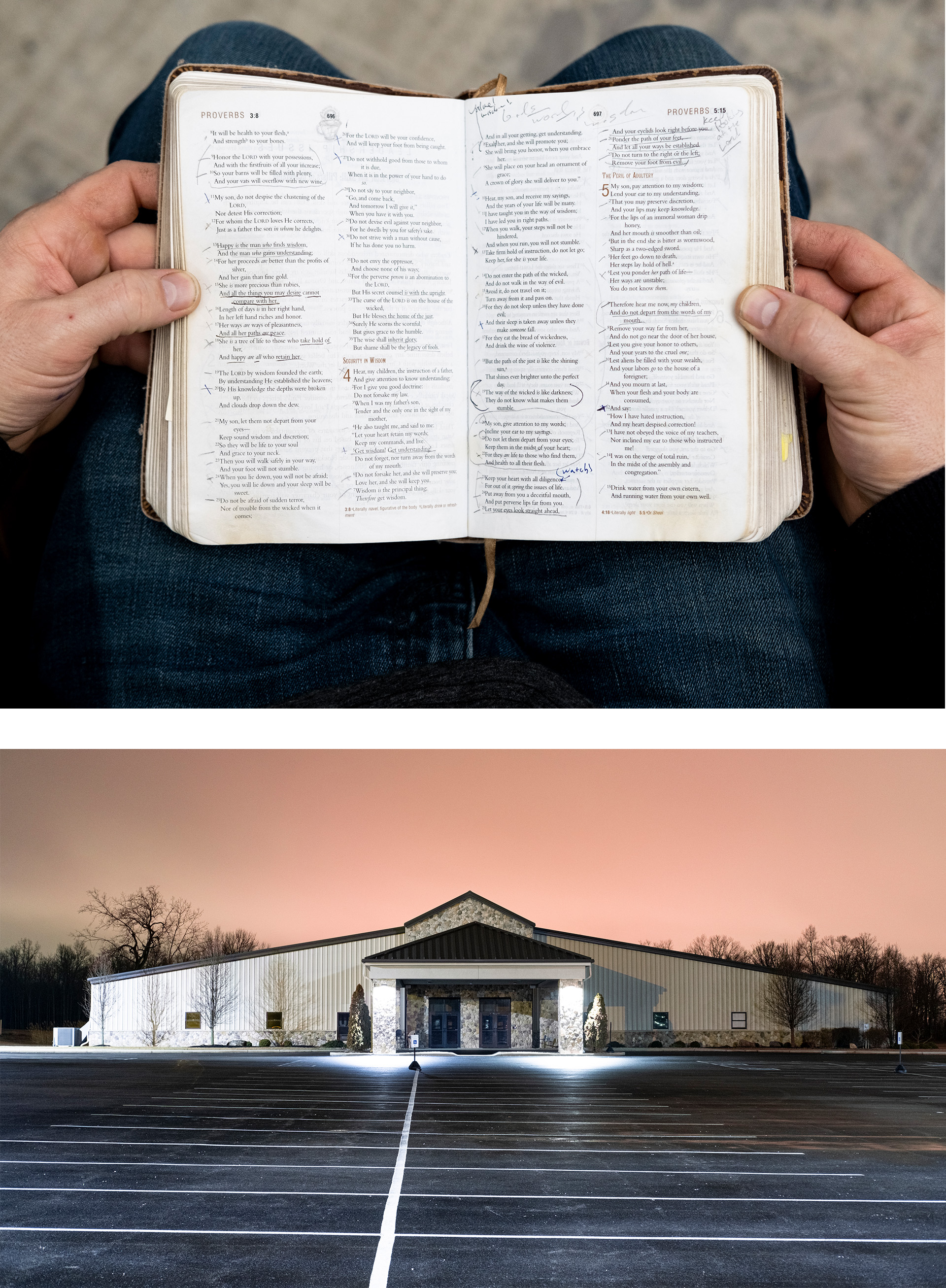
Top: Benjamin’s personal bible. Bottom: Benjamin’s church in Lima, Ohio.Eli Hiller
Top: Benjamin’s personal bible. Bottom: Benjamin’s church in Lima, Ohio.

Needless bruises and bloodshot eyes

I started reading my mom’s Bible, turning to the Book of Proverbs because that’s what my dad would read to us growing up. Many passages grabbed my attention. “Who has woe? Who has sorrow? Who has strife? Who has complaints? Who has needless bruises? Who has bloodshot eyes?” (23:29). That was me, for sure.

I read these words: “Wine is a mocker and beer a brawler. Whoever is led astray by them is not wise” (20:1). Then these: “For drunkards and gluttons become poor, and drowsiness clothes them in rags” (23:21). But the verse that really stopped me in my tracks was Proverbs 4:19: “The way of the wicked is like deep darkness; they do not know what makes them stumble.”

I realized I was stumbling through life because I was always trying to fit in. To be something I wasn’t. Drinking and drugging to win approval from the crowd. But all it did was push me down an increasingly dark path. I saw clearly that my wickedness was my selfishness. I had pushed everyone away, and in return, everyone was gone, leaving me with loneliness and addiction.

I cried out to Jesus, and he saved me. He also started changing me by the power of his Spirit. This didn’t happen overnight, and even though I didn’t desire drugs or alcohol anymore, I continued playing with my bar band for the next year. By God’s grace I avoided falling back into addiction. Meanwhile, God gave me a greater desire to pray and read his Word.

Missy and I have now been married for 11 years, and I’ve been free from drugs and alcohol the entire time. We’ve been blessed with the opportunity to do outreach ministry together, in part by hosting an event called Night of Hope, a concert geared toward helping and encouraging people facing all types of addiction. We have seen the mighty hand of God moving in people’s lives to change and rearrange them from hopelessness to new life in Jesus Christ. Praise God that I can share the hope of having a relationship with Jesus that truly turns one’s darkness to light.

Benjamin Budde is the author of War a Good Warfare: Fighting the Battles Within as well as a children’s book, The Tale of Louie the Lion Tamer. He and his family live in St. Marys, Ohio.

Ideas

Divine Abundance Is More Than a Charismatic Hobbyhorse

Columnist; Contributor

The language of extravagant blessing is thoroughly biblical—even if it’s sometimes abused.

Illustration by Rick Szuecs / Source Images: Tomas Kirvela / Unsplash / Envato

Pentecostal and charismatic Christians love the theme of divine abundance. Hopefully all Christians do, but my tradition tends to stress it. We love talking about the bounty of God, the overflow of the Spirit, and the extravagant riches of Christ. We are more likely to name our churches “Abundant Life” than “Main Street Bible Church.” Our songs and prayers reflect a confidence that God will surpass our expectations by a country mile.

From a distance, this conviction can be misunderstood. Many associate it with an unhealthy interest in money. And at its worst, the language of fullness and abundance can be (and has been) distorted to promise material comfort to those who believe enough, declare enough, or give enough.

But there is no need to throw the baby out with the bathwater. At its best, celebrating divine abundance simply reflects the emphasis of Scripture: the garden filled with fruit, the land flowing with milk and honey, the temple festooned with gold and purple, or the mighty crystal river cascading from God’s throne, bringing healing and fruitfulness wherever it goes.

In particular, divine abundance reflects the emphasis of John’s gospel. Most of us are familiar with John 10:10, where Jesus famously declares, “I have come that they may have life, and have it to the full.” This is not an incidental or isolated remark. Coming halfway through the gospel, it is sandwiched between two “I am” statements: “I am the gate” (v. 9) and “I am the good shepherd” (v. 11). Jesus pictures himself as a doorway to salvation and a shepherd laying down his life for his flock, and between these images comes the key contrast between his ministry and that of the “thieves and robbers” who came before him (v. 8). They came to take; he comes to give. They sought destruction; he seeks abundance.

John has been building toward this statement for a long time. In chapter 1, he describes the ministry of Christ as an outpouring of divine fullness: “From his fullness we have all received, grace upon grace” (v. 16, ESV). In chapter 2, we visit a wedding where Jesus produces an absurdly large quantity of outstanding wine. In chapter 6, he does the same with bread, creating so much that everyone is full and 12 basketfuls are left over.

Jesus’ signs are repeatedly expansive, excessive, and needlessly generous. Individuals are healed after being paralyzed for 38 years (5:1–9), being blind since birth (9:1–7), or even being dead for four days (11:38–44). Over 150 large fish are summoned from the deep, caught, counted, and barbecued (21:11). These are just a small fragment Jesus’ lavish, life-giving deeds—if we had written them all down, John suggests, all the books in the world couldn’t possibly contain them (21:25).

The dialogues in John tell the same story. We learn that Jesus “speaks the words of God,” who gives “the Spirit without limit” (3:34). We learn that he comes to grant “a spring of water welling up to eternal life” (4:14), to do “greater works than these, so that you will be amazed” (5:20), to bequeath “rivers of living water” for people to drink (7:38). He compares himself to a seed that dies and thus bears “much fruit” (12:24, ESV) and a vine in whom his disciples will abide and bear much fruit as well, so that their “joy may be complete” (15:11). Even in Jesus’ death, we see blood and water pouring out of his body, streams of living water flowing from his innermost being (19:34).

John could not make it clearer. Jesus is full—of grace and truth, Spirit and joy, bread and wine, light and life, works and water, and fish and fruit. Divinity professor David Ford puts it simply in his recent commentary: “John is a Gospel of abundance.”

Perhaps we emphasize divine abundance too much. Maybe our obsession with material wealth and welfare results from too much time reflecting on God’s fullness. My suspicion, however, is the exact opposite: that we grab what we can because we think our Father’s resources will run out. Only by reflecting on his bounty—the vats of wine, the baskets of bread, the grace upon grace—do we cultivate lives that are generous and hearts that are filled with joy unspeakable. As Jesus says in Matthew 10:8, “Freely you have received; freely give.”

Andrew Wilson is teaching pastor at King’s Church London and the author of God of All Things.

Ideas

Let’s Rethink the Evangelical Gender Wars

Columnist

Maybe the lines of division between egalitarians and complementarians were in the wrong places.

Illustration by Abigail Erickson / Source Images: Getty

Last year I came across stinging words of rebuke against the ministry of Beth Moore. Her preaching and teaching was a “gateway drug to radical feminism,” said a young conservative. I found the rhetoric appalling, but I couldn’t tell that to the author of those words because he no longer exists. He was Russell Moore, circa 2004.

I was wrong about Beth Moore, but I’m even more chastened by the phrase gateway drug. The gender debate between complementarians and egalitarians was often fraught because it was a debate about just that: which views were “gateway drugs” to what abyss, which “slippery slopes” led to what error.

Some were convinced that egalitarians would lead us away from what the Bible declares to be good: that God designed us as male and female, that we need both mothers and fathers, that sexual expression is limited to the union of husband and wife. Meanwhile, others warned that complementarian arguments wrongly used Scripture the way an earlier generation did to defend white supremacy and slavery.

In recent years, many of us have seen old coalitions and old certainties torn apart. We’ve also discovered “slippery slopes” in unpredictable places. For those who are more traditional, the frustration started with an ever-narrowing definition of complementarian, measured increasingly by countering one’s “enemies” rather than by finding actual biblical consensus. First-order issues that define the catholicity of the church were treated as in-house debates while secondary or tertiary matters of “gender roles” were treated as matters of conciliar-like boundary-definition.

More importantly, recent scandals have demonstrated that the slippery-slope arguments of egalitarians were at least partially right—by pointing out that, for some, what lay behind a zeal for “male headship” was not responsibility before God but a psychologically stunted loathing of women or, worse, a cover for the sadistic silencing of women and girls. We see this not only in the uncovered horrors themselves but also in those who give no evidence of meeting the 1 Timothy 2 requirements for ministry—who, rather than putting away “anger” and “disputing” (v. 8), are the most eager to apply the rest of the chapter to castigate women leaders who’d dare to be a church’s guest speaker on Mother’s Day.

Whatever one might think of the “servant leadership” rhetoric of Promise Keepers a generation ago, we should agree that it’s quite a fall from that to today’s “theobro” vision of opposing such allegedly feminizing attributes as empathy and kindness. Turns out, there really was more John Wayne than Jesus, more Joe Rogan than the apostle Paul, in a lot of what’s been said to be “biblical.”

Many evangelical egalitarians have found themselves “homeless” too. They’ve been labeled in progressive circles as not “real feminists” precisely because, for them, the issue is how best to interpret inspired, authoritative Scripture—including Paul’s letters—not to deconstruct it. Today, when there really is a slippery slope of gender ideology that challenges the male-female binary, evangelical egalitarians spend more of their time in the outside world defending the idea that there is a complementarity of male and female, just not of the patriarchal sort.

As one woman minister told me, “I can’t go to the conferences I want to attend—with people I agree with on 99 percent of everything—because they think I’m ‘liberal,’ while some of the people who would celebrate that I’m ordained are horrified that I will never give up the essential biblical language of God as Father, Son, and Holy Spirit.”

Many of us are rethinking who we once classified as “enemy” and as “ally.” Maybe the lines of division were in the wrong places all along. Those who hold to believer’s baptism, for example, have more in common with evangelicals who practice infant baptism than with Latter-day Saints who immerse adults. Those who disagree on how Galatians 3:28 fits with Ephesians 5 but who want to see men and women fully engaged in the Great Commission have more in common with each other than with those who would make gender either everything or nothing.

A new generation of Christian men and women is coming. When it comes to teaching them how to stand together, and how to equip one another to teach and lead, I trust Beth Moore much more than 2004 Russell Moore to show them the way.

Russell Moore is editor in chief of CT.

Ideas

God’s Yoke for the Decision Fatigued

Columnist

The way out of overcommitment runs through God’s temple.

Illustration by Rick Szuecs / Source Image:Stockcam / Getty

I often begin writing a new song—or even something as ordinary as a letter to a friend—because I have seen a spark, a shimmer of God’s renewal in the world. But sometimes I have to weather a few false starts. Some seeds we plant seem to sprout overnight, while others take time.

Much of life is like this. Recently, we had plans to take the family to a local concert. I was hoping the tickets might present an opportunity for family bonding or even a new tradition. But I had just returned from travel, and my idealized imaginings of a happy annual outing fizzled as we were all pulled in different directions: One family member needed dinner; another was not feeling well; one had a homework backlog; another had a last-minute school event.

We were about halfway to the venue, driving in the rain, when we gave up on the concert. I felt a mix of relief and disappointment as we turned toward home. When logistical tornados like this one swirl, my resolve goes soft and my commitment falters. Should we push through and stick to the plan? Or should we hang back to accommodate the needs of the moment?

When our plans become too much and our days too full, it’s easy to get stuck. We’re overextended, and we stumble into indecision like it’s quicksand. The harder we try to climb out, the more we sink down. We try to discern what plans to make or which priorities to keep by reducing them to something like a math equation. We ration out resources to our competing desires.

It’s a logical approach. So why is it so hard sometimes to figure out what the one thing is that really matters?

Maybe because—as happens often in such moments—none of the options we’re choosing from is the one that really matters. “One thing have I asked of the Lord, that will I seek after: that I may dwell in the house of the Lord all the days of my life, to gaze upon the beauty of the Lord and to inquire in his temple” (Ps. 27:4, ESV).

Psalm 27 whispers wisdom into our small, overwhelmed moments. Many things come up in a day: a water leak, a medical bill that slipped by, a birthday card to send. But our anxieties can hold us hostage to vague ideas when we could be taking active, imaginative steps toward bringing about God’s beautiful plan for us and for his world.

“To inquire in his temple” sounds like a big idea. How do we go about that? It can begin small, maybe simply with the act of stopping to wonder at the beauty of God. When I stop to wonder about the thoughts God may be having today, in this moment, in real time, my own thoughts are reordered. My priorities change.

What does God think about the plans we’re making for dinner? What does he think about the local election coming up? What does he notice in the meeting at work that he whispers to me in my spirit? Who does he see in my social orbit today I might have overlooked?

These kinds of questions are not meant to put us into some state of overspiritualized paralysis. They are meant to free us from the other questions that do and to help us slow and still ourselves long enough to pay attention to God’s presence.

We want to create meaning in our lives, but sometimes we miss the main idea. Even after years of practicing this, sometimes I still don’t recognize the best decision until I’m halfway to where I was going and make a tearful U-turn.

This is not simply mindfulness. It is transformation by beauty. When my aim is delight, I am not as easily taken with distraction. If we delight in his plans over our own plans, we find alternate outcomes. When we have taken delight in his beauty and glory, we can rest when we need to rest. We take his freedom as our own. We don’t have to be enslaved to the demands of our desires or our relationships. We become lighter in spirit. A view of his glory turns our own plans and ideas into a truer reflection of his. We are free to be more than “pleasers” or to just put out the fires of the urgent requests of our day.

The more we gaze upon him, the more our lives are illuminated by the shimmer of his glory. It is like glitter in a preschool classroom: His glory goes everywhere. It stays, it sticks, it shines when you spend time near him.

Sandra McCracken is a singer-songwriter and author in Nashville. She is also the host of The Slow Work podcast produced by CT.

To Keep Gen Z in the Pews, One Singapore Church Lets Them Run the Service

Churches also find that having them in community with older members and answering their “whys” help them stay in the church.

Young people at Heart of God Church in Singapore run all aspects weekend worship.

Young people at Heart of God Church in Singapore run all aspects weekend worship.

Christianity Today February 10, 2023
Courtesy of Heart of God Church

Since Heart of God Church in Singapore started more than 20 years ago, it’s succeeded in attracting a hard-to-capture demographic: The average age of its congregants has remained steady at 22 years old.

Today, about 5,000 people attend Heart of God Church each Sunday. Cecilia Chan, the church’s co-founding senior pastor affectionately known as Pastor Lia, noted their strategy: “Youths need to be invited, included, involved, before they can be influenced and impacted.”

That means teens as young as 12 are given responsibilities like designing slides, filming church livestreams, running the soundboard, or even helping coordinate Sunday services. At the same time, they are mentored by others a few life stages ahead of them.

Churches in Singapore face similar struggles as their counterparts around the world in keeping Gen Z engaged, as the digital natives are bombarded with distractions and noise from the rest of the world. Many young people’s views on issues like sexuality or what comprises a family unit are no longer defined by Asian societal norms. A 2020 census found that a growing number of young people (ages 15-24) say they have no religious affiliations: The number rose from 21 percent in 2010 to 24 percent in 2020.

Singaporean students, who are known for their chart-topping test scores, also experience high levels of anxiety and stress about doing well academically. With pressure from their parents as well as their peers, students spend afterschool hours in tutoring and enrichment classes. In their remaining free time, many spend it on their phones. Activities that provide opportunities to interact face-to-face and don’t focus on schoolwork are a breath of fresh air.

Christianity Today spoke with three Singaporean churches that have bustling youth ministries to see how they are reaching this demographic. These congregations are getting young people involved, providing interaction across generations, building in-person relationships, and pressing deeper into why the Bible and God can be trusted. “I feel empowered”

Goh Xin Yi, 19, started attending Heart of God Church six years ago after a friend from school invited him to the church’s Easter service. “It was interesting to see so many young people at one place outside of school and [tutoring] centers,” he said.

As a new member, he attended a ministry training program which introduced him to more than 80 ministries in which he could serve. At the same time, he took part in Bible studies to learn more about God.

Goh chose to serve in the church’s live-feed team before becoming the camera director at 16. Now at 19, he is the leader of media operations, supervising 50 others.

“Serving in the ministry gives me a sense of belonging,” Goh said. “I feel empowered. I feel trusted to be given a chance to handle the very expensive equipment.”

More than 80 percent of the congregation serve in various ministries, with seven “generations” of leaders working alongside each other. Each generation is about three to five years apart and forms its own youth group. The first generation includes homegrown pastors in their 30s, while the newest generation incorporates leaders as young as 13.

In Goh’s case, he is mentored by a 27-year-old leader who heads the entire media team of more than 300 people. And Goh himself works with young teens who are 12 and 13.

“They offer very raw thoughts and fresh perspectives,” Goh said of his mentees. “I like to empower them like how I used to be given responsibilities when I was at their age.”

Left: Service at Heart of God venue, Imaginarium. Right: Three Generations serving together as photography trainer, crew, and supervisor.Courtesy of Heart of God Church
Left: Service at Heart of God venue, Imaginarium. Right: Three Generations serving together as photography trainer, crew, and supervisor.

Lia noted that giving young people opportunities to lead and train helps keep them engaged. “Older generations are not replaced but reinforced as the younger generations join the ranks” and serve with them, she said.

Finding a family in the church

Over at the Chinese-language congregation at All Saints Church, leaders are using a different strategy to reach young people. One challenge the congregation faces is that young Singaporeans are more comfortable speaking English than Chinese, so they often attend English-speaking churches.

Yet All Saints Church is seeing its Chinese-language youth ministry, which currently has 70 members, grow at about 6 percent each year. It builds on its strength of being a multigenerational church by creating activities for both teens and the elderly to participate in together.

For instance, the church organizes an annual camp for students at Anglican High School, which is connected to the church. The elderly church members serve food during camp and pray for camp members, while the young adults oversee camp programming and lead the church camp small groups.

“In a Chinese church like ours, the family culture and tradition is more pronounced,” said Fu Weikai, an associate pastor at All Saints Church who oversees the Chinese youth ministry.

According to Fu, some young people find in the church the kinship or family bonding missing in their own homes. "We have this program called Dinner with the Elders where couples in their 50s open their homes to young adults for dinners and fellowship with them.”

Clement Ong, 29, joined the church when he was 16 after participating in the Anglican High School’s student camp. Today Ong serves in the youth ministry. He has observed that in some dual-income families, a child’s support system has shifted from their nuclear family to the church family.

“With Instagram and social media, we leaders are also more tuned in to the lives of the youths,” Ong said. “When we see certain updates, we will check in on them more often, dropping them a text and meeting them one-on-one for meals.”

But such technology has a flip side. Fu noted that many young people’s worldviews are formed through their smartphones.

“What they know about their friends are from the Instagram stories and TikTok videos,” Fu said. “Some youths are actually awkward in social situations as most of them communicate virtually.”

That’s why Fu and the church’s other leaders are intentional about building in-person relationships. The church has a space for Anglican High School students to gather and get to know some of church workers during recess. In this air-conditioned environment, students can also play with the onsite guitar or drum set to unwind.

Thinking about how young people engage with information, Fu has also changed the way he delivers sermons and what he covers in the youth ministry. “I cannot nag at them for 40 minutes,” Fu said. “It used to be when we ask them to jump, they say ‘How high?’ Now they ask, ‘Why jump?’” said Fu.

Now he caps his sermons at about 20 minutes and no longer has a list of dos and don’ts. For instance, when he preaches on the topic of pride, he can’t just tell them to stop being prideful. “It is about explaining the problem of pride, acknowledging the presence of pride in our lives, and how to lean on God’s faithfulness to deliver us.” said Fu. Answering the “whys”

Eddie Ho, a pastor at Faith Methodist Church who oversees its youth ministry of 200 members, said young people often ask him, “why should I trust the Bible?”

This is different from the past, when teens would more willingly accept what their parents and teachers tell them. Now with easy access to the internet, young people seek other points of views and alternative perspectives.

“We cannot assume they are convinced that the Bible is the truth,” said Ho. “We have to provide the ‘why.’ We need to tell them the underlying principle behind God’s commandments.”

For instance, Ho’s sermons dig deeper into the question of why Jesus commanded his followers to love their neighbors as they love themselves: “Because we are all created in His image,” Ho said. “We love God, we love his image, we love our neighbors.”

Once a month, the church hosts youth services with a panel of speakers discussing relevant topics like serving in church, social media and online games, sexuality, and apologetics. Afterwards, there is time for students to discuss and reflect on the topic, and sometimes they gather for a meal.

Ho believes one-on-one ministry is important in an age when young people want quick answers to their questions. “We need to equip good youth leaders to connect with the youths, especially at this age when youths rather listen to their friends than their parents.”

Yet even with the best efforts of their parents and their congregation, young people can still stray from the church and from God. Ho encourages those with wayward children or loved ones: “Look further ahead, some youths may not attend church now, but we as parents, as spiritual parents, and families should continue to show love and plant the [seed], and prayerfully wait for God to do His work on these youths.”

News

With Sports Betting Surge, Churches Should Up the Ante on Addiction Recovery

As the Super Bowl pulls in record wagers, more people are seeking help for problem gambling. Christians can pull lessons from the opioid crisis to help with treatment.

A person gambles at a Vegas casino in February as betting odds for NFL football's Super Bowl are displayed on monitors.

A person gambles at a Vegas casino in February as betting odds for NFL football's Super Bowl are displayed on monitors.

Christianity Today February 10, 2023
AP Photo/John Locher

Americans are gearing up to bet billions on the Super Bowl, but the quick expansion of gambling is leaving a trail of addiction in its wake.

Troy Adams is one of those in recovery. When he was a 22-year-old US Marine, Adams went with some other Marines to a Las Vegas casino the weekend before they deployed to Iraq. They played baccarat and won a lot of money. The casino offered them all free rooms and other comps.

“We were young and dumb and didn’t realize why they were doing these things,” he remembered. Years passed without him going to casinos again, but that feeling of winning stuck with him.

Years later, in 2016, he craved that feeling again when a lot of crises piled up: Massive flooding hit his home in southern Louisiana, his brother’s wife died unexpectedly, and his dad was diagnosed with terminal cancer.

“I started going to the casino as an escape,” he told CT. “It became my safe haven and my refuge.” Like any other addiction, he said, “you physically cannot stop. You can’t see a way out.” It began to take over his life.

The science of gambling addiction works similarly to addictive substances. The American Psychiatric Association added gambling to its category of behavioral addictions in 2013, based on research that it is similar to substance abuse in “clinical expression, brain origin, comorbidity, physiology, and treatment.”

It was the first non-substance behavioral addiction to be classified this way, but Americans still don’t see gambling as a potential problem like drugs or alcohol. And churches often don’t see the moral hazards of gambling or the need for recovery ministry for gambling.

Kentucky is one of the few holdout states that hasn’t legalized online sports betting, and Baptists there are using the parallels to the drug crisis to try to halt the legislature’s attempts this session to legalize the industry.

“Kentucky already struggles with drug addiction, and it is immoral for the state to encourage another form of addiction—sports betting,” said Todd Gray, the head of the Kentucky Baptist Convention, in comments to Kentucky Today.

The National Council on Problem Gambling estimates two million Americans meet the “diagnostic criteria” for gambling addiction. (For comparison, about three million Americans have an opioid use disorder.) Being young and male are the highest risk factors. The New York Times reported a 43 percent increase in calls to a national hotline for gambling problems last year.

This weekend, the Super Bowl will draw $16 billion in wagers from Americans, according to the American Gaming Association, up from $7.6 billion last year. The number of Americans planning to place wagers on the game has increased 61 percent from last year, the association found. BetMGM reported that its bets doubled on the Super Bowl in 2022 compared to the 2021 game.

The big game highlights how gambling has exploded since the US Supreme Court removed a ban on sports betting in 2018. Since then, most states have legalized it with few restrictions. Americans bet $92 billion in 2022, according to SportsHandle, a trade publication, up from $58 billion in 2021.

More people are being introduced to gambling. “I haven’t seen an online sports betting ad in almost 7 minutes. Am I dead?” joked comedian Conan O’Brien in a tweet last year. Companies use offers of “risk-free” bets to bring in new customers, reimbursing them for losses. The New York Times in an investigation last year discovered that 18 states made those promotional offers tax deductible for the gambling companies—essentially subsidizing them.

And as has happened in other countries where online sports betting has been legalized, a surge in new people betting means more people with a gambling addiction. As Adams told CT, the problem is that betting can result in a positive outcome—winning money.

But that’s similar to the early days of the opioid crisis, when the drugs were marketed as nonaddictive. Gambling might not be lethal like fentanyl, but the National Council on Problem Gambling has said that the suicide rate among problem gamblers is higher than for any other addiction disorder, and there is a correlation with other substance abuse.

For Adams, Adderall and alcohol use crept in as he stayed up to gamble while working a full-time job. He began stealing money from his cousin’s business and eventually went to jail. He was released into various recovery programs but relapsed and was sent back to jail. His dad died while he was in jail, and he attended the funeral in shackles.

He went in and out of residential recovery programs, some of them better than others, some faith-based and some not. He was “off the bet” for 18 months and then relapsed, and eventually ended up back in jail, and then in another recovery program.

This time the court-ordered recovery program was helpful. After that, he started at a faith-based recovery home that was part of First Bossier, a Baptist church that has one of its pastors focused on recovery ministries.

Adams found a lot of growth there. The church hosts a weekly Celebrate Recovery program that Adams joined in addition to attending a local Gamblers Anonymous meeting. GA and Celebrate Recovery “pretty much saved my life,” he said.

“GA more than anything was the most beneficial—a group of people who understood and didn’t judge you,” he said. “The only two groups of people I’ve met in the world that are not judgmental—or they’re compassionate and understanding—are real Christians and people in recovery. … God still loves me, and I try to live my life that way.”

Recovery ministry veterans see resources

Janet Jacobs has been connecting churches and individuals with gambling-addiction recovery resources for more than 20 years through Gambling Recovery Ministries, affiliated with the United Methodist Church (UMC). She didn’t know anything about gambling addiction when she started the ministry in 2001 at the request of her bishop.

“The UMC, their particular doctrine with regard to gambling is, ‘No,’” quipped Jacobs. “You don’t gamble.”

Now, as well as in 2001, she found very few faith-based resources for gambling addiction recovery. Churches rely on general addiction recovery ministries to help someone with a gambling problem, she said.

One benefit of more than a decade in the pits of an opioid crisis is that churches do have more addiction recovery resources than in the past. But some problem gamblers, she finds, want more specific help than drug or alcohol recovery.

Jacobs said the US Catholic Church has an outreach for its priests or nuns with a gambling problem at a Catholic treatment center, but not something specific for parishioners.

“There really is very little in terms of faith-based outreach to problem gamblers and their loved ones. … It gets lumped in all the different addictions,” she said.

She says there are a lot of non-faith-based resources for addicted gamblers: She finds Gamblers Anonymous meetings and Gam-Anon meetings to be very helpful. She encourages people who may not like a particular GA meeting they visit to try a different GA group that might have a different feel. For churches who want to do outreach, she says they can start by contacting GA and offering to host GA meetings at their facility. That starts relationships, she said.

“Many faith-based organizations or fellowships just don’t go beyond that,” she said. But, “you have to start somewhere.”

Some areas of the country may lack counselors certified in gambling addiction, but she says those certified through the International Gambling Counselor Certification Board “know what they’re talking about.” As a volunteer there, she started a clergy track at the board about a decade ago to offer additional training and certification. She recommends that kind of counseling treatment alongside GA or Celebrate Recovery.

Deborah Haskins, a clinical counselor, got that clergy certification, and she has been training other clergy on this issue. She recently held a training for 16 people from an African-descent Pentecostal church in Delaware.

“We need more faith leaders to understand this is a public health concern,” she told CT. With the recent blanket advertising, “more folks will become addicted. … We are where we were years ago with drug addiction. People still see it as a character defect versus a brain disease.”

Parents look for recovery options for their children

Lisa Gwatney’s son began gambling with friends in college. Soon after he graduated, sports betting became legal. He was an athlete, he was competitive, and, his mom said, he is good with numbers—so he was winning, and he was drawn in.

He gambles on his phone now all the time, Gwatney says. Casinos have targeted him, she said, giving him promos, free alcohol, and flying him out to Las Vegas. He’s tried to self-ban from apps and casinos with his mom’s help, but she said the casinos will offer free rooms in another state where he hasn’t self-banned.

“When people say, ‘What’s the big deal?’ I’m telling you it’s a very big deal,” Gwatney said. “We had this kid with so much promise and watched him be systemically destroyed by an industry that doesn’t care if he’s dead.”

Les Bernal at Stop Predatory Gambling has noted that betting companies ultimately want sports betting users to move to casino games—because then users are playing against the house.

“The states want the money,” Gwatney said. “The losses of addicted people are just acceptable consequences for them.”

Solutions were hard to find, Gwatney said. She found one of the few GA meetings in the area and went with her son to it, only to discover it had stopped meeting. She called the national hotline but said they didn’t have any resources to give to a parent, only to the person with the addiction.

In desperation about a year ago, Gwatney got her pastor and friends to hold an intervention for her son. Their friends were surprised he had an addiction. She did her own research and found a professional to guide them through it, having everyone write him letters and cut him off financially. She asked him to stay and get help in Tennessee, but she said a casino had just offered him free rooms in Detroit—and he went there.

After, she wasn’t sure the intervention was the right choice. She had read a book about drug addiction, Unhooked, which helped her understand the principles of addiction at work in her son. It noted that forcing an addict into recovery rarely works, that the person needs to want help.

She has asked herself what she might have done wrong as a parent—she and her husband had rules for him; they loved him. She cautions other parents to warn their children about gambling the same way they would warn them about drinking and driving or not leaving a drink unattended at a party.

“If I could take this burden from him, I would take it,” said Gwatney.

Friends continue to pray for her son, and Gwatney prays a prayer from a card for a prodigal son every day. It starts, “Lord, protect my son. Build a hedge around him …”

She wakes up every day, she said, and checks her phone to see if her son is alive. She doesn’t know how someone without faith in God could bear something like this. But she was convicted recently that the shame about what her son was going through was a sign “that the Devil wanted to separate us from God’s grace.” She has bought her son health insurance in the hope that maybe he could go into a residential rehab program when he’s ready.

“The folks who are not keeping up with this—even halfway keeping up—are really losing out in terms of outreach to help people,” said Jacobs from Gambling Recovery Ministries.

Gambling Recovery Resources
Gamblers Anonymous
Gam-Anon
National Council on Problem Gambling – Help line and chat
Gamtalk.org
– Recommendations from Janet Jacobs, longtime head of Gambling Recovery Ministries

News

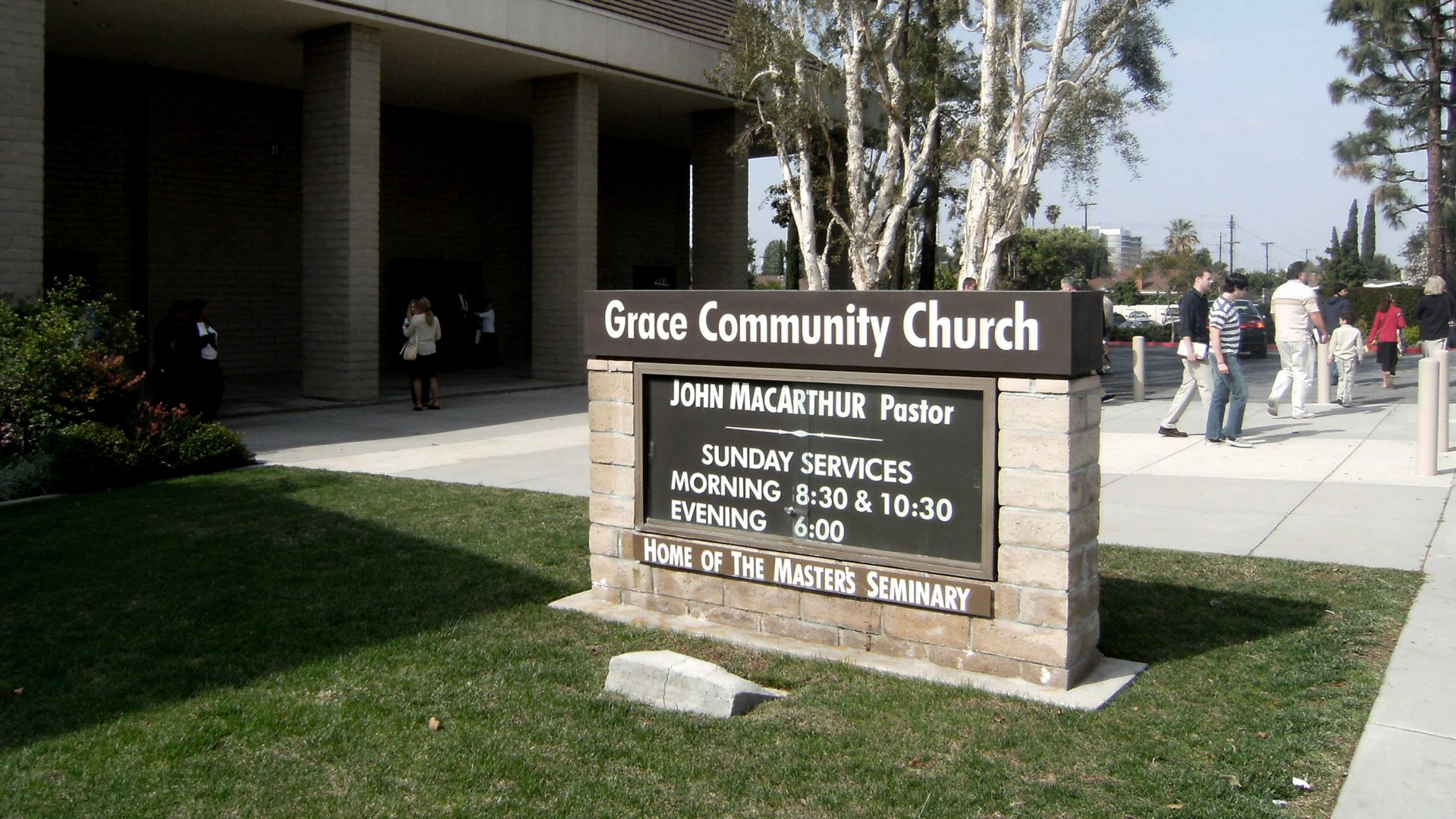
Grace Community Church Rejected Elder’s Calls to ‘Do Justice’ in Abuse Case

While a former leader hopes for change, women who sought refuge in biblical counseling at John MacArthur’s church say they feared discipline for seeking safety from their abusive marriages.

Christianity Today February 9, 2023
Edits by Christianity Today / Source Image: WikiMedia Commons

Last year, Hohn Cho concluded Grace Community Church had made a mistake.

The elders had publicly disciplined a woman for refusing to take back her husband. As it turned out, the woman’s fears proved true, and her husband went to prison for child molestation and abuse. The church never retracted its discipline or apologized in the 20 years since.

As a lawyer and one of four officers on the elder board at Grace Community Church (GCC), Cho was asked to study the case. He tried to convince the church’s leaders to reconsider and at least privately make it right. He said pastor John MacArthur told him to “forget it.” When Cho continued to call the elders to “do justice” on the woman’s behalf, he said he was asked to walk back his conclusions or resign.

It’s been 10 months since Cho left Grace Community Church, and he has not been able to forget the woman, Eileen Gray, whose experience was described in detail last March in Julie Roys’s news outlet, The Roys Report.

Though Cho stepped down quietly, he continued to hear from other women from his former church. They had also been doubted, dismissed, and implicitly or explicitly threatened with discipline while seeking refuge from their abusive marriages. Even at his new congregation, Cho began to meet visitors with connections to Gray’s case, which he saw as a sign of God’s providence.

No, he couldn’t “forget it.”

The more he learned, the more people he talked with, the more the injustice weighed on his conscience and the more concerned he grew about the church’s biblical counseling around abuse.

As Cho wrote in a 20-page memo to top leaders at Grace Community Church last March, “I genuinely believe it would be wrong to do nothing. At the end of the day, I know what I know. I cannot ‘un-know’ it, and I am in fact accountable before God for this knowledge, and if you have labored mightily to read this far, you are now accountable before God for it as well.”

Grace Community Church is led by MacArthur, one of America’s longest-standing and most influential pastors. The Sun Valley, California, megachurch is best known for MacArthur’s preaching and prides itself on its fidelity to the Bible over the whims of the world.

GCC’s reach extends far beyond the crowds that fill its 3,500-seat auditorium for multiple services each Sunday, through MacArthur’s popular books and commentaries; affiliated schools The Master’s Seminary and The Master’s University; Grace to You teaching ministry; and the church’s annual Shepherds Conference.

At the conference last March, Cho taught on “Conscience and Conviction.” He spent the rest of the year living out the lesson. Over the summer and fall, Cho held out a “faint hope” that the 37-member elder board would reconsider Gray’s case, praying that God would soften leaders’ hearts and change their minds.

He wanted to see them correct the mistakes of their past and do better in the future. Instead, he discovered they appeared to be repeating them.

Months after raising his concerns about a 20-year-old case, Cho discovered “another grievous GCC counseling case” in the fall of 2022. A woman reported that church leaders had advised her to move back in with her husband and not get a restraining order despite his documented grooming behaviors, infidelity, and angry outbursts. Though the case settled in January, after the woman sought court-ordered protection last year, two pastors had filed declarations on her husband’s behalf.

“In God’s providence, he kept placing reminders in front of me, completely unbidden. When my wife and I were asked by a friend to pray for a woman my wife happened to know, she reached out in concern, and we were horrified to discover the same awful patterns of counseling were still happening at GCC,” Cho told CT.

“This is when I sadly came to believe beyond any personal doubt that GCC congregants who we still love could effectively be playing Russian roulette if they ever needed counseling at GCC, especially anything involving the care of women or children. I knew I could not pass by silently on the other side of the road, that I needed to help this woman and to call out a warning, or else the blood of the people would be on my head.”

For this story, CT spoke with eight women who recounted how they and others at Grace Community Church had been counseled to avoid reporting their husbands and fathers to authorities, to accept their apologies, and to continue to submit to them.

The victims were regularly quoted Scriptures on forgiveness, trust, love, and submission—and were told to reconcile and return home even in cases where they feared for their safety and their children’s safety.

No one from GCC responded to requests by CT to discuss the church’s counseling philosophy or response to abuse, or to questions about specific cases. Six pastors and elders were contacted for comment by phone and email repeatedly over a three-week period prior to this article’s publication, as well as one former pastor and elder. (Update: Following publication, Grace Community Church released a statement saying that the elders do not comment on counseling and discipline disputes, but that the church “deals with accusations personally and privately.” They defended their counsel as biblical, saying, “Our church’s history and congregation are the testimony.”)

‘You need to make it right’

Cho first read about Eileen Gray’s case last March, after the Roys Report coverage, when he said he had been asked to look over the church’s handling of her case for the elder board. His review, drawing from his legal background and training, became part of an initial internal investigation.

The church discipline happened in 2002, a few years before Cho came to faith at Grace Community Church. Gray had refused to follow leaders’ counsel to lift a restraining order against her abusive husband, David Gray. During a monthly Communion service, MacArthur characterized her decision as unrepentant sin, saying the mother of three chose “to leave … and forsake” her husband.

David Gray, once a teacher on staff at the church, went on to be sentenced for his crimes in 2005: aggravated child molestation, corporal injury to a child, and child abuse. Witnesses and victims backed his wife’s account of the abusive behavior, while church leaders continued to defend him, according to court documents referenced and posted with the March 2022 Roys Report article. David Gray remains in prison.

Cho said many leaders at Grace Community Church refused to read the Roys Report article. Some did and dismissed its findings anyway. Top leaders at the church became defensive, he said, and wanted to protect MacArthur.

To Cho, as well as to seven Christian lawyers who reviewed the material, it was obvious that David Gray was guilty beyond a reasonable doubt and Eileen Gray’s refusal to lift the restraining order to protect her children was objectively reasonable and fully vindicated.

“Now that the facts are indeed known, it is not too late to ‘do justice’ even at this late stage, almost 20 years later,” he wrote to the elder board. “One’s own integrity, and upholding justice and righteousness, and being faithful even in the small things, even for something 20 years ago, all matter immensely.”

Cho expected the church to hold itself to a higher standard than even the secular courts. In Eileen Gray’s case, overseen by then-associate executive pastor Carey Hardy and involving GCC’s longtime pastor of counseling Bill Shannon, he found evidence of mistreatment, bias, and errors in how they handled the case. Eileen Gray was repeatedly disbelieved and accused of being “bizarre,” which wasn’t relevant to the reason for her discipline, and leaders cast doubt on her account despite David Gray’s history of deceit.

“They sided with a child abuser, who turned out to be a child molester, over a mother desperately trying to protect her three innocent young children. And that was and is flatly wrong, and needs to be made right,” Cho said to CT. “Numerous elders have admitted in various private conversations that ‘mistakes were made’ and that they would make a different decision today knowing what they know now. But those admissions mean you need to make it right with the person you wronged; that is utterly basic Christianity.”

While still on the board last March, Cho emphasized the urgency of correcting the record. The elders had called out sin where there was none, he insisted. If they had learned that they’d disciplined a man wrongly accused of adultery, wouldn’t they want to make that right, even if they found out 20 years later?

According to Cho, who served as the board secretary and was responsible for taking notes, MacArthur replied during the March meeting that the comparison didn’t apply to Eileen Gray. The pastor brought up again claims of her “bizarre behavior” and wasn’t inclined to reconsider her discipline.

After that, Cho said, he was told by elder board chair Chris Hamilton that he would need to “walk back” his findings about the church’s mistakes if he wanted to remain an elder. (Hamilton did not respond to requests for comment.) Cho and his wife resigned their membership the next day.

Submit ‘as unto the Lord’

This fall, Cho found himself once again reviewing court filings from a member at Grace Community Church who sought a restraining order against her husband in hopes of protecting herself and her young children from abuse—this time at the woman’s request. Certain parallels to Eileen Gray were immediately clear to him.

The woman told CT she recognized the parallels too. She said when she read about Eileen Gray last year, she thought, This sounds a lot like what I’ve been told. (CT’s policy allows victims of abuse to go unnamed for the sake of privacy and safety; her identity and the details of her account have been verified in reporting this story.)

“Whenever I made moves in the direction of the restraining order, it was, ‘Be careful of the heart of retaliation,’” the woman said. “They were telling me to back off, essentially. … They were saying it was un-Christian of me to seek that legal protection because believers don’t take other believers to court.”

She said she had reported to church leaders evidence of her husband’s infidelity, searches for incest porn, and inappropriate behavior with their daughter starting when she was just a couple years old.

A month after moving back in with her husband at the request of their pastors, she called 911 out of fear during an argument on the road. In court filings obtained by CT, she stated pastor and elder Rodney Andersen told her that she should submit to her husband “as unto the Lord” rather than provoke him. The domestic violence officers dispatched to the scene, she said, told her not to return to home.

Two GCC elders went on to submit sworn statements on behalf of her husband. Andersen’s declaration recounts the husband saying during counseling that he and his daughter had touched tongues while they kissed to imitate a scene in a cartoon.

A declaration from the other pastor and elder, Brad Klassen, said that the woman came to him concerned about pictures taken by her husband but that she didn’t have “evidence” of the abuse. According to her own filing, the photos include pictures of her toddler touching her husband’s pants zipper and her face being sprayed with water as well as selfies with the child while she was naked. Klassen’s declaration said the photos did not contain nudity.

Two other leaders at Grace said they would testify on the wife’s behalf, but the couple reached an agreement in January prior to their court date, so none of the pastors ended up needing to testify. In the settlement, the wife did not retract the abuse claims made against her husband.

In the end, she said, the betrayal of her church—now her former church—hurt the most.

“I hit subzero spiritually. I was doubting if God is real. I thought, If God is real but we’re supposed to submit to church leaders when this is going on, I’d rather die,” the woman said to CT. “Even unbelievers wouldn’t stand for this.”

The woman said she saw the Lord “work sovereignly” to lead her through the process, eventually coming to see that “the failure of the church doesn’t nullify the existence of God or the justice of God.”

“I need to fear God instead of man. Just because someone quotes a verse to you and they’re in a position of authority doesn’t mean they’re doing it well,” she said.

When she challenged the pastors’ advice to return to and trust her husband, she said she was reminded of passages like love “believes all things” and that Jesus said to forgive “seventy times seven” times.

According to her account, the trauma and warning signs weren’t enough—the pastors wanted evidence of physical abuse, “skin to skin” adultery, or a conviction of child molestation before agreeing she had biblical grounds for divorce. She couldn’t wait for that.

‘My safety was not the No. 1 priority’

The cases at Grace Community Church land in a larger debate around what qualifies as abuse and whether Christians should prioritize reconciliation in abuse cases, with the church and its seminary holding a prominent place among conservative biblical counselors and the Association of Certified Biblical Counselors (ACBC).

“There’s a fundamentally different understanding of what abuse is,” said Jonathan Holmes, a graduate of The Master’s University and a pastor and counselor in Ohio, noting that the label—and the most serious responses—often get reserved for physical and sexual violations.

Like fellow complementarians, MacArthur has preached multiple times against women staying with abusive husbands for the sake of marital submission. He taught that women and children should “get to a place of safety” and that perpetrators of domestic violence are no longer behaving as believers and have therefore forfeited their right to marriage.

Yet, as Cho brought up in his letters to key elders last year, a string of women over the past decade said they received different counsel at his church when they feared for their safety or their children’s safety.

Multiple women named Bill Shannon, a pastor of counseling and ACBC fellow, as discouraging them from reporting abuse to police and directing them to stay in homes where they had been threatened with violence. One couple said they observed a counseling session where Shannon failed to advise a member of their family to report a man who had confessed to an incident of child molestation; Shannon told her to “not settle” but did not direct her to leave him, since he hadn’t been convicted.

Shannon is among the leaders who did not respond to multiple requests for comment for this story.

Current and former elders had also raised concerns about Shannon’s “incompetent” counsel. Cho said MacArthur had been warned about the concerns but has defended Shannon and kept him in the same position. According to the GCC website, Shannon continues to provide “formal and informal” counseling to members, teach the church’s premarital and marriage seminar, and preach sermons for an adult small group.

“In the first meeting with Bill Shannon, it was made known that my safety was not the No. 1 priority; it was submission in my marriage,” said one woman, who asked not to be named in this story because she is attempting to move on from her time at Grace Community Church. “My job was not to rile [my husband] up.”

While the woman was hospitalized due to her husband’s physical abuse, Shannon called her and advised her to go home without calling police, she told CT. At times, the torment at home was bad enough that she worried she was going to die, but she said she was told that her situation may be “God’s will for your life.”

In marital counseling, pastors asked wives whether their attitudes contributed to the patterns of violence, anger, and manipulation in their relationships. In some situations, they implied women were looking for fault in their husbands.

“It’s hard for a pastor to conceive of a dynamic where a woman is receiving mistreatment, where at some point along the road, she is not expressly responsible for it,” Holmes said.

This “mutualization” of sin can take place in church settings where both parties are asked to confess and seek forgiveness from each other.

“Our philosophy is that if there’s been abuse, you don’t put them into a room and expect them both to go through the process of getting the log out of their eyes,” said Ken Sande, a Christian mediator who spoke of patterns he’s seen over decades of conciliation ministry, not about GCC in particular.

‘No other choice’

Each of the women CT spoke with said at some point they considered themselves partly responsible for their husband’s behavior or had a church leader indicate they were.

The women were reminded of the biblical directive for wives to submit to their husbands. For years, they had hoped their submission, their faithfulness in marriage, and their desperate prayers would eventually lead to change in their husbands. But when issues persisted and escalated, they sought help and counsel on what else could be done.

“It takes a tremendous amount of courage, humility, and vulnerability to even seek help from the church when there has been abuse in the home,” said Wendy Guay, who spoke to The Roys Report last year about abuse by her father Paul Guay while he was on staff at Grace Community Church in the late 1970s. “Women have hidden, persevered, and tried to handle things on their own until there was no other choice,” she added.

When wives felt like they needed to move out for their safety, they said pastors told them to stay. After they had separated or secured legal protection, they said pastors urged them to reconcile. Women told CT that pastors saw their husbands’ continued involvement in counseling, caring treatment of their kids in supervised settings, and verbal promises that the abuse would stop as indications that they no longer posed a threat.

In some cases, like those of Eileen Gray and the woman who agreed to a settlement last month, leaders at Grace Community Church went on to support the men they had accused of abuse in legal cases. Although churches may avoid legal involvement in marital disputes for liability reasons, it’s not unheard-of to have pastors siding with the accused.

Pete Singer, the executive director of GRACE (Godly Response to Abuse in the Christian Environment), said seeing faith leaders defend a perpetrator in court was part of what prompted prosecutor Boz Tchividjian to start the organization in the first place.

“It’s not unique. It’s unfortunately prevalent in child abuse and intimate partner violence as well. It’s a reflection of how the pastor has been groomed,” Singer said. “If there’s a noticeable power differential, why am I lining up on the side of the person who may be the oppressor and not the person who may be oppressed?”

Discipline as a distinctive

While evangelicals are growing more sensitive to the dynamics of abuse, some conservative communities retain an underlying skepticism around victims-advocacy movements and trauma-informed psychologists, defending the place of the local church in addressing marital conflict.

Former members who reported abuse said they feared church discipline for lack of submission or abandoning their marriage.

While most evangelical churches have formalized disciplinary processes in written policies and bylaws, it’s becoming less common for American churches to follow them in practice and even rarer for a church to publicly announce discipline cases multiple times a year, according to Sande, the Christian mediator.

MacArthur considers church discipline a “distinctive” at Grace Community Church, where elders follow guidelines taken from Matthew 18—first confronting the accused privately, and then with another witness, before publicly announcing cases of discipline that have made it to the third stage of the process, when unrepentance would preclude a member from participating in the Lord’s Supper.

Cho, the former elder, said that at this stage, elders must unanimously approve cases that go before the church body a few times a year, during monthly Communion services.

The women who spoke to CT about their counseling experiences had been members of Grace for years, some over a decade, and had sat in the services when MacArthur announced church discipline. They believed that if leaders didn’t see their situation as grounds for divorce, their names could be read.

‘Time and truth go hand in hand’

Until now, Cho had not publicly spoken about the circumstances that led to him leaving GCC and his advocacy efforts since. He hoped Grace Community Church would look back at Eileen Gray’s case and reconsider the evidence that vindicated her. He repeated pleas to take seriously the concerns about Shannon and the church’s counseling.

After leaving, he kept contacting top leaders at Grace, asking questions and offering to discuss his concerns privately. He emailed MacArthur and Grace to You executive director Phil Johnson, an influential leader and elder at the church. He went back and forth in messages with Carey Hardy, the pastor who oversaw the Gray discipline case and now serves at a church in North Carolina.

His appeals drew from Scripture, sometimes quoting more than 20 verses on reconciliation, wrongdoing, and justice—like James 4:17: “Therefore, to one who knows the right thing to do and does not do it, to him it is sin” (NASB 1995).

Whenever he met with or saw elders in person, the case came up in discussion. He texted and called individual members of the elder board to share concerns.

Cho never imagined himself being in this position and advocating from outside Grace Community Church. Over almost 17 years of membership there, Cho met his wife, began teaching the Word, and rose to leadership on the church’s board of elders .

“I was a vocal loyalist,” said Cho, who now objects to what he sees as “blind trust” among many of the men he used to serve and lead beside.

Last year, when he questioned the decision to discipline Eileen Gray, he said fellow elders suggested they just trust the previous leaders who affirmed it. Cho countered that Scripture commands us to trust the Lord and examine everything (1 Thess. 5:21).

Cho held out hope, thinking of a line John MacArthur was known for saying: “Time and truth go hand in hand.” The truth eventually comes out.

‘Let God take care of the results’

Eileen Gray said hearing about other women who had been “blamed, accused, and often retraumatized” by leaders at Grace motivated her to share her account publicly years later, once her children were adults. Immediately after last year’s coverage in The Roys Report, she said, she learned of even more testimonies of mishandled abuse.

“Would my sharing sooner have brought about change at Grace Community Church or other churches who follow their leadership model? I don’t know, but I feel horrible about the enabling effect my silence has had through the years,” she told CT in an email.

“To this day I have direct testimonies from a multitude of witnesses that Grace Community Church is still following a similar unbiblical and unloving way of treating abused women and children who cry out to church leaders for help while suffering under their abusive husbands and fathers. This is an egregious sin.”

One former member of Grace, once excited to move to California to be able to sit under MacArthur’s teachings, said the faith that had meant everything to her was destroyed by the way the church treated her when she sought help during and after an abusive, unloving marriage.

“The worst thing of all, it wasn’t the divorce—it was my relationship with God. I know God is God and man is man, but I really trusted those people at the church,” she said. “They took that closeness that I had with God away. They made me look differently at men. When I go to church, I feel like the pastors are lying. They left me brokenhearted. … I really feel like I was spiritually raped.”

Grace Community Church has not apologized to Eileen Gray, rescinded its discipline, or made a public statement on the case, nor did it offer a response for this article.

Just days after Christmas last year, Cho sent what he called a “final appeal” to each of the GCC elders. Cho still held out that faint hope—“The Lord has so often done far more than I ever could have thought possible”—even knowing that the board was unlikely to move and that his public stance would upset many he used to serve and worship alongside.

“At the end of the day I need to do what’s right, as the Spirit and my conscience and prayer and counsel and the Word all lead me, and let God take care of the results,” he told CT. “And the man who taught me that was John MacArthur.”

Editor’s note: Over the years, some readers have wondered why we publish evidence of wrongdoing by ministry leaders otherwise doing good in the world. Here’s why we do it.

Apple PodcastsDown ArrowDown ArrowDown Arrowarrow_left_altLeft ArrowLeft ArrowRight ArrowRight ArrowRight Arrowarrow_up_altUp ArrowUp ArrowAvailable at Amazoncaret-downCloseCloseEmailEmailExpandExpandExternalExternalFacebookfacebook-squareGiftGiftGooglegoogleGoogle KeephamburgerInstagraminstagram-squareLinkLinklinkedin-squareListenListenListenChristianity TodayCT Creative Studio Logologo_orgMegaphoneMenuMenupausePinterestPlayPlayPocketPodcastRSSRSSSaveSaveSaveSearchSearchsearchSpotifyStitcherTelegramTable of ContentsTable of Contentstwitter-squareWhatsAppXYouTubeYouTube