Books

Evangelical End Times Thinking Has a Baby-and-Bathwater Issue

We shouldn’t toss out Christ’s second coming with bizarre theories of how it will unfold.

Christianity Today April 20, 2023
Illustration by Mallory Rentsch / Source Images: WikiMedia Commons / Getty

In recent decades, many Christians have taken pains to emphasize that faith in Christ is more than a mere “ticket” to eternal life. This has led to a renewed focus on the significance of faith in the here and now. At the same time, however, it can also cause us to downplay New Testament references to a hope grounded in a future event—Jesus’ second coming.

Bright Hope for Tomorrow: How Anticipating Jesus’ Return Gives Strength for Today

Chris Davis, pastor of Groveton Baptist Church in Alexandria, Virginia, was among those who avoid the topic of the Second Coming, out of embarrassment at the wild speculations and contentious debates that eschatology sometimes inspires. But in a season when hope was running thin, he returned to the theme and discovered afresh how it focuses our hopes and desires upon Jesus. This journey of rediscovery culminated in a new book, Bright Hope for Tomorrow: How Anticipating Jesus’ Return Gives Strength for Today.

J. Todd Billings, author of The End of the Christian Life and professor of theology at Western Theological Seminary in Holland, Michigan, spoke with Davis about his book.

Your book opens with a story. You had been a pastor for 10 years and experienced various health and family struggles. You and your wife were aching for a looming two-month Sabbatical. As you write, “Our daily goal was simply to make it to that day when the Sabbatical would set everything right.”

What happened when your sabbatical came? And what’s the significance of our tendency to look forward to some moment when everything, presumably, will be set right?

What happened was we took ourselves on sabbatical with us. Which meant that very little changed over those two months. I wish I knew why humans expect things to get better. I’d like to think that it is an ingrained sense that God is at work to make things new in the world. Yet just like we have extracted the person of Jesus from a Christian anthropology in our culture, I think, broadly, we have extracted Jesus from our hope.

Martin Luther King Jr. famously said that “the arc of the moral universe is long, but it bends towards justice,” and he could say that as a Christian minister. But we now display that quote at his memorial here in Washington, DC, without any reference to Jesus. I think as human beings, for whatever philosophical reason, we have hope that things will get better without any real logic behind it.

Many Christians today are suspicious of hope set in the future. They’ve heard preachers contrast a faith concerned with the here and now and a faith concerned with the coming age. From that perspective, a future hope can seem irrelevant. So what does it look like for Christians to move beyond just saying they believe in Christ’s return with a shrug?

When it comes to Jesus’ return, we have a “don’t throw out the baby with the bathwater” issue. And that’s understandable. Eschatology is on the short list of areas where the church veers most egregiously into the bizarre. It becomes a circus, and also a sideshow, where we have made the set-dressing of the Second Coming more important than the main character, who is Jesus.

I’ve been guilty myself at times of throwing the baby out with the bathwater, and I appreciate why others feel the need to do the same. We don’t want to associate ourselves with the more bizarre understandings of the end times. My invitation in this book is to refocus on the person of Christ and to find a link between the already of his presence with us, by the Spirit, and the not yet of his return. I think it’s very possible to live in both aspects of the kingdom.

We should remember C. S. Lewis’s brilliant words, from Mere Christianity, that “the Christians who did most for the present world were just those who thought most of the next.”

Another barrier I see to Christians thinking about and hoping in Christ’s return is that the coming day of the Lord makes them really scared. How can we move from that place of fear toward a posture of hope?

At the risk of slipping into the “Jesus is my boyfriend” trope that many of us grew up with in youth group, I think the metaphor of an engagement that leads to a marriage is both biblical and helpful. It reminds us that the beginnings of a covenant relationship now will give way to a consummation that is far beyond what we can imagine in terms of joy, intimacy, belonging, and flourishing.

My wife and I lived 1,000 miles apart when we were engaged, and the difference between talking on the phone and actually being together is almost “not worth comparing,” to use Paul’s language in Romans [8:18]. So if we use today’s intimate communion with Christ by the Spirit as a baseline, and realize that being with Christ in person will be incalculably more glorious, then I think we can look forward to his return with deep and abiding hope.

You discuss four biblical images for Christ when he returns: the bridegroom, the warrior king, the judge, and the resurrected one. Which portrait did you find most surprising as you researched and wrote the book?

By far, it was the image of Jesus as the Judge. This was the chapter where I felt like, It’s time to take our lumps. It’s time to address the really challenging aspects of Jesus’ return.

But when you explore Paul’s anticipation of Jesus’ return as judge, you don’t find him dreading it. Instead, he welcomes it! We see this in his letters to the Corinthian church. The Corinthians had an adolescent, uninformed critique of their spiritual father, Paul. And it crushed him.

Yet Paul grounded his entire sense of approval in ministry on the moment when Jesus would judge him. In the context of being harshly criticized by his spiritual children, Paul eagerly anticipated the moment when Jesus would shine a light on all his motives and actions, and “then each will receive their praise from God,” as he says in 1 Corinthians 4:5.

That shocked me! And in the context of ministerial difficulty, that deeply encouraged me.

You frequently remind readers that when it comes to hope in Christ’s return, it’s “by the Spirit we taste this hope now.” In what ways do we need a renewed theology of the Spirit to embody hope for Christ’s return?

Many of us grew up with the language of Jesus living in our hearts. But this can cause us to forget that Jesus is in heaven and that the means by which Jesus does dwell in our hearts is through the Spirit. The Holy Spirit is indispensable to hope. Because it is by the Spirit that we taste the presence of Christ with us now, as the down payment, the first fruits, the guarantee of our final inheritance, which is being in the presence of Jesus at his return.

I say in the book that the explicit hope to which we look is inexpressible, glorious joy in our face-to-face communion with Jesus at his return. The Holy Spirit is the means by which we obtain tastes of that joy now.

One section of the book explores some ways we can cultivate hope for Christ’s return, as a church, through various rhythms and practices. These include gathering, fasting, and resting. Which of these do you think evangelicals, especially, need to recover today?

My guess is that, among these, the practices evangelicals do the least are fasting and Sabbath rest. For me, personally, when I practice Sabbath rest, I have to remind myself that I am resting to anticipate, at Jesus’ return, the redemption of work, the consummation of God’s rule, and our eternal delight in his presence.

At the same time, the New Testament is explicit in teaching that our rhythms of gathering are meant to have an eschatological flavor. In Hebrews 10:25, the church is described as “not neglecting to meet together, as is the habit of some, but encouraging one another, and all the more as you see the Day”—that’s a capital D, for the Day of the Lord—“drawing near” (ESV). Just as we likely neglect fasting and Sabbath rest, we also neglect the aspect of gathering weekly on Sundays that includes pointing one another to our hope in Jesus’ return.

So, my desire would be that we recover disciplines that we have left by the wayside. Moreover, I want us to recover the intent of our gathering together, which is in part to remind one another, like Caleb, that if the Lord delights in us, he will deliver us (Num. 14:8).
Church Life

Charles Stanley Was Everyone’s Pastor and Mine

One of the most beloved broadcast preachers was also a dear friend and spiritual father to my family.

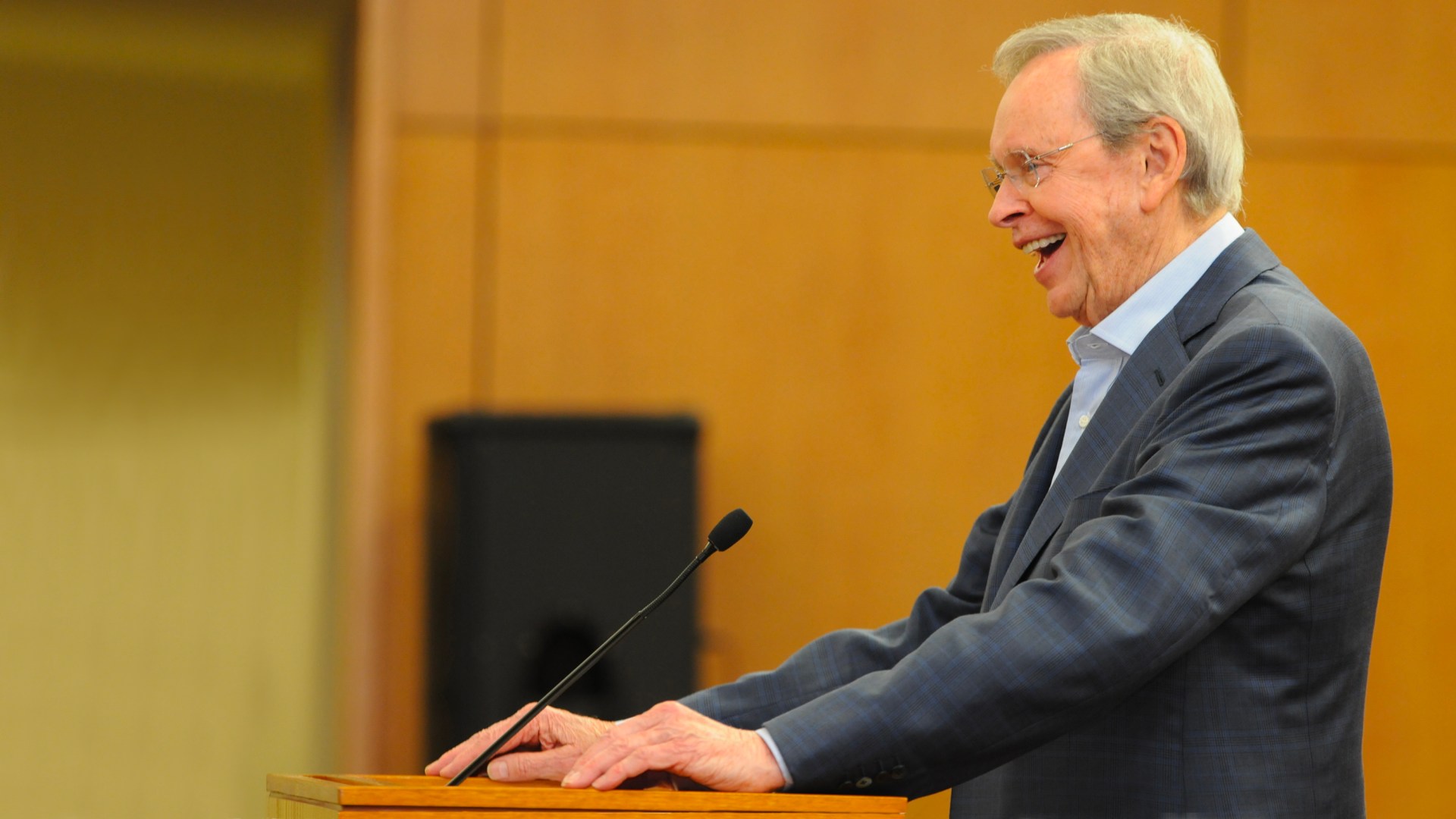
Dr. Charles Stanley

Dr. Charles Stanley

Christianity Today April 19, 2023
WikiMedia Commons

Charles F. Stanley had the unflinching zeal of Billy Sunday and the neighborly compassion of Mister Rogers.

A shy, small-town boy from Dry Fork, Virginia became one of the most prolific broadcast preachers around the world. He also became a friend to my family.

Stanley pastored First Baptist Church of Atlanta for over 50 years and founded the global broadcasting organization In Touch Ministries. On Tuesday at the age of 90, he entered Heaven—a place he often described as his final and permanent home.

His ministry spanned 65 years, growing from humble origins to a worldwide reach. He authored more than 70 books and his sermons have been heard in over 127 languages internationally through radio, shortwave, television, and solar-powered audio devices.

Stanley’s appeal to diverse audiences was reflected not only in his global footprint, but also—perhaps most so—in the diversity of his local congregation at First Baptist Atlanta. This thriving church community incorporates members from over 100 nations who experience a wide range of socio-economic realities.

My family was one of those immigrant families who found a home at his church, which means Stanley’s influence played an integral role in shaping our trajectory. I came to know him as a spiritual grandfather of sorts: he discipled my dad in the 1970s, led my mom to faith in Christ in 1980, and personally encouraged me at critical points in my own journey for over three decades.

Stanley grew up in poverty during the Great Depression. His dad died when he was nine months old, and his mother worked at a textile mill to support them making $9.10 a week. At the age of 13 in 1945, Stanley became a newspaper delivery boy, working Mondays and Thursdays to earn a weekly wage of $4.

“It was a long route, and I had a lot of papers,” he reflected at his 80th birthday gathering. “I was often scared walking alone in the dark, but that’s when I learned to talk to God before the sun rose.”

In his mid-teens, Stanley borrowed $125 from the bank to buy a daily paper route where he could earn $16-$20 a week. “The first thing I did was make sure I tithe,” he said. He delivered newspapers in his town of Danville, Virginia, until heading to college.

“Your confidence and faith in God was not passive,” Andy Stanley told his dad in a 2020 interview discussing his upbringing. “Your work ethic has always been extraordinary; you work as hard as you can possibly work, and then you trust God to honor that.”

“I’m still a paper boy delivering news,” Charles Stanley remarked with a chuckle. “Good news.”

Stanley’s stated vision for the church he led over five decades was “to touch the world with the Word of God, motivated by a passion for God and compassion for people.” And that he did.

His preaching emphasized that salvation is available for anyone who believes. He focused on the fact that every individual must make a personal commitment to follow Christ as their only Savior and Lord.

That message gripped my mom’s heart when she walked down the aisle on a Wednesday night at First Baptist Atlanta in 1980. She left her Hindu belief system and stepped into a relationship with Jesus. “Dr. Stanley’s sermons emphasized that the scope of the gospel is universal, but also highlighted the exclusivity of Jesus as the Way, the Truth, and the Life,” she recounts.

Stanley’s Pentecostal upbringing sometimes showed through in his worship preferences, and he referenced the Holy Spirit in almost every sermon and book.

I think one of the many enduring aspects of his legacy is the compelling way he combined theology and life application. He always anchored himself in Scripture, while reminding his listeners that intimacy with God was the highest priority and that it would determine the impact of our lives. The “30 Life Principles” that guided Stanley were woven throughout his sermons, writing, and public interactions as he exhorted others to grow in knowledge, service, and love of God.

Stanley personally encouraged me in various seasons of my life. I still remember how he gave me my first “grown up” Bible when I was a spunky six-year-old in first grade (“Now you be sure to read this,” he admonished), how he came and spoke to my high school youth group (“Never sacrifice your future for the pleasure of a moment,” he cautioned a room full of rambunctious teenagers), and how he prayed with me during some of my most challenging days in college and beyond (he loved to quote Joshua 1:9). Each of these encounters left an indelible mark on my heart and mind.

Some knew Stanley as an evangelical stalwart, a founding member of the Moral Majority, or president of the Southern Baptist Convention during a pivotal juncture for the denomination. As a leader in the SBC’s conservative resurgence in the 1980s, he led the movement to affirm the inerrancy of the Bible and restore its focus on uncompromising evangelism and the faithful proclamation of the gospel message.

He preached to presidents and dignitaries, never backing down when it came to defending the truth of Scripture. And he was a pastor to little ones, often kneeling down to look children in the eye and tell them about God’s love. His bus tours garnered massive and diverse book-signing lines in cities big and small—demonstrating his unique ability to connect authentically with individuals from many different backgrounds.

Although he had well-defined political views, he largely stayed out of the partisan fray to avoid being distracted from his goal of taking the gospel to every place, people, and culture.

Stanley was America’s longest-serving pastor with a continuous weekly broadcast program which has aired since 1980.

His steady, resonant voice was unmistakable. It combined bold conviction with heartfelt empathy—at once speaking as a concerned parent committed to orthodoxy and as a tenderhearted friend who cared for the individual.

Stanley was able to translate deep theological truths into practical life principles. His insights were engaging enough for seminarians and scholars and yet simple enough for children to understand.

His preaching wasn’t heard only in church sanctuaries and Christian media, but also in airports and sports bars, and even in the world’s most isolated and dangerous places—from war zones in the Middle East to the streets of Asia’s most impoverished slums.

“I would hear his voice all the time, especially in the red-light district in New Delhi,” a social worker involved with anti-trafficking efforts in India told me this week, describing how she’d often walk past a row of brothels in a back alley and hear the voice of Charles Stanley preaching.

“Many of the women who were trafficked were not even allowed to have cell phones, but the madams would allow them to have the Messengers from In Touch Ministries for entertainment. It’s probably the only sermons and Bible teaching many of those women ever heard.”

The Messenger is a solar-powered device pre-loaded with an audio Bible and Stanley’s sermons in over a hundred different languages. It is through this medium that Stanley’s words have reached thousands of unlikely places across the globe.

Since 2007, these devices have been distributed to hundreds of thousands of people who have limited access to electricity and internet—including in remote villages and rural churches. Some eager recipients use his messages to learn English, while aspiring pastors leverage them to plant and lead house churches.

Stanley may have been a preacher of old-time religion, but he was always excited to adopt new technologies to reach more people around the world.

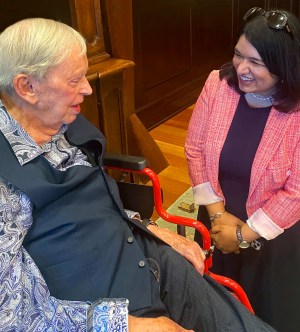
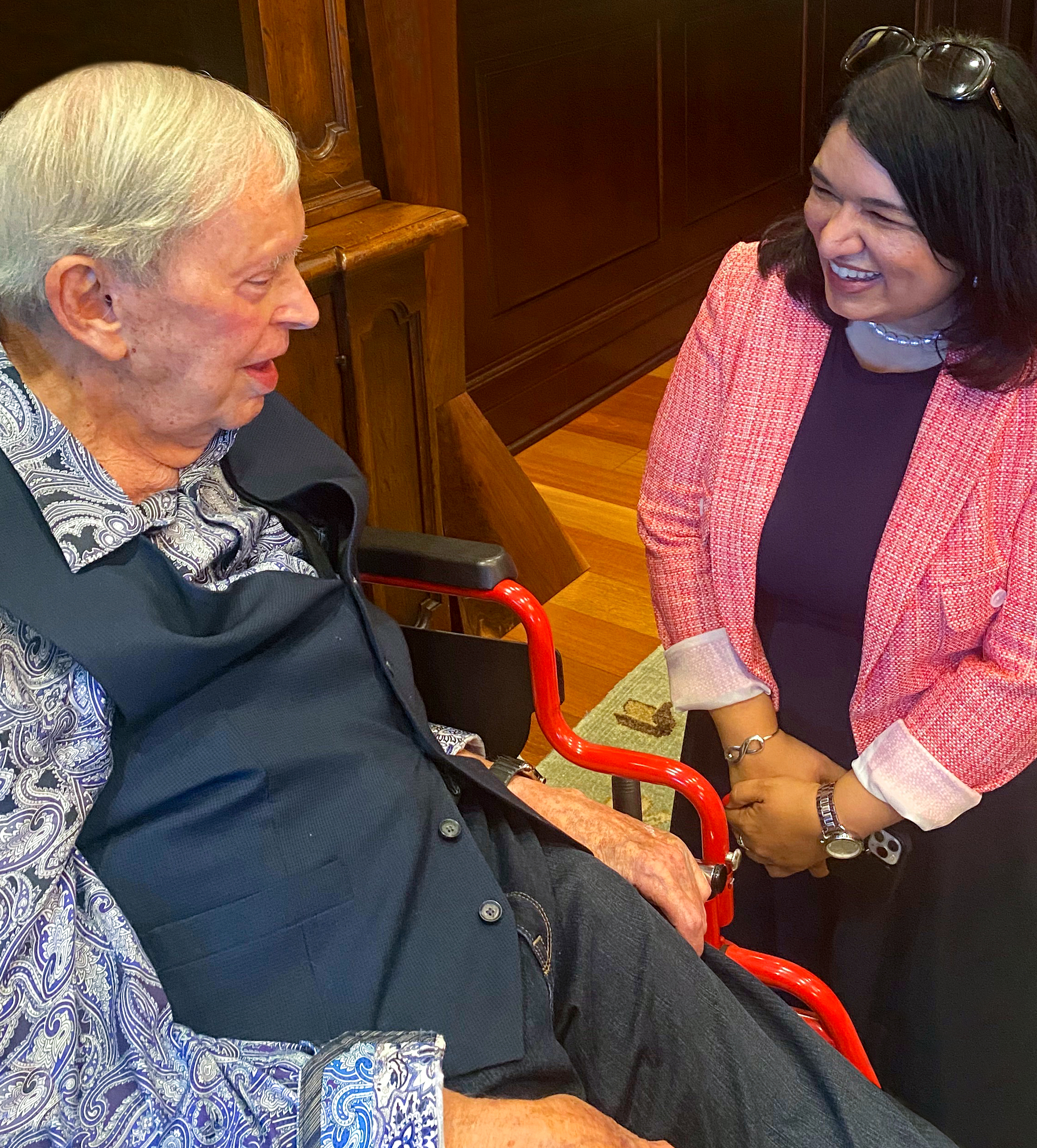
The last time I saw Stanley was the week of his 90th birthday last September. After an outdoor gathering with In Touch Ministries staff, I went up to his office with him and a few others. He cut a small chocolate cake and reminisced about his milestone birthday celebrations through the decades. His voice was frail, yet his spirit was strong.

Dr. Charles Stanley and Ruth Malhotra on their last visit together.Courtesy of Ruth Malhotra
Dr. Charles Stanley and Ruth Malhotra on their last visit together.

I shared with him that I’d soon be speaking at a business leaders’ conference and planned on referencing his teaching on true success. “You taught me that ‘genuine success is the continuing achievement of becoming the person God wants you to be and accomplishing the goals he has helped you set,’” I said, quoting from one of his past sermons verbatim.

“Say it again,” he responded, visibly choking up. “Those are your words,” I reminded him, obliging his request.

“Ruthie, if you say it just like that, they’ll remember it,” he told me with tears in his eyes. “Dr. Stanley, you said it just like that when I was a little girl, and I still remember it,” I replied.

Millions of people remember Stanley’s words because he said it “just like that,” pointing us to the truth and goodness of the gospel message with clarity and grace—and with a humble confidence that reflected the Savior he served faithfully.

Alongside the words of wisdom he’s spoken from the pulpit, I’ll treasure the moments of banter we shared through the years.

An avid photographer, Stanley traveled far and wide capturing the beauty and majesty of God’s creation. His stunning images adorn the walls of First Baptist Atlanta, In Touch Ministries, and homes around the world—including my own.

He once gave me an impromptu lesson on how to get just the right shot.

“It’s all about the light,” he told me with a twinkle in his eye. “Remember that when you take those pictures.”

I love you, Dr. Stanley. Thanks for being my pastor. You were a familiar face on television for many, and a real neighbor to me. I know you’re taking pictures on the streets of gold in the eternal city where it truly is all about the Light.

Ruth Malhotra is passionate about helping Christians communicate truth with clarity and grace. She manages strategic partnerships for Ronald Blue Trust and is a member of First Baptist Church Atlanta.

News

Chicago Settles $205K Case to Allow Evangelism in Millennium Park

After security stopped Wheaton College students from sharing their faith, a federal lawsuit forced the city to change its speech rules.

Anish Cooper's "Cloud Gate," also known as the "Bean," was a flashpoint in the debate about Wheaton students' park evangelism.

Anish Cooper's "Cloud Gate," also known as the "Bean," was a flashpoint in the debate about Wheaton students' park evangelism.

Christianity Today April 19, 2023
Scott Olson / Getty Images

The city of Chicago has settled with four Wheaton College students who were prohibited from evangelizing in the city’s Millennium Park in 2018. The case pushed the city to change park regulations to allow evangelizing and other public speech.

The city council approved a $205,000 settlement on Wednesday, which includes $5,000 each for the students as well as attorneys’ fees for the five-year litigation.

“I’m thankful that the gospel is going to be preached in Millennium Park again,” Caeden Hood, one of the Wheaton students, told CT. Hood has graduated from Wheaton and is now studying at Knox Theological Seminary in Fort Lauderdale, Florida. “We’re willing to work with the authorities. … That’s fine. We just don’t want the proclamation of the gospel to be hindered.”

A group of Wheaton students would go to Chicago every Friday, into the subways or on street corners, and start conversations, pass out tracts, or do street preaching. Sometimes they would go to Millennium Park, one of the most popular parks in the city with the famous “Bean” sculpture.

City rules prohibited “the making of speeches” and passing out of literature in most of the 24-acre park. In 2018, park security had asked Wheaton students passing out tracts to stop, which they did, but then in subsequent interactions security also stopped them from evangelizing. Four students—Hood, Matt Swart, Jeremy Chong, and Gabriel Emerson—consulted with a Wheaton professor who reached out to a Christian law firm, Mauck & Baker.

Attorney John Mauck had previously handled religious land use cases, especially for Black storefront churches in Chicago that were being zoned out of their spaces. He became one of the architects of the Religious Land Use and Institutionalized Persons Act of 2000, a federal law that prohibits using land use law to infringe on religious exercise. The Wheaton students didn’t have any money to pay a lawyer with an expertise in constitutional law, but the firm took the case on its own dime.

The firm filed a federal lawsuit in 2019 alleging infringements on the students’ free speech and free exercise of religion. Other individuals who had their own confrontations with park security over collecting signatures for ballot referendums in the park joined the suit as intervenors.

Arguments played out over years and with pandemic delays.

In a 2019 evidentiary hearing in the case, Scott Stewart, executive director of the Millennium Park Foundation, testified that the park was different from other public parks because it was designed as a series of artistic “rooms”—an argument that the park was not a “public forum” where the First Amendment would apply.

In the hearing, Stewart conceded that someone might pass out the novel Moby Dick but not religious literature in the park, and another park official, Ann Hickey, said that the prohibited speech in the park depended on the “intent.”

Based on that testimony, federal judge John Robert Blakey in 2020 ruled that the park was enforcing “vague provisions in a discriminatory manner” and issued a preliminary injunction.

Blakey wrote that the park was clearly a public forum protected by the First Amendment: “It is free, open to the public, and serves as a public thoroughfare.”

“Indeed, if a ‘curated design’ were enough to transform the nature of the forum, any park with a statue could lose its First Amendment protections,” he wrote. “The law precludes this absurd result.”

In 2020 the city put out new park rules, but the court said those rules may still “fall short of constitutional requirements.” The rules now clarify that they do not “restrict First Amendment activity on the sidewalks throughout the park.”

Mauck told CT that the students had an earlier opportunity to settle, but one condition of the settlement was no evangelism in the vicinity of the Bean. The students refused since the Bean is such an important gathering place.

The compromise they agreed to with the city was that evangelizing near the Bean was allowed, but not handing out literature. And in areas where literature handouts are allowed, people can offer literature once but not again.

“We live in the real world. We have to compromise. But I don’t feel Scripture authorizes us to give away other people’s rights to hear the gospel,” Mauck said.

Street preaching is culturally uncomfortable in the US but not in many other parts of the world, say those who do evangelism.

Public evangelism “causes us to recoil in a way that it would never have done five, 10, 20 years ago,” said R. York Moore in a 2019 interview with CT about the students’ case. At the time, Moore was the national evangelist for InterVarsity Christian Fellowship USA.

“As the social perception and policy restrictions continue to push proclamation out of view, Christians will eventually have no choice but to pay a higher price for the proclamation—either as lawbreakers or subversives,” Moore said.

Hood, one of the Wheaton students, said he had “fooled around” his freshman year at Wheaton but decided to “pursue God whole-heartedly” his sophomore year and joined the evangelism team. He started reading the Bible more often.

“I started to see the way the Bible talks about the Word of God,” he said. “Jesus says, What you’ve heard from me, proclaim from the housetops. Jeremiah talks about hearing from God, and he can’t hold it in anymore. He said it’s like a fire in his bones. … Stuff like that gave me a sense of confidence.” He had never preached out in public like that before, and it was “a little uncomfortable … I tend to struggle with attention.” But he grew more comfortable over time.

The case brought public attention to the students, too. Mauck had warned the students, as he does with most clients, that the city might drag the case out for years as a legal strategy, and asked if they would “hang in there” as plaintiffs.

“Usually they don’t understand how that can wear on them and cause anxiety,” Mauck said. “In this case it helps that we have four [Christian] brothers who know each other and can encourage each other.”

The case did drag out for years, but the four stuck with it. Two of the others are in seminary at Mid-America Reformed Seminary, according to Hood. Hood still evangelizes in Florida where he is in seminary, and says the others have been evangelizing where they live now.

“That’s all that matters to me at the end of the day,” he said.

Books
Excerpt

Save the Planet. Read Nature Fiction.

As an ecologist, I believe that works of literature draw us closer to God and deeper into creation care.

Christianity Today April 19, 2023
Illustration by Karlotta Freier

In my senior year of college, I studied ecology in Costa Rica and Ecuador. For two weeks, I lived with other students on a small boat in the Galápagos Islands. On one of our excursions, the captain told us there were whales in the area, and I went up to the deck just in time to see a humpback swimming straight at the side of our boat.

The Wonders of Creation: Learning Stewardship from Narnia and Middle-Earth (Hansen Lectureship Series)

The Wonders of Creation: Learning Stewardship from Narnia and Middle-Earth (Hansen Lectureship Series)

IVP Academic

144 pages

At what seemed to be the very last second, the whale turned on its side and looked up at me. Staring into the eye of that whale was one of the most wondrous moments of my life. In that moment, I experienced awe and joy. I was deeply curious about the whale and felt compelled to act—to learn, to change, and even to protect.

That encounter lasted only a minute, if that, but it had a profound effect on me. In the years since then, I’ve had similar experiences while camping or hiking or wandering beyond a trail. Not everyone experiences creation in this way, nor is everyone physically able to hike through natural landscapes. Still others simply don’t have access.

Nevertheless, I believe everyone can pursue wonder by spending time in fictional landscapes.

On this topic, the works of C. S. Lewis have been significant to me. I remember the first time I “heard” Aslan’s song in The Magician’s Nephew:

In the darkness something was happening at last. A voice had begun to sing. … The voice was suddenly joined by other voices; … the blackness overhead, all at once, was blazing with stars. … The Lion was pacing to and fro about that empty land and singing his new song. … And as he walked and sang the valley grew green with grass. It spread out from the Lion like a pool. It ran up the sides of the little hills like a wave. In a few minutes it was creeping up the lower slopes of the distant mountains, making that young world every moment softer.

As I read, I was transported back to beautiful landscapes I had experienced in my life. I mentally revisited places where I had experienced deep joy—places that have left me with many more questions than answers.

Lani Shiota, a social psychologist who studies emotion, describes “wonder as that moment when our minds are trying to stretch, to take in and comprehend whatever it is that’s before us.” Through Aslan’s song, Lewis invites us into this space of wonder. We’re encouraged to comprehend the beauty of what we are seeing and hearing.

In the Narnia creation story, we see moles, frogs, elephants, and even a lamppost emerge. As we contemplate the cacophony of these beginnings, something stirs in us. Lewis writes:

The Lion was singing still. But now the song had once more changed. It was more like what we should call a tune, but it was also far wilder. It made you want to run and jump and climb. It made you want to shout.

If we understand wonder as virtue, as suggested by Hope College professor Steven Bouma-Prediger, “we exhibit the virtue when we have the cultivated capability to stand in grateful amazement at what God has made and is remaking.” I believe this gratitude for the wonder and beauty of nature should lead us to act through stewardship of creation.

In his essay “Wonder and the Critical Encounter,” philosopher H. Martyn Evans agrees that awe should move us to action. He suggests that wonder is a “transfiguring encounter” that results in an “altered, compellingly intensified attention to something that we immediately acknowledge as somehow important.”

Can a reader’s experience of fictional landscapes shape her interaction with actual landscapes? I believe so. I am moved to action when I hear Aslan’s song. When I am in Narnia, I respond to Aslan’s request “to be”: “Narnia, Narnia, Narnia, awake,” he says. “Love. Think. Speak. Be walking trees. Be talking beasts. Be divine waters.”

Awe is the first step to developing the virtue of ecological wonder, which enables our response to the call to be stewards of creation.

Experiencing wonder has important theological implications as well. If we believe, as Paul writes in Romans, that “God’s invisible qualities—his eternal power and divine nature—have been clearly seen, being understood from what has been made, so that people are without excuse” (1:20), then spending time in creation helps us understand more about our Creator and develops in us the virtues of wonder and gratitude.

These virtues require that we look very closely at the world around us. I often refer to the practice of deliberate attention to nature as “reading landscapes,” and in many of my courses I try to help my students develop this discipline. I typically ask them to spend time observing the details of a place through what they see, hear, smell, and feel.

In practicing this discipline, I want them to learn that when we slow our lives and take time to engage in a close reading of creation, we’re then able to turn our focus and wonder toward the Creator. In this way, exercising deep attention to nature is similar to interpreting religious texts because it facilitates a relationship between us and God, the Author and Creator.

Awe begins this transformative work. As we pay close attention to nature, we’re more likely to notice the amazing aspects of God’s creation. And as we develop the virtue of ecological wonder, we begin to practice the divine call to stewardship.

This essay was adapted from The Wonders of Creation by Kristen Page. Copyright (c) 2022 by The Marion E. Wade Center. Used by permission of InterVarsity Press.

From the Archives: Views on Universalism

A selection of CT articles about the eternal fate of humankind.

Christianity Today April 19, 2023
Illustration by Mallory Rentsch / Source Images: Unsplash

“This is typical of the kind of discussion that universalism arouses: it is never abstract, but is always charged with emotion, for it has to do with the love of God.”

This quote by G. C. Berkouwer appeared in Christianity Today’s pages in 1957, demonstrating that universalism is hardly a recent source of theological concern. Browse the CT pieces below on the topic that include overviews of historical universalist thought, J. I. Packer’s reflection on the fate of the “Old Testament faithful,” and a 2021 Pew Research survey about how Christians see the issue now.

Click here for more from the CT archives.

Books
Excerpt

Love, Joy, and Peace Are a Package Deal

Don’t ignore their ordering in Paul’s passage on the fruit of the Spirit.

Illustration by Rick Szuecs / Source images: Envato

In Paul’s fruit-of-the-Spirit passage (Gal. 5:22–23), joy is sandwiched between love and peace, which points us toward a deeper understanding of genuine joy.

An Invitation to Joy: The Divine Journey to Human Flourishing

An Invitation to Joy: The Divine Journey to Human Flourishing

Wm. B. Eerdmans

243 pages

Those who have a version of joy without love can be very self-centered. You may know someone who appears joyful but whose joy is shallow; they retain it by being oblivious to the needs of others.

Similarly, peace without love and joy is a counterfeit peace. In the 1970s, as a campus minister, I watched students who were attending the Erhard Seminars Training weekends (known as EST). They would pay good money for the experience of being treated abusively, insulted, and forbidden to talk to fellow participants or go to the bathroom for hours at a time. The goal was apparently to experience a sort of peace or tranquility, to remain calm in the face of fearsome treatment. But I saw students who came back with a glassy-eyed, detached calmness, which is a counterfeit to real, biblical peace and joy. God’s peace is not a tranquilizer.

Christian peace does not come from the annihilation of feelings and desires, which is more characteristic of stoicism or certain Eastern religions. Similarly, God’s gift of joy is not a passive denial of or resignation to the pain and unpleasant experiences of life, but rather an honest acceptance of this pain in light of God’s goodness, mercy, and love.

Jesus conveyed his peace to his disciples by saying, “Peace I leave with you; my peace I give you. I do not give to you as the world gives” (John 14:27). Paul later states that Jesus not only offers peace; he himself is our peace (Eph. 2:14). Commenting on this passage, Walter Wilson, a Missouri medical doctor who later became a preacher, recalled the days when he used to make house calls. Often, he would enter a home where a woman was in labor or where someone was deathly ill. The whole house would be in a panic. But when he entered, an amazing calm and peace took hold. His presence was their peace, and Jesus’ presence is our peace.

And he is our joy. I have seen the power of prayer to turn panic into peace. When I was a young pastor, a woman called our church for help. She had seen the movie The Exorcist, and she was terrified that she was under attack. As we prayed, she invited Jesus into her life. I watched a peace come over her. The she beamed with joy. She suddenly realized that some sounds she was hearing were simply from a rusty gate. Later, as a campus minister, I watched this kind of transformation take place in the lives of scores of students, turning fear into peace and joy.

Adapted from An Invitation to Joy: The Divine Journey to Human Flourishing by Daniel J. Denk (Eerdmans: 2023). Reprinted by permission of the publisher.

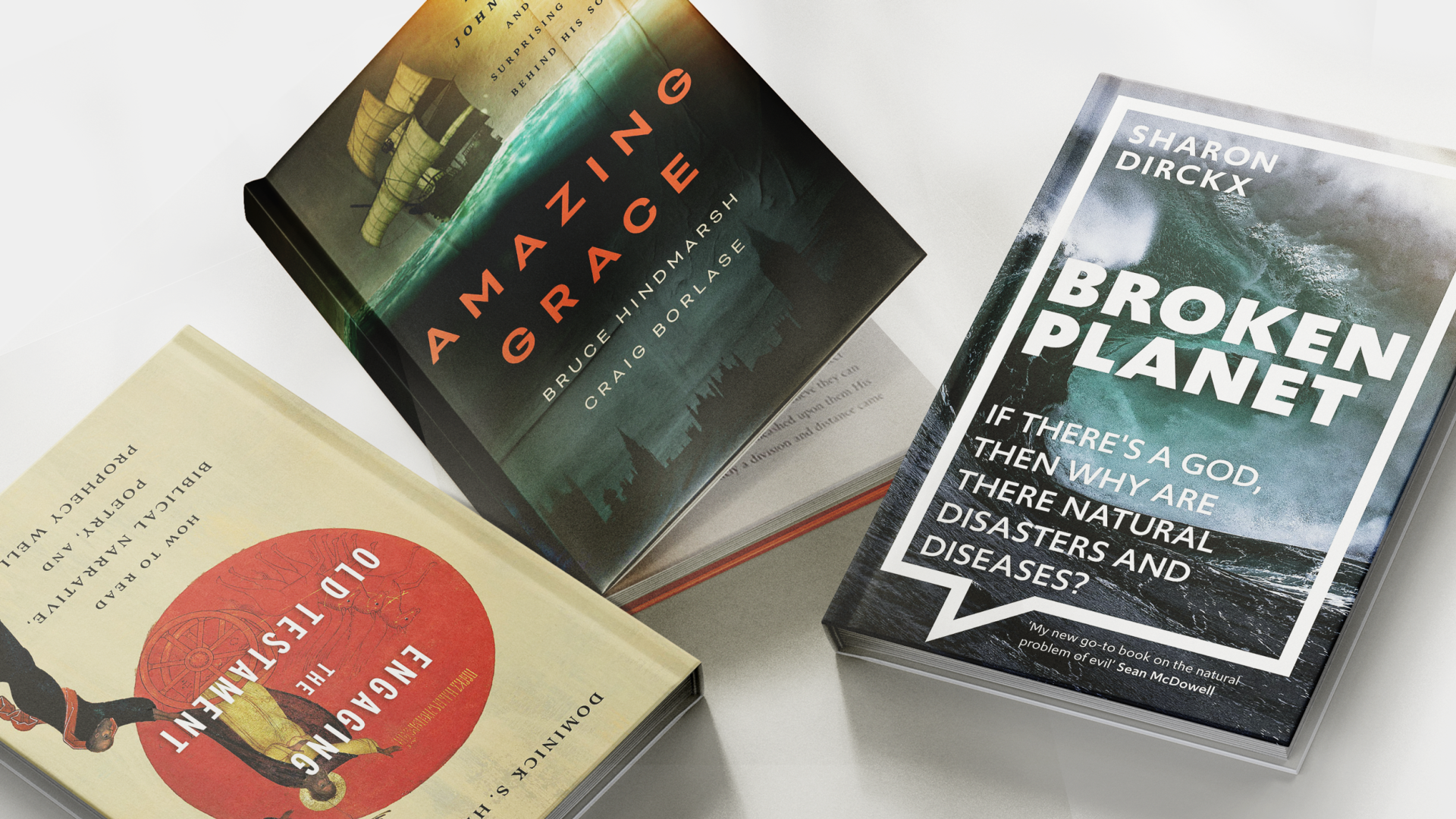
New & Noteworthy Books

Compiled by Matt Reynolds.

Broken Planet: If There’s a God, Then Why Are There Natural Disasters and Diseases?

Sharon Dirckx (IVP)

We often refer to natural disasters as “acts of God,” a fact that helps explain why skeptics of Christian faith invoke them as stumbling blocks to belief. In Broken Planet, Sharon Dirckx of the Oxford Centre for Christian Apologetics explores how to defend God’s goodness in light of events like tsunamis, hurricanes, earthquakes, famines, and pandemics. The book also includes extensive firsthand testimonies from a range of believers, including rescue workers, local residents, and other eyewitnesses.

Amazing Grace: The Life of John Newton and the Surprising Story Behind His Song

Bruce Hindmarsh and Craig Borlase (Thomas Nelson)

This year marks the 250th anniversary of the writing of “Amazing Grace,” John Newton’s iconic hymn. To mark the occasion, historian Bruce Hindmarsh and writer Craig Borlase have teamed up to write what they call a “dramatized biography” of the former slave-ship captain, one “with the feel of a film or a life play.” Like the song that inspires it, Amazing Grace summons readers to consider the arc of redemption in their own lives.

Engaging the Old Testament: How to Read Biblical Narrative, Poetry, and Prophecy Well

Dominick S. Hernández (Baker Academic)

For many believers, the Old Testament seems bafflingly inconsistent with the picture of God we receive from the New Testament. This can tempt us to neglect it, downgrade it, or read it selectively. Dominick S. Hernández, a professor at Biola University’s Talbot School of Theology, wants to correct these tendencies in this survey of Old Testament interpretation. “If Christians … ignore or renounce attributes of the revealed character of God (in either the Old or the New Testament),” he writes, “then we necessarily disregard parts of the plan of redemption.”

Books
Review

Conflict Between Science and Religion Is Always Possible but Never Inevitable

A new history challenges perceptions that the two are either completely autonomous or completely at odds.

Illustration by Abigail Erickson / Source Images: Getty, Unsplash

Nicholas Spencer’s latest book, Magisteria: The Entangled Histories of Science and Religion, opens and closes with references to Stephen Jay Gould’s depiction of science and religion as nonoverlapping magisteria, or “NOMA.” By this, he meant that science is about the natural, religion the supernatural, and never the twain should meet. Each is magisterial, or authoritative, in its own domain—but not beyond it.

Magisteria: The Entangled Histories of Science & Religion

Magisteria: The Entangled Histories of Science & Religion

Oneworld Publications

480 pages

Gould, a popular science writer and avowed secularist, advanced this concept in 1997, at the height of America’s latest public dustup over teaching so-called creation science and intelligent design. He thought NOMA could defuse the controversy while removing religion from science education.

Neither side wholly bought NOMA then. On the one hand, proponents of secular scientism like Richard Dawkins, who want science enthroned as the arbiter of all truth in the modern mind, rejected the notion that religion is magisterial anywhere. On the other hand, theists such as the noted geneticist Francis Collins denied that religion was cordoned off from the natural world—otherwise, why would believers pray for physical (or even mental or emotional) health?

Nor does Spencer, a senior fellow at London’s Theos think tank, buy NOMA now. In Magisteria, he argues from history that science and religion are (and have always been) deeply entangled. This is nothing new. Spencer begins his book by noting that, since the 1980s, historians have uncovered a complex relationship between science and religion, and he names ten leading scholars in this enterprise. (Full disclosure: I’m listed as number six.) Spencer draws on this body of scholarship to compile a narrative history of science and religion since ancient times. His story mainly covers the Christian West but also touches on the Islamic world and the Asian context.

Any sweeping history, especially one emphasizing entanglement, necessarily moves in fits and starts over time and space. Skipping vast periods and various places, the narrative focuses on discrete, well-known encounters between religion and individual scientists or persons involved with science (broadly defined so as to range from ancient natural philosophy to modern social sciences). Accordingly, the book unpacks such fabled episodes as Galileo’s persecution by the Catholic church, Thomas Huxley’s debate on evolution with bishop Samuel Wilberforce, and the Scopes Monkey Trial. Among other subjects, Spencer tackles astrology, heliocentrism, physio-theology, the fossil record, phrenology, evolution, modern physics, Freudian psychology, Marxism, and sociobiology, concluding with the challenge to religion posed by artificial intelligence.

Embracing complexity, Spencer treats each encounter on its own terms. Conflict characterizes some, harmony others. NOMA-like separation emerges in Michael Faraday’s revolutionary work in electromagnetism, while labored accommodation drove the effort to fit ancient fossils into a day-age interpretation of Genesis. As Spencer depicts them, battles over authority spur some episodes, particularly where a literal reading of Scripture clashes with scientific findings, while parochial politics or personal pride enflame others. Nothing seems inevitable about any of the outcomes except that both science and religion survive and persevere.

Befitting his role as a public commentator on religion in public life, Spencer strives (with mixed success) to find something about humanity and human morality underlying each encounter. “Time and again, when it seemed as if people were arguing about the power of planets, the composition of the body, the order of the cosmos, the design of nature, the origin of life, the age of rocks or the development of species, they were really talking about the nature of the human beast,” he claims. “What (or who) is the human, and who (or what) gets to say? These two questions run through the histories of science and religion.” Religion rightly refuses to defer to science on such questions, he maintains, and science cannot definitively answer them, because humans, uniquely of all creation, mix the natural and the supernatural. Spencer sees this tension driving the entanglement between science and religion. Both have something significant to say about humanity.

Spencer warns against basing science on religion or religion on science. They don’t work that way. In his view, Galileo had it about right when, in defending his heliocentric model of the solar system, he wrote that the role of religion “is to teach us how one goes to heaven, not how the heavens go.” Presuming that the first use of heaven means a supernatural abode and the second denotes the natural cosmos, then religion should illuminate the former and science the latter.

Yet the history recounted in Magisteria shows that Galileo’s aphorism can be devilishly hard to apply in particular cases. Modern science has made the average human life longer and healthier, Spencer notes, but not (as in cases like phrenology and eugenics) always better. “In some places, NOMA makes sense. But the human being is emphatically not one of them,” he writes. “Humans are both ‘material’ creatures, which are measurable and explicable according to the methods of science, and ‘spiritual’ ones, who talk about and aspire to things like meaning, significance, transcendence, purpose, eternity and love, which have always been the building blocks of a religious understanding of reality.”

(Although Spencer does not quote him, Francis Collins made a similar point as director of the Human Genome Project. “Science,” he predicted in 2002, “will certainly not shed any light on what it means to love someone, what it means to have a spiritual dimension to our existence, nor will it tell us much about the character of God.”)

“Precisely because they overlap across the human, the potential for conflict between science and religion is always a live one, whether talking about algorithms in the twenty-first century or astrology in the fourth,” Spencer concludes. “And yet, if the long history of science and religion has anything to teach us, it is that this conflict is only potential, not inevitable.” He hopes these entangled magisteria can work together, each in its proper sphere, to advance the commonweal. Although his accounting of the past offers no assurances about the future, it does portend that science and religion will remain entangled on matters important to humanity.

Edward J. Larson is a historian and legal scholar teaching at Pepperdine University. He is the author of Summer for the Gods: The Scopes Trial and America’s Continuing Debate over Science and Religion.

Books
Review

The Power and Peril of Spiritual ‘Evolution’ Stories

They can encourage people on similar journeys. They can also misconstrue one’s own.

Illustration by Jack Richardson

In an episode of NBC’s sitcom The Office, Michael Scott offers a humorously self-serving accounting of his weaknesses as a boss: “I work too hard, I care too much, and sometimes I can be too invested in my job.” Asked to list his strengths, he replies, “Well, my weaknesses are actually strengths.”

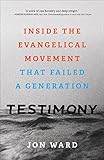
Testimony: Inside the Evangelical Movement That Failed a Generation

Call it the Michael Scott paradox. In telling stories about our lives, we have a habit of casting ourselves as the hero. Every day is a new chapter confirming that we alone are truly empathetic, courageous, and reasonable. Our strengths are obvious (or at least they should be). And our weaknesses are really strengths.

This penchant for valorizing our choices and motivations speaks to the fundamental fallenness of our nature. It tempts us to misremember, misconstrue, and misunderstand not only ourselves but those around us. This is the peril of spiritual-transformation memoirs such as Testimony, a new book from Yahoo News political reporter Jon Ward. Few things are as compelling and as invulnerable to disputation as a great personal story. And yet few things can slip away from the teller’s grasp as quickly or as totally.

Too often, Ward’s book succumbs to this latter tendency. Its subtitle (Inside the Evangelical Movement That Failed a Generation) promises a sweeping analysis of a religious community and a postmortem on that community’s fall from grace. And traces of this are sprinkled throughout the book, especially in its depiction of a church culture that prizes performance over grace.

But as a whole, Testimony struggles to overcome the Michael Scott mindset. Its memories of a conservative evangelical childhood are tainted by retroactive moralizing. Testimony is not so much a portrait of an evangelical movement as a snapshot of one evangelical’s attempt to process his past. As such, its lessons for readers are less about the dangers of institutions and beliefs out there than about the inner workings of our own hearts.

Testimony begins the way many testimonies do: at home. In the first several chapters, Ward narrates a childhood and adolescence spent within a conservative evangelical church culture anchored by his parents, especially his father (one of the few religious mentors the book portrays in a positive light). Many readers who grew up in conservative Christian settings will see familiar sights. Ward goes to church a lot; he and his siblings groan during family devotions and are kept away from alcohol and profanity.

The way Ward describes these mundane details is sometimes strange and off-putting. In one anecdote, he rebukes his pastor-father, who asks him to “participate more enthusiastically” in church: “I spoke up. ‘Dad, you’re just telling me to do that so you’ll look good to other people.’ To my dad’s credit, he admitted I was right and left me alone.” This exchange may be meant to convey something of the author’s youthful incisiveness, but I read it with grief. Perhaps Ward’s father genuinely wanted his son to take more joy in spiritual things. Could there have been more to this story?

This is unfortunately the beginning of a pattern that persists throughout Testimony, one marked by the absence of self-critique and a tendency toward assumption. In one especially miscalculated passage, he describes watching his mother play piano, which was “one of the few things I remember Mom doing for herself. … Gradually, any hopes and dreams she might have had for a life of her own, even a hint of something she could call hers outside of raising us kids, kept getting smaller.”

This comment, of course, expresses Ward’s concerns regarding traditional gender roles. But it struck me as misguided because Ward’s mother is not a subject in the book. She never speaks, and there’s no indication that his conclusion about her quiet desperation is fair or true. Too much of Ward’s memoir seems filled with unresolved tension between a son and his parents, and the lack of meaningful self-doubt gives it a revisionist vibe.

As Ward gets older, he becomes progressively dissatisfied with his family and the church he attended for several years, Covenant Life Church in Maryland. Its pastor at the time, former Sovereign Grace Churches head C. J. Mahaney, has faced charges of mishandling allegations of sexual abuse and leading in a headstrong manner. Clearly, Ward believes his experience at Covenant Life (and within conservative Calvinism writ large) is a microcosm of broader trends in American evangelicalism. He is critical of Mahaney, and he recounts having a crisis of faith and departing Covenant Life during a period when he was being “groomed for leadership” within the church.

Ward’s narration of this crisis is fascinating, both for what it includes and what it leaves out. He recalls reading through his Covenant Life–era journal entries and finding “mountains of BS cloaked in religious language.” But he tells us nothing about searching the Scriptures to better disentangle bad interpretation from true doctrine. Indeed, the Bible is conspicuously absent in many of the book’s most important moments. Ward looks Christian hypocrisy straight in the eye, often rightfully so, but his tendency is to confront this hypocrisy despite Scripture rather than with Scripture.

The appearance of Donald Trump halfway through the book highlights another major theme in Ward’s story: how politics can drive theology rather than the other way around. Many readers will resonate with Ward’s description of church politics and how struggles around leadership and institutional survival can poison our spiritual lives. And many will appreciate his criticism of Trump and the seemingly unconditional support he received from some evangelicals.

But there’s a tension within Testimony that Ward never resolves. Take, on the one hand, his robust opposition to Trumpism. He straightforwardly blasts “White evangelical churches” and their support of Trump in the aftermath of the 2017 white supremacist rally in Charlottesville, Virginia. “I couldn’t understand how fellow Christians could be so committed to remaining inside a spiritual bubble that they wouldn’t squarely look at the conflict and division engulfing our nation,” he writes. “All of it was being stoked and encouraged and inflamed by the sitting president.” In a startling chapter, he gives a detailed, blow-by-blow account of an escalating argument with his parents and siblings over Trump, a disagreement that appears to have wounded their family.

When it comes to Trump, then, Ward is unequivocal: He was a wicked president, and evangelicals who supported him are morally tainted. Yet it’s a similar attitude of moral certainty that Ward distrusts within the evangelical tradition of his youth. He criticizes statements of faith, contrasting them against “the kind of faith that is a lifelong journey of growth in which one never truly arrives but is constantly seeking and growing and evolving.” He declares that the “roots of evangelical anti-intellectualism run deep,” exemplified by the way his church “promoted absolutism,” leaving “no room for nuance” and making “no allowance for complexity or shades of gray.”

For Ward, it seems, evangelicalism is hopelessly dogmatic on some issues (like doctrinal statements or claims of biblical authority) and insufficiently dogmatic on others (like the proper stance on Christianity’s relationship to conservative politics). What explains the difference? It’s hard to escape the conclusion that Ward may simply care more about one set of issues than the other.

There is always an intrinsic danger to telling one’s story. We are all fallible narrators. Even the purest intentions cannot cure a mistaken memory or a misunderstood moment. These things do not make our self-histories worthless; they simply make them human.

Yet telling our stories of theological, political, or intellectual transformation carries a distinct risk: that our gratitude for where we are now lures us into ignoring or distorting the grace that met us at a much different place. This isn’t just a factual problem. It’s a spiritual one as well.

Many of us raised in evangelical subcultures must admit that we are very different people today than we were while living with our parents, attending this Sunday school class, or sitting under that youth pastor. Many of us will look back at the things we were taught and see problems—some minor, others serious.

Yet this transformation shouldn’t leave us with contempt for the people and places of our past. When we’re honest with ourselves, we should acknowledge that even the ways we change are deeply rooted in the things that were poured into us when we were too young to refuse them.

Ward’s book certainly showcases the power of the evangelical “transformation” memoir. His experiences of hypocrisy and cynical church cultures will be familiar to many. His frustration with his family and those who mentored him is often quite relatable. Many will see themselves following a similar trajectory, and Testimony will give them words to describe what they had felt but not yet named.

Yet the peril of this genre is overwhelmingly present as well. More than any theological or political point, I came away from Testimony freshly aware of my own tendency to see myself in the purest light, and to apply grace to my own journey but deny it to others. Indeed, this is the peril of all our testimonies. We see even our own lives only as through a mirror dimly.

Most of us will not publish a spiritual memoir, but in a way, we are all writing one every day. The church needs these stories. But our stories need the church too. When we look into our lives for reasons to feel better about ourselves, we tend to stare straight past the mercy, the forgiveness, and the love that God pours into us through others. Instead, we should see our testimonies the way Christ sees them: as a vindication not of our wisdom, but of his glory.

Samuel D. James is an acquisitions editor at Crossway and a writer. He is the author of a forthcoming book, Digital Liturgies: Rediscovering Christian Wisdom in an Online Age. His Substack is Digital Liturgies.

Books

What Singleness Reveals about the World to Come

Unmarried Christians can live as signposts of the new creation.

Illustration by Abigail Erickson / Source Images: Getty, Pexels, Unsplash

With rates of long-term singleness on the rise across Western societies, evangelicals are increasingly reflecting on the challenges this poses for the church. In The Meaning of Singleness: Retrieving an Eschatological Vision for the Contemporary Church, Danielle Treweek reframes the discussion around the Bible’s picture of the creation to come. Author and theologian Barry Danylak spoke with Treweek—founding director of the Single Minded ministry and an Anglican deacon in Sydney—about cultivating a robustly theological understanding of singleness.

The Meaning of Singleness: Retrieving an Eschatological Vision for the Contemporary Church

The Meaning of Singleness: Retrieving an Eschatological Vision for the Contemporary Church

IVP Academic

336 pages

What are some the challenges you see with defining singleness?

Singleness is a modern concept that carries lots of baggage. It can mean different things in different contexts. We don’t open 1 Corinthians 7, for instance, and see Paul talking about singleness specifically, but rather a host of related concepts like virginity and betrothal. And elsewhere in Scripture we see categories like widowhood and examples like the eunuchs in Matthew (19:12). So we need to be flexible in how we talk about singleness, recognizing some of the assumptions we’re bringing to that concept.

What is the chief problem with how today’s evangelicals understand singleness?

The chief problem is that, by and large, we have an impoverished theological understanding of singleness. And I see two problematic tendencies that have brought us to this state.

The first problem arises from the fact that we’re very good at looking over our shoulder to Genesis and developing a theology of marriage from Scripture’s account of creation. As Christians, however, we also look forward to what is ahead, to the new creation that Scripture promises. So we have to work out what it means to live in light of this reality we’re heading toward, one that Scripture tells us has already been inaugurated.

The second is failing to realize how much we are products of the world we live in. Paul warns in Romans 12 against being conformed to the patterns of this world (v. 2). But when it comes to matters of marriage, romance, sex, friendship, and community, we’re being discipled by the world without realizing it.

You point out that many popular evangelical writers view personal sanctification as one of the primary purposes of marriage. Why do you see this perspective as mistaken?

Marriage certainly can be helpful for sanctification. But we shouldn’t assume that getting married is the best way to become like Jesus. The Holy Spirit works within us in the context of all our relationships, marital or otherwise. I can certainly see how the Spirit uses marriage bonds to challenge our sinfulness. But you don’t need a spouse to have your sinfulness challenged, either by the Spirit or those around you.

What are some ways singleness is theologically significant?

The typical approach to understanding the theological significance of singleness relies on its instrumentality. In other words, it’s a matter of what you’re doing with your singleness.

Of course, that category really is important. But I’m trying to explore whether there’s something theologically significant about the status of being unmarried, in and of itself. Looking at singleness through the lens of eschatology, we can see how it has implications for things like sex, romance, companionship, community, parenthood, and family. What keeps coming back to me is how a faithful theology of singleness is essential for our ecclesiology—for understanding who we are as the church.

You argue that celibate Christian singles might inform a more expansive, biblically authentic understanding of sexuality. How can this play out?

Too often, the church sees celibacy as oppressive rather than expansive. There are two reasons I think that’s wrong.

The first is that single people committed to honoring God with their bodies can testify to others that they’re not enslaved to sexual longings. In a world that celebrates sexual desire as the total of who you are, celibate singles can show that we have rich and fulfilled lives.

The second reason takes things further into an eschatological perspective. As resurrected people in God’s new creation, we’re going to be our most perfected human selves. We will retain our male or female sexual natures, but as we see from Matthew 22, we won’t express those natures through sex in marriage (v. 30). If, in eternity, I’m my most perfected self, and that self is celibate, then this suggests that human sexuality is oriented toward relationship more broadly. Single Christians get to remind the world that there’s more to being sexual than having sex.

How do we actually inspire today’s Christian singles—and for that matter, the church as a whole—to see singleness as theologically significant?

In my pastoral ministry, the vast majority of singles I’ve gotten to know desire marriage. So how do I handle that theologically and pastorally?

I think the answer is helping them to see their singleness the way God sees it. Our world can send the message that your singleness is only as good as you feel about it. If you’re happy and content being single, then your singleness is good. But if you’re unhappy and struggling, then your singleness is a bit tragic. My desire is to think beyond the personal experience of singleness to see the significance God has imbued it with.

For the church as a whole, the answer is much the same. Let’s be willing to go back to Scripture and look afresh at God’s purposes for marriage and singleness alike. Of course, that always feels like a cop-out, because people are keen to ask how the church should address singleness on a practical level. And that’s important to wrestle with. But without considering the underlying theology, we’re only applying Band-Aids to a gaping wound.

How has your own experience with singleness informed your work?

I became interested in this subject because I was single, and remaining so as fewer of my friends were. This compelled me to think theologically about God’s purposes for this part of my life. But what really cemented it for me was working in ministry and being exposed to lots of single women grappling with similar questions—not only never-married women, but widows and divorcees as well.

And even though this is a more pragmatic way of looking at things, it’s still true: I don’t think I could have done all this research and reflection had I been married with kids over the last eight years. Being a single woman in ministry has allowed me to invest in this project, which is a great gift to me and hopefully for others as well.

What advice would you give Christian believers struggling with their singleness?

First, take that struggle seriously. You don’t need to feel shameful because you’re struggling. There are real griefs involved in all sorts of life circumstances, singleness very much included.

But don’t be content to remain in that struggle. Prayerfully ask God and other believers to help you seek Christian growth and contentment. And ask that you can find a comfort and peace rooted in God’s sovereignty over your life. Even amid grief, we can move toward the joy the gospel gives us, particularly as we look toward the new creation that awaits us.

addApple PodcastsDown ArrowDown ArrowDown Arrowarrow_left_altLeft ArrowLeft ArrowRight ArrowRight ArrowRight Arrowarrow_up_altUp ArrowUp ArrowAvailable at Amazoncaret-downCloseCloseellipseEmailEmailExpandExpandExternalExternalFacebookfacebook-squarefolderGiftGiftGooglegoogleGoogle KeephamburgerInstagraminstagram-squareLinkLinklinkedin-squareListenListenListenChristianity TodayCT Creative Studio Logologo_orgMegaphoneMenuMenupausePinterestPlayPlayPocketPodcastprintremoveRSSRSSSaveSavesaveSearchSearchsearchSpotifyStitcherTelegramTable of ContentsTable of Contentstwitter-squareWhatsAppXYouTubeYouTube