Theology

Western Classics Exclude Me. But Christ Can Redeem Them.

As an Asian American, God’s great story helps me value literature that often leaves me out.

Christianity Today May 8, 2023
Darwin Vegher / Unsplash

Last year, I began reading Herman Melville’s Moby Dick. At first, I was swept away by Ishmael’s beautiful descriptions of his passion for the sea. But I grew increasingly uncomfortable in chapter two, when Ishmael accidentally stumbles into a Black, presumably Christian, worship service.

He shockingly describes the gathering as a “great Black Parliament sitting in Tophet” (another name for hell) and the preacher as “a black Angel of Doom.” In the next chapter, we meet the Native American character Queequeg, whose first words are “Who-e debel you? … you no speak-e, dam-me, I kill-e,” before he is promptly labeled as a cannibal.

What do we do with racist passages in classic books like this—especially as readers of color?

As a lifelong lover of books, I heartily applaud that many Christians seem to have a vested interest in preserving and championing classic Western literature.

In On Reading Well and various articles, Karen Swallow Prior writes about how good books can help cultivate our virtues. Similarly, Jessica Hooten Wilson has said that books help us to be holier. They can sharpen our worldview and help us develop empathy. Reading good books can, as Philip Ryken writes, sanctify our imaginations and nourish our love for beauty; it can even help us be more effective teachers, preachers, and leaders.

As a nonwhite Christian, however, I find that most discussions of reading classic Western literature today either fail to acknowledge or only tangentially mention two difficult truths.

First, even if a book is not overtly racist, readers of color must inevitably reckon with the hostility, condescension, and suspicion toward people of other races that permeated the historic periods in which much of these classic authors lived.

Melville and Dickens, Brontë and Byron, Twain and Tolkien were all embedded in cultures that subjugated entire continents of people to slavery and imperialism. It is simply not enough to tell a reader of color that these were bygone times, for we know better than anyone else that racism still exists today.

The second truth about much of English literature—which is difficult to reconcile with the first—is that it is a part of our Christian past. From Chaucer to Joyce, Christianity is baked into many of the plots, themes, and characters of numerous classic works of the West.

On the one hand, this makes the reading of classics an enlightening tool for believers. Kathleen Nielson writes that “Christians should read classics, because classics tell our story. At the most recognizable level, many Western literary classics tell our Christian story in various ways because they emerge from cultures shaped by Christianity.”

For readers of color, however, the “Christian story” is more problematic.

Aside from the fact that Western literature often ignores the full story of early Christianity’s flourishing in Africa, Asia, and the Middle East, the classics also tell (or do not tell) of periods of slavery and lynching, discrimination and othering, dehumanizing mass incarceration and barred entry, often enacted by those who considered themselves devout believers of the faith.

And although the global face of Christianity has changed drastically since then, for readers of color, the very cultures that deny us are also the historic stewards of the religion that saves us. Thus, classic English literature is at once a dagger and an enigma to me—as well as a beloved passion that plays at my deepest heartstrings.

For example, Emily Dickinson, a devout Christian and a poet I love dearly, writes in “His oriental heresies”: “His oriental heresies / Exhilarate the Bee, / And filling all the Earth and Air / With gay apostasy.” In this poem, her image of what it means to be “oriental” implicates both a heresy and an exhilaration, a kind of thrilling, mildly threatening “apostasy.”

Her views are telling of the times, which often cast Asian women as exotic subhuman beings. In The Making of Asian America, Erika Lee describes how the first-recorded Chinese woman arrived in the United States in 1834, when Dickinson would have been four years old. Nineteen-year-old Afong Moy was kept in a re-created “Chinese Saloon” exhibit for eight hours a day.

Visitors would pay money to watch Moy use chopsticks and marvel at her “national costume” and tiny bound feet. Later, when she grew older, she was sold to a circus before disappearing from history. It is reasonable to assume that many of the visitors to the “Chinese Saloon” exhibit were Christian, given the historical records of the time.

One such record is from Alexis de Tocqueville, who visited the US in the 1830s and remarked, “There is no country in the whole world in which the Christian religion retains a greater influence over the souls of men.”

Of course, classic literature is much more than its racist contexts and passages. But failing to acknowledge the difficult and complicated truths of our past, we can come across as tone-deaf in an increasingly diverse landscape.

If we are to defend the classics, we must also answer the difficult question of why nonwhite readers, particularly Christians, should keep reading them.

In his discussion about the cross of Jesus, Reading While Black author Esau McCaulley asks, “What is God’s first answer to black suffering (and the wider human suffering and the rage that comes alongside it)? It is to enter it alongside us as a friend and redeemer. The answer to black rage is the calming words of the Word made flesh.”

That incarnation touches even the pages of classic Western literature. I believe that through books like these, we can train our eyes to look the past square in the face. We can use our theological imaginations to envision Jesus sitting beside us as we read the great literary works of the past—weeping with us, angry along with us, loving humanity with us.

Before we can examine what this means, we must realize that discussions about classic literature and its racist problem are not new. Many readers today, Christian and non-Christian alike, have thrown out classic works for this very reason.

For example, some have perceived classic children’s literature like Tin Tin in the Congo, Peter Pan, and Little House on the Prairie as “threats to the moral development of youngsters not yet desensitized to the seductions of neocolonialist apologetics.” The solution has been to rename awards, ban books, and discontinue titles, stirring up flurries of controversy.

On the other end of the ideological spectrum, conservative Christians are party to various bills—like those in Wyoming, Oklahoma, and Tennessee—that propose to charge librarians for stocking certain books, prohibit books on topics like sexual identity, and remove books that include nudity or curse words.

Whether they are too “neocolonialist” or, on the other hand, too “woke,” many books are in the hot seat today. An article in The New York Times says that “parents, activists, school board officials, and lawmakers around the country are challenging books at a pace not seen in decades.”

But I would argue that a curious thing happens when thoughtful Christian readers engage with “dangerous” literature, even those written in blood-stained times.

In her essay “Reading Racist Literature” for The New Yorker, Elif Batuman describes the rewarding experience of watching a play called An Octoroon—which is an empowering modern reworking of a racist melodrama from 1859 called The Octoroon. Its problematic name was “a forgotten word once used to describe nonwhite people in the same terms as breeds of livestock.”

Batuman asks a rhetorical question: “What do you do with your mixed feelings toward a text that treats as stage furniture the most grievous and unhealed insult in American history—especially when you belong to the insulted group? … How do you rehabilitate your love for art works based on expired and inhuman social values—and why bother?”

She continues, “It’s easier to just discard the works that look as ungainly to us now as ‘The Octoroon.’ But if you don’t throw out the past, or gloss it over, you can get something like ‘An Octoroon’: a work of joy and exasperation and anger that transmutes historical insult into artistic strength” (emphasis added).

As Batuman writes in another essay when discussing Leo Tolstoy’s Hadji Murat and Anna Karenina, these reworked stories can “reveal different truths from different points in space and time, perhaps even destabilizing the structures it once bolstered.” She continues that it’s almost as though “the meaning of the novel itself could, and would, keep changing.”

In other words, such retellings often have the power to change the classic works themselves.

One excellent example is Jean Rhys’s Wide Sargasso Sea, written from the perspective of Bertha, the woman in the attic of Charlotte Brontë’s Jane Eyre—who is described only through her unhappy husband Rochester’s words as being born in Spanish Town, Jamaica, and having Creole heritage.

In holding a microphone to Bertha’s voice, Rhys, as a colonized woman herself, reshapes the very narrative of Jane Eyre. Wide Sargasso Sea shows that classic literature is not static but alive.

Joseph S. Walker calls Rhys’s retelling a “re-vision” that “changes the nature and possible readings” of the classic work because it “speaks from the margin, and in so doing changes the center.”

Our very act of reading as Christians of color conjures up the dead of history and continues their unfinished conversations. We not only speak from the margins, but we can also change the very center. And in the process, we participate in Jesus’ work—of making all things new, of restoring the dignity of all peoples, and of moving toward true forgiveness.

Readers of color can revise condemnable narratives not only through our retellings but also simply through our reading and our presence.

When I read Jane Eyre in high school and encountered the scene where Rochester puts on blackface, our class’s conversation was transformed simply because my Black classmates were in the room. Their perspectives shaped my reading of the text and shape it still.

We see history, literature, and the world more clearly when nonwhite eyes read the books of the past. Our story as humanity is made more whole when historically colonized and marginalized peoples wade into the streams of classic Western literature with our eyes wide open—because there are some things that only we can see.

In this way, the pages of classics can point more clearly to the Great Story that will someday be told not just in one language by one people but by people from every nation, tribe, and tongue.

The gospel is, after all, a story that is interwoven through all of history. To believe in Jesus Christ is to believe that he can one day redeem even history’s most painful and ugliest parts. We can have hope that the Lord is doing that even now.

Karen Swallow Prior has written that Aristotle considered literature to be a training ground for the emotions. And for Christian readers of color, classic literature becomes another kind of training ground: practice in forgiveness.

For us, this work of forgiveness is not a sentimental exercise. Rather, growing in love for our neighbors through the pages of old books is splintery and, at times, excruciating work—much like carrying a cross.

It is uncomfortable and difficult, and it isn’t for everyone. But for those who can endure it, the pages of great books give us a front-row seat to wrestling with one of the greatest questions of life: What does it mean to love and forgive our enemies?

If we want to know the true story of Christianity, we must remember that Jesus was not fair-haired, white, and English like the Pevensies in C. S. Lewis’s The Chronicles of Narnia. He was a poor, dark-skinned Middle Eastern man, more like the character Shasta in that same work. Jesus spent his life not in the palaces of imperial Rome but in the subjugated slums of Galilee among an occupied people. He lived a life well acquainted with sorrow and rejection.

The same Jesus who is with us in the pages of Melville is with us when a guy at the mall shouts racist obscenities. He is not afraid of our questions. He sees our hurt. And perhaps most importantly, he will not leave things the way they are.

In every racist remark or characterization found in classic literature, the tides turn when we realize that the real Jesus is standing in the margins—quietly suffering alongside readers of color and transforming the very center of the world.

This knowledge changes the way we read.

I cringe whenever people discuss the value of literature in terms of measurable, utilitarian outcomes. Should we read the classics only if they make us more virtuous and effective leaders? Should we support literary works only if studies show that they increase our intelligence or focus?

Many of us love literature most of all because we find it beautiful. In Rembrandt Is in the Wind, Russ Ramsey writes that beautiful words, like beautiful art, take “the pursuit of truth past the accumulation of knowledge to the proclamation and application of truth in the name of caring for others. Beauty draws us deeper into community.”

He continues, “We ache to share the experience of beauty with other people, to look at someone near us and say, ‘Do you hear that? Do you see that? How beautiful!’”

Great literature speaks to us of eternity. It can make us yearn for God and deepen our vision for our current reality. It can open our ears to cultural resonances across history and cultivate in us a humility of time and place.

I am immensely thankful for the authors who forged a path for writers of color today: Toni Morrison, Langston Hughes, and Amy Tan, just to name a few. I encourage my white Christian friends to explore not only these classics but also the vast and growing number of books written by nonwhite writers today, as well as classics in non-Western cultures.

May our reading help us love the real people around us. May we learn to humbly express the words of C. S. Lewis, “My own eyes are not enough for me; I will see through those of others.”

Some literature will not survive the time jump into our modern era. But to embalm every problematic tome in the tombs of the ivory tower would be our loss. If a work of literature is truly a classic, it will break the cycle of injustice by subversively lending itself to our theological imaginations, to our re-visionings, and to our participation in Jesus’ work of making all things new.

Then perhaps these reimagined works of literary art can, in the words of Miroslav Volf, become “a bridge between adversaries instead of a deep and dark ravine that separates them.”

For this to happen, Christian readers of color must stay in the rooms where classic Western literature is being discussed. These books still have something to say—and some of these things can be said only through us.

Sara Kyoungah White is a Korean American writer and editor. She has a BA in English literature from Cornell University and currently serves as the senior editor for the Lausanne Movement.

Videos

Free Webinar: Asian American Identity and the Church

Join CT and Seminary Now on May 18 for a conversation about the intersections of Asian American faith and culture.

Christianity Today May 8, 2023

Editor’s Note: Watch the video recording of this event here.

Like a sweeping photographic mosaic, the story of the United States is told by a multitude of smaller stories from the various races, ethnicities, and cultures that form our one nation. In May we celebrate Asian American and Pacific Islander Heritage Month, and it brings with it opportunities to discover stories of achievement, survival, and faith from AAPI communities across the nation.

On May 18, at 2 PM EDT, CT is partnering with Seminary Now to host an informative and thought-provoking online conversation on the intersections of Asian American identity and faith. Featuring a panel of influential leaders who are at the forefront of Christian ministry in the church, academia, and the public square, this interactive webinar will spotlight the stories of Asian American Christians, deepen your knowledge of Asian American culture, and unpack key challenges facing Christian leaders in Asian American spaces.

Join panelists Nikki Toyama-Szeto (Christians for Social Action), Jay Kim (Analog Church), Sabrina S. Chan (InterVarsity Christian Fellowship), Raymond Chang (Asian American Christian Collaborative), and moderator Kayla Maysong Vue (Seminary Now) as they engage these relevant themes of faith, culture, and identity.

Click here to register for this free webinar.

Books
Review

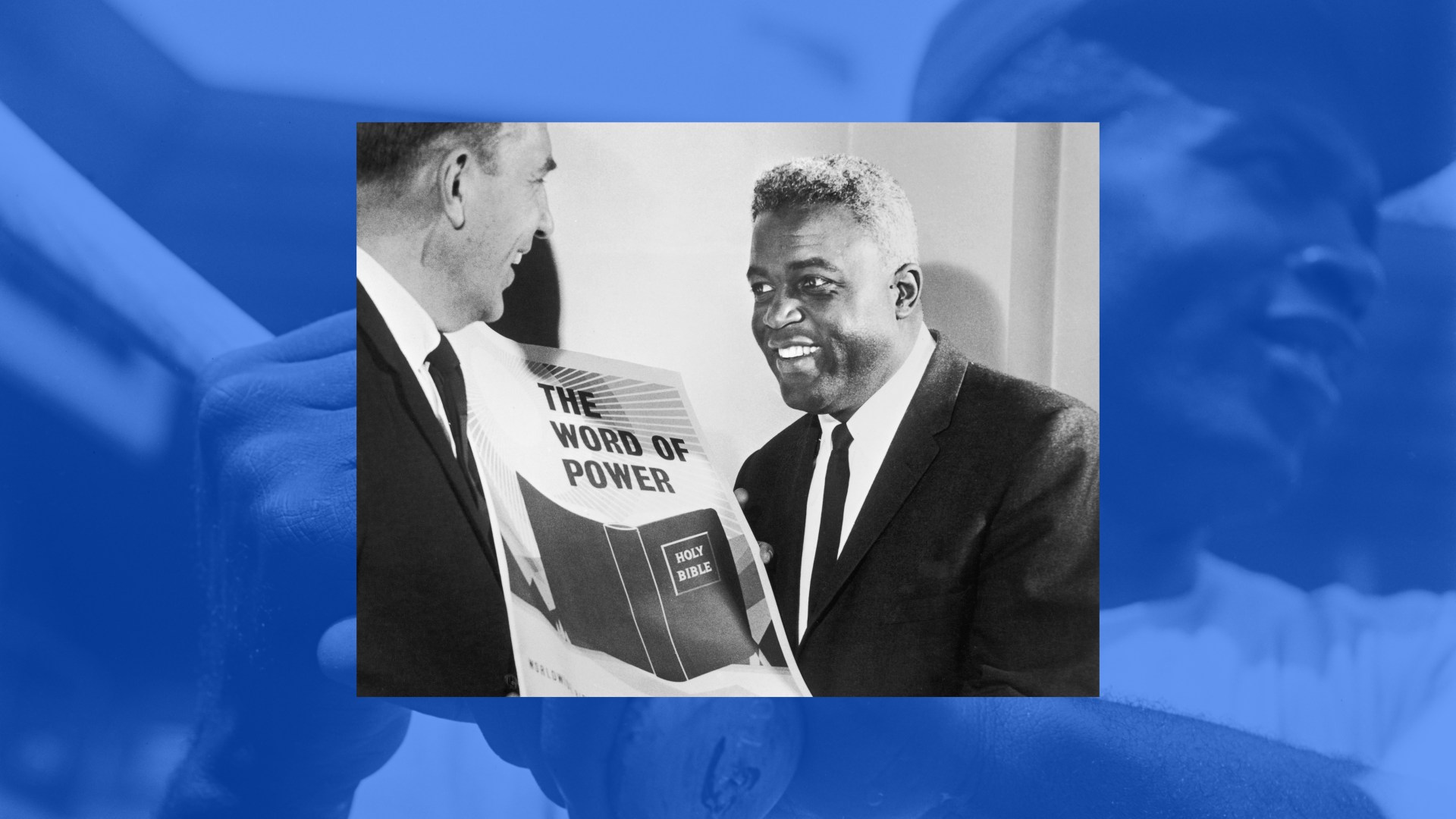
Christian Faith Was Jackie Robinson’s Haven in a Heartless World

A new biography offers an intimate account of his spiritual life, on and off the baseball field.

Christianity Today May 8, 2023
Edits by Christianity Today. Source: Pictorial Parade / Staff / Stringer / Archive Photos

Jackie Robinson, the first African American to play in the modern era of Major League Baseball (MLB), is undoubtedly one of the most significant cultural figures in the history of professional sports. Fittingly, his remarkable life has inspired a number of excellent books aimed at diverse audiences.

Strength for the Fight: The Life and Faith of Jackie Robinson (Library of Religious Biography (LRB))

The starting point for reading about Robinson ought to be his fantastic memoir, I Never Had It Made, published in 1972 just days after his sudden death at age 53. In it, Robinson details the extraordinary challenges he faced as an agent of integration. And it offers equally keen insights into the man himself, particularly his life after baseball as he tried to balance family, business, and civil rights activism on his own terms.

Relying heavily on the letters of Robinson’s wife, Rachel, Arnold Rampersad’s 1997 Jackie Robinson: A Biography offers more nuanced details on Robinson’s upbringing in Southern California and his often-strained family life. The year before Robinson’s death, his son Jackie Robinson Jr. died in a car accident after struggling for years to overcome substance abuse issues related to war wounds suffered in Vietnam in 1965. Rampersad’s account of Robinson’s life is also a work of genuine literary merit crafted by one of the best biographers of the late-20th century.

Several excellent children’s books, too, have been written about the pioneering baseball star. Most impressively, Frank J. Berrios and Betsy Bauer’s My Little Golden Book about Jackie Robinson explains Robinson’s significance in an understandable and age-appropriate manner for young readers.

More recently, Kostya Kennedy’s True: The Four Seasons of Jackie Robinson (2022) delves into the transformative impact of four years in Robinson’s life, both as a player and in retirement. Kennedy’s book, more clearly than any other, makes evident the degree to which Robinson’s life was under a microscope from the moment he integrated minor league baseball in Montreal in 1946 (the year before he broke MLB’s color line with the Dodgers) until days before his 1972 death when he threw out the first pitch at a World Series game.

Ed Henry’s excellent 42 Faith (2017) opened the door to exploration of Robinson’s spiritual life and how it shaped his choices as both a public and private figure. Released at roughly the same time, Michael Long and Chris Lamb’s Jackie Robinson: A Spiritual Biography (2017) grounds its rendering of Robinson’s faith in the child rearing of his deeply pious mother, Mallie McGriff Robinson.

Straight and narrow

Historian Gary Scott Smith has built onto the wing of the Jackie Robinson library that Henry, Long, and Lamb started to erect a few short years ago. In Strength for the Fight, part of Eerdmans’s Library of Religious Biography series, Smith offers a more intimate account of Robinson’s spiritual life than was previously known. Rooted in previous books on his subject, Smith’s book is both a work of synthesis and a triumph of original research that casts a distinct analytical eye on Robinson’s religious life.

While Robinson hardly hid his faith under a bushel basket, he shared his views publicly in a more restrained fashion than many charismatic Christian athletes have in recent decades. Smith illustrates this sensibility by calling upon his subject’s frequent and typically sedate speeches to congregations and church groups, reflecting his mainline Protestant roots in the Methodist church. Robinson spoke calmly about the viciousness he often faced as baseball’s first modern African American player, frequently comparing his experiences to those of Job. Many African Americans who heard Robinson speak could relate to such indignities as they went about their own everyday lives.

Smith places Robinson’s Christianity firmly within the ecumenical sensibilities of 1950s and 1960s mainline Protestantism. In this cultural space, a consensus developed around the need for what Smith terms “social amelioration.” Robinson exemplified the spirit of the time, showing great comfort in both Black and white churches. The straight and narrow of the Christian life was Robinson’s haven in an often-heartless world.

It was also a pathway to social progress and to breaking down seemingly impassible barriers, as Robinson demonstrated time and again during his public life. He desegregated not only Major League diamonds but also housing and public accommodations in many of the cities to which he traveled. He desegregated corporate boardrooms as an executive for Chock full o’Nuts coffee. Such boundary-crossing appeal made him an attractive target for both Republicans and Democrats, who vied for his political allegiances.

For Robinson, politics were personal and rooted in his spirituality. As Smith shows, Robinson’s political and religious thinking was shaped in no small way by Karl Downs, his pastor at Scott United Methodist Church in Pasadena. Downs was just seven years older than Robinson, and the pair developed something of a big brother–little brother relationship. Downs had been schooled in a social gospel-infused theology at Atlanta’s Gammon Theological Seminary. He believed the church had a duty to redeem the wayward institutions of the world, a duty Robinson came to recognize as an essential part of the Christian life. But they believed such reform needed to be pursued within the constraints of basic Christian decency.

From an early age, Robinson was one to turn the other cheek, even while enduring discrimination in his hometown of Pasadena, feeling like an outsider on the predominately white University of California, Los Angeles campus, and facing all manner of enmity and exclusion as he traveled the country as a professional baseball player. Upon retiring after the 1956 season, Robinson became more active in politics, favoring the art of persuasion in the social gospel tradition over direct or militant action. He served as president of the United Church Men, an organization of roughly 10 million Protestant and Orthodox Christian men founded by the National Council of Churches, which threw its spiritually informed weight behind the civil rights movement.

Politically independent

Though formally a Republican, Robinson displayed a decided political independence when it came to issues of civil rights and Black empowerment. Residing in New York State, Robinson stood shoulder to shoulder with Republican leaders like John Lindsay and Jacob Javits, whose bona fides as advocates for racial equality were evident. The former Brooklyn Dodger gave staunch support to the presidential aspirations of Nelson Rockefeller, New York’s liberal Republican governor. He was disappointed when his party nominated Barry Goldwater, who opposed federal civil rights legislation, in 1964—and again in 1968, when he perceived Richard Nixon shifting away from support for civil rights. As a result, he openly supported Democratic presidential candidates: incumbent president Lyndon Johnson in 1964 and Hubert Humphrey in 1968.

While Strength for the Fight is a consistently interesting and informative read, its strongest sections are the ones focused on Robinson’s life after baseball. Robinson’s prowess as a mover and a shaker is evident, as are the subtle ways he infused his religious sensibilities into his efforts at social reform. To some extent, Strength for the Fight seems like old wine in new vessels, but the familiar turf on which it treads has yet to be covered with the distinct analytical eye that Smith brings to Robinson’s life and faith.

Clayton Trutor teaches history at Norwich University in Vermont. He is the author of Loserville: How Professional Sports Remade Atlanta—and How Atlanta Remade Professional Sports and the forthcoming Boston Ball: Jim Calhoun, Rick Pitino, Gary Williams, and College Basketball’s Forgotten Cradle of Coaches.

Culture

New Resource Helps Kids ‘Grow Into’ Hymns

Children’s minister and artist collect 150 songs to span generations.

Christianity Today May 8, 2023
Courtesy of the Gospel Story Hymnal

In 2018, Britta Wallbaum and Lindsey Goetz traveled to a worship conference in Nashville. They hoped to come away with new resources to engage children in musical worship at their Presbyterian church in Aurora, Illinois. As they browsed merchandise for leaders displayed in the rows of vendor booths, neither could find the item they had hoped for: a hymnal for children.

“There were zero resources to share with kids,” said Wallbaum. “There were songbooks [for children] with sheet music but no ways to actually engage kids with them.”

The two friends wandered the exhibit hall separately, not knowing that the other was looking for the same thing. When they realized their common goal, it seemed like a divine appointment. They decided to make the resource they wanted for their church and for their own children.

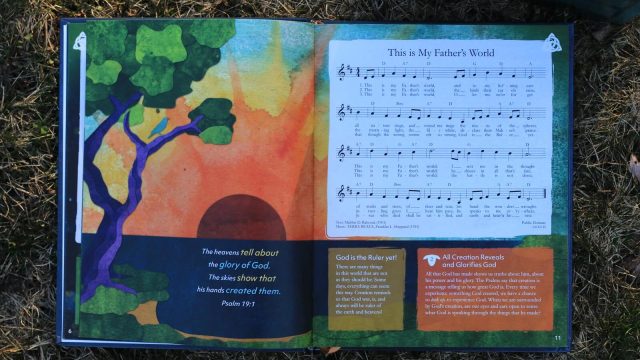
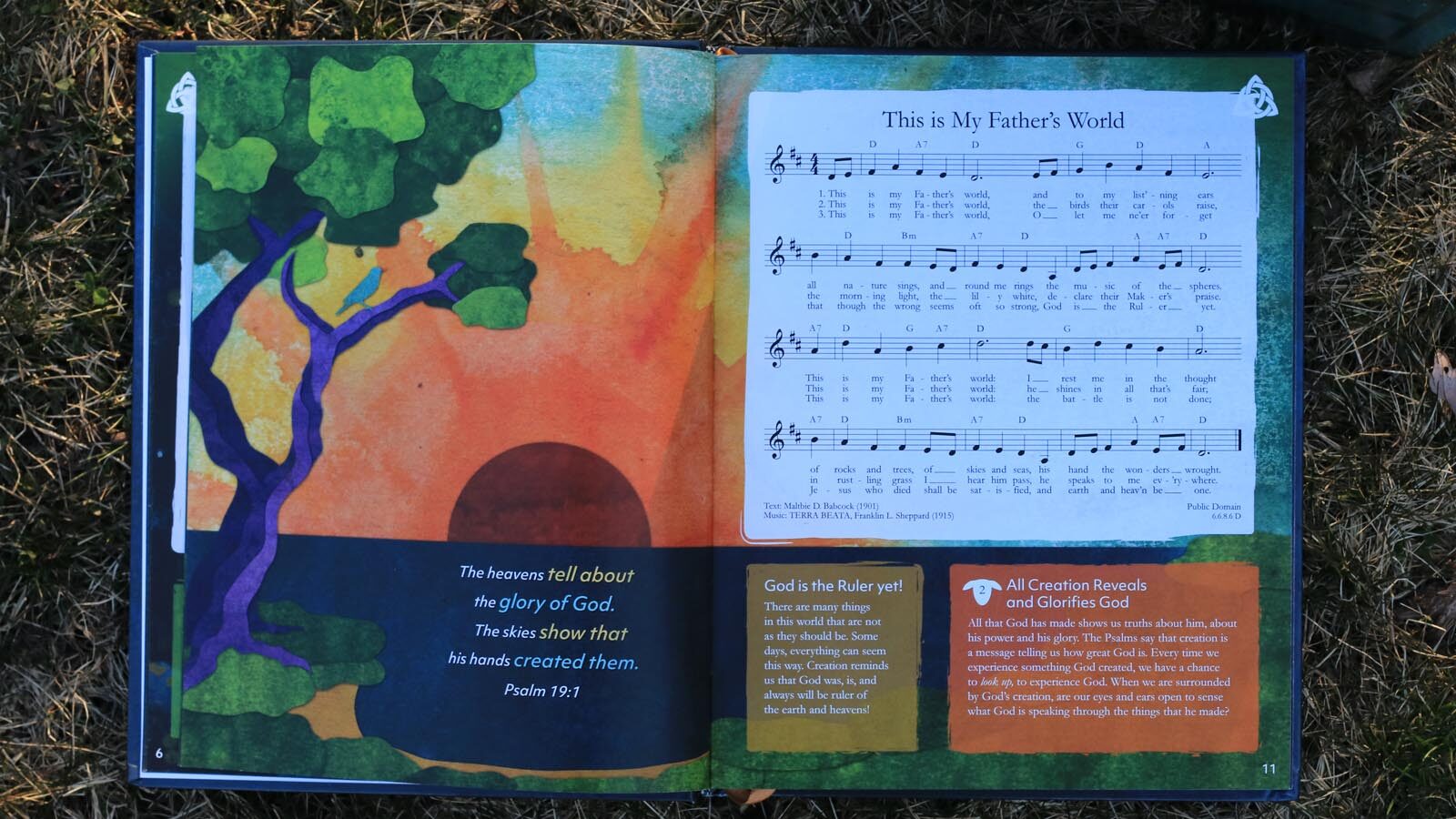
The Gospel Story Hymnal is the product of years of writing, illustration, and curation by Wallbaum and Goetz, who formed Word & Wonder to provide resources for worshipers of all ages, including children.

Crowdfunded by a Kickstarter campaign, the hymnal is a collection of 150 hymns, including centuries-old mainstays like “A Mighty Fortress Is Our God” and “All Glory, Laud and Honor” and more recent works like Michael Card’s “Barocha.” It also contains a schedule that families can use to work through each hymn and the accompanying commentary over a three-year period.

There are five sections in the hymnal: “Creation,” “Rebellion,” “Redemption,” “Already, but Not Yet,” and “Restoration.” Wallbaum and Goetz wanted the hymns to help tell a broad, unified story.

“The Bible isn't a bunch of disconnected stories with good morals. It’s an interconnected story that all points to Jesus. Somehow I had missed that for the first 30 years of my life,” Wallbaum said. “So, this hymnal resource … We needed to build that idea of this overarching story into it—the gospel story, supported by all these different hymns and themes.”

The hymn settings appear alongside Wallbaum’s vibrant watercolor illustrations and original commentary by Goetz.

Wallbaum, an architect, felt inspired to provide the artwork for the book herself. She spent months experimenting with different techniques and styles before developing a watercolor collage process inspired by Eric Carle.

“Each hymn has additional commentary regarding its theological importance, word definitions, applicable context information, scripture references, and/or worship notes, all written at an elementary level,” according the Word & Wonder website.

The authors did not alter or simplify the hymn texts for children. Wallbaum and Goetz believe that there is a benefit to having children sing the original words, even if they are challenging.

“You don’t grow out of hymns; you grow into them,” Goetz said. “As we journey in our life with God, the hymns can unfold greater meaning to us. They are pieces of faith formation that can grow with you.”

Rather than offer simplified hymns, Wallbaum hopes that her original illustrations and the accompanying commentary and scripture will draw children in and impart a sense of belonging in what can sometimes feel like “grown-up church.”

Goetz, the children’s minister at First Presbyterian Church in Aurora and spiritual director of Word & Wonder, believes strongly in the importance of multigenerational worship.

According to Goetz, “a better indicator of whether a high school student will remain a Christian after they graduate is whether they worshiped with their church community, not whether they attend youth group.”

Goetz, who is working toward a master’s degree in educational ministries through Trinity Evangelical Divinity School, spends a lot of time thinking about how childhood experiences in the church shape lifelong faith.

“If our church worship services are not welcoming to children, they need to change. What we see in Scripture is this call for the people of God to worship together.”

For both Wallbaum and Goetz, hymns have been powerful agents of spiritual formation. Wallbaum’s love of hymnody developed while she was a college student at Wheaton. Some of her professors would begin class by having students sing a hymn together. She was introduced to her favorite hymn “Be Still, My Soul” by her computer science professor, who had the class sing it at the beginning of a course meeting. When she got married, Wallbaum walked down the aisle to the hymn.

“It speaks to my soul, and it has walked me through so many phases of my life,” Wallbaum said.

In The Gospel Story Hymnal, “Be Still, My Soul” appears with an illustration of Jesus calming a storm.

Goetz has seen the enduring power of hymns in her life and in the lives of family members who walked with God for a lifetime.

“When someone has dementia, you watch them decline for years,” Goetz said, sharing the story of her grandfather’s death and the role singing hymns had in his final days.

Goetz remembers singing around her grandfather’s bed as he was receiving hospice care. She remembers the late afternoon light and the sound of her family singing hymns together, including “And Can It Be.” She remembers the sound of her father’s strong, deep voice and her aunt’s clear, confident harmonies.

“My grandma’s voice was cracking with tears. We couldn’t hear my grandpa, but his mouth was moving with the words we were singing.”

For Goetz, the memory of her grandfather recalling the words of hymns of the faith in his last hours powerfully illustrates the unique resonance and endurance of hymnody.

Now that The Gospel Story Hymnal is fully funded for a run of 3,000 copies, Wallbaum and Goetz expect books to be printed and shipped by September 2023. Wallbaum is finishing the final illustrations and is working on finalizing copyright licensing for all 150 hymns—no small feat. While many are in the public domain, 64 of them are still under copyright, and many of those have more than one copyright holder.

“It’s close to 100 copyright agreements I’ve ended up getting,” said Wallbaum. “For some I've actually had to get in touch with all the different songwriters, make a copyright license, and meet with them to sign. It's been … It's been a process.”

The creation of The Gospel Story Hymnal has been a rewarding and demanding undertaking for the authors. Goetz said that the prospect of giving this resource to churches looking to be more welcoming to children makes all the labor worthwhile.

“What I have seen at my church, in a congregation where children are welcomed and included—and of course we are still growing in this—I see children who can conceive of themselves as meaningful and important parts of the church,” said Goetz.

Goetz and Wallbaum, both mothers of young children, hope that The Gospel Story Hymnal will become a physical indicator in pews and seatbacks that children are welcome in the sanctuary.

“Experiencing belonging is one of the most important parts of how early faith develops. What's kept me going is the idea of seeing these [hymnals] in the pews and knowing that a child will open a book that's in the pew and say, ‘Oh, this is for me.’”

Ideas

Ron DeSantis’s Campaign Christianity

Staff Editor

Can the creator of “God Made a Fighter” political ads woo evangelicals from Trump?

Christianity Today May 8, 2023
Chris duMond / Stringer / Getty Images News

Will they, or won’t they ? The question of white evangelical voters’ support for former president Donald Trump isn’t over yet.

As Florida governor Ron DeSantis seems to be preparing to formally enter the Republican presidential primary for 2024, it could launch a notorious new season, set in sunny Florida and shaped by a buzzy subplot about Christian nationalism, which DeSantis and Trump alike have been accused of propagating.

Trump’s use of Christianity as a political prop is by now well known. Though demonstrably unfamiliar with basic aspects of the faith, the former president gamely toted his Christianity around on the campaign trail and in office. (Sometimes he literally toted it, as when he held up the Bible in front of a church sign for a photoshoot.) In 2016 and 2020, Trump hit his marks, visiting Christian colleges, conferences, and churches, and this year, he’s been eager to remind Christian voters—particularly evangelicals—how well that played with many of them before.

But compared to 2020, when Trump ran functionally unopposed for the GOP nod, in 2024 he’ll have competition. DeSantis, widely expected to be Trump’s most formidable primary opponent, is an especially interesting example here, as his campaign use of Christianity is more knowledgeable and sophisticated than Trump’s has tended to be. Will evangelicals see him as one of our own?

A practicing Catholic, DeSantis has a facility with biblical references Trump could never quite master, and he fits comfortably in evangelical culture in a way Trump does not. He’s a throwback to pre-Trump Republican appeals to white evangelicals as a voting bloc, in which candidates often identified with evangelicalism to a degree Trump has never attempted. (Trump speaks of “the evangelicals” just as he does of “the Jews,” linguistically placing himself outside each category.)

Whether DeSantis can put his cultural expertise to effective use remains to be seen. Once he announces, however, the show will really get going. Background players—including anticipated and declared candidates like former vice president Mike Pence, Sen. Tim Scott (R-S.C.), former New Jersey governor Chris Christie, and former South Carolina governor Nikki Haley—will have their scenes, vying for second billing after the midseason break. And episode recaps will abound: Evangelical leader X declines to endorse at this time. Candidate Y says God led him to run for president. The Z campaign’s secret weapon with Iowa evangelicals.

Christianity itself will appear as a campaign prop, with large block letters for easy identification onscreen and a strategically smoothed silhouette, ambiguous enough that any audience member, if so inclined, could tell herself that’s just like the Christianity she has at home.

There have been only glimpses of DeSantis’s version of campaign Christianity so far, but what little we have seen has been revealing. As much as he sometimes feels like a pre-2016 throwback where evangelical outreach is concerned, DeSantis is decidedly a post-Trump candidate too, with a brash culture-war pugilism almost every GOP contender will try to emulate this cycle.

His “God made a fighter” ad, launched during his gubernatorial campaign last year but clearly intended for a national audience, is a slick amalgamation of the two sides and probably a good forecast of Christianity’s place in this race. That’s why we should notice how little of Christ this campaign-prop Christianity contains. In fact, the ad never mentions Jesus at all.

It has no specifically Christian imagery, not even a cross. Church, visualized as disembodied raised hands, comes up only as a destination a DeSantis voter might wish to visit. Though clearly intended to appeal to evangelicals, there’s nothing specifically Christian here, let alone anything evangelical. A Jewish or Mormon candidate could produce the same ad—cut off the first five words (“And on the eighth day”) and a Muslim or generically deist candidate could too.

And beyond that deliberate religious ambiguity, this ad isn’t really about God or faith at all. DeSantis is the one who will save the people’s “jobs, their livelihoods, their liberty, their happiness.” He’s the hero of this tale. The narrator quotes imagined words from God at length, but God isn’t the object of praise here. God’s the one doing the praising. He’s praising Ron DeSantis.

Shrunk down to prop size and glazed in cheeky mid-century nostalgia, Christianity serves the campaign, not the other way around. The result is a clever ad, delivered in Christianese fluent enough to appeal to a large and useful voting bloc but vague enough to avoid highlighting the candidate’s nonevangelical theology, alienating people who call themselves evangelicals only because of their politics, or turning off the growing post-religious right. I suspect it will be imitated widely in the months to come, maybe even revamped by DeSantis himself for his official national debut.

None of this is to suggest DeSantis and his fellow candidates are insincere in their own faith. I can only make educated guesses as to what’s in their hearts (Matt. 12:34–37), and I know for certain I too have acted out of “selfish ambition or vain conceit” (Phil. 2:3), failed to draw near to God (James 4:8), and “conform[ed] to the pattern of this world” (Rom. 12:2).

But we don’t need to judge others’ faith to get into “no true Christian” territory or to say campaign-prop Christianity isn’t really Christianity at all. The “fullness of the Deity” (Col. 2:9) can fit inside a baby, but not inside a campaign ad.

Ideas

Can the United States Be ‘Forgiven Our Debts’?

Staff Editor

Even if the debt ceiling resolves, we should consider future generations.

Christianity Today May 5, 2023
Illustration by Rick Szuecs / Source images: Envato / Jtyler / Getty

When my husband and I wanted to buy our first house in 2012, we ran into a problem: Neither of us had a credit history. We both came from families with a typical evangelical wariness of debt, and so we’d gotten all the way through college and marriage without a single loan payment between us. We’d earned scholarships and gone to cheaper schools, hosted a cookout for our wedding reception, and squirreled away cash to buy used cars.

“The borrower is slave to the lender” (Prov. 22:7), my mother had often warned. But declining to take on debt also made sense to me at a personal level. I have all the skepticism of complex financial systems you’d expect in someone who finished college during the Great Recession. I dislike the feeling of obligation and limitation debt can entail (Prov. 22:26–27). With a few exceptions like mortgages and some business loans, I associated accumulation of debt with poor stewardship and lack of self-discipline. Having no debt felt right and responsible.

Like many evangelicals, that attitude easily mapped onto my politics. The US national debt was around $15 trillion in 2012, one year after the debt ceiling drama of 2011. If you’d asked me then, I’d have described that debt just as ethicist David P. Gushee did for CT in 2014. It’s “immoral and unwise,” he argued, even citing my mom’s favorite debt proverb:

Certainly, the Bible regularly calls for generous lending and debt forgiveness. But when it speaks of borrowing, the Bible is negative, and not just when addressing individuals. Borrowing is emblematic of national weakness that invites subservience to creditors (Deut. 15:6; 28:12). Borrowing for short-term needs risks long-term decline and even enslavement (Neh. 5:3–5). Creditors gain power over debtors (Prov. 22:7), though the powerlessness may not be visible until later. We Americans are feasting with borrowed money. We risk becoming a beggar nation.

I found that final point—that our borrowing would eventually be ruinous, if not for us then for our descendants—especially compelling. How could so much debt not take its toll? This kind of warning, of which there were many back then, struck me as self-evidently correct.

But $15 trillion in borrowing came and went, and then $20 trillion, and $25 trillion, and now the national debt is sitting at $31 trillion. That works out to about $94,000 per US citizen, $247,000 per taxpayer (a little less than half of the average American’s lifetime income tax payments), and a record-high 134 percent of GDP.

As the debt spiked ever higher, warnings of debt-induced crisis never stopped. Yet the crisis never materialized. The piper never seems to get paid. Is that because—as voices from the typically left-leaning modern monetary theorists to the late Rush Limbaugh have argued—there is no piper? Were the warnings always wrong?

That’s once again a pressing question, because we’re in another debt ceiling drama this spring. In late January, the federal government reached the legal cap on how much money Washington can borrow through the sale of Treasury bonds to make up the annual deficit, which is the difference between tax revenues and expenditures in a given year.

Though the Treasury Department can delay a federal debt default using “extraordinary measures”—accounting maneuvers to keep paying the government’s bills in the short term—those tactics can only buy so much time. But as the default deadline of June 1 fast approaches, the Biden administration and Congress are feeling the pinch to reach a dea—and fast.

Though some congressional Republicans are pushing to keep the debt ceiling at status quo, they don’t have the numbers to get what they want. Nor do Democratic lawmakers who want to get rid of the debt ceiling altogether—and anyway, president Joe Biden nixed that idea months ago, calling it “irresponsible.” (His administration is now reportedly reconsidering that conclusion, but it remains unclear whether Biden would take this option even if his legal advisers offer it.)

Realistically, the final deal will likely keep and raise the debt limit. The outstanding question is whether it will also cut federal spending to decrease or even reverse federal accumulation of debt going forward (as GOP leaders prefer) or if it will be a “clean” deal with no spending cuts (as Biden would like). Either way, a post-deal Washington will still have an unfathomably large debt. Should we be looking for the piper?

It’s not wrong to anticipate serious consequences for this level of borrowing, Romina Boccia, director of budget and entitlement policy at the libertarian Cato Institute, told me via email. But she warns that “a future U.S. fiscal crisis have been misunderstood.”

The danger is not so much an inflation so bad you might use bills as wallpaper. It’s rather a drift “toward more of a Japanese-style stagnation,” Boccia told me, and perhaps “a sudden, unexpected fiscal crisis during which interest rates would rise steeply.”

In that latter scenario, high interest rates would hit ordinary Americans trying to get mortgages and other loans, and they’d force the federal government to devote a far higher portion of tax revenues to debt payments to avoid loss of confidence in Treasury bonds or the dollar itself.

Louise Sheiner, an economist who’s worked at the Federal Reserve and US Treasury and is now with the Brookings Institution, didn’t anticipate quite such a drastic consequence in our phone interview. Some have warned that a loss of confidence would mean “no one’s going to lend to us,” she acknowledged. But the US had no difficulty borrowing throughout the pandemic at incredibly high rates. People still see Treasury bonds as good investments, even at the $31-trillion mark, Sheiner said. “We’re always able to pay them back.”

That’s not to say there’s zero risk of unwanted outcomes here, Sheiner continued, but she believes those consequences are mostly related to a rise in interest rates that would affect the whole economy, including both consumer and federal borrowing. This serious yet relatively mundane effect would require lawmakers to make the difficult choices they’re avoiding while low interest rates keep debt payments relatively affordable.

A spike in interest rates isn’t the only crisis economists envision coming from too much national debt. The modern-monetary-theory crowd contends inflation is the real concern and deficits don’t matter unless they’re causing inflation to rise too much. Across the board, though—whether we fear interest hikes or inflation or not, believe loss of confidence in US bonds and dollars is a real risk or not, want spending cuts now or later—there’s one consistent theme here: uncertainty about the future.

“We keep adding to the debt, and at some point, that is going to cause issues in the economy,” Sheiner told me, “but we don’t know what that point is. No one knows what that point is.” But, she said, “we care about the debt because we care about the future,” which requires us to think past the next decade, past the next election, past this deadline in June.

On this point, Boccia agreed, noting that the policy changes we would need for Washington to stop spending at a deficit “can take decades to produce significant savings,” and the kind of “prudent policy foresight” we’d need to adopt those changes now is in short supply.

We should be considering our children’s children and the impact on future society, not just the present moment (Prov. 13:22). Unfortunately, it appears more likely that we will stay in our ways and “pay the penalty” (Prov. 22:3). But it shouldn’t take a default deadline for us to think long-term.

News

Died: Rachel Kerr James, Missionary Nurse to War-Torn Vietnam

One of the first Southern Baptists into Indochina, she started medical clinics while raising four children and helping her husband plant churches.

Christianity Today May 5, 2023
International Mission Board

Rachel Kerr James was the first medical professional to arrive on the scene of the US embassy bombing in Saigon in March 1965. She saw the smoke, mangled metal, and scores of people wounded by the blast that ripped a hole in the side of the five-story concrete building. She knew immediately what she had to do.

“I am going to stay here as long as necessary,” she said to her husband, Sam. “It could be a long time.”

James spent three days tending to the wounded at the embassy—and 13 years caring for the people of Vietnam during the war. A Southern Baptist missionary nurse, she volunteered with the Red Cross, set up medical clinics in the villages around Saigon, and launched a mobile clinic, all while raising four children and helping her husband plant churches and start a seminary.

James died in Virginia in April. She was 88.

“I felt God called me to be a foreign missionary,” James said. “My whole life has been centered around this call.”

James was born October 17, 1934, in Durham, North Carolina. Her father, Theodore Kerr, worked at a local hospital. Her mother, Ethel Peed Kerr, was a homemaker who had once dreamed of being a missionary and passed her passion for mission work on to her daughter.

James accepted Jesus as her personal savior at 14. Shortly afterward, she started to feel a call to nursing and missions that was, as she later described it, “increasingly definite.” As she started to date, however, that call was challenged. Few if any of the young men she knew were committed to missions. Fewer still liked the idea of getting married to a woman who wanted to be a missionary.

One day, praying in church before dawn, she was convicted that following Christ had to come before anything else—even getting married and having a family. She stretched herself out on the altar as the sun rose through and gave her life to God.

“Lord, I want you to know I am completely willing and ready to go alone,” she said. “But, Lord, if you send me somebody, and we can go together, that will be okay too.”

Two years later, as a nursing student at Duke University, she was invited to dinner at the home of a woman from her church. The woman also invited her nephew, a Navy veteran who had a born-again experience while serving in Korea. Sam James was immediately smitten with this woman who was so committed to the Great Commission. He drove her back to her dormitory, and the two sat in the parking lot until midnight, when all the nursing students had to be in for curfew.

Before they parted, they prayed that God would guide them on their respective paths to serve him—each hoping, but not saying aloud, that those paths might merge.

Sam and Rachel James were married on August 8, 1957.

As they prepared for mission work, Sam took a job as a pastor of a Baptist congregation in rural North Carolina. James had her first child there, and then her second.

The growing family struggled in those first few years of ministry. Political tensions divided the church, and some people started leaving when they heard Sam was planning to allow Black people to attend. He had not thought about trying to integrate the congregation, Sam later wrote in a memoir, but he was deeply unsettled by the racial views in the church. He demanded the church vote on whether to keep him.

“God loves all mankind no matter where in the world they live, what skin color they have, what economic strata they belong to, or what social standing they have,” he preached. “Above all, God loves every single one of us.”

The congregation agreed to keep their young pastor and allow Black people to sit in one section of the sanctuary if they came. (None did.)

In 1961, the Jameses were accepted as candidates by the Foreign Mission Board of the Southern Baptist Convention. Rachel James attended orientation while three months pregnant with her third child.

They left by boat from San Francisco in March 1961, with a three-year-old, an 18-month-old, and a newborn in tow.

When they landed in Hong Kong, however, the Jameses were informed that their visa applications had been rejected. The South Vietnamese government, run by Catholics, was concerned about American Protestants undercutting support for the regime. They appealed and waited. They waited all spring, all summer, and into the fall.

Yet when it seemed like they would never get approval, Rachel James became convinced the authorities were going to change their minds. Baptist churches in the United States had a calendar telling them when to pray for missionaries, and they were scheduled to pray for her on her birthday, October 17. She was certain it would make a difference.

On October 17, the Jameses were notified their visas had been approved. They became the sixth Baptist missionary family to go to Vietnam.

The Jameses spent two years in intensive classes learning Vietnamese, taking turns studying and watching the children. As they learned the language and the culture, they began to love the people.

It wasn’t always easy, though. There were small but embarrassing faux pas, like the time Sam offended a guest by eating first or the time he couldn’t think of the vocabulary for “plucked” and asked a woman in the market for a chicken without clothes. She called everyone over to laugh at him.

There were more serious challenges too. The American government started sending combat troops into the country, and fighting increased. The South Vietnamese government, worried about dissidents, outlawed all meetings of more than three people, making all of the Jameses’ Bible studies illegal. Rachel wasn’t legally allowed to start a clinic, because all the Vietnamese doctors had been drafted into the military and she needed a doctor to supervise.

In 1967, as they began their second term in Vietnam, however, an American army doctor showed up at the church they had planted in a suburb of Saigon. S. Leo Record Jr., a Wesleyan from North Carolina, had received orders to provide medical care to the South Vietnamese. But he didn’t have anyone to translate. He heard the Baptist missionaries spoke Vietnamese and was shocked to find that one of them was a trained nurse who wanted to start a clinic.

James and Record teamed up to provide medical care. They opened weekly clinics in the villages around Saigon, each serving 100 to 200 people. Around the same time, James had her fourth child.

In 1973, when President Richard Nixon started withdrawing troops, most of the medical personnel in Saigon were sent home. The army sold James all the medical equipment she wanted, though, and she teamed up with a Catholic doctor and established a mobile clinic, driving to a different place each day to continue the work.

James insisted on continuing, even when the work was threatened by Northern Vietnamese soldiers.

“Sam,” she told her husband, “I just can’t give up the ministry God has placed in my care. The need is just too great. … I simply will not, cannot quit.”

James continued for another two years, until the South Vietnamese government fell and the family had to be evacuated.

Back in the US, James supported her husband as he oversaw the construction and development of a missionary training center in Richmond, Virginia, known today as the International Learning Center. Sam went on to serve as East Asia area director for the International Missions Board and then vice president for creative leadership development.

“A missionary wife goes through cycles of life and ministering,” she said. “There are times when she is free to do what she wants to do. Then she may enter a cycle where she is busy almost full-time carrying out the responsibilities that come naturally to a wife and mother. … All of this is the Lord’s work and in his will and timing.”

In 2002, the Jameses were allowed to return to Vietnam to see the church they helped start in Saigon with $50,000 taken up in Lottie Moon offerings in Southern Baptist churches. The church survived the Communist rule under Vietnamese leadership and continues to this day. The couple made regular trips back to Vietnam to teach until James’s health no longer allowed her to travel.

James is predeceased by her third child, Philip. She is survived by her husband and children, Deborah Winans, Stephen James, and Michael James. A memorial service will be held at First Baptist Church, Richmond, Virginia, on May 13.

Church Life

They Denounced an Art Exhibit. But Will Anyone Understand Why?

Taiwanese Christians thought a zombie-themed show dishonored God. I’m not sure their response was Christlike.

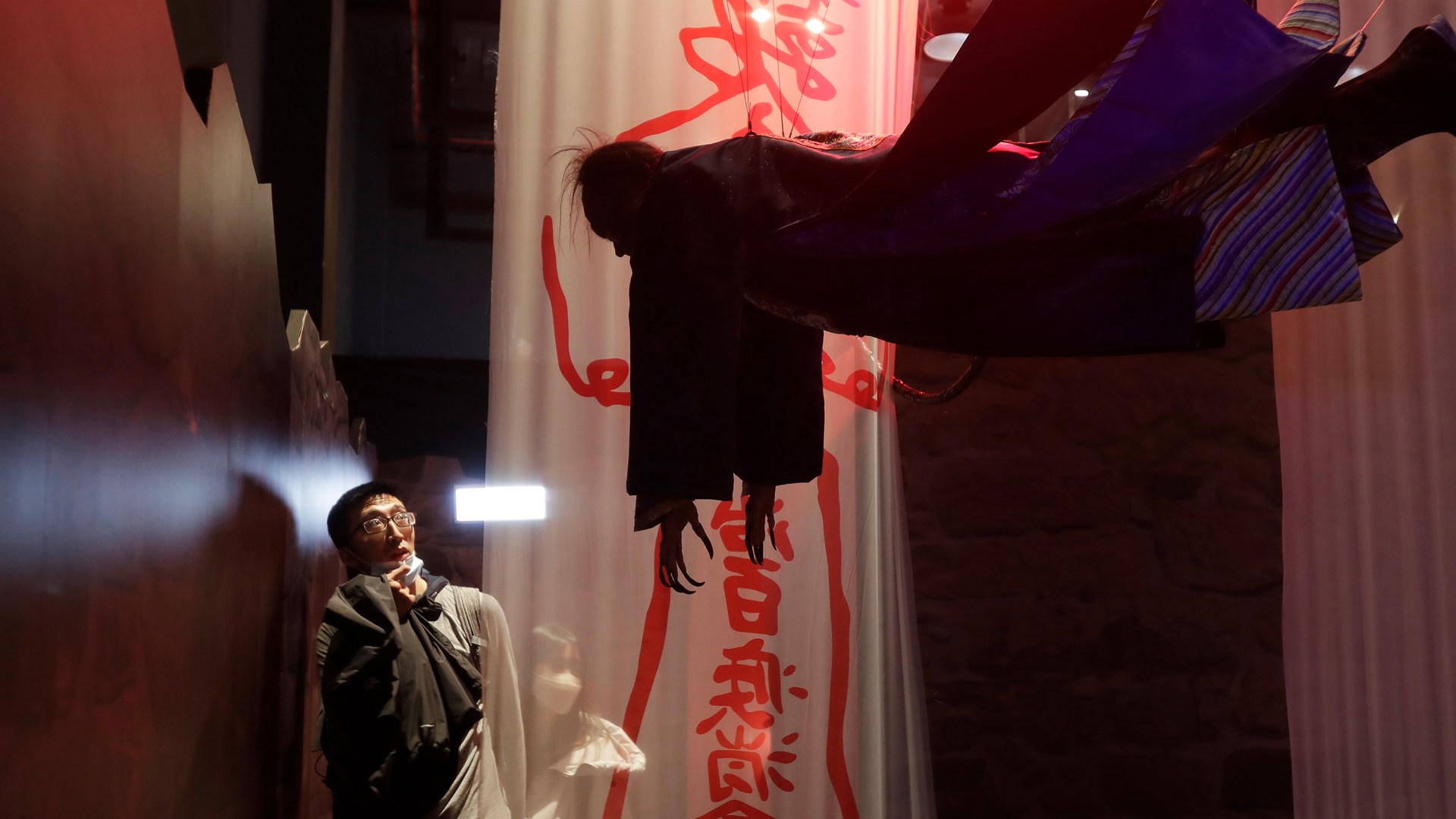
People look at mannequins at a Zombie exhibition in Taipei, Taiwan.

People look at mannequins at a Zombie exhibition in Taipei, Taiwan.

Christianity Today May 5, 2023
ChiangYing-ying / AP Images

Last year, the Tainan Fine Arts Museum announced a forthcoming exhibition featuring images of ghosts and zombies. To contextualize the show, which originated in France, curators incorporated artwork inspired by local folk beliefs and cultural stories of various Asian countries.

But before the exhibit had even opened, many Christians began flocking to the museum’s Facebook page to criticize the show as “immoral and harmful to public decency” and a “freakish power of the demon”—and even to request that the museum pull the plug on it. One church issued a public prayer request, claiming that the exhibit would “pollute the country and the people” and that the “the evils of our country are growing [and] we are ignorant, deeply offending God!”

As Christians lamented the zombie exhibit, its supporters argued with them in the comment section—and bought tickets. Ultimately, presales for the zombie exhibition sold out as soon as they were available, and many people waited in queues for several hours to enter the venue.

The Christians I grew up around in Taiwan would likely defend the critics who say pop culture or art is displeasing to God. Like many evangelicals in America, many of them believe the church has the responsibility to speak out against the culture when it appears to violate biblical teaching and values. But is this asking too much of the world?

To paraphrase Marvin Olasky, Christians often categorize their society as Israel, when in actuality it’s Babylon. While Olasky makes this claim about American Christians, it is even more true in Taiwan, where Christians make up only 5.5 percent of the population and nearly half (49.3%) of people profess folk religion (a mixture of Daoism and Buddhism).

For years, while Taiwan was under authoritarian rule, Taiwanese society kept and practiced the Confucianist ethics. Since many moral codes advocated in Confucianism overlap with biblical principles, Christians in the past did not seem as concerned with countering Confucian teachings with biblical truth.

But when Taiwan started to democratize in the 1990s, the country began opening to different voices and values. The church was used to being in a relatively “comfortable” conservative society and wasn’t ready for the rapid progress of “secularization.” Taiwanese Christians began to imitate American Christian narratives about combating secularization and reacting against perceived “godlessness.” In the process, they forgot the fact that Christians have always been the minority in Taiwan and that people have been worshiping worldly idols for centuries—including our own culture.

Consequently, most people who live on the island do not care what the “Christian God” thinks of them or what the “prophets” of the Christian religion may think of their chosen ways of life. When these “prophets” ascend to the mountain to cry out and lament, Taiwanese people cannot understand what they are angry about. Often, all they can see is strangers judging their actions.

To Christians, this ignorance should make sense. Paul notes that “the message of the cross is foolishness to those who are perishing” (1 Cor. 1:18). The word world (κόσμος) occurs 186 times in the New Testament alone. And before we met Christ, weren’t we ourselves once practitioners in the world’s ways?

In his time on earth, the Gospels do not portray Jesus as showing any discomfort around people who did not know him. In fact, Jesus made the deliberate decision to eat with “tax collectors and sinners” in an age and culture where eating at the same table was an intimate act. And the Bible includes more instances of Jesus rebuking those who considered themselves to be religious than those who counted themselves as sinners.

The Pharisees, who claimed to keep God’s law, were obsessed more with manipulating people’s behavior than with caring for their difficulties (Mark 3:1–6). They rejected people’s words on account of their social status (6:1–3), looked on the outward appearance and not at the heart (7:1–23; 10:23–27), sought glory in their own way (8:32), competed for status and prestige (9:33–37) and were jealous of those who were gifted in ministry (9:38). I think the reason Jesus rebuked the Pharisees and the disciples so often was that they not only misunderstood the world (lacked compassion) but also could seldom see how much they resembled it (1 Cor. 3:1–3).

The Bible teaches us to love sinners, but it also expects sinners to repent. And yet we often overlook how Jesus called sinners to repentance—how he made them willing to repent.

Jesus could have spent all his time directly rebuking tax collectors and prostitutes for being immoral sinners, but instead he focused his ministry on building relationships with them and addressing their needs. In the process, they often came to understand why they needed their sins forgiven. After a conversation in the middle of the day, Jesus tells a Samaritan woman about water that ensure she will never thirst again (John 4). He also confronts her about being married five times and that she currently isn’t married to the man she is with. After this long exchange, she is not only willing to change her own life but she eagerly tries to convince her community to meet Jesus.

And while many in this world will see the kindness of God in the loving way of Jesus, realize their sinfulness, and ultimately repent (Rom. 2:4), there are just as many who have a “hard and impenitent heart” (v. 5, ESV)—including those who claim to follow him yet “have eyes but fail to see, and ears but fail to hear” (Mark 8:18).

Paul said, “We are therefore Christ’s ambassadors, as though God were making his appeal through us. We implore you on Christ’s behalf: Be reconciled to God” (2 Cor. 5:20). After Jesus left the world, the church became the body and messengers of Christ—representing his image on earth. As such, we are called to live out the essential commands of Christ: “Love the Lord your God with all your heart and with all your soul and with all your mind and with all your strength,” and “love your neighbor as yourself” (Mark 12:30–31).

How strong is our public testimony if all we are doing is reminding everyone of our high moral standards, expressing our disappointment with people’s life choices, and displaying our anger every time we see what we consider to be an “offensive” act against God? Instead, how powerful would our witness be to those outside the church if they saw us fighting for justice day and night, repenting for our wrongdoings, making peace and reconciling with others, and sacrificing ourselves to serve our neighbors and the least of our brothers and sisters?

As Kirsten Sanders argues in a recent piece for CT, “When the church becomes preoccupied with defending itself to the world, it eventually becomes incoherent.” This does not mean the church should be “withdrawn or ignorant or politically uninvolved,” but it does mean that there is a better way to go about it—and that is “to speak the peculiar language of peace, of forgiveness, of repentance and resurrection.”

Jesus’ Great Commission to the church is not to “go therefore and make all nations know that they are sinners.” Instead, he commanded us to make disciples—and part of that involves letting our light “shine before others, that they may see your good deeds and glorify your Father in heaven” (Matt. 5:16). Sometimes, the world cannot understand us because they cannot see how we are any different than they are. And unless Christians understand the ways of the world, how will we know whether we resemble them?

Some Christians fear that our light is too small for the world to see. This fear can convince them that speaking authoritatively and stridently is the best way to remind people that Christians are not ashamed of their faith. But I do not believe this approach best reflects the way Christ conducted himself on earth.

Personally, I don’t think Jesus would try to stop people from going to see the zombie exhibition. Instead, he might engage them about the spiritual themes in the art. He might praise the artistic talent on display in the work or look for ways for the church to honor and recognize the artists. Or maybe he would recognize that people’s very desire to be in a setting that connects spirituality and beauty is the same impulse that can lead them to seek out God—and then he might invite them into that very thing.

Yiting Tsai is from Taiwan, and currently serves at a local church in Chicago. She also leads Christianity Today's Chinese translation efforts.

Theology

‘Memorizing’ the Scars of South Korea’s Gwangju Massacre

Chun Woo-won’s apology for his military dictator grandfather’s sins is Nehemiah in action.

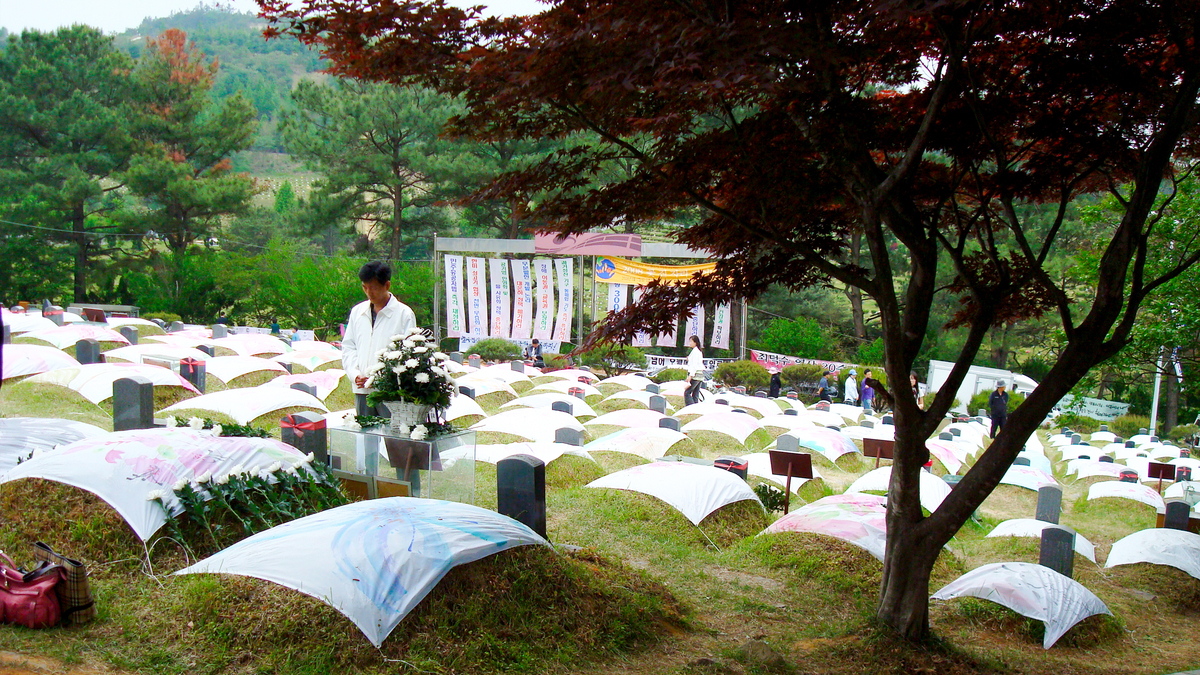
Mangwol-dong cemetery in Gwangju where victims' bodies were buried.

Mangwol-dong cemetery in Gwangju where victims' bodies were buried.

Christianity Today May 5, 2023
Wikimedia Commons

Midway through global K-pop sensation BTS’s 2015 track “Ma City,” J-Hope raps a lyric that’s both a personal homage and a history lesson: “Everyone dial it, 062–518.” Those digits are a cleverly encoded reference to his beloved hometown Gwangju. The South Korean city’s area code is 062, and 518 harkens back to May 18, 1980, and the prodemocracy mass uprising that took place in Gwangju on that date.

A little more than a week later, a military crackdown that included tanks and helicopters stormed the hundreds of thousands of civilians who had gathered to protest Chun Doo-hwan’s military coup and dictatorship. The brutal attack left 144 civilians dead, according to official government figures, although surviving eyewitnesses claim that the true death toll surpassed 2,000. Thousands more were injured, with many falling victim to indiscriminate beatings, rapes, disembowelments, and torture carried out by riot police and paratroopers. The state massacre is widely considered to be one of the darkest moments in Korea’s struggle for democracy.

In 2010, BTS’s Suga released the hip-hop track “518-062,” which pays tribute to courageous victims and calls a new generation to join him in “memorizing” the scars and wounds from “that dark past day”:

their bodies are filled with scars from the flag

darling, I’ll ignite your will again

brothers, I’ll memorize your scarred Korean flesh without pause

“[I want] to ask people not to allow the uprising to fade little by little from their memories and to remember it once again,” Suga said when the track debuted.

Chun Woo-won, the 27-year-old grandson of the late former president Chun Doo-hwan, has not allowed the uprising to fade from his memory. His recent actions vividly illustrate the biblical practice of intergenerational responsibility and confession and its capacity to engender the healing of old, festering wounds.

A public confession

The younger Chun, who lives and works as an accountant in New York, made international headlines on March 31 when he visited Gwangju to offer a formal apology to surviving victims and bereaved families of the 1980 massacre.

“I sincerely apologize for coming so late, and I am grateful to the people of Gwangju for graciously welcoming me for doing something that should have happened a long time ago,” Chun said that day, appearing visibly emotional.

Although he gestured towards his own flaws and failings, Chun expressed remorse primarily as a stand-in for his grandfather, who died in 2021: “As a family member, I acknowledge that my grandfather Chun Doo-hwan was a sinner and a slaughterer who committed such a great crime.”

Chun concluded his visit by paying respects to the deceased at Gwangju’s May 18 National Cemetery, which holds the graves of 764 victims. He vowed to “repent and express regret for my family’s wrongdoings for the rest of my life.”

While the immediate reaction was mixed, no one could deny that this public gesture of contrition was remarkable for having happened at all: Chun Woo-won is the first member of his family ever to apologize for the 1980 massacre. His grandfather, nicknamed “The Butcher of Gwangju,” denied issuing a shoot-to-kill order in a 2016 magazine interview, claiming, “I had nothing to do with the Gwangju incident.” He died, still defiant, at the age of 90.

Even after Chun Doo-hwan’s passing, victims ached for acknowledgment from the family. “A truthful apology would require Chun’s family coming to and kneeling at the victims’ graveyard,” insisted Choi Hyung-ho, the head of the Seoul branch of The May 18 Memorial Foundation.

And this is precisely what Chun Woo-won did. Besides offering a verbal apology, he also knelt before massacre survivors and family members of victims and offered the deepest and most formal way of expressing humility and respect in Korean culture: keunjeol, or a full-prostration bow, in which all five points of the body, including elbows, knees, and forehead, touch the ground.

https://twitter.com/0veptodittID/status/1641622459299561474

Videos of the powerful moment immediately went viral across social media platforms around the world. Some expressed skepticism about Chun’s sincerity and motives, which were undermined by his personal vices and indiscretions. But many were hopeful. One individual commented on Twitter, “This has me shedding tears.” Another said, “This is so powerful. It’s such a simple gesture. But an apology goes a long way.”

Reflecting on this incident, King’s College professor Anthony Bradley wondered what America might be like today “if US white conservative descendants of slavery’s Master Class and Jim Crow supporters (who were in every state) had practiced this Nehemiah 9:2 act in local communities across America in the 1970s.”

Such is the potential for public apologies to heal and to mend. Such is the power of intergenerational confession.

Bearing responsibility

Nehemiah 9, the text Bradley cited, offers a salient example of intergenerational confession from the Bible. With their bodies draped in sackcloth and dirt smudged on their faces—a cultural analog to keunjeol, perhaps—the restored exiles of Jerusalem gather to confess not only “their sins” aloud but also “the iniquities of their fathers” (v. 2). They do so, first, by rehearsing the history of God’s dealings with their ancestors in judgment and redemption (vv. 6–32), and then by identifying with that story and those ancestors in a penitential prayer: “You have been just in all that has come upon us, for you have dealt faithfully and we have acted wickedly” (v. 33).

Us. We. With these pronouns of remorseful solidarity, the people join a chorus of voices in Scripture that own and acknowledge their predecessors’ sins. “Both we and our fathers have sinned,” Psalm 106:6 sings. “We acknowledge our wickedness, O Lord, and the iniquity of our fathers, for we have sinned against you,” laments the prophet Jeremiah (14:20).

“Our fathers sinned, and are no more; and we bear their iniquities,” the author of Lamentations bemoans (5:7). This ancient chorus echoed once more in the voice of a grandson in Gwangju, a voice that grieved “the hideous crime we had committed.”

In spite of this broad biblical precedent, there will be some in the Christian tradition who appreciate Chun’s apology for its symbolic and sentimental value but resist any suggestion that apologizing for the sins of one’s deceased forebears should be a normative practice.

Two possible reasons for this skepticism are worth examining briefly.

The first involves the skeptic’s cultural vantage point. Sociologists have long noted that the social function and meaning of an apology can vary widely in collectivist cultures like South Korea, as opposed to individualist cultures like the US. In the former, people tend to see themselves as connected to others, define themselves in terms of their relationships, and apologize as an expression of eagerness to repair a damaged relationship. In the latter, people tend to see themselves as separate from others, define themselves by their individual traits and choices, and associate apologies primarily with personal guilt.

These two groups will tend to read the Bible differently when encountering collectivist and intergenerational concerns in places like Nehemiah 9. Individualistic observers are more likely to resist the idea of apologizing to strangers they have never met for wrongs they didn’t personally commit.

This brings us to a second reason for skepticism toward intergenerational confession. Some say that the practice is theologically invalid because it unjustly punishes people as if they had personally committed the sins of others. But this reflects a misunderstanding of the concept.

Intergenerational confession doesn’t rely on a reckless imputation of an individual’s personal guilt to another. The prophet Ezekiel clearly asserts that a person “shall not die for his father’s iniquity” (Ezek. 18:17; also Jer. 31:29–30), even as he affirms the fairness of Israel’s communal judgment by exile (Ezek. 16–17). Individual culpability remains distinct from collective responsibility.

The Gwangju apology does not imply that Chun bears personal guilt for his grandfather’s atrocities, as though he himself had committed them. Neither does it serve as an equivalent substitute for the repentance his grandfather owed but never offered—“his blood shall be upon himself” (Ezek. 18:13). Rather, Chun’s apology represents an embrace of corporate responsibility for the sins of one member (Chun Doo-hwan) of a collective (the Chun family) in which the person apologizing (Chun Woo-won) is also a member.

Whether by instinct or learning, Chun, who is Christian, appears to understand that he is implicated in his grandfather’s evils, even if he is not personally to blame for them. He bears responsibility “as a family member.”

The road to healing

What does this collective, intergenerational responsibility entail? The obligation to ameliorate, and not merely acknowledge, the harms of the past.

Old Testament scholar Michael Rhodes points to the Year of Jubilee as a key example (Lev. 25–26). Israelite families that had acquired land from other families, sometimes by sinful and oppressive means, were required to return the land to the original owners every 50 years. “If the damage one generation does is not fixed in their own day, that damage does not simply disappear at their death. The wrong must be righted, and the job may well fall on their descendants,” Rhodes explains.

This biblical principle applies to Chun Doo-hwan’s descendants: They may not have broken it, but they must repair it. They should not only “confess their iniquity and the iniquity of their fathers” (Lev. 26:40), as Chun Woo-won did, but also “make amends for their iniquity” (Lev. 26:43).

What kind of amends can be made to the residents of Gwangju? What emblems of repentance, healing, and neighborly love can be offered? This is a matter for Chun to determine for himself, guided by the input of victims and their families. But he already appears inclined toward this frame of mind. In a press conference after the event, Chun expressed his intent to “continue to contact” the bereaved families “as much as needed” and to “continue the dialogue.” Perhaps that dialogue could include the possibilities of repair.

To be clear, the process of healing did not begin with Chun’s apology. It has taken place over the past 40 years at the local and national levels through efforts around truth-seeking, criminal prosecution, memorialization, and government reform. It has also included material reparation. Beginning in 1990, the government—which bears primary responsibility for the massacre—passed a series of measures, including the Kwangju Compensation Act, that provided compensation to families of the deceased and missing and to those who were injured. A total of 5,185 cases were handled, and 233 billion Korean won (approximately $202 million USD) was paid to victims, for an average amount of 45 million Korean won ($39,000) awarded per person, according to one estimate in 2009.

Transitional justice advocates will insist that redress to victims is an essential pillar of social healing. Old Testament law apparently agrees. Yet, $39,000 is a relatively modest sum when considered in light of the full extent of the actual damage that was done—the murders, the brutalization, and the rape and sexual assaults carried out by soldiers during their crackdown on the uprising.

Reparation is necessary for healing, reconciliation, and peace. But its limited payout brings into brighter focus the sheer enormity of the loss, together with what political philosopher Hannah Arendt called the “predicament of irreversibility,” the plain human inability to undo what has been done.

No amount of recompense can undo what was done in Gwangju, and we would be wise not to sentimentalize the tearful goodwill displayed there. “Transgenerational forgiveness cannot be achieved with a simple apology and its acceptance,” said Ani Kalayjian, a scholar and descendant of Armenian genocide survivors.

Forgiveness, like collective responsibility and confession, is a scriptural imperative (Matt. 6:14–15; Luke 17:3–4; Eph. 4:32). It brings about a mutual release from the oppressive bonds of vengeance. But it is also complex. Sometimes forgiveness proves elusive in a sin-scarred world. Very often, forgiveness involves a long and arduous process, especially when it is generationally delayed and involves remorseless or deceased perpetrators of state brutality.

Survivors and families whose loved ones perished in the Gwangju massacre received Chun Woo-won warmly in Gwangju. Some of the bereaved, including elderly mothers who lost their college-aged children decades ago, burst into tears and accepted his apology. Others commended him for his courage and hugged him. One woman, whose son was killed in the uprising, expressed her hope that Chun would “think of Gwangju as his second home.”

Whether these visible gestures of goodwill can be accurately interpreted as forgiveness is unclear. Whether they reveal that the original perpetrator, Chun Doo-hwan, is hereby forgiven on account of his grandson is even less certain. Still, the victims’ magnanimous response indicates that some kind of release from indebtedness, some kind of freedom from vengeance, may have pierced through the decades-old fog of bitterness and grief that day.

If so, that too is a kind of healing. That too is a legacy worth memorizing.

Duke Kwon is coauthor of Reparations: A Christian Call for Repentance and Repair and lead pastor of Grace Meridian Hill, a neighborhood congregation in the Grace DC Network. He lives in Washington, DC, with his wife and three children.

News

Mobs Kill 6, Burn Down 25 Churches in Northeastern India

While ethnic tensions have festered for decades, leaders in Manipur say religious extremism is fueling the extreme aggression.

Christianity Today May 4, 2023
Associated Press

Rioting mobs have taken the lives of at least six people and destroyed or burned down 25 churches in the northeastern Indian state of Manipur. Since May 3, thousands of victims, the majority of them Christians, have fled as their homes and businesses have gone up in flames.

While tensions over property rights and economic interests have existed between the state’s ethnic groups for decades, local leaders told CT that church burnings are the result of the growth of Hindu nationalism among the dominant Meite community.

The chief minister of Manipur, N. Biren Singh, described the situation as a “prevailing misunderstanding between two communities” and said that his government was committed to protecting “the lives and property of all our people.”

“We should not allow the culture of communal harmony in the state to be disturbed by vested interests,” Singh said, adding that he also intended to address the community’s “long-term grievances.”

Manipur borders Myanmar and is home to a diverse range of ethnic groups, including Meiteis, who are a numerical majority in the state and are predominantly Hindu, and various tribal communities, who are largely Christian.

Primarily based in Imphal Valley, a region which includes Manipur’s capital, the Meiteis have long dominated the state's political and economic landscape. Meanwhile, tribal communities make up around a third of the population (35.4%) and are mainly concentrated in the hills surrounding the valley, 90 percent of the state’s geographical area.

For decades, the issue of land ownership and control has been a source of conflict between the two groups. But in recent years, these tensions have been exacerbated by the political influence of the Hindu nationalist organizations Rashtriya Swayamsevak Sangh (RSS) and the Bharatiya Janata Party (BJP), which have sought to promote their faith as the dominant religion in India and have used the Meitei community to advance their political agenda in the state.

https://twitter.com/ashoswai/status/1654141620130914305

This month’s violence came weeks after the Manipur High Court ordered the state government to respond to the Meitei community’s request for Scheduled Tribe status. The designation gives communities special constitutionally backed protections including reserved seats in the parliament and state legislatures, affirmative action in education and employment, and property protections.

But believing that this categorization would dilute their own protections and political representation, Manipur tribal groups have long fought this change.

While area leaders believe that the violence was largely a reaction to this political decision, they see its viciousness and severity, particularly the attack on churches, as the growth of the influence of BJP and the RSS. Radical Hindu ideology historically has struggled to find a foothold in Manipur, because of its mix of tribal, Hindu, Christian, and Muslim communities.

Christian leaders from the area told CT that they believed this violence was religiously motivated.

“In this pogrom, the Hindu Meiteis not only burned down churches belonging to tribals but also churches that exclusively belong to Meitei Christians,” said Ngaineilam Haokip, an academic at university in Kolkata, who grew up in Manipur. “They targeted their own brethren who follow Christ by burning their churches.”

“If this is not a pogrom, what is? They are burning churches when the protest rally was simply against the inclusion of Meiteis as Scheduled Tribe by All Tribal Student Union Manipur (ATSUM). There is definitely a religious angle here,” said a Christian leader in the area, who for security reasons asked to be identified by the name Lien.

After the BJP came to power in 2017, it sought to create a Hindu nationalist identity for the Meitei community. This encouragement to see themselves as part of the Hindu fold has come even as nearly 10 percent of the community practice an indigenous religion known as Sanamahism.

After the court’s April 19 directive, the state government was given a four-week deadline to review the Meitei community’s request and make a recommendation to the federal government for its consideration.

https://twitter.com/ashoswai/status/1653988653717176322

On Wednesday, thousands of people across the state, the majority Christians, gathered locally to protest the Meitei’s demand. Although the event ended peacefully in several districts, there were reports of arson, vandalism, and confrontations in other areas.

In the district of Churachandpur, one unidentified group set fire to a famous war memorial. Infuriated by this arson, there was a clash among locals, resulting in the destruction of homes and forcing hundreds of residents to seek refuge in nearby forests. Retaliatory attacks by local youths targeted Meitei neighborhoods in Churachandpur, and the violence caused two deaths and injured 11. Some reports alleged attackers carried sophisticated weaponry.

In response, groups of people targeted several tribal neighborhoods in the capital city of Imphal. Residents told The Wire that mobs burned down 23 houses and injured 19 residents.

One victim of the attacks was a tribal legislative assembly representative who sustained severe head injuries and is currently in critical condition.

“Tribals were not prepared for a war. They were holding peace rallies against the demand for Scheduled Tribe status by Meiteis. The Meiteis on the other hand, were planning for this kind of confrontation for a long time, it seems. They collected gun licenses and guns and then lit the fire,” Haokip said.

In the wake of the violence, the government has imposed a curfew and suspended internet access. The severity of the situation has led the Indian government to deploy military to the affected areas and authorize it to use lethal force in “extreme cases” in addressing the increasing violence. The federal government has additionally invoked Article 355, giving it authority over the state of Manipur. More than 7,500 people have been evacuated to safer places.

As of the evening of May 4, interpersonal violence has abated, although some residents have reported burning buildings and church vandalism.

The Evangelical Fellowship of India expressed sadness and concern over the violence, though it did not link the event to religious extremism or suggest that Christians had been targeted because of their faith.

“We call upon all parties involved to exercise restraint and work towards a peaceful resolution of the issues. We urge the people of Manipur to avoid forces that instigate division and cause polarization,” said Vijayesh Lal, the general secretary of the Evangelical Fellowship of India in a statement. “We also appeal to the state and the union government to engage in constructive dialogue with all stakeholders to address the underlying causes of the conflict.”

The North East Students Society of Delhi University, a group that represents the Christian tribal community, condemned what they described a “division along the lines of religious faith and communal identity fueled by political propaganda.” Representing a similar constituency, the Naga Students Union Delhi urged the government to “address the underlying issues that have led to these events by wider consultation with the various stakeholders.”

addApple PodcastsDown ArrowDown ArrowDown Arrowarrow_left_altLeft ArrowLeft ArrowRight ArrowRight ArrowRight Arrowarrow_up_altUp ArrowUp ArrowAvailable at Amazoncaret-downCloseCloseellipseEmailEmailExpandExpandExternalExternalFacebookfacebook-squarefolderGiftGiftGooglegoogleGoogle KeephamburgerInstagraminstagram-squareLinkLinklinkedin-squareListenListenListenChristianity TodayCT Creative Studio Logologo_orgMegaphoneMenuMenupausePinterestPlayPlayPocketPodcastprintremoveRSSRSSSaveSavesaveSearchSearchsearchSpotifyStitcherTelegramTable of ContentsTable of Contentstwitter-squareWhatsAppXYouTubeYouTube