News

What South Asian Christians Do During Diwali

Festival of Lights marking the Hindu new year brings invitations to Jesus followers in India, Nepal, and neighboring nations.

Diwali candles in Kolkata, West Bengal, India

Diwali candles in Kolkata, West Bengal, India

Christianity Today October 23, 2022
India Photography / Getty Images

Rivaling the scale of Thanksgiving or Christmas in the United States, Diwali has become India’s biggest holiday season.

The Festival of Lights (also known as Deepavali) marks the start of the Hindu New Year and is the faith’s most important festival, celebrated for five days by more than a billion people in India—not only by Hindus but also by Jains, Sikhs, and some Buddhists—as well as across the Hindu diaspora.

The festival symbolizes for its devotees the triumph of good over evil, light over darkness, and knowledge over ignorance. Diwali is marked by feasts, lighting clay lamps outside the house to banish evil spirits, decorative lights, prayers, family gatherings, exchanging gifts, burning firecrackers, and doing charity, besides worshiping at homes or visiting temples.

Each year the holiday falls on different dates in the Hindu lunar calendar determined by the position of the moon, usually between October and November. This year, the festival is observed from October 22–26 with Diwali falling on October 24.

Diwali details:


Various legends are associated with the origin of Diwali, an important harvest festival in the subcontinent’s ancient past.

In northern India, the holiday commemorates the return of Prince Rama to the Uttar Pradesh town of Ayodhya along with his wife Sita (an incarnation of the goddess Lakshmi) and his younger brother Laxmana after 14 years of exile, according to the Hindu epic Ramayana. In southern India, Diwali honors the victory of the major Hindu deity Krishna over the demon Narakasura. In the Indian state of Bengal, the goddess Kali is worshiped during the holiday.

For the Sikh community, Diwali commemorates the release of Hargobind, the sixth of ten gurus of the Sikh religion, in the 17th century after 12 years of imprisonment by Jahangir, the Mughal emperor. For the Jain community, Diwali is observed as the day when the last of their great teachers Lord Mahavira reached nirvana. And for the Buddhist community, Diwali is celebrated as the day the Hindu emperor Ashoka converted to Buddhism.

The festival begins with

Dhanteras

, where people purchase gold, silver, new clothes, gadgets, automobiles, and other items as a sign of good luck. They also worship Lakshmi, the goddess of wealth, prosperity, and good health, as well as Ganesha, the lord of intellect and wisdom, and Kubera, the demigod for material prosperity.

The second day is

Narak Chaturdashi

, also called “small Diwali.” People decorate their homes with lamps and make designs on their doorway or inside the house with colored sand, powder, rice, or flower petals called

rangoli

.

The third day is “big Diwali,” where devotees may visit temples. They light their homes and get together to burn fireworks at night.

The fourth day is

Govardhan Puja

, where people worship Krishna ,and for many this marks the new year and they exchange gifts.

The fifth and last day is

Bhai Duj

, which celebrates the bond between siblings.

Some of today’s cultural practices of Diwali have historical spiritual significance:

Firecrackers: When Rama returned to Ayodhya from exile, the Hindu scriptures mention the decoration and atmosphere of the festivities but there is no direct mention of firecrackers. Some historians claim the practice comes from the influence of China, where firecrackers are used to scare away evil spirits .

Clay lamps: Many Hindus believe that lighting such lamps protects against negative energies and bad spirits . In Odisha, people pay homage to their ancestors and call upon them to visit and bless them.

Rangoli: Drawing

rangoli

design patterns at doorways is considered sacred and believed not only to invite good luck but also to ward off evil spirits and bad luck.

CT interviewed Christian leaders in the majority Hindu nations of India and Nepal—as well as neighboring Sri Lanka, Bangladesh, and Pakistan—in order to better understand what South Asian followers of Jesus do during the festival, whether they think Christians should join in Diwali celebrations, and whether churches conduct outreach to Hindus during the holiday.

India — Anil Kant, pastor, gospel singer-songwriter, and executive director of Trinity Sounds, Mumbai:

We as Christians celebrate only Jesus, so we do not celebrate Diwali in our homes. But we connect and engage with Hindu friends during Diwali. We live in a community with different religions and orientations and we use every opportunity to love people and to show God’s love.

We give a special invitation to our Hindu friends in our regular satsang (sacred gathering, or church service) during the week of Diwali. It is important to engage with people—to visit them, to interact with them. We visit Hindu friends who invite us during Diwali and eat with them. We do not consider it a religious thing, and believe that love has no boundaries.

Nepal — Hanok Tamang, chairman, National Churches Fellowship of Nepal, Kathmandu:

Diwali is a major festival, commonly known as Tihar by locals, in Nepal. Churches in Nepal do not indulge in outreach programs to the Hindu community, but many churches at the provincial level organize fellowships for new converts from a Hindu background. It is a difficult time for those whose families have been celebrating Diwali for generations and since their childhood to suddenly have nothing to do with the festival.

I come from a strong orthodox Buddhist background, and for the first few years it was very difficult for me to ignore Diwali. It took me a long time, as I coped with not participating in or celebrating the festival.

Based on my own experience, I believe there are many young people who need encouragement. They might not know why they celebrated Diwali, but they have been involved in the celebration since their childhood and suddenly cutting themselves away is hard. It is important to educate them that Jesus is the Light of the world. Christ is the one who brings us from darkness to light.

We don’t need to ignore all the good things in our Eastern culture, like our cultural dresses which are elegant and sober and treating guests very kindly and showing hospitality. We must teach our younger generation and the recent converts about which things are cultural and which are related to religion. We are living in an inclusive society, but (at times) we must be exclusive based on our precious faith that is deeply rooted in Christ. Our target is to educate, encourage, equip, and empower local believers.

Sri Lanka — M. Gnanapragasam, pastor of World Redeem Church of God, Colombo:

Diwali holds a special place in the Sri Lankan culture, and Tamil Hindus celebrate Diwali with great pomp and show. I wish all my Hindu friends, “Happy Deepavali.” Though Christians here do not celebrate Diwali in their homes, we live in a community with Hindu (and Buddhist) neighbors, and we go to Hindu homes when invited for Diwali to be a part of their celebration.

Bangladesh — Martha Das, general secretary of the National Christian Fellowship of Bangladesh, Dhaka:

Though Diwali is celebrated by Hindus in our country, there is no public holiday for the festival. I have not heard firecracker sounds during Diwali. People do light up their homes, but the atmosphere of festivity is not felt in the city of Dhaka. On the other hand, Durga Puja is celebrated as the largest festival of the Hindu community—maybe because of the influence of neighboring West Bengal. The church does not do any outreach program during Diwali. If our Hindu friends invite us to their homes, we don’t mind going.

Pakistan — Riaz Anjum, attorney and Christian human rights defender, Lahore:

The Hindu community in Pakistan fearlessly light their homes, burn firecrackers, and celebrates Diwali. Churches in Pakistan do not celebrate it. As a human rights defender for minorities, I organize and participate in interfaith harmony meetings where representatives of every faith community participate.

Diwali in Pakistan is considered as a religious festival and is celebrated by the Hindu community only. To show love and respect, some individual Christians may attend their celebrations but are very clear on their lines of not being a part of the worship ceremonies. Christians would not light clay lamps or burn firecrackers in their own homes. Pastors would not indulge in intermingling with Diwali celebrations at all, and churches do not do any outreach.

India — Shalini Bhatt, principal of St. Luke School, Haldwani, Uttarakhand:

We decorate the school during Diwali and involve the children in various activities related to the festival like craftwork, but I discourage them to burn firecrackers because they cause a lot of air and noise pollution and are harmful for animals besides humans. I am a Christian, so I do not decorate or light clay lamps or decorate rangoli in my own house.

India — Jyotsana Eva Lall, Sunday school teacher at Grace Fellowship Church, Ahmedabad, Gujarat:

I participated in a lot of rangoli competitions in my school days. Since I became a Christian, I have never lit clay lamps or burst firecrackers or made a rangoli. I am an artistic person, and I would have loved making rangoli patterns at my doorway, but I had a hint that there is spiritual significance to making rangoli thus I haven’t participated. I am keen on knowing the spiritual aspects of all that we indulge in without proper knowledge.


News

Christians Say Sayfo Martyrs Should Get Genocide Status

Syriac-Aramean Christians, fewer in number than similarly suffering Armenians, assert their Ottoman-era plight deserves separate recognition.

Members of Syria's Syriac Christian minority attend a ceremony to mark the mass killing of the Assyrian civilian population more than a century ago.

Members of Syria's Syriac Christian minority attend a ceremony to mark the mass killing of the Assyrian civilian population more than a century ago.

Christianity Today October 21, 2022
Delil Souleiman / Getty

In the waning days of the Ottoman Empire, evangelicals laid down their lives for their Lord. Living in Nusaybin, once home to the ancient theological school of Nisibis, they were among the firstfruits of the Sayfo (“sword”) martyrs.

Overall, modern estimates posit half a million deaths of Syriac-Aramean Christians at the hands of Turkish and Kurdish soldiers, concurrent with the Armenian genocide that claimed 1.5 million lives. Today this Christian community, still speaking the language of Jesus, seeks its own recognition.

In June 1915, the Muslim-majority city—now located on Turkey’s southeastern border with Syria—had about 100 Syrian Orthodox families, and an equal number belonging to other Christian sects. The Protestants were rounded up with Armenians and Chaldeans, marched to the front of town, and shot dead.

The Orthodox families were promised peace by the local leader, but 30 men fled and sought refuge in the rugged mountains. A monk, trusting authorities, led soldiers to their hideout seeking to reassure the frightened band.

According to reports, along the way they turned on the monk, demanding he convert to Islam. Upon his refusal, they cut off his hands, then feet, then head. Returning to Nusaybin, the soldiers assembled the remaining Christians, leading them out of town. In joyful procession the believers sang hymns of encouragement: Soon we will be with our Lord Jesus Christ.

Refusing conversion, one by one they were shot, and then dumped in a well.

In 1919, then-Syrian Orthodox Archbishop Aphrem Barsaum filed a report to the prime minister of Britain, after the Allied powers displaced the Ottomans. Similar massacres had been repeated in 335 other villages in the archbishop’s jurisdiction, killing 90,313 Christians and destroying 162 churches. Collecting other reports, delegates to the Paris Peace Conference following World War II tallied 250,000 deaths.

“It is unjust when they speak only of the Armenian Genocide,” said Archbishop Joseph Bali, secretary to Syriac Orthodox patriarch Mor Ignatius Aphrem II. “We also need to be vocal about our people.”

Fueled by a substantial diaspora, the Armenian tragedy has been recognized as a genocide by 33 nations. The US resolution, passed by Congress in 2019, listed additionally Greek, Assyrian, Chaldean, Syriac, Aramean, Maronite, and other Christian victims.

Greeks are also among those seeking individual recognition.

The situation with the others is complicated by name. Divided into three sects—Syriac Orthodox, Chaldean Catholic, and the Assyrian Church of the East—portions of the community prioritize different terminology.

Chaldean patriarch Louis Sako has stated the theological differences are not substantial, but each body represents a distinct tradition. His church, based in Baghdad, is aligned with the Vatican, while the Syriacs, based in Damascus and most populous in India, are within the non-Chalcedonian Oriental Orthodox family. The independent Assyrians are heir to the ancient Nestorian church.

“I see nothing to prevent [our] union,” said Sako last month. “What unites us is much greater than what divides us.”

This would include the genocide—but advocacy was slow to develop. Scattered across remote mountain villages, Syriac-Aramaic farmers were less cosmopolitan than the integrated Armenians. Violence began in the 1840s, killing thousands. Another massacre followed in 1895, and the Young Turk revolution of 1908 led to further displacement.

As the Ottomans lost territory in the Balkans in 1913, Muslim refugees streamed to the empire, which resettled them in Christian areas. And following the empire’s dissolution after the Great War, the 1923 Lausanne Conference established the current borders of Turkey and Greece, leading to further transfer of Muslim and Christian populations.

But by then, local Christians, indigenous for centuries, had been subjected to death marches, with survivors fleeing to Syria. The Armenians were awarded a nation-state in the Caucasus, but the Syriac-Aramaic people had no country of their own.

Both communities integrated into the religious diversity of the Levant. But Habib Ephrem, president of the Syriac League in Lebanon, said that the traumatized families hardly wanted to speak of Sayfo among themselves, let alone to the outside world.

“Our people were late to begin a political effort to recognize what happened to them,” he said. “We had no PR or international relations.”

Ephrem’s grandfather came to Lebanon in 1917, but eventually many compatriots relocated to Europe, particularly to Sweden. He has been advocating for genocide recognition the past 15 years, rewarded in 2007 when the International Association of Genocide Scholars (IAGS) judged that both the Assyrians and Greeks deserved separate status.

It called on the Turkish government to issue a formal apology.

As with the Armenian Genocide, Ankara denies any formal policy to exterminate a people. Seeking an audience, Ephrem traveled to Istanbul University in 2006 and quoted a Turkish poet: Separating a person from his land is like ripping his heart out of his chest.

“My grandfather did not come for tourism,” he said. “We were uprooted, just because we were there.”

Despite failures in Turkey, since the IAGS decision genocide advocacy has gained steam. Sweden (2010), Armenia (2013), the Netherlands (2015), Germany (2016), and Syria (2020) have all officially recognized the Syriac-Aramaic plight.

Ephrem has lobbied in the US as a regular attendee of the National Prayer Breakfast. But his primary concern lies elsewhere—in the stability of Middle East Christian communities. In 2015, ISIS overran 33 villages in Syria’s Khabour River valley, and today less than 400 people remain, he said. The economic crisis is driving emigration from Lebanon, and he fears his people will eventually dissolve into the European mosaic.

It is right to recognize the genocide, but the stakes are greater than memory.

“Is it better to forget and live as a citizen in Sweden, or to weep and cry?” Ephrem asked. “If you don’t have a future in your homeland, who are you?”

That question, said Theodora Issa, must be answered by faith and forgiveness.

“The responsibility falls to the church and the faithful,” said the Australian academic and daughter of an archpriest in the Syriac Orthodox Church of Antioch, originally from Iraq’s Nineveh Plains region. “Speaking about Sayfo will help our people cling to their identity.”

Issa bears a double burden—her mother’s family fled the Turks; a century later, her father’s family fled from ISIS. Her activism includes publishing books, participating in conferences, and representing her denomination in the central committee of the World Council of Churches (WCC).

Last month, the general assembly voted to not only recognize the Syriac-Aramaic genocide as “distinct and separate” from the Armenian tragedy—recognized by the WCC nine years earlier—but also to work for its greater awareness among all member churches.

“We acknowledge that these tragic events occurred,” read the official WCC resolution, “and that they must be named by their right name.”

If it was simply called the “Christian Genocide” from the beginning, said Issa, things might have been different. As it is, the standard designation has overshadowed the suffering of Sayfo’s diverse Syriac-speaking communities.

This religious label, said Craig Simonian, fits the history.

“Turkic-Ottoman leadership was not concerned whether a Christian was of Armenian, Greek, or Assyrian descent,” said the regional director for the World Evangelical Alliance’s Peace and Reconciliation Network, an ethnic Armenian. “And in the face of outright genocide denial on the part of the Turkish government today, it is vital that the atrocities perpetrated against the Syriac-Aramaic people be recognized in its own right, rather than a footnote in the broader Armenian Genocide.”

Without denying the massacres, other Armenians say that Sayfo lacked the clear political agenda that marked the eradication of Armenians. As such, it does not meet the standard of official “genocide.”

Armenians commemorate April 24 as the beginning of the 1915 genocide. To distinguish, Bali stated that his church’s Holy Synod designated June 15 instead. It marks the approximate date two bishops were killed in the monastery-laden region of Tur Abdin, which translates to “mountain of the servants of God.”

And since their capture in Syria in 2013, two Syrian-born Orthodox bishops remain missing today. Sayfo, its denial, and continued atrocities against the community can lead many to animosity.

“For me, as a Christian, it is an outrage to hear how members of my community, especially the elder among them, indiscriminately curse Kurds and Turks as people that one just cannot trust,” wrote Amill Gorgis, publisher of The Persecution and Extermination in Tur Abdin, 1915, which relates the evangelical story from Nusaybin above. “Why are we like this? Are we not used to learning and hearing the texts from the gospel where it says: Love your enemies, and pray for those that persecute you?”

The compendium, he wrote, is an effort to understand the source of this pain.

Many sources emphasized that Sayfo is not about revenge. Tens of thousands of Syriac-Aramaic people live in Turkey today in relative peace, while the Assyrian Church of the East is returning its patriarchal headquarters to Iraqi Kurdistan.

Sayfo can never bring our ancestors back, said Bali. And it is not about reconciliation, for the original killers cannot be identified. At stake is the truth, and a gaping wound.

Jesus healed the bleeding woman, he said. But before the miracle, he asked for her story, and let her speak about her pain. The same is necessary for Syriac-Aramaic peoples today—in recognition of their genocide.

“We as Christians have to forgive, for the sake of our healing,” said Bali. “It is not true forgiveness, if we just keep it inside.”

Public Schools Aren’t Godless. Ask the Christians Who Feel Called to Stay.

Amid pandemic shifts and concerns over controversial curricula, more families have opted for private or homeschool. But many believers see their place in the system.

Christianity Today October 21, 2022
Illustration by Mallory Rentsch / Source Images: Pexels

When pastor Clark Frailey noticed that his local schools were underfunded—at the time, Oklahoma received less education funding than almost any other state—he stepped in to help provide materials like wipes, paper, and markers.

But he soon realized the problem was much bigger than empty supply closets. School buildings developed black mold. Teachers were rebinding decades-old textbooks. Kindergarteners jammed into classes of up to 30 students.

So in 2016 Frailey and fellow Baptist pastors launched an initiative, Pastors for Oklahoma Kids, to advocate for the students and schools across their state.

“We had a lot of demonization at the time,” he told Christianity Today. “People were saying our schools were Marxist, socialist, atheist—and that just wasn’t our experience as local church pastors.”

They knew the principals, teachers, and superintendents leading locally; school staff attended their churches and volunteered in Sunday school and the nursery. The discussion from fellow Christians, alleging radical ideology in the school system, “felt like a false narrative,” Frailey said. “There was a strong movement to discredit public education in Oklahoma.”

That movement has targeted public education in communities across the country.

Homeschool and private schooling have jumped at unprecedented rates since schools transitioned to online education during the first months and years of the pandemic. Concerns over curricula were heightened too, as stories spread of public schools teaching “gender theory,” encouraging transgenderism, and promoting critical race theory.

Despite the headlines, many Christian educators told CT they haven’t seen cause for outrage in their own school systems and feel convicted to remain in the classroom.

“I have not experienced what I think my church and maybe some of the church members are angry and upset about,” said Brittany Braun, a third-grade teacher who has taught in public schools for 14 years. “I don’t feel like I have been asked to quiet my faith or push an agenda that I don’t believe in.”

Braun said her own experience as a Christian student in public high school, surrounded by people from diverse beliefs and backgrounds, was “super formative in my faith” and was a training ground for college. Her two children, ages 5 and 7, attend school in her district.

“When it came time to have children, it felt hypocritical to send my own children to a private school if I was intentionally working to make public education the best it could be,” she said. “If I didn’t trust my own kids in the public school system that I’m giving my life to everyday, then what am I doing?”

Braun returned to the classroom this fall after taking off part of last school year due to breast cancer treatment, eager to be back with the students she feels called to teach and serve.

Even with public schools developing a negative reputation among some Christians, groups like Christian Educators continue to offer support with prayer, resources, and even legal advice for those worried about protecting their jobs. The professional association aims to “reach the next generation of ambassadors for Christ in our schools.”

“Our light is supposed to shine in the darkest of places,” said Micah Walls, an elementary school teacher in Lapel, Indiana. “If we don’t have any Christians in the public school system trying to love these kids, then who’s gonna do it?”

Despite an uptick in Christian school enrollment and homeschooling, research suggests there is still deep support among evangelical Christians. PDK International, an organization that supports teachers, found in its polling that parents consistently have a more favorable view of their kid’s school and their own local schools than the nation’s public schools. Christians who identified as politically conservative were most frustrated with the system.

“In short,” wrote Marilyn Anderson Rhames, “Disenchantment with public education appears to have much more to do with political ideology than religion.”

Christian parents who pull their kids from public schools may disagree with certain lessons—particularly on sex and gender—or fear not knowing what information their children will be exposed to through the curricula or with fellow students.

“I believe the solution is found in creating healthy dialogue at home,” said Mandy Majors, Christian mom and founder of nextTalk, which coaches parents on keeping kids safe online. Her open communication philosophy draws from Deuteronomy 6:6-7, which says we are to talk to our children “when you sit at home and when you walk along the road, when you lie down and when you get up.”

Some Christian families, like the Groens in Minnesota, have recently rethought their assumptions about public school. After she and her husband both attended private Christian schools, Jenny Groen intended to do the same with her six kids.

But some of their children were unable to attend private school due to health needs, so Groen homeschooled for a year during the pandemic. The experience made her realize “how isolated we had been living” inside a “very small, insulated Christian bubble.”

“We felt that we were failing to follow what Scripture says when it calls us to ‘live in the world, but not of the world,’” she told CT. “After a year of homeschooling, we decided to send all six of our kids to the local public school, and I am so happy to be able to truly say that they are all thriving.”

In one study, religion researcher Tyler VanderWeele found little difference in ultimate faith outcomes between children who went to private, religious school and those who attended public school. Homeschoolers, however, were 51 percent more likely to frequently attend religious services in adulthood.

Colorado mom Hadley Heath Manning described her relationship with public schools as “fragile.” She worries that what she sees as a negative sway in schools is partially a result of Christians “retreating from the public sphere.”

As a Christian, she said she feels pressured to remove her kids from public school but also believes that Christians should be part of the discussion on public school policies and curriculum.

“While there are some things I do not want my kids to be exposed to—like bad messaging about gender and sex—I do want my kids to be exposed to families from a variety of backgrounds,” she said. “If I can establish trust with the teacher, be present in the classroom as a volunteer, and have transparency about what my kids are learning, then I not only feel good about the choice to send my kids to this school, but also hope that my family can be an influence on and a blessing to other children and teachers.”

Prayer is a major factor. Manning and her children pray together each morning before school. Stacy Callender, a leader with Moms in Prayer, a Christian group that prays for schools, has seen an uptick in membership since the pandemic.

The battle for children in schools today has intensified, Callender said, and there’s less need to “convince women that our schools need prayer.”

“The safest place for us and for our children is the will of God, and that can be public schools,” said Callender, who said she has seen school administrators welcome in parachurch organizations to help manage the recent onslaught of mental health struggles.

Teachers in Prayer is another organization grounded in praying for schools; it also helps teachers navigate questions about religious liberty in public education.

Church leaders like Maggie Mobley, at Sherwood Oaks Christian Church in Bloomington, Indiana, see a missional advantage to sending kids to public schools over Christian ones.

“We want to be in the middle of the mess,” said Mobley, Sherwood Oaks’s connections pastor. “We can minister to others if we put ourselves in a position to share Jesus with people that don’t know him.”

Mobley said she and her husband have had difficult conversations with her children about things they’ve heard in school, but they rely on a strong foundation of faith. They remind their three children: “Be an influencer; don’t be influenced” and, “Shine God’s light.”

In interviews with CT, Christian parents and teachers alike referenced the scriptural call to be “salt and light” in public schools. But others have challenged whether it’s a child’s job to be on mission or whether parents should prioritize their spiritual development at home while they are young. (An earlier CT article addressed a similar debate involving the children of missionaries.)

“Our children have a job. It is being a CHILD. It is to be trained up by their parents. It’s to hide the word of God in their heart. When they are older, they will be better equipped to go out and serve him,” wrote one Christian parent who advocates for homeschooling.

Bible teacher and CT columnist Jen Wilkin sent her kids to public school but wrote that “we did not try to strategically position our kids as miniature missionaries.”

She did see the benefit of the worldly distinctions that naturally emerged for her children in that educational setting. “Public school drew clear lines for our kids,” she wrote. “They know they are in the minority … we do not have to convince them they are aliens and strangers.”

Amy Perry Goldsmith, whose five children attended public school, similarly saw how public school gave her kids a broader look at their community and allowed them to get comfortable with diversity, new perspectives, and issues of equity and poverty.

Christian students in public schools often participate in the annual See You At the Pole prayer rally, a one-day annual movement when Christians gather to pray around the flagpole in front of their schools. There are also ministries, like Cru and Campus Life, that host meetups and offer support, community, and resources for Christian public school students who want to connect with like-minded people. Smaller, local groups, like Partner with Schools, a nonprofit out of Ohio, also helps connect local churches with schools to offer Christian clubs.

These kinds of efforts were how Frailey thought his peers could hear the gospel years ago. He started Bible clubs and a Christian newsletter in high school, hoping to be “salt and light” to those around him.

“That became my vision,” he said, “to go places that were not objectively Christian and bring light into that.”

Theology

An Ark Mentality Can’t Survive an Anxiety-Flooded Age

In a world of fear and turmoil, the story of Noah brings baptismal hope.

Christianity Today October 20, 2022
Source Image: Wikimedia Commons /Edits by Rick Szuecs

A few weeks ago, a commentator identified what he believes to be the dominant mindset of our time. He calls it “ark head,” borrowing from the biblical account of Noah and the flood.

“Ark head,” argues Venkatesh Rao, happens when we give up on solving our big global problems and look instead for an “ark” in which to ride out the storms of this age of anxiety.

Rao points to the numbness with which most people see the “snowballing global problems and crises we’re hurtling towards,” whether the prospect of a nuclear World War III, another global pandemic, or a collapsing economy. He speculates that even news of an alien invasion would be greeted with a What can you do about it? sort of bored acceptance. This, he writes, is a coping mechanism for people in a new dark age.

The point of an ark, after all, is to “survive a cataclysmic flood while preserving as much of everything you care about as possible,” Rao writes.

For some in the tech sector, the ark could be cryptocurrency, artificial intelligence, or the metaverse. Others seem to be scaling down to their narrow subcultures of work or interest or personal life.

“If you can retreat within it, and either tune out or delusionally recode the rest of reality, it works as an ark,” Rao says.

If “flood geology” is the view advocated by some creationist groups to explain phenomena such as the Grand Canyon, I suppose one could call Rao’s thesis a kind of “flood psychology.”

His metaphor caught my attention because I’m currently teaching through Genesis 1–11 (which includes the Noah narrative) in a Sunday seminar at my church. I stopped to wonder if his metaphor might actually get at something true about this moment and, if so, what the church can learn from it.

Rao is no doubt right that we live in an extraordinarily anxious age. He’s also right that we live in a time when cynicism often manifests itself as self-protective numbness. At least some of this is due to the failure of big utopian problem-solving endeavors that haven’t worked. For many issues—often some of the worst ones—the answers are indeed small-scale and local, in the “little platoons” of church, family, and community.

Even so, I think Rao has missed the point of the Noah’s Ark story, and maybe we Christians have too.

The ark was not a coping mechanism. Noah didn’t seek it out. As a matter of fact, the Book of Hebrews describes the construction of this boat as an act of faith by one who was “warned by God concerning events as yet unseen” (Heb. 11:7, ESV throughout). When Jesus compared the last days with the “days of Noah,” he was speaking not of how shocking and disruptive these days were but how calm and boring and everyday they were.

The people of that age were not anxious, but instead “were eating and drinking, marrying and giving in marriage, until the day when Noah entered the ark, and they were unaware until the flood came and swept them all away” (Matt. 24:37–39).

The ark wasn’t the coping mechanism; everyday life was.

The apostle Peter wrote to a dispersed group of Christians in the first century who had been waiting for the return of Christ. Like Jesus, Peter warned that the biggest obstacle to being ready is the sense of everydayness.

Scoffers will say, “Where is the promise of his coming? For ever since the fathers fell asleep, all things are continuing as they were from the beginning of creation” (2 Pet. 3:4).

This mundane stability can lead one to forget the suddenness of the flood that once submerged the land. The rainbow sign in the skies points to a covenant in which God pledged to never again destroy the earth by flood.

To those who believed themselves to be abandoned by God—since the end had not yet come, the earth had not been purged with fire, and the new heavens and new earth were not yet here—Peter wrote that what they were seeing was not God’s inattention but his patience, “not wishing that any should perish but that all should reach repentance” (2 Pet. 3:9).

In some ways, what’s needed from the church is a version of Rao’s ark mentality. We are to remember that just as through the ark “eight persons, were brought safely through water,” we are baptized into Christ. We have, in him, already passed through the greatest crisis of them all—the judgment of God.

That’s why the Christian life starts with something as odd as passing under water. The apostle Paul taught us that our ancestors, the people of Israel, were “baptized” by passing unscathed through the same waters that overwhelmed the Egyptian armies (1 Cor. 10:1–2). They passed through the waters of the Jordan into the Land of Promise. And at the beginning of his own ministry, Jesus went to that same Jordan River to be baptized. That’s our story.

To some degree, what the church does is point to the ark and warn, as the old song puts it, “No more water, the fire next time.” And yet, maybe too, we should see ourselves not just on the front end of the flood but on the back end of it too.

When the waters subsided, the Bible says, Noah sent out some birds as scouts. The raven never returned. This was an ominous sign, since ravens are scavengers who feed off of what’s dead. The wreckage was still all around.

Then, though, he sent out a dove. At first the dove returned because she “found no place to set her foot” (Gen. 8:9). Also bad news. On the second flight, the dove returned with a freshly plucked olive leaf. It meant hope and a sign of life. Something was out there on the other side. Even better was when the dove didn’t return at all. There was enough of a future out there that the bird could rest outside of the ark. It had found a home.

When Jesus underwent baptism, his cousin John was scandalized. John’s baptism, after all, was for sinners and for vipers who needed to fear the wrath to come. John knew from as far back as his days in utero that Jesus did not fall into this category. And yet, Jesus identified himself with us sinners, just as he would when he underwent the baptism of fire on a Roman cross (Luke 12:49–50).

And, as he came up out of the water, the Holy Spirit descended on him like a dove. Once again, a dove scouted out new creation, found life after judgment, and pointed toward home.

When Jesus went away, he told us he hadn’t abandoned us but rather sent that same Holy Spirit to remind us that “in his Father’s house there are many rooms” (John 14:1–18).

The anxiety all around us is real. Sometimes it seems the entire world is having a nervous breakdown all at once. We see it perhaps most pointedly in the uptick of adolescents facing an unprecedented spike in mental health problems. Others—many of their parents and grandparents and friends and neighbors—feel no anxiety at all but have given up hope for the future.

For a world like that, our message should not be to find distractions—trivialities to numb ourselves from what seems like a terrifying world. Nor should we just get used to the way things are, content to feed off of what is dead.

An “ark head” cannot survive in an anxiety-flooded world. The arks we build are no match for the waters we face. There’s life on the other side of the waters, though.

Russell Moore is editor in chief of Christianity Today.

The Push for Women’s Rights in Iran Is a Push for Religious Freedom Too

Christian advocate: The uprising in Tehran coincides with the rising disillusionment with Islam and the growth of the underground church.

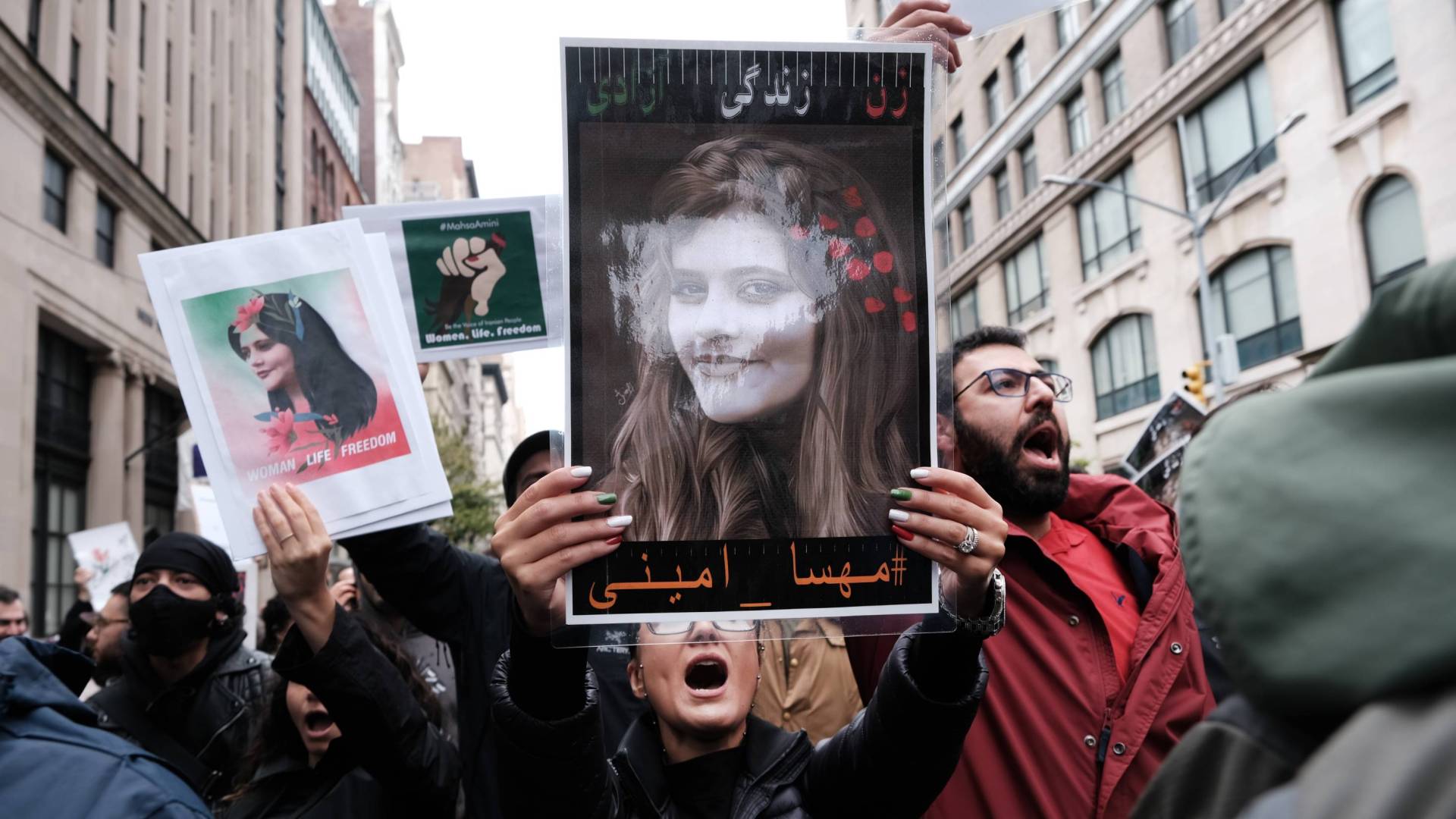
Since Mahsa Amini’s arrest on September 16, Iranians and supporters around the world have been holding protests to demand an end to the current Islamic regime in Iran.

Since Mahsa Amini’s arrest on September 16, Iranians and supporters around the world have been holding protests to demand an end to the current Islamic regime in Iran.

Christianity Today October 19, 2022
Spencer Platt / Getty Images

Growing up in a home with a Muslim father and a Christian mother, Iranian American Shirin Taber had a special appreciation for being able to choose what she believed. When she told her dad that she wished everyone back in Iran could have the same freedom, he—knowing the harsh reality of the regime—said it would never happen.

Since then, Taber has worked on the cause of international religious freedom, hoping to see the trajectory change in one of the most restrictive countries in the world. And with the current uprising of Iranian women and young people, the American advocate is more optimistic than ever.

In Iran, Generation Z—whose grandparents lived through the revolution—has become particularly emboldened, creative, and strategic, inspired by the impact of movements like #MeToo and #BlackLivesMatter.

“Millennials did their part, Gen X did their part, their parents, but this generation is very unique,” Taber said, referencing the viral impact of young activists, including the move to dye Tehran’s fountains blood-red. “Gen Z is no-nonsense. They’ll just go out tough. The girls, they’ll cut their hair, and they’ll jump on cars.”

Iranians eager for reform have held out hope that they could work within the Islamic government, but Taber believes the country has reached a tipping point.

It’s been a month of protests, spurred by the death of 22-year-old Mahsa Amini, who was arrested for not wearing her hijab properly. The viral videos of women cutting their hair symbolize longstanding grievances beyond dress code regulations to women’s unequal status in inheritance, marriage, custody, and travel.

The political pushback, Taber says, correlates with a growing disillusionment with Islam itself, too. Iranians are spiritually hungry and looking for answers; even with government restrictions on religion, the church continues to grow through Christian teaching coming into the Islamic nation over satellite TV.

“The women and the youth are driving the house church movement,” Taber said. “The students are on fire, they’re so resilient, and it’s happening all over the country, all the major cities.”

The current global attention around the protests in Iran is also drawing more awareness to the dynamics between gender equity and religious freedom—the central message of Taber’s work through her organization Empower Women Media. Ahead of an upcoming forum in Washington, she spoke to CT about how the cry for women’s rights relates to freedom of religion and belief in Iran and why Christians should be at the forefront of the cause.

This interview has been edited for length and clarity.

Many of us see the protests around Mahsa Amini as a fight for human rights for women. What does it tell us about the fight for religious freedom?

I have had a lot of people say, “Wow, Shirin, we’re finally seeing in Iran what you’ve been talking about.” It was very abstract to people when I would say Iran needs religious freedom. They’re like, “What are you talking about? It’s a Muslim country, that’s just the way they are.” But when they see women now saying, “It’s not just about a hijab, we want systematic change. We want to topple the regime. We no longer want to live in a one-state religion. We no longer want the state to dictate to us what our faith should look like, how we practice it, how we live it. We want separation of church and state. We want separation of Islam and the state.”

Now, they’re not saying they’re not going to be Muslim, because some of them still want to be Muslim. They just don’t want the state enforcing what it looks like. And that is the definition of religious freedom. Religious freedom is one of many human rights, but it is a pillar because religious freedom correlates with multiple other freedoms like freedom of speech, freedom of expression, freedom to congregate, freedom to manifest, freedom of art. I mean, there’s so many things that are tied. You could even say LGBT is related to religious freedom because it allows you freedom of conscience.

The thing we have to help Christians understand is freedom of religion is more than religion; it’s freedom of conscience. It’s an issue of the soul. We’re not promoting religion per se; we’re promoting the idea that every human being has their own right to make their decisions regarding matters of faith and belief. As Christians, we can say it’s a God-given freedom that we can choose him or not choose him.

In your own experience and work, how have you seen women’s rights and religious freedom go together?

I think the turning point for me was after the Arab Spring in 2011. I was really hoping that we would see massive change in the region, we would see women’s rights, religious freedom, and open secular societies, and it didn’t happen. In fact, ISIS came in, and they attacked. Muslims were attacking Muslims. We saw in many ways these societies were going backwards since the Arab Spring. …

In 2017, I started reading what other women were writing about the intersection of religious freedom and women’s rights, and how these two rights had to work together, but historically, we thought they were different. Women’s rights people didn’t want to talk to religious freedom people because women’s rights people thought religious freedom people were going to try to take away their rights and subjugate women and make them second-class citizens … but the research was showing, no, actually if we can work together, we can propel both movements better, because if women have religious freedom in the Muslim world, there’s no ceiling on women’s rights.

In my own work with Empower Women Media, we lead a women’s religious freedom media training, and we train women to become religious freedom advocates in the Muslim world. What we learned was women were the best frontline workers for religious freedom. If you sent a woman to speak about religious freedom or advocate for it, the public was way more open to it than if you sent men. If you send men, they think, “Oh, he has an agenda, he’s from the CIA, he’s from the government.” But if you send a woman, they’re like, “Oh, she sounds like my sister, she sounds like my mom.”

So that’s why I’m so passionate about equipping and empowering women as religious freedom advocates in the Muslim world, because it’s just more accepting, more palatable. People are willing to listen and engage, and it actually shifts their heart.

What are the things that you are working toward, praying toward, as next steps after the protest movement that’s happening now?

What we really need right now is some clear leaders to emerge. There are some leaders that are kind of emerging, but it’s not like a Nelson Mandela for South Africa. We need some leaders to really emerge and stand strong and be courageous, and then we need people to rally around them and support those leaders, so if the country topples that there will be people to step into that vacuum. Because the worst thing is if the country toppled and someone worse took over. Maybe even more radical like the Taliban or the communists took over … We need business people and stakeholders to get ready, to have a plan of action.

Because that’s what we found at Arab Spring—there was this big gap, but the countries weren’t really ready, they were just scrambling to throw together their constitutions. I think we need to demand that it’s no longer an Islamic state, it’s no longer a one religion state. We need to demand that they become a democracy. That’s the only way forward. People can be Muslim, but it just cannot be a Muslim state anymore. That would send huge a shockwave all over the Middle East because everyone is watching. The Saudis are watching; the nearby countries, Egypt, Jordan, and these other power brokers are all watching Iran to see what happens.

That was going to be my next question. What are the implications for international religious freedom in the rest of the region?

I think they’re watching and they’re realizing that [being a Muslim country], it just doesn’t work. They really need to be thinking about becoming a true democracy. It doesn’t mean they have to give up their faith or religion, but they need separation of church and state.

Research shows the countries that have the highest religious freedom have the highest levels of economic prosperity and human rights. The problem is a lot of Muslims are worried they’re going to lose their culture if they give up being a one-religion state, but they don’t have to. They need to trust that the culture will stay intact. Yes, there will be some shifts, but it will be better.

What’s your outlook given the current protests in Iran?

I’m very hopeful. I just don’t know the timing. The shift is coming. It’s kind of like that expression, “You can’t put the genie back in the bottle.” The elephant is in the room. I don’t know, whatever idiom you want to use. But women and youth know too much now in Iran. They have too much information about the outside world. The youth culture is becoming more homogenous, they want a lot of the same values, and they want to have the same freedoms. A change is coming, we don’t know how brutal it will be, we don’t know how many people will be killed, we don’t know if it’s going to happen overnight. It’s coming.

Do you have a sense of what Christian leaders in Iran are doing now?

They’re not necessarily leading the movement, but they’re right there with the movement, supporting it. Our hope is that if there is a regime change, there will be Christians that are also a part of that governmental change, and maybe some Christians will get some of the posts and they’ll get some influence and roles.

It’s going to be a process; nothing will happen overnight. Iranians still consider themselves Muslim, so it’s not like overnight it’s going to be Christians who are in charge of everything. But we’re hoping that there will be space for Christians at the table, along with Jews, who are historically a big part of Iran also, and the Bahá’í’s, who’ve been very heavily persecuted.

What are some ways for Christians to pray and help?

There are some really great ministries that you can support financially, pray, and find out what are some projects that we can help … there’s Mohabat TV that’s part of CBN. They have incredible TV programming that goes into Iran, so that’s how they do their house churches. They literally watch satellite TV. There’s Elam, which is a ministry that equips pastors and house churches and student ministries. There’s Satellite-7, there’s Iran Alive.

Of course, there’s the Iranian diaspora that is millions of Iranians living in America, Europe, and Canada. We want to encourage them who come to Christ to grow in their faith. Because if the country topples, we want those people to go back and help build the infrastructure and build the communities, build the churches, build businesses, build schools, charities, hospitals. We really need people to give back once the country opens up, so if we can support Iranian Christians in America, disciple, mentor them, when that door opens, we want them to go back and help.

Evangelical Creation Care Expert Shares Lessons Learned from Global Tour

Around the world, Christians look to scriptural lessons on stewardship to depoliticize environmental issues.

Christianity Today October 18, 2022
Illustration by Mallory Rentsch / Source Images: WikiMedia Commons / Getty / Unsplash

If the world is at stake, stewardship of creation must be global. And with an evangelical passion akin to world missions, Ed Brown is preaching ecology to the nations.

One region at a time.

Following initial consultations in Jamaica in 2012, Brown became the Lausanne Movement’s catalyst for creation care and helped build out the Lausanne/World Evangelical Alliance Creation Care Network (LWCCN). The goal was to amplify a conviction forged two years earlier in Cape Town, South Africa, at the third Lausanne Congress: Creation care is a gospel issue within the Lordship of Christ.

Since then, LWCCN has conducted conferences in 12 regions drawing delegates from over 120 nations. Concluding earlier this month in Jordan for the Middle East and North Africa, Brown and his colleagues addressed local issues for a region experts warn is warming at twice the rate of the rest of the world.

And the UN is cued in. Its 27th climate change conference, COP27, begins November 6 in Sharm el-Sheikh, Egypt, with COP28 scheduled next year in the United Arab Emirates’s Abu Dhabi.

Brown served previously as chief operating officer for the evangelical Au Sable Institute of Environmental Studies, and today is a fellow at the Nelson Institute of Environmental Studies at the University of Wisconsin-Madison. He founded Care of Creation, Inc. in 2005, and is author of Our Father’s World: Mobilizing the Church to Care for Creation.

In Amman, he spoke with CT about the challenge of politics, the response of missionaries, and the drastic impact environmental changes will soon have on ministry to one’s neighbors.

Reflecting on your many meetings, did the message of creation care resonate with the international evangelical community?

Much more so than in the US. We found people hungry and eager to have us come. People in these countries live closer to nature, without the protections from nature that exist in the West. They are much more aware of climate change happening. You can’t hide from it.

We’ve seen this with the floods in Pakistan, and with Hurricane Ian it is coming home to America. But this has been true for people in the Philippines for decades. The weather is changing, and our message is that creation is groaning in a biblical sense.

What is it that they were hungry for, or lacking?

Everywhere we go, the Spirit has been speaking to people about caring for God’s creation. With a conference like this, people are discovering each other. I may be the only one in my church, they realize, but I’m not the only one in [my] country—and now we can communicate with each other.

There is also a thought that individuals and church leaders sensed that something wasn’t right, without knowing the biblical foundation about how the Bible speaks to the issue.

Can you give an example about how we have missed this message in Scripture?

The central passage I use is Colossians 1:15–20. It begins by speaking about Christ creating all things and ends with how the blood of Christ on the cross is redeeming all things. Most people read this redemption in terms of people. But if you zoom out and realize that the “all things” being redeemed are grammatically the same as the “all things” he has created, then you have a universal picture of redemption.

This is reinforced by Romans 8: how creation is waiting for the redemption that will come through the revealing of the children of God.

The church has sometimes struggled over the correct prioritizing of evangelism and social outreach. Does adding a third issue of creation care become too much for some?

Actually, it is the opposite. People working in poverty have realized for a number of years that they are on a treadmill and moving backwards. You cannot make progress in development and ministering to the poor if there are environmental problems that haven’t been addressed.

On the health side, medical missions want to cure people, but many of the diseases they face are environmental diseases. You can’t have a public health program without addressing the underlying environmental issues. There is a synergy here that we should have picked up on a long time ago, but it is happening now.

One of the underlying strengths of our movement has been to use local leadership, local scientific resources, and local theologians as much as possible. It has been organized by a couple of us from the West, but my UK co-catalyst was raised in India, and me in Pakistan.

Still, it has been thought-provoking that we’ve had very little buy-in from the local missionary community. They have been invited, but they don’t come. The pastors come, the publishers come, and the churches the missionaries have planted have come. But up to now, the American and Western missionaries have not been very interested.

Have you found any skepticism about the science?

In some places. But we have not allowed these conferences to be debates over whether climate change is real—that is a given. The purpose is to say: What are we going to do about it?

Whether in America or elsewhere, how do you address the skepticism, whether it is with the science or the politics?

There are two doors we can walk through. The first [is] from Scripture. If the audience is politically skeptical but biblically literate, we can present a solid exegetical message that creation care really is a gospel issue. These passages exist, and we must deal with them.

The second door is the historic American commitment to care for the poor. It is starting to dawn on people that other countries are suffering because of weather events, and it is becoming more and more difficult to deny that is caused by what is happening in the environment.

But there have always been poor, as well as climate catastrophes—to which the church has responded. What is different now?

People are realizing: This famine or this drought is not just an act of God. It might actually be caused because of my lifestyle, our lifestyles together. If it is just a plague of locusts, I can respond, but I bear no responsibility. But if is a hurricane driven by climate change, or food scarcity caused by the shrinking of biodiversity, we connect the dots and say: Maybe how I live is having an effect on these crises.

But perhaps you will lose people in this complexity? Activists can follow the arguments and evidence, but can pastors?

There are many pastors who are well read and up on the science, [who] are aware of the connections to consumerism and Western lifestyles. But they are dealing with people in their churches who are skeptical. What can they do, especially if their job is on the line?

We are doing a program this November at the University of Wisconsin called Creation at the Crossroads. It is designed to bring pastors together, [to] talk to scientists about the latest evidence and to theologians about the biblical way to address it. We have a conflict expert coming, about how to navigate a church that is divided. We need to learn how to talk to each other.

So how should pastors bring this message to their congregations?

In my experience, you bring the empirical evidence within the context of a biblical framework. Anecdotes within a sermon. The message is that God made the world, he gave us a responsibility for it, and it is falling apart. I have confidence that the Holy Spirit can take his word, help people see what is happening, and then help them start to make a difference.

What about the political side of skepticism? Often climate change is part and parcel of left-leaning issues.

One of the things we are trying to do is depoliticize it. In the creation care movement in the US, there are people working the Republican side of the aisle, trying to persuade others that the environment should not be a progressive issue. In fact, it is a quintessential conservative issue. Conservative. Conservation. Do you see the connection? It is concern for future generations, exactly the same as fiscal conservatism. It ought to be seen as a conservative issue, and the fact that it is not is because we’ve been sold a bill of goods.

Any convinced individual can begin to make the lifestyle changes necessary to help the environment. But given the severity of the problem, policy changes appear necessary. For this perhaps one must vote left, but many will not want to do that. How do you advise someone torn about this issue, on how to vote to save the planet?

I am probably among those who strongly feel we need a third party in the middle. There has never been a better time for a party to package pro-life and pro-environment together. I have to say that I have not made politics my particular part of the vineyard; God has not called me there.

But are there others, working to cultivate strong evangelical environmental advocacy efforts with people on the left and decouple the environment from other progressive issues?

I think more of the work has been done with people on the right. People on the left, they are already convinced. It is on the right where people are digging in their heels. It is a thorny issue to go to the left and persuade people to change their view on abortion or gay rights, or whatever else. So I don’t know what the answers are, politically.

But apart from politics, are there issues ecologically minded evangelicals are debating among themselves?

Actually, yes. As we learn more about how intricate and complex God’s creation is, some evangelical creation care thinkers are reexamining the idea of dominion and stewardship.

Knowing now how little influence we humans have within nature, are we perhaps overstating our role as rulers or managers on God’s behalf? It is a lively debate, but one that has a biblical answer.

The concept of dominion is stated clearly in Genesis 1 and expounded at some length in Psalm 8. For me the question is not, “Are we rulers or stewards?” but rather, “What kind of rulership or stewardship ought we to be exercising?”

With whatever influence it has, what should the church do now?

With what I anticipate happening in the next 15–20 years, and [like] many scientists I’m afraid it might be sooner, the church must realize that aspects of normal ministry may no longer be possible.

Consider Ukraine: No one can do door-to-door evangelism in a war zone. Similarly, how can you do church planting in Pakistan, when a third of the country is underwater? We need to anticipate environmental refugees—and there are already studies explaining where they are coming from and where they are going.

And of course, let us do what we can to slow things down. Almost everyone agrees that climate change cannot be stopped, but it can be slowed if we change our lifestyles.

If you play the visionary, what must the church or mission agency do now to prepare for the coming changes? How will they take the gospel message to the world?

Much of what we will have to do is practical love, not just suburban evangelism. I don’t know how leaders of World Vision, SIL, Compassion International, or TEAM should change their strategies—but they must be talking about this. Do the analysis, and anticipate the threats.

Will “practical love” be necessary also in the suburbs?

As environmental impacts ramp up, more and more people will discover they are vulnerable. On the West Coast, the Colorado River is running dry. An entire swath of the country is or may soon be on water rationing, and I don’t know how to deal with that. We are not as protected from environmental impacts as we think we are.

Supply chain issues are affecting cellphones and new cars, but what happens when it hits the grocery stores? Trace it back, and you will discover that there were no apples, because the pollinators were absent. This brings it home, but by then, it will be too late.

That sounds discouraging. Are there signs of hope?

Practically speaking—and politically, since this is a global political challenge—there isn’t a lot of hope. And even if things were to change dramatically on the political front, the rise in temperatures already experienced will make events like Hurricane Ian and the Pakistan floods regular and frequent events.

On the other hand, as Christians, we’re not limited to what is practically and politically possible, are we? Our hope is in Jesus, and my belief is that as God’s people wake up and begin to respond, God will meet us more than halfway.

We believe in miracles when it comes to human disease. Why not also an environmental miracle or two?

Theology

American Idol: How Politics Replaced Spiritual Practice

Christian formation is central to civic renewal, not the other way around.

Christianity Today October 18, 2022
Illustration by Mallory Rentsch / Source Images: WikiMedia Commons / Unsplash

When voters go to the polls for US midterm elections this November, many will be motivated by a sense that the other side seeks to bully them.

According to a poll from the University of Chicago’s Institute of Politics, nearly identical percentages of Democrats (74%) and Republicans (73%) believe members of the opposing party are “generally bullies who want to impose their political beliefs on those who disagree.”

Similarly high percentages of Americans in both parties believe that members of the other side tend to be “generally untruthful and are pushing disinformation.”

These statistics reflect what a group of social scientists have termed “political sectarianism”—a “poisonous cocktail of othering, aversion and moralism” that “poses a threat to democracy.”

Sectarianism poses a threat to democracy because self-governance only makes sense in a culture where citizens care and think about someone other than themselves. According to a recent survey from Pew, however, most American voters believe public servants (let alone other voters) are in office to promote their own personal interests.

Here’s the deeper danger: Political sectarianism—and the culture it promotes—enables a destructive and suffocating social imaginary. Toxic politics deforms the whole person, along with their relationships and practices. It causes spiritual harm. Our civic culture doesn’t shape governance alone; it affects ever-expanding realms of the social and emotional.

We also need to come to terms with how much it claims and dictates our theology.

On the first Sunday after the tragic 2017 shooting massacre in Las Vegas, my pastor, David Hanke, shared the following two statistics from Barna in his sermon: First, that 57 percent of practicing Christians believe they have a right to defend themselves with violence. Second, that 11 percent of practicing Christians believe Jesus would agree with them.

The first point has been argued by believing Christians for millennia. The second, however, is where the main problem arises.

“It’s not just about violence; it’s about anything,” Hanke told us that morning. “If you are convinced about something and you don’t think Jesus would agree with you, that’s a problem. Our culture wouldn’t be so violent if we could all own how much we love it. It’s actually hard to see where violence might be necessary, because we are so entertained by it and in love with it.”

The social scientists who put forward the concept of “political sectarianism” harbor a similar concern.

“Democrats and Republicans have grown more contemptuous of opposing partisans for decades, and at similar rates,” they write. “Only recently, however has this aversion exceeded their affection for copartisans … Out-party hate has become more powerful than in-party love as a predictor of voting behavior.”

Think about that. Out-party hate has become more powerful than in-party love. Many voters would choose to forgo helping themselves if it means passing up the opportunity to harm their opponents. We’ve lost the imagination for a politics that helps people and instead bought into a political logic that justifies hurting them. And we tell ourselves, This is just how the game is played. They’ll do it to us if we don’t do it to them. But would Jesus agree?

Despite the disappointments and mistakes of the past, I’m convinced that we have everything we need to tell a different story.

First, despite the rise of political sectarianism, Americans, including many Christians, are fighting against this anti-social imaginary. They do so mostly through local engagement, not through national politics. They do so through action, not symbolism. And they do so for concrete purposes, not with abstract culture change in mind. We need to put these practical Christian actions (and the resources behind them) into contact with the distorted narratives that dominate our political life.

Second, the Christian faith offers tremendous resources for combating political sectarianism and so much else that ails our politics, but we have to connect those resources to our public life and politics. Christians don’t need to be reminded of kindness, gentleness, and joy. But many do need to be convinced that the way of Jesus is up to the task of politics. They need to be convinced that the public arena, too, is a forum for faithfulness.

That doesn’t mean making every policy a matter of religious dogma. Quite the opposite! One of the greatest contributions Christians can make to our politics right now is caring about it without making an idol of it, and then reminding our country that political decisions are very rarely a simple issue of dogma—religious or secular—and more often about prudential matters.

We should pursue faithfulness even when it can’t be reduced to a proposition.

Third, this faithfulness can be offered as a loving service to our communities and our nation. Most Americans don’t like what our politics is doing to us, but they’re too exhausted to push back and build something new. The public is more open than we think to public leaders who make genuine contributions, rather than impose themselves on others and grab power. It’s times like these—when everything seems contested—that it’s most worthwhile to step into the fray if we have something to add. And we do.

These convictions ground The Center for Christianity and Public Life, a new nonpartisan institution based in the nation’s capital that I, along with our board and staff, have launched this week. Our mission is to contend for the credibility of Christian resources in public life and for the public good. We advance that mission through two parallel streams of work: civic influence and spiritual formation.

No single organization or leader will solve the problems we face. There’s no silver bullet to the social and political dysfunction we see, and we should be wary of quick fixes. It will take many diverse leaders, organizations, churches, and Christians encouraging each other and partnering together to advance a basic vision of faithfulness to God and loving service to the public. This vision is key not just to our organizational vision but to the Body of Christ.

As we survey our public life and see what Parker Palmer called our “politics of the brokenhearted,” we need to have compassion. So many people feel harassed and helpless. “The harvest is plentiful, but the workers are few” (Matt 9:37).

I’m eager for more workers.

Dallas Willard defined joy as a “pervasive and constant sense of well-being.” How many of us would say our politics is full of a pervasive and constant sense of well-being? How many of us would say we bring a spirit of joy to our politics?

The loudest voices urge division and exclusion. They tell us that politics is only about conflict, that politics is where we go to play out our resentments and hatreds. They’re loud precisely because they feel so threatened, so fragile. Their well-being is always at risk. Their anger reflects a lack of confidence and conviction, not an abundance of it.

But politics needs people with joyful confidence who seek security not in politics but in Jesus. We can break the vicious cycle. There’s a better story to tell. And we should tell it as we live it.

Michael Wear is the President and CEO of the Center for Christianity and Public Life.

How Do You Get to the Dove Awards?

Without set theological parameters, it’s the audience and the industry that elevates artists.

The Dove Awards ceremony in 2018

The Dove Awards ceremony in 2018

Christianity Today October 18, 2022
Jason Kempin / Getty Images

In the joke about how you get to Carnegie Hall, the punchline is “practice, practice, practice.” But how do you get to one of the biggest stages in Christian music: the Gospel Music Association’s (GMA) Dove Awards?

For over a half century, the annual ceremony in Nashville has featured the top artists in Christian and gospel music. In a realm where music isn’t just entertainment—it’s also spiritual formation for millions of listeners—the recognition is significant. It can boost the platform of up-and-coming musicians and designates artists as respected and endorsed by the Christian music industry.

So how do you decide if a song is eligible for a Dove Awards nod?

The awards contain categories across genres—rock, rap, country, worship, and more—and the association emphasizes its desire to celebrate “our rich musical diversity.”

“We’ve seen the sound evolve over the years, and as each new sound comes to the surface, the people vote,” said Jackie Patillo, GMA president since 2010.

“It’s about the music,” she said. “As it stands, our criteria and submission process would allow any song with a Christian worldview.”

The GMA has a Trinitarian Christian statement of faith, with its final point emphasizing spiritual unity among believers (John 13:35). But the association doesn’t have specific requirements for what makes a “Christian worldview” in the music it features and recognizes.

As some younger artists are trying to make their way as Christian musicians outside the typical screening of radio play and Christian labels, more questions have come up about who belongs in the Christian music industry and who gets to define it.

Indie musicians are bypassing traditional gatekeepers with their viral social media fame. Grace Baldridge, a genderqueer and nonbinary singer who performs under the stage name Semler, campaigned for a Dove Awards nomination this year but fell short and plans to attend Tuesday’s ceremony as a guest.

It’s not a surprise that few indie artists earn Dove recognition. To make it through the submission process, musicians often need to have established their place in the Christian music industry already. Nominations for Dove Award categories like Song of the Year are “based on sales, airplay and church performance.” (The GMA uses data aggregated from Christian Copyright and Licensing International [CCLI], Nielsen Music Connect, Broadcast Data Systems, and SoundScan.)

Other categories rely on votes from committees of professionals or current GMA members—people who work full-time in Christian and gospel music, in many cases for radio networks and labels—to determine nominees.

The GMA website advises individuals applying for individual membership, “Pursuing a career in the Christian music world is difficult because there is not one clear path that guarantees success.” The organization encourages aspiring artists to get involved in music leadership in a local church and to begin by promoting their music independently on social media, citing Luke 16:10, “whoever can be trusted with the little things can also be trusted with much.”

While the Christian music industry has always been competitive, artists trying to break in sense a closing of the ranks as it becomes harder to access inner circles of songwriting teams and label representatives. If an aspiring artist calls Capitol CMG, for example, a series of prompts in the phone system leads to a message stating that the label does not accept unsolicited demos and directs the caller to the GMA and the Christian Musician Summit, an annual songwriting conference.

Dove Award-winning songwriter Krissy Nordhoff told CT earlier this year that it is becoming rarer for labels and producers to look at unsolicited demos; getting music in front of an industry insider usually requires a personal connection. There are exceptions, like this year’s nominee for Best New Artist and Songwriter of the Year, Anne Wilson, who was discovered on YouTube by an industry executive.

The struggle to make the right industry connections to get record deals, radio play, and awards is not exclusive to the Christian music industry. But unlike mainstream music, the challenges of breaking through as a new artist also come with ideological expectations and standards. Even in the case of the GMA, evangelism is the first point in its mission.

In his book, God Rock, Inc., ethnomusicologist Andrew Mall suggests that inclusion in the Christian music market depends on the participant’s behavior and beliefs just as much as, if not more than, aesthetic quality or characteristics.

So while the GMA may make the Dove Awards open to any song that reflects a Christian worldview without evaluating the behavior or particular beliefs of the songwriter or recording artist, the industry and its audience perform their own vetting processes that often preclude an artist even being considered.

Sometimes these vetting processes occur inside the industry, between artists themselves, or between artists and their labels.

Maverick City Music recently chose to split with artist Dante Bowe (both were nominated for Dove Awards this year) over concerns about Bowe’s “inconsistent” behavior. Maverick City didn’t specify what the singer did to raise concerns. In 2003, Michael Passons of the vocal group Avalon was asked to leave when he refused to continue undergoing “reparative therapy.” Passons publicly came out as gay in 2020.

Contemporary Christian music artists Sandi Patty and Amy Grant famously experienced major career disruptions during and after their divorces. Grant’s career rebounded over time.

Hillsong Worship has recently been criticized as allegations of moral failings of leadership and unethical practices in the church have come to light, though currently it doesn’t appear that audiences or the industry are pulling away from the organization. Hillsong artists are among the nominees, performers, and presenters at this year’s awards.

The “ethical boundaries” of the Christian music industry, argues Mall, are neither top-down policies developed by executives nor responses to audience pressure. Gatekeeping in the industry is an ongoing and evolving negotiation between market realities, aesthetic trends, and consumer pressure.

Currently, Christian musicians like Semler are challenging those boundaries. They use language that listeners of mainstream Christian music will find familiar and relatable. Their 2021 song “Raise Up” goes: I have told you that I am the way, the truth, and the life. I am justice. I am all that is right.

Baldridge categorized their demo, Preacher’s Kid, as Christian on iTunes. Although the release sat in the top two spots on the iTunes Christian charts for a couple weeks last year, none of its tracks made it into rotation on Christian radio. In addition to being queer, Baldridge is an independent artist with no label support, and Preacher’s Kid has two tracks designated as “explicit.”

Baldridge told CT that they don’t expect to change everyone’s mind about the inclusion of queer Christians in the industry. But they do hope to convince critics that LGBT Christians have valuable art and insight to contribute. “What we’re after is being afforded a space at the same table,” they said.

“I really do think we deserve to be there,” Baldridge said about this year’s award show. “I’m still really inspired to knock at this door.”

Ricky Braddy, director of music and arts at GracePointe Church in Nashville, says that there is a long list of queer-affirming people in the Christian music industry who are hoping to see a shift toward inclusion. Braddy, who began performing as a Southern gospel artist at age six and appeared on NBC’s The Voice, came out in 2019.

LGBT artists like Baldridge and Braddy said they know affirming Christians in the industry who aren’t open about their stance for fear of judgment. It’s part of why Braddy expects the industry will eventually platform more queer artists, even if primarily for financial reasons.

“It’s either going to go there, or the whole thing will just die,” Braddy said.

CCM icon Amy Grant spoke of her LGBT-affirming stance last year in an interview on Apple Music’s Proud Radio. Grant was prominently featured in the documentary The Jesus Music, and her stance hasn’t called into question her position as an industry giant.

Historically, once artists have come out publicly—Jennifer Knapp, Vicky Beeching, Ray Boltz—they find themselves moving on from Christian music.

While research shows evangelical support for same-sex marriage is growing, the core audience for Christian radio skews conservative and is more likely to hold traditional stances on marriage.

Weekly churchgoers, whose worship song selections determine CCLI rankings, are among the only groups who oppose same-sex marriage, according to a 2022 Gallup poll.

While the Christian music industry may decline to define theological boundaries for artists, churches and ministries can be quicker to speak up or take action when a song’s message or a particular artist raises theological concerns. Prior to coming out, Beeching said speaking up for LGBT rights led some conservative churches in America to “boycott” her songs, which cost her royalties.

Sean Nolan of The Gospel Coalition criticized Baldridge’s efforts to break into the Christian music industry.

“In the end, to demand inclusion in Christianity without submitting to Christ the Lord doesn’t work. Christian identity without repentance is a fraud,” wrote Nolan. “If Semler is serious about wanting to retain the Christian title—and I pray she is—the path will be through Christ’s authority and his scars, not hers.”

It remains to be seen how an industry that aims to be a big tent for the wide-ranging music of the global Christian faith will handle artists whose stances on LGBT issues differ. Will it strive to welcome diverse views in this area, as it does for questions of theology and musical taste?

“We tend to live in our own silos,” said Patillo of GMA, who declined to comment on individual artists. When “we gather as an industry, we bring together artists from every genre. They get to appreciate the art of one another. You’re gonna hear something that you love … you’re also being exposed to God’s diverse kingdom.”

Kelsey Kramer McGinnis is a musicologist, educator, and writer. She holds a PhD from the University of Iowa and researches music in Christian communities.

What’s to Blame for Thailand’s Deadliest Mass Killing?

Some point to economic, social, and moral problems, but a Thai pastor encourages a deeper look.

Parents hold a photo of their child during the funeral cremation at Wat Rat Samakee in Uthai Sawan subdistrict, Nong Bua Lamphu, Thailand.

Parents hold a photo of their child during the funeral cremation at Wat Rat Samakee in Uthai Sawan subdistrict, Nong Bua Lamphu, Thailand.

Christianity Today October 17, 2022
Lauren DeCicca / Stringer / Getty

Top Thai government officials pushed for tighter gun regulations and a renewed war on drugs last week after a mass killing at a daycare in northeastern Thailand killed 36 people, including 24 children. Meanwhile in the Na Klang district of northeastern Thailand, devastated families gathered at Buddhist temples to attend mass cremations for their loved ones.

The attacker, former police officer Panya Khamrab, also killed his wife and stepson before turning the gun on himself on October 6. Khamrab stabbed children sleeping in the daycare, as well as a teacher who was eight-months pregnant. The Royal Thai Police said it had fired Khamrab in June for possession of methamphetamine, and he was set to go on trial the day after the massacre.

Patompon Kong, academic dean of Chiang Mai Theological Seminary and pastor of Grace New Life Church, reflected on the tragedy and how to understand the worst mass killing in Thailand’s history.

The shooting incident at the Uthai Sawan Child Development Center has stirred up fear, confusion, anxiety, pain, resentment, and loss for the Thai people. Many have blamed it on a wide range of social, economic, and religious problems. But from the perspective of Thai Christians, the real problem is the sinful state of our souls. Thai society will be only truly saved by the gospel (Col. 1:15-20). Let us look deeper at each of these problems.

In the past 40 years, I’ve noticed Thai society change from an open-handed to a closed-fist posture. Before, Thai people were dependent on each other. It was common practice to be courteous to neighbors and show mutual respect.

But today, people only show kindness to those in their own circle. Rather than sharing, people scramble for resources. Differing political views are splitting up families, communities, regions, and the nation. This may have prevented Khamrab from receiving the help he needed.

News reports revealed that Khamrab often behaved aggressively, at times drawing his police gun and threatening people when drunk. He had abused methamphetamine since high school and continued to buy meth from drug smugglers while working as a police officer.

Khamrab’s relatives said he asked the mayor to help with his drug problem, but his request was denied because tackling drug addiction and smuggling was a massive endeavor local authorities could not solve on their own. He resorted to finding a solution by hurting others, his family, and himself.

Since the mass killing, people have discussed what pushed Khamrab over the edge. Some view it as a result of quarrels with his wife. Others pointed to his money troubles since getting fired from his job and the difficult economic climate in Thailand due to the COVID-19 pandemic.

Many people questioned whether the country’s gun control laws could have prevented this event and whether only police officers should have the right to possess guns. Yet in many cases, shootings are caused by the unauthorized possession of guns. (About 40 percent of the guns in Thailand are unregistered.)

Some Thais believe the attack was a result of the country’s moral failings. In a country where Buddhists make up 93 percent of the population, the common mantra is that “every religion teaches us to be a good person.” The average Thai honors the beliefs of others. But if religious principles help society operate well, why did the shooting happen? Where were the religious doctrine and good morals?

It is incorrect to conclude that religious morality is not good; however, the average person does not follow moral principles when they face societal pressure. This causes many of the problems we see in Thai society today.

Although various government and private agencies have come to help in the aftermath of the attack, I cannot look at the incident and blame Khamrab’s actions on drug abuse or gun control or economic stressors. We have to look at the true roots of Thai society from a biblical perspective.

The problem in today's world is that a person’s behavior is merely a manifestation of his or her true inner state. Everyone has sinned and fallen short of the glory of God (Rom. 3:23, 6:23). There is no other way to God than the gospel (Rom. 5:8, John 14:6, Hebrews 4:12). Another mass shooting in Thailand took place in a military camp in 2020, when a soldier killed 30 and left 58 wounded. The incidents point to the reality that there are real problems that need to be addressed in Thai society.

Right now, Thai Christians are feeling sorrow, fear, and insecurity. Church leaders encourage believers to rely on God amid this incomprehensible tragedy. We encourage our brothers and sisters to always believe that God reigns over all situations. God’s plan is sovereign, and he instructs us to support one another through dark times like these.

The Christian’s immediate response to this event is to express condolences, grieve with our fellow countrymen, pray for God to help them make it through, and encourage those who lost loved ones. Yet if the Thai church believes the gospel of our Lord Jesus Christ is the answer to various problems, Thai churches also need to be more alert.

Thailand is a country where the gospel has not completely reached the population. Although missionaries have been preaching here for almost 200 years—from 1828 to the present—Protestants comprise only 0.75 percent of the country’s population of 68 million. Thai Christians must be vigilant in preaching the good news, witnessing, praying, and contributing to society by being salt and light (Matt. 5:13-16). They need to cooperate at all levels with both government and private agencies.

Major Thai Christian groups—including the Protestant Committee of Prathai, the Christian Cooperatives of Thailand, United Baptists of Thailand, and the Council of Churches of Thailand—have joined together and set a goal to bring 500,000 people to Christ by 2028, so the Christian population will reach one million in the country. They also aim for Thailand to have 10,000 churches and 10,000 ministry workers. To fulfill this vision and the Great Commission, there must be the cooperation of Christians both at home and abroad.

In the meantime, after this tragedy, we should focus on reaching out to the community and those who lost loved ones. One way to do this is through counseling and mentoring. In addition, churches will need to learn more about how to minister as a larger church body during tragedies like mass shootings.

One way the church can mourn with those who mourn is by organizing prayer meetings that are broadcasted online, so that Christians all over the country can participate. Christians from around the world can also play an important role in Thai society by praying, preaching, and witnessing to Thais.

Thai Christians continue to grieve this unspeakable tragedy. We will continue to be a witness and point people to Jesus during this difficult time in Thailand.

Ideas

The Forgotten Christian Cause: Preserving Democracy

Contributor

This election season, love your neighbor by supporting voter results, a free press, and a peaceful transfer of power.

Christianity Today October 17, 2022
Iker Ayestaran

The midterms election season is not the easiest time to feel good about American democracy.

We’re inundated with negative campaign ads that often distort the records of opposing candidates and portray them in the worst possible light. Each side warns that the election of the other party means disaster for the United States on an apocalyptic scale.

Can Christians really defend a democracy like this? Yes. We can and we should. And there’s no better time to do it than now.

Democracy is currently facing an unprecedented crisis, both in the United States and around the world. According to V-Dem Institute, the world’s leading research group for tracking democratic progress, there are only 34 liberal democracies in the world, the fewest since the mid-1990s. And only 13 percent of the world’s population lives in one of those countries—down from 18 percent 10 years ago. (V-Dem ranks the United States No. 29 in the list of liberal democracies, and its score is rapidly falling.)

Democracy allows for journalistic independence, free and fair elections, and peaceful transfer of power, but those attributes are fragile and easily lost. It’s currently much more common for a democratic country to become autocratic than for an autocratic country to become a democracy.

Some countries that lose their democratic status fully autocratize and become military dictatorships. But V-Dem’s recently released 2022 report suggests that the much more potent threat to democracy is not dictatorship but rather what the institute calls “electoral autocracy.”

Under that system, elections continue to be held, but the government rigs the political process by controlling the media, harassing critical journalists, and unconstitutionally expanding executive power.

Forty-four percent of the world’s population currently lives in an electoral autocracy, according to V-Dem. Countries that are in this category (or are rapidly moving toward it) include Brazil, India, Hungary, Poland, and Turkey, among many others.

Here’s the scary thing for Christians who take their faith seriously: In every country I just mentioned, religious conservatives are some of the main supporters of autocratization. In majority-Christian countries, those religious conservatives are Christians. In Brazil, many of them are even evangelicals.

Why would voters—including, in many cases, Christian voters—elect politicians who limit the freedom of the press and remove some of the legal checks and balances that have traditionally protected democracy?

According to V-Dem Institute’s exhaustive study of more than 200 countries, the main reason is partisan polarization. If voters’ fears of an opposing party become strong enough, they will often welcome whatever measures keep that party out of power, even if that means the loss of certain constitutional freedoms.

This dynamic seems to be playing out in the United States. The more we fear the opposing party, the more likely we are to excuse antidemocratic measures that might be needed to keep that party out of power. To put it another way: The more we believe in the rightness of our cause, the less likely we are to care about the process needed to achieve our political goals. We’ll act as though the end justifies the means.

This might explain why American evangelicals have sometimes been attracted to antidemocratic movements.

In the United States , evangelicals have often been more interested in fighting for particular political issues than in preserving the democratic process itself. And when they believe strongly enough in the righteousness of their cause, some of them demonize their opponents to the point where they’re willing to use antidemocratic measures to keep their preferred party in power.

For the past 200 years, American evangelical political campaigns have often focused on using the vote to fight evil. There’s a lot of merit to this view. Scripture does portray government as an agent of justice. Romans 6 and numerous passages in the Old Testament make that clear.

But if we focus only on the government’s role in bringing about a righteous order, we might miss an insight that many mainline Protestant Americans have historically held: The preservation of the democratic process is just as important as the creation of just laws, because it allows us to make sure that each person is treated as a divine image-bearer whose voice matters.

In other words, the democratic process can be a way for us to love our neighbor as ourselves.

Harvard historian James Kloppenberg, author of Toward Democracy, argued that democracy in the US will succeed only if parties on both sides are “willing to allow their worst enemies to govern if they win an election.”

This willingness to sacrifice one’s own interests, he writes, has often stemmed from a “Judeo-Christian tradition” that is willing to “see the call to love others for their own sake” as an opportunity for “self-reflection and self-transcendence.”

According to Kloppenberg, there is intrinsic value in allowing someone with whom we vehemently disagree to exercise political power, even when we believe they’re using it for horrific ends.

This self-denial, he believes, has to be rooted in something larger than ourselves, which is why democracies are so fragile. Most collapse entirely or, at the very least, become mere electoral autocracies where elections are held but few trust the results and even fewer dare to openly criticize those in power.

To sustain a democracy, we must value the process even more than the political causes we favor. We must love our neighbor more than we love our own interests. That means being willing to accept election results even when we dislike them and being willing to do whatever we can to defend the freedom of critical journalists with whom we might disagree.

But it also means that, when we’re the ones in power, we have an obligation to listen to our political opponents and make them feel valued. The winners of an election must model what Abraham Lincoln advocated for in his second inaugural address—“malice toward none” and “charity for all.”

Evangelical Christians have the theological tools to embrace this vision. We of all people should know that our vision is clouded by sin and self-interest and that our own political causes are sometimes based on mistaken interpretations of God’s truth. Not every evangelical political cause seems as noble in hindsight as it did at the time. An awareness of our own fallibility gives us the humility to listen to others even while respectfully arguing for our own position.

The kingdom we ultimately seek is God’s kingdom—not the victory of a particular political party and not even the advancement of the United States of America. That knowledge enables us to entrust the government to people we think might be deeply wrong. We know that Jesus will continue to be the king, even when earthly rulers fail us.

With this realization, we have the freedom to use our vote to love our neighbor. Although of course we’ll try to use our vote to advance righteous causes, those causes themselves are not our ultimate goal. Instead, our measure of success is the advancement of God’s kingdom, which relies on weakness, humility, and Christlike love for others.

As some around us resort to partisan attacks, we can instead use this election season as an opportunity to listen to other voters and show genuine concern for the things they care about. Instead of seeking to protect our own interests, we’ll seek to love others. And if we do that, we can use this election season as a chance to magnify the love of Jesus, regardless of whether our preferred party wins at the polls.

God did not ordain democracy or the American electoral process as the only acceptable mode of government. But nevertheless, preserving democracy may be a duty for Christian voters. We do so not because there’s inherent virtue in casting a ballot but because democracy is a way for us to show preference toward others and to practice humility and self-denial.

Those virtues are definitely worth preserving.

Daniel K. Williams is a professor of history at the University of West Georgia and the author of Defenders of the Unborn: The Pro-Life Movement Before Roe v. Wade.

Apple PodcastsDown ArrowDown ArrowDown Arrowarrow_left_altLeft ArrowLeft ArrowRight ArrowRight ArrowRight Arrowarrow_up_altUp ArrowUp ArrowAvailable at Amazoncaret-downCloseCloseEmailEmailExpandExpandExternalExternalFacebookfacebook-squareGiftGiftGooglegoogleGoogle KeephamburgerInstagraminstagram-squareLinkLinklinkedin-squareListenListenListenChristianity TodayCT Creative Studio Logologo_orgMegaphoneMenuMenupausePinterestPlayPlayPocketPodcastRSSRSSSaveSaveSaveSearchSearchsearchSpotifyStitcherTelegramTable of ContentsTable of Contentstwitter-squareWhatsAppXYouTubeYouTube