Books

5 Books on the Connection Between God and Animals

Chosen by Caryn Rivadeneira, author of “Saints of Feather and Fang: How the Animals We Love and Fear Connect Us to God.”

Illustration by Rick Szuecs / Source Images: Envato Elements / Raw Pixel

The Soul of an Octopus: A Surprising Exploration into the Wonder of Consciousness

Sy Montgomery (Atria Books)

No one writes about animals like the naturalist Sy Montgomery. And in this gorgeous book, she takes us deep into the majesty and mysteries of one of God’s most amazing creatures. As we learn about and marvel at them, we end up learning about and marveling at their Creator.

All Creation Waits: The Advent Mystery of New Beginnings

Gayle Boss (Paraclete Press)

Boss offers 25 essays that allow us to linger with our animal friends amid the dark and cold of winter as we move toward the coming of Christ. In each stunning study on animal behavior, Boss reminds us that God’s plans for rest and restoration are not just for humanity but indeed for all creation.

The Lost Dogs: Michael Vick’s Dogs and Their Tale of Rescue and Redemption

Jim Gorant (Gotham Books)

While this book isn’t about God per se, is it possible to tell a “tale of rescue and redemption” about lost creatures without it being about God? I’d argue no. On every page of Gorant’s masterful reporting of these dogs’ escape from abuse and dogfighting, we see part of God’s grand restoration plan at work.

A Shepherd Looks at Psalm 23

W. Phillip Keller (Zondervan)

My first reading of this book, published in 1970, was more of a skim. I was just a child, after all. But even that skim showed me that people who know and love animals can have special insights into the Scriptures—and therefore into the heart of God. This book continues to feed our animal-loving souls more than 50 years after its publication.

Salvage the Bones

Jesmyn Ward (Bloomsbury)

Ward’s masterful novel follows a family living in coastal Mississippi before and after Hurricane Katrina. While religion is not a major factor in the book, I sensed God using the teenage character Skeetah—who fights his beloved pit bull, China, and risks much to save her and her puppies—to teach me about seeing goodness in enemies (like people who fight pit bulls!). At its essence, Salvage the Bones is a study in loving one another and the other—animals and people alike.

Books
Review

Fearing God Means Living with the Grain of Reality

Michael Horton looks to restore the first principle of wisdom to its rightful place.

Source images: Jonathan Borba / Omar Ram / Unsplash / Edits by Rick Szuecs

Fear, I have said to myself over the past two years, is what I’m having for breakfast. Anxiety, whether I like it or not, is the bread and butter that sustains me. I lather it on in the morning and sip it down at night. Even my sleep is interrupted by strange and garish dreams.

Recovering Our Sanity: How the Fear of God Conquers the Fears that Divide Us

Recovering Our Sanity: How the Fear of God Conquers the Fears that Divide Us

HarperCollins Children's Books

320 pages

$3.86

I am not alone. I can’t count the number of people I know who are dealing with unprecedented levels of anxiety. And when I look at my children and the world they are inheriting, well, other words crowd in, like panic.

Is it any wonder that we are so quick to turn on each other? And then—once again—blame God for failing to make it all better? Worry can seem like the obvious, most rational way to manage the troubles that aren’t just lurking in the shadows but are coming out to bite my soul every time my phone glows with updates and texts.

In Recovering Our Sanity: How the Fear of God Conquers the Fears that Divide Us, Westminster Seminary theologian Michael Horton preaches a gospel of a peace that surpasses our current ways of understanding, an ordered mind that cools disordered desire, and a worshipful life that attends to the still, quiet, rational fear of God.

Horton works through every aspect of the Christian life. Are you anxious about the environment? Afraid of COVID-19? What about your freedom? Are you afraid of being canceled? Of people spreading wrong information online? What about being called racist? Or uncovering racism in your community? What about LGBT issues, or abortion? Amid all these pressing political and cultural questions, what about your own vocation? Do you have a purpose? Enough money to pay your bills? Are you stuck? In short, Horton names everything that could possibly be making you anxious and afraid, examining it through the lens of Scripture.

“The fear of God,” writes Horton, “is living with the grain of reality. … We did not make ourselves, so it is insane to live as though we could be whatever and whomever we choose. We do not belong to ourselves, but to God.” But most of us do not properly fear God. We fear everything else—our circumstances, our future, death, and other people. How can we put ourselves back into the grain of reality?

Horton answers this question in two parts. The first, “The Fear to End All Fears,” sets out the Scriptural basis for a proper fear of God. This is an engaging, though necessarily basic, primer on biblical theology and anthropology. The problem of sin, of trying to satisfy the self with created things rather than the Creator, began a long time ago and hasn’t gotten much more complicated in the intervening years. We fear everything except that which is most fearful—God himself.

As Horton writes, “All of our fears come down to this one: we are afraid of Someone knowing our deepest secrets, cherished transgressions, and failures to fulfill our chief end.” We keep making coverings for ourselves without falling in awe before the one who can really protect us and provide for all our needs.

Through the biblical narrative, Horton establishes a fresh view of how we should orient ourselves in relation to an all-powerful and all-knowing God. And he is very clear—don’t mess around, since you may die tomorrow:

Don’t mistake God’s kindness and patience as a sign that he is either unable or unwilling to unleash his wrath. Even now, there may be some reading this who have lived around Noah’s ark all your life, so to speak. You have camped around it and played in its shadow and on its scaffolding, even as this barge of salvation was being built. But you have never entered the ark. Like an old coin, your religion is something you carry around in your pocket. It even has an image of Christ, but this image has lost its embossing and is now faded.

In the book’s second part, Horton tackles the divisive issues we face today. He looks first at suffering and corrects the various wrong ideas so many Christians hold about what pain is for and why it happens. He then positions the believer in his or her proper sphere as a person who will live for eternity but still must attend to the circumstantial troubles of the moment. A series of chapters, grouped under the title “Confronting Our Fear of Each Other,” examines religious liberty, LGBT issues, and racial fear.

It would be a mistake to jump to these sections without working through the biblical foundation Horton lays. Only by grappling with today’s thorny issues through this lens, he argues, can we avoid succumbing to yet more fear: “When we raise our eyes to heaven, something strange happens to us. Fears of our circumstances, including life, vocations, and the condition of the environment, are so moderated that we are able to engage in stewardship with hopeful responsibility instead of utopianism or despair.”

After closing the book, I found online that Horton had been taken to the hospital with COVID-19 and pneumonia. It turns out the problem wasn’t related to the virus, but he still has a long road of healing ahead. In any event, what a blessing to have this book as I pray for him and his family. If you work through it carefully, you will find wisdom restored to its rightful place in your mind and heart.

God has not abandoned any of us. He isn’t out to make everything worse. He loves us so much that he came to die in our place, to destroy our true enemy—sin and death. We have nothing to fear because his perfect love casts out all our fear.

Anne Kennedy is the author of Nailed It: 365 Sarcastic Devotions for Angry or Worn-Out People. She blogs at Preventing Grace on Patheos.

Books
Review

Jesus Is Risen! Now What?

We’re quick to affirm the Resurrection, but we often miss its full meaning.

It may sound a little strange or morbid, but I enjoy preaching at funerals. Of course, I hate seeing friends, family, and church members leave us behind. But some unchurched family members and friends may hear about God’s love and the reasons for the hope that is in us. In these raw moments, mourners tend to consider their own mortality and give serious thought to the claims of Christ.

Resurrection of Jesus Christ

Resurrection of Jesus Christ

Baker Academic

208 pages

$13.46

Jesus expressed a similar sentiment when Lazarus died and his disciples saw the resurrection and the life in action: “Lazarus has died. I’m glad for you that I wasn’t there so that you may believe” (John 11:14–15, CSB). We cannot know the joy of resurrection without experiencing the pangs of death and loss.

Funerals are opportunities to rehearse the drama of our eschatology, to practice the experience of hope before others. When I stand before a coffin or an urn, I proclaim that the resurrection of Jesus is the guarantee of our own future resurrection. Jaroslav Pelikan’s aphorism always comes to mind: “If Christ is risen, nothing else matters. And if Christ is not risen—nothing else matters.”

Books on the Resurrection typically emphasize questions about the historical credibility of the Gospel accounts, and with good reason. The apostle Paul staked everything on this one event happening in time and space: “If Christ has not been raised, your faith is worthless; you are still in your sins” (1 Cor. 15:17, CSB). Academic studies usually try convincing readers that Jesus was raised from the dead while having little to say about why we should care.

Regent College theology professor W. Ross Hastings flips this script in his newest release, The Resurrection of Jesus Christ: Exploring Its Theological Significance and Ongoing Relevance. Presuming that the bodily resurrection of Jesus is the best explanation of all the biblical and historical evidence, Hastings launches into a book-length exploration of its practical and theological implications.

The linchpin of salvation

No serious Christian questions the importance of the Resurrection for the gospel, but its significance for other areas of theology is often ignored. For example, Martin Luther once suggested that justification is the article of faith on which the church stands or falls.

Hastings offers gentle but helpful pushback to these sorts of claims. Justification may have defined the Protestant Reformation, but there is no justification without Jesus truly being raised from the dead. Nor can we understand what the Bible teaches about justification apart from what it teaches about Christ’s resurrection. Hastings contends that the same is true for other doctrines like Christology, creation, salvation, and the last things. For Hastings, the Resurrection is the true center of our theological universe.

The first and largest portion of the book explores what the Resurrection means for our salvation. One of many “Aha!” moments I had while reading came from Hastings’ observation that, in the Book of Acts, apostolic proclamations of the gospel mention the Resurrection far more than the Cross. What does this mean for how we think about and talk about the gospel? Evangelicals are accustomed to saying that Jesus died for our sins and then rose again on the third day, but Hastings challenges us to think deeply about the ways Jesus rose again on the third day for our sins. His resurrection is just as vital to our salvation as his death (Rom. 4:25).

Hastings insists that the Resurrection must be central to our understanding of the Atonement. Of course, theologians have been debating their relationship for nearly two millennia. Those in the penal-substitutionary camp contend that Jesus died in the place of sinners, taking on the punishment for sins we so rightly deserve. Advocates of the Christus Victor theory contend that Jesus died not to placate the wrath of an angry God but so he could have victory over Satan, sin, and death. Hastings advances a creative proposal that preserves the strengths of both theories without succumbing to either-ors.

For Hastings, the Atonement is first and foremost about the risen Lord’s active, ongoing participation with humanity. God the Son participated in humanity by taking on a nature like ours and becoming part of the human story. Though Jesus never sinned, he personally bore our sin-tainted humanity on his shoulders. He endured the wrath of God in our place, forever silencing our satanic accuser. The pronouncement of Jesus’ victory through the Resurrection has become our own victory over sin, death, and the powers of darkness.

Hastings demonstrates how the Resurrection impacts every stage of the order of salvation. In the past, God saved us from sin by declaring righteous all who are united to Christ by faith (the biblical idea of “justification”). Yet we cannot be united to a dead Savior. What’s more, if God did not raise Jesus from the dead, he could not establish his own righteousness. As Hastings argues, the Resurrection gives legitimacy to our own justification: It “says that God has been righteous in fulfilling his covenant promises to Abraham and his seed. The resurrection says that God has redeemed them in a righteous way.”

God continues to save us from sin in the present by actually transforming us into his likeness (what theologians call “sanctification”). As Hastings explains, “We live the Christian life from the reality that in Christ we have already been raised and that our lives are now hidden with Christ in the very life of the triune God.”

Through our union with the risen Lord, we have been raised from spiritual death and seated in the heavenly realms with Christ (Eph. 2:4–6). We can live in the power of the same Spirit who raised Jesus from the dead as we learn how to clothe ourselves in the virtues and attributes of Christ.

Hastings does not describe sanctification as a paint-by-numbers exercise in spiritual disciplines but as active communion with the risen Lord. Just as Christ participated in our humanity with his death and resurrection, we must learn how to participate in his life.

Drawing from the restoration of Peter described in John 21:1–17, Hastings places three “vocational resurrection disciplines” at the heart of our ongoing participation with Christ. First, we must “see Christ,” learning how to prayerfully meditate on his presence in our lives. Next, we must “feed on Christ” by denying ourselves and delighting in his Word. And finally, we are called (like Peter) to “feed the sheep,” pouring our lives into God’s people with the same gospel hope that nourishes us.

The Resurrection also has clear implications for our future salvation, when God will save us from sin by completely removing the stain of sin and death (the stage we call “glorification”). We cling to Scripture’s promise that we, like Jesus, will be raised from the dead with bodies that reflect God’s glory and goodness. Our personal hope for resurrection also translates into cosmic hope for the whole created order. To paraphrase J. R. R. Tolkien, the Resurrection ensures that everything sad will come untrue.

Resurrection living

The second part of the book explores how Christ’s resurrection has changed the nature of reality. We know Christ has been raised from the dead, but what does this teach us about his person and work? First, his resurrection is a divine declaration of his victory over death and demonic powers. Second, it vindicates all his suffering on our behalf. The risen Lord reigns, and one day everyone will recognize his rule (Phil. 2:9–11). Finally, because Jesus has been raised from the dead, he has an ongoing work as the Great High Priest and King who lives to pray for and shepherd his people.

In one of his final chapters, Hastings explores the implications of the Resurrection for our doctrine of creation, our ethics, and our engagement with the sciences and the arts. Through the resurrection of Christ, God affirms the original creation mandate given to Adam to fill the earth and rule over it, but he also gives a new mission and sense of purpose to the ecclesial community created to celebrate his triumph over death.

We can’t have Christianity without the Resurrection, but we often neglect its power in our daily journey. Hastings encourages us to go beyond a superficial, purely cognitive affirmation to a hands-on, passionate embrace of the resurrection life. “I am convinced,” he writes, “that most evangelical Christians, despite the fact that they would die for the belief that Jesus Christ arose literally and bodily from the dead, and despite the fact that they believe notionally in the fact that the resurrection was God’s guarantee that we are justified and forgiven of all our sins, know very little about resurrection living—that is, guilt-free, joyful, and passionately missional, other-oriented Christianity.” Such practical and pastoral wisdom truly sets this book apart from standard historical or apologetics fare.

There are certain theological themes I wish Hastings had explored in greater detail, like the doctrine of God or ecclesiology. Frequent appeals to the work of Karl Barth may frustrate some readers. But his other dialogue partners, figures like T. F. Torrance and Jonathan Edwards, ensure much-needed evangelical balance. Hastings is at times repetitious, but this stems from the interconnectedness of the themes he addresses.

The Resurrection of Jesus Christ is a short volume but not one to be read hastily. It is neither a pure exposition of biblical texts related to the Resurrection nor a neat and tidy systematic theology. Instead, Hastings provides an excellent example of contemplative theology that challenges us to ponder the glory, the mystery, and the majesty of the risen Messiah. Readers can hardly ask for anything more rewarding.

Rhyne Putman is associate vice president for academic affairs at Williams Baptist University. He is the author of The Method of Christian Theology: A Basic Introduction and When Doctrine Divides the People of God: An Evangelical Approach to Theological Diversity.

Books

Help! I’ve Stopped Caring About God.

Why Christians slide into spiritual apathy, and how they can recover.

Source Image: Alex Mccarthy / Unsplash / Edits by Rick Szuecs

Believers often describe the Christian life as a series of peaks and valleys, with periods of joyful discipleship followed by seasons of spiritual listlessness. Uche Anizor, a professor at Biola University’s Talbot School of Theology, writes for those trudging through the valley in Overcoming Apathy: Gospel Hope for Those Who Struggle to Care. Matthew LaPine, a pastor and author on topics of theology and human psychology, spoke with Anizor about the causes of spiritual apathy and the pathway back to a passionate pursuit of God.

Overcoming Apathy: Gospel Hope for Those Who Struggle to Care

Overcoming Apathy: Gospel Hope for Those Who Struggle to Care

Crossway

192 pages

$9.36

What motivated you to write a book on apathy among Christians?

There are two motivations. One comes from experiences early on in my Christian life, particularly when I worked with Campus Crusade for Christ. Basically, my job was to mentor students and do regular evangelism. However, there were many days when I would dread facing these monumental spiritual tasks. It troubled me: I had raised support to do this, but when it came time to do it, I didn’t really want to. Fear of evangelism was probably a factor. But overall, there was a general “blahness” in my attitude. During that time, I told people over and over that my main vice as a Christian was being an apathetic person. So I wanted to get my mind around why that was.

My other motivation comes from having mentored lots of students during my years at Biola. They struggle with typical stuff, but I think the main thing is just not caring about their spiritual life. Intellectually, they know the importance of knowing theology, loving Jesus, and living the Christian life. But they can’t get themselves to care the way they know, deep down, they should.

When it comes to the pull of apathy, do you see any generational differences?

There is apathy in every generation. But different people process and evaluate it in different ways. The irony right now is that younger people are often far more emotionally aware than their elders. They are aware of their internal world, aware enough to want to talk about it openly. But I’m not sure that awareness leads them to deal with what’s going on inside. Their friends might say, “Yeah, I totally connect with that.” But they’re all stuck in this self-affirming mire.

Perhaps previous generations were less emotionally aware. Even if they had feelings of apathy, they would just persist in putting their heads down and getting the job done, whereas members of this emotionally aware generation might stop doing something when they don’t feel genuine passion. If they’re feeling apathetic about the things of God, they’ll be less inclined to continue pursuing those things.

How would you distinguish between apathy and close cousins like depression, despondency, and what might be called “dry spells”?

It’s important to note that I’m not using the term apathy in a clinical sense, but instead as it pertains to the things Christians purportedly value, the things of God. There is overlap between this kind of spiritual apathy and depression. But there are certain characteristics unique to each. Depression relates to things like suicidal ideation and a pervasive lack of energy or motivation in every area of life.

Apathy, however, tends to be more selective. With the young men I’ve mentored, they are not apathetic about everything. They might be quite excited about gaming, or their girlfriends, or the LA Lakers. Depression tends to be more pervasive, and it might require therapy or other forms of treatment that wouldn’t necessarily apply to apathy.

As for despondency, I define it as a deep sadness, or bewilderment, especially as it pertains to the things of God. If we’re dealing with despondency rather than apathy, what the despondent person needs most is to be comforted.

With dry spells, or what we might call the dark night of the soul, we’re dealing with something that is good and divinely orchestrated. God intends it for our good. The person going through the dry spell just needs help to persevere through it and press into God.

In the book, you outline several possible causes of apathy, from the situational to the spiritual. How can someone untangle these possible causes?

Many people are bewildered by their apathy. In the book, I present seven possible causes, a mix of internal and external factors. I’m aware that I could have come up with more, but the goal is simply to offer some aids to self-diagnosis—some mirrors to help assess where you are. Perhaps, for example, my description of spiritual doubt rings true to you. Or perhaps you’ve been immersed in triviality and just stopped caring about basically everything. Or perhaps you’ve just stopped doing anything that pertains to God, and so naturally you’ve grown indifferent. If any of these causes don’t seem to fit, just move on to the next one. The book is meant to be something of a conversation partner.

In your own case, you describe how your season of apathy arose from both doubt and depression. Can spiritual and nonspiritual causes reinforce one another?

Apathy can have causes that aren’t obviously moral or spiritual. Think of grief, for example. Scripture doesn’t treat grief as problematic or sinful. We all grieve, even if we aren’t meant to grieve like those who have no hope. So even though grief is an amoral category, it can contribute to hopelessness, which is something that tends toward apathy. There are other things—like consuming media or experiencing certain forms of doubt—that may not be inherently problematic, but which can lead to apathy if they are mishandled or overindulged.

You recommend combating apathy through cultivating—mixing a military metaphor with the language of gardening. Why this combination?

The combat metaphor communicates that we’re called to engage in real spiritual battle with the flesh and with the Enemy. This is not passive Christianity. It’s not “Let go, let God.” We’re engaged in a battle.

However, this battle doesn’t turn on some decisive moment where I take out my sword of the Spirit, recite some Scripture, slay the Devil, and move on with life. Overcoming apathy involves cultivating a life of virtue, of integrity and holiness.

You write about the importance of cultivating community, affection, meaning, mission, generosity, and fortitude. What has been most important in your journey away from spiritual apathy?

I would say community—both church community and Christian community broadly speaking. Being with God’s people has kept me going in my drier seasons, especially when wrestling with doubt. Simply being with normal Christ-ians and taking part in the life of the church have been key. It has been helpful to have close friendships with people who are passionate.

I realized that it was critical not to spend time only with people who were stuck, like me. I’m not saying we cast off people who are struggling. But it’s important to have some accountability on this issue, especially from those who are fighting for zeal and are real examples of it.

What is your greatest hope for this book?

I hope those who are struggling with apathy can get a clear sense that God is for them and with them. The Father has given us his Son and his Spirit, which empowers us to move beyond apathy in our lives. I hope this book can give people real hope that change is possible, even if there are no silver-bullet fixes. Apathy isn’t destiny. Ideally, the book can offer some tools to help people take baby steps toward overcoming it.

News

Who Is My Neighbor? For Christians in the Balkans, the Answer Might be Troll Farms.

Amid memes targeting Americans, social media ministries witness to the truth.

Twenty of the top 22 Christian pages on Facebook in 2021 were run from Europe’s southeast corner.

Nikola Galevski’s wasn’t one of them.

The pastor of Soulcraft Evangelical Church in Skopje, North Macedonia, actually prefers Twitter, which in the Balkans mostly attracts leftist and antireligious voices. He uses the handle “Protestant Imam,” which is a tongue-in-cheek gesture of openness to the Muslim population that makes up about a third of his country.

“The community teases me, and I tease them,” Galevski said, “but it helps develop their life with Christ.”

He has around 5,000 followers on Twitter, and some of his videos on YouTube went viral when his wife, Anet, was dying of cancer. Galevski shared about the struggle of her death in his weekly sermons, which were posted online. Orthodox Christians, nonbelievers, and Muslims joined him in his mourning, and when Anet died, views jumped into the tens of thousands.

But that pales in comparison to the top Christian Facebook page, “Be Happy Enjoy Life,” which reached 75 million users every month, according to an internal Facebook document obtained by MIT Technology Review. Ninety-five percent of viewers did not sign up to follow that page but instead had its content pushed into their news feeds by Facebook’s algorithms.

That page is one of 15,000 in the Balkans that is believed to be a “troll farm,” pumping out disinformation and figuring out new and better ways to command eyeballs—many of them belonging to Christians scrolling in America.

An internal Facebook document written by a senior-level data scientist said, “Our platform has given the largest voice in the Christian American community to a handful of bad actors who, based on their media production practices, have never been to church.”

They’re certainly not evangelicals.

Galevski, who is also the coordinator of the Evangelical Protestant Initiative, would probably know them if they were. There are about 4,000 evangelicals in 60 churches in North Macedonia, a nation of about two million.

“Seriously,” he said, “I personally know 99 percent of the evangelicals in Macedonia.”

The nation’s believers are quite active on social media, though. They have drawn converts from all backgrounds and won a reputation for inclusivity. During the Yugoslav Wars, they gained Muslim respect by providing relief for refugees fleeing the neighboring conflict with Serbia. The president at that time, Boris Trajkovski, hailed from the historic United Methodist Church of Macedonia. With a reputation for prayer and piety, he presided over the NATO cease-fire and kept North Macedonia from becoming like Bosnia.

Ethnic divisions often run deep in the Balkans. The Facebook study, however, stated that Balkan politics play little role in the trolling. Mostly, it is teenagers getting paid to figure out how to grab and hold American attention, techniques which can then be used by foreign polical actors or businesses.

Across the border in Albania, evangelicals are also active on social media. But they, too, know nothing about Christian troll farms.

“I guarantee you this does not originate with us,” said Ylli Doçi, pastor of Cornerstone Church of Albania. “Albanians would have nothing to do with bad actors on Facebook.”

There are also few Albanian evangelicals. In 1967, the nation proclaimed itself the world’s first atheist state. Today, about 57 percent of Albanians identify as Muslim and 20 percent decline to answer the census religion question.

A tiny minority of just 30,000 people, evangelicals are generally well regarded in a nation that sees pluralism and coexistence as the key to national unity, according to Doçi, who is also president of the Evangelical Brotherhood of Albania and chair of the nation’s interreligious council.

Albanians have also increasingly recognized evangelicals’ place in their history, according to David Hosaflook, an American who serves as executive director of the Institute for Albanian and Protestant Studies.

The institute traces the evangelical community back to its origins in the 1800s. Among its key findings: The British and Foreign Bible Society based in Istanbul pioneered the development of written Albanian. The first Gospel was published in 1824, and in 1908, Albanians of all dialects and religions unified around their common language at a massive “Alphabet Congress.” One of the organizers, George Kyrias, worked as a national representative of the Bible Society.

“It is evident that such tireless endeavor … was undertaken with a genuine love of the Albanian people,” wrote Xhevat Lloshi, a linguist, “in order that they might discover the light of knowledge and no longer be called a ‘people without books.’”

Albanian evangelicalism was almost obliterated during Communist rule following World War II. But it survived. And last November, in the center of the capital city, the community celebrated the 30th anniversary of its refounding and growth.

If their numbers continue to grow in the future, it may well come through social media ministries. Cru and other Christian ministries in Albania have put out a lot of evangelistic content focusing on reasons to believe in God and encouraging people to consider their relationship with their Creator.

Cru recently posted an animated short, for example, in which a robot rebelled against its central computer. Desiring independence, it cut its cord and immediately died. The video was part of a contest asking viewers to comment how it related to their relationship with God.

Twelve Albanians were declared winners and given books by American apologist Josh McDowell and Albanian evangelical novelist Kaon Serjani. Cru staff personally delivered the books.

The personal connection is one big difference between troll farms and legitimate social media ministries in the Balkans. The real Christians want to talk.

“We are not satisfied with anything less than meeting people personally,” said Serjani, who also works with Cru.

The ministry uses social media—Facebook, but also increasingly Instagram and TikTok—to reach people, but then the goal is to connect them with committed Christian believers.

Currently, Cru’s “I Believe” Facebook page reaches about 300,000 people a month—one-third of them in neighboring Kosovo. Kosovo, according to Facebook’s internal documents, ranks with Macedonia as the heart of troll country. The nation declared independence from Serbia in 2008 and is now more than 95 percent Muslim.

It’s an unlikely place to produce the most popular Christian Facebook pages in America. Working in Albania, Serjani hasn’t noticed.

The roughly 10,000 evangelicals in Kosovo do not do much online at this point. Only a handful of the country’s roughly 50 churches and ministries have social media accounts, and these do little more than promote their own events. Evangelism is not socially acceptable on Kosovar social media, according to Femi Cakolli, head of the Kosovo Protestant Evangelical Church.

“Society is not yet open enough to tell public stories of individual conversion,” Cakolli said. “Our focus is on convincing people we exist.”

It is the opposite approach of the troll farms, which hide in the internet shadows and do everything they can to remain anonymous.

Evangelicals across the Balkans, despite the many ethnic divisions and social and historic differences of their nations, are united in this.

“We preach the gospel with full respect,” Galevski said. “And like Paul with his parchment, social media is not just an invitation to Christianity—it is an invitation into our lives.”

Jayson Casper is Middle East correspondent for CT.

Correction: A previous version of this article said the 1908 Alphabet Congress was orgnized by the Bible Society. It was not. One of the organizers was a Protestant who also worked for the Bible Society.

News

Are the Precise Words of Baptism Important?

Pastors weigh in on the critical formulation of the sacrament.

Source Images: Getty / Halfpoint / amphotora | Unsplash / David Becker

A Catholic priest resigned in February after learning that 20 years of baptisms were invalid because he said, “We baptize you” instead of “I baptize you.”

We asked a range of evangelical ministers about the importance of baptismal words.

Yes, but …

I believe the “formulation of the words” used during baptism is important. The words should not convey something false about God or teach something inaccurate regarding the meaning of baptism. However, I don’t believe saying, “We baptize you” rather than “I baptize you” invalidates 20 years of baptism. Of course, as a Baptist, I also don’t believe pedobaptism is the proper application of baptism. Even so, God judges our hearts.

— Jared Burt, Southern Baptist pastor, Texas

As a pastor, I affirm the significance of how clergy leads a sacrament. The words, the context, and even the posture of those who gather for the sacrament have significance. But we must never forget that the sacrament of baptism is the action of God.

—Tara Beth Leach, nondenominational pastor, Illinois

I do believe that for the sake of the unity of the church and the teaching of the flock, those administering sacrament should strive to be as faithful to the universal formularies as possible. When we depart, I am hopeful God’s grace covers our stutters and feeble understandings.

—Heather Ghormley, Anglican Church in North America rector, Indiana

Not exactly

The words definitely matter, but the precise formulation can’t be determinative, otherwise we would all need to use the Greek or Galilean dialect of Aramaic that Jesus spoke. Wonderfully, Pentecost sanctified the use of every language to speak words of grace! This doesn’t open the door to a sort of paraphrasing that obscures meaning, but it does open the door to a wideness of ways by which grace may be “exhibited and conferred.”

—Jeff Hutchinson, ECO Presbyterian church planter, Connecticut

Whenever humans are involved (and in the church, humans are always involved!), the best plans go awry. As an Orthodox friend once told me, “Some clergy are like clay pots, others are golden vessels; both pour water.” At its heart, baptism is receiving and living God’s grace.

—Kevin Adams, pastor and author of Living Under Water: Baptism as a Way of Life, California

No

The precise formulation of the words spoken by the officiant at a believer’s baptism is not what ultimately matters. What matters is the object of faith (e.g., Jesus Christ as Lord and Savior) of the one being baptized (Col. 2:12).

—Daniel Rodriguez, religion professor, Pepperdine University, California

As a minister, I am not performing an incantation, and if my words are misspoken or I jumble a formula, the heart of the baptized and their faith in the forgiving power of God through Jesus Christ are the important things.

—Joshua S. Lewis, Pentecostal pastor, Virginia

News

Embezzlement Bedevils Global Church Giving

Experts project fraud will cost Christian ministries $170 billion in 2050.

Source Images: Getty / vikif / Andreas Berheide / George Stan

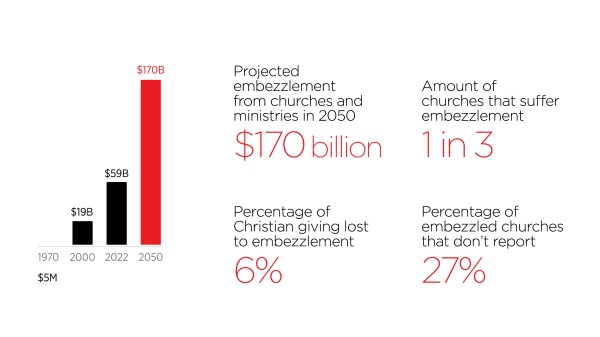
Embezzlement is a growing problem, globally, impacting Christian ministries and churches of every shape and size. The Center for the Study of Global Christianity projects thieves will take $170 billion in the year 2050, if current trends continue, but there are things that individual churches can do to protect themselves.

Recent Cases of Church Embezzlement

1 Oakland, California

A bishop and a lay leader in the African Methodist Episcopal Zion Church mortgaged properties owned by congregations in Oakland, San Jose, Palo Alto, and Los Angeles to obtain $14 million in high-interest loans. The money was used to buy real estate in North Carolina.

2 Lubbock, Texas

A bookkeeper took $450,000 from Church on the Rock, using the church’s credit cards to pay for a car loan, medical expenses, meals, and to sustain a bakery she co-owned with her daughter.

3 Formosa, Brazil

A Catholic bishop and five priests under his supervision stole the equivalent of $608,000 and used it to buy luxury watches, laptops, cellphones, cattle, a ranch, and even a shop selling lottery tickets. The congregation first noticed the fraud when the reported cost of running a parsonage skyrocketed.

4 Lagos, Nigeria

A church bookkeeper took the equivalent of about $99,000 from Living Faith Church (also known as Winners’ Chapel). When confronted by the pastor, he made a full confession and wrote out an explanation of how he’d stolen the funds.

5 Singapore

The founder and senior pastor of City Harvest church siphoned off the equivalent of $17 million through bogus bond investments. Much of the money was used to support his wife’s music career, which many church members supported as part of a project to use pop music to reach nonbelievers. Church leaders used an additional $19 million to try to hide the embezzlement from auditors.

6 Adelaide, Australia

A woman who worked for a company that collected and deposited money from multiple churches stole about $300,000, which she used for overseas trips and $26,716 in Louis Vuitton products. She was caught when a church finance officer noticed a discrepancy in the reports and started tracking the serial numbers of some donated bills.

Q&A with Todd Johnson, codirector of the The Center for the Study of Global Christianity, on trends in church embezzlement.

Is embezzlement a special problem in churches and Christian ministries?

It is a particular problem with religious organizations because trust is so important. One of the things we found after someone had been convicted of embezzlement, some cases where a pastor was actually in prison, you had church members who still said, “I don’t believe he could do this.” They were the victims, but they still couldn’t accept it.

That shows the power of trust. And trust is good, but if it’s misused—which is the definition of affinity fraud—that’s really a problem.

The Center for the Study of Global Christianity, where you serve as codirector, projects embezzlement in churches in 2025 will be down about $10 billion. Why is that?

I don’t have a single clear answer for that. The projections are composite figures, all tied to gross national income, the demographics of Christianity, rates of Christian income and giving, and the dynamics of fraud. Those are all constantly changing.

It’s almost so complex underneath that it’s hard to ascribe a single reason. These numbers have competing trends within them.

Longer term, the center projects an increase in Christian embezzlement. What is driving that?

It’s going up because of economic growth.

One of the overall trends we see is that Christianity is shifting from more wealthy countries to less wealthy countries. But what complicates that is the leveling out of economic growth, especially in places like India and China.

China was largely rural in the 1990s, and as the church was growing rapidly, it was the church of the poor. Now Christianity has moved into urban centers, and it’s a mixture of rural and urban, and economics are changing, the demographics are changing, and the demographics of Christians are changing all at the same time. But the result is the amount being embezzled is expected to rise there and other, similar places.

We’re also concerned the percentage of fraud will go up because Christianity is growing in places where it’s more independent. That independence is part of the reason Christianity is growing, but that independence also means there’s some likelihood that there are fewer guards in place when it comes to money. So as a global community, we might pay a price for that growth.

There are ways that individual churches can prevent embezzlement. But is there something that could impact the overall rate of fraud?

Even in situations with more controls or more sophisticated structures, people find ways.

We would hope that Christian churches would not have the same percentage of fraud that you’d find in business or other situations. But money is part of Christianity. People make money, they give money. Giving is encouraged in Christianity. And some of that gets stolen. We have an ecclesiastical crime folder here in our office, and it’s getting pretty full.

Our hope in bringing this to light is that churches would take seriously the issues of accountability and stop this as much as possible.

How to Protect Your Church Against Embezzlement

Checks and Balances

Make sure multiple people are involved in every part of the process of handling money. If one person takes the collection, another person should deposit it. If one person pays the bills, another person should reconcile the books. CT’s Church Law & Tax recommends rotating responsibilities on a semiregular basis.

Culture of Accountability

Cultivate a culture that values accountability. Too many Christian ministries rely on trust (and a sense of being “family”), ignoring the fact that we’re all sinners prone to temptation. When Church Law & Tax asked churches that had suffered fraud why they hadn’t instituted systems of accountability, the No. 1 explanation was fear of offending someone. If accountability is seen as offensive, instead of responsible stewardship, churches will be exposed to the risk of embezzlement.

Transparency

Secrecy is good for sin. Honesty encourages moral rectitude. Commit to transparency even when it’s painful. Church Law & Tax found that more than a quarter of churches don’t disclose embezzlement. That is a violation of the trust of donors and concealment of a serious crime.

Daniel Silliman is news editor of Christianity Today.

Correction: An earlier version of this article misstated the denomination of the bishop and lay leader who mortgaged properties church properties in Oakland, San Jose, Palo Alto, and Los Angeles, California. The are African Methodist Episcopal Zion, not African Methodist Episcopal.

News

Gleanings: April 2022

News from Christians around the world.

Source Images: Getty / PeterHermesFurian / Ryhor Bruyeu

Exiting Methodists take church property

More than 130 congregations have split from the United Methodist Church using a conscience clause to leave with church property ahead of an official division over LGBT issues. Methodist bylaws say that all property is held in trust of the denomination, using legal language put in place by John Wesley and Francis Asbury. In 2019, however, a special general conference created an exemption. Congregations can leave with property if they exit for reasons of conscience, approve departure with a two-thirds vote, and finish by late 2023. It is unclear whether the departing churches will form a new denomination or become nondenominational. The next general conference, where Methodist delegates will be asked to vote on “A Protocol of Reconciliation and Grace Through Separation,” is scheduled for late August.

Support for church choirs disappears

The last of the major publishers of church choir music has closed its doors. Brentwood Benson, which published the Ready to Sing series that was a staple for many small-church choirs, announced its closure in December 2021. The Lorenz Corporation, which was founded in 1890 and absorbed Word Music in 2017, went bankrupt during the COVID-19 pandemic. And Lifeway Christian Resources stopped publishing physical choral music, though it will still produce some material in a digital format. The changing landscape is attributed to the rapid decline in church choirs, compounded by the disruption of COVID-19.

COVID-19 lawsuit dismissed

Bolivia’s Minister of Justice disqualified an Association of Evangelical Churches lawsuit over COVID-19 vaccine passports. The churches, joined by a labor leader and two doctors known for promoting unproven treatments of COVID-19, asked the court to annul two government decrees that required vaccination passports and threatened violators with up to 10 years in prison. The government official said the vaccine is voluntary and a negative coronavirus test also suffices for a passport. He dismissed the churches’ arguments as “a series of fallacies, lies, [and] half-truths.”

Prayer stick unearthed in Oslo

Archaeologists in Oslo have discovered a medieval rune carved on a wooden stick, which appears to bear the female name Bryngjerd and the Latin words for Lord and hands. The full inscription has not been recovered from the marred wood but may be a version of the common prayer “Into your hands, O Lord, I commend my spirit. You have redeemed me, O Lord, O God of truth.” Elsewhere on the stick, the medieval woman appears to have written, “It is true.” Researchers hope the find will expand their knowledge of the breadth of Christian practice in medieval Scandinavia.

Dozens killed at worship meeting

A stampede at a church gathering in Liberia’s capital city of Monrovia killed at least 29 people, including 11 children and a pregnant woman. A gang of street robbers known as zogos reportedly started the panic by rushing into the all-night worship event, called a crusade, with blades at about 9 p.m. President George Weah declared a three-day period of national mourning and said the government might consider regulations restricting the number of people allowed in a venue. Even though “we all are religious people,” Weah said, Liberians should be willing to comply with reasonable safety regulations. The pastor who led the service could face criminal charges.

Murder charges dropped in succession fight

The case against 42 people accused of murdering five men in a conflict over succession at the International Pentecostal Holiness Church (IPHC) in Zuurbekom, western Johannesburg, has been dismissed due to insufficient evidence. Three factions within one of the largest South African churches have struggled for control since Glayton Modise, son of founder Frederick Samuel Modise, died in 2016. The struggle turned deadly with an early-morning raid in July 2020. Police, responding to the scene, found five bodies and more than 60 firearms. Michael Sandlana, leader of the now-cleared “Jerusalem faction,” said he hopes authorities go after the real killers soon.

Bible bashing punished with prison

A Muslim cleric in Indonesia was sentence to five months in prison for committing blasphemy against Christians when he said the Bible was a work of fiction. Muhammad Yahya Waloni, a convert from Christianity, made the statement in a sermon posted on YouTube. The crime can carry a five-year sentence, so a local Catholic leader complained the verdict was “very far from justice.” Human rights advocates oppose the law, which criminalizes religious belief and has been used to covict more than 150 people since 1965, most of them Christians.

News

More Ministries Seek Alternatives to Child Sponsorships

Nine million children are supported by one-to-one funding, but a growing number of Christian groups say that approach is problematic.

Photo courtesy of Lifeline Christian Mission

Darwyn Sanchez teaches Honduran children that God loves everyone, but sometimes they question him. How could that be true, they ask, when only some children receive gifts from the Americans?

Those sponsored through the US-based Lifeline Christian Mission received letters, school supplies, and toys. But other students at the same school—and sometimes even in the same family—weren’t “chosen,” said Sanchez, Lifeline’s Honduran assistant country director. And those kids wondered what was wrong with them.

“There is good fruit from the sponsorship program … but we need to grow,” Sanchez said. “We need to give dignity to the people, and we need to change the strategies.”

Lifeline has ended its one-to-one child sponsorship in Latin America and Haiti and has started a five-year transition to a new model of caring for children. The mission organization now promotes group sponsorships, which allow groups of Christians to support classrooms of children or entire communities, instead of individuals.

It is always a challenge for ministries to give up models they have relied on—more so when, like sponsorships, they provide a solid financial foundation for the ministry.

Despite the risk, Lifeline has decided to go ahead.

“Ultimately, it became a question of doing what we thought was right,” said Joel Augustus, executive vice president of field ministries, “what God was leading us to do.”

1 in 4 American donors have sponsored a child.

Lifeline is one of many organizations that are ending or “massively restructuring” their child sponsorship programs due to concerns that it’s largely just a fundraising tool, promotes white saviorism, and isn’t best for children, said Phil Darke, author and advocate for best practices in child-focused international work.

This model has been a huge part of international child ministry and the American donor experience. About nine million children are sponsored globally, a 2013 study showed. One in four American donors have sponsored a child, with more than $3 billion going to child sponsorships annually.

Sponsorship is a broad term. While the familiar experience of choosing a child from an online directory or a wall of postcards is nearly universal, what aid groups do with sponsor donations varies widely. Some fund orphanages. Others pay for after-school programs, tuition, or food for children living with their families.

And some of those approaches have shown positive results. Sponsored children are more likely to graduate from high school and college, become leaders in their communities, and get salaried jobs, according to the 2013 study, which evaluated 10,144 people in six countries served by Compassion International.

But many who have worked in the field have come to believe the downsides are worse. They say sponsorships disrupt communities, create confusion, and undermine local institutions that could lift people out of poverty. They also fear the model encourages unhealthy donor behavior, including feelings of entitlement.

The reexamination of sponsorship as a fundraising tactic is part of a broader shift in approaches toward helping at-risk children. In the late 20th century, programs concerned with saving children at all costs—which often involved removing kids from their communities and placing them in orphanages—began giving way to programs concerned more for child rights and dignity.

But “it wasn’t like we passed from one era to the next,” said child rights advocate Brandon Stiver. “In some regards, especially when it comes to fundraising, the two areas really operate concurrently.”

In the past few years, however, even donors have come to see problems with one-on-one sponsorships. In 2017, CT reported 60 percent of child sponsors said they were “wary” of sponsorships, 54 percent said sponsorships are mostly a fundraising gimmick, and three-quarters said they were not confident their money actually went to one child.

There is also growing concern, in the internet age, about how sponsored children will feel about the way their tragedies were promoted. Heather Nozea, director of child protection in Haiti for Rapha International, a ministry that cares for survivors of sexual exploitation and human trafficking, said she cringes.

“Can you imagine how that will feel when that child gets a bit older and finds the most devastating details of their life posted publicly for the world to see?” Nozea said. “I have seen things like, ‘His mother doesn’t want him’; ‘She was left on the trash dump to be eaten by pigs’; ‘Her mother was raped and her father tried to kill her’ posted on websites and social media next to a child’s name and/or photo.”

Sponsorships are also, in some instances, part of the model that sustains support for orphanages. Though the most high-profile Christian ministries have moved away from orphanages because of the documented problems they create for children and their communities, visits to orphanages remain one of the most popular short-term mission trips for American Christians.

When those trips are over, financial support typically dries up, unless the American is offered a child sponsorship. In Haiti alone, one child advocacy group was able to document $70 million given to orphanages annually, mostly from American Christians.

“It’s actually a disincentive to get the kids back into families if we’re doing child sponsorship,” Darke said.

Not every organization believes child sponsorship is beyond reformation, though. World Vision, which helps 3.5 million kids around the world, has been trying to address root problems of poverty for 70 years using child sponsorship, said Margaret Schuler, senior vice president of World Vision’s International Programs Group.

Schuler understands the criticisms. But she said one-to-one sponsorship brings attention to vulnerable kids, and in World Vision’s model, it funds development projects for the entire community.

“There’s some narrative out there about how … child sponsorship is not a great approach and it’s dying,” she said. “I think it could be if you don’t do it right. Sponsorship gives the sponsor the opportunity to form a personal relationship with a child, be their champion, watch him or her grow over time … and ensure that their well-being is tracked.”

The organization has made many changes over the years and in 2019 turned the child-sponsor relationship on its head. Children—instead of donors—now do the choosing.

Though sponsorship ministries haven’t reached a consensus on the best alternative to one-to-one sponsorship, there is broad agreement that donors will need to let go of their unhealthy need for an emotional experience with a sponsored child.

Hands and Feet Project, a Tennessee-based ministry that operates in Haiti, tried to nudge supporters in that direction in 2017, when it relocated its housing for short-term mission teams and limited the interactions supporters could have with sponsored children and other kids in its programs.

“A lot of really passionate supporters left,” executive director Andrea McGinniss told CT in 2019. “It challenged the mentality of, ‘I want to come down. I want to hold babies. I want to have a feel-good moment.’”

The biggest risk for child sponsorship organizations is that any attempt to reform the system or develop a new model will come at a financial cost. Many want to change or end their child sponsorship model but are afraid they’ll lose donors, said Brent Phillips, CEO of Cherish Uganda. Donors can be brought along, however, if the changes are explained, he said.

Cherish Uganda now promotes a transitional model of sponsorships that withholds children’s names from donors, citing Matthew 6:3: “But when you give to the needy, do not let your left hand know what your right hand is doing.”

“I think people respected that,” Phillips said. “They’re like, ‘Okay, you’re thinking deeper than, you just want to go get some money.’ It further solidified some of those donors.”

Lifeline, a 40-year-old Christian ministry, started looking into alternatives when Ben Simms took the role as CEO. The organization was founded by a general contractor and has been entrepreneurial and unafraid of change. Simms told staff he valued humble leadership and listening to voices from the field. Lifeline started its five-year transition away from sponsorships in 2020.

The Latin Americans who grew up being sponsored through the ministry welcomed the change, Sanchez said. They believe there are better models for caring for children than what they themselves experienced.

The big question for the ministry is still whether Americans—especially those who have long relationships sponsoring children one to one—will be willing to adjust.

“I’d like to say to our brothers and sisters in the USA: Help us to grow, giving us dignity, giving us the opportunity to lead others and to empower the people in the communities,” Sanchez said. “That’s the way we can be the difference. This is the way they can continue loving us.”

Rebecca Hopkins is a journalist living in Colorado.

Testimony

The Booze-Filled Business Trip That Made Me a Christian

I was on the verge of making a fortune, but I couldn’t stop dwelling on a conversation about religion.

Photo by Willie Petersen 

Certain days are marked indelibly in our memories. For me, it’s the day the limo picked up the Isilon Systems corporate team from our New York City hotel and drove us to the midtown Manhattan trading floor of the investment bank Morgan Stanley.

I was still a little hung-over from the stock pricing party the evening before. We were going to stand on the trading floor as the momentous day began. In a few moments, Isilon’s stock would be publicly traded, and we would watch the stock price fluctuate until it made us wealthy.

When the opening bell rang, Isilon’s stock stood at $13 per share and immediately began a steady climb, more than doubling its offering price. Isilon team members spent the rest of the day hugging and congratulating each other over our roaring success. I was now a millionaire on paper.

But something wasn’t right. While most corporate execs would feel elated, I felt an overwhelming sense of melancholy and dissatisfaction. My Isilon colleagues felt ebullient and optimistic, but I couldn’t share in their triumph.

The world without Jesus

A week earlier, on this IPO road show, I had come to faith in Jesus Christ in London. On that fateful day, we had a series of nine meetings, after which we enjoyed a long dinner—replete with endless supplies of cocktails and wine—at a restaurant in the trendy Soho neighborhood.

Walking the streets afterward, we passed an older-looking office building that could have served as an apartment house. An investment banker stopped us and pointed out that Karl Marx had lived there during his time in London, while working on his book Das Kapital.

A voice from our group piped up: “Lucky for us Karl Marx didn’t get it right, or we wouldn’t be here.” Everyone laughed. The irony of passing a monument to communist history while drumming up investments for our business hadn’t escaped us.

“True,” another member of our party chimed in. “But he did get one thing right: Religion is an opiate for the masses. It’s nothing but a support for people’s insecurities. A crutch.” Someone else echoed this judgment: “If it wasn’t for religion, most of the wars in the world would have never taken place. Think of all the lives that would have been saved. If it wasn’t for religion, this world would be a much better place.”

“Makes sense,” I mumbled as I nodded my head. They continued their conversation while we headed back to the hotel in our limousine.

Entering my room, I felt clearheaded—more clearheaded than normal—and I looked down at the wet bar. At first, I thought I’d have another drink or two before heading to bed, but instead I shook my head and sat down in a large oak chair with lambskin upholstery. Something was stirring in my gut. I couldn’t get the comment about religion being the opiate of the masses out of my mind. It amused me because of how shallow and sophomoric it seemed, and yet it bothered me too. In some ways my mind wanted to say yes, but my heart said no.

Then a question reverberated deep inside: What would the world be like without Jesus Christ? I wrestled with it and couldn’t shake it. Sure, I thought, the world is a broken and depraved place where wars and violence are common. Sure, there is suffering and endless heartache. But what would the world be like without Jesus Christ?

Sitting in that luxurious chair, I reflected on the high and low points of my life. I thought especially about my quest for autonomy and self-sufficiency, and how it ended up enslaving me to the pursuit of wealth and other material things.

Then my wife, Trish, came to mind. She was a Christian—and truth be told, I had persecuted her for it. I had seen her hiding her Bible in the morning so I wouldn’t make snide comments. I had called her a “Bible thumper” and a “Jesus freak.” Our marriage was struggling mightily because, in biblical terms, we were unequally yoked.

But what would her life be like without Jesus? Her joy seemed to come from something she realized she didn’t earn. How could she be joyful in anything if she didn’t earn it? That’s not how I saw life.

I realized that up to that point, I had invested all my intellectual energies into the idea that God didn’t exist. Because if he did, then where did that leave me? I had put all my stock into myself—my self-sufficiency, my business acumen.

Looking at the clock, I realized I had been lost in thought for two hours. Glancing at the wet-bar fridge, I thought, Maybe I should have a drink or two. No, not tonight. I didn’t want anything to cloud my thinking. Plus, at least for that moment, the desire wasn’t there.

Suddenly, I felt a warm wave of energy surge through me, and my eyes welled up with tears. I couldn’t stop it—a feeling of joy but also regret. A feeling of deep and unending love but also a deep sense of the need to repent. It seemed like a light had come on, even though the room was still dark.

I’ve had this all wrong, I thought. Yes, the world is a broken, depraved, and violent place. But the Bible says that Jesus healed people. He transformed them. He hung out among the worst of them. And he forgave them.

Then I felt a divine presence in the room. Shivers ran up and down my spine. The Holy Spirit was there. “Jesus!” I cried out. “I’ve worshiped myself, but it’s empty. I don’t want to live another moment apart from you. I give my life to you. Please forgive my pride. Make me one of yours, and adopt me into your family.”

Then I laid down on the floor on my face before God and sobbed all night. Every tear washed away a memory of rebellion, a harsh word, an indiscretion. I didn’t care whether anyone in the hallway or next door could hear me. I wanted a relationship with Jesus Christ.

Changing priorities

The years following my conversion featured crisis after crisis. I endured a painful separation from Isilon Systems. There were lawsuits and bad investments, to say nothing of the sinful habits that lingered in my life. The most difficult obstacle to overcome was finally admitting I was an alcoholic and committing to in-house rehab.

After getting sober, I felt called to spread the gospel. I got involved in Celebrate Recovery as well as a prison ministry at my church. Meanwhile, Trish could sense something new happening within me. She could see my change in priorities. No longer was I working 60- to 80-hour weeks while neglecting my family. And I had developed a ravenous appetite for Christian books.

Eleven years ago, I sat down with Trish to discuss our future. I told her my yearning to know God at a deeper level had planted in me a desire to go to seminary. Trish gave me a big smile and a bear hug. “Be careful what you pray for,” she said through tears. “I asked God to save my husband. A garden-variety Christian man would have sufficed, but he’s giving me a Charles Spurgeon!”

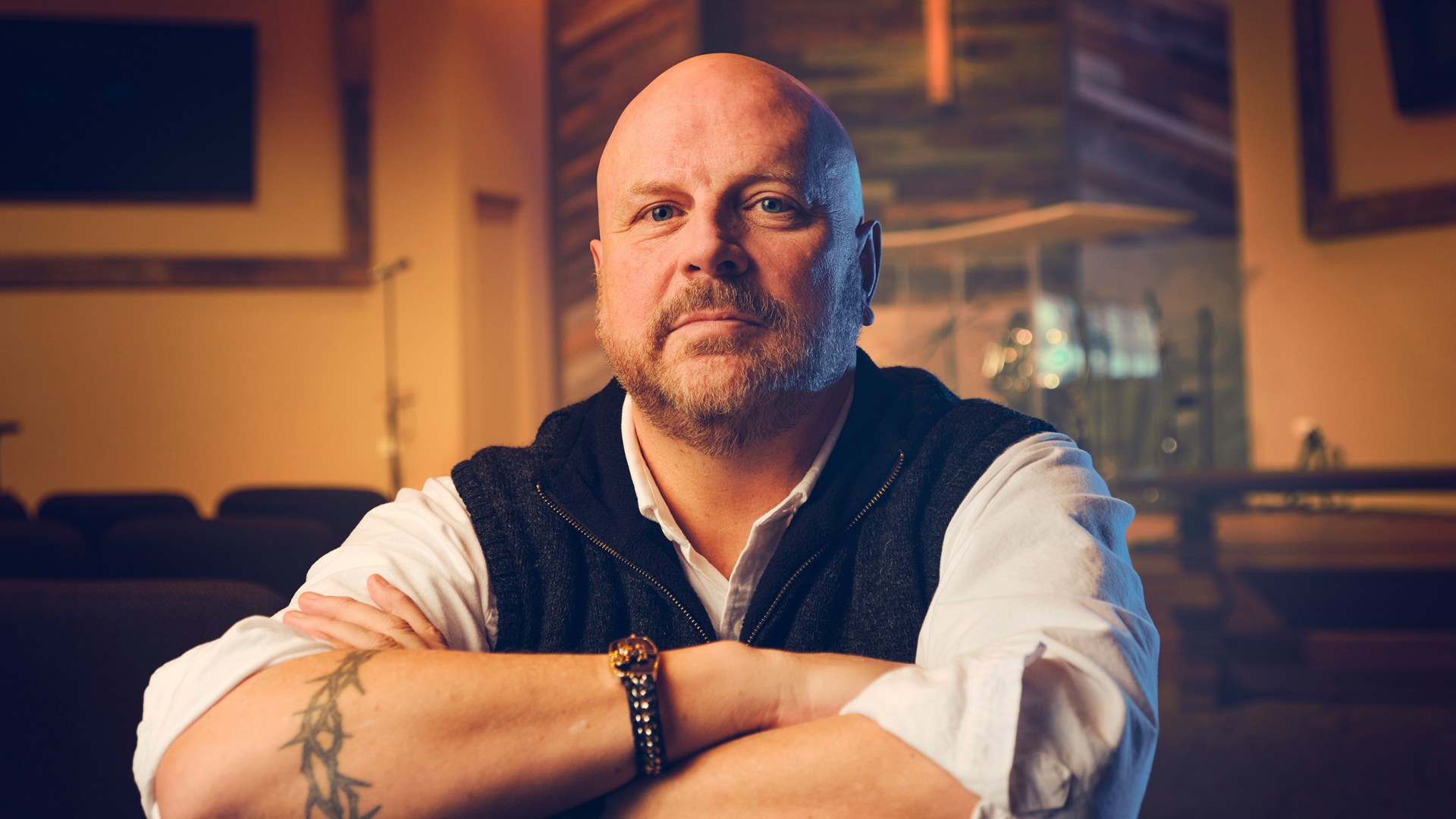
On my shoulder, I have a tattoo of 1 Peter 5:9–11, which speaks of God’s grace making us “strong, firm and steadfast” after we have “suffered a little while.” It steadies my faith, reminding me that God’s purpose in my life never fades.

Stu Fuhlendorf is the senior pastor of Redemption Hills Church in Littleton, Colorado. He is the author of Wall Street to the Well: A Story of Transformation from Fortune to Faith.

Apple PodcastsDown ArrowDown ArrowDown Arrowarrow_left_altLeft ArrowLeft ArrowRight ArrowRight ArrowRight Arrowarrow_up_altUp ArrowUp ArrowAvailable at Amazoncaret-downCloseCloseEmailEmailExpandExpandExternalExternalFacebookfacebook-squareGiftGiftGooglegoogleGoogle KeephamburgerInstagraminstagram-squareLinkLinklinkedin-squareListenListenListenChristianity TodayCT Creative Studio Logologo_orgMegaphoneMenuMenupausePinterestPlayPlayPocketPodcastRSSRSSSaveSaveSaveSearchSearchsearchSpotifyStitcherTelegramTable of ContentsTable of Contentstwitter-squareWhatsAppXYouTubeYouTube