Books

Cultural Diversity Isn’t a Problem to Be Solved

Different languages and ethnicities aren’t a consequence of sin, but a part of God’s plan.

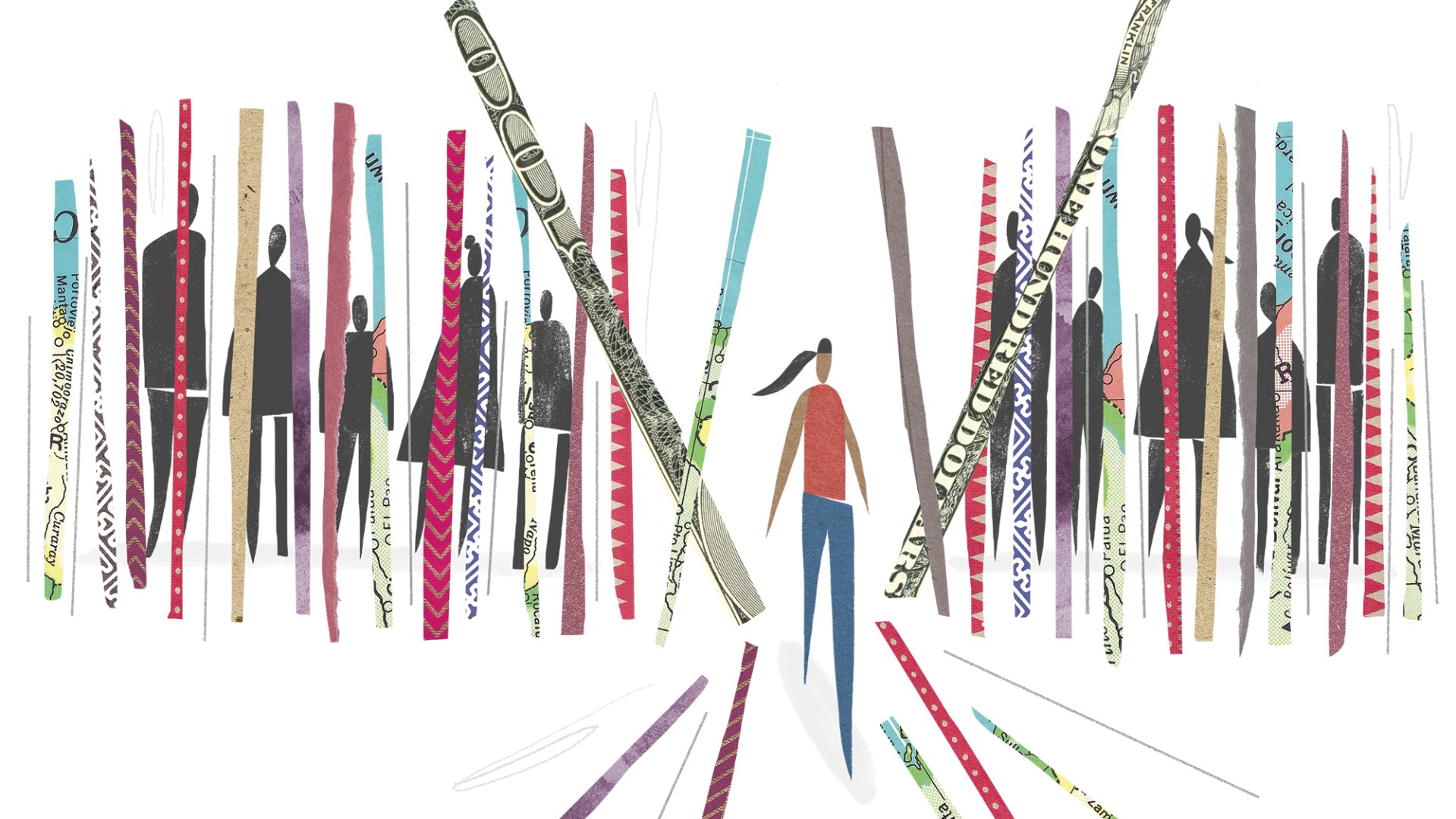
Illustration by Rick Szuecs / Source images: Adobe Stock / Kwanzaa - Freepik / Envato Elements

Every now and then, I’ll hear Christians musing about heaven. They might speculate about the future of marriage, the biology of immortality, or the extent of our supernatural abilities—“Will we be able to pass through walls?” But perhaps the most common question is “What language will we speak?”

Cultural Identity and the Purposes of God: A Biblical Theology of Ethnicity, Nationality, and Race

The underlying assumption is that we’ll have the same language, human or heavenly. Many imagine that God’s original plan for humanity was for one people, speaking in one language. In this way of thinking, only sin—and the specific failure at Babel—led to a diversity of peoples, languages, and cultures. And in the new creation, confusion will be undone as all become one.

However, in Cultural Identity and the Purposes of God: A Biblical Theology of Ethnicity, Nationality, and Race, Steven M. Bryan argues that our desire for unity—and the biblical vision of it—requires linguistic and cultural diversity. More specifically, he contends that God’s plan from the beginning was to fill the earth with a multiplicity of peoples who together experience the reciprocity of mutual blessing.

In exploring God’s purposes for our diverse world, Bryan considers the prominent forms of cultural identity: ethnicity, nationality, and race. However, the book’s main emphasis is biblical and theological, not sociological. Bryan, a New Testament professor at Trinity Evangelical Divinity School, depicts God’s unfolding plan for peoples from creation to new creation as revealed in Scripture.

The book blends rich theological reflection and deep cultural perception, drawing on the author’s 20 years of missionary experience in Ethiopia. Bryan includes several anecdotes from this period. Ethiopia has significant historic, ethnic, and linguistic diversity—as well as its fair share of cultural conflict. As such, it provides something of a case study for the cultural battles common throughout the world today.

For example, Bryan considers how the emergence of globalization has led to widespread ethnonationalism. In response to mass migration (itself often resulting from ethnic conflict), many nations are becoming culturally insular or domineering, operating with “the notion that a nation should have but one people with one culture.”

Bryan’s concern is that many Christians have “succumbed to the temptation of thinking that cultural multiplicity within a society is ultimately unworkable and must somehow be prevented, banished, or reduced.” Christians taking such a view might hold the theological assumption that “cultural multiplicity plays no part within the purposes of God or is itself a problem to overcome.”

In response, Bryan explores “what Scripture has to say about God’s purposes not only for people but also for peoples.” As he asserts, “The relationship between peoples turns out to be a crucial, if often overlooked, feature of the biblical story. Only by understanding God’s intentions for peoples can we live in the world as God intended and live in hope of the world to come.”

Cultural Identity and the Purposes of God is thoroughly biblical. Throughout, Bryan offers fresh readings of Bible passages, both familiar and obscure, from the curse of Canaan to cultural preferences among Roman believers. His book is saturated with scriptural insight that repays careful reading.

Bryan also demonstrates a necessary evenhandedness when evaluating cultures. He’s clearly able to read both Scripture and current events with an eye for the beauty of diversity and the dangers of cultural sins.

Within the context of local churches, Bryan envisions a community that integrates peoples without assimilating them—one that deconstructs idolatrous practices without asking converts to renounce their cultures. He suggests the gospel creates a new and shared cultural identity that incorporates the glory and gifts of diverse individuals.

Bryan also seeks out a biblically informed perspective on some of today’s most challenging topics, including nationalism, systemic racism, identity politics, genocide, and privilege. Here again he demonstrates careful and nuanced thinking on oft-divisive matters, moving beyond theological reflection to practical application. In this, the book is commendable for being a truly ambitious work.

The word ambitious also hints at my primary critique. Biblical theology often seeks to identify a theme and trace its development across the biblical canon. But the perennial temptation within this discipline is to spotlight a theme’s significance in passages where it’s only a supporting character.

At times, I wondered whether Bryan overstates the importance of cultural identity in various biblical stories. For example, I wasn’t convinced by his claim that Cain’s sin is best understood as “a story of willful resistance to the divine purpose that the human family comprises many families united in worship of the one God.” Likewise, I was skeptical of the way he described Abraham’s faith as a willingness to disadvantage himself for the sake of other nations.

Furthermore, in a book tracing themes of nationality and ethnicity, I would have expected fuller treatment of key passages related to cultural identity like Acts 17:26–27 or Galatians 3:28. In the end, I think Bryan could have better developed his case that “a rich variety of cultures is central to the divine vision for humanity” and that “God’s intent is for a world filled with diverse peoples.”

Still, I found his overall argument compelling. While some Christians may assume linguistic and cultural variety are the product of sin rather than the purpose of God, God’s mysterious plan for the nations, as revealed in history’s culmination, says otherwise. When God sums up all things in Christ, the result, to use Bryan’s preferred phrase, is “a people of peoples.”

Those in Christ are a new people representing every nation, tribe, and tongue. In the beautiful vision of Revelation, as Bryan puts it, “each culture in all its uniqueness will fulfill its true purpose in magnifying the glory of the Lord,” as diverse peoples bring their unique glories into the city of God (21:24). And within the New Jerusalem, ongoing cultural (and linguistic!) diversity will be expressed in perfect unity to the praise of the Lamb who was slain.

Elliot Clark works with Training Leaders International. He is the author of Evangelism as Exiles: Life on Mission as Strangers in our Own Land and Mission Affirmed: Recovering the Missionary Motivation of Paul.
Our July/August Issue: War Stories

Amid the ashes, beauty stands out.

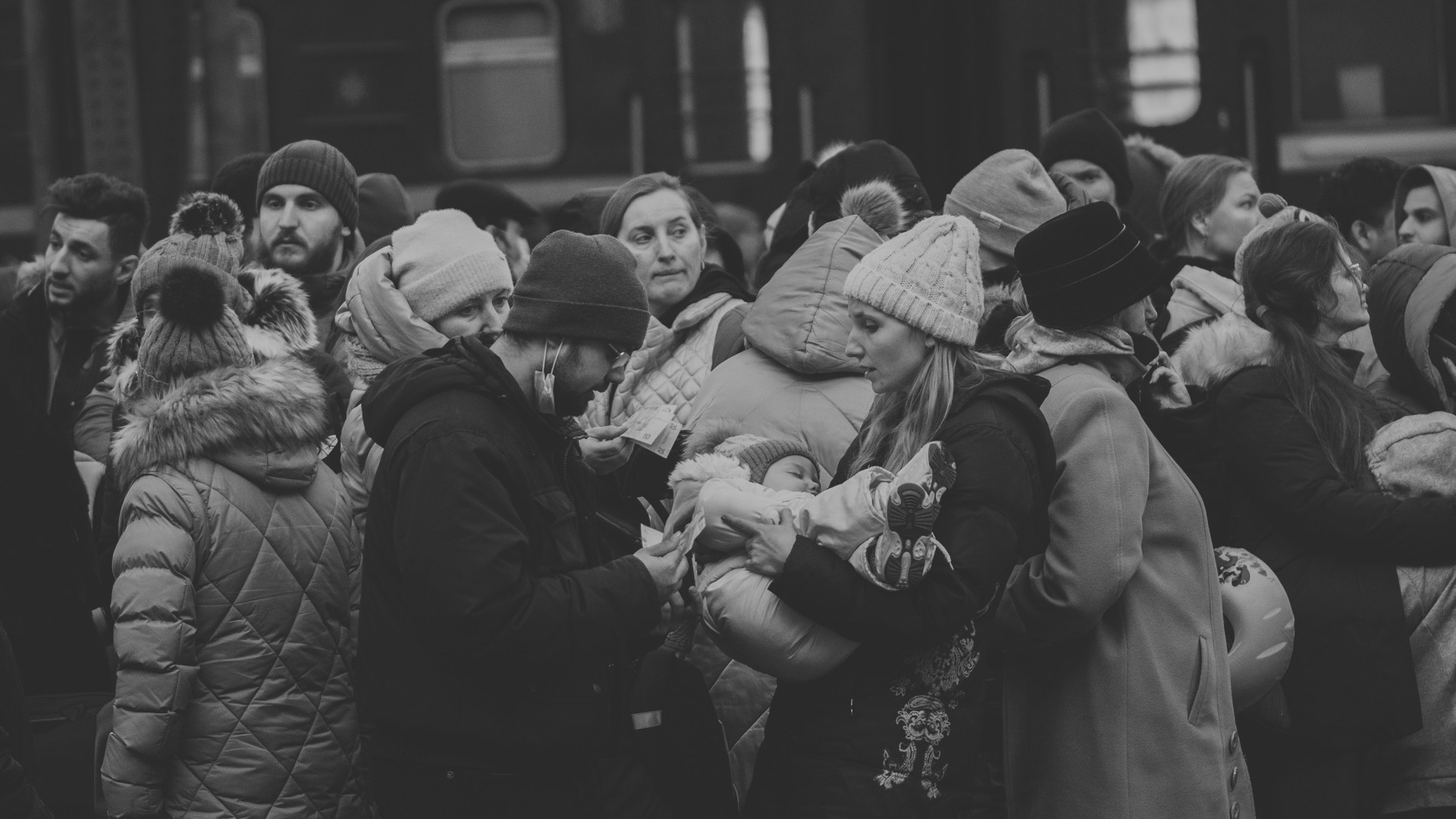
A woman, man, and their child stand on a crowded train station platform in Lviv, Ukraine, in February 2022.

A woman, man, and their child stand on a crowded train station platform in Lviv, Ukraine, in February 2022.

Photo by Joel Carillet

Sophia Lee and Joel Carillet both hoped to beat the Russians to Ukraine.

Carillet, an East Tennessee–based photojournalist who had previously lived in Ukraine, managed to pull it off. He landed in Kyiv 10 days before missiles began falling.

Lee, a newly hired writer at CT, planned to travel there on her debut assignment for the magazine. But by the time she started in March, the incursion was well underway; she flew instead to Poland to document Ukrainian refugees.

The two met one afternoon at a hotel in Warsaw to begin reporting this month’s cover story. Carillet struck Lee as nice, really quiet; she liked him immediately. Lee seemed to Carillet a little reserved, similar to himself. She had an impressive work ethic.

But who can really feel, when they first shake someone’s hand, how much weight a person is carrying? Journalists don’t bring themselves to a story tabula rasa, minds undivided and hearts unburdened.

Carillet had already spent weeks photographing the heartbreaking outflow of displaced people. “I think I cried at some point almost every day,” he said. Then there was his mother, a former missionary to Ukraine who was declining in hospice care back in the US. (Tragically, she passed away while he was still in Europe.)

Lee was seven months pregnant. She was days into a new job, and she and her husband were still grieving the sudden death of her mother-in-law.

Naturally, Carillet and Lee reported on stories of Christian hope and joy in the midst of cruelty and suffering. They wanted those stories as much for themselves as for CT’s readers. But they also encountered people with a different variety of faith, people who had given up demanding quick fixes to their desperate situations. These people exhibited Job-like confidence in God’s faithfulness and presence. Their faith was “a way of living,” Lee wrote in an online essay for CT, “like breathing, even when those breaths sometimes rasp out in gasps.”

It was among such people that Carillet and Lee stumbled into unforeseen graces directed their way: a kind word, a sudden embrace, a refugee’s prayer of blessing over a journalist. The beauty of such acts was magnified “precisely because it was set against the ugliness of this war,” Carillet said. “That beauty leaves a mark on you.”

That would be a worthy prayer for everything we publish at CT: that against the ugliness of hard truths, we might also see great and contrasting beauty.

Andy Olsen is print managing editor of Christianity Today. Follow him on Twitter @AndyROlsen.

Cover Story

They Fled Ukraine, and Ukraine Followed

Escaping Russian missiles, some exiled believers found a new sense of purpose helping refugees.

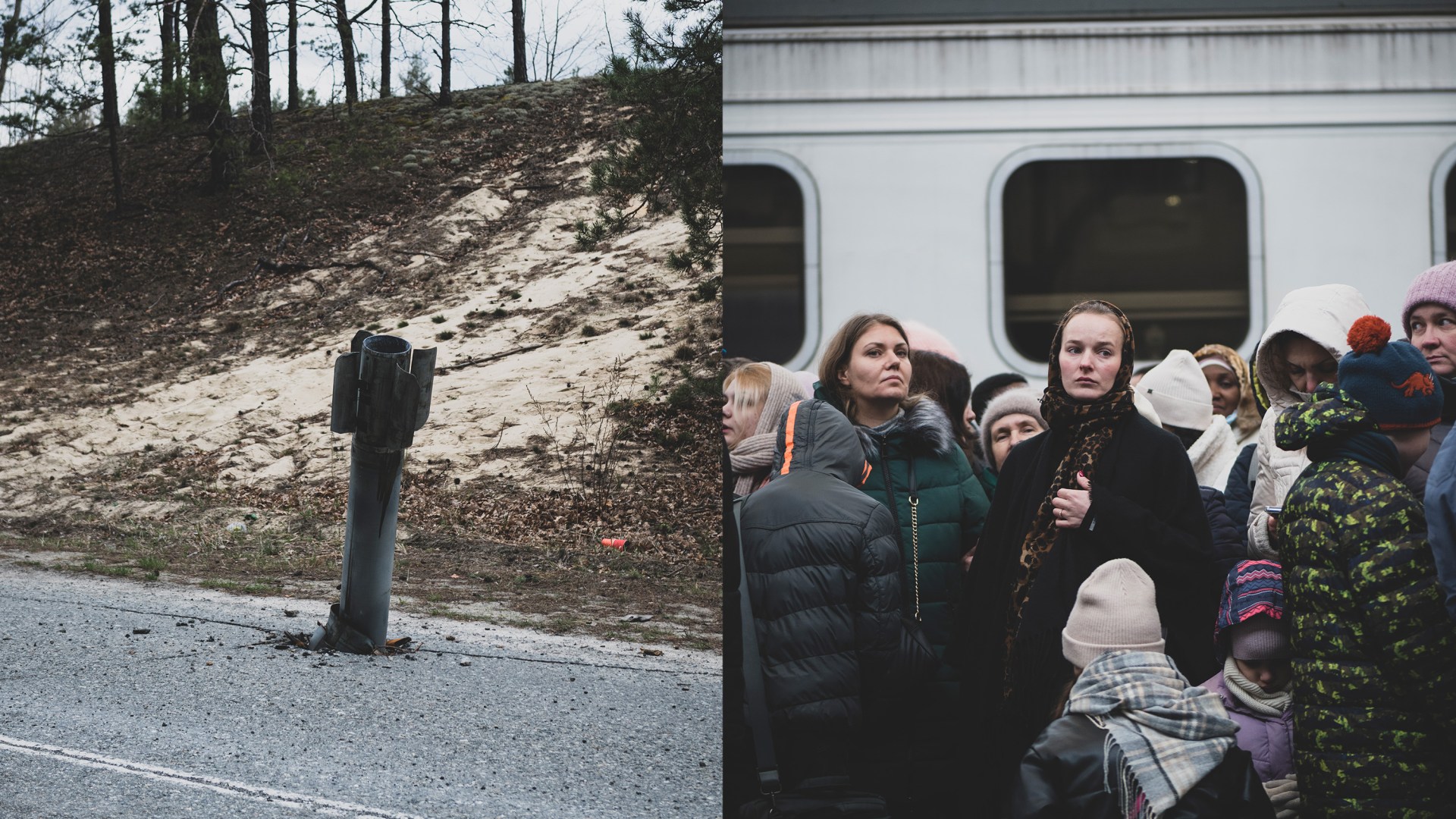
Left: A rocket embedded in the asphalt on a rural road between the villages of Piskivka and Kukhari, northwest of Kyiv. Right: Passengers wait on a crowded train station platform in Lviv, Ukraine.

Left: A rocket embedded in the asphalt on a rural road between the villages of Piskivka and Kukhari, northwest of Kyiv. Right: Passengers wait on a crowded train station platform in Lviv, Ukraine.

Photo by Joel Carillet

It was 2:30 in the morning on February 24 when Maksym Maliuta finally fell asleep. That night, he had been arguing with his college classmates, who dismissed warnings of a Russian invasion of Ukraine as “Western media panic.” No, Maksym insisted, the signs were all there: Vladimir Putin was building up to a massive military operation.

Maksym had been asleep two hours when his phone rang. Russian airstrikes were raining on cities across Ukraine, his cousin called to tell him. Maksym went online and found a video of missiles exploding in Kharkiv, Ukraine’s second-largest city. Then he went into his parents’ room and woke them with the news: Putin was attacking their country.

When Maksym walked to the bathroom to wash up, the shock finally splashed him full in the face, and he began shaking. The possibility of a Russian invasion had been looming in his consciousness since he was 10, when Russia annexed Crimea in 2014. And yet, it seemed unreal when it actually happened, “like a nightmare that finally came true.”

It should have been a relief that the Maliutas were, in fact, half a continent away from their home in Kyiv.

Maksym’s father, Ruslan, works with international evangelical ministries, and whenever people outside of Ukraine asked for his thoughts, Ruslan had answered, “War is possible, but unlikely.” But in mid-January, while on a prayer walk, Ruslan began wondering if, as a father of five children, he ought to prepare an evacuation plan, just in case. He reached out to a friend who owns a chalet in the Swiss mountains. That friend offered the chalet as a temporary safe place to his family but advised, “If I were you, I’d think about coming soon.”

Until then, the idea of leaving Ukraine had been hypothetical. But as Ruslan and his wife, Anya, prayed, they felt a nagging sense that they shouldn’t wait. They needed to go soon.

Within a few days, the Maliutas piled their luggage into the family van and headed toward Switzerland with mixed feelings. Ruslan wasn’t sure what to expect; they could return home in a month or never see home again. Anya expected they would be back in two weeks.

Maksym, their 18-year-old oldest son, was the most pessimistic: He feared war could erupt at any moment, that bombs might strike Ukraine before they even made it out of the country. When they finally crossed the Ukraine-Hungary border, he felt relief, then sadness. “I had a very strong feeling that we’re not going to be back home for a long time.”

Ruslan Maliuta (right) and his son Maksym (left) visit the shelter at Chełm Baptist Church in Poland.Photo by Joel Carillet for Christianity Today
Ruslan Maliuta (right) and his son Maksym (left) visit the shelter at Chełm Baptist Church in Poland.

A month later, when the invasion began, the Maliutas had temporarily relocated to an Airbnb in southern France because of a scheduling conflict at the chalet. They were turning it into a mini seaside holiday, hiking and strolling on the beach. But word of the war, 1,800 miles away, arrived like a storm cloud and blotted out the beauty and warmth of the French coast.

For hours, Ruslan and Maksym fixated on their devices, watching their country turn to smoke and rubble. It felt surreal. Ruslan recognized a building that was ripped apart by a missile: It was a short walk from the hospital where all five of his sons were born. A friend called to tell them he was fleeing Kyiv with his wife and son, without a clue where they were going. When a garbage truck pulled up near the house making loud popping sounds, Ruslan jumped in fright.

As the family finally went out for a walk to take a break from the news, Ruslan gazed at the happy people at the beach, uncomprehending, feeling as though he were observing life through a screen. “There was a crystal-clear sense that life has changed.”

For tens of millions of Ukrainians, February 24 sliced time into two eras: before and after. For Ruslan and Maksym, the weeks after felt like one unending, nightmarish day. But the family had a decision to make: How would they respond? Who would they become in the new era?

Ruslan recalled Viktor Frankl, a psychiatrist and Holocaust survivor, who once observed that those who found meaning and purpose were able to survive the horrors of concentration camps, whereas those who clung to unrealistic optimism or gave in to despair were doomed.

“We are living in a time of big changes,” Ruslan said. “We don’t know what’s coming, but we need to be ready in terms of our relationship with God, our priorities, the foundational things—understanding what those are, and what it means to be ready for whatever’s coming.”

Nobody is ever completely ready for war, even those who take precautions.

On paper, Julia Sachenko was more ready than most. She leads the Ukraine branch of A21, a global anti–human trafficking organization. Because Sachenko and her team work for an international group, A21’s security staff worried that, should Russians occupy Ukraine, they might suspect Sachenko and her team were spies. A21 advised Sachenko’s team, including spouses and children, to relocate from Kyiv to a country house 25 miles outside the capital.

On February 12, the entire staff moved into that house and began working there together, not knowing what to expect. When nothing seemed to happen, they got antsy, missing home. Sachenko convinced them to stay put until February 25. But on the 24th, Russian troops entered Ukraine.

Sachenko and her team hastily packed their bags. She had two suitcases—one stuffed with clothes for her and her children, the other with work documents. Her husband helped her carry their two boys, ages four and six, to her Volkswagen Tiguan. They looked up at the missiles flaring overhead. Then they kissed goodbye. They had previously agreed that should something happen, he, a pastor in Kyiv, would stay behind with his congregation while Sachenko took the kids to safety in Poland.

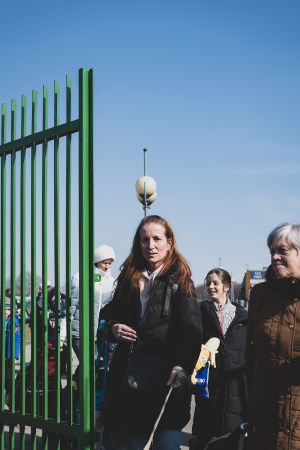
People cross from Ukraine into Poland at the border in Medyka, Poland. Photo by Joel Carillet for Christianity Today
People cross from Ukraine into Poland at the border in Medyka, Poland.

For her boys, Sachenko tried to pretend like they were on a road adventure. But she could barely see the road through her tears. A staff member riding with her read Psalm 91 over and over: “I will say of the Lord, ‘He is my refuge and my fortress, my God, in whom I trust.’ ”

More than 6 million refugees have fled Ukraine, while more than 7 million are internally displaced—about a quarter of the country’s entire population—a scale of human suffering and forced displacement that, according to the United Nations, “far exceeds any worst-case scenario planning.”

Sachenko is one of more than 3 million refugees who crossed the border into Poland, a country of 38 million, where refugees from Ukraine are eligible for work permits, free health care, schooling, and bonuses for families with children. The vast majority of them are women and children arriving unemployed, bereft, and traumatized. Most say they plan to return home. But even if the war ended today, it would take months and years for some to go back while Ukraine rebuilt its economy and infrastructure and removed the land mines scattered like confetti across its terrain.

Even when the war has seemed to abate—such as in early April, when the Russian military retreated from the northern regions to focus assaults on the south and the east—many refugees said they feel stuck in limbo. They don’t know when it’s safe to return home or what to do in the meantime.

Sachenko was still in her car when she realized exactly what she’d be doing during her exile.

It took her and her team two days and two nights to clear the Hrushiv-Budomezh border crossing. The line of cars there was more than two dozen miles long. Sachenko estimates they traveled about 20 inches every 20 minutes. While her kids dozed fitfully in the backseat, she pinched herself awake in the dark. They relieved themselves behind bushes that stank of human excrement and dined on cookies and chocolate until a local man offered them hot borscht, tea, and hard-boiled eggs.

At the checkpoint, Sachenko was troubled by the huge and chaotic crowds, mostly women with children lugging suitcases and backpacks. People pushed against each other, kids sniffled and cried, and husbands and fathers hugged their families goodbye as border guards turned away adult Ukrainian men, most of whom are prohibited from leaving the country in case they’re needed to fight.

Sachenko saw strangers in private cars offering rides all over Europe. After more than 10 years in anti-trafficking work, her trained eyes flitted among all the signs of trafficking risk. Many of these strangers acted out of kindness and compassion, but how many were predators, pouncing on a litter of desperate, vulnerable victims willing to accept any help?

She recognized a critical need then—one that her team was uniquely positioned to fill. Sachenko and her staff spoke Ukrainian and understood the mindset of wartime refugees, since they were becoming refugees themselves. Now here they were, entering the country that was receiving more Ukrainian refugees than any other.

When they finally crossed into Poland, the face greeting them was no stranger: The pastor of Zoe Church in Warsaw had waited for them at the border for two days in below-freezing weather. By the time Sachenko’s team made it to Warsaw, Zoe Church had booked hotel rooms for them and would soon find them an apartment.

A staff member’s daughter had turned eight and Sachenko’s son had turned seven at the border, so the pastor’s family prepared a chocolate birthday cake, presents, and chocolate eggs for the children—a small gesture that sparked delight in both kids and adults.

But Sachenko’s mind was already turning toward vulnerable refugees who didn’t have a welcome team awaiting them. She committed to staying in Poland at least six months to do what she could to help.

“I don’t think God brought us to Poland by chance,” Sachenko told her team. “We are here for such a time as this.”

They had work to do.

“For such a time as this.”

I heard this phrase often during my reporting. War may be senseless, but the Christian response has profound, eternal implications. “The church has always preached, ‘Love God, love people,’ ” said Czeslaw Kusmider, a pastor in Przemyśl, Poland, whose congregation worked around the clock to host more than 40 refugees a night. “Now God is saying, ‘I want to check the love that you say you have for me and people.’ We’re not just saying it anymore—we’re doing it.”

Polish pastors say they don’t know of any church in Poland that’s not in some way helping Ukrainians. In many towns, churches were the first responders: They retrieved refugees from the border; fed, clothed, and housed them; helped enroll kids in school; connected them with churches in other cities; prayed for them; and baptized them. Though most churches lack the resources of government bodies and international aid groups, when banded across cities and countries and denominations like a railroad network, they were able to act instantly, evolving their services swiftly and effectively without being encumbered by government bureaucracy.

Many churches in Poland have small congregations; some can barely afford a full-time minister. God’s Light Church in Lublin, for example, has only 30 members, mostly college students and fresh graduates. When I visited, they were housing about 60 refugees a night in four different locations.

How does a 30-member church host a group twice its size? Jan Lukasik, 22, smiled and flexed his arm: “We have very strong faith in God.” Lukasik and his Ukrainian wife, Ania, got married in January. Since February 24, Ania’s cellphone has been buzzing nonstop with messages from Ukrainian refugees. She quit her job as a child psychiatrist to serve them full time. The day I met the Lukasiks at one of the church-run shelters, Ania’s phone was still pinging every few minutes. “Putin took my wife,” Jan half joked.

A family in a shelter at God’s Light Church in Lublin, Poland.Photo by Joel Carillet for Christianity Today
A family in a shelter at God’s Light Church in Lublin, Poland.

God’s Light Church holds prayer meetings every evening at its four shelters—rooms in office buildings and an apartment. Volunteers share the gospel or offer prayers whenever they can. Ania said at first she was nervous that people would resent God, asking why he would allow such terrible things to happen. But nobody did, and nobody rejected offers of prayer.

“In times of death and suffering,” she said, “God is the only hope. We see all this evil around us, but we also see God in people—people who are neither rich nor powerful but still do everything they can to share the love of God.”

All over Poland, churches have doubled in size. “Everyone’s a believer now,” said Andrii Kokhtiuk, a pastor in Ząbki, a town northeast of Warsaw. “They’re all crying out to God. The soil is ripe for growing and planting.”

Some Christians feel God is using Ukrainian refugees to bless the Polish people. Less than 0.1 percent of the Polish population identify as evangelical Christians, and though a majority identify as Roman Catholic, less than half regularly attend mass, and many view Catholicism as just part of Polish culture.

Meanwhile, Ukraine has been an incubator for evangelical megachurches, seminaries, charities, and missions since the 1990s, after the Soviet Union dissolved. While many European countries secularized, Ukrainian churches sent thousands of missionaries to Russia, Central Asia, and Europe. Now many of these evangelicals are being scattered in a mass exodus from Ukraine. “We’re involuntary missionaries to the whole of Europe,” Kokhtiuk said.

Jonasz Skrzypkowski, whose father pastors Chełm Baptist Church in Chełm, a city 15 miles west of the Polish-Ukrainian border, said he was amazed by the faith of the refugees. He met one couple in their late 60s who crossed the border from Irpin with their two granddaughters. They had just bought a house with their entire life savings, but Russian shelling smashed that house like a cookie. The couple didn’t know where to go. “‘But God knows our path,’” Skrzypkowski said they told him. “They kept saying, ‘Praise God, praise God.’ They had no resentment, no blame towards God. Can you imagine?”

Chełm Baptist Church was the first in its area to open a refugee shelter. The first day, 20 people showed up. The second, 120. On the third day and every day for weeks after, 200 people came. At first, the 80-member congregation was apprehensive. They were already struggling to pay the church bills. How could they handle hundreds of refugees?

“So we took a leap of faith,” Skrzypkowski said. He used his credit card to purchase new mattresses. The little church served 350 hot meals a day through the help of local restaurants and neighbors. Thanks to donations, the church sent five trucks to Ukraine packed with food and supplies worth $40,000 per truckload. Its regular annual budget is $50,000.

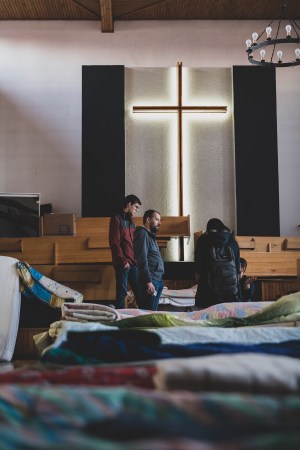
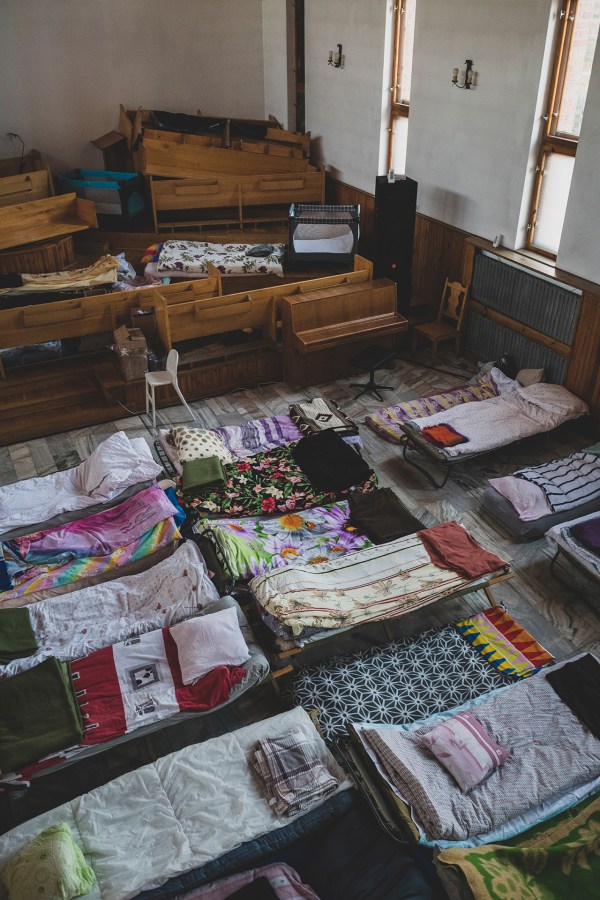
Pews stacked on the sanctuary stage at Chełm Baptist Church.Photo by Joel Carillet for Christianity Today
Pews stacked on the sanctuary stage at Chełm Baptist Church.

“God completely changed us,” said Jonasz’s father and the church’s pastor, Henryk. “We woke up from our comfortable life. Now we truly understand what it means to be the body of Christ.”

The day I met Jonasz, he looked exhausted. He sank onto the steps in front of the pulpit, groaning. It had been a while since he’d sat down. But he also looked hopeful. “We pray God will use the people in Ukraine,” he said, “just like God used the Jewish diaspora from Jerusalem to spread the gospel to us.”

Ukrainians told me they are overwhelmed and encouraged by the outpouring of support and compassion from other countries. When Ruslan and Maksym Maliuta traveled to Poland to introduce me to churches and ministries helping Ukrainians, they gazed around in amazement. Wherever they turned at the Warsaw Chopin Airport, they saw people cheering for Ukraine, the yellow-and-blue Ukrainian national flag, signs and posters offering aid to Ukrainians, and social workers in bright vests speaking in Ukrainian. Even the flight attendants of their Polish plane had pinned the Ukrainian flag to their breast. “It felt a bit like home,” Ruslan mused.

Besides his day job working with a global children and youth ministry called OneHope, Ruslan leads a special task force on Ukraine for the World Evangelical Alliance (WEA). So far, WEA is financially supporting about 20 evangelical denominations and church networks in Ukraine, Poland, Slovakia, Moldova, Romania, and Hungary based on Ruslan’s connections. That work, Ruslan knows, would have been far more difficult or even impossible if he were still in Ukraine, preoccupied with his own family’s survival under siege.

When he met me in Poland in March, he was officially there for the WEA. But he and Maksym also had personal goals: They yearned for some relief from their sense of helplessness and distance. “Everyone—all Ukrainians who are not in Ukraine—have survivor’s guilt,” Maksym told me. “You feel like your whole nation suffers, and you’re not there.”

Throughout the trip, I watched him scroll constantly through channels on the messaging app Telegram, silently reading about a hospital and school in Mariupol that were bombed, about the 96-year-old Holocaust survivor killed in Kharkiv. He absorbed the information with numbness. Logically, he understood the calamities of war—but the reality didn’t quite hit him until he stood at a warehouse of emergency supplies bound for hot zones in Ukraine.

There, volunteers wearing yellow “Pray for Ukraine’’ vests were packing medical supplies and first aid kits that would go to Ukrainian soldiers on the front lines. They forklifted pallets of canned beef, cooking oil, buckwheat, flour, sugar, and diapers into 10-foot trucks. Almost all these volunteers were Ukrainians, many refugees. That was when Maksym grasped the magnitude of the war: all this food, going to real people. To his people.

When war broke out, the Pentecostal Church for Ukraine in Warsaw, a Ukrainian immigrant church, received so many donations from locals and other churches in Europe that boxes and crates spilled out of their rented church space. Before he had shipped a single truckload to Ukraine, lead pastor Oleksandr Demianenko knew he’d need to rent an actual warehouse.

That warehouse is now a bustling hub for Ukrainians from all over the world. Refugees, missionaries, ministry leaders, and volunteers from Ukraine, North America, Estonia, the Netherlands, Spain—a once-scattered diaspora congregates in this Warsaw building through a common identity, faith, and mission.

The first several days after the war started, Demianenko’s prayers were mostly tears. He cried for three days under the weight of death, suffering, and hopelessness. He canceled regular church services and called his congregation to pray. It was time to get ready for action.

Since February 24, the cellphones of church members have been blowing up with calls and messages from churches in Ukraine requesting help. “I couldn’t even use the toilet,” one deacon told me. He estimated he had received more than 5,000 messages in one month.

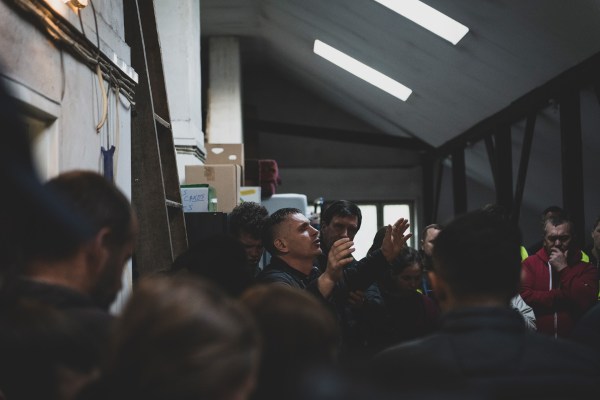
Oleksandr Demianenko prays before a meal at his warehouse in Warsaw.Photo by Joel Carillet for Christianity Today
Oleksandr Demianenko prays before a meal at his warehouse in Warsaw.

The church quickly developed a streamlined system for their warehouse. They built a coordination team. They kept a fast-moving waitlist of requests from church leaders for supplies and evacuation. They calculated the cost of each truckful of supplies and slashed costs by ordering products directly from factories. They also mobilized a network of churches from Europe to North America to send donations and supplies to the warehouse, provide transportation for evacuation, or offer shelters for refugees. Most days, Demianenko marches about the warehouse from morning till midnight, meeting with church leaders and coordinating each day’s route for the delivery trucks.

“I’ve never seen anything like this before,” he said. “Before, everyone was fighting for bread for himself. Now, everyone is fighting to give bread.” This, he declared, is “extraordinary and supernatural. This is God.” He grinned wide. “And it’s only the beginning. We will be different after this. We will change”—he tapped his heart—“here.”

Demianenko said he believes God called him to Poland in preparation for this crisis. “I didn’t want to move to Poland,” he recalled. He was comfortable in Ukraine. He owned a house, had a good ministry, and has three young kids and a wife who also didn’t want to move to Poland. “But God told me, ‘You won’t understand now, but in time, you will.’ All I knew was we had to prepare for something.”

That was about five years ago. Demianenko planted a church in Warsaw, then planted 17 more throughout Poland. The moment war began, this entire network of churches “turned on right away,” Demianenko said. “We were ready because we were already so well connected.”

But he was clear that his church’s original mission has not changed: “We will follow Jesus Christ. We will spread the gospel until Christ comes back. We will fulfill God’s will. We will love our enemies—even the Russians.”

Daily reminders of war puncture the buoyant energy at the warehouse. The day I met Demianenko, he had just gotten word that Russian forces allegedly fired at vans from his warehouse near Borodyanka, northwest of Kyiv. One driver was killed, another was wounded and died later in the hospital, he told me. A refugee volunteer at the warehouse recently received news from relatives in Mariupol: His nephew had gone out to collect baby food and apparently walked into Russian artillery. His family collected his body parts and buried him in their yard.

These stories and the relentless headlines struck close to home for the Maliutas when they received a call from a relative in late April: A cousin of Ruslan’s wife, Anya, had died in Mariupol, perhaps in a building collapse. So had two of her children, reportedly shot by Russian soldiers.

When people argued about the pros and cons of enforcing a no-fly zone or sanctions from the West, Ruslan would shake his head: “I’m so past theoretical discussions.”

When he moved among the sophisticated skyscrapers and giant, westernized malls of Warsaw, Ruslan remembered what his country has lost: “This could have been Ukraine in a few years.”

At the Warsaw Central railway station, Ruslan stood for a long time on the second-floor balcony, looking down at masses of weary refugees. The train station used to evoke anticipation of adventure and vacation. “But there, you could sense the apprehension,” Ruslan said. “None of them are there by choice.”

Their needs are critical and long-term, causing some to worry about the societal backlash as Poland groans under the weight of almost three million refugees streaming in.

“I’m not too optimistic,” said Bishop Marek Kaminski, who heads the Pentecostal Church of Poland, a denomination of 275 churches.

Kaminski had been vocal about supporting refugees back in 2015 during the migration crisis, when Poland, along with Hungary, closed its doors to refugees from Africa and the Middle East. Opinion polls then showed that about three-quarters of Polish people disapproved of accepting refugees. Today they’re responding very differently with the Ukrainians, who share a similar culture, language, and background. Currently, many Polish people and leaders are “moved by emotions,” Kaminski pointed out, but what happens when those feel-good emotions dry out?

“On a personal level and as a society, we want to love our guests, but our lives have changed to a degree that we don’t want it to.” Yet the gospel calls Christians to a different kind of life, he said.

In January, Kaminski had preached a sermon calling his church to become an “apostolic church.” He urged churches in Poland to pray globally: “It’s time for us to stop being concerned only with ourselves. It’s time for us to look at other people.” He didn’t realize then that he was being prophetic. He added, “Now, two months later, everyone is praying for Ukraine. Two months later, millions of relationships are being formed across nations. … We became an apostolic church. This is our apostolic mission.”

In Warsaw, Julia Sach-enko is also busy with a mission—and her life has changed to something she never wanted. She’s functionally a single mother, a refugee who’s leading international anti–human trafficking awareness and prevention campaigns for Ukrainian refugees. Sometimes, in the middle of the day, Sachenko startles to a jolt of surrealism: Is this a dream? Am I really in Warsaw because my country is at war, separated from my husband while people are dying and trafficked?

At times, Sachenko just wants a long, long nap. “But we realize we cannot rest right now. It’s not our time to rest.” She believes her team has the specific skills, expertise, and experience Europe needs right now. If the A21 team took a break, relief and deliverance would surely come from other places, “but what will happen with us?” she said, referencing Esther 4:14. “God has prepared us for such a time as this, and if we didn’t do anything? I don’t ever want to be in that position.”

One night, after reading reports of indiscriminate violence in the regions around Kyiv, Sachenko told her husband how overwhelmed she felt. Her husband reminded her of Matthew 24 when Jesus told his disciples not to be alarmed by wars and rumors of wars. “We’ve gotten too used to a comfortable Christianity,” he told her. What’s happening is terrible, but it makes him even more determined to serve and love those who are still alive.

“And I thought, He’s right. He is so right,” Sachenko said.

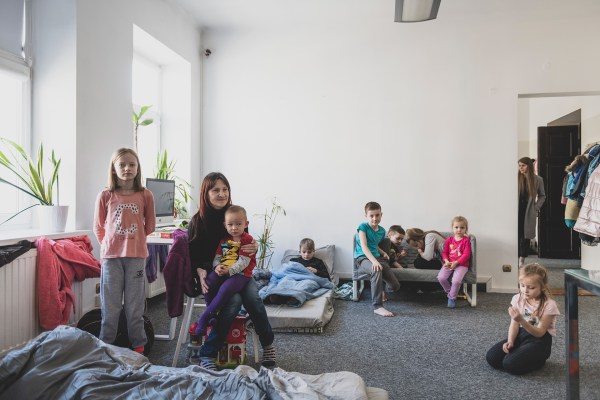
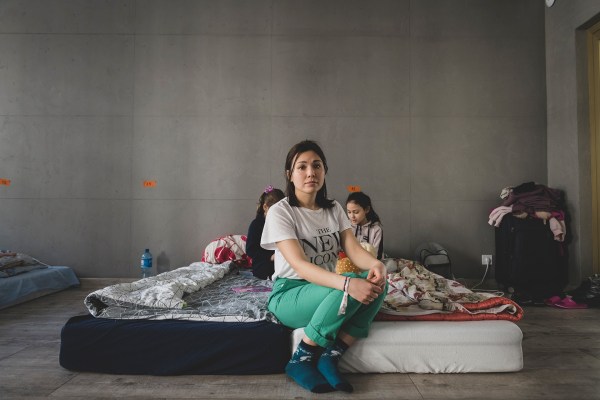
A Ukrainian mother and her children in  a shelter at a Pentecostal church in Warsaw.Photo by Joel Carillet for Christianity Today
A Ukrainian mother and her children in a shelter at a Pentecostal church in Warsaw.

As for Ruslan and Maksym, life in the era after February 24 has also changed. Maksym has stopped obsessively checking the news. He’s trying to find a new normal: taking daily walks, meeting deadlines for school. He’s engaging with friends in Ukraine—not just exchanging facts and news, as he realized he had been doing, but really listening to what’s going on in their lives.

On their last day in Poland, the Maliutas picked up Maksym’s cousin, who had just crossed the border that day. Ruslan had been trying to help his brother’s family get out of Ukraine, but his nephew, who would turn 18 in two weeks, could not wait much longer before he would be barred from leaving. He now shares a room with Maksym in Switzerland.

During dinner, as Maksym and his cousin chatted excitedly, giggling and joking, I was reminded that Maksym is still an 18-year-old college kid. It’s easy to forget how young he really is, how much the war has robbed him of that world-is-your-oyster optimism of youth. Before February 24, his life had stability. He had his family and home, a routine of classes and work, friends and summer plans, career dreams. “But now, I don’t know what will happen tomorrow,” he said. In August, his family will have to leave the Swiss chalet. But to go where?

Even as they struggle with survivor’s guilt, grief, and fear, both Maksym and Ruslan believe they’re there for a reason. Ruslan says he’s encouraged to see Christians in Ukraine doing what a church in a country at war should do. He’s encouraged to see Christians in Europe doing what the church should do for sojourners, foreigners, widows, and orphans. And he’s encouraged that he, too, has a role to play: “We’re where God wants us to be. It’s a reminder that he’s in charge. … He decides where each of us needs to be stationed, and our best response is ‘yes.’ It’s a small part of what God is doing through the church, but I feel blessed that Maksym and I are able to come alongside others.”

Perhaps that’s why, at the warehouse in Warsaw, despite the heavy presence of war, another presence is also tangible, one of hope and anticipation—and even joy. My last night there, during a dinner of Domino’s pizza and Neapolitan ice cream, Demianenko encouraged his group of volunteers to press on in faith: “The Holy Spirit is making us look more like Jesus Christ. When we look like Jesus, we are showing others the way to Jesus. We don’t understand everything, but we continue to trust in Jesus.”

One volunteer called out, “God is good!”

The group chorused back, “All the time!”

“God is good!”

“All the time!”

Sophia Lee is global staff writer at CT.

Church Life

Who Will Pay Africa’s Medical Bills?

Locals are increasingly running African mission hospitals. The next challenge: keeping foreign donors.

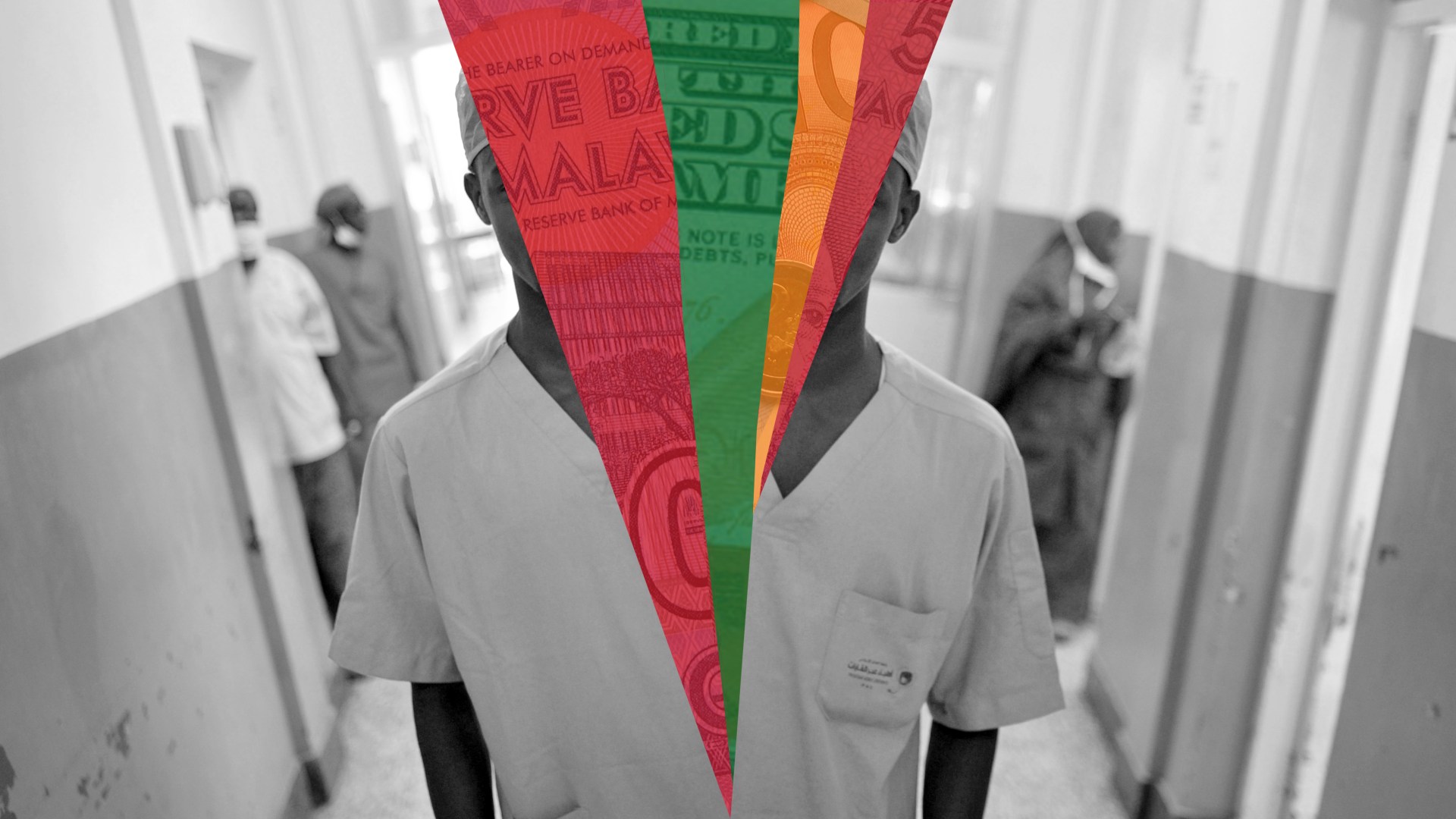
Illustration by Sarah Gordon / Source Images: Wikimedia Commons

One day in March, Yowati Nthenga, the head of accounting at Nkhoma Mission Hospital, was sitting at his desk wondering where he would get the money to pay the hospital’s roughly 400 employees the overtime and bonus pay they were owed. He had paid salaries, fortunately, but staff counted on that additional “allowance,” and it should have gone out already.

Nthenga’s office is near the gate of the rural, 250-bed hospital, which serves a region of about 460,000 people in central Malawi. On that day, patients arrived on motorbike, on foot, and in minibuses: women in labor, older men with hypertension, a boy with kidney damage. The hospital took care of them, and then Nthenga and the other administrators had to figure out how to pay for it. If patients can’t afford the hospital’s subsidized fees—a consultation costs about 90 cents—Nkhoma’s staff work out a doable amount or find some charitable program to cover the cost. Their policy is to not refuse anyone treatment. But eventually, the care must be paid for somehow.

The hospital is run by the Church of Central Africa Presbyterian, a Malawian denomination. Since it is the only hospital serving Nkhoma’s rural district, the Malawian government helps fund staff salaries. But the county’s health care system relies heavily on foreign funding, as does the mission hospital. And Nthenga has been watching those foreign donations trend downward.

This is happening in mission hospitals across Africa serving rural, poor populations. Giving from Western churches and organizations has declined, while the need for medical care is increasing with population growth. The pandemic worsened that trend, administrators at mission hospitals say, when churches in the United States turned inward to their own needs and the needs of their immediate communities.

As the medical missions world celebrates that mission hospitals are increasingly run by African churches, African doctors, and African administrators, many of those hospitals face a paradox: Weaning them off foreign physicians has long been the dream, but achieving that dream sometimes means losing foreign money.

Nthenga is accustomed to the money stress now: The hospital must find about $40,000 every month from somewhere to cover operating expenses. The staff have a meeting about the books every two weeks to decide which payments are priorities.

Nthenga has been working at Nkhoma for 12 years, and somehow the monthly deficits always work out. Church hospitals historically drew funding from US denominations but now regularly seek help from international organizations like Samaritan’s Purse and, in Nkhoma’s case, African Mission Healthcare.

Still, the pandemic was the toughest two years he and other administrators at Nkhoma Hospital remember. Suppliers started asking for cash up front because the hospital was getting behind in its payments. The hospital has been working on income-generating ideas, but so far it is operating in a deficit.

“The fact is we cannot manage without donors,” Nthenga said.

Frank Dimmock has worked with Nkhoma and in Malawi for years and serves as a liaison between the historically Presbyterian hospital and the Presbyterian Church (USA). He said PCUSA giving to operational expenses at the hospital stagnated during the pandemic, although a few presbyteries gave significantly to the hospital’s COVID-19 response.

Mission hospitals “are all struggling, unless their overseas partner churches are still underwriting them,” Dimmock said. But the number of overseas partners is shrinking. Back in 2011, he surveyed Christian health associations across Africa. Groups from Togo to Malawi reported that foreign giving was down. An association in Chad told Dimmock that Europeans “ask us to focus on the local opportunities of fundraising.”

Since then, Dimmock said, foreign churches aren’t sending as many missionaries—expats who often bring with them visitors and money—as they used to.

Mission hospitals are critical to health care in sub-Saharan Africa, where the majority of the population is rural but health infrastructure is often concentrated in capital cities. Faith-based hospitals like Nkhoma tend to operate in more remote areas. In Malawi, 70 percent of rural health care comes from church clinics and hospitals. Nkhoma is also a teaching hospital, training Malawian nurses, medical students, family medicine doctors, and surgeons.

But providing highly trained staff and hospital infrastructure in remote places is expensive, and the populations mission hospitals are serving don’t have the money to support it. A compilation of household surveys from 14 African nations published in the medical journal The Lancet in 2015 showed that faith-based health facilities had the highest percentage of patients from the lowest economic quintile.

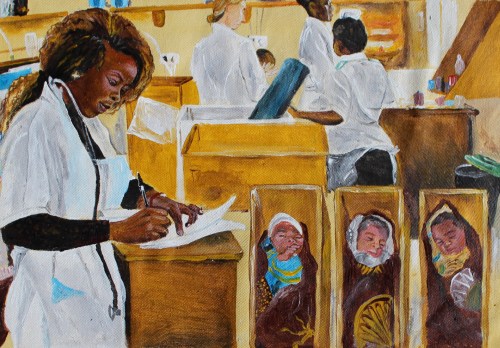
A painting of the Nkhoma Hospital by local artistPainting by Eddie Amtonyo
A painting of the Nkhoma Hospital by local artist

At Nkhoma, the economics of the population the staff served was evident: Some patients came barefoot, and one mother brought in her frail three-month-old baby boy with the copper hair and skin lesions characteristic of malnutrition, as well as her three-year-old who weighed less than a typical one-year-old. The hospital rehabbed the children for 11 days and then discharged them. At a checkup three weeks later, the baby boy whose bones had been showing had gained two pounds and was plump and healthy.

In recent years, financial challenges have compounded to test Nkhoma’s mettle.

During the pandemic, inpatient admissions plummeted 80 percent. According to hospital staff, patients were afraid of getting the coronavirus at the hospital, and because of lockdowns they also didn’t have money for services.

The Malawian kwacha also devalued during the pandemic, making supplies more expensive. Hospital staff were expecting the war in Ukraine to affect their bottom line too, making commodities more difficult to obtain.

The price of drugs, the most expensive line item after salaries, has gone up. There were shortages of magnesium sulfate, which the hospital uses to treat preeclampsia, and diazepam, used to treat seizures. Deciding what drugs to keep on hand is difficult. Some are too expensive to stock for uncommon conditions, and some expire too quickly for a rural hospital on a budget.

“Each time we would go to get quotations for the month or two months, we always get new prices. The prices are not just adding 10 or 20 [percent], but 40, 50 percent,” said Agness Nyanda, the hospital’s administrator. But the patient fees remained the same.

To cut costs, the hospital began limiting the use of its vehicles, which included sometimes canceling non-emergency visits to patients in villages. It tried to reuse protective gowns by dipping them in bleach, but that didn’t work, so it switched to washable fabrics.

In January and February, cyclones added to the hospital’s problems. They disabled one of the four hydroelectric plants that provide the nation’s power, triggering rolling blackouts that have lasted hours a day and continued for months. Heavy rainfall damaged underground cables connected to one of the hospital’s generators, forcing the hospital to rely for several days on an undersized backup generator.

On its ninth day of running, the backup generator quit. The hospital rushed in oxygen cylinders for COVID-19 patients and portable generators to support preemie babies in the neonatal ward. It evacuated an emergency surgery case to another hospital. Women were giving birth under phone flashlights.

Fortunately, no patients died. But Nyanda said repairing the underground cables cost the hospital about $6,000. When the next such emergency comes up, the hospital may have to delay other payments, like staff allowances. While staff generally know they are making sacrifices to work at a rural hospital, where their families might not have as many job or education opportunities, delays on payments add to already-depleted morale.

But then, something new—something encouraging—did happen during the pandemic, in early 2021.

The hospital put out an emergency appeal to local churches, saying that it was in trouble and needed help. The churches responded with the largest amount they had ever given: $13,000. That was meaningful, even if it covered only a small part of the hospital’s monthly costs.

“God has seen us through,” Nyanda said.

On the day Nthenga, the accountant, was trying to figure out what to do about the staff allowances, the hospital got two undesignated donations wired from the United States. One was for $12,000 from a Presbyterian church in Seattle. His problem was solved. If the funds had been designated, he couldn’t have paid the salaries. He ordered a transfer of the donations directly to the hospital’s bank account, which added up to enough money for the staff allowances to go out.

“So the question is, what will happen next month!” Nthenga said with a hearty laugh. “By God’s grace we are moving, and the years are going by. I get amused and amazed sometimes; what has made us go past 2019? What has made us go past 2020? 2021, 2022? God’s grace is upon us, but we are also doing our part.”

Emily Belz is news reporter at Christianity Today. She is based in New York.

News

Counting the Cost of Paying Ransoms for Missionaries

A Haiti kidnapping raises questions about no-payment practices.

Illustration by Joe Anderson

International Christian organizations and missions experts agree it’s not best practice to pay kidnapping ransoms.

But ransoms do get paid. And the impacts are hard to quantify. The cost is a burden borne by local churches, fellow missionaries, ministers, aid workers, and the many people they hope to serve.

A thousand dollars or a hundred thousand might tip the scales for kidnappers in the future, as they weigh whether to abduct more people. But one payment—or two, or three—might not tip the scales at all.

Three members of a group of captive Christian Aid Ministries workers were released last December by a Haitian gang known as the 400 Mawozo, after someone outside the Anabaptist organization paid the kidnappers. It’s unknown how much money the gang received, though the final amount was likely only a fraction of the original $1 million per person they demanded.

The remaining missionaries escaped. But money did exchange hands for three of them. As experts have assessed its impact over the past year, they haven’t reached a consensus on what it means for the future of missions in Haiti.

For some, it seems that the security situation in Haiti has deteriorated so significantly that paying one gang to release three missionaries had no effect at all.

“How can you raise the threat of kidnapping any higher? It’s already off the charts,” said Scott Brawner, president of Concilium, an organization that helps international Christian ministries assess risk. “Whether a ransom has been paid or not has not raised the threat of kidnapping. There are multiple kidnappings of Haitian nationals on a daily basis.”

More than 100 people in Haiti were kidnapped the same month as the Christian Aid missionaries, the Center for Analysis and Research in Human Rights reported. The total victims for 2021 came to around 800—a rapidly increasing number in the past few years.

Some believe that not paying ransoms in the highest-profile case of the year, however, could have helped curb the rise in kidnapping. Dieumème Noelliste, a Haitian-born evangelical who now teaches theological ethics at Denver Seminary, sees a missed opportunity.

“I was holding on to hope that the kidnapping of the American missionaries would provide an opportunity to break the back of the gang violence that has swept the country,” he said.

The 400 Mawozo was clearly not as successful as members might have hoped. One leader was extradited to the US on unrelated gun charges. But for the gang, the kidnapping didn’t end in complete disaster. They might consider it a moderate success, worth trying again.

“This means that foreign missionaries are now fair game,” Noelliste said. “[And] if the criminal elements have no compunction attacking American citizens who have the protection of the United States, what restraint would they show for a Haitian congregation? … The Haitian church therefore has nowhere to turn, and the gangsters know it.”

But even if missionaries and aid organizations all agree on the folly of paying ransoms, they’re not the only ones making decisions. In high-profile kidnappings, organizations face pressure from donors with their own opinions about the right response.

The family members of kidnapped missionaries often also get involved. Brawner advises missions organizations to include families in their crisis planning.

“Organizations have to do a good job not only communicating with but ministering to family members in the midst of this crisis,” he said. “Not every family member may share the calling to that risk. Now you’re dealing with family members who are angry with the organization for sending their children down there. There has to be a member-care piece that helps to minister to the family in the midst of this crisis.”

When the US government sends negotiators, they almost always work with the family, not the employer, putting key decisions in the hands of husbands, wives, and parents. When ransoms are paid, it’s often family members who put up the money, disregarding best practices.

The money may save a loved one’s life. But sometimes it doesn’t.

“Kidnappers can be very vicious and actually carry out what they say they will do, which is kill the victims,” said David Shedd, a former CIA agent and executive adviser of VDI, a security consulting firm relied on by American missionaries. “One is always wishful and hopeful that it would never happen to you, but when it does, all of a sudden it’s very real.”

Hostage negotiation is a complicated process and frequently goes wrong. In 2002, family members of Martin and Gracia Burnham arranged for a philanthropist to pay more than $300,000 to extremist Muslims who had kidnapped the American missionaries in the Philippines. Local police delivered the money, but then the group demanded $200,000 more.

When the Filipino military attempted to rescue the New Tribes missionaries, Martin Burnham was killed and the kidnappers escaped. Gracia Burnham, back in the US, argued that her husband would have lived if the full ransom had been paid.

Even when ransoms aren’t paid, money may still be exchanged. The reality of behind-the-scenes negotiations with kidnappers is often more complicated than statements of best practices make it appear.

John Berger, vice president for global operations and strategy at Crossworld, a cross-cultural disciple-making ministry, learned about this in crisis training.

“A no-ransom policy does not require a no-negotiation policy, and negotiation may lead to some kind of financial transaction,” Berger said. “It’s not giving into a ransom demand per se. It’s negotiating in a way that acknowledges that the hostage-takers and negotiators will be seeking some resolution to the situation beyond simply releasing the hostages and getting nothing back in return.”

Experienced negotiators may ask kidnappers about their expenses, such as housing and feeding captives and hiring a crew of armed guards, said Berger, who lived in Haiti for several years. They may try to figure out how to allow the kidnappers to save face.

“Negotiating with the hostage takers is kind of like a plea deal in a court case,” he said. “You agree to a lesser charge, so to speak, in an effort to resolve the situation.”

That lines up with what Megan Schreiber, the US director of Haitian Christian Outreach, has observed. While the ransom kidnappers demand isn’t normally paid in full, they often do get paid some money.

Has Schreiber ever seen hostages released without some kind of payment?

“No.”

Right now, kidnappings are only a piece of the larger security picture. Haitians are also dealing with the fallout from the assassination of President Jovenel Moïse and a gang-related oil crisis, in addition to long-term issues with the recovery from a 2020 hurricane and a 2021 earthquake. Local churches may not have food or fuel to spare, even if they want to welcome missionaries or aid workers.

“With the deterioration of the country and lack of resources, we don’t want to take away from resources that our family and communities need,” Schreiber said.

This scarcity may cause Christian expats in Haiti to consider leaving for a time, Berger said, or consider increasing their security. Missionaries and their organizations may also need to reevaluate their kidnapping contingency plans.

Whatever they decide, they will still have to pray about it, explain it to families, and put their trust in God. The missionary calling isn’t taken lightly.

“It’s always an emotional struggle for people on the ground,” Berger said. But, “I know very few long-term missionaries who bail out of fear.”

Morgan Lee is global media manager for Christianity Today.

News

Preach the Gospel Everywhere. When Necessary, Use Laundromats.

A different kind of “third place” ministry creates community and connections with washers and dryers.

Flynn Larsen / Getty

Some come with track marks from years of drug abuse. Others come with children in tow. Some are struggling through a bad week. Others, a bad decade. All bring their dirty laundry.

They wash it and dry it for free at church-run laundry services throughout the United States.

“Christ said we should feed the hungry and clothe the naked, and I think those clothes should be clean,” said Catherine Ambos, a volunteer at one such ministry in New Brunswick, New Jersey.

Of course, it’s not really about hygiene, but dignity.

“If someone is dirty, unkempt, you tend not to look at them. You don’t want to meet their eye,” Ambos said. “If you can’t afford to wash your clothes and you’re a budding teenager, it’s an embarrassment.”

Churches have been washing clothes across the US since at least 1997, when a minister at First United Methodist Church of Arlington, Texas, started doing a circuit around the city’s coin-operated laundries, passing out change. There may well have been others before this. Today, these ministries exist across the country, run by churches of all traditions and sizes.

They’re not as common or as well known as church-run coffee shops, which have been promoted as “third places,” locations separate from work and home where people create community. But a growing number of churches see laundry ministries as a better way to connect with their neighbors and witness to the gospel.

Some churches buy their own washers and dryers, renovate a space so it has enough electrical outlets, and open a church-run laundry. Others, like Christ Episcopal Church in New Brunswick, send out volunteers with quarters. Ambos started doing that four years ago.

They budgeted $200. They quickly realized it wasn’t enough. “We were three-quarters of the way through the session when it became apparent that we were going to go over,” Ambos said.

Christ Episcopal’s pastor agreed to cover whatever they spent, and they handed out $267 in coins. The ministry hasn’t stopped since.

Belmont Baptist Church in Charlottesville, Virginia, has one of the older laundromat ministries still running. The church started helping people clean their clothes in 2010, when pastor Greg Anderson heard through another ministry that poor people in homeless shelters and long-term-stay motels would regularly throw away their clothes.

“It was just easier to go and get new clothes at a clothing-center type of ministry as opposed to being able to launder them,” Anderson said.

The church decided to install five washers and dryers in a building on its property and open a laundromat. Today, volunteers estimate that they save people upwards of $25,000 per year—money they didn’t have, or if they did, they could now spend on food, gas, or medicine.

“This works along with the adage, ‘People don’t care what you know until they know that you care,’” Anderson said. “We let them know we care and God cares, and we share Christ through that and directly with our words when that opportunity arises. To do so in the spirit of Christ is an incarnational thing. … The spiritual needs that so often receive all the attention cannot be separated from the physical needs of the people who might benefit from a place to wash their clothes.”

While people are doing their laundry, they talk to each other and the church volunteers, and relationships form. The church has been able to help more people through those connections.

Church members have helped families with car trouble and others who needed clothes. Once, they helped someone cover funeral costs. Another time, a single dad got help with child care.

The church sees it as evangelistic because they’re sharing God’s love with people. But the laundromat hasn’t contributed to church growth.

“None of these people became members of our church,” said Barbara Lowery, who has volunteered at Belmont Baptist’s laundry for 12 years. “That wasn’t what it was about. It was about helping people in need.”

Margaret Brown says volunteering at the Belmont laundromat for the past 12 years has opened her eyes to the needs in her community. The people who show up at the church with their dirty clothes have a lot going on in their lives. They’re not lazy and they’re not pretending to need help.

“These are people who really need it,” she said. But at the same time, “they don’t expect something to be handed to them.”

Brown has formed relationships with many of the people she sees week after week. One woman found out how much Brown loves coffee and during her laundry time made a point of bringing Brown something—a fresh cup, or sometimes coffee cake or coffee candy.

“I would say 95 percent of them are so appreciative that it breaks your heart,” Brown said.

Susan Thomas, who runs an Episcopal ministry paying for laundry in Blaine, Washington, said this is what has surprised her most: how much a load of laundry can mean to someone.

“We started it because we were looking for something to help the community that no one else was doing,” she said. “I can’t tell you how many people have come up to us with tears in their eyes thanking us for having this program. They have to decide whether to put gas in their car or put food on the table or have laundry.”

Blaine has a little more than 5,000 residents, but last year, Thomas said, the church paid for 1,600 loads of laundry, at about $7.25 per load.

Santa Maria, California, with a population exceeding 100,000 people, looks very different from Blaine, but the needs are similar. Frank Hall, a member of Crestwood Christian Fellowship, has run Morning Star Laundry for the past 10 years. Before COVID-19, they were helping around 50 people a week.

Hall has also worked with homeless ministries in the region in the past, and often he saw there was a place people could get a shower, but then they’d have to put their dirty clothes back on.

“Nine times out of 10 they’re walking around in dirty clothes, which isn’t going to help their health,” he said.

The nondenominational church gives $200 per week to Morning Star, and Hall collects recycling from church members to subsidize the ministry. He knew some local businesses could become critical of the church-run laundry because they didn’t want homeless people in the area and might worry about losing business.

To mitigate that, he’s developed relationships with them. He buys what he needs for the laundry from local stores and sets clear rules at the ministry about drug use, intoxication, and any antisocial behavior.

“We want to support the other businesses and not make them feel like we’re harming them,” Hall said.

Managing everything can be a challenge. It’s probably more work than a coffee shop. But Hall thinks it’s worth it.

“It allows us to help people, care for them, and help people to have some dignity,” Hall said. “When you’re doing it, you are caring for people that God loves.”

Adam MacInnis is a reporter in Canada.

News

Long Sermons Seem Longer in the Pews, Study Finds

But it’s not a new problem. Just ask Martin Luther.

Edits by Christianity Today. Source: Sean824 / Karl Fletcher / Getty

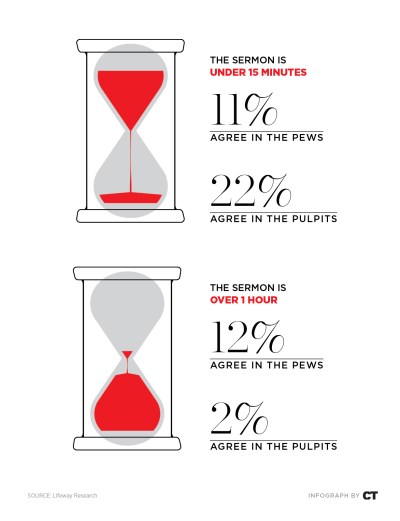
Churchgoers are six times more likely than preachers to say that their church’s typical sermon goes over an hour. Preachers, on the other hand, are twice as likely to say their sermons last less than 15 minutes.

Time, it seems, moves differently in pulpit and pew.

Modern preachers may decry the shortened attention spans of contemporary congregants, but conflict over sermon length isn’t new. It was a frequent point of contention during the Reformation, as preachers discovered the great depths of the Word—and went on and on about it.

Some sermons clocked in at three hours. Even the leading Reformers soon suggested restraints. Thomas Cranmer thought an hour and a half really ought to be plenty of time. John Calvin said a preacher needed to stop when he got tedious. Martin Luther offered young ministers this indelible advice: When people say, “He was prattling on and could no longer stop,” that’s a bad sign.

British churches eventually started installing hourglasses by the pulpits, according to church historian Owen Chadwick. The craftsmen who made them were more sympathetic to the experience in the pews than in the pulpits, though, and more than a few of the timepieces did not keep an honest hour. One surviving hourglass reliably runs out of sand at 48 minutes.

Though the preacher probably said it was half an hour.

Source: Lifeway ResearchInfograph by Christianity Today
Source: Lifeway Research

For more on sermon length and the perception of sermon length, visit: Lifeway Research.

Ideas

How to Greet the End of ‘Roe’

President & CEO

Faithful responses to the Supreme Court decision should involve new care practices.

Illustration by Joe Anderson

One of the best parts of attending Perimeter Church in north Atlanta was seeing the parking lot for young families. Industrial-sized vans pulled in each Sunday and poured forth children. These were not shuttles that gathered youngsters from local neighborhoods but single-family vans filled with children who had been adopted domestically and internationally, many with special needs.

Perimeter families have adopted over 100 children in the past 13 years, due in large measure to a ministry incubated in the church. Named for the declaration in Psalm 68:6 that God “sets the lonely in families,” Promise686 has supported nearly 500 adoptions through grants and other assistance. The ministry supported the adoption of my daughter, whose congenital heart defect probably would have been fatal if she had been left in China’s state orphanage system.

Ministries such as Promise686 will be critical now that the US Supreme Court has overturned Roe v. Wade. We celebrate the ruling in Dobbs v. Jackson. The sanctity and dignity of all human life remains the preeminent moral issue of our time, and five decades of calling evil good has distorted the moral vision of our culture. Overturning Roe is a testament to a long faithfulness, passed down from parents to children to grandchildren, to fight for the lives and dignity of people in all stages of development. It could be the most significant moral achievement of a generation.

But what will a faithful response to success look like? Overturning Roe sends abortion policy decisions back to the states, and many will prohibit or have prohibited abortion. In the words of Jedd Medefind, president of the Christian Alliance for Orphans, “Many children will be born that would have been previously aborted,” and many to parents “that are strained and struggling.”

Is adoption the answer? Probably not. It is, at best, only part of the answer.

The Christian adoption movement in America was driven by the biblical command and the compassionate desire to care for the orphan and the widow. Countless families have made beautiful sacrifices—and experienced blessing—by opening their homes to children in desperate need.

But then came more moral complexity. Many adopted children, sundered from their original communities and cultures, grew up, learned their stories, and experienced a profound sense of loss and disconnection. In some cases, adoption was right and necessary; but in others, it was unclear whether adoption had served either the “orphan” or the “widow” (the birth mother) well.

The ready availability of American families willing to spend tens of thousands of dollars to adopt also led, in some countries, to traffickers supplying children whose birth families wished to keep them.

The adoption movement evolved. In part, this was driven by adoptive mothers who felt an ambiguous grief in which they loved and celebrated their adopted children but lamented the trauma of separation the children and birth mothers endured. It was also driven by a deepening engagement with the American foster care system. On the one hand were children who suffered abuse or severe neglect and clearly required foster care or adoption; on the other were mothers and children who might have flourished together if they had received loving care.

Promise686 still serves adoptions but has now also supported 6,550 foster placements, wrapping “care communities” around foster families to encourage them and improve their outcomes.

It has also worked to prevent children from falling into the foster system in the first place by supporting families in crisis and keeping children with their mothers whenever safely possible. In the words of president Andy Cook, “Churches are needed at every point on the continuum from prevention to intervention through foster care to permanency.”

Or consider Every Mother’s Advocate (EMA) in Florida. After three years of fostering and an adoption, the founder, Charlee Tchividjian, had seen enough of “the systemic challenges and brokenness mothers face once their families become entangled in the child welfare system.” The majority of child removals, she says, are simply due to an inability to meet the child’s fundamental needs. “For a mother in crisis,” says Tchividjian, “advocacy can change everything.” Of the families EMA engages on the verge of child removal, 88 percent move from crisis to stability.

How, then, should pro-life Christians celebrate the end of Roe? Perhaps by partnering with ministries such as these. “When a mom is advocated for,” says Tchividjian, “families are preserved; fostercare statistics plummet; and the foster care system’s pipelines to poverty, prison, addiction, and homelessness begin to slowly fade.”

The end of Roe will honor the sanctity of human life and deliver children safely into the world. It will also bring real hardships for many mothers. The best way we can celebrate the children who will be born of Roe’s demise is to love the mothers who raise them.

Timothy Dalrymple is president, CEO, and editor in chief of Christianity Today.

News

Anglicans Lose 14 Properties in South Carolina Court Battle

And other brief news from Christians around the world.

St Michaels Church in Charleston, SC

St Michaels Church in Charleston, SC

Kirkikis / Getty

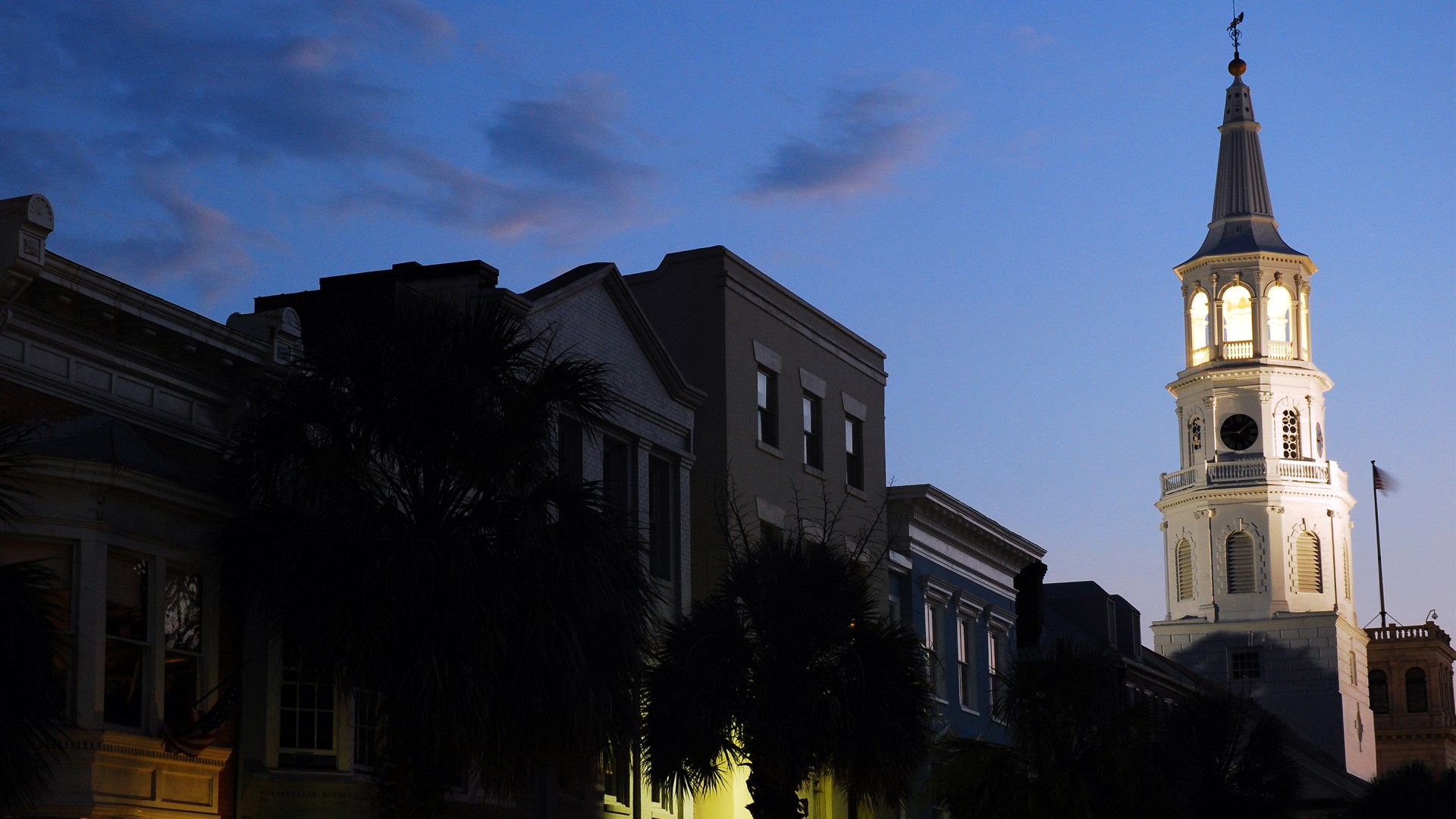
The South Carolina supreme court ruled that the Anglican Church in North America must return 14 of 29 parish properties to the Episcopal Church. The congregations split from the Episcopal Church in 2012, taking about $500 million in church properties with them, after a general convention voted to allow blessings of same-sex unions. The state court ruled in favor of the breakaway congregations in 2017, but the decision was appealed. On second look, the court decided 14 of the disaffiliated parishes had agreed to a 1979 bylaw that said they held their property in trust for the denomination.

United States: Woman claiming coerced baptism dies

The Tennessee Bureau of Investigation is looking into the death of a 42-year-old woman who was suing a sheriff’s deputy for forcing her to get baptized. Shandle Marie Riley was pulled over in a traffic stop in 2019 and told deputy Daniel Wilkey she had a marijuana cigarette with her. She claims the deputy then offered her a choice: arrest or baptism. Riley chose baptism. The religious ritual was filmed by a second deputy. Riley later sued, claiming the law enforcement officers violated her freedom of religion. A Tennessee judge ruled in April that her lawsuit could go forward. One week later, Riley was found dead. Wilkey has also been accused of strip searching people on the side of the road and faces multiple civil lawsuits and criminal charges in Chattanooga.

Infograph by CT

Dominican Republic: Evangelicals call for police reform

The Confraternity of Pastors of Evangelical Churches of Ocoa is calling for police reform in the province capital after a 32-year-old man died in police custody. Medical personnel initially said José Gregorio Custodio was killed by a police beating but later changed their assessment and said the bruises on the dead man’s body were caused by an allergic reaction. “After a citizen has been arrested, you should not mistreat him and even less kill him,” said pastor Andrés Febles.

Trinidad and Tobago: Assemblies of God school faces audit

The Tobago government is investigating the finances of an Assemblies of God high school that shut down suddenly. The Pentecostal Light and Life Foundation High School closed in April, one day after the start of the school term, with 23 of the school’s 27 teachers leaving the premises because of concerns about the condition of the building. Two other schools were similarly shut down, one Catholic and one Seventh-day Adventist, and they will also be investigated. The Assemblies school receives the equivalent of about $88,000 from the government per term, some of which is supposed to fund the maintenance of the building. The director of the school said these are ongoing issues and criticized the secretary of education for publicizing her concerns on social media.

France: Religious liberty needs to be watched ‘like milk on the fire’

French evangelicals have asked President Emmanuel Macron to prioritize religious liberty in his second term. Thierry Le Gall, a member of the National Council of Evangelical Christians in France, said, “Freedom of religious expression needs to be watched like milk on the fire” because recent laws targeting Muslims have moved the nation “from a republican pact of tolerance to a policy of surveillance of religions.” Polling shows the majority of evangelicals supported Macron over his national conservative opponent Marine Le Pen. Macron is an agnostic.

Switzerland: Christian asylum seeker wins appeal

The European Court of Human Rights has ruled Swiss authorities did not properly assess the risk facing a Salvation Army convert if he were deported back to Pakistan. They looked at the persecution of churches, but not at the risks to individual converts. European governments have struggled to develop a workable system for evaluating the legitimacy of asylum seekers’ conversions.

Nigeria: Pastors debate ‘biblical’ marriage

Nigerian actor Yul Edochie announced his marriage to a second wife, prompting a national debate about polygamy. Reno Omokri, a former aide to President Goodluck Jonathan and an independent minister, said that in Scripture many godly men are polygamous and the practice is only forbidden for bishops and elders. African acceptance of the “Western construct” of monogamy has led to social acceptance of adultery and same-sex marriage, he argued. Kingsley Okonkwo, a pastor who frequently addresses relationships, countered that while some men in the Bible had more than one wife, it is clear from Scripture that that was never God’s plan for marriage.

Israel: Slain police officer honored

Busloads of ultra-Orthodox Jews attended the funeral of an Arab Christian police officer, honoring him as a “hero of Israel.” Amir Khoury, 32, rushed to the scene of a terrorist shooting in the city of Bnei Brak, near Tel Aviv. He and his partner exchanged fire with a 27-year-old Palestinian who was reportedly angry a female relative had been attacked by settlers. The Palestinian and Khoury were both killed in the shootout. Christians in Israel have recently clashed with authorities. Some claim the government doesn’t want them in the country.

South Korea: $1M sent for Jewish immigrants to Israel

South Korean Christians donated $1 million to help Ethiopian and Ukrainian Jews immigrating to Israel. The money will go to the Jewish Agency for Israel and was organized by One New Man Family, a ministry that aims to bring Jews and Gentiles together to “celebrate the Second Coming of Christ,” according to its website. Most Korean Christians believe that the church is the new Israel, but pastor Eun Soo Seol—also known as Pastor Joshua—wants to persuade them to “see Israel as Israel in the Bible.”

News

Germany’s Nuclear Power Plants Are Closing. But Their Moral Questions Have a Long Half-Life.

What is the Christian position on radioactive accidents, technology, and replacing fossil fuels?

Sean Gallup / Getty

Emmy Janssen understands the mechanics of nuclear fission. As a physics student at Freie Universität Berlin, she says the math can be challenging, but she loves the way her studies let her wrestle with what she calls “the depth and breadth of God’s created cosmos.”

But she is not so sure, as a Christian, she understands her ethical responsibilities. She wonders about “our role as God’s children, bringing nuclear power into the world in the first place.”

Janssen is not the only one. Across the country, German evangelicals are weighing the ethics of nuclear power.

The government is set to decommission its last three nuclear reactors by the end of 2022. Shutting down Isar 2, Emsland, and Neckarwestheim 2 will complete the county’s Atomausstieg, or “nuclear power phase-out,” and conclude a generation of political debates. But the debates, like radioactive particles, have a half-life, and evangelicals in Germany are still discussing the problems of waste, the risks of catastrophic accidents, and the potential benefits of nuclear power.

Deciding on a Christian position is not as easy as turning on the lights.

“There are indifferent people. There are people who are deeply convinced nuclear energy is dirty and dangerous. There are those who see it as a possibility for protecting the planet and developing cleaner energy,” said Matthias Boehning, director of the World Evangelical Alliance’s Sustainability Center in Bonn.

Some of the differences appear to be generational. Older evangelical views have been shaped by both Cold War history, when the US and the USSR planned out nuclear attacks and counterattacks, and—of even greater concern—by the memory of nuclear accidents.

The German nuclear power program kicked off in the 1950s, producing energy for the nation as it rebuilt after World War II. The German anti-nuclear movement emerged around the same time, raising concerns about the destructive potential of atomic bombs and the incredible difficulty of handling nuclear waste.

But most supported the nuclear program, according to political historians, until 1986—when Chernobyl happened.

For Markus Baum, a 59-year-old Methodist radio commentator for ERF Medien, that accident was a crossroads. He remembers listening to reports that the reactor in what is now Ukraine had melted down and ruptured, spewing clouds of contamination into the atmosphere. There were warnings about radioactive rain. He never thought about nuclear power the same way again.

“After Chernobyl, we saw the complications, the dangers,” he said. “We decided that the nuclear path we had walked had no future.”

Concerns about nuclear power grew. The Greens started arguing for an immediate closure of the country’s reactors. “Chernobyl is everywhere,” they said. They only won a few votes, but the argument became a permanent part of German political discourse.

In 1998, a new ruling coalition of Social Democrats and Greens committed to moving Germany away from nuclear power. The phase-out started in 2002.

When Angela Merkel became chancellor in 2006, though, she said shutting down the nuclear reactors was “absurd.” The power plants were not only “technologically safe,” but didn’t emit the carbon that drives climate change. Merkel, a center-right politician, had previously earned her doctorate in quantum physics. She understood the science and believed in the safety of nuclear power.

But Merkel changed her mind in 2011. An earthquake and tsunami led to three nuclear meltdowns, three hydrogen explosions, and considerable radioactive contamination in Fukushima, Japan, dramatically demonstrating that no matter how technologically safe, nuclear power was always dangerous.

Merkel announced that all power plants would be closed by the end of December 2022.

Some younger evangelicals in the country, however, think Merkel was probably right the first time. They know the risks of nuclear power but feel they are minor compared to the ongoing damage done every day by burning fossil fuels.

Adopting what has been called an “ecomodernist” position, millennial and Gen Z creation care advocates point to increased safety protocols, advanced technologies, and the urgent need for an alternative to coal and oil.

“Nuclear is a clean energy possibility for them,” Boehning said at the World Evangelical Alliance. “They are being less ideological, more pragmatic, and present-oriented.”

Caroline Bader, cofacilitator of GreenFaith’s International Network and coordinator for its work with German faith communities, said this kind of perspective is short-sighted. Concern about climate change is not a good reason to return to nuclear power, she said.

“We demand universal access to clean and affordable energy for everyone, and nuclear energy is harmful in both regards,” she said. “It is expensive, dangerous, and not as clean as its advocates suggest.”

Even if there aren’t any accidents, Bader points out, nuclear plants produce toxic waste that must be dealt with. Germans will be dealing with that technical problem for centuries to come.

Those problems might be solved with advancing technology, but the moral problems with nuclear power will still be complicated. According to physicist Robert Kaita, an evangelical who has worked at the Princeton Plasma Physics Laboratory for 40 years, this is because “as human beings created in God’s image, we have tremendous power to create and destroy, to give life and to take it.”

Understanding creation at the atomic level isn’t enough for Christians coming to terms with the ethical questions of reactors, he said. As a scientist, he doesn’t dismiss concerns about nuclear energy. He prays for wisdom and compassion.

“Nuclear energy isn’t inherently evil,” Kaita said, “but we have to go beyond technical problems and consider the moral ramifications of what we are doing.”

Gerald Fink, a radiation shielding specialist who worked for Germany’s Technical Inspection Association, agrees. He said that as a Christian, he wants to take a “cosmological perspective.” He points back to the creation narrative in Genesis.

“Christianity is part of a very large project of restoration and completion. We are an important part of this, but it isn’t all about us,” he said.

By starting with that biblical perspective on human creativity and purpose, Fink believes questions around technology, clean energy, and nuclear power can be addressed more wisely and thoroughly.

“You have to have this perspective in mind when you come to the question of nuclear energy,” he said, “and then you realize it’s about much more than just splitting or combining atoms.”

Fink knows this doesn’t answer the question of a 20-year-old Christian studying physics in Berlin. But as the German government phases out the last nuclear power plants and the political debate begins a new chapter, this is a place for believers to start.

Ken Chitwood is a writer and scholar of global religion living in Germany.

addApple PodcastsDown ArrowDown ArrowDown Arrowarrow_left_altLeft ArrowLeft ArrowRight ArrowRight ArrowRight Arrowarrow_up_altUp ArrowUp ArrowAvailable at Amazoncaret-downCloseCloseellipseEmailEmailExpandExpandExternalExternalFacebookfacebook-squarefolderGiftGiftGooglegoogleGoogle KeephamburgerInstagraminstagram-squareLinkLinklinkedin-squareListenListenListenChristianity TodayCT Creative Studio Logologo_orgMegaphoneMenuMenupausePinterestPlayPlayPocketPodcastprintremoveRSSRSSSaveSavesaveSearchSearchsearchSpotifyStitcherTelegramTable of ContentsTable of Contentstwitter-squareWhatsAppXYouTubeYouTube