Ideas

Taking the Lord’s Name in Vain Without Swearing

Columnist

Institutions may break the third commandment to excuse their abuse.

Illustration by Mallory Rentsch / Source Images: Andrea Piacquadio / Pexels / Douglas Sacha / Getty

When I read the May report of the Southern Baptist Convention Executive Committee’s decades-long complicity in covering up sexual abuse, along with patterns of intimidation and retaliation against survivors and whistleblowers, I heard myself say, “Oh my God.”

That might have been the first time I’d said that, precisely due to my Baptist upbringing. My grandmother, a pastor’s widow, would wash my mouth out with soap if I said anything like “Good Lord!” or “I swear!” She would point to number three on her framed Ten Commandments, hanging on her wall just as they were in my Sunday school classroom: “Thou shalt not take the name of the Lord thy God in vain.”

This led to a kind of Jesuitical lingo of a Southern Baptist sort—in which “Jiminy Cricket!” or “John Brown it!” was not “cussing” but the words they replaced would be.

When I once called my brother a “fool,” I received my grandmother’s rebuke. Jesus said, she reminded me, that anyone who called his brother “fool” was in danger of hellfire. I called him “idiot” instead; that was allowed.

I loved Jesus and didn’t want to say anything that might offend him, but I couldn’t help but wonder how the King of the cosmos was so limited as to only hear the words one could find in the concordance to the King James Bible.

This question isn’t as bygone as we might think. I recently heard of a debate among 14-year-olds as to whether texting “OMG” breaks the third commandment or if it just means “Wow.”

The third commandment does, of course, address speech and oaths. And casually invoking God’s name for emphasis indeed trivializes what the Bible reveals to be holy. But there’s more than one way to misuse the name of God, more than one way to take his name in vain, and some of those ways are far more dangerous than just “swearing.”

“To speak the Lord’s name, unless instructed to do so, is to wrap yourself in the divine mantle, to summon God in support of your own purposes,” Leon Kass writes in his commentary on Exodus. “In the guise of beseeching the Lord in His majesty and grace, one behaves as if one were His lord and master. One behaves, in other words, like Pharaoh.”
To usurp the authority of God as a means to an end—even a good one—is, the Bible tells us, a pagan act. Much of the Old Testament is a rebuke to the “prophets” who speak where God has not spoken, especially to prop up the power of some political or religious institution. God also condemns as “vain” those who would come before him to worship while their “hands are full of blood” from acting unjustly toward vulnerable women and children (Isa. 1:12–17, ESV).

Sexual abuse, in any context and by any institution, is a grave atrocity. It’s worse when this horror is committed—or covered up—by leveraging personal or institutional trust. But using the very name of Jesus to carry out such wickedness against those he loves and values is a special evil. When sexual abuse happens within a church, violence is added to violence—sexual, physical, emotional, and spiritual. Predators know this power is great, which is why they weaponize even the most beautiful concepts—grace or forgiveness or Matthew 18 or the life of David.

It’s also why institutions seeking to protect themselves will take on the name of Jesus to say that victims, survivors, or whistleblowers are compromising “the mission” or creating “disunity in the body” when they point out horrors.

But God will not long abide the misuse of his name for those who worship their own twisted appetites. When abominations are in the temple, hidden as they may be, the glory of God departs (Ezek. 8–10). And when Jesus sees what God called a “house of prayer for all peoples” turned into a den of robbers, he knows how to clear it out—so that the children can sing in safety once again (Isa. 56:7; Matt. 21:12–16, ESV).

When we see what has been done in the guise of the Jesus we love, in the name of the gospel we cherish, we must pray for him to bring justice and to end the vain use of the sweetest name we know. We must pray for him to clean our institutions built around that name, even if it means some don’t survive the truth.

And maybe that prayer starts by our saying, “Oh my God.”

Russell Moore is Christianity Today’s chair of theology.

Testimony

God Wanted Me When the Foster-Care System Didn’t

I bounced from home to home before finding the Father my heart yearned for.

Photo by Chad Holder for Christianity Today

America claims to not have orphanages, but our group homes are actually quite similar. Growing up, I lived in one with nine other young women who had absorbed a message of worthlessness from the foster care system.

The rules were strict. Cameras watched us from every corner of the house except our bedrooms and the restrooms. The school was on the same property as the home, which meant we weren’t allowed to go very far very often. On Sundays, however, we were allowed to go to church, which at least afforded a brief respite from the sterile group-home environment.

In fact, the pastor’s messages about forgiveness—combined with my mandatory weekly counseling sessions—gave me the first stirrings of hope I could remember. I even asked Jesus into my heart, though I didn’t understand what that entailed. I only went up to the altar because I believed it was my ticket to leave the group home. I thought that if I went through the motions of faith, I’d find relief from the pain of foster care and the continual sense of feeling unwanted.

‘Daddy issues’

As I moved through a succession of foster homes, my heart grew increasingly callous toward God and other people. During my junior year of high school, I took an honors English class where we read Ayn Rand’s novel Atlas Shrugged. I found the book intriguing, which prompted me to learn more about Rand’s objectivist philosophy.

Watching videos of Rand speaking and debating, I found her more relatable than the Christian women I’d met. She did not appear gentle or open. Rather, she came off as quite angry, which was how I felt. I figured I must be an atheist just like her.

My peers would poke fun at me, saying I had “daddy issues.” At the time, I believed having a father would solve lots of my problems. Perhaps someone would have been there to love me and calm Mom down when she spiraled into one of her manic episodes. Maybe I wouldn’t have entered foster care in the first place. If God was so good, I couldn’t help wondering, then why hadn’t he granted me a father?

During many lunch periods, I enjoyed secluding myself in my English teacher’s classroom. For one of my art classes, I received permission to paint a mural on his wall. While I painted, we talked. He never shied away from a good debate or hard questions.

One day he asked if I believed in God. I replied that I didn’t. From my perspective, it seemed like people claimed belief in God due to social consensus more than any genuine faith. “If most people in society didn’t believe in God,” I asked, “would people still believe in God?”

He paused for a long time, and I thought he might be searching for something to disprove my point. But instead, he responded, “I don’t know.” I appreciated his candor, which was rare among the Christians I’d known. Instead of telling me what (and how) to believe, he admitted he didn’t have all the answers.

I didn’t either, and my combative attitude was a blanket I used to hide my insecurity. But my teacher’s honest admission of uncertainty encouraged me to start asking more questions, because deep in my heart I was searching for the Father I’d always yearned for.

I’d recently moved into my 11th foster home, where the parents proclaimed Jesus’ name, took me to church every Sunday, and did devotions at the dinner table every evening. Around that time, I started dating the stepson of a Black Pentecostal pastor who held afternoon services for people who didn’t want to get up in the morning.

Tori Hope Petersen’s personal Bible opened to a passage in John.Photo by Chad Holder for Christianity Today
Tori Hope Petersen’s personal Bible opened to a passage in John.

Between my foster parents and my boyfriend, I spent about five hours in church every Sunday. Again, I felt drawn toward the life of Jesus. He touched the lepers who weren’t supposed to be touched, and he met the woman at the well even as his culture shunned her.

My heart was so drawn to the character of Jesus that I posted a YouTube video asking people to forgive me for being a mean and angry person. I tried my best to be kind and caring toward my peers, because it sank in that I shouldn’t hurt others the way they had hurt me.

One night my boyfriend came over for dinner at my foster parents’ house. We ate outside, and the Rottweiler ran around in the yard. We all laughed when my foster mom told my foster brother to put his hood up and run around, encouraging the dog to attack him.

Afterward, as we cleaned up our dishes and started back inside, my boyfriend stopped me, his face more serious than usual. My foster parents were behaving abusively, he told me.

I shrugged him off, suggesting that it was just something we did for fun. Plus, my foster mom was a licensed social worker—how could she ever abuse anyone? (And of all people, I knew what abuse was. I’d experienced it. Hitting, kicking, slapping, pulling, punching.)

Even so, my boyfriend opened my eyes to the darker reality. Before reckoning with abuse and manipulation from people who proclaimed Jesus, I had been on the verge of accepting him. Now, I was further away than ever. More and more, it appeared that Christianity and Jesus talk were masks people wore to hide their sin.

I didn’t want a mask. I wanted to be seen, known, and loved as I was.

The gift of pain

Once again, I changed foster homes. My single foster mom took me to church every Sunday, and my ears perked up at the sermons. I appreciated that the church made a point of supporting foster families and their children.

On top of that, my foster mom changed her lifestyle to fit my hopes and dreams. I loved track and field, and my track coach believed I had the talent to win a college scholarship. My foster mom made many sacrifices, like attending my practices, buying me the best track spikes, and altering her diet to suit my nutritional needs.

Church in Defiance, Ohio where Tori Hope Petersen came to faith.Photo by Reagan Williams for Christianity Today
Church in Defiance, Ohio where Tori Hope Petersen came to faith.

Around the same time, a youth leader I’d barely seen since junior high reentered my life. I began asking her and my foster mom questions about God, which they answered patiently and kindly. The one question I couldn’t shake revolved around innocent children: If God is so good, then why do they suffer? All they could answer was, “I don’t know.”

I didn’t know either. But I did know that when I looked at Scripture, I saw a God who didn’t shy away from pain but embraced it so that others would know love. And when I looked at the lives of those who most reminded me of Jesus, I could see how they had sacrificed on my behalf. I didn’t want to waste their suffering, or my own, but I wanted to receive it all as a gift—as a call to love others as they had loved me.

My salvation did not happen in a single grand moment, but through small miracles that gradually chipped away at the scales of skepticism. I saw God more clearly the more time I spent around people who pursued godliness, who told me who I was in Christ despite what I’d done and what had been done to me.

In the end, the father I’d always wanted turned out to be the Father who was always there, the Father who revealed himself to me in his own perfect timing.

Tori Hope Petersen is the author of Fostered: One Woman’s Powerful Story of Finding Faith and Family through Foster Care (August 2022).

Theology

Learning to Love Our Neighbor’s Fears

We aren’t all equally afraid of the same things. But Scripture’s wisdom can apply to all of us.

Illustration by Klaus Kremmerz

The 10-minute commute from home to my office at church has always had risks. Driving carries its own inherent danger. Then I have to find parking (sometimes in the dark, and often as the first car there); navigate the security alarm; and if a male coworker arrives, consider the risk of being a woman alone in a building with a man.

Twenty years ago, I found driving somewhat scary and walking across the parking lot alone terrifying; but being in the office with a Christian brother did not worry me one bit. Today, however, while driving remains something I’m careful about, I hardly think about getting out of my car once parked, and I’m considerably more aware of the male-female office dynamics. What caused the shift?

Approximately 10,000 miles.

In many ways, moving from South Africa to the US decreased my fear levels because the actual risks were lower. Driving in South Africa is statistically more dangerous than it is in the United States. Walking alone as a woman is less dangerous in Northern California (South Africa regularly claims the highest rape rate in the world). Over time, my fear lessened, recalibrating to the new risk levels.

But my perceived concerns about being alone with a male coworker increased when we moved to the US, even though I had no reason to think the risk of impropriety had actually changed. I found myself in a local church culture far more anxious about male-female interaction and needed to adapt my awareness accordingly.

Where we live influences both what we fear and how much we fear it. Of course, the size of our fears is affected by the size of the risk; we are more afraid of shark bites than jellyfish stings. But our fears are shaped even more by our perception of the size of the risk. The film Jaws conditioned an entire generation to be wary of shark fins at every beach, even though there are an average of 71 shark attacks per year compared to an annual average of 150 million jellyfish stings.

The COVID-19 debates over appropriate levels of caution are fraught with tensions between perception and reality: Boosted Americans are more worried about contracting the disease than their unvaccinated fellow citizens, despite their lower risk of being seriously affected. As it turns out, where we live makes a significant impact on our perception of threats. Studies have found that fear of the virus varied from region to region.

These differences in how we assess risk affect how we treat others. Much of learning to listen to and love our neighbors well has to do with how we respond to their fears, whether we share them or not. But what if we, judging others by our own personal fear levels, believe they’re much-afraid of little things or that their fears are unfounded? Or what if we believe others are being blasé about things we feel are real dangers?

The geography of fear

We need to ask where our fears come from and how much our location plays into them. We know our own personal experiences shape our fears for good and for bad: Our body keeps a score for both healthy and traumatic experiences. Adverse childhood experiences, mental health issues, and personality differences (neuroticism, for example) play significant roles in forming our fears.

But our locale does, too. In a multinational survey from the early 2000s, National Bureau of Economic Research’s Daniel Treisman found that, whether the object of fear was global like nuclear war or personal like the fear of serious medical errors, survey respondents in Portugal were two to three times more likely than those in the Netherlands to say they were afraid.

And while more than 80 percent of Greeks reported worrying about weapons, genetically modified foods, and new viruses, fewer than 50 percent of Finns said the same. Treisman concludes that “of course, some countries are more dangerous than others. Their inhabitants might be more afraid simply because they have more to be afraid of.”

Yet, he argues, this only explains part of the variation. While researchers could compare people’s fear levels of some dangers to their objective risk, the results showed “the correlations between these (were) often weak, non-existent, or even negative.” In other words, some communities were far more afraid of certain things, even when there was no greater risk of those things happening.

Another example of cultural differences: Each year, the Chapman Survey of American Fears asks a random sample of respondents across the US about 95 different fears ranging from the environment and natural disasters to the government and COVID-19. The most recent Chapman survey revealed that for the sixth consecutive year, Americans’ number one fear (80%) was corrupt government officials.

My South African brain sputtered when I read this report. I studied political philosophy and law at university, and the American democratic system with its checks and balances seemed to be the one that should engender the least fear, from where I was sitting. I called my Nigerian coworker and asked what he made of it.

“I’m stupefied,” he answered. “Corrupt government is a real issue of concern in my home country, but here? Why are so many people afraid?”

Formed by fear

Certainly, fear wells up from within us. But it seeps in from around us, too. Where we are in the world does more than teach us particular ways of living and thinking; it also shapes us in ways of loving and fearing.

Reading reports like these make me wonder: If I lived in a different country, or on a different coast, or in a different state, how would that affect me? How might I process the disasters, diseases, and dreads of this world differently? And how, in turn, would that change the way I related to others around me with compassion?

Catherine McNiel argues in Fearing Bravely: Risking Love for our Neighbors, Strangers, and Enemies that we’ve underestimated how much our immediate culture—whether the physical neighborhood we live in or the digital community we live in virtually—impacts our fears. We’ve been discipled to fear, says McNiel. A disciple is a learner, and we learn a great deal from the stories and emotions of those around us.

We are supposed to disciple people to love God and love our neighbor, but unless we address the ways our environments have taught us to fear “the other,” our attempts to love that neighbor will stumble.

Jesus calls us to enter this world, love our neighbors, take care of strangers, and pray for our enemies, too.

We are malleable creatures. We like to think that we read news and stories to gather information, acquiring facts to impartially assess and then accept or reject. What we underestimate is how this information is also formation: kindling our affection for some things and stoking our fears about others. Facts come with calls to action and appeals to our affection, and those have a local flavor.

As James K. A. Smith said in a CT interview, our habits form us, and this includes our reading habits, our media consumption, and the regular conversation partners with whom we share our day-to-day concerns.

Word of mouth is the quickest way to get out good news (consider God’s wisdom in how he sends salvation to the world), but it is also the quickest way to introduce and escalate worry. I hadn’t spent a minute of my life worrying about a proposed new school curriculum, for example, until I heard fellow parents whispering about it in the school pickup line.

For weeks, it was a topic over multiple dinners and in the local parent Facebook groups. Conversation by conversation and comment by comment, as we traded anecdotes and analyses, we stoked fear too.

There’s a name for this phenomenon of wildfire-like fear spreading: social cascades. Cass Sunstein, Harvard law professor, behavioral economist, and author of Laws of Fear, explains: “Through social cascades, people pay attention to the fear expressed by others, in a way that can lead to the rapid transmission of a belief, even if false, that a risk is quite serious. … Fear … can be contagious, and cascades help explain why.”

We are also susceptible to group polarization, writes Sunstein, so much so that groups are often more fearful than individuals. We might be a little afraid—or not afraid—of something on our own, but we can find ourselves deep in moral panic when we get together and pool our fears.

Christians, however, are called to speak to God in secret, naming our concerns before him in prayer (Matt. 6:5–8). But we cannot confess what we have not named, and the difficulty of dealing with our fears is that they are often subliminal. We might not even know what we’re really afraid of underneath it all. And even if we are, what then can we do about it?

Again and again, the Bible tells us not to fear (Deut. 31:6; Isa. 41:10; Luke 12:32). “For God gave us a spirit not of fear but of power and love and self-control,” wrote the apostle Paul in 2 Timothy 1:7 (ESV). “I will fear no evil, for you are with me,” writes David in Psalm 23:4. Scripture is clear that people of faith are both commanded and empowered to root out fear.

But fear is a nuanced topic. The Bible doesn’t say all fear is wrong; rather, it cautions us not to fear wrongly.

Some fear is sinful, but the fear of the Lord is commended as wisdom. “Sinful fear causes us to spurn God and transfer our affections, hopes, and fears elsewhere. Health, wealth, relationships, and reputation are just a few of the things that take on a ‘divine ultimacy,’” says Michael Reeves, author of Rejoice and Tremble: The Surprising Good News of the Fear of the Lord.

Jesus himself warned that we might be fearing wrongly—and as a result, prioritizing wrongly (Matt. 10:28)—and he invites us not to get stuck in our fears, which are often far more informed by the people around us than by the truth. We might be in danger of fearing the wrong things altogether, or we might fear the right things but in the wrong amount.

But as any person who’s ever struggled with anxiety knows, having someone say, “Don’t worry” doesn’t magically eliminate fear. Spiritual growth cannot come from emotional gaslighting; denying or rebuking our fears doesn’t eradicate them. So how, then, are we to learn not to fear the wrong things?

Faced with the task of comforting a frightened congregation in the midst of political turmoil, German pastor Dietrich Bonhoeffer’s answer was: Preach! Or at least, listen to good preaching.

“Fear secretly gnaws and eats away at all the ties that bind a person to God and to others” until “the individual sinks back into himself or herself, helpless and despairing,” Bonhoeffer said.

Regular, faithful teaching directed at the character and power of God, the promise of Jesus who has overcome the world, and the presence of the Holy Spirit who is with us through it all speaks a powerful message to anchor us in hope when the storms of life seek to toss us around.

We, the united church, can encourage one another in hope (Heb. 10:23), and this does help us to face our fears. But we also have work to do on a much smaller scale, and realizing how much our location impacts our formation can help us disciple people away from fear and toward love.

Praxis and proximity

Growth can come from learning to be curious about why we think the way we do, and being willing to doubt it, Adam Grant argues in his best-selling book Think Again: The Power of Knowing What You Don’t Know. Learning to be curious—and even skeptical—about our fears is a significant first step in our being able to deal with them.

This isn’t intuitive. I usually think my fears are reasonable and rational; otherwise I wouldn’t have them. But moving between countries and visiting different church groups has revealed that often I am much more or much less afraid of a thing than the believers with whom I’m worshiping. This in turn has become an invitation to humbly and prayerfully evaluate what and why I love and fear.

The spiritual practice of discerning our desires before God can include questions to interrogate our fears. Ignatius of Loyola’s examen offers one such tool for introspection, inviting us to discern where we experience consolation and where we experience desolation. Fear would be a firm contributor to the latter.

Writer Brendan McManus explains in a blog post how learning to “be aware of your feelings, and then use your head” can be a simple but useful formula for a spiritually sophisticated approach: “The first step is to reflect on the experience or decision and ask, ‘How do I feel about this?’, whereas the second part looks forward, asking, ‘Where is this bringing me?’ and, ‘What is the likely outcome or fruit?’ Exploring these questions, we can tune in more to what God wants, be more attuned instruments for God in the world, and, ultimately, make better decisions.”

We can let our guards down, even if we disagree on letting our masks down.

Acknowledging that my fears have been culturally informed and formed by where I live—and that those fears have brought me to certain conclusions and will, if unaddressed, have a certain outcome or fruit—invites me to hold them loosely and examine them closely, offering myself both grace for the (real) concerns I feel and room to grow as I learn from new perspectives.

When looking at the fear map of my own heart, zooming out to hear stories from the broader church helps me to recalibrate my concerns, so that I can then invite God to “test me and know my anxious thoughts. See if there is any offensive way in me, and lead me in the way everlasting” (Ps. 139:23–24).

What’s more, we may need to physically close the gaps. If geography—that is to say, physical distance between communities—plays a role in curating our fears, then we should also consider how shrinking that distance can help us cure them. Tyler Merritt, author of I Take My Coffee Black: Reflections on Tupac, Musical Theater, Faith, and Being Black in America, argues for proximity as a tool to address racial suspicions. “Distance breeds suspicion. But proximity breeds empathy,” he writes, a concept he attributes to pastor and author Bryan Loritts. “And with empathy, humanity has a fighting chance.”

In 1 Corinthians 10, the apostle Paul addressed an anxious and fractured nascent Corinthian church that was facing concerns that hadn’t come up in Jerusalem. Some new Corinthian believers came from a pagan background where meat was sacrificed to idols in worship. When eating at an unbeliever’s house, they feared they might be eating something that had been part of a demonic tradition.

Others took a broader view: “The earth is the Lord’s, and everything in it” (v. 26), so they could participate in meals without fear. How were these believers to eat and worship together if they had such different assessments of the risks on the menu?

Paul’s response provides a master class in how we might address our own fears, as well as those of others, with grace and truth. First, he acknowledged the reality of their concerns: Yes, for many, this practice is not just about food, but about participation in a dangerous and demonic realm (vv. 20–22). Then, he offered Scriptural context to help them wrestle with the specific questions arising out of their cultural background: Since the earth is the Lord’s, whatever is sold in a meat market can be eaten without raising concerns about conscience (vv. 23–26).

But even though Paul, coming from where he did, did not share their concerns, he called others to make allowances for them in love. Respect others’ consciences, he counseled (vv. 27–33). Scripture calls for us to be gentle and respectful where people are afraid, leaving room for their fears, even if we do not share them.

Taking the risk to love

Social scientists have shown that negative partisanship—our animosity toward and fear of the “other” side—drives our political behavior far more than our actual confidence in the policies and philosophies of “our” side.

“How we feel matters much more than what we think,” Ezra Klein observed in his book Why We’re Polarized. We are primarily feelings-based social creatures, and in elections, for example, Klein says, “The feelings that matter most are often our feelings about the other side.”

That means the Christian who wants to work out their faith in the public square needs to do more than just think about things biblically before choosing. We need to be able to acknowledge and then address how we feel about things before choosing. Who and what do we fear? Who and what do we love?

And just as we know it is wise to identify the sources for our facts when thinking, wisdom invites us to consider the sources and motivators for our feelings.

Zooming out to hear stories from the broader church helps me to recalibrate my concerns.

Deep-seated and localized fears about food sacrificed to idols were keeping the Corinthians from being able to love their neighbors and share table fellowship with them. In the 21st century, deep-seated fears continue to keep us too from loving our neighbors well.

I imagine Paul might have very similar words to write to believers in my community, where the fear of COVID-19 is high (and mask-wearing very common) as we interact with some believers just 150 miles south of us, in a community where fear of adverse vaccine reactions significantly outweighs the fear of COVID-19 (and mask-wearing is low).

How might he teach us to acknowledge the concerns of our fellow believers, rather than dismiss them, and call us to make room for one another in love so we can enjoy table fellowship and partner in kingdom work? We can let our guards down, even if we disagree on letting our masks down.

Just as my American brothers and sisters have helped me to name, contextualize, and process some of the fears I acquired in South Africa, perhaps my Nigerian coworker and I can help our American church deal with some of its local fears. We can’t do anything to lower the actual risk of corrupt government officials, but perhaps we could mitigate some of the fear that 80 percent of Americans hold by sharing our stories of how we learned to trust God when we lived in countries with less stable governments.

Jesus calls us to enter this world, love our neighbors, take care of strangers, and pray for our enemies, too. To do so and risk love, as Catherine McNiel writes, will require us to journey through our fears, naming them before we can hope to tame them. But before we can name them, we might need to unfold the map of our lives and begin humbly sticking pins in the places where our fears have formed.

Bronwyn Lea is pastor of discipleship and women at First Baptist Church of Davis and author of Beyond Awkward Side Hugs: Living as Christian Brothers and Sisters in a Sex-Crazed World.

Ideas

Why We Preach for Proper Names

Contributor

The local church is small and placed for a reason.

Illustration by Jared Boggess / Source Images: Getty

The first time a pastor ever made me cry out of frustration was when I was 18 years old and working as an intern at a megachurch. I proposed that I spend the summer focusing on about 10 middle school girls, intentionally developing relationships with them.

“Just 10?” the pastor responded, berating me for wasting his time on a small vision. He wanted to be wowed by numbers and metrics. He wanted not just a small group of girls to know Jesus more deeply but a revival where hundreds would be baptized.

This pastor, while I disagree with him, isn’t uniquely evil. He was simply influenced by ill-formed impulses in evangelicalism to grandiosity and efficiency. But we as a church need to rediscover the goodness of smallness and particularity. If we do not, we are in danger of trading depth for shallowness and discipleship for spectacle.

Arguably the most important institution in America today is the local church. And one of its most important and prophetic callings in our moment is to remain, characteristically, local—that is, committed to a particular people in a particular place.

Wendell Berry said that the things we “love tend to have proper names.” We cannot love the church or the world abstractly. Instead, when we preach and minister to others, we must learn to do so for people with proper names in a place with a proper name.

Jesus’ ministry is the ultimate example of embracing smallness and particularity. “The glory of Christianity is its claim that small things really matter and that the small company, the very few, the one man, the one woman, the one child are of infinite worth to God,” wrote former archbishop of Canterbury Michael Ramsey. “Our Lord devoted himself to a small country, to small things and to individual men and women, often giving hours of time to the very few or to the one man or woman.”

He continued: “Our Lord gives many hours to one woman of Samaria, one Nicodemus, one Martha, one Mary, one Lazarus, one Simon Peter, for the infinite worth of the one is the key to the Christian understanding of the many.”

When I read the Gospels, it seems that if Jesus wanted to quickly reach the masses with his message, he wasted a lot of time. Ramsey notes how, like us, Jesus lived in “a vast world, with its vast empires and vast events and tragedies.” Yet, he lived most of his life in obscurity, and even once his public ministry began, he spent the majority of his time with a small group of people or alone in prayer.

Though he did preach to large groups, from a strategic growth perspective—when one considers the amount of time Jesus spent sitting with a very few and not out healing, rebuking, preaching, teaching, or wowing the crowds with miracles—our Lord’s ministry seems positively inefficient.

One of the chief temptations of our digital age is to aim our ministry at those outside the church and to preach to those outside the sanctuary. I heard from one friend that their church began streaming online worship during the pandemic but now plans on offering it broadly for everyone for decades to come. The expressed reason for doing so? They discovered their services garnered a “national audience.”

But disciples are not usually formed in a mass “audience.” They must have proper names.

A sermon is an act of love, not punditry. Preaching flows, in part, from sitting across from a church member over coffee, from pastoral care and counseling, from hospital visitation, and from walking the streets of a particular city and neighborhood.

In general, discipleship is only possible if we know real people and their struggles, needs, and paths of growth. To seek a national platform is to subtly center church on a worship experience—which becomes a performance akin to a rock concert or a TED talk—as opposed to being an embodied local community, living life together, gathered around Word and sacrament.

The quiet, small, and slow work of local churches and pastors witnesses to a different way of being in a world that often embraces the loud, the big, and the efficient. This patient work follows Jesus in seeing and affirming the infinite worth of the one, whom he knows and calls by name.

Ideas

Can We Resurrect Expertise?

Staff Editor

Suspicion of and pride from authority figures are not virtues.

Illustration by Sarah Gordon / Source Images: Belterz / jimeone / Андрей Глущенко / Getty

Mask mandates have ended in most parts of the United States. Stay-at-home orders are done. But the skepticism of expertise that the past two years of COVID-19 taught us won’t easily depart.

Many officials and experts tasked with crafting public health guidance and scientific innovations comported themselves admirably. But others did not. They made politicized judgment calls and dubbed them capital-S Science, behaved with scandalous hypocrisy, and misled the public with noble lies. That duplicity was harmful to more than physical health. It harmed the public reputation of expertise itself.

The death of expertise, as Atlantic writer and former Naval War College professor Tom Nichols argues in a book by that name, “is not just a rejection of existing knowledge.” It is “more than a natural skepticism toward experts,” whom he defines as those possessed of “an intangible but recognizable combination of education, talent, experience, and peer affirmation.”

Rather, Nichols says, “I fear we are witnessing the death of the ideal of expertise itself, a Google-fueled, Wikipedia-based, blog-sodden collapse of any division between professionals and laypeople, students and teachers, knowers and wonderers.”

Nichols reports hearing stories from experts of all sorts—from academics to plumbers and electricians—who regularly find themselves arguing with uninformed or misinformed laypeople convinced they know just as much or more than the expert.

It happens to pastors, too. “One of my best friends is a pediatrician,” Derek Kubilus, a Methodist minister in Ohio, told me by email, “and we often lament together that we are both experts in fields where we are expected to help people who already consider themselves to be experts!”

The trouble is that we need expertise. Modern life can’t run without it. Though sometimes the layperson is right and the expert is wrong, the uneducated—or Google-educated—guess is often worse, and it is hubris to think otherwise. But it’s easy to doubt with all the failures of authorities we’ve witnessed, including within the church.

We have no shortcut around our need for virtue. Experts and nonexperts alike must pursue humility and respect.

For nonexperts, this means we ought not to behave like the proverbial fools who “despise wisdom and instruction” (Prov. 1:7), assume their own intuition is correct (12:15), and scorn prudent advice (23:9).

As a practical matter, that requires adjusting our expectations to make room for expert fallibility. No expert has perfect knowledge or can always communicate or apply their knowledge perfectly. Some failure is inevitable, and revision after learning is a good thing. It demonstrates trustworthiness, not unreliability, because expert knowledge should increase over time, and experts should change their advice as that happens.

We should welcome those updates, for—as Proverbs bluntly says—“whoever hates correction is stupid” (12:1) and “leads others astray” (10:17).

For experts in any field, the task is to make it easier to trust true expertise. Experts have no right to tell noble lies—or any lies—to nonexperts or to technocratically control the behavior of other adults. Humility for an expert means realizing it is not their right or responsibility to determine what information the public is capable of handling well—what complex truths nonexperts can be trusted to know.

Experts can have hubris, too. With expertise comes the prideful temptation to “love the place of honor at banquets and the most important seats in the synagogues” (Matt. 23:6), a desire Jesus says we should expunge from ourselves, for we “have one Instructor, the Messiah,” and “those who exalt themselves will be humbled, and those who humble themselves will be exalted” (vv. 10–12).

Wielded aright, expertise springs from “being made in the image of a knowing God,” as Christian writer Samuel D. James has mused. “Humility to sit under this kingdom economy is the key to resurrecting a culture of trust—and with it, a flourishing, mutually beneficial age of experts.” Particularly in an age as complex and confused as ours, that is a flourishing we need.

This essay is adapted from Untrustworthy by Bonnie Kristian, ©2022. Used by permission of Brazos Press.

News

‘Canceled’ John Crist Has a New Book, Tour, and Comedy Special

The Christian comic brings his downfall into his new releases, while victims say they’re still waiting for repentance.

John Crist in 2019

John Crist in 2019

Christianity Today June 20, 2022
Jason Kempin / Getty Images

The aftermath of the scandal that shook John Crist’s career has become part of his comedy, turning his lessons learned into new material and his experience with “cancel culture” into a punch line.

This month, the popular Christian comedian released a full-length special on YouTube and announced a book due out in October. His debut Netflix special and his first book were pulled after a 2019 Charisma investigation uncovered a pattern of manipulation and sexual harassment of female fans.

Since returning to the stage and social media, Crist has discussed his downfall and four-month stint in rehab, even making off-the-cuff references to his alleged misconduct.

During a performance in February 2022, for example, a woman shouted at the stage from the audience. Crist responded, “Love you, girl!” before pretending to catch himself. “That’s how I got in trouble last time,” he joked. He posted the clip to his YouTube channel and social media, where he has built a fan base of millions through jokes and satire rooted in evangelical culture.

In a Q&A last weekend, the comedian also told his 1.1 million Instagram followers that he “wrote a book in 2019 but then I got canceled rip.” Crist said his upcoming book—Delete That: (and Other Failed Attempts to Look Good Online)—will recount the story from his perspective.

The idea of establishing a national peace institute got a boost in 1783 from President George Washington. But it was only in 1984—after nearly 150 previous congressional attempts to create such an agency had failed—that the U.S. Institute of Peace was approved.
The institute has been active since April 1986. And last month, Samuel Lewis, the former U.S. ambassador to Israel, became the agency’s new president.
The Peace Institute is a federally funded, nonprofit agency created to promote “scholarship, education, training, and the dissemination of information about the peaceful management of international conflicts.” In its fall report, the agency says it is ready to work toward becoming “an important and respected force in achieving a more peaceful world.”
Studying Peace
The institute divides its activities into three categories: grants to finance peace studies and projects; a fellowship program to research peace issues; and a series of special institute projects. Since its founding, the institute has approved more than 50 grants totaling about .7 million.
Lewis said he would like to see the agency begin teaching American diplomats “better techniques for being peacemakers and mediators.” Lewis served as assistant secretary of state in the Ford administration, and as ambassador to Israel in the Carter and Reagan administrations. He is credited with playing a key role in Arab-Israeli negotiations, including the Camp David Accords.
“I felt during those [diplomatic] experiences that we had a lot to learn about how we play our role,” he said. “… The institute is a unique and exciting new institution which can help to fill some of that gap.”
A delicate diplomatic task for the institute itself is maintaining a nonpartisan image. Conservatives within the Reagan administration were not enthusiastic about the agency’s establishment, viewing it as a “left-of-center liberal cause.” Many liberals initially expressed concern about the conservative backgrounds of some of the presidentially appointed board members and the presence of ex-officio members such as former Defense Secretary Caspar Weinberger. So far, however, the institute has managed to avoid being cast in any particular ideological mold.
Religious Support
In the 1970s, several religious groups urged Congress to approve the agency.
Christian College Coalition president John Dellenback served on the congressional commission that recommended the institute. Said Dellenback: “I earnestly hope Congress will continue to fund [the institute], realizing it has brought into being a small child that needs time to grow to take its place as a constructive, strong instrument to help bring about peace in the world.”
Two clergymen serve on the institute’s 15-member board of directors: Sidney Lovett, president of Advisors Unlimited in New Hampshire, and Richard John Neuhaus, director of the Center on Religion and Society in New York. Neuhaus said he believes the institute will “encourage a more intense and more reflective involvement by churches and church-related institutions in the whole discussion of war and peace.”
Skeptics continue to doubt whether the institute will bring about any concrete moves toward peace. But Lewis disagrees.
“It is certainly true that the Institute of Peace is not going to bring universal peace to the world,” he said. “… I’m afraid that from the earliest years of biblical history, violent conflict between nations and within nations has been the norm, and I don’t suppose that unless man’s nature changes it’s likely to be eradicated. But I do think … we can help to bring a less conflict-ridden world by learning better about how conflict is contained, managed, and sometimes eliminated.”

Crist has blamed his “own horrific choices” and apologized for disappointing followers when he had to step away to address “sexual sin and addiction struggles” and get sober. He hasn’t publicly acknowledged the women who say they were hurt by his behavior, however, and victims and their advocates say he has not apologized.

Crist’s new book was announced last Friday and shares a similar take on social media image management as the unpublished title from 2020 (the former was called Untag Me). Its description reads:

In Delete That, Crist takes responsibility for his actions, offers some reflections on how to do better, and encourages us all to stop capitulating to the fear of “But what will they think?!” Instead, this book offers a bold invitation to stop curating life and start living it … one Nickelback concert at a time.

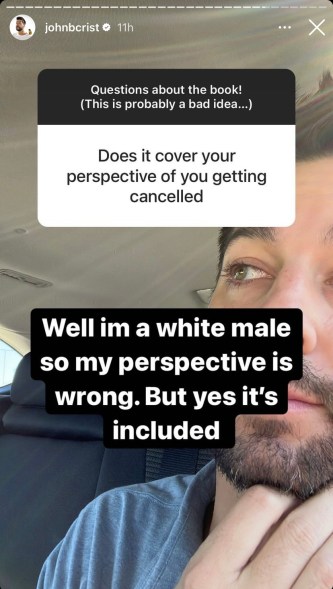
Crist posted on Instagram on Saturday that it would include his perspective on getting canceled but wrote that “im a white male so my perspective is wrong.” The 38-year-old also said that fans can read about “the first ever sex scandal that involved no sex.”

Promoting the book on his podcast last week, Crist recalled how his PR team told him they didn’t need know what happened if he had been drinking in a hotel room with a woman since “you’re kind of already guilty even if nothing happened.”

“I lived my entire life to delete and manicure everything, and then everybody found out everything about me,” he said on Net Positive, the podcast he launched in May. “And I found out that they still liked me, and that changed my whole life.”

Crist’s new book is from a secular imprint, Penguin Random House’s Crown Forum, while the previous one was set to be published by its Christian subsidiary WaterBrook.

Despite the references to getting canceled, Crist maintains a robust Christian fan base and has been back on tour since 2021, performing back-to-back nights of sold-out shows in some cities. His new special on YouTube has nearly three quarters of a million views, and he’s slated to tape another in Dallas this week.

Crist has discussed how he expected to be rejected by Christian fans after rehab but the opposite happened. He now sees their continued support as an extension of God’s acceptance.

“You guys have shown me a love that I have never experienced in my life,” he said in a March 2021 Instagram story thread, reflections that he later repeated in his comedy set. He also had a bit comparing motherhood to being in rehab.

Fans celebrate his vulnerability and Christian testimony in bringing up the darkest times of his life publicly. But some have continued to call Crist to repent and step down from the stage, including victims who say he’s “literally profiting” off their trauma.

Around the launch of his June 1 YouTube special, advocates challenged Christian podcaster Annie F. Downs for promoting Crist on Instagram and celebrating her friendship with him; Downs removed the post and apologized.

Multiple women have come forward in the past couple years with stories alleging predatory behavior, abuse, and manipulation. One wrote, “One of my greatest fears when all this happened was that he would disappear and then come back like nothing happened.”

Within months of getting out of rehab, Crist was back to performing bits and funny videos on social media. The following year he was touring nationally. Only this time, he wasn’t performing in megachurches but traditional comedy venues.

“When I got canceled, no one really knew what to do. I’m obviously still a believer, but we just don’t perform in churches. But that seems fair. A lot of the criticism of me is fair,” Crist said in an interview in January. He implied that he shouldn’t be held to the same standard as a pastor and suggested that saying he shouldn’t work anymore would be “unfair.”

Based on his material, Crist attracts the same evangelical, Southern audience—people who get all the cultural references from a homeschooled preacher’s kid and former Chick-fil-A employee.

During his latest special, filmed at the Lyric Theater in Birmingham, the crowd completed Bible verses at his prompting and sang “Father Abraham” together. “Put the arms down! That’s why people are scared to come to church,” he said.

While on tour, Crist has done an Instagram series visiting and “reviewing” local churches, including some outside his tradition, such as a Greek Orthodox service. He recently shared clips from a visit to Lakewood Church, where he bought a T-shirt in the gift shop.

His social media videos resemble the kind of content Crist did earlier in his career, joking about dads, pastors, fast food, sports, and stereotypes of “basic” white women.

Crist appeared at Turning Point USA’s Americafest at the start of the year, a segment cohosted by Alex Clark, who said she dated the comedian back in 2018. They discussed conservative women’s appearance and how comedy and politics are both approaches to igniting cultural change.

“Cancel culture and the #MeToo movement came first and hardest and only for comedians,” he said, “because comedians will tell you the truth in a way that exposes you.”

Theology

The Last Gift My Father Gave Me

A surprising encounter with my dad, Jesus, and Jerry Seinfeld opened a door to long-awaited healing.

Christianity Today June 17, 2022
Illustration by Mallory Rentsch / Source Images: Yevgen Romanenko / Mohd Kafii Isa / Sarawut Aiemsinsuk / EyeEm / Getty

Last April, I found myself sobbing unexpectedly and uncontrollably while sitting in a barbershop for a haircut. It was the first time I’d really wept since my father passed away a month earlier.

I’ve had a complicated relationship with grief.

Six years before, I left vocational church ministry. I resigned from a church I’d helped plant 15 years earlier, a church I thought I’d retire from. But conflict and unhealthy leadership had wreaked havoc on my soul, and it was time to go.

In the intervening years, I found myself sitting on couches, in armchairs, and in Zoom rooms with various counselors and spiritual directors, trying to process my emotional and physical exhaustion.

“I’m anxious,” I’d say.

“You have grief work to do,” they’d reply.

“I can’t sleep,” I’d say.

“You have grief work to do,” they’d reply.

“I’ve lost the eagerness to work hard and build things. That’s not like me,” I’d say.

“You have grief work to do.”

I remember one day in particular sitting in my friend Bob’s office. A caring and generous soul, Bob had sat with me for untold hours by then. Our session ended like every other. “How’s your grief work going?”

I slumped in my chair and looked over at the fountain sculpture he had hanging on his wall. Water poured across from layer to layer, like barrels tumbling down levels in Donkey Kong. This question always felt like the barrel I couldn’t avoid. I shook my head and blurted out, “I don’t know what the hell that even means.”

Bob has this subtle, almost imperceptible smirk when he knows he’s hit a nerve. “Tell me about the last time you wept over any of this.”

I wasn’t sure I had, I told him. He nodded. “Consider why, and we’ll pick up here next time.”

In his book The Sermon on the Mount and Human Flourishing, biblical scholar Jonathan Pennington argues for a shift in our thinking about two words found in the Beatitudes chapter—makarios and telios. If you get these right, he says, “the rest falls in place; get it wrong, and the whole thing falls apart.”

Telios appears in Matthew 5:48: “You must be telios as your Father is telios.” Most English translations render it as “perfect,” but Pennington argues that the word has important ties to the Hebrew word “shalom.”

Shalom is often rendered as “peace,” but peace is passive—implying the absence of conflict—while shalom is active. Shalom is a sense of wholehearted relationship with God and an awareness of the goodness in his care and rule of the world.

This also ties into the concept of Sabbath—the rest of God. Translating telios as “perfect” makes Matthew 5:48 an ethical command, while rendering it as shalom invites us into wholehearted relationship with God and rest in him. It’s a vision of grace.

He makes a similar argument for reframing makarios—a word that appears earlier and repetitively in the Beatitudes as “blessing.” But both Pennington and fellow New Testament scholar Scot McKnight see a broader idea in connection with Greek philosophy.

In Sermon on the Mount, McKnight writes that “the entire history of the philosophy of ‘the good life’… is at work when one says, ‘Blessed are…’ Thus, this swarm of connections leads us to consider Aristotle’s great Greek term eudaimonio, which means something like happiness or human flourishing.”

In Pennington’s translation of the Beatitudes, he makes the connection directly: “Flourishing are the poor in spirit because the kingdom of heaven is theirs.”

Pennington goes on to reframe Christ’s invitation in the Sermon on the Mount. Rather than seeing the Beatitudes as a new law, declared from on high like the Ten Commandments, it presents a new vision of the good life that is found through Jesus in the kingdom of God.

Dallas Willard often referenced the kingdom as the “upside-down world”—where we discover that true shalom is found in a life entirely inverted from our expectations: poverty of spirit, humility, persecution, and—critical to me—mourning.

My dad fell in January of 2021. It wasn’t a major thing; he felt dizzy and sort of melted to the floor. A month later, my mom texted the rest of our family that he was lethargic and mentally checked out. He went to the hospital that night, and we worried he’d had a stroke. But the scans came back negative.

This began a whirlwind of him spending about two weeks in the hospital, where COVID-19 restrictions kept most of us from visiting him. I only got to see him once—my brother and I talked to him over the phone through a glass window. I don’t think he even knew we were there.

About two weeks in, on his 75th birthday, he took some blood tests, and their results warranted a body scan. That’s when they found the cancer. It was everywhere, and his overactive immune system was attacking his mind. Within a week, he was gone—and my family spent just a few minutes with him the day before he died, as he fought for his final breaths.

He died on a Sunday, his memorial service was held on Wednesday, and life resumed on Thursday.

A month later, I was sitting in that barbershop when a jar of Barbicide caught my eye—the glowing blue disinfectant used to clean the stylist’s scissors and comb. I remembered a scene from Curb Your Enthusiasm, where Jerry Seinfeld and Larry David talk about their fear of germs. Jerry says he likes to keep his pens in Barbicide, and an extended riff between the two of them follows.

The scene was a throwback to exchanges from Seinfeld between Jerry and George Costanza—a character based on Larry David. As often happened on the show, Jerry couldn’t keep a straight face. He and Larry grinned and laughed through every line.

That day, I laughed a little under my breath and mask. Then I thought of my dad.

In high school, we would watch Seinfeld reruns over dinner and new episodes on Thursday nights. We lived with the TV on—and my dad would talk through every show, repeat jokes right after they happened, or if he’d seen something before, he’d tell you a joke was coming moments before it did.

Remembering the Curb scene, I thought, “I should text him when I get out of here.” But that thought froze in midair. He was gone. An anchor point for 41 years of my life had been untied and I was floating in zero gravity.

The laugh under my breath became louder and Jamie—who had been my barber for years—thought I was laughing at the story she’d been telling me about fishing for leopard sharks.

But then the tears started to break through the laughing, and I began to fall apart. She took a step back as I slumped over in my seat and sobbed. Heat rose in my face and neck as I thought about the dozen or so people in the shop who were wondering why a grown man was crying over a haircut.

I sat up, made eye contact with Jamie, and rasped, “My dad just died.”

She stood still for a long moment before nodding in recognition. “Mine too. About a year ago. It hits like this a lot. Over and over.”

Jonathan Pennington translates Matthew 5:4 as “Flourishing are the mourners because they will be comforted.” That day evoked a kind of comfort, and something in me began to crack open.

There’s a finality to the death of a loved one that cuts through abstraction. Life is unalterably different. In accepting the loss of my dad and the disorienting way it came about, I found an understanding of grief that cascaded backwards into my memory.

This incredible sense of loss—loss of a shared dream, of a community, of friendships—had finally found a place to settle in my heart. It was worthy of tears, but it is also held in tension as I wait for the making-new of all things Christ has promised.

As I grieved my father, I learned to grieve other things I’d failed to grieve in the past—and somehow that grief made me feel whole.

My dad loved Jesus, and I know the day will come when I see him again. But in losing him—and especially losing him the way we did—he helped me step into a different way of life, making sense of a complicated and soul-rattling decade.

The last gift my father ever gave me was the gift of grief. And in embracing it, I found a new understanding of what it means to flourish—the first glowing embers of true shalom.

Michael Cosper is the senior director of podcasts at Christianity Today.

Theology

Summer Solstice Reminds Us of God’s Grace to All

Why it matters that the Lord lets the sun rise on both the evil and on the good.

Christianity Today June 17, 2022
Mathieu Bigard / Unsplash

This Tuesday, the sun will hang in the sky over the Northern Hemisphere for what is colloquially known as the “longest day of the year.” In reality, the sun’s position will be no different than usual, but our perception of it will be different owing to the earth’s tilt on its axis as it orbits the sun.

Where I live in the mid-Atlantic, we’ll enjoy over fourteen hours of sunlight, but for those at the farthest reaches north—in places like Svalbard, Norway—the sun will simply never set. (Folks in the Southern Hemisphere will enjoy the same phenomenon six months later when the seasons change.) Traditionally, the summer solstice has been a time of celebration, bonfires, and revelry—inspiring stories like Shakespeare’s A Midsummer Night’s Dream and even the placement of architectural wonders like Stonehenge and the Great Pyramid of Giza.

For many pagan cultures, midsummer was a time of ritual and sacrifice as humans worshiped the sun as the source of life. But there’s a difference between worshiping the sun and worshiping by the sun. And surprisingly, at least to our modern sensibilities, Scripture invites us to the latter. Psalm 19—the psalm that tells us that “the heavens declare the glory of God”—calls attention to the sun’s orbit as it traces a path across the sky. The author likens it to an athlete running around a racetrack:

It rises at one end of the heavens
and makes its circuit to the other;
nothing is deprived of its warmth. (v. 6)

For the psalmist, the arc of the sun’s orbit (the same orbit that makes the summer solstice both possible and predictable) reveals something of God’s character. Elsewhere, the Scripture alludes to the role of the sun’s orbit in delineating “signs and seasons” (Gen. 1:14–19, NKJV)—while the consistent passage of the seasons tells of the faithfulness of God himself. As the Lord promises Noah after the flood,

As long as the earth endures,
seedtime and harvest,
cold and heat,
summer and winter,
day and night
will never cease. (Gen. 8:22)

Finding theological truth in natural phenomena may feel odd to modern readers—and perhaps it might even smack of paganism—but this hermeneutic falls squarely within the tradition of natural theology or general revelation.

The natural world is one of the primary ways God has revealed himself to humanity since the beginning of time. And so, while we’re more accustomed to knowing God through holy texts and prophetic utterances, saints throughout history have found him through his creation. In the early 13th-century hymn “Canticle of the Sun” (based on Psalm 104), Saint Francis of Assisi worships God via the greatness of the sun:

Most High, all powerful, good Lord,
Yours are the praises, the glory, the honor,
and all blessing.
To You alone, Most High, do they belong,
and no man is worthy to mention Your name
Be praised, my Lord, through all your creatures,
especially through my lord Brother Sun,
who brings the day; and you give light through him.
And he is beautiful and radiant in all his splendor!
Of you, Most High, he bears the likeness.

But general revelation also carries a kind of warning, reminding us of where we stand in relationship to our Creator. As much as we might minimize our helplessness or try to escape the uncomfortable truth of our dependence, the natural world has a way of snapping us back to reality. When Job’s friends chide him for blaming God for his suffering, Job reminds them that even animals know their well-being rests in the hands of the Creator. “Ask the animals, and they will teach you, or the birds in the sky, and they will tell you; or speak to the earth, and it will teach you, or let the fish in the sea inform you. Which of all these does not know that the hand of the Lord has done this? In his hand is the life of every creature and the breath of all mankind” (Job 12:7–10). We simply cannot escape the testimony of creation: We are dependent creatures whose only hope is in our Creator. As we approach the summer solstice, our earth circling around a blazing mass of glory, I can’t help but think about how fragile our life on this planet is. Just the right tilt of the axis, just the right distance, just the right length of orbit—all sustained by the One who first set it in motion and maintains it in a continual act of creation.

In light of all this, I understand why people have worshiped the sun. I understand how easy it would be to see the sun itself as your source of life, to realize how dependent we are on its rays and respond accordingly. But our dependence is only half the story. The natural world—the sun specifically—also reveals the goodness and grace of the God on which we depend. Returning to Psalm 19, David suggests that God’s glory is like the sun’s heat: “nothing is deprived of its warmth” (v. 6). God’s presence pervades every nook and cranny of the earth. It “goes out into all the earth … to the ends of the world” (v. 4).

But even as God generously reveals himself as the source of our lives, he also shows himself to be generous—and this grace changes us. In the Sermon on the Mount, Jesus appeals to the sun’s orbit to teach a new ethic of the kingdom of heaven. As children of our Father, he says, we must love not only our neighbors but also our enemies and pray for those who persecute us. And we must do this because this is what our Father does.

Our Father “causes his sun to rise on the evil and the good, and sends rain on the righteous and the unrighteous” (Matt. 5:45). He doesn’t differentiate between those who deserve the warming rays of the sun and those who don’t; he extends the grace of life to all—even to those who resist or hate him. When we feel the glow of the sun on our faces, when we feast under its lengthening rays, we remember that our lives are sustained by its warmth in very real and practical ways. The energy that shines from heaven allows plants to grow and sustains all those who call this earth home. That light falls on everyone—regardless of whether we love and worship the Creator or not—and it is the same light that instructs us in his ways. When self-reliance and ingratitude tempt us to forget the source of life (Jer. 5:24), we pray that God’s kindness will, like the sun, continue to shine on us and lead us to repentance. We pray that we will be open to what this light teaches us and that we will be made more like our Father in heaven—a Father so rich and so kind that the rays of his love permeate the whole earth, so that nothing can be hidden from them.

Hannah Anderson is the author of Turning of Days, All That’s Good, and Humble Roots: How Humility Grounds and Nourishes Your Soul.

News

Synod Votes to Simplify, Clarify Cross-Borders Relationship of the Christian Reformed Church

Task force proposal promises to help US and Canadian congregations work together more easily.

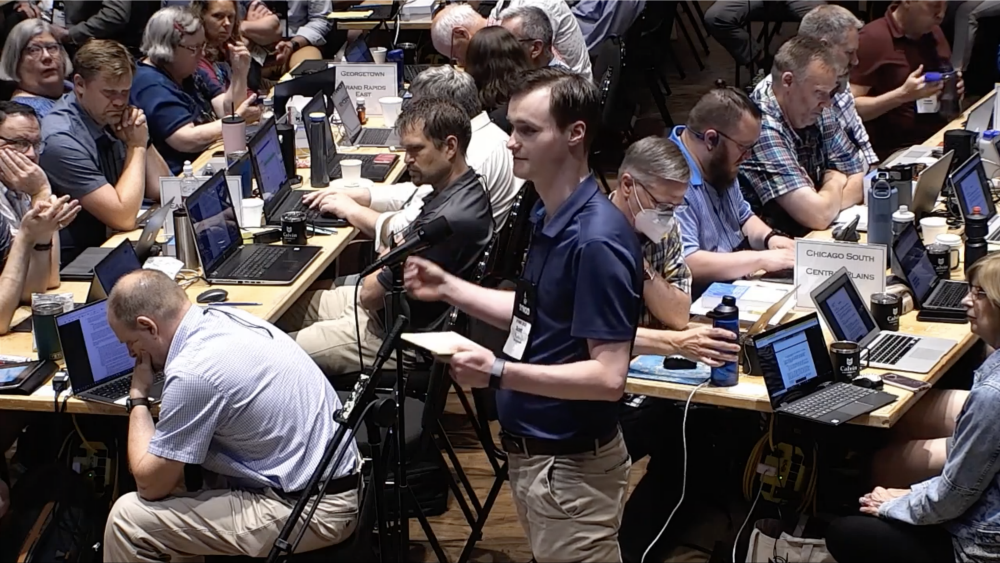
A delegate addresses proposed changes to structure of the relationship between Christian Reformed Churches in the US and Canada.

A delegate addresses proposed changes to structure of the relationship between Christian Reformed Churches in the US and Canada.

Christianity Today June 17, 2022
Screengrab / CRC Synod 2022

What’s the relationship between the Christian Reformed Church in North America in Canada and the Christian Reformed Church in North America in the United States?

It’s complicated.

The Christian Reformed Church in North America (CRC) is single denomination. But legally it exists as two separate entities—one incorporated in Michigan, the other north of the border. Bound together by faith and history, they carry out their work through joint ministry agreements.

How the two operate in unison can be a bit confusing even for those within the churches.

“There is a lot of fog in the system, and it is hard to figure out what is expected and how we can move forward for the benefit of the church,” said Albert Postma, newly appointed transitional Canadian executive director. The Structure and Leadership Task Force (SALT) Report—presented for approval at the CRCNA Synod 2022 and formally passed on Wednesday, June 15—will hopefully add some clarity to the relationship and help the Canadian churches comply with recent changes in nonprofit tax law. Its recommendations include:

  • Clarify ecclesiastical, ecumenical, and synodical responsibilities between countries.
  • Clarify governance responsibilities and interrelationships between boards of directors and advisers in Canada and the United States.
  • Clarify the administrative responsibilities between countries.
  • Clarify ministry responsibilities between countries.
  • Affirm that joint ministry agreements will be approved by relevant governing authorities.
  • Affirm the process of developing and overseeing joint ministry agreements.

The task force is also recommending adjustments to the leadership structure, including the establishment of an office of general secretary.

Postma will be key to carrying the denomination through the coming transitions. Chris deWinter, who chaired the search team that recommended Postma for the position, believes Postma’s experience as a classis renewal leader and pastoring a church in Ontario have made him a good bridge builder. He describes Postma as a synthesizer and a collaborator.

“Those are two skill sets that we need right now, especially in the Canadian office and the work going on,” deWinter said. “He is able to pull all kinds of things together and collaborate with a team.”

Postma said he hopes the changes in the next few years are more than bureaucratic. He really wants to help the denomination figure out what it means to be a binational community of churches and clarify areas of independence and interdependence.

He believes there are benefits to being binational. Part of his job is to help local pastors see what they are.

“The big picture, overall hope, and what I would want to work towards is that every church and church leader and pastor is able to say that they are better off because they are part of this denomination,” Postma said. “I really think the Christian Reformed Church is a good denomination. It’s worth investing in. It’s worth being part of.”

The discussions that Postma are stepping into are certainly not new. It’s something the CRCNA has grappled with for decades.

The Christian Reformed Church was first established in the US in 1857, and while there were a few churches that were seen as missionary outposts in Canada over the years, it wasn’t until a large wave of immigration from the Netherlands to Canada after the Second World War that significant growth happened in the country. US churches helped with the establishment of those churches.

Today there are about 250 CRC churches in Canada and approximately 850 in the US. American citizens frequently pastor Canadian churches and many Canadian citizens pastor in US churches. Legal changes in Canadian tax law, requiring Canadian citizens have control over charitable funds donated by Canadians, prompted review of the relationship across the border, which is also frequently agitated by cultural differences.

The bureaucratic structures have sometimes led to uneasy communication and cooperation.

“It’s easy to only feel a burden and forget some of the great things God is doing right now through us and in us,” Postma said. “I really hope that we can not forget those things.”

Churches are sharing the gospel, discipling Christians, developing leaders, and welcoming refugees. The US and Canadian churches work together through joint ministry agreements that allow them to act as one while they stay within the legal parameters in their respective countries.

These agreements detail everything from the ministry purpose and goals to the resources, staff, and budget. This can include congregational ministries such as Faith Formation, Disability Concerns, Pastor Church Resources, and Safe Church, as well as missions.

In the past, joint ministry agreements were a little more “soft,” said Terry Veldboom, who worked for the CRC in Canada for 35 years in various administrative and finance roles and recently wrapped up a term as the interim executive director.

He said it’s always been a challenge to make sure their agreements met the legal requirements and also facilitated coordinated ministry, but he believes the approved changes will help in both areas.

“Over the last year, we established a new set of joint ministry agreements for all of our cross-border joint activities. They’re much more detailed and solid,” he said.

Now that they’ve got a good handle on the adjusted Canadian legal and governance framework, Veldboom believes there are other questions that need to be addressed on the sociopolitical side. Cultural differences, for example, have often been an issue. CRC churches in Canada tend to be more social-justice minded than those in the US, he said.

As an example, he notes that in Canada, indigenous issues are front and center, but they barely register as a concern in the US.

Can those differences be overcome?

“That’s the question of the hour,” Veldboom said.

He said there are lots of arguments for staying united and many believe that the areas they have in common are greater than those that separate them.

In that sense, Veldboom sees Postma’s appointment as a positive. He believes Postma’s experience with local churches has given him a sense of what things are like on the ground. At 38 years old, Postma is also at an age where he can be seen as someone who can relate to both younger and older generations.

Both Veldboom and Postma hope that by properly dealing with these differences, the CRCNA can come away stronger and richer by intentionally looking at differences in context or culture and what is essential for denominational unity.

“It’s a pain, but sometimes things that add challenge also give us an opportunity to live into those challenges and grow through them,” Postma said.

News

After Annual Meeting, Southern Baptists Begin the Hard Work of Abuse Reform

Survivors sensed a godly shift as messengers approved plans and their new president put sexual predators “on notice.”

Southern Baptist Convention’s 2022 annual meeting

Southern Baptist Convention’s 2022 annual meeting

Christianity Today June 17, 2022
Jae C. Hong / AP

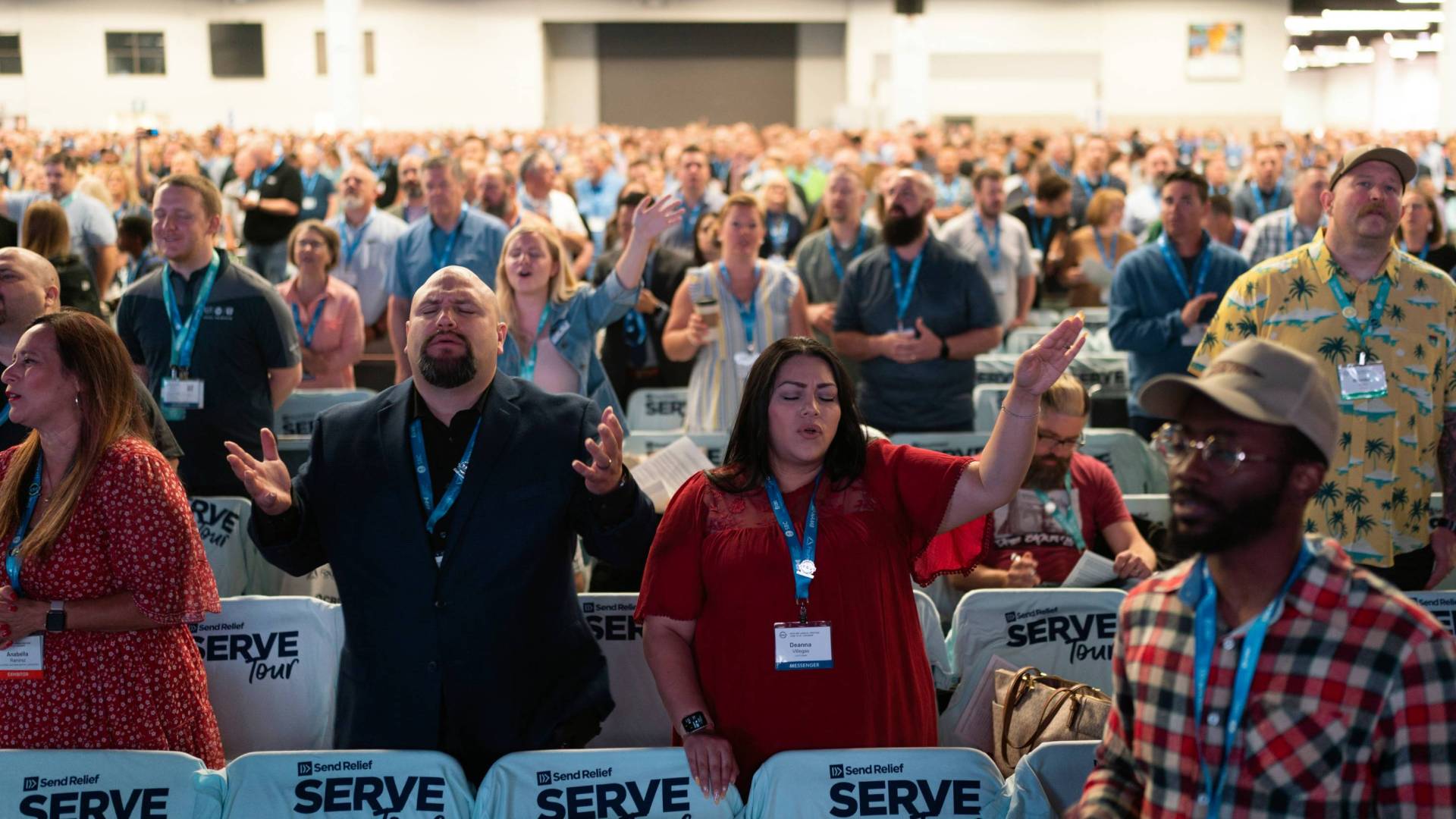
Southern Baptists sang slow and low, “Lord, have mercy on me,” in the cavernous meeting hall where they apologized for their failure to care for survivors and approved long-awaited measures designed to keep predatory pastors and irresponsible churches out of the convention.

Tiffany Thigpen attended the annual meeting in Anaheim, California, with fellow abuse survivors Jules Woodson and Debbie Vasquez­—their names familiar to many Southern Baptist pastors from news coverage, social media, and last month’s abuse report.

After her 20 years of fighting and advocating, Thigpen finally saw a shift. She described “God on the move” in the denomination where survivors had been disbelieved, vilified, and ignored over and over.

This time, Southern Baptist leaders named them from the stage of the 12,000-person gathering to applause. The hall included a special room for survivors, staffed by a team of trauma-informed counselors.

Attendees spoke to them, thanked them for coming, and tucked teal ribbons in their nametags as a sign of support. And, most importantly, the majority voted in favor of abuse reform and in solidarity with survivors every chance they got.

Thigpen said when the messengers—delegates from Southern Baptist churches—raised their ballots in the air to approve recommendations resulting from last month’s abuse investigation, it felt like those seated in the rows of chairs around them were looking to them as if to say, “This vote is for you.”

“It’s a victory in so many ways, because people’s hearts changed, and that’s something only God can do,” said Thigpen, who was groomed and attacked by her pastor over 30 years ago only to be dismissed by prominent SBC leaders who had known of his previous misconduct.

Now, abuse survivors and Southern Baptists leaders wait to see whether the momentum and historic stances will result in meaningful change in the nation’s largest Protestant denomination.

The 2022 convention publicly lamented the harm its inadequate responses have caused survivors like Thigpen over the years, including “our institutional responses, which have prioritized the reputation of our institutions over protection and justice for survivors.” The SBC also strengthened its position against sexual abuse by pastors, saying such behavior is not just sinful but should be criminalized in every state.

Southern Baptists also took the first steps toward a system to identify abusers in ministry and keep them from moving from flock to flock, voting almost unanimously in favor of launching a new database.

“Survivors will look back on this moment and see every single ballot raised in the air, and they’ll say, ‘That was me being believed. That was the impact that I made because I didn’t give up,’” said Rachael Denhollander, a survivor-advocate, attorney, and consultant on the task force that oversaw the recent investigation of the SBC Executive Committee. “And the survivors that come after them look at those ballots and say, ‘I have a place to speak up now.’”

While the report from the outside firm Guidepost Solutions had a long list of suggestions—including a permanent entity to oversee abuse reports, compensation for survivors, a memorial in their honor, and a ban on nondisclosure agreements—the task force ended up putting just two recommendations before the messengers this week: the creation of the database as well as a new task force to oversee further reforms, including improving the process for reporting churches that cover up abuse.

The new task force will look at the other recommendations and make a recommendation next year on whether or how to adopt them.

Christa Brown, a longtime advocate whose story was central to the investigative report, was disappointed that after ensuring such a transparent investigation, the task force “pulled its punches” for the sake of SBC polity and didn’t recommend more dramatic changes from the start. After reviewing the recommendations ahead of the meeting, she told CT she was “perhaps more disheartened than ever.”

https://twitter.com/ChristaBrown777/status/1536868904043048960

Yet Jules Woodson is leaving Anaheim encouraged and hopeful that the initial decisions will spur significant change in the long run. She expects that the database—something survivors like Brown spent 15-plus years calling for—will be a powerful mechanism for keeping abusers out of Southern Baptist pulpits.

And it can work under the SBC’s current structure of autonomous churches. The convention voted in 2019 to explicitly require cooperating churches “not act in a manner inconsistent with the convention’s beliefs regarding sexual abuse.” So far, the credentials committee, which evaluates reports of SBC churches in violation of denominational standards, has recommended disfellowshipping only a few churches that knowingly hired registered sex offenders. With the new “Ministry Watch” database, the committee could also view employing pastors on the list as evidence that a church has disregarded its position against abuse, Woodson said.

An independent body would oversee Ministry Watch, taking reports from churches as well as individuals and prompting third-party inquiries if necessary. Pastors or other ministry workers would be listed if they were found to be credibly accused of abuse through a conviction, civil judgment, confession in a nonprivileged setting, or “preponderance of evidence” in an investigation.

Leaders haven’t put a timeline on the launch of the database, but it’s the first priority for the new abuse reform implementation task force, which could gather as early as next month.

“How does a shepherd talk to another shepherd to make sure a wolf doesn’t get in there?” said Bruce Frank, the pastor who chaired the task force overseeing the investigation. “That’s really what the database is supposed to do.”

Frank was hesitant to celebrate. He called the reforms the “bare minimum” and said they should have been done 15 years ago or more. When he addressed the convention on Tuesday, the North Carolina–megachurch preacher explained that it was long past time to act—that if the SBC did not humble itself to repent, it should be prepared to be humiliated by God.

“It’s going to cost a lot,” he told the convention, whose relief arm already pledged $4 million to cover initial reforms. “It’s not going to cost nearly as much as survivors have paid. It’s not going to cost nearly as much as the stain on the name of Jesus Christ when the largest Protestant denomination doesn’t care for people as we can or even as well as the secular organizations do.”

Bart Barber, the newly elected president of the SBC, will appoint the new task force in charge of implementing changes and reporting back to next year’s convention with further recommendations. Barber, a rural Texas pastor and Southern Baptist historian, was seen as the candidate with the stronger record of standing with survivors.

The biggest barrier to abuse reform in the SBC remains its polity, which doesn’t allow the denomination to oversee or dictate how individual churches are run. A minority of Southern Baptists fear that the small steps taken this year already threaten that structure.

But Barber believes reform can take place within SBC polity and that it could even be a strength. He wants to use its setup against serial abusers who tried to take advantage of the lack of hierarchical oversight in the SBC.

“Our decentralized polity can become, rather than a hunting ground in which predators brutalize their prey, a place where sexual predators are put on notice that the tables have turned and where the hunter is now the hunted,” he told reporters on Wednesday. “Predators have realized the vulnerabilities of our system. It is time for Southern Baptists to realize how nimble and resilient our Baptist polity can be, to put sexual predators on notice that Southern Baptist churches are a dangerous place for them.”

Back in 2019, Barber was among a group of Southern Baptists lobbying for a Texas state law that, now passed, gives churches the legal right to disclose credible sex abuse allegations so pastors with abusive pasts won’t sneak into other congregations.

The convention this year called for strengthening laws against pastors who groom and sexually abuse congregants, putting such violations in the same category as doctors, counselors, and those in other positions where victims are not in an equal position to consent.

Southern Baptists agreed to “encourage lawmakers in every state to pass laws that would provide consistent definitions and classification of sexual abuse by pastors, as sexual abuse committed by pastors constitutes a clear abuse of authority and trust.” At least nine states already have such laws.

Griffin Gulledge, a Georgia pastor who suggested the resolution on criminalizing clergy sexual abuse, said pastors who abuse members of their flock should bear legal consequences rather than merely confessing a “moral failing” and resigning.

Frank said the messengers’ decision last year to approve an investigation into the Executive Committee was them “kicking down the door” to allow for the moves they saw this year around abuse reform—and, God willing, widespread cultural change in the years to come.

GRACE (Godly Response to Abuse in the Christian Environment) said it was hopeful that the SBC’s actions would lead to meaningful reform but noted that the hard work comes next—in actually implementing the changes in SBC churches and seminaries.

Some changes will come voluntarily as state conventions, seminaries, and churches review and improve their own training around abuse. From the start, the new task force is meant to be a resource for abuse prevention and trauma-informed care.

https://twitter.com/juleswoodson11/status/1537569776377028610

Woodson referred to the decisions made this week as putting Southern Baptists on the “right path” and going in the right direction for the kinds of more robust reforms survivors would like to see.

For a long time, Thigpen, like many other advocates, had no reason to hope that that change was coming. Since the early 2000s, when she began speaking out publicly about the abuse she had reported a decade before, all she knew was the uphill battle of trying to get leaders to believe her and actually do something.

With the decisions made at this year’s annual meeting, the Florida native is allowing herself to imagine what it would be like to not have the burden of SBC abuse dominate her life.

“There’s a part of me that would like to have a life outside advocacy,” said Thigpen, adding that she is expecting her first grandchild this summer. “I just pray that they move that ball forward, and maybe we can rest.”

addApple PodcastsDown ArrowDown ArrowDown Arrowarrow_left_altLeft ArrowLeft ArrowRight ArrowRight ArrowRight Arrowarrow_up_altUp ArrowUp ArrowAvailable at Amazoncaret-downCloseCloseellipseEmailEmailExpandExpandExternalExternalFacebookfacebook-squarefolderGiftGiftGooglegoogleGoogle KeephamburgerInstagraminstagram-squareLinkLinklinkedin-squareListenListenListenChristianity TodayCT Creative Studio Logologo_orgMegaphoneMenuMenupausePinterestPlayPlayPocketPodcastprintremoveRSSRSSSaveSavesaveSearchSearchsearchSpotifyStitcherTelegramTable of ContentsTable of Contentstwitter-squareWhatsAppXYouTubeYouTube