Monitoring Government’s Impact on the Family

Returning to one of the key themes of his 1980 campaign, President Reagan has directed government officials to place new emphasis on the American family in forming and implementing federal policy. In an executive order issued last month, Reagan mandated that all government policies be evaluated for their impact on the family.

Reagan has charged the Office of Policy Development, under the leadership of Gary Bauer, with reviewing all existing regulations and policies. Bauer, a Southern Baptist, will issue a report in six months detailing any recommended changes, either in the form of legislation or presidential action.

In addition, under the order, agency and department heads must submit to Bauer’s office a written assessment of how new measures will “enhance family well-being.” The Office of Management and Budget will moniter compliance.

Family-Impact Criteria

In his family-impact statement, Reagan spelled out criteria that should be used in evaluating each government policy:

  • Does it strengthen or erode the stability of the family and marital commitment?
  • Does it strengthen or erode parental authority and rights?
  • Does it substitute government activity for family functions?
  • Does it increase or decrease family earnings?
  • Can the function of the policy be carried out by the family itself, or by a lower level of government?
  • What message does the policy send to young people?

“If a proposed policy doesn’t measure up, this office’s objections will be grounds to stop it until we resolve those differences,” said Bauer, in an interview with CHRISTIANITY TODAY. “If we can’t, then the issue is kicked on upstairs to the chief of staff or the President to decide whether or not to proceed.”

The executive order puts into effect recommendations made by the White House Working Group on the Family in its 1986 report, “The Family: Preserving America’s Future.” Bauer served as chairman of the working group.

“The thing that struck us was that the bureaucracy here in Washington listens to all sorts of special interests who have high-powered lobbyists and lawyers,” Bauer said. “But the most important special-interest group of all, which is arguably the family, doesn’t have anybody who gets paid big money each year to tell the bureaucracy how to help them.”

The family-impact statement is similar to an environmental-impact statement that requires federal building projects to take into account potential environmental effects. Said Bauer: “This executive order is an attempt to force the bureaucracy not to consider the family as an afterthought, but to think of the family as easily as it thinks of the snail darter.”

According to Bauer, the White House is hoping the order will “put the family in the middle of the debate going into 1988.… Our feeling is that a new president, even of the other party, would be very reticent to repeal an executive order that requires the family to be put at the center of public policymaking. Our hope is that we’re going to leave behind a lasting change.”

Profamily advocates say they are encouraged by Reagan’s initiative. Curt Smith, spokesman for U.S. Rep. Dan Coats (R-Ind.), a member of the House Select Committee on Children, Youth and Families, called the order a “positive development.”

“Not only will it require federal managers and departments to look at what programs might do to or for the family,” Smith said, “but it’s likely … it will also foster programs to bolster the family.”

Family Research Council President Jerry Regier called it “a profamily statement that finally has some teeth in it.… The question now is, do we have policymakers with the ability and fortitude to carry out the [executive] order?”
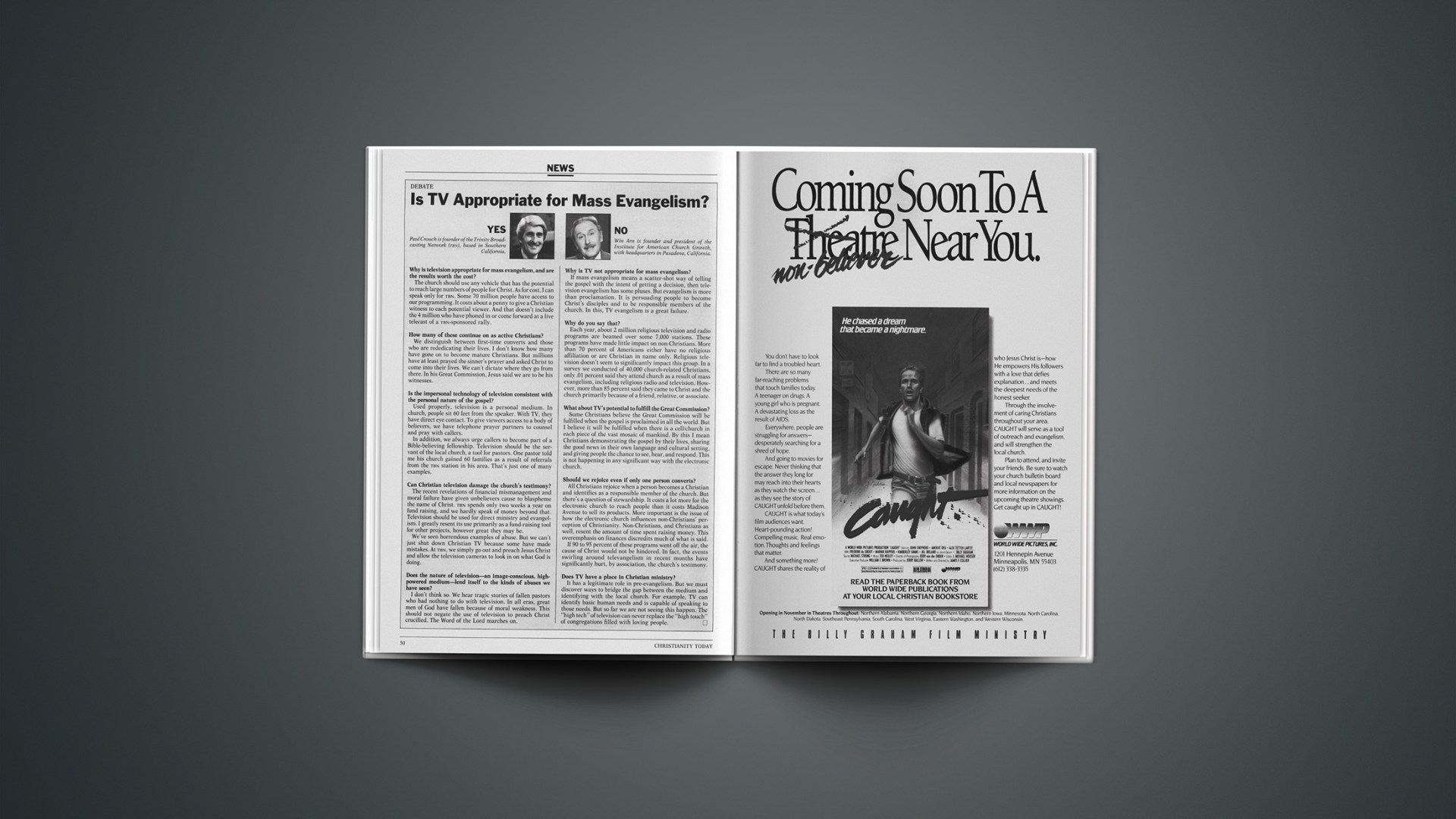
Is TV Appropriate for Mass Evangelism?

YES

Paul Crouch is founder of the Trinity Broadcasting Network (TBN), based in Southern California.

Why is television appropriate for mass evangelism, and are the results worth the cost?

The church should use any vehicle that has the potential to reach large numbers of people for Christ. As for cost, I can speak only for TBN. Some 70 million people have access to our programming. It costs about a penny to give a Christian witness to each potential viewer. And that doesn’t include the 4 million who have phoned in or come forward at a live telecast of a TBN-sponsored rally.

How many of these continue on as active Christians?

We distinguish between first-time converts and those who are rededicating their lives. I don’t know how many have gone on to become mature Christians. But millions have at least prayed the sinner’s prayer and asked Christ to come into their lives. We can’t dictate where they go from there. In his Great Commission, Jesus said we are to be his witnesses.

Is the impersonal technology of television consistent with the personal nature of the gospel?

Used properly, television is a personal medium. In church, people sit 60 feet from the speaker. With TV, they have direct eye contact. To give viewers access to a body of believers, we have telephone prayer partners to counsel and pray with callers.

In addition, we always urge callers to become part of a Bible-believing fellowship. Television should be the servant of the local church, a tool for pastors. One pastor told me his church gained 60 families as a result of referrals from the TBN station in his area. That’s just one of many examples.

Can Christian television damage the church’s testimony?

The recent revelations of financial mismanagement and moral failure have given unbelievers cause to blaspheme the name of Christ. TBN spends only two weeks a year on fund raising, and we hardly speak of money beyond that. Television should be used for direct ministry and evangelism. I greatly resent its use primarily as a fund-raising tool for other projects, however great they may be.

We’ve seen horrendous examples of abuse. But we can’t just shut down Christian TV because some have made mistakes. At TBN, we simply go out and preach Jesus Christ and allow the television cameras to look in on what God is doing.

Does the nature of television—an image-conscious, high-powered medium—lend itself to the kinds of abuses we have seen?

I don’t think so. We hear tragic stories of fallen pastors who had nothing to do with television. In all eras, great men of God have fallen because of moral weakness. This should not negate the use of television to preach Christ crucified. The Word of the Lord marches on.

NO

Win AM is founder and president of the Institute for American Church Growth, with headquarters in Pasadena, California.

Why is TV not appropriate for mass evangelism?

If mass evangelism means a scatter-shot way of telling the gospel with the intent of getting a decision, then television evangelism has some pluses. But evangelism is more than proclamation. It is persuading people to become Christ’s disciples and to be responsible members of the church. In this, TV evangelism is a great failure.

Why do you say that?

Each year, about 2 million religious television and radio programs are beamed over some 7,000 stations. These programs have made little impact on non-Christians. More than 70 percent of Americans either have no religious affiliation or are Christian in name only. Religious television doesn’t seem to significantly impact this group. In a survey we conducted of 40,000 church-related Christians, only 01 percent said they attend church as a result of mass evangelism, including religious radio and television. However, more than 85 percent said they came to Christ and the church primarily because of a friend, relative, or associate.

What about TV’s potential to fulfill the Great Commission?

Some Christians believe the Great Commission will be fulfilled when the gospel is proclaimed in all the world. But I believe it will be fulfilled when there is a cell/church in each piece of the vast mosaic of mankind. By this I mean Christians demonstrating the gospel by their lives, sharing the good news in their own language and cultural setting, and giving people the chance to see, hear, and respond. This is not happening in any significant way with the electronic church.

Should we rejoice even if only one person converts?

All Christians rejoice when a person becomes a Christian and identifies as a responsible member of the church. But there’s a question of stewardship. It costs a lot more for the electronic church to reach people than it costs Madison Avenue to sell its products. More important is the issue of how the electronic church influences non-Christians’ perception of Christianity. Non-Christians, and Christians as well, resent the amount of time spent raising money. This overemphasis on finances discredits much of what is said.

If 90 to 95 percent of these programs went off the air, the cause of Christ would not be hindered. In fact, the events swirling around televangelism in recent months have significantly hurt, by association, the church’s testimony.

Does TV have a place in Christian ministry?

It has a legitimate role in pre-evangelism. But we must discover ways to bridge the gap between the medium and identifying with the local church. For example, TV can identify basic human needs and is capable of speaking to those needs. But so far we are not seeing this happen. The “high tech” of television can never replace the “high touch” of congregations filled with loving people.

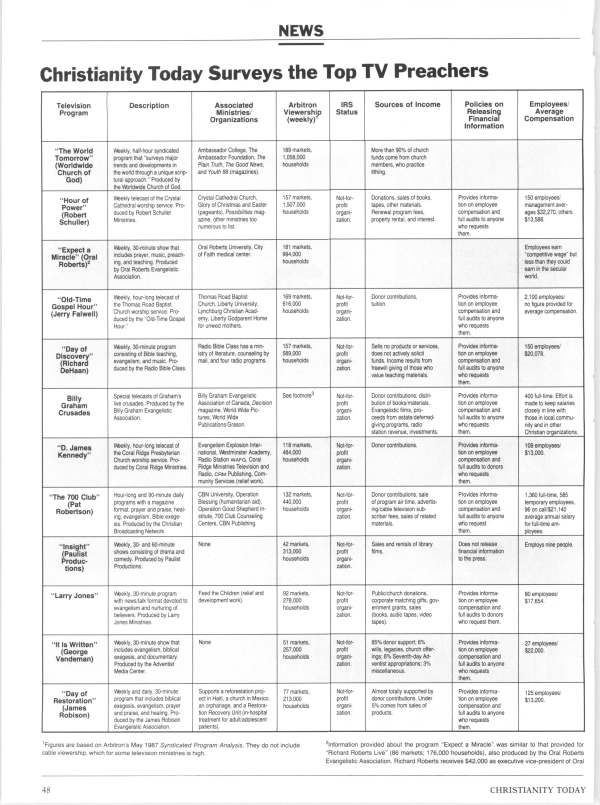
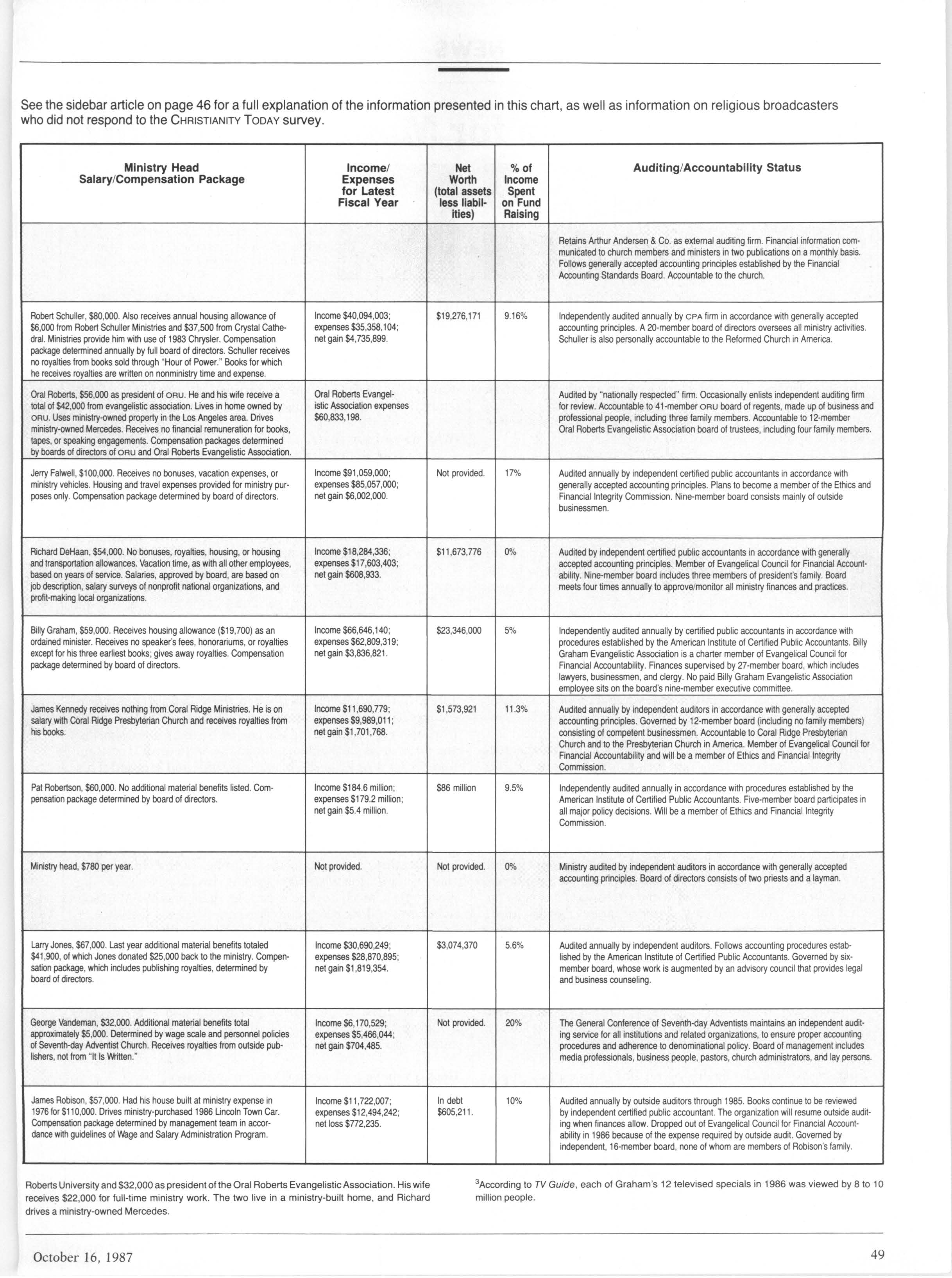
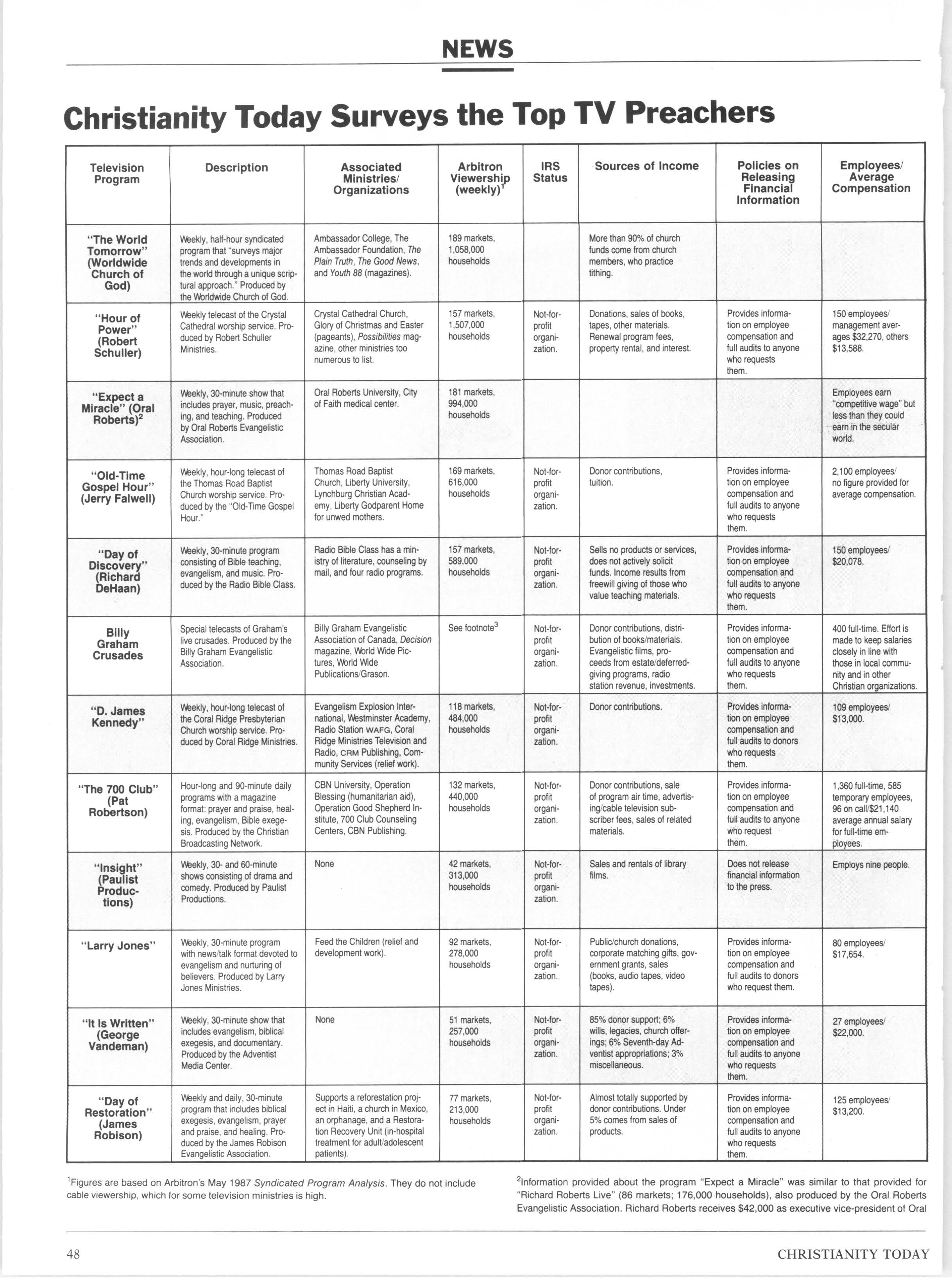
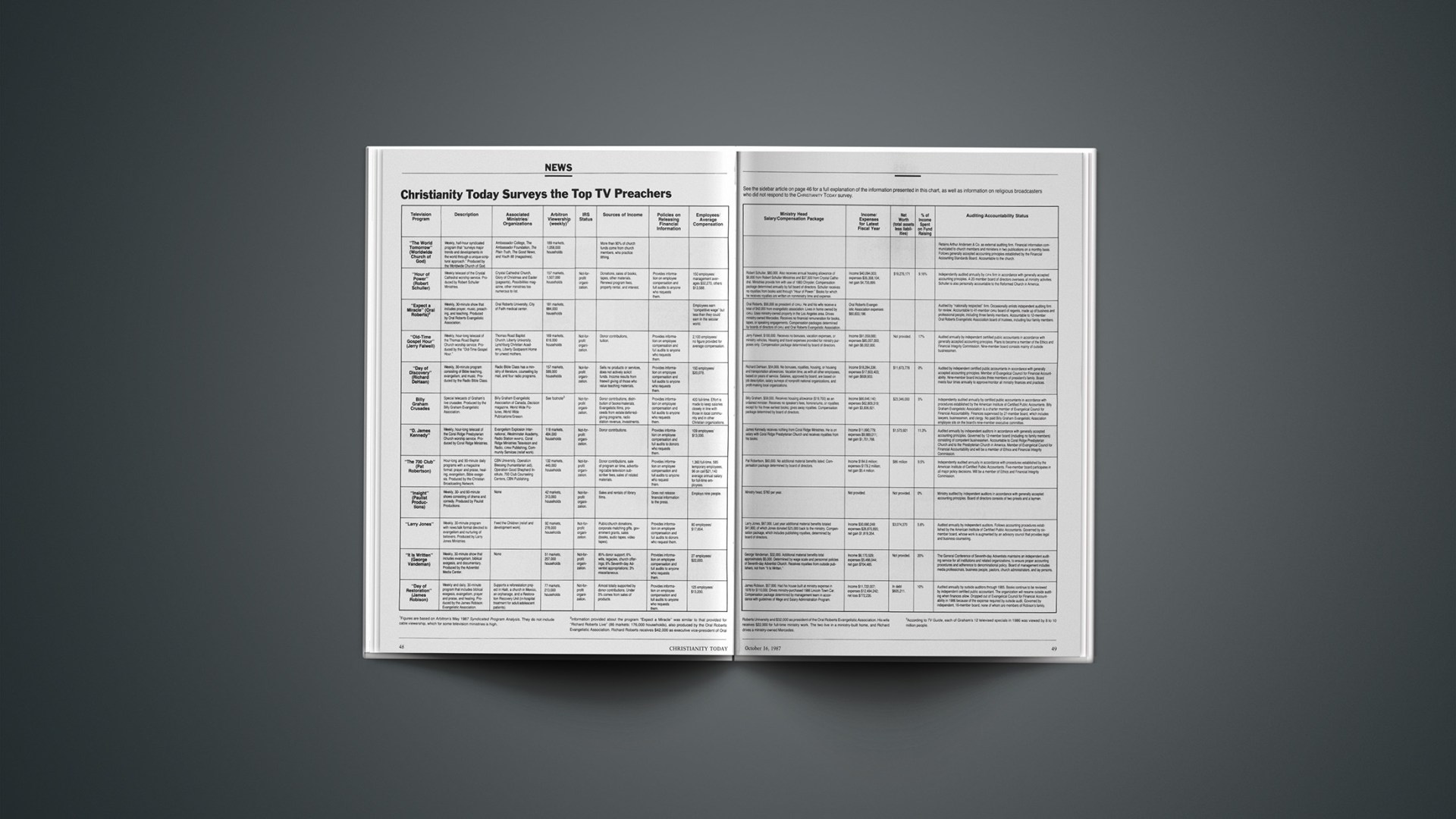
Christianity Today Surveys the Top TV Preachers


Forty years ago, before the creation of departments in African American studies, it was thought that the religious world of slaves in the Americas was fundamentally invisible. Jon Sensbach’s Rebecca’s Revival: Creating Black Christianity in the Atlantic World is a winning reminder of the grave inaccuracy of the assumption of slave religions’ indiscernibility. Eminently readable, and aimed at a wider audience beyond the boundaries of academe, Rebecca’s Revival recounts the story of an extraordinary mixed-race former slave, neither illiterate nor invisible (indeed, a 1751 portrait exists of her, her husband, and child while in Germany), from the West Indian island of St. Thomas, colonized by the Dutch in the 17th century, later passing to Danish control, and today part of the U.S. Virgin Islands. Rebecca, born in 1718 and freed about fifteen years later, not only joined but became a primary mover in the Moravian Church’s evangelical mission in St. Thomas during the mid 1730s. For the next six years, under the aegis of the Moravian mission, Rebecca, along with other black folk free and enslaved, established what Sensbach claims is the earliest bulwark of black Protestantism—no less than the first black church—in the Americas.

Rebecca’s Revival provides that certain thrill of gaining a glimpse at a pioneer’s original tracks. The 1730s is awfully early for evidence of formal Protestant worship in the slave islands of the Caribbean. (In the United States, the successful organized creation of Christian slave communities came much later, in all probability after the American Revolution.) Some of the book’s vigor comes from Sensbach’s self-conscious attempt to provide an account of an original moment, and of what amounts to a world-historical individual within that moment, which marked a transformative shift in history and culture. “St. Thomas,” he writes, “suddenly became the Americas’ new axis for Afro-Protestant conversion,” and Rebecca “helped ignite the fires of a new kind of religion that in subsequent centuries has given spiritual sustenance to millions.”

Later in her life, after she moved from St. Thomas to Germany, Rebecca, along with another woman from the West Indies, was ordained as a deaconess in the Moravian church. Sensbach very rightly points out the historical momentousness of this: “a former slave now administered Communion and practiced other claims to spiritual authority over white women, including European aristocrats.” Rebecca and the West Indian woman “may well have been the first black women to be ordained in western Christianity.” These and other details of Rebecca’s life are truly exceptional; on these terms, the best chapter of Rebecca’s Revival is Sensbach’s account of the persecutory trial of Rebecca’s marriage in 1738 to a white Moravian missionary. The courage that she showed during her imprisonment, and the eloquence of her testimony and post-trial writings, are awe-inspiring.

And yet Sensbach travels the distance between Rebecca’s status as unexampled and original, and her status as exemplary and precedent-setting, much too quickly. Repeatedly he insists that Rebecca’s experience was paradigmatic. As a result, Rebecca’s life becomes broadly representative of multiple staggeringly large historical dynamics. For example, Rebecca functions as a “mirror on a larger narrative—the origins of the black church itself,” as well as one of the “earliest harbingers of what would become an international evangelicalism spanning the Atlantic in multiple directions.” In sum, “her life illustrates the interconnectedness of Africa, Europe, the Caribbean and North America.”

Sensbach should have been more circumspect and precise in his reachings. Time and again, the actual detailed account that Sensbach provides of Rebecca’s wondrous, courageous, multilingual, interracial life undercuts the case for her paradigmatic stature. Rebecca was extraordinarily unusual, and this distinctiveness—even as it gives her story compelling interest—renders her role as emblem debatable, or at least more complex than Sensbach allows for. The biggest example of this, ironically enough, concerns the St. Thomas church which she founded.

As Sensbach acknowledges, the most critical dynamic in the development of African American religion in all parts of the Americas was the range of ways in which slaves transformed the Christianity they were exposed to by incorporating myriad remnants of different African religions. Scholars such as Albert Raboteau, Mechal Sobel, and Robert Farris Thompson have taught us that the manner in which African religions survived—from whole systems of thought to discrete religious practices—varied greatly from place to place. In Protestant North America, for reasons (among others) having to do both with the lack of saints in Protestantism as well as the decidedly smaller size of plantations, African survivals were less systematic and coherent than in places such as Brazil or Haiti. But even the many scholars who characterize the devastation done to slaves’ traditional African beliefs as a type of spiritual holocaust also acknowledge the presence of many African retentions—such as the ethos of congregational solidarity, music, dance, spiritual possession, and specific practices (in the marriage ceremony, for example).

Sensbach makes clear that Rebecca’s church on St. Thomas fell within this basic dynamic: “black women and men began to blend Christianity with the religions they had brought with them from Africa, creating a faith to fortify themselves against slavery.” Yet, Rebecca, as Sensbach shows at numerous turns, “probably identified more with European practices than with African ones,” fundamentally disavowing and even “suppress[ing] lingering African religious practices.” Sensbach points out that one of the reasons the Moravians were so accepting of Rebecca is that “it appeared as though her cultural blackness had disappeared.”

Indeed, Rebecca’s seemingly ready identification with Europeanisms is a constant theme in her life. Rebecca’s first marriage in 1738 was to a white Moravian missionary, and while this does not stand as evidence of her racial identification, it should remind us that Moravians, despite believing that all people could be saved, thought that slavery was divinely sanctioned; it was a theology Rebecca would have necessarily accepted. Rebecca’s second marriage (after her first husband died) was to an African Moravian of mixed-race descent, and here, too, these same tensions persist. Sensbach tells us that while her husband, Christian Protten, “struggled constantly to reconcile his African and European identities, Rebecca showed no such doubts.” When the couple moved from Europe to the African slave city of Christianborg to educate and missionize the city’s mixed-race children, Rebecca taught girls “the skills they would need in European- style patriarchal households,” along with “a steady diet of biblical passages, prayers, and a catechism.” Meanwhile, we are told that many “mulatto” children resisted her work as they continued to worship African gods.

Certainly, the slaves from St. Thomas also resisted Rebecca and others’ efforts to strip them of their surviving Africanisms. Ultimately the church in St. Thomas, like black churches throughout the Americas, developed and evolved in ways that were distinctively African. Sensbach, in fact, applauds the refusal by members of the church in St. Thomas to give up their African-derived dance and song. He speaks of St. Thomas’ slaves in the 1840s celebrating holidays with “reinvigorated African customs.” Yet this leaves Rebecca at significant odds with the later flourishing of the church she helped to establish. At one point, Sensbach is moved to apologize for Rebecca’s appearing “complicit in a campaign of cultural eradication.”

Apologies are not needed. Explanations and analysis are. How are we to think about Rebecca as both crucial and alien to religion’s flourishing on St. Thomas? Sensbach does not say, but he must if Rebecca is going to serve as a window on larger themes in the development of African American religion. His refusal to broach this topic is poignantly captured by the image which Sensbach asks us to remember Rebecca by: “In the end, the image that remains—the one that matters—is that of a preacher, a solitary figure walking the roads, taking the word to workers in the sugar cane fields of America.” Sensbach’s intent, it would seem, is to emphasize the continuity between Rebecca and the workers in the fields. Yet, the powerful vision of Rebecca alone and single-minded cannot help but underscore the very distinct differences between her and those same field workers.

Sensbach’s rather ahistorical account of religion’s development on St. Thomas serves as a reminder of the continuing importance of historian Jon Butler’s claim, in one of the most crucial observations on the development of African American Protestantism, that too few historians provide accounts of slave religion as changing and developing over time. Attending more closely to their historical development, Butler argues that the first black Protestant churches, because of the strict control missionaries exerted, were “more fully European in character than would ever subsequently be true, as slave and free black Christianity became increasingly Afro-American after rather than before 1800.”1 This idea—that the Africanization of black religion in the Americas increased over time—is a radical one. The implication is that in Protestant black America, suppressed Africanisms returned only after black Americans were allowed or able to express themselves within the formal structure of Christianity. It is an insight that is well-suited to thinking about Rebecca, with her strong commitment to European Christian practices, and the ensuing Africanization of the St. Thomas church.

Rebecca’s Revival does not do this exciting work. But by providing in riveting detail the sorts of religious and racial ambiguities that characterized the beginnings of Rebecca’s church, it lays the groundwork for such analysis, while recovering from utter obscurity a remarkable woman whose story cried out to be told.

Jonathon Kahn has a postdoctoral fellowship at Columbia University’s Society of Fellows in the Humanities.

1. Jon Butler, Awash in a Sea of Faith: Christianizing the American People (Harvard Univ. Press, 1990), p. 153.

Copyright © 2005 by the author or Christianity Today/Books & Culture magazine.
Click here for reprint information on Books & Culture.

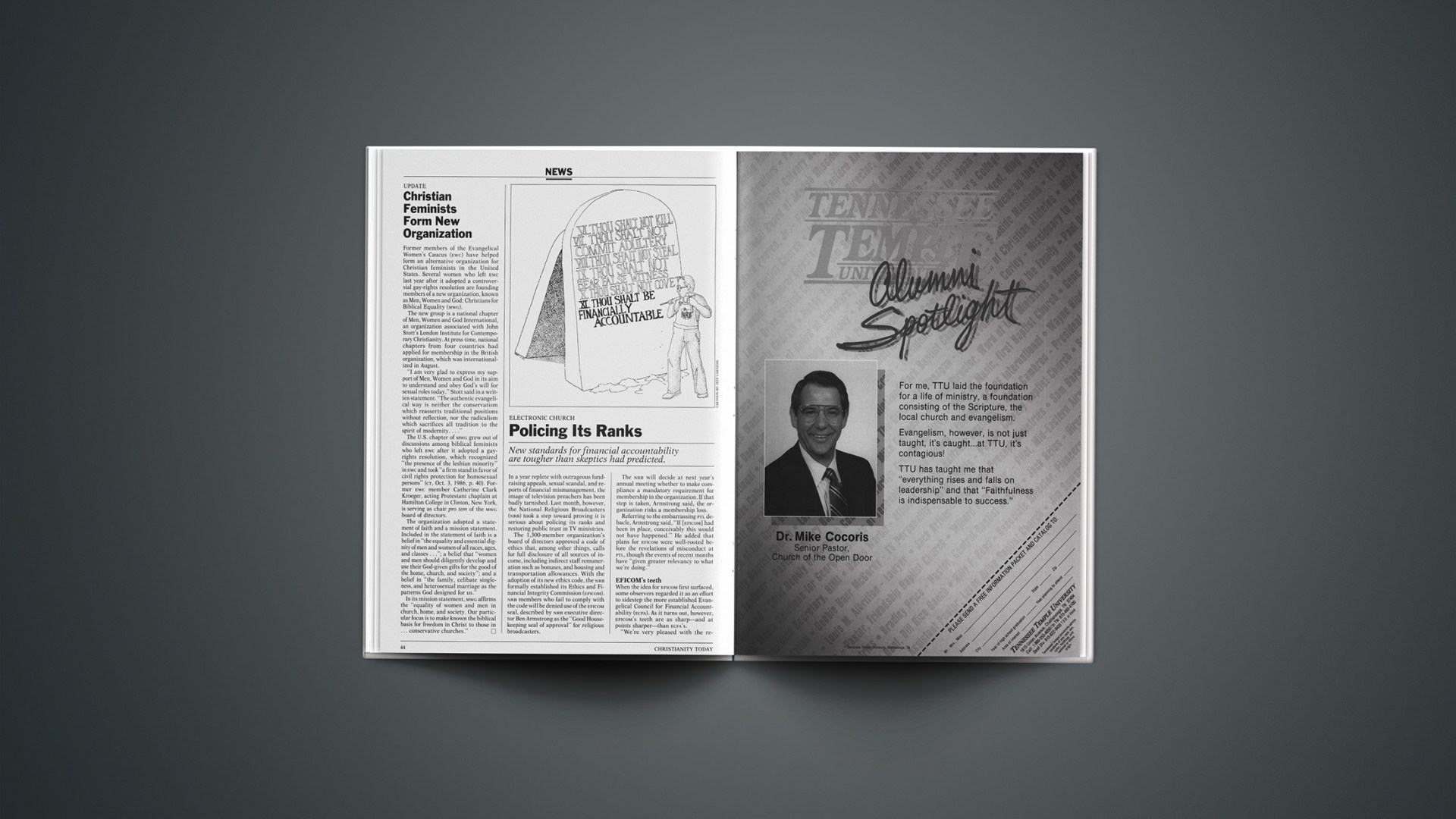
Policing Its Ranks

New standards for financial accountability are tougher than skeptics had predicted.

In a year replete with outrageous fund-raising appeals, sexual scandal, and reports of financial mismanagement, the image of television preachers has been badly tarnished. Last month, however, the National Religious Broadcasters (NRB) took a step toward proving it is serious about policing its ranks and restoring public trust in TV ministries.

The 1,300-member organization’s board of directors approved a code of ethics that, among other things, calls for full disclosure of all sources of income, including indirect staff remuneration such as bonuses, and housing and transportation allowances. With the adoption of its new ethics code, the NRB formally established its Ethics and Financial Integrity Commission (EFICOM). NRB members who fail to comply with the code will be denied use of the EFICOM seal, described by NRB executive director Ben Armstrong as the “Good Housekeeping seal of approval” for religious broadcasters.

The NRB will decide at next year’s annual meeting whether to make compliance a mandatory requirement for membership in the organization. If that step is taken, Armstrong said, the organization risks a membership loss.

Referring to the embarrassing PTL debacle, Armstrong said, “If [EFICOM] had been in place, conceivably this would not have happened.” He added that plans for EFICOM were well-rooted before the revelations of misconduct at PTL, though the events of recent months have “given greater relevancy to what we’re doing.”

Eficom’s Teeth

When the idea for EFICOM first surfaced, some observers regarded it as an effort to sidestep the more established Evangelical Council for Financial Accountability (ECFA). AS it turns out, however, EFICOM’S teeth are as sharp—and at points sharper—than ECFA’S.

“We’re very pleased with the results,” said Arthur Borden, president of ECFA, who met regularly with EFICOM as the new code was being developed. “The standards were stronger with each new draft.” The two organizations have discussed a cooperative relationship in administering the EFICOM code, but the specifics have yet to be determined.

Like ECFA, EFICOM mandates annual audits and reviews of fund-raising materials. It also prohibits a broadcaster’s family members from making up more than 50 percent of his organization’s governing board.

EFICOM requires the disclosure of salaries and “perks,” which goes beyond current ECFA standards. Also, if a ministry loses its certification, EFICOM will publicly disclose the reasons. ECFA’S present policy is limited to responding to requests for information about decertified members.

(Several top religious broadcasters responded to a CHRISTIANITY TODAY survey on financial accountability. See adjacent sidebar and chart on pp. 48–49.)

Following Suit

ECFA’S Borden said EFICOM’S standards are stricter only because of the timing of the organization’s board meetings. He said the ECFA board, which meets this month, will likely adopt financial disclosure policies similar, if not identical, to EFTCOM’S. Borden will also propose to his board that ECFA begin monitoring nonmember organizations so it can better respond to donor inquiries.

The last several months, according to Borden, have witnessed a virtual revolution in the way Christians think about financial accountability. As for ECFA, he said, “Our posture is changing beneath our feet. There are things we might have let go a year ago that we would not let go now.”

More than 60 new organizations have joined ECFA so far in 1987, compared to a usual increase of about 30. The television ministries of D. James Kennedy, Richard DeHaan, and Fred Price are among the newcomers. ECFA’S membership of 405 now represents financial resources totaling $1.75 billion.

However, critics have raised the issue of how much membership in ECFA means. They point out that PTL was a member from 1981 until the end of 1986, a period during which many of its financial irregularies took place. Borden said ECFA recently enlisted an independent specialist on tax-exempt organizations to examine the statements submitted by PTL for the years it was a member. He said the examiner found nothing to suggest the problems that later came to light.

Borden said simply that the “information we received [from PTL] was not accurate.” He said the travesty has led to some fine tuning of ECFA policies and procedures, adding that “any of our members can deceive us if they want to, but only for a while.”

Regarding Oral Roberts’s controversial fund-raising appeal early this year, Borden said he doubted Roberts could survive long in ECFA with such tactics. The Tulsa evangelist told supporters God would “call him home” if he was unable to raise money needed for a medical missions program. If Roberts were a member of ECFA, Borden said, he would be told that such an appeal is not “within the spirit of the council.”

By Randy Frame.

Christian Feminists Form New Organization

UPDATE

Former members of the Evangelical Women’s Caucus (EWC) have helped form an alternative organization for Christian feminists in the United States. Several women who left EWC last year after it adopted a controversial gay-rights resolution are founding members of a new organization, known as Men, Women and God: Christians for Biblical Equality (MWG).

The new group is a national chapter of Men, Women and God International, an organization associated with John Stott’s London Institute for Contemporary Christianity. At press time, national chapters from four countries had applied for membership in the British organization, which was internationalized in August.

“I am very glad to express my support of Men, Women and God in its aim to understand and obey God’s will for sexual roles today,” Stott said in a written statement. “The authentic evangelical way is neither the conservatism which reasserts traditional positions without reflection, nor the radicalism which sacrifices all tradition to the spirit of modernity.…”

The U.S. chapter of MWG grew out of discussions among biblical feminists who left EWC after it adopted a gay-rights resolution, which recognized “the presence of the lesbian minority” in EWC and took “a firm stand in favor of civil rights protection for homosexual persons” (CT, Oct. 3, 1986, p. 40). Former EWC member Catherine Clark Kroeger, acting Protestant chaplain at Hamilton College in Clinton, New York, is serving as chair pro tem of the MWG board of directors.

The organization adopted a statement of faith and a mission statement. Included in the statement of faith is a belief in “the equality and essential dignity of men and women of all races, ages, and classes …”; a belief that “women and men should diligently develop and use their God-given gifts for the good of the home, church, and society”; and a belief in “the family, celibate singleness, and heterosexual marriage as the patterns God designed for us.”

In its mission statement, MWG affirms the “equality of women and men in church, home, and society. Our particular focus is to make known the biblical basis for freedom in Christ to those in … conservative churches.”

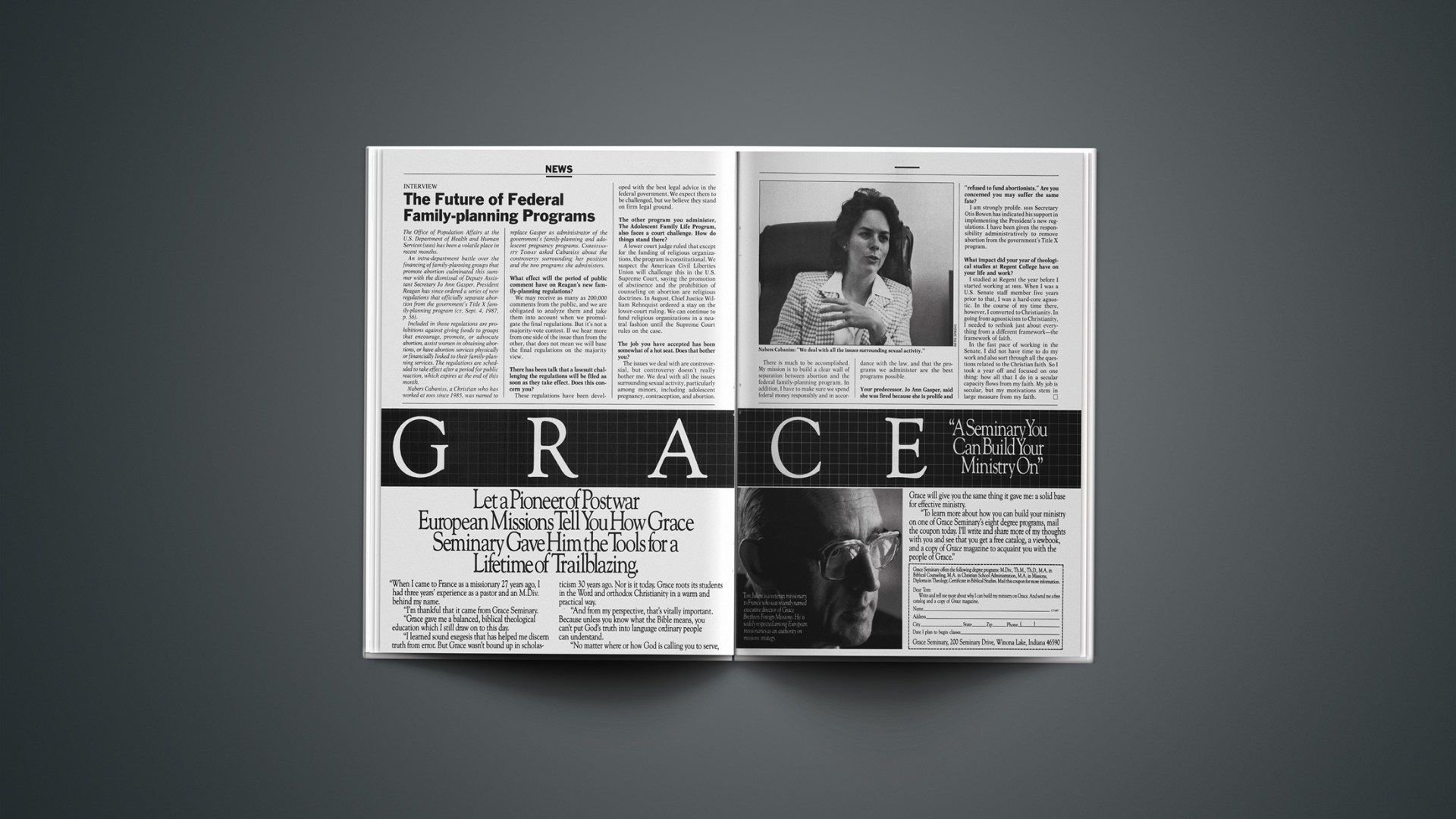
The Future of Federal Family-Planning Programs

The Office of Population Affairs at the U.S. Department of Health and Human Services (HHS) has been a volatile place in recent months.

An intra-department battle over the financing of family-planning groups that promote abortion culminated this summer with the dismissal of Deputy Assistant Secretary Jo Ann Gasper. President Reagan has since ordered a series of new regulations that officially separate abortion from the government’s Title X family-planning program (CT, Sept. 4, 1987, p. 56).

Included in those regulations are prohibitions against giving funds to groups that encourage, promote, or advocate abortion, assist women in obtaining abortions, or have abortion services physically or financially linked to their family-planning services. The regulations are scheduled to take effect after a period for public reaction, which expires at the end of this month.

Nabers Cabaniss, a Christian who has worked at HHS since 1985, was named to replace Gasper as administrator of the government’s family-planning and adolescent pregnancy programs. CHRISTIANITY TODAY asked Cabaniss about the controversy surrounding her position and the two programs she administers.

What effect will the period of public comment have on Reagan’s new family-planning regulations?

We may receive as many as 200,000 comments from the public, and we are obligated to analyze them and take them into account when we promulgate the final regulations. But it’s not a majority-vote contest. If we hear more from one side of the issue than from the other, that does not mean we will base the final regulations on the majority view.

There has been talk that a lawsuit challenging the regulations will be filed as soon as they take effect. Does this concern you?

These regulations have been developed with the best legal advice in the federal government. We expect them to be challenged, but we believe they stand on firm legal ground.

The other program you administer, The Adolescent Family Life Program, also faces a court challenge. How do things stand there?

A lower court judge ruled that except for the funding of religious organizations, the program is constitutional. We suspect the American Civil Liberties Union will challenge this in the U.S. Supreme Court, saying the promotion of abstinence and the prohibition of counseling on abortion are religious doctrines. In August, Chief Justice William Rehnquist ordered a stay on the lower-court ruling. We can continue to fund religious organizations in a neutral fashion until the Supreme Court rules on the case.

The job you have accepted has been somewhat of a hot seat. Does that bother you?

The issues we deal with are controversial, but controversy doesn’t really bother me. We deal with all the issues surrounding sexual activity, particularly among minors, including adolescent pregnancy, contraception, and abortion.

There is much to be accomplished. My mission is to build a clear wall of separation between abortion and the federal family-planning program. In addition, I have to make sure we spend federal money responsibly and in accordance with the law, and that the programs we administer are the best programs possible.

Your predecessor, Jo Ann Gasper, said she was fired because she is prolife and “refused to fund abortionists.” Are you concerned you may suffer the same fate?

I am strongly prolife. HHS Secretary Otis Bowen has indicated his support in implementing the President’s new regulations. I have been given the responsibility administratively to remove abortion from the government’s Title X program.

What impact did your year of theological studies at Regent College have on your life and work?

I studied at Regent the year before I started working at HHS. When I was a U.S. Senate staff member five years prior to that, I was a hard-core agnostic. In the course of my time there, however, I converted to Christianity. In going from agnosticism to Christianity, I needed to rethink just about everything from a different framework—the framework of faith.

In the fast pace of working in the Senate, I did not have time to do my work and also sort through all the questions related to the Christian faith. So I took a year off and focused on one thing: how all that I do in a secular capacity flows from my faith. My job is secular, but my motivations stem in large measure from my faith.

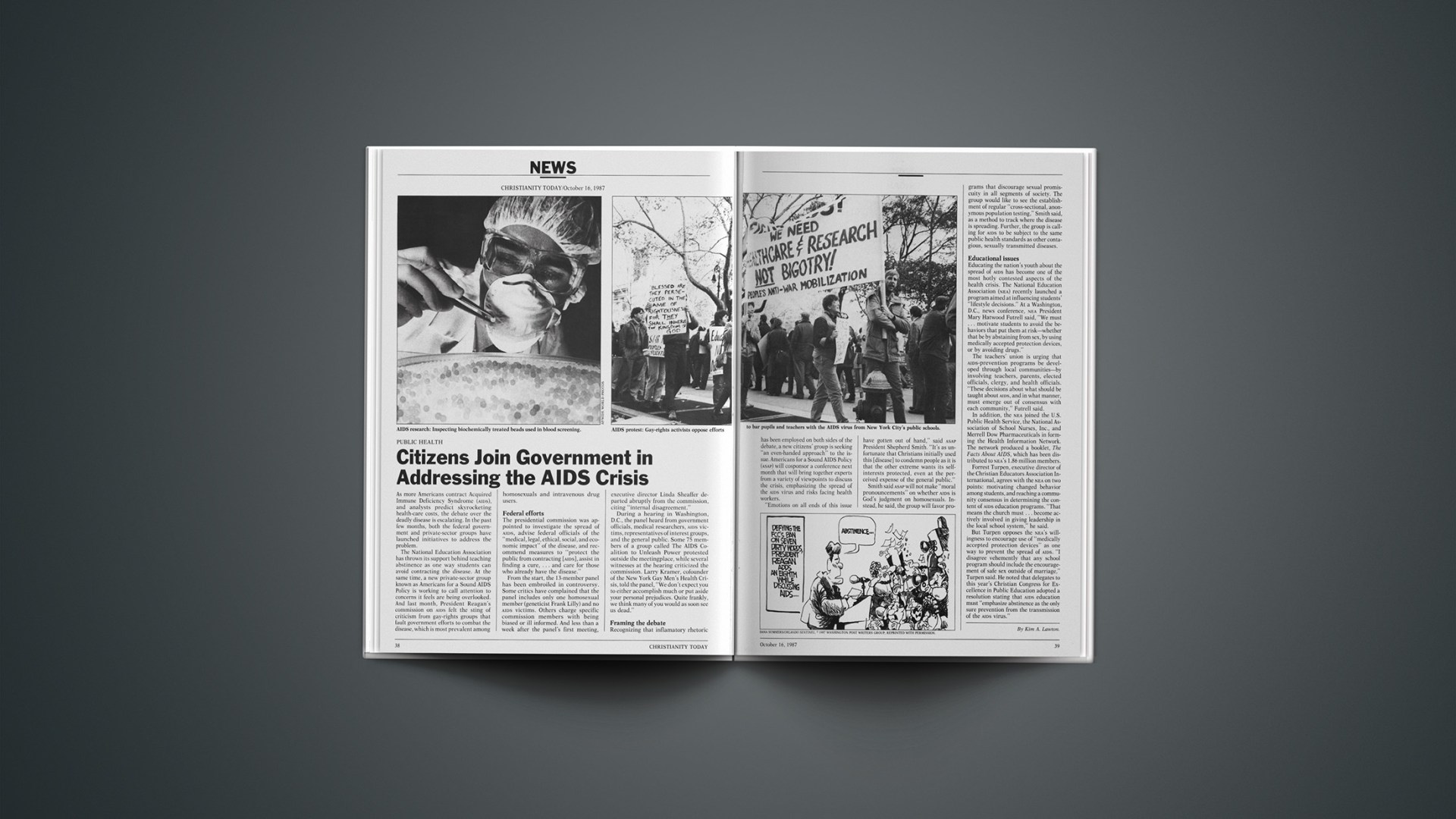
Citizens Join Government in Addressing the AIDS Crisis

As more Americans contract Acquired Immune Deficiency Syndrome (AIDS), and analysts predict skyrocketing health-care costs, the debate over the deadly disease is escalating. In the past few months, both the federal government and private-sector groups have launched initiatives to address the problem.

The National Education Association has thrown its support behind teaching abstinence as one way students can avoid contracting the disease. At the same time, a new private-sector group known as Americans for a Sound AIDS Policy is working to call attention to concerns it feels are being overlooked. And last month, President Reagan’s commission on AIDS felt the sting of criticism from gay-rights groups that fault government efforts to combat the disease, which is most prevalent among homosexuals and intravenous drug users.

Federal Efforts

The presidential commission was appointed to investigate the spread of AIDS, advise federal officials of the “medical, legal, ethical, social, and economic impact” of the disease, and recommend measures to “protect the public from contracting [AIDS], assist in finding a cure, … and care for those who already have the disease.”

From the start, the 13-member panel has been embroiled in controversy. Some critics have complained that the panel includes only one homosexual member (geneticist Frank Lilly) and no AIDS victims. Others charge specific commission members with being biased or ill informed. And less than a week after the panel’s first meeting, executive director Linda Sheaffer departed abruptly from the commission, citing “internal disagreement.”

During a hearing in Washington, D.C., the panel heard from government officials, medical researchers, AIDS victims, representatives of interest groups, and the general public. Some 75 members of a group called The AIDS Coalition to Unleash Power protested outside the meeting place, while several witnesses at the hearing criticized the commission. Larry Kramer, cofounder of the New York Gay Men’s Health Crisis, told the panel, “We don’t expect you to either accomplish much or put aside your personal prejudices. Quite frankly, we think many of you would as soon see us dead.”

Framing The Debate

Recognizing that inflamatory rhetoric has been employed on both sides of the debate, a new citizens’ group is seeking “an even-handed approach” to the issue. Americans for a Sound AIDS Policy (ASAP) will cosponsor a conference next month that will bring together experts from a variety of viewpoints to discuss the crisis, emphasizing the spread of the AIDS virus and risks facing health workers.

“Emotions on all ends of this issue have gotten out of hand,” said ASAP President Shepherd Smith. “It’s as unfortunate that Christians initially used this [disease] to condemn people as it is that the other extreme wants its self-interests protected, even at the perceived expense of the general public.”

Smith said ASAP will not make “moral pronouncements” on whether AIDS is God’s judgment on homosexuals. Instead, he said, the group will favor programs that discourage sexual promiscuity in all segments of society. The group would like to see the establishment of regular “cross-sectional, anonymous population testing,” Smith said, as a method to track where the disease is spreading. Further, the group is calling for AIDS to be subject to the same public health standards as other contagious, sexually transmitted diseases.

Educational Issues

Educating the nation’s youth about the spread of AIDS has become one of the most hotly contested aspects of the health crisis. The National Education Association (NEA) recently launched a program aimed at influencing students’ “lifestyle decisions.” At a Washington, D.C., news conference, NEA President Mary Hatwood Futrell said, “We must … motivate students to avoid the behaviors that put them at risk—whether that be by abstaining from sex, by using medically accepted protection devices, or by avoiding drugs.”

The teachers’ union is urging that AIDS-prevention programs be developed through local communities—by involving teachers, parents, elected officials, clergy, and health officials. “These decisions about what should be taught about AIDS, and in what manner, must emerge out of consensus with each community,” Futrell said.

In addition, the NEA joined the U.S. Public Health Service, the National Association of School Nurses, Inc., and Merrell Dow Pharmaceuticals in forming the Health Information Network. The network produced a booklet, The Facts About AIDS, which has been distributed to NEA’s 1.86 million members.

Forrest Turpen, executive director of the Christian Educators Association International, agrees with the NEA on two points: motivating changed behavior among students, and reaching a community consensus in determining the content of AIDS education programs. “That means the church must … become actively involved in giving leadership in the local school system,” he said.

But Turpen opposes the NEA’s willingness to encourage use of “medically accepted protection devices” as one way to prevent the spread of AIDS. “I disagree vehemently that any school program should include the encouragement of safe sex outside of marriage,” Turpen said. He noted that delegates to this year’s Christian Congress for Excellence in Public Education adopted a resolution stating that AIDS education must “emphasize abstinence as the only sure prevention from the transmission of the AIDS virus.”

By Kim A. Lawton

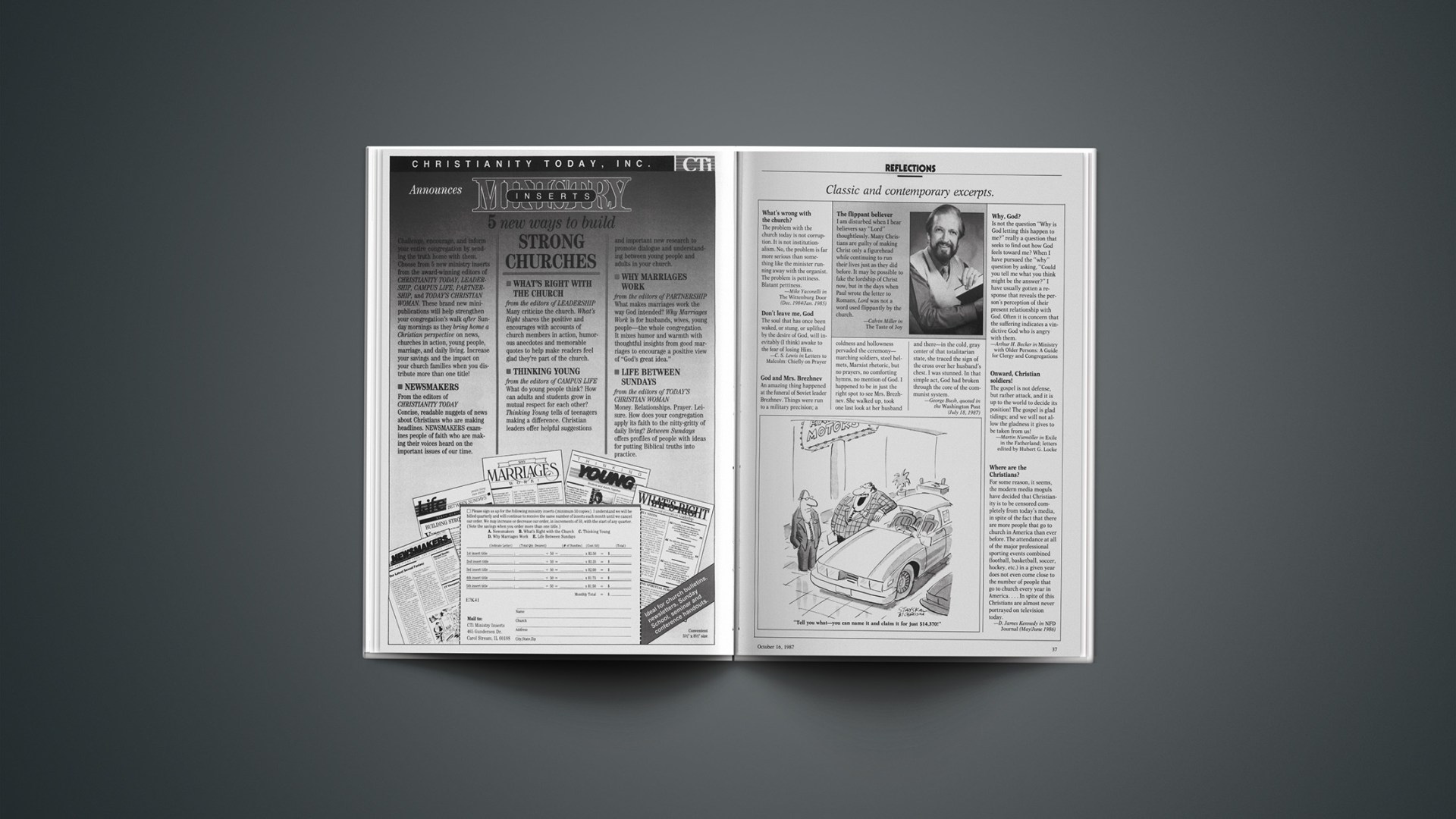
Classic & Contemporary Excerpts from October 16, 1987

What’s wrong with the church?

The problem with the church today is not corruption. It is not institutionalism. No, the problem is far more serious than something like the minister running away with the organist. The problem is pettiness. Blatant pettiness.

—Mike Yaconelli in

The Wittenburg Door

(Dec. 1984/Jan. 1985)

Don’t leave me, God

The soul that has once been waked, or stung, or uplifted by the desire of God, will inevitably (I think) awake to the fear of losing Him.

C. S. Lewis in Letters to Malcolm: Chiefly on Prayer

God and Mrs. Brezhnev

An amazing thing happened at the funeral of Soviet leader Brezhnev. Things were run to a military precision; a coldness and hollowness pervaded the ceremony—marching soldiers, steel helmets, Marxist rhetoric, but no prayers, no comforting hymns, no mention of God. I happened to be in just the right spot to see Mrs. Brezhnev. She walked up, took one last look at her husband and there—in the cold, gray center of that totalitarian state, she traced the sign of the cross over her husband’s chest. I was stunned. In that simple act, God had broken through the core of the communist system.

—George Bush, quoted in the Washington Post (July 18, 1987)

The flippant believer

I am disturbed when I hear believers say “Lord” thoughtlessly. Many Christians are guilty of making Christ only a figurehead while continuing to ran their lives just as they did before. It may be possible to fake the lordship of Christ now, but in the days when Paul wrote the letter to Romans, Lord was not a word used flippantly by the church.

—Calvin Miller in The Taste of Joy

Why, God?

Is not the question “Why is God letting this happen to me?” really a question that seeks to find out how God feels toward me? When I have pursued the “why” question by asking, “Could you tell me what you think might be the answer?” I have usually gotten a response that reveals the person’s perception of their present relationship with God. Often it is concern that the suffering indicates a vindictive God who is angry with them.

—Arthur H. Becker in Ministry with Older Persons: A Guide for Clergy and Congregations

Onward, Christian soldiers!

The gospel is not defense, but rather attack, and it is up to the world to decide its position! The gospel is glad tidings; and we will not allow the gladness it gives to be taken from us!

—Martin Niemoller in Exile in the Fatherland; letters edited by Hubert G. Locke

Where are the Christians?

For some reason, it seems, the modern media moguls have decided that Christianity is to be censored completely from today’s media, in spite of the fact that there are more people that go to church in America than ever before. The attendance at all of the major professional sporting events combined (football, basketball, soccer, hockey, etc.) in a given year does not even come close to the number of people that go to church every year in America.… In spite of this Christians are almost never portrayed on television today.

D. James Kennedy in NFD Journal (May/June 1986)

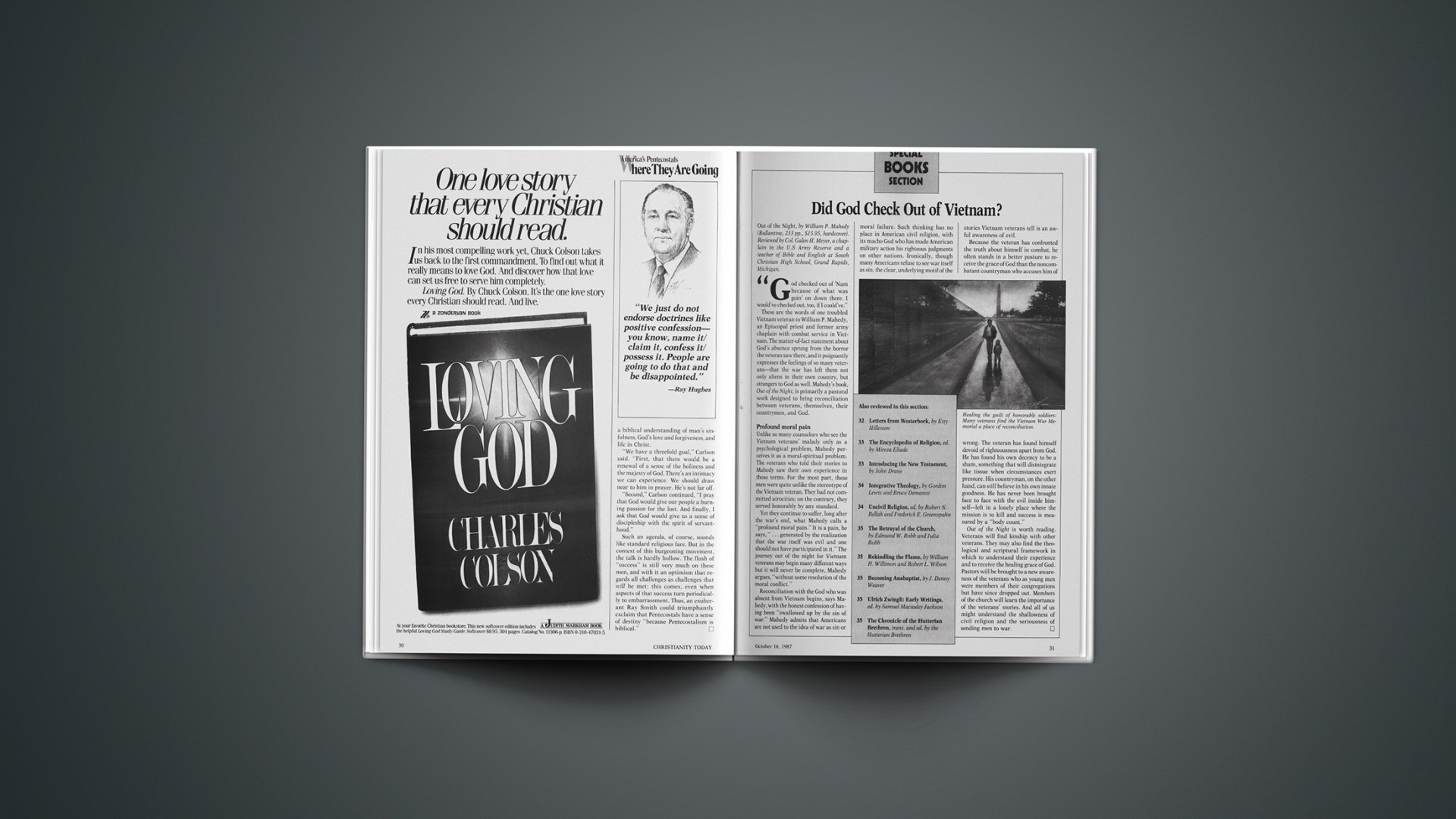
Did God Check Out of Vietnam?

Did God Check Out Of Vietnam?

Out of the Night, by William P. Mahedy (Ballantine, 233 pp., $15.95, hardcover). Reviewed by Col. Galen H. Meyer, a chaplain in the U.S Army Reserve and a teacher of Bible and English at South Christian High School, Grand Rapids, Michigan.

“God checked out of ‘Nam because of what was goin’ on down there. I would’ve checked out, too, if I could’ve.”

These are the words of one troubled Vietnam veteran to William P. Mahedy, an Episcopal priest and former army chaplain with combat service in Vietnam. The matter-of-fact statement about God’s absence sprung from the horror the veteran saw there, and it poignantly expresses the feelings of so many veterans—that the war has left them not only aliens in their own country, but strangers to God as well. Mahedy’s book, Out of the Night, is primarily a pastoral work designed to bring reconciliation between veterans, themselves, their countrymen, and God.

Profound Moral Pain

Unlike so many counselors who see the Vietnam veterans’ malady only as a psychological problem, Mahedy perceives it as a moral-spiritual problem. The veterans who told their stories to Mahedy saw their own experience in those terms. For the most part, these men were quite unlike the stereotype of the Vietnam veteran. They had not committed atrocities; on the contrary, they served honorably by any standard.

Yet they continue to suffer, long after the war’s end, what Mahedy calls a “profound moral pain.” It is a pain, he says, “… generated by the realization that the war itself was evil and one should not have participated in it.” The journey out of the night for Vietnam veterans may begin many different ways but it will never be complete, Mahedy argues, “without some resolution of the moral conflict.”

Reconciliation with the God who was absent from Vietnam begins, says Mahedy, with the honest confession of having been “swallowed up by the sin of war.” Mahedy admits that Americans are not used to the idea of war as sin or moral failure. Such thinking has no place in American civil religion, with its macho God who has made American military action his righteous judgments on other nations. Ironically, though many Americans refuse to see war itself as sin, the clear, underlying motif of the stories Vietnam veterans tell is an awful awareness of evil.

Because the veteran has confronted the truth about himself in combat, he often stands in a better posture to receive the grace of God than the noncombatant countryman who accuses him of wrong. The veteran has found himself devoid of righteousness apart from God. He has found his own decency to be a sham, something that will disintegrate like tissue when circumstances exert pressure. His countryman, on the other hand, can still believe in his own innate goodness. He has never been brought face to face with the evil inside himself—left in a lonely place where the mission is to kill and success is measured by a “body count.”

Out of the Night is worth reading. Veterans will find kinship with other veterans. They may also find the theological and scriptural framework in which to understand their experience and to receive the healing grace of God. Pastors will be brought to a new awareness of the veterans who as young men were members of their congregations but have since dropped out. Members of the church will learn the importance of the veterans’ stories. And all of us might understand the shallowness of civil religion and the seriousness of sending men to war.

“Before Our Eyes, Mass Murder”

Letters from Westerbork, by Etty Hillesum, introduction and notes by Jan G. Gaarlandt, translated by Arnold J. Pomerans (Pantheon; xviii + 156 pp.; $14.95, cloth). Reviewed by Paul W. Nisly, chairman of the language, literature, and fine arts department, Messiah College, in Grantham, Pennsylvania.

Readers who have read Etty Hillesum’s powerful journal, An Interrupted Life, will be grateful for this finely edited collection of her letters written in the embattled Netherlands of World War II. Etty Hillesum (then 27) began writing her intensely personal journal in March 1941—days of increasing Nazi pressure on Dutch Jewry.

In the summer of 1942, Etty was first shipped to Westerbork, a detaining camp in northeastern Netherlands for Jews before they were sent to Auschwitz. Both because of her work on the Jewish Council and because of her health problems, she was allowed to return to her native Amsterdam on several occasions—but always her heart was with her people in Westerbork.

Westerbork itself was a small camp, with 10,000 people eventually crowded into tiny huts and wooden barracks. Etty’s letters help us feel the awful mud and later the wind-whipped sand. Always there seemed no place even to write a letter. “I have visited ten different places in order to fill this one sheet of paper,” she once wrote to a friend.

Her letters reveal a young woman who cared deeply about human misery and uncertainty. Particularly poignant is her concern for her aging parents and her talented pianist brother, Mischa. Beyond her efforts for her family, she spent much time helping the old, the weak, the very young—all those who seemed especially vulnerable.

One of the horrors that she and the others faced was the weekly transport train, which came to the camp and took a thousand or more people to an unknown destination in Poland. Always there was the anxiety, the lack of knowledge: Who is on the list this time? My parents? My brother? A friend? Then there was the moral dilemma of knowing that if her parents and friends were spared, someone else’s parents or friends would fill the quota.

Beyond Comprehension

The experience was too incongruous to assimilate into her consciousness, much less to understand. “The sky is full of birds,” she wrote to friends, “the purple lupins stand up so regally and peacefully, two little old women have sat down on the box for a chat, the sun is shining on my face—and right before our eyes, mass murder. The whole thing is simply beyond comprehension.”

Yet always Etty Hillesum insisted that life, despite appearances, must have purpose. “One discovers that the basic materials of life are the same everywhere, and that one can live one’s life with meaning—or else one can die—in any spot on this earth.”

On September 7, 1943, Etty, her parents, brother, and a thousand others were crowded into a transport train bound for Poland. Did she remember her words from two months earlier?

“Against every new outrage and every fresh horror, we shall put up one more piece of love and goodness, drawing strength from within ourselves. We may suffer, but we must not succumb. And if we should survive unhurt in body and soul, but above all in soul, without bitterness and without hatred, then we shall have a right to a say after the war. Maybe I am an ambitious woman: I would like to have just a tiny bit of say.”

After 40 years Etty Hillesum is finally having her say. Reading these letters and knowing the outcome, one is angered, saddened, grieved and—yes, also—gratified, encouraged, enriched. The mystery of evil is profound, but not overwhelming.

Universal Urge

The Encyclopedia of Religion, Mircea Eliade, editor in chief (Macmillan, 16 vols.; $1,100.00, hardcover). Reviewed by Terry C. Muck.

Any doubts about religion being a universal urge of mankind will quickly be dispelled by a glance through the 16 volumes, 2,734 articles, and over 9,000 pages included in this monumental work. Authored and edited by the crème de la crème of religious-studies scholars and experts worldwide, the Encyclopedia of Religion describes religions from the four corners of the world, from African traditional religions to South American indigenous religions to Tibetan religions to Arctic religions. Articles mark points on a time line that reaches back to prehistoric faith traditions and forward to new religions and present-day movements, and smoothly covers everything in between—including the history of Christianity as seen through the eyes of history of religions scholars.

Edited by the recently deceased Mircea Eliade, perhaps the foremost history of religions scholar of our time, the Encyclopedia is structured for both comprehensive coverage of the field and for ease of use by scholar and layperson alike. It contains two types of articles. The first details each of the major religious traditions (44 are listed), and extensive supporting articles under each of those headings cover the important theologians, events, and principal beliefs of each tradition.

The second type of article takes the history of religions approach, viewing religion as a universal phenomenon. Articles falling into that category look at religious phenomena (such as almsgiving, faith, prayer, celibacy, and revelation) as they appear in many different traditions. There are also articles on the various methods of the study of religion itself, and the scholars who have made the study of religion their life’s work.

Obviously the Encyclopedia’s coverage of Christianity extends beyond the strictly conservative Christian point of view. Articles on Calvin, Bunyan, Fox, and Wesley have equal weight with those on Coleridge, Rahner, and Swedenborg. In the article on Abraham, we read not only what the Bible has to say about Abraham, but what extrabiblical sources, such as the Qur’an, have to say as well.

Yet it is not antagonistic to conservative Christianity. Because of the broad historical approach of the Encyclopedia, intricate points of Christian theology are not debated. Unfortunately, no evangelical scholars have written any of the Encyclopedia’s articles; but the history of religions is a field conservative Christian scholars have by and large chosen to avoid. Perhaps that avoidance is something we should address.

The Encyclopedia is a useful tool, the latest and best in a rich tradition of history of religions resource works. It can help scholar, pastor, and layperson locate his or her Christian tradition in the larger context of world history and the history of belief.

Drane Delivers

Introducing the New Testament, by John Drane (Harper & Row, 479 pp.; $19.95, cloth). Reviewed by Walter W. Wessel, professor of New Testament at Bethel Seminary West in San Diego, California.

Introductions to the New Testament are notoriously dry, usually authored by scholars whose ability to write lucid, succinct prose leaves much to be desired. Although they often claim to be written for “informed” or “intelligent” lay persons, they are in fact written by scholars for scholars.

So when an introduction comes along that is written in clear, intelligible language and demonstrates a grasp of what the real issues are, it is an occasion to celebrate. John Drane’s introduction is that kind of book.

Drane is interested in both history and theology. The kinds of questions he asks indicate this. He asks not only “When was Jesus born?” but “Who was he?”; not only “What is a Gospel?” but “Can we trust our Gospels?”; not only “Did Paul write 2 Thessalonians?” but “Did Paul really believe in freedom?”

Another attractive feature is the large number of contemporary photographs in the book. When Drane explains what it means to be a Christian according to Paul, a photograph shows a priest in a Latin American shantytown. The priest is “acting in the true spirit of the Apostle Paul, who ‘became all things to all men, that I by all means might save some.’ ” In another illustration, Sun Myung Moon becomes the modern example of ancient heretics, for he “claims to have received special revelations from God, though his teaching directly contradicts the Bible.”

Although the book is devoid of the typical scholarly trappings, one must not underestimate the author’s grasp of modern New Testament research. His discussion, for example, of the historicity of the Gospels is a model of clear and accurate analysis of the problems and of sound conclusions based on a thorough knowledge of the research.

Drane is refreshingly tough-minded in dealing with authorship questions. He is not persuaded by the subjective arguments that would deny the Pauline authorship of Ephesians and the Pastoral Epistles. He does, however, hold that 2 Peter may well have originated from a group of Peter’s disciples.

The foreword claims that ordinary readers (in addition to students and scholars) will want to read this book “as an aid to understanding the New Testament and getting to grips with its relevance for their own lives.” And Drane delivers.

The “Denver Theology”

Integrative Theology, Volume 1, by Gordon Lewis and Bruce Demarest (Zondervan, 394 pp.; $16.95, cloth). Reviewed by Stanley J. Grenz, associate professor of systematic theology and Christian ethics, North American Baptist Seminary in Sioux Falls, South Dakota.

At a time when there appears to be no end to new Baptist systematic theologies, Gordon Lewis and Bruce Demarest promise a unique approach—integrative theology. The innovation supposedly lies in the six-step process employed. In each chapter the authors follow the same pattern: problem, historical solutions, relevant biblical teaching, doctrinal development, defense in the face of contrary positions, application to life situations. Central to this process is the authors’ quasi-scientific method of testing theological hypotheses. The correct theological formulation is the one that explains the greatest amount of biblical data.

Whereas some may find this approach unusual, for me it was an “old friend.” Reading the book took me back to my student days at Denver Conservative Baptist Seminary in the mid-1970s. The publication of this first installment of a projected three-volume series indicates that the “Denver theology” is now taking definitive, printed form.

In Volume I the authors apply their approach to prolegomena and the doctrine of God. Most evangelicals will find few surprises here. Lewis and Demarest are uncompromisingly committed to revelation as primarily, if not solely, propositional. Therefore, they find strict inerrancy not only doctrinally correct, but also essential to the theological task. Part two contains a basically traditional description of the doctrine of God, centering on God’s attributes as mediating actual knowledge of the divine essence.

There is much to commend in this volume. Lewis and Demarest are strong advocates of the theological enterprise, being convinced that theology makes a profound difference in life. Their summaries of historical positions and of the relevant biblical data provide a wealth of information. The discussion of the Trinity is a high point, although the doctrine would have been better served by a greater emphasis on its historical development than on its supposed presence in the Bible. The authors also offer a plausible presentation of mild Calvinism.

Even though I share similar positions on certain major issues, the book left me with several of the same reservations I formulated in the classroom. The most significant of these center on the theological method and tone displayed in the work. Although promising in many ways, the method is simply inadequate. By working from a limited understanding of the nature of revelation, Lewis and Demarest make theology too rational, too traditional, and too easy. The reader comes away with a gnawing sense that the task has been oversimplified and the correct answers have too readily appeared.

In short, Integrative Theology will assist the convinced in remaining convinced. To this end it is a helpful addition to other similar works. Yet it may not spur students who want to find out not only the dangers to be avoided among the plurality of theological voices, but the lessons to be learned as well.

Book Briefs

Hostility With A Smile

Uncivil Religion, edited by Robert N. Bellah and Frederick E. Greenspahn (Crossroad, 235 pp.; $17.95, cloth).

Americans find it hard to imagine that anyone would kill for religion. We are tolerant. And yet, there are layers of incivility beneath the calm surface—tensions between Jews and Christians, Protestants and Catholics, liberals and conservatives, established and emerging groups. Uncivil Religion is an effort by 11 historians and sociologists to assess and understand these tensions.

Mark Noll’s essay, “Old Hostilities and New Strife,” uses two pairs of variables to explain recent Catholic-Protestant trends. First, differences concerning the historical conditioning of the Christian faith produce two modes, absolutist and historicist, which differ on whether Christianity should be fixed or developing. And second, the degree to which Christians have assimilated American values (either left or right) exposes another side of recent hostilities. From this analysis Noll describes three kinds of Protestants and Catholics: “old,” “new,” and “Americanist,” and the types of conflicts that have emerged from these differences.

George Marsden’s essay, “A Case of the Excluded Middle,” probes conservative-liberal tensions in the creation versus evolution conflict. He attributes belief in “scientific creationism” to a scientistic or precisionist view of Scripture inherited from millenarianism and Protestant scholasticism. The strength of creationism in the South is traced to North-South tensions that have their historic roots in the slavery controversy. The essay is a fine piece of historical detective work. It, of course, does not decide who is right, but it sheds light on why, when the leaders of early fundamentalism adopted mediating positions on evolution, opposition to all biological evolution has become a test of faith in some circles.

Methodists: Betrayed Or Rekindling?

The Betrayal of the Church, by Edmund W. Robb and Julia Robb (Crossway, 296 pp; $8.95, paper), and Rekindling the Flame, by William H. Willimon and Robert L. Wilson (Abingdon, 127 pp.; $9.95, cloth).

These two titles show something of the conservative-moderate tensions in the United Methodist Church. The Robbs provide a case study in the combination of theological critique and Americanist values, in this case adherence to democratic capitalism. Their opposition to the Religious Left, buttressed by scores of footnotes, is presented as a charge that the mainline churches have abandoned the gospel. They may have done so, but it confuses the argument to treat political and economic issues as though they were theological issues. If the churches were supporting democratic capitalism, would the Robbs object?

Willimon and Wilson, on the other hand, provide strategies to revitalize the church. Their primary call is to “recover the purpose of the church, reaffirm the Wesleyan heritage.” They see the purpose of the church as “formation of a visible people of God” (Matt. 28:19). The unique aspects of the Wesleyan heritage that they support are: the experience of grace as central to the gospel, Christian formation as the central purpose of the church, and the gospel preached and lived before all.

They urge the church to avoid commitment to what Noll (in the book reviewed above) calls Americanist values, either Right or Left, and point to the confusion that commitment has caused in the church. The book includes several specific proposals: serve the church instead of the clergy, demand leaders instead of managers, abolish minimum salaries for clergy (!), insist that clergy teach in the parish, simplify local church structure, and trust the laity.

Something You’re Not

Becoming Anabaptist, by J. Denny Weaver (Herald Press, 174 pp.; $14.95, paper).

In his concluding essay for Uncivil Religion, Robert N. Bellah says, “In order for me to know who I am I need to know who I am not. I am not you.” In this book, J. Denny Weaver says (to turn it around), “I’m an Anabaptist. And you’re not.” What is an Anabaptist? How did they arise? Why is it important?

Using recent historiography, Weaver emphasizes the geographical and theological diversity of early Anabaptism. Three of the five chapters in the book trace Swiss, South German and Moravian, and Low Country origins. A good set of maps, correlating sixteenth-century locations with modern ones, would have made this history even more serviceable. This is especially important when geography contributed to the varied expressions of Anabaptism.

Out of this diversity emerged the basic principles that the author urges on the heirs of the “believers church” tradition: Jesus as the norm of ethical conduct, the church as a community and a fellowship, and nonviolence as the foundation of social relations. He further notes that these themes are increasingly found outside traditional Anabaptist, Mennonite circles.

One of the places where Anabaptist principles are found is among social activists in the evangelical Left and center-Left. As an aid to understanding the perspective of these movements, Weaver’s study is invaluable.

“Fable Of The Ox” And Other Resources

Ulrich Zwingli: Early Writings, edited by Samuel Macauley Jackson (Labyrinth Press, 299 pp.; $15.95, paper) and The Chronicle of the Hutterian Brethren (Volume 1), translated and edited by the Hutterian Brethren (Plough Publishing House, 887 pp.; $36.00, cloth).

These two volumes provide an opportunity to read some of the sources used by J. Denny Weaver. Zwingli was a key figure in the Swiss movement, and Jakob Hutter a leader in Moravia. The Zwingli volume contains the first life of the Reformer to be written, from 1532, along with his “Fable of the Ox” (about the pope and other leaders), and some early pieces on Lenten fasting, marriage of priests, and the church tithe.

Hutterites provide models of living the Christian life under persecution and mistreatment. The Chronicle follows events—many of faithfulness under martyrdom—from 1525 to 1665, primarily in the Swiss Tirol and in Moravia/Slovakia. It serves to flesh out Weaver’s account of Moravian Anabaptism.

Book Briefs by Larry Sibley, who teaches practical theology at Westminster Theological Seminary in Philadelphia.

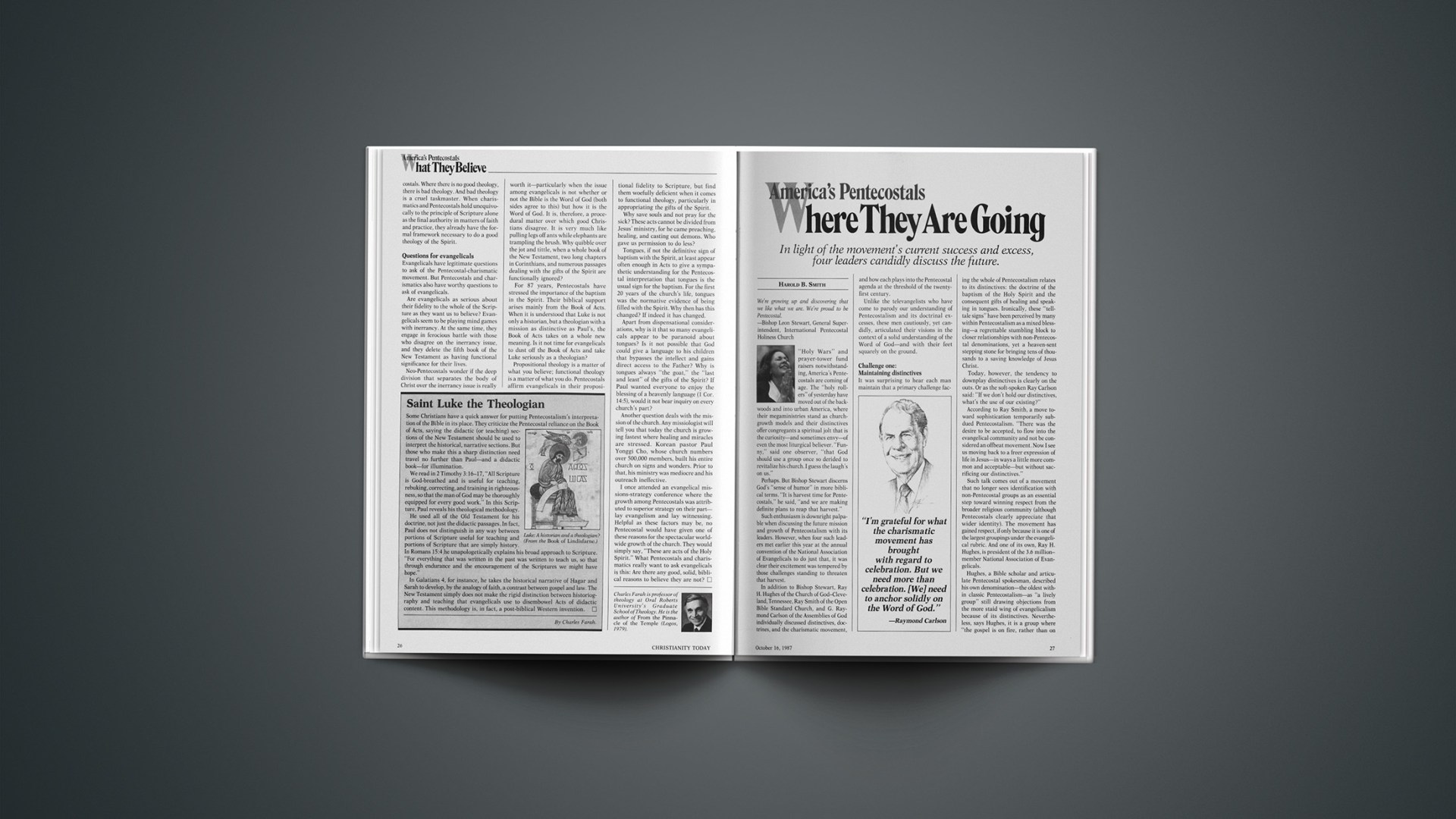
America’s Pentecostals Where They Are Going

In light of the movement’s current success and excess, four leaders candidly discuss the future.

We’re growing up and discovering that we like what we are. We‘re proud to be Pentecostal.

—Bishop Leon Stewart, General Superintendent, International Pentecostal Holiness Church

“Holy Wars” and prayer-tower fund raisers notwithstanding, America’s Pentecostals are coming of age. The “holy rollers” of yesterday have moved out of the back-woods and into urban America, where their megaministries stand as church-growth models and their distinctives offer congregants a spiritual jolt that is the curiosity—and sometimes envy—of even the most liturgical believer. “Funny,” said one observer, “that God should use a group once so derided to revitalize his church. I guess the laugh’s on us.”

Perhaps. But Bishop Stewart discerns God’s “sense of humor” in more biblical terms. “It is harvest time for Pentecostals,” he said, “and we are making definite plans to reap that harvest.”

Such enthusiasm is downright palpable when discussing the future mission and growth of Pentecostalism with its leaders. However, when four such leaders met earlier this year at the annual convention of the National Association of Evangelicals to do just that, it was clear their excitement was tempered by those challenges standing to threaten that harvest.

In addition to Bishop Stewart, Ray H. Hughes of the Church of God-Cleve-land, Tennessee, Ray Smith of the Open Bible Standard Church, and G. Raymond Carlson of the Assemblies of God individually discussed distinctives, doctrines, and the charismatic movement, and how each plays into the Pentecostal agenda at the threshold of the twenty-first century.

Unlike the televangelists who have come to parody our understanding of Pentecostalism and its doctrinal excesses, these men cautiously, yet candidly, articulated their visions in the context of a solid understanding of the Word of God—and with their feet squarely on the ground.

Challenge One: Maintaining Distinctives

It was surprising to hear each man maintain that a primary challenge facing the whole of Pentecostalism relates to its distinctives: the doctrine of the baptism of the Holy Spirit and the consequent gifts of healing and speaking in tongues. Ironically, these “telltale signs” have been perceived by many within Pentecostalism as a mixed blessing—a regrettable stumbling block to closer relationships with non-Pentecostal denominations, yet a heaven-sent stepping stone for bringing tens of thousands to a saving knowledge of Jesus Christ.

Today, however, the tendency to downplay distinctives is clearly on the outs. Or as the soft-spoken Ray Carlson said: “If we don’t hold our distinctives, what’s the use of our existing?”

According to Ray Smith, a move toward sophistication temporarily subdued Pentecostalism. “There was the desire to be accepted, to flow into the evangelical community and not be considered an offbeat movement. Now I see us moving back to a freer expression of life in Jesus—in ways a little more common and acceptable—but without sacrificing our distinctives.”

Such talk comes out of a movement that no longer sees identification with non-Pentecostal groups as an essential step toward winning respect from the broader religious community (although Pentecostals clearly appreciate that wider identity). The movement has gained respect, if only because it is one of the largest groupings under the evangelical rubric. And one of its own, Ray H. Hughes, is president of the 3.6 million-member National Association of Evangelicals.

Hughes, a Bible scholar and articulate Pentecostal spokesman, described his own denomination—the oldest within classic Pentecostalism—as “a lively group” still drawing objections from the more staid wing of evangelicalism because of its distinctives. Nevertheless, says Hughes, it is a group where “the gospel is on fire, rather than on ice.” The same could be said for the other three denominations as well.

“The emphasis on experience, on being built on the Holy Spirit, on being alive,” added Smith, “is like a love relationship where there’s emotion flowing and deep commitment, rather than a businesslike relationship solidly based on marriage principles alone. Pentecostalism adds the zip.”

And it is this characteristic “zip” that Pentecostals recognize as their peculiar kingdom contribution, and an attraction to more and more people. “The presentation of the real Jesus in our everyday lives and in our worship services,” said Bishop Stewart, “will attract a lot of people to our church.”

“It [the baptism of the Holy Spirit] is not our main doctrine,” cautioned Carlson. “That, of course, is Christ crucified, resurrected at the right hand of the Father. Still, it’s important to maintain the Pentecostal distinctives.”

“I think Pentecostals probably feel pretty comfortable with where they are,” said Smith. “It’s the non-Pentecostal evangelicals who are less and less comfortable—and they have to deal with that.”

Challenge Two: Charismatic Cordiality

Coming out of the closet with their distinctives will also necessitate Pentecostals coming to terms with a burgeoning charismatic movement. Surprisingly, surface similarities between classic Pentecostals and charismatics belie deep doctrinal differences. What looks to be a ready-made reservoir of new members for the historic Pentecostal churches is, in fact, a fiercely independent grouping within mainline Protestant and Catholic churches whose “freedom” earmarks both its worship style and doctrine. That troubles many Pentecostal leaders.

“I’m grateful for what the charismatic movement has brought with regard to celebration,” commented Carlson. “But it seems to be steeped in a very humanistic, materialistic kind of orientation. We need more than celebration. We always need that balance of the Word and the Spirit. You need to anchor solidly in the Word of God.”

Said Hughes: “We just do not endorse doctrines like positive confession—you know, name it/claim it, confess it/possess it. People are going to do that and be disappointed. But then again, I can hope those people go back to study the Scriptures concerning asking and having. They’ll see there are instructions, limitations. It says if he abides in you and if his words abide in you, and if it’s according to his will. From this closer inspection, and a desire to grow, they will come to the established Pentecostal churches. I am positive of that.”

Indeed, providing charismatics an anchor in one of the historic Pentecostal denominations is one way to minimize the “name it/claim it” aberrations.

“The independent movements,” continued Hughes, “are beginning to look for roots. They are looking for a solid place, a solid base—something they can sink their teeth into and raise their families in.”

Another “moderating influence,” yet one about which each man expressed certain reservations, is closer identification with the charismatic movement at events such as this past summer’s conference in New Orleans. Of the four groups represented, only the Pentecostal Holiness Church officially identified with the four-day affair drawing over 35,000 people.

“We will be an official part of it,” Bishop Stewart said before the conference, “but we are a little skeptical. But then, we were skeptical when joining the Pentecostal Fellowship of North America and the National Association of Evangelicals, and both of those experiences have proven to be good experiences for our church. In this particular case, we think the potential gain is worth the risk.”

Challenge Three: Dangling Doctrines

Interestingly, some of the doctrinal excesses of the charismatic movement have mirrored similar excesses within the historic Pentecostal churches and have consequently served to warn those churches against their own biblical infidelity. The age-old challenge to shore up emotionalism with a solid theological framework remains the quintessential nemesis facing Pentecostal leaders today.

“If you are living on experience only, you’re going to run aground,” Hughes said. “You must have an experience based in the Word, and not simply on whatever kind of theological framework you want.”

Clearly a concern of all the men was the materialistic prosperity gospel, trumpeted most noticeably by Pentecostal televangelists. Their comments concerning this “false witness” were particularly interesting in light of the fact that they were made prior to the PTL revelations.

“American churches have to get rid of hypocrisy, showmanship, sensationalism—a lot of that stuff,” said Bishop Stewart. “The young people today are smart enough to see right through that. What they want is the real Jesus.”

“It’s so easy to be caught up in ‘me-tooism’—what’s in it for me,” Carlson said. “We are not to use the Holy Spirit, the Holy Spirit is to use us. We must ask ourselves if what we are doing is just for us or for God’s glory. You can’t just name it and claim it.”

Explained Hughes: “Most of us Pentecostals came from the blue-collar working class, and the thing that made the movement grow was that it brought the gospel to the poor. We must not forget that, regardless of how the gospel has lifted us materially. We must not let materialism dominate us.”

“I like to put it this way,” Carlson added. “Stay in the middle of the streams of divine truth. Don’t be carried away by some of the spectacular. We can claim by faith, but the extremes—that’s what I want us to be careful of.”

In The End, Back To Basics

Carlson’s “middle of the stream” analogy summarized the general direction each of the four men hopes to steer his respective denomination in the days ahead. While seeing their Pentecostalism as unique, they all revel in that uniqueness only as it clearly focuses on a biblical understanding of man’s sinfulness, God’s love and forgiveness, and life in Christ.

“We have a threefold goal,” Carlson said. “First, that there would be a renewal of a sense of the holiness and the majesty of God. There’s an intimacy we can experience. We should draw near to him in prayer. He’s not far off.

“Second,” Carlson continued, “I pray that God would give our people a burning passion for the lost. And finally, I ask that God would give us a sense of discipleship with the spirit of servant-hood.”

Such an agenda, of course, sounds like standard religious fare. But in the context of this burgeoning movement, the talk is hardly hollow. The flush of “success” is still very much on these men, and with it an optimism that regards all challenges as challenges that will be met: this comes, even when aspects of that success turn periodically to embarrassment. Thus, an exuberant Ray Smith could triumphantly exclaim that Pentecostals have a sense of destiny “because Pentecostalism is biblical.”

Apple PodcastsDown ArrowDown ArrowDown Arrowarrow_left_altLeft ArrowLeft ArrowRight ArrowRight ArrowRight Arrowarrow_up_altUp ArrowUp ArrowAvailable at Amazoncaret-downCloseCloseEmailEmailExpandExpandExternalExternalFacebookfacebook-squareGiftGiftGooglegoogleGoogle KeephamburgerInstagraminstagram-squareLinkLinklinkedin-squareListenListenListenChristianity TodayCT Creative Studio Logologo_orgMegaphoneMenuMenupausePinterestPlayPlayPocketPodcastRSSRSSSaveSaveSaveSearchSearchsearchSpotifyStitcherTelegramTable of ContentsTable of Contentstwitter-squareWhatsAppXYouTubeYouTube