Books
Excerpt

Christian Parents: You Don’t Have to Protect Your Children from Divergent Opinions

If what we teach them is true, it will stand up to scrutiny.

Illustration by Rick Szuecs / Source image: Dan Kenyon / Getty

I finally gave up Christianity when I was 15,” wrote the famous atheist Richard Dawkins in Outgrowing God: A Beginner’s Guide. Dawkins hoped to reach the rising generation of kids with the good news that they don’t need religion. In the decades since the New Atheist movement launched, you might think this was the only message sounding from the academic world. But this is simply not the case.

10 Questions Every Teen Should Ask (and Answer) about Christianity

10 Questions Every Teen Should Ask (and Answer) about Christianity

Crossway

208 pages

$8.39

Religious belief was supposed to decline as modernization swept the world. But it hasn’t. Being a world-class academic and a serious, orthodox Christian was supposed to be increasingly untenable. But it isn’t. Giving up on religion was supposed to make people happier, healthier, and more moral. But it doesn’t. In fact, even Dawkins has had to acknowledge (grudgingly) the evidence that people who believe in God seem to behave better than those who don’t.

Broadly speaking, religious belief and practice seems to be good for society—and good for kids. Writing in The Wall Street Journal in 2019, therapist Erica Komisar gave this provocative advice: “Don’t believe in God? Lie to your children.”

Komisar was not shooting in the dark. There is growing evidence that regular religious practice is measurably good for the health, happiness, and pro-social behavior of our kids. In a recent study, the Harvard T. H. Chan School of Public Health found that it contributes to a wide range of health and well-being outcomes later in life. Of course, none of this means that belief in God is right, or that Christianity is true. It should, however, give us pause before assuming our kids are better off without religion.

If this data is challenging for nonreligious parents, then declining interest in religion (at least in the West) is worrying for believers. Just as evidence for the benefits of religious upbringing is mounting, cultural tides are pulling kids away from religious moorings. So what are parents, grandparents, and carers on all sides of these great debates to do?

Whatever our beliefs about God, there are some things on which I’m sure we agree: We all want our kids to be happy, healthy, purpose-filled, and good. Few of us would want to lie to our kids, especially about our deepest beliefs. We want them to know the truth. But we also want to protect them from plausible-sounding lies. Deep down we know there’s a tension: To keep our kids truly safe in the long run, we must let them risk-take now. We know this when it comes to practical skills. Babies won’t learn to walk unless we let them fall. Children won’t learn to ride a bike unless we let them risk a tumble or two. Teenagers who weren’t trusted with a bike won’t be ready for a car.

So how does this translate to the realm of ideas? For some parents, protecting their kids from dangerous ideas feels like a must. I’ve heard this both from Christians who don’t want their kids exposed to atheism and from atheists who don’t want their kids exposed to Christianity. I’ve even heard it from parents who think they are very open-mindedly encouraging their kids to explore different religious traditions. For these folks, the really dangerous idea is that one of these religions might actually be true. Many of us who are now in the thick of parenting were raised with the idea that questioning someone’s religious beliefs was arrogant, offensive, and wrong.

I want to offer a different approach. Rather than protecting my kids from divergent ideas, or urging them to affirm all beliefs equally, I want to equip them to have real conversations with real people who really think differently from them—and from me. I want them to learn how to listen well and how to question what they hear. If what I believe is true, it will stand up to scrutiny.

The Christian faith sprang up in a world violently hostile to its claims. But rather than extinguishing the small spark of the early church, the winds of opposition gave it oxygen to spread. I don’t want my kids believing in Jesus just because I say so, or just because it’s the largest and most diverse religion in the world, or just because going to church makes you happier, healthier, and more generous to others. I want them to see Jesus for themselves and to believe that what he says about himself is true.

Content adapted from 10 Questions Every Teen Should Ask (and Answer) about Christianity by Rebecca McLaughlin. Copyright © 2021. Used by permission of Crossway, a publishing ministry of Good News Publishers, Wheaton, IL 60187. www.crossway.org.

New & Noteworthy Books

Compiled by Matt Reynolds.

Work and Worship: Reconnecting Our Labor and Liturgy

Matthew Kaemingk and Cory B. Willson (Baker Academic)

Going to church and going to work each revolve around a particular set of rhythms: roles we perform instinctively and lines we know by heart. Yet the rhythms of Sunday and Monday morning “often feel as if they are a million miles apart,” say theologians Matthew Kaemingk and Cory B. Willson. Their book, Work and Worship, asks how believers beset by weekday pressures can experience Sunday as more than a welcome escape or an irrelevant sideshow. “Daily work,” they write, “should ‘show up’ in the community’s prayers and sermons, its songs and benedictions, its testimonies and sacraments. Theologies of work matter, but they need to be sung and prayed.”

Why Black Lives Matter: African American Thriving for the Twenty-First Century

Edited by Anthony B. Bradley (Cascade Books)

Under Martin Luther King Jr., the campaign for black civil rights took on an unmistakably Christian character. By contrast, today’s Black Lives Matter movement often feels alienated from organized religion. Why Black Lives Matter gathers black pastors, scholars, and theologians who bring their faith to bear on matters of black culture, church life, and political protest. As editor Anthony B. Bradley writes of the contributors, they differ on their “specific prescriptions for change,” but they “share a central conviction that there needs to be a resurgence of black religious leadership to properly form the Black Lives Matter movement.”

The Need for Creeds Today: Confessional Faith in a Faithless Age

J. V. Fesko (Baker Academic)

Many strains of American Christianity are skeptical of inherited tradition. They resist being bound to any faith statements they haven’t arrived at through their own biblical and spiritual reflection. In The Need for Creeds Today, theologian J. V. Fesko recovers the importance of the church’s historic confessions, showing how they proceed from the Bible’s own instructions and bring vitality, not bloodless conformity, to God’s people. “When we create, profess, and pass confessions down to future generations,” Fesko writes, “we do not propagate the dead faith of the living but the living faith of the dead.”

Books
Review

The Problem with À La Carte Politics

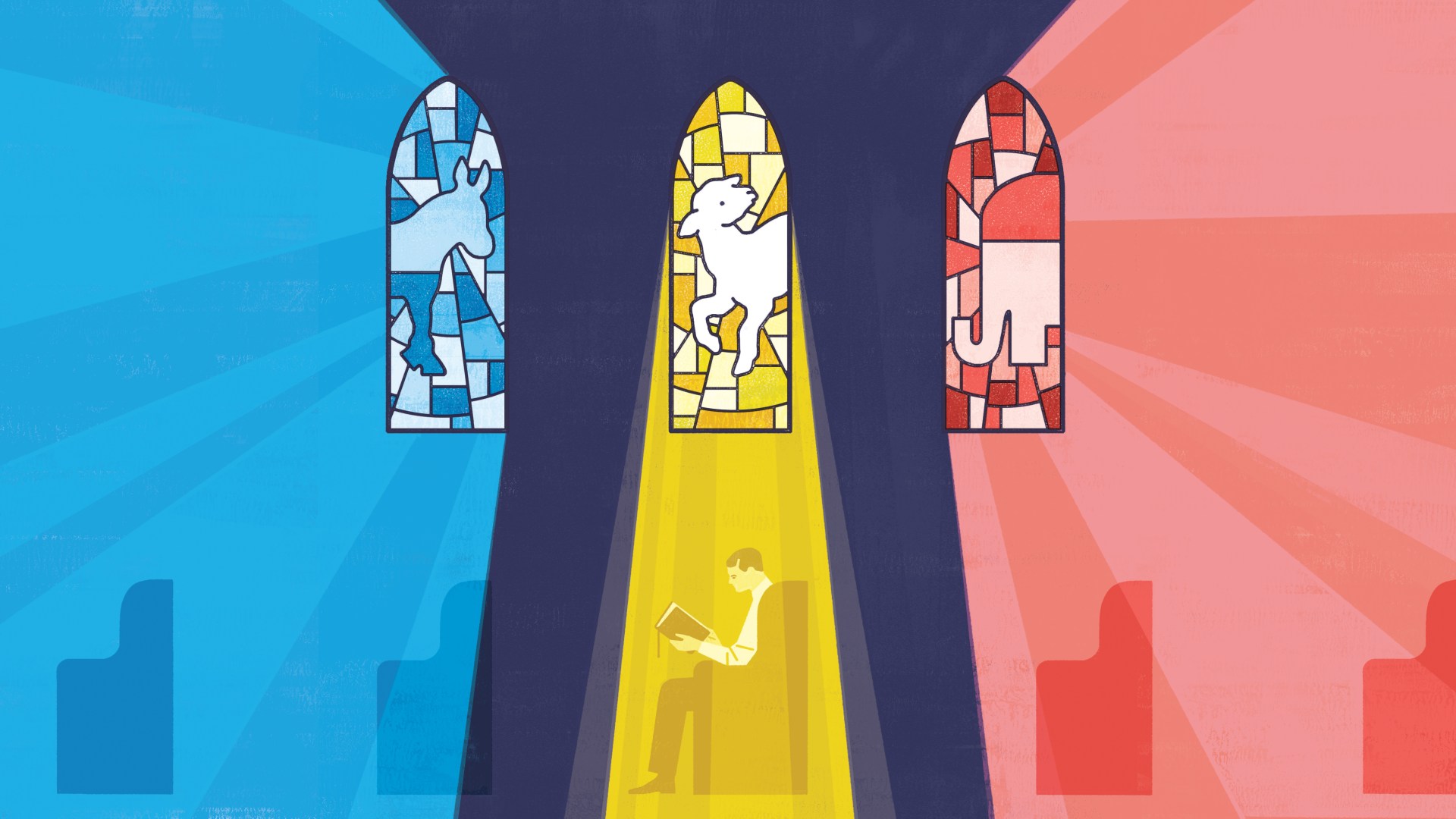
Christians won’t overcome partisanship just by resolving to order from each side’s policy menu.

Illustration by Chris Gash

A few months before the 1996 election, a stack of voting guides showed up at my nondenominational church in suburban Chicago. The guides contained candidates’ headshots and positions on a series of hot-button political issues, including abortion, homosexuality, and congressional term limits. Our church was one of approximately 125,000 to receive them, according to their source—the Christian Coalition, which had emerged out of Pat Robertson’s failed 1988 presidential campaign. Under federal tax-exemption laws, the Coalition guide could not explicitly endorse any candidates; it simply highlighted issues that ought to be high priorities for churchgoing evangelicals. The not-so-subtle messaging: Do the political math, and you will know who is on the side of the angels.

The Politics of the Cross: A Christian Alternative to Partisanship

The Politics of the Cross: A Christian Alternative to Partisanship

Wm. B. Eerdmans

336 pages

$24.97

As a precocious preteen, I occasionally heard rumblings of interesting adult conversations during coffee hour. The guides provoked a controversy that caught my attention immediately. Should the leaflets be inserted into the church bulletins? What kind of theological or political statement would that make? For a church whose ecclesiology swung as low as the Gaither band’s baritone, this was our only substantive liturgical debate of the year. I listened intently in the narthex and later studied the guide at home. For me, it seemed like a great political awakening at the time.

Religious personalities

In The Politics of the Cross: A Christian Alternative to Partisanship, Daniel K. Williams takes aim at the facile Christianization of partisan politics, on both the Left and the Right. There is an evangelical instinct, he thinks, to assume that one party’s platform is firmly aligned with biblical values. On the Right, pro-life advocacy dovetails with free-market ideology and stricter immigration policy. On the Left, advocacy for the poor and marginalized goes hand in hand with abortion rights and support for same-sex marriage. Progressive and conservative evangelicals alike assume that the Bible votes a straight ticket.

Williams, a historian, has written books on the development of the Christian Right and the lesser-known, rather surprising story of pro-life politics before Roe v. Wade. This new book marks a genre shift: from purely descriptive historical analysis to acknowledging and even relying upon his own theological commitments. And in an even more striking departure, Williams steps out to propose an alternative set of Christian political stances on contemporary hot-button issues.

This is not to say that The Politics of the Cross is light on actual historical work. Williams’s first two chapters in particular document what we might call the religious personalities of the Republican and Democratic parties. He describes the former as a kind of evangelical moralism and the latter as “secularized liberal Protestantism.” Both parties have an evangelistic fervor that informs their platforms to this day. But even though you might trace the historical path from Billy Sunday to Jerry Falwell on the Right, or from Walter Rauschenbusch to William J. Barber II on the Left, the path is rather convoluted. According to Williams, neither tradition universally and neatly coheres with biblical and theological truths.

The intuition behind Williams’s project is that a truly Christian politics—which he calls “cross-centered”—will likely adopt policies from the Left and the Right. While he thinks the moral values of the right tend to be more biblically informed, he suggests that they are often best protected through a strategic appropriation of progressive politics. For instance, he suggests, the most effective way to reduce the number of abortions may not be through the Supreme Court, but through progressive social policies that make it less likely for an impoverished teenage girl to think abortion is her only choice.

Four controversial issues set the agenda for the main part of the book—two high priorities for conservative evangelicals (abortion and sexuality) and two that have historically motivated their progressive counterparts (race and poverty). Judicious is the word to describe Williams’s handling of each. He is nuanced and unpresumptuous, and admirably unconcerned with whether his final conclusions will satisfy those to his ideological right or left.

In each issue-focused chapter, key political actors—from Ida B. Wells to Billy Graham to Donald Trump—are ushered on and off the historical stage in ways that dramatize how our polarized ideologies came to exist. Williams enjoys drawing out political ironies on both sides, whether it is the inconsistency of a pro-life platform that focuses myopically on human life before birth or—as he says—a pro-choice platform that fails to count the unborn among the marginalized. There are few better antidotes to uncritical orthodoxies than good, painstaking historical spadework, as this book shows.

But the lessons aren’t merely historical. Williams aims to offer biblical, theological, and political analysis of some of the most divisive issues in contemporary Christianity.

Each of Williams’s chosen hot-button issues receives the same careful attention that guides his historical analysis. For instance, on abortion, Williams leads readers through key scriptural texts, noting that although abortion itself is never explicitly addressed, it is possible to discern relevant moral principles about the value of human life and procreation. Similarly, on wealth and poverty, Williams draws attention to segments of the Mosaic Law that prescribe debt forgiveness and the liberation of slaves. It is easy to see how cookie-cutter ideologies, on both the Left and Right, are too neat and narrow to account for what Karl Barth once called “The Strange New World within the Bible.”

Theological anchors

As a survey of relevant biblical texts and theological principles on these four issues, Williams’s book is helpful. As a constructive program, however, it is ultimately unsatisfying.

In principle, there is nothing wrong with ordering à la carte from the Republican and Democratic menus. In practice, it seems unwise to do so without a holistic and robustly theological vision of political life. Although Williams desires a third-way approach, he is still offering an issue-driven checklist. It is piecemeal politics—vastly preferable to the ham-fisted Christian Coalition pamphlets, but nevertheless similar in form and function.

In describing and defending his scriptural, issue-centered approach, Williams claims the Reformed tradition as his heritage. But I suspect that Williams is actually describing an American evangelical instinct. Proof-text politics is generally foreign to classic Reformed theology, as it is to the greater part of the Christian tradition stretching back from Calvin to Aquinas to Augustine.

Johannes Althusius, one of my favorite Reformation-era political thinkers, described politics as the art of sharing life together. As an art form, politics aims to cultivate the practices and institutions that make communal life an invaluable good. For many of us, describing politics as an art rather than a set of policies requires a radical shift in perspective. We are accustomed to thinking about which candidate, party, or platform we should support every two to four years. But for all their importance, elections are a blink of the eye; the majority of political life is what happens in between.

How do we love our neighbor at the town hall, the dog park, the school board meeting, the abortion-clinic protest, or the Black Lives Matter rally? What do we owe to those we find disagreeable, unfamiliar, or even hateful? How do we ensure that every member of society can enjoy the goods of social life, rather than just the few, the powerful, and the native-born? What civic virtues should we cultivate in ourselves and our church communities to better suppress the temptations of unprincipled power, uncritical partisanship, and ethnic nationalism?

These are hard—but inescapably foundational—questions. And, perhaps unwittingly, they reveal an uncomfortable truth made especially evident over the past several years. To appropriate Mark Noll’s famous assessment in The Scandal of the Evangelical Mind, the scandal of evangelical political theology is that it does not really exist. Checklists, pamphlets, and partisan platforms are easy to manufacture, but without theological anchors, they are driftwood on the shifting sea of political power. Or perhaps more troubling, they suggest that an attraction to raw power may be written into the political DNA of evangelicalism, as historian Kristin Kobes Du Mez suggests in her recent book Jesus and John Wayne.

Of course, The Politics of the Crossattempts to save evangelical politics from partisan temptations. It is an admirable effort, but I harbor doubts about its effectiveness. The problem is, in part, one of audience and persuasion. In short: Whose political imagination should we try to capture, and how best should we capture it? Does Williams want to convince the Trump-voting 81 percent? The ex-evangelical Antifa activist? Or the few in the middle? And beyond that, will his careful, issue-based analysis draw many toward this third-way politics?

My original political awakening—or so I thought—was seeing all the policy dots connected via a church bulletin insert. That proved as fleeting as Republican support for congressional term limits. I suspect that any hopes for a second, longer-lasting awakening among evangelicals will arrive not via proof-text politics, but through an encounter with the rich historic tradition of theological reflection on the common good, as developed by figures like Augustine, Aquinas, Calvin, Frederick Douglass, Dorothy Day, and Gustavo Gutiérrez.

The Spirit works in mysterious ways, but redemptive history shows that he is especially present with those who do justice, love mercy, and walk humbly. We have a cloud of witnesses who exemplify these virtues, who weave together the threads of biblical narrative, theological reflection, and political visions of the good life. The lingering question is whether the witnesses will be heard in this uncritically partisan age.

David Henreckson is the director of the Institute for Leadership and Service at Valparaiso University. He is the author of The Immortal Commonwealth: Covenant, Community, and Political Resistance in Early Reformed Thought.

Books
Review

Evangelical Thinking on the Trinity Is Often Remarkably Revisionist

Theologian Matthew Barrett diagnoses our drift away from an orthodox understanding of Father, Son, and Spirit.

Illustration by Rick Szuecs / Source image: Envato

By and large, American evangelical Christians have conservative views of Scripture and morality. According to theologian Matthew Barrett, however, their most basic claims about God are often remarkably revisionist.

Simply Trinity: The Unmanipulated Father, Son, and Spirit

Simply Trinity: The Unmanipulated Father, Son, and Spirit

Baker Books

368 pages

$13.20

Barrett, professor at Midwestern Baptist Theological Seminary and executive editor of Credo Magazine, is the author of Simply Trinity: The Unmanipulated Father, Son, and Spirit. The book—a follow-up to his 2019 work None Greater: The Undomesticated Attributes of God—does two things. First, it shows how a good portion of evangelical theology on the Trinity has drifted from the classical Christian tradition. Second, it recruits a veritable “dream team” of teachers from across that tradition to lead readers back to the safe harbor of biblical orthodoxy. The tone is accessible, but the sources are deep.

How has evangelicalism gone wrong in its understanding of the Trinity? Barrett ranges broadly, but he fixes on the development, in recent theology, of what he calls “social trinitarianism.” Proponents of this view, which is more of a common posture than a monolithic school, tend to conceive of the oneness of God as a community of persons. Barrett introduces some of its major figures, including liberal theologians like Jürgen Moltmann and Leonardo Boff and American conservative counterparts like Wayne Grudem and Bruce Ware.

The hallmark of social Trinitarianism is its willingness to appropriate the relationships between the persons of the Trinity as a model for various social projects. For liberals like Moltmann and Boff, this can mean invoking the equal status of Father, Son, and Spirit to advance an egalitarian vision of society. Conservatives like Grudem and Ware sometimes point to supposed hierarchies within the Trinity—namely, what they call the Son’s “eternal submission” to the Father—as grounds for their complementarian views on gender roles. (Plenty of complementarians disagree. Liam Goligher, pastor of Tenth Presbyterian Church, raised the alarm several years ago in a viral blog post accusing Grudem and Ware of undermining the unity that exists between Father, Son, and Spirit.) Simply Trinity provides a thorough analysis of how revisionist trends in Trinitarian theology have settled into the seemingly conservative world of American evangelicalism.

What’s the way home? In part two of his book, Barrett retrieves classical Trinitarian teachings, addressing the relationship of eternity and history while affirming the oneness and simplicity of God. The doctrines he covers—the “eternal generation” of the Son, the “eternal procession” of the Spirit, and the “inseparable operations” of the triune God—can sound rather elevated, but Barrett explains them with ease and clarity.

Amid these chapters, Barrett also offers a single chapter examining the claim by Grudem, Ware, and others that the Son is “eternally subordinate” to the Father. He rightly shows that the relations of origin between Father, Son, and Spirit profoundly affect our understanding of salvation.

The book isn’t perfect. Barrett doesn’t always go deep enough in addressing either the root causes of recent revisionism or the glories of classical Christian understandings of the Trinity. And he fails to locate the work of Trinitarian reflection within larger questions of Christian spiritual formation, which restricts the book’s focus mainly to matters of intellectual debate and biblical interpretation.

This doesn’t quite match the mode of classical Christian thought. Take the fourth-century church father Gregory of Nazianzus, for example. In his Five Theological Orations, he certainly addresses Bible passages about the Father, Son, and Spirit—but only after reflecting on the spiritual preparation needed for Trinitarian conversation.

In his Confessions, Augustine demonstrates that God, as characterized in Scripture, is a character unlike any other. But Social Trinitarianisms, of the left or the right, tend to make the mistake of drawing false analogies between God and other people. Unless we address that root malady, we’ll continuing seeing symptoms of theological error pop up from time to time.

Still, Simply Trinity goes a long way toward identifying and excising some of these harmful tendencies. For anyone who has read confusing blog posts about the Trinity in recent years, the book will help you regain your theological bearings. And for anyone seeking to recover the riches of worshiping one God in three persons, Barrett will prove a more than able guide.

Michael Allen is the John Dyer Trimble Professor of Systematic Theology at Reformed Theological Seminary in Orlando, Florida. He is a co-editor of The Oxford Handbook of Reformed Theology.

Books

Ordinary Life Is Crammed with Heaven

How our senses can point the way to God’s presence.

Yipengge / Getty

Taste and see that the Lord is good.” For Joel Clarkson, a composer and Berklee College of Music graduate, words like these (from Psalm 34:8) offer much more than a metaphor. In Sensing God: Experiencing the Divine in Nature, Food, Music, and Beauty, Clarkson, now pursuing a theology PhD at the University of St Andrews in Scotland, shows how our physical senses can point the way to a larger understanding of our Creator and his workmanship. Recording artist and record producer Charlie Peacock spoke with Clarkson about the many touch points between Christian faith and everyday life.

Sensing God: Experiencing the Divine in Nature, Food, Music, and Beauty

Sensing God: Experiencing the Divine in Nature, Food, Music, and Beauty

NavPress

224 pages

$21.41

What does it look like to cultivate a theology of the senses?

We live in a world of experience, and this is a core aspect of our faith. It’s not that faith is on one side, with everyday experiences on the other. These actually go together. Within our daily lives, there are many touch points: the food we eat, the music we listen to, the people we meet, and the nature we encounter.

I hope my book conveys the idea that the world, and our lives within it, are crammed with heaven. Heavenly activity doesn’t just occur during transcendent moments, like seeing the northern lights or hearing a beautiful concert. Even amid the mundane, we can encounter God’s presence. And this isn’t a matter of doing something new so much as changing our perspective within the space we already occupy.

Enjoying God through our senses opens up a larger experience of the world and life in Christ. Scripture is full of the language of desire, and we are called to worship the Lord in the beauty of his holiness. Our intellect and senses work together toward the end of loving God with our whole hearts.

In the book, I argue that we love and desire beauty because beauty begins and ends in God, as manifested through the whole of creation. Ephesians 2 says that we are God’s “masterpiece” (v. 10, NLT). The Greek term, poiema, is associated with making, with creating. God is a creator, and to deny the value of creativity, of beautiful things, is actually to limit our vision of who God is and the works he might call us to do.

Your book focuses on the importance of the Incarnation. How should it shape our perspective on our physical senses?

We often live out a philosophy of dualism between mind and body, believing that ultimately it’s our minds that lead us into a proper understanding of reality. How we think and what we believe are very important, of course, but our beliefs are rooted in a deeper reality. At the heart of Christianity is not an idea but a person, the person of Christ. We can’t get around it, because it happened in our time and space. God entered into the dimensions that we exist in day to day. The Incarnation changes the way that we think about the fabric of the universe and creation itself.

I have this memory of coming home from Berklee one semester, feeling lost and distant and experiencing spiritual dryness. Of course, one’s college years are often the setting for crises of faith, especially in the West—and especially for those who grew up in the church.

I talked to my mother about this, and she was very gentle with me. There I was in Colorado, where my family lives, on this beautiful spring afternoon with the pines blowing in the wind and the sun beginning to set. We had a cup of coffee, and she just began pointing out these elements of creation and saying, “Don’t worry about feeling close to God. He’s reaching out to you at this very moment in these elements. It’s his gift to you, to the whole world.” Before anything else is true, before we receive anything else, existence comes to us as a gift of God’s grace.

We’re both musicians, so let’s talk about music. How has your background shaped your thinking on the relationship between faith and art?

I started out in the film industry doing composing, orchestrating, and conducting. In recent years, I’ve turned my focus to church settings, leading choirs and doing some choral conducting.

Working in a sacred-music setting has helped spark questions about the purpose of artistry and music and how we encounter God through them. My doctoral thesis looks at contemporary musical theology. I’m looking to understand how music leads us into deeper participation in corporate worship, and how that draws us into the work of what Christ does within it.

Music can be a glorious, transcendent thing. Before the digital age, all music had to be created by some movement of the body: by drawing a bow across a string, say, or drawing air out of lungs and over vocal cords. There’s this embodied aspect to music that makes us aware of ourselves, all while drawing us into the experience of a transcendent space beyond.

The more we enter into the cosmos of faith and the work of Christ in us, growing in sanctification and letting ourselves be shaped by the rhythms of liturgy, the greater our openness to this sense of improvisation in all of life. We gain the capacity to be awed by something as simple as sunlight through a window and to let that change us for the good.

In your book, you mention Robert Farrar Capon’s book The Supper of the Lamb. How would you describe the importance of food and table fellowship to the Christian life?

At the heart of a Christian theology of the senses is a meal. The narrative of Scripture begins in a garden and ends in a wedding feast. And right in the middle is this beautiful gift that Jesus gives to his disciples: his body and blood, the bread and wine of life. This isn’t just the story of the Upper Room; it continues with Luke 24, on the road to Emmaus. The followers Jesus meets are talking through ideas and theology, and they don’t recognize Christ until he takes bread into his hand and breaks it (vv. 30–32). Ultimately, it’s a visible, tangible sign that makes them aware of who Christ is.

Knowing God through sensory experience, you argue, ultimately points to Christ’s ministry of reconciliation. Can you elaborate?

We never want to lose the fullness of what reconciliation makes possible. Reconciliation to God in Christ is central, but so is sharing in God’s life as participants in the new heavens and the new earth, where we will meet for a feast at the table of God, celebrating the supper of the Lamb.

John 1 is one of my favorite Bible passages. It begins not with Christ as Redeemer but Christ as Creator. In the beginning was the Word, and through him all things were made. It reads like a recapitulation of Genesis 1. John is revealing that Christ, the author of salvation, is the author of all creation, and that the glory of the creative act includes the acts of redemption—Jesus’ incarnation, crucifixion, and resurrection. All are inextricably bodily things.

God doesn’t intend to abandon creation. He intends to redeem it. We look forward to the moment when all things are made right. That’s our hope in Christ. Our senses testify to the hope within us, not by communicating the mere idea of Christ but by pointing to actual things in his world as tangible signs of the glory we anticipate.

Cover Story

Paul’s Letter to a Prejudiced Church

How the apostle’s instructions on the Lord’s Supper speak to multiethnic congregations today.

Illustration by Chad Hagen

Read the rest of our March coverage of multicultural churches: Korie Little Edwards reviews how far the movement has come and how far it has to go, and Erin Chan Ding looks at why some children of immigrants return to mono-ethnic worship communities.

Many of us have believed multiracial congregations to be solutions for white racism. But as sociologist Korie Little Edwards’s research demonstrates, even when churches gather racially diverse congregants, the way they gather often reinforces societal preference for white culture and deference to white power structures. In such cases, churches solve the problem of segregated Sunday mornings without solving the problem of a racially oppressive Christianity.

Scripture addresses a similar situation in 1 Corinthians. The apostle Paul writes to a multiracial, multiclass church made up of Jews and Gentiles, enslaved people and free people (12:13). This made their congregation far more diverse than the typical North American church today, which, according to Edwards, lacks even a single member from another ethnic group.

Paul nevertheless tells the Corinthians that their gatherings “do more harm than good” (11:17–22). The reason? The way they came to the Lord’s Supper reinforced socioeconomic divisions among them. Some had too much to eat. Others had nothing at all.

To understand Paul’s critique, we need to understand the way that meals worked within Corinthian society. Corinth had a clear hierarchy, an obvious social and economic ladder. Where you stood on that ladder depended on whether you had enough social capital to be considered “wise,” “influential,” and “of noble birth” (1:26).

This social hierarchy could be a matter of life or death. Earning one of these labels meant that you were more likely to get the economic opportunities and social network on which your survival might depend.

In Corinth, communal meals provided a primary way for individuals to claim their spot on the ladder or even move up a rung. Like middle-school cafeterias today, where you sat at the meal said a lot about where you stood in the social pecking order. Bringing more food or claiming a more honorable seat, for example, were strategies for trying to climb the ladder.

This was all just business as usual in Corinth, but Paul declares that such behavior has no place in church. Because of the way this multiethnic, multiclass congregation humiliated the have-nots, they couldn’t call what they were doing the Lord’s Supper at all. They were acting more Corinthian than Christian.

By mirroring oppressive Corinthian hierarchies in the way that they gathered, the Corinthian believers “despise[d] the church” and sinned against the very body and blood of the Lord himself (11:22, 27).

Paul’s intensity in 1 Corinthians 11:17–34 might surprise us, but it makes complete sense given his words earlier in the letter. Consider your calling, Paul tells the church:

Not many of you were wise by human standards; not many were influential; not many were of noble birth. But God chose the foolish things of the world to shame the wise; God chose the weak things of the world to shame the strong . . . so that no one may boast before him. (1:26–27, 29)

At the start, Paul tells his listeners that the way Christ arranged his church smashes to bits the Corinthian social ladder that honors the wise, influential, and well-born. How has the Corinthian church responded? By gluing that oppressive social ladder back together in the way they gather.

Paul’s solution isn’t to disband this multiracial, multiclass church, or to reduce the role the meal plays in their life together. Instead, he calls the church to “welcome one another” in the way they feast (11:33, CSB). This might be easily missed, because most major English versions translate Paul’s command in verse 33 as “wait for one another.” But in hospitality contexts, the Greek verb translated as wait can refer to welcoming someone, similar to the way we might talk about someone in the hospitality business “waiting” on tables. What would it look like for the Corinthian church to “welcome one another”?

Paul gives us a clue in what he says next. In 1 Corinthians 12:12–13, he reminds them that though they are an ethnically and economically diverse congregation, each individual is a member of the one body of Christ. The diverse members use their diverse gifts for the good of the whole. This is a message to which contemporary multiracial churches remain committed.

I’m not sure, however, that we’re nearly as excited about what follows: “But God has put the body together, giving greater honor to the parts that lacked it, so that there should be no division in the body, but that its parts should have equal concern for each other” (12:24–25).

God himself has structured the church so as to give greater honor and concern within the congregation to members who lack honor outside of it. God does pay attention to where people are in the social hierarchy, but only in order to privilege those at the bottom.

Because of this, Paul calls the church to welcome one another in ways that fit this countercultural arrangement. By refraining from privileging the socially powerful and by actively according special honor to the socially disenfranchised, the Corinthians would gather for the better, rather than for the worse.

The Corinthians’ preservation of social hierarchies at the Lord’s Supper mirrors the way many multiracial churches prioritize white preferences and norms in their worship styles, their approach to community engagement, and the racial makeup of their leaders. But if the problems are similar, perhaps the solutions are too.

Multiracial congregations might learn from the way historically black churches, for example, have dismantled social hierarchies in their own gatherings. Every church, regardless of its ethnic makeup, must “examine” itself and “discern” the ways congregational life privileges white culture and treats certain brothers and sisters as less than full members of the body of Christ (1 Cor. 11:28–29).

Multiethnic congregations that follow Paul’s instructions have a unique opportunity to model for the rest of us how to rearrange our corporate lives. Then we can all embrace Paul’s instructions to “welcome one another” by giving special honor within our churches to those most likely to be marginalized in broader society. May we do so with courage and joy.

Michael J. Rhodes is an Old Testament lecturer at Carey Baptist College and an assistant pastor at Downtown Church, a multiethnic church in Memphis. This article is adapted from a paper in Studies in Christian Ethics 33.4 (2020): “Arranging the Chairs in the Beloved Community.”

Cover Story

The Multiethnic Church Movement Hasn’t Lived up to Its Promise

Multiracial churches have not been good news for everyone. What can we do about it?

Illustration by Chad Hagen

Read the rest of our March coverage of multicultural churches: Erin Chan Ding looks at why some children of immigrants return to mono-ethnic worship communities, and Michael J. Rhodes unpacks prejudice in the early Corinthian church.

Pastor Richard Johnson struck me as an affable person as he excitedly shared with me the journey that led him to start a multiethnic church. It was 2010, and we were meeting for lunch on Ohio State University’s campus at his request. He was still in the early stages of church planting and reached out when he heard that I—a Christian and a professor who studied multiracial churches—lived in his town.

Over lunch, I listened to Pastor Rich tell me his story about why he chose to leave the black church and make his foray into the multiethnic church world.

“I was praying about a Latina worship leader because we’re going to be diverse, you know, in what we represent up front. We’re doing this because of (every nation, tribe, people, and language in) Revelation 7,” he recalls telling me. “We just have to do this differently.”

But I wasn’t buying it. Having studied multiracial churches, I knew he was in for a rude awakening. I shared some of what I discuss in my book The Elusive Dream: The Power of Race in Interracial Churches: Multiracial churches tend to mimic white churches in their culture and theology; whites are not comfortable with black church culture or addressing the elephant in the room, race; multiracial churches work—that is, remain diverse—to the extent that their white members are comfortable.

Pastor Rich remained undeterred. He told me recently: “I was saying all the right things, what we are taught typically when we plant multiracial churches. All of the boxes, I was checking off.”

Church-planting strategies like Pastor Rich’s seem at first glance to be paying off. The number of multiracial churches has risen steadily in the US over the past two decades. A recent study reveals that in 2019, multiracial churches made up about 16 percent of all congregations in the US, compared to 6 percent in 1998. While Catholics have consistently had the largest percentage of multiracial churches—17 percent in 1998 and 23 percent in 2019—evangelical churches showed the greatest increase, moving from 7 percent in 1998 to 22 percent in 2019.

Moreover, we have seen a greater increase in the proportion of people of color not only attending multiracial churches but leading in them. This increase is most striking for black people. In 1998, 4 percent of multiracial churches were led by black people. In 2019, 16 percent were.

The recent growth in multiracial churches may be linked to changes in racial and ethnic demographics in the US. In 1990, the national census reported 84 percent of the US population was white. In 2019, it was estimated at 60 percent. We have also seen a parallel growth in megachurches during this same period.

With their relatively abundant resources, these congregations are disproportionately led by white men and are still largely white on average but are an increasingly attractive option for all people in metro areas. There has also been a multiethnic church movement growing over the past couple decades among a segment of conservative Protestants.

Multiracial church pastors are fighting an uphill battle.

Such congregations are viewed as a recent development, but they are actually not new. Richard Allen, a black minister once with the Methodist Church, regularly preached to racially diverse crowds in Philadelphia in the late 18th century. Although noted for his exemplary preaching, teaching, and leadership gifts, neither he nor other blacks in the church were perceived as equal to whites. Whites in the church demanded that blacks be relegated to the balconies—treatment that ultimately led to Allen founding the African Methodist Episcopal denomination in 1794. Today, more than 200 years later, similar patterns of exclusion and oppression persist, albeit in different ways.

Multiracial congregations have gained a greater share of American churches over the past 20 years, but as my colleagues and I have found, they are not delivering on what they promised. Multiracial churches often celebrate being diverse for diversity’s sake. They aren’t challenging racial attitudes that reinforce systemic inequality. Rather, they either attract blacks and Latinos who already had attitudes that reinforced inequality, or blacks and Latinos over time begin to adopt whites’ typical individualistic ideas about race in America.

Additionally, studies show that people of color in multiracial churches are often relegated to roles that are more symbolic, ones that people see (like usher or singer) but that have no real influence or authority in the church. This can even occur when racially homogenous churches merge to become a racially diverse church. Over time, whites end up occupying the roles in the church with the most authority. Racial diversity without power equality is not good news for anyone, especially not for people of color.

Pastor Richard JohnsonCourtesy of Richard Johnson
Pastor Richard Johnson

The need for equity in diversity

In a national study on religious leadership and diversity, my research team and I examined what it takes to lead multiracial churches. We interviewed head pastors of multiracial churches across the country—from Catholic and mainline Protestant pastors to conservative Protestant pastors. We talked to church planters and pastors who came to already-established multiracial churches. We talked to pastors of small churches and megachurches. The pastors in the study came from various racial and ethnic backgrounds, too, with 40 percent being people of color. About 10 percent of the head pastors were women.

What we found: No matter the religious tradition, racial composition of the church, race or gender of the head pastor, or church size, multiracial church pastors are fighting an uphill battle. All pastors, of course, have to navigate conflict in their churches.

But the challenges that multiracial-church pastors face are heightened because people who are ethnically similar share similar ideas of how church should look: the length of worship services, the music sung, the preaching style, the appropriate clothing, the languages spoken, and the food served are just some examples. Without this commonality, more conflict arises, and those with more power set church culture and structure.

One white Catholic priest in our study, whose parish consisted of mainly black and white members, highlighted the kind of conflict that can come up in multiracial churches. One Sunday, the choir was singing “Lift Every Voice and Sing,” also known as the black national anthem, in celebration of Black History Month. A white male member, a former World War II commander, stood up in the middle of service, marched up to the podium, and grabbed the microphone.

“He goes, ‘Wait a minute. There’s only one national anthem. What is this black national anthem stuff?’ ” according to the priest. “Well, the choir . . . just kept singing. I didn’t try to run up and stop it or anything else.” The choir was singing, the man was ranting, and the priest said he was thinking, “This is an unbelievable scene.” He later asked the choir if they were okay. “ ‘Oh, that’s Jack. You know the way Jack is,’ ” they told him. “They just kind of dismissed it. ”

I suspect having the support of an established, older, white male head pastor greatly empowered that gospel choir that day to ignore the “rants” of another older white man in the church and continue, undaunted, singing the black national anthem.

The greatest strain for pastors of multiracial churches and their members is the topic of race. The social construct of race has deep historical roots and is systemic, woven through every part of American society. It is based on the beliefs and norms that say white people’s lives are more valuable than those of people of color. Whiteness is the default or standard to be followed. That white people occupy nearly all positions of power in society is taken for granted, accepted as just how things are and perhaps ought to be.

‘I assumed we would feel the same things’

Two years after Pastor Rich and I first met over lunch, I received another email from him. Trayvon Martin had just been murdered, and the Black Lives Matter movement was gaining momentum.

“I’ve been bothered all week about the Trayvon Martin case to the point of not being able to eat today,” Pastor Rich wrote, adding that many of his church’s attendees were angry or frustrated as well. “I don’t want [our church] to just gloss over this issue with a prayer or a sermon or a blog post. We need dialogue, not another sermon.”

Pastor Rich’s young church, Sanctuary Columbus Church, was well underway. The Martin case disrupted the unspoken contract upon which, unbeknownst to him, Pastor Rich’s multiracial church was established: Don’t talk about race, racism, or racial injustice, and do not talk about white supremacy. But race could no longer be pushed under the carpet. The honeymoon was over. Pastor Rich felt it was time to address the topic.

Multiracial churches often celebrate being diverse for diversity’s sake.

“We hadn’t really talked about race. We hadn’t talked about what people of color have largely experienced in America, what I had been experiencing largely in America,” he recently told me about that season in his church. “I was promoting diversity, you know, how beautiful it is to be this diverse community who all love Jesus and we just love one another. . . . I assumed that people were going to feel the same things.”

While there were whites in his church who stood in solidarity with African American brothers and sisters, there were also whites who were, as he explained, “waiting for the facts.” They questioned everything, he said. “ ‘Why was Trayvon Martin there? Why wasn’t he home? Why was he holding his hand in his pocket? Why didn’t he just stand down?’ ”

A Korean American pastor from our study shared similar sentiments about how difficult it is to respond to race in racially diverse churches. In a homogenous culture—black or white—tragic events like the killing of Martin or Michael Brown can unify the community. But in a diverse church, “you’re thinking, ‘Man, how is this person going to take it?’ ” the pastor said. “You say, ‘You’re going to offend someone, most likely.’ So, it’s really hard.”

Yet for Pastor Rich, as a black pastor and the leader of a multiracial church, the response by some of the white congregants to the Martin murder was a turning point. He didn’t just learn of the existence and depth of racialized division and racism in his own church. He learned that people who he thought saw and embraced him as a brother in Christ perhaps actually saw him as “just another black man.” This was an affront to his belovedness as a child of God who was created in God’s image.

After some soul-searching, Pastor Rich realized that he had downplayed his own blackness and the richness of what he gained in the black church tradition in order to be a pastor of a multiracial church. He did what so many of us who live in a society where white supremacy is ubiquitous do when in contexts with whites. Without giving it a second thought, we default to whiteness—even sometimes in contexts intended to be inclusive of all people.

After gaining what we sociologists call a sociological imagination—which is, simply put, becoming aware of social patterns and habits—Pastor Rich knew he had to pastor differently, not only for his congregants but also for himself. He began preaching more directly about race. But his sermons “offended” some whites in the church, he said, such as when he mentioned the Confederate flag.

He also tried to bring his staff along on the journey. But he felt alone. “They weren’t resisting, but they weren’t buying into it either,” he said. Finally, Pastor Rich was drained. “I just got tired of having the same conversations with white people at the church. It’d be people that I had been walking with four, five, and six years. And they still didn’t get it. I was tired.”

He recalls one particularly frustrating and transformational moment when he and several people from his church went with others in his Evangelical Covenant Church denomination on a Sankofa trip—a pilgrimage where whites and blacks travel throughout the South to visit historic civil rights sites. A white person on the trip noticed a cotton field across the road and announced: “Oh, look, a cotton field! Let’s go pick some.”

The pain, grief, disappointment, and exhaustion that accompanies heading a multiracial church pushed Pastor Rich to the point of considering leaving the church to pastor a black church, somewhere he could “feel free to name what is really dividing us racially.” But he stayed. As hard as it may be, he believes he has a divine call to “minister to people from different ethnicities and denominations” and remains committed to the church he planted.

Now, he says, he is “reclaim[ing] the theology that was so rich within the black church.” When he left the black church to plant a multiracial one, he said he felt he “needed to join a predominantly white church in order to learn how white people see God and read Scripture” in order to be successful.

“But in that eight-year process, I didn’t look at their theology critically. I accepted it and I received it, and in the process of receiving it, I actually became more critical of the black church and the black theology that I had grown up in,” he told me.

And if he could start all over again, he says he would start a multiracial church from a black church, because a black church “has greater clarity on naming what the injustice is and how to speak the truth to that power of injustice”—specifically, to identify white supremacy and to “call it out.”

Returning to the multiracial church

A couple of years ago, I decided to visit Pastor Rich’s church. By this time, it had gone through many ups and downs. People had come and gone. The congregation had moved from space to space until finally, a little over a year ago, it found a building where it could put down roots—at least for a while.

Pastor Rich’s journey is not uncommon for pastors of color of multiracial churches. Social, material, and financial resources are harder to come by for them compared to their white counterparts.

Pastor Rich was no longer the same pastor I met nine years ago on Ohio State’s campus. He was different. As the calculus of spiritual growth often happens, that change came by much pain and racial trauma. He was more confident of who he was in Christ and surer of being beloved as black man created in the image of God. And it seemed his church was now different, too. Having traversed many challenges over the years, it had grown, at least by my estimation, in the ways that matter most—spiritually and in unity.

For my part, after more than a decade in the black church, I felt a tug in my spirit to jump into the multiracial church world again. Admittedly, it took me some time to listen to that tug. I grew up in the black church. It feels like home to me. But while Sanctuary Columbus Church is still on a journey, it is a journey that I have chosen to join and share with others who choose to do justice, walk humbly, and love mercy as we work out our salvation together.

Pursuing oneness

God has not called the church to “diversity.” God has called the church to oneness. I have no better solution than the gospel of Jesus Christ for this, and there are a few biblical principles that I believe are essential for the journey toward oneness.

To begin, we should mourn with those who mourn (Rom. 12:15). People of color in this country have experienced great trauma that stems from pervasive racism and racial oppression—historically and today.

There are many examples. I will highlight just two: The systemic pattern of killings of unarmed black children, women, and men by white authorities that receive no justice is deeply painful; and the marked increase in racist and xenophobic harassment of Asians during the pandemic, as documented by my colleague Russell Jeung of San Francisco State University, causes trauma. Oneness means that we share in the grief of our spiritual siblings. Are we hearing and acknowledging the pain people of color are sharing? Are we mourning with them?

But white supremacy is more than an attitude. It is a system, one that rewards both whites and people of color for maintaining the status quo and for staying silent. There are also consequences for everyone, regardless of race, who choose to rock the boat.

White Christians who speak out or take action against white supremacy, or advocate for people of color, experience loss of relationships or their jobs. I by no means am equating this loss with the systemic trauma and pain people of color experience. Nevertheless, oneness means we share in one another’s suffering, no matter how big or small.

Another way we live in oneness is to advocate for the freedom of everyone. It is for freedom that Christ set us free (Gal. 5:1). Jesus says that he came to set the oppressed free (Luke 4:18), offering us not only spiritual freedom but also freedom of our emotions, minds, and bodies—the freedom of the whole person. When people are fully free, they can best live out their purpose as beloved children of God. There are many barriers to freedom for people of color; the grossly inequitable criminal justice system is one that is particularly oppressive. How will we and our church organizations advocate for people’s true freedom?

We are all called to a life of repentance (for the kingdom of God is at hand). We—both white people and people of color—must turn away from our support of white supremacy. But repentance is not simply an apology; it is an about-face. It is openly acknowledging how we were going in the wrong direction. In America, that means actively resisting and dismantling white supremacy in our own organizations as a first step to practicing mutual submission and shared power.

Another step is learning and actively incorporating the orthopraxy and orthodoxy of leaders and communities of color, from the first-century church to institutions today, not just those that arose out of white Western religious leaders and communities.

Oneness is not about checking the boxes or parading a diverse representation up front during services. This kind of diversity is what scholars call “cheap” or “thin” diversity. It masks white supremacy. This is no gospel. It causes people of color considerable harm.

As Jemar Tisby has shown in his book The Color of Compromise, the white church in America actively ensured that the long, deep roots of white supremacy took hold in the country. We are living in a moment where these roots are more clearly exposed. We are facing what Martin Luther King Jr. often referred to as the “fierce urgency of now.” The choice faces us: Will we who call on the name of the Lord Jesus confront the American church’s white supremacist past and present, or will we yet again turn a blind eye to it? Know this: To choose not to repent from white supremacy is to reinforce white supremacy.

Multiracial churches have a unique opportunity to confront white supremacy and work out the Good News in intimate community—not merely in theory or in principle, as an ethnically homogenous congregation might. To succeed, however, multiracial churches cannot be places where people of color are expected to sacrifice who they are to belong, where they have to accommodate white people’s predilections, comfort levels, and expectations for the sake of diversity.

Rather, multiracial churches are to be places where every person’s belovedness is embraced and celebrated; where every person is able to come to the table with their gifts and skills as leaders and contributors to advance the Good News of Christ; and where no form of supremacy other than the supremacy of Christ reigns.

A multiracial church that turns white supremacy on its head, that is a high call indeed. This work must be embraced as a spiritual discipline. It requires putting on the whole armor of God as Paul talks about in Ephesians. It means taking Jesus’ yoke upon us, being meek and humble, and choosing to rest in the power and strength of God and not on our own. Everything about a society like America is working against this. But this is what I do know: All things are possible with God.

Korie Little Edwards is a professor of sociology at The Ohio State University; author of several books, including The Elusive Dream: The Power of Race in Interracial Churches; and co-host of The Elusive Dream Podcast.

Reply All

Responses to our December issue.

Prostock Studio / Envato

The Roots of Our Issue

What a cover! Initially, all I saw was darkness pushing against the light. The feathers covering the earth gave some comfort, but it wasn’t until I turned to page 5 that I got it. Then I saw the future glorious upgrade on page 3.

Sandra Stelter Vulcan, Alberta

German Churches Reckon with Antisemitic History

I grew up in Germany and lived through all the turmoil and rebuilding of Germany in the 1940s and 1950s. I had become a Christian in 1958 and began attending the Free Evangelical church in Hamburg. Our pastor was not afraid to preach about the Holocaust and to speak of confessions for the sins that we Germans had committed. When the author of this news article quotes Dirk Sager saying talk about the Holocaust did not come up in churches after WWII, then his study was not comprehensive enough.

Wolf Seiler Tucson, AZ

Ghana Pentecostals Come to the Defense of Accused Witches

Thank you so much for highlighting Ghanaian Pentecostals’ work to respond to this real, complex crisis. I have seen the godly character as well as deep research and loving response of five of the people quoted in your article as we have organized conferences and written together. In two decades living in East Africa, I also worked with Pentecostals to understand and respond biblically to accusations that people had caused misfortune through invisible means. Such witchcraft accusations have led to the murder of thousands of older single women in northwestern Tanzania. Since 2013, we have taught a Christian response to this to over 5,000 in 48 seminars, and the rate of murders has declined each year. The other thing that I have noticed is how much the USA during this pandemic has switched to a similar witchcraft-accusation mentality. As our research in Africa has shown, this is not a biblical or productive response.

Steven D. H. Rasmussen St. Paul, MN

God’s Mercies Redeem Our Guilty Mornings

Born on the farm, I can relate to roosters. I was left to wonder the look that Jesus gave Peter, after hearing Peter’s denial of knowing him. Jesus could have responded in different ways, but according to the text, it was after the look that Peter remembered Jesus prophesizing his denial. I wonder how many such looks are in my direction.

Glenn Reist Kitchener, Ontario

You’re Probably Worshiping a False God

Although there is much to commend in this article, I think the author has missed the thrust of 1 John. In the first chapter, John tells us that he is writing so that believers might experience full joy through fellowship with the God, who is light. That fellowship comes by walking in the light and is entered and maintained by confessing our sins. The rest of the letter points out various ways believers can sin. I’m sure that for some those could become idols, hence the warning at the end of the letter. But the emphasis of the epistle is living in fellowship with God.

Thomas Nite Ringgold, GA

For Expats and Missionaries, COVID-19 Was a Crossroads

Thank you for sharing and drawing attention to the crisis that many overseas workers are facing. I direct a counseling ministry for pastors, missionaries, and their families. This very issue has been a significant factor in these global leaders reaching out for help.

John DeKruyter Richland, MI

I wish this article would have at least touched on the idea that COVID-19 is simply pushing missionaries to return to our roots, to live as temporary sojourners. We were never meant to be the lasting anchor of the church in new places.

Daniel Hoskins Jacksonville, AR

For those of us who stayed, the decision and questions have us evaluating and re-evaluating. We miss family; we missed our son’s wedding. Our dads are old and frail. COVID-19 has truncated our ministry in Nigeria (we teach in an international school). Will borders close again? Are we safer in Africa? The equation keeps changing. Every day is a crossroads. Meanwhile, we just keep trying to serve the Lord and be faithful.

Meredith DeVoe Jos, Nigeria

She Knew She Was Called to Serve. Then COVID-19 Came.

Thanks for the article, as well as Ms. Kirchner’s (and her co-workers’) dedicated service in the face of COVID-19 and other tremendous difficulties.

Rick Meschino Carol Stream, IL

We Prayed for Healing. God Brought a Pandemic.

May the era of attributing wrath and judgment of God to tragic events that happen to others end. The humility this man now possesses is priceless.

Felicity Hernandez-Rika (Facebook)

In My Remote Corner of India, Christianity Is Seen as a Cultural Threat

The first article I turn to is the testimony. This month I rejoiced in Apilang Apum’s testimony. It is very similar to many I have heard as I traveled and served with SEND International. Praise God for the power of the gospel.

Frank Severn South Lyon, MI

Correction: Part of the description of a chart on page 18 of the December issue incorrectly describes the data being presented. The number of people pursuing master of divinity degrees at evangelical seminaries has dropped by about one-third from its high in 2010.

Ideas

Scriptural Meditation Promises Something Better than Zen

Columnist

Christians don’t need mysticism or quiet emptiness for the illumination that comes through repetition.

Jurica Koletic / Unsplash / Edits by Rick Szuecs

When you think about the practice of meditation, what image comes to mind? Like many, you may picture the caricature of someone seated in the lotus position, eyes closed, hands extended, murmuring a steady stream of “Om” sounds.

It’s a caricature many Christians don’t identify with or even outwardly reject. The prevailing sentiment is that meditation is for mystics and yogis, not for the children of God.

But meditation is, in fact, a Christian discipline. Not only that, it’s one that should characterize us. But before you put on your stretchy pants and assume the lotus position for your quiet time, let’s distinguish between the mystical practice of meditation and the practice indicated in the Bible. What is the object of Christian meditation? Why should we practice it? And how?

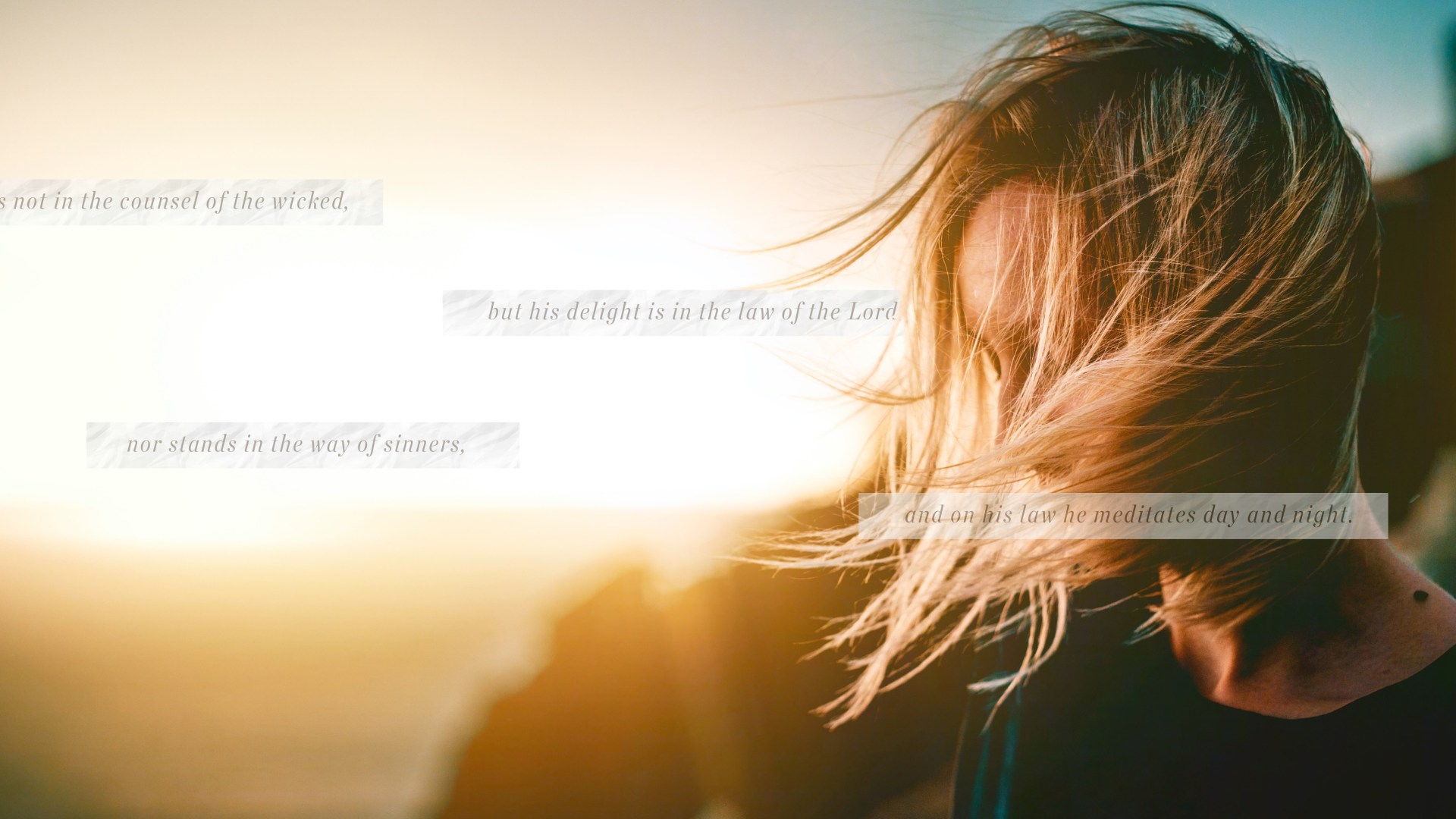
In Psalm 1, we are told that the one who is called blessed is characterized by delighting in the law of the Lord, “and on [it] he meditates day and night” (v. 2, ESV). When the psalmist speaks of meditating, the object of his reflection is God’s law (Torah), God’s promises, God’s works, and God’s ways. The record of these things would have been found in the sacred writings we now call the Old Testament. Modern-day followers of the one true God understand the object of our meditation to include the whole of Scripture, from Genesis to Revelation.

So, the “what” of our meditation is the Scriptures. But the “why” also matters. And it stands in contrast to the meditation of the yogis. Mystical meditation is the emptying of the mind for the purpose of ceasing. Those pursuing the benefits of meditation are told to focus on their breathing and quiet their thoughts for the purpose of relieving stress or anxiety or other forms of mental distress or confusion.

By contrast, Christian meditation is the filling of the mind for the purpose of acting. It is a means of learning by repeated exposure to the same ideas. It involves study, reflection, and rumination. Unlike mystical meditation, Christian meditation sees understanding as the product of thinking on whatsoever is virtuous (Phil. 4:8). Christian meditation is not an end in itself but is intended to yield the fruit of right living. In Joshua 1:8, God tells Joshua, “Keep this Book of the Law always on your lips; meditate on it day and night, so that you may be careful to do everything written in it.”

But what about the “how” of Christian meditation? Mystical meditation methods sometimes make inroads into Christian practice: “If I read a verse and hold very still and quiet my mind, the Spirit will speak insight into the empty space.” While well intentioned, this approach can often lead to misinterpretation on a grand scale. It tends to skip any reflection on the context of a passage, instead promising an immediate yield in the form of application or encouragement.

Yes, the Scriptures have a plain meaning the Spirit illuminates, but they also yield deeper and deeper levels of understanding when we make them our repeated object of thought. Put another way, rumination begets illumination. The Spirit responds to the diligent employment of the mind by giving insight, wisdom, and understanding.

Christian meditation adheres to the well-worn maxim that repetition is the mother of learning. We meditate on God’s words by reading and re-reading.

Because we are privileged to live in a time of unprecedented access to the Scriptures, we can do this in a wealth of ways. We can read first in one translation and then again in another. We can listen to the Scriptures being read via an app. We can hear them sung and learn to sing them ourselves. We can copy them line by line into a journal, praying them as we write. We can illustrate what we are reading in a margin. We can read them aloud in a community group or a family setting, as a means to “talk about them when you sit at home and when you walk along the road, when you lie down and when you get up” (Deut. 6:7).

Think. Study. Reflect. Ruminate. Meditating on God’s law, his promises, his works, and his ways trains us to think according to them. And it prompts us to act as we ought. It may not promise a Zenlike state, but it promises something even better: the peace that passes understanding, the fruit of a mind that is fixed on the things of God.

Jen Wilkin is an author and Bible teacher. An advocate for Bible literacy, her passion is to see others become articulate and committed followers of Christ. You can find her at JenWilkin.net and on the Knowing Faith podcast.

Our March Issue: When Church Is Not ‘Home’

In praise of uncomfortable worship.

Illustration by Chad Hagen

One of the most formative church bodies I’ve been part of met in a nearly windowless old post office in central Kentucky. Cristo Reina was a majority-Latino congregation pastored by a team of Mexican and Mexican American seminary students, a warm and passionate trio ministering to a community that, at the time, had been mostly overlooked by other churches.

Sermons were in Spanish, of course, occasionally translated for English-speaking guests. Communal meals followed every service. The worship team, for which I often played drums, was young and flew always by the seat of its pants. Despite this, in those moments when musicians and congregants managed to settle into the same key, the singing could give chills. Many in our little church body were undocumented farm workers advancing through their weeks one barn accident or traffic stop away from ruin; when they laid their burdens at the foot of the cross, the earth shook.

The church is long gone now. But my brief sojourn there—probably less than two years—was the only time in my church life that I, as a white man, experienced in some small way what it is to be in the minority. To be sure, outside those concrete-block walls, I was a privileged member of the cultural majority, with US citizenship to boot. But inside, Cristo Reina didn’t feel exactly like “home.” I spoke its language, but not perfectly. I liked pozole and menudo, but would never crave them. The church was not structured around people like me, around my worship tastes or preaching preferences or busy schedule. And rightly so. Who was I, in that context, to deserve any attention at all?

Remarkable to me, however, is that the leadership never saw things that way. Like Christ pausing amid far bigger worries to look into the eyes of a woman who had touched his cloak (Matt. 9:22), time and again they would pause from putting out fires and step aside with people like me to ask questions and listen, to admonish and encourage and pray. They were, in the truest sense, my pastors.

Anyone who takes Scripture seriously must also embrace its promise of a coming multiethnic worship community comprising “every nation, tribe, people and language” (Rev. 7:9). In the meanwhile, multiethnic churches will be messy, will often be difficult, and for some today, may even feel impossible. But done right, they offer an environment like none other to model the ways God’s love for his people transcends social status, power structures, and credentials. As Korie Little Edwards, arguably today’s preeminent scholar on multiracial churches, writes in this month’s coverage of the topic, they can be “places where every person’s belovedness is embraced and celebrated.”

Andy Olsen is print managing editor of Christianity Today. Follow him on Twitter @AndyROlsen.

Apple PodcastsDown ArrowDown ArrowDown Arrowarrow_left_altLeft ArrowLeft ArrowRight ArrowRight ArrowRight Arrowarrow_up_altUp ArrowUp ArrowAvailable at Amazoncaret-downCloseCloseEmailEmailExpandExpandExternalExternalFacebookfacebook-squareGiftGiftGooglegoogleGoogle KeephamburgerInstagraminstagram-squareLinkLinklinkedin-squareListenListenListenChristianity TodayCT Creative Studio Logologo_orgMegaphoneMenuMenupausePinterestPlayPlayPocketPodcastRSSRSSSaveSaveSaveSearchSearchsearchSpotifyStitcherTelegramTable of ContentsTable of Contentstwitter-squareWhatsAppXYouTubeYouTube