News

Wheaton’s New Jim Elliot Plaque Does More Than Remove ‘Savage’

The revised memorial takes a longer view at the well-known story of the missionaries killed by the Waorani.

Christianity Today May 25, 2021
Getty Images

In this series

A new plaque honoring Wheaton College alumni Jim Elliot and Ed McCully and their fellow slain missionaries will no longer refer to the Waorani as “savage indians” and, at double the word count of the original 1957 inscription, offer a more detailed account of their engagement with the people who killed them.

Wheaton released the updated wording on Monday. The new inscription describes how the missionaries sensed God calling them to reach the Waorani, “a people who had never heard the gospel message. Known for their violence to encroaching outsiders and for internal cycles of vengeance killing, they were among the most feared indigenous peoples in South America at the time.”

The task force who reviewed and revised the plaque wording aimed to move the story—now one of the highest-profile accounts of missionary martyrdom in the 20th century—beyond the events of January 8, 1956.

“Their actions took place at a certain point in time, but we don’t want to leave them there,” said Kathryn Long, professor of history emerita at Wheaton.

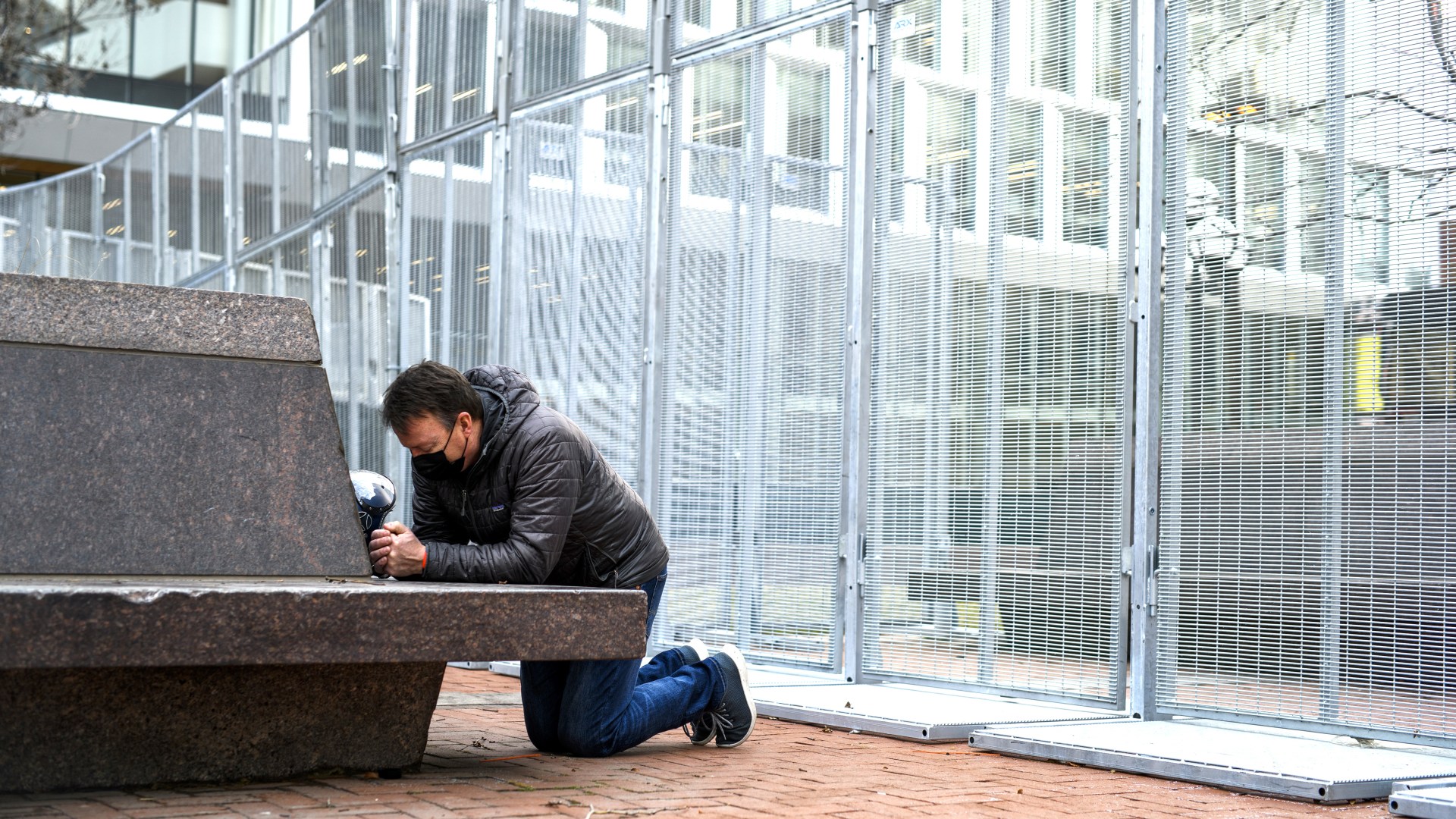
The evangelical college pulled the original plaque from Edman Chapel in March, citing concerns from students and community members over its characterization of the Ecuador tribe.

A task force was appointed to review and revise the language for the plaque, which honors the two alumni along with Nate Saint, Roger Youderian, and Pete Fleming.

The original plaque was erected in 1957.

The plaque wording task force included Long—author of God in the Rainforest, an account of the five missionaries, their deaths, and the subsequent history of the Waorani—as well as an undergraduate student who spent much of her life living among the Waoroni, an anthropologist, a missiologist, several missionaries, and a member of the Kuna tribe of Panama and Colombia. The task force also consulted with Steve Saint, Nate’s son.

Leading the group was Dr. Beverly Liefeld Hancock, president of the Wheaton Alumni Association, whose mother, Olive, was widowed when her first husband Pete Fleming was killed alongside Elliot.

Hancock said she hoped the rewording would honor the Waoroni people as made in God’s image. She said that the revisions reflect the perspectives of the families of the fallen missionaries as well as Wheaton alumni who serve as missionaries.

Whereas the original plaque concluded with the men’s tragic deaths, the new plaque will highlight the lasting impact of their sacrifice in ways the Wheaton class of 1949 could not have imagined when they donated the plaque in 1957: “Their sacrifice was a turning point for the Waorani and an inspiration for evangelical missions globally. Inviting members of the men’s families to live with them, the Waorani responded to the gospel and put down their spears. God’s redemptive story continues as the gospel is still shared among the Waorani to this day.”

Elisabeth Elliot biographer Lucy Austen noted that the revised language accurately reflects that the story did not end when the five missionaries died. She said that Elisabeth Elliot, whose writings popularized the missionaries’ story, revised her prologue to Through Gates of Splendor over the years to better reflect the ongoing nature of the story.

“I’m pleased to see that the plaque now ends by reminding us that the story did not end in 1956, or at some point between then and now, but continues into the future,” Austen said.

Wheaton plans to dedicate the new plaque in the fall.

“My prayer since starting this has been to tell this story to a new generation in words that are fresh and they can hear,” Hancock said. “This is God’s story, and to see how God has used it is really beautiful.”

Theology

For Cosmopolitan Christians, Secular Approval Is a Common Temptation

Elite believers often sound more like disciples of Jacques Derrida than Jesus Christ. That needs to change.

Christianity Today May 24, 2021
Illustration by Mallory Rentsch / Source Images: WikiMedia Commons / A. Martin UW Photography / Getty Images / Unsplash

A few years ago, I was asked to speak about the gospel’s justice imperative at a local Christian high school. Upon arrival, I was escorted through campus by a young administrator, who thanked me for coming to engage a topic the school’s elders had ignored for too long. With Dietrich Bonhoeffer–like resolve, he and another young teacher confided that they were subversively trying to change the culture at the school. I immediately, and perhaps hastily, commended their efforts.

The truth is, too many Christian institutions have been nonresponsive to the injustice in their midst. Some of these schools were established to maintain segregation and still refuse to reckon with their history and extinguish the mentalities responsible for it.

Many evangelicals will fight to exclude critical race theory but won’t even acknowledge racial disparities in education. We do not have to agree with everything every critical-race theorist says in order to recognize unjust disparities. The Black church has been addressing injustice in a theologically sound way for literally hundreds of years, well before CRT was a thing.

Without a doubt, the young educators’ concerns were legitimate. Deep, disruptive change was necessary, but the more we talked, the more I grew concerned that their approach was misguided. They were espousing a plainly secular progressive framework, unrefined by the truth and moral order of the gospel. They had an infatuation with trending secular theories, without guardrails to keep them from taking concepts like intersectionality and inclusion into unbiblical territory.

Those ideas can be helpful. But they should never be followed uncritically, because they can lead to identity idolatry, which would have us embrace broken aspects of ourselves. There’s a difference between celebrating parts of our identity and centering or exalting identity to the point where it naturally justifies some and condemns others. These brothers correctly identified an old problem, but their solutions were generically pop culture oriented and flat.

Their mistake isn’t unique. Because large parts of the church have failed to articulate and demonstrate a true model of compassion and justice, many Christians feel they have to leave biblical grounds to achieve loving and just objectives.

Anecdotally, this appears to be a growing problem among Christians in the professional class. It’s disturbing how many Christians uncritically accept the ideological assumptions prevalent in their profession. Assimilating into the secular progressive worldview is a certification of sorts among the highly educated.

This is particularly dangerous in K-12 education, where administrators rush to implement postmodern policies with little to no academic value. Higher education is severely left leaning, so it’s no wonder that wide-eyed Christians leave college sounding more like disciples of Jacques Derrida than Jesus Christ.

Postmodernism is so pervasive in academia that it starts to seem like the natural progression of a growing mind. Many Christians lack the biblical foundation and confidence to even question the opinions of their secular-minded instructors. We summarily accept their conclusions and insecurely imitate their sensibilities to prove we belong.

There’s also more than a hint of elitism mixed in with the good intentions and the indoctrination. Proving we can intellectually grasp the ideas that secular elites have branded as sacred knowledge elevates us above the people in the pews who raised us. They now represent the caricatures that embarrass us, and we’re eager to separate ourselves by flaunting our aptitude. Our presentism says new ideas are always better ideas. Accordingly, assuming the old saints are wrong is a mark of sophistication, as in, “Okay, boomer.”

While exiled in Babylonia, the prophet Daniel rejected this type of indoctrination and elitism because it conflicted with his moral framework. King Nebuchadnezzar changed Daniel’s name, taught him a new language, and tried to use his authority and resources to endear the young Hebrew (Daniel 1:3–14).

However, Daniel wasn’t as malleable as we tend to be when lured by professional opportunities, a new vocabulary, and elite identity. Sitting at the king’s table and accepting this new worldview would’ve ensured that Daniel could stand above his people with an air of superiority. But Daniel was unimpressed and uninterested. He didn’t value what the king valued. He only wished to please God, so he refused to defile himself by accepting the king’s indecent proposals.

Instead of reacting like Daniel, we often enter a new arena and, because of our insecurity, go silent on the Christian convictions society frowns upon. We wield influence in the church while seeking validation from the world. Are we ashamed of the gospel?

Believers can’t embrace elitism or anti-intellectualism. We should learn as much as we can from subject matter experts, but without a sense of awe and uncritical acceptance. Professional journals aren’t our Bible, and industry experts aren’t our priests.

There are many principles in our professional fields that we should embrace. For instance, doctors should obviously uphold the Hippocratic Oath to “do no harm.” However, we must distinguish between sound ethics and the seeds of indoctrination. If our education makes unborn life seem less sacred or causes us to pursue self-definition and self-indulgence, then we’ve been miseducated.

We need Christians who aren’t smitten with the culture or merely proficient at regurgitating its liturgy. We need believers who can wrestle with secular thought, affirming the merits and opposing the lies. Christians must be confident and distinctly Christian in our fields—boldly speaking up when the emperor is striding around with no clothes. When change is necessary, we must correct the mistakes of our elders by moving closer to the Bible, not further from it.

Justin E. Giboney is an attorney, political strategist, president of the AND Campaign, and coauthor of Compassion (&) Conviction: The AND Campaign’s Guide to Faithful Civic Engagement.

News

No White Saviors: How Suburban Minneapolis Churches Learned to Help

After George Floyd’s death, white and Black congregations partnered to serve the city.

Christianity Today May 24, 2021
Stephen Maturen / Stringer / Getty Images

Buffalo Evangelical Free Church wanted to help. About an hour’s drive from downtown Minneapolis, the majority white church was deeply upset by the news of George Floyd’s death and shocked by the videos on social media.

As protests swept the city, the Buffalo, Minnesota, congregation started to ask what it could do. Pastor Greg Braly was eager too, but cautious.

“I think one of the mistakes that Anglo churches can make is to walk in with the white savior hat on and walk in thinking we know what’s going on,” Braly said. “We don’t.”

Braly asked the organizers coordinating food and other supplies for those impacted by the protests and police crackdowns for advice and got a very clear response: “You don’t know our culture. You don’t know our community. You don’t know our pain.”

Instead of showing up with a plan, the church needed to start with a relationship. Braly reached out to another Evangelical Free congregation and connected with the majority Black Riverside Evangelical Free Church, located between the airport and the VA Medical Center.

Braly became friends with Riverside pastor Prince Lee and then found ways for the congregations to connect. Lee spoke at Buffalo, the churches worshiped together, and the white suburban congregation supported the urban Black church with material and financial resources as it ministered in the city.

“We view the Riverside church as a partner and sister church,” Braly said. “They are the experts.”

Similar partnerships have formed across the Twin Cities. White evangelical churches have looked for ways to respond and serve while being more aware than they have in the past that there are better and worse ways to help. When Transform Minnesota, an evangelical organization that brings pastors together to wrestle with social issues, hosted a Zoom call with more than 250 ministers last May, multiple pastors of color repeated this point. If white, suburban churches really wanted to help and to be effective, they needed to listen to Black Christian leaders in the impacted communities.

“We don’t need saviors,” Charvez Russell, a Black Baptist pastor, told the group in June. “What we need are partners. … Yes, we need your help right now. Yes, we need your help cleaning up. Yes, we need your resources. But we also need long-term partners who are going to help us stand up for God and tear down the systems that hold people down.”

A year later, the pastors who have tried to respond to that call and forge relationships across racial divides say it hasn’t always been easy. On the one hand, pushing their white congregations to think about racism in their communities can stir up controversy and bad feelings. On the other hand, the pastors worry about saying the wrong thing and offending the Black Christians while trying to reach out.

“Everybody wants you to take a stand, but I’m not always sure what stand to take,” said Kory Kleinsasser, pastor of the predominately white Waite Park Wesleyan Church.

His instinct is to look for nuance. But attempts to emphasize complexities aren’t always welcomed.

“I have to make statements about things that I don’t feel like I fully understand myself,” he said.

Kleinsasser said that’s okay, though, because everything has to be done with an open and humble spirit.

Practically, for the Waite Park Wesleyans, this looks like sweeping broken glass, feeding the hungry, and giving clothes to people who need it—but doing those things because they are asked as they come alongside Black Christians, who are also engaged in this work.

The Wesleyans started a relationship with Wayman African Methodist Episcopal (AME) Church in 2016, after a police officer shot and killed high school teacher Philando Castile during a traffic stop. The white congregation has learned a lot in the years since then, and both the Black and white pastors say the church was more prepared to respond last year because of that preexisting relationship.

“Because we’ve been dealing with race and racial healing, Black and white churches working together to find ways to cooperate, we weren’t caught flatfooted,” said Richard Coleman, leader of the AME congregation.

Conversations about racism were not always comfortable, Coleman said, but he hopes to help Christians in Minneapolis learn “how it affects all of us” and “how it affects the church.”

“We encourage people not to run from it,” Coleman said. “Embrace the truth. Learn why it exists.”

Together, white and Black churches in Minneapolis have accomplished some significant things. One major example of cooperation is The One Fund project. Started in April 2020 to help communities disproportionately impacted by the COVID-19 pandemic, the religious leaders involved decided to make racial justice a fund priority too after Floyd’s death. By May 25, 2021, the anniversary of Floyd’s killing, they expect to have $1 million available in grants for African American ministries in the area.

“We’re bringing a greater force to combat the areas in our communities that are hurt and need attention,” Coleman said.

Race is a fraught topic, and a lot of things hold pastors back when they think about leading their congregations into the public square and speaking on complicated issues, said Matthew St. John, pastor of New Hope Church, another Evangelical Free congregation in greater Minneapolis.

“We are often distracted by our own great failures,” he said.

As New Hope came together with Black Christians, though, and then joined with Black and white congregations from across the city to pray during police officer Derek Chauvin’s trial, they returned repeatedly to key questions: How can we be a gospel witness to the glory of Christ? How can we show unity and proclaim justice in the face of all these complexities?

“The ultimate solution is going to be a gospel solution,” St. John said.

If Christians will press on despite past failures and understand the power of God to reconcile, he believes they can present their city with God’s vision for a unified body of people from every tribe and tongue.

“Nobody has a solution like that,” he said, “except the church.”

With white and Black pastors willing to work with each other more closely than before and churches working to give up their “white savior hat” and put friendship and partnership first, Coleman is hopeful about the future in Minneapolis.

“It doesn’t mean that we’re going to start agreeing about all those things. There may be things we never agree about," he said. “But we can love each other.”

News

Southern Baptist Church Planting Up in 2020, But Baptisms Plunge by Half

The pandemic accelerates more than a decade of decline for the denomination.

Christianity Today May 21, 2021
Kelli M. Allison / Lightstock

Southern Baptists saw an uptick in church planting and kept relatively steady levels of giving despite COVID-19 lockdowns in 2020. But overall, the denomination experienced another year of decline, with the pandemic accelerating historically steep drops in membership and baptism.

The country’s largest Protestant denomination has been getting smaller for 14 years in a row, down to 14 million after losing 436,000 members last year, according to the Annual Church Profile released Thursday by the Southern Baptist Convention (SBC). Baptisms dunked by nearly half year-over-year.

“COVID-19’s effect on 2020 stats is undeniable. Yet 2020 is only the latest year of continued decline in major categories,” tweeted Mike Stone, a pastor in Georgia who is in the upcoming race for SBC president. “Southern Baptists need a move of God. Let us pray and work to that end.”

For years, pastors and denominational leaders have responded to shrinking numbers by calling for a renewed focused on missions. The year 2020 showed promising signs of progress on the mission field, adding 588 new church plants in the US and over 18,000 abroad, both figures up from the year prior.

But the growth has not offset the downward trend in overall membership. Researcher Ryan Burge wrote last year that the generational shift will be the biggest factor accelerating losses in the SBC, as the denomination ages and members die off.

Losing more of its older members due to COVID-19 is likely one factor in the 2020 drop, according to Scott McConnell, executive director of Lifeway Research. Membership declined by 2 percent in 2019, the SBC’s biggest drop in a century. Last year—as congregations winnowed inactive members from their rolls and saw fewer people join during shutdowns—the decline was 3 percent.

Churches were also less likely to participate in this year’s annual compilation; 69 percent contributed data compared to 75 percent in previous years. While not a complete picture, the Annual Church Profile is the denomination’s best snapshot of Southern Baptist trends. Leaders are still grappling with what last year’s numbers will mean for the SBC in the long-term.

“It may take years for us to know the full effects of the COVID-19 pandemic on our churches,” said Ronnie Floyd, president of the SBC Executive Committee, in comments to Baptist Press. “There are lessons to be learned from 2020 as we put it behind us—such as the vital need for corporate worship, the value of being creative in developing ways to share the Gospel, and how much local communities need our churches to minister in difficult circumstances.”

Church planting represents a bright spot amid the trend toward decline; the number of SBC churches launched in the US in 2020 was 588, an increase over 552 the year before. Southern Baptists have planted 8,200 churches in North America since 2010, a rate that researcher Ed Stetzer says amounts to “replanting the denomination every few decades.”

“Well, the SBC continues its downward trend, for sure, but the church-planting numbers are a reminder that the North American Mission Board plants more than anyone else and that they kept doing it in a remarkably difficult year,” said Stetzer, executive director of the Wheaton College Billy Graham Center. “If Southern Baptists find a path to a better future, the road goes through church-planting territory.”

Kevin Ezell, president of the North American Mission Board, the entity overseeing domestic evangelism and mission, told CT he’s encouraged by their work in 2020 but also looking forward.

“The number I care about most is how many survive after four years. Right now that survival rate hovers around 80 percent, which is incredibly strong,” he said. “But to plant 588 churches during lockdowns and social distancing demonstrates that Southern Baptists have a strong church-planting network and a strong financial commitment that holds up to even the toughest challenges.”

Even during a year where many churches were closed or digital-only during lockdowns, and even with fewer churches reporting, giving remained relatively steady—declining less than 1 percent to $11.5 billion. SBC churches spent $1 billion on missions in 2020.

The annual report comes less than a month before Southern Baptists are scheduled to meet in Nashville in June for their annual meeting, the first since the pandemic. Leaders are expected to address the downward trends in the denomination as well as recent debates over their approach to politics, race, women, and abuse.

“A convention perpetually at war with itself cannot do what God has called it to—pursue the Great Commission,” said outgoing SBC president J. D. Greear in a statement. “There are voices calling us [to] come to Nashville to divide even further over things beyond the scope of our statement of faith and therefore best left to the autonomy of churches. This will surely send us even further into decline.”

Baptisms have decreased as fewer converts join SBC churches and were put on hold in many churches as a result of the pandemic. Historically, that’s been the landmark measure for the denomination. “It’s not just a point of pride; it’s also evidence that the SBC is carrying out the Great Commission,” said Barry Hankins, historian at Baylor University. “It’s not hard to imagine a sense of bewilderment if not despair at the steady decline of baptisms and membership in the SBC.”

Adam W. Greenway, president of Southwestern Baptist Theological Seminary in Fort Worth, said Southern Baptist leaders are continuing to respond with urgency.

“We desperately need a great movement of God among our people for which these statistics should drive us all to our knees in prayer,” he said. “The data also underscores the indispensable need for providing the best theological education to prepare the next generation of pastors and church leaders for the challenges of ministry today.”

News
Wire Story

Friendly Neighborhood Epidemiologist Deploys Expert Advice With Christian Love

The Baylor professor’s Facebook page took off with answers around COVID-19 precautions and vaccinations.

Christianity Today May 21, 2021
Robert Rogers / Baylor University / RNS

Emily Smith didn’t realize there was such a divide between faith and science for many Christians.

Smith’s parents led worship at a charismatic church—“just a fantastic experience and upbringing”—and she married a Baptist pastor. She studied science and medicine because she dreamed of becoming a medical missionary. She volunteered in the kitchen and made balloon animals aboard Mercy Ships in Honduras while in college. Eventually, she became an epidemiologist.

For her, epidemiology was a natural way to live out her Christian beliefs, loving her neighbor the way Jesus commanded and caring for the most vulnerable—like the “good Samaritan” of Jesus’ parable did when he stopped to care for an injured man while others passed by.

“My first (Facebook) post on faith was about the good Samaritan because I see the field of epidemiology as that: Quantify who’s the vulnerable, and we don’t walk by,” said Smith, now 40 and assistant professor of epidemiology at Baylor University in Waco, Texas.

Then came COVID-19, a time when she thought Christians—with their commitment to “love thy neighbor”—might shine.

Smith started Friendly Neighbor Epidemiologist, a Facebook page, in March 2020 to share information about the novel coronavirus and answer questions she was hearing from her neighbors and friends. Yes, COVID-19 was something they should pay attention to. No, they didn’t need to hoard toilet paper.

Since then, the page, written in Smith’s friendly, informational voice, has grown to more than 96,000 followers. About half are evangelical Christians, she said.

But threats and pushback have also followed—all but one from her fellow Christians. She has been sent pictures of guns, handwritten letters about the “mark of the beast” and the End Times, messages telling her she should leave the preaching to her husband or telling her she is going to hell. That’s nothing compared to what many others have put up with for much longer, she said.

But, the epidemiologist added, “Every time I would talk about faith over fear and masking as a way to show our freedom and allegiance to Jesus, they would come.”

At first, Smith was answering questions on Facebook about whether face masks work and whether churches should continue to meet in person.

Over the summer, though, she saw some Christians begin to shift the narrative in ways that were alarmingly racist, blaming the spread of COVID-19 on Black Lives Matter protests, immigrants arriving at the US-Mexico border, and Asian Americans. None of the data supported that, she posted on the Friendly Neighbor Epidemiologist page.

She heard arguments that masking was a sign of fear and not of faith. She kept pointing back to Galatians 5, which says while Christians are called to be free, they are to use that freedom to “serve one another humbly in love.”

“I think wearing a mask and getting a vaccine, full of faith, displays my lack of fear more than going to an unmasked church service just to prove something,” she said.

Especially troubling to her were people who refused to wear masks, especially at large gatherings hosted by evangelical Christian leaders, like Franklin Graham’s Prayer March 2020 in Washington, D.C., and services at John MacArthur’s Grace Community Church in California.

“I was hearing all of this stuff, and I was uncomfortable, because that’s just not Jesus to me or ‘love thy neighbor,’” she said.

These days, Smith is posting a lot about the COVID-19 vaccines, as polling by the Pew Research Center shows 45 percent of white evangelicals say they definitely or probably will not get vaccinated against COVID-19, a higher number than any other religious group.

She’s not the only Christian urging evangelicals to get vaccinated.

Curtis Chang, a faculty member at Duke Divinity School and senior fellow at Fuller Theological Seminary, has launched ChristiansAndTheVaccine.com in partnership with the National Association of Evangelicals to help pastors and other Christian leaders talk about the COVID-19 vaccines.

Graham, head of the Billy Graham Evangelistic Association and evangelical relief organization Samaritan’s Purse, appeared on Axios on HBO over the weekend to encourage evangelicals to get vaccinated, saying his father, the late evangelist Billy Graham, would have supported it.

Also over the weekend, Pastor Robert Jeffress’ megachurch, First Baptist Dallas, hosted a vaccination clinic.

Smith said she’s glad Graham and Jeffress, who both informally advised the previous president, are speaking out now about the vaccines, but, she added, “I wish they would have been as vocal about loving your neighbor through masking and public health precautions for the last year.”

There’s a reason why the Friendly Neighbor Epidemiologist approach has resonated with so many Christians, according to Aaron Kheriaty, director of the Medical Ethics Program at UCI Health.

“I think one of the reasons there’s serious engagement with Dr. Smith’s website is that this is a Facebook page that doesn’t just engage in sloganeering. It tries to unpack complicated science for the lay public, and people are obviously hungry for that,” Kheriaty said, speaking alongside Smith on a panel about faith communities and COVID-19 vaccines last month at the virtual Religion News Association Mini-con.

The Rev. A.R. Bernard of the Christian Cultural Center in Brooklyn, who appeared alongside Smith in one of a series of live videos hosted by Facebook on the topic of faith and COVID-19, noted her ability to speak “from both a pastoral perspective and a scientific perspective.”

Smith said she believes Friendly Neighbor Epidemiologist has taken off the way it has because her experience of the pandemic has been the same as so many other Christians’ experiences. Her Facebook page has given a voice to those who believed wearing a mask was a way to “love thy neighbor”—her mantra for the past year.

She’s heard all the same arguments and conspiracy theories they have. She and her husband even left their church this past year, she said.

“I think there were a lot of people like me that had to make a decision: Were they okay with what they saw unearthed in 2020? A lot of people left their churches, a lot of people left faith in general. There’s just an entire population of Christians that are homeless now,” she said.

But, Smith said, she’s come out the other side. She’s found a new Baptist church that shares her view of what it means to “love thy neighbor” and offers a bit of quiet at a time that feels anything but. In 2021, she said, she wants to share with other Christians that’s possible for them, too.

“Hopefully, it can give people hope there’s more to Christianity than what is being shown on Fox News,” she said.

News

Rockets, Riots, Sermons, and Soccer: Christian Views on the Conflict in Gaza and Israel

(UPDATED) How a dozen Messianic Jews and Palestinian Christians are trying to minister across the divide as Hamas and the IDF war once again.

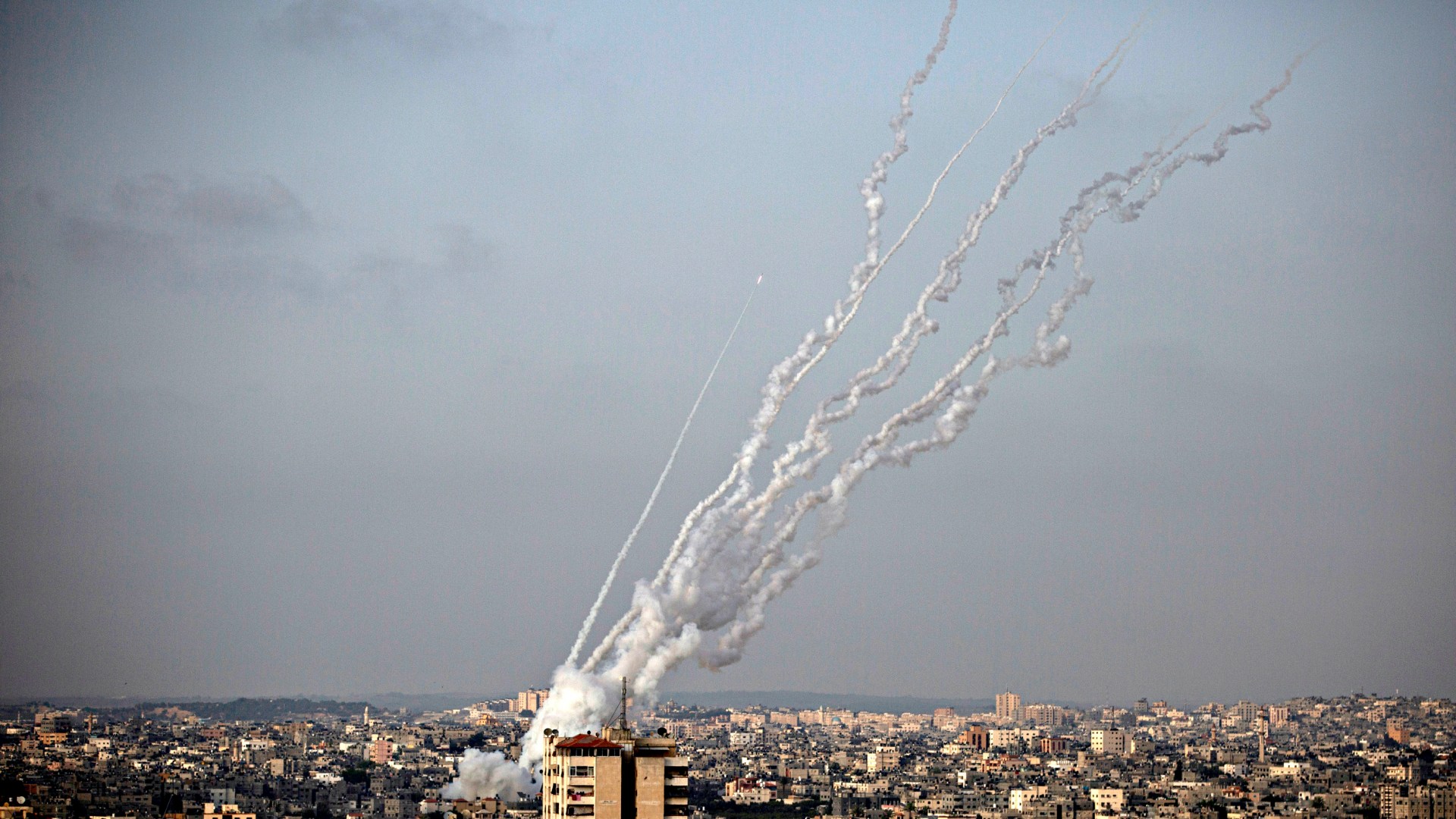
Rockets are launched from the Gaza Strip toward Israel on May 10, 2021.

Rockets are launched from the Gaza Strip toward Israel on May 10, 2021.

Christianity Today May 20, 2021
Khalil Hamra / AP

Bombs fall in Gaza as rockets target Israel.

Frustrated Arab rioters are met by extremist Jewish settlers.

And in the middle of it all, Danny Kopp sent his boys out to play soccer.

Numbers were down at the Jerusalem neighborhood park frequented by Jew and Arab alike, but his 13-, 10-, and 8-year-old sons still translated between the sides.

“These encounters, as small as they are, remind belligerents that coexistence is still viable,” said the chairman of the Evangelical Alliance in Israel.

“Wholesale vilifying is simply inaccurate.”

But it is easy to do, if attached to a favored narrative.

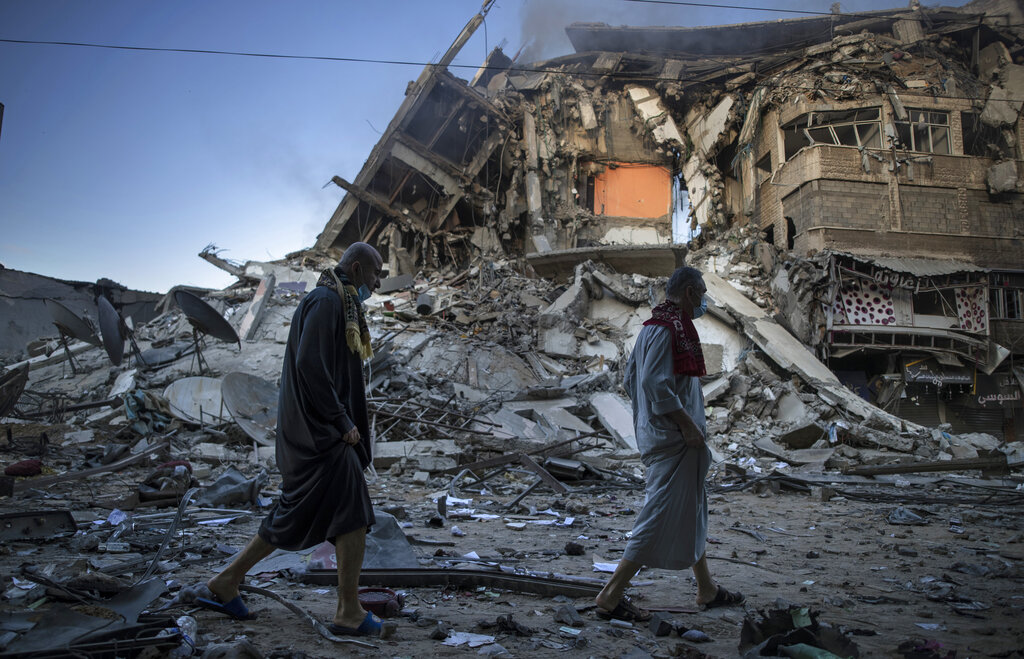
Since the outbreak of fighting on May 10, Israeli bombs have leveled almost 450 buildings in Gaza, including six hospitals, nine health centers, and the headquarters of the Associated Press. Hamas authorities count 232 dead, including 39 women and 65 children. More than 1,900 people have been injured, and 52,000 displaced from their homes.

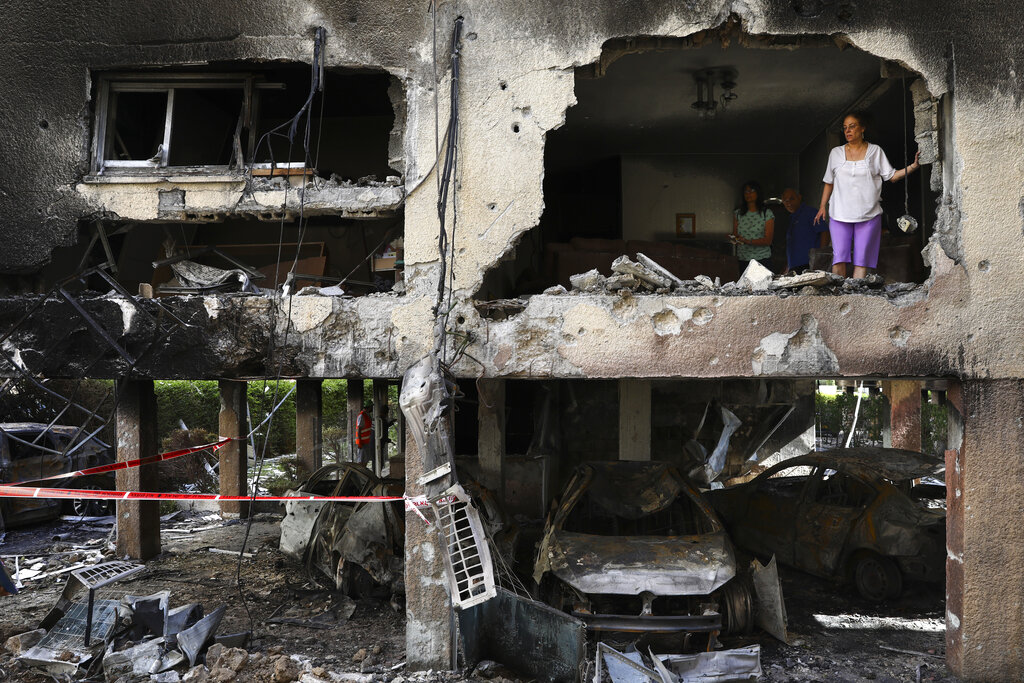
But 160 of these have been militant fighters, said Israeli authorities. Hamas’s indiscriminate barrage has launched more than 4,000 rockets and killed 12 people—including two children—while injuring hundreds. Israel’s Iron Dome defense system has intercepted most rockets, but Iranian sponsorship of Hamas has led to a dramatic increase in missiles able to target Jerusalem.

Such long-range weapons represent 17 percent of the thousands of missiles fired this month. Nine years ago, they represented only 1 percent.

A ceasefire is now in place. President Joe Biden pledged to work through the United Nations and the Palestinian Authority to rebuild Gaza. The US would prevent such aid from restocking Hamas’s arsenal, while allowing the replenishing of the Iron Dome’s defenses.

The weapons evolve, though the animosity is familiar.

Smoke rises following Israeli airstrikes on a building in Gaza City on May 13, 2021.

But what has shocked and saddened a dozen sources interviewed by CT—half Jewish and half Palestinian—is the ethnic violence that has torn through previously peaceful towns of coexistence. In Lod, Haifa, Nazareth, and elsewhere, Arab rioters have set 10 synagogues and more than 100 Jewish homes on fire, while looting or damaging hundreds more.

Israel called up 7,000 reservists to quell the violence. But reports say police have been far more lenient with Jewish settlers who have responded in kind, though with less damage. Video recordings, however, depict settler attempts to seize Arab Israeli properties.

The outbreak of violence is tied to Israeli legal proceedings to evict Palestinians from their homes in the East Jerusalem neighborhood of Sheikh Jarrah. The families have resided there for generations, and the land dispute has alternate explanations. Protests were met with violence, which then spread to the al-Aqsa Mosque. Hamas fired rockets in solidarity.

And amid the backdrop of this quagmire, Kopp sent out his children.

On Saturday, he preached the same message to his mixed Jewish-Arab Narkis Street Congregation in Jerusalem, asking his flock to purposefully hear both sides.

“Jesus constantly broke out of his information bubble,” he said, “engaging every kind of person imaginable and on a consistent basis.”

Across the separation wall, however, Munther Isaac’s Sunday sermon had a different tone.

“What is required is not calm and restraint,” said the pastor of Evangelical Lutheran Christmas Church in Bethlehem. “What is required is to call things by their names.”

This includes antisemitism, Isaac told CT. Yet he also highlighted the 2020 Jerusalem Declaration, created by Jewish scholars to clarify when criticism of Israel or Zionism crosses the line while specifying that criticism in itself is not antisemitism.

But Isaac’s focus was on “occupation” and “ethnic cleansing”—and “apartheid.” B’Tselem, a leading Israeli human rights organization, recently published that the state’s effective control of the West Bank and Gaza makes the controversial term appropriate.

Isaac then asked Palestinian Christians to act appropriately: with nonviolent resistance. And he asked believers in the West to likewise act: with vocal advocacy.

“Christ died a victim of raging violence and religious extremism,” he preached. “But because we believe in the Resurrection, the last word is justice.”

Such preaching, however, riles fellow Palestinian evangelical Khalil Sayegh.

“The Palestinian church response has been largely in line with our society’s polarized state,” said the Philos Project fellow. “One-sided narratives only inflame people’s anger.”

Born and raised in the Gaza Strip, Sayegh acknowledges the appropriate call for justice. But it is simultaneously necessary for each group to reach out to the other.

Israel and Hamas will eventually reach a ceasefire. But given the ethnic strife, popular wounds now run deeper than before.

“If we are not comforting each other while suffering,” Sayegh said, “we won’t be any closer to a solution when the situation begins to improve.”

Palestinians walk next to the remains of a destroyed 15-story building hit by Israeli airstrikes on Gaza City on May 13, 2021.

Sources told CT they are doing so, but the impact has been mixed. Sayegh has experienced a lack of empathy from some. Ron Cantor said a Palestinian Christian pastor sent him well wishes for his birthday.

But reconciliation is difficult.

“We have made attempts,” said Cantor, president of Shelanu TV, Israel’s only 24/7 digital Hebrew gospel channel. “But in all honesty, there is mistrust on both sides.”

This past Saturday, Messianic Jewish congregations preached against racism and for Arab-Jewish unity, Cantor said. The settlers provoking the violence are tied to a political movement he believes is rejected by the vast majority of Israelis.

But while most Arabs—who comprise a fifth of Israel’s population—and Jews get along, most Palestinian Christians do not believe in a unique divine role for Israel. And while Cantor understands—but rejects—their claim that Zionists stole their country, most Palestinians are at odds with what he says is a clear baseline standard.

“It is important that people stick to their Bibles and not the news,” he said. “Israel is a fulfillment of prophecy.”

But this does not mean Messianic Jews are without fear. Discipling believers in the Israel Defense Forces, Eli Birnbaum protects them from hate and resentment.

“Growing up in Israel, you get used to the fact that there is a group of terrorists who will kill you if given the chance,” said the Jews for Jesus Israel ministry director, noting this is not true of Palestinians at large.

“These rockets aren’t targeting the military; they are targeting my children.”

As such, Jews who believe in Jesus and who are frustrated with war have a recourse other than turning on political leaders or in anger toward enemies. Pastoring a small congregation in Tel Aviv, Birnbaum is preparing a sermon on 1 Samuel 30, in which David’s men wanted to stone him after the Amalekites burned Ziklag and took captive their wives and children.

“David turned that frustration toward prayer,” said Birnbaum. “And ultimately, Jesus gave his life on the cross so that we can be strengthened in him no matter the circumstance we are in.”

Members of the Sror family inspect the damage to their apartment in Petah Tikva in central Israel after it was hit by a rocket fired from the Gaza Strip on May 13, 2021.

But this does not take away the “disgust” most Messianic Jews have for Hamas and its disdain for both Jewish and Arab life, said David Friedman.

In contrast, in their fellowships Jewish and Arab believers are praying together—without blame.

“I am impressed with the sincerity of our unity,” said the Messianic Jewish Theological Institute professor and former dean of King of Kings College in Jerusalem.

“No matter what side of the political spectrum we may be on, the current rocket war is no breaking point.”

Similarly, David Katz, deputy general manager of Sar-El Tours which serves many evangelical clients, said he believes most Messianic Jewish congregations would justify Israel’s response to Hamas attacks on Israel. Many Messianic Jews live in Ashkelon and Ashdod, within range of the shortest-range missiles.

But they are also praying for Gaza, mourning the loss of life and longing for a lasting solution to the conflict.

Katz attended the solidarity rallies that followed the violence. Arabs and Jews in mixed neighborhoods came together to clean up their streets, repair damage, and raise money for the victims. In Jerusalem, they created a “peace chain.”

Solidarity, however, can go only so far.

“We extend love and prayers, but don’t go too deeply into the source of the conflict,” said Katz. “Now is not the time for that discussion.”

Lisa Loden, with much frustration, agrees.

“At this stage, talking with those who hold different political views is useless,” said the co-chair of the Lausanne Initiative for Reconciliation in Israel/Palestine (LIRIP).

“It is a time for intercession and lament. May the Lord have mercy on us all.”

Beginning in 2010 after a similar surge in Gazan missiles and deaths in 2009 strained ministry in the Holy Land, LIRIP sought to have honest but intense discussions about the different perspectives Messianic Jews and Palestinian evangelicals have toward the conflict.

A decade later, Loden sees this relationship nearer a breaking point rather than getting better. Though believers sing and pray in each other’s languages, “what was gained is at risk of being lost.”

Her LIRIP co-chair, Botrus Mansour, is a little more optimistic.

His recent interactions with Messianic Jews have encouraged further work toward reconciliation. As director of operations of Nazareth Baptist School, Mansour said joint programs with Jewish schools help promote the values of love and tolerance.

The same atmosphere is present at Hand in Hand School, a mixed bilingual public school in Jerusalem. Parents called frantically, said the principal, worried about the impact of clashes.

Looking outside her window, she saw the students playing soccer.

Other youth, however, are moving the wrong direction.

In February, Hebrew University polled over 1,000 students ages 16 to 18. Nearly half of the ultra-Orthodox and religious nationalist Jews said they “hated” Arabs, and favored stripping their citizenship.

Nearly one-quarter of secular Jews said the same.

Arab Israeli students polled at 22 percent hatred toward the religious Jews and 12 percent toward secular Jews. But in March, the Palestinian Center for Policy and Survey Research found 37 percent of all ages favored armed resistance.

“The atmosphere is polluted with racism,” said Mansour. “It starts from leaders of Israel and goes down to the regular people.” He urges more examination of the root causes of the violence versus the current focus on the symptoms.

Shadia Qubti, co-producer of the Women Behind the Wall podcast, which uses storytelling to highlight the experience of female Palestinian Christians under occupation, said Palestinians have been suffering from years of political incitement and dehumanization.

“If you are tired of this repetitive news from Israel and Palestine, I sympathize with you,” she said. “As your Palestinian brothers and sisters, we are weary of enduring it.”

The human rights organization Adalah—meaning justice in Arabic—counts 65 discriminatory laws in Israel, roughly half of which have been enacted since 2009.

For Loden, this is the main cause of the riots.

Arab Israelis face inequality and an unspoken second-class citizenship, she said. This was enshrined especially in the 2018 nation-state law that made primary the Jewishness of Israel.

“The pain, anger, and sense of betrayal in the Arab community has not been addressed,” Loden said. “It was buried.”

And Christian youth are growing frustrated with their churches, said Salim Munayer.

“Most evangelical churches have limited their message to ‘let us pray for peace,’ and some claim they don’t want to get involved in politics, sticking only to spiritual matters,” said the executive director of the Musalaha reconciliation ministry, based in Jerusalem. (He explains more on CT’s Quick to Listen podcast.)

“The silence is loud.”

Stuck in their own narratives, the youth turn to social media. There has been some interaction between communities, and Munayer has seen discussion of proper politics in view of the gospel message.

But on the ground in mixed cities, the reality does not facilitate reconciliation. The government, he said, has actively placed Zionist yeshiva students there to “Judaize” the neighborhoods.

Jack Sara, president of Bethlehem Bible College, said that the coexistence touted in mixed cities was never built on peace and justice, only pragmatism. Reconciliation cannot be built on unequal relationships.

For example, the government invests $8,000 per year per Arab high school student in these areas, compared to $13,000 per Jewish student.

Sara cited Sheikh Jarrah as an example of Judaizing efforts. Like the biblical Ahab and Jezebel, Jewish settlers found a “legal” way to steal land.

“Today, the Palestinians are calling for ‘Elijahs’ of the world to confront ‘Ahab’ for his crimes,” said Sara. “If so, maybe he will repent and return what he has stolen.”

But whereas Isaac called against calm in the face of injustice, Sara—equally resolute in an open letter as Middle East coordinator for the World Evangelical Alliance—appreciates joint efforts seeking to tone down the anger.

The Board of National Pastors and Elders in Israel released a statement.

“In light of the current situation … [of] polarization and hatred between Arab and Jewish citizens, we Israeli Jews and Arabs, who share the same faith in Jesus as Messiah and Lord: declare that we are united in brotherly love,” they stated, expressing their agony. “With blessings and hope for quieter and better days.”

Arab churches have conducted online prayer gatherings asking God to protect both Arab and Jewish towns. Jewish congregations have asked God to intercede for both communities.

Jamie Cowen, a Messianic Jewish lawyer, said that in his congregation, the leader testified that God had changed his heart toward Arabs when he first became a believer.

“For those I’m in touch with, there’s a sense that something needs to change in the country,” he said, “to heal the wounds and deal with the Palestinian issues.”

For Katz, active in the peace movement, this will not be easy.

Jewish settlement expansion in the West Bank has made a two-state solution nearly impossible. But a one-state solution will present demographic problems for the Jewish state, as all Palestinians under their control must be given passports and the right to vote.

“Reconciliation, equity, and respect between the sons of Abraham,” Katz said. “That’s a big call. But it’s what we need.”

And it will not happen, said Kopp, unless creative solutions can be found to address the core concerns of each group. God has a unique calling for both Jews and Palestinians.

But each must give up their treasured narratives in joint pursuit of the truth.

Hamas’s indiscriminate rocket fire should not be equated with Israel’s precision-seeking self-defense, he said. But neither should Israel’s flawed democracy be considered above reproach.

And until consensus is found, a soccer ball will help.

“It’s a mundane, Sisyphean effort of tiny strides,” Kopp ended his sermon to his congregation.

“But it’s the only way to reduce our striving for greatness, and end up the humble, peacemaking, and merciful children God wants to see in his kingdom.”

Additional reporting by Jeremy Weber

News

Evangelical Colleges Consider Vaccine Requirements for Fall

Most schools opt to strongly encourage inoculation and continue safety measures.

Christianity Today May 20, 2021
Courtesy of Samford University / Stephanie Douglas

Only one of the roughly 140 US schools that belong to the Council for Christian Colleges and Universities (CCCU) is planning to require students to receive COVID-19 vaccines before starting school in the fall: Seattle Pacific University.

The rest will “strongly encourage” vaccines, according to CCCU spokeswoman Greta Hays, while leaving the ultimate decision up to individual students and their families. While the evangelical institutions want to ensure campus-wide health and administrators widely support inoculations, they are also concerned about the impact vaccine requirements would have on enrollment.

At Westmont College, in Santa Barbara, California, the head of enrollment estimated a vaccine requirement could mean the 1,300-student school has 200 fewer students enrolled in the fall.

“For a school our size, that’s a chunk,” said Irene Neller, Westmont’s vice president of enrollment, marketing and communications. “It’s financially driven in many regards. State-funded schools can really be black and white. … But a lot of the private, smaller campuses, Christian or secular, just can’t.”

Evangelical Christian colleges get about 80 percent of their revenue from tuition. Unlike big state schools and Ivy League institutions, they generally can’t rely on big endowments or donors. Year to year, the financial health of the school depends on the number of students arriving in the fall.

Neller said Westmont and other evangelical schools recognize the controversy around vaccinations and also the range of reasons people don’t want to be required to get the vaccine—some motivated by politics, some cautious about the science, and some citing health conditions that make vaccination more dangerous.

Westmont, like many schools, has tested students frequently during the pandemic and managed to avoid any major outbreaks. Neller said she joins a call with dozens of representatives from other CCCU-member schools who discuss ways of keeping their campuses safe while avoiding measures that would push prospective students away.

Samford University in Alabama isn’t requiring students to be vaccinated, but the school sought to boost vaccinations by hosting a clinic on campus in April and May. The clinic helped students “know people getting vaccinated,” said Betsy Holloway, vice president for marketing and communication, and “took away fear that someone might have.”

Marc Smithers, dean of students at Houghton College, said the school doesn’t want to do anything that would prevent students from going to Houghton.

“I really want students to experience the Houghton education, and if something like a COVID-19 vaccine requirement is going to be the thing that ultimately brings them to decide to go somewhere else, I don’t want to be responsible for driving them away from an experience,” Smithers said.

At Houghton, students will discuss the intersection of faith and science and consider the pros and cons of vaccination programs, Smithers said. They don’t have to accept an answer before they arrive.

“Those are important questions that they need to be here in order to wrestle with,” he said. “I think we do a good job at preparing our students for that.”

Seattle Pacific also wants to encourage that dialogue, but only after it has required students to be vaccinated.

“You want to continue to protect your community as your top priority and then, if there are anomalies to that or exceptions, so be it,” said Nate Mouttet, vice president for enrollment management and marketing. “We want to take what we think is best for the entire community first and then allow people to dialogue with us, thoughtfully and intelligently.”

Another factor at Seattle Pacific is the relationship between the school and the surrounding community, said Jeff Jordan, vice provost for student formation and community engagement. While some small colleges are isolated communities, the school is located in Seattle, and many students have internships across the city. Administrators didn’t want to put the wider community at risk.

The university will, however, grant medical, disability, and religious exemptions. To receive religious exemptions, students must write to explain why they are seeking an exemption and then submit a letter from a pastor or another religious leader, written on their behalf. Administrators said students who ask for exemptions will most likely get them, but the school wants to start with a conversation about ethical responsibility, vaccine efficacy, and trustworthiness.

“We have a history of being a pretty wide tent within the Christian faith tradition, and we’re making room for that once again,” Mouttet said.

Not requiring vaccines could also have an impact on enrollment, according to Mouttet. Seattle Pacific has a heavy emphasis on science programs, at both the undergraduate and graduate levels, and not taking the coronavirus seriously would communicate a disregard for scientific consensus to prospective students.

The Chronicle of Higher Education has identified 375 US schools that are requiring vaccinations. About 50 percent of them are private institutions; 48 percent, public.

According to the Centers for Disease Control and Prevention, vaccinated people can return to prepandemic behaviors. They don’t need to wear masks indoors or social distance from each other. A classroom of vaccinated people may look like a normal college classroom.

For the schools who aren’t requiring students to be vaccinated, several questions about health and safety requirements remain. Neller said that all Westmont students, vaccinated and unvaccinated, will likely have to abide by the same restrictions, even if the unvaccinated minority is creating the need for certain protocols.

Smithers said it’s possible the opposite will be the case at Houghton. Vaccinated and unvaccinated students may be held to different standards. Students who haven’t been vaccinated could be asked to test frequently for COVID-19.

“We want to give the individuals who feel strongly that they don’t want to be vaccinated the freedom to do that. But that choice and conviction are not for those who are vaccinated to bear the cost of,” Smithers said.

Still, administrators acknowledge it’s not ideal. Life on CCCU campuses would be easier if everyone voluntarily chose to be vaccinated.

“There are aspects of living in community that are always going to be frustrating,” Smithers said.

Neller agreed, saying Westmont is making “amends” with the reality.

At the same time, she said, “we’ve gone through the most critical moments. … We’re pretty confident we can manage it going forward.”

Books
Review

Twentieth-Century Theology Lost Sight of Something Essential about the Trinity

It’s time to recover the teaching that Father, Son, and Spirit act as one, with no “division of labor” between them.

Christianity Today May 20, 2021
Illustration by Rick Szuecs / Source image: Wikimedi Commons

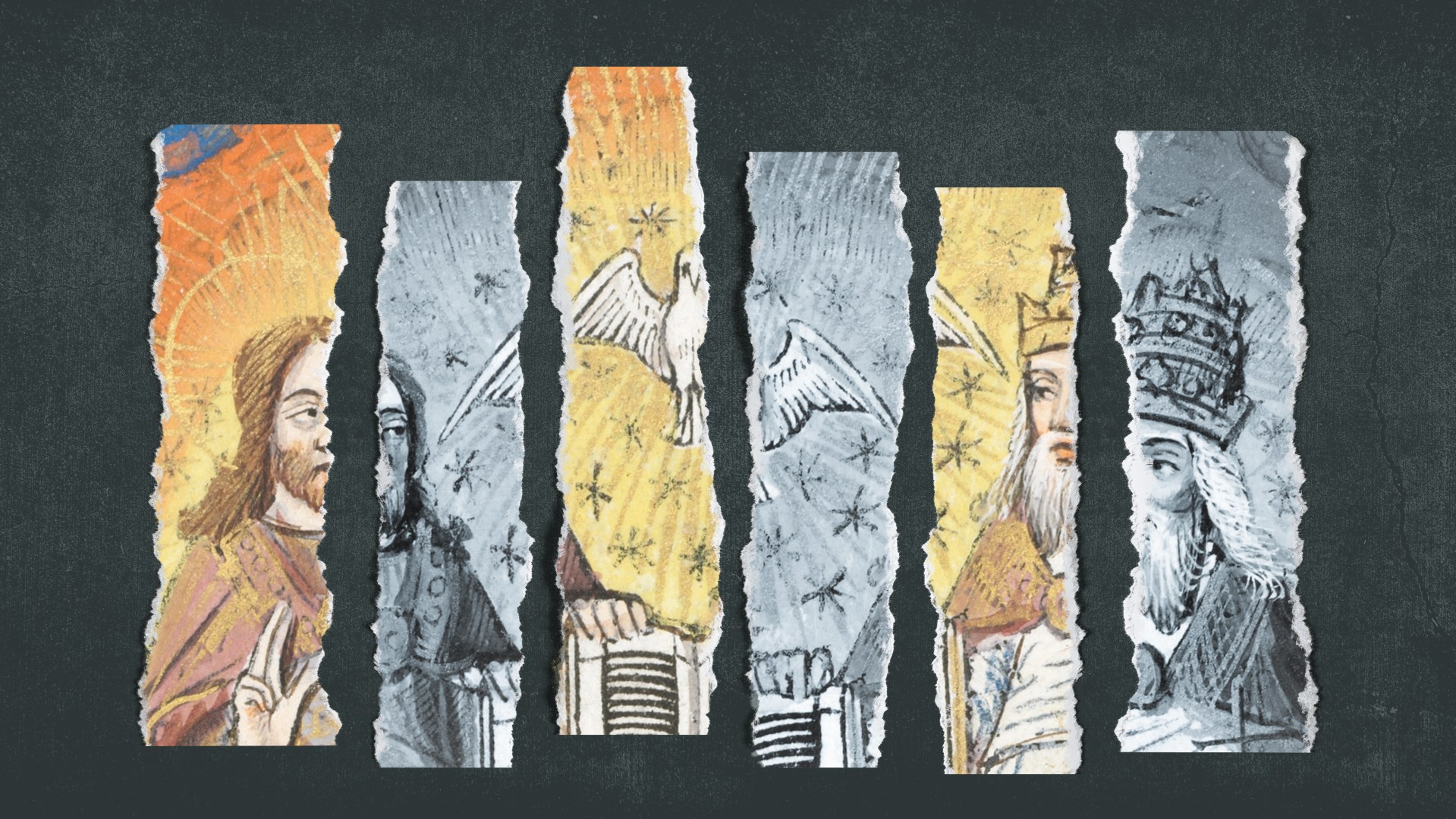
When our church fathers defended one of the most important creeds (the most important creed, some might argue) in the history of the church—the Nicene Creed—they believed the biblical and orthodox doctrine of the Trinity hung in the balance, and with it, the survival of the church.

The Same God Who Works All Things: Inseparable Operations in Trinitarian Theology

As they muscled their defense into place, they pinpointed several key beliefs as absolutely essential in the fight against heresy. One of these was “inseparable operations,” a belief summed up in a famous Latin phrase, opera Trinitatis ad extra indivisa sunt. What this means is that the work of the Trinity—from Creation to salvation—is undivided. Or as Augustine said with such elegance in his classic, De Trinitate, “As the Father and Son and Holy Spirit are inseparable, so do they work inseparably.” The Father, Son, and Spirit work as one because they are one—one in essence, will, power, and glory.

Enter modernity. The doctrine of inseparable operations—a “rule” once indispensable to Christian orthodoxy and liturgy—has been thrown into question: dispensed by some, severely modified by others. As theologian Adonis Vidu explains in his sobering new book, The Same God Who Works All Things: Inseparable Operations in Trinitarian Theology, “During the past century the rule has gone from being part of the very foundation of Trinitarian dogma to being dodged as one of its greatest vulnerabilities.”

What happened? And why does it matter?

A departure from Nicene tradition

The classical, Nicene tradition labored to preserve Scripture’s witness to the unity of the persons of the Trinity, and likewise their equality. This tradition distinguished the persons according to their eternal relations of origin: The Son is eternally begotten from the Father, who is himself unbegotten, and the Spirit eternally proceeds (or is “spirited”) from the Father and the Son.

Yet these “processions” (or personal properties) do not create three gods since, as the English Puritan John Owen said, “a divine person is nothing but the divine essence, upon the account of an especial property, subsisting in an especial manner.” For example, the church fathers not only said the Son is eternally begotten from the Father (this alone distinguishes the Son as Son); they were sure to clarify that the Son is begotten from the Father’s essence. As the early Christian apologist John of Damascus put it, the Trinity is “not one compound perfect nature made up of three imperfect elements, but one simple essence … existing in three perfect subsistences.” That word “simple” (or simplicity) is critical, guarding the church from turning the Trinity into a collection of separate parts—individuals who can be greater or lesser, superior or inferior.

Everything changed in the 20th century when theologians, departing from the Nicene tradition, began defining the Trinity as a society of separate agents, a society not unlike our human society. In a shocking statement, theologian Colin Gunton explained the new thinking like this: “What it is to be a human person is in this case identical with what it is to be a divine person, and therefore the word means the same at the levels of creator and creation.”

With the rise of what came to be called social trinitarianism, explains Vidu, the divine persons were redefined, as if each person were his own center of consciousness and will, his own distinct individual self. Christian philosopher Richard Swinburne has even proposed a Trinity composed of three individuals. Vidu’s research is revealing: If modern theologians still reserved a place for inseparable operations, they either described the unity of the Trinity in creation and salvation merely as a cooperative enterprise or as a division of labor. But in some cases, the doctrine was discarded altogether because it could not jibe with social trinitarianism’s emphasis on the individuality of the persons.

None of this sits well with Vidu. And as I see it, his theological angst is more than justified. Vidu is onto something when he concludes that modern theology has not only misconstrued but misused this core belief in inseparable operations. He writes, “It does not indicate that within the immanent life of the Trinity there are three separate agents who each have a separate will, a separate knowledge, and a separate love for the others”—as modern theologians assume. “Rather, it indicates that within the essential divine causality there obtain real and irreducible distinctions, that there are subsistent relations that distinguish and define the persons over against each other yet never against the substance.”

That last phrase—“yet never against the substance”—should not be overlooked. What is Vidu suggesting? By treating Father, Son, and Spirit as separate agents with separate wills, and explaining their unity of action as a matter of cooperative enterprise, we have set the persons over against their shared divine substance. Is it any wonder, then, why the charge of tritheism (three gods) has been leveled in recent decades?

Vidu also warns how easy it is to transition from a social definition of the three persons to relationships of supremacy and subordination between them. The Nicene creed unambiguously rejected the idea of the Son being subordinate to the Father—describing Jesus, for instance, as “true God from true God,” begotten “of the same essence as the Father.” But over the past several decades, many major evangelicals have created a new subordinationism, as if the Father has a superior authority and glory to the Son.

This is a sobering reminder that we have been more influenced by modern theology than we think. As clever as it sounds to say that the Son is ontologically equal with the Father but functionally subordinate, we must be discerning enough to see through such a false dichotomy. As Vidu helpfully observes, “A divine person is not one thing and the divine substance another. Rather each divine person is identical with the substance, but under a particular and irreducible relational aspect.”

If Vidu is right, then inseparable operations might just have a future in evangelical theology. But only if we first recognize that there are no individual actions, only Father, Son, and Spirit performing one single action.

Unity of action

The burden of Vidu’s book is to recover the doctrine of inseparable operations and with it the unity of the Trinity, a project long overdue. Vidu’s contribution shines brightest when he puts forward several test cases, including the Incarnation. Is the Incarnation the Son gone solo? Unfortunately, too many modern and evangelical theologians talk this way, as if exclusive actions can be attributed to individual persons.

Vidu enlists Augustine to admonish us: “The Trinity produced the flesh of Christ, but the only one of them it belongs to is Christ.” On the one hand, if inseparable operations is true, then the whole Trinity produces the “action” we call the miracle of the Incarnation. On the other hand, the “state” of the Incarnation—assuming human nature itself—belongs only to the Son.

That is not a contradiction. The singularity of the Trinity’s action stems from the singularity of the shared, common divine essence. And yet, the Son alone takes on flesh because each person may “appropriate” a work of salvation in a way that corresponds to that person’s eternal relation of origin. Since the Son is eternally begotten from the Father, it is fitting for the Father to send the Son to assume a human nature to his person and for our salvation. Or, as Vidu says with such precision, “the persons do not have their distinct actions, but they possess a distinct mode of action within the unity of the same action.”

Therefore, as Vidu argues, while we may look at a particular “created effect”—from Creation to Incarnation—and say that it “terminates” on a particular person, we should also recognize that any action is the one action of the whole Trinity. Vidu returns to an illustration throughout his book to capture this mystery: “Much like the metal object, which is moved by the whole magnet yet attaches distinctly to one of the poles, the human nature of Jesus Christ, the created effect of the mission of the Son, is produced by the whole Trinity yet attached to the Son exclusively.”

This illustration takes on flesh when the book arrives at Calvary. Vidu identifies with penal substitutionary atonement, the belief that on the cross Christ took our place and bore the penalty (divine judgment, eternal wrath) for our transgressions. However, he is quick to point out that some advocates have articulated this doctrine in a way that divides the Godhead. One recurring theory portrays the Father as the angry one in the Trinity, with the Son cast as the loving one. Another speculates that the Cross creates change in God, prodding him from holiness to love. Perhaps worst of all, some claim that, Jesus’ cry of dereliction—“why have you forsaken me?”—means the Trinity is divided at the cross, deity ruptured. Vidu’s recovery of inseparable operations is a needed correction: If penal substitution has any chance of escaping its own worst caricatures, it must avoid depictions that throw Nicene nuance to the wind in an effort to preserve divine satisfaction.

Nevertheless, one criticism should be raised. On the one hand, Vidu is as refreshing as he is honest, predicting the collateral damage should we fail to approach the Atonement within the guardrails of inseparable operations. On the other hand, I finished his atonement chapter still looking for exegetical guidance. If Christ’s cry of dereliction is not a split in the Godhead, how should Christ’s quotation from Psalm 22:1 be interpreted?

Vidu’s compelling theological case could be advanced further by attention to canonical categories. For example, Paul assumes in Romans 5 that Christ is the Second Adam. The first Adam represented his posterity, but his sin brought condemnation. Violating the covenant of creation gave birth to the curse of the cosmos. By contrast, the new Adam, Christ, represents the ungodly, but his fidelity to God’s law is our justification. In that light, the Cross is not a split in the Trinity, but the Son substituting himself and bearing the curse of Adam’s transgression, the law’s condemnation. Sounding a lot like the prophet Isaiah, the church father Gregory of Nazianzus wrote, “[Christ] was in his own person representing us. For we were the forsaken and despised before, but now, by the sufferings of him who could not suffer, we were taken up and saved. Similarly, he makes his own our folly and our transgressions.”

Vidu does not devote extensive attention to various biblical motifs. Nevertheless, by laying the philosophical foundation, he does leave open a window of opportunity. More work needs to be done locating these canonical themes within a Nicene framework, which is fruit still to blossom from the tree of theological interpretation.

Deep dogmatics

The Same God Who Works All Things is a superb example of deep dogmatics, the kind C. S. Lewis once said he enjoyed more than devotional books as long as he had a pencil in hand. Vidu is thorough and persuasive. Convicting—that may be the better word. His book leaves the reader lamenting our neglect and outright misuse of inseparable operations.

But if Vidu has his way, this will galvanize the church to join him in the recovery of Trinitarian orthodoxy. After a century of experimenting with the liberal project on a doctrine as consequential as the Trinity—and yes, I am speaking to evangelicals as complicit participants—the time is at hand to recover our orthodox heritage. And inseparable operations—as affirmed by the pro-Nicene tradition—is the right step to renewal.

Matthew Barrett is the author of Simply Trinity: The Unmanipulated Father, Son, and Spirit. He is associate professor of Christian theology at Midwestern Baptist Theological Seminary, executive editor of Credo Magazine, and host of the Credo Podcast.

News
Wire Story

Supreme Court’s Next Abortion Case Could Be a Pro-Life Turning Point

Evangelicals anticipate a ruling on Mississippi’s 15-week ban as a possible first step toward overturning Roe v. Wade.

Christianity Today May 19, 2021
Alex Wong / Getty Images

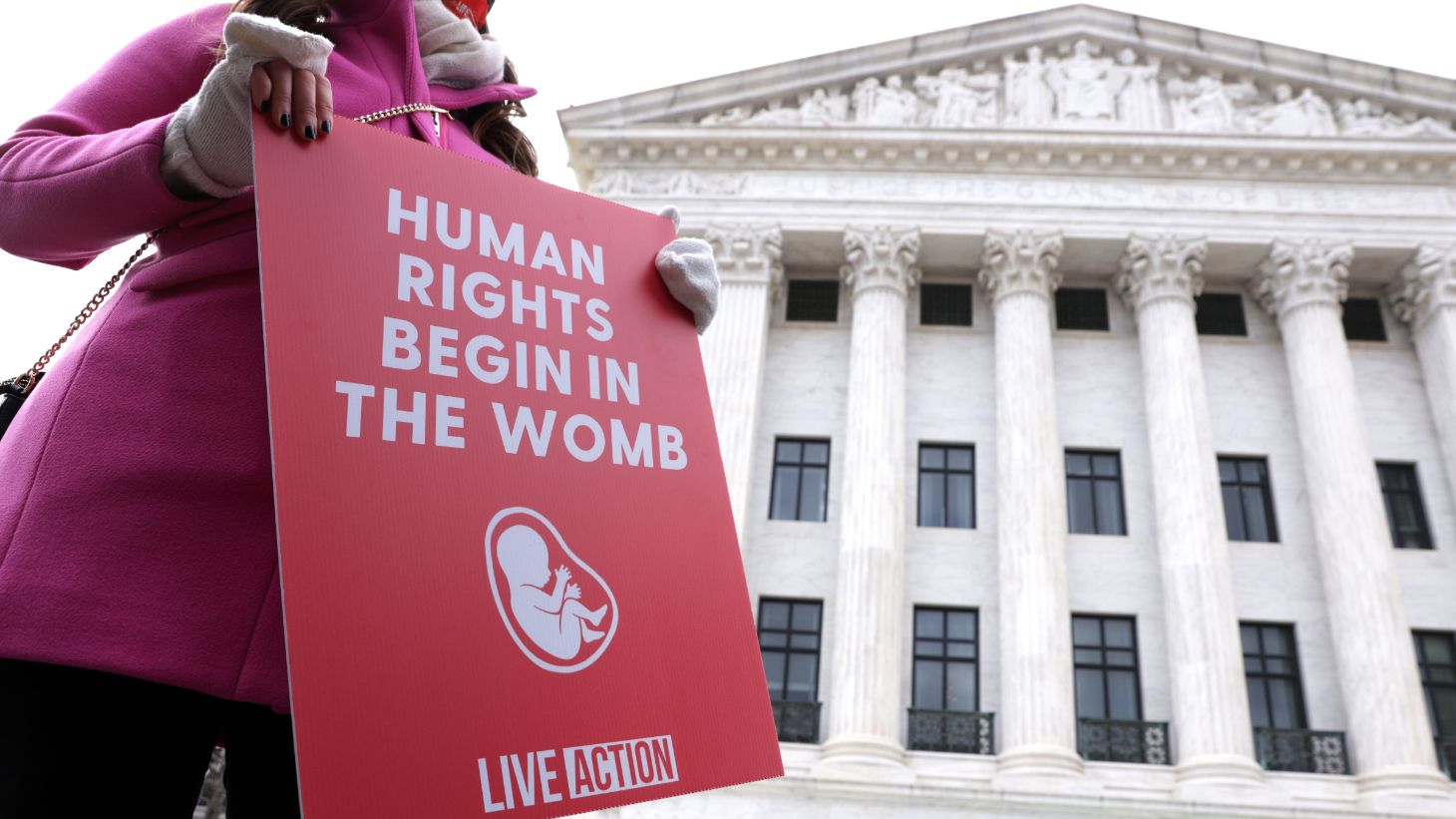
In agreeing to hear a potentially groundbreaking abortion case, the Supreme Court has energized activists on both sides of the long-running debate who are now girding to make abortion access a major issue in next year’s midterm elections.

For many evangelicals, the case could serve as a validation of more than four decades of persistent work and a sometimes awkward relationship with former President Donald Trump, whose three Supreme Court appointments sealed a 6-3 conservative majority. If those justices unite to uphold a Mississippi law banning abortion after 15 weeks of pregnancy, it would mark a first step toward the possible demise of the 1973 Roe v. Wade decision, which established a nationwide right to abortion at any point before a fetus can survive outside the womb, roughly 24 weeks.

Abortion rights advocates, meanwhile, are urgently warning that the case is the biggest threat to decades of rulings that have consistently upheld, with some caveats, a woman’s constitutional right to decide whether to end her pregnancy.

Since the Roe decision, abortion has become a defining theme in American politics, emerging as the sole issue that some voters use to assess which candidates they’ll support. The Mississippi case could emerge as another turning point—with unpredictable results. Abortion opponents may become further emboldened if their long-desired goal moves closer to reality, while an unfavorable decision could spur supporters to intensify calls for dramatic changes to the judiciary.

For now, both sides say they are fully engaged.

“This is huge—it’s saying that for the first time in a long time that we have a pro-life majority on the Supreme Court,” said Katherine Beck Johnson, a lawyer with the conservative Family Research Council. “It will encourage the voting base to get out and vote Republican.”

Jennifer Dalven, director of the American Civil Liberties Union’s Reproductive Freedom Project, said the high court’s decision to hear the case was “really alarming.”

“For more than 40 years the Supreme Court has said states can’t ban abortion prior to viability,” Dalven said. “There is simply no way for the court to rule for Mississippi without gutting Roe v. Wade.”

The case probably will be argued in the fall, with a decision likely in the spring of 2022 during the campaign for congressional midterm elections. Many abortion-rights groups urged their supporters to start mobilizing now.

“There’s never been a more important time to elect Democratic pro-choice women to local and national office,” said one of those groups, Emily’s List. “If the Supreme Court strikes down Roe v. Wade, we’ll need all the help we can get.”

Even if the court does not explicitly overrule Roe, a decision favorable to Mississippi could lay the groundwork for allowing more restrictions on abortion. Bills have been enacted in multiple Republican-governed states that would ban abortion as early as six weeks, and also in cases where a decision to abort was based solely on a diagnosis of Down syndrome.

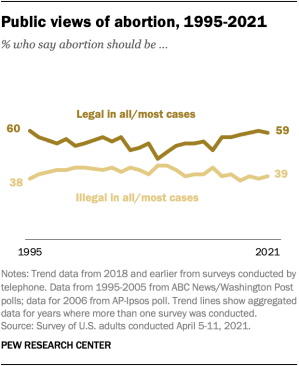
Nationwide polls have repeatedly shown that most Americans support the premise of Roe v. Wade. An April poll from the Pew Research Center found that 59 percent of Americans think abortion should be legal in most or all cases, while 39 percent think it should be illegal in most or all cases. Opposition to abortion is strongest among white evangelicals, just 21 percent favor making it legal, while 77 percent say it should be illegal.

Some abortion opponents, noting those surveys, are skeptical that the Supreme Court would fully overturn Roe.

“The Supreme Court has never led public opinion but followed it when it comes to major issues like slavery, gay marriage, and women’s rights,” said First Baptist Church Dallas pastor Robert Jeffress, who has been a close ally of Trump.

“As long as 70 percent of the American people oppose the overturn of Roe, it will never happen,” he said. “Realistically, conservatives can hope that the court uses the Mississippi case to chip away at unrestricted abortion in our country.”

Charles Camosy, a professor of theological and social ethics at Fordham University, also acknowledged those poll findings. But he noted that the Gallup poll has repeatedly found that more than two-thirds of Americans say abortion should be illegal after the 12th week of pregnancy—a time frame that is in force in several European countries.

“I doubt the court’s majority is willing to totally undo the legal right to abortion,” he said. “More than likely is they will rule that a 15-week limitation does not pose an undue burden on a woman’s right to abortion.”

White evangelicals, who remain among Trump’s most loyal backers, had celebrated his overhaul of the federal courts and his reshaping of the Supreme Court as perhaps his greatest accomplishment. But there remains trepidation after the court surprised them by failing to rule their way in past cases.

“Trying to predict what the Supreme Court is going to do on a state statute on abortion regulation is like trying to predict the path of a hurricane, only more difficult, because there are a lot of things at play,” said Ralph Reed, chair of the Faith and Freedom Coalition and a longtime ally of Trump.

Reed acknowledged that abortion is only a top issue for a small minority of voters but argued that in many competitive congressional and gubernatorial elections, “it could theoretically be the difference.”

“It’s not necessarily the issue that ranks highest in terms of determining one’s vote, but it still matters in terms of intensity and enthusiasm,” he said.

Among 2022 US Senate races where the issue could be a key factor are those in Pennsylvania, North Carolina, Georgia, and Florida.

If the Mississippi ban is upheld, “pro-lifers would be energized,” said Michael New, an abortion opponent who teaches social research at Catholic University of America.

“It would show that the strategy of supporting pro-life candidates for the presidency resulted in a Supreme Court that was sympathetic to legal protections to preborn children,” he said. “Pro-life state legislators in other states would likely pass similar 15-week abortion bans, confident that these bans would also be upheld.”

Albert Mohler, president of the Southern Baptist Theological Seminary, said he was optimistic the Mississippi ban would be upheld, giving abortion-rights groups a chance to mobilize their supporters with warnings of Roe’s demise while infusing abortion opponents with a new sense of optimism.

“Pro-life voters are looking for progress,” Mohler said. “What serves to deflate the vote of pro-life Americans is frustration at the impression of the lack of progress.”

Mallory Quigley of the Susan B. Anthony List, which seeks to elect anti-abortion candidates, predicted the issue would be a “huge motivator on both sides” going into the midterms.

As far as Republicans, she said, “It’s motivating to see how past electoral choices are impacting policy today and then moving forward, what more is to be done.”

Abortion-rights supporter Kelly Baden of the State Innovation Exchange, a strategy center for state legislators who champion progressive values, said the wave of anti-abortion legislation in Republican-led states “shows how much we’ve already lost and how dire our circumstances already are.”

“But we have the power to take it back,” she said. “If and when the courts let us down, we can and must show up at the voting booth.”

News

Is It Discrimination or ‘Do No Harm’? Christian Doctors Gear Up for Transgender Debates

As HHS challenges continue to play out in court, the Christian Medical and Dental Associations provides a more robust position statement on treating patients with gender dysphoria.

Christianity Today May 19, 2021
Heath Korvola / DigitalVision / Getty Images

Update (July 26, 2022): The Department of Health and Human Services (HHS) is moving to expand its nondiscrimination policies around sexual orientation and gender identity, which would have practical and legal implications for doctors who decline certain procedures such as gender transition treatments.

A proposed rule, released on Monday, is meant to better align with the 2020 Supreme Court ruling in Bostock v. Clayton County, which included sexual orientation and gender identity in workplace discrimination protection on the basis of sex. HHS would enforce the revised policy among health care providers receiving federal funds as well as insurers.

HHS noted in the proposed policy that multiple groups have already opposed existing enforcement of the Affordable Care Act’s nondiscrimination policies, called Section 1557, on religious grounds. There are appeals pending in the Fifth and Eighth Circuit courts, and a district court in North Dakota has barred the HHS from enforcing the policies in a way that would require Christians “to perform or provide insurance coverage for gender transition services or restrict or compel their speech on gender identity issues.”

Luke Goodrich, senior counsel at the religious liberty firm Becket, criticized the new rule, which he said attempts to “force doctors to perform gender transitions and abortions. Goodrich tweeted, “Everyone benefits when doctors are free to follow their Hippocratic Oath to ‘do no harm.’ It’s long past time for this Administration to stop fighting against conscience, common sense, and sound medical judgment. And we expect the courts to agree—yet again.”

https://twitter.com/LukeWGoodrich/status/1551720750016602114

——–

As cultural conflicts around transgender identity grow more intense, Christian doctors see a need to be more sensitive to the plights and preferences of people experiencing gender dysphoria while also holding firm to personal and professional convictions around biological sex.

That’s what the Christian Medical and Dental Associations (CMDA) says in an updated statement on transgender identification that leaders hope will inform its 20,000 members as well as the general public.

That balance might be difficult to maintain, though, if federal health officials take the position that declining certain treatments for transgender patients can be considered a form of discrimination based on sex.

Last week, the US Department of Health and Human Services (HHS) announced that antidiscrimination protections under the Affordable Care Act include sexual orientation and gender identity. The current administration’s stance revives a contested interpretation under President Barack Obama.

Though the HHS announcement said the department would comply with religious freedom protections in its enforcement under this interpretation, the decision raises the stakes for two current lawsuits over conscience protections for religious hospitals and doctors who do not perform certain procedures for faith reasons—and it is expected to spur further legal challenges.

“We do know that this is happening. Our fear, as an organization, is we had a temporary reprieve under the Trump administration,” said Dr. Jeffrey Barrows, CMDA’s senior vice president of bioethics and public policy. “We are very concerned and expect that we’ll have an increase in lawsuits and threats against our members and other Christian health care professionals if they do not perform some of these surgeries, prescribe cross-sex hormones, or prescribe puberty-blockers.”

The CMDA’s revised position statement on transgender identification came out last week; at 6,700 words, it’s more than triple the length of its previous statement from 2016, adding more biblical references and medical citations from research and examples over the past five years.

“While we’re not doctrinally backing down, we realized that there were some things we could do, some fine-tuning on how we phrase things, that type of thing,” said Barrows. “For the first time many of our members have been confronted with the whole pronoun issue … and are put in the position of pronouns of using a ‘preferred pronoun’ and think, ‘What does the Bible say about that? As a Christian, should I really do that?’”

Christians in health care should not discriminate or turn away patients based on their LGBT identity and “should respect how a patient wishes to be addressed, including pronoun preferences, within reason,” according to the CMDA.

The organization affirms that patients struggling with gender identity should be treated “with sensitivity and compassion, consistent with the humility and love that Jesus modeled and commanded us to show all people.” The association says it’s out of this sense of care and responsibility that it cannot endorse treatments it believes are harmful and not medically justified.

The position statement says that Christians in health care should not initiate “hormonal and surgical intervention” intended as sex reassignment and takes a stand against doing so through treatments such as alterations to sexual anatomy, uterine transplants, or hormones for children or adolescents.

The CMDA reviews theological, ethical, and medical considerations before taking its positions. The group concluded that participating in gender reassignment “threatens professional integrity by undermining our respect for biological reality, evidence-based medical science, and our commitment to non-maleficence.” The association also defends Christians’ role in offering support to patients who ask for help accepting their biological sex and gender identity.

The conversation around transgender identity, and non-gender-conforming youth in particular, is growing and shifting, as Wheaton College psychologist and gender dysphoria expert Mark Yarhouse discussed with CT last month. Doctors and other health care providers are increasingly seeing those questions come into play in their practices and, according to the CMDA, are feeling the pressure to respond with sex reassignment treatments.

The Biden administration’s guidelines, released on May 10, were framed as an effort to protect LGBT people from discrimination in health care settings that receive federal funding. The HHS document deals with section 1557 of the Affordable Care Act, the same part that has been challenged by religious liberty advocates in court.

Policy experts state that, according to section 1557, “insurance plans across the country may not deny access to medically necessary medications, surgeries, and other transition-related treatments for transgender people if similar services—a hysterectomy, for example—would be covered for non-transgender people.”

Because the vast majority of the US health care system receives federal funding through Medicaid and Medicare, the regulation extends broadly, including to certain providers who decline to perform sterilization procedures and gender assignment for faith reasons.

In two lawsuits, one in Texas and one in North Dakota, the Becket Fund argued on behalf of Christian hospitals and doctors, including the CMDA, that the HHS interpretation of the law violated regulatory requirements and protections under the Religious Freedom Restoration Act, said Becket vice president and senior counsel Luke Goodrich.

While the courts sided with Becket’s case, the outcomes are still being challenged. Last month, an appeals court in the Fifth District (Texas) sent the decision back to the trial judge for reconsideration in light of more recent decisions around gender identity protections, and the Biden administration appealed the injunction granted in the Eighth Circuit (North Dakota).

https://twitter.com/LukeWGoodrich/status/1384596313694605316

The recent HHS guidance, by emphasizing the federal protections for gender identity, could strengthen the religious liberty argument by making it clearer that the interpretation and enforcement of the regulation would put the plaintiffs—who treat transgender patients for everything from “cancer to the common cold”—in the position of having to perform gender reassignment procedures against their conscience or lose out on federal funding.

The “transgender mandate” in some ways is running in parallel to the yearslong legal battle over the ACA’s “contraception mandate,” requiring employers to cover items such as birth control.

“In some ways, this announcement on Monday (May 10) goes further than the contraception mandate because it’s not just that you have to cover gender transition procedures in your health insurance plan, it’s also that you have to perform the procedures yourself as a doctor in the hospital,” said Goodrich, who is also the author of Free to Believe, a book on religious liberty in America. “The very simple solution here is for the administration to adopt a very clear and broad religious exemption that tracks the courts’ decisions in Hobby Lobby and Little Sisters of the Poor.”

So far, the administration hasn’t moved in that direction, but he says losses in court could force them to carve out the protections around gender reassignment that Christians in health care are asking for.

addApple PodcastsDown ArrowDown ArrowDown Arrowarrow_left_altLeft ArrowLeft ArrowRight ArrowRight ArrowRight Arrowarrow_up_altUp ArrowUp ArrowAvailable at Amazoncaret-downCloseCloseellipseEmailEmailExpandExpandExternalExternalFacebookfacebook-squarefolderGiftGiftGooglegoogleGoogle KeephamburgerInstagraminstagram-squareLinkLinklinkedin-squareListenListenListenChristianity TodayCT Creative Studio Logologo_orgMegaphoneMenuMenupausePinterestPlayPlayPocketPodcastprintremoveRSSRSSSaveSavesaveSearchSearchsearchSpotifyStitcherTelegramTable of ContentsTable of Contentstwitter-squareWhatsAppXYouTubeYouTube