Theology

The Unearthed Conscience of Black Fundamentalism

A hard racial line divided conservative white and Black Protestants 100 years ago. It didn’t have to be that way.

Illustration by Mallory Rentsch / Source Images: MirageC / Abzee / Getty Images / WikiArt

Seventy-four years ago, Carl F. H. Henry, the first editor of Christianity Today, produced his watershed volume The Uneasy Conscience of Modern Fundamentalism. This work represented Henry’s clarion call for evangelicals to engage with the social ills facing the world, to apply the fundamental doctrines of the Christian faith to address the needs of society without being trapped into preaching a mere “social gospel.” Fundamentalists of the prior generation, he argued, showed a troubling “reluctance to come to grips with social evils” as they isolated themselves from the surrounding world.
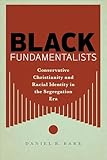
Black Fundamentalists: Conservative Christianity and Racial Identity in the Segregation Era

Listed with “aggressive warfare,” “the liquor traffic,” “exploitation of labor or management,” and other social sins that Henry identified as too removed from fundamentalist rhetoric and conscience was, notably, “racial hatred and intolerance.” And this was, by and large, an accurate assessment, at least among those whom Henry here envisioned as “fundamentalists”—a category essentially white in its composition.

This assumption was not only shared by Henry and his contemporaries but by historians looking back on the era. Yet while the conscience of Henry’s fundamentalists might have been uneasy under the weight of social isolation, there is another fundamentalist conscience of this era that has long been obscured. The self-conscious presence of Black fundamentalists on the early-20th century American religious landscape both interrupts the common historical narrative and, perhaps, might prompt today’s evangelical heirs of the fundamentalist movement to reflect on their theological heritage.

The theological thrust behind fundamentalism during much of the 1900s was, at its most basic, an unwavering opposition to the theological alterations and innovations being advanced under the day’s “modernist” or “liberal” theology.

Believing that modernists’ embrace of ideas like higher biblical criticism and evolutionary theory constituted an abandonment of historic Christian faith, fundamentalists emphasized what they saw as the “fundamental” doctrines of the age-old faith. On its face, there seems to be no reason that such theological concerns ought to be racially delimited, yet African Americans remained excluded from the story of fundamentalism.

This is changing. For example, Mary Beth Swetnam Mathews’s excellent 2017 book, Doctrine and Race, has deservingly received a great deal of attention as it examined fundamentalism’s relationship to the color line.

Still, even Mathews treats fundamentalism as a phenomenon wholly external to the Black Protestant community: “The movement’s leaders had so racially coded fundamentalism as the purest form of Christianity that their racial inclinations could not allow African Americans the ability to confess it for themselves.”

But many African Americans did confess it for themselves, arguing both for the theological ideas of fundamentalism, like the supernatural authorship of Scripture, and for the term itself. As an editorial in the Norfolk Journal and Guide, one of America’s leading Black newspapers, proudly asserted in the buildup to the famous 1925 Scopes Trial over teaching evolution: “The Afro-American people are Fundamentalists, for the most part.”

Why, then, have Black fundamentalists been ignored or marginalized—intentionally or accidentally—not only by their contemporary white counterparts, but also by historians looking back on the era?

One reason is Black and white fundamentalists shared theological convictions and shared a belief that those convictions meant fighting sin and worldliness in the political and social spheres, but they differed on which social sins deserved attention.

Early white fundamentalists spent their energy primarily fighting cultural battles over issues like the inclusion of evolutionary theory in public school curricula, while generally accepting (or at times promoting) the racial status quo of their day. The theological conservatism of Black fundamentalists, by contrast, undergirded calls for racial advancement and equality.

While many leading Black voices of the early 20th century—men like W. E. B. Du Bois and Langston Hughes—adopted and adapted elements of Walter Rauschenbusch’s emerging social gospel theology to address the racism facing the African American community in the Jim Crow era, others chafed at the idea of abandoning the old-time, fundamental Christianity that had so long sustained the Black community. Many church leaders argued that the advancement of the Black community was tied to its faithfulness to the historic Christian faith.

That Norfolk Journal and Guide editorial, for example, continues by arguing that fundamentalist faith “has brought [the race] thus far, and the belief is general that it is sufficient to carry us further in the enlargement of higher and better things in human life and living. … Yes, the Afro-American people are Fundamentalists, and they can give a reason for the faith that is in them by pointing to what they have become in this free Nation from what they began in the days of the Colonies.”

A similar endorsement of fundamentalism came from J. G. Robinson, longtime editor of the African Methodist Episcopal Church’s newspaper, the A.M.E. Church Review. Robinson took over editorship of the paper in 1924, representing a sharp contrast to his more social gospel–friendly predecessor, Reverdy Ransom.

Robinson’s theological conservatism shone through during his editorial tenure for the better part of the next two decades, and was particularly obvious in an article that he penned in 1936 for the A.M.E. Zion newspaper, The Star of Zion. Robinson warned that the pressing threat of modernist theology in Black churches was “contrary to the universal belief of the Christian church.” Modernism was a blight on the church due to its assumption of “the errancy of the Holy Scriptures,” which led modernists to summarily dismiss “many of the doctrines which were believed to be necessary for salvation”—doctrines like Christ’s virgin birth, his deity, and his literal resurrection. In contrast to the dangerous infidelity of the modernists, Robinson hailed the upright example of “the old line preachers (of which I am one) called ‘Fundamentalists’ … who unequivocally hold on to the inerrancy of God’s Word as it is set down in the Holy Bible from Genesis to Revelation.”

Robinson likewise distinguished between the gospel messages that modernists and fundamentalists preached. He exhorted pastors to “hold tenaciously to the apostolic interpretation of the Word of God,” preaching a “Gospel of conviction, Conversion, Regeneration and Sanctification.” Modernism, by contrast, offered a “Gospel of social service and economic security,” which represented both a betrayal of the historic Christian faith and a corrosive threat to the spiritual well-being of the Black community. In fact, he declared, the modernists’ social gospel message had “well nigh taken all the comfort and sweetness out of the lives of the people and almost emptied the churches.”

As a man who believed that the faith and character of the community’s ministers were among “the greatest factors in the elevation” of the race, Robinson lamented that social-gospel preaching threatened to undermine the religious truths that had for so long bolstered the Black community in their struggle for freedom. To remain true to their own heritage, then, African American churches needed to “leave off much social philosophy and sociology, and give us the pure unadulterated Gospel of Jesus Christ.”

Robinson’s category of “old line preachers” would certainly have included his contemporary Isaac Reed Berry, whose pulpit ministry similarly illustrated constellations of fundamentalist doctrine, anti-modernist condemnations, and racial applications.

Hailing originally from Fodice, Texas, Berry had migrated eastward in his early 20s in pursuit of higher education, training first at Howard University and then as one of the few Black students at the Boston University School of Theology. Ordained a Methodist minister in 1917 and pastoring numerous churches across the upper South, Berry made no secret of his fondness for fundamentalist exemplars like Billy Sunday or, in turn, his abiding hostility and disdain for the program of modernist theology.

A particularly common target of Berry’s polemical ire from the pulpit was the practice of higher biblical criticism. He derided the modernist view of the Bible as, among other things, a satanic deception, an expression of hatred toward God, a fire of infidelity, and an unabashed wickedness in the Lord’s sight. Yet even in the face of such ungodliness, he assured his congregants, the “inspired” and “imperishable” Scriptures would unfailingly prevail.

As with white fundamentalists, the doctrinal considerations of Black fundamentalists did not stand isolated from the circumstances of the surrounding world. In one sermon, Berry conjoined biblical criticism with “bigotry” as societal forces that aimed to “keep the Bible from doing its blessed work in the world.” In doing so, he positioned the doctrine of biblical inerrancy as a firm pillar to uphold African Americans’ claims to social equality. In his preaching, Berry repeatedly invoked texts like Acts 17:26 (“[He] made of one blood all nations of men”; KJV throughout) and Psalm 133:1 (“Behold, how good and pleasant it is for brethren to dwell together in unity!”) as divine rebukes of the Jim Crow racial hierarchy, words from God himself underscoring the full humanity and equality of Black people.

Berry argued, for instance, that the Athenians in Acts 17 “considered themselves a super race, a unique race, and all other races were just a little lower, for they were made out of a little lower dust,” evoking an unmistakable parallel with the Jim Crow racial theories of Berry’s day. Paul’s message of divine creation in Acts 17:26 thus undergirded Berry’s claim to full social and racial equality, affirming that “every man on earth is my brother, no supermen, no super race, we are one in nature and we all need to be saved from sin.”

Yet modernist higher critics sought to undermine the authoritative nature of these texts by casting doubt on the Bible’s standing as God’s Word. For Berry, the stakes here were high: After all, if God did not specially create humanity in his own image, as the Bible taught, and if the Bible itself did not represent God’s trustworthy revelation to mankind, then Christian rebukes of Jim Crow had no firm foundation but rather rested atop pillars of sand.

Berry also used other fundamentalist doctrines to challenge the racial status quo in ways that his white counterparts typically would not, despite their theological alignment. He began and ended one sermon on the equality of mankind with a focus on Jesus’ substitutionary atonement. His application: Legalize interracial marriage.

“When wedlock is unrestricted except by moral law, individual taste and pleasure,” he enjoined, “the heart of the races will beat as one. When this is accomplished, one race will cease lauding it over and domineering any other race and the race antagonism will melt away like a frost on a bright spring morning before the glare of the rising sun.”

Christ’s sacrifice for all mankind demonstrated that people of all races stood on equal footing before God, Berry repeatedly argued. Thus societal racism was an affront to Jesus’ work. In other sermons, he grounded the doctrine of Christian unity in the objective atoning power of Christ’s shed blood, offering applications that highlighted the racial prejudice of his day. Whereas the unity of the church on the basis of Christians’ common redemption in Christ’s blood ought to pertain equally “on earth and in heaven,” tragically this was not the case. Christ’s second coming would establish a kingdom with “no class spirit,” “no prejudice,” “no racial discrimination,” and “no envy, jealousy, and selfishness.” Meanwhile, white Christians tolerated the “destruction of homes, and disfranchisement and discriminations in most subtle, cruel, and hideous forms [that] the Negro suffers today.”

As he was quick to point out, the ideals of Christian unity and Christians’ common blood-bought redemption demanded an end to such “cruel and hideous” treatment of any racial group. For Berry, then, there was no need for “a new theology, a new salvation, [or] a new redeemer,” for the old-time doctrines that the modernists had rejected constituted the basis of his calls for racial equality and fraternity.

Even as certain Black Protestants embraced the fundamentalist mantle, they remained marginalized with respect to the institutional structures of the fundamentalist movement. Their racial identity led to a degree of isolation, as both their contemporary white counterparts and later historians tended to overlook them. Over time, identifications like fundamentalist began to wane as theologically conservative white Christians like Carl Henry and Billy Graham shifted to identifiers like evangelical and Bible-believing.

While theologically conservative African Americans continued to affirm the same essential doctrines as their now-evangelical white peers, the tensions begotten of longstanding racial inequality remained. Some Black pastors continued to express concerns about the social gospel (even as they preached social and political implications in the gospel message). Others saw common cause with predominantly white evangelical institutions and leaders while focusing on their own congregations and institutions. And other Black leaders sought greater distance from both evangelical labels and predominantly white evangelical networks even as they remained centrally concerned with the theological truths that define the evangel (Good News)—the universality of human sin; the authority and trustworthiness of Scripture; the reality of the Incarnation; the salvific and atoning work of Christ in his life, death, and resurrection; and so on.

While the story of Black fundamentalism represents an important piece of history that has fallen through the cracks, it offers more than just an interesting historical anecdote. It is a demonstration of the breadth and depth of conservative Protestant heritage that goes too often unnoticed, both inside and outside those Christian communities. Black fundamentalists in particular illustrate the adaptability and applicability of evangelical theology across different cultural contexts.

And so, as today’s evangelicals represent the theological heirs of early fundamentalism, it is helpful to recognize through our own history that, even as we all hold uncompromisingly to those central elements of the evangel, diverse experiences and social contexts can illuminate applications that might not be obvious to any lone observer. Thus, at its best, the doctrinal unity of evangelicalism can represent an opportunity to seek out a variety of co-laborers—learning from one another, leaning on one another, and building one another up in considering fresh and crucial applications of old-time fundamental doctrines.

The story of Black fundamentalism also reminds us that theological unity across racial lines has not always created ties that bind hearts in Christian love. Many white fundamentalist leaders marginalized and dismissed conservative Black Christians. The uneasy fundamentalist conscience that Henry had in mind in 1947 groaned because of its unwillingness to address the social ills of the world—including a propensity to overlook, or indeed at times even to support, the prejudice that structured the society of that day. It also groaned because for decades before Henry’s book, it had shut its ears to Black Christian leaders addressing those same ills. Perhaps the unearthed conscience of Black fundamentalism might push us to consider that the power of the evangel transcends societal vicissitudes, and therefore evangelicals ought not be captive to the whims or prejudices of whatever culture in which we find ourselves—then or now.

Daniel R. Bare is an assistant professor of religious studies at Texas A&M University. He is the author of Black Fundamentalists: Conservative Christianity and Racial Identity in the Segregation Era.

News

Enough Is Enough: Asian American Pastors on Speaking Truth

A discussion on preaching hope, confronting anti-Asian hatred, and serving their diverse communities.

Christianity Today April 30, 2021

Has the American church remained too silent about anti-Asian racism and violence? How can we respond with a biblical and unified voice?

Join us for this free webinar featuring a dynamic panel of seasoned Asian American ministers in conversation about preaching hope, confronting anti-Asian hatred, and serving their diverse communities.

Our Panelists

Mary Chung March

Mary Chung March serves as co-lead pastor of New City Covenant Church in Edina, Minnesota. She also is president of the Evangelical Covenant Church’s denominational Asian Pastors Association and president of the Mosaic (Ethnic) Commission.

She earned her bachelor’s degree from the University of Michigan and her MDiv and a master’s in counseling form Gordon-Conwell Theological Seminary. She is married to John (co-pastor at NCCC) and is a mom of four.

Juliet Liu

Juliet Liu serves as pastor of Life on the Vine Church, a small missional congregation in the northwest suburbs of Chicago. Juliet is a graduate of Trinity Evangelical Divinity School (MDiv, 2005) and the University of Illinois Urbana-Champaign (2001).

Prior to coming to Life on the Vine in 2010, she ministered as a college campus minister with InterVarsity Christian Fellowship and as the director of worship at both North Shore Chinese Christian Church and Trinity International University. Juliet also serves as chair of the board and writing team member for Missio Alliance, where she formerly served as editorial director.

Peter Lim

Peter Lim is founder and lead pastor at 4Pointes Church in Atlanta. Peter is an ordained minister who is a graduate of UCLA (1995) with a BA in political science, and of Trinity Evangelical Divinity School with a master of divinity (1999) and a master of theology (2000), and of Gordon-Conwell Theological Seminary with a doctor of ministry (2020). He and his wife, Sung-Ae, are the parents of two adorable sons.

Dennis Liu

Dennis Liu is the co-lead pastor of Vineyard of Harvest Church, a multigenerational, multilingual, and multicultural congregation, in Walnut, California.

He grew up in New Jersey, graduated with his bachelor’s degree from Cornell University, and earned a MA in intercultural studies from Fuller Theological Seminary in 2005.

After serving as an intern at Vineyard of Harvest Church, he joined the staff of the church full time as the minister to the English congregation. Dennis now serves as co-lead pastor of the church alongside his father-in-law, Kenneth Kwan, who founded the church.

Dennis and his wife, Evangeline, are excited about the future and envision a church that plants many churches!

Michelle Ami Reyes (moderator)

Michelle Ami Reyes is the vice president of the Asian American Christian Collaborative as well as an author, speaker, and activist based in Austin, Texas.

In 2014, Michelle and her husband co-planted Hope Community Church, a minority-led multicultural church that serves low-income and disadvantaged communities in East Austin. Her new book, Becoming All Things: How Small Changes Lead to Lasting Connections Across Cultures, was released this April.

Books
Review

Makoto Fujimura Sings with God, Carries His Cross, and Awaits the New Creation

In a new book, the renowned Christian artist gathers a lifetime of insights on faith and creativity.

Christianity Today April 30, 2021
Windrider Production / Courtesy of Makoto Fujimura

One of the most formative moments early in my artistic journey was hearing Andrew Peterson’s song “Let There Be Light.” I was in my late teens at the time, just beginning to grapple with the musical gifts that would eventually lead me to a career in composition. But as Peterson crooned the lyrics, “When your spirit is hovering over the deep / In the image of God just look into that darkness and speak,” I remember the lightbulb illuminating in my mind: My creativity is an act of faith.

Art and Faith: A Theology of Making

Art and Faith: A Theology of Making

Yale University Press

184 pages

That singular notion has stayed with me throughout my life, fueling my creative work and giving me a sense of purpose. And I can think of numerous musicians, authors, poets, artists, and theologians who have similarly encouraged me along the way.

Fine artist Makoto Fujimura is undoubtedly such a figure. While his stunning work has captivated countless people around the world, the way he has lived out his vocation far exceeds the bounds of his artistry. Throughout his public life, he has promoted the interaction of art, culture, and faith through founding the International Arts Movement, establishing his own Fujimura Institute, and, more recently, serving as the director of the Brehm Center for Worship, Theology, and the Arts at Fuller Theological Seminary. He has also come alongside many other artists, advocating for them and supporting their efforts, as he did for me in writing the foreword to my first book.

In each of these pursuits, Fujimura has sought to promote a vision of what it means to create and how acts of creativity relate to our faith. Now, in his engaging book Art and Faith, Fujimura gathers the many themes from each corner of his vibrant career into a single volume that persuasively articulates a “theology of making” (to quote the book’s subtitle) while communicating that vision in a contemplative style that itself radiates the very creativity he advocates throughout the book.

Abundance and exuberance

Art and Faith builds on Fujimura’s previous writing, especially the approach to cultural engagement he outlines in his 2017 book Culture Care: Reconnecting with Beauty for Our Common Life. In this latest book he expands that vision, considering the meaning of God as creator and portraying the act of creation as an artistic overflowing of God’s abundant love. Fujimura suggests that this might reorient our vision of “making” itself, showing it to be crucial for understanding who God is and how we are to live out our Christian vocations. “God’s design in Eden, even before the Fall,” he writes, “was to sing Creation into being and invite God’s creatures to sing with God, to co-create into the Creation.”

For Fujimura, embracing this invitation to “sing” and create with God requires reassessing certain entrenched habits of thought. He observes how the development of industry over several centuries has inclined Christians to favor utility over creativity. In contrast, Fujimura points out that God’s creative act models a radically different rationale: “The Theology of Making assumes that God created out of abundance and exuberance, and the universe (and we) exist because God loves to create.”

We can recover this sense of God’s extravagance, Fujimura suggests, by thinking of our faith lives through the lens of “creating” rather than “fixing,” since our ultimate hope is one of “New Creation” rather than mere “restoration” of the world as it is. The foreword for Art and Faith comes from Anglican theologian N. T. Wright, and it is no surprise to find Wright’s theology referenced often throughout the book. Fujimura’s approach neatly dovetails with Wright’s vision of a creation destined for re-creation. Fujimura takes up that redemptive anticipation and reads it through the lens of making, showing how our acts of creativity attest to God’s heart in creation and his intent for the new creation to come.

Fujimura believes that the Crucifixion reveals this theological vision in powerful ways. As he writes, “Christ’s redemptive work on the cross, Christ’s bloodshed, becomes an entry point of faith for all of us.” Artists, he argues, are uniquely able to witness to the hope of redemption amid brokenness by letting their artistry emerge from the traumas and tragedies of living in a fallen world:

Art literally feeds us through beauty in the hardest, darkest hours. … Through this wine of New Creation we can be given the eyes to see the vistas of the New, ears to hear the footsteps of the New, even through works by non-Christians in the wider culture.

Metaphors like “new wine” are among the key ways Fujimura expresses his vision. He draws heavily on the image of soil as a regenerative space where even our brokenness can testify, over time, to new creation. And he attests to the invaluable gift of tears as expressions of sanctification and consecration.

This theme of suffering is central to the book, as it is to Fujimura’s work as a fine artist. Art and Faith gives particular focus to the Japanese art form of Kintsugi, in which broken pottery is reformed using precious metals. The result, writes Fujimura, is a work of newly created beauty, “which now becomes more beautiful and more valuable than the original, unbroken vessel.”

In many insightful moments, Fujimura relates this redemptive vision of Kintsugi to experiences of suffering in his own life. In a particularly poignant passage, he describes the trauma of confronting the 9/11 terrorist attacks up close as a New York City resident. While the experience created a profound sense of loss in his life and his creative work, he shares how the example of certain artists and writers inspired meaningful ways of grappling with his grief. For Fujimura, such artists open up “a ‘holy ground’ that allows me to journey into my faith, my doubts, and my awareness of suffering.”

Patient process

In itself, Fujimura’s theology of making is a powerful reframing of Christian vocation. Yet Art and Faith offers much beyond theological explication. What made the book most appealing for me was its artful composition, which helped me reflect fruitfully on my own artistic process.

When I compose music, my primary method of expression is thematic exposition and development. Because of the way that multiple musical ideas can be expressed at the same time (what is known as counterpoint), musical beauty emerges through a sort of circularity, built around repetition, transposition, and transformation of each theme. Though music is brought to life upon an aural canvas and fine art upon a visual one, there are many similarities in their respective approaches to composition. And while writing imposes its own limitations upon the way themes are expressed and developed, it is clear that Fujimura brings an artist’s eye to the written word.

Rather than presenting his ideas in a sort of conventional three-point argument, Fujimura gradually discloses each theme, letting it unfold over the course of the book. He alternates between different modes of prose, moving from theology to insights into his own creative process to stories from his life. At first, some of these transitions can feel quite abrupt. But with further reading, the seemingly fragmented approach reveals a deeper thematic continuity, much like distinct musical motifs presented in counterpoint, which are gradually integrated into an elegant whole. To use a different metaphor, one from the book itself, Fujimura’s writing is quite like Kintsugi: It offers a mosaic of concepts bound and sealed with the golden veins of a singular theological sensibility.

This means reading the book requires a degree of patience. Fujimura’s creative style is often described colloquially as “slow art,” and his literary style is no different. The ideas in Art and Faith are not easily mined; like Fujimura ’s artwork, his writing must be received in a posture of attentiveness and receptivity. In asking readers to consider a theology of making that rejects mere utility, he implicitly invites them to relinquish their desire to simply extract something from the book and thereby consume it. Instead, his style encourages observation of the way that core themes are realized upon the canvas of his thought: themes of fire and water, creation and re-creation, soil and tears, bread and wine. I could attempt to analyze how all these concepts relate to each other in Art and Faith, but that would only do a disservice to the artful way Fujimura’s prose embodies the very vision he sets forth in the book.

Ultimately, what Fujimura offers is less a systematic truth to be comprehended intellectually and repeated verbatim than a spiritual vocation to be inhabited and lived out. For the reader willing to accept that premise and enter into this book with a willing heart and mind, there are substantial rewards in store.

Joel Clarkson is a writer and composer pursuing a PhD in theology at the University of St Andrews. He is the author of Sensing God: Experiencing the Divine in Nature, Food, Music, and Beauty.

Culture

‘Faithful’ Project Offers Sacred Space for Christian Women to Create

A new collaboration from Integrity Music brings together musicians and Bible teachers to celebrate God’s faithfulness to women in a way that transcends evangelical silos.

Christianity Today April 30, 2021
Courtesy of Faithful Project

The essence of Faithful, as both a product and a model of creative collaboration, is a meditation on authority and vulnerability and how they coexist in the stories and experiences of women.

Through a thoughtfully designed book, album, and broadcast event, Faithful tells stories of women in the Bible—Rahab, Ruth, Eve, Mary Magdalene, and more—whose lives were marked by conflict, disappointment, and oppression.

Organized by David C Cook, Integrity Music, and Compassion International, the project supports Compassion’s efforts to serve girls living in poverty around the world. The collaborators—including Amy Grant, Ann Voskamp, Ellie Holcomb, Christy Nockels, Ginny Owens, and Rachael Lampa—have framed their participation as an opportunity to speak and create with authority, hoping that other women will be moved to do the same.

As singer and writer Sarah Macintosh told me, “My hope, my greater hope, is that women would speak, because they are emboldened to speak whether or not they are respected as having authority.”

Both in my personal experience in the church and my research around women’s roles in worship, I’ve seen why this is a struggle. There’s a pattern of female creators, writers, and leaders approaching their ministry with some degree of precarity. It’s not that they doubt what God has called them to do, but that they anticipate being challenged, questioned, or forced to defend their position at some point along the way.

“There’s such a debate about women and roles and women and calling,” said writer Trillia Newbell, who was involved with both the album and the accompanying book. “We’re just always trying to figure out our place.”

To be a woman leading the church is to be constantly aware of your authority and vulnerability—a dynamic that the project captures across church history.

Singer-songwriter Sandra McCracken emphasizes that whether or not women hold a place or title of authority in a particular space, “innately, to be made in the image of God means that we have authority as women.”

Macintosh, who regularly facilitates workshops for writers, noted the importance of cultivating safety in the Faithful workshops, where the women gathered to write together during the fall and winter before the pandemic. This setting represented a careful effort to create a space where women could feel confident to write and create together.

“There was no hierarchy,” Macintosh said—an important factor because women in some traditional church settings often “do not feel safe to speak because they feel … unintelligent” or unqualified.

Over the past couple years, several influential books have captured concerns about gender roles in evangelical spaces and culture, including Kate Bowler’s The Preacher’s Wife, Kristin Kobes Du Mez’s Jesus and John Wayne, and Beth Allison Barr’s The Making of Biblical Womanhood.

Though evangelicals may disagree about the extent of the problem or about particular pastoral roles, we can all agree that when women are not flourishing and contributing their spiritual gifts to the church, the whole body of Christ suffers.

So the concerned and cynical may worry that as a project “for women and by women,” Faithful might be further confirmation that the work of women in the church is marginalized. I admit that was my first instinct. I saw Faithful as another example of women’s creative and intellectual labor being marketed to women through prettiness and an aura of feminine sensitivity.

Then, as I began to work on this article, I dropped my toddlers off with my mom to get a few hours to write. On my way home, I cued up the music from the Faithful album; “Rahab’s Lullaby” began to play.

I approached the music as an exercise in straightforward listening and brainstorming, but the song pushed me into an unexpected emotional place.

At first, I was confused. I tried to figure out what it was about the song that “got to” me. Was it the narrative? The story of Rahab doesn’t hold personal significance. In fact, I had to revisit her story in Joshua to remind myself of the details of the scarlet cord and the profession of faith she gives to the Israelite spies.

Still, I found myself fighting tears as a strong, clear voice sang, “You belong to me / And I belong to Him / Hold this scarlet cord and breathe / Hope is on the other end.”

Was it something about the music itself? The song has simple instrumentation, beginning with a spare guitar accompaniment and gradually adding additional strings and piano throughout. The voices carve the emotional contour of the song, layered in close harmonies and background echoes. One moment full of breath, the next soaring to a confident, full-throated cry. Was it the lyrics? Did it matter?

In that moment, alone in my car, I was embarrassed to have been moved to tears. Why? I have spent years of my life studying music. I treasure music in part because of its ability to affect human emotions. Why fight this response? As I looked at myself honestly, I realized that I was embarrassed to have been so moved by something I had approached with clinical calculation. I wanted to hold this work at arm’s length, analyzing it without truly engaging. What a disservice to these women and their gifts.

I’m not proud of the fact that it took an emotional encounter with one of the pieces of Faithful to help me start asking better questions. For instance, one question I initially wanted to answer was, “Why only women? Shouldn’t men be encouraged to listen, meditate, and take in this work?” When I asked this of a couple of the contributors, they (understandably) seemed puzzled, if not annoyed. Why does it matter if men read or listen?

I thought of an interview Sarah McLachlan gave about Lilith Fair, a music festival she started with like-minded female artists in 1997. She told Rolling Stone that during the early years of the festival, she was often asked questions like, “Why don’t you have men on the tour?” or, “Why do you hate men?” Her response: “Our mission is great music being made by women.”

Reminiscing about her experiences with Lilith Fair, McLachlan evoked the spiritual: “I think it’s the closest thing to church that I understand—getting to sing, to share my purpose, to live my purpose, and to connect with other people who are feeling the same way.” Steeped in the surge of third-wave feminism, these prominent female musicians had to admit that this venue created by women and for women afforded them expressive freedom and safety that they often had to do without to secure places on stages dominated by male-fronted acts. It was sacred space.

Like McLachlan, the women of Faithful seem relatively uninterested in figuring out whether it would be worthwhile to try to get men to take their work seriously. They were enamored by the experience of safely and freely creating with other women.

They were eager for the stories of Hannah, Miriam, and Jehosheba to be told and explored by women in a way that might “appeal to women who may not be eager to read a book written by yet another man about these stories,” said Newbell.

I’ve long been fascinated by a theory of Felicity Laurence, a music educator and scholar, that music can be a cultivator of empathy. “Music,” wrote Laurence, “offers a specific potential to enable, catalyze, and strengthen empathetic response, ability, and relationship.” This idea resurfaced as I explored Faithful because many of the contributors to the project, in prose and lyricism, rely on empathy gained through the female experience as a new source of insight into the stories of women in the Bible.

“With empathy and compassion, we held these women with our creative attention,” wrote Amy Grant in the book’s introduction, “until their stories became our stories, until their voices became our voices.”

One reason I believe music (and creative work in general) is such a powerful cultivator of empathy is that the ability and impulse to create reflects the Creator. To see and respect creativity in another human is to see and respect their createdness and the image of God in them.

Empathetic meditations on women in the Bible may help the church at large see these stories as central to the narrative of redemption. Music and poetry can open the door to the depth of these stories by cultivating our empathy. Without willingness to inhabit some of the trauma endured by these women, we won’t fully understand their significance. We will miss examples of God’s attentiveness, faithfulness, and grace in individual lives.

I close with empathy because I was struck by the desire of these women to inhabit difficult stories, to take on an emotional burden in order to speak and create. They empathize so that the reader and listener might empathize with both the artist and the woman whose story she is retelling. They can uniquely empathize because they are women.

Work like this may create new inroads to stories of women in Scripture, carved with the wisdom and authority that comes from community, experience, and createdness.

The Faithful album releases April 30, while the book and livestream come out May 1.

Kelsey Kramer McGinnis is a musicologist, educator, and writer. She holds a PhD from the University of Iowa and researches music in Christian communities.

News

Study: Black Christians See Limits to Multiracial Churches

About a third experience racism and obstacles to leadership in congregations that value diversity.

Christianity Today April 29, 2021
Jason Armond / Getty Images

Most practicing Christians believe the church can enhance race relations in this country by welcoming people of all races and ethnicities, new research finds.

But 29 percent of Black practicing Christians say they have experienced racial prejudice in multiracial congregations, compared to about a tenth who report such an experience in monoracial Black churches. And a third of Black Christians say it is hard to gain leadership positions in a multiracial congregation.

The new report, released Wednesday, April 28, by Barna Group and the Racial Justice and Unity Center, examines the views of what researchers call “practicing Christians”—people who self-identify as Christians, say their faith is very important to them, and say they attended worship in the past month.

The research included 2,889 US adults, with 1,364 of them meeting the definition of “practicing Christians.”

Even as the percentage of multiracial churches has dramatically grown, particularly in Protestant churches, there remain divisions on how to address racial justice among Christians as well as a willingness to do so, says the report, titled “Beyond Diversity: What the Future of Racial Justice Will Require of US Churches.”

“Racial injustice is like a disease,” writes Michael Emerson, co-principal investigator, in the report’s welcome. “Our research has found that the disease has not gone away even as the supposed antibodies of multiracial churches have multiplied. Racial injustice has mutated into new forms, and it has proven highly resistant to the antibodies of multiracial church.”

Emerson, a sociologist and co-author of the 2000 book Divided by Faith: Evangelical Religion and the Problem of Race in America, said both multiracial and homogeneous congregations “can make things better or worse.”

The report defines multiracial churches as congregations where no one ethnic or racial group comprises more than 60 percent of the congregation.

It notes a tendency in some multiracial congregations—many of which have leadership teams that are at least half white—to normalize white traditions and understandings while expecting congregants of color to assimilate.

“For attendees of color, joining diverse worship environments might mean ceding traditions, influence or preferences,” it says.

Emerson, a white man and longtime advocate of multiracial churches, acknowledged that “given our times, homogeneous congregations led by people of color can serve as a safe haven for people of color and be strong voices for justice.”

The report also found that Black practicing Christians (68%) are more than twice as likely as their white counterparts (32%) to link racial inequalities in housing, income and jobs to ongoing discrimination.

On the other hand, white practicing Christians (32%) are almost three times as likely as their Black counterparts (11%) to say such inequality occurs “because many Black fathers leave their families.”

Glenn Bracey, a Black man and the other co-principal investigator for the research, said in the report’s introduction that the new study aims “to uplift the Church—not to shame it.”

But he said the differences between white and Black Christian views on historical oppression of people of color demonstrate “a pattern in which the powerful and advantaged deny or minimize the social structures that sustain their dominance.”

Bracey, assistant professor of sociology and criminology at Villanova University, added: “it appears that racial divisions and stereotypes in society are not only present, but often more concentrated, in the Church.”

The research also showed white practicing Christians in multiracial churches appeared to have a greater sense of awareness about past and present racial injustice and have more of a desire to deal with it.

The report said white churchgoers who attend multiracial congregations are more likely than those in monoracial congregations to agree that “Historically, the United States has been oppressive to minorities.” Almost half—48 percent—of white practicing Christians in multiracial congregations agreed, compared with 38 percent of those who attend primarily white congregations.

About half (51%) of white practicing Christians attending multiracial churches say they are motivated or very motivated to address racial injustice, compared with 28% of those who attend primarily white congregations.

The report, which suggests resources for churches seeking racial progress, includes comments from other experts, including one who noted that just reading a report or attending a conference is not sufficient.

Barna Group, a California-based research firm, described itself in the report’s preface as having a “predominantly white team” that has sought out leaders and churchgoers of color as “a step in our own repentance toward segments of the Church we haven’t fully represented and served in our work.”

The overall sample of 2,889 respondents had a margin of error of plus or minus 1.8 percentage points.

News
Wire Story

Mask Up and Get Back to Church: CDC Endorses Indoor Worship After Vaccination

Gathering at full-capacity is now listed among safe activities for people who have gotten the COVID-19 shot.

Christianity Today April 29, 2021
Daniel Gregory / Lightstock

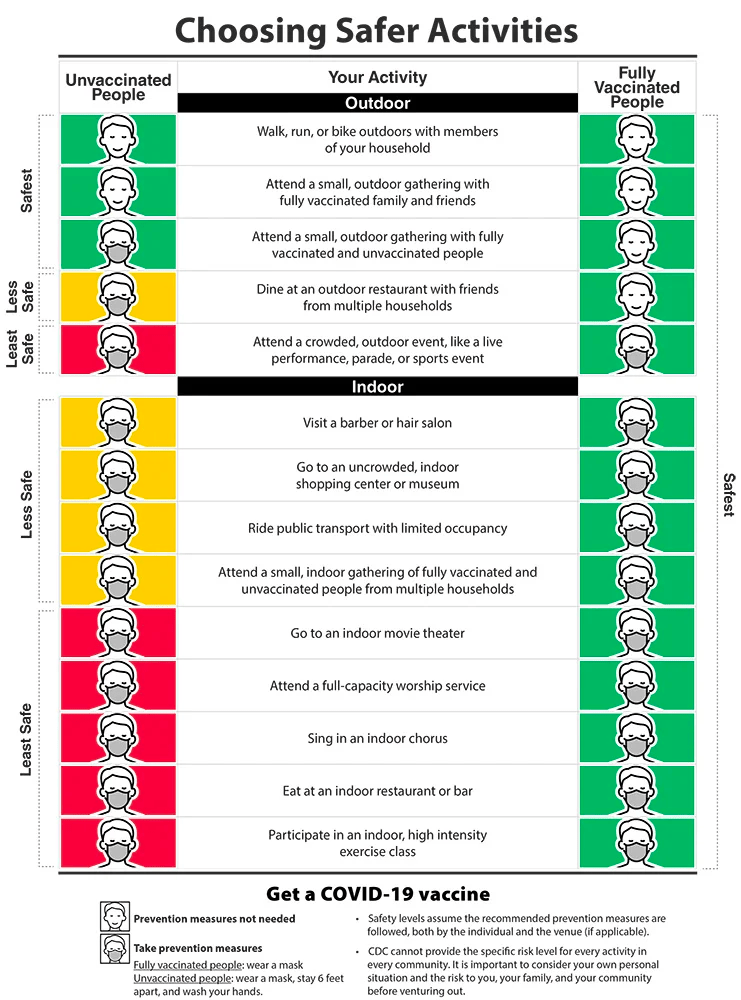
The director of the Centers for Disease Control and Prevention loosened the agency’s social distancing recommendations this week, announcing that fully vaccinated people who wear masks can safely attend many indoor events such as worship services.

CDC Director Dr. Rochelle Walensky made the announcement Tuesday during a White House press briefing, where she outlined a number of indoor activities people who wear masks and have received vaccines against COVID-19 can participate in safely—including worship.

“As we gather more and more data on the real-world efficacy of vaccines, we know that masked, fully vaccinated people can safely attend worship services inside,” she said.

Walensky also said that masked, fully vaccinated people can safely go to an indoor restaurant or bar, and “even participate in an indoor exercise class.”

The CDC continues to recommend that fully vaccinated people use masks for indoor activities such as singing in an indoor chorus, going to a movie theater or eating indoors at a restaurant. As for outdoor activities, the CDC generally only recommends masks among fully vaccinated people if they plan on attending a crowded outdoor event such as a concert.

According to the CDC, people are considered fully vaccinated two weeks after they receive the second dose of the Moderna or Pfizer/BioNTech vaccines. They are also considered fully vaccinated two weeks after receiving the Johnson & Johnson vaccine, which only requires one dose.

“The examples shown today show that when you are vaccinated, you can return to many activities safely, and most of them outdoors and unmasked—and begin to get back to normal,” Walensky said.

Officials were quick to note they still recommend widespread mask use for people who are not fully vaccinated, and that many activities remain unsafe for those without the shots.

A slide accompanying the announcement categorized many activities as “less” or “least” safe for people who are not fully inoculated against COVID-19. Attending a full-capacity indoor worship service or singing in a chorus, for instance, were among the actions designated as “least safe” for unvaccinated people.

Centers for Disease Control and Prevention

Also, the CDC stressed that even vaccinated people should continue to take precautions such as generally wearing masks during indoor public settings, avoiding “large-sized” indoor gatherings and wearing “well-fitted masks when visiting indoors with unvaccinated people from multiple households.”

“Generally, for vaccinated people, outdoor activities without a mask are safe. However, we continue to recommend masking in crowded outdoor settings and venues, such as packed stadiums and concerts where there is decreased ability to maintain physical distance and where many unvaccinated people may also be present,” Walensky said. “We will continue to recommend this until widespread vaccination is achieved.”

It’s unclear how the recommendations will impact individual houses of worship, which are typically beholden to state laws as well as internal policies that can differ by denomination or regional group.

Religious groups were among the first to shift their policies when the pandemic began to escalate last year: When an Episcopal rector in Washington, D.C., tested positive for the virus in March 2020—one of the first in the city to come down with COVID-19—the local diocese quickly suspended the use of wine during Communion and drained baptismal fonts.

While the CDC suggestions are guiding principles and not formal federal restrictions, debates over local worship restrictions have raged throughout the pandemic. Despite mass-transmission incidents taking place at worship services and many religious groups shifting to online worship, some faith leaders refused to stop worshipping in person. Some were arrested, and others have sued local and state governments over the restrictions.

For his part, President Joe Biden continued to attend Mass in person throughout the pandemic, and he said in November he believed people can worship indoors if they do so “safely”—although he did not offer details as to what that would mean.

Ideas

Why All The Concern Over Carbon?

US climate commitments at the Earth Day summit signal an urgency Christians should support for eschatological as well as ecological reasons.

Christianity Today April 28, 2021
Illustration by Mallory Rentsch / Source Images: Christiana Gottardi / Hennie Stander / Patrick Hendry / Unsplash

President Joe Biden opened a two-day virtual climate summit on Earth Day by committing the United States, the world’s second largest greenhouse-gas producer after China, to reducing emissions 50–52 percent below 2005 levels. It’s an ambitious goal, one that the US is not on track to come close to meeting. Emissions this past year were projected to be down more than 20 percent, mostly due to the pandemic’s impact on human activity. But with restrictions easing, pressure mounts on the world to return to normal, which is bad news for the atmosphere since this means releasing carbon to levels higher than has ever happened naturally in over 20,000 years.

Jesus foretold environmental demise on a cosmic scale while standing in the temple courts, symbolic of creation itself as the abode of the Almighty. Jesus cited ancient apocalyptic language about the darkening sun and moon, famines, earthquakes, and war (Mark 13:5–25).

Currently, over a third of evangelicals say there is “no solid evidence” that climate change is happening.

Jesus’ grim forecast nevertheless provides solace in God’s sovereignty and concern for his people (13:13). The Lord will watch over human life (Ps. 121:7–8). Unfortunately, this solace sometimes mixes in nationalist politics and laissez-faire economics alongside long-held suspicions of science as a secular displacement for faith. Christians have expressed skepticism over government rules restricting economic activity, and skepticism over scientific predictions of the future given past inaccuracies. Currently, over a third of evangelicals say there is “no solid evidence” that climate change is happening.

If only this were true. Instead, an overwhelming body of evidence starting in the mid-1800s aboard ships and progressing to recent tracking from satellites, geologic data, and computational analysis all converge to affirm the earth is getting hotter. More than 90 percent of earth scientists concur and point to humans as the primary cause. Rising tides, extreme weather, and hotter temperatures notwithstanding, climate change unheeded threatens to destroy economies, render parts of the world uninhabitable, and exacerbate disparities between rich and poor. Exactly what this may look like remains to be seen—consensus on warming isn’t consensus on its future effects—but the worries are real.

My adolescent daughter regularly bemoans being born whenever she hears catastrophic outlooks: “Why did you bring me into such a world?”

According to Robin Globus Veldman, assistant professor of religious studies at Texas A&M University, some evangelicals resist dire prognostications on climate and policies in part because of an anticipation of Christ’s return. The world is the abode of evil, destined for extinction by the triumphant return of Jesus (Rev. 19:11–21). Add to eventual triumph the inherent temporality of earthly life, and you end up with less concern for preserving the planet.

From our inception, God granted humans dominion over the earth (Gen. 1:28), implying how, as image-bearers, our care for creation should reflect his own (Gen. 2:15; Lev. 25:3–5). This ordained responsibility and power should encourage creativity in developing climate solutions and motivate lifestyle modifications. Still, sinful human nature being what it is, we are prone to abuse power and serve ourselves, perverting the duty of dominion into domination, with the aftermath being detrimental outcomes for ourselves, our communities, and potentially our planet.

Jesus’ resurrection and return are God’s final answers to all depravity and destruction. The Son of Man comes “in clouds with great power and glory. And he will send his angels and gather his elect from the four winds, from the ends of the earth to the ends of the heavens” (Mark 13:26–27). Jesus ascribes Daniel 7, a pinnacle vision of Old Testament prophecy, to himself. Daniel saw “one like a son of man, coming with the clouds of heaven. … He was given authority, glory and sovereign power” (vv. 13–14).

Jesus refers to himself as “Son of Man” throughout the gospels, by which he meant more than a normal human being. As we know from Christmas, Jesus was the son of no man but was conceived by the Holy Spirit, and thus endued with divine right to judge human sin. New Testament scholar Elizabeth Shively further notes that the darkening sun and shaking heavens represent Jesus’ judgment against demonic powers too.

Yet this assurance of future divine triumph and all things made new is not grounds for leaving the present to ruin. Jesus’ return is no release from responsibility. On the contrary, our care and concern for the earth and its inhabitants is a basis on which our own faithfulness will be judged (Matt. 25:14–30; Mark 13:33–34; Luke 18:8).

For Christians who view creation as God’s handiwork (Ps. 19:1), our faith compels us to praise, give thanks, and participate as wise stewards. I try in small ways to do my part. I keep bees, eschew herbicides, drive an electric hybrid, and installed solar panels. But given the magnitude of the warnings, my tiny efforts likely do more to assuage my conscience and impress my liberal neighbors than mitigate global catastrophe.

Worldwide systemic reordering is needed, an enormous task demanding immense political will, especially from richer countries that emit greenhouse gases at the highest levels. Roughly 40 percent of US electricity came from renewables and nuclear power in 2020. We will need that number to rise to 80 percent by 2030 to get halfway toward Biden’s overall goal of 50 percent reductions.

Individuals and churches can showcase loving dominion as well as advocate for political action. Such action along conservationist and preservationist lines can help unleash nature’s own resources for recovery—a testimony to creation’s power endued by God—but also a necessity for human survival. There is a fundamental solidarity between creatures made in God’s image and creation in which God’s image dwells, a fundamental continuity between creation and new creation, with our new birth igniting its new birth (Rom. 8:20–23).

Scripture’s promise of new creation specifically includes a new heaven and earth (Isa. 65:17; Rev. 21:1), a new world but not necessarily so different. The fundamental continuity between creation and new creation suggests a new earth modeled after our own. Ours, therefore, is not a throwaway planet, any more than our bodies are mere jars of clay to be carelessly tossed aside. Christians confess the resurrection of the body patterned after Jesus’ own resurrected body, and similarly an emergence of a new habitation patterned after new heaven itself (Rev. 21:2). Eternal life is not lived by ethereal beings floating on clouds, but by the newly embodied within a new city where God’s glory provides all the light (v. 23).

Christians hold that the created and cursed is the very stuff that gets redeemed and glorified. Though all things die and return to dust, it is out of that same dust that resurrection happens. Just as we experience foretastes of our future salvation in the present—in worship, in community, in beauty, and in love—so should we experience foretastes of our reconciliation with our environment. Our anticipated reconciliation should affect the ways we interact with the earth—the energy we burn, the gardens we tend, the food we eat, the water we use, the restraints we impose regarding consumerism and waste, the policies for which we advocate. As redeemed people, dominion invites us to live aspects of eternal life now, on earth as it will be in heaven.

Daniel Harrell is editor in chief at Christianity Today.

How CT Was a Lifeline in a Journalist’s Darkest Days

Meagan Gillmore, a visually-impaired journalist from Canada, shares how she learned to live faithfully amidst the tensions of her career.

How CT Was a Lifeline in a Journalist’s Darkest Days
Photo Courtesy of Meagan Gillmore

There was a point in Meagan Gillmore’s life when she questioned if it was possible to be a Christian and a journalist at the same time.

In fact, the news stories that Meagan covered early in her career caused her to become discouraged and disillusioned. Wanting to encourage their daughter, Megan’s parents gifted her with a subscription to Christianity Today. CT became a lifeline for Meagan during this season of her life as she wrestled with the tension of living as a Christian while working in a secular newsroom.

Growing up in a Christian household, Meagan accepted Christ at the young age of four, but her faith truly became her own when she went on a mission trip to Greece as a sophomore in high school. She recalls visiting places mentioned in the New Testament, like Corinth or Mars Hill in Athens. “The leaders read to us from 1 Corinthians and Acts 17. This was when Scripture really came to life for me,” recalled Meagan. “It became real for me when I saw that the events in the Bible happened in real places with real people, and that Jesus actually made a tangible difference in people’s lives.”

After getting her English and Journalism degree in university, Meagan started her first job as a journalist working for the Yukon News, a community newspaper in Whitehorse, Yukon. However, when Meagan received her first assignment to cover a story about a scandal in the local humane society, she felt discouraged to be reporting on a seemingly trivial topic. “The news I was covering seemed to be mostly about what I thought were insignificant issues involving seemingly petty leadership disagreements and financial scandals, especially in light of what else was going on in the world,” said Meagan. “I was also reporting on news about people drowning in the Yukon lakes and car accidents involving drunk drivers. It felt as though my only contribution to the world as a journalist was simply to say, ‘Welcome to Yukon, that river will kill you!’” Meagan’s frustration with her work contributed to her downward spiral.

The Christianity Today subscription Meagan received from her parents came at just the right time as she wrestled with the dissatisfaction she experienced with her career. “CT was a lifeline for me during a dark season of my life,” recalled Meagan. “I was struggling to determine how to follow God faithfully in a world that ignores and derides religion, and I felt alone in my feelings. But CT reminded me that I’m not the only one feeling this way and taught me that this tension is actually a good thing. CT also showed me how I should feel about this tension, what I should do about it, and provided me with resources about how to live faithfully while working in the field of secular journalism.”

“In my experience, journalists are very aware of the problems in the world, but are not interested in a divine solution. You see a lot of grief without hope and it’s hard to talk to people who are in pain when you can’t do anything for them in your professional capacity,” explained Meagan. “Much also needs to be done to better understand and support the needs of disabled journalists, as we are few and far between. However, the bright side of being a Christian disabled journalist is that my disability gives me a reason to report on issues that reflect on how everyone is made in God’s image.”

Throughout her career, Meagan read many articles in Christianity Today about what churches were doing in their local communities. These stories encouraged her to reflect on how she could practically apply Scripture in her job. “As somebody who was spending a good portion of my week writing about city council news, CT’s articles helped me reframe what I was doing at my job,” she said.

For Meagan, the most memorable CT articles are the ones that focus on the local church. “It’s really easy to complain about the church. But when I read CT’s articles about the goodness and beauty of the local church, it reminds me that Jesus is still actively using the church and is committed to her good and purity. CT’s cover story on New Life Church was the aftermath of a scandal, while the story about Snow Memorial was the aftermath of a church closure. Both those topics are sometimes discussed in mainstream media, but rarely, if ever, is the full story told.”

Currently, Meagan works as a freelance journalist and also regularly appears on radio, television programs, and podcasts produced by Accessible Media Inc., a non-profit Canadian media organization that focuses on news and current events from a disability perspective.

One particular audio show Meagan hosted in 2019 marked an important moment in her career when she interviewed a visually-impaired Jewish rabbi. During this interview, Meagan told her audience for the first time that she was a Christian. “I thought if my audience could handle a conversation on disability, they could also handle a conversation about religion,” she said. “While I was terrified of sharing my faith live on air, the first thing I wanted the audience to know about me was not that I’m a journalist, but that I’m a Christian. The Jewish rabbi and I had a lot in common due to how our disabilities impacted our individual faith journeys and relationship to our faith communities.”

“Journalists often start with ideals, or at least I did. There’s this idea that we as individuals will solve every systemic problem, but you learn pretty quickly that this isn’t true. This led me to become disillusioned about my career, but thankfully, CT reminded me that my primary identity is a follower of Jesus. This truth requires me to be part of the Church and real change will happen through God’s work in the Church. Right now, due to my job and workplace, I have some limits on how much I can fully depict the truths of the Gospel in my job. However, organizations like CT can share these truths more fully and that’s encouraging for me.”

Grace Brannon is content marketing associate at Christianity Today.

News

Died: C. René Padilla, Father of Integral Mission

He pushed evangelicals to see social action and evangelism as “two wings of a plane.”

Christianity Today April 27, 2021
Courtesy of Fraternidad Teológica Latinoamericana / edits by Rick Szuecs

Editor’s note: CT also offers a collection of tributes by leaders and friends of Padilla.

C. René Padilla, theologian, pastor, publisher, and longtime staff member with the International Fellowship of Evangelical Students, died Tuesday, April 27, at the age of 88.

Padilla was best known as the father of integral mission, a theological framework that has been adopted by over 500 Christian missions and relief organizations, including Compassion International and World Vision. Integral mission pushed evangelicals around the world to widen their Christian mission, arguing that social action and evangelism were essential and indivisible components—in Padilla’s words, “two wings of a plane.”

Padilla’s influence surfaced most prominently at the Lausanne Congress of 1974, where he gave a rousing plenary speech. Nearly 2,500 Protestant evangelical leaders from over 150 countries and 135 denominations gathered in Lausanne, Switzerland, at a meeting funded primarily by the Billy Graham Evangelistic Association (BGEA). One influential magazine called Lausanne “a formidable forum, possibly the widest-ranging meeting of Christians ever held.” When Padilla ascended the stage, he carried the hopes and dreams of many evangelicals from the Global South who sought equal footing in the decision-making of worldwide churches and mission organizations.

Padilla specifically called American evangelicals to repent for exporting the “American way of life” to mission fields around the world, devoid of social responsibility and care for the poor, making the case for misión integral.

A term drawn from his homemade whole-wheat bread (pan integral), it referred to a synthesized spiritual and structural approach to Christian mission, originally translated as “a comprehensive mission.”

“Jesus Christ came not just to save my soul, but to form a new society,” he said at Lausanne.

Padilla’s life story was surprising in its global reach—from an impoverished childhood in Colombia and Ecuador to sharpening evangelicals throughout the world. He ministered with American missionaries Jim Eliot, Nate Saint, and Pete Fleming before their untimely deaths outside Quito in 1956; he translated for Billy Graham crusades across Latin America in the 1960s; he shared intimate friendship and speaking tours with John Stott in the 1970s; he bridged a growing divide between a younger generation of evangelicals from the Global South and leaders in the United States and Great Britain in the tumultuous 1960s and 1970s; and he led global evangelical organizations. He also was published widely in theological journals and student publications such as that of InterVarsity Christian Fellowship (IVCF).

Much of Padilla’s legacy remains within Latin America among pastors, theologians, and lay leaders. While he was often offered positions in the United States, Padilla chose to remain in Latin America, pastoring among the poor, leading the Kairos Center for Integral Mission, and publishing hundreds of first-time Latin American authors through his Ediciones Kairos publishing house. Padilla also co-founded the Latin American Theological Fellowship (FTL) and the International Fellowship of Evangelical Mission Theologians and served as president of Tearfund UK and Ireland and the Micah Network.

Carlos René Padilla was born in Quito, Ecuador, on October 12, 1932. Padilla came of age alongside the American missionary community in the region, pioneering evangelism projects and translating US radio programs as a young teenager for the HCJB radio ministry. As a child, Padilla knew he was different, marked by a religious identity that was marginalized and excluded by a broader Latin American culture. Padilla’s father was a tailor to pay the bills but an evangelical church planter at heart. Both his parents became evangelical Christians before he was born, through the influence of Padilla’s uncle, Heriberto Padilla, who according to Padilla was one of the first evangelical pastors in Ecuador.

Church planting was a dangerous endeavor in the staunchly Roman Catholic Colombia, where his family moved in 1934. Their homes were firebombed, and multiple assassination attempts were made upon him and his father as they planted churches and performed open-air evangelism. Padilla bore scars from stones thrown at him as a seven-year-old as he walked down the streets of Bogotá, attempting to attend the local school.

Looking back, Padilla noted this was part of being a faithful evangelical Christian: “In Colombia you had to identify yourself as an evangelical Christian, and if you did, you had to pay the consequences.”

As an economic migrant and as a member of a religious minority community, Padilla was shaped by a context of violence, oppression, and exclusion. The relationship between suffering and theology was an organic one for Padilla. As a young person, he recalled “longing to understand the meaning of the Christian faith in relation to issues of justice and peace in a society deeply marked by oppression, exploitation, and abuse of power.” The question for Padilla was not whether the gospel spoke to a challenging Latin American context, but how. These questions drove Padilla to seek answers in theological education and practical ministry among college students.

As a teenager, Padilla flew in American missionary pilot Nate Saint’s plane over the Ecuadorian Andes. Saint, along with Jim Elliot and Pete Fleming, had recently organized an evangelical children’s Bible camp in a small town outside of Quito. As Padilla peered through the cockpit at the Amazonian jungle below, he recalled Saint’s advice: “You’re going to study theology—be careful not to take theology undigested.” When the three missionaries were killed by indigenous Waorani people in a failed evangelization attempt in 1956, Padilla was a student at Elliot’s alma mater, Wheaton College. Their sudden deaths made, in his words, an “enormous impact” on him at Wheaton.

After arriving on campus in fall 1953, Padilla sought out the help of the school’s president, Victor Raymond Edman, who had served as a missionary in Quito, working alongside Padilla’s parents with the Christian and Missionary Alliance. Edman supported his new student—who barely spoke English and was in debt from his plane fare—by helping him find a job and connect with campus resources. By 1959, Padilla had earned a bachelor’s degree in philosophy and a master’s in theology. But he graduated in absentia, as he was already on staff with the International Fellowship of Evangelical Students’ movements in Venezuela, Colombia, Peru, and Ecuador. (IFES is the global body that arose out of national movements such as the US-InterVarsity Christian Fellowship and the Universities and Colleges Christian Fellowship in Britain.)

From Latin America, Padilla also proposed marriage to his longtime American friend, fellow Wheaton graduate and InterVarsity staff worker Catharine Feser. He described his marriage proposal as explicitly twofold—to marry him and to marry Latin America. Her commitment to Latin America as a mission field would play a major role in their shared ministry. (She would ultimately reject the US and vow to never return.) Catharine edited nearly everything René wrote, including his Lausanne 1974 speech. She provided a crucial bridge between English language proficiency and native fluency.

Padilla’s new role came six months after Fulgencio Batista’s regime was toppled in Cuba by Communist forces loyal to Fidel Castro. The uprising woke up the region’s young people to the reality that American imperialism was not inevitable, and its success amplified nationalistic tendencies, casting widespread doubt on foreign ideas. Most evangelical theological materials in Latin America had little to say about the pull of Marxist ideologies. Returning from the American suburbs to Latin America’s tumultuous political context shocked the young Ecuadorian and threw into question his theological categories, particularly those imparted by his education at Wheaton.

Padilla’s discontent with existing approaches to ministry, mixed with student demand for social engagement, pushed him to explore innovative solutions in mission and theology. His widespread contact with universities and students within Cold War Latin America gave him a unique perspective. But practical ministry experience was not his only expertise. His evangelical education credentials gave him wider credibility to speak into theological debates, such as those at Lausanne.

From 1963 to 1965, Padilla completed his PhD at the University of Manchester under F. F. Bruce, Rylands Professor of Biblical Criticism and Exegesis, “the most prominent conservative evangelical biblical scholar of the post-war era,” as historian Brian Stanley later described him. Studying with Bruce made Padilla trustworthy to the broader evangelical world, ultimately leading to a speaking invitation at Lausanne and a partnership with John Stott, which would prove crucial to the later inclusion of social elements in the Lausanne Covenant.

In the 1960s and early 1970s, Padilla began to speak of Latin America’s theological poverty, lamenting that local questions were being met with foreign answers. Padilla joined forces with IFES colleagues Samuel Escobar and Pedro Arana, as well as missionary Orlando Costas, creating an eclectic coalition of restless theologians. Together, they shared experiences of living in unjust and unequal contexts during the Cold War and a frustration with how many evangelical organizations treated Latin Americans.

One such frustration occurred at the 1969 BGEA-sponsored “First Latin American Congress for Evangelization,” better known for its Spanish acronym, CLADE. The event was an attempt to help Latin American pastors and theologians see the dangers of Marxist-inflected theologies and to impose US theological categories upon the region. The BGEA had observed the seemingly unchecked advance of radical theological movements by prominent, first-generation liberation theologians, and commitment to traditional Protestant evangelistic mission had started to wane. But for the embryonic Latin American Evangelical Left, CLADE represented a resurgence of American evangelical paternalism and imperialism. Padilla called the conference “made in the USA” and said paternalism was “typical of the way in which work was done sometimes in the conservative sector.”

In response, Padilla, Costas, Escobar, and others founded Fraternidad Teológica Latinoamericana (FTL). The organization pushed Padilla to publish and produce answers to gnawing missiological questions, and its early years provided some of the most significant contextual theology for Latin American Protestant evangelicals, including Padilla’s book Mission Between the Times: Essays on the Kingdom.

Padilla was already gaining prominence and sharpening his critical voice even prior to Lausanne. In a 1973 article for Christianity Today—the magazine’s first article to directly address liberation theology—Padilla warned conservative evangelicals to address their own ideological biases before critiquing liberation theology. He also rejected liberation theology itself, while concluding, “Where is the evangelical theology that will propose a solution with the same eloquence but also with a firmer basis in the Word of God?”

In July 1974, Catharine Feser Padilla gathered her children around a world atlas in their home in the barrio of Florida Este in Buenos Aires. Her daughter, Ruth Padilla DeBorst, later recalled, “The tone of her voice had a certain unaccustomed urgency: ‘Today, when he gives his talk here, in Lausanne, Switzerland’—pointing to the city on the map—‘Papi will say some things that not everyone is going to want to hear. Let’s pray for him and for the people listening to him.’”

At the Lausanne Congress of 1974, for the first time, leaders from the Global South gained a place at the table of the world's evangelical leadership—bringing their emerging brand of social Christianity with them. Latin Americans spoke with a particularly strong voice, having honed their critique as a religious minority community. The editor of Crusade Magazine wrote that Padilla’s remarks “really set the congress alight,” and received “the longest round of applause accorded to any speaker up till that time.” Even Time highlighted Padilla’s speech in its coverage, calling it “one of the meeting’s most provocative speeches.”

Seizing momentum from his and Escobar’s plenary papers, Padilla, alongside John Howard Yoder, rallied an ad hoc group of 500 attendees they called the “Radical Discipleship” gathering that sought to further sharpen the social elements in the drafted Lausanne Covenant. After the congress, Padilla recalled their radical discipleship document as “the strongest statement on the basis for holistic mission ever formulated by an evangelical conference up to that date.” He also declared the death of the dichotomy between social action and evangelism in Christian mission.

Padilla’s presentation caused a stir. Stott, for instance, had previously rejected this view, but publicly reversed himself in his 1975 book Christian Mission in the Modern World. But it made many other evangelical leaders nervous, not only in North America and Britain, but also in the Global South. InterVarsity’s general secretary Oliver Barclay took issue with the heart of Padilla’s Lausanne presentation and later that year warned him of reaction to his paper in the “media” and attempted to rein in the young leader.

At Lausanne, Padilla had connected the mission of the church to the content of the gospel message itself—content that contained social realities. In doing so, he challenged the prevailing theology of mainstream Protestant evangelicalism that social action was an implication of the gospel message—not inherent to it. But for some, calling social ethics part of the gospel message unnervingly smacked of the social gospel and theological liberalism.

But for Padilla, embracing the wider gospel message was crucial for Christian mission. “The lack of appreciation of the wider dimensions of the Gospel leads inevitably to a misunderstanding of the mission of the church,” he said. “The result is an evangelism that regards the individual as a self­-contained unit—a Robinson Crusoe to whom God’s call is addressed as on an island.”

In the following decades, Padilla helped shape the trajectory of the Lausanne Movement, leading colloquiums and conferences across the world. He continued to sharpen his message, including critiquing the role of the United States as a global power. His missiological legacy is perhaps most clearly seen in the documents of the Lausanne Congress in Cape Town in 2010. For the first time, integral mission was included in the official documents of the Lausanne movement.

Today, it is standard language for many evangelicals to speak of a wider gospel message—for individual, for neighbor, for creation. Beyond global gatherings, Padilla spent much of his time carrying out integral mission theological formation with pastors and lay leaders throughout Latin America through the Centro de Estudios Teológicos Interdisciplinarios (CETI), founded with Catharine in 1982.

Padilla was preceded in death by his lifelong colleague and first wife, Catharine Feser Padilla, in 2009. He is survived by his second wife, Beatriz Vásquez, and his five children with Catharine, Daniel, Margarita, Elisa, Sara, and Ruth, along with many grandchildren.

Theology

Leaders and Friends Remember C. René Padilla

Theologians and pastors from Latin America and around the world mourn the theologian who helped integrate social action and evangelism.

Christianity Today April 27, 2021
Carlinhos Veiga

CT asked Christian leaders who knew René Padilla, who died today at age 88 [see obituary in English, Español, or Português], about his legacy among the Latin American evangelical community, how he changed the Western evangelical world, and how he personally impacted their lives.

Valdir Steuernagel, Brazilian pastor and theologian:

Padilla was a church person. The church was not something he spoke about but that he belonged to. His life and his theology can’t be understood outside an ecclesiological frame. As a continuous traveler and minister at large, Padilla knew the church—especially in Latin America—quite well. Many evangelical leaders in the continent went into the avenue of prosperity theology, quantitative church growth, and a populist right-wing political approach. Padilla was a critic of a model that was more concerned with numerical growth than with the ethical consequences of the gospel, and a church that was more concerned with having an impact in society instead of transforming that society toward a more just, horizontal, and transparent one. Padilla always committed himself to a church that wanted to be a sign of the kingdom of God.

The North American missionary enterprise had come to Latin America with a strong critical tone toward a more “liberal theology” and a so-called “social gospel.” Padilla could not accept a gospel that was not able to provide an answer to the deep problems of poverty and injustice in this continent. Padilla was, somehow, an “evangelical outsider” be it in Latin America or in North America. An outsider building bridges with other “outsiders” without denying himself to sit at the table—as can be seen at his deep, critical involvement in the Lausanne movement.

The most important word I have to say about him, is that he has always been the same: a dedicated servant of the Lord. A simple person with a deep experience always—and sometimes stubbornly—emphasizing a consistent and prophetic discipleship.

Harold Segura, director of faith and development at World Vision for Latin America and the Caribbean:

Dr. Padilla has had a significant impact on recent generations of Latin American evangelicals, largely for his missiological proposal known as Misión Integral. He invited us to think about the gospel as a project that not only attends to the needs of the human soul but also one that speaks our social needs and to a specific political and cultural context.

His beliefs and ministry commitments were closely tied to the Fraternidad Teológica Latinoamericana, of which he is one of the distinguished founders, as well as the Comunidad Internacional de Estudiantes Evangélicos. But, beyond these organizations, his biblical thinking transcended borders and enabled dialogues with evangelical theologians on other continents. This missiological proposal of Misión Integral has been accompanied by his model of contextualized biblical interpretation and by his committed pastoral action with the most vulnerable.

Christopher J. H. Wright, global ambassador and ministry director, Langham Partnership:

René Padilla was passionately committed to the teaching and preaching of the Bible as the indispensable foundation for authentic and holistic Christian mission that combined word and deed, evangelism and social engagement. He was instrumental in the birth of one of the three major programs of Langham Partnership, namely, Langham Preaching. Padilla and John Stott had been old friends for decades, even before their involvement in the Lausanne Congress of 1974. In 2001 he invited Stott to conduct a preaching seminar at his Kairos Center in Buenos Aires. I had just taken on the leadership of the Langham ministries at Stott’s invitation that same year, so he further invited me to accompany him in October on a trip that saw us jointly leading weeklong preaching seminars for pastors and lay preachers in Peru and Argentina.

Those first two training seminars in Latin America inspired by René Padilla, with their combination of teaching, practicing, modeling, and evaluating, gave birth to a program that has initiated national preaching training movements in more than 80 countries by 2021. And in Latin America itself, the indigenous leadership of Langham Preaching throughout the continent is in the hands of men and women, some of whom were mentored as students and student leaders by René Padilla himself. It is one part of his enormous legacy.

Melba Maggay, president, Micah Global:

Dr. René has been a mentor and a kind of Barnabas for those of us who were searching for some theological handles on the issues we were facing in our various contexts in the Majority World. He fought for the insertion of social concern in the Lausanne statement drafted by John Stott in the mid-’70s. Since then, my generation of scholars and activists has drawn much inspiration from his insights and his generous encouragement.

The man is a unique combination of scholarship and pastoral warmth. We worked together on the draft of the Micah Network Declaration, and I was impressed with his uncompromising commitments and the insistence on wedding social justice and personal righteousness. When we were together in Ghana, I asked how he was getting on, his beloved wife having passed away some months before. Tears welled in his eyes as he spoke. I was so moved that here was a man who had fought many battles valiantly, yet had such tenderness about him and a vast melancholy sadness over the loss of his wife, something quite rare in these days of infidelity even among church leaders. I shall surely miss him.

Tom Lin, president of InterVarsity Christian Fellowship and trustee of the Lausanne Movement:

René’s legacy extends from individual theologians and institutions to truly the global church. Every evangelical who sees evangelism and social engagement as complementary callings owes René a great debt. At the 1974 Lausanne Congress, he helped the Western church recover a Biblical vision for integral mission, which has shaped global missions and church community engagement ever since. God’s holiness and love naturally lead to both robust evangelism and biblical justice because God desires that his righteousness be reflected in individuals and societies.

Mission integral emerged, in part, from René‘s deep engagement with Latin American students through the International Fellowship of Evangelical Students and from his founding role in the Fraternidad Teologica Latinoamericana. He nurtured scholarship and writing by Latin American pastors and theologians as the editor of the International Fellowship of Evangelical Students’ publishing house Ediciones Certeza. Nearly 50 years before the current interest in global theological reflection, René demonstrated why we need voices from the whole church as we reach and serve the whole world.

Vinay Samuel, theologian, founding director of the Oxford Centre for Mission Studies:

A major blind spot of the evangelical world in the 1960s was its inability to see that the gospel message of the kingdom of God included God’s purposes for the world inhabited by the life God created. René addressed this blind spot with sound biblical teaching and restored an understanding of Christian mission that addressed all of life affirming the slogan “the whole gospel to the whole world by the whole church.”

René’s legacy for Latin American Christianity was to build its understanding of evangelism and mission on biblical theology. His writings and mission engagement contributed significantly to the development of an understanding of mission as addressing social change among evangelicals in North America. René’s commitment to developing evangelical leadership in the non-Western world was a great encouragement to me as I set up the Oxford Centre for Mission Studies.

Miroslav Volf, founder and director, Yale Center for Faith & Culture:

René Padilla was one of the heroes of modern church history. He has been a blessing to the nations: to the church globally and the world more broadly. I first learned of Padilla through my brother-in-law and my first theological teacher, Peter Kuzmic. He had witnessed the key role that Padilla, along with his friend Samuel Escobar, played during the Lausanne Congress (1974). They helped make sure that evangelism did not get reduced to proclamation only. He made the term “integral mission” known globally in evangelical circles. The phrase captures well the deep connection that the “good news” has with the “kingdom of God” that encompasses all dimensions of life. The idea of “integral mission” has been important for me in my own early theological development as it was for many generations of young theologians.

Padilla served as president of the International Fellowship for Mission as Transformation. When they met in Osijek in 1991, I had the opportunity to work with him drafting the document “Freedom and Justice in Church-State Relations,” a central issue for Central and Eastern Europe under the demise of communism. Working with him, I could witness firsthand the attributes that marked him as a church leader and theologian: his theological acumen, his commitment to the gospel, and his sensitivity to local contexts.

Editor’s note: CT’s obituary for René Padilla is now available in Spanish and Portuguese.

addApple PodcastsDown ArrowDown ArrowDown Arrowarrow_left_altLeft ArrowLeft ArrowRight ArrowRight ArrowRight Arrowarrow_up_altUp ArrowUp ArrowAvailable at Amazoncaret-downCloseCloseellipseEmailEmailExpandExpandExternalExternalFacebookfacebook-squarefolderGiftGiftGooglegoogleGoogle KeephamburgerInstagraminstagram-squareLinkLinklinkedin-squareListenListenListenChristianity TodayCT Creative Studio Logologo_orgMegaphoneMenuMenupausePinterestPlayPlayPocketPodcastprintremoveRSSRSSSaveSavesaveSearchSearchsearchSpotifyStitcherTelegramTable of ContentsTable of Contentstwitter-squareWhatsAppXYouTubeYouTube