Books
Review

Churches, Don’t ‘Accommodate’ Disability. Plan for It.

Including people with mental and physical challenges should be an expectation, not an “extra.”

A woman with headphones and a person in a wheelchair
Christianity Today July 18, 2025
Illustration by Mallory Rentsch Tlapek / Source Images: Unsplash, Pexels

I didn’t grow up in church. But even as an undiagnosed autistic child raised Hindu in the South, I was aware of church culture. I even knew a few popular hymns. Yet I found the idea of church far more confusing than my own family’s religious practices. At the very least, I was certain it would require a level of decoding I couldn’t yet master.

I became a Christian in my early 20s, but even from the inside, the church still confused me. Now, as a parent to autistic children, I find myself helping my children decode some of the same rules I still struggle with. And while we’ve found welcome and community, we’ve also encountered plenty of unintentional barriers: sensory overload, unspoken behavioral expectations, well-meaning volunteers who didn’t quite know what to do with us.

I’ve combed through ministry resource after resource looking for something that will help me better advocate for and meet the needs of a family like mine. While many outline logistical, practical, and safety-related steps, few embody the love of Christ as tenderly as Sandra Peoples’s Accessible Church: A Gospel-Centered Vision for Including People with Disabilities and Their Families.

Peoples, a disability-ministry consultant who grew up with a sister with Down syndrome, is also a parent to an autistic child. Her book is a timely and deeply needed resource for churches seeking more than a manual for ministry logistics. It offers a holistic framework—both theological and practical—for making the church a place where people with disabilities and their families are truly seen, welcomed, and valued. As Peoples demonstrates, the rationale for pursuing accessibility and inclusion lies not in sentiment or social obligation but in the very nature of the gospel.

Accessible Church has a clear foundational premise: Including people with disabilities is not an “extra.” It’s intrinsic to the mission of the church.

Drawing from the doctrine of the imago Dei, Peoples asserts that every person—regardless of ability—is created in God’s image and called to participate in the life of Christ’s body. This foundational truth bestows dignity, value, and purpose on every individual. It teaches us to treat disabilities not as unfortunate deviations but as sovereignly ordained realities, capable of reflecting God’s glory in unique and powerful ways.

Peoples’s writing reflects this conviction—she doesn’t treat disabilities as problems to be solved or obstacles to be managed. Her theological approach is pastoral, not clinical; biblical, not sentimental.

She weaves Scripture throughout the book, from Moses’s speech limitations to Paul’s thorn in the flesh. These aren’t cherry-picked proof texts but part of a broader narrative: Throughout the history of his people, God’s power is revealed through human weakness. The church, if it would reflect Christ, must learn to see beauty and purpose in what the world calls limitation. “As churches,” Peoples suggests, “we may need to lay down our preferences, our traditions, and our reputations for the sake of the gospel.”

The book presents sobering statistics about the relative absence of people with disabilities in our churches, measured against disability rates in our larger communities. Such figures point to a glaring discrepancy between churches’ self-perception as a welcoming environment and the actual experiences of families impacted by disability.

Peoples encourages readers to consider why these families might avoid our congregations. The reasons aren’t that mysterious. Lack of support, physical inaccessibility, behavioral misunderstandings, and theological confusion all play some role. Peoples names these dynamics honestly, without shame or blame, and invites churches to build structures that allow a wider range of people to feel at home rather than merely “accommodated.”

She also clarifies an important matter: Disability is not a monolith. From physical and cognitive disabilities to learning differences, mental health challenges, and trauma histories, the needs—and strengths—of people in this category vary widely. The book offers differentiated strategies that reflect this complexity instead of flattening disability into a single model.

As an autistic adult, I found this nuance deeply affirming. I know what it feels like to sit in a space that was not built for me—where participation requires performance and the unspoken message is “Act normal, and maybe you can stay.” Peoples envisions a better way: a church that aims higher than simply letting people like me attend. A church, in other words, that expects my attendance and plans for it in advance. That mindset shift—from accommodation to anticipation—has the power to transform church culture at its roots.

Accessible Church excels in its practicality. For Peoples, inclusion can’t be reduced to an abstract value or a sentimental gesture. It is a calling that must shape physical environments, volunteer policies, communication structures, and leadership assumptions.

The book outlines four basic models of accessibility in church classrooms and other ministry settings: inclusive environments, which host people with disabilities alongside their peers; specialized environments, which cater to specific cognitive and sensory needs; hybrid models, which allow movement between inclusive and specialized settings; and reverse inclusion programs, which invite a church’s teens and young adults into otherwise specialized spaces for the purpose of fostering relationships. These options offer churches of all sizes flexible starting points based on their resources and context. There is no one-size-fits-all model, and that humility is refreshing.

The book provides a wealth of practical tools grounded in love, not avoidance of liability. The emphasis is clear: Accessibility is about people, not just programs. When churches prioritize safety and belonging, gospel encounters become possible. This is especially true for children who may struggle with communication, emotional regulation, or participation.

“People with disabilities just can’t hide their neediness as easily as the rest of us try to hide ours,” Peoples points out. I’ve spent much of my life trying to mask my own “neediness,” so this truth hit me hard. The church is meant to be a place where we stop hiding. The more we can learn to treat visible vulnerability as a strength, not a liability, the closer we’ll come to Christlikeness.

As a parent, I long for a church where children like mine are seen not as exceptions but as fellow image-bearers with spiritual gifts to offer and discipleship needs to be met.

Peoples rightly emphasizes that disability ministry is a team effort. It’s not the work of one overwhelmed volunteer. It requires pastoral support, leadership buy-in, and a framework for sustainability.

I was especially encouraged by her description of “buddies”—volunteers who support children one-on-one, not as babysitters but as co-ministers. Peoples outlines how to recruit, train, and celebrate these volunteers—reminding readers that inclusion is a joy, not a burden.

Still, I couldn’t help noticing a gap: While the book offers a rich treatment of ministry and support to individuals with disabilities and their caregivers, it says little about adults with disabilities serving as leaders. Peoples cites Erik Carter, director of the Baylor Center for Developmental Disabilities, who has charted five steps in “the evolution of disability ministry”: “ministry apart,” “ministry to,” “ministry among,” “ministry with,” and “ministry by and with people with intellectual disabilities.” But she could have offered more examples of what it looks like when those people take the leadership reins.

Many autistic adults—myself included—are parenting neurodivergent kids, quietly navigating Sunday mornings without being invited to contribute. I’ve had the blessing of being involved in shaping a disability ministry at my home church, but I know this is the exception.

We adults with disabilities carry lived, embodied wisdom about our experiences—about regulation, communication, and sensory needs. And if churches are serious about inclusion, we need to be part of the leadership conversation—not just the care plan.

What sets Accessible Church apart is its unwavering focus on the gospel.

Inclusion is not framed as a charitable outreach, a performative gesture, a political imperative, or a ministry niche. It runs through the very fabric of the gospel. The church cannot fully reflect the body of Christ if it excludes its most vulnerable members.

This is not about extending pity or carving out “special needs ministries” as side projects. This is about ecclesiology. It’s about what we believe the church is. If the body of Christ has many parts, then exclusion is not just unfortunate—it is theologically devastating.

As Peoples observes, “Being an accessible church benefits the church as well as the families who are included.” Families impacted by disability are not burdens. They are co-laborers, image-bearers, and fellow heirs of grace. When we welcome those whose needs are different from ours, we remember our own needs. When we build spaces where difference is not just tolerated but embraced, we begin to look a little more like Christ.

Too many disability stories in the church focus on healing. This book offers a better story—one where grace sits at the table with disability and says, “Stay. You belong here.”

Perhaps your church is just beginning the journey of disability inclusion. Perhaps it’s been walking this path for years. In either case, Accessible Church is an indispensable resource. It will stretch your theology, strengthen your ministry, and maybe, as it did for me, offer healing in places you didn’t expect.

Sunita Kapahi Theiss is a writer, communications consultant, and homeschool parent based in Georgia.

News

In Immigration Court, Christians Show Up to Fill the Back Benches

Some asylum seekers face arrest at their hearings under a new ICE tactic. Now clergy are learning how to be witnesses in those moments.

Federal agents detain a man at immigration court in New York City in July.

Federal agents detain a man at immigration court in New York City in July.

Christianity Today July 18, 2025
Spencer Platt / Getty Images

Early one June morning in downtown Los Angeles, a group of eight people was learning how to observe immigration hearings.

Holding notebooks to write down all their instructions, they were mostly Protestant clergy but also Jews and those of other faiths, all under the tutelage of a local faith-based group called CLUE (Clergy and Laity United for Economic Justice). In recent weeks, more Catholics have signed up for the court-observation training with CLUE, too, according to its director Jennifer Gutierrez.

Ashley Hiestand, a minister from Mount Hollywood United Church of Christ was among the group visiting immigration court for the first time. It was initially intimidating, especially seeing Immigration and Customs Enforcement (ICE) agents in the hallways, but when she learned the process, it felt simpler.

“Our congregants might not know how to plug in in this moment—but this is one way,” she said.

There are 58 immigration courts around the country, most in major cities like New York, Los Angeles, and Miami or near sizable immigration detention centers like Adelanto, which sits about 90 miles northeast of Los Angeles.

The vast majority of those facing deportation now are Christian. 

The public can sit in on immigration hearings. More clergy are starting to observe hearings in big cities since the Trump administration began a new deportation tactic at courts.

In the removal hearings, the Department of Homeland Security (DHS) lawyers will move to dismiss the case. If the judge grants the dismissal, that ends the immigrants’ court cases and makes them eligible for “expedited removal.” That means ICE can arrest them outside the courtrooms and they are subject to deportation.

This process ends most legal remedies available to individuals who successfully obtained legal parole in the US—for example, through the app CBP One—but are now facing deportation because President Donald Trump has canceled many of those asylum programs.

In May, a Queens pastor observing immigration court in New York was arrested, right when ICE first began its tactic of arresting people at their court hearings. Authorities later released him.

Before going into Los Angeles court on this morning, CLUE’s Jennifer Coria, leading the group, emphasized that this was not an attempt at civil disobedience. It was about following rules—observing the court hearings, offering resources to immigrants there, witnessing ICE arrests outside courtrooms, and recording detainees on video as ICE agents load them into vans outside the court.

Observers also might be the only way a detainee without a lawyer can get word to family before being sent to a faraway facility, perhaps in another state. Volunteers offer to connect with an emergency contact if they can.

Coria hadn’t been in the LA courthouse before, but she had been observing immigration court in nearby Orange County and had watched people have their cases dismissed and then ICE arrest them for deportation.

Though CLUE’s Christian volunteers who showed up this day were mostly mainline, evangelicals from Spanish-speaking churches have been coming to CLUE events. 

After going through security, the group walked under the observation of some bored National Guard soldiers in the lobby and to an elevator bank, then up to the executive office for immigration court to find the rooms that would be holding what are called “master calendar” hearings.

In those courts, immigration judges hear multiple cases in a row, and ICE agents linger to arrest people after hearings.

Coria suggested a few people sit in the courtroom and a few sit outside to see what the agents were doing.

Each courtroom functions in its own way, but when two clergy members went into the courtroom to sit in on the hearings, the court clerk came over to ask who they were, and they shared what church they were from.

“The judge on Friday really noticed the clergy was present in the courtroom—he looked at them when he was speaking,” said Coria.

Seven immigrants sat on benches waiting for the judge to call their cases. One was a woman carrying a baby, juggling toys to keep the baby happy. The judge allowed her to stand and bounce the baby during her hearing.

Outside the courtroom, four unidentified men in cargo pants, big watches, and short-sleeve collared shirts gathered, whom CLUE staff guessed to be ICE agents.

Judge Rachel A. Ruane, drinking from a large coffee tumbler at a standing desk, called up several immigrants at a time to hear their cases, a practice reflecting the high caseload of immigration judges. Some of the cases she heard that day involved immigrants who entered the country in 2022 and who would have merit hearings in 2028.

The first three cases she heard were for immigrants without lawyers—the woman with the baby, a young man, and another man who had come all the way from Houston for his hearing. Ruane gave them a sheet listing free legal-aid services: a resource if they wanted representation, she said.

The DHS lawyer motioned to have two of the cases dismissed, which would allow the agents outside to arrest the immigrants.

The judge asked the two immigrants, through a Spanish interpreter, if they agreed with the motion or if they would like to have time to find a lawyer.

Though the dismissal of deportation proceedings could sound like a win for the immigrants, the woman with the baby understood the implications—she began weeping and said in Spanish that she feared persecution if she returned to her country.

To the DHS lawyer the judge said, “I’m holding those motions [to dismiss] in abeyance today.” She said she would give the immigrants time to find lawyers for their next hearing.

After her ruling, the presumed ICE agents left the hall outside the courtroom.

As the immigrants left the courtroom, CLUE clergy intercepted them to ask whether they had legal resources. The volunteers learned lessons for their next court visit: Have a printed resource page in Spanish to hand to people. The immigrants were receptive and chatted briefly.

After one round of cases, the volunteers left and convened outside the court. The woman with the baby on her hip continued talking with one of the clergy members in Spanish. The volunteers asked each other if anyone could give her a ride, but no one had a car seat. So instead they waited with her for someone else to pick her up.

Hiestand, one of the pastors, said the constant immigration raids have felt like “hell” in LA, but showing up felt like the “small next right thing.”  

“You don’t have to know all the things,” she said, but just show up, maybe with a buddy if not an official group. “To bear witness now matters. … I noticed people reacted to our presence there. The folks in court see it; the folks who work at court see it.”

The group discussed a plan to go to LA court weekly, with volunteers in the morning and afternoon.

“The community feels that presence even if ICE isn’t there,” said Coria.

Pastors

Would Jesus Flip Our Tables?

Jesus flipped over what was blocking people from prayer. What needs clearing out in our churches today?

CT Pastors July 17, 2025
Edited illustration by CT Pastors / Source image: ONYXprj (Getty)

One of the most shocking scenes in the New Testament is when Jesus walks into the temple and starts flipping over tables. 

He finds merchants selling animals and exchanging money, turning the place of worship into a marketplace to make men rich. What should be holy ground now buzzes with greed. His response is swift and fierce.

He doesn’t just scold. He drives them out. He flips their tables. 

Yes, this is still Jesus. But not the side of him we often picture, who welcomes children, heals the sick, and eats with sinners. The Prince of Peace. That leaves us asking: Is this the same Jesus we’ve seen throughout the Gospels? Why did he react this way? What made him so indignant?

Jesus used the opportunity to teach those listening: “Is it not written: ‘My house will be called a house of prayer for all nations’? But you have made it ‘a den of robbers’” (Mark 11:17).

Context helps us understand. In the first century, Jerusalem’s temple was divided into three sections: one for Jewish men, another for Jewish women, and a third where Gentiles (non-Jews) were invited to pray and seek God. The money changers and animal sellers were most likely located in the court of the Gentiles—a section designated for foreigners—since that is where currency exchanges were carried out for those who arrived with foreign money.

These travelers had likely journeyed for weeks, maybe months, to offer a prayer in the temple. But when they arrived, they found chaos. They were distracted and diverted by exploitative merchants pushing products, shouting prices, and exchanging money. Instead of encountering a sacred space to pray, they were taken advantage of. The very place meant to help draw them nearer to God had become a barrier to experiencing his power and presence. 

The sacred had been swallowed by the superficial.

That is what provoked Jesus’ righteous anger. A holy space had been hijacked. An obstacle was placed in the path of those seeking the Lord. As R. C. Sproul put it, the merchants “had no business conducting their business in that place and violating God’s design for the Gentiles to pray there.”

That is why Jesus declared, “My house shall be called a house of prayer for all nations.” He was reminding them that God loves all nations. That he is pleased when they come with genuine and repentant hearts. In doing so, he made the temple’s purpose unmistakably clear: to serve as a spiritual bridge for people to connect with God—not a place to lose sight of him.

Today, we no longer gather at a physical temple. Instead, the church—the body of believers around the world—is the living temple of God (1 Cor. 3:16–17; 2 Cor. 6:16). And though the structure has changed, the church still has the same purpose. We are still called to be a bridge. We are still called to help people find their way to Christ. The question is: Are we?

It’s a hard question, but we must ask it. 

Is there anything in us—or in our church buildings—that is impeding people seeking the Lord? 

Have we become more of a barrier than a bridge? 

If Jesus walked into our churches today, would he overturn our tables?

Are we helping people connect with God, or are we just distracting them with noise? 

Has our focus on trivialities  built up obstacles?

Pastor, your job isn’t to mediate access to the sacred. You’re not an Old Testament priest guarding the holy of holies. You are a shepherd. Your responsibility is to guide those who seek the Lord to their own encounter with God. 

As Paul writes in Ephesians 4:11–13: 

Christ himself gave the apostles, the prophets, the evangelists, the pastors and teachers, to equip his people for works of service, so that the body of Christ may be built up until we all reach unity in the faith and in the knowledge of the Son of God…

Our calling is to build up the people of God and to point them to Christ. But what if instead of pointing them to Christ, we point them to ourselves? 

The temptation is common among pastors—to draw people in with our charisma or communication skills, to become the focus rather than the guide. And we have seen the rotten fruit that bears.

We don’t need more case studies of how this pastor-centered culture can wreak havoc on the church. The headlines keep coming in: scandals abound, pastors fall from grace, trust is broken. 

The Western spotlight on celebrity pastors has distorted our vision of pastoral calling. We now risk raising up young leaders who pursue pastoral ministry not because of what the Bible calls them to do, but to be recognized—for the platform, the followers, the promise of a successful career. 

This is not what Jesus had in mind.

When this distorted image of pastoral ministry enters the church, it begins to reshape everything else the church does. Without realizing it, we begin to worry more about marketing than about intercession. We trust more in the reach of social media than in the power of fasting. We rejoice when the churches are full, regardless of whether people are actually being discipled. It starts to feel normal, and we don’t notice how far we’ve drifted. 

With good intentions, many of us have adopted styles, strategies, or services we think define what a “modern” church should look like. We’ve shortened services for convenience. We’ve streamlined the flow and tightened every transition. We craft messages too blunted to penetrate the heart. 

To make room for the next service, we rush people out of the sanctuary, cutting off any possibility of fellowship and community. What should feel like family starts to feel like a forced event. And somewhere in that process, the pastor has stopped smelling like sheep. He’s no longer among the flock but is, instead, surrounded by cameras and lights. 

We’ve traded depth for speed. Surrender for shine.

Pastor, the people in your church don’t need another celebrity to follow, but a pastor to turn to. They need a shepherd. Your calling is not to impress them but to disciple them, ensuring their heart is increasingly shaped in Christ’s image.

A. W. Tozer once diagnosed this very problem:

If the Holy Spirit was withdrawn from the church today, 95 percent of what we do would go on and no one would know the difference. If the Holy Spirit had been withdrawn from the New Testament church, 95 percent of what they did would stop, and everybody would know the difference.

That’s a convicting thought.

What we need is not another upgrade in style or strategy but a genuine reformation and a return to our true calling: to connect people to Christ and to see Christ formed in them. Our Sunday services matter. Good production has value. But these things can never replace the power of the gospel. 

Of course we want our churches to grow. And many pastors dream of one day leading a large, thriving church. But we must be honest with ourselves: What’s driving that desire?

It’s easy to fall into the comparison game. We look at larger churches and wonder, Am I doing something wrong? Why do I have so few followers? Why am I not more relevant? But what if we’re measuring ourselves against the wrong standard? Growth in itself is good, but when driven by insecurity or vanity, it can also be a snare.

Could someone who has never heard of Christ walk into one of our churches, hear a polished three-song concert, experience a seamless production, receive a motivational message, and leave without ever being able to pray and connect with God? Just like foreign visitors in Jesus’ day, is it possible they came seeking God but found only noise and distraction?

God’s heart is for his house to be a place where people can truly encounter him. A place where they can pray, talk to him, confess, worship, ask, and surrender. If our services are so fast, curated, and entertaining that no one has time to do any of that, we have missed the mark entirely.

When Christ returns, he won’t ask you about your follower count. He won’t ask how many people tuned in to your podcast. He won’t care about how many square feet your building had or how many albums your worship team released. He won’t be impressed by the attendance numbers of your Christmas or Easter productions. Whether they were 10, 100, or 10,000, the question will not be about scale—it will be about stewardship. 

He will simply ask: What did you do with the people I entrusted to you? 

The parable of the talents reminds us: God is not moved by our numbers. He’s moved by how faithfully we steward what he’s placed in our hands.

That is our job. It is our calling—as the body of Christ and as pastors—to represent him so clearly, so humbly, that people see Jesus through us without any interruption or distraction. 

We are not the main act. Our ministry dreams are not the point. 

We must remove ourselves from the spotlight and direct all attention to him.

Originally from Paraguay, Sebastián Franz is a pastor at Iglesia de Dios United in Oklahoma City and along with his wife, leads the young adult-oriented ministry and podcast Volviendo a la Esencia (Returning to the Essence).

News

Newsboys Scandals Show Christian Music Has Few Moral Guardrails

Michael Tait’s admissions raise questions about industry accountability.

Michael Tait performs for an audience
Christianity Today July 17, 2025
Stephen J. Cohen/Getty Images

When frontman Michael Tait left the Newsboys suddenly, he wasn’t the first. 

In 1997—long before Tait’s recent departure and subsequent confession—John James abruptly left one of the biggest acts in contemporary Christian music (CCM). 

At the time, the Newsboys said James was returning to Australia to preach. That was not the truth. The truth, as James later said publicly, was that he was getting drunk before noon, spending hundreds of dollars on cocaine, and wrecking his marriage with serial infidelity. He left the Newsboys because he couldn’t hide the disaster of his life anymore. 

When James has talked about this in recent years, he has not blamed the Newsboys or CCM more generally for what he did. He made his own decisions. He is responsible for his moral failures.

At the same time, James raised questions about the industry.

“The industry has the ability to expose defects in your character,” he said in 2024.

And it does little to provide direction or offer meaningful accountability.

In 2007, James told a journalist that no one in Newsboys or the CCM industry tried to stop him from straying from the straight and narrow until it was way too late. He said there were no real moral guardrails. 

“The success, the fame, the money, the screaming girls, the autographs. It’s like, how do you deal with that? How do you process that?” James said. “There wasn’t anyone mentoring or helping me to deal with this, mentally or emotionally. It’s like, you’ve got people that surround you and help you to become successful but no one really mentored us in regards of how to keep our heads in check.”

Tait’s scandal is re-raising questions about corporate culpability. Cory Asbury, known for his song “Reckless Love,” said “everyone knew” something was going on behind the scenes at Newsboys. The band’s lead singer, Adam Agee, said they heard lots of “rumors over the years” but they couldn’t be confirmed.

Performers may face audience backlash (especially in the internet age), but the Christian music industry doesn’t seem to have a reliable way to check artists’ misbehavior. 

There have been inconsistent attempts to create accountability systems for Christian musicians over the years. For example, some bands—including DC Talk and Newsboys—have brought “road pastors” on tour to try to provide spiritual guidance. 

John Cooper, frontman of the veteran Christian rock band Skillet, isn’t convinced that’s effective. 

“If you’re not committed to living in the light, you can just lie,” he told CT. “It’s about the culture of the band.” 

An unusual corporate structure shaped the culture of the Newsboys. Despite the group’s band-centric image and its plural name, the Newsboys operates more like a traveling Broadway show or circus than a typical rock band. The performers are employees or independent contractors. 

“The Newsboys is a brand,” said John J. Thompson, founder of the Christian-music magazine True Tunes. “Wes Campbell created a show, and the show is the priority.” 

Once just the band’s manager, Campbell registered the trademark for the Newsboys in the US in 1994. Since 2009, when founding member Peter Furler left, Campbell has also been sole head of the company. As owner, he has worked to keep the Newsboys going despite major disruptions.

The Newsboys transitioned from James to Furler in 1997, moving Furler up as frontman, and from Furler to Tait in 2009, with Furler literally handing his microphone to Tait during a live performance.  

When Tait stepped down, it didn’t take Campbell long to find a new face for the Newsboys. He brought on another singer, Adam Agee, a CCM veteran who previously played in Christian rock bands Stellar Kart and Audio Adrenaline, which Campbell has also managed since 2012. 

Campbell wrote in a letter to the Gospel Music Association leaked on the internet last week that “each band member has personal accountability procedures in place,” such as a road pastor, a manager, and a traveling companion. Tait joined the band with an “established accountability infrastructure,” the letter says, and those people were responsible to take care of him. 

Campbell has been involved in the management of a roster of other Christian musicians—including Tasha Layton, Cochren & Co., Rhett Walker, and 7eventh Time Down—through a management company he cofounded.

This corporate model can contribute to a group’s longevity, according to True Tunes’s Thompson. He compared the Newsboys to The Imperials, a Southern gospel quartet formed in the early 1960s and still actively performing, retaining its name while frequently changing the roster of performers.

The model allows a single successful band to live in its own ecosystem. Campbell cultivated the Newsboys’ close connections with nonprofits and formed two limited liability companies, Thriving Children Advocates and Thriving Charity Advocates. They function as broker agencies between the Newsboys and nonprofit organizations seeking to sponsor events or promote child-sponsorship programs at concerts. 

Campbell also developed and maintained the brand’s relationships with labels and publishing companies. He oversaw the band’s close affiliation with the God’s Not Dead film franchise, including the group’s appearances in three of the five movies. 

Campbell benefits from the success of the Newsboys’ music on radio and streaming platforms and with church-licensing providers. He holds songwriting credits on over 40 Newsboys songs and publishing rights on others. 

Neither Campbell nor his lawyer returned requests for comment for this article, but Campbell has denied any knowledge of inappropriate behavior by Tait. 

Steve Taylor, former Newsboys producer and songwriter, told CT he believes it “utter nonsense” that Campbell didn’t know what was happening. He said Campbell is involved in every aspect of the Newsboys business.

Taylor said CCM includes many “upright and honest” people, but in his experience, Campbell was “not a trustworthy person or a particularly ethically minded person.”

CT spoke with others within CCM who said they feared speaking out would lose them business or lead to lawsuits. Sheena Hennink, a concert promoter in Canada, said a lawyer representing the Newsboys sent her an intent-to-sue letter in response to an Instagram video she posted explaining why she canceled a series of concerts following Tait’s departure.

While the corporate structure of the Newsboys is unusual, it’s not clear to industry experts that other approaches provide more accountability. CCM historian Leah Payne, who wrote the book God Gave Rock & Roll to You, said some industry attempts to enforce moral standards for Christian musicians have not been successful. 

“A lot of Christian record labels have had morality clauses, but the only real guardrail is the marketplace,” Payne told CT. “The dollar is the governing body.”

If performers’ behavior shocks audiences, they stop buying albums and attending concerts. That’s the most serious check the industry has—the possible damage done to an individual’s reputation and the economic fallout for the label and management. 

Several high-profile CCM artists are calling for industry-wide reform in the wake of the Newsboys scandal. John Cooper, the Skillet frontman, said it may be discouraging for listeners to hear, but the industry doesn’t care whether an artist is a good Christian or even a good person. 

He told CT there’s a temptation to trust people in CCM because they’re Christians or because they’re making faith-oriented music. He’s had to learn through experience that CCM industry professionals aren’t necessarily more principled than their secular counterparts.

“Sometimes you let your guard down when you’re dealing with Christians and assume we’re all dealing with a particular set of principles,” Cooper said. “People are just going to lie and steal and cheat sometimes.” 

With the rising popularity of worship music, more artists are selling themselves as not just performers but worship leaders. Even with performers who pray and lead worship songs during their concerts, Cooper said, it’s not safe to assume that everyone is being transparent or that the persona the audience sees on stage is consistent with the off-stage individual.

Many fans are likely aware of an element of artifice to CCM. Artists project and perform spiritual fervor, night after night, show after show. Christian listeners generally know the figures on stage aren’t perfect, but when fans resonate with the music, they want to believe—or at least hope—that the musicians are earnest people of faith. 

That belief, said Cooper, is what makes it so disappointing when a Christian artist has a public scandal. He does not think CCM is more morally corrupt than the mainstream but about the same. 

“And because it’s not supposed to be the same,” Cooper said, “it feels worse.”

News

Why Scotland’s Christian Minority Stays Quiet

Research finds that churchgoers want to share their faith but don’t see others doing so.

People walk alongside river Ness in Scotland with a church tower in the background.
Christianity Today July 17, 2025
George Pachantouris / Getty Images

For the first time in Scotland, the majority of the population has no religion, and only 39 percent would call themselves Christians.

While many wonder how Scotland lost the faith, Christians, greater in number than a mere remnant, remain faithful. Some may predict a continuous decline in church attendance, but new evidence bolsters optimism for Christian Scots.

A national survey from Logos Scotland asked Christians about their participation in the church, experience in discipleship and training, and willingness to engage in public discourse.

Church attendance may have fallen dramatically since 1984, but Logos found that engagement is still incredibly high. Over 80 percent of Christian respondents say they go to their church at least one time each week—a level of commitment that is uncommon in many other countries.

The survey also showed that many Christians feel equipped and ready to share their faith with others, yet they believe that their fellow Christians are hesitant to do so. This perception gap may contribute to a wider silence of Christian voices in public discourse and stifle their freedom to joyfully share their faith.

From the earliest missionaries, such as Saint Ninian and Saint Columba, to the Scottish Reformation, Christianity has influenced Scotland’s moral framework and political institutions. Even as the nation grapples with evolving secular and pluralistic values, the legacy of Christian virtues undergirds the freedom and civility expected in public discourse.

Yet the public square becomes diminished if any one part of the vibrant fabric of Scottish society is self-censoring. Christian leaders are challenged to correct any misunderstandings within the broader church to promote engagement within local neighborhoods and in public spaces.

A supermajority of 71 percent of Christians report feeling equipped to discuss their beliefs with people of different religious or secular views. This is a significant finding in an era marked by reports of declining church attendance and waning Christian influence.

Across various denominations—Catholic (76%), Church of Scotland (74%), Free Church (71%), and Independent (51%)—Christians express confidence in their ability to articulate their faith.

The majority of Christians (57%) also feel equipped to speak about current issues from a biblical perspective. As commentators worry about the decline in biblical literacy, Christian Scots feel confident in their biblical viewpoints, even in the context of current issues capturing headlines.

There is a good amount of variation, however, across church affiliations. Congregants in the Church of Scotland feel the least equipped (50%) and Christians in the Free Church feel the most prepared (70%) to speak on issues affecting Scotland from a biblical perspective.

While Christians may feel equipped, they are not as confident when the potential for negative reactions is introduced. The survey indicates that 43 percent of Christians disagree with the notion that they are reluctant to speak about their faith due to fear of reprisal. Yet a significant number remain neutral or slightly agree, suggesting a nuanced hesitation when it comes to public expression.

This reluctance is more pronounced among certain denominations, with the Free Church members (39%) expressing the most hesitation and Catholics (28%) the least. Indeed, Catholics in Scotland are the most confident in speaking about their faith with others both in terms of feeling equipped and being less reluctant to self-censor due to fears of negative reactions.

The survey also found that Christians notice the reticence among fellow believers. In fact, 67 percent of Christians consider others to be reluctant to share their faith; fewer than 10 percent of Christians disagreed.

This is a surprising finding given that a majority of Christians feel individually equipped and only a minority are personally reluctant to speak about their faith. It may be that a self-fulfilling prophecy is at work.

Even if individuals feel confident, they may be less prone to speak about their faith if they believe others are reluctant. No one wants to be alone in speaking from one’s faith identity in public, and thus, a joint perception of others’ reluctance may paradoxically cause the most equipped and ready Christian to become individually reluctant.

Interestingly, non-Christians do not think Christians are reluctant to share their faith in public spaces. When non-Christian respondents were asked whether Scottish Christians were reluctant to share their faith in public, only 22 percent agreed that Christians were reluctant, and 42 percent disagreed.

Christians often view their peers as hesitant or ill-equipped, which may foster a sense of collective insecurity. The public square, therefore, risks becoming less vibrant if any group, including Christians, is self-censoring.

Christianity has profoundly shaped modern Scotland, leaving an indelible mark on its societal values and public discourse. The Scottish church has played an important role in developing the freedom and civility that undergird the public square.

But too few Christians avail themselves of these freedoms to enter public spaces and represent their faith-based identities. It is not that Christians are ill-prepared, but their very belief in others being reluctant leads to a general retreat from public thought and conversation.

Thankfully, leaders can use data to dismantle myths of timidity and biblical illiteracy across Scottish churches. Christians are able and ready to join conversations on important societal topics. May each congregation believe other churches are standing as faithful presences within their communities.

A necessary step in entering the public square is believing one is not alone. For centuries, Christians have boldly and joyfully engaged public discourse. It is time for Christians to reenter public spaces and trust that many more will follow.

Timothy W. Taylor is associate professor of politics and international relations at Wheaton College.

Culture
Review

‘Apocalypse in the Tropics’ Oversimplifies Brazilian Evangelicals’ Political Desires

Many backed controversial president Jair Bolsonaro. That doesn’t mean they want a theocracy.

Protestors in Brazil from the documentary, Apocalypse in the Tropics.

Protestors in Brazil shown in the documentary, Apocalypse in the Tropics.

Christianity Today July 17, 2025
Apocalypse in the Tropics

Only in recent decades has Brazil’s cultural elite begun to acknowledge the growing presence of evangelicals in the national landscape. This visibility reached new heights during the presidency of Jair Bolsonaro (2019–2022). The evangelical electorate’s strong support for Bolsonaro, combined with the appointment of evangelical leaders to key government positions and even a Presbyterian pastor to Brazil’s Supreme Court, signaled a dramatic shift in the country’s dynamic between politics and religion.

Petra Costa, director of the recent documentary Apocalypse in the Tropics, offers a lens through which to view this transformation. Yet Costa herself affirms her unfamiliarity with religion. Her intellectual formation reflects the path of Brazil’s affluent cultural class: elite education, cosmopolitan worldview, and secular assumptions. She studied performing arts at the University of São Paulo before earning degrees in anthropology and theater from Barnard College at Columbia University. Later, she completed a master’s in community and development at the London School of Economics.

Costa’s distance from religion is not surprising, given her family’s background. Her parents left Roman Catholicism during their youth, driven by their involvement in Brazil’s Communist Party. As a result, Costa grew up with no religious formation. Her mother, Marília Andrade, was a political prisoner during Brazil’s military dictatorship (1964–1985) and even shared a cell with Dilma Rousseff, the woman who would later become Brazil’s president from 2011 to 2016.

Petra Costa first gained international recognition with The Edge of Democracy, her intimate, politically charged documentary that was nominated for an Academy Award for Best Documentary in 2020. Filmed during Rousseff’s impeachment process, the film blended personal memory with national history, reflecting the polarized moment in Brazilian politics.

The earliest footage for Apocalypse in the Tropics was captured inside the Chamber of Deputies in Brasília. A member of Brazil’s Congress, Cabo Daciolo, approached the filmmaker, handed her a Bible, and invited her to give her life to Jesus. According to Costa, this unexpected encounter marked the first time evangelicals truly entered her radar.

Still, the full idea for Apocalypse in the Tropics would only take shape later, born from a growing curiosity about the rising political influence of evangelicals in Brazil and the religious language that increasingly shaped public discourse in the country.

During the COVID-19  pandemic in 2020, she decided to produce the documentary because of a striking image of a group of evangelicals gathered in the heart of São Paulo, Brazil’s largest city, praying on their knees with heads bowed and hands raised to the heavens. They were responding to a call from Bolsonaro, who had urged the nation to fast and pray for deliverance from the virus.

Bolsonaro, who long denied sanitary measures for pandemic control and opposed vaccination, was convinced by Pentecostal pastor Silas Malafaia to call for a national fast to overcome the COVID-19 virus. This moment, symbolic of the merging of political and religious power, takes center stage in Apocalypse in the Tropics

Malafaia serves as the film’s primary evangelical voice, offering his vision of a Brazil where faith and politics are no longer separate realms but deeply intertwined.

Costa’s distance from religious themes, coupled with her uninitiated perspective on the intricate world of Brazilian evangelicalism, forms both the documentary’s strengths and its weaknesses.

On the one hand, her outsider perspective allows her to ask honest, even vulnerable questions. She approaches the evangelical movement with curiosity rather than cynicism, and this gives the film a poetic, almost wondering tone. On the other hand, her distance from the reality of faith sometimes leads to oversimplification. 

Without Costa’s sense of defamiliarization with the evangelical presence in Brazilian politics, there would be no documentary. In anthropology, defamiliarization is a methodological tool rooted in the encounter with the “other” that evokes surprise, confusion, and even discomfort but also invites understanding. 

Costa leans into this tension with patience and care. She approaches the evangelical “other” not with judgment but with questions and attentive listening. The film is rich with scenes that capture this sense of wonder and disorientation, as if the one behind the camera is seeing something for the very first time.

But her lack of knowledge about evangelical churches and their beliefs leads her to rely too heavily on the voices most eager to explain the movement, especially those already prominent in media and politics. 

A more seasoned approach might have helped her here. By focusing so much on figures like Malafaia—clearly an influential voice, but far from representative—Costa risks portraying evangelicalism as monolithic, missing its theological diversity and the quieter, more grounded expressions of faith lived out in communities across Brazil. It is through Malafaia that Costa arrives at dominion theology as a framework to explain the growing evangelical presence in Brazilian politics. 

Apocalypse in the Tropics frames evangelical participation in Brazilian politics as an effort to dominate all spheres of social life. But this framing largely reflects Malafaia’s interpretation of the movement. The documentary misses the opportunity to show that evangelical engagement with politics—in Brazil or elsewhere—is far more complex and multifaceted than a single ideology or strategy can explain.

The documentary leaves little doubt about the involvement of some evangelicals in the antidemocratic events of January 8, 2023, which culminated in the invasion and depredation of the headquarters of Brazil’s three branches of government in Brasília. However, it stumbles in its interpretation by attempting to link evangelical support for such acts directly to dominion theology. 

This theological framework is virtually unknown to many pastors and evangelical believers in Brazil. By treating dominion theology as a unifying force behind evangelical political action, the documentary projects a fringe ideology onto a diverse and often fragmented movement.

The far right’s strategic alliance with evangelicals in Brazil took shape as it embraced culture-war tactics in the political arena. Politicians like Bolsonaro began speaking in defense of Judeo-Christian civilization values while evangelical politicians positioned themselves as a moral barrier against what they described as the progressive left’s agenda, especially on issues such as gender equality, abortion, and same-sex marriage. 

The “apocalypse” that unfolded on January 8 in Brasília owes far more to the long-standing demonization of the political left and to unfounded claims of election fraud than to any coordinated evangelical plan to establish a theocracy in the tropics. This reality does not lessen the seriousness of the attacks on Brazilian democracy in which some evangelical sectors participated. But it does challenge the notion of an organized evangelical conspiracy to seize political power in the country.

The documentary’s mistake in adopting dominion theology as the primary explanation for the evangelical advance in politics does not diminish its merits. Apocalypse in the Tropics remains a valuable starting point for reflection, especially for those who feel uneasy about the direction of the relationship between Christian churches and politics in democratic societies and about the ongoing tension between church and state.

Miroslav Volf, a Croatian theologian, reminds us that the solution to distorted forms of Christian political participation is not withdrawal from public life but a deeper biblical and theological reflection on how the church can serve the common good in democratic societies. 

The central question raised by the documentary is “Will evangelical participation in politics remain aligned with the far right, becoming an instrument that fatally wounds Brazilian democracy from within, only to remake the country into an autocracy in the style of Hungary or Russia?”

I do not see this scenario as likely in the near future. Although the alliance between evangelical politicians and the far right will continue to put strain on Brazil’s democratic institutions, several key factors make the establishment of an autocracy disguised as a theocracy highly unlikely. The lack of support from the military high command for any authoritarian resolution, along with the Supreme Court’s trial of Bolsonaro for his role in the attempted coup following the 2022 elections, have made the establishment of an autocracy unfeasible.

Malafaia and other politicians will continue to quote, “Blessed is the nation whose God is the Lord” (Ps. 33:12), arguing that Brazil’s Christian majority, Catholic and evangelical alike, should use democracy to pass laws that aim to restore a version of Christendom. 

This type of biblical approach to politics causes polarization and feelings of hostility, and it works to elect legislative candidates such as representatives and senators, but it sets Christians against the rest of society, deepening division rather than promoting justice, peace, or the common good.

Following the path suggested by Miroslav Volf, I believe the way forward lies in a deep, biblical conversation about God’s will for the church in democratic societies. The New Testament nowhere advocates a project of a “Christian nation”—yet, in every nation, the Holy Spirit gathers followers of Jesus to form his church, a people set apart not by political dominance but by faithful witness.

This vision is powerfully affirmed in the book of Revelation: “You are worthy to take the scroll and to open its seals, because you were slain, and with your blood you purchased for God persons from every tribe and language and people and nation. You have made them to be a kingdom and priests to serve our God, and they will reign on the earth” (Rev. 5:9–10).

The Lamb did not purchase any one nation to become his church. Rather, he shed his blood to gather from every nation those who would become his people. The New Testament presents no vision for a Christian nation but rather a vision for a Christian church—sometimes more numerous, sometimes more marginalized—within each nation-state. 

Throughout the New Testament, the role of the state is consistently presented as the promotion of justice, not the promotion of faith. In his first letter to Timothy, the apostle Paul urges that prayers be made for “all those in authority” so that “we may live peaceful and quiet lives in all godliness and holiness” (1 Tim. 2:2). In Romans 13, Paul affirms that governing authorities exist by God’s will and are charged with upholding justice. 

Of course, I recognize that appealing to justice does not eliminate conflict. After all, the political right and left often disagree on what justice entails. But this biblical emphasis gives us a shared foundation for public debate. More importantly, it acts as a safeguard against the illusion that Christians are called to build a theocracy.

Another biblical theme that Apocalypse in the Tropics invites us to recover is the sovereignty of God. In today’s polarized climate, political participation has generated intense anxiety among Christians on both the right and the left. There is a growing fear that if the ideological sides we identify with lose the next election, everything will fall into chaos. 

But this fear eclipses a central message of the risen Christ to the churches suffering under the power of the Roman Empire: “Do not be afraid” (Rev. 1:17). That word, spoken not from a throne of political power but from the victory of the Cross, reminds us that Christian hope is rooted not in winning elections but in trusting God’s sovereign rule over history.

Finally, it is important to remember, both for better and for worse, that no government fully controls contemporary societies or the global order. We live in an era of diminished control, a condition that sociologist Anthony Giddens described as a “runaway world.” 

When Christians pursue control through political power, we fall into two traps. First is a sociological illusion, since no group can fully dominate the complex, autonomous systems that govern economy, culture, politics, and more. The second is a theological misstep, because we forfeit the opportunity to bear witness to the true source of Christian security: “I lift up my eyes to the mountains—where does my help come from? My help comes from the Lord, the Maker of heaven and earth” (Ps. 121:1–2).

Valdinei Ferreira holds a PhD in sociology and is a pastor in the Independent Presbyterian Church of Brazil.

Ideas

I Took My Birthright Citizenship for Granted

Contributor

Heavenly citizenship doesn’t mean abdicating our earthly citizenship, especially when it comes to speaking on behalf of the most vulnerable.

A stroller made of the American flag
Christianity Today July 17, 2025
Illustration by Mallory Rentsch Tlapek / Source Images: Unsplash

On a recent trip back from South Africa, I was warmly greeted in the Chicago airport by a US customs official with the words “welcome home.” He didn’t know the weight of those words for me, an American citizen by birthright who has had a complicated relationship with my nationality—complications made freshly relevant in light of President Donald Trump’s efforts to undo citizenships like mine.

Last week, federal judge Joseph LaPlante continued the judicial branch’s struggle with the Trump administration when he blocked the executive order that would have denied citizenship to children born to immigrant parents in the US. In a hearing before his ruling, Judge LaPlante declared that such citizenship is “the greatest privilege that exists in the world.”

While I acknowledge the nobility of such a statement, I confess that the benefits of that privilege didn’t always feel so apparent to me as a child growing up in Midwest America.

I was a US citizen on paper, yet people repeatedly assumed that I’d just immigrated from another country. I would sing, “I’m proud to be an American,” during school choir, and then hours later in a McDonald’s parking lot, a white man would drive by with a roar of his engine and yell at me and my family, “Go back to China!”

When I moved school districts in 7th grade, I was automatically placed in ESL class based on my Korean name. Reading and writing (in English) had always been my strongest subjects. Why did that need explaining? At the same time, Korean-born acquaintances called me a Twinkie: yellow on the outside, white on the inside.

Unable to fully identify as either Korean or American, I instantly connected with Paul’s words in Philippians 3 the first time I read them: “Our citizenship is in heaven” (v. 20). Paul, a Hebrew of Hebrews, a Benjamite, a Pharisee, a Roman citizen—who could claim every kind of national belonging to his favor—chose to forsake it all in view of his heavenward call.

It seemed like the perfect way to avoid my own identity angst, so for many years, I took my birthright citizenship for granted. I didn’t care to read the news, snored through American history, and when I turned 18, quietly decided not to vote alongside my peers. What was earthly citizenship, anyway? I counted it all as dross and pressed hard into my identity as a Christian.

But I was wrong. History and the Bible have since taught me that citizenship is nothing to scoff at. Like all other gifts in life, it is to be used to help us obey the call to love God and neighbor. Neglecting to do so comes at a cost to the most vulnerable.

The displacement I felt as a child was not just personal. Beneath today’s birthright citizenship battles in the US is an old undercurrent: how to determine, in a nation made up almost entirely of immigrants, which immigrants belong and which do not.

Birthright citizenship is not the norm around the world. Most countries grant citizenship based on ethnicity and ancestry—by “the law of blood,” or jus sanguinis. You’re a citizen if your parents are—and in many ways, things are simpler that way. Among the 20 most developed countries, only Canada and the US grant citizenship through jus soli, or “the law of soil.”

Jus soli in the US originated from the colonial era, when European settlers born in colonies were considered “natural born” subjects of England’s king. This practice influenced how an independent America later conferred citizenship to most Europeans born in the US. Non-European immigrants (and Indigenous people) were excluded from this privilege.

That changed in 1894, when Wong Kim Ark, who was born in America and had lived most of his life there, returned to California after visiting China. He was denied reentry on grounds that his Chinese parents were ineligible for US citizenship under the Chinese Exclusion Act that throttled Asian immigration to America at the time.

In response, Wong claimed his status as a US citizen under the 14th Amendment, which had brought equal citizenship to formerly enslaved Black people. In United States v. Wong Kim Ark, the court ruled in Wong’s favor, affirming that all persons born in the US were, regardless of race, entitled to the rights of citizenship.

Wong’s case was the beginning of birthright citizenship as we know it today. Still, it was contested from the very beginning, and for many years after, did little to prevent continued discrimination against Chinese and other Asian Americans. The path to naturalized citizenship for those who were not “common-sense white” or Black did not open until 1923.

The US “has always wrestled with two strains of nationalism,” explains Gary Gerstle, a historian at the University of Cambridge. “On the one hand, ‘civic nationalism’ imagines America as a country open to everyone, regardless of faith, color or creed,” while “racial nationalism” imagines America as a place where nonwhite people “could never be accepted as full-fledged members.”

The Wong verdict was a step away from racial nationalism toward civic nationalism. Over the decades since Wong’s case, the US pivoted, however slowly, to become a multiracial democracy. “The absorption of millions of immigrants was part of what made the new superpower unique, then and now,” says Marcela Valdes in The New York Times.

Yet racial nationalism never fully went away. Birthright citizenship has been debated since long before Trump’s first presidency. It’s raised difficult questions, like what to do with “birth tourism” or children born to parents who are in the US illegally. Above all, it’s concerned with a key question: In a diverse democracy, who is truly a citizen and who is an “alien”?

Christians of all nationalities know we are both heavenly citizens and earthly exiles. “Live out your time as foreigners here in reverent fear,” writes the apostle Peter (1 Pet. 1:17), and the writer of Hebrews calls people of faith “foreigners and strangers on earth” who are “looking for a country of their own” (11:13, 14). It would be easy to conclude, then, that our earthly citizenship doesn’t matter. But a closer look at Paul’s relationship with his Hebrew and Roman identities shows a more complicated picture.

Paul denounces his elite Hebrew status in Philippians 3, but in Romans 9, he expresses “great sorrow and unceasing anguish” (v. 2) over the unbelief of his people, “those of my own race” (v. 3). His citizenship is in heaven, but he unabashedly exercises his Roman rights when he and Silas are unjustly imprisoned (Acts 16:37–39). In Acts 22, when Paul is stretched out to be flogged, he turns to the centurion and says, “Is it legal for you to flog a Roman citizen who hasn’t even been found guilty?” (v. 25). The commander and his guards withdraw; the law of Rome rises to protect Paul.

Rather than letting his love for Rome or Israel take precedence in his identity, Paul uses these earthly nationalities in service to the kingdom. He repeatedly pushes the limits of his Roman citizenship to shield his colleagues and preach before audiences as diverse as the Sanhedrin and sailors (Acts 23; 27). His example challenges me to likewise use my rights as an American citizen to voice concern on behalf of the most vulnerable.

The US Conference of Catholic Bishops recently wrote in a statement that the repeal of birthright citizenship “would render innocent children stateless, depriving them of the ability to thrive in their communities and reach their full potential.” The repeal of birthright citizenship would “create a permanent underclass in U.S. society, contravening U.S. democratic tradition,” the statement continues, “undermining the human dignity of innocent children who would be punished though they did nothing wrong.”

What’s most concerning today is that even those who did everything right are not safe. The Trump administration’s focus on ridding the country of illegal immigrants has also targeted legal refugees and asylum seekers, professionals, and students (as my parents once were). Immigrants in America today are truly in danger of becoming stateless, punished without doing anything wrong. Many being deported are Christians, some fleeing persecution from countries like Iran.

Those of us who are Christian—and who wish to see our nation guided by our faith—should be especially concerned about all this, especially when many of our fellow citizens now see diversity as a danger to American culture.

A primary arc of Scripture is that our heavenly citizenship extends to people from every nation, tribe, tongue, and class (Rev. 7:9; Gal. 3:28). “Christianity has been a multicultural, multiracial, multiethnic movement since its inception,” writes Rebecca McLaughlin. One cannot read the Bible without seeing that God cares deeply about injustice toward the foreigner, the poor, and the oppressed (Isa. 58:6–7; Matt. 25:35–40). American Christians who disagree with this kind of vision may be sorely disappointed if the country were to become a truly Christian nation.

“The promise of Christ’s return does not demand quietism or political escapism,” writes Kaitlyn Schiess. “Rather, it should prompt faithful political work that can resist the impulse toward violence and injustice.” When our earthly citizenship is rightly lived out in service to our heavenly one, we can live more fully into our calling to love God and neighbor. It’s a calling that others have lived out for me.

I, as an American Christian, can thus harness the protection of the First Amendment to speak out against the troubling turn toward racial nationalism of late—the confirmation of all my worst suspicions as a child. As what was spoken in United States v. Wong Kim Ark is being undone, my prayers may look like weeping, my love like joining a march with arms linked. But all this would be an expression of what it means to be both a faithful citizen of the US and a faithful citizen of the kingdom to come.

Birthright citizenship did not wholly take away my feelings of statelessness or lift me from being perceived as somehow less than American. But I grew up in a time when all these feelings and experiences fell to shambles at the hard, legal truth of my passport. Though there was always anxiety each time my parents applied for a new visa, we weren’t separated or deported. We didn’t fear them being snatched off the streets by immigration officers in plain clothes.

America wasn’t perfect then, and it isn’t perfect now. But in my day-to-day life, I had friends who rallied around me, who loved me for my whole person, and who spoke up on my behalf. I had mentors and teachers who prayed with me, encouraged me, and enfolded me with a sense of belonging.

I know there are still Christians like this in America. I’m blessed to call them my friends. Both my earthly and my heavenly citizenships demand that I now be that kind of person for others too.

Sara Kyoungah White is an editor at Christianity Today.

Culture
Review

‘Testament’ Imagines Acts Happening Now

From the blood of the martyrs to swimming pool baptisms, the new TV series stages the biblical drama with intelligence and creativity.

Charlie Beaven as Stephen (center) in Testament.

Charlie Beaven as Stephen (center) in Testament.

Christianity Today July 17, 2025
© 2025 by Angel Studios, All Rights Reserved

Filmmakers tackling the Gospels or the Book of Acts often look for ways to make the story of Jesus and his followers relatable to modern audiences.

Sometimes they set the plot to modern music. Sometimes, as in The Chosen, they use modern idioms in the dialogue, impose modern establishments like hair salons on the first-century setting, or focus on the emotional relationships between characters.

And sometimes they go in the opposite direction, moving the first-century story to the present day. That is more or less what Testament, a new series based on the Book of Acts, has done, and the results are fascinating, illuminating, and at times profoundly moving. (The first seven episodes are currently streaming on the Angel Studios platform; the first-season finale arrives July 21.)

Directed by Paul Syrstad, who wrote the series with his wife, Faith, and her brother Kenneth Omole (who also plays the apostle John), Testament puts the Book of Acts in a setting that resembles modern Britain but is known as “the District of Salem.” Salem is under the occupation of a political entity known as “the Imperium,” and the Imperium has been ruling the district with the help of local ministers—a word that neatly hints at both the political and the religious roles played by the priests in Jesus’ day.

The series begins at Pentecost—identified here by its Hebrew name Shavuot—as the Holy Spirit descends on the apostles in their “upper apartment” and they step outside to find a crowd waiting to hear them preach. Swimming-pool baptisms follow while the disciples prepare small study groups and preach in the “temple” courts.

The setting is at once familiar and yet slightly off. The characters drive cars and take rides in trains, but there doesn’t appear to be much, if any, digital technology, and money takes the form of small bars rather than coins or paper. The soldiers wear red armor and opaque visors like something out of a dystopian sci-fi movie, and some of them wield electrified spears.

The music, too, has a contemporary, even secular feel; the hymns sung by the Christians at their gatherings are basically modern praise songs, and when the apostles come home unscathed from their first hearing before the ministers, they’re chanting like sports fans who’ve just watched a great game at the pub.

While the mix of ancient and modern details sometimes feels a little odd—we hear that Jesus was crucified, but we get no hint of what that particular form of execution would have even looked like in this modern urban setting—the fact that the series isn’t trying to be historically accurate allows the filmmakers to dig into the emotional truth of a scene without worrying about whether all the details feel correct.

It also allows them to give full rein to their imaginations, to fill in the gaps in the biblical narrative while also adding new story lines that tie the story to modern forms of ministry.

Some of the connections they make are fairly standard. The biblical Saul (Eben Figueiredo), who started out as a persecutor of the church, was also a student of Gamaliel (Stewart Scudamore), an esteemed rabbi who told his peers to leave the Christians alone. While the Book of Acts never puts these two men in the same scene at the same time, Testament—like nearly every other film about Paul—imagines what their relationship was like and milks it for dramatic conflict, pitting the intolerance of one against the tolerance of the other.

Other subplots look at the story from fresh angles. Chief minister Caiaphas (Gary Oliver), for example, responds to the public preaching and miracle working of the apostles by complaining that he thought the Jesus issue had been put to rest over a month ago. I can’t think of any other film or series that has made me aware of how much time passed between the Resurrection and Pentecost and how frustrating it must have been from the priests’ perspective to be dragged back into this controversy.

The series also pays attention to small details that most other films miss. The biblical Saul had a sister and a nephew, the latter of whom helped foil an assassination plot against him (Acts 23:16–22), but very, very few films about Paul have depicted those characters. (I can think of a few old and rather obscure films that depict the nephew, but none that depict the sister.)

Testament—the first season of which ends while Saul is still persecuting the church—obviously can’t get into that story yet, but it lays the groundwork for it by devoting a few key scenes to Saul’s relationship with his sister, who is here named Eliza (Nisha Aaliya), and her son Asher (Tanay Joshi).

But if there is any one plot that gives the first season its arc, it’s the story of Stephen (Charles Beaven), an early convert to the faith who—spoiler alert for those who have never read Acts— ends up becoming the church’s first martyr.

When we first see Stephen, he’s reading the Book of Ruth with his mother, Esther (Lizzie Hopley), at Shavuot. He is soon drawn outside by the gust of wind that announces the coming of the Spirit, and before long, he hears the first sermon delivered by Peter (Tom Simper) and is baptized along with many, many others.

Stephen is very aware of the fact that he has never met Jesus himself, and this becomes a recurring theme throughout the season: How can he believe in someone he has never met? And how can he ask other people to join him in following someone he has never met at the potential cost of their freedom, maybe even their lives?

Stephen’s regret at never meeting the Messiah is nicely contrasted with the apostles, who did know Jesus personally but now find themselves adjusting to the facts that he isn’t with them physically anymore and that it might be a long, long time before they get to see him again.

In one episode, John steals away to pray in Gethsemane, and he tells Jesus how much he misses him. When an angel appears to the apostles in prison, Peter asks if she has come to take them back to Jesus. Nope, she says; instead, they’re sent back out into the world, where they get the authorities’ attention all over again, with even harsher results.

Eventually it all comes back to Stephen—and to his relationships with those outside the community who don’t know what to make of his faith.

Early on, Stephen takes a lame beggar named Caleb (Steve Furst) to hear the apostles preach, and he is excited when Peter and John actually heal Caleb (as per Acts 3). But then the story takes an unexpected turn as Caleb and the apostles are dragged before the Sanhedrin and Caleb realizes he never asked to be put in the cross hairs. Caleb’s resistance to becoming a Christian—even after he has been healed—gives Stephen pause about his own faith.

And then there is Stephen’s mother, Esther. She practically disowns Stephen when she learns about his conversion. Of course, she clearly still loves him, and in episode 7 (which started streaming last Monday, July 14 on the Angel Studios platform) her reaction to her son’s martyrdom is quietly but powerfully devastating.

Not everything translates to the modern setting as well as it could.

The series, which depicts the followers of Jesus as a multiethnic community from the get-go, obscures the narrative trajectory of Acts, which is all about how the church became more diverse, expanding from Hebraic Jews to Hellenistic Jews (Acts 6), Jewish-adjacent groups like the Samaritans (Acts 8), and then finally the Gentiles (Acts 10).

When the series gets to the story of the Hellenistic Jews—who are depicted here as foreigners speaking Ladino, an obscure Judeo-Spanish dialect—it depicts Stephen as one of the insiders who ministers to this outside group. But the biblical Stephen, like all the other deacons who ministered to non-Hebraic Jews, was actually a Hellenist himself. (Note their Greek names.)

Still, there’s a lot to like here, from the competitive politics between some of the ministers to the thoughtful way the series integrates even the most troubling of stories, like the deaths of Ananias (Edward Baker-Duly) and Sapphira (Ony Uhiara), struck down by God for lying about their gift to the church (Acts 5). In spite of those interludes, this narrative is mostly about the joy found within the early Christian community.

There are plenty of little Easter eggs, too, for those who know their Bible. A female temple guard named Mara (Yasmin Paige) goes undercover as “Naomi”—an inversion of how the biblical Naomi asked her friends to call her Mara, which means “bitter” (Ruth 1:20). And when the Sadducees tease Gamaliel, a Pharisee, by asking if he’s planning to join their sect, he replies, “Maybe in the next life”: a subtle, humorous nod to the fact that the Pharisees believed in the Resurrection and the Sadducees didn’t (Acts 23:6–8).

Intelligent, creative, and deeply pastoral, Testament is one of the best “faith-based” projects to come along in some time. Here’s hoping it gets a second season.

The first seven episodes of Testament are currently available on the Angel Studios platform; the season finale comes out July 21. The producers are also making each episode available for 24 hours on their YouTube channel and Facebook page one week after they debut on Angel; episode 7 goes live on YouTube and Facebook July 21, and episode 8 on July 28.

Peter T. Chattaway is a film critic with a special interest in Bible movies.

Inkwell

The Social Media Navel Gaze

Self-reflection in small doses is an elixir. Too much is a poison to our well-being.

Inkwell July 17, 2025
"Two women in a grove" (1886) by Eugeniusz Wrzeszcz

The term navel gazer comes from the Greek word omphaloskepsis, and it didn’t enter the English vernacular until the 20th century. But omphalopsychoi (people having their souls in their navels) was initially a pejorative name given to the Hesychasts, a monastic faction of Eastern Christianity in the 14th century.

Central to Hesychasm was a practice of contemplative prayer, where the attention was fixed on the middle of the body. The idea was to connect to one’s breath by literally gazing at one’s navel. Rather than just self-reflection, this practice was a way to find the quietness necessary to commune with God.

In the centuries since the Hesychasts gazed at their belly buttons, belief in the transcendent has eroded. Navel-gazing as we know it is no longer a way to commune with the divine but to seek deeper communion with ourselves. And you, as it turns out, make both a fascinating and a disturbing subject of study.

Documenting this phenomenon, I recently did a social experiment on my Instagram account. The self-obsessed “hot girls” on the platform were driving me mental—the ones defined less by their physical attractiveness and more by their incessant, vapid posting about themselves. So I decided to try posting like one. My goal was to get to the root of my own annoyance.

For two weeks, I posted only self-aggrandizing photos of myself: “fit check” videos, self-timer photos, selfies in bed. I kept a record of how it was making me feel and how other people responded to my posts. And then I wrote a whole essay about it.

In essence, I was doing some navel-gazing. 

G. K. Chesterton, in his essay “A Much Repeated Repetition,” writes: “Of a mechanical thing we have a full knowledge. Of a living thing we have a divine ignorance.” We are complicated, living beings, ignorant of even ourselves most of the time. Some amount of self-observation is necessary if we want to pursue wisdom and even love. But self-reflection is a kind of Goldilocks game. Just enough of it is immensely helpful. Too little or too much can warp us in unintended ways of being.

And then social media enters the chat—an addictive platform defined by the currency of attention. It’s become a kind of marketplace where we are rewarded for navel-gazing and then encouraged to do even more of it. Find your perfect color palette, discover your metabolic rate, unearth your trauma through this new therapy technique, figure out your attachment style. All of these are invitations to look at ourselves and attempt to heal the wounds within us—a frantic scramble to look better, to be better and to do it in front of each other online.

This content is packaged with the underlying assumption that you can fix yourself only if you put in enough effort. But just because you know something doesn’t mean you actually have the capacity to change it or yourself. Thus the apostle Paul says at his most relatable, “For I do not do the good I want to do, but the evil I do not want to do—this I keep on doing” (Rom. 7:19). 

During my own social media experiment, I learned a lot of things, both about the way that others reacted to my posts and what it did to me as I engaged in it. Put simply, the posts that were directly and unabashedly about me got more attention. That feedback loop was addictive. Yet it also tormented me. Why didn’t more people respond? Why did that person respond, but that person didn’t?

I also started to notice how the act of taking photos of myself and posting them was making my lens of the world even more self-focused. On one particular walk in the woods with my mom, I caught myself thinking, That patch of sunlight would be the perfect place for a photo of me.

Thankfully, I capped my experiment at two weeks. The attention-grabbing made me feel gross inside, and I wanted to go walking in the woods again, unencumbered by the narrative of my own psychodrama.

Ironically, navel-gazing about my own navel-gazing helped me to disengage from it. Yet I was still left with the palpable feeling that those things at the root of my irritation with the hot girls, as well as of my tendency to get caught up in other people’s attention, were buried so deeply in my heart that I couldn’t reach them all by myself.

Arthur C. Brooks, Harvard professor and social scientist, in one of his recent columns for The Atlantic, writes:

The rate of depression in the United States has risen to its highest level on record. Behavioral science offers a compelling thesis that may explain what we’re seeing, as a result of what has been termed the “self-reflection paradox.” An intense focus on self is an evolved trait, scientists suggest, because it confers competitive advantages in mating and survival. But research has also shown that to be so focused on self can be a primary source of unhappiness and maladjustment. So what appears to be happening is that we have developed culture and technology that together supercharge this primal drive of self-reflection—to such an unhealthy and unnatural extent that it has the paradoxical effect of ruining our lives.

It seems that a small dose of self-reflection is some kind of evolutionary elixir, but too much and it becomes a poison to our well-being. 

The Hesychasts were criticized for their navel-gazing, but there may be something in their practice we could learn from—both their search for quietness and their hunger to commune with Someone other than themselves. I think of the psalmist’s words: “Search me, God, and know my heart; test me and know my anxious thoughts” (Ps. 139:23). We could keep gazing at ourselves with our critical, fallacy-prone human eyes. Or we could invite the perfect gaze of God.

I quoted G. K. Chesterton above. But I withheld the last part of that quote because I wanted to save the best for last. Chesterton finishes with this: “Of a living thing we have a divine ignorance; and a divine ignorance may be called the definition of romance” (emphasis mine).

Could it be that our inability to truly know or fix ourselves is a kind of beckoning portal to divine communion—a prompt to invite the divine gaze that always looks with unflinching honesty and kindness? The gaze that knows the way out of the quagmire of your brokenness. The only gaze with the power to truly heal you.

Maybe this secure affection could allow you to participate in the adventure, the romance that is your life; to let yourself be revealed over a lifetime and not scrutinized, dissected, overanalyzed like a thing. You are a person, a story within a story. And you cannot only be studied, you must be known, treasured, loved into becoming who you are. 

A young man struggling with excessive self-awareness once wrote C. S. Lewis asking for advice. Lewis responded with a beautiful letter, at the end of which he writes, “I sometimes pray, ‘Lord, give me no more and no less self-knowledge than I can at this moment make a good use of.’ Remember He is the artist, and you are only the picture. You can’t see it.”

As an Enneagram Four, a hopeless romantic, and a highly sensitive, navel-gazing prone woman, that prayer from Lewis brings me relief. While I may have stopped posting vapid selfies, I still scroll Instagram too much. Sometimes I see reels of therapist interviews and am tempted to diagnose myself with the latest trending mental health problem, like a hypochondriac reading too many WebMD articles and convincing myself I have cancer.

I come back to Lewis’s prayer often, whispering the words to myself, asking God for my daily bread of self-awareness and nothing more.

Sarah Jane Souther is a graphic designer and the founder of Unfortunately, i Love You, a poetry collective centered around the theme of unrequited love. Her writing has been published online at Fathom and Woman Alive. She currently resides in Manhattan and writes about culture, literature, and faith on her Substack, The Other Darlings.
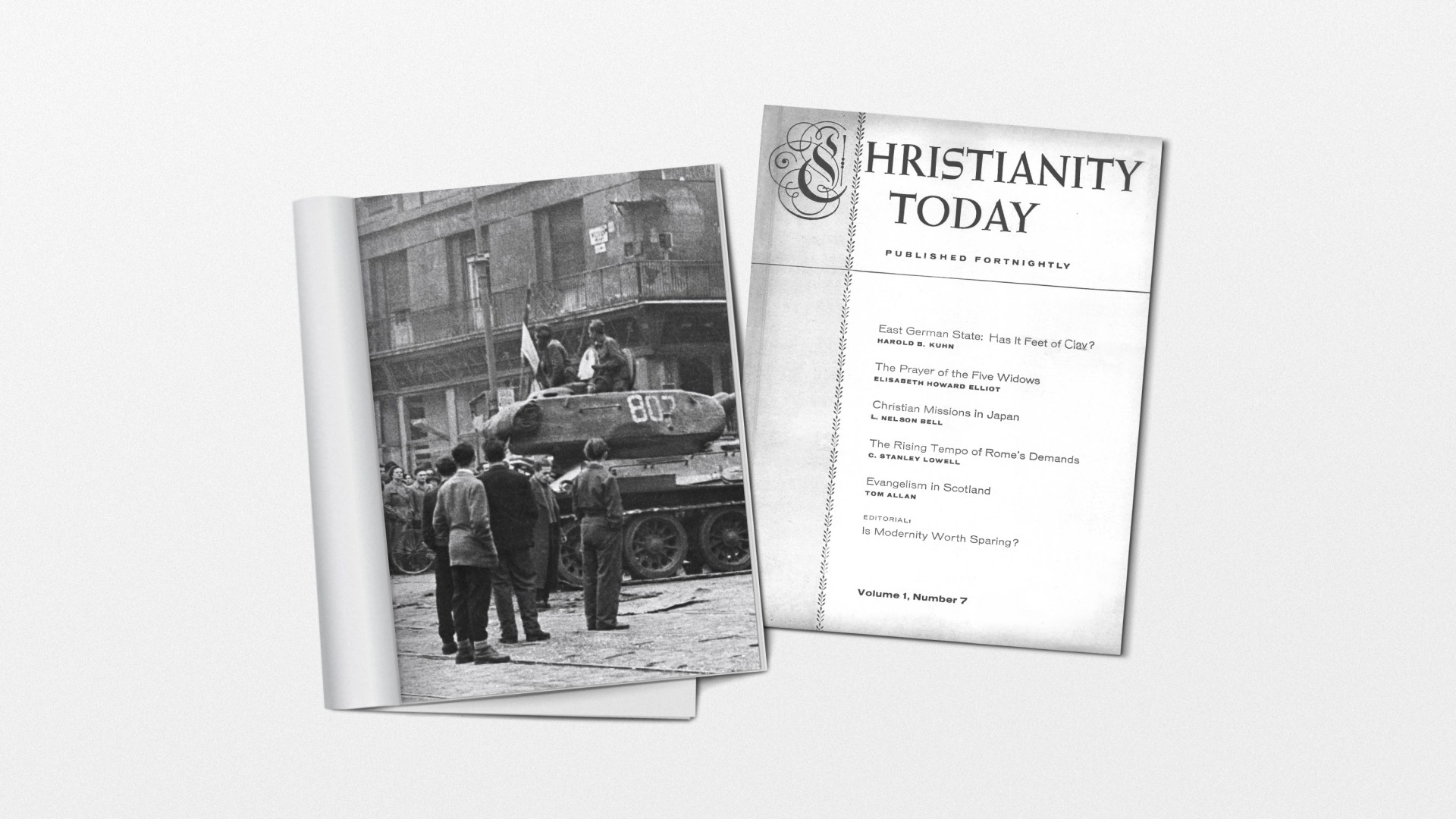
Theology

Why We Want to See the Epstein Files 

Columnist

All of us can agree that we want wrongs to be righted and evil to be avenged.

A protest group holds up signs of Jeffrey Epstein
Christianity Today July 16, 2025
Illustration by Christianity Today / Source Images: Getty

This piece was adapted from Russell Moore’s newsletter. Subscribe here. Want to listen instead? Russell Moore reads the piece aloud on his podcast.

Sometime last winter, I was jarred by a picture on social media of a Christmas ornament: a figure of a smiling Jeffrey Epstein attached to the tree by a noose around his neck. The caption on the post read: “This ornament didn’t hang itself.”

The reference to the popular notion that the alleged sex trafficker’s suicide in prison was perhaps murder didn’t strike me as resonant with holiday cheer. I couldn’t have imagined that, come summer, Epstein would be the most inflammatory conversation topic in the country.

The controversy was ignited by Attorney General Pam Bondi’s refusal to release the files from the Epstein case, including the “client list” of those involved in Epstein’s ring of powerful friends alleged to have assaulted multiple girls and young women.

At first, the attorney general said the files were on her desk and she would release them later. Then she said there were no such files, just Epstein’s own videos of abuse. Then President Donald Trump implied that there were files but that they had been faked by some of his political opponents who somehow had access to the levers of justice long after they left office.

The president then told people to stop talking about Epstein. But people have not stopped talking about Epstein. Those enraged by all this include some of Trump’s most enthusiastic backers—Tucker Carlson, Laura Ingraham, Glenn Beck, Alex Jones, and, of course, Elon Musk, who suggested on his social media platform several weeks ago that the files are not released because Trump is named in them.

To see why this moment matters, we might look backward to another time. Before Richard Nixon went to China, he went to Disney World. There at the Orlando resort, in the fall of 1973, the president told newspaper journalists that he welcomed questions about the Watergate scandal because “people have got to know whether or not their president is a crook.” His next statement defined an era: “Well, I’m not a crook.”

If you made it through your high school American history class, you know that Nixon did not, in fact, welcome questions into Watergate. And you know that—whatever else one might think of Nixon—the “I’m not a crook” statement was answered on tape, in Nixon’s own words. The American people heard what came to be known as the “smoking gun” recording, in which the whole country heard Nixon ordering what he said he never did. Some felt betrayed. Some felt vindicated. The country decided to move on.

I’m not sure that “Stop talking about Epstein” will be taught to high schoolers in 2065 in the same way that “I’m not a crook” is. We are unlikely to ever see the files. We are also likely to be in the middle of another all-consuming national conversation in a matter of days, maybe even by the time you are reading this.

Even so, we should ask ourselves what this moment means. Why do we want to see the Epstein files?

The most obvious reason is that we want justice done. We want to believe that our institutions—even in the present crises of credibility that most are going through—are not wholly corrupt. Most people don’t want the kind of country in which a poor person is behind bars for drug possession while some of the wealthiest and most powerful men in the world rape women on a Caribbean island with no penalty whatsoever.

This impulse is a good one. In fact, it is more than just a moral instinct. It is written on the heart. “You shall do no injustice in court,” God said through Moses. “You shall not be partial to the poor or defer to the great, but in righteousness shall you judge your neighbor” (Lev. 19:15, ESV throughout). That principle is repeated in various ways throughout both the Old and New Testaments.

Behind this moral foundation, though, there might be something else more specific to this moment in American history. The Epstein files might be a parable, a stand-in for a definitive settling of what has ripped America apart: a way to see, in real time and without dispute, who are the good guys and who are the bad guys.

The pro-Trump media ecosystem spent years talking about the files and the fishy circumstances around Epstein’s death because it was part of a larger story: about how Trump was standing up to a “deep state” cabal that was, among other things, trafficking children. For these people, the Epstein files were meant to show that, like the Hunter Biden laptop, there really was a story there that the people they mistrust didn’t want to talk about.

Those of us who don’t support the president, on the other hand, are no less pulled toward the story of a conclusion to the moral divide of this time. The Epstein files suppressed by a president who was friends with the dead villain would finally cause our neighbors and friends to walk away from the kind of character that’s been celebrated over the last decade.

But that’s not going to happen—no matter what happens with the Epstein files. The revelation that Nixon had lied about Watergate wasn’t a shocking reversal of image to the degree that it would have been if, for instance, Mother Teresa had been discovered to have a private jet or if Gerald Ford had been seen coming out of a strip club. For years, Nixon had carried the nickname “Tricky Dick.” Still, many of his supporters were stunned when Nixon—as songwriter Merle Haggard put it—“lied to us all on TV.”

I’m not sure we are in an era where a shared morality would trump tribal identity. After all, we all heard the Access Hollywood recordings. We all saw January 6. None of these things ultimately mattered, if by “mattered” we mean resolved the political divide. But they will matter in history. Those who come after us will be horrified that our generation looked away from these matters of character—or they will approve of such things as good.

With the Epstein files, part of what we want is—at long last—unity, agreement that there is something on which we, as a matter of moral principle, can agree is wrong. We also want justice: the right prosecution of those who have ruined lives. I doubt we will get either, but it’s possible.

Behind all that, however, we want something even bigger. We cry out for wrongs to be righted and evil to be avenged in a more ultimate sense than any Department of Justice can grant. Regardless of what happens here, for that, we will have to wait.

We should pursue justice as far as we can while recognizing that even when it is not done, no one will get away with it. Jesus said, “So have no fear of them, for nothing is covered that will not be revealed, or hidden that will not be known” (Matt. 10:26).

Whoever the victims are, they will be heard. Whoever those who harmed them are, they will be found out. The Epstein files may never be opened on earth, but do not be deceived; they are open in heaven.

Russell Moore is the editor in chief at Christianity Today and leads its Public Theology Project.

Apple PodcastsDown ArrowDown ArrowDown Arrowarrow_left_altLeft ArrowLeft ArrowRight ArrowRight ArrowRight Arrowarrow_up_altUp ArrowUp ArrowAvailable at Amazoncaret-downCloseCloseEmailEmailExpandExpandExternalExternalFacebookfacebook-squareGiftGiftGooglegoogleGoogle KeephamburgerInstagraminstagram-squareLinkLinklinkedin-squareListenListenListenChristianity TodayCT Creative Studio Logologo_orgMegaphoneMenuMenupausePinterestPlayPlayPocketPodcastRSSRSSSaveSaveSaveSearchSearchsearchSpotifyStitcherTelegramTable of ContentsTable of Contentstwitter-squareWhatsAppXYouTubeYouTube