News
Wire Story

Amy Coney Barrett, a Catholic and Scalia Protégé, Nominated by Trump

With an abortion record opposite Ruth Bader Ginsburg’s, Barrett has said her faith does not shape her decisions behind the bench.

Christianity Today September 28, 2020
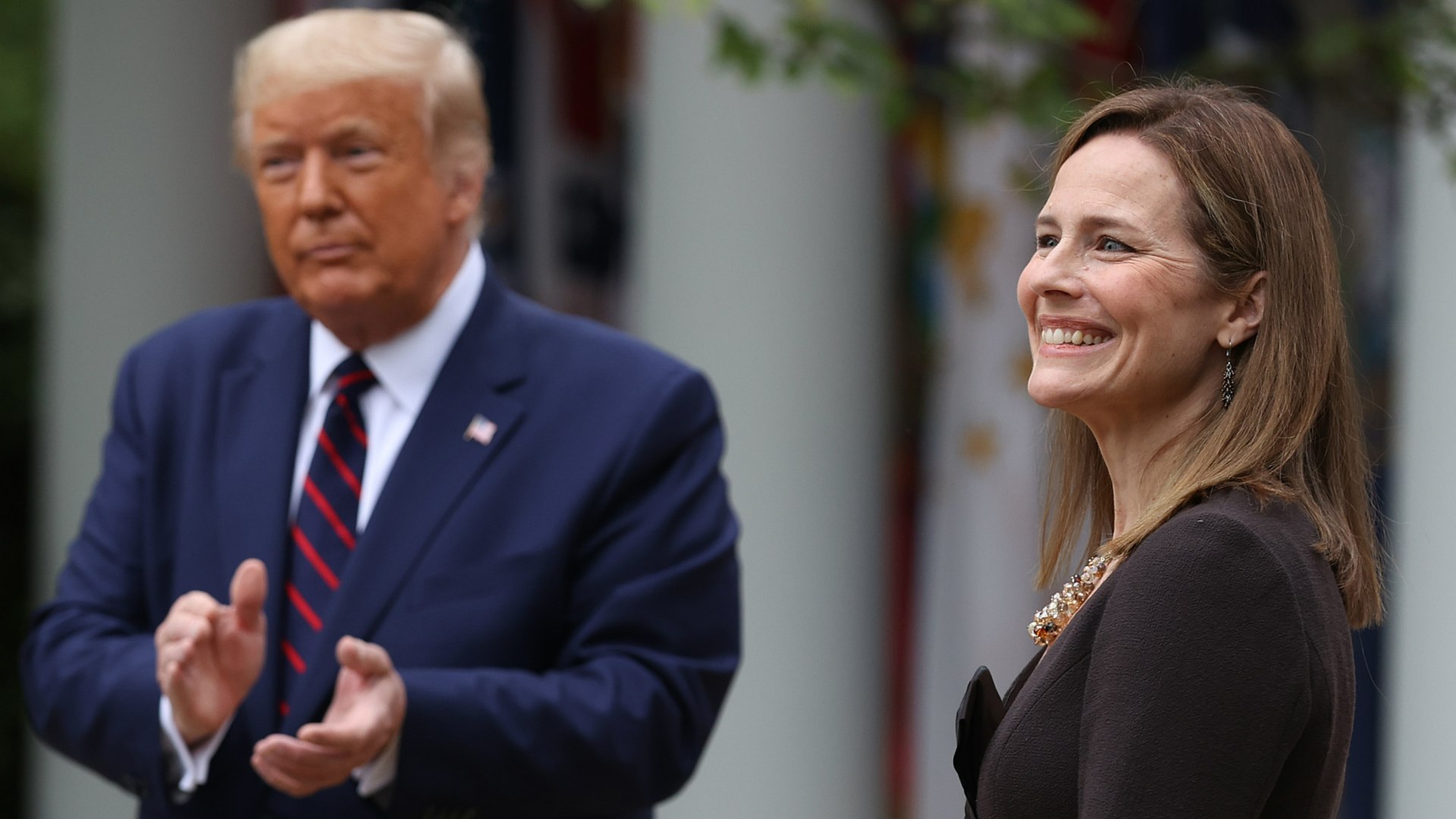
Chip Somodevilla / Getty Images

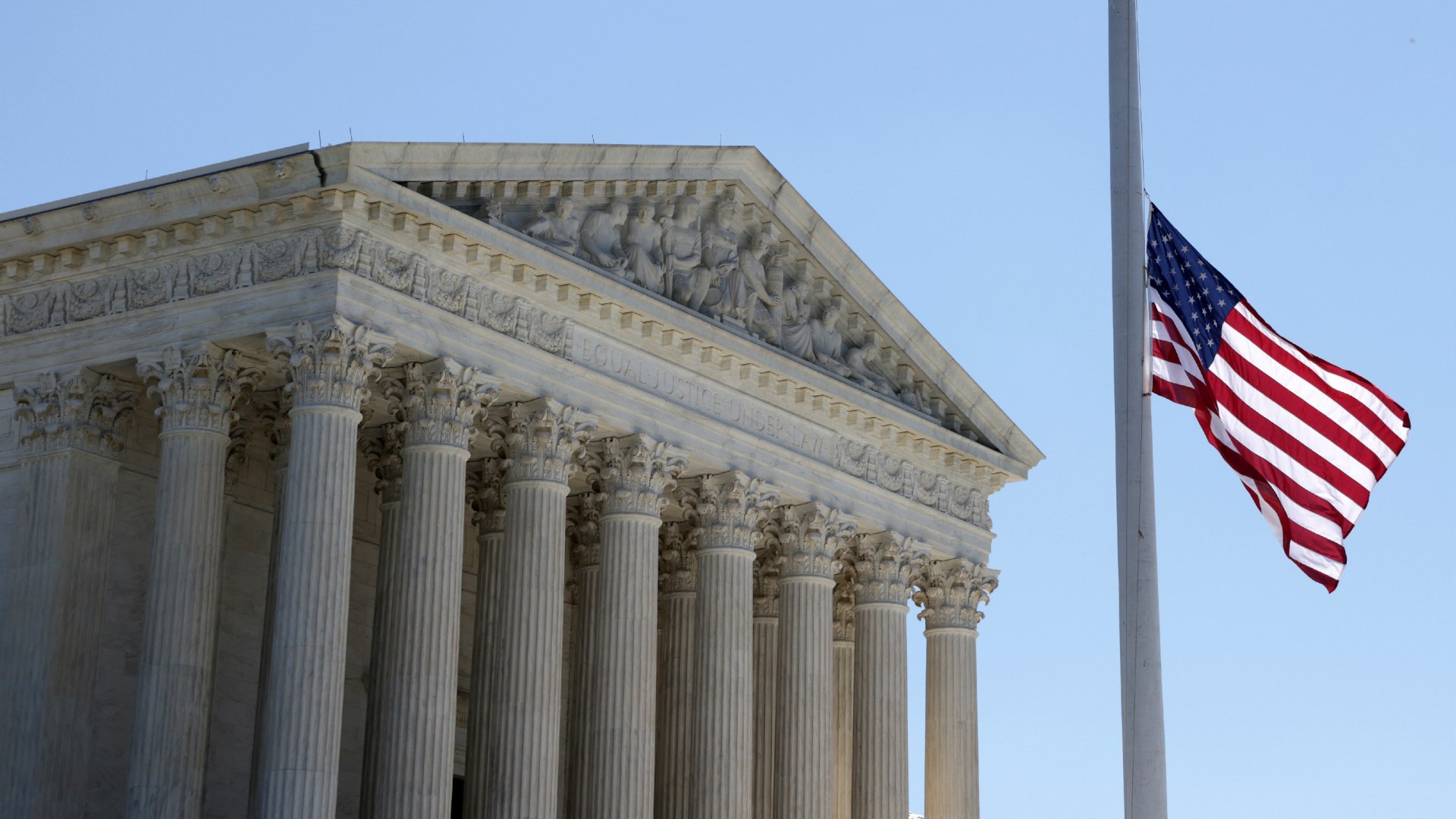
Amy Coney Barrett paid homage to Justice Ruth Bader Ginsburg in her White House speech Saturday as a shatterer of glass ceilings. She said she would be mindful of the woman whose place she would take on the Supreme Court.

The conservative Catholic even commented that her seven children think their father is the better cook, much as Ginsburg used to talk about her husband’s prowess in the kitchen.

But the replacement of the liberal icon Ginsburg, the second woman to serve on the high court, by Barrett, who would be the fifth, would represent the most dramatic ideological change on the Supreme Court in nearly 30 years and cement conservative dominance of the court for years to come.

Barrett, a judge on the federal appeals court based in Chicago, made clear in her Rose Garden address that she looks to conservative Justice Antonin Scalia, for whom she once worked, and not Ginsburg, on matters of law.

“His judicial philosophy is mine, too. Judges must apply the law as written. Judges are not policy makers,” Barrett said. She was referring to their common method of interpreting laws and the Constitution based on what they were understood to mean when they were written.

Ginsburg, who died this month at age 87, and Scalia were dear friends, but they were on opposite sides of the most divisive issues of the day.

Barrett’s conservative judicial record, her writings, and speeches suggest that she too would be Ginsburg’s polar opposite on a range of issues that include abortion and guns.

Conservative evangelicals have applauded Trump’s decision to nominate Barrett, who would be the third Supreme Court justice added during his term.

“There is no question that Judge Barrett is qualified by intellectual acumen and years of experience to serve on the highest court in the land,” said Russell Moore, president of the Ethics and Religious Liberty Commission of the Southern Baptist Convention. “I am praying for her, her family, and our nation in what are sure to be tumultuous days in the weeks ahead for the entire country.”

Ronnie Floyd, president of the SBC Executive Committee, also praised Barrett in a statement to the Baptist Press, saying she is “one of the most gifted legal minds in America today” as well as “a woman of deep Christian faith, a committed wife, and the mother of seven children.”

During her confirmation hearing in 2017, when she had been nominated to the 7th Circuit appeals court, she repeatedly clarified the relationship between her faith and her place on the bench.

“If you’re asking whether I take my faith seriously and I’m a faithful Catholic—I am, although I would stress that my personal church affiliation or my religious belief would not bear in the discharge of my duties as a judge,” she said after being asked about her Catholicism.

She went on to say, “It’s never appropriate for a judge to impose that judge’s personal convictions, whether they derive from faith or anywhere else on the law.”
Barrett has cast votes suggesting she would uphold state abortion restrictions that Ginsburg found violated the Constitution. Barrett has also been critical of Chief Justice John Roberts’ opinion upholding the Affordable Care Act, which is again facing a constitutional challenge at the Supreme Court. Ginsburg was one of five votes that saved the law on two prior occasions.

If Barrett is confirmed before the November 3 election, she would get a chance to weigh in on the latest lawsuit to overturn Obamacare, which is set for arguments a week later.

The backgrounds of Barrett and Ginsburg also are very different. Barrett is a Catholic from New Orleans. The Brooklyn-born Ginsburg was Jewish. Barrett had the chance to serve as a Supreme Court clerk. Ginsburg was able to secure a clerkship with a lower-court judge only after the intervention of a law school professor.

The contrast between Ginsburg and Barrett most resembles the differences between Justice Thurgood Marshall and the man who replaced him in 1991, Justice Clarence Thomas.

Marshall was part of the majority in the 1973 Roe v. Wade decision that declared a nationwide right to abortion. In his first year on the court, Thomas joined a dissenting opinion arguing that Roe should be overturned.

Marshall was a firm supporter of affirmative action programs in education and a fervent opponent of the death penalty. Thomas holds opposing views on both issues.

News

Eritrea Frees Evangelical Prisoners Due to COVID-19

Dozens of persecuted believers released on bail. But hundreds reportedly remain imprisoned in the “North Korea of Africa.”

Enda Mariam church in Asmara, Eritrea

Enda Mariam church in Asmara, Eritrea

Christianity Today September 28, 2020
hugy / iStock Editorial / Getty Images

The Eritrean government has released on bail more than 20 prisoners detained for years because of their faith, the BBC reports.

Sources told the British broadcaster that the prisoners are from evangelical and Pentecostal denominations, some held at Mai Serwa prison outside the capital Asmara.

Christian Solidarity Worldwide (CSW) confirmed the news, putting the number released at 27.

In 2002, Eritrea introduced a new law that forbids all churches except for Orthodox, Catholic, and Evangelical Lutheran ones. Sunni Islam is also officially recognised.

The Horn of Africa nation is No. 6 on the Open Doors 2020 World Watch List of the 50 countries in which it is most difficult to live as a Christian.

According to a religious freedom campaigner from Asmara but now based in North America, Hannibal Daniel, believers who’d been in prison for up to 16 years have been freed on bail.

A regional spokesperson for Open Doors International said that, for some time, the group had heard discussion that prisoners might be freed on bail due to the coronavirus pandemic—as has happened in other countries—but could not independently confirm the reports: “If true, this could be quite significant.”

According to CSW sources, the group released consisted of 19 men and 8 women detained without charge or trial for 2 to 16 years. About 54 total releases were anticipated.

However, CSW stated no detained church leaders were released, while a handful more were arrested in Asmara weeks before.

“It is a government strategy,” stated CSW, quoting one of its sources. “They cannot detain everybody, so they keep you for some time, hoping that you will become weak or frightened. Then they put in other people. They release and put other people in prison at the same time.”

The source estimates 300 Christians remain detained.

The Eritrean government has not responded to BBC requests for confirmation or denial. Previously, it’s dismissed accusations of intolerance to religious freedom.

In May 2019, a monitoring group for the UN said “thousands” of Christians are facing detention as “religious freedom continue[s] to be denied in Eritrea” and questioned why the UN was not monitoring the situation more closely.

In June 2019, Reuters reported that more than 500,000 refugees worldwide have left Eritrea, up from 486,200 a year earlier.

Many flee compulsory military service, but others flee political or religious persecution.

That same month, the government seized all Catholic-run health clinics in the country, and arrested five Orthodox priests. These moves prompted the UN Special Rapporteur for human rights in Eritrea, Daniela Kravetz, to call on the government to uphold religious freedom for its citizens and “release those who have been imprisoned for their religious beliefs.”

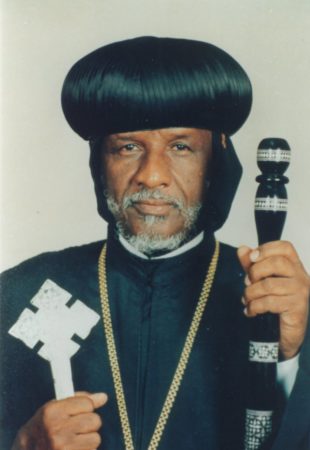
Abune Antonios, Patriarch, Eritrean Orthodox ChurchWorld Watch Monitor
Abune Antonios, Patriarch, Eritrean Orthodox Church

In August 2019, Eritrea’s Orthodox patriarch, Abune Antonios, was accused of heresy and expelled by pro-government bishops of his church; he remained in detention throughout 2019.

Antonios had been under house arrest since 2007, when he refused to comply with the regime’s attempts to interfere with church affairs.

The US Commission on International Religious Freedom (USCIRF) labels Eritrea a Country of Particular Concern, stating:

“In 2019, religious freedom conditions in Eritrea worsened, with increasing interference in and restrictions on religious groups. In spite of the significant regional political changes and the 2018 peace agreement between Eritrea and Ethiopia, Eritrea continues to have one of the worst religious freedom records in the world, and has shown little interest in concretely improving the situation.”

The US State Department estimates there are between 1,200 and 3,000 prisoners held for their faith. USCIRF included some of those cases in its new Victims List.

Some prisoners, such as the leader of the Full Gospel Church, have been in prison for more than 15 years.

At least 150 Eritrean Christians were arrested by government officials during summer 2019, with some held in an underground prison made up of tunnels.

For instance, on August 18, 2019, Eritrean security officials detained 80 Christians from Godayef, an area near Asmara airport.

Four days later, on August 22, the United Nations observed its first annual commemoration of victims of religiously motivated violence. “On this day, we reaffirm our unwavering support for the victims of violence based on religion and belief. And we demonstrate that support by doing all in our power to prevent such attacks and demanding that those responsible are held accountable,” said UN Secretary-General António Guterres.

The Eritrean government’s 2019 clampdown on evangelical Christians had begun in June 2019 when security officials arrested 70 members (among them 35 women and 10 children) of the Faith Mission Church of Christ, in Eritrea’s second city, Keren. These were taken to Ashufera prison, outside the city.

The prison is a vast underground tunnel system, and conditions in which detainees are held are very harsh, a local source said. It’s far from a main road, the source said, which “means that anyone who wants to visit has to walk a minimum of 30 minutes to reach the entrance. Inmates are forced to dig additional tunnels when officers need extra space for more prisoners.”

After the 2019 arrests, government officials also closed the church-run school, said the local source, whose identity World Watch Monitor withheld for security reasons.

The Faith Mission Church of Christ was the last church still open in the majority-Muslim city, 56 miles northwest of Asmara. Started over 60 years ago, the church once had schools and orphanages all over the country, according to CSW.

The church had been waiting for registration since it submitted an application in 2002 when the government introduced the new law. This clampdown sent other Christians in Keren into hiding, the source said.

“While applauding the fact that people who were deprived of their liberty have regained their freedom, it is also important to recall that they were detained arbitrarily and without due process for excessive periods simply on account of their religious beliefs,” said Mervyn Thomas, CSW’s founding president. “Moreover, these releases remain conditional, as they were secured by property deeds, leaving the guarantors vulnerable to losing their properties.

“Far more prisoners of conscience remain arbitrarily detained than have been released, and the fact that these releases were preceded by further arrests is indicative of an ongoing repression of the right to freedom of religion or belief,” he said. “CSW therefore continues to call for the immediate and unconditional release of prisoners detained arbitrarily, particularly in view of a pandemic that poses a risk to life for those still held in inhumane conditions.”

Additional reporting by Jeremy Weber

Theology

The Church Mothers Teach Us to Delight in Scripture

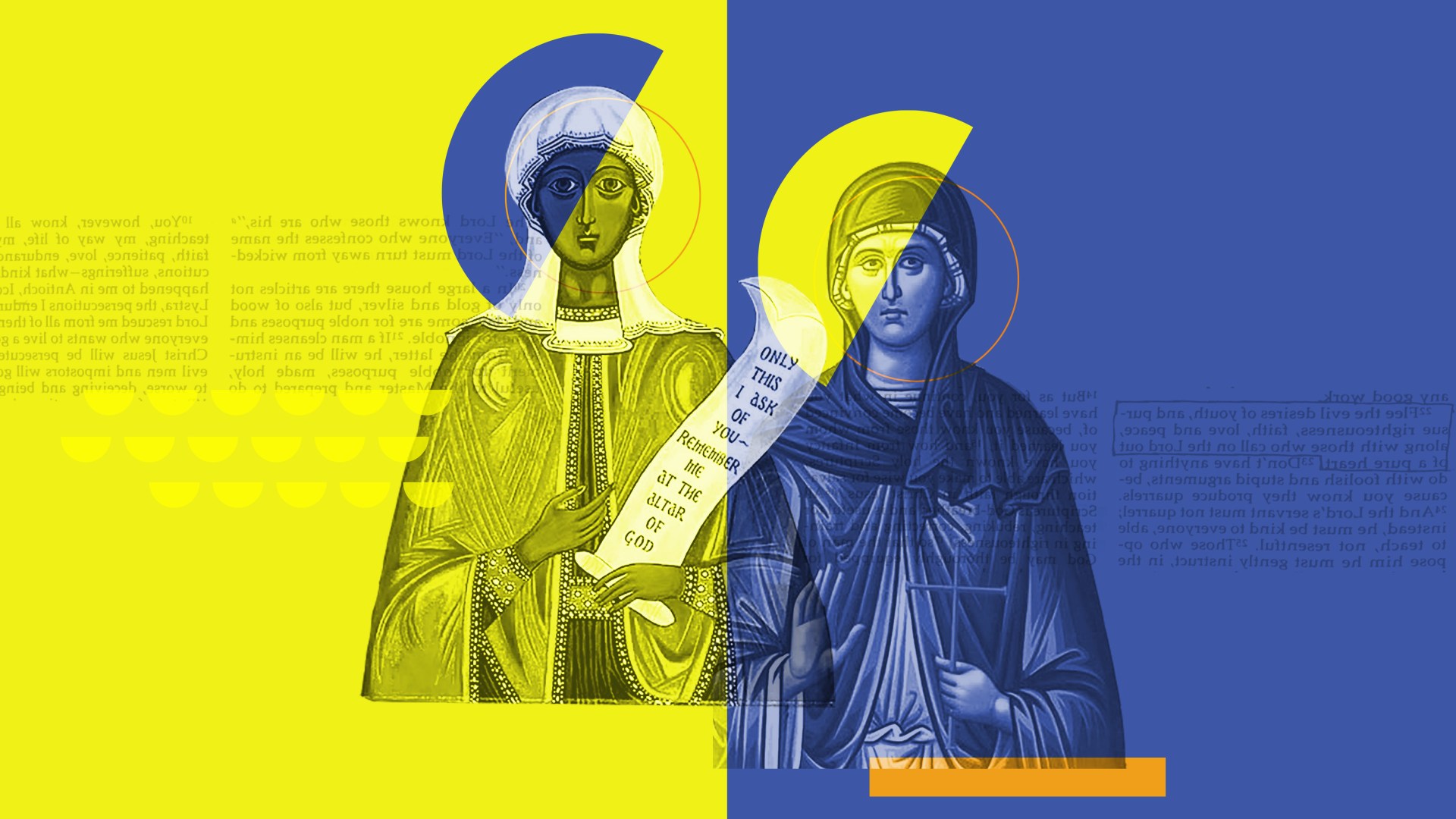
Monica and Macrina didn’t just influence Augustine and Gregory of Nyssa. They were biblical interpreters in their own right.

Illustration by Sarah Gordon

“What are you doing? In those books which you read, have I ever heard that women were introduced into this kind of disputation?” This almost awkwardly direct question comes from Augustine’s mother, Monica, when she finds out he is recording her comments for his book On Order. She is not so much honored as dismayed by the censure her inclusion may bring him. In response, Augustine concedes that some may dismiss him for including the voice of a woman in his writings. But he doesn’t give a whit for such critics, he says; such “proud and ignorant men” should attend more to the substance and less to the “dress” of what they read.

Though he expects some superficially minded people will look down on him for including a woman’s ideas, Augustine incorporates Monica’s contributions because her ideas are so good. He wants her to be a part of the discussion because her spiritual inclinations and intellectual chops make her indispensable. He writes of his mother, “By long intimacy and diligent attention I had by this time discerned her acumen and burning desire for things divine … her mind had been revealed to me as so rare that nothing seemed more adapted for true philosophy. Accordingly, I had determined to do my best that she be not absent from our conversation.” And so, through Augustine’s account, we gain a precious glimpse of this brilliant mother of the church.

Of the few early Christian women commonly known today, Monica, along with her near-contemporary Macrina, are perhaps the most familiar. But despite the records we have of their extraordinary spiritual and intellectual gifts, they are not commonly known for their own abilities. Instead, these fourth-century mothers of the church are famous by association. Monica’s prodigal son, Augustine, became the father of the Western church. Gregory of Nyssa and Basil, Macrina’s younger brothers, have been long known with their friend Gregory of Nazianzus as the Cappadocian Fathers. These men who made Monica and Macrina famous shaped the theological imagination of the entire Christian tradition, giving classic formulation to doctrines we now consider basic: the Trinity, grace, and the Holy Spirit.

Like Eunice to Timothy and Miriam to Moses, Monica and Macrina are great women of the faith who enabled the ministries of great men. Submission to the spiritual leadership, teaching, and admonition of Monica and Macrina, which continued well into the adulthood of both Augustine and Gregory, made these church fathers the giants they were.

But what can we say about Monica and Macrina as faithful biblical interpreters in their own rights? In both cases, a lesser-known yet foundational aspect of their legacy, as depicted in the texts that come down to us, is their own work as students and teachers of God’s Word.

Monica: Hearing and Speaking the Word

Augustine characterizes his mother as a woman who prized and pursued Scripture in her everyday life. In a comic interlude in his early philosophical dialogue On Order, he recounts how one of his pupils had recently learned a chant of Psalm 80:19. The young man just couldn’t stop singing it. He sang it in the morning; he repeated it all day long. He even kept singing it, as Augustine put it delicately, when he had “gone out for the needs of nature.” At this, Monica put her foot down, Augustine tells us, “precisely because the place was unbecoming for chant.” The young man rejoined, “jestingly: ‘As if, should some enemy confine me here, God would not hear my voice!’ ” To our modern sensibilities, Monica’s reproof may seem prim, even prudish. But this little anecdote, meant to amuse, makes a lighthearted gesture toward the enormous weight Monica accords to Scripture. She wants worship and the Bible to have a place of honor in the lives of those around her.

In addition to respecting Scripture, Monica hungered for it. Augustine, addressing God in Confessions, tells us of Monica’s eagerness to hear God’s Word: “taking no part in vain gossip and old wives’ chatter, [she wanted] to hear you in your words and to speak to you in her prayers.” Monica confided her deepest hopes and longings to her Maker, pouring out her tears before him as she prayed daily, year in and year out, for the salvation of her son. But she also wanted to listen to God on his own terms.

Monica heard God’s Word through regular Christian worship, attending church twice a day. The Word preached by her well-known pastor, Ambrose, riveted her, and she “would zealously run to Church to hang on [his] lips, to ‘the fount of water bubbling up to eternal life’ (John 4:14).” Given her social status, it is also likely that Monica, unlike many women in the ancient world, was literate and was able to follow up on messages she had heard in church with reading at home. Monica’s engagement with the Word in worship was frequent, consistent, and life-sustaining.

Monica’s attentive listening to Scripture equipped her to speak the truth of God’s Word into the life of her beloved son Augustine. He recounts how imbibing the name of Christ along with his mother’s milk whetted a deep subconscious appetite for the Word. Though when he first read the Bible for himself he found it primitive, its pull was elemental. In the end, Augustine could not resist it. When her son reached adolescence, Monica again proved to be the vehicle of God’s Word. Seeing him consumed by the heat of his teenage lusts, she tried to restrain him. At the time, Augustine dismissed her advice as “womanish.” But he later came to see that her admonitions were the very voice of God. Looking back ruefully, he prayed, “I believed you were silent, and that it was only she who was speaking, when you were speaking to me through her.”

Monica continued to speak God’s Word into the life of Augustine in his adulthood, as recorded in another early dialogue, The Happy Life. At the end, Augustine suggests that the happy life is knowing the triune God. On cue, Monica concludes with an allusion to 1 Corinthians 13:13: “This is without doubt the happy life, and that life is perfect toward which we can, we must presume, be quickly brought through solid faith, lively hope, and burning love.”

Now an adult and a committed Christian himself, Augustine gratefully receives these biblically inspired words of Monica, letting them stand as the final statement of substance to the larger group of Christian men assembled for the conversation and to the many readers the work will have in his own generation and beyond.

Macrina: Scripture as the Starting Point

Just as Monica was a teacher taught by God for Augustine, Gregory of Nyssa refers repeatedly to his elder sister Macrina simply as “the teacher.” The dialogue On the Soul and the Resurrection, in which Gregory poses critical questions while Macrina defends the Christian faith, gives us a window into how Macrina used Scripture.

Born into a prosperous family, Macrina likely enjoyed a good education in addition to basic literacy. In On the Soul and the Resurrection, she brings her innate and learned intellectual capacities to bear with a sophistication and skill on par with her brothers and other thought leaders of the period. Indeed, such was her wisdom that her brothers constantly looked up to her.

The book begins with high emotion. Gregory has set out to visit his sister to convey the sad news of their brother Basil’s death. But when Gregory first lays eyes on Macrina, he is shocked to see that she herself is not long for this world. After giving Gregory time to express his sorrow, Macrina “reproached me with the apostolic saying, that we should not grieve concerning those who are asleep, because this emotion belongs only to those who have no hope.” These words from 1 Thessalonians 4:13 are Macrina’s first in the work. Her use of Scripture to intervene in a family crisis is just one of the many ways she draws on the Bible as a teacher of theology.

Macrina uses Scripture to set boundaries. In her words, “we always use the holy Scripture as the canon and rule of all our doctrine. So we must necessarily look towards this standard and accept only that which is congruent with the sense of the writings.”

Yet, as Macrina shows, these constraints make possible constructive and critical engagement with extra-biblical viewpoints. In the dialogue, she engages a wide variety of philosophical ideas, rejecting some and accepting others. The Bible is the benchmark that enables this differentiation.

Macrina lets Scripture show her where to direct her theological energy. She sees Paul as introducing a key distinction: “The apostle says that he has believed this much, that the age itself was fashioned by the divine will, and whatever has come to be within it … but the how he has left unexamined.” We can know that some things are true, because Scripture tells us so, without understanding how they are true. Macrina uses this distinction to avoid getting bogged down in insoluble intellectual puzzles so she can focus on the issues God has called and equipped her to address.

Macrina also draws on Scripture to inform belief’s content. She does so on the level of individual verses, determining, for example, on the basis of Genesis 1:28 that reason should control the emotions since human beings were, in her words, commanded “to rule over all the irrational creatures.” She also draws on the broader biblical narrative, for instance arguing based on various biblical exemplars (Daniel, Phinehas, Moses) that emotions are neither bad nor good in themselves but are up to us to use wisely. And like many other early Christian thinkers, Macrina uses Scripture to interpret Scripture. In a particularly beautiful passage, she weaves together a wide range of biblical metaphors to imagine what it might mean when Paul describes God as “all in all” (1 Cor. 15:28). Someday, she says, God will be our everything: “a place for the saints, a house, a garment, nourishment, drink, light, wealth, dominion, and every concept and name of the things which contribute to the good life for us. He who becomes all will also be in all.”

Finally, Macrina is serenely confident about the truth of Scripture. We can rest secure in what the Bible says without arguing for it at every turn. At one point, Gregory expresses concerns about those who reject the existence or creative power of God: If they don’t even accept the reality of God, how should we convince them of the Resurrection? Macrina’s answer: We shouldn’t even try. “She said, ‘It would be more fitting to keep silent concerning these matters, and not to consider the foolish and impious propositions worthy of an answer, especially since one of the divine sayings forbids us to answer the fool according to his folly [Prov. 26:4–5]. He is undoubtedly a fool who, in the words of the prophet, says that there is no God [Ps. 14:1].’ ” It is not that Macrina doesn’t care about such people. Her point is that Scripture liberates us to keep our peace in the face of their critiques; we need not be defensive.

Instead of forcing the Bible to fit objections it was never designed to address, Macrina begins with Scripture, letting it speak on its own terms: “I think that we should first run briefly through what is set forth in various places by the divine Scripture concerning this doctrine.” She then draws on a variety of passages to establish a solid basis for the Resurrection (Ps. 103; Ezek. 37:1–14; and 1 Cor. 15:51–53, in addition to the Gospels). Only after discussing biblical evidence in favor of it does she hear Gregory out on the objections. And even at that point, she emphasizes Scripture: “First we must understand what the aim is of the doctrine about the resurrection, why this is declared by the holy revelation, and why we believe it.” In offering her final assessment, Macrina does not mince words. “Truly we should recognize the superfluity and ineptitude of the objections, as we plumb the depths of the apostle’s wisdom.” We see the shallowness of these arguments, Macrina contends, by immersing ourselves in the profundity of Scripture.

Loving Scripture, Loving God

At one point in On the Soul and the Resurrection, Macrina draws on a text Monica had also invoked at the end of The Happy Life: 1 Corinthians 13. The purpose of human life, Macrina suggests, is an endless increase in love because God’s beauty is unlimited: “But when the thing hoped for comes, all the others grow quiet while the operation of love remains, not finding anything to take its place.”

For both Monica and Macrina, Scripture provides a script for everyday life: singing a Psalm of praise to God, raising a child, recognizing intellectual limits, learning from others while holding fast to the truth, grieving a loved one who is dying. But for both women, the Bible is more, in the end, than a practical how-to manual. It directs us to the stirring beauty of our Creator and the ultimate, glorious purpose of our lives that gives meaning to every minor concern: It teaches delight in God.

Han-luen Kantzer Komline teaches church history and theology at Western Theological Seminary in Holland, Michigan. She is the author of Augustine on the Will: A Theological Account.

This article is part of “Why Women Love the Bible,” CT’s special issue spotlighting women’s voices on the topic of Scripture engagement. You can download a free pdf of the issue or order print copies for yourself at MoreCT.com/special-issue.

Books
Excerpt

Mental Illness and the ‘Medical Theodicy’ Trap

Why do we feel such a palpable sense of spiritual relief when the problem is with the body rather than the mind?

Christianity Today September 25, 2020
Illustration by Mallory Rentsch / Source Images: Adolfo Félix / Dadalan Real / Unsplash / WikiMedia Commons

Five years ago I received a telephone call from a friend. She told me that one of our mutual friends had taken his own life. No one knew why.

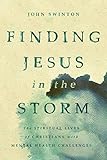
Finding Jesus in the Storm: The Spiritual Lives of Christians with Mental Health Challenges

Brian was a successful health-care professional, with a wife, a family, and an apparently very bright future. Many of us had not seen any indications that something was wrong, although those in close contact with him knew there were problems. He just got up one morning and was never seen alive again. Everyone was devastated.

What do you do with such news? One of the most painful human experiences must be to say goodbye to a loved one in the morning and then never see that person alive again. I was asked to do the sermon at the celebration of Brian’s life. I preached on the psalms of lament and the unending, unfailing love of God. I tried to help people see that the joy that God promises includes suffering and that the psalms of lament offer faithful language to express our hurt, brokenness, anger, and disappointment at what my friend had done and what God had seemingly not done: save him.

Two Affirmations

Brian was a Christian; he was a lover of Jesus, as were his family and many of his friends. And yet, despite the profound consolation of the gospel, for some, the first response to his death by suicide was not comfort but fear. In spite of the apostle Paul’s firm assurance that “neither death nor life, neither angels nor demons, neither the present nor the future, nor any powers, neither height nor depth, nor anything else in all creation, will be able to separate us from the love of God that is in Christ Jesus our Lord” (Rom. 8:38–39), they were afraid for Brian’s eternal future. I guess that is the problem with hypercognitive theologies that assume that our eternal futures lie in our own hands rather than in the loving hands of God. If it is the case that neither death nor life can separate us from God’s love, then we need not fear death, even death by suicide. We simply need to trust in God’s grace.

There is a difficult tension between recognizing that God does not abandon those who end their own lives and the imperative that such actions are not God’s desire for human beings. As Duke Divinity School theologian Warren Kinghorn once reminded me, two affirmations are indispensable for a Christian approach to suicide:

  1. Suicide is a tragedy and a loss, and never to be encouraged or seen by Christians as a positive good.
  2. Nothing will be able to separate us from the love of God in Christ Jesus our Lord.

If we Christians say either of these things without the other, we fall into error. My sermon at Brian’s funeral tried to capture the complex dynamics of these two statements. The lament psalms articulate the reality of tragedy and loss alongside the reality of God’s unending love. Such an approach does not take away our pain, but it does provide us with a certain kind of consoling hope. I think people were helped by that sermon.

But then something changed.

The autopsy results came back, and it turned out that Brian had had a problem with his pituitary gland that may have contributed to his depression and ultimate demise. Some people seemed strangely relieved when they heard this. “Ah! It wasn’t really his mind. It was his body that had gone wrong.”

Now, that may have been the case, but there are two things to consider as we reflect on this reaction. First, the spiritual dualism is quite startling. If his death has something to do with Brian’s mind, then it is a spiritual problem, but if it has to do with his body, it is a medical issue. Second, and connected to the first point, it is interesting how medicine became, for some, a therapeutic theodicy, a way of explaining the presence of perceived evil and suffering. If the problem lies within the human psyche, and if the human psyche is the place where we determine our salvation, then Brian has a real problem. But if the issue is biological, then medicine can explain it without the need for awkward questions around the nature of God and the meaning of human suffering.

One of the problems for modern Western people is the tendency to equate the soul with the mind. Culturally we place inordinate social value on intellect, reason, quickness of thought, and academic ability. Certain strands of theological thinking can be sucked into this hypercognitive trap when defining emphasis is placed on intellect and verbal ability, with the verbal proclamation of the name of Jesus assumed as a central and vital aspect of our salvation. When we think like this, any damage to the mind implicitly or explicitly morphs into damage to the soul.

This can make it particularly difficult for Christians to live well with mental health challenges, brain damage, or something like dementia. The implication that the real problem is soul damage prowls around like a roaring lion. The palpable sense of relief that some of my well-meaning Christian friends expressed as they encountered a medical theodicy is but one instance of a cultural phenomenon that is, to say the least, troublesome.

A Liberating Language

Fast-forward five years to a few months ago. I had just flown from Aberdeen to London and was walking toward the airport exit when a man I had never met before stopped me. “You’re John Swinton?” he said. Now, I can never be certain whether to own up to a question like that! But on this occasion I did. He said, “You spoke at Brian’s funeral five years ago. I just want to thank you. I had never thought of suffering and joy in that way, and I had certainly never thought that it was OK to be angry with God and to speak out that anger and frustration through the psalms. I just wanted to say thank you.” With that he walked on.

I left the airport and got on a train to central London. As I thought about that brief encounter, I began to realize that the problem that many people encountered when Brian took his life was that they were speechless. His friends had no effective language to articulate the pain, lostness, and indeed anger that they felt toward the situation and in many ways toward God. They had become monolingual in their faith lives, sure and confident in the language of happiness and hope, but completely lost when it came to the language of suffering, brokenness, disappointment, and in particular, a biblical understanding of joy.

They had heard Jesus say: “Very truly I tell you, you will weep and mourn while the world rejoices. You will grieve, but your grief will turn to joy” (John 16:20), but they had not experienced the illumination of his words. This lack of language led them to turn to medicine and biology for intellectual and spiritual relief. They turned to them as theodicies not just because they alleviated fears about Brian’s eternal destiny but because they spoke in a language with which they were familiar. Medicine and biology represented a safe place. Within their theological tradition, they couldn’t find the right kind of language to articulate their feelings and fears. The language of medicine and biology filled the gap.

What the stranger in the airport taught me was that the words of my sermon had given him a language to express his sadness, his pain, and his anger, and that this language came from within his faith tradition in a way that he had not noticed previously. My articulation of the power of the psalms had moved him from silence into speech. I had helped him to reframe both lament and joy.

By understanding the nature and purpose of joy, we can understand depression in a different way, and that will give us a way to talk about depression (and to remain silent) that is both liberating and, I hope, healing. Understanding depression through the lens of Christian joy can help us understand depression more thickly and respond more faithfully.

John Swinton is professor of practical theology and pastoral care at the University of Aberdeen in Scotland and the founding director of the Centre for Spirituality, Health and Disability. He is the author of Finding Jesus in the Storm: The Spiritual Lives of Christians with Mental Health Challenges (Eerdmans), from which this essay is adapted.

Why Each Issue of ‘Christianity Today’ Tells the Story of How Someone Met Christ

Behind the scenes of the well-loved ‘Testimony’ section.

Why Each Issue of ‘Christianity Today’ Tells the Story of How Someone Met Christ

Since 2013, Christianity Today’s back page has been reserved for first-person stories of people from a variety of backgrounds sharing how they found Jesus. In it, former atheists, Muslims, and Mormons share dramatic conversion stories and scientists and previously incarcerated people reveal the radical ways in which they felt the love of God. Not surprisingly, since its inception, the Testimony section has consistently been one of the most beloved by readers.

“I’ve read most issues of Christianity Today since I began preaching over 60 years ago. I’ve read lots of great articles, and I love the news reports, but the Testimony page is the best of all,” wrote one reader. “I usually finish it with tears in my eyes.”

“I love the testimonies!” wrote another last year. “It is one of the first articles I read and I often share the stories in my preaching. Thanks for the diversity and excellence of these stories. I believe they help communicate to those who don’t yet believe!”

These readers aren’t the only ones who find its stories valuable. CT books editor Matt Reynolds has shepherded this space since 2016 and recently shared how he finds these stories, what particular ones have touched him, and how his faith has been shaped in the process.

In general, how do you find stories for the testimony page?

They come to me through a variety of channels. Fellow editors at CT are diligent about alerting me to interesting stories they encounter within their social or professional circles, or through their own reading. As books editor, I often come across autobiographical books in which the author’s conversion plays a prominent role. And very often, I’ll receive pitches directly from writers who have compelling stories of coming to faith.

Do you think there is any danger in telling stories in which someone’s testimony feels overly sensationalized? Why or why not?

As someone who falls into the “can’t remember a time I didn’t believe in Jesus” category, I occasionally develop an acute case of “testimony envy” while shepherding some of the more dramatic stories we publish. And I’m sure plenty of our readers feel the same way. In the end, I suspect there’s a balance to be struck. I absolutely want to publish testimonies that illustrate the utterly remarkable ways that God can work to transform the lives of sinners, even in an instant. I want readers to get a sense, from these stories, of his awesome power and matchless sovereignty. But I also want them to see how he works in quieter, humbler ways as well. Hopefully our testimonies are conveying something of that range of possibilities.

What is a testimony you have published in the past year that really spoke to you? Why?

I can think of several, but one that especially stands out is the testimony of John Joseph, a former drug dealer turned pastor, which appeared in our January/February issue this year. I was struck by how it straddled some of the fault lines that crop up as you read batches of our testimony pieces. For instance, while some stories revolve around dramatic turning points and others feature a slower build, this one combined elements of both. And while there were moments of high drama—a close call with the cops here, a New-Year’s-Eve bender there—it’s clear that the author’s embrace of faith rested on nothing more spectacular than his conviction of sinfulness and desire for forgiveness.

What struck me most, however, was the sheer number of people—both Christian celebrities and ordinary believers—who played some role in his journey to faith. It’s amazing to see what God can do when one person plants a seed and others water it.

What have you learned about how God works in the world as a result of reading these stories?

The thing that really jumps out is the near-unfathomable variety of means and methods that God uses to draw sinners to himself. In some cases, he ministers through friends and family; in others, he intervenes through total strangers. In some cases he persuades through books or philosophical arguments; in others, he makes an impression through unlikely events or circumstances. Even this only scratches the surface. It all reminds me of Paul affirming that the Word of God is unbound (2 Tim. 2:9). There’s no limit either to what God can accomplish or how he can accomplish it!

Why is it important to continue sharing testimonies? What role do they play in 2020?

When you spend enough time acquiring and shaping testimony articles, you’ll notice that many of them fall into certain familiar grooves: the atheist, say, who discovers that believing in God isn’t so irrational after all; or the drug addict who, after hitting rock bottom, turns to Christ in a moment of desperation. And it takes nothing away from God’s goodness in orchestrating these stories to admit that, in a cynical way, you can begin asking yourself whether drawing from these same wells, again and again, doesn’t get a little dull.

Even so, I can’t imagine a moment when sharing testimonies ever grows stale. Jesus tells us that the angels in heaven rejoice every time a sinner repents (Luke 15:10). This should be our attitude as well, no matter how mundane or clichéd a particular story might seem. And the travails of 2020 give us all the more reason for rejoicing. The events of this year leave some of us wondering whether God is silent or absent while the world suffers. But stories of his saving and preserving grace in the lives of sinners reaffirm that death, decay, and despair won’t have the final word.

How has your faith changed as a result of reading these stories?

Here’s one very concrete example: I’ve always been somewhat inconsistent in remembering to pray for my unbelieving friends. But ever since taking the reins of the testimony section, I’ve become more deliberate about making this a habit. It’s easy to look at certain people in our lives and think, “That person would never take Christianity seriously.” But the testimony stories I’ve overseen for CT remind me that God can soften even the hardest of hearts.

Morgan Lee is Global Media Manager at CT.

Stung Like a Bee

White evangelicalism failed to lead and take action for racial reconciliation in America.

Christianity Today September 24, 2020
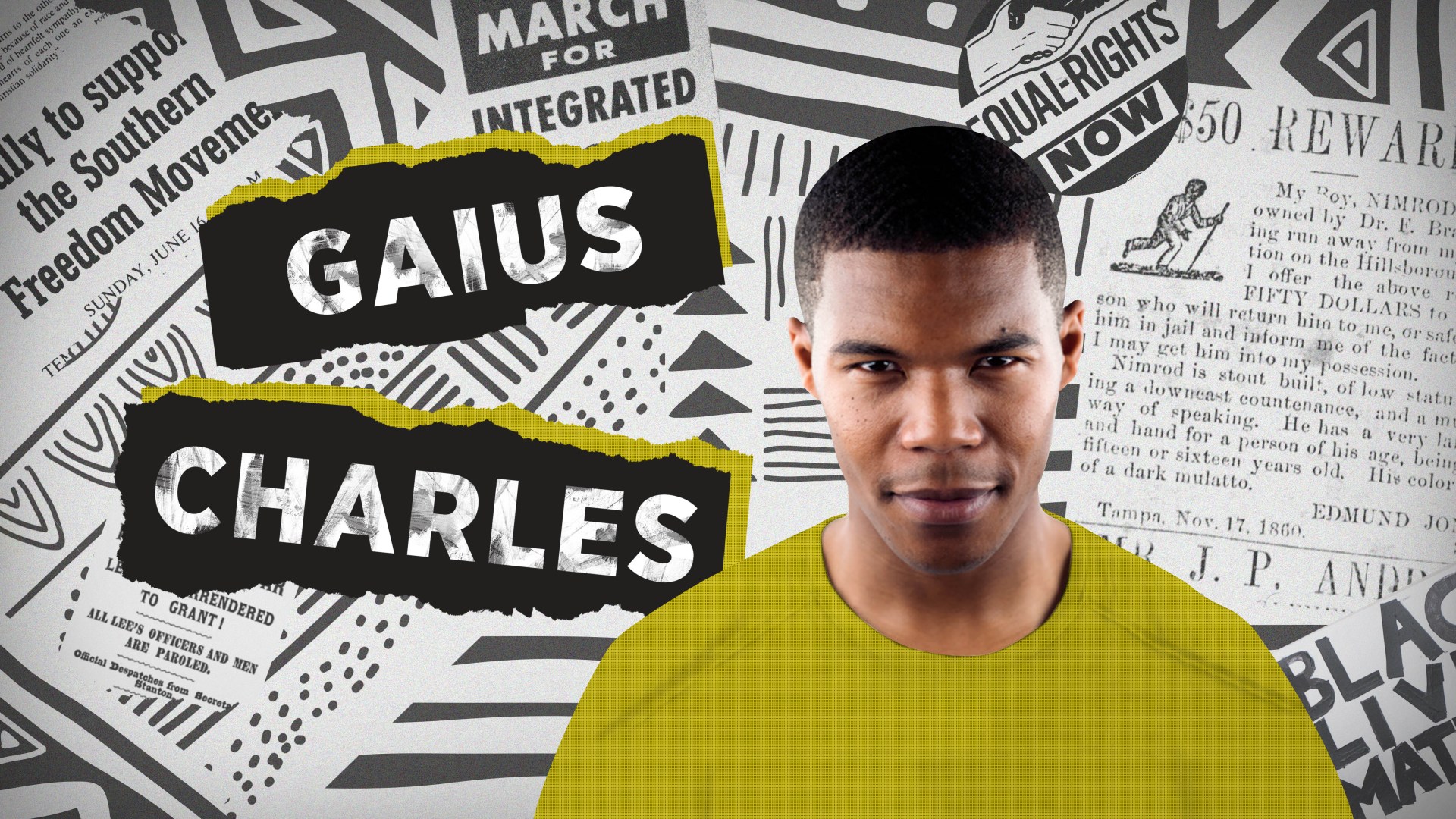
Illustration by Mallory Rentsch / Portrait: Courtesy of Charles Gaius / Background Images: WikiMedia / Unsplash / New York Public Library

In 1971, British broadcaster Michael Parkinson sat down with Muhammad Ali for an interview covering various aspects of his life, his career, and the American civil rights struggle. When asked why he became a Muslim, Ali described winning the gold medal in boxing for the United States in the 1960 Summer Olympics only to come back to his hometown of Louisville, Kentucky, and a life of segregation. One particular anecdote crystallized the dehumanization: Fresh off his international triumph, Ali was refused service at a local restaurant because of his skin color.

During the interview, Ali recounted how the Christian church where he served and worshiped and which he undoubtedly made proud as an Olympic gold-medal boxer refused to stand up for him in the face of discrimination. He spoke frankly about how his church’s lack of action motivated his transition away from Christianity and catalyzed the pursuit of his faith elsewhere.

Watching current events in America, I can’t help but sense the parallels. Like Ali’s childhood church, white evangelical churches have failed to lead and take action for racial reconciliation in our great country. I say this not out of arrogance or judgment but with deep grief and disillusionment as a Christian myself. Yet even more troubling, the history of the white evangelical church in the United States shows it to have been a major proponent of white nationalism, white supremacy, and white superiority over the last two centuries.

Ronald J. Sider, president emeritus of Christians for Social Action, recently affirmed this by writing:

White evangelicals have too often participated in, and even led, … racism. It was white evangelical Christians in the South (helped by northerners) that passed the laws and organized the violence that effectively squelched the progress made by African-Americans in the first two decades after Lincoln’s Emancipation Proclamation in 1863. It was white evangelicals who led or tolerated thousands of lynchings for about 100 years. After the Supreme Court’s 1954 decision ending “separate but equal” school segregation, it was white evangelicals who organized segregated private “Christian” Academies so their white children would not have to go to school with black children.

The promotion of white nationalism by white evangelicalism reaches into the present. One of the largest, most visible, and most dominant segments of the American church, it has supported white nationalist leaders and beliefs, including those tied to our current president and his administration for the last three and a half years. How can evangelical Christians ever support a leader whose words, conduct, and behavior so starkly reveal his racist character and disposition?

As a black man and a Christ follower, I grew up in a predominantly white Methodist church, and much of my Christian discipleship, from my teenage years to adulthood, was supplemented by white evangelical teaching. It wasn’t until I got to college and attended a black Baptist church that I realized there was so much more to the role of the church in American life and my experience of Christ in society that was, and still is, particularly consequential to me.

Nevertheless, with so many Christian leaders supporting Donald Trump, I tried hard to stay open to something I was perhaps missing. After all, some of the same Christian leaders who have praised, supported, advised, and stood by the president are Christian leaders I’ve admired. Some of these leaders have even put forward the idea that Donald Trump is somehow God’s modern-day Cyrus, a chosen man to restore Christian values to the United States and the federal government like Cyrus, king of Persia, restored the nation of Israel after the Babylonian exile (2 Chron. 36:22–23; Ezra 1).

God’s ways may not be our ways, but they are never at odds with his righteousness.

This reasoning permeates many conservative evangelical circles, despite the fact that biblical leadership is not merely transactional. It is primarily a matter of character. God’s ways may not be our ways (Isa. 55:8–9), but they are never at odds with his righteousness. Furthermore, Jesus teaches believers to discern character like inspectors of agriculture, evaluating others and systems by the fruit they produce (Luke 6:44–46). The Bible also teaches us how in the last days, many false prophets and false messiahs will come forth in Jesus’ name to deceive many (Matt. 7:15, 24:11), even the church (Matt. 24:24).

Theologian Rob Schenck described the alignment of white evangelicals with President Trump as a “Faustian deal” whereby he receives unconditional allegiance and religious cover in exchange for coming through on the conservative policy wish list. Pat Robertson, a major figure among many white evangelicals, offered rare public criticism of President Trump for using the Bible as a prop in front of St. John’s Church in Washington, DC, in June. But beyond that, too many in this segment of the church remain steadfastly supportive, in anticipation, perhaps, of his appointing a third conservative Supreme Court justice now that Justice Ruth Bader Ginsberg has died. The hope is that the stacking of the court to the right will lead to a fundamental rebalancing of federal legislation and societal norms in the United States for generations to come.

The intent of a political scheme known as the Conservative Legal Movement, at least thirty years in the making, is to ensure victory in the so-called culture wars. Never mind the countless number of black and brown people harmed by a criminal justice system rigged against them, God’s demand of honest scales in our dealings (Prov. 16:11), or that our Lord and Savior Jesus Christ was wrongly accused, convicted, and executed by a corrupt legal system. Add to this restrictions on nonwhite European immigration and rolling back the rights of minorities, effectively tilting the nation into a decidedly backward sociopolitical footing.

As I process this movement in relationship to my Christian faith, I stand with my white evangelical brothers and sisters on certain issues, like the sanctity of life before birth, for instance. I just wonder how many of them will sincerely stand with me to affirm the same for black lives after? How many white evangelical churches, leaders, and organizations will commit to a platform and culture of meaningful and comprehensive anti-racism? How many will consistently teach their flock that racism is sin and that there will be no tolerance for it in the house of God? How many will promote qualified black and brown staff members to places of prominence and authority in their ministries? How many will publicly denounce white supremacy and police brutality and support social equity, including criminal justice reform and economic justice for people of color?

Every institution in society needs to take part in the worldwide effort to secure racial equity. My hope, while faint, is that white evangelicals will also reform their culture and join in the fight to ensure that black lives matter in America and around the world. My fear is if they don’t, other groups will arise to fill the leadership vacuum and become the spiritual and moral compass supplanting the love, transformative power, and eschatological hope for divine healing, reconciliation, and restoration only Jesus Christ can truly provide. The political pendulum will swing left again, but without the best of the Christian church, where will that swing lead?

The church must be heavily self-reflective as it seeks to reach today’s young and passionate generation, who, like Ali, hunger for justice and truth. The righteously indignant may rush to conclude that the whole American church has bankrupted itself morally in its disregard for black lives and its thirst for political power. Like Ali, they may decide a fulfillment to their faith in a God who will stand up for their dignity and humanity must be found elsewhere.

Gaius Charles is an actor, director, and producer. He holds a master’s degree in religious studies from Drew University. Follow him on Instagram, Facebook, and Twitter @gaiuscharles.

Ideas

In Christ, It’s ‘Yes In My Backyard’

Staff Editor

Cyprian of Carthage offers caution against the “suburban lifestyle dream.”

Christianity Today September 24, 2020
Illustration by Rick Szuecs / Source images: Stockyimages / Getty / Gustavo Zambelli / Unsplash / Envato

Suburbia has become a flashpoint of the 2020 election as both presidential campaigns vie for its voters, particularly suburban women. President Trump won the suburban vote by four points in 2016, but most recent polling puts Democratic nominee Joe Biden ahead by a similar or greater margin for 2020.

Trump wants to undo that reversal, and his chosen strategy is to present himself as the champion of, in his phrasing, the “suburban housewife” and her “Suburban Lifestyle Dream.” The message is NIMBYism—“not in my backyard”—gone national. It is also a new version of an old temptation of misplaced trust Christians have always faced. Ancient wisdom from a third-century African bishop, Cyprian of Carthage, can help us escape its lure.

Trump’s defense of the suburbs has two facets. One is about the dangerous people who could go there: Trump says a Biden presidency will mean violent criminals moving into and/or looting and otherwise terrorizing suburban neighborhoods without consequence. The president has no control over who buys which houses, of course, nor does he have much influence over local policing. This half of the claim is best read as symbolic hyperbole: What Trump is communicating is not a pledge of specific policy action but a promise of favor, security, and status for his supporters. It’s about shared fears and antipathies, not deciding who lives next door.

The second facet of Trump’s NIMBY message is about housing. The issue at hand is zoning rules that say what can be built in which locations. These regulations are typically set by city or county governments, but Washington can encourage local officials to change them by restricting federal subsidy money to cities that zone a certain way. (This can be persuasive, because suburbia runs on subsidies.)

So when Trump says Democrats want to “abolish” the suburbs, what he means is they want to adjust local laws and federal incentives to allow duplexes, granny flats, and perhaps small businesses or apartment buildings in areas formerly zoned solely for single-family homes. This change is called “up-zoning,” and Trump argues it will destroy the ’burbs, “bother[ing]” suburbanites with “low income” neighbors.

Critics have argued (persuasively, I think) that Trump’s language is code for racial exclusion, a code cracked by knowledge of the long history of zoning as a tool of state-enforced segregation and the correlation of race and poverty in America. At the very least it is wildly unrealistic: We could instantaneously eliminate single-family zoning nationwide, and most of American suburbia would change little or not at all. Established neighborhoods might see a few duplex conversions and mother-in-law suite additions—if they’re lucky, a church or coffee shop in walking distance—but developers wouldn’t plunk 40-story high rises into quiet cul-de-sacs.

This is why up-zoning advocacy was historically a cross-partisan position with strong conservative support: It gives property owners greater freedom and, by reducing housing costs, can make having children and caring for elderly parents more accessible. Beyond these familial benefits, for Christians, up-zoning can make it easier to worship and minister where we live, to make our church community an integral part of our neighborhood. (The very name of NIMBYism’s opposite, YIMBYism—“yes in my backyard”—sounds like an invitation to a church potluck, doesn’t it?) Up-zoning can also give us new opportunities to practice loving our neighbors by literally giving us more neighbors. “One implication of extreme-separation zoning laws is that they reduce our contact with people of other socioeconomic classes and thus reduce our potential for compassion,” writes pastor Eric O. Jacobsen in Sidewalks in the Kingdom, which delves deeper than I can here into the importance of urban design for the outworking of Christian faith.

What does all this have to do with temptation? Well, housing makes us feel safe—and, in a sense, it should. Our homes fulfill a basic human need for shelter. It is good and right for us not only to have housing but also to enjoy it. In Scripture, loss of your home can be a sign of divine judgment for sin (e.g., Jer. 6:12, Ezek. 26:12), while dwelling comfortably in your home is a blessing from God (e.g., Isa. 65:21–22, Ezek. 45:4). Jesus promises his followers rooms in his Father’s house (John 14:1–3), and Paul longs to be “at home with the Lord” (2 Cor. 5:8).

Home is a good gift from God, yet our homes become our idols if we make them the source of security we ought to find in Christ.

Home is a good gift from God, yet our homes become our idols if we make them the source of security we ought to find in Christ. I know this because I’m prone to that idolatry. My family moved often when I was growing up, and it was generally not a Suburban Lifestyle Dream. We once lived in a camper and also a motel. The house I own now figures prominently in my assessment of life—sometimes too prominently, providing a substitute sense of refuge I know I ought to find only in God. I don’t think I’m alone in this predilection: Eight in 10 Americans say homeownership “is a vital component of achieving the American dream.” Our homes mean a lot for how others see us and how we see ourselves.

Writing to Christians in his pastoral care in North Africa around A.D. 250, Cyprian of Carthage warned against this misplaced trust of our homes in unsparing terms. Those, he wrote,

who, excluding the poor from their neighborhood, stretch out their fields far and wide into space without any limits … even in the midst of their riches those are torn to pieces by the anxiety of vague thought, lest the robber should spoil, lest the murderer should attack, lest the envy of some wealthier neighbor should become hostile, and harass them with malicious lawsuits. Such a one enjoys no security either in his food or in his sleep.

The security we seek in a Suburban Lifestyle Dream is a lie, Cyprian said, because searching for security outside of God leaves us with emptiness, fear, and vulnerability instead. Enjoying a large yard or a single-family house isn’t sinful. But making any home—suburban or not—the foundation of our identity or a fortress to be guarded against the “intrusion” of the poor into our communities most certainly is.

The way to “solid and firm and constant security,” Cyprian advised, is to be “anchored on the ground of the harbor of salvation, to lift [our] eyes from earth to heaven.” For “when the soul, in its gaze into heaven, has recognized its Author, it rises higher than the sun, and far transcends all this earthly power, and begins to be that which it believes itself to be.” No matter the zoning laws or election results, it is God who “make[s our] lot secure” (Ps. 16:5).

Bonnie Kristian is a columnist at Christianity Today.

Why the Supreme Court Makeup Matters Beyond Abortion

Legal experts cite religious freedom and free speech among the major issues for evangelicals in a post–Ruth Bader Ginsburg court.

Christianity Today September 24, 2020
Alex Wong / Getty Images

Last week’s death of Ruth Bader Ginsberg represents the third opportunity for President Donald Trump to nominate a Supreme Court justice.

A third of evangelicals by belief cited Supreme Court nominees and abortion stance as reasons for voting for Trump in 2016. Many evangelicals and pro-life Americans have celebrated the possibility that another conservative justice could shift the Court toward overturning Roe v. Wade and reshaping abortion law in the country. Yet the new makeup of the Court will address crucial issues for the church that extend far beyond abortion.

CT asked legal experts how a new Supreme Court appointment replacing Ginsburg stands to affect evangelicals outside of Roe v. Wade. Here are their responses, calling out issues such as religious freedom, racial equality, child protection, and free speech.

Barry P. McDonald, law professor at Pepperdine University:

As it stands, the Supreme Court is controlled by a majority of five solid conservative justices who either have a strong record of supporting religious freedom rights or give every indication that they will develop such a record. If President Trump succeeds in appointing Justice Ginsburg’s successor, that will likely add one more justice to this coalition. While an additional vote is not necessary to maintain this trend, it could prove important to religious freedom proponents in cases where Chief Justice John Roberts might moderate his vote in an attempt to shield the Court as an institution from charges that it has become too political and divisive (or where any conservative justice moderates his or her vote for whatever reason). This is most likely to occur in cases where religious beliefs might conflict with laws prohibiting discrimination on the basis of sexual and gender orientation. Indeed, both Roberts and Justice Neil Gorsuch recently alluded to such future contests in voting to interpret federal workplace laws as barring such discrimination.

Kim Colby, director of the Christian Legal Society’s Center of Law and Religious Freedom:

Justice Ginsburg’s replacement potentially could provide a more secure footing for our basic human right of religious freedom. In 27 years on the Supreme Court, Justice Ginsburg heard over 30 religious freedom cases. Unfortunately, her support for religious freedom was lackluster.

Justice Ginsburg previously voted in favor of religious schools’ freedom to choose their teachers but then voted against that right in a recent case. She voted once for—and three times against—robust application of the Religious Freedom Restoration Act. Her two votes in favor of prisoners’ religious freedom, as well as a Muslim employee’s right to wear a hijab, were commendable. But four times, she voted to uphold the government’s exclusion of religious speech from the public square.

Justice Ginsburg advanced a theory of the Establishment Clause that excluded religious students from government programs funding education. Several times she voted to remove religious symbols from public property. When comparing her votes in recent cases to votes by Justice Neil Gorsuch and Justice Brett Kavanaugh, the comparison suggests that someone nominated by President Trump likely will be a good steward of religious freedom.

Lynne Marie Kohm, law professor at Regent University:

Justice Ruth Bader Ginsburg’s replacement can make a dynamic difference for America’s children in three key cases—one past, one present, and one (hopefully) future.

Past: Transgender rights—Bostock v. Clayton County, Georgia. The Court held that firing an individual for being transgender violates Title VII. Ginsburg’s replacement could alter future transgender rulings, particularly as biological female athletes seek to protect their rights in girls’ sports.

Present: Foster care—Fulton v. Philadelphia. First Amendment rights of Christians who provide foster care are at stake as the Court soon determines whether the government can condition a religious agency’s ability to participate in the foster care system on practices that contradict its religious beliefs.

Future (hopefully): Child pornography. In 2002, Ashcroft v. Free Speech Coalition struck down two provisions of the Child Pornography Prevention Act of 1996 as overbroad, giving a tremendous win to the adult-entertainment industry. Child pornography has since proliferated. Children need protections that a Ginsburg replacement could help deliver.

Beyond Roe, American evangelicals want to see all children protected, born and unborn.

Thomas Berg, law professor at the University of St. Thomas:

One obvious evangelical priority for the Court’s new justice (beyond abortion) is religious freedom, which the Court already strongly supports. Majorities of 5–7 justices have protected religious schools’ right to hire the religion teachers they choose, employers’ right to object to covering employees’ contraception, and families’ right to choose religious schools for their children and still receive government educational assistance. Justice Ginsburg dissented from all those rights; the new nominee will strengthen them.

But the nominee should also be questioned about another priority: racial equality. Christians must care about this because racism denies that some fellow humans have their full God-given dignity. And justices should care because the Constitution’s Fourteenth Amendment was meant to eliminate practices that had kept black people constricted even after their formal enslavement ended. Republican appointees typically commit to enforcing a provision’s “original meaning.” The next justice should apply the amendment vigorously to racially unjust practices of our day.

Rena M. Lindevaldsen, law professor at Liberty University:

Conservative justices view the Constitution as a source of, and limit on, their power, recognizing that the separation of powers best protects our God-given liberties and that the Constitution contains an amendment provision to make changes when necessary. Liberal justices circumvent that amendment provision and simply change or create law to suit what they believe the culture desires. But when those justices promote the “right” of people to do whatever pleases them amidst a culture that promotes “godlessness and wickedness” (Rom. 1:18), government punishes those who proclaim the unchanging truth of Scripture. That punishment takes many forms, including firing employees who will not promote a particular agenda, arresting sidewalk counselors, singling out churches for censorship, labeling the truth of Scripture as hate speech, or stripping people of the right to self-defense against a despotic government. Appointing the right justice helps us, as Justice Scalia said, guard “against the black-robed supremacy.”

Carl H. Esbeck, law professor emeritus at the University of Missouri:

Justice Ruth Bader Ginsburg was an effective legal activist, first for the ACLU and later as a high court justice. To admire her work depends on whether one believes the role of a judge is to align the law with one’s sense of justice or is it to subordinate the self to the nation’s organic documents and the rule of law. Unlike Justice Ginsburg, we can aspire to a successor who will interpret the US. Constitution in accord with the original meaning of the adopted text. I also hope for reconsideration of the free speech case of Hastings Chapter of the Christian Legal Society v. Martinez. Authored by Justice Ginsburg, this was a 5-4 decision denying student religious organizations access to meeting space at a state university campus without first agreeing that there be no qualification that the organization’s student officers and members conform to a statement of faith.

Gregory Sisk, co-director of the Terrence J. Murphy Institute for Catholic Thought, Law, and Public Policy at the University of St. Thomas:

These are good times for religious liberty in the Supreme Court. Religious liberty is robust and extended even-handedly to both minority religious groups, as is right and just, and to Christians, who are often slighted by contemporary secular culture. Sadly, the Free Exercise Clause remains narrowly interpreted as a doctrine of equal treatment rather than affirmative protection for religious exercise. But the Free Speech Clause has taken up much of the slack and become a bulwark for religious dissenters. Federal statutory protections are successfully invoked for appropriate accommodations to heavy-handed federal regulations and to overturn arbitrary prison rules that impair prisoner religious exercise. And the most encouraging ruling in recent years—affirming that the First Amendment bars government from second-guessing the choice of religious leaders and teachers in the guise of employment discrimination claims—was adopted unanimously by the Supreme Court and extended by a super-majority of seven.

Theology

Our Personal Scars Can Help Others Heal

There are four marks of wounded healers.

Christianity Today September 24, 2020
WikiArt

When asked to describe 2020 thus far, many have used the words uncertain, divisive, and disruptive. When I asked my friend this question, her response summarized it sufficiently: wounding.

Now over 200,000 people have died from COVID-19 in the United States, almost 70 times more than those who died in the September 11 attacks and more than the Vietnam, Korean, and Iraq wars combined. Even if we avoided the virus, we have experienced its wounding effects. In March, the Dow Jones recorded its worst point drops since the Great Depression. By July, 48 million people had filed for unemployment. Mental health professionals are seeing surges in people suffering with their mental and emotional well-being. Wildfires still rage on the West Coast. Viral videos of racial injustice prompted peaceful protests, demonstrations, riots, and looting in cities across the country. The nation is trying to reckon with something that African Americans have long realized: racism has deeply wounded our country. All of this has led to a palpable us-versus-them mentality, especially as we approach a polarized presidential election.

Pain and suffering have always been present; but this year they have intensified, accelerated, and become more deeply divisive. How can Christians lead and serve in our astoundingly complex reality?

In times of tragedy, the late children’s television personality Fred Rogers is often quoted: “When I was a boy and I would see scary things in the news, my mother would say to me, ‘Look for the helpers. You will always find people who are helping.’” We’ve all seen and experienced scary things—and we will continue to see and experience scary things. But what if now is the time the world is looking for the healers? What if the helpers are primarily healers?

The prophet Isaiah wrote of the coming Messiah by declaring, “He was pierced for our transgressions, he was crushed for our iniquities; the punishment that brought us peace was on him, and by his wounds we are healed” (53:5). The late Catholic priest and author Henri Nouwen focused on this in his prescient book The Wounded Healer: “We do not know where we will be two, ten or twenty years from now. What we can know, however, is that man suffers and that a sharing of suffering can make us move forward.” This sharing of suffering, which leads to healing, is our mandate in the new reality.

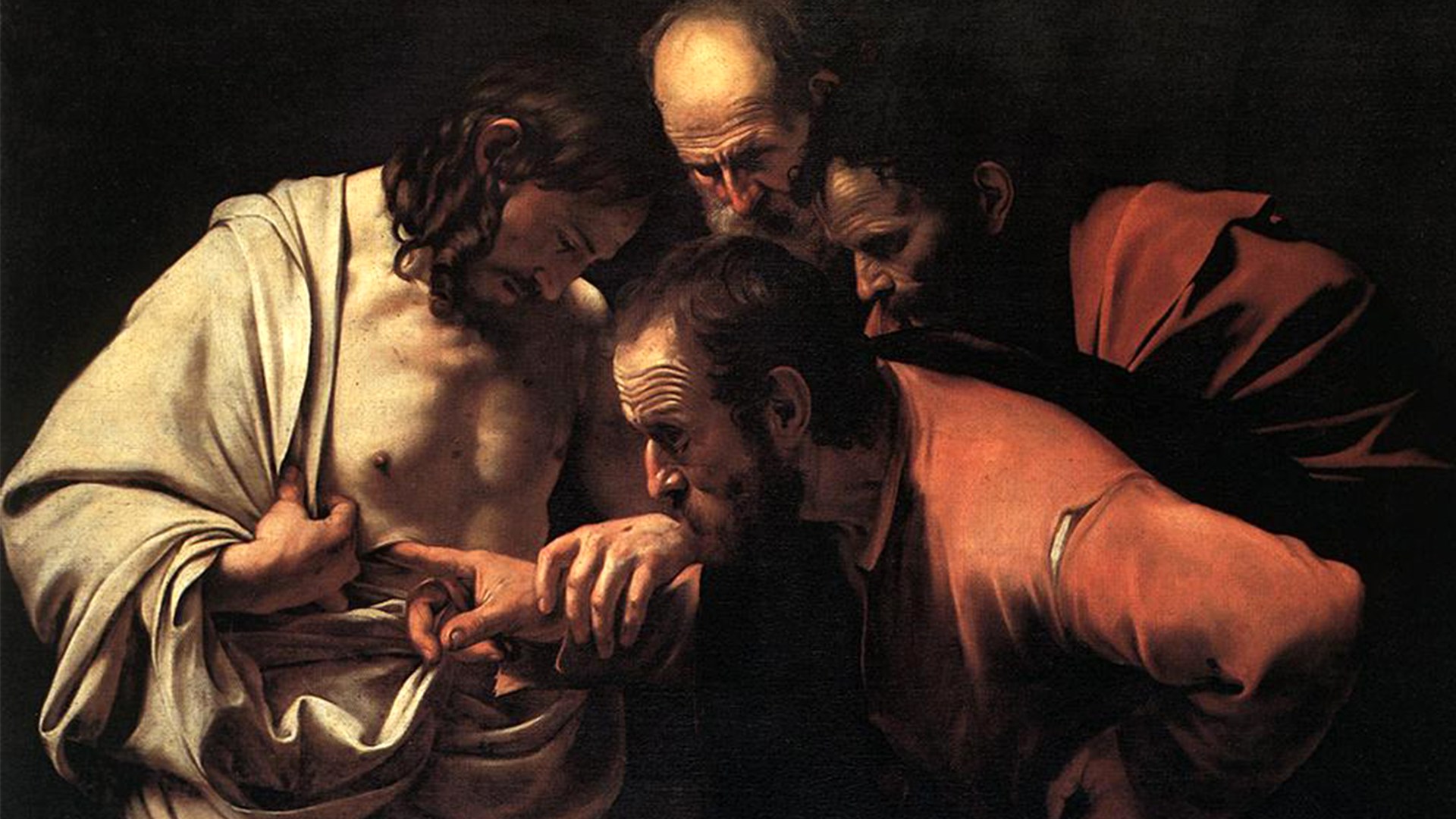
It is astounding that Jesus’ post-resurrection body bore scars. When Thomas doubted Jesus’ resurrection, Jesus invited him to touch the wounds that brought healing to the world. “Put your finger here; see my hands. Reach out your hand and put it into my side” (John 20:27). Four hundred years ago, the Italian painter Caravaggio brilliantly created this scene in his famous painting The Incredulity of Saint Thomas. In the piece, Jesus vulnerably opens his cloak and calmly guides Thomas’ finger into his wounded side. This is our example. We, too, can offer our wounds to a scarred and scared world for the healing of others—and ultimately ourselves.

Sociologist Rodney Stark’s book The Rise of Christianity sought in part to answer the question of how a little sect of a few followers at the time of Jesus’ death could have a worldwide following of millions of adherents within just a few centuries. One of the primary answers Stark found is that the early Christians saw themselves as agents of healing while everyone else ran and hid, even in the midst of persecution. The willingness of early Christians to run to the front lines of suffering, as well as their ability to offer radical hospitality and compassionate service in the midst of great need, was the greatest and most effective form of evangelism.

We’ve heard this pandemic described as “unprecedented” an unprecedented number of times. And yet, it is far from it. Epidemics and plagues have been quite frequent throughout history—and Christians have rushed to provide healing to those who were most deeply affected.

We may be wounded by all that has transpired, but this does not disqualify us. Jesus has a penchant to use people who share their wounds in order to bring healing in his name.

In A.D. 250, a plague spread from northern Africa to Europe, lasting almost 20 years and killing approximately one million people. The bishop, Cyprian, encouraged Christians to donate their resources for care for the sick. The church organized programs in several cities for systematic health care—all while Christians were experiencing massive persecution. Christians showed care not just to other Christians but also to the pagans—showing radical compassion in the midst of a pandemic to the ones who were attempting to kill them for their faith. This event in history is known today as the Plague of Cyprian not because he was to blame for spreading the plague but because he spread radical compassion during it.

Around A.D. 312, Eusebius, bishop of Caesarea and a prominent church historian, recorded that the region had been deeply impacted by war, famine, and a ravaging plague all at the same time. The response of the Christians was so great he recorded,

In this awful adversity they alone [Christians] gave practical proof of their sympathy and humanity. All day long some of them tended to the dying and to their burial, countless numbers with no one to care for them. Others gathered together from all parts of the city a multitude of those withered from famine and distributed bread to them all, so that their deeds were on everyone’s lips, and they glorified the God of the Christians (emphasis mine).

In the late fourth century, hospitals were first created through the efforts of Basil the Great in Caesarea and John Chrysostom in Constantinople. Later, the medieval church established hospices.

Like the early church, we, too, can take up the mandate to be agents of healing. We may be wounded by all that has transpired, but this does not disqualify us. In fact, Jesus has a penchant to use people who share their wounds with others in order to bring healing in Jesus’ name. There are several marks of wounded healers.

Wounded healers bear scars and offer them to others as a source of identity, solidarity, and vulnerability. Our primary task is to offer healing, not to “fix” others. We own our pain, then lovingly and gently touch other people’s pain. The word compassion in the original Latin root means “co-suffering.” Wounded healers suffer alongside others. We show our wounds to others, and we earn trust for others to show us their wounds. And just as Paul heard Jesus say, “My grace is sufficient for you, for my power is made perfect in weakness,” (2 Cor. 12:9–10), we can take these words from Jesus as our own in this time of woundedness.

Wounded healers engage in lament. We embrace lament and see it as an important element of the healing process. Wounded healers don’t encourage others to simply “move along” without grieving loss because they know the acknowledgment of the pain is a crucial part of the healing process. Lament precedes celebration—and it cannot be rushed, manipulated, or forced.

Wounded healers are rooted in a robust theology of suffering and of hope. Nouwen wrote that “the main task of the minister is to prevent people from suffering for all the wrong reasons.” Wounded healers help others see that finding hope in suffering is centered in the person of Jesus and the heart of the Christian faith. Even though we travel through death’s valley, we trust that God remains with us—Immanuel.

Wounded healers realize they play a significant role in the healing process, but they realize true healing is based on the love and the power of God. Wounded healers know the power of presence in healing, but they also know it is the presence of Christ, the Wounded Healer, who is the ultimate bringer of healing that the world needs. We join with God, but we do not play God. Susan Harper, managing director of Institutional Strategy and Partnerships at the American Bible Society, told me we see in the Gospels Jesus and his disciples healing others but not healing themselves. In our Western culture of the sovereign self, we can easily turn this into self-help therapy. But the biblical reality is not focused on self-help or looking to heal myself. Through our wounds, we offer ourselves to him. We invite people to bring their wounds to the one who can truly heal.

If we are to take seriously the fact the world is looking for healing in this global moment, where then are we to look?

First, we can look at Scripture as a book written to oppressed and traumatized people.Have you ever considered what suffering and trauma the original hearers of God’s message had experienced? When you view it through this lens, you begin to see what good news healing was—and continues to be—for people. God’s grand story recounts the shalom-creating God seeking to heal humanity through a shalom-bringing Jesus, who was wounded so we could be healed and returned to shalom (Num. 21:4–9; Isa. 53:5; John 3:14–15, 5:6). The reality of this healing, redeeming, and reconciling Jesus is in our DNA.

We can look for the healers present among us. When we identify, encourage, equip, and join the doctors, nurses, medical professionals, social workers, psychologists, therapists, school counselors—those devoted to people’s physical healing—we empower them to be bringers of healing. But we shouldn’t look only to those whose professions help people in their pain and suffering on a daily basis. The divorced young mother of four knows something about pain, as does the survivor of childhood sexual abuse. So does the widow of 17 years and the army vet who has suffered severe PTSD after his deployment. How might churches be the place that first sees the immense potential of these wounded healers and empowers them to bless and bring healing in Jesus’ name?

We can also look for the healers within our communities—yet outside the walls of our churches. We must think larger and look more purposefully in other places. Many times there are already established organizations, groups, and initiatives where partnerships can be strengthened and deepened. Where can we create good kingdom mischief by linking arms or developing or deepening partnerships with local businesses and financial institutions, with community wellness centers, mental health providers, and others? We don’t have to reinvent the wheel. Many in your community are most likely already involved in the world. When we look, do we see those leaders and individuals whom we can support, encourage, and partner with?

The good news is that Jesus saves, but the good news is also that Jesus heals. Our mandate is to follow Jesus, our Wounded Healer, to experience healing and then, in turn, be bearers and bringers of healing to a broken and scarred world.

J. R. Briggs is an author, leadership coach, and founder of Kairos Partnerships. His latest book, The Sacred Overlap: Learning to Live Faithfully in the Space Between (Zondervan) released earlier this month.

Ideas

The Supreme Court Needs to Be Less Central to American Public Life

Columnist

Here’s what evangelicals should expect—and not expect—from the highest court in the land.

Christianity Today September 23, 2020
Bill Clark / AP Images

Every summer I get reacquainted with the sound of bullhorns. That’s because every June I find myself on the steps of the Supreme Court of the United States, waiting with crowds of other people for a high-stakes decision. The crowds there are mostly peaceable, but there are always the fringes on both sides screaming into microphones at one another. While waiting for the Obergefell decision on marriage, I witnessed Westboro Baptist Church types screaming that they would delight in the others going to hell, while men dressed in drag as nuns shouted obscenities right back.

Regardless of the year, every June brings the certainty of large and contentious crowds. And that’s because, even for people who give no thought to legal philosophy, the Supreme Court is at the center of virtually all our national fissures.

Now with the death of Justice Ruth Bader Ginsburg, we are on the precipice of another fiery dispute between the competing halves of the country about the future of the Court, maybe even fierier than the debate over Justice Kavanaugh two very long years ago.

As evangelical Christians, what should we hope is the end result of these transitions? Ultimately, we should hope for a future where the Supreme Court plays a less central (and less divisive) role in our public life. But the more immediate answer depends on our having a realistic view of what can change and what will not change under the current circumstances.

What will not change—barring some unimaginable circumstance—is the question of whether a justice will be confirmed. As with the death of Justice Scalia, this vacancy comes in a presidential election year, this time even closer to the election. Americans debate whether President Trump should wait until after the election to nominate a justice and whether the Republican Senate should wait until a new Senate is elected to vote on the nomination.

Those arguments are important—and underlying them are deeper questions about the current state of our institutional norms—but they will change nothing. The hearings will happen, and a vote will be held. And there’s no chance that they will not be divisive. The confirmation process will almost inevitably bring forth something we have seen a number of times in the past—namely, a caricaturing of the nominee on the basis of her religious views and practices.

In the years to come, what might change through the Supreme Court? Some decisions of the past may be overturned, and we should hope that they are. Evangelicals and others are right to see Roe v. Wade and Planned Parenthood v. Casey as bad decisions, rooted in incoherent and contradictory legal assertions that restrict the state from even the most basic measures to curb violence against unborn children. The Smith decision—written by Justice Scalia—should be replaced with a decision that fully respects the First Amendment principles of religious free exercise. We should also hope for a Court that rejects on constitutional grounds any cruelty toward immigrant children who are brought into this country by their parents.

That said, even in the best of scenarios, the Supreme Court will not usher in a utopia for one “side” or a dystopia for the other. Even if Roe is gone this year—and I hope that it is—that will not mean a pro-life America in which unborn children are, in the words of George W. Bush, “welcomed in life and protected in law.”

Yes, it would mean a necessary impediment is gone and a tragic stain is removed from the country’s legal status quo. But in some ways, the day after Roe will be the beginning of the pro-life movement, not the end of it. A repealed Roe would simply return the abortion laws to the states in a culture where most Americans to some degree are supportive of legal abortion. We would need to work to change minds on human dignity and create even more parallel structures to help women and children in crisis—a task to which we as Christians are called anyway (James 1:27).

Likewise, a repeal of Smith would remove an obstacle to religious freedom, but there would still be murky conflicts between public policy and religious accommodation—just as there are on freedom of speech and every other constitutional guarantee.

No matter what, the next few years of the Court will be contentious, as they have been for the past few. People will scream “traitor!” when one of their “side’s” justices decides a case differently than the outcome they would want—just as they do now. That is not avoidable, given the divisions already present in American life—and the decisions the Court has already made. After all of that, though, what we should hope for is a Supreme Court that is less central to all of our lives—where every June does not seem like an episode of a spy drama in which a character is racing to defuse or to ignite a city-leveling bomb.

By that, I don’t mean the Court is “legislating from the bench” (although sometimes, of course, it is). The Court exists because we (rightly) have a constitutional system that is not majoritarian when it comes to our basic rights. For example, the Supreme Court was correct—and heroically correct—in the Brown v. Board of Education decision. Jim Crow was a violation of constitutional guarantees, no matter what the “majority” of white southerners may have thought at the time about segregation.

Similarly, we should not depend on public opinion to determine whether Amish pacifists should be drafted into combat. The Court can independently state that those mandates violate the free exercise of religion (even if almost everyone in the country at the time thinks Anabaptist theology is crazy or unpatriotic). And I would argue that unborn children and elderly patients should be recognized as persons bearing inalienable rights, no matter how popular those rights are with registered voters.

The reason the Court has become so central to our public life is not primarily because of judicial activism (although, again, that is a reality) but because American life is so frayed.

Biblically defined, judging is a crucial aspect of governing. Solomon, for instance, asks for wisdom to be able to discern good and evil so that he can judge disputes among the people of Israel (1 Kings 3:9). God grants him that wisdom, which is illustrated in the classic case of the two prostitutes who appeal to him to decide whose baby is the living one and whose was killed in the night. Solomon’s discernment is on display—such that “cutting the baby in two” has now become a cliché metaphor—but the situation itself is a sign that something has gone wrong. A baby is dead; a relationship is fracturing.

In other words, when we need judges, it’s a sign that something is awry.

These aspects of judgment are necessary. Disputes will happen in a fallen world. But we should hope that the fabric of our country strengthens to the point where we can find other ways of mediating our different viewpoints toward justice. We should hope for a country where high-stakes 5-4 or 6-3 decisions are rarer than they are now—not because important issues aren’t litigated but because the country sees human dignity and public justice in ways that correspond to what our consciences already tell us.

We can pray for the future Court to make wise decisions, and we know that, at least for the next few years, those decisions will be necessarily controversial. But on the other side of that, we can hope and pray for future Junes to come and go without most of us even noticing what the Supreme Court has said. We can hope for a day when we walk past the Court and ask, “What did they decide today?” without hearing the bullhorns from around the bend. That would mean that the country is at least moving toward liberty and justice for all.

Russell Moore is president of the Ethics and Religious Liberty Commission of the Southern Baptist Convention. Speaking Out is Christianity Today’s guest opinion column and (unlike an editorial) does not necessarily represent the opinion of the publication.

Apple PodcastsDown ArrowDown ArrowDown Arrowarrow_left_altLeft ArrowLeft ArrowRight ArrowRight ArrowRight Arrowarrow_up_altUp ArrowUp ArrowAvailable at Amazoncaret-downCloseCloseEmailEmailExpandExpandExternalExternalFacebookfacebook-squareGiftGiftGooglegoogleGoogle KeephamburgerInstagraminstagram-squareLinkLinklinkedin-squareListenListenListenChristianity TodayCT Creative Studio Logologo_orgMegaphoneMenuMenupausePinterestPlayPlayPocketPodcastRSSRSSSaveSaveSaveSearchSearchsearchSpotifyStitcherTelegramTable of ContentsTable of Contentstwitter-squareWhatsAppXYouTubeYouTube