



Christianity Today’s Top Testimonies of 2020
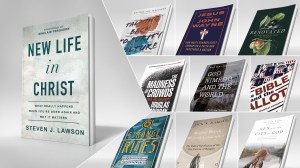
The Christian conversion stories that CT readers shared most.

Christianity Today December 11, 2020

In each print issue, Christianity Today devotes the back page to stories of Christian conversion—from the quiet to the highly dramatic. If you missed any, here are CT’s top testimonies of 2020, including some online exclusives, ranked in reverse order of what people read most.

12.
11.

10.

9.
8.
7.

6.
5.
4.
3.

2.
1.

Check out the rest of our 2020 year-end lists here.
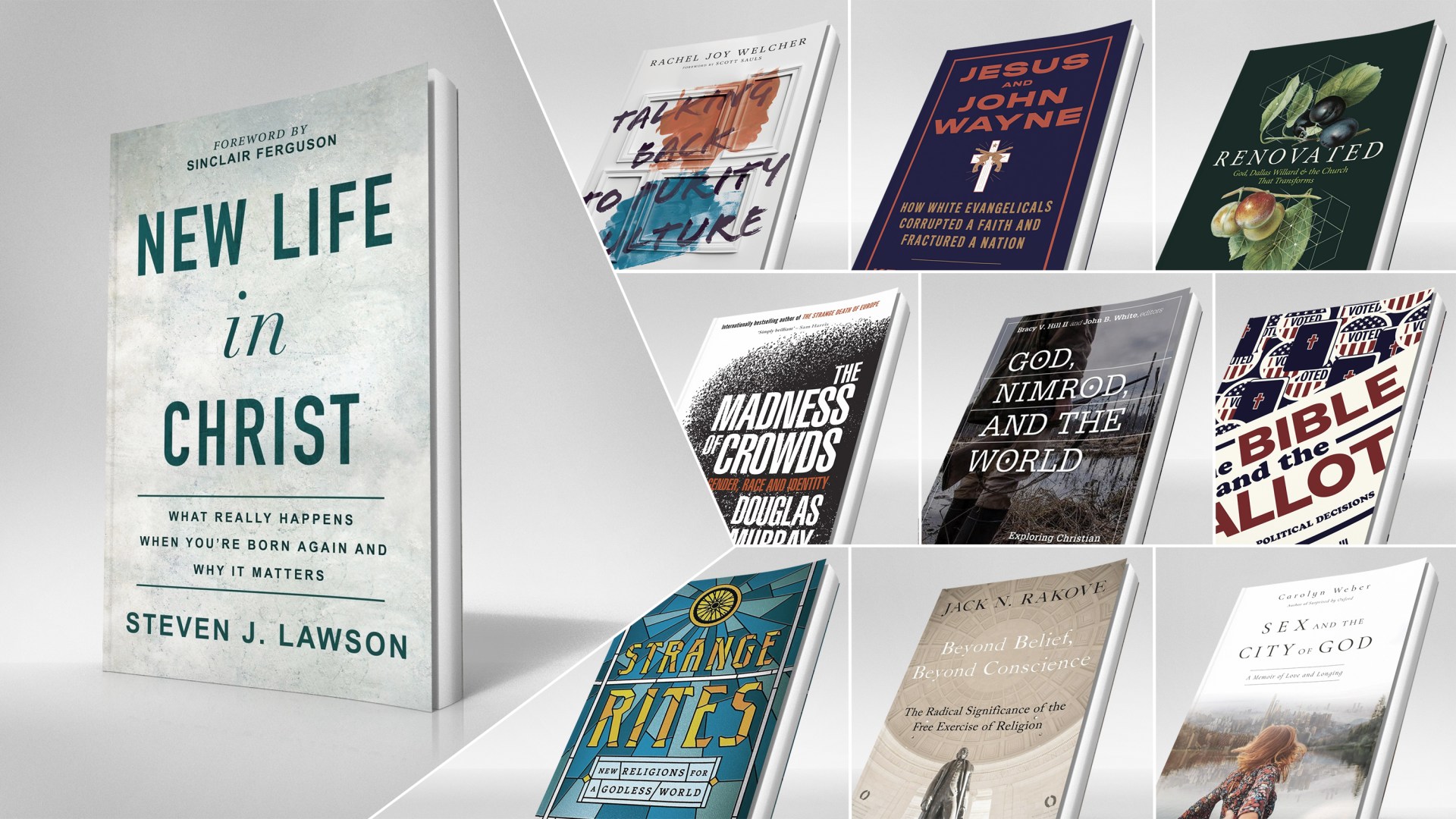

Christianity Today’s 15 Most-Read Book Reviews of 2020

Recovering the real meaning of “born again,” rethinking purity culture, “remixed” spirituality, and much more from the year in books.

Christianity Today December 11, 2020

Here are our most popular book reviews of 2020, ranked in reverse order of what our online audience read most.

15.

14.

13.

12.

11.

10.

9.

8.

7.

6.

5.

4.

3.

2.

1.

Find all of CT’s book reviews here.
Theology

Advent Week 3: Immanuel, God with Us

Advent devotional readings from Christianity Today.

Christianity Today December 11, 2020
Image: Illustration by Jared Boggess

In this series

[Available in Traditional Chinese]

Jump to the daily reading: Sunday | Monday | Tuesday | Wednesday | Thursday | Friday | Saturday.

Want to print these devotionals or read them in PDF format? Purchase this entire Advent devotional, plus additional Bible studies and Bible reading guide with our Advent 2020 digital bundle.

Sunday: Greatness and Grace

Today’s Reading: Matthew 1:1–17

During Advent, as we seek to encounter and worship Christ, we often look for him in the shining star that led the Magi to the miracle in the manger. We look for Christ in the gifts of gold, frankincense, and myrrh. We look for him in the heavenly host of angels singing to shepherds watching o’er flocks by night.

We don’t often think to look for Jesus in his genealogy. There we see the mention of great men like Abraham, the father of our faith, or King David, the warrior and worshipper. Yet the Messiah’s genealogy highlights not only greatness but also grace. His lineage names not only leaders but also those least expected—unlikelies like Tamar, a tainted woman; Ruth, a Moabite; and Rahab, a woman of the night.

A genealogy isn’t just a list of names to skim and skip through. Genealogies are paragraphs of paradoxes that point to a God of the impossible. A God who had it in his mind for our Messiah to come from a bloodline of kingdoms and crowns as well as from criminals and castaways.

The genealogy of “Jesus the Messiah the son of David, the son of Abraham” not only invites us to ponder that God chose some of the unlikeliest of people, places, and plots to accomplish his plans for his people; it also provides us a record of promises and prophecies from the heart of a faithful God who fulfilled the very future he foretold. More than a mere summary filled with names, Matthew’s genealogy of Jesus reveals the fulfilled prophecy of a Messiah who’d “come up from the stump of Jesse” (Isa. 11:1) and the fulfillment of God’s promise to Abraham that through him “all nations on earth will be blessed” and that his descendants would be “numerous as the stars in the sky” (Gen. 22:17–18).

So lean into this list of names. Let it lead you into holy living as we persevere in the time and space between Christ’s birth and Christ’s return. Let it remind you that we can trust in God’s Word and in his promise to make good of our unlikely lives and, ultimately, to make good of this unlikely world. So linger long in the lineage of Christ, praising God for all that he has done, all the while waiting—with eager and expectant hope—for all that is to come.

—Rachel Kang

Ponder Matthew 1:1–17.

Also consider reflecting on the stories of Tamar (Gen. 38), Ruth (Ruth 1:1–5, 4:13–22), Rahab (Josh. 2), David (2 Sam. 23:1–4), and Abraham (Gen. 22; Rom. 4:1–3). How does Jesus’ genealogy point toward his purpose? How does it deepen your trust in God?

Monday: Hold On

Today’s Reading: Luke 1:5–25

In an instant society in which we can order something online and get it an hour later, we often have a hard time waiting. Yet, as Simone Weil said, “Waiting patiently in expectation is the foundation of the spiritual life.”

Zechariah and his wife, Elizabeth, had been waiting for a long time. “They were childless because Elizabeth was not able to conceive, and they were both very old” (Luke 1:7). Zechariah means he whom the Lord remembers. There’s a painful irony here, for though his name means the Lord remembers, in all the long years of waiting, it likely felt as if the Lord had forgotten him.

But in Luke 1:5–25, everything changes. The angel Gabriel appears to Zechariah and says, You will have a son. This news is so incredible, so shocking, that Zechariah’s response is This is impossible. It’s hard for Zechariah to believe it’s going to happen. And because he doesn’t believe, Zechariah gets a case of angelic laryngitis for the next nine months until his son is born.

Zechariah and Elizabeth’s story reminds us that a faithful response to waiting is prayer. Gabriel told Zechariah, “Your prayer has been heard” (v. 13). This statement gives us insight into how Zechariah and Elizabeth handled their long years of disappointment: They persevered in prayer. They prayed even when things did not unfold as they expected them to. They held on to God, even in the midst of social disgrace, disappointment, and hopelessness.

But, of course, their waiting was not perfect. Consider verse 20: “You did not believe my words, which will come true at their appointed time” (emphasis added). Even though Zechariah lacked faith, God still performs the miracle. Advent reminds us that even though our faith is not always strong, God is faithful to come. We may doubt, get depressed, become discouraged, or want to give up, yet God is still gracious to come.

The story of Zechariah and Elizabeth is both beautiful and frustrating. It’s beautiful because their long waiting ends with answered prayer. But it’s also frustrating because we know that not all of our prayers are answered in this same way. This is the complexity of Advent—human suffering and divine grace—and we hold it all together. Whether it is in this life or the life to come, we know God will make all things new. So with Zechariah and Elizabeth, we hold on.

—Rich Villodas

This article is adapted from a sermon Rich Villodas preached on December 8, 2019. Used by permission.

Reflect on Luke 1:5–25.

In what ways might you relate to or empathize with Zechariah? What does this account reveal to you about God? About suffering? About waiting?

Tuesday: Part of the Story

Today’s Reading: Luke 1:26–38

Mary is incredibly famous today, but there was a time when she was completely unknown. She was just a teenage peasant girl from Nazareth, a town which some scholars say may have had fewer than 100 people. Like her peers, Mary was probably illiterate. Given her station in life, she would have been expected to marry humbly—a poor, working-class boy. Their family would likely often go hungry because there wasn’t enough to make ends meet.

When the God of the universe decided to choose his mother, he didn’t approach a young woman of wealth and status. Instead, God approached an illiterate peasant girl from a very small town. Jesus’ genealogy (Matt. 1:1–17) shows us that we don’t have to be of a particular race or be an “insider” to be part of God’s story. And when we look at Mary, we see that we don’t have to be rich, from a big city, highly educated, or important in society. We can be dirt ordinary and yet be part of this everlasting story.

What is the one qualification that God seems to require? When the angel Gabriel came to Mary and told her, You’re about to become the mother of God, Mary opened up her heart and said, Yes, may it be to me as you have said. To become part of this story and to experience God birthing his life in us, all we need is a yes. We need to consent to the work of the Holy Spirit inside us.

Recently, I’ve been praying something called the Welcoming Prayer. I pray it like this: Holy Spirit, I agree to your work in me and I let go of my desire for security, for affection and esteem, for power and control. This was the essence of Mary’s yes to God. She let go of security, affection and esteem, and power and control. As a result, her reputation would be stained for the rest of her life. She’d one day see her adult son mocked, spat upon, beaten, and nailed to a Roman cross. It would feel like a dagger piercing her heart (Luke 2:35). Yet she said yes.

May we, like Mary, pray, “Holy Spirit, I say yes to your work in me.” May God’s life be birthed in us. May we too play our part in the grand and everlasting story of God.

—Ken Shigematsu

This article is adapted from a sermon Ken Shigematsu preached on December 25, 2019. Used by permission.

Contemplate Luke 1:26–38.

What might it look like for you to say yes like Mary? To consent to the work of the Spirit within you? Pray, welcoming God’s work in your life.

Wednesday: Hope When the Future Crumbles

Today’s Reading: Matthew 1:18–24

What did Joseph hope for in life? We don’t know much about this carpenter who lived so long ago. Matthew tells us he was righteous and faithful. We see firsthand that he was compassionate, wanting to protect Mary even as his future crumbled. Joseph knew how to sacrifice for the sake of duty, becoming a husband to Mary and father to Jesus under disquieting circumstances. He later fled to Egypt, leaving behind family, home, and work to protect the toddler boy who was not his own (Matt. 2:13–15).

We see a glimpse of Joseph in his choices, but I wish we knew more. What did the angel’s strange tidings mean for him, and how did he make sense of it all? Had Joseph longed for marriage and a family? Did he yearn for Mary, or was the betrothal brokered by her parents? When he first learned of her pregnancy, was he heartbroken? Or angry? Or frustrated by the delays and red tape of divorcing her?

We’ll never know for sure what Joseph hoped for from life, but it certainly wasn’t this: a pregnant fiancée, an unborn child not his own, a lifetime of gossip and slander still ahead. Who would believe the angel’s story? Would you? Did he?

Maybe he didn’t, entirely. Most of us would not, could not, no matter how much we wanted to. Babies were conceived the same way then as now. Perhaps Joseph wrestled with lingering doubts, praying something like another biblical father would: “I do believe; help me overcome my unbelief!” (Mark 9:24).

Whatever Joseph wanted from life, marriage, and fatherhood, we know he was given a steeper climb than he hoped. And yet, he stepped forward. Joseph actively set his face toward a long-term hope that God would prove faithful and true, that a far-off redemption would be powerful enough to overturn all this suffering and darkness, all this bitter disappointment.

They named Mary’s boy Jesus, a common name, believing that he also bore another name—Immanuel and believing that this scandalous birth story would be redeemed by divine scandal, “God with us.” Joseph wagered his life, family, future, and identity on the chance that God was faithful—that this common boy, this source of so much initial disappointment and upheaval in Joseph’s life, was indeed the hope of the world.

—Catherine McNiel

Read Matthew 1:18–24,

prayerfully engaging your imagination to step into Joseph’s story. What might he have thought or felt? What does he show us about faithfulness and hope?

Thursday: A Song of Mercy and Justice

Today’s Reading: Luke 1:39–56

In Luke 1:39–56, Mary leaves her hometown to be with her relative Elizabeth. When she gets there, she learns that Elizabeth is pregnant as well. And when Elizabeth sees Mary, the baby inside her womb jumps for joy. Elizabeth says, “God’s favor is on you, Mary.” She affirms and confirms God’s words to Mary.

And out of the joy of this encounter, Mary starts to sing. She bursts forth with exuberance and rejoicing. She sings about the goodness of God, then focuses on God’s mercy. She says, “His mercy extends to those who fear him” (v. 50). She sings, “He has helped his servant Israel, remembering to be merciful” (v. 54).

We tend to think of mercy in a limited way, such as providing relief for someone who is in pain. But in Scripture mercy goes much deeper and further than that. Yes, it speaks of compassion, but it also speaks of God’s loyalty to and fierce love for his people.

Mary’s song is also a song of justice. She sings, “He has scattered those who are proud. . . . He has brought down rulers from their thrones but has lifted up the humble. He has filled the hungry with good things but has sent the rich away empty” (vv. 51–53). When Mary sings, she’s essentially saying, God’s justice is coming.

Justice, biblically speaking, is about God taking everything that’s wrong with the world and making it right. In God’s kingdom, things are turned upside down. The least are now the greatest. The last are now the first. Justice is God taking what’s broken and bringing it to wholeness. In Advent, a season of longing and expectation, we wait for God to make things right. And this is a key theme in Mary’s song: Lord, make it right.

Mary’s song reminds us that there is no sin so deep that God’s mercy doesn’t go deeper. The good news of Advent is that God has come and God is coming in the person of Jesus—and he offers mercy that goes deeper than our sin. Mary’s song also reminds us that there’s nothing so wrong with the world that God’s justice won’t one day make right. This is why we sing: because of God’s mercy, because of God’s justice. This is why we wait for Jesus to come again: because when he comes, he’s making all things new.

—Rich Villodas

This article is adapted from a sermon Rich Villodas preached on December 5, 2019. Used by permission.

Ponder Luke 1:39–56

. How does Mary’s song emphasizing God’s mercy and justice speak into your own life today? How does it offer hope to our hurting world?

Friday: The Light and the King

Today’s Reading: Isaiah 9:2–7; 40:1–5; Luke 1:57–80; 3:1–6

Zechariah and Elizabeth named their baby John, which means “God is gracious and has shown us favor.” Filled with the Holy Spirit, Zechariah prophesied over his son: “You will go on before the Lord to prepare the way for him, to give his people the knowledge of salvation through the forgiveness of their sins, because of the tender mercy of our God, by which the rising sun will come to us from heaven to shine on those living in darkness and in the shadow of death” (Luke 1:76–79).

When we fast-forward to John the Baptist’s adult life, we see he does exactly that. Luke records,

He went into all the country . . . preaching a baptism of repentance for the forgiveness of sins. As it is written in the book of the words of Isaiah the prophet: “A voice of one calling in the wilderness, ‘Prepare the way for the Lord, make straight paths for him. Every valley shall be filled in, every mountain and hill made low. The crooked roads shall become straight, the rough ways smooth. And all people will see God’s salvation.’” (3:3–6)

These ideas from Isaiah about reshaping valleys, hills, and roads to prepare the way were, in the ancient world, associated with the arrival of royalty. And, indeed, John’s ministry focused on this one thing: declaring that a king was on the way.

Zechariah’s prophecy over his newborn includes a paraphrase of another passage from Isaiah: “The people walking in darkness have seen a great light; on those living in the land of deep darkness a light has dawned” (9:2). The people who heard Zechariah prophesy these words would have known exactly what this Isaiah passage was about: the promise of a coming king. It’s part of the same familiar passage that declares, “For to us a child is born. . . . He will reign on David’s throne” (vv. 6–7).

This offers such immense hope for us. As much as we may like to believe that we can create the peace and joy we desire through our own efforts, the story of John the Baptist and the words of Zechariah and Isaiah emphatically declare that the peace and joy every human longs for will not be realized until the king arrives. John the Baptist literally gave his life to proclaim this truth—to help people see that a light was about to break through the darkness.

—Jay Y. Kim

This article is adapted from a sermon Jay Y. Kim preached on December 9, 2018. Used by permission.

Consider Luke 1:57–80

alongside

Isaiah 9:2–7, 40:1–5,

and

Luke 3:1–6.

Which parts of Zechariah’s prophecy stand out to you? How do these passages convey the hope of Advent?

Saturday: A God We Can Touch

Today’s Reading: Luke 2:1–7

It was said that the gods of the ancient world lived outside time and space, on a different plane from our mortal existence, unreachable. On earth, in the hopes of glimpsing divinity, the ancients established hallowed places—a sacred tree or mountain, a holy temple or city—which they believed existed in both spheres, like a window to heaven. The people traveled to these holy places on holy days, believing the divine and mundane might nearly overlap for one reverent moment.

Luke takes pains to communicate that this story, this God, this mingling of divinity and humanity are altogether different. The Creator is arriving here, to our muddy, dusty, physical, emotional, beautiful, terrible world. Like a midwife carefully noting the time and place of birth, Luke clarifies that God’s birth interrupts a particular event—the Roman census—in a particular place—the town of Bethlehem—in a particular family—the house of David. Jesus is born into history, to a specific woman, exactly here and exactly now. We might gloss over these local details, but to Gentile readers Luke’s statement would be jarring.

On this night, God does not come like the gods of old, on a cloud or a storm, his untouchable power barely glimpsed through a holy mirror. No, God falls into the arms of his mother, arriving on this earth the way we all do. For months she carried him, for hours she labored with pain and blood and struggle, pushing until God was born on earth among us, an infant, vulnerable, wrinkled, and wet. Exhausted from the ordeal and sleeping now but soon to awaken, howling and hungry.

This is Luke’s unbelievable news: The true God came near to us physically, tangibly, in a way that we can see with our eyes and touch with our hands. God arrived in a village we could walk to, during a year we can remember. Divinity took on flesh in a mother’s womb, interrupting a marriage, a night, and a village like any other birth. We no longer meet God in sacred places and spiritual spheres but here on the ground, in the dirt, in our families and flesh and blood.

It is a shocking idea, even for us so many centuries later. There is no longer a separation between sacred and mundane. Our messy, daily lives are exactly where God is found, where God is at work. This is a God we can touch.

—Catherine McNiel

Reflect on Luke 2:1–7

, considering the details Luke uses to situate this event in space and time. Why is this significant? What does it emphasize to you about God? About Advent?

Contributors:

Photos courtesy of contributors.

Rachel Kang is a writer of prose, poems, and other pieces and the creator of Indelible Ink Writers, an online community of creatives.

Jay Y. Kim is lead pastor of teaching at WestGate Church, teacher-in-residence at Vintage Faith Church, and the author of Analog Church.

Catherine McNiel is a writer and speaker. She’s the author of All Shall Be Well and Long Days of Small Things.

Ken Shigematsu is senior pastor of Tenth Church in Vancouver, British Columbia. He’s the author of God in My Everything and Survival Guide for the Soul.

Rich Villodas is lead pastor of New Life Fellowship, a multiracial church in Queens, New York. He is the author of The Deeply Formed Life.

Want to print these devotionals or read them in PDF format? Purchase this entire Advent devotional, plus additional Bible studies and Bible reading guide with our Advent 2020 digital bundle.

[Available in Traditional Chinese]

Testimony

I Grew Up a Fervent Evangelist for Islam. Now I’m Living Out the Book of Acts.

How an encounter with Christian missionaries made me into a missionary myself.

Christianity Today December 11, 2020
Illustration by Rick Szuecs / Source image: Tanner Ross / Carolyn V / Unsplash / Bisualphoto / Envato

I grew up in a Muslim family on the coast of Kenya. My father served as an Imam, and I was one of the muezzins (Muslims who call others to pray five times a day) at a local mosque.

The only school I ever attended existed to educate young men in the ways of Islam and to help them grow as Muslims. I was being trained to defend the Muslim faith and to share it with others. As a young man, I became one of the best and most well-known evangelists for Islam in my region.

Early in life, my father had taught me to hate Christians and even to beat them if necessary. I was trained to believe that Christians were on the same level as animals. We were not allowed to associate with them in any way.

A Miraculous Transformation

In 2009, my life was forever changed. The day started out just like any other: I woke up and went to the local mosque to start calling people to pray. I was set to recite the adhan (Muslim call to prayer) into the microphone so that my call could be heard throughout the city. But when I tried to speak, nothing came out. Leaving the mosque, I saw my friend Ali in the street and I tried to explain what had happened, but he wouldn’t believe me.

We went back to the mosque, where I stepped up to the microphone and attempted to call the adhan once more, but again my voice would not come out. Ali was as surprised as I was. We both were nervous, but he took over my duties so that I could go home for the day.

When I got home, I tried to relax and calm my mind. My heart was heavy, and I felt troubled. I went to my kitchen, grabbed a thermos, and started to make hot tea. I poured the tea into a mug and was about to start drinking when I saw that the tea had turned red, a dark red that looked like blood. I left the tea on the counter and took a walk, hoping to clear my mind after a day full of seemingly crazy events.

During my walk, I came to a marketplace where a large crowd had gathered around the back of a pickup truck. Getting close enough to hear and see what was going on, I listened as a Christian missionary was preaching. He was clearly a Kenyan, just like me, and not someone who had come here from the Western world. I was skeptical and kept my distance, but I listened to what he was saying.

After the man had finished preaching, I felt compelled to approach him. Because I was known very well in that area, the pastors who were with him (they were also Kenyan) initially blocked me from coming forward, but the missionary allowed me to talk with him. He shared the gospel with me, and right then and there everything felt different. I saw everything that had happened during that day in a new light. I knew that God was the one who wouldn’t let my voice come out; he was the one who turned my tea blood red, as a symbol of Christ’s blood spilled on the cross for me.

The Holy Spirit changed my heart, and I gave my life to Jesus. The missionary told me to go tell my family what had happened, and I did as he requested, even though I knew my father would not like it. Sure enough, he saw my conversion as an abandonment of Islam and an act of personal betrayal. He called my uncle, a well-respected leader in the Muslim community, to ask for advice on how to handle this crisis. My uncle recommended having me excommunicated. But my father was in no mood for half-measures: He wanted me dead. He ordered me to get out of the house right away, and I wasn’t even allowed a moment to gather my belongings.

After my father had left the house, I returned and saw my sister. She told me that my father had burned all of my belongings behind our house. She had been washing clothes at the time, and she gave me one set to take with me.

That night I ran away, staying outside on a park bench. It was a cold night, and I considered returning to my father and apologizing. But as I prayed, I found new strength in Jesus Christ. The next day, I went out and started sharing my testimony, explaining what Jesus had done for me and how others could receive him as well.

I found the missionary who had shared the gospel with me, figuring I would stay the night with him and his fellow pastors before leaving the next morning. But soon we heard that my father had sent people out looking for me, people who would kill me if they found me. So that night, around 3 a.m., the group of missionaries escorted me out of my hometown.

They brought me to a city eight hours away. A longtime member of a local church took an interest in me and started to disciple me. Another member even allowed me to stay in his home since I had no place to live.

The more I got settled in this strange new place, the more I felt a call to ministry. I started sharing the gospel to lost people in the area, gathering a group of about 10 people in the area to disciple as I had been discipled.

I hoped to attend a Bible school, so that I could become a better preacher and teacher of the gospel, but I did not have the money to pay for it. So I started traveling around and visiting different churches and congregations, where I had the opportunity to preach, teach, and share the story of my conversion.

Yet danger kept stalking me. After visiting one church in the region for five days, preaching and sharing the gospel, I learned that some men had come there looking for me. They had been sent by my parents. In the mosque where I grew up, an announcement had gone out that I was wanted, dead or alive.

Counting the Cost

Over the years, I’ve continued to travel and visit different churches under the support of the national missionary organization that aided me at the time of my conversion. In April of 2017, I took a new step of boldness. Alongside one of my own disciples, I journeyed to a city close to the border of Somalia, where the population consists mostly of Somalis who were members of my own ethnic group. I had ventured there to do what God had put in my heart so many years ago: sharing Christ with Muslims in my homeland.

We had planned out a four-day trip. On the first day, as I started to preach and share the gospel, a crowd gathered. As I continued evangelizing, the crowd became angry, and a few people complained to the police that I was causing trouble.

The police arrested me and took me to jail. I was punched and kicked by other cellmates and by the corrupt police officers. I learned that the man I had been discipling had left to return home. But I continued to share Christ, and 10 Somalis came to know Jesus as Lord in jail. On the fourth day, I was released, and I walked straight from the jail to the market where I had preached the gospel. Seven Muslims prayed to receive Christ that day.

In the Gospels, Jesus tells the crowds that anyone who would follow him must be prepared to leave everything behind for the sake of carrying a cross (Luke 14:26–27). Since becoming a Christian, I’ve had many occasions to count the cost of discipleship. On top of having to flee from my home and family, I was forced to part ways with the Muslim woman I was set to marry (though God later saw fit to provide me a wife at one of the churches I visited). On several occasions, people from the cities I’ve evangelized have shown up at my home in the middle of the night to threaten me and my family. I have been beaten by crowds five different times.

And yet, when I think of even the worst suffering—of all the slaps, punches, and kicks I’ve endured—I still “count it all joy” (James 1:2, ESV). I’ll gladly surrender everything for the cause of Christ and to reach my Muslim brothers who are blind.

Aaban Usman (a pseudonym) works as a national missionary through Reaching Souls International, an organization based in Oklahoma City. Koal Manis is a freelance writer and a student at Oklahoma Baptist University.

Ideas

Should Pastors Speak Up About the COVID-19 Vaccine?

With Christians split on the issue, some urge vaccination as a form of neighborly love, while others leave it up to conscience.

Christianity Today December 11, 2020
Illustration by Rick Szuecs / Source image: Gchutka / Getty / Product School / Unsplash / Envato

About half of US Protestant adults don’t plan to receive the new COVID-19 vaccine, according to a recent Pew Research Center survey.

While confidence in the vaccine has actually risen since September—three companies announced viable vaccines last month—50 percent of white evangelicals and 59 percent of black Protestants say they won’t get the vaccine, while the majority of the US population overall (60%) says they will.

For centuries, religion and medicine have collaborated for the prevention of disease, though the relationship at times has been complex. In more recent years, public health professionals have relied on church leaders’ support—particularly in communities of color—to gain trust in promoting health initiatives. The coronavirus pandemic has become another example of the complex relationship between faith and science.

Given the split among Christians, how should pastors engage with their congregants about the COVID-19 vaccine? Should they encourage church attenders to receive the vaccine?

CT heard from five pastors about how factors like race, theology, and congregational makeup affect their approach to the issue.

Jeff Schultz, pastor of preaching and community at Faith Church in Indianapolis

Our church been praying for vaccine research and development, but taking a vaccine is not something we would direct people on.

Our congregation has a number of doctors, nurses, medical researchers, and people in pharmaceutical development. We believe that God works through miraculous intervention, but more commonly through our work, gifts, and wisdom applied in service to others. We’ve encouraged people to wear masks and practice social distancing. We have members who won’t return to in-person worship until a vaccine is available. But I don’t think we would say anything formally about taking a vaccine (except to give thanks for their existence).

At an individual level, I will encourage people to consult with their physician on making that decision. I see masks and social distancing as extremely low-risk interventions that help us love our neighbors. A COVID-19 vaccine is another important way to stop the spread of a deadly disease, but I don’t believe that as a pastor I have the medical qualifications to direct people on medical treatments that may have side effects or long-term health impact. I want to help people see the good of a vaccine while asking us all to respect others’ decisions.

Luke B. Bobo, director of strategic partnerships at Made to Flourish, a pastor’s network based in Kansas, and visiting professor at Covenant Theological Seminary

Abortion, film, music, guns, cartoons, medical science—pastors, as cultural exegetes, must discuss these topics because such things are not benign. These cultural artifacts mediate messages that are often contrary to the Christian life and worldview, so engaging their congregants about the COVID-19 vaccine is no exception. I believe pastors must engage in vaccine discourse biblically, wisely, and Christianly.

Of course, for African American pastors, engaging their congregants about this vaccine will be more complicated, as many abuses have been inflicted on black persons for the sake of medical progress. Who can forget the Tuskegee syphilis experiment and the infamous “HeLa” cells, cancerous cells stolen from Henrietta Lacks without her family’s consent? So pastors must engage this topic historically as well.

Pastors must teach their people how to think critically about this COVID-19 vaccine. If they are asked whether they plan to take the vaccine, they should state their answer and follow with a statement like, “That is my decision; you must do the hard work and make your own decision.” In other words, pastors must not think for their congregants; rather, they must equip their people with the necessary tools so that they can think and decide for themselves.

Mandy Smith, pastor at University Christian Church in Cincinnati

I have no problem with vaccines on a philosophical or theological level and will defer to the medical professionals in my congregation who know more about such things than I know. The church I lead is on what’s sometimes called “Pill Hill”—we have four hospitals in our immediate neighborhood, and so we have quite a few medical professionals. At the same time, since we’re in a diverse community, we also have quite a few folks interested in alternative lifestyles, which leads them to be wary of vaccines.

As Christians, we need to have space for difference of opinions—unity in essentials, liberty in nonessentials, and in all things, love. On a philosophical level, our opinion about vaccines is nonessential—we won’t lose our salvation and shouldn’t split with other Christians over it.

At the same time, on a practical level, with a vaccine the decisions we make affect one another. While we might have differences of opinion where we can agree to disagree, if our children are playing together, and we’re sharing potluck meals and Communion, the choices we make about vaccines are not for our own personal sake but for the sake of our entire community. If there’s one thing that the pandemic has shown us, it’s that our lives, bodies, and health are interwoven.

Stephen Cook, senior pastor of Second Baptist Church in Memphis

COVID-19 has claimed the lives of more than 283,000 of our neighbors in the United States, more than 1.5 million of our neighbors around the world. With the hope of a vaccine on the near horizon, pastors have the opportunity to call Christ’s people in our congregations to neighbor-love in a way that embodies Christ’s command to love one another.

When Jesus is questioned by a lawyer who wants to know who counts as his neighbor (Luke 10), he responds with the story of the Samaritan who stopped to provide for the needs of the one beaten and left for dead. Notably, the Samaritan whom Jesus points to as an exemplar of merciful service lives out the call to neighbor-love through an act of healing.

Encouraging people of faith to be vaccinated against this disease that has devastated so many is a pastoral responsibility. It is an occasion to summon Christ’s followers to consider the role we have to play in promoting the healing of the world. It is an opportunity for us to recall that, at the end of the story, Jesus lifts up the one who acts like a neighbor in response to a desperate need.

Stephanie Lobdell, campus pastor at Mount Vernon Nazarene University in Ohio

The directive of Christ to love our neighbor has informed the life of the university campus I pastor in distinctive ways, from masks to plexiglass dividing diners in the cafeteria. Moving forward, it ought to inform our posture toward the vaccine as well. To receive the vaccine if one is physically able is yet another way to practice love for neighbor.

As a Christian liberal arts university in the Wesleyan-Holiness tradition, we bring an additional impetus to the vaccine conversation. As Wesleyans, we hold steadfastly to the centrality of cooperative grace in Christian practice. God takes the initiative toward us, inviting us into a relationship of love as well as into meaningful partnership in the work of embodying new creation. We seek to inspire our students to view the vocation for which they are studying as an expression of that partnership.

When scientists unravel the DNA of a dangerous virus, when doctors work tirelessly to find more effective treatments, when researchers formulate a shot that protects people against infection, we do not raise a self-righteous fist in the face of science claiming, “Faith over fear!” Rather, we rejoice. We rejoice at the life-giving manifestation of divinely ordained vocation. We proclaim thanks be to God, both for God’s provision and for the holy gift of human capacity.

News
Wire Story

Around America’s ‘Christmas City,’ Rural Churches Left Heartbroken by COVID-19

Congregations in Noel and Neosho, Missouri—one diverse and one mostly white—grapple with the strain of the pandemic.

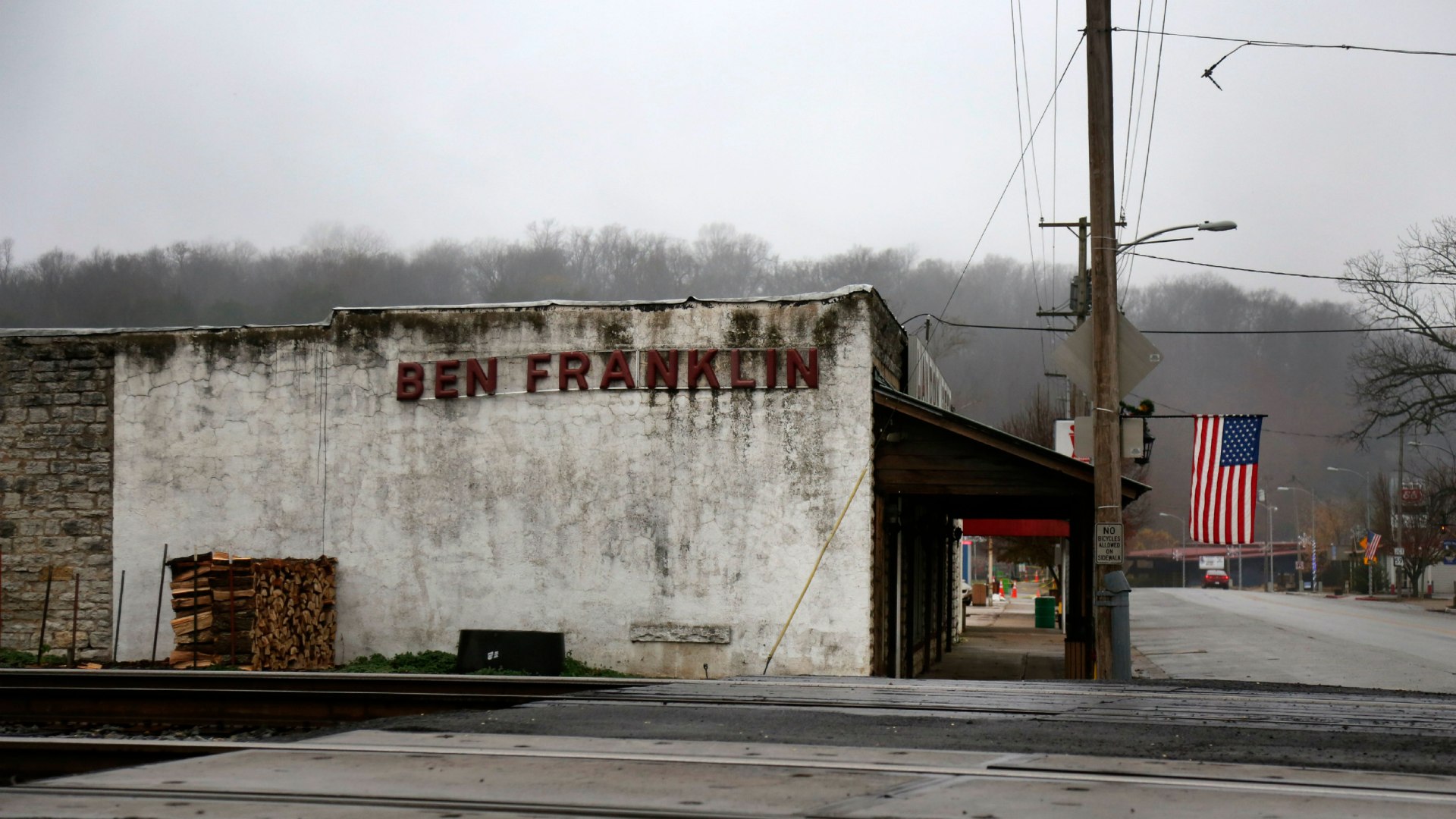
Main Street in Noel, Missouri.

Main Street in Noel, Missouri.

Christianity Today December 10, 2020
Jessie Wardarski / AP

Thirty miles of rural Missouri separate the two churches, and so much else. One is mostly white; the other hosts services in five languages for a flock that spans the world.

Still, every Tuesday the pastors meet midway between their houses of worship, seeking each other’s counsel, sharing their joys—and, more often, their burdens. Because in these pandemic-wracked days, they are sometimes overwhelmed by the crucible of ministering.

“Whether it be the death of a member, whether it be somebody upset, whether it be losing funding, whether it be just all sorts of different things, or maybe just our own depression, just dealing with being locked up at home,” said pastor Mike Leake at Calvary of Neosho, a Southern Baptist church.

One church was staggered by COVID-19 early on. The other has not had as many infections but has seen congregational life turned upside down.

The ministers struggle. Pastor Joshua Manning of the Community Baptist Church in Noel was sickened himself.

And still, they persevere. While they both want to keep parishioners safe, they are determined to carry on with in-person services as long as members of their congregations are eager to attend.

“Our mission to profess the gospel doesn’t end because the coronavirus is here,” Manning said. “And so, we have to still function. We still have to preach. We still have to meet together.”

Praying for a Revival in ‘Christmas City’

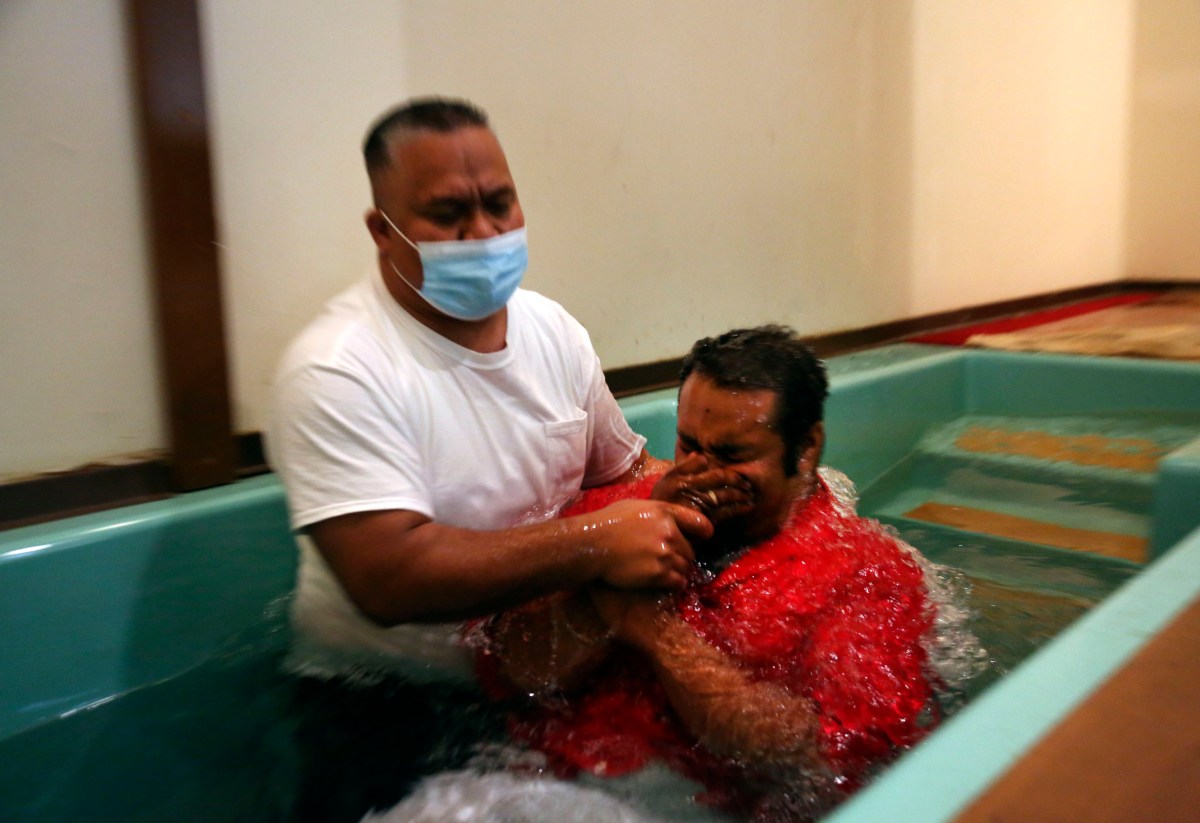
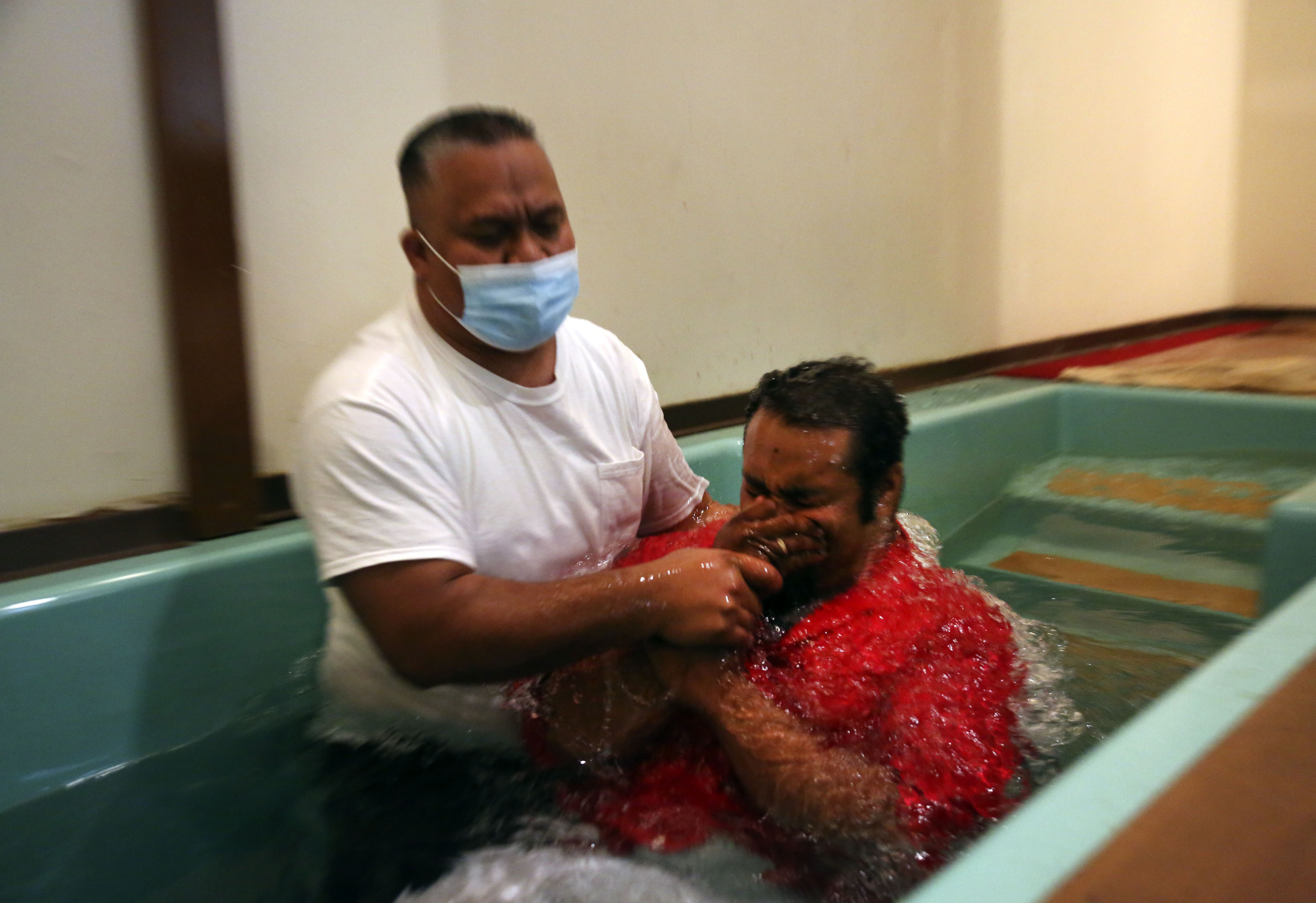
At the end of a recent Sunday, 11 people were immersed in a turquoise baptismal pool behind the altar of Community Baptist, thousands of miles from the islands in the Pacific Ocean where they were born.

This was the last of five services for five international congregations—in all, about 200 people—who worship at the church in Noel. The town of 1,800 in the far southwest corner of Missouri has a large immigrant population, including Pacific Islanders, Mexicans, Sudanese, and refugees from Myanmar.

Most arrived here drawn by the opportunity of a job at the local Tyson Foods chicken processing plant. Many were infected with COVID-19 during the summer when McDonald County, where Noel is located, became a hot spot of the pandemic.

Few places were hit as hard by the virus this summer. Though it has just 23,000 residents, in late June only four other Missouri counties and the cities of St. Louis and Kansas City had recorded more cases. So far, there have been 1,715 confirmed cases of COVID-19 and 24 deaths in McDonald County, according to figures released Dec. 7 by the county’s health department.

At the start of June, McDonald County, had fewer than two dozen confirmed cases. By June 23, 498 cases had been confirmed. Three days later, Tyson Foods announced that 371 employees at its chicken processing plant in Noel had tested positive for COVID-19. Tyson said it is implementing a new COVID monitoring strategy, but did not provide an update on confirmed cases up to December despite multiple requests.

“Just pretty close to overnight, most of our church body and the town largely had it,” Manning said.

Five immigrant congregations meeting at Community Baptist baptized an estimated 50 people in a three-month span.Jessie Wardarski / AP
Five immigrant congregations meeting at Community Baptist baptized an estimated 50 people in a three-month span.

At the onset of the pandemic, Manning closed the church for two months to follow safety guidelines. When he reopened it in June, he contracted the virus and was forced to shut it down again for a month.

His wife, Lauren, and three children also were sickened, as was Lauren’s grandfather, who died in October. And the church’s Spanish-language pastor, Roberto Nunez, died in July. A pastor has been driving more than five hours back and forth from Nebraska to lead the Spanish service each Sunday.

Amid all of this, Manning has pushed ahead.

“I have to basically balance two different things,” the 41-year-old pastor said. “I have to preach the gospel. The church has to meet together. Businesses have to run. Without the poultry industry running, people don’t get paid, and people don’t eat.”

“You have to have school, you have to have those things. And doing any of those things causes risk. And I know because I’ve lost people that’s close to me.”

Manning worked for two decades as a Walmart manager before he chose to follow his calling and became pastor of the church in 2018.

He had lived in McDonald County for most of his life but knew little about Noel. Though the town near the Missouri-Arkansas-Oklahoma border is named for a founding family, many across the world send Christmas cards to the Noel Post Office so they can be stamped from “The Christmas City.”

Immigrants from Mexico and Central America began to arrive here in the late ‘90s, drawn by the opportunity to work for Tyson. They were followed by people from Somalia and Sudan, Pacific Islanders and refugees from Myanmar.

Manning said that many had lived in refugee camps in Thailand, and when they first arrived in town, they slept on concrete floors. Now many are homeowners, and their kids attend college.

“If you want to talk about the American Dream on steroids,” he said, “This is it.”

The coronavirus, though, showed the extent of food insecurity in a town where many children rely on free meals at school. Manning started a food pantry at his church’s community center.

On a recent Saturday, he drove his van around town and picked up three young congregants from Myanmar’s ethnic Karen minority who were excited to volunteer. He later treated them to pizza and lowered the rim of the basketball court at the community center so they could dunk.

The next day, he delivered a sermon at his church that was translated a couple of sentences at a time.

“We are separate—from different tribes,” Manning told the congregation. “But we’re all part of God’s kingdom. This kingdom, we call the church.”

Speaking in his second-floor office after a day of back-to-back services, Manning said the church was still “affected by COVID, but … the effect isn’t largely negative.”

The pandemic, he said, also brought a revival of faith. He estimated that in the past three months, a record 50 people have been baptized in the church.

“The spiritual hunger of people is very different than what it was before,” he said. “This is an extraordinary revival because people have a passionate interest when times are tough to what is the important stuff in life, and they go back to their faith.”

Melody Binejal, 27, a Hawaiian of Marshallese parents who moved to Noel this year, sat in one of the front pews, her hair still wet after being baptized. Her father-in-law died after contracting the virus.

It’s a struggle, she said, but “it’s the perfect time to just give your life to Jesus, because you never know when or what time he’s going to arrive and just take everything away from us.”

Community Baptist Church in Noel, MissouriJessie Wardarski / AP
Community Baptist Church in Noel, Missouri

Pandemic ‘Heartbreak’ in the Pews

A 30-mile drive north from Noel is the town of Neosho, nicknamed the Flower Box City. Its population of 12,000 is far less diverse than Noel’s—roughly 85 percent white, with relatively few immigrants and no meat processing plants.

Those differences have not spared Neosho, and its 20 churches, from heartbreak and disruption as the coronavirus arrived in force in June and continues to take a heavy toll.

Back in March, the coronavirus seemed to pose no threat to southwest Missouri as its toll mounted overseas and in a few distant parts of the US.

But even then, the outbreak caused the first of many disruptions for Calvary of Neosho.

Late on March 9, Leake learned that the Southern Baptists’ International Mission Board had urged the denomination’s churches to cancel any foreign mission trips scheduled over the next six weeks.

The very next day, Leake and three members of his congregation had planned to depart on a mission trip to Mexico. But he heeded the IMB warning and called Ashley Jones, one of the would-be travelers who’d been making the arrangements. She scrambled to cancel their flights.

The months that followed have been challenging for the congregation, as initial hopes that Neosho was spared gave way to realization that the pandemic was on its doorstep.

“We’ve had a lot of ups and downs,” Jones said. “But we have a good core group of people who’ve been super faithful and know God is in control. A lot of us have grown in unity through this.”

Leake held an in-person service the Sunday after the mission was canceled and then, following state and local restrictions, halted such services for seven weeks while resorting to online worship.

At that time, with few COVID-19 cases in the area, some residents were furious at city officials who ordered restrictions.

On May 10, as the restrictions on indoor gatherings eased, Leake resumed services at the church, but only after sending his congregation a detailed notice outlining new safety measures.

Worshippers were asked to maintain 6 feet of social distance and no longer gather in prayer circles. The offering plate was no longer passed through the congregation; instead, donation baskets were placed at exits.

When the church reopened, drawing a congregation about half the normal size, Neosho’s Newton County had recorded only 19 cases, but soon—like much of the Midwest—the county of 58,000 people was hit by a surge. By July 1, there had been 427 cases, and by late November about 3,000. The county’s COVID-19 death toll stood at one in early June; it’s now approaching 40.

Like other Neosho pastors, Leake has wrestled with whether Calvary should again halt in-person services. Instead, he’s encouraging congregation members to attend if they and their families are healthy, and stay away if they’re sick or at risk.

As of late November, no one in the congregation had died of COVID-19, Leake said, but several contracted the disease or had friends or relatives who died.

Before the outbreak, Sunday attendance was averaging around 200. Only 98 people attended on May 10, Leake said, but recently attendance has been around 120 to 150. Revenue from weekly offerings has ranged from a below-average $3,000 one Sunday to an above-average $9,000 the next week.

Throughout the pandemic, Leake has encouraged Calvary worshippers to wear masks at services, but has not mandated it. Scott Tucker, who works at a local golf course, is in the majority that does not.

“I’m not going to live in fear,” he said. “Whatever happens here on this Earth isn’t going to affect my eternity. … If I die from COVID, then I’m better off anyway, because I know where I’m going.”

Leake, 39, said the issue has troubled many local pastors.

“A lot of them say, ‘I’m damned if I do, damned if I don’t,’“ he said. “If you had a mask mandate, you’d have people leave your church. By the same token, you’d have some people leaving if you don’t mandate masks.”

It’s hard being a minister these days, he said. “Some weeks I don’t know a single pastor who wants to be pastoring right now.”

Leake became Calvary’s pastor in April 2019. Within a year, he found himself ministering to congregants beleaguered by coronavirus-related woes.

The pandemic’s disruptions strained some marriages; Leake offered counseling but said two or three couples broke up. He helped organize delivery of care packages to shut-ins who couldn’t leave home.

Through it all, he has remained adamant: There is value in coming together, in body and spirit.

He wrote an impassioned note to the congregation in July, explaining why he would attend in person even if he weren’t the pastor.

“There is something which the generations preceding me understood that I believe has been lost upon my generation,” he wrote. “And that is the power of showing up. … There is something powerful about you being there.”

News

Engineered in His Image? Christians More Cautious About Gene Editing.

A Pew Research survey across 20 countries found believers lag behind non-religious neighbors in support for the technology, with the biggest gap in the US.

Christianity Today December 10, 2020
Imaginechina via AP Images

Christians around the globe share concerns about the application of fast-advancing gene-editing technology, making them more cautious about the research and its potential application to alter a baby’s genetic makeup, according to a new survey.

Trevor Stammers, bioethicist and former chair of the UK-based Christian Medical Fellowship, called gene editing “arguably the most significant medical advance of the millennium to date” and said, “it is certainly here to stay.”

As the gene editing has moved from possibility to reality, this year the Pew Research Center found that across 20 countries, most people are open to using the technology to treat disease in babies.

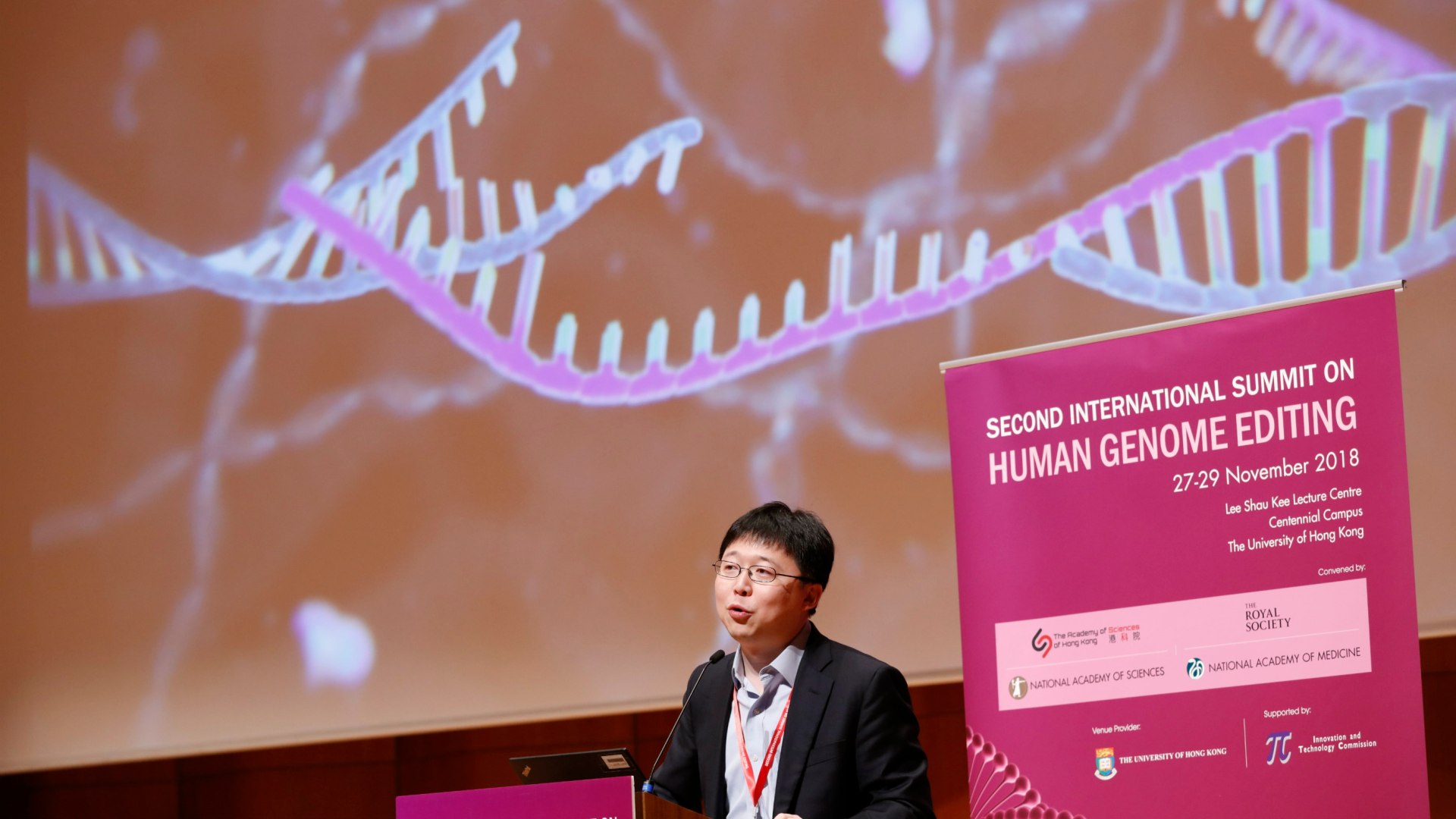
The team of researchers that developed CRISPR “scissors”—a tool to insert, replace, and remove particular segments of cell DNA—won the 2020 Nobel Prize in chemistry, and scientists are already discussing possible uses of gene editing in response to the COVID-19 pandemic.

The bioethical concerns around editing human DNA aren’t as familiar to everyday Christians as abortion and assisted suicide, medical ethicist Daniel J. Hurst told CT, but they are growing more urgent.

In 2018, a Chinese scientist performed experimental gene editing on a set of twins, altering their DNA to increase their resistance to HIV. Members of the scientific community condemned his methodology and urged researchers not to put “the technical cart before the ethical horse,” recounted Hurst, a Christian and the director of medical professionalism, ethics, and humanities at Rowan University.

Those with a special concern for upholding life and honoring God’s creation tend to approach this field of research with additional unease.


Francis Spufford's first book—The Chatto Book of Cabbages and Kings: Lists in Literature—was published in 1989, the year he turned 25. "Not surprisingly," Spufford wrote in the introductory essay, "the first response to a good list is often one of undifferentiated delight at the apparently universal reach displayed, at the pyrotechnical aspect of a device that can marshal so much so concentratedly." Much the same could be said of Spufford's subsequent career as a writer: each book a surprise, unpredicted by its predecessors, yet the whole hanging together, defying probability.

His latest book, Unapologetic: Why, Despite Everything, Christianity Can Still Make Surprising Emotional Sense, was published in the United Kingdom in 2012 and in the United States in the fall of 2013, earning a 2014 CT Book Award in the Apologetics/Evangelism category. On his U.S. book tour, Spufford visited the offices of CT for a conversation with Books & Culture editor John Wilson.

When CT editors first suggested this conversation, it was framed as a debate between American apologist William Lane Craig and you. I was happy to moderate, but my reaction was, "What are they going to debate about?" It seems to me that you and he are doing different things. There are people whose job it is to get up and debate Richard Dawkins and such; that's a good thing to do, and Craig does it superbly. They're bringing a certain toolkit that's different from your toolkit, but you're not saying to them that their brand of apologetics has passed its sell-by date. Was I right about that?

Yeah. I'm not here to say, "From now on, apologetics shall be conducted in this wishy-washy language of art." Had [Craig and I] had that conversation, we would have turned out to be more complementary than competitive. But we do have disagreements, some of which can be explained by the different settings in which we're situated. So, for instance, Craig's Reasonable Faith talks about reason offering a rational justification for the truth claims of religion. In my setting, I see reason as having an important but slightly different and smaller role. It's just not the case in Europe that large numbers of people are up to argue about the truth claims of religion.

What we need in Europe is to push back against the idea that religion is so farfetched that it's not worth talking about. For me, the job of dialectical reason is to cut up—lightly, suavely, and wittily—the claim that that the center point of probability in the discussion isn't even agnosticism anymore; that all sensible people have to be atheists; and that the burden of proof is entirely on religion, because it makes such freaky and bizarre claims that believers have all the credibility of the tooth-fairy mob.

I want the center of the argument pulled back toward agnosticism, so that it's possible to say that atheism and faith are both necessarily leaps into the dark. I'm not saying we're stuck with fideism—you just make your choice, and you know nothing. I'm saying knowledge can't take you all the way on either side. Which is why I would respect a deep, emotional conviction of the absence of God in an atheist, and why I would hope an atheist [would] respect my deep emotional conviction of the presence of God.

I don't really believe that the truth of Christianity can be demonstrated in public by logical tools. What can be done is for false claims about the improbability of Christianity to be pushed to one side, so that we have, once again, a clear space in which the conversation can happen.

In connection with the recent 50th anniversary of C. S. Lewis's death, I've also been thinking about a quote from his friend Austin Farrer, who was assessing Lewis's legacy. Here it is:


The day in which apologetic flourishes is the day of orthodoxy in discredit; an age full of people talked out of a faith in which they were reared. . . . Where the erosion of orthodoxy has gone beyond a certain point, other champions and different arms are called for. There can be no question of offering defenses to positions which are simply unoccupied; or justifying ideas of which the senses never dawned on the mind.


That is the contemporary European situation, where justification and defense are the wrong tools. What you need is a quiet, imaginative introduction of those things in the first place. You need to appeal to people's existing knowledge about their lives. You need to say, "This stuff, far from being the far-off stereotype of which you have only distantly heard, is actually a recognizable way of talking about the heart you already possess."

Yes. What you say makes me think of several writers—British, European—who are far indeed from being Christian but whose books, whatever their intentions, may open some readers to the possibility of faith. Let me give two examples. I don't know if they are people you've read or care about, but one of them is a crazy, brilliant guy named Charles Stross, who writes novels that are not reviewed in The New York Review of Books and alas probably never will be.

I'm a faithful reader of Charles Stross.

Wonderful! You're a kindred spirit. Then you'll remember the passages where Bob, the protagonist of the Laundry Files series, tells us he used to be an atheist, and he was lot more comfortable then.

He's being pitch-forked into a horrible Lovecrafty basement, full of demonic things with tentacles.

Exactly. As he puts it, if somebody had told him there was any such thing as magic, he would have thought, This person is just a fool. So his encounters with soul-sucking pretas function as a kind of reality therapy: he's forced to acknowledge these realities that weren't conceivable in his smug atheism. He refers ironically, in capital letters, to the One True Religion, which acknowledges the existence of these malign forces. They're coming to get us, but in the meantime we try to hold off their minions while we can.

Well, it's very funny, and of course he's also a genius of parody, but it's not just funny, because it's intended to puncture a complacency. Now along with this, he's scathing about Christian faith.

Oh, yeah.

But he's also scathing about the cultivated, European mindset; his view is that the world is actually much nastier than you think.

The second example is Roberto Calasso, an urbane Italian polymath, a publisher, and the author of many books. I've read almost all of them, and I'm still not sure exactly what he believes. He seems to be a really sophisticated Neo-Pagan. When he talks about the gods rustling around, he's provoking his complacent secular readers. At the same time, he abhors the crudity of Christians with their monotheism.

Stross, Calasso, and others we could name agree on one salient point: The world is different from what secular reason tells us. They're saying, "This notion of the world you have, that you assume is shared by all enlightened people, is wrong." Does that resonate with you?

Yes. It absolutely does. I mean, Stross is, with every conscious fiber of his being, a thoroughly enlightened, distinctly anti-Christian European writer, and for that matter sort of anti-Judaic writer as well (I think he's a completely secularized Jewish guy). As far as he's concerned, every moral commitment he has—to equal rights of various kinds, and issues to do with sexuality, and so on—makes it completely impossible that he could ever give the time of day to this barbarous Christian stuff, with its well-known one-book, anti-pluralistic biases.

Right!

But he is also omni-interested, and extremely clever, and constantly nibbling away at all directions, and so long as he can tell himself these things are just fascinatingly different mythological operating systems, he's very interested in burrowing into them. And as you say, he keeps coming back to this picture of the world in which you have your rational, enlightened surface with lots of other dangerous stuff going on underneath it.

Calasso I know less well, but the way he does mythology seems to me to be so suave and Italian. On the other hand, that, too, is operating from deep within the European psyche. It is feeling the pull back toward the pre-rational.

Yeah.

It makes me think of the joke about reality having a well-known liberal bias: one could also say that reality has a well-known theological bias. I think it's observably the case that our understanding of the world is just not exhausted by talking about our daylight enlightened systems, our best intentions, our codes of law and science, the things that in the bright light of noon we want to be true about ourselves. There's all the other stuff, too, and anyone who is paying attention keeps tripping over it. You get back onto theological ground no matter what your opinions are.

I think you're absolutely right. There are a couple passages in the Laundry Files where Bob talks about praying, and he says, "Of course I know it's ridiculous, but I do it anyway," and then he repeats the line I mentioned earlier: "I was much happier when I was an atheist, you know."

He also says at one point, "I believe in a God, I know he's coming, and I'll be waiting for him . . . ."

. . . with my shotgun."

In some respects, the way you describe things in Britain is not so different from the way it is over here, in what you might call elite culture.

I agree. You can find within the States places that are much more like secularized Europe. I do see that here, too, Christianity talks across a gulf when it is trying to reach where some people live. I think it's a differently constructed gulf from our European gulf, but perhaps gulf-hood is something that it's got in common there.
I have asked myself whom Unapologetic is for in America. Again, it's supposed to be primarily for those who don't believe, not those who are in a state of settled, happy hobbyist anti-theism, but those who are curious but have never really felt that thing over there called religion reaches out to where they live.

There's an irony in this, because in Britain I hear far more about [the book's] adventures among those who already believe, because they're the ones connected into the same network as me. I hear back from them, so I know it gets read in a way that has maybe helped refresh the faith of people who are already committed.

I know it works as a discussion book among those who are already committed, but I only get a few little twinkling data points from out there in the void that tell me what it's doing among people who aren't Christians.

One of the things that's so interesting about books is the way they take on a life of their own. I loved your memoir The Child That Books Built. In one passage, you talk about being in a bookstore, dazzled by the manyness of it: that there are all these ways of seeing the world just on one shelf. That resonated a lot with me. There are readers out there who, right now, are not interested in Christianity, who someday will be in a place where there are books, and it will be precisely the otherness of your book that will attract them to it.

Which is one of the powers that books have; the way that they solidify viewpoints other than our own, emotional and mental traveling into the far unknown and the near unknown, both in fiction and in nonfiction. There is a connection between The Child That Books Built and Unapologetic. I tend to be interested in things in practice, and there is surprisingly little written about the experience of reading when it is the stuff of most bookish people's lives. We fast-forward through the discussion of what reading itself is like, and just treat it as this transparent portal that opens out in the book, and then we just talk about the book. The shared experience, which is the reading, goes unsaid. In the same way with Unapologetic, it was a bridge of experience I wanted to construct. I'm interested in the way faith is experienced in life. The way it lives in daily experience, and metamorphoses there, and manifests itself in forms that are not always polite or tidy, but that are nevertheless the stuff of real commitment.

It seemed like the most natural thing in the world to try and talk about the experience of belief rather than belief itself. Again, not fast-forwarding through how we feel it and where we feel it, straight to the thing felt, but to try and talk seriously about where it lives in a life, and on what terms. Which is also, I hope, where you get common ground with people whose lives are very different.

That attentiveness to "the experience of belief" comes through very strongly.

As I said, it seemed like the most natural thing to do, but it is quite difficult as well. It requires you to give a textured internal accounting of something that is as real as Wednesday, but is as hard to get at as the movements of the soul. Once you start doing it, you start noticing glimmers of it all over the place. Some of what I'm doing in the book is also just the very traditional Christian thing of finding contemporary ways of re-describing permanent things. There's a perennial problem with familiarity crusting things over.

You have to make it strange.

Yes. You have to take your scrubbing brush and take off the superficial coating of familiarity so you can see how strikingly strange it is.

You do that beautifully. I'm thinking especially of the chapter called "Hello, Cruel World." In the eyes of many people looking from the outside, Christianity is about complacency. You say, "No, it's about hope for a change that is so good it's almost unbelievable, and sometimes it is unbelievable to us, and yet that's where we put our trust."

Christianity is a religion of continuity and discontinuity as well. It's about what stays the same and what changes in the twinkling of an eye. Both are necessary truths, but sometimes it's important to accentuate the discontinuity, the sudden leap, the way you go up a tree, Zacchaeus, and come down a saint. Otherwise, the stereotype about complacency isn't being properly challenged. Christians are as subject to complacency as anybody else, and we can certainly settle into repetition and forget that something radical and extraordinary is being asked of us as well—that we hold to an extraordinary promise about how, from moment to moment, something enters the world and enters us, after which everything is different. I wanted to bring to the front the way in which it promises the break of grace rather the continuity of law. Both are true, but both do not get equal coverage in the minds of those who haven't really thought about it.

One word that crops up among younger evangelicals these days is radical. A true Christian life is radical. You've just said that very well. And yet—so it seems to me, at least—the way the rhetoric of "radical" plays out in everyday life often leads to distortions. It isn't true to the quotidian, so some spiritual double-bookkeeping ensues. "We are radical, we are radical." How long can we be radical? You read about the radicals in the 1960s and find out they couldn't be radical for a whole week.

For my money, the way you negotiate this tension is just right. We fail repeatedly, yet at the same time you don't neglect the hope we share, the mending promised in Acts 3:21, that is absolutely essential. But you can't talk about it all the time. That's just like saying we are going to be radical all the time.

If we ask to be radical all the time, it often seems to be not just rushing past the quotidian, but rushing past our own distinctly pitied and cracked nature. We don't get to be weightless like that because we are, most of the time, in need of a much more humble and ordinary repair job.

That's beautiful.

In the chapter where I have to produce a kind of one-chapter New Testament for people who've never come across it, the reason why I have Yeshua, my de-familiarized Christ, saying, "Far more can be mended than you know," which I think is actually true to the New Testament, is that I want mending. Not flying free, not transformation, but humble, ordinary, everyday, get-you-back-on-your-feet mending, to be at the center of the Christian story.

When the book was being translated into Dutch, the translator sent me an email: "This word mend, I've looked it up in the dictionary, and it seems to be the same word you use for repairing bicycles. You must mean something else."

I wrote back, "No. No. No. I want the bicycle-repair word." What I absolutely want is to suggest that before it's anything else, redemption is God mending the bicycle of our souls; God bringing out the puncture repair kit, re-inflating the tires, taking off the rust, making us roadworthy once more. Not so that we can take flight into ecstasy, but so that we can do the next needful mile of our lives.

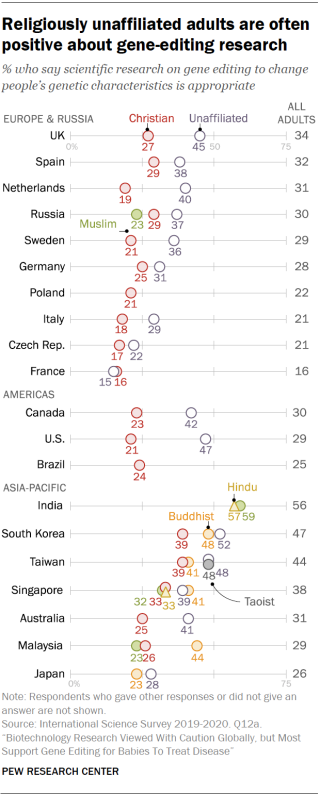
Christians in the US are half as likely as the religiously unaffiliated to believe scientific research on gene editing is an appropriate use of technology (21% vs. 47%), the widest gap among the countries surveyed.

Believers in Canada, the UK, the Netherlands, Sweden, Italy, and Spain also lagged behind the unaffiliated, though both demographics disapproved of gene-editing research.

In France, where approval levels were lowest, Christians and the unaffiliated felt about the same (16% vs. 15% said it was appropriate).

Few people, regardless of faith, considered it appropriate to alter genetic makeup to make a baby more intelligent; overall, 82 percent disapproved.

But many believe scientists should work on gene editing to prevent or cure diseases, even if that means using “germline editing” techniques that alter the DNA in a human germ cell (an egg or sperm) or an embryo.

“Most gene editing researchers see the creation and destruction of embryos as an intrinsic necessity … and many Christians will find this unethical—the end point here being neither healing nor enhancement of the embryo involved,” wrote Stammers.

In the UK, the Christian Medical Fellowship spoke out against a decision by the Human Fertilisation and Embryology Authority decision to allow genome modification of human embryos fertilized through in vitro fertilization.

But some Christians also see a case for CRISPR technology as a tool for healing.

In a US survey CT covered in 2018, Pew found that 61 percent of both white evangelicals and black Protestants said gene editing to help cure a disease at birth was an appropriate use of medical technology, while fewer were comfortable with the idea of using gene editing to reduce disease over a lifetime. Around half of black Protestants and 45 percent of white evangelicals approved of using it for future conditions.

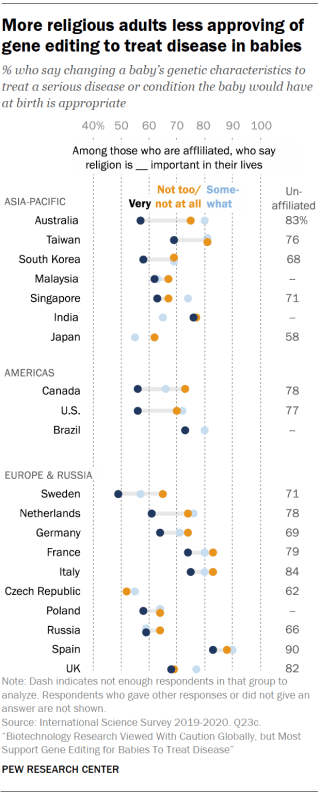
In the 2020 report, a median of 70 percent of people across the 20 countries said they approved of gene editing to treat congenital conditions that babies would be born with, and 60 percent approved of using it to reduce the risk of a disease that could develop later.

Majorities of believers who considered religion very important to them approved of gene editing to treat disease at birth, though people who said religion was less important were even more in favor of the treatments.

“What I think is still missing is solid theological reasoning, within the Christian community, about CRISPR. Why exactly does the doctrine of the imago Dei mean that we should be wary about germline editing?” said Nathan Barczi, executive director of The Octect Collaborative and associate pastor of Christ the King Church in Cambridge, Massachusetts.

“If CRISPR could be practiced and developed without the destruction of human embryos, would that make it okay? Does our concern for the sanctity of human life apply to the unborn (as it should!) only, or does it extend more broadly to that, to how we think about what it means for ourselves and our fellow humans—with all of our limitations, constraints, and differences—to be fully human, bearing God’s image?” said Barczi, who previously wrote about gene editing for CT. “I think there’s lots of work left to be done there.”

Jason Thacker, chair of research in technology ethics at the Ethics & Religious Liberty Commission of the Southern Baptist Convention, agrees. He sees Christian formation around the sanctity of life and the call to love God and neighbor as the basis of the church’s response to potential issues in biotechnology.

“The church needs more people steeped in these truths and speaking clearly to the pressing ethical issues surrounding all forms of technology,” he said. “It will take a concerted effort from all of us to raise awareness about the life-altering issues at stake in these debates.”

Age is consistently a factor in how people approach gene editing. Younger people across the countries surveyed were more open to the technology than older populations.

Pew also found that, in most countries, between a third and half of Christians say their religious beliefs conflict with science.

The perceived disparity between faith and science was highest in parts of Asia, with 64 percent of Christians in South Korea and 58 percent of Christians in Singapore reporting some conflict. It was lowest in Sweden, where just 15 percent of Christians saw conflict.

News

Logos Enlists Black Church Leaders to Diversify Bible Study Resources

The collective will bring more African American scholarship to 4.5 million users.

Christianity Today December 10, 2020
Courtesy of Chauncey Allmond

Chauncey Allmond dreams of a day when white evangelical preachers will reference the work of African American Bible scholars without even thinking about it. He and his colleagues at Logos Bible Software hope they can make that happen by adding more African American voices to the digital study tools currently used by more than 4.5 million people.

“The African American voice is a powerful voice that needs to be heard,” Allmond said. “There’s a lot of traditions in the African American church that I think Logos is missing out on.”

Logos has been working for about a year to diversify its Bible study products and has gathered a group of African American Christian leaders to help. They call the group the Kerusso Collective. Kerusso is a Greek verb meaning “proclaim” or “herald” and is used in the New Testament to describe the act of preaching the gospel.

In addition to Allmond, the collective includes:

  • Charlie Dates, pastor of Progressive Baptist Church in Chicago
  • Cynthia L. Hale, pastor of Ray of Hope Christian Church in Decatur, Georgia
  • Esau McCaulley, assistant professor of New Testament at Wheaton College
  • Kenneth C. Ulmer, pastor of Faithful Central Bible Church in Inglewood, California
  • Joseph W. Walker III, bishop of Mt. Zion Baptist Church in Nashville
  • Ralph Douglas West, pastor of Church Without Walls in Houston

The group will advise Logos on resources and scholarship to include. Logos may have bundles of specific African American resources available early in 2021. The goal is not to produce separate Bible study products, however, but to improve existing material by adding the perspectives of black Christians.

“We don’t think it’s going to be primarily for the African American audience. We’re looking at it also to serve the white evangelical church because there’s a need there,” Allmond said. “The multiethnic churches are growing leaps and bounds, and for them to have product and resource offerings that will help them serve their community, I think, is a win-win for everyone.”

The announcement comes as part of a broader movement of American evangelicals listening to black voices and valuing the contributions of African American Christians. Last year, for example, Holman Bible Publishing released the Tony Evans Study Bible, the first single-author study Bible by an African American. The volume highlights black people in the Bible and offers the Dallas pastor’s own perspective on the text.

This year, InterVarsity Press published Reading While Black by McCaulley. The book argues for the importance of African American perspectives on Scripture, showing how the black church tradition illuminates aspects of the Bible that white American readers have too-often missed.

Damon Richardson, who is also a presenter with Logos Bible Software, said the Kerusso Collective will take that same approach, using African American perspectives to show aspects of the truth of the Scripture that haven’t been visible from other vantage points. It’s not that different, he said, from hearing how a professional shepherd might read Psalm 23 differently than someone who has never seen sheep.

“The light hits that diamond in a different way,” Richardson said. “You get a different cut and a different glimmer.”

The Logos effort to diversify the Bible software began before the recent national conversation on racism, based on feedback from African American presenters like Richardson and Allmond and the responses when they demonstrated Logos resources to diverse groups of Christians across the country. African Americans in particular—who are more than twice as likely as Americans overall to read the Bible daily, according to surveys from the American Bible Society—noticed a distinct absence of black Christian voices in the available materials.

“What we started to realize internally, as well as the feedback we had been hearing from our customers and potential customers, was that there was a need to have more African American scholars and theologians included in our library,” Allmond said.

Since the company, based in Washington state, is predominantly white, it established the Kerusso Collective so black Christian leaders could direct the inclusion of more voices of people of color. While the COVID-19 pandemic has hindered their ability to meet as early as they would have liked, the project is still moving forward.

Richardson, who was raised in the Nation of Islam before converting to Christianity, said the diverse perspective reflects an important truth of Christianity. Where the Nation of Islam and others have argued that Christianity is “a white man’s religion,” designed to oppress black people, in truth the church includes people from every ethnicity. The gospel does not belong to a race. Black people have made serious contributions to the church and to Christians’ understanding of the Bible. The new effort to diversify the scholarship will reflect that and present a fuller and truer picture of the Christian understanding of Scripture.

“I think it’s good for people to see the African American contribution in these areas,” Richardson said. “It’s good for the church.”

Books
Review

The Triumph of the Sexual Revolution Seems Stunningly Swift. But Its Roots Go Back Centuries.

Carl Trueman maps out the revolutionary shifts that made it possible, then plausible, then actual.

Christianity Today December 10, 2020
Illustration by Mallory Rentsch / Source Images: WikiMedia Commons / Gabriel Silvério / Brooke Cagle / Unsplash

I’m a woman trapped in a man’s body.” Only a generation ago, few Americans would have regarded this statement as coherent and believable. Yet today, someone who comes out as transgender can earn cultural cachet, while those who question the new orthodoxy are increasingly branded as bigots or worse. This shift in cultural attitudes is only the latest triumph of the sexual revolution that has radically reshaped sexual categories and behaviors over the past several decades in America. Yet the roots of this revolution go back much further.

The Rise and Triumph of the Modern Self: Cultural Amnesia, Expressive Individualism, and the Road to Sexual Revolution

When determining why revolutions happen, social scientists often distinguish between three types of causes: preconditions, precipitants, and triggers. Preconditions are the long-term structural factors that make revolution possible. Precipitants are the short-term events that combine with these structures to make revolution plausible. Finally, triggers are the immediate catalysts—the sparks that ignite and make revolution actual.

The sexual revolution and its triumphs result from a similar mix of immediate, short-term, and long-term causes. Yet cultural commentators tend to focus only on triggers, acting like police officers or insurance adjusters who arrive at the scene of an accident to determine the extent of the damage or who’s at fault. These roles are important, but they only scratch the surface of how the church should respond to the sexual revolution.

A more holistic response requires a more holistic understanding that can only be achieved by sorting out the long-term structural causes of the revolution from its short-term and immediate causes. This sorting is precisely what theologian and historian Carl Trueman aims to do in his latest book, The Rise and Triumph of the Modern Self: Cultural Amnesia, Expressive Individualism, and the Road to Sexual Revolution.

Trueman’s basic contention is this: The sexual revolution is a symptom rather than the cause of efforts to redefine human identity. Centuries before the nation swooned when Bruce Jenner debuted as Caitlyn, for example, intellectual shifts were taking place that would make a cultural event like this possible. What Trueman offers is the story of those shifts.

Reimagined Selves

Trueman begins by diagnosing the state of modern Western culture so that, throughout the rest of the book, he can trace some of its intellectual preconditions. Here, he relies heavily on the work of three key thinkers: philosopher Charles Taylor, psychologist Philip Rieff, and ethicist Alasdair MacIntyre.

Of particular importance to Trueman’s narrative is the idea of the “social imaginary,” the term that Taylor uses to describe a society’s basic intuitions about the world and the place of human beings within it. As each of us goes through life, we tend not to operate on the basis of a self-conscious commitment to a particular set of ideas. Instead, the process is much more intuitive. For example, only a generation ago, the claim “I’m a woman trapped in a man’s body” was widely understood to be nonsensical. This understanding owed less to a deep theoretical knowledge of gender and sex than it did to the widespread intuition that the world has an established order and meaning to which we must conform.

Today, the social imaginary has been radically reimagined. People tend to see the world and themselves more as raw material that they can bend and shape to suit their own purposes. This reimagining wasn’t the result of learning new truths about the physical world but of subjugating the physical to the psychological. The modern idea of self has become thoroughly psychologized: One’s identity is defined not by a relationship with the external world but by an individual, internal sense of happiness. On this basis, the modern person operates according to what Taylor calls “expressive individualism,” desiring both to express an internal sense of self and to have that sense of self recognized and accepted by the external world.

Drawing from MacIntyre’s work, Trueman explains that expressive individualism has become the default mode of modern society. Because we lack a common framework for understanding who we are and why we exist, our moral discourse has degenerated into expressions of personal feelings and tastes. In order to satisfy our moral preferences, we feel we must be liberated from the repressive constraints of objective moral claims. Such liberation requires a full-scale campaign of cultural iconoclasm, of dismantling and disavowing the ideas and artifacts of the past so that we might pursue happiness on our own—thoroughly psychological and distinctly sexual—terms.

Revolutionary Shifts

After diagnosing the state of modern Western culture, Trueman spends the bulk of the book showing that our reimagined sense of self is rooted in intellectual shifts that had been taking place for several centuries.

The first shift was the psychologizing of the self—in other words, making one’s feelings and desires foundational to one’s identity. Trueman highlights the work of the 18th-century Genevan philosopher Jean-Jacques Rousseau, who laid the groundwork for this shift by arguing that we can only live authentically when our outward behavior can match our inner psychology. In a revolutionary step, Rousseau gives ethical priority to one’s psychology, claiming that society is the enemy of the authentic self because it forces people to suppress their desires and conform to conventional morality.

At the turn of the 19th century, Rousseau’s heirs within the Romantic movement—particularly the poets William Wordsworth, Percy Bysshe Shelley, and William Blake—were instrumental in popularizing this psychological view of the self. Yet for all their calls to cast off the repressive influences of civilized society, these Romantics—like Rousseau—were confident that nature possessed a purposeful order upon which humans could build their lives. By the end of the 19th century, such confidence was greatly undermined by the work of Friedrich Nietzsche, Karl Marx, and Charles Darwin. To Nietzsche and Marx, belief in transcendent reality and purposeful order are symptoms of psychological weakness and social sickness. Then, Darwin’s writings on evolution dealt the death blow by providing a new story of humankind that reduces human nature to something fluid and directionless.

With the belief that personal identity is psychological and self-determined, the stage was set for a second intellectual shift: the sexualizing of psychology. It was Sigmund Freud, the father of modern psychology, who in the early 20th century championed the insidious idea that’s intoxicated modern society: Self-identity is grounded in sexual desire. We’re essentially psychological, says Rousseau. Yet our psychology is essentially sexual, says Freud. Therefore, we’re essentially sexual. With Freud, sex is transformed from something we do into who we are.

After this transformation, it was only a matter of time before a third intellectual shift occurred: the politicizing of sex. Two Freudian acolytes, psychoanalyst Wilhelm Reich and philosopher Herbert Marcuse, drove this shift by merging Marxist ideas of political oppression with the Freudian notion of sexual repression. They argued that, because humans are essentially sexual, there can be no political liberation without sexual liberation.

In response, from the mid-20th century to the present day, a bevy of writers and activists from the New Left have aimed for sexual liberation by attacking the most problematic of all bourgeois institutions: the nuclear family. As long as the nuclear family is considered good and necessary to the right ordering of society, allegedly repressive norms such as heterosexuality and monogamy will perpetuate an oppressive social hierarchy that rewards sexual conformity and punishes those who wish to follow their own sexual codes. On this understanding, political liberation depends on sexual liberation—which depends on the dismantling of the nuclear family.

Though not everyone reaches the same conclusions, the underlying association of political liberation with sexual liberation is widely assumed today. Even if they’ve never read the writings of Freud, Reich, Marcuse, and the New Left, many people intuitively believe that open and unqualified expression of sexual desire is essential to human identity and dignity.

It’s this revolutionary belief that has transformed our “social imaginary” and led to a swift and stunning series of triumphs for the sexual revolution. Trueman devotes several chapters to detailing three triumphs in particular: the pervasiveness of eroticism in art and pop culture, the prioritization of psychological well-being in academic settings and legal or ethical arguments, and the widespread embrace of transgender identity.

Yet, as Trueman reiterates throughout his book, the triumphs of the sexual revolution are not as swift and stunning as they appear. Instead, they’re the latest logical outcomes of a society that has accepted expressive individualism as its basic premise. The road to sexual revolution was long and marked by a series of intellectual turns that were hardly inevitable. But once chosen, they led Western culture to where it is today.

Road to Renewal

As a preeminent church historian, Trueman is well-versed at telling the stories of intellectual turns and tracing their cultural consequences. Yet here Trueman’s aim is more modest: Rather than showing precisely how the ideas that undergird the sexual revolution have come to permeate our culture (for this would take many volumes), he intends only to show that these ideas aren’t new but have been preconditioned by several centuries of intellectual shifts. In this aim, he succeeds marvelously.

Yet certain segments of the book would have benefitted from some attention to causation. I’ll give just one example: By moving from Rousseau (chapter 3) to Wordsworth (chapter 4) in his narrative, Trueman implies a causal relationship that’s hardly clear. Though Wordsworth emphasizes the internal life of the poet, in his preface to the Lyrical Ballads he reins in any excess expressivism by describing the true poet as one “who being possessed of more than usual organic sensibility, had also thought long and deeply.” Also, Wordsworth’s reasons for using everyday language echo the literary choices of earlier poets like Dante, who in De Vulgari Eloquentia insists that vernacular is “natural” and “more noble” than the “artificial” language of educated elites. Further, Wordsworth's distinction between poetry and history stands in the tradition of Aristotle and the poet Sir Philip Sidney.

So, it could be that Wordsworth owes more to Rousseau than to these earlier poets, but the lack of a clear causal connection blunts Trueman’s dramatic claim that “Wordsworth stands near the head of a path that leads to Hugh Hefner and Kim Kardashian.” A similar lack of causal explanation blunts the force of other conclusions that Trueman makes throughout the book.

Yet this critique should take nothing away from the fact that The Rise and Triumph of the Modern Self is a signal achievement of cultural analysis. Readers wishing to understand the cultural convulsions and social upheavals taking place in the West will find this an indispensable book. It’s a masterclass on the fact that, while all ideas have consequences, some ideas are more consequential than others. Trueman shows that the consequences arising from ideas about human nature and identity can be especially revolutionary.

This fact should help guide the church’s response to the sexual revolution. Just as the revolution was made possible by certain preconditioned ideas about human nature and identity, any successful counter-revolution must arise from preconditions of its own. The church must lead the way by articulating and modeling a vision of true human identity and community. And we must do this with the knowledge that we’re unlikely to see any significant change in our own day. The road to sexual revolution was long, and so too will be the road to renewal. But it’s the only faithful road, and so it’s the one we must take.

Timothy Kleiser is a teacher and writer from Louisville, Kentucky. His writing has appeared in National Review, The American Conservative, Modern Age, The Boston Globe, Front Porch Republic, and elsewhere.

Culture

Christmas Albums 2020: What’s on Our Playlist

From Tori Kelly to Maverick City Music, here are our favorite new releases by Christian artists.

Christianity Today December 10, 2020

In an especially disorienting year, we ache for the familiarity of gathering together as Christmas approaches. Luckily, music has a way of stirring up memories and encouraging us toward a future hope, and this year, there seems to be something for everyone.

These eight albums—from better-known Christian artists and some fresh finds—provide the inhale and exhale of Advent, reminding us to both celebrate and hold our breath in anticipation of the coming Christ. You can check out our Spotify playlist to listen to all of the recommendations.

A Tori Kelly Christmas by Tori Kelly

If you’re wishing that Sister Act had been a Christmas movie, look no further than A Tori Kelly Christmas. Known for her impossibly perfect vocal riffs, she puts a spin on Christmas classics that brings in R&B tempos, throwback beats and, of course, a choir of backup singers. It’s not only hype, though. Her rendition of “O Holy Night” is as vocally powerful as it is timeless. If you need some pep in your step, throw on “Joy to The World/Joyful Joyful” and crank up the volume. This album is ideal for getting tasks done or for a boost of energy as the days become shorter.

A Jolly Irish Christmas (Vol. 2) by Rend Collective

In their second release of the year, Rend Collective’s A Jolly Irish Christmas (Vol. 2) complements their 2014 Christmas offering. The 12-track album encompasses everything from classics like “The First Noel,” to an upbeat cover of the Irish carol “Christmas in Killarney.” The Northern Ireland rock band’s folky “Silent Night (Be Still)” adds a chorus that especially resonates in 2020: “Be still my heart / Be still my mind / May I still see the magic of that silent night / Fill me with wonder / Keep mystery alive / May peace on earth be my song tonight.”

A Drummer Boy Christmas by For King & Country

In A Drummer Boy Christmas, For King & Country proclaims Christ’s arrival bookended by a prologue and epilogue versions of “In the Bleak Midwinter,” even bringing Needtobreathe to join them in “O Come O Come Emmanuel.” Pop harmonies and electrifying bridges make their Christmas covers stand out. The album’s inspiration came from the Christian duo’s performance of “Little Drummer Boy” at the Country Music Association’s “CMA Country Christmas.” Lucky for us, it’s the perfect soundtrack to brighten our dark winter.

Maverick City Christmas by Maverick City Music

Maverick City Music marries gospel style to CCM form to create music that leads the soul to worship. Especially as so many of us miss meeting in person, the voices on this album move the listener to sing along in a way that only church worship can. The group takes classic Christmas hymns and adds new choruses or lets the Spirit move as it extends them into a worship experience, as demonstrated in the “Joyful Joyful We Adore Thee / Angels We Have Heard on High” medley.

Christmas (Deluxe) by Sandra McCracken

It’s no secret that Sandra McCracken is the singer-songwriter who brings undeniably Bible-centered lyrics to her enchanting falsetto. Though the original album released in 2019, McCracken released a deluxe edition of Christmas this year. She tells stories that make the listener feel at home: “We bless the seeds under the snow / We bless the patience, take it slow / We bless the limits, bless the tears / We bless the failures that brought us here”? This album is best accompanied by fresh snow, a crackling fire, or a cup of tea to unwind.

Advent, Pt. One by Sarah Sparks

Sarah Sparks has been writing music for years with soul and thoughtful, original lyrics. Her latest creation, “Advent, Part One,” is an eight-song collection that brings a balm to her listeners’ hearts and new life to old favorites. I especially loved her original “400 Years,” which says: “And in 400 years / not one word was spoken / and the prophets were silent / leaving us in the darkness / But then what should appear? / Do we hear a new sound in this silent night? / For the first time / not a silent night.” It’s a perfect album to spruce up the winter midday mundane.

A Seed, A Sunrise by Caroline Cobb

Caroline Cobb is less known but equally worthwhile. Her album “A Seed, A Sunrise” is an intentional voyage from Advent to Christmas, leading us from anticipation to full celebration. It’s the kind of album that moves you slowly to where you need to be when you feel stuck during this strange time. Songs like “Comfort, Comfort” remind us that Christ brings us much-needed salvation from what burdens us.

Christmas: Acoustic Sessions by Phil Wickham

Always a calming presence in music, Phil Wickham has given us a real gift in his acoustic album Christmas: Acoustic Sessions. We’re busy much of this month, trying to tie up loose ends and send Christmas cards and gifts, and this album beckons us to set things down and rest. If you need a slowdown, Phil is your ally. With his signature buildups and heart-lightening voice, this album gives us an extra dose of hope this season.

Listen to our playlist below to get in the Christmas spirit with CT’s holiday mix.

Melissa Zaldivar is an author, a Bible teacher, and the podcast host of Cheer Her On. She lives near Boston.

addApple PodcastsDown ArrowDown ArrowDown Arrowarrow_left_altLeft ArrowLeft ArrowRight ArrowRight ArrowRight Arrowarrow_up_altUp ArrowUp ArrowAvailable at Amazoncaret-downCloseCloseellipseEmailEmailExpandExpandExternalExternalFacebookfacebook-squarefolderGiftGiftGooglegoogleGoogle KeephamburgerInstagraminstagram-squareLinkLinklinkedin-squareListenListenListenChristianity TodayCT Creative Studio Logologo_orgMegaphoneMenuMenupausePinterestPlayPlayPocketPodcastprintremoveRSSRSSSaveSavesaveSearchSearchsearchSpotifyStitcherTelegramTable of ContentsTable of Contentstwitter-squareWhatsAppXYouTubeYouTube