News
Wire Story

Christopher Heuertz’s Enneagram Projects Halted Over Abuse Allegations

Zondervan will no longer promote the best-selling author’s books or release an upcoming documentary.

Christianity Today June 16, 2020
ATZ / iStock / Getty

Zondervan, the Christian media and publishing company, is suspending promotion of two books and indefinitely halting a documentary by popular Enneagram teacher and best-selling author Christopher Heuertz after allegations by nearly three dozen people who saw or experienced “spiritual and psychological abuse” by him.

A spokesman for Zondervan said a foreword and endorsement written by popular social scientist Brené Brown would be removed from Heuertz’s latest book, The Enneagram of Belonging: A Compassionate Journey of Self-Acceptance.

The decision by Zondervan follows a public post on the platform Medium signed by 33 women and men who wrote that Heuertz “has harmed many people and we cannot remain silent anymore.” Many others have since corroborated the accusations and added their stories.

The June 10 post described a pattern of spiritual and psychological abuse by Heuertz, a liberal Christian active in social justice causes as well as the contemplative tradition borrowed from Catholicism. He is an expert on the Enneagram, a model of the human psyche based on nine personality types that has exploded in popularity in certain Christian circles.

Heuertz apologized publicly on his webpage, saying, “I failed to maintain suitable boundaries in some of my friendships with women.”

“We are suspending any promotion of The Sacred Enneagram and The Enneagram of Belonging as we sort through information that is presented. We have also placed NINE: The Enneagram Documentary release on hold indefinitely,” a Zondervan spokesperson said.

The board of Heuertz’s Omaha, Nebraska-based organization, Gravity, said it would hire a firm to investigate the allegations. It also announced that Heuertz and his wife, Phileena, who co-direct the center, would take a voluntary sabbatical until the investigation is completed.

George Mekhail, who chairs the board of directors at Gravity, a spiritual retreat center, said there was an anonymous claim made against Heuertz a few years after he started Gravity. But the veracity of the claim could not be verified and the accusation fell outside of his work with Gravity.

The investigation the Gravity board is now launching will examine all those claims.

“We’re taking this very seriously,” said Mekhail. “We want to get to the bottom of what’s going on. What exactly are the nature of the claims so we can take action as needed.”

Accusations of sexual harassment against Heuertz are not new. In 2012, he was asked to step down from Word Made Flesh, an international organization he founded in 1991 to combat poverty and human trafficking around the world. His dismissal came after several women of color he had mentored complained about his sexually predatory behavior.

A statement from Word Made Flesh posted recently said it condemns the abuse that occurred and supports the women in their efforts to bring accountability and transparency.

It was not clear if there were new allegations of sexual harassment by Heuertz or if the allegations in the public post authored by Daphne Eck, a communications consultant from Castle Rock, Washington, date to his time at Word Made Flesh. Eck was unavailable for comment Tuesday.

The Center for Action and Contemplation, founded by popular writer Richard Rohr, a Franciscan friar, has also said it would “pause” all collaboration with Heuertz.

In his apology, Heuertz wrote: “Although I have taken steps over the years to make amends, I have been unable to sufficiently express my sorrow. I want you to know that I have learned from these experiences.”
News

Most US Pastors Speak Out in Response to George Floyd’s Death

Survey finds many still worry discussing race is “too political.”

Christianity Today June 16, 2020
Melissa Sue Gerrits/Getty Images

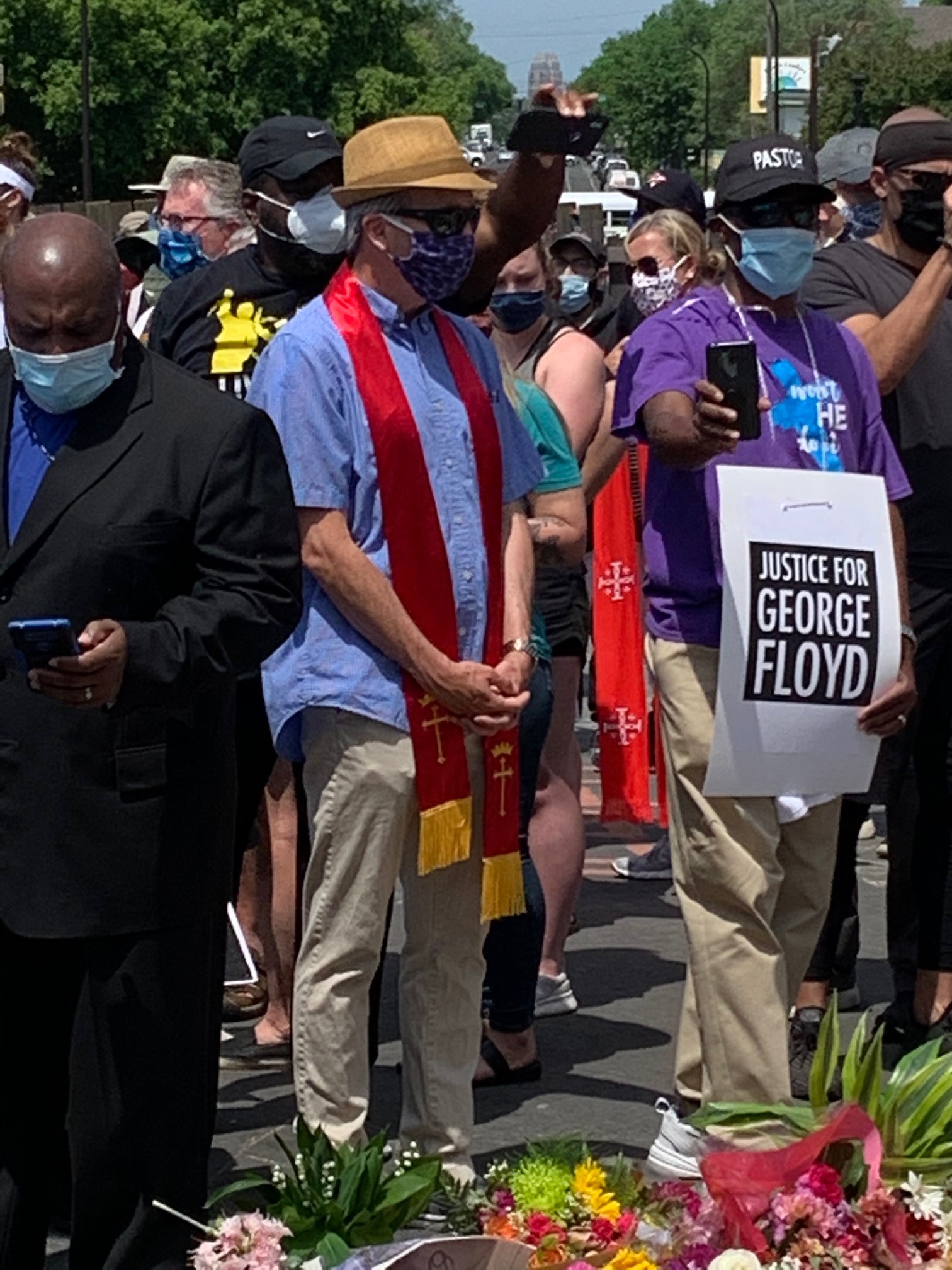
As protests continue across America, Christians may be shifting their views of the church’s role in addressing racism, becoming more outspoken and involved in the current movement for racial justice.

Nearly all US pastors (94%) agree that “the church has a responsibility to denounce racism,” and most (62%) say their church has made a statement on the unrest stemming from the May 25 death of George Floyd, according to a Barna Church Pulse Poll released today.

The poll, conducted over the past week, also found that 76 percent of pastors say the church should support peaceful protests occurring in response to Floyd’s killing.

More research is needed to be sure Christians’ attitude toward racism is changing, said David Kinnaman, president of the Barna Group. “But there are a couple of indications that pastors are as open as they’ve ever been” to addressing racial discrimination.

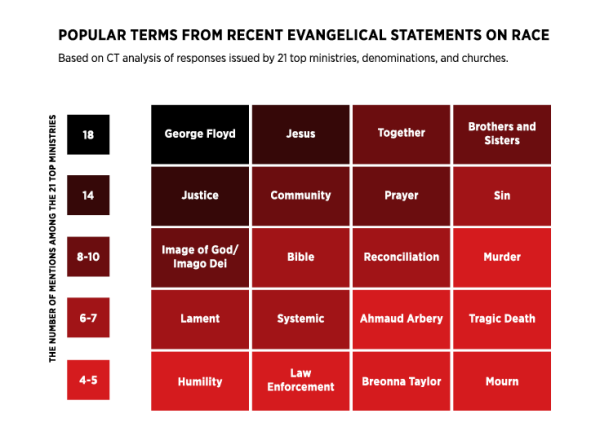
Nearly two-thirds of pastors say they have spoken out to address the moment, and about the same “strongly agree” that it’s important for church leadership to publicly show support for people of color. Many churches, denominations, and ministries released statements on Floyd’s death, along with resources on racial reconciliation.In a sample of the statements from some of the biggest evangelical organizations—groups like the Assemblies of God, InterVarsity Christian Fellowship, and several of the largest megachurches in the country—most appealed to Christian teachings on justice, the imago Dei, and lament.

Many pastors also took the opportunity to preach on race. A Pew Research Center survey conducted earlier this year showing that white evangelicals were far less likely than black Protestants (39% vs. 62%) to believe churches should “offer sermons that address political topics” like “race relations.” (Esau McCaulley, a Wheaton College professor and black Anglican priest, previously urged pastors in both majority white and majority black and brown churches to clearly address racism from the pulpit in an article for CT Pastors.)

According to Barna data published last year, 42 percent of white Christians said they believe America’s history of slavery and racism continues to impact African Americans, and about 1 in 5 pastors (19%) across all ethnic groups said there’s nothing the church should do to respond to America’s history of racism.

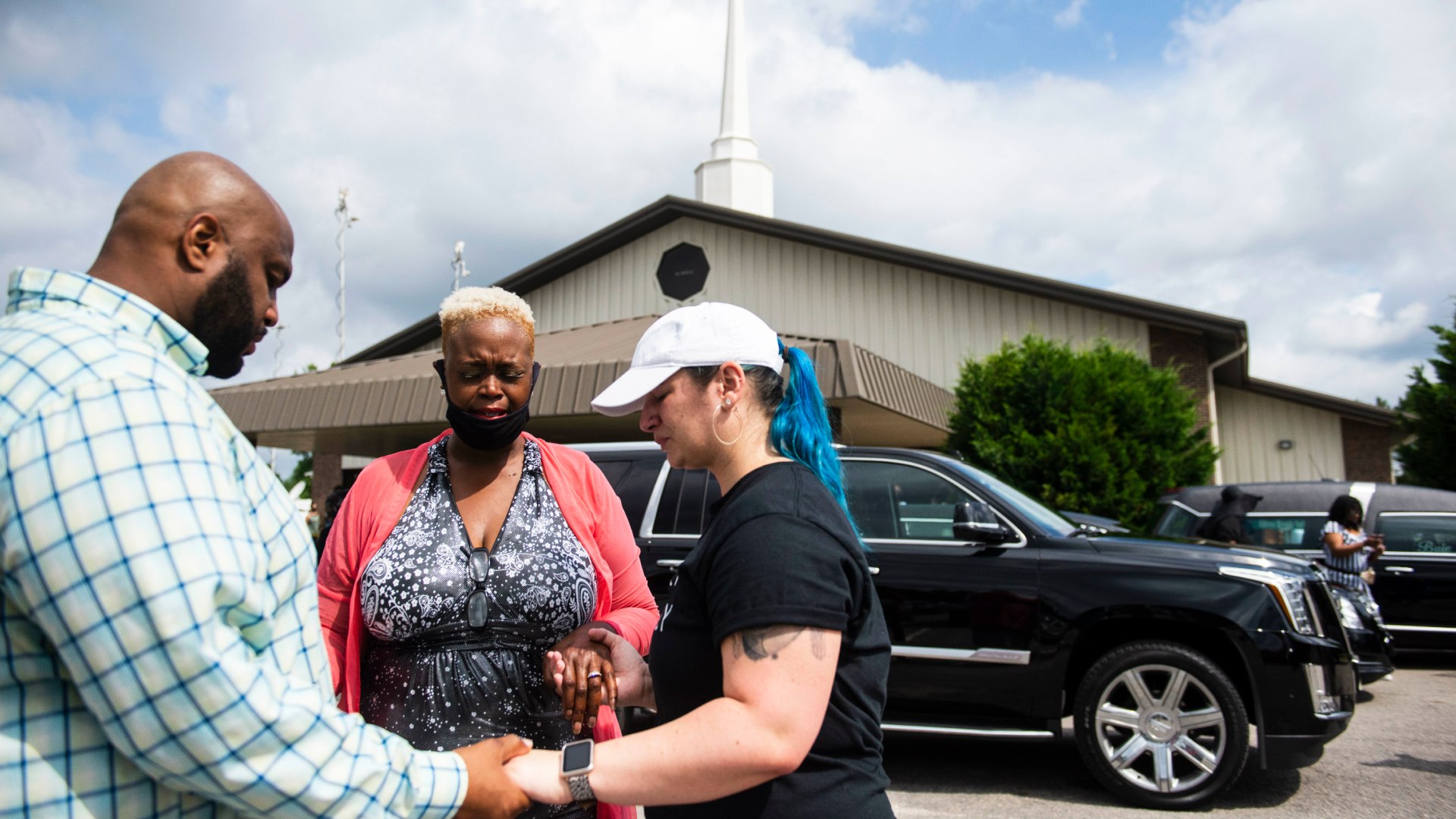
Yet, in recent weeks, cities across the nation have witnessed large public gatherings of Christians. In Chattanooga, Tennessee, for instance, an interracial prayer service was scheduled for June 16. Thousands gathered for prayer near the White House on Sunday.

In Birmingham, Alabama, the predominately black Greater St. John Baptist Church has intensified its friendship with Dawson Memorial Baptist Church, a predominately white congregation. Some 150 members of the two churches gathered June 15 to discuss privilege, poverty, and the intersection of race and religion.

Following three recent killings of African Americans by civilians and police (Floyd, Ahmaud Arbery in Georgia, and Breonna Taylor in Kentucky), “both churches saw a need for discussion to take place,” Greater St. John pastor Nathaniel Brooks said. “It was a domino effect.”

Around a third of the 400 pastors surveyed continue to believe the church should not be involved in movements aimed at political change, according to this week’s Barna poll.

A majority (61%) also said that the current conversations about race are “too political.”

“In this moment,” Kinnaman said, “church leaders are going to have to lead with humility and with being connected to the thoughts and perceptions” of others.

David Roach is a writer in Nashville.

Why This Is the Christian Side Hug’s Moment

Will our disgust for germs get the best of us? A psychologist weighs the risks and benefits of human touch in a pandemic.

Christianity Today June 16, 2020
Ocamproductions / Lightstock

Imagine you are offered a fresh glass of orange juice, but just before you are handed it, an experimenter drops a roach in the juice, stirs it around, removes the roach, and hands you the glass. Would you drink it? Of course you wouldn’t. But now imagine the experimenter takes that same glass of juice, runs it through a filter used to clean tap water, boils and sterilizes the juice, and filters it again. Will you now drink the juice? If you are like most people who were a part of this experiment, you wouldn’t. You intellectually know the juice is “clean,” but for some visceral reason you can’t get yourself to drink it. This instinctual reaction is what psychologists define as disgust, and this response is referred to as contamination psychology. When it comes to disgust, our reason and our contamination psychology can be at odds with one another.

Now imagine that the issue isn’t one of juice and roaches, but of an unseen virus and contact with those that may or may not be carrying the virus. What if this virus is possibly deadly? Would you be willing to come into contact with these people, shake their hands, or attend a worship service with them?

Infectious disease expert Anthony Fauci recently stated that Americans should never shake hands again—and he’s speaking about after the coronavirus pandemic. Fauci stated that infectious diseases, such as influenza, could be significantly reduced by eliminating shaking hands. Biologist and Gordon professor Craig Story points out, albeit more gently, that better hygiene practices at church could help prevent the spread of diseases.

However, according to contamination psychology, there is possibility of overreacting and ending up with a deficit of human touch necessary for our mental health. The question we must immediately ask as the first wave of infections is waning: is it worth the risk to engage in hugs and handshakes at church? Or what about the “passing of the peace,” the laying on of hands, or anointing with oil? For some, gathering, fellowshipping, recreating, and worshipping are back in some form; for others they are not. As we now have evidence that church attendance and even financial giving actually remained steady during this time of virtual church, it may seem safer to stick with streaming services during this lull.

But what about beyond: when it’s declared over, how will humans interact? Will we prefer the safety of eliminating all physical touch and close proximity? Will we still desire to Skype or Zoom into meetings just to be safe? How do we navigate socially along the ups and downs of bell curves of infection cases, hospitalizations and death?

The Hidden Logic of Disgust

There is a great diversity of opinions about what composes safe behavior. Public health expert Daniel Chin advised strict modifications to meeting in person at churches based on local health data. And like Fauci, some epidemiologists argue that safety and protection are paramount and therefore we must refrain from activities that threaten our lives. Last week, The New York Times asked 511 epidemiologists when they foresee being able to hug, have a dinner party, or go on vacation again, among other activities. Answers were spread over a wide range, but 42 percent expect to give up hugs and handshakes for more than a year, while 39 percent anticipate a wait of 3-12 months. In this view, close contact must be monitored, and it is safer to resign ourselves to the new virtual world.

It is possible, however, that some opinions overestimates the danger. In fact, another recent article asked an expert in airborne disease transmission how risky hugs are. Using mathematical models that took into account the dosage required to catch the virus, scientist Linsey Marr, who studies airborne particles, said the risk to give a loved one a hug is actually quite low but gave some precautions one could take to hug more safely—including wearing a mask, avoiding crying, coughing or talking, and washing your hands afterward.

If some in the general public respect the opinion of Fauci and other experts worried about physical contact, that may relate to a deeper unconscious motivation found in the “psychology of disgust.” Illness and death are a couple of things that trigger disgust. It may be that the little colorful, spiky coronavirus protein we see every day on the TV is triggering disgust in us all.

Disgust serves important functions in humans. Core disgust acts like a boundary system helping humans know what to incorporate into their bodies, protecting them from ingesting dangerous substances. But further than that, the dynamic leads to withdrawal and avoidance all the way to rejection, expulsion, and elimination. Ultimately it helps us avoid discomfort and death.

But disgust also has a “promiscuous” aspect in which it becomes linked to a variety of other stimuli, including moral (e.g., disgusting behaviors), social (e.g., disgusting people), and religious circumstances (e.g., one must avoid disgusting immorality). Disgust has a kind of irrational logic, what Richard Beck of Abilene Christian University calls “magical thinking.” Beck says it’s “magical” because we begin to believe that what is disgusting can contaminate us in ways that are unrealistic. Beck notes, “The problem comes when the logic of ‘contact’ begins to be applied in situations where it shouldn’t apply.”

While core disgust begins with something like a virus, the irrational logic of disgust can quickly spread from germs to people. Paul Rozin and colleagues described how this magical thinking results in the logic of disgust and the four principles of contamination: First, contact will always lead to contamination. Second, even microscopic amounts of the contaminated element are harmful; this is referred to as dose insensitivity. Third, permanence, which implies that once something (or someone) becomes contaminated, it can’t be purified. And last, negativity dominance, a belief that when a contaminant and a pure object come into contact the contaminant is stronger and ruins the pure object. Despite one’s rational knowledge that contamination is not realistic (the juice has been sterilized), the logic of contamination creates a visceral feeling we just can’t shake.

A not-too-distant example is the beginning of the AIDS epidemic. When AIDS first emerged and the public knew little about it, sufferers were avoided and shunned by others who feared contamination. Even as accurate information about transmission emerged, people were still afraid. AIDS patients felt others’ disgust.

While it might be hard to imagine that anyone would label potential carriers of COVID-19 as disgusting, one need only remember the anti-Asian sentiment seen at the beginning of the outbreak. While those responses were clearly racist and unjustified, all the mixed and misinformed messages regarding the virus combined with the logic of contamination makes it understandable how people might start looking at one another as potential contaminants. The logic of disgust would say it’s best to stay away! We might tell ourselves that the virtual world is “good enough” and that by limiting our contact with others we are being smart, safe, and wise, which, of course, we should be, but the magical-thinking logic of disgust suggests that we may be illogically overestimating the danger.

The Importance of Touch

While disgust may repel us from one another, psychological literature is replete with studies demonstrating the importance of touch. Many are familiar with the story of the Romanian children raised in orphanages, where they were fed, diapered, and bathed on a regular schedule, but weren’t rocked, cuddled, or lovingly touched. Researchers who followed these children over a 14-year period discovered that the children showed major delays in language, cognitive functioning, motor development, and socio-emotional functioning, some severe enough to receive psychiatric diagnoses. Or consider Genie, a case study found in most introductory psychology textbooks. Genie was parented by a mentally ill father who strapped her to a potty chair, restricted her movement, and cut her off from all kinds of stimulation, including language. When Genie was rescued at the age of 13, she couldn’t walk or talk and appeared autistic. Genie’s deficits were not a result of low intelligence but rather a lack of human interaction.

Humans don’t just have relationships; relationships make us humans. We are wired for relationships, which includes physical proximity and touch. The infant brain goes through enormous amounts of development after birth based on interaction with the environment. Bonding begins through skin-to-skin touch releasing the bonding neurotransmitter oxytocin in both baby and parent. Research in infant-parent interactions demonstrates that these earliest experiences form attachment styles, shaping the way we relate to others clear into adulthood.

What about adults? Certainly, when our brains are fully developed, touch must be less important, right? Dacher Keltner, professor and executive director of the Greater Good Center at UC Berkeley, believes otherwise. Keltner believes that human touch is essential for communication, health, and bonding. In one experiment, Keltner physically separated two subjects by a wall so they couldn’t see one another. Subject one would place one arm through a hole in the wall. Subject two was given a list of emotions to attempt to communicate only by touching subject one’s forearm. While there was only an 8 percent chance of subject one correctly guessing the correct emotion, subjects in Keltner’s study were able to identify the emotion of compassion 60 percent of the time.

Touch may even increase generosity. Keltner mentions a related study, where participants play “the prisoners’ dilemma,” subjects had the choice to either cooperate or compete with a partner for a limited amount of money. Subjects who received a pat on the back right before starting the game were more likely to share their money with their partner.

Touch is even related to health. Adult-to-adult touching, same as parents and infants, also releases oxytocin, what some call the “love hormone,” increasing bonding and feelings of trust. Touch’s soothing impact has been linked to reducing cardiovascular stress, while hugs have been shown to lower heart rate and blood pressure, strengthening the immune system, according to research.

Touch is so central to being human that Susan K. Farber writes in Psychology Today that people are “seeking out their own ‘professional touchers’ and body arts teachers—chiropractors, physical therapists, Gestalt therapists, Rolfers, the Alexander-technique and Feldenkrais people, massage therapists, martial arts and T’ai Chi Ch’uan instructors. And some even wait in physicians’ offices for a physical examination for ailments that have no organic cause—they wait to be touched.”

The View of Disgust from Scripture

If core disgust, which is about protecting us from death, can be linked to moral, social, and spiritual situations, some of the Pharisees’ behavior in the Gospels makes sense. The Pharisees were not simply overbearing legalists but were normal humans afraid of contamination (i.e., moral impurity). Core disgust became linked to certain behaviors and people via the irrational logic of contamination and subsequently led to fear of proximity and touch. It’s possible that post-pandemic, people might be tempted to remain isolated and satisfied with virtual worship as a thin disguise of disgust. But change will not come solely by knowing about contamination’s “magical thinking” and its promiscuous nature. We need new understanding and new behaviors we can imitate. In Scripture, Jesus offers us both.

Jews feared coming into contact with the unclean, but Jesus welcomes crowds of the sick/unclean (Matt.14:34–36; Mark 3:7–12; Luke 4:40). While Jesus could, and occasionally did, heal unclean individuals by words alone, it seems he preferred touching them. He touches lepers (Mark 1:40–44), he heals the blind and mute with spit from his own mouth (Mark 7:31–37; John 9:1–7), he reaches down and touches the dead (Luke 8:40–56), and the woman with the issue of bleeding is healed through touching Jesus (Luke 8:43–48). Touch is important to Jesus, and he uses it frequently with those considered untouchable. Perhaps touch is important to Jesus because not only does it heal, but it recognizes one’s humanity. In doing so, Jesus reconciles these people to a community that has previously looked upon and treated them with disgust.

In the Gospels, Jesus literally flies in the face of each of the four principles of contagion outlined by Rozin. He breaks the fear of proximity and dose insensitivity, the idea that even a tiny bit of contaminant ruins the whole. Jesus denies this logic by eating in the home of sinners and showing no discrimination with whom he interacts (Luke 19:1–10). The theory of permanence suggests “once contaminated, always contaminated,” but Jesus demonstrated time and again that anyone can be made clean (Luke 7:36–50; John 8:1–11). And finally, countering the logic of negativity dominance—the idea that the unclean dominates the clean, rendering it unclean—Jesus doesn’t fear coming into contact with the unclean. Either disease or sin could render others unclean, but he shows that he overcomes contamination and enables them to become clean.

Jesus doesn’t buy the logic of contamination and disgust. In example after example, not only does Jesus heal, through touch, but he makes the unclean clean. People are forgiven, healed, and returned to their communities, as good as new. Instead of following the natural impulses of disgust, avoiding, shunning, or even shaming, Jesus loves his neighbors through an act of radical hospitality. He moves toward those labeled unclean. Of course, ritual uncleanness and viral contagion are not the same thing, but we can still learn how to overcome disgust from Jesus’ example. The danger of a disease like COVID-19 is that the disgust will not remain in the realm of the biological but will promiscuously become attached to people, leading to avoidance, othering, and losing the benefit of touch, proximity, and church together.

Is It Worth the Risk?

Of course, we need to be wise and safe. Of course, we need to listen to experts in the field and follow the practices laid out by our leaders. This is not a call to flaunt the rules, as some have done in the guise of liberty—a thin concealment placing individual rights over communal responsibility. The questions remain: How shall we behave as we return to church services or gathering in some form? How can we can make modifications to participate in community more fully again? Should we take measured risks? The research on touch and the example of Jesus shout yes. Disgust is a psychological strategy to protect us from illness and death. But to be human is to be vulnerable—we can’t avoid it entirely.

In the church, we are called to one day return to practicing vulnerability, in spite of fear, while passing the peace, laying on hands, sharing meals, and worshiping and doing life together. When we share the Eucharist, we remember Christ’s vulnerability, his radical hospitality toward us, the broken, the unclean. We remember that because of his death and resurrection we don’t have to fear. “He (Jesus) set free those who were held in slavery their entire lives by their fear of death” (Heb. 2:15).

When we remember this, we can boldly move, when the imminent danger is over, not only into our own churches but into our neighborhoods, practicing a radical hospitality. So, let’s look forward to greeting one another with a holy handshake or kiss, giving hugs, laying on hands, and anointing with oil. It is definitely worth it.

Brad D. Strawn is a psychology professor at Fuller Seminary, School of Psychology, a licensed psychologist, and an ordained elder in the Church of the Nazarene. His forthcoming book, with Warren Brown, Enhancing Christian Life: How Embodied Cognition Augments Religious Community, is published by InterVarsity Press.

Editor’s note: Want to read or share in Portuguese or Korean? Now you can!

For translations of other select CT coronavirus articles, click here and look for the yellow links.

You can now follow CT’s latest content on WhatsApp and Telegram.

News

Middle East Christians Grapple with Apocalyptic Pandemic

COVID-19 offers eschatology experts opportunity to refine public understanding of what Revelation teaches.

Christianity Today June 15, 2020
Illustration by Mallory Rentsch / Source Images: WikiMedia Commons / Gehad Hamdy / AP Images

Imad Shehadeh sensed an apocalyptic felt need.

As chatter increased in the Arab world over the soaring coronavirus death tallies in China and Iran, the president of Jordan Evangelical Theological Seminary (JETS) in Amman began preaching on eschatology in lockdown.

“The coronavirus could qualify as one of the calamities that point to the end times, but could also just be a passing plague,” he said in a widely shared video series posted in March.

“We cannot be dogmatic, but at the very least [these] distresses have resemblance to much more severe events in the future time of tribulation.”

Diligently studying to incorporate aspects of all theological systems, Shehadeh aimed to keep the Cross central within a literal hermeneutic.

“The more we study prophecy,” he said, “the more we can see things in our world that others cannot, like a physician who knows immediately how to treat a wound.”

COVID-19 has left many bleeding.

Shehadeh previously wrote a four-volume commentary on biblical prophecy. It was written in Arabic, he said, to address the gap created by a lack of traditional Catholic and Orthodox focus on eschatology. A gap sometimes mirrored in the older Protestant denominations of the Middle East.

Shehadeh founded JETS in 1991. By contrast, the Near East School of Theology (NEST), the first Protestant seminary in the Middle East, was founded in Beirut in 1932 by pioneering Presbyterian and Congregationalist missionaries.

“Every time there have been wars and pestilences in history, some people have either proclaimed the end or busied themselves with the question of signs,” said George Sabra, president of NEST. “We should not waste time doing the same, but show God’s love and compassion toward the suffering.”

In fact, there is a distinct danger in a dispensational-type approach to eschatology, he said. It often leads to Christian Zionism, which, with its pro-Israel bias Sabra believes is “harmful” to the Christians of the region.

Shehadeh sees harm going both ways.

“We need to shield ourselves from theologies that often lead to a Christianity dominated by a victim mentality, in line with political and religious extremism,” he said, acknowledging that some dispensationalists also fall prey to such extremes.

“But allegorical interpretations deny God the right to express himself through the plain-sense words of Scripture.”

Shehadeh emphasizes his approach is not about any modern political entity but about God’s mercy to all nations. Many Americans, however, put Israel in the forefront.

According to a LifeWay Research survey released in March, 7 in 10 evangelical and black Protestant pastors see the modern state of Israel as a fulfillment of biblical prophecy in advance of the end times.

The “birth pangs of the Messiah” are a shared belief between evangelicals and Orthodox Jews, stated Mitch Glaser, president of Chosen People Ministries, a joint sponsor of the survey.

And a similar survey sponsored by the Joshua Fund suggests Jews—at least in America—are responding at even greater rates. Nearly 2 in 5 (38%) said the pandemic has increased their interest in the Bible’s teachings (including end-times prophecies), compared to 1 in 5 (22%) for non-Christians in general.

It is unwise to guess if these findings hold in Israel, said fund founder Joel Rosenberg, who also co-sponsored the LifeWay survey through the Alliance for Jerusalem.

But while the Hasidic community has been hit hard by the pandemic, Rosenberg believed the return to the Bible—including the New Testament—is driven by the less observant.

“Most Jewish people in Israel, the US, and around the world have either rebelled against or drifted from strict Orthodox Judaism,” he said.

“Whatever the reasons, the rejection of their own religion has left them spiritually empty and searching.”

To address this need, the Joshua Fund published a 12-page fact sheet in English, Hebrew, and Arabic. It summarizes God’s “sovereign purposes” for plagues as either divine judgment, warning of sin, or awakening from spiritual slumber.

Just like Pseudo-Methodius, back in the seventh century.

The original Methodius was a fourth-century church father, a bishop in Olympus. But in northern Syria, an unknown author appropriated his name to write a Syriac apocalyptic text, following the Islamic conquests of Christian territory.

“Islam’s arrival was the punishment for sin,” said Wageeh Mikhail, a Christian-Muslim relations expert for ScholarLeaders, summarizing Pseudo-Methodius. “But even if Islam is dominating now, a later Roman emperor will arise and defeat the enemies of the faith.”

After establishing peace, this emperor would proceed to defeat the armies of Gog and Magog. He would then go to Jerusalem and offer his crown to Christ. The crown would be taken up to heaven along with the spirit of the emperor, at which time the Antichrist would appear and usher in the final battle.

Yet the delay in these eschatological events eventually shifted Middle East Christian literature from apocalypse to apologetics, said Mikhail, formerly the director of the Center for Middle East Christianity at the Evangelical Theological Seminary in Cairo.

The shift is witnessed in two 13th-century commentaries on Revelation preserved from the Coptic golden age. One, by Bulus al-Bushi, calculates Muhammad’s name to equal the 666 mark of the beast, wrote Stephen Davis of Yale University in The Harvard Theological Review. The other, by Ibn Katib Qaysar, mentions Bushi but leaves out this detail. Instead, using Quranic terminology it identifies the apostle John, the author of Revelation, in similar reference to Muhammad, as a “messenger.”

Yet Qaysar also revives a literal understanding of the millennium, which church fathers uniformly abandoned by the fourth century.

“Patristic writing did not limit eschatology to future events,” Mikhail said, “but applied it as a present reality after the Incarnation.”

Bishop Gregory Mansour of the Maronite Catholic eparchy of Brooklyn said this approach still influences Lebanon today.

September 14 is the Feast of the Holy Cross, though the Maronite “vibrant understanding of the end times” extends this focus until November. The liturgy emphasizes the need for preparedness through the eschatological passages of Jesus, Paul, and Revelation.

“It is not so much an end-of-time prediction,” Mansour said, “but the world’s resistance and opposition to God, every time he is introduced to society.”

And in this light, the bishop appreciated the approach of Pope Francis, who said the new coronavirus is not necessarily God’s judgment on us, but an opportunity for us to judge ourselves and see where we went wrong.

Sympathetic, Archbishop Angaelos of the Coptic Orthodox diocese of London believes this is a crucial time to refine the message even further.

So far, the Middle East has suffered more than 36,000 confirmed cases of the new coronavirus, and more than 3,700 deaths.

Even so, in Egypt, Christians do not tend to be overly worried about the end times, where the government has said the nation is “coexisting” with the virus.

But Angaelos is nevertheless very concerned by talk that emphasizes either God’s wrath or the waywardness of the world.

“People are so troubled and fragile, they need a comforting, empowering word to get them through these days,” he said.

“The COVID-19 pandemic will pass, but the image of God we engrave in their hearts and minds will not.”

Back in Jordan, Shehadeh agrees.

Only 20 percent of Revelation is about judgment, he said in his video series. The rest is about God’s feelings for people tragically led toward sin by Satan.

“Proper eschatology must keep the centrality of the Cross in a message of God’s grace,” Shehadeh said.

“And we prepare for the end times by trusting in the character of God as his witnesses, eager not only to warn of his judgment, but also to share of his love in Christ.”

Additional reporting by Jeremy Weber

News

Supreme Court Extends LGBT Anti-Discrimination Protections

Legal experts worry that ruling in landmark workplace discrimination cases can’t provide the nuanced exemptions evangelicals have advocated for.

Christianity Today June 15, 2020
Tasos Katopodis / Getty Images

Update (June 15): The Supreme Court ruled that the federal law barring employment discrimination on the basis of sex also applies to sexuality and gender identity.

“An employer who fires an individual merely for being gay or transgender violates Title VII,” the court stated in a 6–3 decision authored by Justice Neil Gorsuch.

Gorsuch called out religious liberty concerns, including exceptions allowed under the Hosanna-Tabor decision and the Religious Freedom Restoration Act (RFRA).

“We are also deeply concerned with preserving the promise of the free exercise of religion enshrined in our Constitution; that guarantee lies at the heart of our pluralistic society. But worries about how Title VII may intersect with religious liberty are nothing new; they even predate the statute’s passage,” he wrote.

The decision said RFRA protections for religious employers could supercede Title VII anti-discrimination policies in certain cases.

“While other employers in other cases may raise free exercise arguments that merit careful consideration, none of the employers before us today represent in this Court that compliance with Title VII will infringe their own religious liberties in any way.”

In his dissent, Justice Samuel Alito stated that religious freedom protections in employment are already narrow and disputed with the ongoing debate over which employees fall under the ministerial exception. “The position that the Court now adopts will threaten freedom of religion, freedom of speech, and personal privacy and safety,” he said.

In an article for Christianity Today’s ChurchLawAndTax.com, attorney and senior editor Richard Hammar said churches retain important protections with employment decisions pertaining to clergy, despite Monday’s ruling. However, Monday’s decision fosters greater uncertainty for churches with employees in nonministerial roles, he said.

“Churches that take an adverse action against an employee or applicant for employment based on religious considerations should describe their action appropriately,” Hammar said. “Refer to the religious or doctrinal principle at issue, and avoid generic labels like ‘sex’ or other gender- or sexuality-based labels.”

Russell Moore, president of the Southern Baptist Ethics & Religious Liberty Commission, wrote that the ruling will have “seismic implications for religious liberty, setting off potentially years of lawsuits and court struggles, about what this means, for example, for religious organizations with religious convictions about the meaning of sex and sexuality.”

“This Supreme Court decision should hardly be surprising, given how much has changed culturally on the meanings of sex and sexuality,” he said. “That the ‘sexual revolution’ is supported here by both ‘conservatives’ and ‘progressives’ on the court should also be of little surprise to those who have watched developments in each of these ideological corners of American life.”

———-

Original post (October 9): The United States Supreme Court was debating the meaning of the word sex on Tuesday when Chief Justice John Roberts brought up religion. He called it “that other concern”—religious liberty.

Roberts asked: How can the government protect the rights of gay, lesbian, bisexual, and transgender employees in the workplace and the rights of religious groups to employ people who agree on issues of sexuality, sexual orientation, and gender identity?

Three current cases before the court all raise this question—but might not answer it. On Tuesday, the Supreme Court heard arguments in Bostock v. Clayton County, Georgia; Altitude Express v. Zarda; and Harris Funeral Homes v. the Equal Employment Opportunity Commission.

In all three, the court is considering whether the 1964 Civil Rights Act protects LGBT people from getting fired. Title VII of the law says employers cannot dismiss people “because of sex.” The court has to decide whether sex includes sexual orientation and gender identity.

The defendants—Gerald Bostock of Georgia, Don Zarda of New York, and Aimee Stephens of Michigan—say it does.

Bostock was a child welfare services coordinator for the Clayton County, Georgia, juvenile court system, who said he was fired for his sexual orientation after his employer learned he joined a gay men’s softball league. Zarda—who died before his case got to the Supreme Court—was a skydiving instructor who lost his job after he told a female student he was gay. Stephens was a funeral director for R.G. and G.R. Harris Funeral Homes and got fired after coming out as a transgender woman. Stephens’ employer said she was in violation of the dress code, which requires men to wear suits.

Bostock, Zarda, and Stephens' lawyers all argue they should have been protected by Title VII.

Bostock’s lawyer made the case that discriminating against people in same-sex relationships is a form of discrimination based on sex. She asked the judges to imagine two employees who both got married the same weekend, each to man named Bill. “When you fire the male employee who married Bill and you give the female employee who married Bill a couple of days off so she can celebrate the joyous event,” the lawyer said, “that's discrimination because of sex.”

According to Stephens’ lawyer, “a dress code that distinguishes on the basis of sex obviously is because of sex.”

The other side says that’s obviously not what the law meant when Congress passed it in 1964. They argue no one was thinking about sexual orientation or gender identity at the time, so the statute should not be interpreted to protect LGBT people from discrimination.

John Bursch, an Alliance Defending Freedom attorney who represents the Christian owner of the funeral home that fired Stephens, appealed to “those types of things everyone would have understood Title VII” to mean “at the time of its enactment.”

A number of major evangelical groups, including the National Association of Evangelicals, the Billy Graham Evangelistic Association, and the Council for Christian Colleges and Universities (CCCU), have also added that expanding the definition of “sex” to protect LGBT rights could interfere with the employment practices of churches and Christian institutions.

“It should not be surprising that religious universities seek to hire employees who support their religious missions,” the CCCU’s lawyers wrote. “Refashioning the statute to equate ‘sex’ with sexual orientation and gender identity would create new conflicts for many religious universities that hire employees whose beliefs and practices will advance their religious mission.”

Becket Law, which takes on religious liberty cases, told the court that expanding the definition of sex would “trigger open conflict” with faith-based employment practices.

The evangelical groups argue there should be laws to protect LGBT people in the workplace, but those need to be balanced with protections for religious groups.

More than 20 states have already done this, passing laws against discrimination on the basis of sexual orientation and gender identity, but with exemptions for religious employers. The statutes give religious groups some leeway to discriminate. (The CCCU is among the evangelical groups who have pushed for legal solutions to protect both LGBT and religious rights, nicknamed “Fairness for All.”)

Luke Goodrich, an attorney with Becket, said legislatures can craft the laws with all these considerations in mind, whereas courts can only interpret the law on a case-by-case basis. When judges try to legislate, he said, it creates problems.

“The bottom line is that, regardless of your position on the expansion of rights for LGBT people, the court is not the place to do it,” Goodrich said. “If you don’t do it legislatively, then you have to fight out each case in court and you have tons and tons of lawsuits.”

LGBT advocates, on the other hand, argue it shouldn’t be up to a vote whether or not people can be legally fired because of their sex, sexual orientation, or gender identity.

Justice Sonya Sotomayor also argued the court’s decisions about the legal definition of “sex” actually wouldn’t affect religious groups, because there are already laws that protect them. She specifically mentioned the “ministerial exception” that protects the rights of churches to hire and fire clergy, but doesn’t apply to religious non-profits or small Christian companies.

These are also the first LGBT cases to go to the court after Justice Anthony Kennedy’s retirement. Kennedy was the deciding vote and author of the majority opinion in the four most significant LGBT cases: Romer v. Evans in 1996; Lawrence v. Texas in 2003; United States v. Windsor in 2013; and Obergefell v. Hodges in 2015. He has been replaced on the court by Brett Kavanaugh, a Donald Trump appointee who is expected to vote with the conservative majority.

Thomas Berg, a religious liberty expert and a professor at the University of St. Thomas in Minnesota, said the question is whether or not LGBT advocates can find a swing vote. Berg said they could possibly convince one of the conservative justices with their “textualist” reading of the plain meaning of the words “because of sex.” Justice Neil Gorsuch, another Trump appointee, has described himself as a textualist.

At least one justice did not find LGBT advocates’ interpretation convincing on Tuesday, though. “You're trying to change the meaning of what Congress understood sex to mean,” Justice Samuel Alito said, “and what everybody understood sex to mean in 1964.”

The court will issue its ruling by the end of the term in June 2020.

Religious Freedom Lessons from COVID-19 Disputes

Understanding the legal issues at play can help the church if government restrictions return with another pandemic spike.

Christianity Today June 15, 2020
Joe Raedle / Getty Images

After almost three months of COVID-19-related closures, thousands of congregations of all faiths can gather again in person because state or local orders have expired or relaxed. The situation is complex. Congregations still face restrictions like size limits or social distancing rules; in some places, the restrictions remain severe. Out of safety concerns, many congregations that are free to gather will stay online.

And a surge in cases in some places is causing communities to rethink their plans.

Restrictions on in-person worship have been divisive in the general public and within congregations. Those challenging the restrictions have often accused the government of devaluing religious practice. The challengers have often been accused of ignoring the common good.

While many churches are free to resume their gatherings, the questions and disputes around government restrictions during a pandemic remain. As a legal scholar and religious liberty advocate (Thomas Berg) and a law student and church leader (Shawna Kosel), we believe examining the legal principles and convictions at play will help us extend grace to those on both sides of the latest religious freedom disputes. It’ll also provide a better understanding if the virus spikes again and strict restrictions on worship return.

Religious Freedom Considerations

In their early weeks, state orders prohibiting worship were relatively strict across the board, prohibiting a wide range of in-person activities. But as states began to open up, they allowed more activities like in-restaurant dining and “personal services” (hair salons, tattoo parlors, and barbershops). Both of those bring people into close proximity for extended time periods, two of the significant factors that make worship services risky for coronavirus transmission.

If government restricts worship but allows activities presenting similar risks, that can amount to a religious freedom violation in two ways.

One is under the Supreme Court’s First Amendment doctrine, which says that government can restrict religious practice if, and only if, the law in question is “religion-neutral and generally applicable.” According to several court decisions, a law restricting religion fails the general-applicability standard, even if it doesn’t target religion alone, if it allows other activities that cause similar harms.

The second is that under both federal and state rules, government can restrict religious conduct if can prove the restriction is necessary to serving a “compelling” governmental interest (like public health). It’s difficult to prove that restricting religion is a compelling necessity if activities causing similar harms are allowed.

Candidly, we see downsides when churches assert their rights aggressively by pointing to other activities that the government has allowed. Such assertions can intensify an unhealthy sense of grievance among Christians. They can play into the “what-aboutism” that often makes it difficult to establish any agreement in public debate today.

But equal treatment is also an element of intuitive fairness, and an important means of guaranteeing liberty. As Supreme Court Justice Robert Jackson once wrote, “[N]othing opens the door to arbitrary action so effectively as to allow [government] officials to pick and choose only a few to whom they will apply legislation, and thus to escape the political retribution that might be visited upon them if larger numbers were affected.”

Not only have a wide range of entities opened up, but in the last two weeks cities nationwide permitted large, crowded protests, complete with chanting and singing, exceeding the limits that COVID orders generally place on “mass gatherings.” The protests’ message challenging racism and police brutality is crucial—and often religious. But regulation must rest on the activity’s riskiness, not on the content of its message. Admittedly, the protests were outside, and their grassroots nature would’ve made stopping them impossible. But congregations have already begun to argue that declining to enforce health rules strictly to stop protests means you cannot invoke them strictly to stop worship.

How Courts Have Ruled So Far

As states and cities “open up,” more have permitted in-person worship with limitations. One survey reports that 31 states have no statewide prohibitions on in-person worship, 11 have prohibitions similar to those for other activities, and 9 restrict worship more severely. Some closure orders expired when a new reopening phase began, but others ended only because of actual or threatened litigation.

Many but not all local restrictions have been lifted too. Last week, after a threatened lawsuit, Madison, Wisconsin, eliminated its provision restricting worship gatherings to 50 people (they are still limited to 25 percent of room capacity).

On May 29, the US Supreme Court refused a request by a church to block California’s order confining worship services to 100 people and 25 percent of capacity. Chief Justice John Roberts cast the decisive vote, writing that churches had been treated no worse than “comparable secular gatherings” such as “lectures, concerts, movie showings, spectator sports, and theatrical performances.” He added that in the “dynamic” situation of a pandemic, judges should not “second-guess” elected officials on when to reopen.

The Court’s ruling presents a hurdle to litigation, but it won’t mean the end of it. The California church faced a stiffer standard than normal because it was seeking an emergency injunction. And the scope of the restrictions may make a difference. California successfully defended its 100-person limit, while Madison rescinded its 50-person limit.

Essential vs. High Risk

Many orders allowed “essential services” to continue (groceries, food takeout, banks, and health care), but omitted in-person worship from that category, instead classifying them with “mass gatherings” like theatre and spectator sports. The exclusion from “essential” activities is probably the element that most angered those who oppose the orders. Members of Shawna’s congregation were stung that during the weeks when in-person worship was barred, the flashing LED lights of the local liquor store read, “We are essential!”

The rationale for these classifications cannot be that worship services are “inessential.” The First Amendment, by explicitly protecting religious exercise, treats it as an important activity. Classifying worship with sports and entertainment should not reinforce the attitude that religion is one “hobby” among others, rather than part of the lifeblood of society. Churches can be a vital resource during this crisis, comforting people and educating, leading, and encouraging them in acts of compassion and self-sacrifice.

Putting in-person worship in the restricted category can only be based on the risks of transmission it creates. Those are real. In worship and other mass gatherings, as Chief Justice Roberts observed, “large groups of people gather in close proximity for extended periods of time,” longer than in most retail settings. Worship can also involve hugs and the sharing of sacraments or hymnals. And singing seems to propel respiratory droplets further. These factors justified tight restrictions on in-person worship in early weeks—although as already noted, that justification weakens when activities presenting similar risks are “opened up.”

There’s some perspective in knowing that similar disputes arose during the 1918 flu pandemic. In early October, churches in the District of Columbia complied with authorities’ official request to close, which soon became an explicit ban on even outdoor services. Three weeks later, with cases and deaths declining, the Protestant clergy federation sought permission to hold services on Sunday, October 27. One pastor argued that churches were “not a luxury, but a necessity” and should not be put “in the same class with poolrooms, dance halls, moving picture places, and theaters”; another said that “in quieting through strengthened faith in God the panic and fear in which epidemic thrives, the churches are potential anti-influenza workers.” The ban was lifted on October 29.

Congregations reassembled then, and they’re reassembling now. But the language of “essential” activities has created unnecessary resentment. In their phased reopening plans, many governors and mayors have instead focused explicitly on the relative risks that different activities pose. They should continue with that focus if they have to impose new restrictions in the fall.

Online alternatives?

Congregations have made creative use of livestreaming and recorded videos for online worship. But for legal purposes, that’s not a sufficient answer. Religious-freedom rules do require a claimant to show that a government action “substantially burdens” religious exercise—but substantial limits on in-person worship unquestionably meet that threshold. Civil courts are in no position to question the religious importance of meeting in person; such theological judgments are beyond judges’ authority.

Moreover, some people cannot participate in online services. At Shawna’s church, which is located an hour outside Minneapolis, 10 percent of the congregation lacks internet access. One congregant, who created masks for Shawna’s whole family, told Shawna she’d had no connection with worship for several weeks until drive-in services began recently.

One study estimates that 42 million Americans—including one-third of the population in rural areas—lack broadband access and, during the pandemic, are “being cut off even more from daily life, from doctor’s appointments to online worship services.” African American churches face disproportionate barriers: In a Pew survey, only 73 percent of black regular churchgoers said their churches had moved online, versus 84 percent of all regular churchgoers.

Conflicts Over Reopening

Congregations that are legally free to open still face multiple questions about whether and how it’s safe to do so. As a pastor’s spouse and a leader in her church, Shawna writes:

The considerations for reopening are staggering, and the members of our congregation and community have strong, clashing opinions about each. Our town’s ministerial association hoped to promote unity by opening all 13 churches on the same Sunday, but it quickly became clear that different congregations’ unique situations would make that impossible.

Our church had to remember our core values in deciding when and how to reopen. We are generationally diverse and put priority on doing church together. We constantly promote the gospel work of bearing with one another, loving each other by setting our preferences aside. We have not yet returned to our building, because the car service has been the most “together” we can be. More vulnerable people can keep their windows rolled up; kids can sit in lawn chairs near their cars. We are considering an evening prayer service tailored to vulnerable attenders. We’re glad we now have freedom to make those decisions.

We are praying for a resurgence of encouragement and patience, of understanding and hope as we move forward. Whether or not it’s called “essential,” the church is still committed to facilitating redemption, reconciliation, peace, mercy, justice, and love.

Thomas Berg is James Oberstar Professor of Law and Public Policy at the University of St. Thomas School of Law in Minneapolis.

Shawna Kosel is a wife and mother, community leader, and religious philosopher pursing a law degree at St. Thomas as an extension of her love of learning and commitment to the common good.

Books

Mark Galli: Your Spiritual Dry Spell Is God’s Fertile Ground

Loving the Lord depends less on personal feelings and more on practice, says the former editor in chief of Christianity Today.

Christianity Today June 12, 2020
Photo Courtesy of Mark Galli

Mark Galli, former editor in chief of Christianity Today, spent the majority of his career mapping the trajectory of evangelicalism and asking critical questions about its past, present, and future. What are the enduring strengths and weaknesses of our movement? How have we fallen prey to therapeutic culture? And how has low-church worship both helped and hindered our conception of personal faith? Galli proffers some answers in his latest book, When Did We Start Forgetting God?: The Root of the Evangelical Crisis and Hope for the Future (Tyndale, April 2020).

When Did We Start Forgetting God?: The Root of the Evangelical Crisis and Hope for the Future

When Did We Start Forgetting God?: The Root of the Evangelical Crisis and Hope for the Future

Tyndale House Publishers, Inc.

256 pages

$10.49

Current editor in chief Daniel Harrell spoke with Galli about the call of obedience and what it means to love God even when you don’t “feel the love.”

Tell us about the spark that lit this project’s fire.

I really have to say I don’t know. I can tell you the first time I recognized that my spiritual life was adrift, and that was maybe three or four years after I went forward at an altar call in an Evangelical Free Church, and I was talking to one of my friends who was older than me by one year. I was so impressed with how kind he was and how loving he was toward me and other people around him. For some reason, I put two and two together and realized that I had thought of the Christian life mostly as keeping a certain set of rules, and it occurred to me for the first time that maybe it was more about love.

That’s not necessarily a profound insight, but you asked about a spark. I was moving one direction, then all of a sudden I get this neat revelation that things were not right. So in some sense, the project started when I started going deeper in my Christian faith. A lot of the stuff I wrote in the book a careful reader could probably find hints of all throughout my writing over the years. But this was the moment in my career when it was time to sum some things up. It was in my last year as an editor in chief, and I thought, “Let’s just put down on paper all these things that have been brewing within me for decades and see what comes out.”

When was this altar call?

It was December 19, 1965. I’m a really good evangelical. I can remember the date, the time, the place, and the hour. It was probably around 11:45 a.m. at the Evangelical Free Church of Felton, California. I had been attending the church with my mom, who had recently converted. In our family, when my mom got into something, everybody did, except my dad. So we’d go to this church, and there would be an altar call every week, and the preacher, I later discerned, was just a master at making people feel guilty.

I thought, “I am not going to go through Christmas without solving this problem.” So on December 19, the week before Christmas, I went forward and tearfully welcomed Jesus into my life. Then I was surprised and appalled that the next week, I felt just as guilty during the altar call. But for some reason, paltry motive that it was, the Lord has held me fast to that commitment, and I’ve not been able to shake it.

In the book, you talk about the idea that worship for many people has become more about what they’re getting out of it, rather than about the worship itself. Tell us what you see, both in terms of the problem and the solution.

You and I, old fogeys that we are, tend to think of worship as an experience where the focus is on God. And what’s happened over the last 20 or 30 years is that worship has become something that I do and something that I feel. That’s been a remarkable shift. It’s not surprising, in a culture that’s been characterized as a therapeutic culture. We take something that’s supposed to be outward-directed and begin to make it inner-directed.

I’m sensitive to this because for years I attended a charismatic Anglican church, and the extraordinary, wonderful thing about the charismatic Anglican church is that there are moments of shekinah glory, when you experience something of God that you don’t normally experience in day-to-day life. What happens, though, to a person in a therapeutic age is that they begin to start focusing not on the God who in fact gave them this moment of deep spiritual pleasure but on the deep spiritual pleasure itself. And so they want to come back to church mostly because they want that feeling again, not because they really want to worship God.

I speak personally here. I struggle between wanting God and wanting the experience of God. It’s a subtle but very profound difference. In this therapeutic age, the preacher and the bandleader and others feel this pressure to give people an experience. The continuing and ongoing temptation is to make the worship service into a spiritual pep rally, so that when people walk out, they are enthused for Jesus and ready to go out and change the world. As anyone who has been involved in worship for a long time knows, that’s a very thin spirituality in the long run.

Let me push back a little bit. Yes, these distinctions exist. And yes, we’re always deceiving ourselves with how we feel. But isn’t there a place for a love of God that gets expressed through human emotion?

It’s both/and. Sometimes love is simply obedience. That’s how love expresses itself. So worshipping together with other Christians, reading the Scriptures, listening to the preached Word, participating in the sacraments, loving your neighbor—these are expressions of love for God because they are simple matters of obedience and doing what he calls us to do.

But if one’s spiritual life is merely obedience, there is something missing, yes. In the phrase “love God with all our heart,” there is an emotional component there. Our love will not be complete until all of those factors are in play—heart, mind, soul, strength.

Of course, we’re called to follow the commands of the Old Testament, as they are carried forward in the New Testament. But that’s only one dimension. What my experience has taught me is that there is something that transcends these rules but doesn’t necessarily take those rules away.

Right. Sometimes we make the choice without a corresponding feeling, and there are plenty of times when we love without feeling love.

Spiritual directors hear people say, “My spiritual life is dry, I don’t feel like praying, I don’t feel like going to worship. If I go to worship I can’t concentrate. Nothing’s happening, and this has been happening for months.” Most spiritual directors will say, “Okay, yeah, that’s kind of typical.”

The best thing we can do is to pray and worship.

Yeah, you’ve just got to keep at it. We pastors—I used to be a pastor, I’m not a pastor now—we are taught to be really anxious when people are spiritually dry. We’d love to be able to give them a solution or provide an experience that will move them out of that. We are super-helpers and we really want to solve people’s problems, when actually sometimes the best way to solve people’s problems is to allow them to live in the problem for while and also just be with them in the problem. The reasons for spiritual dryness are complex, but at its core, just to be bored or tired or listless in worship is not in and of itself necessarily a problem. It can be part of a person’s spiritual growth.

Throughout the book, you’re comparing and contrasting high-church and low-church traditions. In the context of your main idea—how to love God—what can other traditions learn from Protestant evangelicals?

Well, I had an interesting conversation with the bishop of Sacramento, back when I was serving in Sacramento. I forget the occasion of our meeting. We got to talking about of the number of evangelicals who are becoming Catholic. He said, “Here is the one thing I really wish: that when evangelicals become Catholic, they would bring Jesus with them.” I thought that was such an interesting line, because he just said, “We need more of Jesus.”

What do you think he meant by that?

People like me who are a little more intellectual like to make fun of people having a personal relationship with Jesus, but that’s the kind of thing we bring to the table. And we remind people what a friend we can have in Jesus. He can walk with me and talk with me along life’s narrow way. When you are in liturgical traditions, you understand the magnificence of God and the glory of God and the beauty of the service. But evangelical Protestants at their best bring Jesus with them, and I think that’s something that liturgical churches can benefit from.

You’re asking readers to rekindle their love of God through both individual and corporate practices. How are you doing that in your own life?

In my ideal world, I’d like to be the person who wakes up in the morning and prays to God, and then interrupts his day at noon and has what the Catholics and Anglicans call “noonday office.” Really ideal would be evening prayer before I sit down to dinner, maybe. But if I get two of those done in a day, that’s an amazing day. So I will be the first to admit that sometimes it’s a matter of “I just don’t feel like doing it,” and a lot of times it’s a matter of “Oh my gosh, I forgot.”

I am pretty consistent about that morning prayer. I try to do a little lectio divina. I meditate on a passage of the Gospels, then I go through the morning office, a morning prayer. I’m very faithful at weekly worship. And I do attempt to pause during the day and reflect on the thing I’m enjoying or watching or observing, to put a divine frame around it and understand it from a larger Christian perspective. But I don’t want to fool anybody. I hate to say it, but I encourage people to not do what I do but to do what I say. Any preacher has to eventually come to that conclusion, don’t you think?

Absolutely. But I would say, as someone who has been participating in a daily office for decades, that any kind of real rhythm is somehow contingent on community.

Yeah, I think it’s absolutely crucial. It’s not so much a matter of people holding each other accountable and then girding up our loins in discipline in the most negative sense. It’s being part of a community that is shaping the way you actually think about the world and how you interact with it. People will just talk about faith practice: “I was reading the Bible the other morning,” or “I’ll pray for you; will you pray for me?”

That’s what is so vital—to be a part of both a worship service and a smaller group of Christians. Evangelicals are some of the leaders in rediscovering the power of small groups and why they’re so vital to the spiritual life of the church. We meet together with other people who share our passion for Jesus.

Let’s close with a personal question. A few months into your retirement, you went into quarantine. How are you spending your time these days?

Fishing and praying. I’m an introvert, so my lifestyle hasn’t changed all that much. I’m remodeling my trailer, and I have a few hobbies, and I’m working for World Relief as a volunteer, to help refugees with their unemployment applications. I love the peace and quietness of this time, but I will be happy when the pandemic is over, that’s for sure.

Books
Review

The Truth About Angels and Demons Is Staring Us in the Face

Michael Heiser’s books cut through the myths and legends surrounding these supernatural beings.

Christianity Today June 12, 2020
WikiMedia Commons

M. Night Shyamalan’s film The Sixth Sense catapulted the director to overnight stardom. Most people who saw the film will never forget the shock they felt when the trick ending was revealed and they were forced to reassess the meaning of each and every scene they had just witnessed. In the flash of an eye, it became a very different movie, far richer and far stranger than they had first imagined.

The Unseen Realm: Recovering the Supernatural Worldview of the Bible

The Unseen Realm: Recovering the Supernatural Worldview of the Bible

Lexham Press

368 pages

$15.31

If I may leap from the secular to the sacred, from pop culture to inspired Scripture, I suppose the two travelers on the road to Emmaus must have felt the same way when Jesus opened up the Old Testament to them (Luke 24:27). So, they must have thought to themselves, that’s what Moses really meant—and David and Isaiah and Ezekiel and Daniel! How could we have missed it when the truth was staring us in the face all these years?

It is as if the viewers of the film and the travelers to Emmaus were trying to put together a thousand-piece puzzle without having been shown a picture of what the finished puzzle looks like. Only when the director of the film, or the gospel, revealed that picture were they able to use it as a key for assembling the pieces into a coherent image and narrative. I felt something of that sense of revelation when I happened upon Michael Heiser’s book The Unseen Realm: Recovering the Supernatural Worldview of the Bible, first published in 2015.

Heiser, who holds a PhD in Hebrew Bible and Semitic languages and is the executive director of the School of Theology at Celebration Church in Jacksonville, Florida, has devoted his career to expanding the horizons of Bible-believing Christians who have never known what to make of Scripture’s frequent references to “gods” and “sons of God.” Using Psalm 82 as his starting point, Heiser argues that God chose to work through a divine council of supernatural beings whom he created and over whom he holds full sovereignty. He intended for his council to also include human representatives who would meet at Eden, itself a nexus point between heaven and earth.

But man, tempted by a rebellious member of the council, sinned and lost Eden. Things devolved further when a series of supernatural beings assumed bodies and mated with human women to produce a race of giants, the Nephilim (Gen. 6:1–4). The evil of this race furthered the wickedness of men and led to the Flood, but even that event did not put an end to human and divine wickedness. The campaign to build the Tower of Babel showed that evil and rebellion were still rampant among men and gods alike.

As a result of that rebellion, God portioned the land and turned over those portions to the control of supernatural members of his council (Deut. 32:8–9), leaving Israel for himself as a remaining plot of holy land to be inhabited by the descendants of Abraham, whom he called for that purpose. But the supernatural guardians of those portions turned, one by one, to evil, causing God to judge and curse them, as recorded in Psalm 82. Worse yet, the descendants of Abraham turned to evil and began to worship the rebellious gods of the other nations, causing God to exile them to Babylon, the very land where the Tower of Babel had been built.

Angelic Ministry

Since the publication of The Unseen Realm, Heiser has continued to flesh out the supernatural worldview of the Bible with two recent books on the nature, origin, and functions of angels and demons. Cutting through the myths and legends that have surrounded these divine beings, Heiser allows us to see them through the eyes of the writers of the Old and New Testament as well as the Jewish and Greek writers who lived in the intertestamental period.

Although Heiser presents his case and offers his conclusions in an accessible manner, his points are backed up by a mountain of textual, historical, anthropological, and linguistic research. Indeed, one of Heiser’s great strengths is taking findings from esoteric, highly academic papers and helping ordinary, non-specialist readers understand their relevance for interpreting the Bible and seeing the overall shape of God’s work in human history.

In his 2018 book Angels: What the Bible Really Says About God’s Heavenly Host, Heiser explains that message-bearing (what the word angel means in Greek) marks only one of the many functions performed by the supernatural, non-physical beings that God created. Angels also act as ministers of God’s will, watchers who are ever vigilant, soldiers in God’s heavenly host (or army), interpreters to men of God’s messages, protectors of God’s holiness, executors of God’s divine judgment, and members of God’s council who participate in and bear witness to God’s sovereign decisions and decrees.

Heiser presents a dynamic picture of God holding session with his divine council, but he also lays down biblical limits for angelic authority and advice. One of the best examples in Scripture of God convening his council is 1 Kings 22:19–23, when he asks how the wicked king Ahab might be defeated. After performing a close analysis on the passage, Heiser concludes that the “text presents us with a clear instance where God has sovereignly decided to act but allows his lesser, intelligent servants to participate in how his decision is carried out. God wasn’t searching for ideas, as though he couldn’t conceive of a plan. He allowed those who serve him the latitude to propose options.”

In his overview of the study of angels between the period of Exile and the ministry of Christ, Heiser marshals his prodigious research to dispel two popular myths. First, he demonstrates that Second Temple Jewish writers, including the translators of the Septuagint (the Greek Old Testament) and the Qumran community that wrote the Dead Sea Scrolls, did not eliminate the language of angels as sons of god out of a fear of promoting polytheism. Their writing shows quite the opposite: a clear understanding that Yahweh is the only God but that he is surrounded by a divine council of supernatural beings who are often called gods. Second, he shows that the Dead Sea Scrolls do not embody a dualistic vision of good and evil as equal and opposite forces, but of angelic warfare between beings created by the omnipotent and always-benevolent Yahweh.

Whereas the Old Testament speaks of the angel of the Lord carrying out the judgment of God, the New Testament, written after God became man, no longer mentions the Angel of the Lord—because judgment has been “entrusted” to Christ (John 5:22). Angels are described as exacting God’s vengeance in the apocalyptic book of Revelation, but in the rest of the New Testament, they are usually seen as ministering to believers.

Some have argued that Christ’s death on the cross redeemed fallen angels as well as fallen human beings, Heiser refutes this theory, making it clear that “the sacrifice of Jesus does not help angels. It helps believers—the children of Abraham by faith.”

Demonic Rebellion

In his most recent book, Demons: What the Bible Really Says About the Powers of Darkness, Heiser takes up the story of those fallen angels whom even the death of Christ could not redeem. The book dispels the myth, popularized in John Milton’s classic poem Paradise Lost, of a single rebellion against God led by Satan before the world was created, a myth that has little actual scriptural support. Instead, Heiser defines demons, or evil spirits, as “members of God’s heavenly host who have chosen to rebel against his will.” Rather than taking place once, as it does in Paradise Lost, this rebellion (as noted earlier in this review) took different forms at different times: the serpent in Eden, the sons of God who slept with the daughters of men, and the disobedient sons of god Yahweh put in charge of the nations after the Tower of Babel.

Still, despite their rebellion, the evil spirits continued to be spirits living in a spiritual realm. As Heiser observes, “Their rebellion did not mean they were no longer part of that world or that they became something other than what they were. They are still spiritual beings. Rather, rebellion affected (and still characterizes) their disposition toward, and relationship to, Yahweh.” As for the demons described in the Old Testament, Heiser explains that some are “associated with the realm of the dead and its inhabitants,” some are linked to specific geographical locations opposed to God’s rule, and some are “preternatural creatures associated with idolatry and unholy ground.”

Regarding the third kind, Heiser notes that, while in theory any ground “not occupied by the presence of God” could be considered unholy, all places outside Jerusalem were not therefore places of spiritual danger. Nevertheless, Heiser writes, “forbidding, uninhabitable places in lands associated with other gods were unholy in the sense of sinister and evil. This was especially true of the desert wilderness, whether literal or used metaphorically to describe places ravaged by divine judgment.” It was into that wilderness that the scapegoat was sent on the Day of Atonement (Lev. 16), a wilderness quite literally viewed as a locus of “a cosmic struggle involving the spiritual world.” Many modern readers, even if they believe in biblical inerrancy, will find these themes unsettling, but they are attested to in the Old Testament, carried forward into the Second Temple period after Israel’s exile, and glimpsed in the exorcisms performed by Jesus in the New Testament.

What Heiser has to say about Satan will be familiar to many, but perhaps not his argument that the demons who seek to tempt, subvert, and possess human beings were believed to have their origin in the hybrid Nephilim that were born to the sons of god and daughters of men. When those Nephilim died, Heiser claims, their disembodied spirits became demons. Another unfamiliar theme concerns the origin of the cosmic, political-territorial spiritual warfare we discover in the Bible. Heiser says it began not in a primeval rebellion by Satan and his minions, but instead when “the sons of god [to whom God had apportioned the nations] transgressed Yahweh’s desire for earthly order and just rule of his human imagers, sowing chaos in the nations.”

But we need not fear, Heiser assures us; after Christ defeated the power of Satan, he opened the way to a reclamation of the demon-controlled nations. This reclamation took place at Pentecost (Acts 2), when the gospel was carried to all those lands previously ruled by the rebellious sons of god. Good Friday, Easter, and Pentecost together healed the division begun by Babel, making it possible for the Gentiles to free themselves from false gods and embrace Jesus as Lord.

Breaking Down the Darkness

Though many readers might trip over the technical aspects of Angels and Demons, with their lengthy charts and heavy emphasis on the parsing of Hebrew and Greek terms, Heiser keeps things moving and skillfully sums up his main points. I do wish, however, that he had been more sympathetic to modern spiritual-warfare advocates who share Heiser’s concept of cosmic strife that includes a strong territorial element. Though I agree with Heiser that the fallen sons of god were disinherited by the Cross, the Resurrection, and the spreading of the gospel, it’s hard to deny that certain areas of the globe remain immersed in spiritual darkness.

Spiritual-warfare advocates have located just such an area in a rectangle that stretches from the 10th to the 40th latitude north of the equator. This “10/40 window,” as missions strategists sometimes call it, encompasses North Africa, the Middle East, China, Pakistan, and India. Given that the vast majority of unreached people groups live in this window and that persecution of the church is strongest there, it does not seem unreasonable to suggest that a territorial reign of evil (or stronghold) exists in that area of the globe, and that intense prayer on the part of believers may help break down demonic communication.

I believe Heiser’s books can inspire that needed movement of prayer just as they have illuminated the full meaning and extent of spiritual warfare in the pages of God’s Word.

Louis Markos is professor in English and scholar in residence at Houston Baptist University and holds the Robert H. Ray Chair in Humanities. His books include Heaven and Hell: Visions of the Afterlife in the Western Poetic Tradition (Cascade Books).

Editor’s note: Want to read or share in Indonesian? Now you can!

Culture

How ‘Way Maker’ Topped the US Worship Charts from Nigeria

Lagos worship leader Sinach penned the pandemic and protest anthem sung by Leeland and Michael W. Smith.

Christianity Today June 12, 2020
Courtesy of Integrity Music

The American church’s quarantine anthem made its way to the States from Nigeria, where songwriter and Pentecostal worship leader Osinachi Kalu Okoro Egbu, known as Sinach, first popularized “Way Maker.”

Her hit has since topped the US charts for both Christian airplay and church worship during the first months of the pandemic. As churches joined protests in US cities in recent weeks, the song has also been sung by demonstrators marching for racial justice, calling out for God as a “way maker, miracle worker, promise keeper, light in the darkness.”

“Way Maker” holds the top spot on the list of Top 100 songs ranked by Christian Copyright Licensing International (CCLI), based on use in churches. In April, the song also claimed two of the top 10 spots on the Billboard Hot Christian Songs when Michael W. Smith and the band Leeland both released popular renditions.

It was the first song in the chart’s history to hit the top 10 twice at the same time. Performances of “Way Maker” by Mandisa and Passion took spots 39 and 40 on the same chart.

Last month, Sinach also became the first African artist to rise to the top of the Billboard Christian Songwriters chart.

Born in Lagos, Nigeria, the 47-year-old singer has been an international gospel sensation for years, leading worship at a huge Pentecostal congregation and taking her music on tour around the world. Last year, Sinach became the first African gospel singer to tour in India.

Her original music video for “Way Maker,” released in 2015, has been viewed over 151 million times.

Les Moir, a manager and talent scout for Integrity Music in the UK, first heard Sinach’s music in 2014 when he received one of her albums during a trip to Nigeria. Integrity licensed Sinach’s “Way Maker” to appear on two British worship compilations in 2018 and 2019.

But “Way Maker” didn’t take off among American evangelicals until Christian music godfather Michael W. Smith released it as a single in February, featuring longtime backup singer Vanessa Campagna and worship leader Madelyn Berry.

Integrity Music formally partnered with Sinach in July 2019, said Mark Nicholas, the company’s vice president of song publishing. Her songs soon appeared on releases from Integrity artists like Leeland, whose Better Word album highlighted songs from other nations.

“It is obvious that this is a special song for this moment in history, and the fact that this song emerged from Africa makes it all the more compelling and to be celebrated,” Nicholas told CT.

“Way Maker” has been sung by Christians protesting in the wake of George Floyd’s death, including in Milwaukee; Fredericksburg, Virginia; and Indianapolis, where they sang it during a prayer vigil interrupted by police tear gas.

The song has been translated into 50 languages, and Sinach wrote that “Way Maker” has become “a theme song sung in many languages [to] bring hope and faith to many in distress during the Covid pandemic.”

In March, Smith released an Italian version—“Aprirai Una Via”—again featuring Campagna, who is Italian and has family in Italy, which was one of the earliest hot spots for the coronavirus outside of Asia.

Though some Sinach fans bemoan that Smith recorded her song, fearing he will steal her credit, Sinach is not concerned. In an interview with CNN Africa, Sinach said she is thrilled when artists can introduce her work to their audiences.

“The joy of a writer is that when you write a song, the whole world will sing it, because the song is really not about you,” she said. “If the song goes ahead of you to announce you before you even show up, that means the song is successful.”

In Sinach’s native Nigeria, she’s a superstar, leading worship at the popular Christ Embassy in Lagos, one of the largest Pentecostal churches in the country, known for attracting young, college-educated Christians. Its pastor, Chris Oyakhilome, keeps the church on the leading edge of music and technology, according to Nimi Wariboko, a social ethics professor at Boston University who studies Pentecostalism in Africa.

Oyakhilome, whose ministry also has congregations in urban hubs in the UK and around the world, has used his public relations skills and tech savvy to help propel Sinach to international fame. “He helped Sinach package herself and become this phenomenal figure,” Wariboko said. “He has been instrumental in mentoring her and pushing her career forward.”

Christ Embassy has strayed into controversy, however. Last month British broadcasting authorities sanctioned Christ Embassy’s UK television station Loveworld after it broadcast a sermon in which Oyakhilome claimed COVID-19 was caused by 5G technology.

Around 20 percent of Nigerians are Pentecostals, according to Wariboko. The popularity of Sinach’s “Way Maker” has spread across both Trinitarian and Oneness branches of Pentecostalism.

According to Leah Payne, assistant professor of theological studies at George Fox University, the ambiguous wording of “Way Maker” makes it palatable to both Trinitarian Pentecostals who believe in the divine triune God, and the Oneness Pentecostals who believe Jesus alone is God.

“Trinitarian and Oneness Pentecostals have a lot of cultural as well as theological differences and they don’t always share the same songs in common,” said Payne, who specializes in religion and popular culture. “One reason why ‘Way Maker’ may have taken off in both circles could be that the lyrics are adaptable to Oneness hymnody as the song includes no explicit references to the Trinity.”

In her native Nigeria, Sinach’s hit was the No. 2 most-listened-to song of the past decade, and she had another title (“I Know Who I Am”) make the top 20.

Though 46 percent of Nigerians are Christians, the country is No. 12 on Open Doors’ World Watch List for global persecution. Just last week, Nigerian press reported that Emmanuel Bileya, a pastor serving the Christian Reformed Church in Nigeria (CRCN), and his wife, Juliana, were attacked and killed while working their farm in Taraba state, Nigeria, leaving behind eight children.

When she sees people all over the world recording her songs and worshiping to songs she wrote, Sinach said she feels blessed.

“They are getting blessed, but I am more blessed just seeing everybody singing the song,” she told CNN Africa last week. “That God could use someone from Africa, Nigeria—yes Nigeria!—just to bless people the way he wants to bless people.”

Theology

Black Faith Matters

“Do not fear those who kill the body but cannot kill the soul.” Matthew 10:28

Christianity Today June 12, 2020
Henry Ossawa Tanner / WikiArt

In Matthew’s gospel you find the story about a woman crashing a dinner party. By labeling her a Canaanite (15:22), Matthew connects her to those promiscuous and pernicious Promised Land pagans God commanded Israel to exterminate on account of their idolatry. You can read about it in Deuteronomy 20. The name Canaan belonged to the son of Ham, Noah’s youngest, whose sordid story you can read in Genesis 9. The ensuing “curse of Ham” provides the backdrop for the Deuteronomy edict, but in later centuries, the narrative was exploited as divine warrant for enslaving generations of dark-skinned Africans, arbitrarily labeled Ham’s descendants. In the eyes of most slave traders and missionaries, Africans were uncivilized Canaanites, dogs undeserving of mercy even from God. In the United States, few efforts were made to convert slaves to Christianity until the 18th century, and only then after it was guaranteed that baptism would not alter their status as “property.”

In context, it’s hard to read Matthew’s label of this party-crasher and not hear shrill racial overtones—nobody else in the New Testament ever gets called a Canaanite dog. That it comes from the mouth of Jesus will prove poetically and powerfully ironic, but not without first disturbing our sensibilities. Jesus acknowledges a stereotype that categorized the woman with the worst of outsiders, an enemy of Israel, cursed by God, marked by her color with no hope of anyone seeing her character. Ethicist Stacey Floyd-Thomas once preached how “black lives matter” may be as old as this encounter, though here, to everyone besides Jesus, the woman’s black life does not matter. And yet she persists, undaunted and relentless. “Her black life may not matter, but her black faith does.”

African-American faith was forged in the crucible of slavery. Slave-holding Christians trotted out a Bible they had chained to a culture that diabolically defended the maltreatment of those judged as hardly human. They’d misuse passages such as this from 1 Peter, “Slaves, in reverent fear of God submit yourselves to your masters, not only to those who are good and considerate, but also to those who are harsh” (2:18).

The same Bible exploited by men to enslave black lives also liberated black faith.

Yet the same Bible exploited by men to enslave black lives also liberated black faith. 1 Peter continues, “It is commendable if someone bears up under the pain of unjust suffering because they are conscious of God. … If you suffer for doing good and you endure it, this is commendable before God” (2:19-20). Slaves heard tell of a God who is Lord of the oppressed, of Jesus, dark-skinned and poor, born to an teenager out of wedlock, wrongfully arrested and hung on a tree by a state-sanctioned mob; but then rightly raised from the dead and victoriously vindicated, all to God’s glory. The horror of the Cross bears its strange fruit in a wondrous and inexplicable capacity to rise above hatred, above prejudice, above injustice and evil with true love, pure grace, and genuine joy. Black Christians suffer and say Sunday is coming. They persevere and put on their praise. Christ died and we thank the Lord for it and call it good news. This is the enduring mystery of the gospel and the heartbeat of black faith.

We read about George Floyd’s faith at work to help troubled young people in Houston’s Cuney Homes housing project. I live in Minneapolis, where George Floyd moved for a better job, struggled at times, and died on the street under the brutal police officer’s knee. Last week, I stood with other clergy, black and white, at the site of Floyd’s death and listened as once again black preachers prayed for peace and for grace and for justice and reconciliation.

To see the power of black faith is to be astonished by its collective capacity for forbearance. As David Remnick put it, “The litany of its great leaders—Frederick Douglass, Martin Luther King Jr., Malcolm X, Howard Thurman, and Fannie Lou Hamer among them—is vastly outnumbered by the anonymous millions who encountered the noose, the lash, the cattle prod, the attack dog, the laws of Jim Crow, and answered it all.” Clear-eyed about their oppressors, they answered most often not to the understandable urge for vengeance, but with a higher resolve to trust the Lord to dispense justice and do mercy.

In Matthew’s gospel, the disciples urge Jesus to send this crazy woman away; she’s a dog who won’t stop barking. But she stays and perseveres, undaunted and relentless. Her black life may not matter, but her black faith does. She presses past barriers for the sake of her sick daughter she wants healed. She falls to her knees and calls Jesus Lord and cries for help. Jesus sets her up by evoking the proverbial prejudice of his day, “It is not right to take the children’s bread and toss it to the dogs.” To which the woman readily replies, “Yes it is, Lord. Even the dogs eat the crumbs that fall from their master’s table.” Jesus exclaims, with a gleam in his eye, mercy on his mind and joy in his heart, “Woman, you have great faith! You request is granted!” The table was turned and her daughter was healed at that moment. (Matt. 15:26-28).

As Howard Thurman once prayed, “Keep fresh before me the moments of my high resolve, Lord, that in fair weather or foul, in good times or in tempests, in the days when the darkness and the foe are nameless or familiar, may I not forget that to which my life is committed.” Black faith matters.

Me at a clergy march in Minneapolis Jon Good
Me at a clergy march in Minneapolis

Here in deeply divided Minneapolis—where George Floyd unjustly joined the dead brotherhood of Jamal Clark, Philando Castile, and too many others—protests turned peaceful after nights of fiery upheaval. Black faith perseveres, undaunted and relentless, marching and praying for justice and reconciliation. There’s so much work. Holding up a Bible won’t do it. We have to open it and read it and do what it says. “Blessed are those who hear the word of God and obey it” (Luke 11:28).

Daniel Harrell is Christianity Today’s editor in chief.

Apple PodcastsDown ArrowDown ArrowDown Arrowarrow_left_altLeft ArrowLeft ArrowRight ArrowRight ArrowRight Arrowarrow_up_altUp ArrowUp ArrowAvailable at Amazoncaret-downCloseCloseEmailEmailExpandExpandExternalExternalFacebookfacebook-squareGiftGiftGooglegoogleGoogle KeephamburgerInstagraminstagram-squareLinkLinklinkedin-squareListenListenListenChristianity TodayCT Creative Studio Logologo_orgMegaphoneMenuMenupausePinterestPlayPlayPocketPodcastRSSRSSSaveSaveSaveSearchSearchsearchSpotifyStitcherTelegramTable of ContentsTable of Contentstwitter-squareWhatsAppXYouTubeYouTube