Books
Excerpt

Beth Moore: God Uses Your Mistakes for Good

In the Lord’s economy, nothing is wasted—not even rotten fruit.

Christianity Today January 29, 2020
Amy Kidd Photography, copyright © 2019. All rights reserved.

Years ago, when the number of attendees at Living Proof Live events started swelling—and, consequently, scaring me half to death—I decided that God would be most honored (and I’d be most reliant on him) if I fasted from the time each conference began until after it ended. If effectiveness increased in response to a combination of fasting and praying, as Scripture indicated it did, why wouldn’t the same formula work for fasting and speaking?

Chasing Vines: Finding Your Way to an Immensely Fruitful Life

Chasing Vines: Finding Your Way to an Immensely Fruitful Life

Tyndale Momentum

304 pages

$20.49

It made perfect sense to me, so I kept this up for years—not one bite on an event weekend, from Friday after lunch until Saturday afternoon. Twenty-four hours or so was plenty doable. I desperately needed God to show up. The way I saw it, if I fasted at these events, God would be more likely to demonstrate favor.

Never mind that favor can’t be earned. Never mind that there’s no formula on earth for guaranteeing the outpouring of God’s Spirit. Sometimes we’re wheeling and dealing and calling it holy. The longer I live, the less I find God to be a hand shaker. Hand holder? Yes. Hand shaker? No.

God was faithful. He carried me through each of those events, especially in the last few hours when I felt shaky, and afterward, too, when the meet-and-greet would go on until I was nearly in tears. I’d already given everything I had.

Then I started seeing stars. Sometimes during the last session of an event, I’d have to steady myself at the podium for a moment until the lightheadedness passed. I was so depleted at the end that the aftereffects weren’t just physical. I’d immediately face spiritual attack, as if a hoard of demonic spider monkeys were jumping on my back.

Wait a minute, I thought. Isn’t fasting supposed to make us more effective at warfare? Isn’t that what Jesus was implying when his disciples couldn’t deliver the demon-possessed kid and Jesus told them, “This kind does not go out except by prayer and fasting” (Matt. 17:21, NKJV)?

I was in it to win it, so I decided I just needed to pray more. I’d made a commitment, and I wouldn’t break it. What if God withdrew his Spirit? If this sounds like madness to you, welcome to the life of someone so far out on a limb that she felt like she had only the space of a twig to mess up. I was going to keep it up if it killed me.

Then at one event, right in the energetic throes of the final session, I thought it was indeed going to. The whole place went dark. By God’s grace, my vision blacked out only for a second and wasn’t noticed by the audience, but I can tell you this: I started eating. I’ve done so ever since, and as far as I can tell, God is still coming to the events. He hadn’t told me to fast. I’d volunteered to do it out of devotion. In the end, it was a godly idea that didn’t produce good fruit.

This turned out to be one of the most important lessons I’ve ever learned. Only one thing is worse than producing no fruit: producing bad fruit. Let there be no mistaking that people of God, the chosen branches of the perfect Vine, can bear unripe, sour, bitter, rotten, and foul-smelling fruit. I’ve done it. I’ve also seen it, smelled it, and eaten it. We can be moral and religiously upright and still produce rotten fruit.

Since the Father calls Jesus-followers to live immensely fruitful lives, it stands to reason that no question is more relevant than this: What kind of fruit are we producing? We can’t see fruit the way God can, but with his help, we are fully capable of distinguishing between good fruit and bad fruit.

Over the years, I’ve been increasingly analyzing the quality of some of the fruit coming from my own life and leadership. I have to ask myself (again and again): What kind of good fruit have I produced in my marriage and my family? My local church? My community? What kind of bad fruit have I produced in my marriage and my family? My local church? My community? What bad fruit have I produced through my job or calling? What good fruit have I produced? What fruit—good and bad—have I produced through my leisure time activities or hobbies? Has my social life borne good fruit or bad fruit?

As I’ve pondered these thoughts from the perspective of a teacher, one question comes straight from Jeremiah: “‘Let the prophet who has a dream tell the dream, but let him who has my word speak my word faithfully. What has straw in common with wheat?’ declares the Lord” (Jer. 23:28, ESV).

I frequently ask myself (sometimes ruthlessly) if I’ve served mostly straw or wheat—in other words, if my teaching has real substance or if it’s stuffed with filler that won’t stand the test of time. To keep the question on my radar, I’ve written the phrase “straw or wheat?” randomly throughout the blank pages of my journal.

The good news is that it doesn’t take years on end to do the math of our fruit-bearing equation. And it shouldn’t, lest it prove too late in any given field to produce a different crop. All it takes is time enough.

By way of example, a parent who drove a child too hard sees evidence of marred fruit long before the son or daughter launches. There’s time to own the problem, address it humbly and openly with the child, and then develop a different dynamic, even if this sometimes requires outside help. If the child is grown, it’s not too late to go back and say, “I was too hard on you, and I am deeply sorry.”

Of course our spiritual eyesight, even in hindsight, will never be twenty-twenty on this side of the sky, for “now we see in a mirror dimly” (1 Cor. 13:12). But in that dim light, if we’re willing to let go of our willful blindness, God will cause us to see things a bit more clearly, like a morning fog dispelling over a hillside vineyard.

The beautiful part about the fog clearing on rows of rotten grapes is that we can see with our own eyes that something’s gone wrong. That’s what it takes. As long as we’re in the fog, we won’t change. We can’t depend on our sense of smell. It’s possible to inhale a certain stench for so long that our sense of smell adapts. We have no idea how bad something stinks. But when the fog lifts and we see the bitter, mangled fruit, our eyes grow wide, and all of a sudden, our nasal airways awaken and sting.

Woe are we! What are we to do?

Sing, that’s what we do. Join in the song of lament. Give way to the regret. Open your mouth, and make the Beloved’s inquiry your own. Why did the field yield wild grapes? Why, Lord? Why did this turn out the way it did? He knows. He tells those who listen.

To our great relief, even rotten fruit finds a place in the vineyard. In the efficient economy of cultivation, nothing is wasted. The vinedresser does a curious thing with the rotten fruit. He turns it back into the soil and there, underground, by some spectacular organic miracle of nature, it fertilizes a future harvest.

Adapted from Chasing Vines by Beth Moore. Copyright © 2020. Used by permission of Tyndale House Publishers, Inc. All rights reserved.
Church Life

Sing to the Lord, All the Earth (and Minnesota)

Listen: Immigrant congregations bring diverse worship to the Lutheran Midwest.

Christianity Today January 29, 2020
Wing Young Huie

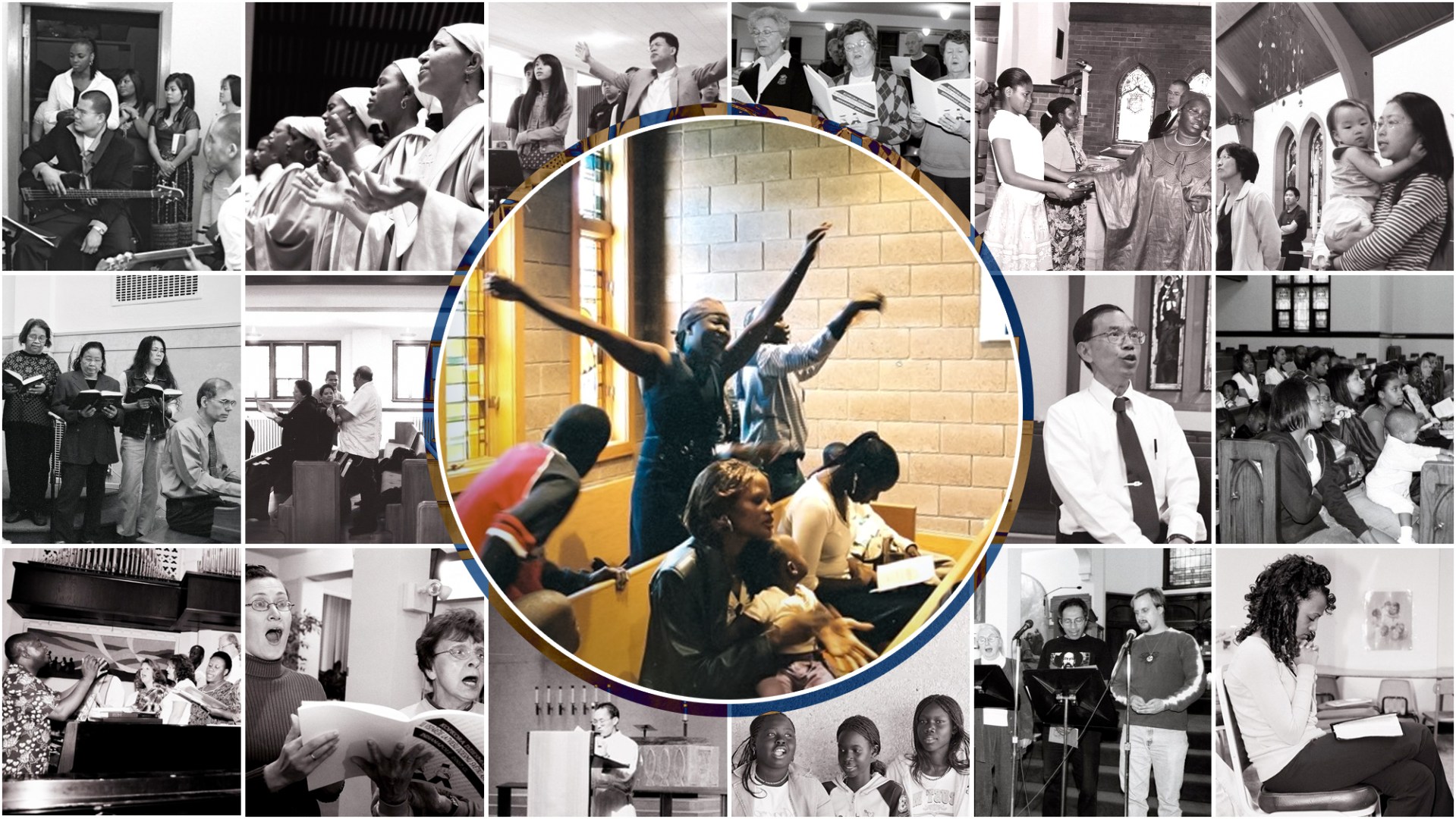
We used to dance to kings but now we are dancing to God,” explains Omot Ochan, the worship leader for the Anuak service at Christ Lutheran Church, near St. Paul, Minnesota.

The music at his church begins as a high-pitched offering, a young woman’s ethereal voice floating through the sanctuary, before meeting a fervent response from congregants and the rhythms of three drums. Most of the parishioners at the service were refugees from the Gambela region in western Ethiopia, which borders South Sudan. Now, they live out their faith in the Midwestern suburbs, surprised to find empty church buildings in a country they once assumed was overwhelmingly Christian.

In the United States, the two largest US Lutheran bodies—the Lutheran Church Missouri Synod (LCMS) and the Evangelical Lutheran Church in America (ELCA)­­­ are around 95 percent white, and the denomination is slowly in decline in the Global North. But Lutheran membership in the Global South is growing. As of 2016, the largest Lutheran bodies are found in Tanzania and Ethiopia; they now rank ahead of Sweden, Denmark, Finland, Norway, and the US.

The revivalist spirit of these Lutheran newcomers is often expressed in a most Lutheran way—music. As Martin Luther himself once said, “Music is next to theology.”

In another Minneapolis suburb, Sudanese Lutherans sing Luther’s “A Mighty Fortress” in the Nuer language, accompanied by a resonant drum. This rendition of the denomination’s most famous hymn is hardly reconcilable with its German predecessor, proof that even the most eminent songs can be reproduced in profoundly different ways.

One God, Many Traditions

I set out more than ten years ago to answer a few questions: What can immigrants and refugees teach us about Christianity in the United States and globally? More locally, what does it feel like to be Lutheran and an immigrant in Minnesota? What does the music at immigrant congregations reveal about the history of religious journeys?

I visited churches with congregations from Tanzania, Laos, Liberia, Cambodia, China, Sudan, and Ethiopia, all within a roughly 30-mile radius of Minneapolis and St. Paul. By attending almost 20 churches that did not worship in English, I learned that the music differs dramatically from church to church. It’s impossible to even try to connect it, even though the congregations exist just a few miles from one another and all self-identify as Lutheran.

Some worshipers hail from countries with Christian histories that stretch back centuries. They grew up singing in Lutheran choirs in their homeland, as their ancestors did. Those from countries with a longstanding history of European colonization or mission work, like Tanzania, carry with them the most obvious signs of European musical influence.

The Swahili congregation at Minneapolis’s Holy Trinity Lutheran Church might sing in precise four-part harmonies, for example. But its music is also distinctively Tanzanian: The lyrics are in Swahili, sung in a call-and-response form common across many sub-Saharan African music, and accompanied by a drum and shakers.

https://soundcloud.com/allisonadrian/baba-yetu-swahli-choir?in=allisonadrian/sets/a-mighty-fortress-far-from-lake-wobegon-lutheran-music-in-the-twin-cities

Some congregations I visited had never sung in a group before arriving in the US, like the Lutherans of the Khmer Choir at Christ Lutheran on Capitol Hill in St. Paul. There was little in the way of group singing as a cultural practice in Cambodia, though music itself has always been highly valued.

Bun Leoung, a celebrated Cambodian musician who co-directed the choir, was spared by the Khmer Rouge, which outlawed religion in the 1970s, because of his talent on the tro khmer (fiddle). He converted to Lutheranism in the US and played the tro with the Khmer choir until he passed away. The choir’s favorite hymns are an unusual combination of folk tunes and harvest songs, accompanied by both the piano and the tro.

Khmer-English translator Thaly Cavanaugh describes the power of singing in the Khmer choir, regardless of whether non-Cambodian congregants understand the lyrics:

When you sing [the word of God], you sing from your heart and soul. And, you feel the joy and are able to share it. We get comments about how [the rest of the congregation] appreciates our Cambodian choir. They don’t even know what we are singing, but they can read the translation [in the bulletin]. It’s a big part of their lives and that helps motivate and inspire us, knowing that we work together for a common faith.

https://soundcloud.com/allisonadrian/khmer-choir?in=allisonadrian/sets/a-mighty-fortress-far-from-lake-wobegon-lutheran-music-in-the-twin-cities

Some groups, like the Anuak congregation at Christ Lutheran Church, have largely converted to Christianity in the context of a refugee camp. East African Anuaks are relatively new to Lutheranism, and it shows in their music. Songs are always started by a female “call” that is responded to by the group. Accompaniment involves hand claps and shakers, most of the time using three two-sided drums and sometimes featuring a synthesizer. The call-and-response structure is not unfamiliar to US Christianity, but the tone quality of the singers and ululations distinctively place the music back in the heartland of the Gambela region of Ethiopia.

https://soundcloud.com/allisonadrian/annual-service-at-christ-lutheran-track-4?in=allisonadrian/sets/a-mighty-fortress-far-from-lake-wobegon-lutheran-music-in-the-twin-cities

A New and Joyful Noise

All of these congregations make music to both remember their roots and plant new ones.

While Orthodox Christianity has been practiced in Ethiopia since the fourth century, Protestantism gained popularity more recently. The musical style at Our Redeemer Oromo Evangelical Church, an ELCA congregation in Minneapolis, is derived from the Lutheran Ethiopian Evangelical Church Mekane Yesus (EECMY), founded in 1959. The church is made up of Protestants from Oromia, Ethiopia, and is considered the mother church for Oromo Diaspora churches. It is also one of the largest immigrant churches in the ELCA.

The musical introduction to the service can take up to 45 minutes. During a heavily amplified prelude led by vocalists and a keyboard, choir members dance in the aisles and church members may speak in tongues. The slow-fast-slow tempo of the music sets the mood of the congregants, who appear reflective, then ecstatic. Flexibility and improvisation, two characteristics virtually absent from most Euro-American services, are key elements to the spontaneity that make the service so exhilarating.

https://soundcloud.com/allisonadrian/ebeneezer-our-redeemer-oromo?in=allisonadrian/sets/a-mighty-fortress-far-from-lake-wobegon-lutheran-music-in-the-twin-cities

Not every congregation is a new, ethnically homogenous group. In some places, integration has gone a step further. Such is the case at Christ Lutheran on Capitol Hill in St. Paul, one of the most diverse Lutheran churches I visited. Here, Cambodians, Africans, white Americans, and African Americans all worship together. The music is accordingly diverse: The traditional choir sings songs in English and the Khmer choir sings Cambodian folk tunes set to Christian lyrics. Congregational singing is entirely new to the Cambodian Americans who have chosen to join the choir.

Paul Swenson, the white, US-born accompanist of the Khmer Choir at Christ Lutheran on Capitol Hill, observes how the deep faith of his fellow Cambodian Lutherans manifests in their music. While European-descended Lutherans have inherited their tradition and may simply sing the hymns because “we’ve always done it that way,” he said, these newcomers are adopting and adapting hymns in ways that require searching and examination.

Because of that work, Swenson said, “In a sense, I think their faith is more vital, more alive.”

https://soundcloud.com/allisonadrian/sets/a-mighty-fortress-far-from-lake-wobegon-lutheran-music-in-the-twin-cities

Allison Adrian specializes in ethnomusicology and musicology at St. Catherine University in St. Paul, Minnesota. She recently served as a Fulbright Scholar in Ecuador where she studied how migration and globalization have influenced indigenous music-making in the Andes.

News
Wire Story

Willow Creek Confirms Abuse Allegations Against Gilbert Bilezikian

“Dr. B,” an egalitarian leader and mentor to Bill Hybels, continued teaching at church for years after elders learned of his misconduct.

Christianity Today January 28, 2020
Mary Fairchild / Flickr

In this series

Willow Creek Community Church—still grappling with former senior pastor Bill Hybels’ history of alleged sexual harassment and abuse of power—now is dealing with allegations of misconduct against the man who mentored Hybels.

A longtime church member shared in a public Facebook post Saturday that Gilbert Bilezikian—known widely as “Dr. B.”—kissed, fondled, and pressured her to have sex with him between 1984 and 1988.

“We believe that Dr. B engaged in inappropriate behavior, and the harm he caused was inexcusable,” Willow Creek’s acting lead pastor Steve Gillen wrote Monday in an email to church staff obtained by Religion News Service.

The Willow Creek Elder Board confirmed in an update posted online Tuesday night that the church had decided to restrict Bilezikian from serving there after the church member came forward with allegations against him about a decade ago.

Bilezikian, a retired Wheaton College professor, was never on staff at the church, according the the elders. But he has been active in the church for decades and was a mentor to Hybels. In addition to his influence on Willow Creek, Bilezikian helped start CBE International (founded as Christians for Biblical Equality) in 1988.

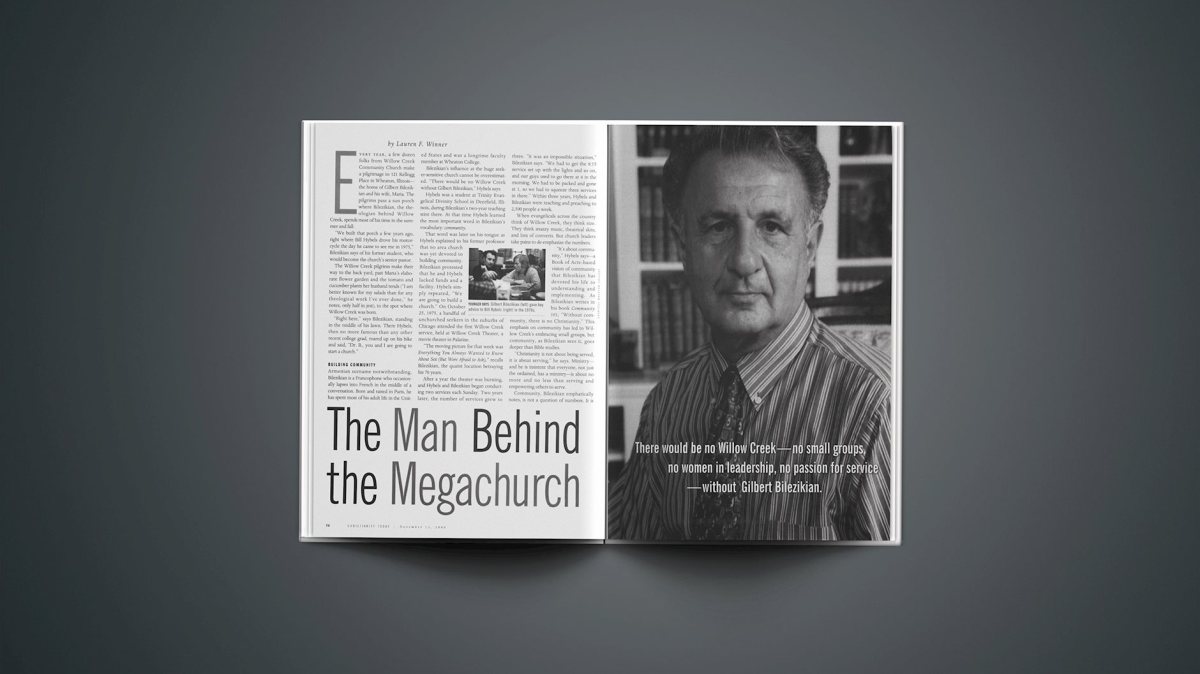
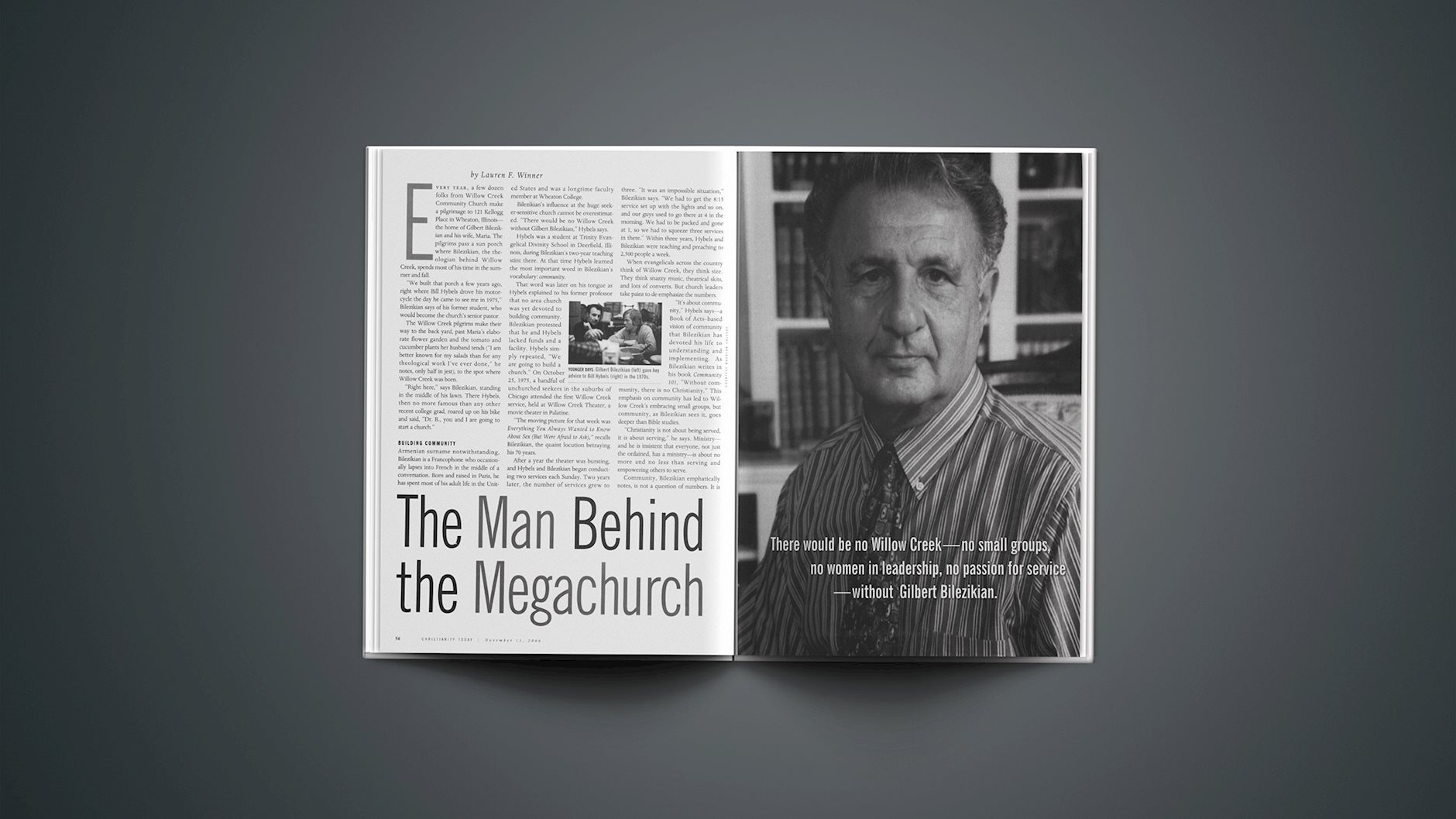
“There would be no Willow Creek without Gilbert Bilezikian,” Hybels told Christianity Today in 2000.

The two met when Bilezikian was a professor at Trinity Evangelical Divinity School in suburban Deerfield, Illinois, and Hybels, a student. According to the article, Hybels rode up to Bilezikian’s house on a motorcycle one day in 1975 and proclaimed, “Dr. B., you and I are going to start a church.”

Not long afterwards, Willow Creek Community Church began meeting in a movie theater in Palatine, Illinois. Bilezikian was credited with Willow Creek’s inclusion of women in its highest levels of leadership.

From a November 2000 CT cover story

The 2000 article also describes the Paris-born scholar’s “French eye for beauty” and “effusive appreciation of female beauty,” describing how he kissed the hands of women and girls who approached him in the hallways of the church and complimented their “ravishing beauty.”

Bilezikian told the magazine at the time this was because his mother had died when he was young, and he “idealized” her.

“As a young man, I was always searching for that elusive perfection in womanhood, which was such an enigma, for someone growing up with no sisters and no mother,” he said.

The church member who accused Bilezikian of misconduct said she began attending Willow Creek in 1984 as a “vulnerable and a heartbroken new believer.”

Bilezikian allegedly “pursued an inappropriate relationship” with her, according to her account, first in “subtle flirtations” after church services. That led to inappropriate hand holding and emotional intimacy, with Bilezikian confiding in her that he was unhappy in his marriage and that “he felt he could help the church thrive because I made him happy.”

On several occasions, she wrote, he pushed her against a wall in a parking garage, behind a truck or into a doorway, where they couldn’t be seen together, and kissed her forcefully. Each time, she noted, she pushed him away.

“I was young in my faith, new to church, and hungry for someone to invest spiritually in me. He made me feel special, and he was a spiritual authority in a large church, and I did not feel like I could say no to him, even when my gut was telling me this was not appropriate,” she wrote.

The church member wrote that she has met privately with Willow Creek leadership to discuss the abuse since 2010, when she “felt strong enough to begin to confront the spiritual abuse I’d experienced so early in my faith.”

For many years, she felt her concerns were not taken seriously and—worse—that she was being sidelined from leadership and watched by security at the church.

She felt hopeful the church would handle her story “honorably” after bringing it to former teaching pastor Steve Carter, who organized a meeting between the church member and several church leaders in 2018.

Around the same time, the allegations against Hybels broke.

At first, the church defended its founding pastor, though officials later said his conduct had been sinful and an independent investigation found the accusations against him credible.

Hybels eventually retired early. As a result of the controversy over the church’s handling of the allegations, the two pastors who succeeded him—Carter and lead pastor Heather Larson—resigned, as did the church’s entire elder board.

The Willow Creek Elder Board’s update confirmed the church member had reported Bilezikian’s behavior to church leadership about a decade ago.

“The team believed the woman’s claim that Dr. Bilezikian engaged in inappropriate behavior dating back to the mid-eighties, including but not limited to hand holding, hugs, kissing, inappropriate touching, and sending overly personal communication,” the update read.

While the church’s Elder Response Team met with Bilezikian and restricted him from serving at the church, according to elders, that restriction wasn’t “adequately communicated.”

So the former professor continued serving and teaching at the church. “This was wrong, and we are sorry,” the update read.

“Over the past years, behavior has been brought to light that is both harmful and unacceptable for a Christ follower. This sinful behavior that we believe was demonstrated by Dr. Bilezikian and Bill Hybels was wrong, and we hold any person entrusted with leading at Willow Creek Community Church to a higher standard, the statement read.

In his email to Gillen, Bilezikian said the church had failed to follow the Bible by not addressing the allegations against him in private.

“I look for some evidence of professional integrity if not of Christian obligation, and I find nothing else here but a recital of accusations that were delivered to the whole church staff behind my back, without my knowledge and without my having been consulted about their accuracy,” he said in the message forwarded to RNS. “Need I bring up references in the Bible for prescriptions about conflict resolution and for the correction of offending brothers, especially veteran servants in our midst?”

He added: “Steve, who gave you the right to violate the biblical process by skipping it entirely and jumping to the closure point, which made of me instantly the pagan and the tax collector?”

Bilezikian also asked for the church to thoroughly investigate the charges against him.

He was a longtime professor at Wheaton College in Wheaton, Illinois. He retired from the evangelical flagship school in 1992. He is the author of Beyond Sex Roles: What the Bible Says about a Woman's Place in Church and Family and a contributor (like Hybels) to How I Changed My Mind about Women in Leadership.

News

13 Christian Takes on Trump’s Peace Plan for Israel and Palestine

(UPDATED) Evangelicals in Middle East and US debate if “Deal of the Century” is “generous” or “extreme.”

An Israeli flag flies in a Jordan Valley Jewish settlement on January 28, 2020 in Shadmot Mehola, West Bank.

An Israeli flag flies in a Jordan Valley Jewish settlement on January 28, 2020 in Shadmot Mehola, West Bank.

Christianity Today January 28, 2020
Lior Mizrahi / Getty Images

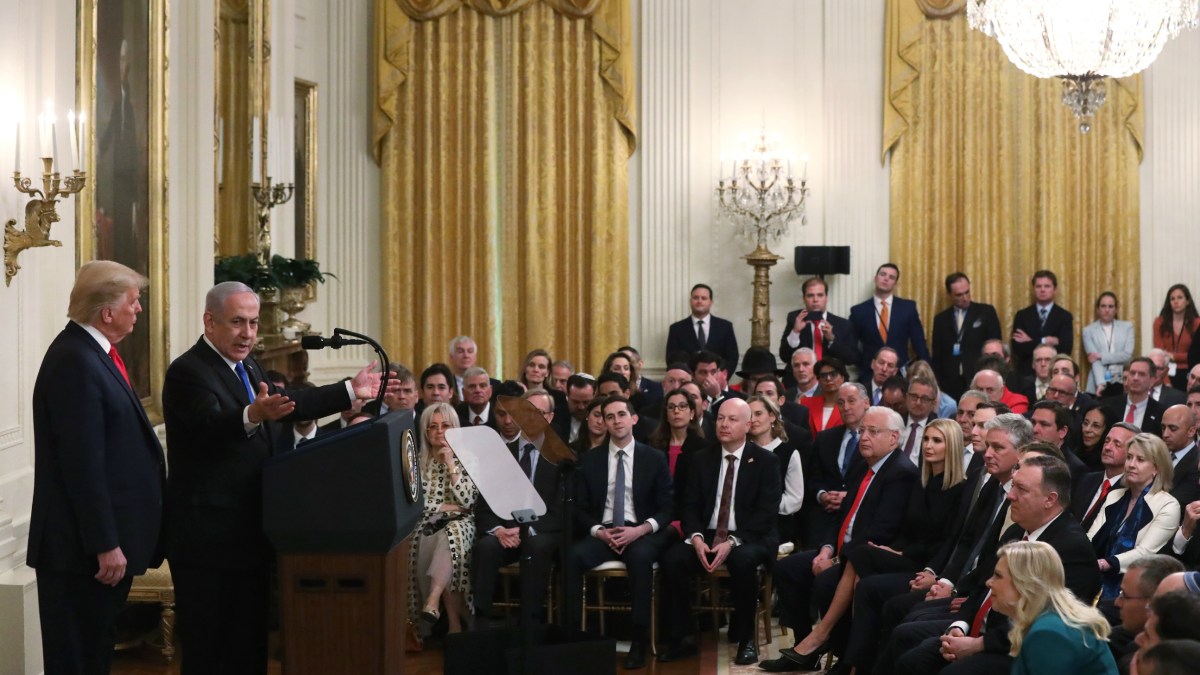
After three years of anticipation—and dread—President Trump announced the launch of his “Deal of the Century” to achieve peace between Israel and Palestine.

With Israeli Prime Minister Benjamin Netanyahu at his side, he outlined details for a proposal that would recognize a Palestinian state following extensive land swaps and security arrangements.

Palestinian Authority President Mahmoud Abbas was not present, having broken off communication with the White House following several US decisions deemed biased toward Israel.

Abbas immediately rejected the plan, which Palestinians had long declared “dead on arrival.”

But Netanyahu’s acceptance was enthusiastic, declaring himself willing to begin negotiations with the Palestinians on such terms. A day earlier, Netanyahu’s challenger Benny Gantz also signaled his party’s agreement with Trump’s proposal.

With three Arab states lacking a peace treaty with Israel in attendance—Oman, Bahrain, and the United Arab Emirates (UAE)—Trump hopes there will be a regional push to implement his plan.

And with $50 billion promised as investment for the nascent Palestinian state, the president believes all the necessary pieces are in place.

“All previous generations from Lyndon Johnson tried and bitterly failed,” Trump said. “But I was not elected to do small things, or shy away from big problems.”

Israeli Prime Minister Benjamin Netanyahu speaks during President Donald Trump's rollout of the White House's Middle East peace plan.Alex Wong / Getty Images
Israeli Prime Minister Benjamin Netanyahu speaks during President Donald Trump’s rollout of the White House’s Middle East peace plan.

It only required he approach peace in a “fundamentally different” manner.

No Arab or Israeli would be uprooted from their home. This guarantees the preservation of all existing Israeli settlements in occupied Palestinian territory.

Jerusalem would remain the undivided capital of Israel. At the same time, on the other side of the separation wall, eastern Jerusalem would become the capital of the Palestinian state, receiving a US embassy.

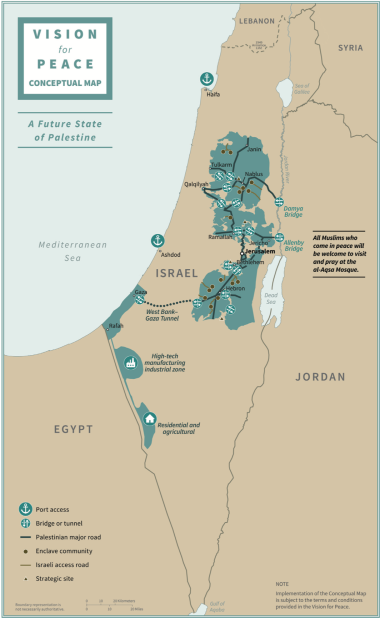
Proposed boundaries of a new Palestinian stateThe White House
Proposed boundaries of a new Palestinian state

Palestinian residents in Jerusalem on the other side of the wall would be given the option to become Palestinian citizens, Israeli citizens, or remain as permanent residents.

Israel would exercise security over Jerusalem’s holy sites, while Jordan would maintain its status quo authority over the Temple Mount and al-Aqsa Mosque. Muslim pilgrims would be guaranteed access.

Palestinian refugees would be barred from Israel but processed in limited numbers into the new state of Palestine. Pending approval, the rest would be given the option of naturalizing into their nations of residence or relocating elsewhere. Funds would be set up to facilitate.

Israel would receive land in the Jordan Valley to address security concerns. Palestine would receive land in the Negev Desert for industrial development. All international access would be controlled by Israel, with corridors created for ease of domestic transportation to non-contiguous territory.

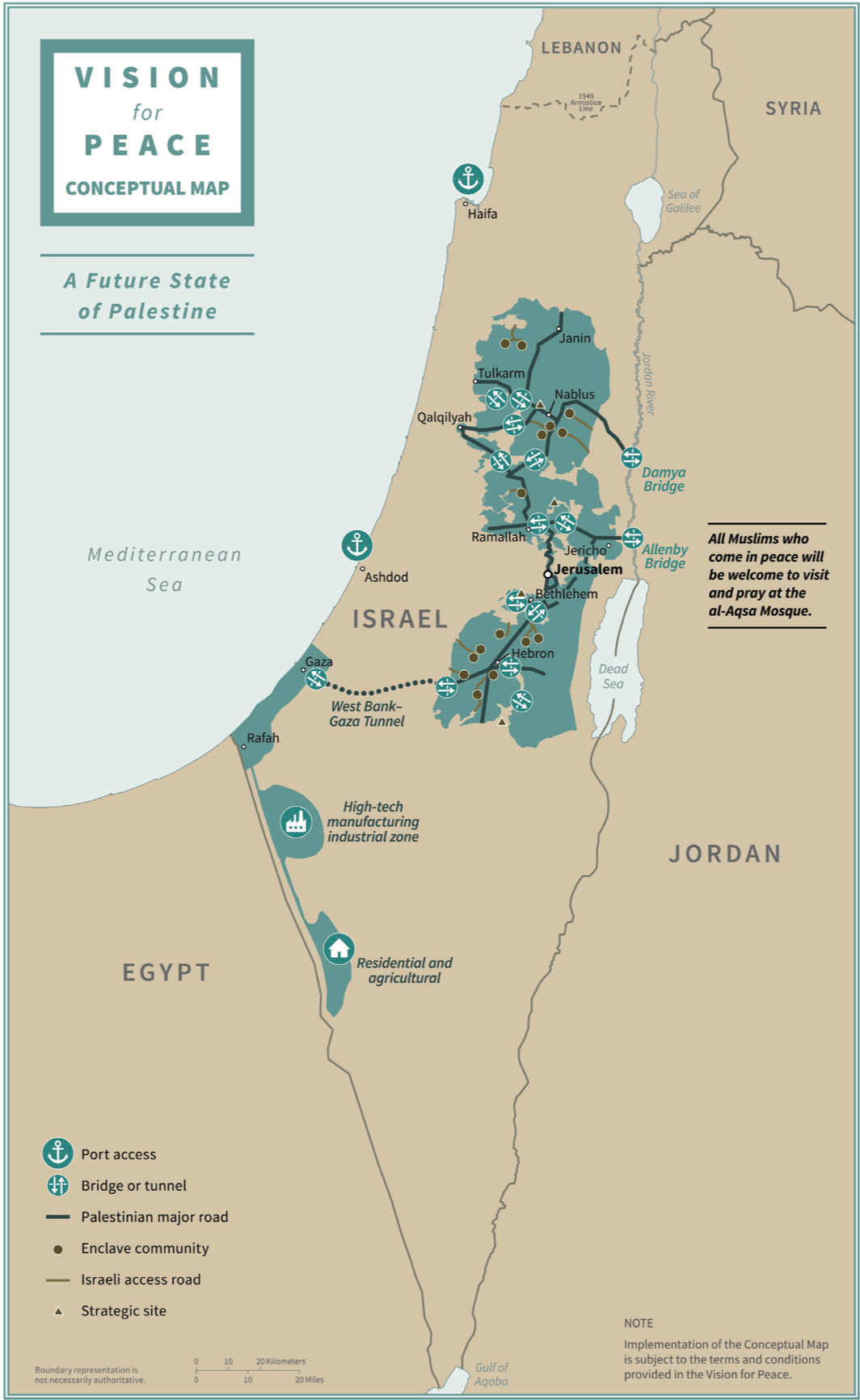
For the first time, a conceptual map of Israel’s borders was released.

Proposed boundaries of IsraelThe White House
Proposed boundaries of Israel

Israel would guarantee a four-year freeze on all settlements outside the scope of this plan, while Palestinian leadership studies the proposal and moves to implement it.

To do so, it must demilitarize Gaza and stop payments to the families of terrorists. Domestic laws must reflect human rights and freedom of religion.

“It is time for the Muslim world to correct the mistake it made in 1948, when it attacked rather than recognized Israel,” Trump said. “If you choose the path to peace, we will be there to help every step of the way.”

Netanyahu also referenced 1948, the year of Israel’s independence, in comparing Trump to then-US President Harry Truman. History would look back on this day similarly, he said, as Trump extended Israel’s sovereignty over “Judea and Samaria,” his favored term for the West Bank.

“You have been the greatest friend Israel has ever had in the White House,” he said. “There have been others, but it’s not even close.”

Joel Rosenberg, co-founder of the Alliance for the Peace of Jerusalem, was impressed.

“It was an excellent rollout ceremony,” he said, “dramatic, surprising—and controversial.”

Withholding full judgment until he reads the full 181-page plan, the bestselling author of End Times-inspired political fiction said that Trump’s plan gave Israel almost everything they wanted, but was also “generous” to the Palestinians.

On that count, it may complicate domestic politics for Trump and Netanyahu alike. Though some Christian Zionists oppose a two-state solution, Rosenberg believes many evangelicals will be “enthusiastic.”

But Israel’s settler community “wants everything,” Rosenberg said.

More than 600,000 Israeli Jews live in settlements scattered across the West Bank and east Jerusalem. Their main political body has rejected the deal, as have a few Netanyahu allies who have called for immediate annexation.

“They are very angry, and Bibi could have a problem on his right,” he said. “He might now surprisingly have to make a deal in the center, with Gantz.”

Trump’s plan, previously delayed due to repeated Israeli elections that failed to secure a ruling majority coalition, now heads to its third re-run on March 2.

But Rosenberg believes the Deal of the Century had two primary goals, anticipating Palestinian rejection. One, to be a creative, credible, compassionate approach to peace—just in case.

And two, to appeal to Arab regional leaders who wish to make peace with Israel but are tied by the Palestinian issue. If Abbas rejects a good plan, they may proceed without him.

“Seeing three Arab Gulf leaders at the ceremony,” Rosenberg said, “he just might have succeeded in threading the needle.”

Perhaps Palestinians will see the promise of a state and economic development and reject their rejectionist leadership, he wonders. Their situation is sad, and perhaps divinely so.

“Palestinian leaders will huff and puff, but they look ridiculous and their people are suffering,” Rosenberg, an evangelical of Jewish descent, said.

“But as I read in the book of Exodus, I can’t help but wonder if God has just hardened Abbas’s heart.”

Not at all, according to Salim Munayer, head of the Jerusalem-based Musalaha reconciliation ministry. This past year, he has held many sessions discussing peace between Muslims, Christians, and Jews.

“From our discussions, the issues are clear: Israelis want security, and Palestinians want justice,” Munayer said. “No Palestinian leader can accept this deal, because it doesn’t meet our basic needs.”

East Jerusalem should be their capital, he said, but left unsettled is the question of Jewish settlers moving into Arab neighborhoods. Refugees deserve the right of return, but are left out of this proposal. And the Jordan Valley is essential for Palestinian population expansion, agricultural development, and vital water supply.

Israel already controls security along the border, it does not need to appropriate the land, Munayer said.

But beyond the details, the “Deal of the Century” lacks the moral framework to win Palestinian support. In successive steps over the past years to move the embassy to Jerusalem, cut humanitarian funding, and no longer consider settlements as occupied territory, the US has lost all trust as a moderator, he said.

“If one side humiliates the other, there can be no agreement,” Munayer said. “Israel is eating the pizza, while saying to the Palestinians, ‘Let’s negotiate slices.’”

This fits also into Israel’s domestic context, he said. The plan was released on the same day Netanyahu was indicted on corruption charges.

Real peace must come through grassroots reconciliation, and not be imposed from the top, Munayer said. But worse, Trump’s plan comes wholly from the outside.

Overall, he had little emotional response to the proposal—that came months earlier, when the US cut funding to Palestinian hospitals.

“I didn’t have a lot of expectations, it was no surprise,” Munayer said. “It used to be one-sided before, but never this extreme.”

Daoud Kuttab, a Palestinian journalist and secretary of the Jordan Evangelical Council in Amman, read the plan in full and said its contents and its rollout “sounded more like a surrender dictate than a peace plan.”

“The fact that of 13 million Palestinians, the Americans couldn't find a single one to attend [the rollout] spoke volumes in its one-sidedness,” he told CT.

Kuttab most approves of the plan’s Gaza-West Bank tunnel, which would end Israel’s separation of the two territories. He most opposes its lack of autonomous borders. “Despite using the words Palestinian state, the plan gives Palestine no real independence and allows Israel control over borders, over the air and sea, and [Israeli security forces] can enter Palestine at any time they choose.”

“It is a surrender document that will lay the grounds for Palestinians to continue to live under Israeli discrimination,” he said. “It is a death to the two-state solution, and will do nothing to help the peace process. This is a formula for further violence and unrest.”

Hanna Massad, a Palestinian pastor who led Gaza Baptist Church for 12 years and returns regularly, said the plan is “unfair” and fails to meet either Palestinian “ambitions” or UN resolutions. It contains “no justice,” which for him means Jerusalem for a capital and a return to 1967 borders.

Massad still has the documents showing the land his family lost in Israel. “We keep it safe, so that at least one day we might receive compensation.”

“It breaks your heart to see the poverty and suffering of the people in Gaza,” he told CT. “As Palestinians, we have also done bad things against the Israelis. But because we are the weaker party, we suffer more.”

“My father told me he wished to see peace in his lifetime,” Massad said. “Now, I wonder if my children will see it.”

“We hope for fairness and justice for all sides,” he said. “But we hope only in the Lord.”

Gerald McDermott, Anglican Chair of Divinity at Beeson Divinity School who recently wrote The New Christian Zionism: Fresh Perspectives on Israel and the Land, said the plan is “a realistic opportunity for a two-state solution,” given its offer of “huge economic help and a Jerusalem capital.”

He is not surprised by Abbas’s rejection, but instead is struck by regional reaction. “For the first time, there is considerable Arab support for an American-initiated deal,” he said, naming the UAE, Oman, Bahrain, and Egypt. “All of these states are tired of Palestinian rejectionism.”

“Like any political compromise, it will cause pain on all sides,” McDermott told CT. “Netanyahu, for example, is suffering major criticism from the Israeli right.”

However, he said, “There is no theological reason why Israel cannot compromise with Arabs. Both Abraham and Isaac did.”

Yohanna Katanacho, a Palestinian pastor and academic dean at Nazareth Evangelical College, said it doesn’t take a “prophet” to know Trump’s plan is “destined to failure.”

“Trump is trying to address a difficult problem but he is not addressing it from the perspective of humility,” he wrote for Come and See, a Nazareth-based Christian website. “Such humility does not ignore UN resolutions, Palestinian input, Palestinian citizens of Israel, and justice.”

“This raises a question concerning peacemaking,” Katanacho wrote. “Political peace is no doubt needed, but it cannot be accomplished without a solid moral foundation rooted in justice, equality, and love.

“At best, Trump’s proposal is seeking to prevent wars. It does not promote a lasting peace,” he wrote. “Trump’s plan does not promote a politics of love but of fear from Palestinians. Love respects, listens, and suffers for the sake of justice. Love does not seek deals, but healthy relationships.”

Lisa Loden, the Messianic Jewish co-chair of the Lausanne Initiative for Reconciliation in Israel–Palestine, acknowledged the plan is “creative” but not viable because it is a bilateral proposal between the US and Israel, not between the Israelis and Palestinians.

“My reaction was one of deep sadness, pain, and grief at what this plan could mean for the people of this region,” she told CT. “The continuation of Israeli control over Palestinian lives, and—according to the plan—the ongoing militarization of this and future generations of Israelis who would continue to exert that control, is an untenable situation resulting in collective trauma for both sides.

“The non-viable and non-contiguous Palestinian state described in the plan and visualized in the accompanying map are unrealistic,” she said. “I was struck by the total absence of any Palestinian city name on the map.”

Loden expects current evangelical supporters of Israel will “generally be quite pleased” with the plan. “A significant number will think that this plan does not go far enough, and that ultimately all the land should belong to Israel,” she told CT. “On the other side, evangelicals who are supportive of the Palestinian people will be devastated by the almost unilateral support of Israel’s positions.”

Joel Chernoff, general secretary of the Messianic Jewish Alliance of America (MJAA), said whether the “Deal of the Century” (DOC) is viewed positively or negatively depends on one’s “perspective and primary objective.”

“If the Palestinian’s primary objective for an agreement with Israel is peace and prosperity, this proposal is a great opportunity and a $50 billion boondoggle one would be foolish to reject,” he told CT. “However, if your objective is an independent state with defined borders that the Palestinians control … and secure with their own military, the DOC will be viewed as a humiliating surrender to the hated Zionist state.”

Chernoff also believes the plan’s pre-conditions are “non-starters.” “First, our Arab cousins have never been willing to recognize and affirm the Jewish state as legitimate. Second, Hamas will never agree to voluntarily disarm and de-militarize Gaza contrary to the wishes and agenda of their puppet-master, Iran,” he said. “The $50 billion for development, though very generous, is really irrelevant when the Islamic terrorist groups and nations backing them desire the destruction of the Jewish state and reclamation of its land for Allah. This is a Muslim theological imperative.”

Martin Accad, chief academic officer at Arab Baptist Theological Seminary in Beirut, was interested to learn the new plan’s details, yet skeptical.

“The fact that this plan was different made it interesting to me,” he told CT. “Seventy years of similar plans have not led anywhere. Could this one provoke change?”

However, now that the details have been released, he sees “it is an unusual way to solve such a longstanding conflict, and it is not promising.”

Accad is disturbed by parts of the plan, as well as that only the Israelis consulted on it. The phrase “no Israeli or Palestinian will be uprooted from their home” is “basically a guarantee to Israel for its settlements,” he said. Meanwhile, the “right of return” has “basically been cancelled.”

“As a Lebanese, we know how problematic it is for the 280,000 Palestinian refugees to still be here,” he told CT. “Settling them in Lebanon is completely out of the question in our political calculations.”

Accad fears if the plan is not refined, it will lead to “something far worse” than the current status quo. “Now that there is an agreement on one side, the four years opens an interesting window,” he said. “If someone would work intensely with the Palestinians, listening to their concerns as [Jared] Kushner has with the Israelis, perhaps this can be brought into the existing framework. But I don’t know if this is even possible, as the plan is unilaterally designed to fit Israeli needs.”

John Hagee, the founder and chairman of Christians United for Israel (CUFI) who attended the White House rollout, praised President Trump for being “the most pro-Israel president in US history.”

“This plan reflects that tradition and is the best peace proposal any American administration has ever put forth,” stated Hagee. “The President’s vision ensures Israel’s defensible borders, a united Jerusalem, sovereignty over biblical holy sites, and provides an opportunity for the Palestinians to choose peace.

“CUFI, as we have since our founding, stands with the decisions of the democratically elected government of Israel,” he stated. “We hope the Palestinian leadership will not miss yet another opportunity for peace in the region.”

Todd Deatherage, cofounder and executive director of Telos Group, which seeks to build a “pro-Israeli, pro-Palestinian, pro-peace movement,” said the plan is not a map for peace but merely a “rearrangement” of the status quo in an “unabashedly rightwing Israeli voice.”

“This American effort is entirely lacking in humility and misses the mark in several ways,” he told CT. “The conflict is much more than a real estate deal.

“It’s for sure a dispute over who has the deepest connection to the same geography, but it’s also a battle of multiple narratives, of different experiences, of identities,” he said. “And to embrace and affirm only one of those—as this does in both tone and substance—can hardly be taken as a serious effort at diplomacy or peacemaking.”

“True peace is not made when powerful parties gather and dictate terms to their enemies,” Deatherage said. “The hard work of peacemaking requires listening, tough choices, hard conversations, and mutual sacrifice.”

“Where bad things have happened over generations, it requires truth and justice, and a process for reconciliation. And where there’s a power imbalance, it requires risk,” he told CT. “A real friend to Israel would help them do the hard things that are in their own long-term interests.”

Wissam al-Saliby, the Geneva-based advocacy officer for the World Evangelical Alliance and a Lebanese evangelical who has worked extensively in his homeland’s Palestinian camps, pointed to the writing of a West Bank rabbi, Hanan Schlesinger, who last year compared Egypt’s enslavement of the Jewish people to Israel’s treatment of the Palestinians today.

“We may disagree on the solution to the conflict: one-state, two-state, and what each of these notions mean,” Saliby told CT. “And we may disagree on what place the current State of Israel occupies in God’s plans.

“But we cannot disagree that the ‘Deal of the Century’ enshrines the injustice that Rabbi Schlesinger describes, rather than lay the foundations for a just and permanent peace,” he said. “We cannot disagree that the proposed island nation of Palestine is non-viable, non-sovereign, and will not bring healing for past injury, hope in the future, or hope in a dignified life. And economic incentives do not provide for dignity, less so for human rights and for freedom.”

Saliby noted how Israeli settlements have “rendered impossible” the promise made in the 1994 Oslo Accords of a Palestinian state. That unfulfilled promise makes it hard for Palestinian leaders to trust the new promises in the new plan.

“The Deal of the Century seems to enshrine the injustice of the current situation,” he told CT, “and this can never achieve peace, even if the Arab nations and the whole world accepted it.”

Ibrahim Nseir, Syrian pastor of the Presbyterian Church of Aleppo, said the plan is overly influenced by the coming elections and ongoing trials in both Israel and the US.

“Whenever you hear about an overture of peace, you will be happy,” he told CT. “But when it is forced, you cannot be comfortable.”

“You cannot make peace this way. Peace is not a decision. It is a process, and a way of walking together.”

“This is more of a business agreement than a peace proposal,” said Nseir. “Where is justice? … There must be confession of the sins of the past, but here no one says they did anything wrong.

“Christ paid for our sins on the cross. But who in this plan will pay the price for the sins of the Israeli-Palestinian conflict?”

CT reported in April on the “red lines” of the peace plan, as expressed by 11 American and Arab evangelical leaders.

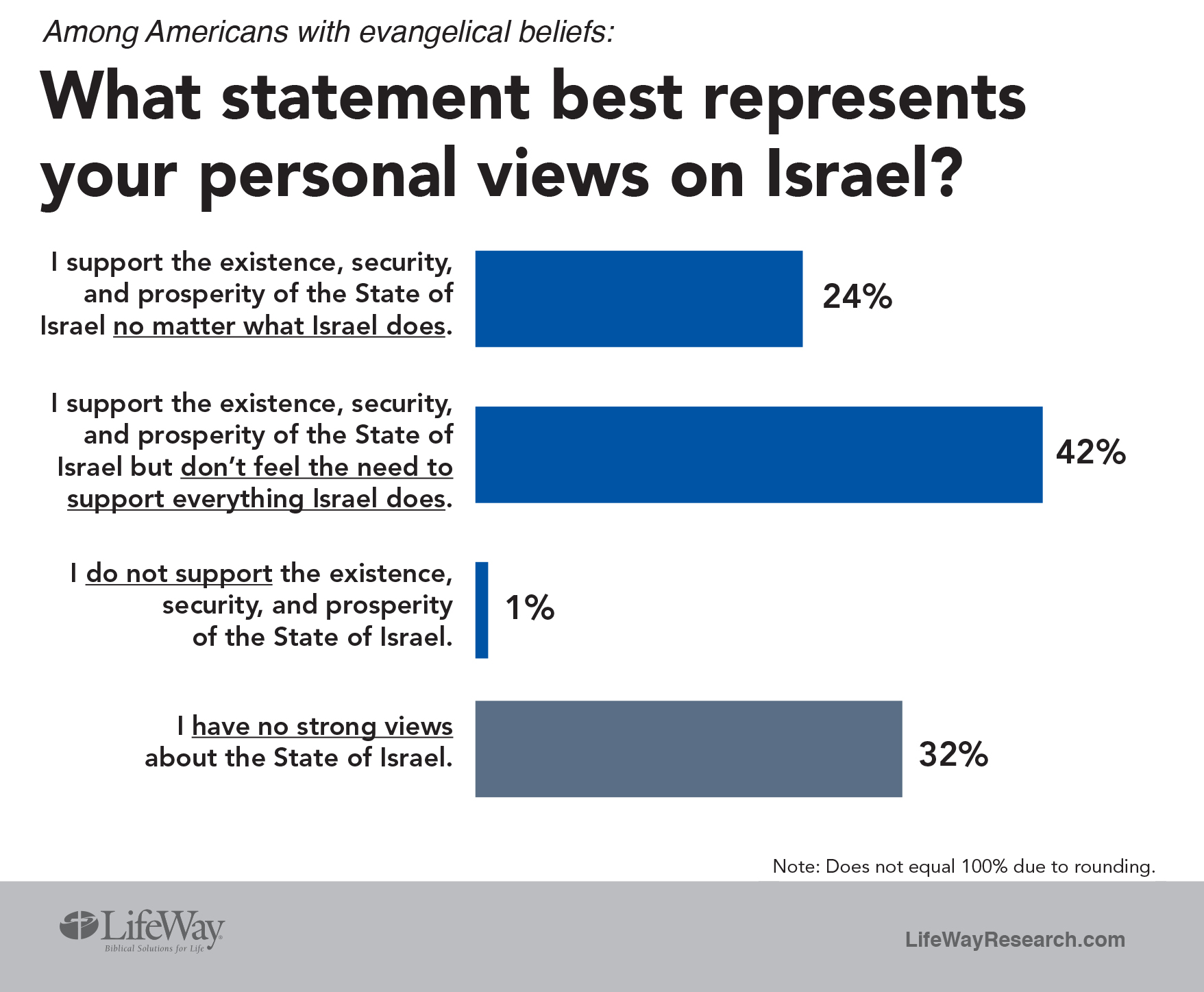
According to a 2017 survey by LifeWay Research, 31 percent of Americans with evangelical beliefs believe Israel should not sign a peace treaty with Palestinians that would establish their own sovereign state. Nearly 1 in 4 (23%) believe they should, while 46 percent are not sure.

Correction: In an earlier version of this story, a source mischaracterized CUFI’s John Hagee as having “spoken clearly against” a two-state solution. CUFI told CT that Hagee has “never taken a position” on a two-state solution.

Key points in Trump’s Mideast peace plan

By JOSEPH KRAUSS Associated Press

JERUSALEM (AP) — The Mideast peace plan announced by President Donald Trump on Tuesday supports the Israeli position on nearly all of the most contentious issues in the decades-old conflict.

Where previous presidents tried to cajole Israel and the Palestinians into compromising on thorny issues like the borders of a future Palestinian state, the status of Jerusalem and the fate of refugees, Trump’s Mideast team largely adopted the Israeli position.

As a result, the Palestinians have angrily rejected the plan, and the international community appears unlikely to rally around it.

Here is a look at the key points of the proposal:

BORDERS


The peace plan says Israel will have to make "significant territorial compromises" and that a Palestinian state should have territory "reasonably comparable in size to the territory of the West Bank and Gaza pre-1967," when Israel seized those territories, along with east Jerusalem, in a regionwide war. The plan provides for mutually agreed land swaps. But a "conceptual map" released with the plan shows a disjointed Palestinian state, with Israeli and Palestinian enclaves linked to their respective states by what the plan calls "pragmatic transportation solutions," including bridges, tunnels and roads. The Jordan Valley, which accounts for around a fourth of the West Bank, "will be under Israeli sovereignty."

JERUSALEM


The peace plan would leave most of annexed east Jerusalem, including its Old City and holy sites, under Israeli control while allowing the Palestinians to establish a capital on the outskirts of the city outside Israel's separation barrier. It said Jerusalem's holy sites, sacred to Jews, Christians and Muslims, should be open to worshipers. The understandings governing the flashpoint holy site known as the Al-Aqsa mosque compound to Muslims and the Temple Mount to Jews would remain in place.

SETTLEMENTS


The plan allows Israel to immediately annex virtually all its settlements in the occupied West Bank, which are viewed as illegal by the Palestinians and most of the international community. It would freeze settlement construction in areas earmarked for the future Palestinian state during the period of negotiations, but those areas are already largely off-limits to settlement activity. "Not a single settlement will be evacuated," Netanyahu told reporters. "Itamar is equal to Tel Aviv," he said, referring to a Jewish settlement in the heart of the West Bank.

SECURITY


Under the plan, Israel "will maintain overriding security responsibility" for the state of Palestine, which will be "fully demilitarized." The Palestinians will have their own internal security forces but Israel will control the borders and monitor all crossings. A "Crossings Board" made up of three Palestinians, three Israelis and a U.S. representative will oversee the crossings and resolve disputes. Israel will only implement its obligations under the plan if the Gaza Strip, which is currently ruled by the Islamic Hamas movement, is transferred back to the full control of the Palestinian Authority or another entity acceptable to Israel. Hamas and all other militant groups in Gaza must disarm and the territory must be fully demilitarized.

REFUGEES


Hundreds of thousands of Palestinians fled or were forced out of what is now Israel during the 1948 war around its creation. Those refugees and their descendants now number around 5 million and are scattered across the region. The Palestinians believe they have the "right of return" to former properties, something Israel has always rejected, saying it would destroy Israel's Jewish character. The peace plan says "there shall be no right of return by, or absorption of, any Palestinian refugee into the state of Israel." It says refugees can live in the state of Palestine, become citizens of the countries where they live or be absorbed by other countries. It says the U.S. will try to provide "some compensation" to refugees.

News

Soleimani’s Death Doesn’t End Iran’s Influence on Middle East Christians

In Iraq, Syria, and Lebanon, can believers offer Shiites better support than the assassinated military leader?

Christianity Today January 28, 2020
Babak Jeddi / SOPA Images / AP Images

Middle East Christians might shrug their shoulders. They might even fret and worry. But perhaps Qassem Soleimani got what he deserved.
“We regret what happened. We do not want anyone to die, because Christianity wants the good of all,” said Ashty Bahro, former head of the Kurdistan Evangelical Alliance.

“But a person leads himself to his own destiny.”

Soleimani, head of Iran’s special operations Quds Force, was killed by a US rocket strike on January 3. It was a rapid escalation following the Iran-linked death of an American contractor, a retaliatory attack on the responsible Iraqi militia, and the storming of the US embassy in Baghdad.

According to the US State Department, Soleimani, who reported directly to Iranian Supreme Leader Ayatollah Khamenei, was responsible for 17 percent of American deaths in Iraq from 2003 to 2011.

He also enraged Sunni Muslims by engineering the subsequent Iranian defense of Syria’s regime, led by President Bashar al-Assad. With Russia and the Iran-backed military wing of Lebanon’s Hezbollah, the shelling of rebel-held cities resulted in the displacement of thousands during Syria’s civil war.

But Soleimani was also acclaimed for his role in fighting ISIS, personally directing Iraqi militias from the front lines.

Thus, Middle East Christians have mixed feelings about his death—and the immediate aftermath.

Some Syrian believers see no benefit to anyone.

“Iran was working with the US government in certain agreements. Why did you destroy them?” asked Maan Bitar, pastor of the Presbyterian churches in Mhardeh and Hama, noting both the fight against ISIS and the nuclear deal.

“This will prompt a severe reaction that will hurt America, and others.”

But not Christians. The general to replace Soleimani would continue Iranian policy, said Bitar.

And within this policy was a commitment to treat Christians well. Bitar believes Iran is very concerned to be viewed as an ethical people who fear God.

“When they made use of a deserted home, whether Muslim or Christian,” he said, “they left it in cleaner condition than when they entered.”

Bitar contributed to reconciliation efforts where the Syrian regime recaptured territory. But not everyone viewed the Iranian role as positive for Christians.

According to the Syrian Network for Human Rights, there were 124 assaults on churches from 2011 to 2019, and 75 (60%) came from the regime.

And overall, the instability of war resulted in the loss of 75 percent of Syria’s Christians, according to Open Doors, which ranks the nation No. 11 on its watch list of the 50 countries where it is hardest to follow Jesus.

“There is an agreement between the extremist elements and the regime … and the Iranian militias,” Samira Moubayed, vice president of Syrian Christians for Peace, told Syria Direct. “[All] aim to displace Christians and change the culture [of Syria].”

Though this was not witnessed by Bitar, it was by Ashur Eskrya, president of the Assyrian Aid Society branch in Iraq. Iranian-backed Shabak Shiite militias patrol the ancient Christian homeland of Iraq’s Nineveh Plains.

Like in Syria, it is good propaganda to be conciliatory, he said. Iran promotes its interests through aligned Iraqi Christian militias and politicians.

But the Shabak have also prevented Nineveh’s Christians from returning home.

“If you have fighters who don’t follow the rules and want to change demography, it is the same as ISIS,” Eskrya said. “Soleimani is not Baghdadi [the American-killed caliph of ISIS], and the Shiite way of fighting is different from jihadis.

“But the agenda is the same.”

Eskrya highlighted the Nineveh Plains city of Bartallah, whose population used to be 100-percent Syrian Orthodox. Instability during the Iran–Iraq war resulted in the city’s Shiite population growing to 10 percent.

Today, the Shiite share is more than 50 percent, Eskrya said.

But Christian life continues in the now-mixed Bartallah. The city’s Christmas tree bore pictures of security forces who died to liberate the plains from ISIS. And local Christians expressed optimism for Iraq, due to the Shiite-led non-sectarian protests raging against corruption and foreign influence.

In particular: Iranian influence.

Last July, the US sanctioned two militia leaders—one a Christian—for ignoring Baghdad’s orders to withdraw from the Nineveh Plains to facilitate refugee return.

And the airstrike that killed Soleimani also killed his Iraqi right-hand man, Abu Mahdi al-Muhandis, deputy commander of the Iranian-backed Popular Mobilization Forces.

Their deaths may result in an opening for US–Iran negotiation, Eskrya hopes. But more likely is an increase in conflict through paramilitary retaliation.

Iran is pragmatic and will not directly escalate conflict with the United States, Eskrya believes. But Bahro thinks war is likely, and that Iran has learned nothing of America’s red lines.

Both call for an expanded US presence in Iraq, as international protection is the key to stability.

“We need a period of time for the young, educated generation to take control,” said Bahro.

“Until then, we urge everyone to resolve differences peacefully, because the only losers are the non-militarized civilians and children, including Christians.”

Martin Accad, chief academic officer at Arab Baptist Theological Seminary (ABTS) in Beirut, Lebanon, is categorically opposed to foreign protection. The American presence has “not been constructive.”

But neither has Iranian interference—though unlike others, he sees it as a mixed bag.

Through Hezbollah in Lebanon, Iran has helped elevate the marginalized Shiite population to balance the historically dominant Christians and Sunnis. But Hezbollah’s weapons and fealty to Iran hinder Lebanon from achieving a genuine domestic pluralism.

Looking back on Syria, it might be positive for Christians that the regime is still in power, Accad said. But Iran’s and Hezbollah’s early militant defense of Assad helped kill off the original legitimate uprising. And Christians only needed rescuing in the first place because of Iranian intervention.

In Iraq, Tehran’s role has been the most negative, stoking sectarianism as some Shiite leaders imitate Iran’s theocratic ethos of government against a secular state.

But killing Soleimani will likely only make things worse.

Lebanon’s protest movement is tilting toward violence, while Hezbollah has pledged revenge against the US (exempting civilians).

Iraq, ranked No. 15 on the Open Doors list, has already lost 7 out of 8 Christians since 2003.

“Catholics and Orthodox are trapped in a centuries-old survival mentality, while Protestants have too narrow a focus on evangelism,” Accad said.

“We have been far too quick to accept the status quo, hoping the visa application succeeds.”

Instead, Arab Christians must change their mentality to view themselves as a vital part of society seeking the common good. Much of Shiite aggression is based on a narrative of victimhood—which followers of Jesus are uniquely positioned to address.

Accad noted ABTS’s efforts to promote reconciliation among Lebanon’s sects.

“Embrace the model of Christ as the wounded healer,” he wrote at the seminary’s blog.

“[Then] we can come to terms with our own woundedness, and find in it a source of healing for societies around us.”

Even so, there will be resistance, Accad warned. A sense of victimhood is powerful, and helps maintain loyalty.

“Work toward reconciliation, toward peace, and if you are wounded in the process, okay,” he said.

“Just remember that your Master was persecuted before you, and keep working for his kingdom’s values.”

Until then, and following an immediate retaliatory missile attack on US bases in Iraq, the region has maintained a tacit calm. Is Iran biding its time, or is another explosion coming?

“For now, everything is normal,” said Eskrya.

“Tomorrow, only God knows what will happen.”

News
Wire Story

Half of US Churches Now Enlist Armed Security

Survey: Evangelical, Pentecostal, and Baptist churches are most likely to have church volunteers carry guns.

Christianity Today January 28, 2020
dlewis33 / Getty Images

In the aftermath of several high-profile church shootings, most Protestant pastors say their congregations have taken some precautions to protect those in attendance.

Since 2000, 19 fatal shootings have taken place at Christian churches, while gunmen have also taken lives at other religious sites like Jewish synagogues, a Sikh temple and an Amish school.

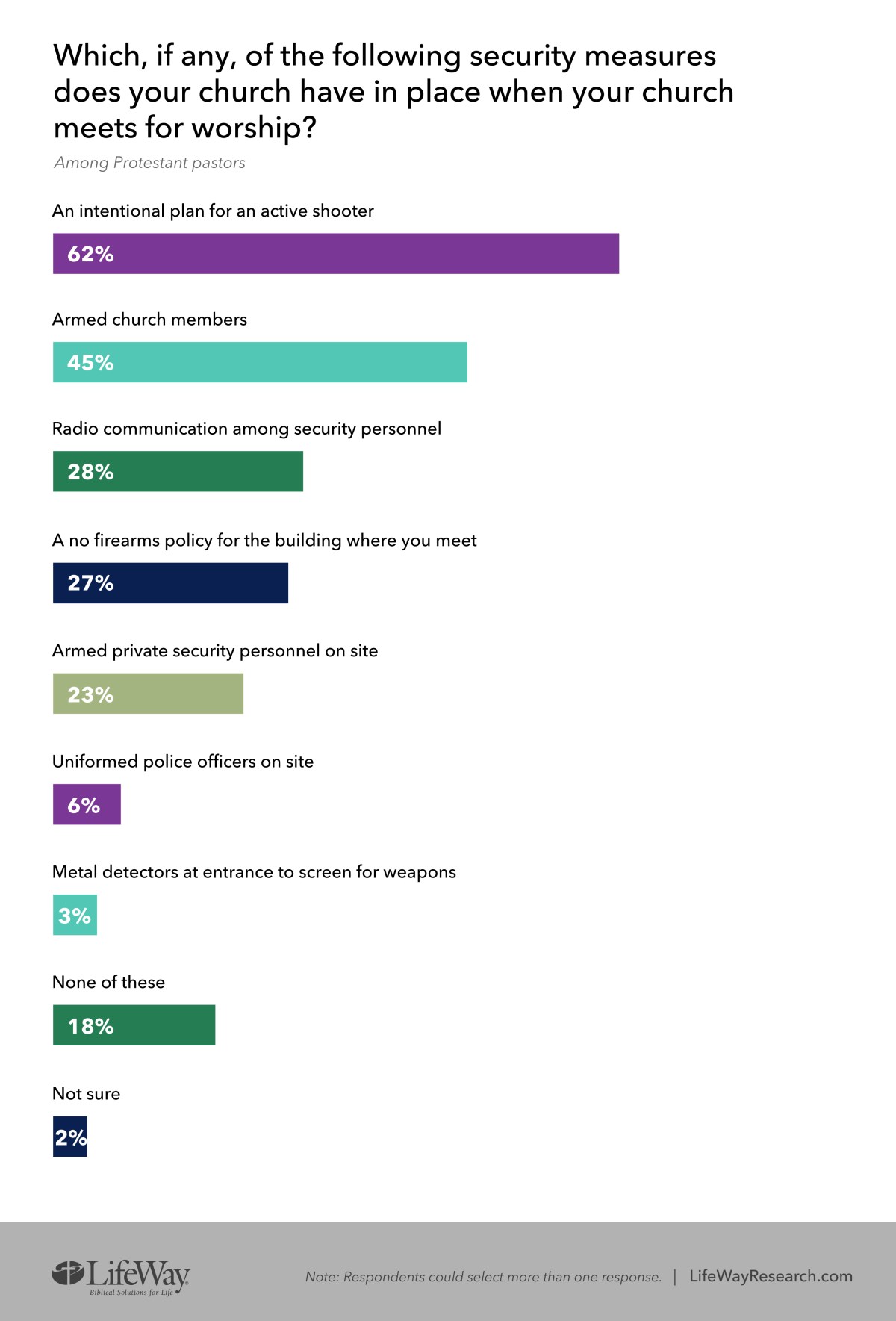
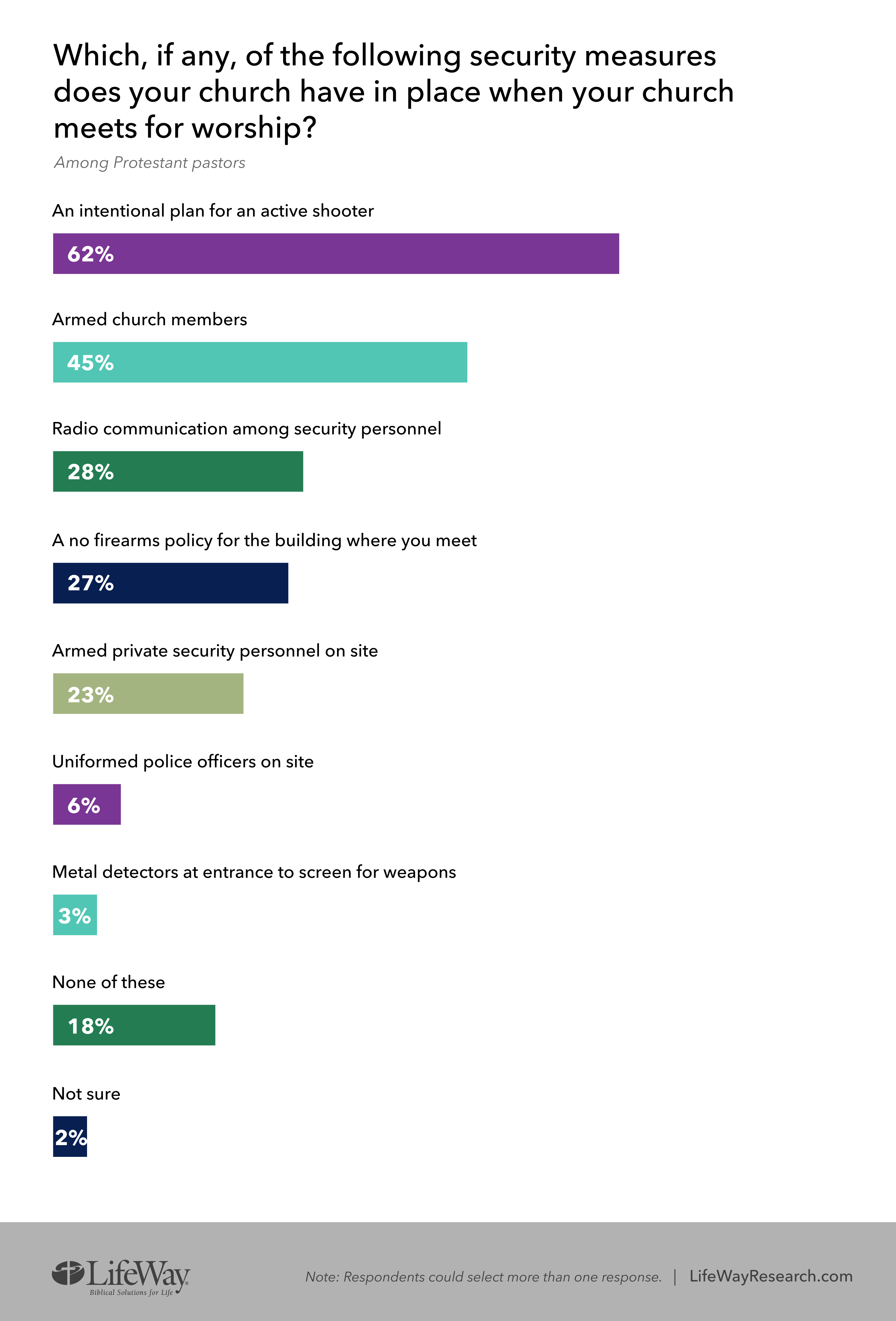
Around 4 in 5 Protestant pastors (80%) say their church has some type of security measure in place when they gather for worship, according to a survey from Nashville-based LifeWayResearch.

“Churches are some of the most common gatherings in any community, and that makes them targets,” said Scott McConnell, executive director of LifeWay Research. “Most churches understand this and have responded in some way.”

(Editor’s note: Last week, President Donald Trump signed new legislation authorizing $375 million in federal grants to help houses of worship and other nonprofits improve their capacities to defend against violence.)

Security specifics

The most common form of preparation is making an intentional plan. Almost 2 in 3 pastors (62%) say their church has an intentional plan for an active shooter situation.

The more people who show up to worship services each week, the more likely the church is to have made plans for a potential gunman.

Pastors of churches with 250 or more in attendance (77%) and those with 100 to 249 (74%) are more likely to have an intentional plan than those with 50 to 99 in attendance (58%) or those with less than 50 in their worship service each week (45%).

More than a quarter of churches (28%) have radio communication among security personnel.

African American pastors (47%) and pastors of other ethnicities (46%) are almost twice as likely as white pastors (25%) to take this step.

The question of guns in church is very much a live debate among pastors, as close to half of pastors (45%) say part of their security measures include having armed church members.

Combining this with the percentages who say they have uniformed police officers or armed security personnel on site, 51% intentionally have firearms at their worship services as part of their security measures.

Evangelical pastors (54%) are more likely than mainline pastors (34%) to say they have armed church members.

Half of pastors in the South (51%) and West (46%) say this is the case compared to a third of those in the Northeast (33%).

Pentecostal (71%), Baptist (65%) and Church of Christ pastors (53%) are also more likely than Methodist (32%), Lutheran (27%) and Presbyterian or Reformed pastors (27%) to say they have armed church members as part of their security measures.

Other churches place their emphasis on keeping all guns away from the worship service.

More than a quarter (27%) have a no-firearms policy for the building where they meet and 3 percent have metal detectors at entrances to screen for weapons.

African American pastors are the most likely to implement these strategies, with 50 percent saying they have a no-firearms policy and 8 percent deploying metal detectors.

Almost 1 in 5 pastors (18%) say their church has taken none of the precautions asked about in the survey, while 2 percent aren’t sure.

“While methods vary, most churches start with the resources they have to prepare for what they hope will never happen,” said McConnell. “With planning, a church can be prepared without being distracted or paralyzed by the threat. Pastors are trying to balance two responsibilities—protect those on the inside, while being as welcoming as possible to those on the outside.”

Police protection

In the survey, which took place prior to the West Freeway Church of Christ shooting in December 2019, close to a quarter of Protestant pastors (23%) say they have armed private security on site. Additionally, 6 percent say they have uniformed police officers on site as an added security measure.

For the vast majority of churchgoers (73%), the presence of a uniformed policeman or security guard at church makes them feel safer, with 37 percent saying they feel much safer.

One in 5 (20%) aren’t sure and 8 percent say it makes them feel less safe.

African American pastors are the most likely to say they have both armed private security personnel (41%) and uniformed police officers (18%) on site.

However, non-white churchgoers are more likely than white churchgoers to say they feel less safe at church seeing those individuals during worship services.

Around 1 in 10 non-white churchgoers (10%) say they feel less safe with uniformed police and security guards at church compared to 6 percent of white churchgoers.

Female churchgoers, on the other hand, are more likely than their male counterparts to say those visible individuals make them feel safer (75% to 69%).

Churches with 250 or more in attendance are the most likely to say they have armed private security personnel (43%) or uniformed police officers (26%).

Those who attend such churches are also the most likely to say seeing police officers and security guards at church make them feel safer (83%).

“Any organization that has relatively large gatherings of people has a responsibility for the safety of those gathered,” said McConnell. “In considering security, church leaders have to consider methods, costs, risks and how those safety measures potentially impact their ministry.”

Aaron Earls is a writer for LifeWay Christian Resources.

Methodology: The phone survey of 1,000 Protestant pastors was conducted August 30 to September 24, 2019. The sample provides 95% confidence that the sampling error does not exceed plus or minus 3.3%. The online survey of 1,002 American Protestant churchgoers was conducted September 20 to 27, 2019 using a national pre-recruited panel. The sample provides 95% confidence that the sampling error from the panel does not exceed plus or minus 3.2%. Margins of error are higher in sub-groups.

News

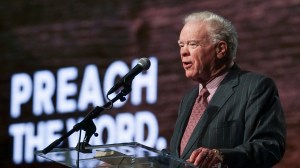
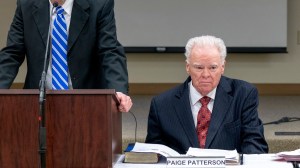
Florida Church Hosting Paige Patterson Faces Backlash

With advocates as well as the SBC president speaking out, #MeToo is changing expectations for who gets a platform in Southern Baptist churches.

Christianity Today January 28, 2020
Adam Covington / SWBTS / Baptist Press

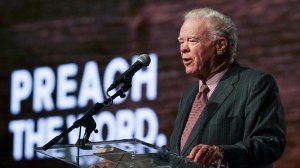
Amid a heated back-and-forth over Paige Patterson’s invitation to speak at a Florida church, the former Southern Baptist Convention leader’s supporters and opponents seem to agree on at least one thing: The #MeToo movement is changing the way some Baptists evaluate who is eligible for public ministry.

After Patterson was announced last month as a speaker at Fellowship Church’s Great Commission Weekend, fellow Southern Baptists and survivor advocates urged leaders to take him off the lineup in light of his 2018 termination from Southwestern Baptist Theological Seminary and allegations he mishandled students’ sexual abuse reports at multiple SBC seminaries. Last week, SBC president J. D. Greear waded into the discussion, urging churches to consider Patterson’s past before inviting him to speak.

Yet, Paige Patterson and his wife, Dorothy, remain top-billed for next weekend’s event. Timothy Pigg, pastor of Fellowship Church, told CT the church has received dozens of emails and phone calls about Patterson. The congregation’s social media traffic has increased approximately tenfold since announcing Patterson as a conference speaker, and its local newspaper, the Naples Daily News, reported on criticism of the church.

Two leaders with the Florida Baptist Convention were scheduled to speak at the conference but have withdrawn. Approximately 150–200 people are expected to attend. Sexual abuse victims’ advocate Susan Codone tweeted a request that people contact the church and ask it to withdraw Patterson’s invitation because “the #SBC and the many harmed by the Pattersons deserve better.”

Among Southern Baptists, adultery and divorce used to be the only sins thought to disqualify a person from public ministry, said Barry Hankins, a Baylor University historian who has written extensively on the SBC. But now, mishandling abuse may be joining the list.

“Things have changed so quickly across American culture with the #MeToo movement, whether you’re talking about Hollywood on one end or the Southern Baptist Convention on the other,” Hankins told Christianity Today. He said that Americans moved from thinking, “Let’s not make a big deal out of” sexual abuse, to thinking, “It’s a big deal, and anyone who doesn’t make a big deal out of it needs to be singled out.”

On Friday, president Greear cautioned churches to think twice before hosting Patterson, when asked by the Houston Chronicle about this weekend’s conference.

“Trustees terminated Paige Patterson for cause, publicly disclosing that his conduct was ‘antithetical to the core values of our faith.’ I advise any Southern Baptist church to consider this severe action before having Dr. Patterson preach or speak and to contact trustee officers if additional information is necessary,” said Greear, who himself studied under Patterson as his doctoral advisor and long saw him as a model and mentor in ministry.

Now, many Patterson supporters seem to agree with his concern, but some critics claim Greear’s statement violates the biblical principle of local church autonomy by attempting to govern a congregation from the outside—pushback that has followed every effort by the denomination to strengthen its response to abuse. The critics also say Patterson is not guilty of mishandling abuse.

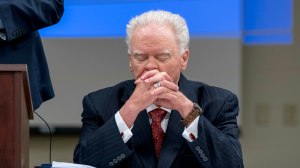
Patterson told CT, “President Greear has every right to hold any opinion of my life and ministry that he wishes. While I read his persuasion with great sorrow, he has a right to publish his views as far as he wishes. If he is accurate, I deserve it. If false, I leave the matter in the hands of God confident that God will excel in mercy and justice at all times.”

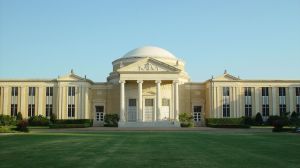
Patterson was removed from his presidential role at Southwestern in 2018 and terminated a week later. Trustees cited information regarding Patterson’s “handling of an allegation of sexual abuse” at “another institution” (presumably Southeastern Baptist Theological Seminary, where he was president from 1992–2003). Patterson also is being sued for allegedly mishandling a student’s claim of being sexually assaulted at Southwestern. Patterson has denied any wrongdoing at either seminary.

Over the past year, he has continued to preach at multiple Southern Baptist churches, including Victory Baptist Church in Rowlett, Texas, where he was recently given a “Defender of the Faith Award.”

Scott Colter, Patterson’s former chief of staff at Southwestern and a fellow speaker at the Great Commission Weekend, called Greear’s comments about Patterson “a monumental overreach and misuse of his role as SBC president.”

While some assume that hosting leaders surrounded in controversy will become too great a risk for churches, certain pastors now may see it instead as an opportunity to flex their independence. Colter said he heard from several pastors who responded to Greear’s remarks by inviting Patterson to preach.

Pigg, pastor of Fellowship Church, views Patterson’s appearance as a local church autonomy issue rather than a #MeToo issue. In a January 17 letter to Fellowship Church members, Pigg wrote that the allegations Patterson mishandled abuse have been “dispelled” and none of the actual reasons for his termination at Southwestern “would disqualify him biblically from occupying our pulpit,” according to a copy of the letter provided to CT.

Greear told the Chronicle that local church autonomy does not negate the need to “take our mutual accountability to each other more seriously than we have in the past. If our system of governance means anything, it means exercising due diligence and heeding what those whom we put in positions of trustee oversight have reported about official misconduct.”

Preventing and responding to sexual abuse continues to be an emphasis during the second year of Greear’s two-year presidency. While abuse advocates inside and outside the SBC have applauded Greear’s remarks, few major SBC leaders have joined him to speak out.

“Very grateful someone took a stand,” tweeted Rachael Denhollander. “Autonomy does not mean silence and lack of accountability. The most important thing we can do is speak the truth and push each other towards righteousness. May we see more of this, and deeper action still.”

Patterson is the first SBC entity executive to be terminated in the #MeToo era amid allegations of mishandling abuse. That has made his situation something of a new frontier for Southern Baptists—and a possible precedent for other leaders who have been fired or have stepped down over mishandling abuse allegations. Patterson “got caught in doing things the old way,” Hankins said. “He’s an egregious offender” but “not singular by any means.”

Online chatter also has surrounded other Southern Baptists accused of abuse and mishandling abuse, especially after Greear last year publicly listed 10 churches “alleged to have displayed a wanton disregard for the seriousness of abuse.” As accused ministers accept speaking engagements or begin new ministry ventures, more controversy is likely to ensue. (Attention has returned to influential SBC preacher Jerry Vines, who is alleged to have concealed claims of abuse alongside Patterson, according to reporting by the Chronicle. The pastor whose abuse he is accused of covering up—Darrell Gilyard—recently returned to the pulpit again.)

“The heighted awareness of the whole sexual assault [issue] is just radioactive right now,” Hankins said. A contingent of “younger Southern Baptist conservatives” are saying that “this old-boy, Southern Baptist way of doing things has just got to go, and the whole sexual assault scandal within the SBC has just raised the awareness.”

The SBC Voices blog has speculated that inviting Patterson to preach could carry consequences for a church within the broader SBC.

A January 14 post by William Thornton theorized that Fellowship Church “has been reported” to the SBC’s newly constituted Credentials Committee, which considers reports of a church’s alleged departure from Southern Baptist polity, doctrine, or practice. The Credentials Committee is charged with reporting to the SBC Executive Committee, which meets next month in Nashville, Tennessee.

David Roach is a writer in Nashville, Tennessee.

Church Life

They Run a Hip Vegan Restaurant—and Give All the Profits to Charity

How one NYC couple is aiming for a maximum return on investment in their business and life.

Christianity Today January 28, 2020
Courtesy of April Tam Smith / Restaurant photo: Peter Kubilus for Erik K. Daniels Architect

In the middle of Times Square, surrounded by Broadway theaters and Michelin-starred restaurants, sits an unassertive vegan restaurant that glows with pink neon lights above a marble bar. P.S. Kitchen is known for its splashy cocktails and upscale vegan fare, but more quietly, it is working to change lives.

Every business owner wants to achieve maximum return on investment (ROI), but maybe not in quite the same way as Graham Smith and April Tam Smith pursue it. They’ve borrowed tips and tricks from socially conscious business ventures and combined them artfully into one restaurant where every aspect of the business has a higher purpose—from the environmentally conscious fare to the intention with which they hire each cook or server.

The founders say that the restaurant’s revenue goes straight to organizations like ethical apparel brand Share Hope, anti–human trafficking nonprofit Restore NYC, and Justice Rising, which works to bring peace through education in war-torn countries. As a plant-based restaurant, the cuisine aims to be environmentally friendly and healthy. And, as a socially conscious restaurant, management hires people who struggle to stay gainfully employed. These three missions are what they call, as noted on the bottom corner of the menu, the “three PS’s.”

“It's like the end of an email,” April Tam Smith said. “I want to make sure people want to come because they find the food delicious and they love being here. It’s simply, by the way, we also do all of these other things. Like, oh, PS, we also give away all the profits. … And what’s really cool about the three PS’s is that [every employee is] really passionate about one of them.”

The restaurant is a brick-and-mortar representation of the Smiths’ life philosophy.

While April is a friendly whirlwind of generosity and grandiose ideas, Graham Smith is the quieter, more measured partner.

“We joke that I’m the gas pedal and he’s the brakes,” April said, laughing, about her husband. The two met at a Bible study with their previous church, Redeemer Presbyterian, back when Tim Keller was pastoring the multicampus church. Graham and April, the daughter of immigrants from Hong Kong, were working in investment banking and bonded immediately over their pull toward radical generosity.

Now, the Smiths’ lifestyle and budget fit almost into what some refer to as “reverse tithing”— giving away the bulk of their income while living off of a more modest sum. Following the Old Testament example of tithing as first mentioned in Genesis 14:20, many churches encourage their congregations to give away 10 percent of their income. But the concept of reverse tithing (giving away around 90 percent of your income) was made popular by Saddleback Church pastor Rick Warren, whose best-selling Purpose-Driven Life allowed him and his wife to give away vast amounts of money.

Although he hadn’t heard of Warren’s personal challenge to live generously, Graham had been living similarly when he first moved to the city. One of his professors at Wheaton College, David Sveen, had warned his entrepreneurship students against “golden handcuffs,” the idea that becoming attached to a lavish lifestyle or luxurious company perks can enslave the individual to a high-paying and demanding career. It made an impact on Graham.

Fresh from spending two months in Kampala, Uganda, Graham arrived in New York to work for Credit Suisse, determined to live modestly. While excelling in his career, he slept on a bunk bed, shared a two-bedroom apartment with four other roommates, and relied on public transportation.

“I saw finance not as a way of accumulating, but as distributing,” Graham said. The excess income he began to build early in his career he started to give away, a habit that drew him to April and that they have continued throughout their marriage.

For example, while their combined income (Graham now works in venture capital) would allow for many luxuries, the two have chosen to live in Harlem, a more affordable neighborhood in the city. And for their whole marriage, they’ve lived with roommates, whose rent payment is either nonexistent or given away to charity, according to the Smiths.

“We’ve had three roommates in five years,” Graham said. “We do community with them. That has been interesting and challenging at times.”

Most notably, the couple—along with the investment of their two other business partners—poured two years of post-tax income into building P.S. Kitchen and getting it off the ground, collaborating with industry experts Craig Cochran and Jeffrey LaPadula. Three months after getting married, they signed a 15-year lease in Times Square. Since they are donating the proceeds, they are currently not making money from the restaurant, the Smiths said.

“I think being in New York, there’s a lot of comparison” and fear of missing out, Graham told the Crazy Good Turns podcast last year. “There’s a type of anxiety that lives in New York City … I like to think of the phrase, ‘The secret to living is giving.’ So really getting outside of yourself.”

April also sits on five nonprofit boards (her main hobby is “volunteering,” she said). As she was serving around the city, April said she was struck by how difficult it was for some people from disadvantaged backgrounds to land a job. One of the goals of P.S. Kitchen is to offer employment opportunities to those who were previously incarcerated or disadvantaged for other reasons. In the past two years, they’ve offered jobs to more than 50 people who needed a second chance, they said. Their first “graduate” of P.S. Kitchen recently moved on to culinary school after working for the restaurant.

While their profit is small, the P.S. Kitchen donor-advised fund has given away over $130,000 to different nonprofits since opening in 2017. But the vegan, plant-based fare also attracts a different type of buy-in—from animal-rights advocates and environmental activists. The restaurant has garnered attention and visits from all kinds of visitors, from Oprah to the cast of Hamilton to members of the New York Knicks.

“We wanted to start a place that had a maximum ROI in terms of return on impact,” April said. “We view working here as a mission, and not just a job—and that really changed things.”

Similarly, Graham’s former professor, Sveen, believes that what’s equally important as a Christian witness in the Smiths’ enterprise is not just the financial giving—it’s also how they run their business. Are they kind to their employees and treat them as equals; do they pay them a fair wage and care about their families?

“The generous giving is fantastic, but there’s more that is important,” Sveen said. “It’s not just financial, it’s environmental, relational” factors that should testify to Graham and April’s belief that “Jesus is who he claims to be and are going to live that out in their economic enterprise.”

Graham, who graduated from Wheaton in 2012, recently won the Young Alumni Award from the Council for Christian Colleges and Universities (CCCU), an annual recognition presented to unusually successful alumni who have graduated within the past decade. The award is decided by committee after the schools nominate a star graduate.

He will be presented with the award on January 29 at the CCCU’s annual Presidents Conference for Christian college leaders. Past recipients of the 5-year-old award—a strategy for the council of 180 institutions to amplify positive achievements by Christian institutions—include Jacob Atem, a former “Lost Boy” of Sudan and co-founder of the Southern Sudan Healthcare Organization; and Angie Thomas, author of the New York Times best-seller The Hate U Give.

“We think [Smith] represents a Christian college grad—he’s got an extraordinary job in finance and is competing with best and brightest,” CCCU president Shirley Hoogstra told CT. He has “decided to organize his life where pursuing his vocation as a businessperson and finance person is good in the eyes of God as a vocation, and then also pursuing a social enterprise that allows for a imperative. You can feed the hungry and you can visit those in prison in a lot of different ways. He’s taking Matthew 25 and he’s actually putting it into a 2020 context. That’s a remarkable thing.”

Extreme generosity can look different according to each person’s resources and abilities. Not everyone can live on 10 percent of their income. But financial giving tends to be higher among evangelical Christians than among the general population. A 2013 Barna Group poll found that 5 percent of American adults tithe (give 10 percent or more) to a church or charitable organization, while 12 percent of evangelical Christians tithe. Predictably, while two-thirds of American adults with a household income of $60,000 or more said they donated money, only 45 percent of American adults who made less than $40,000 gave money away.

But for the Smiths, generosity is a fundamental conviction. They’re not living “like Mother Teresa,” April is quick to clarify. But in a city known for income disparity, their lifestyle is a radical witness.

“Graham said he wanted to marry somebody who would give our lives away together,” April said. “And that’s why it’s so much more than the money or the way we volunteer. Everything we have is God’s.”

Kara Bettis is an associate features editor with Christianity Today .

Books
Review

The Incarnation Lifts Our Gaze from Dust to Light

That God dwelt among us has profound implications for theology, art, and life.

Christianity Today January 28, 2020
Source Images: ZU_09 / Getty Images

When I was 10 years old, my dad would often interrupt our family devotions and begin speaking in this odd, rhapsodic way about the Incarnation. At the time I didn’t understand the connection between the mysterious thing he called the Incarnation and the boring Bible lesson we’d just been reading. Yet his reverent words took up residence in my memory. They became a sort of incantation, a spell he spoke over me that I could never figure out. I couldn’t escape the feeling that the Incarnation was somehow central to my existence. What did it mean that God took on flesh and dwelt among us?

The Shattering of Loneliness: On Christian Remembrance

The Shattering of Loneliness: On Christian Remembrance

Bloomsbury Continuum

192 pages

$15.99

Two decades later, I stood over my wife in a room full of highly specialized doctors and nurses. There must have been 17 people in this room. “It’s a party!” they all kept telling me. Most of the nurses in the room would never get to see something like this again.

For my wife, this was no party. She was sliced open, her abdomen retracted into a circular hole. Her body was a portal to transmit three brand-new souls into the world. I snuck a look at the first, continuing to watch as the doctor pulled two more babies out.

Eventually I looked over at my wife, who was stretched out in cruciform position on the operating table. Her arms were spread wide. Her face was separated from her body by a curtain that kept her from seeing those three newborns, those babies she carried—in rapidly increasing agony—over the preceding 35 weeks.

I can think of no image from my own life that so perfectly captures the mystery of incarnation. On one side of the room there are three beautiful and healthy boys, an image of the divine gift of life. On the other side my wife is lying down, pale and barely conscious. Over the coming years, Amy would develop anemia, insomnia, and depression from the bodily strain of keeping these three identical boys alive (along with raising our 4-year-old and 2-year-old daughters). But in that moment there are the boys, healthy and crying and demanding love. I ask permission to go and hold them. All Amy can do is stare blankly before finally nodding her head. She’s too exhausted to move and too emotionally spent to appreciate what’s just happened.

The Mystery of Suffering

In The Shattering of Loneliness: On Christian Remembrance, the Roman Catholic priest Erik Varden has written a book that describes just this mixture of joy and brokenness we experience as incarnate creatures. A former abbot of an English monastery, Varden has spent much of his life under a rigorous monastic rule. Even though I’m a Protestant who struggles to pray as often I should, Varden writes for Christians like me. He understands the desires that keep us from God and the deeper longings that lead us back to him. I was continually moved by his descriptions of beauty and suffering that call out for spiritual explanation. Varden has written one of those merely Christian books that illuminate the whole life of faith.

The son of a rural veterinarian from Norway, Varden became fascinated by World War II and the Holocaust at a young age. As a boy, he saw a man working in the field, shirtless and scarred all the way down his back. As his father later told him, the farmer had spent time in a Nazi camp, where he had been brutally whipped. The memory stayed with Varden and left him with a desire to understand the meaning of suffering. He wanted to find a good reason for that visceral image of pain. A few years later the adolescent Varden would hear the composer Gustav Mahler’s Symphony No. 2 (known as the Resurrection Symphony). This time he found himself moved by an almost inarticulate longing, and he began groping slowly toward belief. In the music he heard Mahler’s exultant insistence that our sufferings “are not in vain.”

By narrating these two experiences, Varden initiates the pattern for his short but remarkable book of spiritual devotion. He explores a theology of incarnation—our longing for God through our broken bodies and desires—through life, art, and theological meditation. Most chapters begin with a short reflection on communion or the Holy Spirit and then move toward an illustration of that theological insight, whether in life or art. Varden is not difficult to read, but his readings of Scripture and literature are theologically profound. He rewards careful attention and rereading. He describes familiar writers like Athanasius and Leo Tolstoy just as fluently as he introduces lesser-known figures such as the French Resistance worker Maiti Girtanner and the Swedish existentialist playwright Stig Dagerman.

While there is much to savor in Varden’s book, the first and last chapters are the most powerful. In the first chapter, “Remember you are dust,” Varden shows how the Genesis account of creation points in two directions. First, God’s creation of man reminds us of our humble origins. We are made of the dust of the earth. And after a life burned up with desires, we return to dust and ashes.

Secondly, and far more importantly, we have been shaped into the image of God by our Maker’s own fingers. As Varden points out, “we can never find rest in being nothing but dust.” Our spirit cries out with longing for a world beyond death. Varden quotes the playwright Dagerman, who wonders, “Divine love? I suppose it is what should set us free. In a Catholic author I read of a man who could see nothing because he was hidden in the light. If only we had a light to hide in.” Varden finds much to admire in Dagerman’s humility and honesty, but he doesn’t let Dagerman have the last word. Varden calls us to look into the abyss of death and find beyond it a light and a “comfort that does not deceive.” He wants us to remember all that Christ has done and all that he will do.

The rest of the book’s chapters trace the major Christian acts of corporate memory, the remembrances that lead us from a life where our gazes are directed at ourselves to a life defined by longing and hope. In the chapter “Remember Lot’s wife,” Varden describes the difficulty of moving forward in faith. He retells Leo Tolstoy’s “Father Sergius,” a story about a monk who takes literally Christ’s instruction to chop off limbs if they lead to sin (Mark 9:43–47). Despite his extreme actions, Tolstoy’s monk still feels the overwhelming pressures of his desires for power and sexual satisfaction. Yet even these misdirected desires continually lead him back to Christ. At the end of the story, Sergius finally finds peace in the imitation of Christ. He ends his life as a poor servant to a peasant family.

A Theology of Longing

Through vivid stories and historical examples, Varden drives his readers toward the source of all our longing. He wants us to take seriously the sufferings of this life, but he also wants us to see the real comforts of Christ’s incarnation and resurrection. In the final chapter, “Beware lest you forget the Lord,” Varden draws on Athanasius’s treatise on the Incarnation to complete this theology of longing. As Athanasius explains, Adam and Eve abandoned their original longing for God. Instead of looking to God in gratitude for their creation, they cast their eyes down to the earth.

For Varden and for Athanasius, the Incarnation is the deep mystery that redeems our sufferings and straightens our wayward desires. Christ comes to earth not merely to save us but to recreate us. He meets all our desires by suffering with us. As Varden writes, “In God incarnate, our humanity itself signified divine life.” Human beings find a divine outlet for their deepest desires in the God-man who redeems not only our souls but redirects our senses from dust to light. Christ teaches us to see the broken shards of our life as a pattern of remembrance. The act of memory binds us to the long history of Christian believers who came before us. For me, it also calls to mind my dad’s mysterious words on the Incarnation.

From Varden’s book, I have found not only a vivid theology of the Incarnation but also numerous stories of Christians who have pursued God despite unimaginable suffering. (The most moving story in the book focuses on Maiti Girtanner, a talented French pianist who suffered debilitating spinal torture at the hands of the Nazis for rescuing Jews). Varden’s book constantly redirects us to the importance of longing. In the broken body of a spouse or in the painful joys of parenting, we see the wounds of Christ. After Christ’s incarnation, we understand that “our bodies are privileged instruments in our search to know and love an incarnate God.”

Symbols of Hope

A couple years after the triplets were born, my wife wrote a blog post where she imagined traveling to a time after the hard years of raising children. In a reverse act of memory, she imagined herself as a 50-year-old looking back on the early years of our kids’ lives. No young boys hurtling over couches. No girls singing operatically outdoors on the trampoline. Just a quiet house with “no smashed [Cheez-Its], no poorly placed birdseed, no ‘home’ for the snails and murdered caterpillars.” This imagined act of remembrance was painful for her. She didn’t want to be alone. She felt a deep emptiness imagining a home without children. What happens when they leave?

But she also realized that the sufferings of those years had produced, as Paul promises in Romans 5, endurance and hope. The bodily scars, severe anemia, and nights without sleep made her long for the restoration of her body and soul. She longed for an endless communion with God and other human beings. As she said in that post, “Children, though they deplete all reserves necessary for a manageable existence, are the complete and utter symbol of HOPE.”

Varden has written a book full of these symbols of hope. Near the end of The Shattering of Loneliness, Varden reminds us that beauty gives us our intimations of eternity. The beauty in earthly suffering and in God’s creation “forges communion among people by indicating a universal realm in which individual solitude ceases.” In a world where old theological words like grace and sin have lost wide currency, Varden argues that beauty can awaken spiritual longing in any human being. As my dad hinted all those years ago, Christians point to the Incarnation as a symbol of our ultimate hope, the sign that God has dwelt among us and will one day restore his saints to glory.

Jonathan Callis teaches English at Oklahoma Baptist University.

Ideas

The Better Good News on Political Division

The “extreme middle” is shaped like a cross.

Christianity Today January 27, 2020
Source Image: Vitezslav Vylicil / Getty Images

My engagement with the impeachment imbroglio playing out in the hallowed chamber of the US Senate has been mostly after the fact. I watch daily news reports of the congressional proceedings and read the analysis. I scratch my head and roll my eyes. Given the allegiance of the politicians to their parties, the end appears as predictable as the beginning. As a dilettante of American history, I’m aware of our country’s predilection toward binary fury in its politics. Partisan democracy draws its energy from the passion polarity generates. Still, I appreciated columnist P. J. O’Rourke’s sardonic advocacy for extreme moderation: “We need a political system that isn’t so darn sure of itself. … Power to the far middle!”

Good and evil exist as mutually exclusive categories, but since we are fallible and finite humans, any overconfidence in judging ourselves or others as either is intrinsically fraught. Christianity’s doctrine of original sin (however you slice it) indicts even our best judgments as tinged by self-interest. The biblical writers adjure God’s people over and over to err on the side of mercy and leave the reckoning to God, who alone looks and sees our whole hearts (1 Sam. 16:7; Matt. 5:44–45; Rom. 12:17–19; 1 Thess. 5:21–22). Nevertheless, there are times when we must take a stand and even offend, especially in defense of the powerless and disenfranchised and for the cause of the gospel. Offense is sometimes the roadkill of righteousness (Matt. 11:6).

My esteemed predecessor bequeathed a fairly momentous legacy with his viral editorial last month. I’ve inherited the whirlwind, so to speak. Politics and theology both exist on broad continuums. By virtue of Mark Galli’s editorial and CT president Tim Dalrymple’s follow-up, we’ve situated ourselves on these continuums in a kind of extreme middle—in censorial critique of the president and yet open to conversation as well as critique. Tim Dalrymple used the metaphors of a flag and a table. Similarly, my predecessor described himself as “a stake in the ground kind of guy.” Everybody knows where he stands. I joke about being more of “a steak on the grill kind of guy.” I like to sit down over dinner and sort it out between us. The flag and the table.

What we say is important, and how we say it matters too. At CT, we strive to speak truth with love. Scripture instructs us to “Let your speech always be gracious, seasoned with salt, so that you may know how you ought to answer everyone” (Col. 4:6, NRSV). Jesus cautioned against losing our saltiness (Mark 9:50), which modern parlance equates with coarseness and disregard for the other. But the biblical metaphor goes back to the practice of Old Testament sacrifice. Offerings of gratitude and atonement would be seasoned with salt so as to be holy and pleasing to God (Ex. 30:35). Thus Jesus said, “Have salt among yourselves and be at peace with each other” (Mark 9:50).

Jesus was intentionally elusive as to political alignment. You really can’t nail him down, which is part of what got him nailed to a cross. He incited opposition with deliberately political language, speaking of God’s kingdom as one with values and purposes that reject political and cultural prerogatives. Then as now, kingdom implies power, specifically, the power to rule and control . For the Roman empire of Jesus’ day, kingdom power meant control by military might and brute force. Historians describe Pax Romana as a time of world peace, but Rome made peace by way of war, extortion, and economic domination. Roman apologists labeled this imperial supremacy “good news,” which it was as long as you weren’t an enemy of the state, a slave, an immigrant, a woman, poor, or Jewish.

Jesus’ first sermon in the Gospel of Mark—right out of the water and having defied the Devil in the desert—announced the kingdom of God as better good news (1:15). Jesus said the kingdom was near, but you had to repent to believe it. This no doubt offended his audience, chosen people chafing under oppressive Roman rule. Rural Galilee was first-century Israel’s version of a Bible belt. The people already believed in God and suffered for it. They hungered and thirsted for justice. How could Jesus call them to repentance? What did they do?

The better news of the kingdom of God was disturbingly ironic. Kingdom power would not rule through human force or political might or cultural complicity. Kingdom power works from the margins of human power and influence to love enemies and welcome outcasts and strangers. It cares for the poor, shuns privilege and the pursuit of wealth, and humbly goes the second mile, doing its good in secret and not for applause, its left hand not knowing what its right hand is doing. It’s confused with weakness and looks like defeat. Nowhere is this more evident than in Christianity’s calling card. Rome used crucifixion to viciously squelch insurrection. Jesus used the same cross to expose the futility of Roman violence and religious collusion with it while executing a sentence of forgiveness on his crucifiers. In God’s kingdom, peace was not made through the shedding of enemies’ blood, but by the King shedding his own blood. Ours is a Savior crucified by majority vote.

We know but forget that governments are not God. Governments lie and cannot be trusted. Only God can be trusted, which is why Jesus said repent and believe the better good news. Trust God, in whom true power resides.

Last month’s forthright editorials were not the last word, but the next word in what we intend as an ongoing conversation among Christians concerned for our country and its politics even as we pray God’s kingdom come and his will be done on earth as in heaven. Look for space in our pages and online for dialogue and debate but also, we pray, for consensus and commitment to living our lives in a manner worthy of the calling to which God has called us in Christ.

Daniel Harrell is editor in chief of Christianity Today.

Apple PodcastsDown ArrowDown ArrowDown Arrowarrow_left_altLeft ArrowLeft ArrowRight ArrowRight ArrowRight Arrowarrow_up_altUp ArrowUp ArrowAvailable at Amazoncaret-downCloseCloseEmailEmailExpandExpandExternalExternalFacebookfacebook-squareGiftGiftGooglegoogleGoogle KeephamburgerInstagraminstagram-squareLinkLinklinkedin-squareListenListenListenChristianity TodayCT Creative Studio Logologo_orgMegaphoneMenuMenupausePinterestPlayPlayPocketPodcastRSSRSSSaveSaveSaveSearchSearchsearchSpotifyStitcherTelegramTable of ContentsTable of Contentstwitter-squareWhatsAppXYouTubeYouTube