Here are all of CT’s 2019 cover stories from our print issues, ranked in reverse order of which ones our online readers looked at most.
Christianity Today’s 2019 Cover Stories, Ranked
Here are our print features that online readers looked at most.



Advancing the stories and ideas of the kingdom of God.




Here are our print features that online readers looked at most.
Here are all of CT’s 2019 cover stories from our print issues, ranked in reverse order of which ones our online readers looked at most.
The 70-year-old Texan leaves a legacy of love and support.

Lois Irene Evans, beloved wife of Tony Evans for 49 years and founder of Pastors' Wives Ministry, passed away Dec. 30, 2019 of biliary cancer. She was 70.
Tony, senior pastor of Oak Cliff Bible Fellowship in Dallas, shared the news on Facebook. "Just before the sun came up this morning," he wrote, "the love of my life transitioned from earth and watched her first sunrise from heaven."
Lois was with her husband and the couple's four children when she died Monday (December 30).
"As she slipped away, we told her how much we love her, how proud we are of her, and how thankful we are for the life she has lived," Pastor Evans wrote. "We are what we are because of her."
Priscilla Shirer, best-selling author, actress, and the Evanses' daughter, tweeted, "Goodnight my beautiful, beloved Mommy. I'll see you in the morning."
The Evanses' son, Christian music artist Anthony Evans, Jr., posted, "I love you forever, Mommy."
Southern Baptist Convention President J.D. Greear also expressed his condolences on Twitter. "Grieving with you and your family, Dr. Evans," Greear tweeted. "Your and Mrs. Lois' life and ministry have been an almost incalculable blessing to many of us."
Marshal Ausberry, president of the National African American Fellowship of the SBC and pastor of Antioch Baptist Church in Fairfax Station, Virginia, shared with condolences with Baptist Press.
"Lois Evans has been a picture of a loving wife, mother, and Christian woman," Ausberry told BP Thursday (January 2). "Lois Evans' strong support of her husband enabled him to do all he did. They truly served well as a team. The Evans family has touched countless lives around the world."
A 9 a.m. viewing and an 11 a.m. funeral are scheduled for Monday (January 6) at Oak Cliff Bible Fellowship Church.
"We are grateful for your thoughts and prayers," Pastor Evans wrote. "Many have asked how to help during this time. In honor of Lois, I would also love for you to consider sending flowers this week to your pastor's wife. Lois loved receiving flowers but she also loved giving them. Because her passion was ministering to pastors' wives and making sure they felt loved and cared for, your gift of flowers in her memory would be a gift to us as well."
In lieu of flowers, he suggested "continuing the ministry to pastors' wives that was dear to Lois' heart" by contributing to The Urban Alternative's Pastors' Wives Ministry.
Why did we turn on the Jews so quickly? And what do we do about it now?
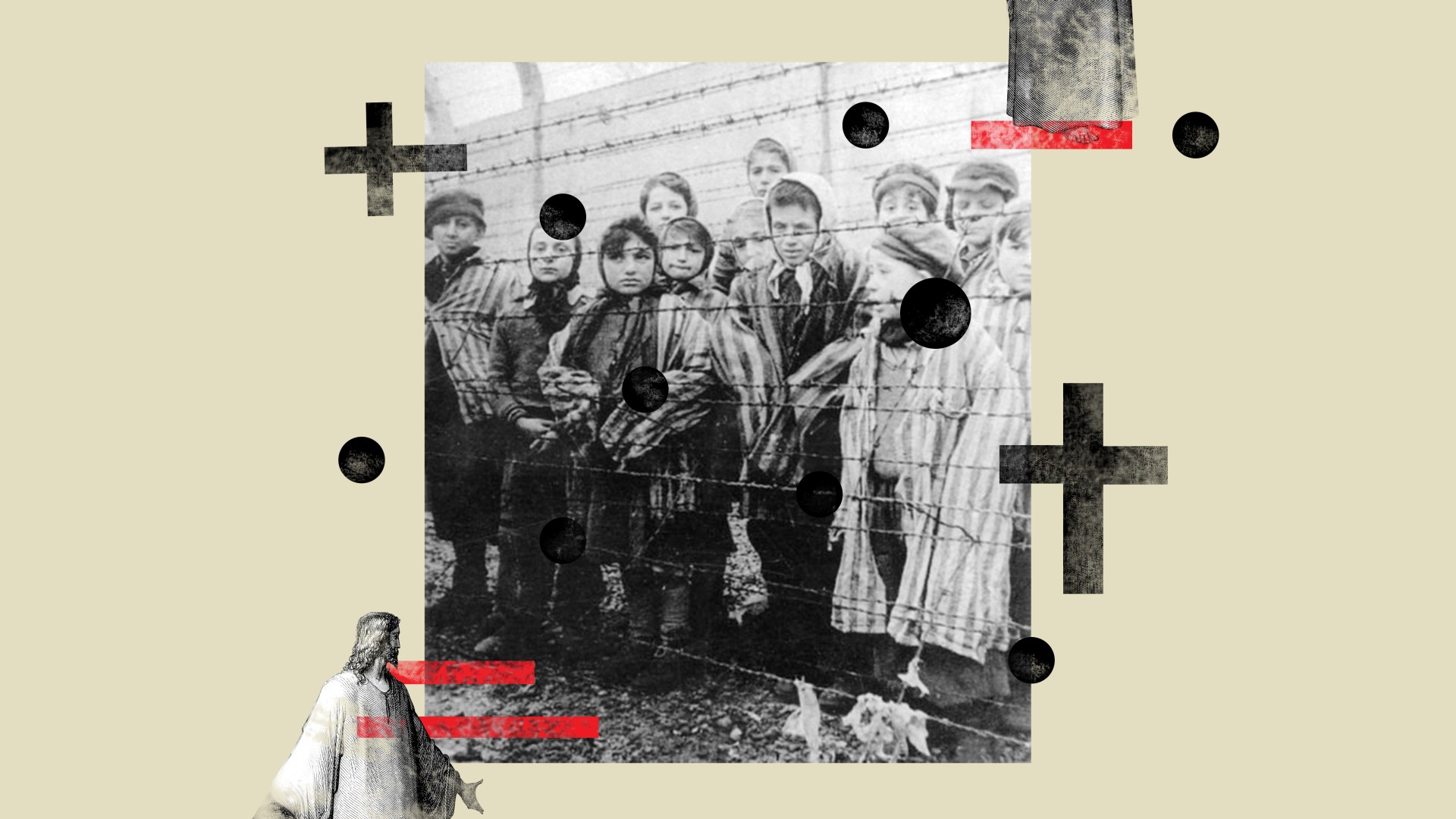
The custom of circumcising the flesh … was given to you [Jews] as a distinguishing mark…. The purpose of this was that you and only you might suffer the afflictions that are now justly yours; that only your land be desolated, and your cities ruined by fire, that the fruits of your land be eaten by strangers before your very eyes.
—Justin Martyr, Dialogue with Trypho, A.D. 138–161
We tend to think the birth of Christ was intended to be a blessing for the whole world. No question it eventually was seen as such, and rightly so. “Peace on earth and goodwill to men,” after all. But when the wise men came from the East, they were not looking for the universal savior, but only for the “king of the Jews” (Matt. 2:2).
When the priests and teachers explained to Herod that the Messiah would be born in Bethlehem, they quoted this verse: “And you, O Bethlehem in the land of Judah … a ruler will come from you who will be the shepherd for my people Israel” (Matt. 2:6, NLT). Not the shepherd of all people. But “for my people Israel.”
The first indication of this was noted by the angel who appeared in a dream to Joseph. After announcing that his betrothed will conceive by the Holy Spirit, the angel says, “And you are to give him the name Jesus, because he will save his people from their sins” (Matt. 1:21). Not all people. His people. That is, the Jews.
We might expect all that in Matthew’s gospel, which seems to have been written with a Jewish readership in mind. But not in the Gospel of Luke, who is said to have Gentiles in focus when he wrote his work. Yet we read in Luke 1:16 about an angel announcing to Zechariah the coming birth of John, who “will go on before the Lord,” bringing back “many of the people of Israel to the Lord their God.”
When Gabriel tells Mary that she will conceive and give birth to a son, he adds, “The Lord God will give him the throne of his father David, and he will reign over Jacob’s descendants forever” (Luke 1:32–33).
Later, when Mary and Elizabeth joyfully greet one another, Mary sings praises to God because “He has helped his servant Israel, remembering to be merciful to Abraham and his descendants forever, just as he promised our ancestors” (vv. 54–55).
When Zechariah’s tongue is finally loosed, he exclaims, “Praise be to the Lord, the God of Israel, because he has come to his people and redeemed them…” (v. 68).
There is little indication in the birth narratives that Jesus has come for the sake of the world. Instead he’s come for the most part as the new David, the Messiah of Israel, to redeem not the world or any other people, but only Israel. The arc of the gospel story from beginning almost to the end is this: Jesus came to save his people. Fast forward to the end of Luke’s Gospel to the scene with the two disciples on the road to Emmaus. When asked by a stranger what they are talking about, they reply, “About Jesus of Nazareth … We had hoped that he was the one who was going to redeem Israel” (24:20–21).
In short, while Jesus’ life, death, and resurrection have repercussions for the whole world, first and foremost, Jesus became “flesh and dwelt among us, full of grace and truth,” for the sake of the Jews.
The question is: Why did we forget this so quickly–to some extent within about a century (note the Justin Martyr quote above), and certainly within three?
Now then, let me strip down for the fight against the Jews themselves, so that the victory may be more glorious—so that you will learn that they are abominable and lawless and murderous and enemies of God. For there is no evidence of wickedness I can proclaim that is equal to this.
—John Chrysostom, from one of eight anti-Jewish sermons given in A.D. 386–387
By this time, the Jews do not seem to be a people deeply loved by God.
One reason we forgot Jesus came for the Jews is that after his conversation with the two disciples on the road, Jesus used the Scriptures to explain himself and universalize his meaning: “The Messiah will suffer and rise from the dead on the third day, and repentance for the forgiveness of sins will be preached in his name to all nations” (Luke 24:46–47, emphasis added).
We’ve read about that alongside the Great Commission in Matthew 28, alongside Paul’s adventures in preaching this message around the Mediterranean, and, soon enough, we’re thinking a lot about all nations and not much about the people of Israel. This led to the greatest movement in world history: the spreading of the Christian faith to every nook and cranny of the world. It’s a glorious story, not to be gainsaid.
But along the way, we made a mistake of monumental proportions. We forgot something crucial.
[I swear] to go on this journey only after avenging the blood of the crucified one (Jesus) by shedding Jewish blood and completely eradicating any trace of those bearing the name ‘Jew,’ thus assuaging his own burning wrath.
—Godfrey of Bouillon, Frankish knight of the First Crusade, A.D. 1095–1099
It is uncomfortable to say today that Jesus was killed by the Jews. And for good reason: That has led to the most vile and ugly racism the world has ever known. Theologically, it is crucial to say that we killed Jesus. All of us, Jew and Gentile. Legally and in fact, it was the Romans who literally killed Jesus. But for the sake of this article, let’s take note of this as well: Jesus was killed at the instigation of the Jews, who chanted, “Crucify him! Crucify him!” forcing the hand of a weak-willed Pilate. And here is the marvelous thing, contra Godfrey of Bouillon: He forgave them as he was dying. He did not reject, let alone forget, his people. He not only forgave them, but he told his disciples that his gospel should be preached “beginning in Jerusalem.” Even though his message is universalized, Israel still comes first.
Paul is absolutely clear on this point. He never forgets Israel’s priority place in the heart of God. The gospel is the power of salvation “to everyone who believes,” but “first to the Jew…” (Rom. 1:16).
Paul was never in danger of forgetting this. The fact that most Jews failed to recognize Jesus as Messiah tears him apart. “My heart is filled with bitter sorrow and unending grief for my people, my Jewish brothers and sisters. … They are the people of Israel, chosen to be God’s adopted children. God revealed his glory to them. He made covenants with them and gave them his law” (Rom. 9:1–4, NLT).
Perhaps the linchpin of his understanding comes next: “Christ himself was an Israelite as far as his human nature is concerned. And he is God, the one who rules over everything and is worthy of eternal praise!”
That’s a marked contrast to Justin Martyr and John Chrysostom, who seem to glory in Jewish suffering, which they chalk up to Jewish rejection of Jesus. They gloat. Paul weeps.
It’s even more of a contrast with Godfrey of Bullion and Martin Luther, who seek revenge.
What shall we Christians do with this rejected and condemned people, the Jews? Since they live among us, we dare not tolerate their conduct, now that we are aware of their lying and reviling and blaspheming…. I shall give you my sincere advice:
First to set fire to their synagogues or schools and to bury and cover with dirt whatever will not burn, so that no man will ever again see a stone or cinder of them. This is to be done in honor of our Lord and of Christendom, so that God might see that we are Christians…. Second, I advise that their houses also be razed and destroyed. … Third, I advise that all their prayer books and Talmudic writings, in which such idolatry, lies, cursing and blasphemy are taught, be taken from them…. Fourth, I advise that their rabbis be forbidden to teach henceforth on pain of loss of life and limb.
—Martin Luther, “The Jews and Their Lies,” A.D. 1543
We rightly stand in awe at the mystery that God become flesh and dwelt among us. We glory in the specificity of his life—sucking on the breast of Mary, learning carpentry from Joseph, living a daily and dusty life in the lost corner of the world called Nazareth, and so on. We often fail to appreciate that God took on Jewish flesh; that God, when he decided to become a man and walk among us, decided to do it as a Jew.
If we celebrate the Incarnation because it esteems the value of our material bodies, we should also celebrate it because it manifests the glory of the Jews, with whom, out of all the peoples on the earth, God decided to dwell. Jesus died on the cross as a Jew—“the King of the Jews” was written on a plaque on the cross in three languages. When Jesus rose bodily from the dead, his body was that of a Jew. And as Jesus now sits at the right hand of the Father, he does so as a Jew, the Chosen One of the chosen people.
This is not a new idea. Karl Barth noted it some decades ago:
There is one thing we must emphasize especially. … The Word did not simply become any “flesh.” … It became Jewish flesh. … The Church’s whole doctrine of the incarnation and atonement becomes abstract and valueless and meaningless to the extent that [Jesus’ Jewishness] comes to be regarded as something accidental and incidental (Church Dogmatics 4/1).
If God has invested so much in these Jews and in this one Jew—well, a most blessed and glorious people they must be.
Now the measures of the state towards Judaism in addition stand in a quite special context for the church. The Church of Christ has never lost sight of the thought that the “chosen people,” who nailed the Redeemer of the world to the cross, must bear the curse for its action through a long history of suffering… . But the history of the suffering of this people, loved and punished by God, stands under the sign of the final homecoming of the people of Israel to its God. And this home-coming happens in the conversion of Israel to Christ….This conversion, that is to be the end of the people’s period of suffering.
—Dietrich Bonhoeffer, “The Church and the Jewish Question,” 1933
Paul goes on in Romans, yes, to expand the notion of “the chosen people” so that it includes everyone who is not Jewish. But never does he suggest that, because the Jewish people as a whole have rejected Jesus, God now rejects them, or worse, causes their suffering, as Bonhoeffer and nearly every Christian before him believed. No, just the opposite: “God has not rejected his own people, whom he chose from the very beginning” (Rom. 11:2, NLT).
Yes, they have “stumbled,” but not so far as to “fall beyond recovery” (Rom. 11:11). In fact, God is using their transgression as a means to bring salvation to Gentiles—“their rejection brought reconciliation to the world” (v. 15). If that’s what their rejection means, “what will their acceptance mean but life from the dead?” Paul doesn’t say “if” they accept, but he speaks about their acceptance as if it will happen at some point.
And then he makes absolutely clear the relationship of Jews to Gentiles: Gentiles are like branches grafted on to the roots and the trunk of the tree (Rom. 11:17–18). The main thing is Israel. Israel is the privileged people. The Gentiles are—to not put too fine a point on it—second-class citizens. There is a hierarchy in the scope of salvation, and the Jews are at the top.
It’s as if Paul is saying, “And Gentiles, don’t you forget it.”
But we did forget it. And because we forgot it, the world, especially the Christian world, took note and decided that the Jews should become merely a memory.
We were packed into a closed cattle train. Inside the freight cars it was so dense that it was impossible to move. There was not enough air, many people fainted, others become hysterical…. In an isolated place, the train stopped. Soldiers entered the car and robbed us and even cut off fingers with rings. They claimed that we didn’t need them anymore. These soldiers, who wore German uniforms, spoke Ukrainian. We were disoriented by the long voyage, we thought we were in Ukraine. Days and nights passed. The air inside the car was poisoned by the smell of bodies and excrement. Nobody thought about food, only about water and air. Finally we arrived at Sobibor.
—Ada Lichtman, who was deported to Sobibor and was selected to be one of the few Jews working in the concentration camp and later escaped, 1942.
We not only forgot it, our minds moved in the exact opposite direction. Deriding the Jews. Spitting on Jews. Harassing Jews. Killing Jews. And we taught, by word and example, one of the most cultured Christian nations, thoroughly imbued with Lutheran sensibilities, to do the same. If by your fruits you shall know them—well, what does that say about us? When it comes to the Jews, what does our fruit taste like?
In the morning or noon time we were informed by Wirth, Schwarz, or by Oberhauser that a transport with Jews should arrive soon. … After the disembarkation, the Jews were told that they had come here for transfer and they should go to bath and disinfection.
… My post in the “tube” was close to the undressing barrack. Wirth briefed me that while I was there I should influence the Jews to behave calmly. After leaving the undressing barracks, I had to show the Jews the way to the gas chambers.
I believe that when I showed the Jews the way, they were convinced they were really going to the baths. After the Jews entered the gas chambers, the doors were closed by Hackenholt himself or by the Ukrainian subordinate to him. Then Hackenholt switched on the engine which supplied the gas. After five or seven minutes—and this is only an estimate—someone looked through the small window into the gas chamber to verify whether all inside were dead.
Only then were the outside doors opened and the gas chambers ventilated. After the ventilation of the gas chambers, a Jewish working group under the command of their kapo’s entered and removed the bodies from the chambers….
The corpses were besmirched with mud and urine or with spit. I could see that the lips and tips of the noses were a bluish color. Some of them had their eyes closed, others eyes rolled. The bodies were dragged out of the gas chambers and inspected by a dentist, who removed finger-rings and gold teeth. After this procedure, the corpses were thrown into a big pit.
—Karl Alfred Schluch, describing his experience at the Belzec Concentration Camp, 1942
The Jews to us have not been the apple of God’s eye but a people under a divine curse. They were not beloved for the sake of their ancestor Abraham, but were seen only as Christ-killers. And so we became Jew-killers.
Report No. 51 of Reichsfhrer-SS Heinrich Himmler to Hitler about mass executions in the east, 1942.
| – |
August |
September |
October |
November |
|
Prisoners executed after interrogation |
2,100 |
1,400 |
1,596 |
2,731 |
|
Accomplices of guerrilla and guerrilla suspects executed |
1,198 |
3,020 |
6,333 |
3,706 |
|
Jews executed |
31,246 |
165,282 |
95,735 |
70,948 |
|
Villages and localities burned down or destroyed |
35 |
12 |
20 |
92 |
To put it another way, over the centuries, the Jews became the mirror image of Jesus: “He was despised and rejected—a man of sorrows, acquainted with the deepest grief. We turned our backs on him and looked the other way. He was despised, and we did not care” (Isa. 53:3, NLT).
Can we not see that in rejecting the Jews, we have in some sense rejected our Lord?
For I was hungry and you gave me nothing to eat, I was thirsty and you gave me nothing to drink, I was a stranger and you did not invite me in, I needed clothes and you did not clothe me, I was sick and in prison and you did not look after me (Matt. 25:42–43).
Perhaps it is the Jews—who were ethnically, culturally, religiously his brothers and sisters—whom Jesus also had in mind when he told this parable. If that is the case, woe to us Christians who have not merely forgotten these least among us but have put them in prison and taken away their clothes and let them starve. And if that was not enough, we set such an example of hate that nation after nation steeped in Christian faith—Germany, France, Poland, and on it goes—thought nothing of harassing and killing the least of these.
Yes, there has always been a small minority of noble and brave Christians who have stood up for the least of these. Some of them commoners, some kings and popes. But always a small minority.
I hear, “Oh, but they weren’t evangelical Christians, they were not real Christians. If we had been the major expression of Christianity, we would have never done something so horrible.” Except when we were the main expression of American Christianity, we enslaved Africans by the millions, treating them with a cruelty that can only be compared to the Holocaust. No, all have sinned and fall short of the glory of the God of the Jews.
But why? Why have we spent two millennia participating in such cruelty? What was that all about? How could we be so obtuse? Not to put too fine a point on it—how could we be so evil?
The rulers of the Third Reich wanted to crush the entire Jewish people, to cancel it from the register of the peoples of the earth. Thus the words of the Psalm: “We are being killed, accounted as sheep for the slaughter” were fulfilled in a terrifying way. Deep down, those vicious criminals, by wiping out this people, wanted to kill the God who called Abraham, who spoke on Sinai and laid down principles to serve as a guide for mankind, principles that are eternally valid. If this people, by its very existence, was a witness to the God who spoke to humanity and took us to himself, then that God finally had to die and power had to belong to man alone.”
—Pope Benedict XVI, speaking at Auschwitz, 2006
Let’s not try to weasel out of this by saying, no, we were not members, let alone rulers, of the Third Reich. Let us not pretend that there is no evidence that Christians have, certainly at times, wished “to cancel [the Jewish people] from the register of the peoples of the earth.” History shows that Christians were only too willing to go along with the Third Reich, sometimes egging it on, sometimes guiltily looking the other way.
This sounds horrid, and it is. Then again, our participation in this sin against the Jews is as old as history, and is the same as that of Adam and Eve—the yearning to be free from God that we might be like gods. Our sin against the Jews is the same as the hard-heartedness with which all of us put Jesus on the cross. At base, we do not want to be ruled by God.
The Roman Catholic and Anglican churches teach that at the Eucharist, Christ’s death on the cross is re-presented. He is not sacrificed again, but his death is presented to our eyes and bodies and souls afresh. One does not have to buy into the doctrine of transubstantiation or even real presence to see the value of thinking about the Lord’s Supper in this way.
But this re-presenting has not just happened at each and every Eucharist, but also at each and every pogrom, at each and every slanderous word spoken against the chosen people, at each and every man, woman, and child who suffocated in jammed box cars or who inhaled deadly gas in a barren and cold “shower room.” As we have sinned against the least of these, we have re-presented Christ on the cross, and the chosen people were re-presented, collapsed into the body of the Chosen One, pressed with divine force into him, in a fusion of judgment and mercy, of sinner and redeemed, of this age and the next.
And what he prayed on the cross he has prayed ever since, year after year, century after century, pogrom after pogrom, train car after train car, crematory after crematory: “Father, forgive them, for they know not what they do.”
My Jewish readers are surely not happy at this point—if after five years of interfaith dialogue I understand them. If there was ever a statement that seems like cheap grace, this is it—that Jesus forgives the most heinous sins in history. Just like that. With a mere breath of words.
To many of my Jewish friends, forgiveness for such a sin would be immoral. (I’m thinking especially of the powerful essay by Meir Y. Soleveichik, “The Virtue of Hate.”) And even if this impossibility were to become possible somehow, many Jews would demand that forgiveness must be preceded by a desperate repentance and heroic effort at atonement.
For the Christian, it works in just the opposite fashion.
First comes the forgiveness.
Then comes the atonement.
Then comes the repentance.
Jesus forgives our sin while on the cross, and then dies to atone for our sin. And now he calls us to repentance. I grant that this whole business is more theologically complex than this simple summary. But it’s still not a bad summary of how things work. We don’t earn our salvation, but we certainly work it out in fear and trembling.
To put it another way, Jesus’ word of forgiveness and his work of atonement do not give us a free pass. Repentance is not a one-time event but a lifelong journey. Martin Luther’s first thesis of 95 put it like this: “When our Lord and Master Jesus Christ said, ‘Repent’ (Matt 4:17), he willed the entire life of believers to be one of repentance.”
No, the Cross is not a free pass as much as it is a work permit. And the work permit in this case says this:
The bearer of these divine gifts is entitled and commanded the following: Love your Jewish brothers and sisters like you’ve never loved them before. Love them year after year, century after century, maybe for two millennia. Show them what repentance looks like. And then, maybe, when you tell them about the forgiveness of Jesus, then, maybe, they might be willing to listen. And then, maybe, they also might forgive you.
Mark Galli is editor in chief of Christianity Today.
Note: This article has been edited for clarity since its original publication.
The president kicks off 2020 outreach at a Miami church that includes staunch supporters and swing voters.
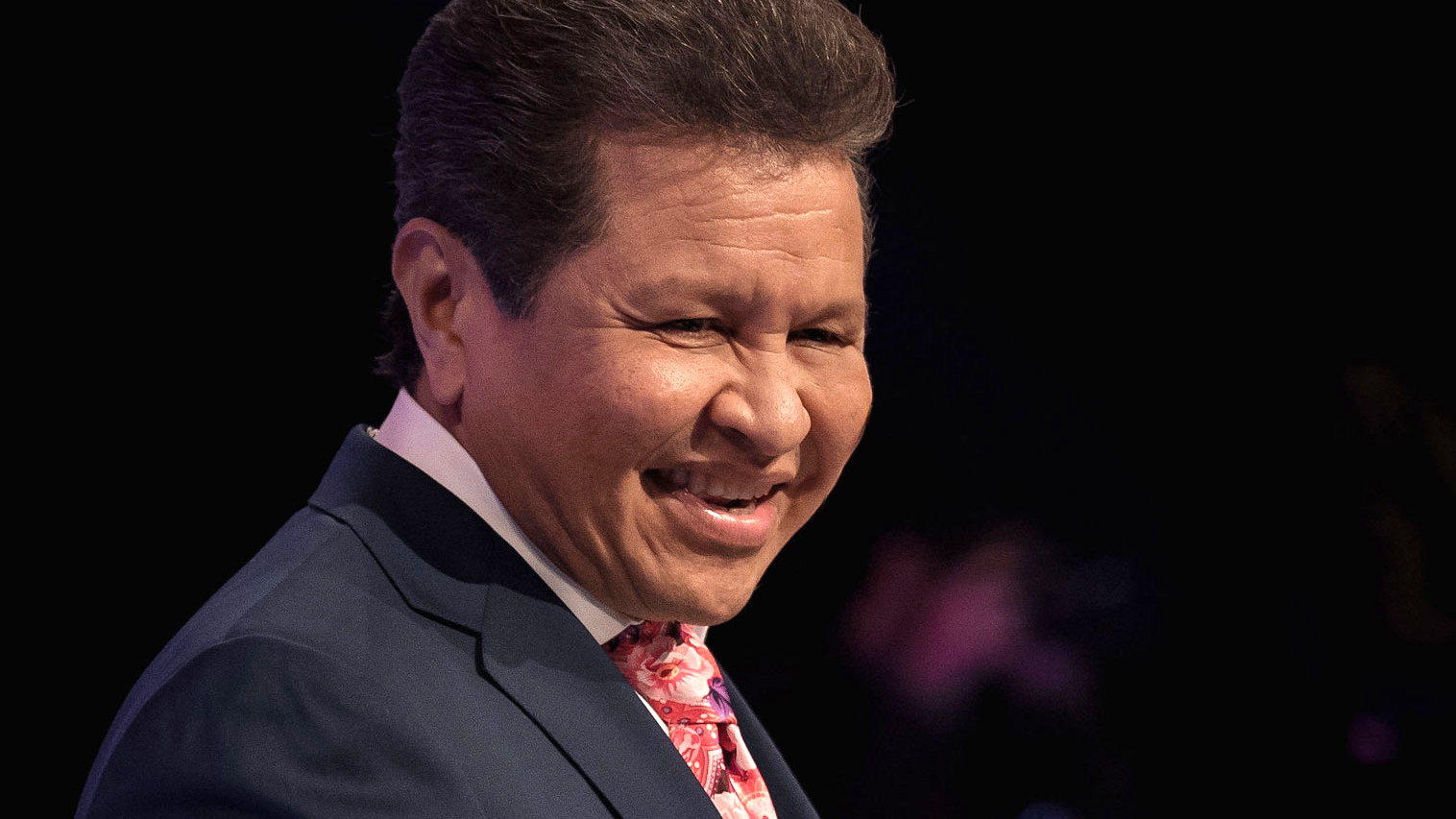
Pastor Guillermo Maldonado has visited the White House several times during Donald Trump’s presidency. Now, the president is coming to his church.
Maldonado leads what’s considered the biggest Spanish-speaking congregation in the country—El Rey Jesús, or King Jesus International Ministry—whose 7,000-seat sanctuary will be the location for today’s “Evangelicals for Trump” rally in Miami, a kickoff to Trump’s 2020 outreach to Christian leaders as well as the Hispanic faithful.
The 54-year-old Honduran American has joined fellow Pentecostal preachers such as spiritual-adviser-turned-faith-outreach-official Paula White-Cain at Trump’s gatherings with evangelical leaders, laying hands on him during a prayer session back in October and visiting most recently for a Christmas reception.
Maldonado serves as an apostle alongside his wife Ana who serves as a prophet at King Jesus, a 23-year-old global ministry that falls in line with the New Apostolic Reformation (NAR) movement. Like leaders at Bethel Church and the International House of Prayer, Maldonado focuses on declaring what he hears as God’s prophetic words.
Maldonado is not only a pastor to his congregation, which holds both Spanish and English services each week, but also a spiritual father to fellow ministers. Beyond the 10 King Jesus churches in the US, Maldonado’s network extends to hundreds of Apostolic churches in 50 countries, plus thousands more who watch him on Daystar and TBN.
A year ago, he claimed he had “activated 1.5 million people in the supernatural.” He describes the practical manifestations of the supernatural, saying that God’s word and his Spirit—released at the right time—transform people’s lives. He shares testimonies of struggling churches of 40 people that turned into booming megachurches of 40,000; secular businesses blessed with dozens of franchises and hundreds of thousands of dollars in profits; and even effective commands to hurricanes to avoid the Miami area.
He’s now one of 70 leaders who have joined the Evangelicals for Trump coalition to back the president in his re-election campaign. King Jesus released a statement explaining that the church has rented space for the event but is not involved in organizing it. Maldonado, the church said, will be appearing in his personal capacity.
Samuel Rodriguez, president of the National Hispanic Christian Leadership Conference called it “politically brilliant” for Trump to start the year with a major rally at a Latino megachurch in Florida.
Trump campaign communications director Tim Murtaugh said the evangelical rally at King Jesus had already been in the works prior to Christianity Today’s viral editorial challenging evangelical support for the president and calling for his removal from office. Trump Victory’s national press secretary, Kayleigh McEnany, told media the church was “a natural fit” since “Apostle Maldonado is a staunch supporter.”
Maldonado also “represents a growing segment of Christianity,” said Candy Gunther Brown, an Indiana University religious studies professor who researches Pentecostals and Charismatics. “Many of Maldonado's emphases—healing, deliverance, faith, prosperity, kingdom of heaven, and, yes, apostolic leadership and tongues—can be found in many, many churches in the US and in Latin America.”
The Miami-based minister—who was born in Honduras and came to faith in college in the US—was among the Hispanic pastors who attended a roundtable with the president last January. He has spoken up in favor of the administration’s border control policies. Ahead of today’s rally, Maldonado assured his church that undocumented congregants would be welcome to attend without fear of deportation: “Someone said, ‘But how can you bring Trump to church if there’s people who don’t have papers?’ I ask you: Do you think I would do something where I would endanger my people? I’m not that dumb.”
The Tampa Bay Times reported that Maldonado also shared from the pulpit “migration miracles” of people in their church including “a woman who had finally become a US citizen after years of waiting, a man who had been previously denied a visa through a family sponsor and received his green card, and a woman who said a change in her son’s immigration status that had put him at risk of deportation was resolved through divine intervention.”
A member of the executive committee for the Latino Coalition for Israel, Maldonado has also praised Trump for moving the US embassy from Tel Aviv to Jerusalem.
But he has mostly emphasized the biblical call to pray for government leaders, regardless of their policy positions. He said commitment to pray for those in power even extended to Fidel Castro in Cuba—though, like many of his congregants who suffered under communist governments in Cuba and Venezuela, he opposed his policies.
Politicians of both parties have made campaign stops at King Jesus services over the years, enough that the Washington Post in 2012 wrote that coming to Maldonado’s megachurch “is a requirement if you want to run for Congress in South Florida.” Maldonado said he takes this responsibility seriously. “What is my responsibility? To pray for them. And to vote,” the pastor said at the time. “Anybody can come here to the church, they asked, and I said okay.”
This fall, Maldonado opened a sermon by greeting his congregation and the viewers streaming the serviced online, saying, “I love this country, I love America, I love the president, I love everybody.” He added, “If you love the president—the Bible says if you don’t love your brother, you’re going to hell. You have to love him. You have to pray for him. Amen? Okay.”
Maldonado is close with the charismatic leader Cindy Jacobs, a fellow apostle who decades ago prophesied that his congregation in Miami would flourish, and now appears alongside her, Lou Engle, Che Ahn, James Goll, and dozens of others at her annual prophetic ministry conference. During last year’s event, Maldonado shared that God told him, “I have raised somebody in office to open the doors for my gospels” and “America, open your eyes. Do not miss the time of your visitation.”
Christians in the New Apostolic Reformation movement—a term which was popularized and described by missiologist Peter C. Wagner—want to see Christians rise to positions of influence across sectors of society. Some refer to the “seven mountains” of business, government, media, arts and entertainment, education, family, and religion. In a 2017 interview with CT, Brad Christerson, professor of sociology at Biola University and co-author of the Rise of Network Christianity, described how many Christians in this movement believe God “is appointing people into these high positions” in government, “he will use them to supernaturally make America or the world into the kingdom of God,” and at this time, “God is using Trump to bring in the kingdom.”
Similar attitudes come up in politics in Latin America, where evangelicals have grown in influence and members of the New Apostolic Reformation in particular have started running for office, according to Martin Ocaña, a pastor who belongs to Peru’s national evangelical council. One apostolic network in his home country, where multiple apostles and their wives (“prophets”) have run for office, states that “the church’s mission is to influence until you get to rule and reign on the earth (Rev. 5:9)” and “we are now in the kairos of God for a more glorious manifestation of the sons and daughters of God in all areas and institutions of human life.”
Christerson observed that American NAR leaders tend to back Christian politicians regardless of whether they are fellow Pentecostals, or in the case of Trump, “Some … describe Trump as a King Cyrus figure—he’s not one of us, but God is using him to defeat our enemies and restore our nation.” (But the US is also seeing leaders from within the movement seek office themselves; last fall, Bethel worship musician Sean Feucht announced he’d be running for US Congress in California.)
Plenty of Maldonado’s 600,000 Instagram followers applaud his work with the White House, liking photos of his visits and mentioning that they too are praying from the Trump administration. But King Jesus in Miami, the spiritual home to thousands from across Latin America, also contains “a lot of swing voters,” Carlos Curbelo, a Republican who represented the area in Congress from 2015 until 2019, told the Miami Herald.
CT previously reported how 41 percent of Hispanics with evangelical beliefs voted for Trump in 2016, according to data from the Billy Graham Center Institute at Wheaton College and LifeWay Research. “Most Latinos will tend to be socially conservative on issues like abortion and same-sex marriage but will tend to be social liberals on issues like education and immigration, so we’ve tended to be divided on how we spread the vote,” said Juan Martínez, former professor of Hispanic studies at Fuller Theological Seminary and now the vice president at Ashland Theological Seminary. “This isn’t new; it just stands out more because we’re a larger percentage of the voting block. Those of us who have voted have struggled with this for years because the Democrat/Republican way that this is broken out doesn’t fit us well.”
Rodriguez of the NHCLC, also one of Trump’s evangelical advisers, predicts more Republican voters in the upcoming election. “Latino evangelicals represent a constituency that is pro-life, supportive of religious liberty, and focused on biblical justice,” he told CT. “The unprecedented hard left turn by the Democratic Party, abandoning the Obama strategy of 2008, will prompt more Latino evangelicals to support President Trump in 2020.”
White evangelicals have been a reliable source of support for the president, and an Associated Press-NORC Center for Public Affairs Research poll released yesterday found that 8 in 10 white evangelicals approved of Trump’s job performance, though not unequivocally. Most (self-identified) white evangelicals said they opposed the administration’s policy of separating families detained at the border, though nonwhite Protestants and mainline Protestants also opposed that policy by slightly larger margins.
After years of “playing it cool” with my unbelieving friends, I can tell you: It only gets weirder to talk about faith the longer you wait.

Last January, I made an unusual resolution. On New Year’s Day, like many people, I peel the plastic off a new planner and imagine its pages filled with earnest but unlikely ambitions, from reading the Bible cover to cover to praying the Examen every night. But last year, instead of changing a daily practice, I set out to change a pattern: I would begin to speak openly about my Christian faith. Doing so would require revealing my relationship with Jesus to many people outside of my church community for the first time.
I’m a resident of the “None Zone,” a title the Pacific Northwest was given nearly two decades ago thanks to a high percentage of residents that claim no affiliation with any religion. In a 2017 Gallup poll of Washington state, 47% of American adults identified as not religious compared to 33% of the general population. Seattle, in particular, is one of many progressive American cities where the cultural narrative says Christians are an anomaly at best or anti-intellectual and backward at worst.
When I made my New Year’s resolution, I had been living in Seattle for 15 years. I knew how to walk the line. If I met a non-Christian, I’d carefully consider when to reveal that I attend church. More likely than not, I wouldn’t mention it at all. When I was in grad school during that time, a friend was flummoxed to discover my Christian faith through a blog post I’d written, since I’d only talked about my Jewish family. When I did mention my faith, I would do all I could to let people know that I’m a Christian but not that kind of Christian—one that fits an urbanite’s “straw man” stereotype of evangelicals. I wanted to be the sort of believer you could invite to your party.
Over time, the strategy of withholding my relationship with Jesus began to backfire, and I started to wither inside. It takes time and energy to present different sides of yourself to different people; no one can be their own PR manager forever. I was swimming in murky and lukewarm waters in both my online and real lives, and I’d become disingenuous and detached. The vibrancy of my faith was suffering, too.
After decades of “playing it cool” in hopes that I’d pass an imaginary litmus test from my many agnostic and spiritual-but-not-religious friends, let me tell you: It only gets weirder to talk about faith the longer you wait.
I was well aware of the risks of opening up. I knew what it looked like when conversations with non-Christian friends went south, because it had happened to me several times over the years. These scenarios didn’t end in confrontation but in ghosting. Once, sitting outside a cafe in Seattle’s Capitol Hill neighborhood, I told a public radio producer about my faith life and church attendance. The heavy weight of silence after I spoke was palpable. We finished our coffee, shuffled through a few more minutes of awkward conversation, and then bussed the table. I never heard from him again.
A similar scenario played out with an acquaintance I met in a writing class. Over pizza at a restaurant near downtown, I told her about my family of origin and talked about how my faith impacts my ethical framework. Instead of inquiring further, the conversation flatlined. We finished a final slice and parted ways.
I spent the next several years playing out in my head (and then avoiding) similar scenes with other acquaintances. But then the Spirit began to convict me in prayer to move past the shame I’d attached to the gospel. Slowly, God revealed the paradox I had created: The thing I most value, life with God, was the thing I’d hidden for fear of judgment.
During this past year of practicing a more public witness, I’ve learned a few things.
First, when we withhold our identities as Christians, we tacitly participate in the cultural narrative that we can manage how we message ourselves. The need for peer acceptance becomes an idol. But the Christian story reminds us that we can’t predict the outcome of our lives, nor can we control how others perceive or receive us. The Christian life resists the category of “personal branding.” Instead, it is generative and others-facing.
Second, I’ve learned that if you have a fear of talking about Jesus for whatever reason—maybe for what seem like good reasons—remember: The people you think are against you might actually be for you. Although I have been ghosted, the opposite has also happened. In the past year, I’ve had coffee with people from my past who are genuinely curious about my faith experience. These moments have been a gift. I’ve been able to deeply listen to and better understand the experiences of friends who identify as spiritual but not religious. Conversely, I’ve been given the space to speak candidly about Jesus.
Finally, I’ve re-learned what I know already but keep forgetting: I don’t sit at the center of the story—God does. As Christians, we believe that our lives are hidden with God and held by him, and that’s immensely liberating. By contrast, it’s tiring to exert anxious energy skirting around that reality.
I’ve seen this truth play out in my writing life as well. Last year, I started writing more publicly about faith and culture, but before I did, I pictured a couch with my critics seated in a row. I started to name them in my head—not just particular people from my past but also my own fears. Then I pictured each person or each fear getting up from the couch, one by one. Slowly, my fear was replaced with levity.
In the Sermon on the Mount, Jesus offers an admonition that could have been written to American Christians in 2020. We’re counseled not to become like salt that loses its saltiness (Matt. 5:13) or a lamp hidden under a bowl (Matt. 5:15). Maybe in recent years, we’ve had the wrong idea of what it means to be salty. Instead of an in-your-face bumper sticker or another politically charged Facebook post, we are called to a much simpler practice: being present and transparent with our neighbors.
“In the same way, let your light shine before others,” Jesus says, “that they may see your good deeds and glorify your Father in heaven” (Matt. 5:16). We learn this passage as kids in Sunday School, and we sing it, too: “This little light of mine, I’m gonna to let it shine.” It’s an invitation intuited by children and easily muffled by adults.
Instead of speaking about our faith ironically or with a carefully chosen filter, let’s speak with transparency and boldness. Even better, let’s not go it alone. Let’s also speak with confidence about how God’s goodness changes us and changes our communities. We’re never going to reverse the tide of people leaving the church if we don’t speak plainly about who we are as the church body and what motivates us to pursue Jesus.
Yes, our lives might seem strange and even off-putting to some secular friends. But when we live honestly and openly, we become co-laborers with Christ and bear witness to the fact that it’s not about us in the first place.
Sara Billups is a Seattle-based writer exploring faith and culture and the co-host of the Ebenezer Podcast. Read more on her website and Instagram and in her occasional newsletter, Bitter Scroll.
We think these articles rocked. If you missed them, check them out!

Christianity Today’s work spans the spectrum from entertainment to small town pastorship, representing what affects our readers and writers throughout the year. If you haven’t seen these articles, we think you should. Check out our “in case you missed it” list from 2019:
“So whatever effect pornography is having, it isn’t enough to offset the effects of many other conservative Protestant lifestyle choices that are strongly associated with personal, marital, and sexual happiness. This lifestyle of chastity until marriage and commitment within marriage is still, in fact, the most strongly happiness-associated lifestyle in America today.”
Excerpt: “Instead of comfort, I have chosen to prize truth, in imitation of the two writers I admire most—Fyodor Dostoevsky and Flannery O’Connor. Both of them give the devil his due in order to save us from losing our souls.”
“Like Elijah, we may experience ministry failure, doubt our calling, or feel tempted to give up. But the Holy Spirit will never let us run so far that we are no longer in his presence. The gentle whisper of the Spirit is there—we can learn to listen and wait for it in hope.”
“Reading For the Life of the World reminds us that the church in North America (and beyond) has a dual problem with its academic theology: The academics are increasingly spending their time and energy on pursuits that do not enable the laity to see and understand more deeply the gospel of Christ and his power for their daily lives; and the laity, faced with such irrelevant output, are increasingly convinced that theology has no place in their lives. Instead of calling each other to account, the two sides have let the situation worsen.”
“Like most Americans, I grew up hearing that hard work is essential for success. What I didn’t hear, though, is that hard work isn’t the same in all circumstances, so it doesn’t have the same results.”
“It’s not so much that women are more likely to be literalists, but people who experience a secure, personal, intimate relationship with God are more likely to be literalists. If you take a man and a woman who report the same level of closeness to God, there is no difference in their likelihood of being literalists. So then you get into questions of socialization: Why do we find that women are more likely to seek that intimacy than men?”
Excerpt: “Short of massive revivals among men (an aim that even efforts like Promise Keepers and Mark Driscoll’s work never achieved), the church must change how it talks about singleness and marriage.”
Excerpt: “It had been raining for 42 days straight when I considered taking my own life. I had no transportation, no license, and no hopes of getting one anytime soon. I was miles away from civilization and as sober as I’d ever been.”
“When we advocate on behalf of Muslims and other religious minorities, the Golden Rule dovetails with making common cause against aggressive secularization and government overreach.”
“For Bonnie and the toys he loves to have any chance to flourish, Woody, much like the Boomers in the audience, must find a way to let go—to let the other toys step fully into their vocation—and to have enough faith in them to know that, when he does, ‘it’s going to be okay.’”
“The core question we all should be wrestling with, Shatzer offers, is what is real—in our experiences, the places we inhabit, the relationships we form, and our self-understandings.”
“When I called Pat by name on her second Sunday her eyes got wide. ‘How did you remember my name?’ she asked. I didn’t tell her that I work at it. Learning someone’s name is an introductory act of Christian love. We can’t dismiss this duty by saying, ‘I’m just not good with names.’ If that’s the case, then you’ll just have to work harder at them.”
“Hansen’s Disease, which is commonly known as leprosy, actually just kills the pain nerves in your body. All the damage we associate with leprosy—fingers falling off and that kind of thing—happens because people hurt themselves and don’t realize it. They’re actually destroying their own bodies because they can’t feel pain. Jesus’ healing of lepers was restoring their ability to feel pain.”
“By and large, black and white evangelicals share orthodoxy. However, their cultural and experiential differences resulted in divergent theological methods, which explains the disagreements regarding orthopraxy.”
“We believe that those who will never leave their dusty roads and remote settings ought to have accessible gospel community for the glory of God and the good of their neighbors.”
“I wanted to let church leaders know that there is a fully developed ministry philosophy that doesn’t focus on a woman’s stage of life or marital status but that is all about equipping women in discipleship in the local church.”
“We continually told couples that it’s never too early and never too late to take part in a marriage enrichment program.”
“If you don’t put the sails up, pull the mainsheet fast, or adjust the jib, you won’t go anywhere, even if the wind is blowing powerfully.”
“The fact of the matter is that the government runs the foster care system. We cannot serve foster children without contracting with the state.”
“Most Christians were among more than 1.3 million Cambodians whose bodies were scattered in more than 20,000 mass burial sites called ‘killing fields’ throughout the country, in what many consider the worst genocide of the 20th century.”
“The guidelines for holy living are spoken to us as God’s gathered children, the way I might sit my children down around the dinner table for a family discussion.”
“Distinguishing itself from the arguments of abolitionists Thomas Clarkson and John Newton, Equiano’s Christian argument against the slave trade and slavery proved historically unique because he wrote about the horror of slavery, having experienced it firsthand.”
“We set out to flee, but my husband was captured by extremists. I continued with my plan to escape Pakistan, thinking my husband had been killed. I knelt in church every day praying for his safety, even though the evidence told me it was futile.”
“When congregations engage in recreation, laughter, and creative pursuits together, they are building bonds that strengthen mission, deepen fellowship, and create a relational foundation for discipleship.”
“Multitudes came out to hear the Gospel. The blind were led; the maimed, the aged and the decrepit, and many invalids were brought on the backs of their friends. There was great joy and weeping in the assembly.”
For more “in case you missed it” lists, check out our picks from 2017 and 2018.
Armed security guards protected the Fort Worth-area flock against “evil” in the pews.
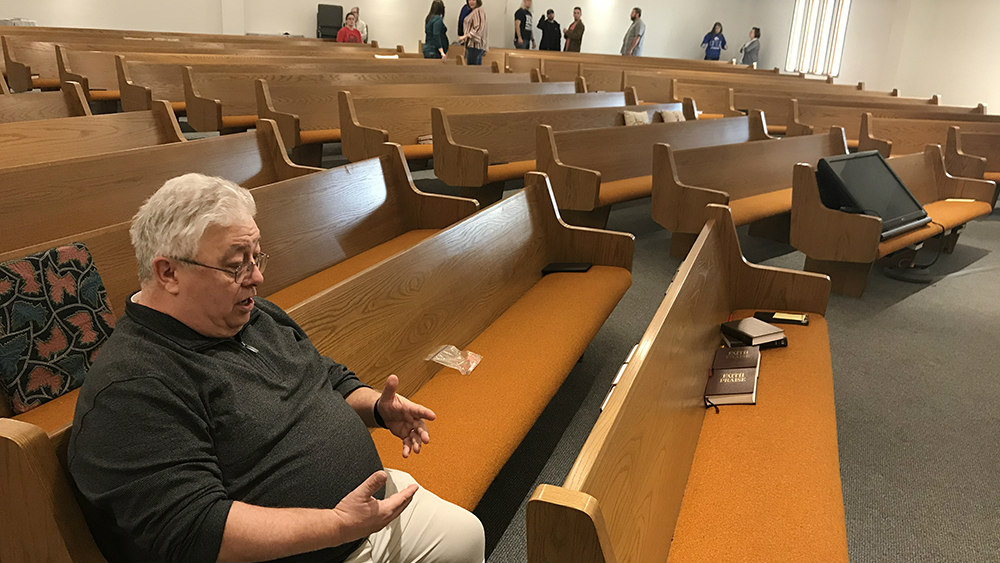
Minister Britt Farmer sits in the spot where he witnessed two of his fellow church members lose their lives on Sunday.
The West Freeway Church of Christ, a close-knit congregation of about 280, didn’t get to finish its Sunday morning worship assembly.
So Monday night—roughly 30 hours after a gunman killed two beloved Christians during the Lord’s Supper before an armed member fatally shot him—the suburban Fort Worth church came together.
A standing-room-only crowd squeezed into the church fellowship hall, next door to the closed auditorium where the shooting occurred, to grieve, pray and sing “Amazing Grace,” “Precious Memories,” and “It Is Well With My Soul.”
“What happened yesterday is not something that we will ever be able to explain,” minister Britt Farmer told church members, who shared hugs and tears before the special gathering as canine officers made sure the building was secure.
“There is evil in this world, and evil took two of my dear friends yesterday,” Farmer added. “Not a bullet from a gun—evil. Not ideology—evil.”
But the preacher, occasionally overcome with emotion that made it difficult for him to speak, declared that he would not let evil win.
“The battle belongs to God!” he said to amens and applause.
Farmer praised his family—all four of his adult children traveled home after the shooting—and his spiritual family for the support they have shown him.
“You are incredible, and I love you, and I mean that from the bottom of my heart,” he said.
Mike Tinius, one of the church’s five elders, wrapped an arm around Farmer and led the church in prayer.
“With all of our hearts, we ache. And with all of our hearts, we love,” Tinius said to God. “What we feel as loss, we know is your gain. Guide us in how we handle the losses … that your way be our way.”
The elder added, “Father, we even grieve the soul of the one who wronged us.”
The gunman, identified by authorities as Keith Thomas Kinnunen, 43, slipped into the Sunday service wearing a long black wig, a fake beard, and a bulky jacket, witnesses said.
During the Lord’s Supper, Kinnunen pulled out a modified, 12-gauge shotgun with a pistol grip, Farmer told The Christian Chronicle.
Farmer said the gunman’s motive remained unknown. But after seeing a photo of Kinnunen without his disguised appearance, the minister recognized him.
“We’ve helped him on several occasions with food,” Farmer said. “He gets mad when we won’t give him cash. He’s been here on multiple occasions.”
Kinnunen’s first two shots killed deacon Anton “Tony” Wallace, who held a silver tray as he served Communion, and church security team member Richard White, 67, who yelled “Drop it!” at the gunman as he reached for his own pistol.
Wallace, a father of two and grandfather of four, was the church’s deacon over community outreach and visitation. He preached periodically at a predominantly black Church of Christ in Mineral Wells, about 45 miles west of White Settlement. He volunteered each summer at a Christian youth camp.
“He just loved kids,” Farmer said. “Tony was a joy to be around. He loved to sing.”
White was Farmer’s best friend.
“Preachers don’t get friends like that very often,” Farmer said. “He never held me to a higher standard.”
The two enjoyed golfing together, and earlier Sunday, White gave Farmer his Christmas present.
“It was a box of golf balls, and the dirty dog put ‘Property of Britt Farmer’ on them so if I hit them into the woods, somebody would know I’d done it,” Farmer said.
Both victims were at the back of the auditorium, where Kinnunen had taken a seat, gone to the restroom during the “meet and greet” time at the service’s start and quickly drawn the attention of the church security team.
“When he came in, he was under observation. … This was (a case of) ‘maybe it’s nothing, but maybe it’s worth looking into,’” said church elder John Robertson, who mans the church’s video room. “We had put him on isolation on one of the cameras back here so we could see that he was behaving at the moment.
“So when he got up between the bread and the cup, or right after the prayer, we said, ‘We need to make an intervention,’” Robertson added.
But before that could occur, Kinnunen brandished his weapon and opened fire.
As the attacker turned toward the front of the auditorium, he fired a third shot. It ended up in a wall to the right of the pulpit stage where the congregation’s children normally bring change—part of a “Coins for Christ” ministry—after Communion.
Just as Kinnunen fired his third shot, church security team leader Jack Wilson pulled his own trigger.
Wilson’s single shot struck Kinnunen, who immediately fell to the ground. A bullet hole was visible Monday in the side wall by the pews where the gunman stood. The smell of gunfire remained strong.
“The events at West Freeway Church of Christ put me in a position that I would hope no one would have to be in,” Wilson wrote on Facebook, “but evil exists and I had to take out an active shooter in church.”
Other church security team members with handguns approached Kinnunen as the six seconds of gunfire ended—the loud blasts replaced with screams and crying from the shocked congregation.
Police arrived within two minutes. However, Farmer said it felt like an eternity.
“The citizens who were inside that church undoubtedly saved 242 other parishioners,” Jeoff Williams, regional director of the Texas Department of Public Safety, said Sunday. “The true heroes are the people who were sitting in those pews today—the immediate responders who saved their fellow citizens. I just can’t overstate how critical that is for everyone to recognize. It is truly heroic.”
The West Freeway church beefed up its security team after the November 5, 2017, massacre at the First Baptist Church of Sutherland Springs, Texas, in which a gunman killed more than two dozen people, one of whom was pregnant. The gunman later killed himself.
Typically, anywhere from 25 to 30 West Freeway members carry concealed handguns on any given Sunday, Farmer said.
However, he said that number “would have been a lot less” Sunday because a number of people were away for the holidays.
Hugh Galyean, the church’s volunteer worship coordinator, spent 30 years as a Maryland state trooper and an FBI agent in Louisiana, Nebraska, and California.
Galyean, a member of the church security team, said he had leaned down to take a Communion cracker when he heard the first shot.
“And I saw the flash in my peripheral vision and immediately knew it was him,” Galyean said of the strangely attired visitor, whom he had noticed sitting not far from him. “And I did as my training taught me: Go to cover first and then bring your weapon up. By the time I did that, our head of security had already taken the one shot that killed the guy.”
Galyean, the song leader at Monday night’s service, said he wasn’t surprised the gunman was able to get off shots.
“The only way you would have prevented this is to search him,” Galyean said.
But the church doesn’t want to search people, he said. It wants to welcome them into God’s family.
The question: Where is the line between loving people and protecting the flock?
“I think our process here normally works,” Galyean said. “We don’t want to eliminate people from coming just because they’re homeless or look like they’re homeless. It’s a very loving church.”
Bobby Ross Jr. is editor in chief of
The Christian Chronicle
, where this story first appeared. The original version of this story can be found here.Despite years of persecution, the jiating movement persists.

A jiating service in Beijing, China.
This week, China sentenced Early Rain Covenant Church pastor Wang Yi to nine years in prison. This conviction was the latest attack on jiating (house church) congregations and came a year after officials took more than 100 leaders and members of the prominent congregation into custody. The round-up had come on the heels of the government shutting down Beijing Zion Church, one of China’s capital largest house churches, after the congregation refused to install surveillance cameras in its sanctuary. The crackdown on Beijing Zion marked the beginning of a new campaign by the Chinese Communist party-state to eliminate all jiating churches in China. With these high-profile forced closure of several prominent jiating congregations, the Chinese authorities have now begun zeroing in on the lesser known but numerous jiating churches throughout China.
Many Chinese Christians belong to a distinct type of Protestant churches called jiating churches, which are often translated as “house churches,” “family churches,” or “home churches.” Although expedient, these are inadequate translations. The Chinese word jiating could mean family, home, or house, and “house” is the least commonly used meaning, so referring to these churches as “house churches” is a misnomer. The members of such churches often regard their church as jia, which means the family or the home associated with a sense of familial belonging and close-knit fellowship. The physical structure of a house is the least important and may change from time to time. As the meaning of a jiating church is closer to a “congregation” than a church building, I adopt the transliteration and refer to these churches as jiating churches.
Jiating churches have undergone several phases of development, beginning as underground bodies, snowballing from private gatherings in homes to congregations of hundreds, and pivoting from passive avoidance of the authorities to actively seeking registration with the government. With the exception of the Cultural Revolution, when all religious institutions were eradicated, jiating churches have generally stood independent from and parallel to the officially sanctioned “Three-Self Patriotic Movement.”
On August 7, 1955, Rev. Wang Mingdao of the independent Christian Tabernacle church in Beijing was arrested for refusing to join the “Three-Self Patriotic Movement” committee. Wang was one of several Christian leaders who opposed the Three-self committee for various reasons, including the political nature of the party-engineered movement and the modernist theology of some Three-Self leaders. “Three-Self” technically refers to self-governing, self-supporting, and self-propagating. But in reality, the movement was the engineered campaign to fold churches under the Chinese Communist Party (CCP). (The word “patriotic” in it actually meant loyalty to the CCP.) During the initial campaign, the CCP forced every church to cut off organizational and financial ties with foreign missionary organizations and churches in the West. By 1954, the Three-Self committees were officially established at the national level and some local levels.
Despite tremendous pressure to join the Three-Self committee, Wang defiantly published an essay titled “Obey Man or Obey God?” in a 1954 issue of Spiritual Food Quarterly. He argued that Christians ought to obey institutions only when the powers that be are not opposed to God’s commandments. In his view, the government had no right to interfere in the Christian life of Communion and evangelism. In the following year, Wang published another essay, titled “We are for Faith,” which expressed his firm opposition to modernist liberal theology and charged some Three-Self leaders as nonbelievers. In 1955, Wang and his wife were arrested and charged with “counterrevolution.” The event coincided with many Christians leaving Three-Self churches to hold Sunday worship and prayer meetings at private homes. The jiating church movement was born.
In 1958, about a decade after Chairman Mao Zedong took power, the government disbanded Christian denominations and churches were agglomerated under the Three-Self committee, which assigned pastors and preachers to churches. During the subsequent political campaigns of the Great Leap Forward and the Socialist Education Movement in the 1950s and 1960s, many Three-Self churches closed. When the Cultural Revolution broke out in 1966, Mao Zedong’s youth mobs called Red Guards ransacked many churches and shuttered every religious site across China. The de facto ban of religion lasted for 13 years until 1979.
Nevertheless, Christianity survived through underground worship and prayers at homes, caves, woods, and crop fields. Such religious gatherings were illegal and the punishments could be severe, including shame parades, labor camps, and prison terms. Surprisingly, recent oral history that I and other researchers have conducted indicate that Christian revivals proliferated even during the heydays of the Great Leap Forward and the Cultural Revolution. By the 1970s, jiating churches began expanding rapidly in the eastern and central provinces of Zhejiang, Henan, and Anhui. By the end of the 1970s, the total number of Protestant Christians reached from 5 to 6 million, according to the estimates of historian Daniel Bays. Mao Zedong’s policy of religious eradication failed.
Following the death of Mao in 1976, Deng Xiaoping rose to paramount power in the CCP and launched a series of social and economic reforms. Beginning in 1979, the party-state allowed some churches, temples, and mosques to reopen to rally citizens toward economic development. In addition to restoring the Three-Self committee, the Christian Council was established to manage internal church affairs and improve public relations with churches abroad. Nevertheless, this council became a de facto wing of the Three-Self committee, and together they became known as lianghui (two councils).
The new policy of limited religious freedom was formalized in the revised constitution and the CCP Document 19 of 1982, which had ambiguous wording on Christian gatherings at homes. While many underground Christians joined the reopened Three-Self churches, many others refused to join due to the political nature of these churches and the apostasy of some Three-Self officials who joined radicals to suppress Christians during the Cultural Revolution. Thereafter, some Three-Self leaders, including its top leader, Bishop Ding Guangxun, attempted to articulate the delicate position of discouraging but nonetheless allowing home gatherings. In the following three decades, the CCP intermittently persuaded, pressured, and repressed jiating churches.
In response, the primary strategy of jiating churches in the 1980s and 1990s was evasion from authorities. During crackdowns, some Christians fled to other counties and continued evangelizing there. Many testimonials and reports have circulated among Chinese Christians and around the world about the hide-and-seek relationship of jiating churches and the police.
Some jiating church networks in rural Henan, Anhui, and Zhejiang became well organized and sent out evangelists to faraway provinces, including the borderlands in southwestern and northeastern China. These jiating church leaders attributed to God miraculous protection and evangelistic harvests, which evoked comparisons to early Christians fleeing Jerusalem for Antioch and beyond.
The student-led democracy movement and the Tiananmen Square Massacre in June 1989 marked a watershed of spiritual awakening of college-educated Chinese. Thereafter, many Bible studies and fellowship groups emerged from university campuses, converging into the “Christianity fever” and “cultural Christian” phenomena. Meanwhile, rising economic levels also created “boss Christians,” Christian businesspeople who were successful in the emerging market economy.
While some “cultural Christians” and “boss Christians” were baptized at Three-Self churches, many others joined jiating churches. The CCP reported that the number of Three-Self Christians multiplied from 3 million in 1982 to 6.5 million in 1995 to more than 10 million by 1997. Many observers estimate that the number of jiating church Christians probably grew similarly rapidly.
The transition from central planning to a market economy brought sweeping changes in social life. The “people’s communes” in rural areas were dissolved; the “work-units” in urban areas reduced many welfare functions. Christian churches attracted individuals yearning for social support and fellowship, and Christian belief filled the void of meaning and morality amid rapid social transformation. Meanwhile, the CCP made economic development the central task, with control over jiating churches often lapsing.
In the 21st century, along with experiencing rapid growth, jiating churches have diversified in theology and organizational structure. The church networks originating from rural Henan and Anhui have planted churches in urban areas and dispatched missionaries to south, central, and western Asia. Wenzhou’s businesspeople became active domestically and abroad, and the Christians among them established churches wherever they went.
Meanwhile, Pentecostal and charismatic churches organized numerous revivals across China. Reformed theology became popular among young professionals with higher economic and cultural capital. Accordingly, some new urban jiating churches adjusted their strategy from eschewing the authorities to negotiating with the state for gaining legal status.
In 2005, China’s State Council announced the Regulations of Religious Affairs, which hinted at the possibility of permitting jiating churches to register with the government without joining the Three-Self committee. For registration, the regulation only required a fixed meeting place, membership, and leadership. In response, some jiating churches made organizational adjustments and applied for registration.
The most prominent case of a church seeking registration was Beijing Shouwang Church. In Beijing’s university district of Haidian, about a dozen Bible study groups merged to form a congregation. This congregation rented a hall in an office building as a sanctuary, passed a church constitution, and installed elders and a pastor to formally establish the Beijing Shouwang Church. The church then submitted its application for registration to the Religious Affairs Bureau (RAB) of Haidian.
The Haidian RAB required that the church join the Three-Self committee or have its pastor certified by it. The church petitioned the RAB at the municipal level, arguing that joining the Three-Self committee or getting certified by it was not a requirement in the Regulations of Religious Affairs. The Beijing RAB, however, affirmed the Haidian RAB’s decision against the church.
The church then submitted a petition to the State Administration of Religious Affairs. The church insisted that it would not join the Three-Self committee because of its political nature, citing Wang’s 1955 article “We are for Faith.” In response, the authorities raided the sanctuary and ordered the church to disband. The government evicted the church from its rented hall multiple times and prevented the church from entering its newly purchased property. Without a building place, the church called its members to gather outdoors in a plaza for Sunday worship service. However, police sealed off the plaza on Sundays. Its pastor, Jin Tianming, has been under de facto house arrest since 2011.
In the 2010s, Early Rain Reformed Presbyterian Church in Sichuan province became a pioneer in the jiating church movement. The congregation moved into a sanctuary it purchased; established a seminary, a day school, and a college; and developed the West China Presbytery with other jiating churches in the city of Chengdu. The church’s ministries included a campaign to oppose forced abortion and a show of support for families of political prisoners. In December 2018, authorities closed down the church and detained Pastor Wang Yi, and other leaders, accusing him of inciting subversion, similar to the crime of counterrevolution for which Pastor Wang Mingdao was arrested in 1955. After being held in secret detention for months, this week, Wang received a nine-year sentence for “inciting to subvert state power” and “illegal business operations,” the longest prison term issued against a house a church pastor in a decade, according to World magazine’s China reporter, June Cheng. Wang was also fined and had his personal assets seized. While the pastor has stated that he denies whatever charges the government has against him, he said he will serve his time.
Since Xi Jinping came to power in 2012, militant atheism has prevailed as national policy. Following the pronouncement of the revised Regulations of Religious Affairs in 2018, the party-state has implemented the fiercest campaign against jiating churches since the 1980s. In the past year, Chinese authorities have shut down well-known jiating churches, including Rongguili Church in Guangzhou, Xunsiding Church in Xiamen, and some in other large cities.
Nevertheless, tens of thousands of jiating churches of various sizes persist throughout China, and most have been firm in rejecting the Three-Self committee. While large congregations have had to break into smaller groups for worship and prayer meetings, many jiating churches continue to baptize new members and plan for overseas missions. In fact, as historians and sociologists of religion know well, when it comes to bringing in new converts, the evangelistic zeal of a small-group fellowship is often more effective than large church gatherings. Moreover, the current campaign may keep jiating churches small in size, but these campaigns usually wane after a while. Indeed, some jiating church leaders have been making preparations for the turnaround of the policy and the bouncing back of jiating churches in the near future.
Fenggang Yang is the director of Center on Religion and Chinese Society at Purdue University and the founding editor of the Review of Religion and Chinese Society .
Eugene Peterson and R. C. Sproul pass on, LifeWay closes all 170 stores, and Acts 29 removes Mars Hill, asks Mark Driscoll to step down.
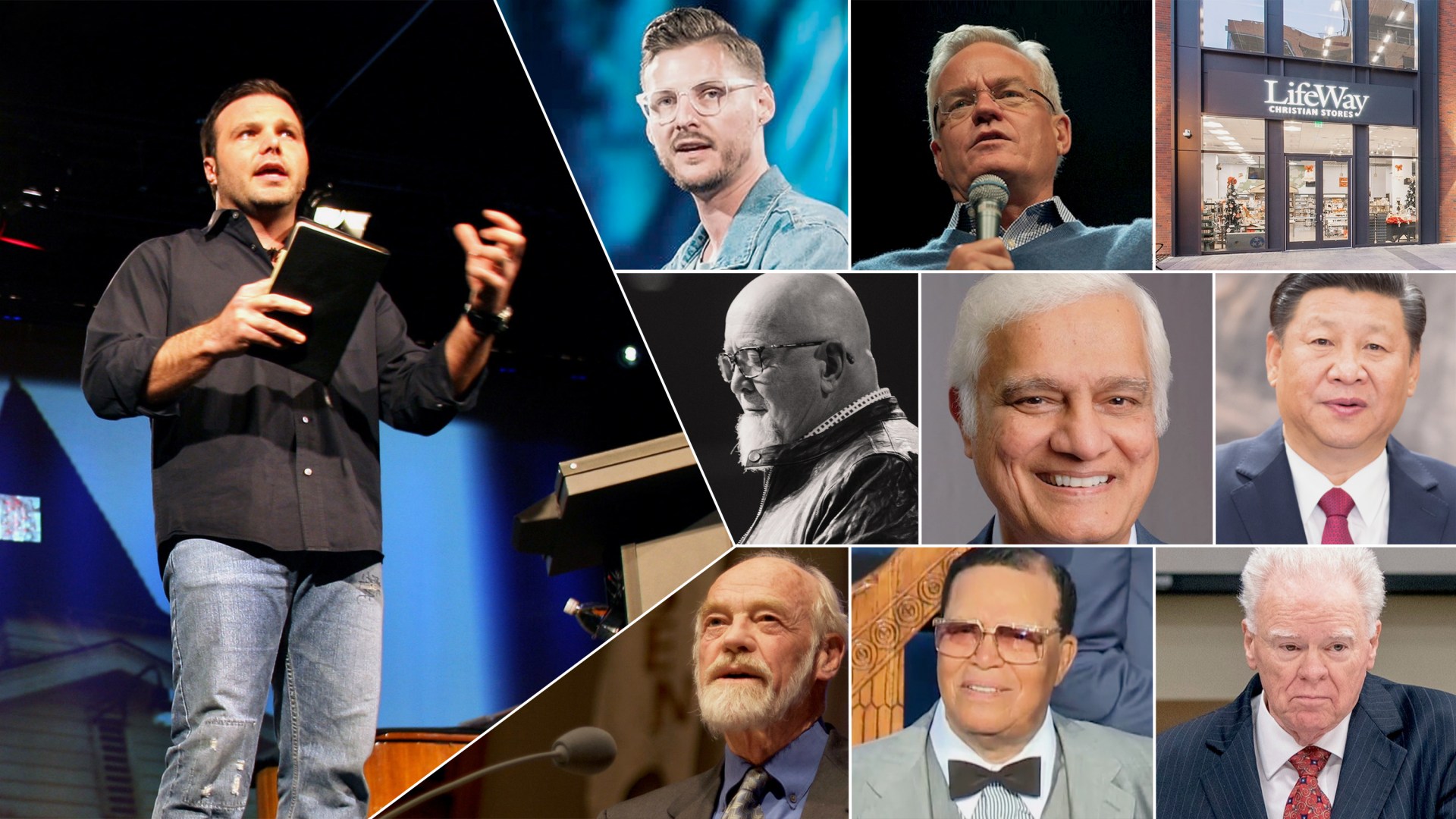
In the 2010s, evangelicals witnessed theological controversy, the fall of influential leaders, and the deaths of powerhouse theologians and pastors. Yet in the midst of the tragedies, the church sought justice and fought for theological orthodoxy. These are headlines that you, our readers, clicked on the most throughout the past decade, in reverse order from least to most popular.
Screens are changing the way we read Scripture, preaching against racism is not a distraction from the gospel, and the disturbing temptations of pastoring in obscurity.

This year’s top articles for pastors gather around a common question: What does spiritual health and wholeness look like for those in full-time ministry? “What unites me with a thousand other pastors who are both godly and dysfunctional?” asked Todd Wilson in the most-read CT Pastors piece of the year. “A lack of integration.” This humble confession represents the heart of most articles on this list. Pastors face unique challenges, but they will overcome their temptations in the same way as their congregants, through the steady formation of the Holy Spirit and God’s Word. Amy Simpson wrote in another article that pastors will be at their healthiest when they acknowledge their humanity. “There are no substitutes for inner work, humble transparency, open-handed leadership, and true relationship.” Here are the top articles for pastors our readers viewed this year, in reverse order of lesser read to most-read.