

News

Long Sermons Seem Longer in the Pews, Study Finds

But it’s not a new problem. Just ask Martin Luther.

Edits by Christianity Today. Source: Sean824 / Karl Fletcher / Getty

Churchgoers are six times more likely than preachers to say that their church’s typical sermon goes over an hour. Preachers, on the other hand, are twice as likely to say their sermons last less than 15 minutes.

Time, it seems, moves differently in pulpit and pew.

Modern preachers may decry the shortened attention spans of contemporary congregants, but conflict over sermon length isn’t new. It was a frequent point of contention during the Reformation, as preachers discovered the great depths of the Word—and went on and on about it.

Some sermons clocked in at three hours. Even the leading Reformers soon suggested restraints. Thomas Cranmer thought an hour and a half really ought to be plenty of time. John Calvin said a preacher needed to stop when he got tedious. Martin Luther offered young ministers this indelible advice: When people say, “He was prattling on and could no longer stop,” that’s a bad sign.

British churches eventually started installing hourglasses by the pulpits, according to church historian Owen Chadwick. The craftsmen who made them were more sympathetic to the experience in the pews than in the pulpits, though, and more than a few of the timepieces did not keep an honest hour. One surviving hourglass reliably runs out of sand at 48 minutes.

Though the preacher probably said it was half an hour.
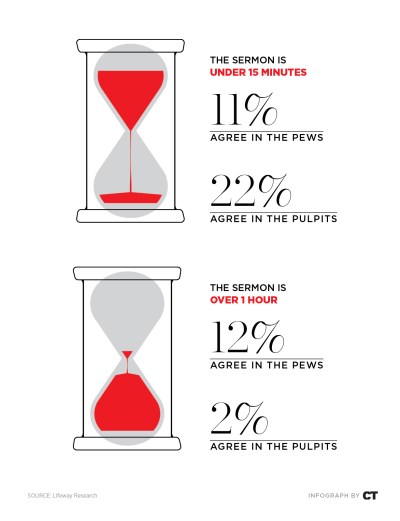
Source: Lifeway ResearchInfograph by Christianity Today
Source: Lifeway Research

For more on sermon length and the perception of sermon length, visit: Lifeway Research.

Also in this issue

Our cover story this month follows a handful of Ukrainians who left their country on the eve of war—or in some cases, years earlier—and who sensed they were in exile “for such a time as this.” Plus: laundromat ministries, sermon lengths, fighting compassion fatigue, Jesus and jazz, and more.

Cover Story

They Fled Ukraine, and Ukraine Followed

Reply All

News

Counting the Cost of Paying Ransoms for Missionaries

Can We Resurrect Expertise?

Why We Preach for Proper Names

Learning to Love Our Neighbor’s Fears

Bronwyn Lea

Testimony

God Wanted Me When the Foster-Care System Didn’t

Tori Hope Petersen

Taking the Lord’s Name in Vain Without Swearing

News

Germany’s Nuclear Power Plants Are Closing. But Their Moral Questions Have a Long Half-Life.

News

Anglicans Lose 14 Properties in South Carolina Court Battle

Editorial

How to Greet the End of ‘Roe’

News

Preach the Gospel Everywhere. When Necessary, Use Laundromats.

5 Books for Getting to Know the Desert Fathers and Mothers

Andrew Arndt

Who Will Pay Africa’s Medical Bills?

Emily Belz in Nkhoma, Malawi

Our July/August Issue: War Stories

Andy Olsen

Cultural Diversity Isn’t a Problem to Be Solved

Elliot Clark

The Gospel and All That Jazz

Joy Marie Clarkson

What Should We Do If Our Compassion Runs Out?

Eric McLaughlin

Disasters Often Bring Revelation Rather than Punishment

The Unexpected Parenting Comfort of Ecclesiastes

The Christian Case for Reading Black Classics

Interview by Patricia Raybon

New & Noteworthy Fiction

Amanda Dykes

View issue

Our Latest

Public Theology Project

Why Christians Ignore What the Bible Says About Immigrants

Believers can disagree on migration policies—but the Word of God should shape how we minister to vulnerable people.

Review

Apologetics Can Be a Balm—or Bludgeon

Daryn Henry

A new history of American apologetics from Daniel K. Williams offers careful detail, worthwhile lessons, and an ambitious, sprawling, rollicking narrative.

Hold the Phone?

Anna Mares

Faced with encouragement to lessen technology use, younger Christians with far-flung families wonder how to stay connected.

The Russell Moore Show

Joseph Loconte on the War for Middle-Earth

What if the most decisive battles in our time aren’t fought with ballots or bombs—but with the imagination?

Norman Podhoretz Leaves a Legacy of Political Principle

Michael Cosper

The Jewish intellectual upheld the Judeo-Christian tradition.

News

A House of Worship Without a Home

One year after the Palisades and Eaton fires, congregations meditate on what it means to be a church without a building.

‘The Image of God Was Always In My Mother’

Kate Lucky

Responses to our Sept-Oct issue.

Disintegration is the Church’s Greatest Threat

A note from Mission Advancement about the Big Tent Initiative and One Kingdom Campaign.

Apple PodcastsDown ArrowDown ArrowDown Arrowarrow_left_altLeft ArrowLeft ArrowRight ArrowRight ArrowRight Arrowarrow_up_altUp ArrowUp ArrowAvailable at Amazoncaret-downCloseCloseEmailEmailExpandExpandExternalExternalFacebookfacebook-squareGiftGiftGooglegoogleGoogle KeephamburgerInstagraminstagram-squareLinkLinklinkedin-squareListenListenListenChristianity TodayCT Creative Studio Logologo_orgMegaphoneMenuMenupausePinterestPlayPlayPocketPodcastRSSRSSSaveSaveSaveSearchSearchsearchSpotifyStitcherTelegramTable of ContentsTable of Contentstwitter-squareWhatsAppXYouTubeYouTube







