 A friend e-mailed weeks ago to ask my political opinion. Because of her newfound faith, she's approaching this election differently. Like most Christ-followers, Democrat and Republican, she wants to cast a "Christian" vote.
Her e-mail arrived the day Her.meneutics released its first eBook, What Christian Women Want This Election Season, which I advised her to read. Apart from this recommendation, however, I was stumped. In fact, I was feeling—and still feel—politically ambivalent. Voting is a great freedom and an important civic responsibility. However, a vote for president cannot express the breadth of Christian conviction.
Although political disengagement may not be a "moral option," I have decided I won't vote next month. Now that I am living in Canada, I would have needed to obtain an absentee ballot to vote, and I simply lacked the political will to bother.
Let me begin by sketching my demographic as well as my political voting history. I fit a Republican profile. I am white and, according to recent Gallup polls, wealthy. I was raised in a conservative evangelical home, and until 2008, have always voted Republican. This past affiliation has been owed primarily to my conservative stance on social issues informed by scriptural principle. I have wanted to defend human life, religious liberty, and the sacred institution of marriage.
But I have grown increasingly wary to affiliate with the Republican Party, for a number of reasons. To begin, I regret the influence of the Tea Party, which forces centrist and conciliatory Republicans toward more extreme political positions, effectively ensuring that Congress gets nowhere. I am also embarrassed by the apparent diminishment of Republican intellectual credibility reflected individually in statements from politicians like Todd Akin, Sarah Palin, and Michelle Bachmann. What's more, if ignorance weren't bad enough, how about generally boorish behavior? Whether it's hate mail sent to climate scientists (Katharine Hayhoe is a professing evangelical Christian) or Rush Limbaugh calling Sandra Fluke a "slut" and "prostitute," some Republicans have just sounded bigoted and hateful.
Of course, people of red and blue ilk commit these sins. But I have one more reason for my hesitation to vote Republican this year. For this, I have my Canadian friends to thank.
One small step out of the American political landscape has been one giant leap of perspective. If one issue on the ballot this fall is the virtue of the social safety net and policies like the Affordable Care Act, Canadians have already cast their ballot. As an example, decades ago, they gave a majority "yes" to government-funded health care. Their health-care system, while not a perfect one, is a source of great national pride.
I find myself wondering what informs this seemingly instinctual Canadian altruism. I haven't lived here long enough to answer that question, but it has begged me to notice that collective caring doesn't come naturally to me. That may mean I'm a terrible Christian. It may also mean I'm an American schooled in the principles of individual freedoms—or maybe just a Republican persuaded of the importance of personal responsibility. These persuasions are inherently good and right, but it may keep me from realizing that we also owe service and sacrifice to one another.
I am deeply suspicious that my unwillingness to improve the social safety net—affordable health care, as an example—stems less from principle (It's the church's job!) and more from my own inclination toward self-preservation. Call me a Darwinian, or call me a Calvinist, but I am realistic enough to know this of myself: Apart from the transforming work of the Spirit, I will innately defend and pursue what benefits me.
As an example, last November, I was a vehement critic of Canadian health care. When my son was admitted to the hospital here when all that should have been required was routine asthma care (care to which I did not have immediate access), I wanted to wave my greenbacks and demand better treatment. I certainly didn't share a Canadian colleague's pride that a homeless man can get adequate basic care here. I wanted specialty care for my son, and I was willing to pay for it.
You can hardly blame me, a concerned mother with a pocketful of cash. But when the crisis passed, I saw in myself something I didn't like or see as "Christian." I had acted like a "get-what-you-pay-for" capitalist. And it forced me to remember that in the United States, many don't get because they simply can't pay.
Poverty isn't always a lack of personal responsibility. Let's be honest about wealth in America. We may say it's hard-earned, but if you are like me, you have the work you have in large part because of the family you were born into and the opportunities that have been afforded you, not the least of which was education. Are there people in America who can't pay their bills because they're lazy? Yes. But is this true of all or even most poor people? I don't think so.
In the end, I can't suggest a "Christian" vote to my friend. But I can ask her to consider the moral issues on both sides of the aisle. Abortion, gay marriage, and religious liberty should continue to matter to Christ-followers. So, too, should ensuring that poorer Americans enjoy equal opportunity to health care and education. Embracing the breadth of these red and blue convictions can restore to us a Christian identity that rises beyond a political party.
We will decide our convictions differently this year—or like me, you may not decide at all. Nevertheless, when the ballots are counted, Christians will unite collectively to pray for those in power, a responsibility shared by all of us (1 Tim. 2:1).
Jen Pollock Michel writes for Today in the Word, a monthly devotional published by Moody. She blogs at FindingMyPulse.com and has written for Her.meneutics about suicide and motherhood.
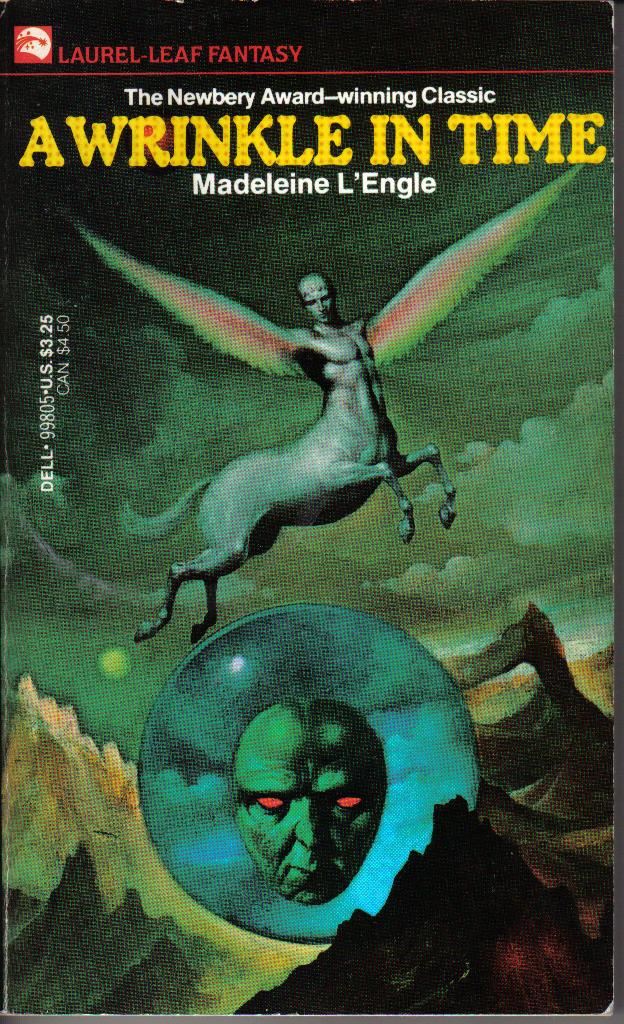
The Hollywood Reporterwrites that A Wrinkle in Time, Madeleine L’Engle’s beloved children’s story, is about to get a script and later to be turned into a feature film.
Jeff Stockwell, who penned the screen adaptation of A Bridge to Terabithia for Disney in 2007, will write the Wrinkle script.
According to THR, “the BBC made a film version of the young-adult novel, and Dimension produced a telefilm for ABC in 2004. Disney carried remake rights from that deal and is developing the new feature iteration with Bedrock, which had negotiated rights to the property from the L’Engle estate.”