





In Washington, cherry blossoms are in bloom. Love for political leaders, however, is not. A majority of Americans do not approve of how President Obama is handling critical issues such as the situation in Libya or the deficit, according to the April political poll by the Pew Research Center for the People and the Press. The poll suggests that Americans also are pleased with leaders in Congress.
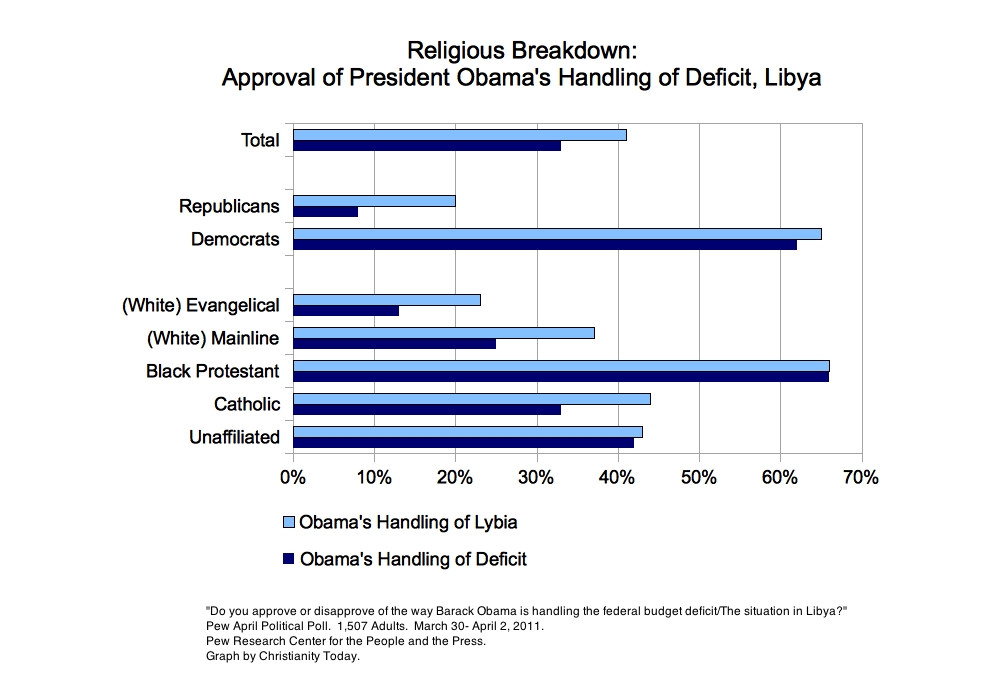
While Obama’s overall approval rating was 47 percent, approval of his handling of the deficit was only 33 percent. He fared better for his handling of the situation in Libya, with 41 percent approving. Support was, not surprisingly, highest among Democrats, over 60 percent of whom gave Obama thumbs up on both issues. Republicans were not impressed, with less than one-in-ten approving of his handling of the deficit.
Evangelicals were similarly disapproving of Obama. Only 13 percent approved of his handling of the deficit; 25 percent approved of his job on Libya. This was lower than approval ratings for other religious groups, though mainline Protestants and Catholics showed a similar pattern of having higher approval for Libya than the deficit. Black Protestants and those who are not affiliated with a religious tradition showed the same level of support for Obama’s handling of both issues.
This week on The Bulletin, hosts Mike Cosper, Nicole Martin, and editor in chief Russell Moore gather around the microphone to talk about the authority figures shaping our world. This past week the pope sent ripples through the Catholic church when he declared that same-sex relationships would now be invited to blessings. Colorado followed with ripples of its own when the court determined Donald Trump is ineligible to run for president in 2024. And, rising from scandal, Hillsong’s Brian Houston is starting a new church in the coming year. Tune in and join the conversation.
Read More from Christianity Today About Today’s Topics:
Why You Shouldn't Have a Position on LGBTQs.
What Mark Driscoll Told Brian Houston at Hillsong Conference
Hillsong Founder Not Guilty of Sexual Abuse Cover-Up
“The Bulletin” is a production of Christianity Today
Executive Producer: Erik Petrik
Producers: Clarissa Moll and Matt Stevens
Associate Producer: McKenzie Hill
Editing and Mix: TJ Hester
Music: Dan Phelps
Show Design: Bryan Todd
Graphic Design: Amy Jones
Social Media: Kate Lucky
But if GOP leaders expected evangelicals to approve of Republican leaders in Congress, they were disappointed. Overall, the public does not look kindly on Congress. Roughly a third approved of Republican leaders in Congress. The same proportion approved of Democratic leaders.
As with Obama’s approval rating, there is a partisan split, but not as much of a religious one. Republicans approved of GOP leaders (60 percent) but not Democratic leaders (10 percent). Democrats were the opposite with 59 percent approval for their party’s leadership and 15 percent approval for the Republicans.
Evangelicals were the most approving of religious groups of the Republican leadership, but a majority disapproved of the GOP and only 43 percent approved. Mainline Protestants and Catholics disapproved of both parties, and only a third of each tradition approving of each party’s leadership. Black Protestants and those unaffiliated with a religious tradition had higher approval of Democrats than Republicans in Congress.
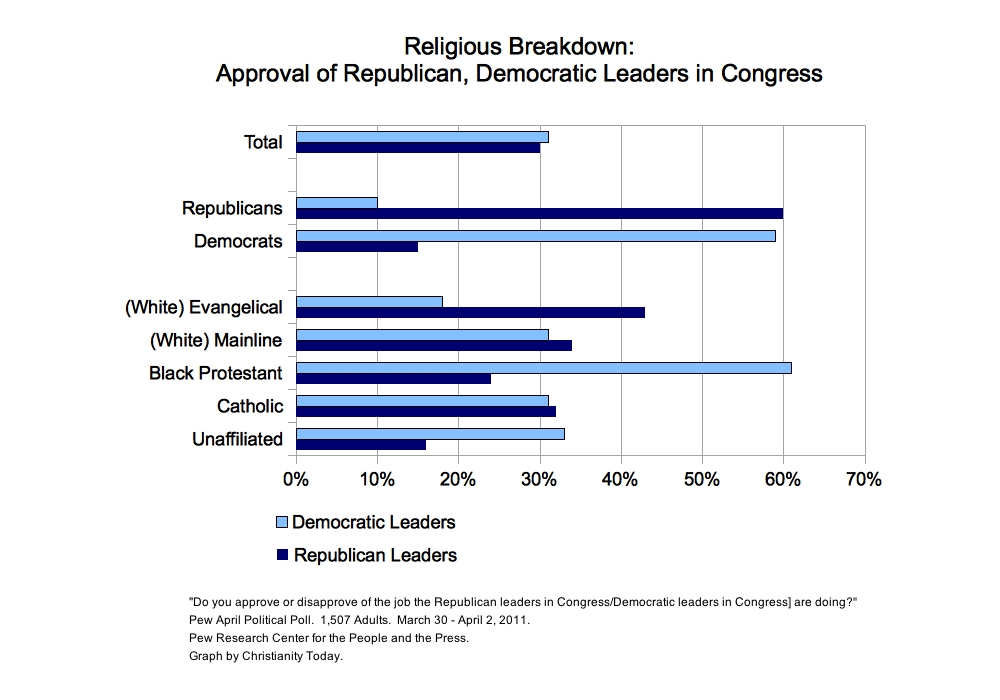 Illustration by Amy Jones / Source images: Getty Images
It is unclear from the poll whether the lack of support among evangelicals reflects a low view of Republican leaders per se. While evangelical approval of GOP leaders was not as lopsided as the approval among the rank-and-file Republicans, evangelicals were the only religious group to have a higher approval rating for Republican leaders than Democratic leaders.
Editors Note: The Public Religion Research Institute provided Christianity Today with a religious breakdown of questions from the poll. However, CT is responsible for all analysis and interpretation of the results. Around one-fifth of Americans are identified as white evangelicals in the poll. The margin of error for subsamples is larger than for the poll as a whole. The results are descriptive; religious differences could be due to partisanship, ideology, income, or other factors.







