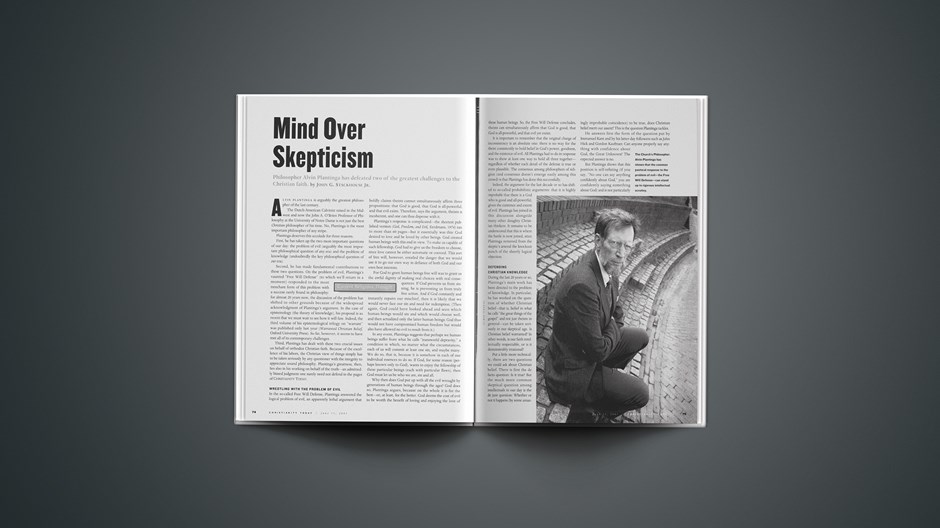
Alvin Plantinga is arguably the greatest philosopher of the last century.
The Dutch-American Calvinist raised in the Midwest and now the John A. O'Brien Professor of Philosophy at the University of Notre Dame is not just the best Christian philosopher of his time. No, Plantinga is the most important philosopher of any stripe.
Plantinga deserves this accolade for three reasons.
First, he has taken up the two most important questions of our day: the problem of evil (arguably the most important philosophical question of any era) and the problem of knowledge (undoubtedly the key philosophical question of our era).
Second, he has made fundamental contributions to these two questions. On the problem of evil, Plantinga's vaunted "Free Will Defense" (to which we'll return in a moment) responded to the most trenchant form of this problem with a success rarely found in philosophy: for almost 20 years now, the discussion of the problem has shifted to other grounds because of the widespread acknowledgment of Plantinga's argument. In the case of epistemology (the theory of knowledge), his proposal is so recent that we must wait to see how it will fare. Indeed, the third volume of his epistemological trilogy on "warrant" was published only last year (Warranted Christian Belief, Oxford University Press). So far, however, it seems to have met all of its contemporary challenges.
Third, Plantinga has dealt with these two crucial issues on behalf of orthodox Christian faith. Because of the excellence of his labors, the Christian view of things simply has to be taken seriously by any questioner with the integrity to appreciate sound philosophy. Plantinga's greatness, then, lies also in his working on behalf of the truth—an admittedly biased judgment one surely need not defend in the pages of Christianity Today.
Wrestling with the Problem of Evil
In the so-called Free Will Defense, Plantinga answered the logical problem of evil, an apparently lethal argument that boldly claims theists cannot simultaneously affirm three propositions: that God is good, that God is all-powerful, and that evil exists. Therefore, says the argument, theism is incoherent, and one can thus dispense with it.
Plantinga's response is complicated—the shortest published version (God, Freedom, and Evil, Eerdmans, 1974) ran to more than 60 pages—but it essentially was this: God desired to love and be loved by other beings. God created human beings with this end in view. To make us capable of such fellowship, God had to give us the freedom to choose, since love cannot be either automatic or coerced. This sort of free will, however, entailed the danger that we would use it to go our own way in defiance of both God and our own best interests.
For God to grant human beings free will was to grant us the awful dignity of making real choices with real consequences. If God prevents us from sinning, he is preventing us from truly free action. And if God constantly and instantly repairs our mischief, then it is likely that we would never face our sin and need for redemption. (Then again, God could have looked ahead and seen which human beings would sin and which would choose well, and then actualized only the latter human beings; God thus would not have compromised human freedom but would also have allowed no evil to result from it.)
In any event, Plantinga suggests that perhaps we human beings suffer from what he calls "transworld depravity," a condition in which, no matter what the circumstances, each of us will commit at least one sin, and maybe many. We do so, that is, because it is somehow in each of our individual essences to do so. If God, for some reason (perhaps known only to God), wants to enjoy the fellowship of these particular beings (each with particular flaws), then God must let us be who we are, sin and all.
Why then does God put up with all the evil wrought by generations of human beings through the ages? God does so, Plantinga argues, because on the whole it is for the best—or, at least, for the better. God deems the cost of evil to be worth the benefit of loving and enjoying the love of these human beings. So, the Free Will Defense concludes, theists can simultaneously affirm that God is good, that God is all-powerful, and that evil yet exists.
It is important to remember that the original charge of inconsistency is an absolute one: there is no way for the theist consistently to hold belief in God's power, goodness, and the existence of evil. All Plantinga had to do in response was to show at least one way to hold all three together—regardless of whether each detail of the defense is true or even plausible. The consensus among philosophers of religion (and consensus doesn't emerge easily among this crowd) is that Plantinga has done this successfully.
Indeed, the argument for the last decade or so has shifted to so-called probabilistic arguments: that it is highly improbable that there is a God who is good and all-powerful, given the existence and extent of evil. Plantinga has joined in this discussion alongside many other doughty Christian thinkers. It remains to be underscored that this is where the battle is now joined, since Plantinga removed from the skeptic's arsenal the knockout punch of the sheerly logical objection.
Article continues below
Defending Christian Knowledge
During the last 20 years or so, Plantinga's main work has been directed to the problem of knowledge. In particular, he has worked on the question of whether Christian belief—that is, belief in what he calls "the great things of the gospel" and not just theism in general—can be taken seriously in our skeptical age. Is Christian belief warranted? In other words, is our faith intellectually respectable, or is it demonstrably irrational?
Put a little more technically, there are two questions we could ask about Christian belief. There is first the de facto question: Is it true? But the much more common skeptical question among intellectuals in our day is the de jure question: Whether or not it happens (by some amazingly improbable coincidence) to be true, does Christian belief merit our assent? This is the question Plantinga tackles.
He answers first the form of the question put by Immanuel Kant and by his latter-day followers such as John Hick and Gordon Kaufman: Can anyone properly say anything with confidence about God, the Great Unknown? The expected answer is no.
But Plantinga shows that this position is self-refuting (if you say, "No one can say anything confidently about God," you are confidently saying something about God) and is not particularly persuasive on any other ground.
Then Plantinga shifts to the form of the question put by most modern critics: Can Christian belief be proven on the basis of what reason and experience tell us is true? Plantinga and colleagues such as William Alston and Nicholas Wolterstorff have been attacking the hubris of such a demand for more than two decades, showing that very little of what we take for granted (for example, memory beliefs, sense perceptions, and the belief that there are other minds in the universe, not just my own) can meet this stringent test. Indeed, the demand that beliefs must be shown to follow deductively from indubitable ideas is itself not capable of proof on this basis—and is thus self-refuting.
Plantinga continues by lobbing several well-aimed grenades at what he calls the "Freud-Marx Complaint," the commonly encountered jab at Christianity as mere wish fulfillment, as the projection of a heavenly Father on the blank canvas of the universe. In particular, he observes that Freud and Marx provide no real evidence for their suspicion of Christianity other than their prior conviction that it isn't true and therefore must be believed, where it is believed, on the basis of some other motive.
Article continues below
All of this circles around, then, to Plantinga's main point. He responds to the de jure objection not only by assailing its various criticisms but also by then articulating and defending an alternative Christian explanation of knowledge. He sets out this model in the heart of his concluding volume on warrant, crediting it largely to insights of Thomas Aquinas and John Calvin (Plantinga is, after all, a Calvinist teaching at Notre Dame).
This model suggests that Christians learn about the world the way everyone else does: by sense perception, intuition, introspection, and so on. But Christians believe that human beings were created originally with the ability to perceive God immediately upon encounter with the world he made (so Romans 1)—the so-called sensus divinitatis. Furthermore, Plantinga argues, while sin has corrupted our ability to sense God, the Holy Spirit now testifies to the truth of the gospel in the hearts of each believer, and this testimony is epistemologically as trustworthy as any other resource we have, such as our senses and our memories.
What Plantinga argues is not that Christian belief is true. That is the de facto question. What he argues instead is that if Christian belief is true, then its teachings about the sensus divinitatis and the inward testimony of the Holy Spirit are true, and those teachings then find a proper place in a Christian epistemology. Such resources, that is, provide warrant for Christian belief every bit as worthily as any other form of knowledge acquisition, and therefore explain just how Christians really do become convinced of the gospel.
Plantinga concludes by examining three possible "defeaters" for this model of Christian belief, the three defeaters that vex Christians today more than any others: critical biblical scholarship that undermines the authority of the Scriptures; postmodernism and pluralism that undermine any claim to having the truth; and the problem of evil, which undermines the fundamental nature of Christian teaching about God's goodness and power. Plantinga allows that someone might well come up with an argument he has not considered yet. But so far, he affirms, this model meets all challengers—a rather breathtaking summation, yet persuasive to one who has worked through the argument he offers.
Article continues below
The Difference Plantinga Has Made
Plantinga, then, has established the intellectual grounds for Christians to continue to believe in God, and particularly the God of historic orthodoxy, in the face of the two most daunting philosophical challenges of this century. He has done so, however, in distinctly 20th-century fashion. He has not, that is, offered a theodicy, an explanation for how God does, in fact, run the world. All Plantinga has done is show that it is not contradictory to believe that God is good, that God is all-powerful, and that evil yet exists. Whether one should go on to believe the gospel—well, that is not for him, as a philosopher, to say.
Nor has Plantinga offered an argument for the truth of Christianity. Again, all he has done is show that it is not improper for Christians to believe their religion is epistemologically well-grounded. Whether Christianity is actually true—well, that is not for him, as a philosopher, to say.
What Plantinga has done is to prevent the world's main philosophical challenges from pressing Christianity out of the realm of reasonable options. He has helped preserve a space for intellectually respectable Christian belief. Whether anyone should go on, then, to believe in the Christian faith—well, that is for theologians and apologists and evangelists, and for every individual Christian and every Christian congregation, to show through faithful witness. That is for the Holy Spirit, ultimately, to say. Alvin Plantinga has masterfully done his part as a philosopher, and circumspectly steps aside for the rest of us to do ours.
John G. Stackhouse Jr. is the Sangwoo Youtong Chee Professor of Theology and Culture at Regent College in Vancouver, Canada, and author of Can God Be Trusted? Faith and the Challenge of Evil (Oxford University Press).
Other Christianity Today articles by John Stackhouse include:
The Seven Deadly Signs | Ministries that think they can do no financial wrong deceive themselves. (June 30, 2000)
An Elder Statesman's Plea | John Stott's 'little statement on evangelical faith' reveals the strengths and limitations of the movement he helped create. (Feb. 14, 2000)
















 While we pray for peace, we need moral clarity about this war.
 A Christian reconciliation group in Israel and Palestine warned that war would come. Now the war threatens their relevance.españolالعربيةFrançaisрусскийУкраїнська
 The government plans to close its porous border with Myanmar to boost security, separating ethnic groups that straddle the boundary.






