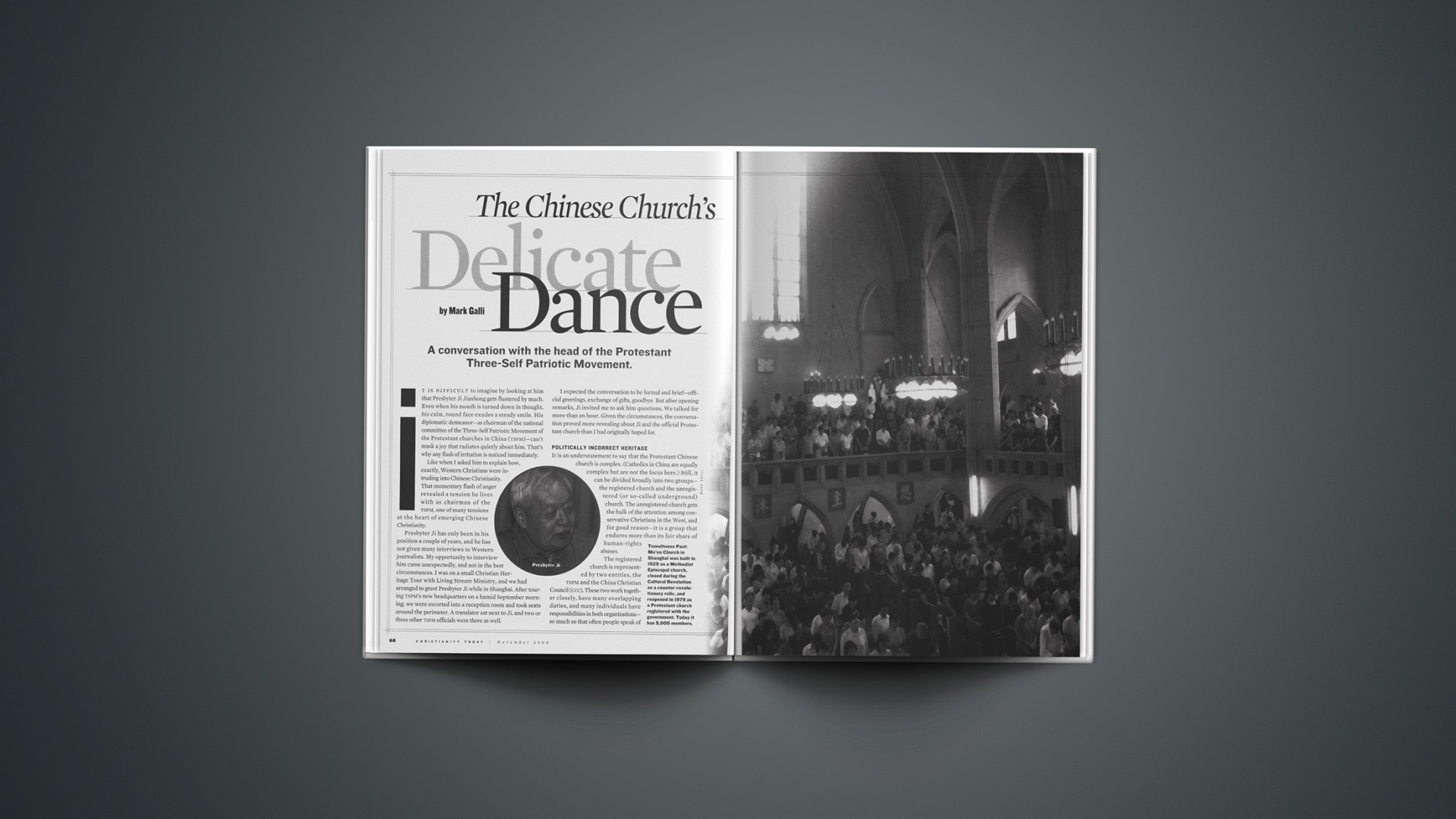
It is difficult to imagine by looking at him that Presbyter Ji Jianhong gets flustered by much. Even when his mouth is turned down in thought, his calm, round face exudes a steady smile. His diplomatic demeanor—as chairman of the national committee of the Three-Self Patriotic Movement of the Protestant churches in China (TSPM)—can’t mask a joy that radiates quietly about him. That’s why any flash of irritation is noticed immediately.
Like when I asked him to explain how, exactly, Western Christians were intruding into Chinese Christianity. That momentary flash of anger revealed a tension he lives with as chairman of the TSPM, one of many tensions at the heart of emerging Chinese Christianity.
Presbyter Ji has only been in his position a couple of years, and he has not given many interviews to Western journalists. My opportunity to interview him came unexpectedly, and not in the best circumstances. I was on a small Christian Heritage Tour with Living Stream Ministry, and we had arranged to greet Presbyter Ji while in Shanghai. After touring TSPM’s new headquarters on a humid September morning, we were escorted into a reception room and took seats around the perimeter. A translator sat next to Ji, and two or three other TSPM officials were there as well.
I expected the conversation to be formal and brief—official greetings, exchange of gifts, goodbye. But after opening remarks, Ji invited me to ask him questions. We talked for more than an hour. Given the circumstances, the conversation proved more revealing about Ji and the official Protestant church than I had originally hoped for.
Politically Incorrect Heritage
It is an understatement to say that the Protestant Chinese church is complex. (Catholics in China are equally complex but are not the focus here.) Still, it can be divided broadly into two groups—the registered church and the unregistered (or so-called underground) church. The unregistered church gets the bulk of the attention among conservative Christians in the West, and for good reason—it is a group that endures more than its fair share of human-rights abuses.
The registered church is represented by two entities, the TSPM and the China Christian Council (CCC). These two work together closely, have many overlapping duties, and many individuals have responsibilities in both organizations—so much so that often people speak of them together as the TSPM/CCC. Still, broadly speaking, the CCC works to build up the life of the registered churches as such, and the TSPM is the intermediary between these churches and the government.
Many underground Christians remain suspicious of the TSPM/CCC enterprise. They remember that in the 1950s, the TSPM colluded with the government in arresting thousands of believers. They also know that registered churches have legal restrictions that can severely limit evangelism. But as to the suspicions that TSPM/CCC leaders have submitted to another head besides Jesus Christ—that doesn’t seem tenable.
Take Presbyter Ji, for example (“Presbyter,” or “Elder,” is an honorific title). “I was born [in 1932] into a Christian family,” he said. “My father was an evangelist. He was originally a member of a Presbyterian church, but he left that church because he no longer believed in the Presbyterian system. My father worked with Watchman Nee, who created the Little Flock movement. I was nurtured by the Little Flock as a child.”
This is quite a revelation for a Christian leader in China. To acknowledge that one has been influenced by Nee’s teaching and followers—well, it would be like someone in the United States saying he was deeply influenced by the infamous American traitor, Benedict Arnold. Watchman Nee (1903-1972) was no traitor. He was a dynamic Christian teacher and founder of one of the first indigenous Chinese church movements, the Little Flock (or Local Church). He was deeply influenced by the Plymouth Brethren and the Keswick holiness movement (among others). But after the 1949 Communist takeover, he adamantly refused to register his churches with the government, and as such has been considered a traitor by that government since. (He died in prison after suffering 20 years there.) Publication of his name is still banned. At the September Beijing Book Fair, Global Publishers Alliance (a group that promotes American Christian books to Chinese publishers) included some Nee books in its catalog. But before the catalog was distributed, a government official marked out Nee’s name wherever it appeared.
Ji readily acknowledges his debt to Nee and the Little Flock. But he also points to a turning point when he was 15: “My family had regular gatherings for prayer and Bible reading, but most of the time I was passive and only had a vague understanding of what was going on. I attended out of obedience. Nothing was going on inside. I had no enlightenment. But I remember one family gathering, when during the prayer, I felt a need for a Savior. A kind of transformation took place in my heart. After that, I felt like I had a real relationship with God. So I then asked to be baptized.”
From that day on, he’s been involved in the church, first with the Little Flock, and today with the official Chinese church—except for the Cultural Revolution (1966-1976), the decade when Mao Zedong, to “purify” China, encouraged Red Guards to attack traditional and “bourgeois” values and test party officials by publicly criticizing them. Many elderly people and intellectuals were verbally attacked, physically abused, and some were killed.
Like nearly every other Christian in China, Ji suffered for his faith during that decade—though he didn’t have as hard a time as some. He was sent to the countryside “to receive re-education from poor farmers and peasants,” he says. Though the peasants received him with sympathy, he and his wife were forced to do heavy manual work everyday. He hinted that though there were times of sorrow and even anger, “This 10-year time is quite special to me because God made me learn many lessons.” Besides, he wrote to me in a recent e-mail, “We have too much to do in life today [than] to harbor the grudges of the past.”
Advocate for the Church
Too much to do, indeed. The registered church, like the rest of the country, is still recovering from the Cultural Revolution. Ji noted that the TSPM/CCC is working overtime to meet the pastoral, theological, and educational needs of some 16 million Christians in 50,000 churches spread over an area the size of the United States.
He’s been doing this sort of work for almost 30 years now. After the Cultural Revolution, he committed his lot to the TSPM—partly because he was convinced that the Communist government was really trying “to serve the people.” But also because he believed in the Three-Self idea for the church, that it should become “self-supporting, self-governing, self-propagating.” This idea was first set forth by missionary Henry Venn in the 19th century, and was endorsed by Watchman Nee. It is no wonder that Ji warmed up to it. Like most believers in most countries, he doesn’t see a necessary contradiction between being a good Christian and a patriot: “A Christian is also a citizen and thus has responsibility towards his country.”
So after the Cultural Revolution, Ji joined the Jiangsu Provincial Three-Self Committee (which he chaired) and helped pastors who had been imprisoned or sent to the countryside. He worked to restore churches and church property that had been confiscated, and, according to one online profile of Ji, he took some risks to get the Bible published once again.
This was a daunting project since there was but one printing press in China with adequate technology to bind the Bibles—the People’s Liberation Army’s (PLA) press in Nanjing. This is the press that published Selected Thoughts of Chairman Mao.
After some prayer, Ji plucked up his courage and approached the party secretary of the factory. He explained how important the Bible was for Christians. Then he challenged the party secretary, saying that if Christians could not have Bibles, it meant that the government policy on the freedom of religion was not being fully implemented. To his surprise, the party secretary said that burning Bibles had been the result of ultra-Leftist influences and had to be rectified. At the end of three months, in 1982, the Provincial Christian Council had produced 450,000 Bibles using the PLA press.
Speaking up for the churches is still part of his job. He’s a member of the Chinese People’s Political Consultative Conference (CPPCC), a 2,000-some-member advisory body to the government. At a recent meeting of the CPPCC, Ji advocated for greater liberty for churches. “Much importance has been attached to the freedom of religion,” he told the conference, “but the CPPCC can do more to help religious circles hold exchanges and exhibitions to show the outside world the development of religions in China.”
As he said in another interview, “Loving one’s country does not imply a total approval of the government. The government also treats us in the same way. Of course, there are those officials who don’t like to be criticized.”
What To Do with Those ‘Cults’?
At the same time, Ji can be critical of Christians, registered and unregistered—though it’s the unregistered Christians, for better or worse, who cause him and the TSPM/CCC the most grief.
The government in China has a tendency to paint all religions with a broad brush—this is especially true of religious groups that, for conscience’s sake, refuse to register with the government. It sees the Falun Gong (which provokes the government with defiant public demonstrations), aberrant Christian cults (some of which have power-hungry leaders who manipulate their followers), and orthodox Christian groups (who just want to be left alone to worship as they please) as one and the same phenomenon—at best, heterodox groups that refuse to cooperate with the rest of society to help rebuild China, and at worst, secret societies that may foment insurrection.
When the government gets nervous about unregistered religion, registered religionists also pay the price in restricted freedoms. This is one reason why the TSPM and CCC are also nervous about unregistered churches, and why in 2002 they passed a strong “Resolution on Opposing Evil Cults and Resisting Heretical Beliefs.” The resolution says in part:
In recent years, some cults that wrap themselves in the banner of Christianity have become very active, seriously damaging the public reputation of Christians. These include “Eastern Lightning,” the “Shouters,” the “Followers,” the “Established King,” the “Lord-god,” and so forth. They ignore the nation’s laws, commit crimes and do evil, ruin people’s lives, and harm society. Their vicious behaviors seriously endanger the construction of socialist civilization, both material and spiritual, and social stability. With regard to this, the Conference calls on all Christians to resolutely oppose evil cults, especially those that masquerade as Christian, and to support the government’s legal attempts to eradicate evil cults.
The TSPM and CCC are walking a fine line. Note there is no mention of the unregistered orthodox Christian groups—the Little Flock or the Born Again movement, for example. Though they continue to deny the existence of “tens of millions” of underground Christians, the TSPM and CCC are willing to recognize the existence of an unregistered Christian church.
In a follow-up e-mail to me, Ji put it this way: “We oppose and reject those who want to set up a church on the basis of ‘interest,’ ‘profit,’ ‘mutual assumption,’ ‘common insights,’ etc. Actually, it is a denominational understanding and a kind of separation. Some so-called house churches have part of these understandings. Most of the Christians in those churches love Christ and are part of Christ’s body.” Though he strongly disagrees with them on some matters, he says, “We have accepted them as our brothers and sisters in faith and life.”
Elsewhere he has elaborated his concerns. In a July 2003 article, he wrote about a theological tendency that he equates with Western Christianity, in which “certain theological ideas” are used “in a dubious manner to serve colonial expansion and to mislead believers. … Church growth and the spiritual needs of Christians are being used as a means to oppose China and the Chinese people.”
He continued: “For instance, these groups proclaim that the world is evil, full of sin and unrighteousness. Thus Christians should not love the world or worldly affairs, especially in a socialist country governed by a Communist Party. Christians are told that their citizenship is in heaven, and therefore are urged to refuse the supervision of the authorities and to disobey laws and regulations. This has led some churches and innocent believers to oppose the government, to oppose social development and nation building. The following is a typical example: A Christian woman used to be committed to her work, actively participating in the community and showing great concern for the country’s development. She bore good witness among colleagues and neighbors, receiving many awards from her work unit and community. Later on, however, she was misled by false teachings and regarded herself as having loved the world and worldly affairs. To love God with all her heart and spirit and to separate herself from the world and from sin, she returned all the certificates of merit to her work unit and the community.”
In my recent interview with Ji, he complained about many Western churches: “They interfere, and this slows the work of the church in China. First, we’re trying to build up a nondenominational, unified church, and yet overseas denominations are trying to revive denominationalism here. Second, there is theological interference. They criticize, saying that under communism one cannot operate a church; we are citizens of heaven; we don’t need to be under any government. And third, they want to negate the independence of the church in China, and instead set up a mother-son relationship with churches overseas.”
Though Ji’s complaints can be questioned, anyone familiar with the history of Christianity in China—its complicity in the opium trade, its blessing of treaties that exploited China, its support of Western militarism—will have no trouble understanding the sometimes-deep resentment many Chinese Christians feel about Western Christianity, and the motivation behind the Three-Self Patriotic Movement. They’ll also understand why, when Ji made this last comment, his voice was noticeably tinged with irritation.
After Ji finished, I said, “It sounds like this sort of thing makes you angry.”
He replied as a diplomat should: “I’m not that upset by it.” Then he paused, looked down reflectively, and added, “But sometimes, yes, I get very angry.”
Those Arrested Christians
I asked Ji what I should tell American Christians who believe that all Christians in China are persecuted by the Communists.
“Do I look like I’m persecuted? Do I look like I’m being controlled by the government?” He was becoming animated again. “All I can say is, look at the church here, look at the Christians here. You’ll see a much different picture than the one painted by some overseas.”
Indeed the picture is complex. Perhaps the most telling example came at a dinner I attended with a leader of a registered church in Zhejiang province. He was visiting an unregistered church in Beijing to help lead a revival. The lines between registered and unregistered are becoming increasingly blurred.
But that picture Ji speaks of still includes Christians who are languishing in jail, some of whom are treated brutally, even killed. Aren’t Christians still being persecuted? According to underground Christians, the answer is a definite “Yes!”
Yet Presbyter Ji told me, “There is no persecution of Christians in China.”
Who is right? In some ways, both. For example, in a recent trial in Hangzhou city, Zhejiang province, three Christians were arrested, tried, and sentenced. What provoked the arrest and trial was the fact that all three defendants had informed Western sources about the trial and prison abuse of Christians in China. Many China watchers point to this as a clear case of Christian persecution. But according to the court documents, they were convicted not for being Christians or worshiping Christ, but for “illegally leaking … state intelligence overseas.”
Naturally a man in Ji’s position could have no other official view of persecution. “Yes some Christians get arrested,” he explained, “but not for their faith. They get arrested because they have broken some law. It is not against the law to be a Christian or to practice your faith.”
And yet Christians, along with many other religionists, get arrested regularly and are often treated brutally in prison. Is this harassment of Christians as such? Not necessarily. The fact is, the government goes after anyone who for any reason reports on Chinese prison torture. Would it be better to simply call it severe human-rights abuse? Maybe, but some Communist officials still harbor deep animosity toward this Western “imperialist” religion and make up excuses to go after believers, especially if they have contacts with the West. Of course, to those languishing in prison unjustly, it’s mere semantics whether it’s “Christian persecution” or general “human-rights abuse.”
Still, Ji doesn’t seem to have his head in the sand. No one can work that closely with any government and think that everything is just A-OK. I believe he put it as frankly as his position allows. “Yes, in some places, officials make it difficult to implement church policies,” he admitted, and he believes one of his roles is “to educate officials about official policy on religion.”
That, to put it mildly, is a difficult job for a man in his position. Naturally, champions of the underground church question whether he advocates strongly and often enough for religious rights. And naturally, registered churches, which today enjoy more freedom than imaginable even five years ago, don’t want him to push so hard it would provoke a government backlash.
It’s another of the many tensions that Presbyter Ji, and the Protestant church in China—registered and not—feel every day.
Mark Galli is managing editor of CT.
Copyright © 2004 Christianity Today. Click for reprint information.
Related Elsewhere:
The Amity News Service is the house organ for the official China Christian Council. It has a short biography of Elder Ji Jianhong.
Amity has the China Christian Council’s resolution opposing “evil cults,” its constitution, the constitution of the Three-Self Patriotic Movement, and Elder Ji’s speech on “Theological Reconstruction and Church Development.”
China is listed as a country of particular concern by the State Department, recommended by the U.S. Commission on International Religious Freedom.
Reports say China has increased freedom for religious groups. China’s religion unit grants more freedom | China plans to allow more autonomy for religious groups and curb arbitrary state interference in their activities, a Religious Affairs Bureau official said. (Oct. 22, 2004, Washington Times)
But the BBC says persecution continues. China’s Christians suffer for their faith | “They hung me up across an iron gate, then they yanked open the gate and my whole body lifted until my chest nearly split in two. I hung like that for four hours.” (November 9, 2004, BBC)
More Christianity Today articles on China include:
Loose Lips | Christians in Hong Kong worry over remarks by broadcaster. (Aug. 13, 2004)
A Captivating Vision | Why Chinese house churches may just end up fulfilling the Great Commission. (April 14, 2004)
China Arrests Dozens of Prominent Christians | At least 50 detained in fresh crackdown on house churches, reportedly promoted by new video and book releases. (Feb. 18, 2004)
The Red Glowing Cross | A veteran journalist makes vivid the hidden and expanding world of Chinese Christianity (Feb. 18, 2004)
House-Church Christian Dies in Custody | Family saw prisoner injured and bound with heavy chains (Jan, 15, 2004)
Crushing House Churches | Chinese intelligence and security forces attack anew. What you can do to help persecuted Christians in China (Jan. 13, 2004)
About-Face on Charities | Communist leaders invite even Christians to help the poor. (Oct. 21, 2003)
‘Dangerous’ Chinese Bill Is Thwarted | Article 23 would have automatically banned Hong Kong groups now outlawed on the mainland. (Aug. 21, 2003)
Breakthrough Dancing | A look at the one of the most creative youth ministries in Hong Kong—if not the world. (July 23, 2003)
Hit by the SARS Tornado | Breakthrough reacted quickly when the disease hit Hong Kong. (July 23, 2003)
Inside CT: Chinese Puzzle | Things are changing for China’s church. (March 07, 2003)
Under Suspicion | Hong Kong’s Christians fear antisedition measures will curb religious liberty. (Feb. 21, 2003)
Did Apostles Go to China? | Evidence suggests Christianity reached China in the first century. (Oct. 21, 2002)
Working with the Communists | Some evangelicals minister happily within China’s state-supervised Three Self church. (Oct. 18, 2002)
Bush: ‘I’m One of Them’ | Religious persecution allegations set the stage for George Bush’s visit to China. (Feb. 27, 2002)
‘New’ China: Same Old Tricks | Top communists, despite their denials, endorse arrest and torture of Chinese Christians by the thousands. (Feb. 15, 2002)
The Unlikely Activist | How a bitter atheist helped besieged Christians—and became a believer. (Feb. 15, 2002)
What China’s Secret Documents Reveal | The New York archive of religious persecution in China contains numerous government documents that show how the government controls religion. (Feb. 15, 2002)
China Persecution Dossier: Zhang Wu-Ji | Tortured to the point of death. (Feb. 15, 2002)
China Persecution Dossier: Shi Yun-Chao | Beaten for Hosting Bible Studies. (Feb. 15, 2002)
China Persecution Dossier: Gu Xiangmei | Surviving on “tiger’s diarrhea.” (Feb. 15, 2002)
In Perspective: What is the Falun Gong? | And why does the Chinese government want to destroy it? (Feb. 06, 2002)
Gong’s ‘Accusers’ Claim Torture Induced False Confessions | Letters from imprisoned Christian women in China describe assaults with electric clubs (Feb. 01, 2002)
Gospel View from China | He Qi first saw Jesus’ face in an old magazine. Now he paints his own images of the biblical story. (Jan. 25, 2002)
Church Leader Gets Reprieve | China’s case against Gong Shengliang now on hold. (Jan. 24, 2002)