


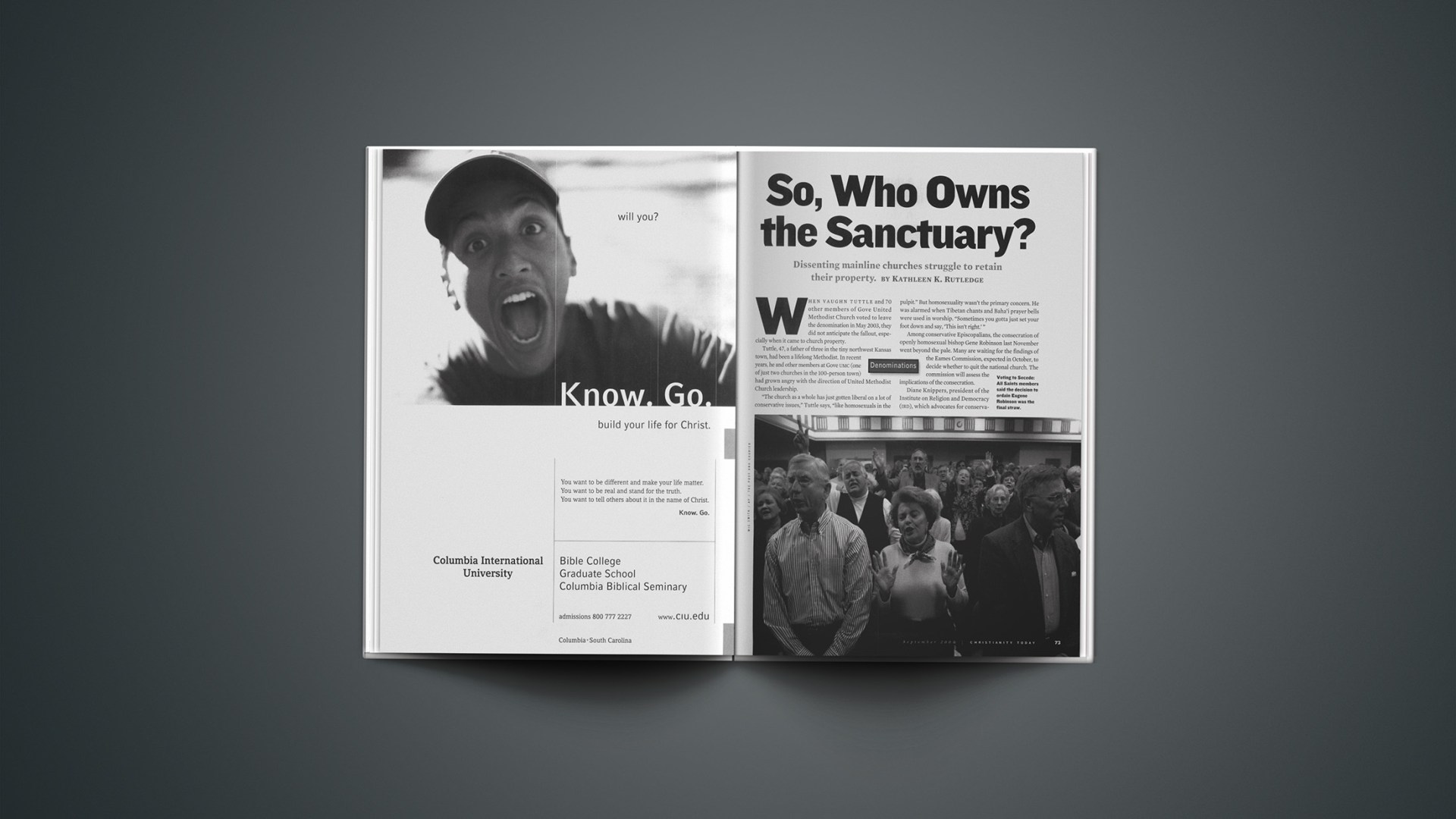

When Vaughn Tuttle and 70 other members of Gove United Methodist Church voted to leave the denomination in May 2003, they did not anticipate the fallout, especially when it came to church property.
Tuttle, 47, a father of three in the tiny northwest Kansas town, had been a lifelong Methodist. In recent years, he and other members at Gove UMC (one of just two churches in the 100-person town) had grown angry with the direction of United Methodist Church leadership.
“The church as a whole has just gotten liberal on a lot of conservative issues,” Tuttle says, “like homosexuals in the pulpit.” But homosexuality wasn’t the primary concern. He was alarmed when Tibetan chants and Baha’i prayer bells were used in worship. “Sometimes you gotta just set your foot down and say, ‘This isn’t right.’ “
Among conservative Episcopalians, the consecration of openly homosexual bishop Gene Robinson last November went beyond the pale. Many are waiting for the findings of the Eames Commission, expected in October, to decide whether to quit the national church. The commission will assess the implications of the consecration.
Diane Knippers, president of the Institute on Religion and Democracy (IRD), which advocates for conservative renewal, says, “We are probably going to see a spate of property disputes. It is just unavoidable.”
In recent months, conservatives in mainline congregations across the United States have voiced similar frustration. Christianity Today spoke in depth with leaders in two divided mainline congregations, Gove UMC and All Saints Episcopal Church in Pawleys Island, South Carolina, to gain insight into the property issues that arise when local congregations split.
Time for Action
In the UMC, some evangelical leaders have said it may be time for conservatives and liberals to pursue amicable separation after years of dispute. Such an administrative divorce may be discussed at the next global meeting of Methodists in 2008.
But for a few congregations, the waiting is over. After months of debate, more than 70 members of the 125-member Gove UMC in May 2003 voted to secede from their denomination. Seven months later in January 2004, 468 members of the 800-member All Saints parish voted to leave the Episcopal Church USA (ECUSA).
Russell Campbell, head of the All Saints governing board, cited an erosion of orthodox beliefs in the national church. “The orthodox members felt that the church they had known had been taken away by the revisionist group.” All Saints senior pastor David Bryan said the consecration of Robinson was the final straw. “Folks were continually less confident that the Episcopal Church was going to straighten itself out.” The majority at All Saints chose to join the Anglican Mission in America (AMIA). AMIA is a four-year-old missionary endeavor sponsored by Anglican archbishops in Rwanda and Southeast Asia. It has 65 congregations, mostly in North America.
That vote put the ownership of the All Saints church campus, valued at $10 million, in dispute. A 1979 Episcopal church law, called the Dennis Canon, states that all parish property belongs to the local diocese and the national church. The All Saints campus includes several buildings and 50 acres of land.
Ross Lindsay, chancellor of All Saints, says the parish plans to challenge the constitutionality of the Dennis Canon if necessary. The church was established in 1767, more than 20 years before the Episcopal Church was formed. Lindsay says All Saints property was given in the 1740s as a charitable trust to the local inhabitants, not the national church. But Nick Ziegler, attorney for the Diocese of South Carolina, dismisses the All Saints argument, which he calls “a very stale claim.”
Legal Wrangling
Alan Wisdom, vice president of the IRD, says it is hard to estimate how many mainline congregations want out because those that make their intentions known leave themselves open under canon law and civil law to have the property seized. The legal wrangling over All Saints, which officially began in 2000, has already cost the parish $250,000 in legal fees.
In addition, some All Saints members who did not agree with the split formed a new congregation and claim legal rights to the worship facility and other assets. All Saints conservatives informally offered the old church building, cemetery, and rectory to the minority that chose to stay in ECUSA. Conservatives would keep the new, larger building and the rest of the property. The land and building they offered the ECUSA congregation were worth $2 million. The offer was rejected.
The All Saints conservatives saw the state appeals court reverse a lower court ruling in their favor and likely face a trial in circuit court next year.
While the IRD’s position is that conservative churches should aim to stay and fight in the denomination, Wisdom called on denominational bureaucrats to show some grace: “It is not becoming for a denomination to hold a congregation against its will when they feel their conscience has been violated.”
The All Saints conflict has an added twist, in that All Saints actually agrees with its immediate governing body—the Diocese of South Carolina—on most theological issues.
Relationships in Peril
At the United Methodist church in Gove, there was not $10 million in real estate at stake, but generations of interfamily relationships in jeopardy.
“This is a county of less than 3,000 persons, and most of these people are related to one another by blood or marriage or long-standing friendships,” Pat Ault-Duell, administrative head of the Kansas West Conference, said in a written statement. The schism caused “very deep hurts and a large sense of betrayal,” she said.
On May 25, two weeks after the majority faction elected to leave the denomination, further severing occurred when denominational leaders showed up unannounced to conduct Sunday worship. Though the group of 70 had voted to leave the national church, it continued to use the church facility for worship.
“The members of the splinter group were free to leave the denomination,” Ault-Duell said, “but they were not free to take property built for and used by the United Methodist Church.”
Similar to Episcopal canons, the Methodist Book of Discipline states that all properties accumulated in the name of the UMC are to be held in trust for use by the denomination.
An argument ensued—and Ault-Duell called the remaining members to the parking lot for an ad hoc worship service.
On that day families were divided, Vaughn Tuttle recalls. Children elected to leave the UMC, while parents and grandparents stayed with the denomination. “My son’s girlfriend, her family left,” Tuttle says. “Her grandmother came over and said, ‘Hey, are you going with us?’ and she said, ‘No.'”
Six weeks later, the Kansas West Conference froze the assets of the local church, saying the Gove church was subject to the denomination’s “trust clause.”
Paul Woodall, presiding pastor of Gove UMC when the body elected to split, says he did not think the trust clause applied to the church because the phrase was not in the deed. Likewise, Woodall says, the congregation believed the trust relationship described in the Book of Discipline referred to a mutual obligation to uphold both church doctrine and church law.
Bishop Fritz Mutti, who supervises the South Central Jurisdiction, which incorporates eight states including Kansas, denies charges of doctrinal unfaithfulness. Pastors and denominational leaders are expected to agree to Methodist doctrinal standards when they are ordained, he says, conceding that “it doesn’t mean everybody talks about theology in the same way.”
In regards to property disputes, however, Mutti said the church law is clear: “The property is held in trust for the trustees of the United Methodist Church.”
After several months of legal exchanges, the two sides agreed to mediate the assets of Gove UMC last December. In the settlement, which was finalized in February, the conference received full title to the property, and the Gove splinter group agreed to turn over the church’s assets—$50,000 in cash and certificates of deposit and architectural drawings. All the cash, under the agreement, will be donated to a Methodist youth camp in a neighboring town.
Woodall says the majority faction ultimately lacked the money for a sustained legal battle.
The pastor estimates that the congregation members had already contributed roughly $10,000 of their personal income to the lawsuit. “Their grandparents built the building, their parents built the building, they contributed to the building,” Woodall says. “It never went to trial because we didn’t have the money.”
Once the mediation was complete, however, there was a sense of relief—and sadness. Some 18 months after the initial break, there are now two churches on the same quiet street in the small town. The splinter group, which renamed itself Gove Methodist Church, merged with Gove Bible Baptist Church. The merger—called the Gove Community Bible Church—has had more than 100 worshipers on Sundays. A new building fund has begun.
Though it has been a painful process, neither Woodall or Tuttle nor the other members of the new Gove Community Bible Church regret the decision to leave the denomination.
“It was difficult. We weren’t really fighting for the buildings. We were fighting for the moral values,” Tuttle says. “The United Methodists got the building, and we got the church. The church is the people.”
No one seems to know exactly how many conservative congregations in the mainline are about to bolt. But whether they stay or go, they face a hazardous pilgrimage, if the painful passage of All Saints and Gove United Methodist is any guide.
Kathleen K. Rutledge is a writer based in Lexington, Kentucky.
Copyright © 2004 Christianity Today. Click for reprint information.
Related Elsewhere:
All Saints Episcopal Church’s website has more information about the congregation.
News stories about the church’s fight include:
Pawleys Island church votes to leave Episcopal Church | The congregation of All Saints Waccamaw Episcopal Church, one of the largest Episcopal churches in South Carolina, has voted to leave the national Episcopal church. (Associated Press, Jan. 09, 2004)
Parish vote to cut ties leaves hurt feelings | The decision of a South Carolina parish to leave the Episcopal Church has left many in the Diocese of South Carolina confused and hurt, according to the chairman of a committee that tried to work out a compromise. (The Post and Courier, Charleston, S.C., Jan. 12, 2004)
More articles on ECUSA denominational disputes from our Church Life page include:
Sanctifying Sin | Statement affirming homosexual unions roils Anglicans. (July 14, 2004)
A Slow Exodus | Disaffected orthodox Episcopalians start new ministries. (May 27, 2004)
An Anglican Rorschach Test | Conservatives and liberals fide hope in statement. (Dec. 02, 2003)
Canadian Anglicans Face Off | Bishops hold charges against dissenting clergy, but division and suspicion abound. (Dec. 09, 2003)
The Gay Bishop’s Global Fallout | How each of the 39 provinces in the Anglican Communion have responded to Sunday’s consecration. (Nov. 07, 2003)
Translating the Anglican Primates | Interpretations vary widely on what last week’s statement means, how forceful it was, and what’s next. (Oct. 21, 2003)
One-and-One-Half Cheers for the Anglican Primates’ Statement | An interview with theologian—and longtime Anglican—J. I. Packer (Oct. 17, 2003)
Dispatch: Conservatives Just Got Clobbered | Last week’s American Anglican Council meeting in Texas announced victory prematurely (Oct. 17, 2003)
Weblog: Early Responses to the Anglican Primates’ Statement | Both sides seem happy as the Episcopal Church USA promises to go ahead with its gay bishop ordination (Oct. 17, 2003)
Anglican Leaders Criticize Episcopal Church, Canada’s New Westminster Diocese on Homosexual Actions | Future of the Anglican unity “in jeopardy,” they say, but don’t break communion—yet (Oct. 16, 2003)
Anglicanism’s Communion of Saints | Under the somber portraits of their predecessors, Anglican archbishops will discuss the fractious issues of the church and homosexuality (Oct. 15, 2003)
Weblog: Where Else to Go for News and Analysis of the Anglican Primates’ Meeting | The best (and worst) articles and sites monitoring the breakup of the world’s third-largest Christian body (Oct. 15, 2003)
One-and-One-Half Cheers for the Anglican Primates’ Statement | An interview with theologian—and longtime Anglican—J.I. Packer (Oct. 17, 2003)
Anglican Leaders Criticize Episcopal Church, Canada’s New Westminster Diocese on Homosexual Actions | Future of the Anglican unity “in jeopardy,” they say, but don’t break communion—yet. (Oct. 16, 2003)
Florida Bishop Defies Episcopal Church Head | The consecration of a new bishop becomes the latest battleground between Frank Griswold and the American Anglican Council. (Oct. 10, 2003)
Reimagining Anglican Bonds of Affection | Orthodox American leaders begin describing what realignment of the Anglican Communion might look like. (Oct. 09, 2003)
Conservative Episcopalians Challenge Church Politics as Usual | “A Place to Stand” conference combines unofficial convention, pep rally, and communiqué to Anglican leaders. (Oct. 08, 2003)
Our Brothers and Sisters, the Episcopalians | The Episcopal Church needs our help. Here’s why we should give it. (Oct. 03, 2003)
Orthodox Canadian Anglicans on Alert (Sept. 09, 2003)
To My Episcopal Family | Final thoughts from the Episcopal Church’s General Convention. (Aug. 08, 2003)
Bishops Sanction ‘Resources,’ Not Rites | Having confirmed gay bishop, Episcopal leaders turn to discussing same-sex unions. (Aug. 7, 2003)
Darkness in the Afternoon | Openly homosexual Episcopal priest cleared of misconduct, confirmed as bishop (Aug. 6, 2003)
The Bitter Harvest of Sexual Ideology | No one wanted the Gene Robinson bishopric debate to take this sad turn (Aug. 5, 2003)
Deputies Slice into the Gordian Knot | The Episcopal Church’s House of Deputies approves Gene Robinson as New Hampshire Bishop. The House of Bishops will vote today. (Aug. 4, 2003)
Praise the Lord and Pass the Condoms | Southern Hemisphere primates warned that approving Gene Robinson would place the church outside most of the world’s 72 million Anglicans. “You’ll get over it,” responded about 60 percent of the House of Deputies. (Aug. 4, 2003)
Gene Robinson Takes Questions in a Church called Gethsemane | Speaks on reparative therapy, potential schism, and whether he really “/left” his wife for his male lover. (Aug. 4, 2003)
What in the World Is God Doing? | For Episcopalians, the night may be darkest before the dawn. (Aug. 4, 2003)
Integrity Doles Out God’s Not-So Inclusive Love | The Integrity Eucharist has become a triennial sort of mass pity party. (Aug. 1, 2003)
Gay Rites Would Not Bless Ecumenism | Could also impair Anglican work overseas. (Aug. 1, 2003)
Gene and Me | My history with the openly gay man elected bishop of Rochester. (July 31, 2003)
Coming Attractions | Gay activism is not just found in liberal churches (July 28, 2003)
Anglican Communion Frays | Bishops worldwide chastise Canadian bishop who approved gay unions. (July 09, 2003)
The African Lion Roars in the Western Church | Anglican liberals are fretting, conservatives rejoicing, and all are scrambling to their history books: whence this new evangelical force on the world scene? (June 27, 20 03)
Why I Walked | Sometimes loving a denomination requires you to fight. (Jan. 03, 2003)
A Holy Nuisance | J.I. Packer has strong words for those who don’t feel called to agitate for reform. (Jan. 03, 2003)
Mortified in Vancouver | A church’s actions can be in conflict with its professed faith only so long before faithful Christians wonder how much hypocrisy they can stand. (July 30, 2002)
Vancouver Anglicans Approve Same-Sex Unions | Conservatives walk out after synod vote to bless gay couples. (June 17, 2002)
Anglican Diocese Endorses Same-Sex Unions | Traditionalists walk out, issue global call for outside intervention. (July 12, 2002)
Canadian Anglicans Vote on Blessing Gay Unions (June 13, 2002)
Weblog: Is Anglicanism’s First Election of an Openly Gay Bishop an Exit Sign? (June 9, 2003)
Commission Will Try to Resolve Tensions Within Anglicanism Worldwide | Group will examine strains over homosexuality, as well as role of Archbishop of Canterbury. (March 20, 2001)
More articles on UMC denominational disputes from our Church Life page include:
Pondering a Divorce | Some United Methodists think their differences are irreconcilable. (July 01, 2004)
Methodists Back Away from Breakup | Evangelicals shelve call for ‘amicable separation.’ (May 07, 2004)
United Methodist Conservatives Seek ‘Amicable’ Split | Despite gains, evangelicals say Methodist divisions over homosexuality are ‘irreconcilable.’ (May 06, 2004)
Methodists Strengthen Stand Against Homosexual Practice | Lesbian pastor may not be reappointed. (May 05, 2004)
Lesbian Is Eligible for Reappointment, Bishop Says | Differing interpretations of Methodist court ruling prolong denomination’s fight. (May 06, 2004)
Weblog: Methodist Council Says Homosexuality Is ‘Incompatible’ with Christian Teaching (May 03, 2004)
Flouting Church Law | Two gay controversies likely to dominate United Methodist General Conference this week. (May 2004)
A Methodist Mob Mugging | There are real victims in the farce that was the Methodist church trial of a lesbian minister. (March 25, 2004)
Weblog: Methodist Court Acquits Homosexual Minister (March 22, 2004)
Weblog: Methodist Trial Opens With Arrests, Comparison to Crucifixion (March 18, 2004)
Weblog: In the United Methodist Church, a Trial Comes After the Court’s Decision (Dec. 18, 2001)
Other Christianity Today articles about mainline churches and evangelicalism includes:
Turning the Mainline Around | New sociological studies show that evangelicals may well succeed at renewing wayward Protestantism. (July 25, 2003)
‘Confessing’ Christians Stick It Out | Some conservatives, however, give up on reforming their denominations. (November 27, 2001)
Will Presbyterians Embrace ‘Confessing Movement’? | Conservatives threaten to withhold money if national leadership doesn’t agree with affirmations. (May 9, 2001)
Mainstreaming the Mainline | Methodist evangelicals pull a once ‘incurably liberal’ denomination back toward the orthodox center. (August 18, 2000)