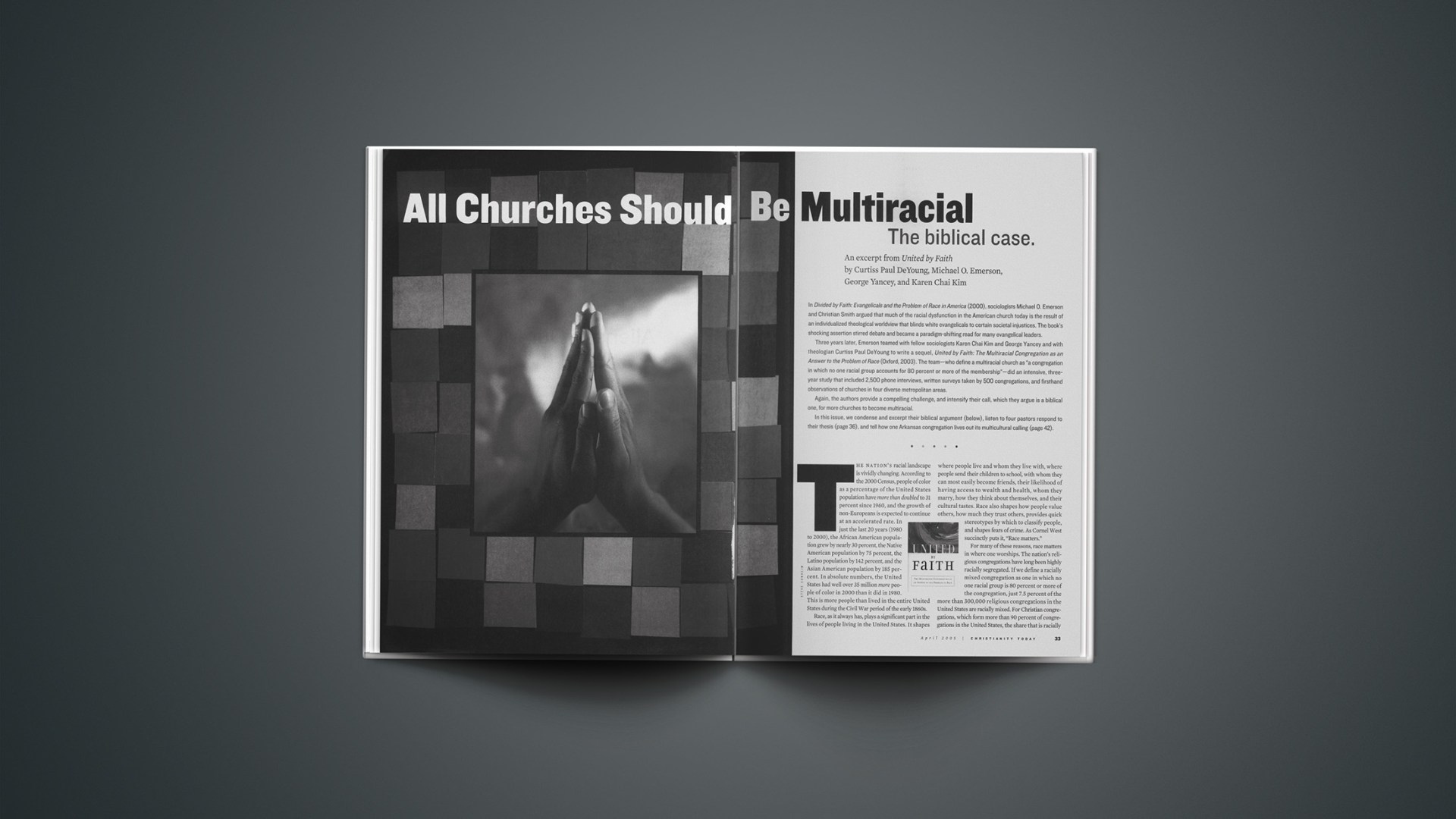
In Divided by Faith: Evangelicals and the Problem of Race in America (2000), sociologists Michael O. Emerson and Christian Smith argued that much of the racial dysfunction in the American church today is the result of an individualized theological worldview that blinds white evangelicals to certain societal injustices. The book’s shocking assertion stirred debate and became a paradigm-shifting read for many evangelical leaders.
Three years later, Emerson teamed with fellow sociologists Karen Chai Kim and George Yancey and with theologian Curtiss Paul DeYoung to write a sequel, United by Faith: The Multiracial Congregation as an Answer to the Problem of Race (Oxford, 2003). The team—who define a multiracial church as “a congregation in which no one racial group accounts for 80 percent or more of the membership”—did an intensive, three-year study that included 2,500 phone interviews, written surveys taken by 500 congregations, and firsthand observations of churches in four diverse metropolitan areas.
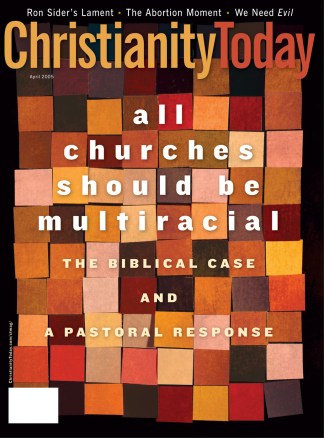
Again, the authors provide a compelling challenge, and intensify their call, which they argue is a biblical one, for more churches to become multiracial.
In this issue, we condense and excerpt their biblical argument, listen to four pastors respond to their thesis, and tell how one Arkansas congregation lives out its multicultural calling.
The nation’s racial landscape is vividly changing. According to the 2000 Census, people of color as a percentage of the United States population have more than doubled to 31 percent since 1960, and the growth of non-Europeans is expected to continue at an accelerated rate. In just the last 20 years (1980 to 2000), the African American population grew by nearly 30 percent, the Native American population by 75 percent, the Latino population by 142 percent, and the Asian American population by 185 percent. In absolute numbers, the United States had well over 35 million more people of color in 2000 than it did in 1980. This is more people than lived in the entire United States during the Civil War period of the early 1860s.
Race, as it always has, plays a significant part in the lives of people living in the United States. It shapes where people live and whom they live with, where people send their children to school, with whom they can most easily become friends, their likelihood of having access to wealth and health, whom they marry, how they think about themselves, and their cultural tastes. Race also shapes how people value others, how much they trust others, provides quick stereotypes by which to classify people, and shapes fears of crime. As Cornel West succinctly puts it, “Race matters.”
For many of these reasons, race matters in where one worships. The nation’s religious congregations have long been highly racially segregated. If we define a racially mixed congregation as one in which no one racial group is 80 percent or more of the congregation, just 7.5 percent of the more than 300,000 religious congregations in the United States are racially mixed. For Christian congregations, which form more than 90 percent of congregations in the United States, the share that is racially mixed drops to 5.5 percent. Of this small percentage, approximately half of the congregations are mixed only temporarily, during the time they are in transition from one group to another.
The explosion of racial and ethnic diversity in the United States has introduced dramatic tensions within faith communities. How should they respond to a pluralistic society? What should congregations look like racially? Does considering the racial composition of congregations sidetrack faith communities from more important religious matters? Given the current and historical racial context of the United States, are certain racial and ethnic communities best served by having their own congregations?
This book sets out to make a bold, clear, controversial argument: Christian congregations, when possible, should be multiracial. It may be stunning or even offensive to some that we state our argument so imperatively. But before deciding whether we go too far, we hope the reader will carefully examine the biblical and sociological evidence.
Given how far we are from this reality, we issue a call for the emergence of a movement toward more multiracial congregations. The 21st century must be the century of multiracial congregations.
Our conclusion rests in part on the premise that multiracial congregations can play an important role in reducing racial division and inequality and that this should be a goal of Christian people. We need to move beyond simply stating that Christian worship is the most segregated hour in the United States. What does the Christian tradition teach that we ought to do?
Jesus’ Radical Passion
The dramatic confrontation that Jesus had with the moneychangers in the temple was recorded by all the Gospel writers. The authors of Matthew, Mark, and Luke included Jesus’ quoting from the prophet Isaiah (56:7) in their retelling. Only Mark included the entire quote. Jesus declared, “Is it not written, ‘My house shall be called a house of prayer for all the nations’?” The author of Mark understood that the last four words of that quote from Isaiah—for all the nations—summed up what caused the religious leaders to fear Jesus and look for a way to kill him (Mark 11:18).
Jesus quoted the prophet Isaiah from the Hebrew Scriptures to announce and declare the purpose and passion of his ministry. He stood in the temple area and proclaimed to all who could hear him what he understood to be the culmination of three years of preaching, teaching, healing, and ministering in the highways and byways of greater Palestine: “My house shall be called a house of prayer for all the nations.” Brian Blount captures the writer of Mark’s understanding of Jesus’ message when he writes: “In the Gospel of Mark, Jesus is a preacher of multicultural worship. He envisioned a future that was radically different from the one espoused by the temple leadership.”
In the Beginning
Christianity’s first congregation emerged from an undistinguished group of Galilean followers of Jesus who gathered together in Jerusalem during the days following the drama of the Crucifixion and Resurrection. The death, resurrection, and ascension of Jesus ushered in a new era for his disciples. No longer did they have a human Jesus providing guidance. The mantle of leadership passed on to them. Those early followers faced the challenge of implementing Jesus’ vision of a house of prayer for all the nations.
After several weeks of meeting together for prayer, an amazing and transforming event occurred on the Day of Pentecost. According to the author of the Acts of the Apostles, the power of the Holy Spirit came upon those 120 praying in an upper room and propelled them out into the streets proclaiming the Good News of Jesus Christ in the languages of the nations. “Jews from every nation under heaven living in Jerusalem” gathered and inquired as a result of this unusual occurrence (Acts 2:5). Individuals who relocated to Jerusalem from Jewish enclaves throughout the continents of Asia, Africa, and Europe heard the gospel in the dialect of their local community in the country of their origin. The Spirit of Jesus supernaturally spoke through these Galilean disciples in the language of the house of prayer for all the nations. On the Day of Pentecost the Jerusalem congregation grew to more than 3,000 multicultural, multilingual Jews (2:41). Several thousand more were added in the days that followed (4:4, 5:14, 6:7). The church was multicultural and multilingual from the first moment of its existence.
Who Are These People?
According to Acts, the first congregation to experience the reconciliation of Jews and Gentiles into one coherent faith community formed in Antioch of Syria in the 30s. Antioch was the third largest city in the Roman Empire, with a population of nearly half a million people. A wide cultural mix of peoples including Syrians, Romans, Greeks, Arabs, Persians, Armenians, Parthians, Cappadocians, and Jews made up Antioch’s urban population. One-seventh of the population was Jewish. The relative peace of the Jewish community was disrupted in the late 30s and early 40s. Ethnic tensions erupted between Jews and the majority Greco-Syrians. Mobs attacked Jews and torched their synagogues.
Into this city arrived Greek-speaking Jewish Christians who left Jerusalem during the persecution of the mid-30s. They began preaching to fellow Jews (Acts 11:19). Some of their Cyrenean and Cypriot leaders also preached to Greeks (11:20). This gave birth to the first congregation of followers of Jesus Christ that included both Jews and Gentiles.
The Antioch congregation selected a diverse leadership team in the early stages of their formation. Both Paul and Barnabas were Jews raised outside Palestine and immersed in Greek culture, yet they were fluent in the traditions of Jerusalem. Saul spent his school years in Jerusalem under the watchful eye of the noted teacher Gamaliel. Both were bilingual, speaking Aramaic and Greek. Manaen grew up in the household of Herod Antipas as a stepbrother. Lucius of Cyrene came from North Africa, possibly one of the people who initially preached in Antioch. Simeon, called Niger (black), was most likely a black African.
The Antioch church lived out an inclusive table fellowship that emulated the social practices of Jesus. Jews and Gentiles continued to embrace their culture of origin but broke with certain cultural rules that inhibited their ability to live as one in Christ. For example, they ate and socialized together. For Jewish Christians this required them to give up an understanding that their ethnic identity necessitated separation from Gentiles and risk being seen as developing close relations with pagans. In the midst of Antioch’s extreme ethnic tensions, as scholar Rodney Stark puts it, “Christianity offered a new basis for social solidarity.”
Therefore the social commentators of the day in Antioch could not identify the followers of Jesus with any known group. So they were called Christians or Christ followers (Acts 11:26). As theologian Virgilio Elizondo states, the Christians “could not be classified according to the … categories of either the pagans or the Jews. They were both and yet they were neither the one nor the other alone. … They were bound together by a new intimacy and mutual concern that went beyond normal, acceptable behavior within the empire.”
Today’s Challenge
The Antioch congregation became the model for the expansion of the church in the first century. And followers of Jesus Christ continued to establish multicultural congregations beyond the time recorded in the New Testament into the second century. Their broad inclusiveness decreased only when the church became more aligned and identified with the Roman Empire and the culture of the elite. The faith that united the early followers of Jesus was co-opted and the church became divided by faith.
Thus, we have discovered that the early followers of Jesus embraced his vision of a house of prayer for all the nations and implemented this in their congregations.
For us, the basic question is this: How were relatively stable and sturdy communities with considerable inner cohesion formed from a mixture of ethnic, social, and religious groups? How did Jews and Gentiles, Greeks and barbarians, slaves and freemen, men and women, come to form a new unity in Christ?
We declare that the first-century church was united by faith! This unity occurred as local congregations strategically implemented Jesus’ vision of a house of prayer for all nations.
If we claim to follow Jesus Christ and to have inherited the gospel of the first-century church, we contend that our present-day congregations should exhibit the same vision for and characteristics of those first Christian communities of faith. Therefore, we even go so far as to say that a Christian, by biblical definition, is a follower of Jesus Christ whose way of life is racial reconciliation.
Our premise remains that when possible, congregations should be multiracial. We have held high the standard of what it means to be an authentic multiracial congregation. We do not apologize for this. We do recognize that multiracial congregations are the result of a commitment to take a long and difficult journey toward authenticity. So we call for a movement toward more multiracial congregations.
We grant the validity of three exceptions. First, in some locations, particularly certain rural areas, only one racial group resides. Obviously, a multiracial congregation is not possible. Yet even congregations in such settings must operate as New Testament congregations. They should be crossing any ethnic lines that exist: Germans and Italians, Vietnamese and Laotian, Trinidadian and Haitian, and the like. Also, congregations that are in racially isolated areas should develop partnerships with congregations in other areas that are diverse, and they should educate themselves as though next year their community will diversify. Many formerly racially homogeneous communities are now integrated. The Christian congregation should be the first group to welcome new neighbors.
A second exception to our thesis is the lack of a common language. Affordable technical possibilities for simultaneous translation may eliminate this exception in the future.
The third exception allows for the unique circumstances of first-generation immigrant groups. The challenges of crossing cultures may be too great for the first generation living in the United States.
There may be a few unique situations we have missed that qualify as exceptions. We cannot anticipate every special circumstance in particular congregations. But these special cases are a small percentage of total churches.
The future of Christianity in the 21st century depends on practical, living examples of authentic reconciling faith. While multiracial congregations will never be perfect organizations, God’s call to reconciliation through the life, death, and resurrection and abiding presence of Jesus Christ compels us to embrace the challenge of moving forward toward this goal.
Curtiss Paul DeYoung is an associate professor of reconciliation studies at Bethel University, Minnesota; Michael O. Emerson is a professor of sociology at Rice University; George Yancey is an associate professor of sociology at the University of North Texas; and Karen Chai Kim is an assistant professor of sociology at the University of Houston.
Copyright © 2005 Christianity Today. Click for reprint information.
Related Elsewhere:
United by Faith is available from Christianbook.com and other book retailers.
More information is available from the publisher.
Our October, 2000, coverage of Divided by Faith includes:
Divided by Faith? | A recent study argues that American evangelicals cannot foster genuine racial reconciliation. Is our theology to blame? (Sept. 22, 2000)
Color-Blinded | Why 11 o’clock Sunday morning is still a mostly segregated hour. An excerpt from Divided by Faith. (Sept. 22, 2000)
We Can Overcome | A CT forum examines the subtle nature of the church’s racial division—and offers hope. (Sept. 29, 2000)
Shoulder to Shoulder in the Sanctuary | A profile in racial unity. (Sept. 28, 2000)
Common Ground in the Supermarket Line | A profile in racial unity. (Sept. 27, 2000)
The Lord in Black Skin | As a white pastor of a black church, I found the main reason prejudice and racism hurt so much: because we are so much alike. (Sept. 25, 2000)
More Christianity Today coverage of racial reconciliation includes:
Growing Up at Koinonia | The focus of a PBS documentary, Koinonia Farm was the target of segregationists, a radical Christian community, and where Jim Jordan grew up. (March 09, 2005)
The Work of Faith | How the torch of racial reconciliation, once carried by Christian civil-rights workers, is now being held by faith-based organizations. (Feb. 23, 2005)
Hope Deferred | Christians are uniquely positioned to further racial equality. (June 29, 2004)
CT Classic: Confessions of a Racist | It wasn’t until after Martin Luther King, Jr.’s death that I was struck by the truth of what he lived and preached. (January 17, 2000)
Martin Luther King, Jr.: A History | No Christian played a more prominent role in the century’s most significant social justice movement than Martin Luther King, Jr. (January 17, 2000)
CT Classic: The March to Montgomery | Christianity Today‘s coverage of King’s historic voting rights march, from our April 9, 1965 issue (January 17, 2000)
Catching Up with a Dream | Evangelicals and Race 30 Years After the Death of Martin Luther King, Jr. (March 2, 1998)
She Has a Dream, Too | Bernice King talks about her father’s death, her call to ministry, and what the church still needs to do about racism. (June 16, 1997)
Billy Graham Had a Dream | American revivalist preachers have been evangelical Christianity’s most visible spokesmen over the centuries. What does their record on race relations show? (Jan. 12, 1998)