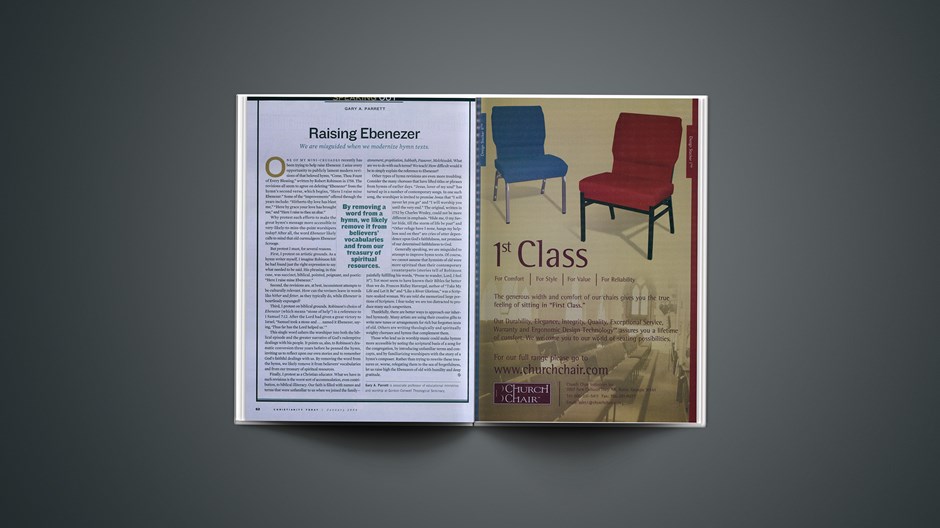
One of my mini-crusades recently has been trying to help raise Ebenezer. I seize every opportunity to publicly lament modern revisions of that beloved hymn, "Come, Thou Fount of Every Blessing," written by Robert Robinson in 1758. The revisions all seem to agree on deleting "Ebenezer" from the hymn's second verse, which begins, "Here I raise mine Ebenezer." Some of the "improvements" offered through the years include: "Hitherto thy love has blest me," "Here by grace your love has brought me," and "Here I raise to thee an altar."
Why protest such efforts to make the great hymn's message more accessible to very-likely-to-miss-the-point worshipers today? After all, the word Ebenezer likely calls to mind that old curmudgeon Ebenezer Scrooge.
But protest I must, for several reasons.
First, I protest on artistic grounds. As a hymn writer myself, I imagine Robinson felt he had found just the right expression to say what needed to be said. His phrasing, in this case, was succinct, biblical, pointed, poignant, and poetic: "Here I raise mine Ebenezer."
Second, the revisions are, at best, inconsistent attempts to be culturally relevant. How can the revisers leave in words like hither and fetter, as they typically do, while Ebenezer is heartlessly expunged?
Third, I protest on biblical grounds. Robinson's choice of Ebenezer (which means "stone of help") is a reference to 1 Samuel 7:12. After the Lord had given a great victory to Israel, "Samuel took a stone and … named it Ebenezer, saying, 'Thus far has the Lord helped us.' "
This single word ushers the worshiper into both the biblical episode and the greater narrative of God's redemptive dealings with his people. It points us, also, to Robinson's dramatic conversion three years before he penned the hymn, inviting us to reflect upon our own stories and to remember God's faithful dealings with us. By removing the word from the hymn, we likely remove it from believers' vocabularies and from our treasury of spiritual resources.
Finally, I protest as a Christian educator. What we have in such revisions is the worst sort of accommodation, even contribution, to biblical illiteracy. Our faith is filled with names and terms that were unfamiliar to us when we joined the family—atonement, propitiation, Sabbath, Passover, Melchizedek. What are we to do with such terms? We teach! How difficult would it be to simply explain the reference to Ebenezer?
Other types of hymn revisions are even more troubling. Consider the many choruses that have lifted titles or phrases from hymns of earlier days. "Jesus, lover of my soul" has turned up in a number of contemporary songs. In one such song, the worshiper is invited to promise Jesus that "I will never let you go" and "I will worship you until the very end." The original, written in 1752 by Charles Wesley, could not be more different in emphasis. "Hide me, O my Savior hide, till the storm of life be past" and "Other refuge have I none, hangs my helpless soul on thee" are cries of utter dependence upon God's faithfulness, not promises of our determined faithfulness to God.
Generally speaking, we are misguided to attempt to improve hymn texts. Of course, we cannot assume that hymnists of old were more spiritual than their contemporary counterparts (stories tell of Robinson painfully fulfilling his words, "Prone to wander, Lord, I feel it"). Yet most seem to have known their Bibles far better than we do. Frances Ridley Havergal, author of "Take My Life and Let It Be" and "Like a River Glorious," was a Scripture-soaked woman. We are told she memorized large portions of Scripture. I fear today we are too distracted to produce many such songwriters.
Thankfully, there are better ways to approach our inherited hymnody. Many artists are using their creative gifts to write new tunes or arrangements for rich but forgotten texts of old. Others are writing theologically and spiritually weighty choruses and hymns that complement them.
Those who lead us in worship music could make hymns more accessible by noting the scriptural basis of a song for the congregation, by introducing unfamiliar terms and concepts, and by familiarizing worshipers with the story of a hymn's composer. Rather than trying to rewrite these treasures or, worse, relegating them to the sea of forgetfulness, let us raise high the Ebenezers of old with humility and deep gratitude.
Gary A. Parrett is associate professor of educational ministries and worship at Gordon-Conwell Theological Seminary.
More Christianity Today articles from our Worship page include:
Old Words, Vibrant Faith | Christian pop/rock band Jars of Clay explains why the church needs more Redemption Songs. (Oct 21, 2005)
'Hymn for Easter Day' | Charles Wesley's 'Christ the Lord Is Risen Today' brings alleluia's historical significance to modern audiences. (March 24, 2005)
The Silenced Word | Why aren't evangelicals reading the Bible in worship anymore? (March 20, 2001)
Whatever Happened to God? | One of evangelicalism's most respected theologians says most worship is clubby and convivial rather than adoring and expectant. (Feb. 1, 2001)
The New/Old CCM | Classical Christian music, especially the sacred works of Johann Sebastian Bach, finds a young, and large, audience. (Dec. 18, 2000)
















 While we pray for peace, we need moral clarity about this war.
 A Christian reconciliation group in Israel and Palestine warned that war would come. Now the war threatens their relevance.españolالعربيةFrançaisрусскийУкраїнська
 The rage of the mob is a poor substitute for real community.






