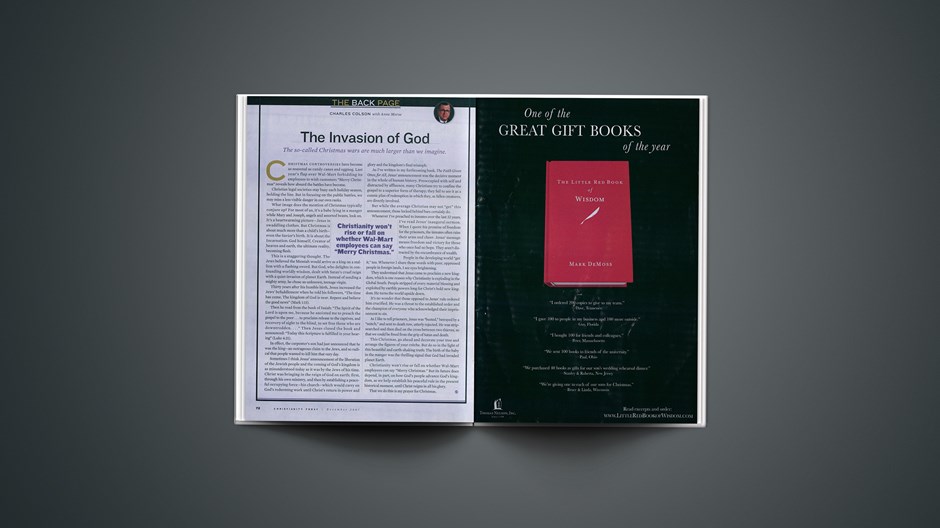
Christmas controversies have become as seasonal as candy canes and eggnog. Last year's flap over Wal-Mart forbidding its employees to wish customers "Merry Christmas" reveals how absurd the battles have become.
Christian legal societies stay busy each holiday season, holding the line. But in focusing on the public battles, we may miss a less visible danger in our own ranks.
What image does the mention of Christmas typically conjure up? For most of us, it's a babe lying in a manger while Mary and Joseph, angels and assorted beasts, look on. It's a heartwarming picture—Jesus in swaddling clothes. But Christmas is about much more than a child's birth—even the Savior's birth. It is about the Incarnation: God himself, Creator of heaven and earth, the ultimate reality, becoming flesh.
This is a staggering thought. The Jews believed the Messiah would arrive as a king on a stallion with a flashing sword. But God, who delights in confounding worldly wisdom, dealt with Satan's cruel reign with a quiet invasion of planet Earth. Instead of sending a mighty army, he chose an unknown, teenage virgin.
Thirty years after his humble birth, Jesus increased the Jews' befuddlement when he told his followers, "The time has come. The kingdom of God is near. Repent and believe the good news" (Mark 1:15).
Then he read from the book of Isaiah: "The Spirit of the Lord is upon me, because he anointed me to preach the gospel to the poor … to proclaim release to the captives, and recovery of sight to the blind, to set free those who are downtrodden. …" Then Jesus closed the book and announced: "Today this Scripture is fulfilled in your hearing" (Luke 4:21).
In effect, the carpenter's son had just announced that he was the king—an outrageous claim to the Jews, and so radical that people wanted to kill him that very day.
Sometimes I think Jesus' announcement of the liberation of the Jewish people and the coming of God's kingdom is as misunderstood today as it was by the Jews of his time. Christ was bringing in the reign of God on earth; first, through his own ministry, and then by establishing a peaceful occupying force—his church—which would carry on God's redeeming work until Christ's return in power and glory and the kingdom's final triumph.
As I've written in my forthcoming book, The Faith Given Once, for All, Jesus' announcement was the decisive moment in the whole of human history. Preoccupied with self and distracted by affluence, many Christians try to confine the gospel to a superior form of therapy; they fail to see it as a cosmic plan of redemption in which they, as fallen creatures, are directly involved.
But while the average Christian may not "get" this announcement, those locked behind bars certainly do.
Whenever I've preached to inmates over the last 32 years, I've read Jesus' inaugural sermon. When I quote his promise of freedom for the prisoners, the inmates often raise their arms and cheer. Jesus' message means freedom and victory for those who once had no hope. They aren't distracted by the encumbrance of wealth.
People in the developing world "get it," too. Whenever I share these words with poor, oppressed people in foreign lands, I see eyes brightening.
They understand that Jesus came to proclaim a new kingdom, which is one reason why Christianity is exploding in the Global South. People stripped of every material blessing and exploited by earthly powers long for Christ's bold new kingdom. He turns the world upside down.
It's no wonder that those opposed to Jesus' rule ordered him crucified. He was a threat to the established order and the champion of everyone who acknowledged their imprisonment to sin.
As I like to tell prisoners, Jesus was "busted," betrayed by a "snitch," and sent to death row, utterly rejected. He was strip-searched and then died on the cross between two thieves, so that we could be freed from the grip of Satan and death.
This Christmas, go ahead and decorate your tree and arrange the figures of your crèche. But do so in the light of this beautiful and earth-shaking truth: The birth of the baby in the manger was the thrilling signal that God had invaded planet Earth.
Christianity won't rise or fall on whether Wal-Mart employees can say "Merry Christmas." But its future does depend, in part, on how God's people advance God's kingdom, as we help establish his peaceful rule in the present historical moment, until Christ reigns in all his glory.
Charles Colson was the founder of Prison Fellowship Ministries, an outreach to convicts, victims of crime, and justice officers. Colson, who converted to Christianity before he was indicted on Watergate-related charges, became one of evangelicalism's most influential voices. His books included Born Again and How Now Shall We Live? A Christianity Today columnist since 1985, Colson died in 2012.















 While we pray for peace, we need moral clarity about this war.
 We’ve got little information on Jesus’ appearance and personality. But that’s the way God designed it.españolFrançais
 The rage of the mob is a poor substitute for real community.






