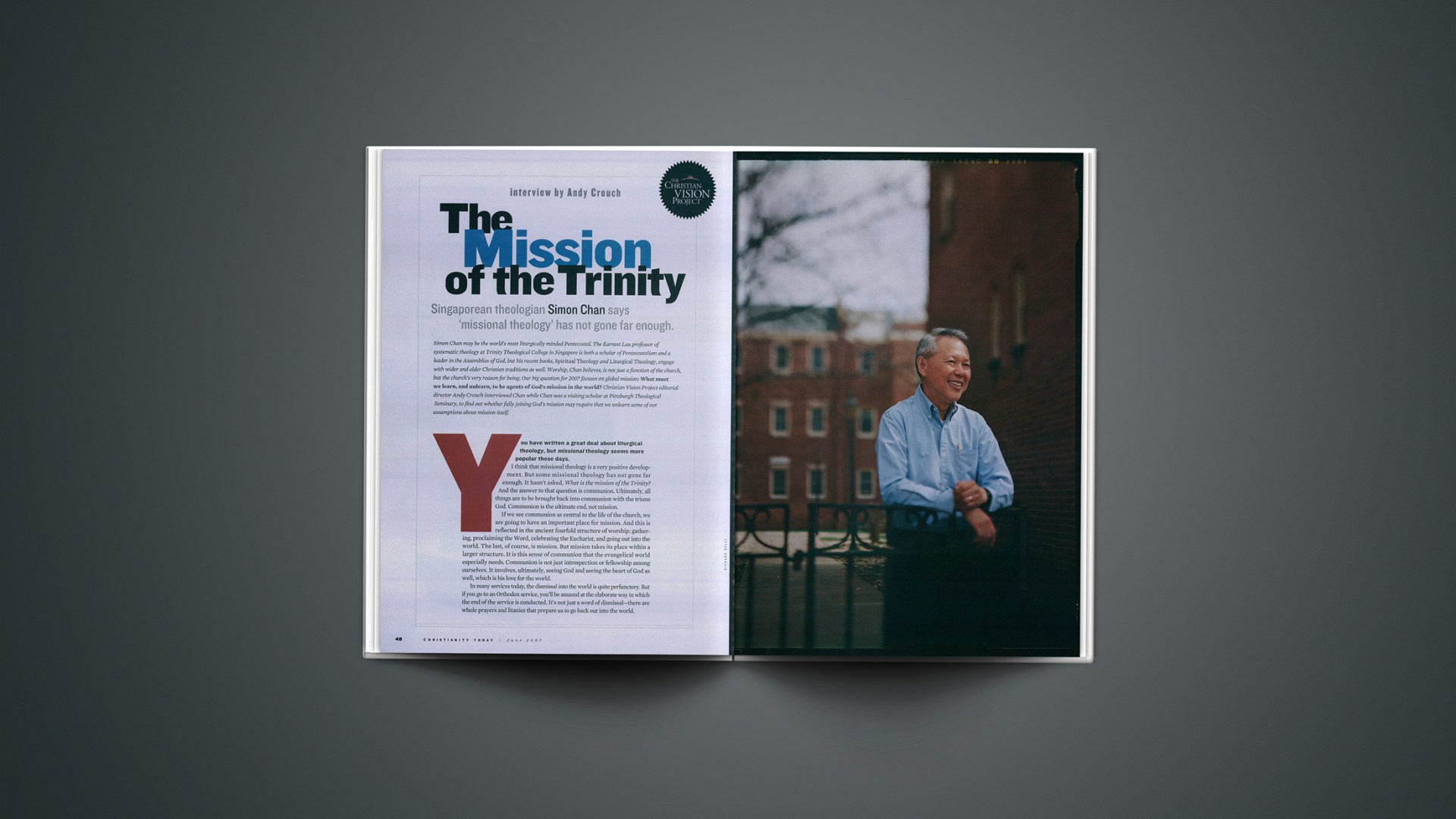

Simon Chan may be the world’s most liturgically minded Pentecostal. The Earnest Lau professor of systematic theology at Trinity Theological College in Singapore is both a scholar of Pentecostalism and a leader in the Assemblies of God, but his recent books, Spiritual Theology and Liturgical Theology, engage with wider and older Christian traditions as well. Worship, Chan believes, is not just a function of the church, but the church’s very reason for being. Our big question for 2007 focuses on global mission: What must we learn, and unlearn, to be agents of God’s mission in the world? Christian Vision Project editorial director Andy Crouch interviewed Chan while Chan was a visiting scholar at Pittsburgh Theological Seminary, to find out whether fully joining God’s mission may require that we unlearn some of our assumptions about mission itself.
You have written a great deal about liturgical theology, but missional theology seems more popular these days.
I think that missional theology is a very positive development. But some missional theology has not gone far enough. It hasn’t asked, What is the mission of the Trinity? And the answer to that question is communion. Ultimately, all things are to be brought back into communion with the triune God. Communion is the ultimate end, not mission.
If we see communion as central to the life of the church, we are going to have an important place for mission. And this is reflected in the ancient fourfold structure of worship: gathering, proclaiming the Word, celebrating the Eucharist, and going out into the world. The last, of course, is mission. But mission takes its place within a larger structure. It is this sense of communion that the evangelical world especially needs. Communion is not just introspection or fellowship among ourselves. It involves, ultimately, seeing God and seeing the heart of God as well, which is his love for the world.
In many services today, the dismissal into the world is quite perfunctory. But if you go to an Orthodox service, you’ll be amazed at the elaborate way in which the end of the service is conducted. It’s not just a word of dismissal—there are whole prayers and litanies that prepare us to go back out into the world.
If liturgical worship is such a good preparation for mission, why are Pentecostalism and evangelicalism, which hardly follow the ancient structure of worship, growing so fast?
In the modern age, the free churches are evangelistically successful, but in the broader history of mission that hasn’t always been true. Europe was evangelized in the early centuries by missionaries who were certainly not free-church evangelicals. And think of the spread of the Orthodox Church from Russia to northern Africa.
In Singapore, we keep very close statistics about the growth of the Assemblies of God, which is currently the second-largest Protestant denomination in the country. We are good at evangelizing, bringing people in, but we have also noticed that many of those people that we have brought into our churches would over time go to more traditional churches and seeker-friendly megachurches. Our net growth isn’t really that much, but in terms of bringing people in, yes, we have significant numbers of people being brought into the church for the first time. It may be that in God’s providence he is using free churches, Pentecostals, and charismatics to reach out to the world, but I still believe that his aim is to embrace them all within the one holy, catholic, and apostolic church.
Surely part of Pentecostalism’s success is its ability to adapt rapidly in a technological culture.
Pentecostals are definitely very adaptable. They are quick to seize upon new opportunities for the sake of the gospel. They make use of the technologies of the times. There is a certain habit of mind that enables them to readily leave behind things that don’t work and to move on to things that they think will work. Whereas the liturgy creates a different habit of mind, a habit of stability. This has its strengths and weaknesses, just as the Pentecostal mindset has its strengths and weaknesses. But in my view, in the modern world especially, the danger of a short memory far outweighs the danger of not being willing to change.
Many people would say the opposite: For the church to succeed in its mission, it needs to be ready to change.
But is that true in the long run? Coming from a Pentecostal background, I’m more sensitive to the dangers that a church is exposed to when it forgets its history.
What is the place of new communication technologies in worship and mission?
I believe that if we have a clear, coherent ecclesiology, if we know what it is to be the church, then technology will have its proper place. It’s when we lack a clear understanding of our own identity and are driven by a pragmatic understanding of the church and its mission that technology becomes a threat to the life of the church. For too long, evangelicals have been driven by a rather shallow understanding of the church. We tend to see the church as a kind of pragmatic organization to fulfill certain tasks. And of course, if the church is viewed in this way, then we use technology very uncritically as long as those tasks are done.
This is especially important when it comes to the ultimate meaning of communion. Technology has created what we call virtual reality. It can give you a sense of intimacy. But whether it is real intimacy or not is quite another matter. I think this is where the Christian understanding of community enables us to look beyond what modern technology can offer, because the Christian understanding of real communion is embodied communion. Communion means bodily presence. That’s at the heart of our incarnational theology, God coming to us in person; it’s the meaning of the resurrection of the body. So no matter what virtual reality technology can create, it will never be an adequate substitute for communion.
But a high-definition video screen seems to bring us much closer to the preacher. Does that sense of intimacy happen in liturgical worship?
The traditional liturgy doesn’t exist primarily to foster interpersonal relationships. It operates on a very different paradigm. In the liturgy we are, in a very real sense, objectively recognizing God for who he is. And in the midst of proclaiming who God is, we encounter God. At the end of the day, we may not be particularly drawn toward individuals, but in a good liturgy, we are drawn to God. We recognize him for who he is.
What can liturgical traditions learn from the charismatic and Pentecostal stream?
I think they need to be willing to recognize that God can and often does surprise us. We cannot control God. The Pentecostal willingness to change things at the spur of the moment may not be a bad thing at times! Liturgical churches need to be open to what Jonathan Edwards called “the surprising works of God.”
What do we need to learn and unlearn about making disciples?
We need to rediscover this ancient word, catechism. In a way, it is very straightforward. Its purpose is to help people become the body of Christ and be incorporated into the church. And I don’t think that the modern church can improve very much on what has already been given: the creeds, the great commandments, the Lord’s Prayer. Those are the basic things that help the church develop its identity as the church of Jesus Christ. We can certainly add other training programs, but I think the catechism should be central to any training of disciples.
Now, the traditional approach was rote learning, asking questions and memorizing the responses. That may not be the most useful approach now, although it’s surprising how some of those things we learn by rote stick at the back of our minds for a lifetime. But there are many other things that need to be addressed as the church enters into new contexts. The basic content of the catechism needs to address contextual issues.
For example, in some parts of the world, in the course of catechetical instruction, when we come to the Christian’s renunciation of the world and of idolatry, that can quite literally mean that you have to give up your fetishes and idols. It’s not metaphorical. Similarly, exorcism, which is still practiced in a liturgical way in the Roman Catholic and Orthodox churches when people are being prepared for baptism, may be much more than just a ritual in some parts of the world. People who are involved in black magic and the like actually have to renounce these things and have demons cast out of them.
In our context in Singapore, the act of baptism is seen even by non-Christians as the most critical moment of a person’s life. Traditional Chinese do not mind their children going to church. In fact, they’ll say, well, the church can teach you good things—but don’t get baptized. Because the moment you get baptized, you burn your bridge with traditional religion. They understand baptism better than some of our evangelical Christians!
I’m an advisor to a local Assemblies of God church, and I know some of the people in our church who have been in our church for years, who have even taken up leadership positions in the church but who are not baptized.
What does the Asian church have to contribute to our understanding of discipleship and mission?
I believe the traditional Asian family structure, with its emphasis on extended family and authority within the family, could be very helpful to the Western church and its tendency to atomize the Christian community into autonomous individuals. Western people have great difficulty understanding that a hierarchical structure is not necessarily opposed to individual freedom. They tend to think of hierarchy as an arrangement of domination. But that is not the way we see it in Asia.
Likewise, in our more traditional cultures, the value attached to marriage helps us in instructing people in the importance of baptism. When you go through that process, there’s a profound and permanent change of relationship and status. But in the context where marriage is a kind of convenient arrangement, it’s very difficult to teach sacramental theology. So in a way, I can see why free churches in the West talk a lot about the church and leave out the sacraments.
Can’t modernity be described as a loss of sacramentality? There’s nothing particularly special about the world, and we can remake it as we will.
That’s right. But I think in many traditional societies outside the West, the sense of the sacred is still strong. It is beginning to give way as modernity comes in, especially in urban places. But in many other contexts, the sacred is still there. I think that provides a good point of contact for linking them with the Christian faith. This is one of the reasons why Christianity has a special appeal among what we might call tribal societies, where there is still a strong sense of the sacramental universe.
What does the church need to learn and unlearn about mission in your cultural setting?
Unfortunately, when Asian churches start to be involved in cross-cultural mission, especially churches in the more affluent societies like Korea and Singapore, many of them seem to repeat the mistakes of earlier missionaries. For example, after Cambodia opened up to the rest of the world, mission groups, many originating in Asia, rushed in. There are countless mission groups working in Cambodia. But they simply perpetuate the denominationalism that they so strenuously condemned in their own countries. So we haven’t quite learned our lesson.
Asian Christians, too, can come with the same colonial mentality that Westerners once did, thinking that we’ve got all the answers because we have the money.
It’s kind of reassuring as a Westerner to know we’re not the only ones who make these mistakes.
At the same time, there’s a lot to be thankful for. Many Asian churches are devoting huge amounts of money to the mission field. I was telling a colleague here at Pittsburgh Theological Seminary yesterday that some megachurches have mission budgets that are bigger than the budget of Trinity Theological College! And they are using that to go and preach the gospel. We can be thankful for that. But at the same time, we need to look at mission in the longer term and engage in things that are going to bear lasting fruit. There are still many parts of Asia, especially tribal regions, where the Bible is not available in the local language. I believe that the key to long-term mission success is to place the Bible in the hands of people in their local language. But this kind of work requires years and years of commitment. And I’m afraid that many of our churches are just not patient. They want to get things done quickly. They want to have results. They want statistics to show.
I suppose translation is just one aspect of contextualization, and it takes a long time to get it right.
Exactly. You need to have people who are willing to live in the place for a long period of time to do translation well. It can’t be done quickly without doing harm to the very culture that you’re seeking to serve.
Copyright © 2007 Christianity Today. Click for reprint information.
Related Elsewhere:
In “Stopping Cultural Drift” and an extended interview, Simon Chan speaks with Christianity Today about the role of the church.
InterVarsity Press has information on and excerpts from Chan’s books, Liturgical Theology and Spiritual Theology.
The Journal of Pentecostal Theology has an abstract of Chan’s article, “The Church and the Development of Doctrine.”
Earlier Christian Vision Project articles on mission include:
Christ, My Bodhisattva | Multinational businessman and politician Ram Gidoomal talks about ‘translating’ the gospel in today’s world. (April 27, 2007)
Living with Islamists | A year in Pakistan gave me a glimpse of what Christian witness might look like today. (March 30, 2007)
On a Justice Mission | Thanks to William Wilberforce, we already know the key to defeating slavery. By Gary Haugen (Feb. 22, 2007)
A Community of the Broken | A young organization models what it might mean to be the church in a suffering world. By Christopher L. Heuertz (Feb. 9, 2007)
An Upside-Down World | Distinguishing between home and mission field no longer makes sense. By Christopher J. H. Wright (Jan. 28, 2007)
Christian Vision Project articles on culture include:
The Importance of Knowing What’s Important | Being a counterculture for the common good begins with what we choose to focus on–and to overlook. By Andy Crouch (December 14, 2006)
Behold, the Global Church | It’s time we figured out how to talk–and listen–to one another. By Brenda Salter McNeil (November 17, 2006)
The Church’s Great Malfunctions | We should be our own fiercest critics, doing so out of the deep beauty and goodness of our faith. By Miroslav Volf (November 10, 2006)
For Shame? | Why Christians should welcome, rather than stigmatize, unwed mothers and their children. By Amy Laura Hall (September ,1 2006)
Our Transnational Anthem | ‘O say can you see … ‘ a church where many cultures work together in Christ? By Orlando Crespo (August, 2006)
Experiencing Life at the Margins | An African bishop tells North American Christians the most helpful gospel-thing they can do. Interview by Andy Crouch (July 1, 2006)
The Phone Book Test | Robert P. George explains how a simple experiment reveals the great divide in our culture. Interview by Andy Crouch (June 1, 2006)
A New Kind of Urban Christian | As the city goes, so goes the culture. By Tim Keller (May 1, 2006)
The Conservative Humanist | Those who are pro-life and pro-family should have no problem being pro-human. By Glen T. Stanton (April 21, 2006)
Loving the Storm-Drenched | We can no more change the culture than we can the weather. Fortunately, we’ve got more important things to do. By Frederica Mathewes-Green (March 3, 2006)
Habits of Highly Effective Justice Workers | Should we protest the system or invest in a life? Yes. By Rodolpho Carrasco (Feb. 3, 2006)
How the Kingdom Comes | The church becomes countercultural by sinking its roots ever deeper into God’s heavenly gifts. By Michael S. Horton (Jan. 13, 2006)
Inside CT: Better Than a Cigar | Introducing the Christian Vision Project. By David Neff (Jan. 13, 2006)