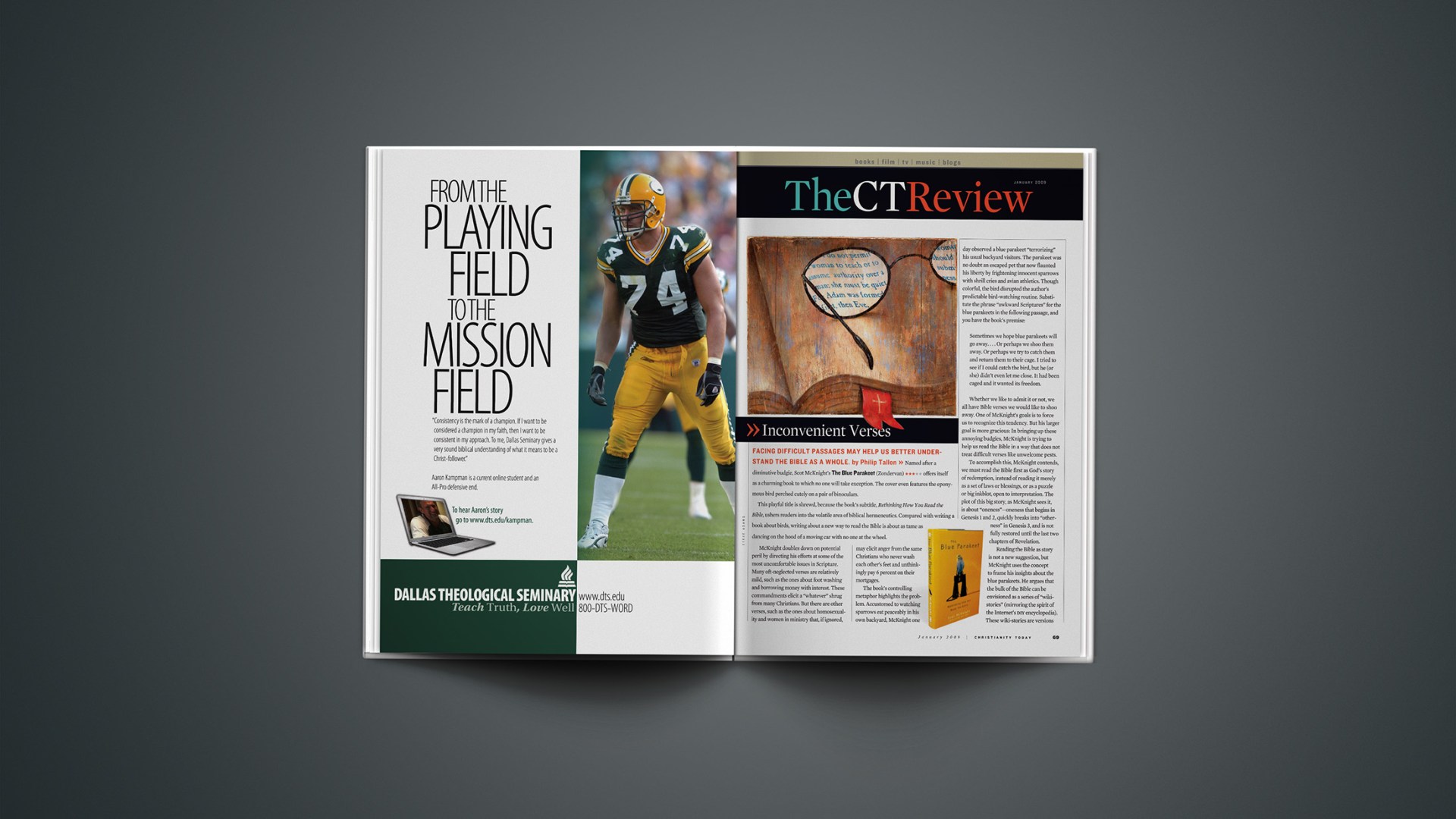

Named after a diminutive budgie, Scot McKnight’s The Blue Parakeet (Zondervan) offers itself as a charming book to which no one will take exception. The cover even features the eponymous bird perched cutely on a pair of binoculars.

This playful title is shrewd, because the book’s subtitle, Rethinking How You Read the Bible, ushers readers into the volatile area of biblical hermeneutics. Compared with writing a book about birds, writing about a new way to read the Bible is about as tame as dancing on the hood of a moving car with no one at the wheel.
McKnight doubles down on potential peril by directing his efforts at some of the most uncomfortable issues in Scripture. Many oft-neglected verses are relatively mild, such as the ones about foot washing and borrowing money with interest. These commandments elicit a “whatever” shrug from many Christians. But there are other verses, such as the ones about homosexuality and women in ministry that, if ignored, may elicit anger from the same Christians who never wash each other’s feet and unthinkingly pay 6 percent on their mortgages.
The book’s controlling metaphor highlights the problem. Accustomed to watching sparrows eat peaceably in his own backyard, McKnight one day observed a blue parakeet “terrorizing” his usual backyard visitors. The parakeet was no doubt an escaped pet that now flaunted his liberty by frightening innocent sparrows with shrill cries and avian athletics. Though colorful, the bird disrupted the author’s predictable bird-watching routine. Substitute the phrase “awkward Scriptures” for the blue parakeets in the following passage, and you have the book’s premise:
Sometimes we hope blue parakeets will go away. … Or perhaps we shoo them away. Or perhaps we try to catch them and return them to their cage. I tried to see if I could catch the bird, but he (or she) didn’t even let me close. It had been caged and it wanted its freedom.
Whether we like to admit it or not, we all have Bible verses we would like to shoo away. One of McKnight’s goals is to force us to recognize this tendency. But his larger goal is more gracious: In bringing up these annoying budgies, McKnight is trying to help us read the Bible in a way that does not treat difficult verses like unwelcome pests.
To accomplish this, McKnight contends, we must read the Bible first as God’s story of redemption, instead of reading it merely as a set of laws or blessings, or as a puzzle or big inkblot, open to interpretation. The plot of this big story, as McKnight sees it, is about “oneness”—oneness that begins in Genesis 1 and 2, quickly breaks into “otherness” in Genesis 3, and is not fully restored until the last two chapters of Revelation.
Reading the Bible as story is not a new suggestion, but McKnight uses the concept to frame his insights about the blue parakeets. He argues that the bulk of the Bible can be envisioned as a series of “wiki-stories” (mirroring the spirit of the Internet’s DIY encyclopedia). These wiki-stories are versions of the big story that have been “edited and maintained” by the Bible’s authors for their own days and ways.
McKnight also rehabilitates the familiar concept of discernment. He notes that most Christians do not strictly adhere to certain biblical commands (i.e., Sabbath observance, foot washing) because we must adapt and adopt Scripture in ways that fit our time and place. McKnight reminds readers that biblical authors themselves adapted the big story for their audiences. The blue parakeets in Scripture, then, are not contradictory assertions but contextually determined discernments by the Bible’s teachers.
As a case study in applying his method, McKnight devotes the final five chapters to the “blue parakeets” on both sides of the women-in-ministry debate. McKnight comes down on the side of women in ministry, seeing a unifying thread running from the beginning of the big story, through the wiki-stories, and culminating in the equality of male and female in Christ. He does not avoid the seemingly prohibitive blue parakeets in Paul’s wiki-story, but concludes after close examination that they actually echo the big story’s call to oneness.
Even if we don’t agree with the author here—and some surely will not—this section helps us see McKnight’s method play out on one important topic. Yet McKnight leaves questions about how to apply these insights to other pressing matters unresolved. On the one hand, McKnight makes biblical interpretation seem fun. On the other, he clearly shows that biblical interpretation is a messy process. The book’s brief treatment of a range of scriptural issues (the death penalty, divorce, Sabbath observance, and speaking in tongues) bears this out, as each case must be handled a bit differently. Each blue parakeet, strangely enough, seems to represent a different species. Regarding circumcision, for instance, McKnight traces a clear intra-biblical change from mandatory to optional. Yet regarding the death penalty, McKnight finds instead of progression a diversity of precedents, each of which must be studied in context.
Because McKnight’s approach to biblical interpretation assumes there is no quick and easy way to sort out blue parakeets, readers looking for the final word on controversial topics will be disappointed. Yet readers may justifiably ask, “Whom exactly is this book for?” In this slim volume, McKnight shows he can communicate big ideas to a wide audience with clear prose and engaging metaphors. But he proposes a new paradigm for understanding the Bible—one big story plus several wiki-stories—without providing the extensive director’s notes and cues that thoughtful readers will expect. And because evangelicals disagree on how best to frame the big story and what’s essential to its telling—see the Atonement debates, for example—it is unclear how McKnight’s narrative reframing will slow debate.
McKnight should be commended for disrupting our predictable Bible-watching routines by letting blue parakeets fly free. But readers who tell the big story differently from McKnight may not find his conclusions worth parroting.
Philip Tallon, executive director of the Christian Studies Center at the University of Kentucky.
Copyright © 2009 Christianity Today. Click for reprint information.
Related Elsewhere:
The Blue Parakeet is available at ChristianBook.com and other retailers.
Scot McKnight also wrote the following for Christianity Today:
Five Streams of the Emerging Church | Key elements of the most controversial and misunderstood movement in the church today. (January 19, 2007)
McLaren Emerging | In his last two books, Brian McLaren presents more clearly than ever his vision of the gospel. (September 26, 2008)
The 8 Marks of a Robust Gospel | Reviving forgotten chapters in the story of redemption. (February 29, 2008)
The Mary We Never Knew | Why the mother of Jesus was more revolutionary than we’ve been led to believe. (November 28, 2006)