My family and I were traveling in Guatemala a few years ago. We visited a man who had given his life to serving a poor congregation. We sat at the kitchen table with him, a man who had been bent into humility by the burdens of pastoring in a struggling nation while raising four children. Still in the muddy trenches of parenthood with our five sons and one daughter, we confessed to him our feelings of inadequacy.
"Your children are grown. What have you learned looking back on your years of child-raising? Do you have any advice for us?" We looked at him, needy, expectant.
He would have none of it. "I'm not one to talk to. I don't exactly have a perfect record." One of his children was immersed in an addiction, he told us, visibly sad. Another had a failed marriage.
He was silent for a moment, nodding slowly, and then continued. "I never lived up to my mother's expectations either. I've been reading her journal lately, and I see how she prayed for me, what she prayed. And I've never lived up to what she hoped for me," he said, his voice a near-whisper. "I think she considered me a failure."
In my mother-mind, I supplied the last words: "And considered herself a failure as a parent." This conversation shook me profoundly, touching one of my deepest concerns.
Prevailing Parental Panic
I'm hardly alone in my fixation. More than any other generation, today's parents are worried sick that they will mess up their children's lives. A massive 2006 study revealed that parents post significantly higher rates of depression than adults without children. Judith Warner's 2005 book, Perfect Madness: Motherhood in an Age of Anxiety, captured the national obsession with successful parenting and its overwrought attempts to secure happiness and success for one's offspring—and, by extension, oneself as a parent. Joan Acocella's November 2008 New Yorker article, "The Child Trap," disdainfully chronicled the anxiety and success-driven extremes of overparenting.
There is so much fretting that even the backlash has spawned a notable movement and subgenre of its own, the slacker mom, visible in such books as Confessions of a Slacker Mom, The Three-Martini Playdate: A Practical Guide to Happy Parenting, and Bad Mother: A Chronicle of Maternal Crimes, Minor Calamities, and Occasional Moments of Grace. In these and other popular books, women compete to claim the most artful and witty negligence of their mothering responsibilities.
I find most Christian parents at the front of the line—the anxiety and success line, not the slacker line. With my own offspring ranging from first grade through college, I take turns stepping into both, perfecting my own blend of angst and aplomb, depending on the issue. This one question, however, sends me elbowing to the front of the anxiety queue, where I find most of my friends and fellow believers. Our most consuming concern is that our children "turn out"—that is, that our Christian faith and values are successfully transmitted, and that our children grow up to be churchgoing, God-honoring adults.
It appears that many of us are not succeeding. The exodus of young adults from evangelical churches in the U.S. is well reported, perhaps over-reported and hyper-hyped. The Barna Group reported in 2006 that 61 percent of young adults who had attended church as teenagers were now spiritually disengaged, not participating in worship or spiritual disciplines. A year later, LifeWay Research released similar findings, that seven in ten Protestants ages 18-30 who had worshiped regularly in high school stopped attending church by age 23. Regardless of which studies are the most accurate, there is little doubt that many youth who were raised in the church do not necessarily stick around.
If this isn't enough to induce parental panic, another unsettling report came our way in a summer 2008 Newsweek article, "But I Did Everything Right!" Sharon Begley reported that, contrary to the opinions of decades of experts, genetics may have a more potent impact on child development than our own parenting practices. Begley summarized findings from studies at the Center for the Developing Child at Harvard University and Birbeck University in London. Jay Belsky of Birbeck found that the child most likely to adopt his parents' values is not the mellow, compliant child, as one would expect, but the fussy, difficult child. The fussy child is genetically wired through the presence of DNA variants to be more sensitive and attuned to her parents and surroundings. The mellow child is more like Teflon; good parenting, and even bad parenting, tends not to stick. These findings, among others, are part of a leading edge of study that "promises to revolutionize our understanding of child development."
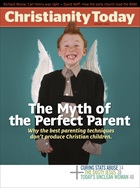
Parents' most consuming concern is that their children 'turn out'—that they grow up to be churchgoing, God-honoring adults.
If we decide to credit these recent findings, we are going to have a lot of questions, maybe even some righteous indignation. "So, the game is rigged?" we might choke out. "Our efforts to raise our children in the nurture and admonition of the Lord may be useless on certain children with specific DNA variants? Our chances of passing the torch hang more on their DNA than on our own parenting?"
Article continues below
We splutter with good cause. After all, this directly contradicts the most quoted and treasured verse in the Scriptures related to parenting: "Train up a child in the way he should go, and when he is old he will not turn from it" (Prov. 22:6). This verse has provided comfort and direction to generations of parents, assuring them that nurture, our nurture, is the prevailing force in our child's life, and that if we get it right, the outcome is sure.
But the first blush of retort and defense should be reconsidered. These scientific findings are not only ultimately hopeful and helpful for parents; more importantly, they also support Scripture in an area that has been plagued with presumption, behaviorism, and wrong thinking for decades.
'As the Twig Is Bent …'
One of the most resilient and cherished myths of parenting is that parenting creates the child: "As the twig is bent, so grows the branch." While the nature-nurture debate has ground on for centuries, nurture has been the clear popular favorite among most child-rearing experts and parents. We catch some of the zeal and heady empowerment of this belief from one of its most vocal proponents, John B. Watson, a well-known psychologist at Johns Hopkins University. In 1924 he famously claimed that if he were given 12 healthy babies and complete control over their environment, he could "guarantee to take any one at random and train him to become any type of specialist I might select—doctor, lawyer, artist, merchant, chef, yes, even beggar and thief, regardless of his talents, penchants, tendencies, abilities, vocations, and race of his ancestors."
Though few would subscribe to Watson's extreme behaviorism, the notion of the infant as an arriving tabula rasa on which we inscribe our design remains deeply embedded in our culture. John Rosemond, a Christian family psychologist and syndicated columnist, hears frequently from parents who believe they have failed when their children have problems. "They think this," he writes, "because they believe in psychological determinism—specifically, that parenting produces the child."
Many Christian writers and parents have absorbed these values and drifted into what could be called spiritual determinism. We have absorbed the cultural belief in psychological determinism but spiritualized it with Bible verses, and one verse in particular. The result is a Christianized version of the cultural myth. It reads something like this: "Christian parenting techniques produce godly children."
Article continues below
Proverbs 22:6 has been widely adopted as both psychological premise and theological promise, despite the widespread recognition that hermeneutically, the Proverbs are not promises from God, but general observations and maxims. (Ironically, if King Solomon did pen this proverb, as many biblical scholars believe, he himself failed to exemplify its truth: In his old age, he abandoned the teaching and example of his father, as "his wives turned his heart after other gods, and his heart was not fully devoted to the Lord his God, as the heart of David his father had been" [1 Kings 11:4].)
Despite these problems, entire formulas and programs have been created to divine and instruct on the kind of parental training that will secure the desired outcome. At least one of these programs, claiming to instruct in God's ways of raising children, has sold in the millions. A few of the more stridently conservative writers are so confident of their parenting methods and outcomes, they describe child-training as a risk-free venture analogous to staking out tomatoes, training dogs, and teaching mules, only loosely veiling B. F. Skinner-like techniques with swatches of strategically placed Bible verses.
One writer warns mothers that they must watch all they say and do, because their child's mind, "like a videotape recorder," is "carefully transcribing every word, right down to the tone of voice and facial expression." To up the stakes further, he cautions that a child's mind and "emotional patterns" may be firmly established by the time he is 2, a "sobering realization for mothers," he intones.
Despite the impossible weight of this responsibility, it holds clear advantages: namely, it's much easier to measure the success of our parenting. We simply examine the evidence—how our children turn out. One parenting writer warns, "If our parents' approach seemed close to biblical parenting, yet bore bad fruit, we can be certain it was not biblical." We can know this, he asserts, because God's Word gives us exactly what we need to raise godly children, and if we correctly apply the principles, "parents will not be disappointed."
An entire branch of Christian parenting takes this tack. "Observe and learn from winning parents," one writer advises. Winning parents are those whose children are "obedient" and "respectful," who "know God's will," who "live faithful Christian lives," he writes. We should be imitating those parents "who are successful, not those who fail."
Article continues below
One best-selling author takes a more numerical approach to parenting. He begins by identifying the goal of parenting as raising "spiritual champions." To maximize readers' ability to produce spiritual champions, the author, a statistician, creates a model based on surveys, statistical studies, and personal interviews. His research reveals that a small family is better than a large family at producing a spiritual champion, that the firstborn is the most likely to become a spiritual giant, and that single-parent homes are seldom successful in producing said champions.
At the end of this section, he admonishes us, before we have children, to "… count the cost of raising them. The research suggests that the more children you have, the more difficult it will be to facilitate the spiritual health and depth of each child." (This, of course, is terrible news for me and others with multiple children, though it's good for the author, who has two.) The book ends with these motivational words: "Between you and your spouse, have you covered the ground necessary to produce children whose lives honor God and advance his kingdom?"
Clearly then, some parents are winners and some are losers. Many friends immediately come to mind: God-loving couples with a child in jail, with an agnostic child, with a prodigal daughter, with children who are lukewarm in their faith, with children who have not yet proclaimed faith. By these measures, they are all losers.
Bad Parents of the Bible
The Bible's examples of spiritual champions move us in another direction entirely. The great hall of faith in Hebrews 11 provides us with a list of men and women who through extraordinary faithfulness "conquered kingdoms, administered justice, and gained what was promised; who shut the mouths of lions, quenched the fury of the flames"—believers of such immense faith that "the world was not worthy of them" (11:32-38).
Yet these spiritual giants were raised in anything but model homes, and many of them were themselves highly flawed parents. Abraham sired a child with a maidservant, then agreed to banish the son to the desert. Isaac and Rebekah were locked in parental favoritism over Esau and Jacob. Rebekah led her son to commit an unthinkable travesty: stealing his brother's birthright. Jacob learned his lessons from his mother well and continued on the path of deceit and, later, of destructive favoritism among his ten sons. Moses was given the young, pagan, unmarried daughter of Pharaoh as his mother. Jephthah was the son of a prostitute, and killed his only daughter because of an impetuous vow.
Article continues below
Many more examples from Scripture confound our parenting expectations, but two more must be mentioned. Jonathan, David's closest friend, was a paragon of righteousness and purity in stark contrast with his murderous father, King Saul. And the boy king Josiah, singularly commended as one who served the Lord "with all his heart and with all his soul and with all his strength" (2 Kings 23:25), was the son of Amon, a man who "did evil in the eyes of the Lord" (2 Kings 21:20).
By contemporary standards, most of these families would be considered dismal failures. They include polygamous families rife with division and jealousy, prostitute mothers, heathen fa-thers, clans rampant with favoritism and fratricide. The only discernible pattern here seems to be one of human sin.
If our supposition—that we can measure the success of our parenting by the outcome of our children—is scripturally based, we should be able apply the test to God himself. After all, God is not only the author of our Scriptures, he is also himself a parent, one who identifies himself as our Father. The Old Testament in particular provides a long, deep look into the Father's heart. When we look at his children, however, the news is not good.
The descent into rebellion began with his very first children, Adam and Eve, and continued through the days of Noah, ending in global destruction. Then a new family was birthed, the nation of Israel, whom God tenderly calls "my firstborn son" (Ex. 4:22). But that relationship, too, is torturous, marked by constant rebellion and the breaking of God's father-heart. Our own record as his children is not much better.
If God's success as a parent is to be judged by his children, what can we conclude? That God himself does not pass our parenting test?
Who's In Control?
We must assume, then, that there is serious error in our beliefs about parenting. We have made far too much of ourselves and far too little of God, reflecting our sinful bent to see ourselves as more essential and in control than we actually are. It's also our heritage as good Americans, psychologist Harriet Lerner observed in her 1998 book, The Mother Dance: We believe that we can fix every problem, that we are masters over our fate. The root of much of our pain in parenting, she writes, is "the belief that we should have control over our children when it is hard enough to have control over ourselves."
Article continues below
The reflex to judge ourselves by our children, and to judge others by their children, has further implications: It reveals a faulty view of spiritual formation. We often expect that the children of believing parents, whether the children claim Christ yet or not, will show the same kind of spiritually mature attitudes and behavior we hope to see in each other: love, joy, peace, patience, kindness, and obedience, as a beginning list.
When we engage in spiritual determinism and a human view of spiritual formation, we can easily fall into judging others. Jeanine, a friend of mine for years, told me that her sixth-grade daughter, Julia, who was struggling with her identity and making friends, was labeled "demon-possessed" by another family in the church. "Some people—even in church—have already written her off. And she's only 11 years old," Jeanine told me. The judgment was not only on her daughter's spiritual condition but also on her own.
When a child does make a decision to follow Christ, we often expect visible, even immediate transformation. The Bible demonstrates another reality. God schooled the Israelites for 40 years to walk them from paganism into faith in the one true God. The disciples lived in the presence of Jesus for three long years, their faith still pitifully small despite having constantly witnessed miracles and resurrections. And our redemption was fully accomplished when Christ uttered "It is finished" from the cross, but our transformation into his image continues as long as we have breath.
The notion of the infant as an arriving tabula rasa upon which we inscribe our design remains deeply embedded in our culture.
Ezekiel's Parenting Model
The question we ask of ourselves must be reframed. We need to quit asking, "Am I parenting successfully?" And we most certainly need to quit asking, "Are others parenting successfully?" Instead, we need to ask, "Am I parenting faithfully?" Faithfulness, after all, is God's highest requirement for us.
We see this clearly in the calling of the prophets, and particularly in the calling of Ezekiel. Though Ezekiel was (as far as we know) not a parent, his assignment to the people of Israel has remarkable parallels to parenthood and the question of success.
Article continues below
When God commissioned Ezekiel to be a prophet, he warned him that he was being sent to his own people, a nation set in revolt against God. Ezekiel's job was to be a mouthpiece for God, to say, "This is what the Sovereign Lord says" (Ezek. 2:3-4). God gives full and dismaying disclosure before the task even begins: The people of Israel, Ezekiel's own people, will not listen to him any more than they will listen to God himself. The job would be hard, then—harder than the prophet could have realized going in. But God didn't leave Ezekiel defenseless. He did not make the task easier, but he made Ezekiel stronger, hardening his forehead "like the hardest stone, harder than flint" (3:8-9).
Ezekiel's response to all this was so encouragingly human, so like myself at times and like many parents I know. With the Spirit of the Lord upon him, he returned to his people on the banks of the river for seven days, "overwhelmed" and "in bitterness and in the anger of my spirit" (3:14-15).
Then the prophetic work of speaking and enacting God's words began.
How successful was Ezekiel? The destruction he foretold played out in every gruesome detail. From our vantage, Ezekiel's mission looks like an utter failure. But God spoke a few words in this narrative that changed everything. As God commissioned Ezekiel to speak his words to Israel, three times he prefaced his commands with this phrase: "whether they listen or fail to listen" (2:5, 7; 3:11). One of those three times God completed the sentence: "Whether they listen or fail to listen … they will know that a prophet has been among them" (2:5).
This was Ezekiel's responsibility: to speak and embody God's words before the people in such a way that they might know who he was, a righteous prophet of God, and that they might know who God was. Ezekiel wanted more than this, of course. He desperately wanted to turn the people back to the living God and prevent the impending and appalling judgment and death. The record does not tell us if anyone repented as a result of his words, but Ezekiel was never accountable for the repentance of others. He was accountable only for his steadfast obedience.
Faith Rather Than Formula
It is likely that we are asking the wrong questions as parents. We are so focused on ourselves—on our own need for success and the success of our children—that we have come to view parenting as a performance or a test. It appears we are failing the test, as large numbers of our youth leave the church when they leave our nests. And now genetic research tells us the test may even be rigged.
Article continues below
We cannot pass this test, I'm afraid, nor could we ever. If we are graded on a curve, we will always find parents and children who are more obedient, more joyful, and more peaceful than we are. We will find parents whose children turned out better than ours, parents with a higher percentage of "spiritual champions" than we can claim for our efforts.
If we are graded instead on an absolute scale—as I believe we are—we fail even more miserably. But this is why a Savior was provided, and gifted to us through grace, through faith—"and this not from yourselves, it is the gift of God—not by works, so that no one can boast" (Eph. 2:8-9). If even our ability to believe in God is given to us by God, then how much of parenting can we perform on our own? We must proceed, then, on our knees first, beggars before the throne, if we are to parent well.
We must rethink our assumptions and our calling as well. We are responsible to teach our children the fear of the Lord, to impress his laws on them when we "sit at home and when [we] walk along the road, when [we] lie down and when [we] get up"—meaning all the time (Deut. 6:7). And we are commanded to not exasperate our children, but to "bring them up in the training and instruction of the Lord" (Eph. 6:4). But we must be clear about our own limits. We are not capable of producing perfect followers of Christ, as if we were perfect ourselves. Our work cannot purchase anyone else's salvation or sanctification. Parents with unbelieving children, friends with children in jail, the discoveries of the geneticists, and the faith heroes in Hebrews 11 are all powerful reminders of this truth: We will parent imperfectly, our children will make their own choices, and God will mysteriously and wondrously use it all to advance his kingdom.
Begley concludes "But I Did Everything Right!" by saying, "It is time to acknowledge there is only so much influence parents can have." Scripture has taught us this all along. We are not sovereign over our children—only God is. Children are not tomatoes to stake out or mules to train, nor are they numbers to plug into an equation. They are full human beings wondrously and fearfully made. Parenting, like all tasks under the sun, is intended as an endeavor of love, risk, perseverance, and, above all, faith. It is faith rather than formula, grace rather than guarantees, steadfastness rather than success that bridges the gap between our own parenting efforts, and what, by God's grace, our children grow up to become.
















 While we pray for peace, we need moral clarity about this war.
 A Christian reconciliation group in Israel and Palestine warned that war would come. Now the war threatens their relevance.españolالعربيةFrançaisрусскийУкраїнська
 How groups like Hillsong learned to let go of the literal in favor of creative collaboration.españolPortuguês






