
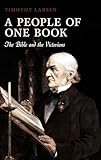
The 400th anniversary of the King James Version has occasioned a slew of books on the impact of this translation and of the Bible more generally, with more still to come before the year is out. It's fitting, then, that 2011 should also mark the publication of Timothy Larsen's A People of One Book: The Bible and the Victorians (Oxford University Press), an exceptionally rich and nuanced account of how "the Bible loomed uniquely large in Victorian culture in fascinating and unexplored ways." In addition to deepening our understanding of the Victorians—and briskly deflating widely held misconceptions left and right—Larsen's chronicle implicitly prompts us to ask questions about the presence of the Bible in our own place and time.
In his previous book, Crisis of Doubt: Honest Faith in Nineteenth-Century England, Larsen gave us a series of case studies challenging the master-narrative of the Victorian era. This was a time, so we've been told, when it became virtually impossible for a thinking person to sustain any sort of orthodox Christian faith (with the understanding, of course, that this crisis of faith among the elite heralded the inevitable triumph of secular reason and the withering away of religion). But Larsen uncovered the stories of prominent freethinkers, atheists, and allied skeptics who began to lose confidence in the Gospel of Doubt and ultimately converted to or returned to faith.
What makes Crisis of Doubt particularly devastating is an unusual combination of massive erudition and serene good humor. Far from being a tub-thumping exercise in setting the historical record straight, it is loaded with wit, a pervasive sense of irony, and an appreciation for the mysterious twists and turns of individual human lives—all this with the warmth of an unobtrusive but equally unembarrassed faith.
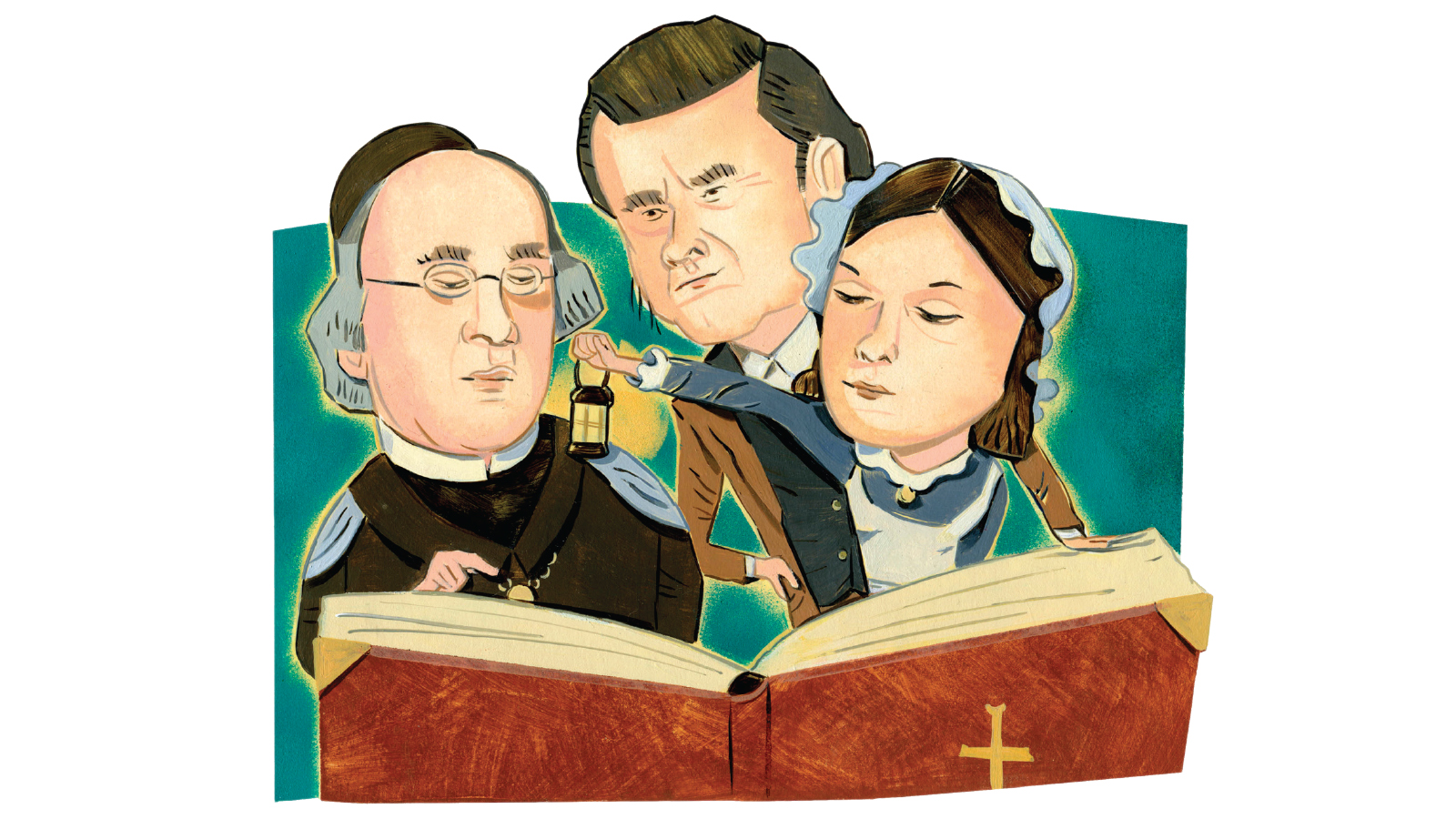
Larsen employs the same strategy in A People of One Book, with the same result. Here the series of case studies highlights representative individuals from 10 traditions: Anglo-Catholics (E. B. Pusey); Roman Catholics (Nicholas Wiseman); Atheists (Charles Bradlaugh and Annie Besant); Methodist and Holiness (Catherine Booth and William Cooke); Liberal Anglicans (Florence Nightingale); Unitarians (Mary Carpenter); Quakers (Elizabeth Fry); Agnostics (T. H. Huxley); Evangelical Anglicans (Josephine Butler); and Old Orthodox Dissent (C. H. Spurgeon).
You might suppose that A People of One Book suffers in comparison with Crisis of Doubt by lacking the element of surprise. After all, even the most die-hard advocates of the secularization thesis would concede that the Bible retained a powerful influence in Victorian England. Aren't these case studies condemned to a weary predictability?
Not at all, and for two reasons. First, Larsen repeatedly upsets preconceptions. We are used to thinking of Catholics as negligent about the authority of Scripture in contrast to the claims of Tradition. Larsen shows how Cardinal Wiseman persistently made the case that Catholic teaching is more closely in accord with Scripture than rival Protestant doctrines are. (Whether Protestants would find his arguments persuasive is beside the point here.) Specialists may know that for much of the 19th century, Unitarianism in England was dominated by the biblicist strain of the denomination. For most readers, however, it will come as a surprise to learn how Carpenter and her father, Lant Carpenter, "gloried in Unitarian thought being even more thoroughly biblical than that of other Protestant bodies."
Fry, the Quaker best remembered for her work with women in prison, "referred to reading the Bible simply as 'reading' or, to express it the other way around, when she referred to 'reading' she meant the Bible." Along with prison reform her highest priority was "the distribution of the Scriptures," accomplished via the Bible Society but also by her habit of carrying "copies of the Bible, the New Testament, or Bible tracts to distribute to those who crossed her path in the course of a day."
And then there is the extent to which outspoken critics of Christianity were themselves steeped in the Bible. Many years after Besant's move from atheism to Theosophy, she gave a presidential address in India on the theme "India the Crucified among Nations now stands on this her Resurrection morning." The speech, Larsen adds, "was not a success," yet it vividly exemplified Besant's "lifelong instinct that biblical language added weight to a pronouncement."
Second, as in Crisis of Doubt, these case studies are not merely intended to flesh out a thesis. On the contrary, each chapter is a superb mini-biography attentive to idiosyncrasies, to the irreducible particularity of the human person.
We learn of Wiseman that his self-conscious Englishness endeared him even to many who were congenitally suspicious of Catholics and Catholicism. Moreover, he was fond of his food and had a girth that made this no secret. Such indulgence disappointed zealous Tractarians flush with the romance of neglected spiritual disciplines. Heroic Anglo-Catholics, who were surviving during Lent on herbs, bread, and water, were disconcerted to have the cardinal set before them a dinner consisting of four elegant fish courses. The Tractarian and eventual Catholic convert F. W. Faber quipped that Wiseman had a spiritual side and a "lobster salad side."
Reading A People of One Book, it's impossible not to compare the place of the Bible in Victorian England with the place of the Bible today in the United States. On the one hand, many American evangelicals will be rightly abashed by the overwhelming evidence of intimate familiarity with the Scriptures—not just a handful of salient passages—presented in Larsen's case studies. On the other hand, we should be grateful for the Bible studies, the scholarship, and the preaching that characterize contemporary evangelicalism at its best, strongly affirming the authority of Scripture while avoiding fundamentalism and know-nothing literalism in other guises.
Many American evangelicals will be rightly abashed by the overwhelming evidence of intimate familiarity with the Scriptures—not just a handful of salient passages—presented in Larsen's case studies.
In contemporary American culture outside the church, biblical literacy is notoriously low. But in fiction, poetry, theater, music, and movies, biblical language, biblical allusions, and biblical themes appear far more often than is generally remarked. In many cases, from Iron and Wine's "Jezebel" to Lady Gaga's "Judas," the intent is to argue with or invert a biblical message. At other times there is a haunting echo, the sound of something once believed or hoped for, now remote and yet not entirely renounced.
One of the most striking chapters in Larsen's book is devoted to Huxley, the gifted and pugnacious expounder and defender of Darwinism and the man who coined the term "agnosticism" after a long dissatisfaction at being lumped together with atheists, from whom he was at pains to distinguish himself. What we don't usually hear about him (although, as Larsen notes, it is related in Adrian Desmond's fine biography, Huxley: From Devil's Disciple to Evolution's High Priest) is that in the mid-1880s, a decade or so before his death, "Huxley abandoned scientific research and embarked on a late, second career as a biblical critic." He continued to attack the Christian understanding of Scripture and yet "he found his own religious position best encapsulated in Micah 6:8," in which the prophet asks, "And what does the Lord require of you? To act justly and to love mercy and to walk humbly with your God."
Larsen quotes Huxley: "Will the progress of research prove that justice is worthless and mercy hateful?" It is not a distortion, I think, to say that Huxley was haunted to the end by that which he rejected.
John Wilson is editor of Books & Culture, and a CT editor at large.
Copyright © 2011 Christianity Today. Click for reprint information.
Related Elsewhere:
A People of One Book is available from Barnes & Noble and other book retailers.
Previous articles on the Victorian era and the Bible from Christianity Today and our sister publication Christian History include:
A World Without the King James Version | Where we would be without the most popular English Bible ever. (May 6, 2011)
Victorian Skeptics on the Road to Damascus | Former atheist Antony Flew's admission of the existence of God shocked believers and skeptics alike, but such a turnaround is far from unique. In the 19th century, many leading intellectuals who had once lost their faith ended up reconverting. (August 8, 2008)
Victorian Visionaries | George MacDonald's friends worked to reform society, challenge the church, and inspire the imagination. (April 1, 2005)
The Power of Books | For the Victorians, reading could be the doorway to doubt—or to faith. (April 1, 2005)
CT also has more music, movies, books, and other media reviews.