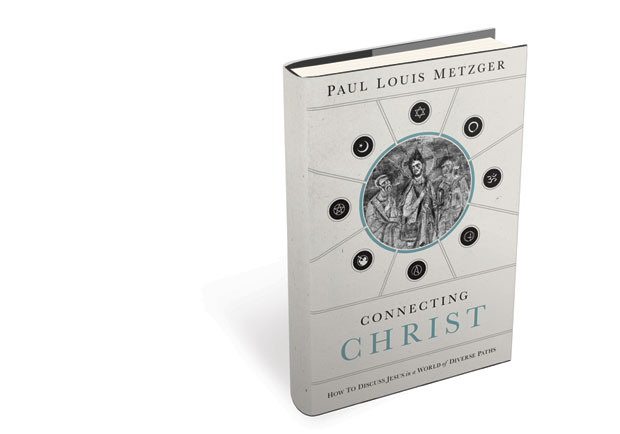
Connecting Christ

Connecting Christ

Connecting Christ: How to Discuss Jesus in a World of Diverse Paths
Metzger, Paul Louis
Thomas Nelson
May 8, 2012
352 pp., $13.37
Have you ever seen the movie As Good As It Gets, starring Jack Nicholson and Helen Hunt? Nicholson plays Melvin Udall, a man who pursues "Carol the Waitress," played by Hunt. Until he falls in love, Melvin is rude, insensitive, racially bigoted, homophobic, and severely obsessive-compulsive. As his gay neighbor Simon Bishop explains, so it is: Melvin is the worst kind of human. As difficult as it is to deal with Melvin, it is perhaps even more difficult to imagine that this man is a best-selling author of romance novels. In fact, when a young unknown female fan who is the receptionist at his publishing house asks him how he is able to portray women so accurately in his works, Melvin tells her that women are like men, only without reason and accountability.
But what does all this have to do with apologetics? Everything. Everything, that is, if you want to engage people truthfully and relationally—and not treat them dismissively. So often I am like Melvin. I talk about romance novels—usually God's love letter to us recorded as the Bible—but I'll never understand the depth of his love. I talk about relationships with people, but I rarely develop them myself. I lecture on incarnational, life-on-life apologetic engagement, but I often fail to respond to people life-on-life, keeping them at a distance ….
Conservative Christians often approach people as Melvin Udall does. We can wax eloquent on romance and relationships, but we rarely experience them. We approach Mormons, Buddhists, and homosexuals as Melvin does: categorizing and dehumanizing them until we are forced to deal with them face-to-face. Only then do we see that they are humans and not stereotypes …. In other words, we can know about homosexuals or Buddhists or Mormons as groups, but never really know or engage the individuals. Instead we simply lump them all into one category, as Melvin unceremoniously labels Carol as a waitress and Simon as a fag. But it isn't so easy to label others once we find out who they really are.
People are complex, mysterious, inconsistent, contradictory, wart-infested, and wondrous to behold. In keeping with how Simon views the matter, the longer you gaze at someone … that individual becomes more than just his or her worldview or demographic. Like God, in whose image everyone is created, each human is too complex to be classified. True understanding requires what Atticus Finch says in To Kill a Mockingbird: "… You never really understand a person until you consider things from his point of view … until you climb into his skin and walk around in it."
Used by permission of the publisher. All rights reserved.
Copyright © 2012 Christianity Today. Click for reprint information.
Related Elsewhere:
Connecting Christ is available from Christianbook.com and other retailers.
Previous articles by or about Paul Louis Metzger include:
Fraternizing with the Enemy | Paul Louis Metzger engages those outside the faith. (May 13, 2011)
Here We Are to Worship | Six principles that might bring a truce to the age-old tension between tradition and popular culture. (August 21, 2009)
Previous articles on evangelism and other religions include:
Proselytizing in a Multi-Faith World | Why mutual respect and tolerance require us to witness for Christ. (March 28, 2011)
The Son and the Crescent | Bible translations that avoid the phrase "Son of God" are bearing dramatic fruit among Muslims. But that translation has some missionaries and scholars dismayed. (February 4, 2011)
Super Bowl Evangelism | Why Jesus did not say, "Market your neighbor as yourself." (February 3, 2011)
Putting Evangelism on Hold | Will the Global Faith Forum's "evangelistic model" of engaging Muslims and Jews catch on? (November 16, 2010)

CT also has more books, film, and music reviews.

The 'Handicap Icon' Gets New Life

Sidelining the Stigma of Mental Illness


Join the Conversation
Displaying 15 of 15 comments
See all comments
Serena Breining
I can never get over the fact that our God was with us, and remains with us- he is so close. I anticipate that this book will challenge me and inspire me to lean into this spiritual reality as I am in Christ and with people, bearing witness to Christ as he was and is. I am confident in my anticipation, knowing that Dr. Metzger and each of his works has simultaneously pointed to Jesus at the right hand of God and at Christ in me, the hope of glory.
Weston Ruter
I really resonate with Dr. Metzger's reflections here. I myself used to seriously prejudge and stereotype people from other faiths and traditions (especially Muslims). All of that changed, however, once I actually met these people whom I had prejudged. Once I became friends with these people I was then able to learn what they actually believe and practice from them, not from what people in my circle (inaccurately) say about what they believe. They were no longer straw-men. Thereafter, I have found myself coming to their defense whenever people in my circle may malign them, because I now take it personally since they are my friends. To be sure, there are major issues my friends believe which I disagree with (and they with me), but now we can discuss our real and actual differences as friends while coming together over a meal (or via Facebook) as we share life together and rejoice in our common ground and bond of friendship.
John Morehead
Dr. Metzger is part of a relatively new and growing group of evangelicals pursuing more incarnational and missional approaches to engaging those in other religions. He recognizes that in a post-Christendom context where the church has less credibility, and one which is pluralistic as well, that this involves loving our religious neighbors, developing relationships, listening, two-way conversations, and acts of hospitality. This is a way worthy of emulation in evangelicalism, and I wish his work well in this through New Wine, New Wineskins, as well as the Evangelical Chapter of the Foundation for Religious Diplomacy.
RICK DALBEY
Rick Cordell, we have over 100 Bhuttanese refugees coming to our church, many Koreans, many Chinese, Indians and hispanics. China sends young pilots to flying school in Portland (its cheaper for them) and we have adopted these young men (they are all men) and invite them to dinner, holidays and church. My family invited 2 to Thanksgiving, it was fun. They are here for only 12 months and they were all atheists when they arrived but many have met the Lord and several have been baptized in water. We now have Korean and Bhuttanese pastors on staff. We are working with an inner city black church in June to evangelize Portland together. Lots going on...I am excited by the move of the Spirit in Portland. e-mail me at rickd@freerange-adv.com.
Rick Cordell
Mr. Dalbey, as a fellow native Portland conservative Christian, I don't think you grasp how exceptional you are in this community. I've been part of the evangelical ghetto around here for 4+ decades, and think you're in the 1% when it comes to personal involvement with those usually considered as "others." For example, my parents have been deeply involved in international student ministry here in town. God has brought thousands from around the world to our city each year. My best estimate is that there have been less than a hundred families and individuals for most of the last 50 years who have personally ministered to them--only a tiny percentage of those who have belonged to the churches you and I have attended. Too often we prefer to send missionaries abroad instead of knowing and loving individuals from those very lands who live and study (in loneliness) at PSU. And in four years of residence, most never get invited to a Christian home, especially during the holidays. Why?