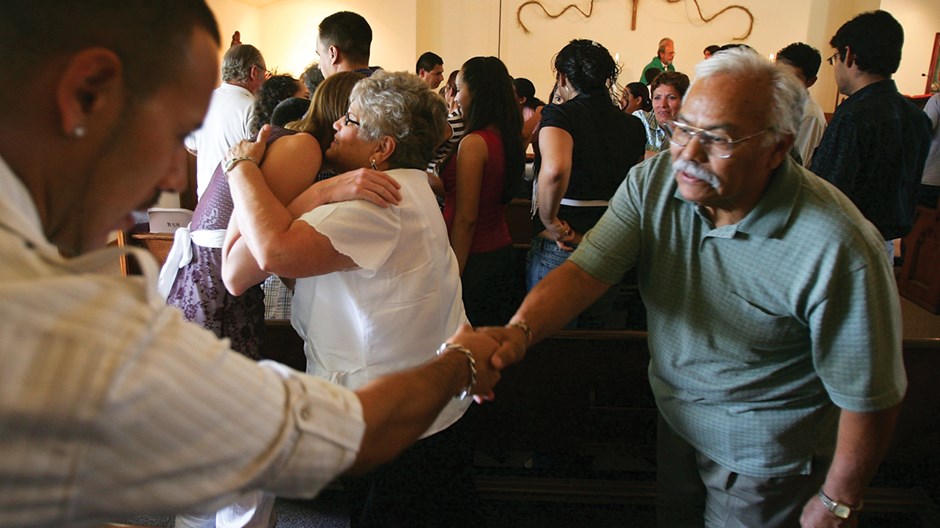
One recession-driven social trend is attracting the attention of church growth experts: Immigration from Mexico and the rest of Latin America—once thought to be nearly bottomless—has dried up to a trickle.
A Pew Hispanic Center analysis of Mexican government data shows the number of Mexicans leaving their country for the United States each year has declined from more than one million in 2006 to 404,000 in 2010—a 60 percent reduction. U.S. Border Patrol arrests in the Southwest have fallen from a peak of 1.6 million in 2000 to about 448,000 in 2010.
Much of the decline comes as U.S. unemployment remains stubbornly high. South of the border, Mexican officials say improved social services have made staying home more attractive.
Couple that with increasingly strict immigration policies in the United States, and Spanish-speaking churches in some states are shutting their doors.
"We are definitely seeing a definitive, measurable decrease in the number of first-generation people," said Samuel Rodriguez, president of the National Hispanic Christian Leadership Conference.
It's a noteworthy change for churches that have eyed the Hispanic population for years as the greatest source of growth. Armed with data projecting that by 2050, whites will become a minority and Hispanics will jump from 14 percent of the U.S. population to nearly 30 percent, churches have launched English as a Second Language classes and Spanish-language services for immigrants.
So is the slowdown cause to toss aside their bilingual Bibles and cancel the Spanish service?
Not so fast, experts say.
The U.S. Hispanic population is still booming, although births are now the driving force. Pew research shows that as the Mexican-American population grew by 11.2 million in the past decade, births accounted for 63 percent of the growth. In the 1990s, birth and immigration contributed equally to growth. In the 1980s, immigration led.
Experts are mixed on whether the slowdown will last, and whether it will hamper once-fervid church planting and outreach efforts to the Hispanic community.
"What you see now is economic entrenchment," said Arlene Sanchez-Walsh, associate professor of Latino church studies at Azusa Pacific University. "The economy has put a crimp on how you can start a church."
One thing is certain: The trend has prompted some soul-searching.
Gaston Espinosa, associate professor of religious studies at Claremont McKenna College, said the changing demographics will pressure churches to gear more toward second- and third-generation Hispanics—who virtually all speak English as a primary language.
"Any church that insists on just being Spanish-speaking risks losing young people," said Daniel Sanchez, who teaches church planting at Southwestern Baptist Theological Seminary in Fort Worth, Texas.
But if Spanish-only churches are losing ground, demand for culturally Hispanic churches remains high.
Second- and third-generation Hispanics are doing what Sanchez calls "selective assimilation"—adopting the language of the United States while retaining Latino cultural values and often a preference for churches that share those values.
This group is often more receptive to evangelicalism than the more staunchly Roman Catholic immigrant generation before them.
And unlike many other ethnic minorities, Latino youth are primed by a Catholic background and characterized by what Espinosa calls "a native spiritual intelligence" and curiosity about God and the next life.
"Some people may view this shift in population as a time to reprioritize outreach to Latinos," he said. "But that would be a mistake. It's an enormous population to overlook."
Evangelicals Endorse Immigration Reform | The National Association of Evangelicals' board overwhelmingly approved a resolution to seek 'faith and equal treatment' of immigrants. (October 9, 2009)















 While we pray for peace, we need moral clarity about this war.
 A Christian reconciliation group in Israel and Palestine warned that war would come. Now the war threatens their relevance.españolالعربيةFrançaisрусскийУкраїнська
 How groups like Hillsong learned to let go of the literal in favor of creative collaboration.españolPortuguês






