As I enter the sanctuary, I see the cloth-draped table near the podium. Communion Sunday! My heart lifts—and sinks. What will they serve? If they passlittle cubes of bread, I resolve to take three or four. This time I am determined to be nourished.
The problem could be me. Maybe I simply lack imagination. In the churches where mini-saltines are served, my clumsy fingers struggle to find and keep purchase of a single morsel. As I crush it in a single chew while the pastor reads, "This is my body, broken for you," I cannot help wondering if Christ has broken a fingernail on my behalf. At the common cup where I take a single anxious swallow, or in the jigger of juice I down in two gulps, I strain to see the blood that flowed from his face and side, the blood that covers the flood of my sins. I know this should be enough, because I deserve none of it—not a fingernail of bread, not a tongue-tip of the blood that Christ spent for me! But the body talks; its messages are real, and I cannot help listening: We have overspiritualized the Lord's Supper. We've turned an actual meal into a pantomime of a meal, and the church is hungry because of it.
I have some guesses as to how this has happened. Forgive the familiarity of this critique, but we're still trying so hard to be spiritual. The Book of Hebrews tells us that earthly things shadow and symbolize the more real yet invisible heavenly things. If Christ's presence is made real through the elements, then a sliver, a swallow is surely enough! And if the ceremony is mostly memorial, a remembrance of Christ's sacrifice, then tidbits and jiggers suffice!
But we cannot escape another truth: On the night he was betrayed, Christ offered a very real meal. Throughout the Scriptures, the apprehension of spiritual realities behind earthly symbols plunges us into physicality rather than removing us from it. John the Baptist sunk penitents into a cold and decidedly wet river. On his eighth day of life, Jesus was marked with a symbol of the covenant—his body cut with a honed knife.
Nor did Christ overspiritualize the meaning of being a disciple. He flaunted, even hyperbolized the physicality of that meal and what was required: "[U]nless you eat the flesh of the Son of Man and drink his blood, you have no life in you" (John 6:53).
It is past time to reclaim the "supper" that Christ instituted and to give the body—our own bodies and Christ's body, which our gathered bodies enact—its full due.
I am not asking for an examination of our theology. In truth, I think much of the Communion practices of the evangelical church have less to do with theology and more to do with the behavior of a single congregation, those unruly, factious Corinthians who gathered for the feast but ate and drank with no regard for others. Some left hungry while others left stuffed and drunk, blind to the body of Christ in their food.
We have overspiritualized the Lord's Supper. We've turned an actual meal into a pantomime of a meal, and the church is hungry because of it.
We've taken care of all that—in spades. Our services are precisely orchestrated. Servers march with military precision. We no longer recline at tables; we stand in line or sit upright in pews. We do not choose our serving; portion control assures we're all served the same. We chew and quaff in exact synchronicity. The Scriptures are scrupulously read as we partake. No one is overeating. No one is getting drunk. Check. Check. Check.
And we've managed to go one further: even in the largest congregations, we can get everyone out the door on time for their real meal after the pretend meal. This is my final complaint. In our avoidance of the sins Paul warns against, we are committing another: the crime of efficiency. We're so busy, and our services so short, there's no time for a sit-down dinner or anything like it.
But I can think of no busier night than those two particular nights: Passover, when the Hebrews were readying for their journey from bondage to freedom. Who had time to cook and eat dinner? But God required a meal, however hastily it was eaten. Jesus had betrayal and death before him, and all of history to overturn on his night. Who had time or appetite for a meal? But the events of those nights were too important not to eat and remember.
I hunger, spirit and body, for the day when our Communion tables are freed from regimentation and parsimony, images of a cautious, lugubrious, measurable redemption so unlike the real table God has set before us. Let us find ways to extend the table to a fuller meal, if not every Communion service, then once a month or quarterly. It is now, in this world, when we are parched and starved, that the church needs the meal most. Let's eat the feast already given.
Leslie Leyland Fields is a writer, speaker and professional editor who lives on Kodiak Island, Alaska in the winter and Harvester Island in the summer, where she works in commercial salmon fishing with her family. She cohosts "Off the Shelf" on KMXT Public Radio and is the author of Parenting Is Your Highest Calling, Surprise Child, and other books.


















 While we pray for peace, we need moral clarity about this war.
 A Christian reconciliation group in Israel and Palestine warned that war would come. Now the war threatens their relevance.españolالعربيةFrançaisрусскийУкраїнська
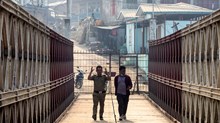 The government plans to close its porous border with Myanmar to boost security, separating ethnic groups that straddle the boundary.






