The thinly thatched roof of the bamboo hut barely shades us from the tropical sun. The four women do not stop making tamales as my daughter introduces me to them. They smile shyly at me while tending the wood fire and tying the leaf-wrapped bundles with twine-like stems. The flies are thick. A baby sitting on the dirt floor surrounded by chickens cries. I try to look pleasant and non-judging.
"Will you come to the fiesta, then?" my daughter asks the mother and her grown daughters.
"Sí," they nod, glancing at me nervously.
The "intercultural fiesta" had been planned for months around my arrival in El Salvador, where my daughter is working in rural villages. The party was the perfect incentive for the women she works with—practicing songs and skits empowering them to resist domestic violence, an enormous problem in their country. I was part of the program. We would share our lives and learn from each other.
"They'll dress up as much as they can," my daughter tells me. So I dress down: a dress from Walmart, a plastic necklace, old vinyl sandals that stink when my feet sweat. I want to blend in, to be one of them, to not be what I really am: a rich American.
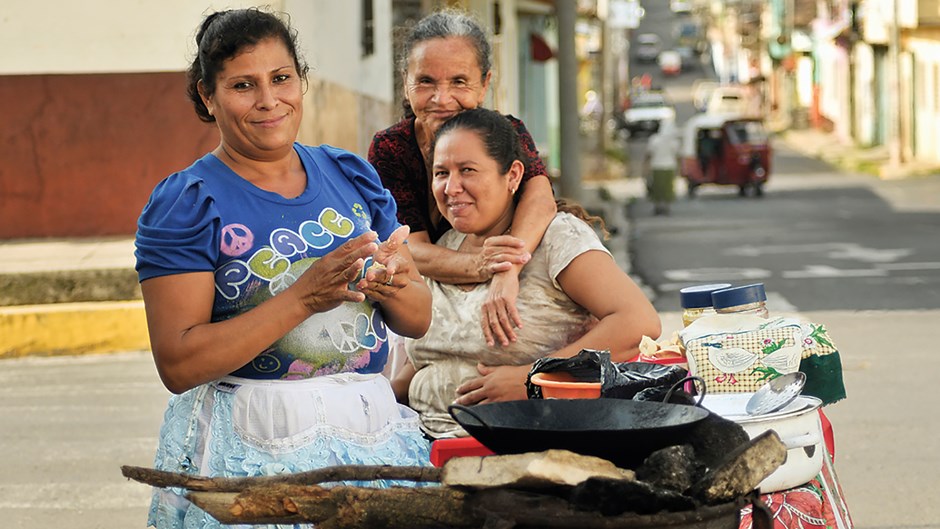
After a skit where my improvisation and faulty Spanish elicit a little too much laughter, we move on to a round of charades. The women act out their lives in the villages, and I do the same for my life in Alaska. For "work," they stand in a row and swing their arms gently back and forth. "Hoeing corn!" I shout out, while my daughter translates. They grin. For my turn, I mime standing in a skiff and pulling in a net heavy with fish. Because they have heard about this already, they immediately guess "Fishing!" When I pantomime church, I bend my head to pray, I lift my hands to worship, and I enact Communion. They shout "prayer!" "Praising God!" "Communion!" with the excitement of recognition. Later, I teach them a hallelujah song.
My heart fills. Though we live 7,000 miles apart, we are women, we are mothers, we worship God—we share so much. I think of the apostle Paul's metaphor for the church, that we are "many members, one body." I think of the mystery of the communion of the saints. I try to overlook the flies and the dirt to see these families as my neighbors. To love them.
But the we-are-all-alike glow doesn't last. Few of the women try to speak to me. The children are afraid of me. I am unable to eat the food served, because a previous meal has made me sick. They do not invite me to sit with them under the shade of the tarp. I ennoble them because of their brown skin and deep poverty. They ennoble me because of my white skin and wealth. Despite their dressing up and my dressing down, we are clearly still "other" to one another, and nothing I do that day changes it.
We are one in Christ not because we are one and the same, but because Christ is the same.
Now, back home, I realize it is a travesty to try to erase what lies between us, which is not simply distance but skin color, language, education, worldview, lifestyle, life span, and myriad other real distinctions. Surely these matter.
The basis for loving our neighbors, and for unity in Christ, is not proximity, understanding, or commonality. We are one in Christ not because we are one and the same, but because Christ is the same. It is an impoverished theology that mistakes unity in Christ for sameness in Christ.
The perfection toward which we are heading, the extinction of our sin nature, will not blur us all into homogeneity. At Pentecost, a foretaste of heaven, the Holy Spirit did not repair the splintering of language begun at Babel, the miracle we would expect. Christ unified the multi-tongued hearers not through the same language, but through the hearing of the same gospel.
No one at the fiesta that day would have mistaken me for anything but what I am. I'm relieved. Whatever borders I cross next—whether countries or church pews—I can give up the guilty fiction that I can become the other. I do know, however, that I can at least be among the other. There, among the women, I hope they marveled, as I did, that redemption is so wide it even includes a middle-aged gringa with bad Spanish and stinky feet.
Portland's Quiet Abolitionists | Leading the liberal city's efforts to halt child trafficking is a network of dedicated Christians. Just don't go advertising it. (This Is Our City, October 31, 2011)
Leslie Leyland Fields is a writer, speaker and professional editor who lives on Kodiak Island, Alaska in the winter and Harvester Island in the summer, where she works in commercial salmon fishing with her family. She cohosts "Off the Shelf" on KMXT Public Radio and is the author of Parenting Is Your Highest Calling, Surprise Child, and other books.


















 While we pray for peace, we need moral clarity about this war.
 A Christian reconciliation group in Israel and Palestine warned that war would come. Now the war threatens their relevance.españolالعربيةFrançaisрусскийУкраїнська
 Beyoncé’s right. Whether listening to Cowboy Carter or reading theology, diversity is a good thing.






