






Of course, they are not inspired by the Spirit of God but by the spirit of our time. Their hopes and fears are their utopias and their nightmares. They do not preach from public squares or ecclesiastical pulpits. Their stage is the media, from newspapers and magazines to television and the World Wide Web. Sometimes they reflect a pretentious sort of intellectual moneymaking entertainment or high-brow showbiz, which have overtaken the role of the former revival preachers, especially for upper-class society.
We Christians of the new millennium do not need such modern, sensationalistic prophecies and messages. We have no need of their predictions of abundant well-being or of universal mischief, because we live with the promises of God. In the first pages of the Bible, in fact, we possess prophecies that help us understand our exciting but overbearing world—and thus point implicitly to God’s promises for his church.
Nothing Is Impossible
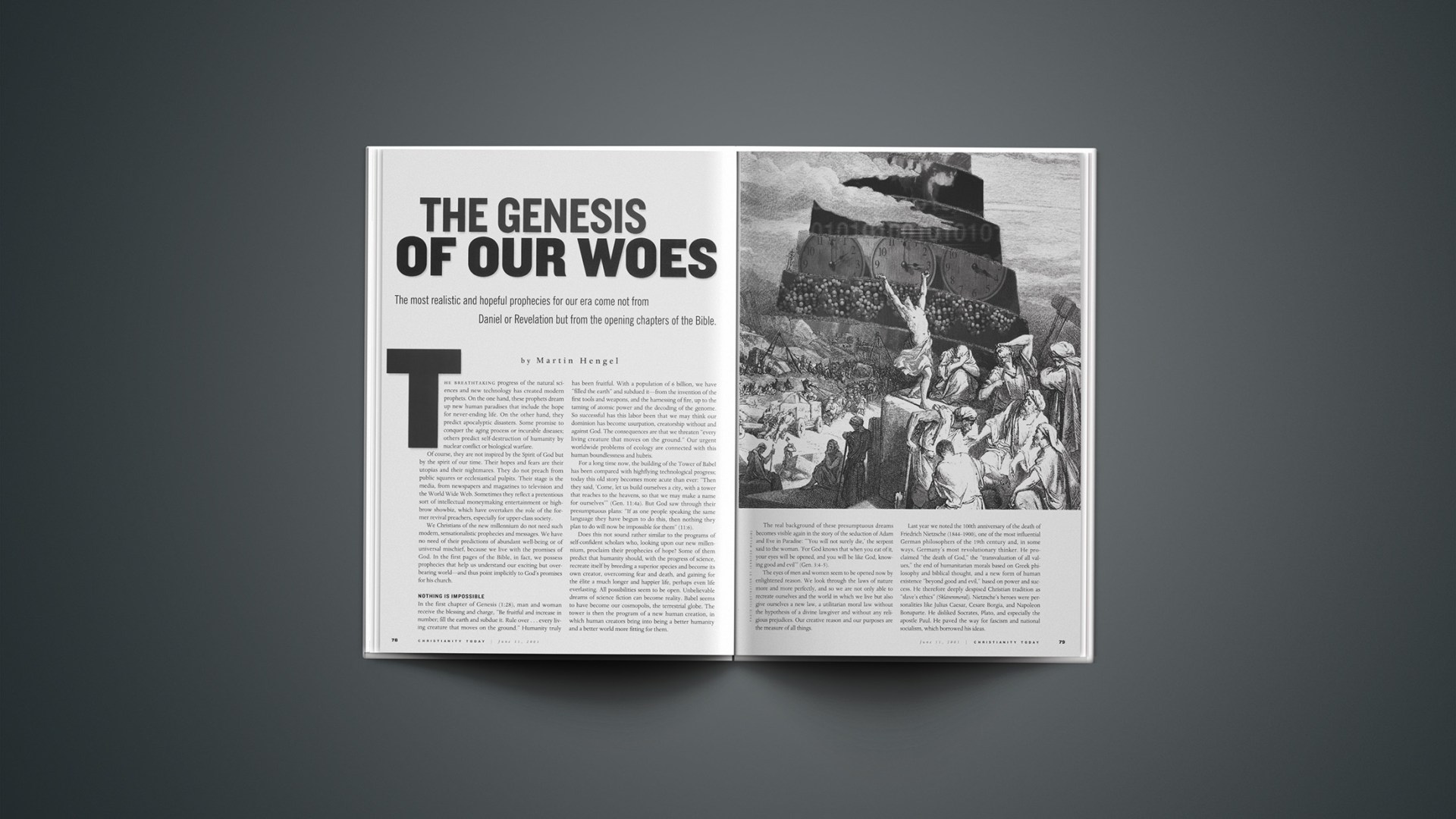
In the first chapter of Genesis (1:28), man and woman receive the blessing and charge, “Be fruitful and increase in number; fill the earth and subdue it. Rule over. … every living creature that moves on the ground.” Humanity truly has been fruitful. With a population of 6 billion, we have “filled the earth” and subdued it—from the invention of the first tools and weapons, and the harnessing of fire, up to the taming of atomic power and the decoding of the genome. So successful has this labor been that we may think our dominion has become usurpation, creatorship without and against God. The consequences are that we threaten “every living creature that moves on the ground.” Our urgent worldwide problems of ecology are connected with this human boundlessness and hubris.For a long time now, the building of the Tower of Babel has been compared with highflying technological progress; today this old story becomes more acute than ever: “Then they said, ‘Come, let us build ourselves a city, with a tower that reaches to the heavens, so that we may make a name for ourselves'” (Gen. 11:4a). But God saw through their presumptuous plans: “If as one people speaking the same language they have begun to do this, then nothing they plan to do will now be impossible for them” (11:6).
Does this not sound rather similar to the programs of self-confident scholars who, looking upon our new millennium, proclaim their prophecies of hope? Some of them predict that humanity should, with the progress of science, recreate itself by breeding a superior species and become its own creator, overcoming fear and death, and gaining for the élite a much longer and happier life, perhaps even life everlasting. All possibilities seem to be open. Unbelievable dreams of science fiction can become reality. Babel seems to have become our cosmopolis, the terrestrial globe. The tower is then the program of a new human creation, in which human creators bring into being a better humanity and a better world more fitting for them.
The real background of these presumptuous dreams becomes visible again in the story of the seduction of Adam and Eve in Paradise: “‘You will not surely die,’ the serpent said to the woman. ‘For God knows that when you eat of it, your eyes will be opened, and you will be like God, knowing good and evil'” (Gen. 3:4-5).
The eyes of men and women seem to be opened now by enlightened reason. We look through the laws of nature more and more perfectly, and so we are not only able to recreate ourselves and the world in which we live but also give ourselves a new law, a utilitarian moral law without the hypothesis of a divine lawgiver and without any religious prejudices. Our creative reason and our purposes are the measure of all things.
Last year we noted the 100th anniversary of the death of Friedrich Nietzsche (1844-1900), one of the most influential German philosophers of the 19th century and, in some ways, Germany’s most revolutionary thinker. He proclaimed “the death of God,” the “transvaluation of all values,” the end of humanitarian morals based on Greek philosophy and biblical thought, and a new form of human existence “beyond good and evil,” based on power and success. He therefore deeply despised Christian tradition as “slave’s ethics” (Sklavenmoral). Nietzsche’s heroes were personalities like Julius Caesar, Cesare Borgia, and Napoleon Bonaparte. He disliked Socrates, Plato, and especially the apostle Paul. He paved the way for fascism and national socialism, which borrowed his ideas.
Among his most influential ideas was the breeding of a new superior race of “superman” (Übermensch), a concept undoubtedly influenced by Charles Darwin, considered the father of evolution, and Count Gobineau, who provided a theoretical basis for racial anti-Semitism. Yet not only Nie-tzsche but also the seemingly opposite ideology of Marxism-Leninism wanted to create a new and perfect society.
Both the totalitarian ideologies of elitist racism and egalitarian communism became responsible for unspeakable atrocities in the past century. They prove the truth of Jewish and Christian anthropology, which we again find in the first chapters of Genesis: “Every inclination of his heart is evil from childhood” (8:21). We are created as God’s partners and bear his image, but we are also fallen creatures and sinners, seeking in our arbitrariness and selfishness to “be like God.”
However, we do not live by our own virtues but by the grace of our Creator and Redeemer alone. This fact prohibits us from both enthusiastic optimism and fundamental pessimism regarding the future. It gives us a realistic outlook based on trust in God, the master of nature and history. In him, we have a gratefulness for all his gifts, including positive progress in science and technology. We also have a responsibility to nature and a dependence on God.
God’s insistent question
Among the many reproaches against the Christian faith is the charge of being a religion of guilt and sin that is said to paint a negative picture of men and women. Yet without the possibility of guilt and sin, there will be no freedom and responsibility. This possibility of sinning, the posse peccare, is an essential part of human dignity, which distinguishes men and women as partners with God, bearing his image, from machines and animals. Only those who have experienced the remission of their own sins know what forgiveness is and can really forgive others. Without the awareness of sin, guilt, and remission there exists no conscience, no duty, and no consciousness of human dignity and rights, indeed no real humanity, which are basic conditions for our survival in this new millennium.Again we find in the first chapters of Genesis a striking example of selfish irresponsibility, which is a parable of unscrupulous human behavior in past and future. In the story of Cain and Abel, God asks the one who committed fratricide, “Where is Abel, your brother?”
Cain replies, “I do not know; am I my brother’s keeper?”
This remains a constant question from God to humans, which will become even more insistent in the future in the presence of a wave of threats to our creation. Those threats include global warming and other climate anomalies; growing poverty in large parts of the world; the decrease of natural resources like water, wood, and crops; the increase of devastating epidemics like aids and hoof-and-mouth disease; the increase of murderous wars and civil strife in the Third World; and the secret war against unborn human life in the womb, an act of inhumanity that renders guilty the richest countries of the world. Abortion is not so much a question of criminal law but rather evidence of no support for helpless and despairing pregnant women, who often act under pressure from their partners or next of kin. By this crime we destroy the future of our people and of Western civilization as stamped by Christianity.
Human intelligence has subdued the Earth and nature to such an extent that by the irresponsible criminal behavior of politicians and peoples even a collective suicide of humankind could become possible.
Indestructible Trust
Since the beginning of history, humankind is accompanied by the one decisive question at the end of the deeply symbolic story of Paradise lost: “But the Lord God called to the man, ‘Where are you?'” (Gen. 3:9). God calls humanity to responsibility. In our inextinguishable desire to be like God, we are hiding from the Creator and Redeemer behind all sorts of idolatry, arguments of skeptical reason, cynical nihilism, or pure thoughtlessness. We do not want to hear God’s call. But his call does not therefore cease.At the daybreak of the 21st century, it is especially intense. God’s call for Christians is identical with Jesus Christ’s call at the beginning of his ministry: “The time has come. … The kingdom of God is near. Repent and believe the good news” (Mark 1:15). Our “time has come” and God’s kingdom comes to us when we confess in trust, “You are my God. My times are in your hands” (Psalm 31:14, 15a). That last sentence of hope is written on the tombstone of my parents-in-law. It will be on my wife’s and on mine as well. This trust means assurance of God’s perpetual presence, each day and in our future, until we give our lives back into his hands. The hope also involves trust in the fate of our Earth, this small particle of dust in the seemingly infinite universe that is God’s creation.
This confession gives certitude, gratitude, and hope in view of all the bewildering prophecies in our presence. At the same time, it gives inner firmness, responsibility before God and man, private and public, and courage for our tasks to be done by us now and in an unknown future, one that remains in God’s good hands.
At the climax of his letter to the Romans, Paul gives proof of this indestructible trust. We could also call it faith, which is to accompany the whole church through all times as an unsurpassed encouragement. “For I am convinced that neither death nor life. … neither the present nor the future, nor any powers, neither height nor depth, nor anything else in all creation, will be able to separate us from the love of God in Christ Jesus our Lord” (8:38-39). This is also true in the third millennium.
Martin Hengel is one of the foremost experts on early Judaism and Christianity. He is professor emeritus of New Testament and early Judaism at the University of Tübingen, Germany. The most recent of his many books is The Four Gospels and the One Gospel of Jesus Christ (Trinity, 2000).
Copyright © 2001 Christianity Today. Click for reprint information.
Related Elsewhere
Commentary, sermons, and other resources on Genesis from such theological leaders and pastors as John Calvin, Basil the Great, John Wesley, C.H. Spurgeon, and Athanasius are available at the Christian Classics Ethereal Library’s World Wide Study Bible.The Text This Week also offers contemporary and historical commentary on Genesis and the rest of the Bible.
In a commentary for the Biblical Studies Foundation, Bob Deffinbaugh finds lessons on the purpose of prophecy in Genesis 49.
Earlier Christianity Today articles about Genesis include:
Evangelicals Embrace Vegetarian Diet (Sept. 6, 1999)
Genesis: Warts and All | What Christians can learn from Jews about the Bible’s first book. (Apr. 26, 1999)
Young-Earth Theory Gains Advocates (Apr. 27, 1998)
What Have They Done to My Genesis? | To my surprise, the PBS series showed me how I’d underestimated Scripture. (Jan. 6, 1997)
Bill Moyers’s National Bible Study | This Southern Baptist preacher-turned-journalist wants to get America talking about the stories of Genesis. (Oct. 28, 1996)
Do Photos Evidence Lost Edenic River? (Oct. 7, 1996)
Earlier Christianity Today articles about prophecy include:
The Rapture: What Would Jesus Do? | An end-times pilgrim counts the cost of discipleship. (Feb. 6, 2001)
Scholars Dispute Fatima Prophecy | Many question whether attempted assassination of Pope fulfilled prophecy. (Aug. 11, 2000)
What Hal Lindsey Taught Me About the Second Coming | At UCLA, amid war protests and police helicopters, teachings on an imminent end made a lot of sense. (Oct. 25, 1999)
Apocalypse Now | Worried about the future? Revelation says more about church life today than about how the world will end. (Oct. 25, 1999)
Stop the Dating Game | Don’t do what Jesus said can’t be done. (Oct. 25, 1999)
Reflections: End Times Edition (Oct. 25, 1999)
Is Revelation Prophecy or History? | Some events described in Revelation occurred contemporaneously with the prophecies themselves. (Oct. 25, 1999)
Inside CT: Obsessed with the End Times (Oct. 5, 1998)
How Evangelicals Became Israel’s Best Friend | The amazing story of Christian efforts to create and sustain the modern nation of Israel. (Oct. 5, 1998)
The Bible Study at the End of the World | Recent novels by evangelical leaders say more about popular American Christianity than about the end times. (Sept. 1, 1997)
Issue 61 of Christianity Today sister publication Christian History examined how Christians have perceived prophecies about end of the world.







