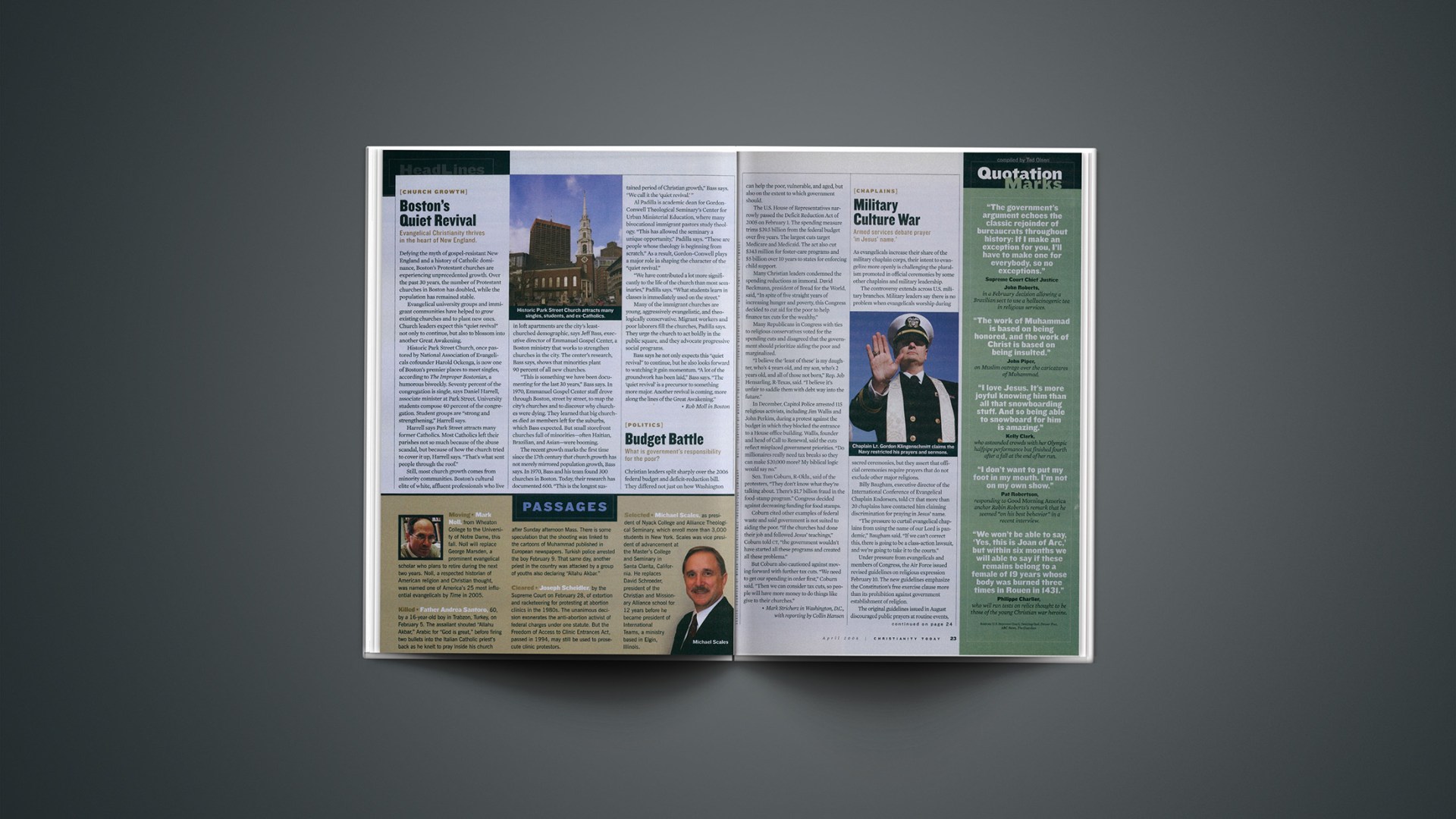

As evangelicals increase their share of the military chaplain corps, their intent to evangelize more openly is challenging the pluralism promoted in official ceremonies by some other chaplains and military leadership.
The controversy extends across U.S. military branches. Military leaders say there is no problem when evangelicals worship during sacred ceremonies, but they assert that official ceremonies require prayers that do not exclude other major religions.
Billy Baugham, executive director of the International Conference of Evangelical Chaplain Endorsers, told CT that more than 20 chaplains have contacted him claiming discrimination for praying in Jesus’ name.
“The pressure to curtail evangelical chaplains from using the name of our Lord is pandemic,” Baugham said. “If we can’t correct this, there is going to be a class-action lawsuit, and we’re going to take it to the courts.”
Under pressure from evangelicals and members of Congress, the Air Force issued revised guidelines on religious expression February 10. The new guidelines emphasize the Constitution’s free exercise clause more than its prohibition against government establishment of religion.
The original guidelines issued in August discouraged public prayers at routine events, saying that personal expressions of faith could be misunderstood as official statements. They now add that there are no restrictions in situations “where it is reasonably clear that the discussions are personal, not official, and they can be reasonably free of the potential for, or appearance of, coercion.”
Disciplined
Navy Chaplain Lt. Gordon Klingenschmitt earned national attention during his 18-day hunger strike that ended January 7. Klingenschmitt, protesting what he called restrictions on how he could pray and preach, said he was disciplined for some of his shipboard sermons.
However, Navy spokesman William Marks said Christian chaplains are actually encouraged to pray in Jesus’ name during divine services. Marks said that during nonreligious events such as memorial services and reenlistment or promotion ceremonies, chaplains should be mindful of all religions in the audience. “We ask that they be inclusive,” Marks said, “but a chaplain would not get in trouble for praying in Jesus’ name.”
U.S. Rep. Walter Jones, R-N.C., sent a letter February 7 to the Department of the Army inspector general requesting an investigation of an incident involving a chaplain stationed in Iraq. Army Captain Chaplain Jonathan Stertzbach submitted two prayers to a brigade chaplain before performing a memorial ceremony. The brigade chaplain modified the prayers to be more inclusive before allowing Stertzbach to include “in Jesus’ name I pray.” Stertzbach was allegedly removed from his chapel for speaking to the Washington Times about the incident.
Army spokeswoman Martha Rudd declined to speak directly about Stertzbach’s case, because he is under review. “There are some people who are uncomfortable with pluralism,” she said. “And if a chaplain is uncomfortable with that, he or she should find a ministry outside of the military.”
Charles Haynes, senior scholar for the First Amendment Center, said working for the military creates built-in tension, because a chaplain must serve both church and state.
“I think really behind this is a political shift … that has led many evangelicals to bring their faith into the public square in ways that are authentic,” Haynes told CT. “It’s a culture-war mentality that … has caused it to come to the surface now.”
Rep. Jones said more than 70 members of Congress have been pressuring President Bush to issue an executive order allowing chaplains to pray according to their faith. Jones said, “If he can send our kids to die, he can certainly protect the chaplains’ First Amendment rights.”
Copyright © 2006 Christianity Today. Click for reprint information.
Related Elsewhere:
In addition to the guidelines, the Air Force has a press release and explanatory memo.
More about Gordon Klingenschmitt’s hunger strike is available from Stars & Stripes.
News elsewhere includes:
Air Force Eases Rules on Religion | New guidelines reflect evangelicals’ criticism, general says (The Washington Post, February 10, 2006)
Air Force sets revised rules for prayers by its chaplains | The Air Force yesterday released revised guidelines on religious observance that say chaplains need not recite prayers incompatible with their beliefs, but that also encourage “non-denominational” or “inclusive” prayer in public situations. (The Washington Times, February 10, 2006)
Previous Christianity Today coverage of military chaplains includes:
Air Force Issues Revised Guidelines on Religion | Interpretation varies on what one-page “interim” document means. (Feb. 9, 2006)
New Air Force Religion Guidelines May Restrict Evangelism | Policy allowing chaplains “to instruct and/or evangelize” withdrawn, lawsuit seeks explicit ban on all members (Oct. 28, 2006)
A Wing and Less Prayer | New Air Force religion guidelines get mixed response. (Oct. 6, 2005)
‘No Overt Discrimination’ | Air Force Academy cleared, but some faulted for insensitivity. (July 7, 2005)
Air Force Chaplains Allege Bias | Independent survey finds perceptions of racial, gender, and religious discrimination. (Oct. 18, 2001)