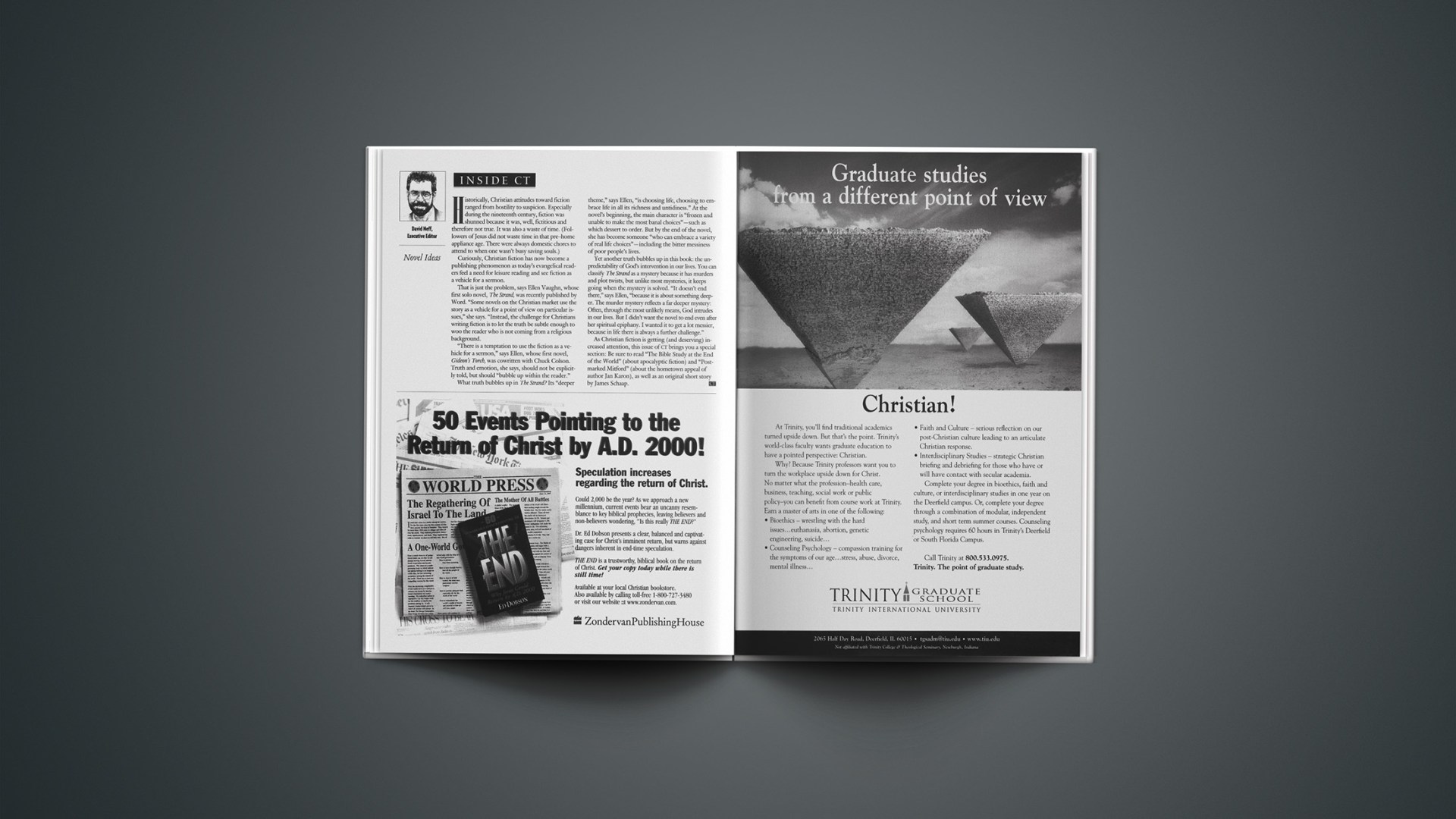

Historically, Christian attitudes toward fiction ranged from hostility to suspicion. Especially during the nineteenth century, fiction was shunned because it was, well, fictitious and therefore not true. It was also a waste of time. (Followers of Jesus did not waste time in that pre-home appliance age. There were always domestic chores to attend to when one wasn’t busy saving souls.)
Curiously, Christian fiction has now become a publishing phenomenon as today’s evangelical readers feel a need for leisure reading and see fiction as a vehicle for a sermon.
That is just the problem, says Ellen Vaughn, whose first solo novel, The Strand, was recently published by Word. “Some novels on the Christian market use the story as a vehicle for a point of view on particular issues,” she says. “Instead, The challenge for Christians writing fiction is to let the truth be subtle enough to woo the reader who is not coming from a religious background.”
“There is a temptation to use the fiction as a vehicle for a sermon,” says Ellen, whose first novel, Gideon’s Torch, was cowritten with Chuck Colson. Truth and emotion, she says, should not be explicitly told, but should “bubble up within the reader.”
What truth bubbles up in The Strand? Its “deeper theme,” says Ellen, “is choosing life, choosing to embrace life in all its richness and untidiness.” At the novel’s beginning, the main character is “frozen and unable to make the most banal choices”—such as which dessert to order. But by the end of the novel, she has become someone “who can embrace a variety of real life choices”—including the bitter messiness of poor people’s lives.
Yet another truth bubbles up in this book: the unpredictability of God’s intervention in our lives. You can classify The Strand as a mystery because it has murders and plot twists, but unlike most mysteries, it keeps going when the mystery is solved. “It doesn’t end there,” says Ellen, “because it is about something deeper. The murder mystery reflects a far deeper mystery: Often, through the most unlikely means, God intrudes in our lives. But I didn’t want the novel to end even after her spiritual epiphany. I wanted it to get a lot messier, because in life there is always a further challenge.”
As Christian fiction is getting (and deserving) increased attention, this issue of CT brings you a special section: Be sure to read “The Bible Study at the End of the World” (about apocalyptic fiction) and “Postmarked Mitford” (about the hometown appeal of author Jan Karon), as well as an original short story by James Schaap.
Copyright © 1997 Christianity Today. Click for reprint information.