In this series




Though the Bible describes shepherds of the church as “blameless,” (Titus 1:6), “upright” (Titus 1:8), and “above reproach” (1 Tim. 3:2), Americans—even Christians—take a much more pessimistic view.
According to a new Gallup survey, the country’s perception of pastors fell to a record low in 2018.
Fewer than half of American Christians (42%) believe clergy have “high” or “very high” standards of honesty and ethics, according to breakouts provided to CT. Self-identified Christians were about as likely to rate clergy’s ethical standards as just average (43%), and about 1 in 10 (12%) considered them “low” or “very low.”
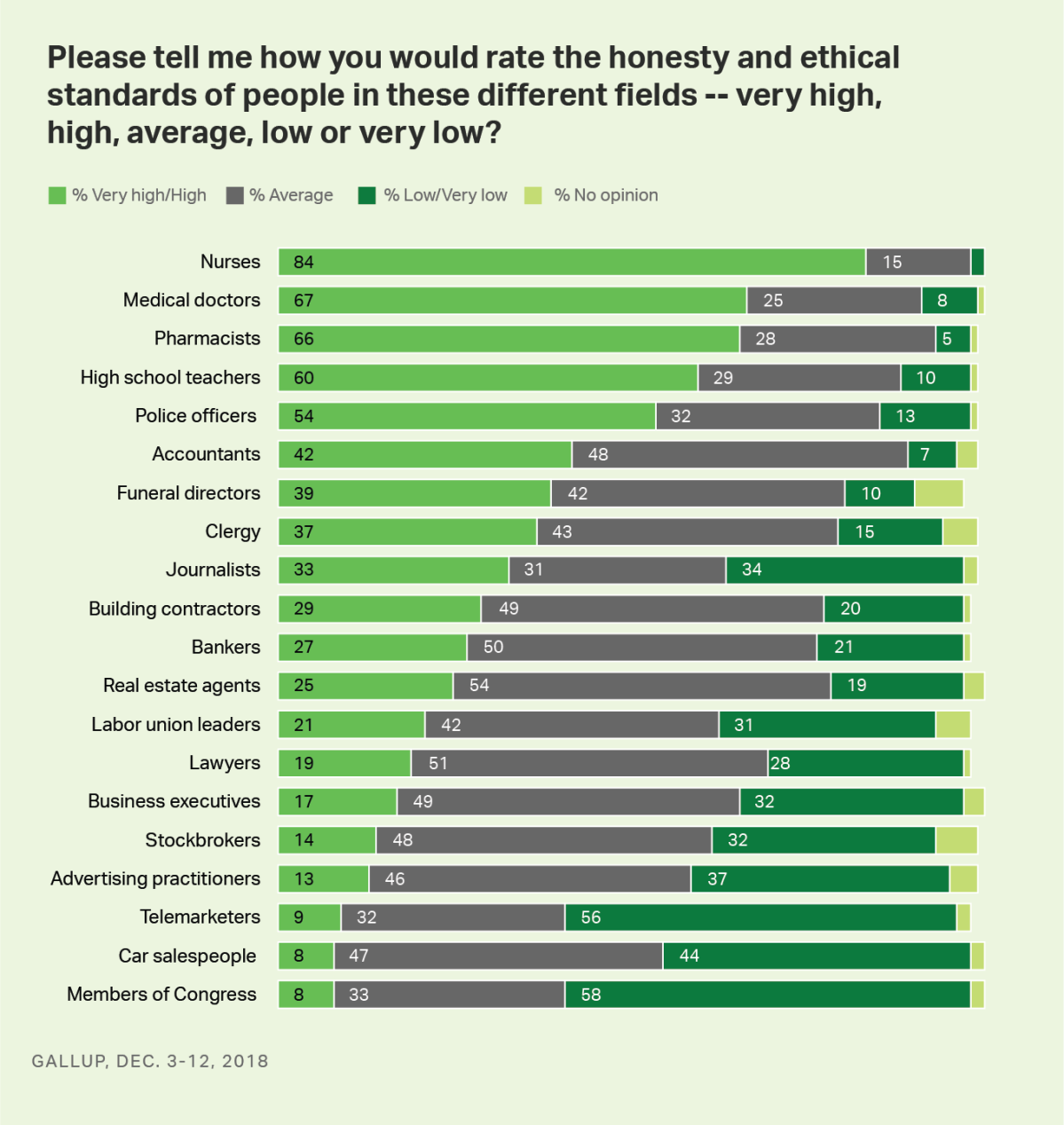
Among Americans as a whole, trust in the clergy fell to 37 percent, making it the eighth-most-trusted profession in the country—ranking below multiple medical professions, teachers, and police and just above journalists and building contractors.
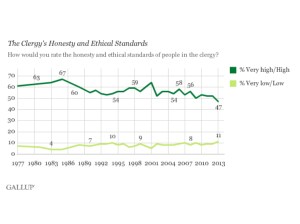
Over the last 40 years, Gallup has measured the country’s view of the trustworthiness of faith leaders along with a range of other professions. Clergy trust peaked in 1985, when two-thirds of Americans said clergy had a “high” or “very high” honesty and ethical standard.
That percentage hovered in the high 50s throughout the 1990s, until dropping to 52 percent in 2002 around the height of the sexual abuse scandals in the Catholic Church. Though Americans’ ratings of their clergy rallied slightly, they’ve been on a steady downward trajectory for most of the last decade.
“These latest low ratings on the clergy come on the heels of more investigations into child sex abuse by Catholic priests in the US,” state Gallup researchers.

“When the priest is an abuser, it breaks all confidence and trust in the authority of the church,” John Armstrong, president of ACT3 Network, told CT in the aftermath of a case in Pennsylvania that unveiled a decades-long cover-up of a scandal in which hundreds of priests abused more than 1,000 children.
“Men and women turn toward clergy in some of the most intimate moments of their lives. They are conduits of people’s deeply held religious convictions that shape the way we understand this world and the next,” said John Fea, professor of American history at Messiah College.
“The kinds of scandals and authoritarian leadership that we saw this year among the clergy undermines the trust we place in them.”
According to the December poll, Catholics are less likely than Protestants to continue to trust church leaders. Fewer than a third (31%) give positive marks to clergy, compared to around half Protestants (48%).
But in the wake of #MeToo, Protestants have also seen their share of misconduct over the past year, with the removal of veteran Southern Baptist leader Paige Patterson from Southwestern Baptist Theological Seminary, allegations against Bill Hybels of Willow Creek, and widespread accusations of abuse among independent Baptist pastors.
Despite declining trust in faith leaders, a separate Gallup poll recently named Pope Francis as the fourth-most-admired man among Americans. The Dalai Lama is No. 8. This marks the first year in more than six decades that Billy Graham, who died in February, has not made the top 10, which is limited to living people. He was on the list every year since 1955.
Even with declining confidence in clergy, pastors are by no means Americans’ least trusted professionals. That designation goes to members of Congress, who are given “low” or “very low” ratings by 58 percent of Americans. The majority (55%) of Christians, too, give negative ratings to congresspeople.
In general, Christians are in agreement with the rest of Americans about who are the most and least trustworthy and ethical professionals in the country.
In addition to members of Congress, telemarketers, and car salespeople are largely distrusted. Advertisers, stockbrokers, lawyers, and business executives are also more often perceived as having “low” or “very low” honesty and ethical standards than “high” or “very high” standards.
“I think we are living in an era when expertise and authority are under attack in a variety of areas, whether it be religion, politics, or academic life,” said Fea. “Our society’s distrust of clergy may be part of the general distrust of authority that comes with certain forms of populism.”
At the top of the list, the most trusted professionals by far are those who work in the medical field. Among both Christians and Americans more broadly, 84 percent perceive nurses as having “high” or “very high” honesty and ethical standards. That’s more than twice the percentage who say the same for clergy.
Doctors and pharmacists, as well as police officers and accountants, also outrank pastors.
Journalists see the most even split, with about a third of Americans giving them high ratings for their honesty and ethical standards, a third giving them average ratings, and a third giving them low ratings.
That 33 percent giving journalists a “high” or “very high” rating is a jump of 10 percentage points from 2016, which ties their 1977 record high. Perceptions of journalists divides along political lines, with more than half of Democrats (54%) giving them high ratings while only 1 in 10 Republicans feel the same.
Of the 20 professions included in this year’s survey, journalists are the ninth-most-trusted in America. Clergy are the eighth-most-trusted by Christians and the general public alike.