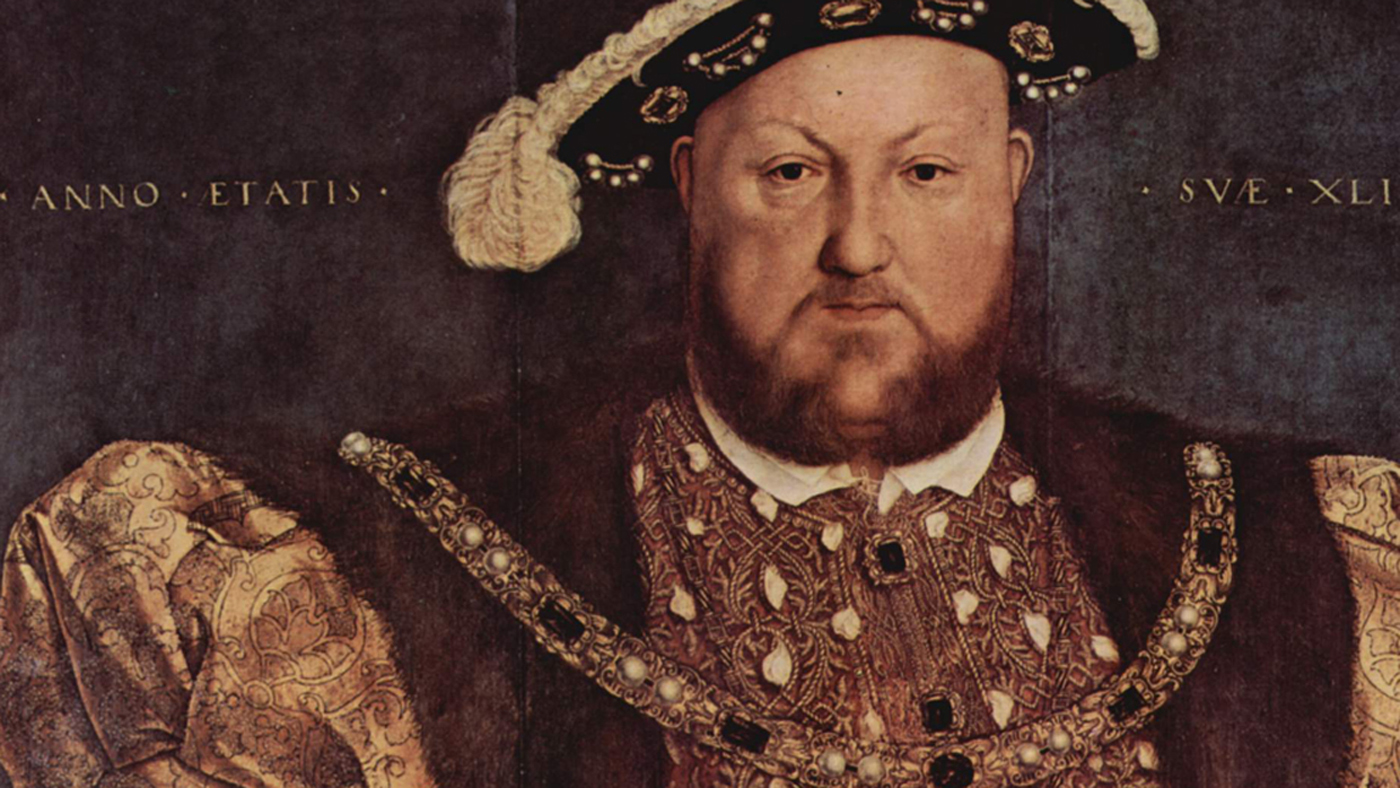

The joke in church circles is that the Episcopal church is the only denomination that started because of a divorce. In fact, as part of an advertising campaign in the 1980s, the Episcopal church designed a poster featuring Henry VIII that stated: “The Episcopal Church welcomes divorced people.” (The Episcopal Church in the U.S.A. is, of course, part of the global Anglican Communion, rooted in the Church of England.)
The English Reformation is far more complicated, however, involving not only the marital woes of much-married Henry, but also a turbulent theological and political situation in England.
Rumblings in England
When Luther posted his Ninety-Five Theses in 1517, they did not go unnoticed in England. In 1521, young King Henry wrote (probably with assistance) a book attacking Luther’s view of the sacraments. The pope graciously replied by bestowing on Henry the title “Defender of the Faith,” a title still used by British monarchs.
Like the rest of Europe, however, England was restless with its church situation. Many bishops were rich landowners, priests and monks were often scandalously immoral, and the religion of the common people was woven with superstition. Earnest leaders like John Colet of Oxford called for reform. At Cambridge, a group of scholars met to discuss Protestant ideas; they became known as “Little Germany” because of their affection for Luther’s teachings. In addition to these theological rumblings, there was a growing feeling of nationalism, a higher devotion to England than to the Roman church. The stage was set for a break with Rome.
Rumblings in the King’s Marriage
Henry VIII, a lustful, selfish ruler, justifiably feared for England’s stability if he failed to produce a son to succeed him. (He had at least one illegitimate son, of little use for succession.) Yet his wife of many years, Catherine of Aragon, was in her early forties and had produced only one surviving child, daughter Mary.
Henry sought an annulment, claiming that since Catherine had been his brother’s widow, she could not legally be his wife. (He based his claim on Leviticus 20:21.) The pope stalled, partly because Catherine was the aunt of the mighty Emperor Charles V, a party the pope did not want to offend.
Henry, who was already drawn to dark-haired Anne Boleyn, couldn’t wait. (“I would you were in mine arms or I in yours, for I think it long since I kissed you,” he wrote her.) Henry knew the anticlerical feeling in England made the time right for a break. He appointed Thomas Cranmer as Archbishop of Canterbury, and Cranmer declared the marriage invalid. Henry married Anne, already six months’ pregnant by him, in 1533.
Rupture with Rome
Pope Clement VII then excommunicated Henry, which only fueled dissent. Parliament passed a series of acts restraining the clergy and increasing Henry’s power over them. In 1534 came the Act of Supremacy, declaring Henry to be “the only supreme head on earth of the Church of England.” England now had a national church, with the king at the helm. The Archbishop of Canterbury held the highest clergy office in the realm.
But Henry was no Protestant. He just wanted a Catholic church without a pope. He had broken with Rome, but not with its theology or ritual. In 1539 he issued the Six Articles, which insisted on continuing practices such as private confession, clerical celibacy, and private masses.
Yet in two ways, Henry departed significantly from Catholic practice. He closed the monasteries and confiscated their vast holdings of land and wealth. The proceeds went into the royal treasury to support campaigns against France, and the land was transferred to nobles in hopes of increasing their loyalty to the crown.
Henry also ordered that an English Bible be installed in all churches. Henry had no real interest in the English people’s studying the Bible, but an English Bible was another way of promoting English nationalism, for the churches would no longer be dependent on a Roman Latin Bible.
Henry died in 1547, having successively acquired four more wives after Anne Boleyn’s execution. His successor was the puny Edward VI, son of his union with the third wife, Jane Seymour. During Edward’s brief reign, England began to be truly Protestant. But Henry died thinking himself a good Catholic; his will provided for masses to be said for the welfare of his soul.
Repercussions of Henry’s Reign
The day of the church’s political supremacy was over, as seen by the fact that Henry could call himself head of the church in England. A century earlier, a king so audacious might have been assassinated. But Henry wasn’t, and for an obvious reason: the English felt more pride in being English than in being Catholic. Nationalism was to be a permanent feature on the landscape of Europe.
The Act of Supremacy broke England from Rome—decisively. Though England briefly returned to Catholicism under Henry’s daughter Mary, England was, forever after, not Catholic. Henry’s selfish acts paved the way for a church that sought the via media, the “middle way” between adherence to the pope, and aggressive dissent.
Copyright © 1990 by the author or Christianity Today/Christian History magazine. Click here for reprint information on Christian History.