Ideas

A Splintered Generation

Evangelicalism’s fracturing is chronic, but not terminal. Here’s how we can move forward.

A church pew ripped in half

Art by Derek Brahney

One day in the middle of the pandemic, I was working a typical pastoral day patching some drywall at our Orlando, Florida, church building, when a church member dropped by to catch up. The week before, we’d had a conversation about joy. I had asked him, “What is stealing your joy right now?” He thought long and hard about that question and wanted to follow up.

“Hey, Mike, your question about joy the other day was really hard, but I had an epiphany,” he said. “I realized that having Fox News on 24/7 at home was the number one thing stealing my joy and making me angry. So this week I decided to turn it off, and it has really made a difference.”

I told him that I was proud of him for his honesty and for taking a significant action step to safeguard his joy in Christ. But then he added, “Except for Tucker Carlson. I watch him every night.” 

I’ve heard similar stories from the other side of the political aisle. Our current reality is no different from this story. What are pastors to do when their church members consume narratives throughout the week tenfold more than their Sunday sermons? What do we do when members who helped found our churches now threaten to leave due to these narratives? What do we do when evangelicalism feels irrevocably fractured? 

The evangelical movement has long been a tapestry of diverse convictions and traditions, united by shared doctrinal and cultural factors rather than formal structures. The term evangelical implies an overarching unity that allows and accounts for diversity without imposing uniformity. This both gives the movement its force and makes it hard to discern its exact contours.

Today, that visage has grown even less clear. Four years ago, we observed in an essay for Mere Orthodoxy that evangelicalism had fractured. The response to American political events that drove media attention and cultural conversation revealed an underlying rending of the evangelical fabric. 

As we saw it, the fracturing of evangelicalism revealed that the historic bonds holding the movement together were less intellectual than they appeared but were rather socioeconomic, political, and cultural. Dividing lines lurked beneath the surface for some time, but in the wake of a series of flash points, the comfortable order of allegiances was disrupted, fractured by unspoken yet deeply held commitments. We categorized the splintering into what we saw as six groups (and added one more borrowing from Mere Orthodoxy editor in chief Jake Meador’s observations):

0 – Right-Leaning Exvangelicals have left the church but identify as Christian or promote the merit of Christianity for the preservation of conservative cultural values and institutions. 

1 – Neo-Fundamentalists focus on biblical fidelity and conservative values. This group is deeply concerned about liberalism and growing cultural hostility toward Christianity.

2 – Mainstream Evangelicals prioritize the Great Commission, so while they are concerned by extreme fundamentalism, they are more worried about the secular left’s influence.

3 – Neo-Evangelicals emphasize the global nature of the movement and the need to engage with the culture. This group critiques conservative political allegiances and failures on social issues while addressing liberal Christianity’s theological compromises.

4 – Post-Evangelicals center on justice and accountability. They challenge hypocrisy and abuses in the church while distancing themselves from evangelical identity, though they hold to core doctrinal beliefs.

5 – Left-Leaning Exvangelicals have dechurched due to disenfranchisement with evangelicalism’s failures but retain some orthodox Christian beliefs.

6 – Dechurched have left both the church and Christian faith entirely, abandoning all vestiges of belief.

Four years ago, we predicted a number of possible scenarios and futures for evangelicalism in the wake of such a fracturing. Most importantly, we recognized that the fracturing was likely irrevocable. This has proven to be true; we are no longer in the era of fracturing. We have transitioned into a new era within a fractured evangelicalism. 

But this need not lead to discouragement or despair; rather, the fractures of evangelicalism have given way to a certain clarity that allows Christian churches to reconceive and renew their commitment to the gospel. A fractured evangelicalism is not a terminal diagnosis. This is not the movement’s first fracturing, and as historical precedent shows, such a moment can give way to new faithfulness for individuals, movements, and institutions that fall under the “evangelical” label. There is a way forward for the movement that remains committed to evangelical distinctives and the spread of the gospel internally and externally, locally and globally. 


Through the early years of the fracturing (circa 2014–2019), the average American evangelical church might have been largely populated by people with differing cultural sensitivities. A church might see a combination of groups 1–4 sharing a pew in worship, serving in the children’s ministry, and communing in small groups. In fact, proximity is what gave rise to the seemingly ever-present tension of those years. 

But as the cultural waves crashed over these communities and receded, they exposed that, often, the individuals gathered in these churches had many things in common—such as core theological beliefs, preferences in preaching and worship styles, aesthetics, and more—but related to the cultural climate in radically different ways.

Plus, social media offered us more of people’s live, unfiltered reactions to events. A Facebook post by a neo-evangelical small group leader could leave the neo-fundamentalist evangelical church member stunned at the former’s opinion of presidential politics. A post-evangelical might feel that their pastor, who is a mainstream evangelical, is not engaging culture or calling for societal change in a way that is sensitive or helpful.

These dynamics initially led to the fractured groupings, but over time a new reality formed. People began to reconsider their ecclesial affiliation based on these cultural factors. No longer could a neo-fundamentalist sit comfortably with a neo-evangelical. Nor could a post-evangelical serve next to a mainstream evangelical. Suspicion, anxiety, and frustration sent people scattering for new group solidarity and prompted movement into like-minded churches. The power of wedge issues created enough tension to ensure that some evangelicals could no longer attend the same church as each other. This was largely solidified by two factors: positions (doctrine) and posture. 

Two evangelical Christians might agree on the sanctity of life, the biblical sexual ethic, and the sinfulness of racism. Likewise, these two evangelicals might have voted similarly in previous presidential elections. However, as the social media age matured, these two Christians began to diverge in their responses. The one person might carry an abrasive, “truth-telling” posture in face-to-face conversations and digital interactions. The other might attempt to carry a nuanced, “winsome” posture.

These two people hold identical positions but have differing postures. Positions are the fundamental ideas that we hold. Posture is the affect with which we hold those positions. How one arrives at belief will determine how one embodies the belief. Thus, though theological differences may prevail in a church, the sorting between churches occurred as differing paths to beliefs led to different postures. The net effect is a significant impact on overall comfort in a church and a space. 

As the fracturing settled, it became obvious that new solidarities were not based strictly on ideological grounds. In part, this is because the way that we arrive at a doctrinal position often determines solidarity more than the position itself. Humans are not hermetically sealed brains that arrive at propositions through pure, brute-force reading of the Bible. Cultural, emotional, behavioral, psychological, relational, and experiential factors often pave the way to our doctrinal destinations. Even those in denominations with antiseptic doctrinal statements have struggled to find solidarity in a fractured evangelicalism because they came to their convictions through different pathways. 

The explosion of social media, videos, and podcasts serves as one of the most powerful factors in doctrinal and cultural discipleship and significantly shapes how individuals come to positions. 

But our newfound solidarity within these church types is driven by shared posture rather than shared positions. If you were to move to a new city and visit all the churches in town, you might find the ways they self-describe and self-identify loaded with all sorts of subtleties that communicate what types of churches they are. The term Baptist, Presbyterian, or Methodist would no longer be the defining difference between a church and its neighbor church down the street. Instead of denominational labels, you may be looking for the ways they discuss politics—and their political enemies. 

The question “What voices do you most trust in evangelicalism today?” once might have turned up a wide array of answers in any given church. This is less likely now and reveals a more settled fracturing. Position matters, but posture is how you find your tribe. 

Today, it is more likely people have found themselves in spaces with compatible postures, prioritizing these over doctrinal compatibility. Many Christians in everyday experience choose a church based on “vibes.” Gone are solidarities forged in the debates over the charismatic movement, worship wars, and the emergent church. One need only look at Southern Baptist presidential politics to see men who once questioned others’ Baptist credentials over Calvinism today nominating those same people for leadership positions. It is common, too, for non-Christians to speak at Christian conferences if they share the same posture on specific issues. This is part of the new world of settled fracturing within evangelicalism. 


So what is the personality of evangelicalism today? We see three main characteristics that define today’s fractured evangelicalism: church centers, new movements, and the gender divide.

Mid-20th-century missiologist Paul Hiebert borrowed terms from set theory in mathematics—bounded set and center set—to describe ways of thinking. According to Hiebert, bounded sets have essential characteristics, have clear boundaries, are uniform in essential characteristics, and are static. Center sets have a defined center, and people judge things by the distance from their location to that center. 

Some have created a metaphor for this of two livestock ranchers. The bounded-set rancher builds a fence to keep sheep within the field so they don’t stray. The center-set rancher builds a well, knowing the sheep won’t stray far from their source of nourishment. Churches today often define their centers and boundaries through primary theological commitments, secondary theological commitments, and cultural matters. 

We see three new types of churches emerging from the fracturing, all of whom define their boundaries differently. 

The first type is a combination of neo-fundamentalists and mainstream evangelicals. These churches see the culture as the problem facing the church and posture themselves in opposition to it while promoting a vision of a renewed Christian society. They tend to place fence posts around primary theology, secondary theology, and cultural matters. While a positive vision of biblical faithfulness is usually at the center, these churches often define their identity by who is in and who is out. Gospel proclamation is the hope of moving people from without to within while condemning churches and individuals who are squarely outside their boundaries. 

Another group of churches, a combination of mainstream evangelicals and neo-evangelicals, is more likely to see the world’s fallenness inside and outside the church as the problem and to see themselves as salt and light in the world. They tend to be bounded set on primary theological commitments and a mixture of bounded and center set on secondary and cultural issues.

While there is certainly an idea of orthodoxy that defines the boundary, their pursuit of the center rises higher, often within discussions of the Great Commission and the kingdom of God. 

Finally, churches composed of a combination of neo-evangelicals and post-evangelicals see Christian hypocrisy and sin inside the church as the most pressing issue. They tend to be center set on primary and secondary theology but draw firm boundaries on cultural matters. Only those who agree with a certain ethical vision in the modern world are within the boundary to pursue that vision with them. 

No church is boundaryless or purely center-driven. Furthermore, postures are often the unstated embodiment of a church’s boundaries and centers and are extremely revealing. Ironically, the first and third groups of churches often end up being like photo negatives of each other on issues such as gender, sexuality, politics, and race. As cultural flash points occur, boundaries intensify and can lead to flared tempers and anxiety. 

Art by Derek Brahney

The middle group of churches does not minimize cultural issues, but due to its center focus, the heat in these moments is turned down. The focal point rises higher in terms of importance. Nevertheless, these churches and peoples are not separated from the world and will often feel the intense tug of war on any given issue pulling toward the churches on their left and right.

In the past two years, the defining cultural values for evangelicals have cooled due to a larger shared agreement around the tragic events in Israel on October 7, 2023; flash points around gender; and renewed cultural conversations around the benefits of Christianity for self and society. Still, these boundaries and centers exist and will fluctuate.

Much of the fracturing we’ve beheld itself derives from a mistrust of the institutions that have defined the shared life of evangelicalism. Our publications, seminaries, denominations, pastors, and churches that once were viewed as the banners of the movement are now under suspicion. The net effect leaves institutions still standing but not necessarily thriving. In a setting of such chaos, two notable movements have arisen that are not obviously associated but do derive from this context. 

The first movement might be called New Pietism, the school of thought commonly known as “Rule of Life” or “Comerism,” after the popular writer and pastor John Mark Comer. This movement emphasizes the cultivation of one’s spiritual life, with a heavy focus on spiritual practices that inspire the individual to holistic commitment to Jesus Christ. 

While there are many factors in this movement’s explosion in the past decade, it is notable that its mainstream attention grew most significantly as the fracturing settled. It might be said that New Pietism arose out of a desire to leave behind the chaos and clamor that defined the fracturing period. As with its spiritual predecessor in the 17th century that reacted against institutional failure in its time, the emphasis of New Pietism largely rests on the individual, though it is not in opposition to communal cultivation of piety. With historically reliable institutions under suspicion, the turn inward serves as a great call to take account for oneself. 

This movement will likely transcend the fracturing through an otherworldly pursuit. Its development doctrinally and communally will define its contours.

The second movement is what we call New Transformationalism. If New Pietism is the extreme inward, individual response to the fracturing, hoping to rise above it, New Transformationalism is the extreme outward, communal response. This movement desires to engage culture and society in the hopes of bringing them into alignment with Christian principles. It is incumbent on the Christian community, then, to take up the task of cultural transformation. 

Christian nationalism is the form of this movement that has dominated the popular conversation on both sides of the spectrum. But opposite it, other groups want to see American society and the church reckon with failures to uphold biblical justice. Both turn outward to the world in hopes of Christian renewal. 

The New Transformationalists differ from those who emphasize cultural renewal, because they believe the institutions that have structured American society and evangelicalism are complicit in the miscarriage of justice—the specifics depending on how one defines that. These institutions must be dismantled finally and totally, in their view, so that new institutions may arise to resurrect the movement upon a better foundation. This is the calling of the Christian community in today’s age. Those who bear the name “Christian” and do not join in this vision are complicit with these failed institutions. 

Both New Pietism and New Transformationalism look at the turbulence of fracturing and long to move forward in faithfulness. The former seeks faithfulness internally and individually. The latter seeks faithfulness externally through the community. 

But as the fracturing settles and institutions remain weary, we can expect these movements to grow and appeal to many across the fracturing spectrum. We may also expect that many, notably mainstream evangelicals, will feel threated by these movements that they see as distractions to the Great Commission.

A pew that's been ripped and then reconstructed together

Perhaps the most culturally significant reaction during the period of the fracturing is the gender divide. Large numbers of women are moving out of the church, and men are moving in (or at least are leaving at slower rates). In 2008, 34 percent of college-graduated men and 36 percent of college-graduated women in the US attended church at least once a week. By 2023, men had dropped off by 2 percent (down to 32%) and women by 9 percent (down to 27%). The results are similar over the same time period for those who have only some college education.

Notably, for the first time since religious data has been recorded, there are now more younger men than younger women in church. And there are now more women over the age of 32 who never attend church versus their male counterparts. In my (Michael’s) book, The Great Dechurching, I found that 65 percent of dechurched exvangelicals are women. Men and women are entering this new era of evangelicalism in very different ways.

It is perhaps too early to answer why the fracturing has been received in such vastly different ways by men and women from otherwise similar racial, socioeconomic, and geographic backgrounds. While there are many possible reasons, we see social media, Western civilization, and the last three election cycles as major influences.

With the atomization of media, men and women are often not listening to the same voices and perspectives. This does not necessarily mean that women are more likely to engage with personas pushing them out of the church, but it does in part explain the radical divergence in cultural attitudes and engagement.

Some have also had concerns over the health and well-being of Western civilization. From newly converted Christians (such as Ayaan Hirsi Ali) to avowed atheists (such as Richard Dawkins), there seems to be a large, influential sect of cultural conversation promoting Christianity as foundational to a thriving society. But this conversation tends to code more male than female, such as apologist Wesley Huff’s appearance on Joe Rogan’s podcast, a show with an overwhelmingly male audience.

And of course, men and women have responded to the presidencies of Donald Trump in divergent ways. His popularity since his first campaign has grown, and his strength with evangelical men solidified, while many women are still wary. These varied reactions might offer insight into women’s faster rate of disillusionment with evangelicalism than men’s.

Regardless of the underlying causes, the widening gaps between young men and young women in politics, religious belief, and religious attendance will play a significant role in the contours of the fracturing of evangelicalism. 


Life within a fractured evangelicalism is still taking shape. But there is a way forward. What should we do? The church needs to prioritize the goodness of the gospel, holistic discipleship, and prayer for institutional revival. 

First, given that cultural flash points will continually change but never subside, evangelical churches must commit to firm doctrinal boundaries and champion the center. To use the rancher analogy, churches must draw people to drink from the well of life. Boundaries must be established by upholding the standard of historic, biblical orthodoxy. This is no cold, dead orthodoxy but one that speaks powerfully and compellingly to and in the language of the world today. Firm boundaries should always point to the center.

At that center must be the gospel of our Lord Jesus Christ and the expansive hope it offers for the transformation of all people. Applying and proclaiming the gospel to the world has always been the defining feature of evangelicalism. With this gospel at the center, all cultural and theological matters will relate to it organically and be set in their proper relationship to one another. The evangelical church should never be ashamed of its boundaries but rather should stand on them as the foundations from which we invite the world into the gospel’s glories at our center. 

Second, churches can pursue holistic discipleship. Discipleship cannot be thought of as an information transfer from one brain to another, as if only positions matter, but as the shaping of doctrine and postures along paths established by the gospel. Competing allegiances and compelling alternatives continue to strip the church of millions of disillusioned individuals. 

For the church to recover its effectiveness in passing on the faith, it must embrace the whole gospel within the whole church for the whole person through discipleship of children, integration of faith and work, cultural apologetics, and more. 

Third, we also believe there can and must be institutional revival. Evangelicalism has been blessed by an abundance of resources devoted to and developed by institutions sharing the Great Commission. Embracing the spirit of Nehemiah, we should devote ourselves to building and rebuilding the institutions that have defined the movement. 

This call is not in the spirit of a baptized nostalgia saying, “Make evangelicalism great again.” The call is to recognize the unique stewardship of gifts and resources that institutions offer when they serve the local church. The movement needs Christian media, missions organizations, seminaries, and others to coordinate, train, resource, and commission men and women to bring the gospel to their neighbors, coworkers, foreign powers, remote tribes, and the ends of the earth. Coupled with this, the movement needs multidirectional leaders—who embody the fruit of the Spirit rather than grasping for personal glory—guiding these institutions. These will strengthen the church—God’s primary plan for caring for his flock and reaching the lost. 

Fourth, churches can solidify a geographical commitment. In the pre-fracturing world, like-minded churches could pull from a wide range of sources to support church planting, ministerial training, mercy ministries, and more. But the past decade of fracturing has doomed many such national and global networks.

Now, many evangelicals have started to recognize the power of geographical commitment from a diverse web of churches within a local area. A friend of ours in rural Texas recently described a theological library, church plants, and pastoral fellowships that have developed across denominational and cultural lines through this sort of commitment. While diverse in theology and posture, they share a passion to see the gospel flourish in one region. As others have noted, large churches are especially equipped to serve this vision if they steward their resources for the benefit of local ministries, organizations, and other churches rather than brand multiplication. 

Cultural clashes between Christians will continue in the post-fracturing era—but so will concern for one’s locale. Partnership on this foundation will serve as a steadying force for the movement.

In many ways, all that we have described here is the application of “evangelical catholicity.” It is an idea, first raised by Kevin Vanhoozer, that the evangelical movement and its individual churches are united to the whole church of Jesus Christ across space and time and embrace all human life and experience. The subsequent ethic entails constructive service through a united and diverse church.

A fractured evangelicalism is not a wholly negative proposition. As we have seen, some of the churches that experienced the most painful ruptures have also experienced the most hopeful reforms in their wake. The fracturing and sorting was a period of pain, but from the pain came new life.

The church where we both worked in Orlando felt like a constant war zone for the better part of a decade. Today it feels vibrant, exploding with zeal and love for one another and the mission. Our renewed life arose not from some new program or method devised to rehabilitate a past vigor. Rather, it was built slowly as our church committed itself to allowing God’s Word to shape us holistically in our lives and our relationship to the city, institutions, and other churches. 

This is not only our story but also the story of many churches that, in the wake of a visceral fracturing, returned to the life-giving power of God’s Word. Pastors who previously felt isolated and under siege are now passionately connecting with others in their areas to seek the good of their given cities. This is evangelical catholicity flowering out of the fracture in the lives of churches.

For the evangelical movement to remain a movement motivated by the spread of the gospel and the glory of God, it must embrace an evangelical catholicity. We must center the gospel and hold to orthodoxy, equip the saints for pious living and societal engagement, build institutions, and invest locally with new and surprising partners. If we embrace this life, the church will be prepared to enter faithfully into an unpredictable future, a rapidly changing world, and the fracturing that defines our present.

Skyler R. Flowers is an associate pastor at Grace Bible Church in Oxford, Mississippi, and associate program director at The Keller Center.

Michael Graham is coauthor of The Great Dechurching and program director at The Keller Center. 

Church Life

How the Nicene Creed Became Cool Again

More and more churches are turning to ancient words of faith to anchor modern worship.

Old German woodcut illustrations based on the Nicene Creed.
Getty Images / Edits by CT

Seventeen hundred years ago, a Roman emperor ordered Christians to work out their differences and put an end to a theological controversy about the nature of Christ that was roiling churches in the Middle East.

So a group of bishops gathered in the town of Nicaea (located in modern-day Turkey) and crafted a document that one recent scholar called “the first credal statement to claim universal, unconditional assent” from followers of Jesus—the Nicene Creed.

Protestants have a complicated relationship with this statement that talks about the Trinity, the Incarnation, the work of the Holy Spirit, and the “one, holy, catholic, and apostolic church.” Evangelicals, who insist on the final authority of Scripture and have often had concerns about anything coming between people and the Word of God, have been especially wary of it.

But recently, more of them have been using the creed in worship. CT talked to more than a dozen evangelical pastors, authors, and theologians to find out why. 

Interviews have been edited for length and clarity.

Glenn Packiam, author of What’s a Christian, Anyway?

The power of the Nicene Creed is it reminds us of a bigger church, an older church, worldwide and historic. 

It became important to me in 2009 when I was at a church in Colorado Springs—New Life Church. That was the church where Ted Haggard was the pastor. Haggard had his scandal in 2006 and then there was a shooting in 2007. I was ministering to the young people, and there was a lot of disillusionment, you know? They weren’t ready to quit and walk away from faith, but they were like, “I don’t want to just buy it because someone who’s clever on this platform is selling it.” So I began to introduce the creed, and we recited it.

I saw people latch on and go, “Okay, my faith isn’t something Ted Haggard came up with. Billions and billions of followers of Jesus have said these words.”

I would encourage people to consider a sermon series and consider saying the creed in your worship service. Do it once. Do it twice. Do it for a month and see what happens. 

Matthew Barrett, author of Simply Trinity

When we say the creed, we’re linking arms with the church catholic—the church universal—to confess the same faith. And there’s a solidarity there that is missing a lot of times in evangelical churches. Are we just standing on our own two feet, on our own authority, by ourselves on an island? Or are we connected to Christians down through the ages who confess this triune God?

I am seeing more Baptist churches recite the creed, and that’s encouraging. Pastors feel like it’s important and people are hungry for it.

Charley Hames Jr., Christian Methodist Episcopal bishop

I think the interest in tradition might be generational. There’s a return to tradition and an increased appreciation for some of those older elements as a Christian witness and a statement about where we stand in the culture.

In our churches, the Gen Zers are more apt to embrace something like that than my friend who is Gen X.

Ronni Kurtz, coauthor of Proclaiming the Triune God

At the church I planted in Kansas City, a Baptist church, we did a series on the Trinity, and as a part of that series, we began reciting the Nicene Creed as a church. After the series ended, the practice continued.

One of the things I could see happening was the church learned to talk about the Trinity and articulate its theology. They could use phrases like “begotten, not created” and grab hold of a deeper theology. Regular Christians—moms and dads, brothers and sisters—talked about the Trinity.

Getty
This German woodcut from the 1400s illustrates the doctrine from the Nicene Creed that God shall come again to judge the living and the dead.

Suzanne Nicholson, professor at Asbury University

The Trinity is hard to understand! But the beauty of God is revealed in the Trinity. Why would I want to know less of that? I want to know more of God. We know more of God so we can glorify God more fully.

If we’re not teaching good theology on a regular basis, then our church is in trouble. If someone says Jesus was just a good teacher, we want the phrases from the creed ready to hand: We believe he is “God from God, light from light, true God from true God.” This is basic to our understanding of who Jesus is, and it’s why we think we’re really worshiping God when we are worshiping Jesus.

Phillip Cary, author of The Nicene Creed: An Introduction

Don’t worry too much about the philosophy stuff—says me, a philosophy professor. The beauty will see you through. It is so darn beautiful! The Father has never been without a Son he loves. He has always given all of his divine essence to the Son. That’s gorgeous, and it’s also really important for Christian faith.

In my youth, in the evangelical churches I attended, we didn’t recite the Nicene Creed. Nowadays, I’m in the Anglican tradition. We recite the Nicene Creed every week, and that’s one of the reasons I’m Anglican.

Simon Chan, author of Liturgical Theology

The Nicene Creed emphasizes corporate formation. I compare this to the way a nation sings its national anthem. Just as the singing of the national anthem serves to forge a national identity, the Nicene Creed helps to forge an ecclesial identity. We are shaped into this Trinitarian faith.

I think many evangelicals were concerned about real problems but basically threw the baby out with the bathwater when they stopped using the creed. I’m a minister in the Assemblies of God in Singapore, and unfortunately we are nonliturgical.

Dale M. Coulter, professor at Pentecostal Theological Seminary

I have seen it recited in some Pentecostal churches recently—in a couple of places, on the edges of Pentecostalism. The churches doing this see it as part of spiritual formation and also as a counter to a lot of the craziness that can happen when private revelation and the prophetic and all of that become paramount. It’s an anchor. The Nicene Creed is a lens on biblical interpretation. 

Behnan Konutgan, translator of the New Turkish Bible

Nicaea is really biblical! It is like the shortest summary of the Bible. It’s also our history. This was the time the church came together—an international church—to say Jesus was born but was not created, he’s equal with the Father, and they announced him as God.

In Turkey, we Christians love the creed, and we use it to evangelize.

Jerome Van Kuiken, author of The Creed We Need

The creed nicely distills some key aspects of Scripture and specifically points out where Christians are liable to go astray if they don’t carefully think through how all the biblical material fits together, especially the doctrine of God and who Jesus is.

You know the old saying “If we don’t learn from the past, we’re doomed to repeat it.” That has a real tendency to happen within biblicist circles that just focus on Scripture without consulting the historic church. 

Albert Mohler, president of The Southern Baptist Theological Seminary

I don’t think that the Nicene Creed is above the heads of average Christian believers. I don’t expect them to be able to memorize Greek terms in order to see the difference between homoousios and homoiousios—by the way, the difference is a diphthong—but congregations are fascinated to know that the difference between orthodoxy and heresy can hang on a syllable.

The believing church has used these words to express biblical truth and to distinguish between truth and error. It becomes part of the confession of faith, and we’re part of this Nicene tradition.

Tish Harrison Warren, author of Liturgy of the Ordinary

I have a very strong sense when I say it that the Nicene Creed connects me to Christians from all times and places. It’s this thing that no one in the room came up with. It reminds me that the Christian faith is this bigger room that I can step into, whatever my emotions are, whether I feel ardent and full of faith and God seems super real, or whether God seems distant.

Modern culture tells everyone to construct their own identity, but it gives them nothing to hold onto. It’s liquid, right? We talk about “liquid modernity.” Lots of evangelicalism can be like that too. 

People are drawn back to the liturgy, and drawn back to the great creeds, because it roots them in a much bigger story of God’s work. It decenters our Americanness. It decenters our moment in history. It decenters our politics and our divisions. It centers the story of Jesus as told for thousands of years in the church.

Russell Moore, editor in chief of Christianity Today

Our church in Nashville recites Nicaea once or twice a year. You’re either intentionally or unintentionally creedal, and the Nicene Creed is a good teaching tool. 

I think this anniversary is a good opportunity for a church that has never done any creedal recitation to do it a few times. A pastor can do some teaching and explain, “Look, it’s 1,700 years since the church wrote this really important document, and we’re going to say it together.”

Culture

Setting Our Scopes on Things Above

A century after the infamous trial, evangelicals can unbundle faith from culture wars and recover a wiser witness.

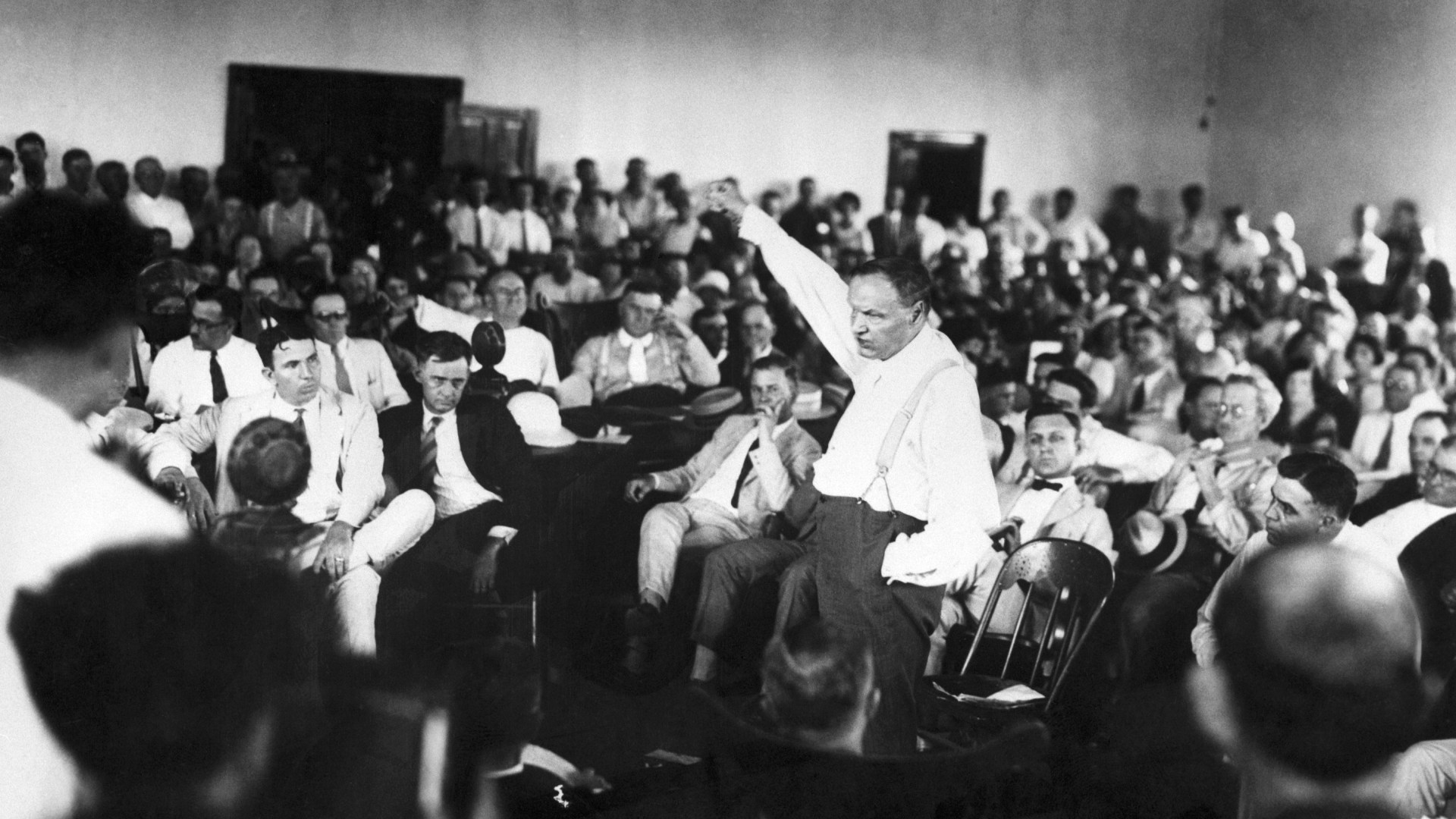
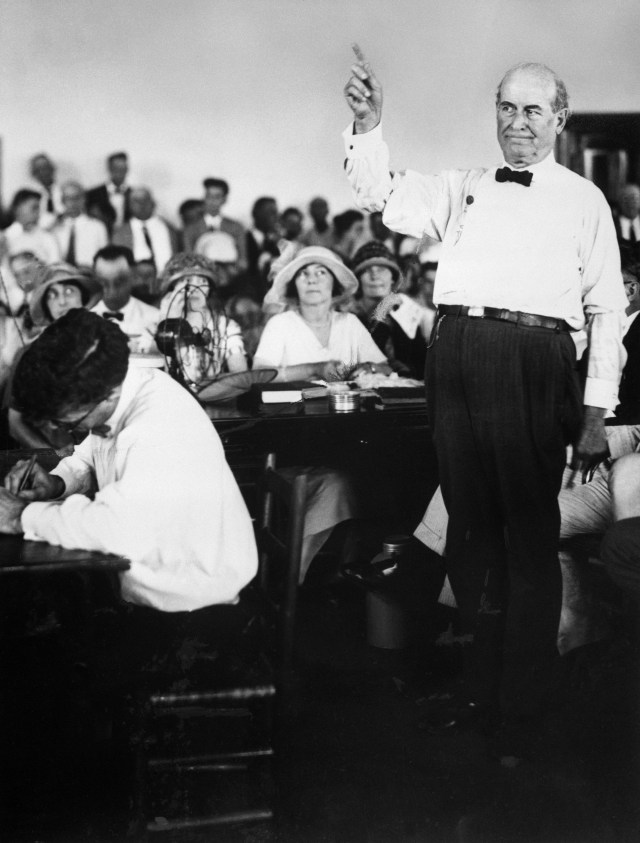
Clarence Darrow makes a speech at the Scopes Trial.

Clarence Darrow makes a speech at the Scopes Trial.

Getty

In the sweltering summer of 1925, crowds flocked to the small town of Dayton, Tennessee. Hundreds of journalists documented a weeklong courtroom melodrama. The trial centered on a high school teacher, John T. Scopes, who was charged with violating the Butler Act, a law passed earlier that year prohibiting public schools from teaching human evolution.

This year marks the centennial anniversary of the Scopes “Monkey” Trial, which was culturally significant in American history as it cemented the rift between modernists and fundamentalists in both church and society. Much like today, Christians back then were working through an identity crisis closely tied to political shifts and deep theological disagreements. 

In the years since the Scopes Trial, anti-evolutionism became tightly linked, or “bundled,” with orthodox Christianity in the American church. That is, until the evangelical movement began disentangling questions of science from the essential gospel truths to allow for more thoughtful and faithful engagement with both.

Although political verdicts on hot-button issues matter, the Scopes Trial reminds us that the way theological crises are handled can shape generations as much as their outcomes can. 

On the surface, the Scopes Trial was about human origins, evolution, and the Bible. Its mythic allure emerged from the dramatic public showdown between two titanic figures—William Jennings Bryan and Clarence Darrow.

Bryan, the star prosecutor, was a charismatic and eloquent politician. Thrice a presidential candidate, Bryan opposed human evolution and advocated for the Butler Act. Darrow, a famed defense attorney and militantly anti-Christian agnostic, teamed up with the nascent American Civil Liberties Union (ACLU) to defend Mr. Scopes. 

The Butler Act specifically prohibited “[teaching] any theory that denies the story of the Divine Creation of man as taught in the Bible, and to teach instead that man has descended from a lower order of animals.”

The ACLU’s initial strategy was to argue that Scopes was not violating the law because evolution was, in fact, compatible with Genesis—an interesting defense given Darrow’s intensely anti-Christian stance. The judge, however, dismissed this out of hand.

Bryan could also cross-examine the ACLU’s experts, all of whom were theological modernists who denied Jesus’ bodily resurrection—an opening Bryan would have seized to discredit them as unorthodox. So instead, the exasperated defense pivoted to ask for a swift guilty verdict that they could appeal. The trial seemed to be ending as quickly as it had started.

But on the last day of the trial, Darrow made a stunning move. He called Bryan himself to the stand as a witness. Prosecutors never testify at their own trials. Yet Bryan agreed.

The day was so hot that proceedings were moved to a stage outside the courtroom. To the cheers of a growing crowd, the two legal champions sparred in a debate that had little to do with Scopes himself. Darrow’s incisive inquiry was wide-ranging, including a memorable question about where Cain got his wife. He aimed to expose Bryan—and his fundamentalist literalism—as inconsistent, ignorant, and bigoted. Bryan, undeterred, seized the opportunity to proudly confess his belief in literalism and Christianity.

The crowds were captivated by the grandstanding, but the judge was not amused. Abruptly, he ended the trial with a guilty verdict. Bryan and Darrow continued their feud in print, but just a week later, Bryan died in his sleep, cementing the trial’s legendary legacy and significance.

To some, the Scopes Trial and Bryan’s untimely death seemed like the last gasp of religious fundamentalism. But to others, Bryan died a hero, defending true Christianity in an ever-evolving culture war, the shadow of which we live in today. 

Although the Scopes Trial was entertaining, the larger fundamentalist-modernist controversy was not a friendly debate. It began among Presbyterians and spread to nearly every American denomination, most of which eventually split as a result. It became part of a larger rift in society at the time—when, to echo Willa Cather, “the world broke in two in 1922 or thereabouts.”

The tensions, and even the cultural panic, that we see today between progressive and conservative Christians are much like the rancor that steadily developed between modernists and fundamentalist Christians beginning in the late 1800s.

As the modernist school of theology made its way from Europe to leading seminaries in the US at the time, the controversy first began playing out in academic journals, with back-and-forth exchanges between theologians like B. B. Warfield and Charles Augustus Briggs.

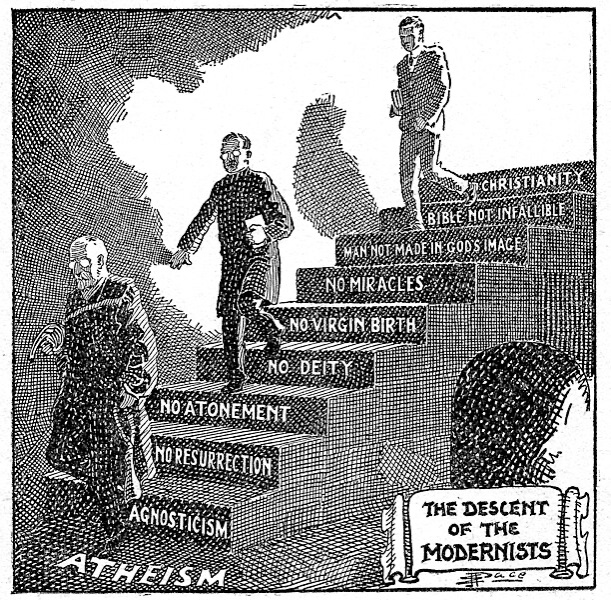
The modernists called themselves Christians, but they rejected the bodily resurrection of Jesus, the Virgin Birth, and all other miracles. They saw the Bible as authoritative but also riddled with errors. According to Briggs, Warfield’s notion of biblical inerrancy was “a ghost of modern evangelicalism to frighten children.” The Christian faith, in their view, needed to modernize and forsake these backward beliefs.

This debate soon spilled into church polity. In 1909, three seminarians sought ordination in the Presbyterian Church though they were unwilling to affirm the Virgin Birth. After intense debate, the three were eventually ordained, shocking many.

This controversy led to the formation of the fundamentalist movement, dedicated to preserving historical Christianity. Against the doctrinal drift of modernists, the group emphasized five “fundamentaldoctrines: (1) the inerrancy of Scripture, (2) the Virgin Birth, (3) the atonement for sin by the death of Jesus, (4) the bodily resurrection of Jesus, and (5) the historical reality of Jesus’ miracles.

At first, fundamentalism was not bound so tightly to the rejection of evolution. Biola University published about 90 essays from 1910 to 1915 known as The Fundamentals, which defined the movement’s identity. These essays were full of evangelical diversity. There were a few anti-evolution arguments, but many also expressed cautious openness to the theory, were the science to pan out.

But when Bryan came on the scene in the early 1920s, fresh from advocating for women’s suffrage and temperance, he entered the origins debate in full force. He became convinced that the pernicious idea of evolution was the root cause of the modernist slide away from historical Christian faith.

This makes sense, since in Bryan’s context, every Christian that affirmed human evolution at the time was a modernist who had departed substantially from many important doctrinal claims of historical Christianity. In many cases, modernists appealed to evolutionary science to justify the controversial theological positions they preferred, including a way to understand creation without the miracles they had eschewed.

Bryan had no theological objections, in principle, to an ancient earth or evolution among animals and plants. But human evolution was altogether different in his mind. The idea that humans shared ancestry with monkeys and apes was, according to his interpretation of Scripture, in direct conflict with Genesis.

In many ways, Bryan’s advocacy, so widely disseminated at the Scopes Trial, caused rejection of evolution to become bundled together with fundamentalism, much as evolution was bundled together with modernism. So in some sense, the bundling of anti-evolutionism with orthodox Christianity is almost a historical accident. If not for Bryan and the Scopes Trial, it might not have happened quite this way.

While Bryan did not realize it at the time, there are ways to affirm human evolution that align with orthodox theology. In fact, a growing number of evangelicals today have shown that evolution is entirely compatible with even a very literalistic reading of Genesis—including a historical Adam and Eve from whom we all descend, in a literal garden, created directly by God without parents of their own.

The Scopes Trial was a key battle in the historic war between fundamentalists and modernists—but its legacy offers us much to learn from a century later.

One lesson might be that we can often overreact to new ideas, particularly in times of great cultural change. In our response, we can bind reactionary politics and ideologies to our Christian practice. This path, it seems, is all the more likely in times when we are struggling to define our theological identity, as is certainly the case right now for evangelicals.

A similar pattern played out with social action and the gospel. As modernists abandoned belief in the resurrection of Jesus, they increasingly emphasized the importance of compassionate justice instead—embracing what became known as the “social” gospel. Fundamentalists rightly rejected this theological error. But they also overreacted, growing suspicious of the Christian duty to do good and seek justice in society.

It wasn’t until the rise of global evangelicalism in the 1960s and ’70s that Christians began unpacking some of the bundles created by the modernist-fundamentalist divide. Leaders like John Stott, Billy Graham, Carl Henry, and Francis Schaeffer emphasized the gospel of Jesus dying and rising for our sins, but they also reclaimed a strong emphasis on social action as a necessary outworking of the gospel.

Another lesson is that political and legal victories can be pyrrhic and even disastrous in the long run. In Tennessee, Bryan and the anti-evolutionists won politically. They passed the Butler Act. They won the Scopes Trial in Dayton. They celebrated their champion too; Bryan died a hero.

But the fallout from these proceedings were far worse than they anticipated. For many important onlookers, like renowned journalist H. L. Mencken, Darrow had entirely exposed Bryan—and his fundamentalism—as backwards, ignorant, and bigoted. This image stuck and became entrenched for decades.

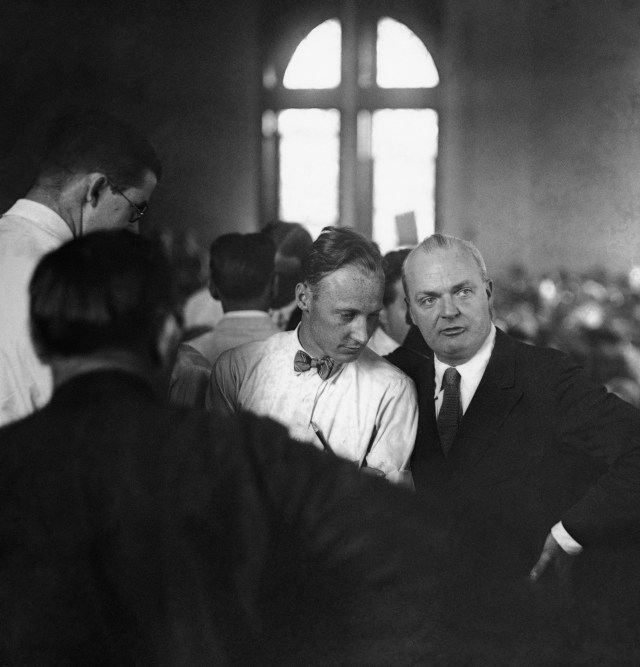
John Scopes, left, sits with Dudley Field Malone listening to the jury’s verdict.Getty
John Scopes, left, sits with Dudley Field Malone listening to the jury’s verdict.
William Jennings Bryan makes his first speech during the Scopes trial.Getty
William Jennings Bryan makes his first speech during the Scopes trial.

The Scopes victory, moreover, did nothing to prevent modernists from taking over most denominations and seminaries in the country. Even Princeton Theological Seminary, where Warfield and others had argued effectively against modernism, became solidly modernist by the 1930s.

Theologians who aligned with orthodox, historical Christianity either retreated or were expelled from most institutions. And as they withdrew, they formed their own publishing houses, universities, and seminaries.

The fundamentalists eventually became so sequestered from broader society that many thought they had died off. This isolation only further cemented the prevailing narrative of Darrow’s portrayal of Bryan and fundamentalism—especially as the story of Scopes was told and retold through popular movies and plays like Inherit the Wind.

On paper, the Scopes Trial was a victory for Bible-believing Christians. But it also marked the beginning of Christian cultural isolationism—which eventually cost us our voice of influence in contributing to moral and ethical discourse in the public square.

Decades later, evangelicalism encouraged Christians to emerge from the shadows, offering them a better way to engage with secular society. As Stott wrote then, “A Christian mind should respond to contemporary culture neither with a blanket rejection nor with an equally indiscriminate acquiescence, but with discernment.”

In some ways, the spirit of the modernist-fundamentalist debate is still with us today. It is present, for instance, in the political tensions between believers on issues like critical race theory; diversity, equity, and inclusion; sexuality and gender; abortion; and immigration.

And while some Christians are celebrating various legal and political wins for biblical principles in the public square, these victories may be costing us our compelling witness and the chance for lasting cultural change.

American society is oriented toward public advocacy. Yet the political and court systems are rarely, if ever, the best way to think through nuanced realities and complicated concepts. Political and legal activism may be important at times, but we need other ways to understand and work through our differences as citizens—and especially as Christians.

“The Descent of the Modernists,” by E. J. Pace, published alongside William Jennings Bryan’s Questions in Dispute series in The Sunday School Times (1924).WikiMedia Commons
“The Descent of the Modernists,” by E. J. Pace, published alongside William Jennings Bryan’s Questions in Dispute series in The Sunday School Times (1924).

The roots of our divides are often fundamentally theological, and our disagreements matter—we need to work through them in light of Scripture. But good thinking takes time. Moving too quickly can ossify reactionary errors, with real consequences that ripple for generations. For this reason, how we respond to the current cultural moment matters. Our actions today will shape the sort of church we leave behind for our children.

Perhaps the final lesson of Scopes is more hopeful: Just as bad “bundles” can be wrapped together in times of turmoil, they can also be disentangled.

We are in a time of great societal change, as many old coalitions and approaches are being dissembled and reconstituted in surprising ways. Both in the US and globally, it is not clear what the future holds for Christian faith and practice. And although we see some indications, we do not yet know what the new ideological bundles will be.

This provides the church with the unique opportunity to witness to the gospel apart from political outcomes. Right now, our values and identity are being reexamined and renegotiated, causing real anxiety and discomfort. But instead of overreacting and making new mistakes to correct old ones, we can resist the drumbeat of outrage and panic and steady the pendulum swing.

Once upon a time, the evangelical movement charted a path for the church to wisely navigate the divides of its day. Can we do the same?

S. Joshua Swamidass is a physician-scientist, associate professor of laboratory and genomic medicine at Washington University in St. Louis, founder of Peaceful Science, and author of The Genealogical Adam and Eve.

Culture

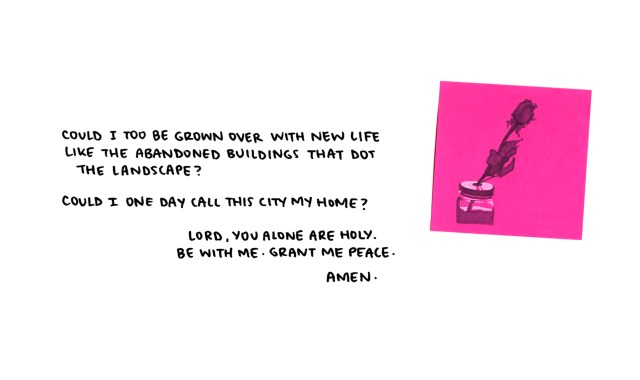
Plein Air Prayer

An artist wrestles with anxieties and faith in young adulthood.

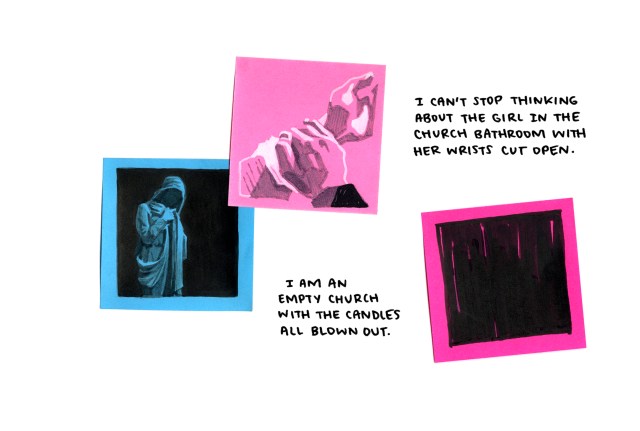
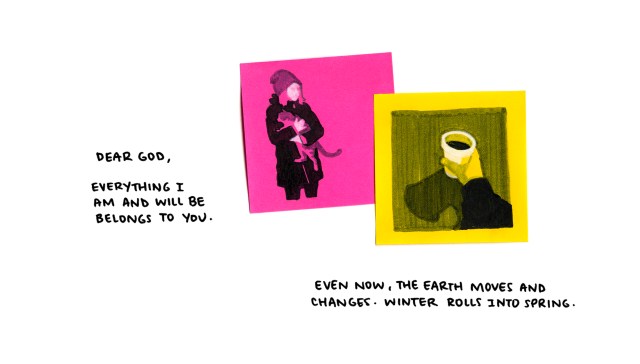
Three post-it notes with illustrations on them
Art by Jocelyn O'Leary
Post-it note with a shadowy figure on itArt by Jocelyn O’Leary
Post-it notes of a car and pill bottleArt by Jocelyn O’Leary
Post-it note artArt by Jocelyn O’Leary

Jocelyn O’Leary is a writer and artist working in Michigan.

Ideas

The Christian Schools That Cried Wolf

Critics of religious academies compare modern parental concerns over sexual ethics to mid-century racism. But the echo they hear is not about education.

Children playing at recess

Illustration by Owen Gent

As our twin boys played with their little sister across the classroom, they did not know what we knew: that this admissions interview could help set the course not only for their formative years but for life. Their future first-grade teacher asked why we wanted to enroll our children at her school.

Well, we said, so many reasons. Some are prosaic: The campus is one walkable mile from our house, and the schedule is convenient. Others are about pedagogy: Younger grades get up to four recesses a day, and there is no homework until middle school. Then there’s the classical education they’ll receive: Our children will study Latin and Greek. They’ll read the great works of literature I self-assigned in high school and college in a belated scramble to learn the cultural canon all my favorite writers seemed to know.

We didn’t bother to mention that we are interested because it is a Christian school. We didn’t bother because of course that’s part of it. We knew it; the teacher knew it; our boys knew it. Mentioning it would’ve felt like telling a real estate agent, “We’re interested in this property because the house has walls.” We want our children to have a deliberately Christian education because in school they will learn more than math and reading. They will learn about who they are and what God expects of them.

 It’s not of course for everyone, I realize, including many faithful Christian families who choose public school or homeschooling out of a sense of calling or simply because there’s no other good option. For us, though, this choice is in some ways very simple. Of course we’re enrolling because it’s a Christian school. 

But the project of Christian education in America is not as simple as that. It’s a project that, in much of the country in the fairly recent past, was wrapped up in rank and shameless racism defended by my fellow white evangelicals on biblical grounds. 

As journalist Paul F. Parsons wrote in a CT cover story in 1987, there was “a widespread perception that [evangelical] Christian schools are racist. After all, what once was a Southern phenomenon of the 1960s—segregationist academies quickly formed in the name of God—has spread nationwide. To some, ‘white-flight schools’ and ‘Christian schools’ are synonyms.”

That history echoes in our schooling debates. It pops up in conversations about today’s Christian—and especially white evangelical—parents’ attraction to private education because of ethical and theological concerns that the Trump administration’s robust executive orders on sex and gender may only temporarily allay. Our leaving public schools over curricula and policy on LGBTQ issues is reliably compared to Christians leaving public schools 60 years ago over race.

In a 2021 New York Times story, for example, religion reporter Ruth Graham made the connection explicit. The current moment is “the second Great Awakening in Christian education in the United States since the 1960s and ’70s,” a source told her. Given the specified timeline, Graham noted that the “previous ‘Great Awakening’ was spurred by a number of factors, starting when white Southern parents founded ‘segregation academies’ as a backlash to racial integration created by the Supreme Court’s 1954 ruling in Brown v. Board of Education.”

Interrogating this comparison—this historical echo—is my chief interest here. It’s partly an intellectual interest. I think there’s a theological difference between these two waves of evangelical attraction to private schools.

I don’t have space to do all the theology here, but say for the sake of argument that contemporary evangelicals are right to believe that racism is an indefensible evil and the traditional Christian sexual ethic is correct. Assume with me that the former runs violently afoul of the God who is revealed in Christ and speaks in Scripture while the latter comports with God’s good will for human righteousness and flourishing.

In an important sense, for Christians, this distinction—that holding fast on sexual ethics is very different from embracing racism—answers the school choice comparison. For many, it may be enough to quiet the echo.

But I have to confess I’m not quite content to leave it there, because I can hear that echo too. I don’t make that comparison, but I understand why others do. Too many Christian parents cried wolf about the supposed dangers of integrated schooling. The cries were loud and long and sinful. Thus the rest of the village, rightly disgusted, is hesitant to listen this time around.


I have to confess too that I have a second reason for my interest. My kids were accepted to that Christian school for first grade this fall. They will receive a private, faith-based education, as I largely did. And my first school, the one that taught me to do sums and write cursive and devour chapter books, began as a segregation academy. Is there an echo not only in evangelical culture but in my own life?

I haven’t been able to dig up my yearbooks from that school, and its board declined to participate in this story. But from fuzzy childhood memories, I’m fairly certain the place had desegregated by the time I attended in the early 1990s.

My mom told me she wasn’t aware of the school’s history when she enrolled me; however, not being from the South, perhaps she simply didn’t recognize the clues.

Many Christian schools south of the Mason-Dixon Line began as my school did. Once integration became “inevitable, white segregationists throughout the South began to focus their energies on the establishment of separate schools,” explains historian Ansley L. Quiros in God with Us, a theological history of the civil rights struggle in a small Georgia town.

These segregation academies “would resist integration rulings and promote a particular theological vision for education.”

Often, the racism was overt. An enrollment application from Mississippi for the 1975–76 school year, for example, dispensed with all subtlety:

It is the belief of the Board of Directors of Council School Foundation that forced congregation of persons in social situations solely because they are of different races is a moral wrong. . . . Council School Foundation was founded upon and is operated in accordance with this fundamental ethical and educational concept. . . . The curriculum of Council School Foundation is designed solely for the educational responses of white children.

Others affected innocence. “We have had some blacks apply from the area,” a Christian school headmaster said in an Associated Press report in 1972, “but the pathetic situation is that they cannot make the preliminary testing.”

It may be tempting to brush this history away, to say, “Oh, but they weren’t really Christians.” Alas, they often were. As God with Us documents, they believed they were defending orthodoxy and Scripture itself against real threats to the faith.

“Christian theology contributed both to the moral power of the civil rights movement and to the staunch opposition it encountered,” Quiros wrote. Segregationists “felt they were acting out of the same impulses that motivated them to sing hymns, entreat the Almighty, and worship. They were upholding the sanctity of the Bible and the fundamentals of Christianity against Northern liberals.”

They were Christians, and they were wrong, and they left a stain on Christian education in America that has only partly faded.

Though there are many thoroughly integrated and even predominantly Black Christian schools in our country today—schools like the online Living Water School, Chicago’s Field School, or Imago Dei Neighborhood School in Richmond, Virginia—Christian schools’ student bodies, on average, remain whiter than the school-age population as a whole. 

An ongoing reporting series on education and segregation by ProPublica has documented that it is not unheard of (particularly in the South’s Black Belt) for private schools to be more than 75 percentage points whiter than their communities. Numbers like that don’t happen by chance. 

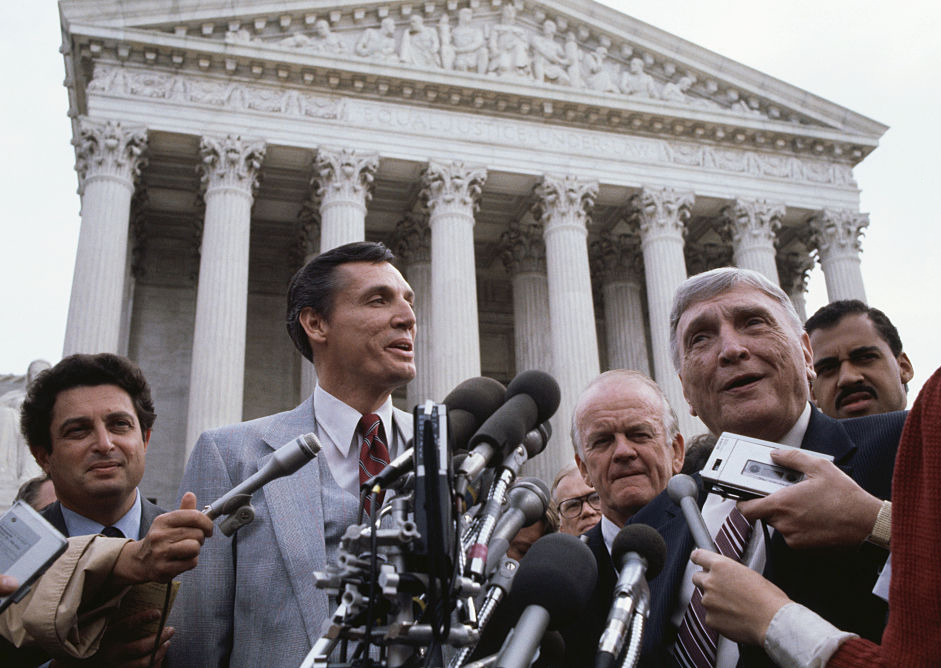
And while many Christian schools now publish racial nondiscrimination statements, it can be difficult to untangle the history and intent behind those pronouncements. Some were first issued defensively after the infamous Bob Jones University case of 1983, in which the Supreme Court held that the “government has a fundamental overriding interest in eradicating racial discrimination in education.”

Today, 47 percent of schoolchildren in America are white, and public schools nearly mirror the general public. Private schools are whiter (65%), and those the National Center for Education Statistics (NCES) labels “Conservative Christian” are slightly whiter still (68% as of 2021). Christian schools seeking to diversify their student bodies often find that task easier said than done, though that’s not to suggest nothing has changed over the years. NCES data shows private schools are slowly but meaningfully diversifying, and conservative Christian schools don’t lag behind their secular and Catholic peers.

That’s true of my first school. In fact, that school has gone above and beyond the standard procedure of posting an affirmation of racial equality. Its statement is also confession, a frank recognition and repudiation of the circumstances surrounding the institution’s founding.

The websites I’ve browsed of other former segregation academies tend to paper over past sins with pictures of smiling Black students in monogrammed polos. To my school’s credit, it laments and repents.

My former school has a second statement on its website, bringing me back to the inevitable comparison. This statement is about sexuality and gender. It avows long-standing Christian understandings of marriage and biological sex in language buttressed by biblical references. 

For many parents exploring private education, theology is one factor in a complex and often fraught decision-making process. Over the past half decade, pandemic policies and their aftershocks, reading instruction methods, and curricula on race and US history have all come to the fore alongside LGBTQ issues as widespread parental worries.

So why the particular attention to matters of sex and gender in the national conversation? Why is that the frequent comparison with the segregation era?

From the perspective of secular critics, I think it’s because, unlike other school-choice criteria, these two issues are understood as matters of unalterable identity. But on the evangelical side of the equation, I’ve come to think that the echo detectable here is not about repeated theological or political error. It’s not even about private education per se. 

It’s about fear.


A characteristic expression of the anxiety in question comes from Secretary of Defense Pete Hegseth, who in 2022 coauthored Battle for the American Mind. It makes a candidly fearful case for Christian education. 

“For many years, my fear was higher education,” Hegseth wrote, but he came to believe that “the real problem is high school, middle school, and now elementary school. The battlefield for the hearts and minds of our kids is the 16,000 hours they spend inside American classrooms from kindergarten to twelfth grade . . . it’s the 16,000-hour war.” And don’t think church is sufficient defense, Hegseth cautioned: “One hour on Sunday morning and one hour on Wednesday night at church is not enough.”

That last line made me chuckle, for I’ve approvingly quoted pastors making the exact same point. I wouldn’t argue for Christian schools with Hegseth’s Fox News–style bombast, but his desire for more intensive discipleship for his children is familiar.

It’s familiar to Christian educators too. University of Virginia sociologist Angel Adams Parham wrote at Comment in 2024,

As I have visited classical schools across the country, I have heard from heads of school who express concern that growing numbers of parents are coming to them not so much because they crave the pursuit of truth, goodness, and beauty that lies at the core of classical education at its best, but because they are beleaguered outcasts seeking shelter for themselves and their children from the ravages of critical race theory, “wokeism,” DEI [diversity, equality, and inclusion] initiatives, and more.

Fears of all kinds and levels of veracity get bundled together. And as Quiros observed in an interview with me, reinforcing all of them is the predilection to panic that defines much of America’s secular parenting culture today.

We live in enviable safety and prosperity, but we’re too scared to let nine-year-olds play in their own front yards. In that context, when the decision concerns things as important as education and sexual ethics, is it any wonder parents freak?


For the average Christian parent considering Christian education, then, I don’t think honing slam-dunk arguments about the sex-and-segregation comparison is the task at hand. Rather, it’s checking our motives for the distinction Parham drew: Do we want to enroll our kids in a Christian school for the good it offers? Or are we doing it because we’re scared?

The trick is being able to accurately parse the inclinations of our hearts. One useful indicator is how we think about insularity, which was brought to my attention by Tia Gaines, executive director of UnifiEd, a nonprofit supporting Christian schools. She also sits on the board of the Association of Christian Schools International (ACSI), a primary accreditor of US evangelical schools.

In one report from ACSI, Gaines told me, more than 400 Christian schools were assessed for 35 community characteristics. One of these “that had the biggest need for improvement was insularity,” Gaines said, which was defined as protecting students from the world’s brokenness, remaining aloof from the broader community, and/or lacking diversity in the student body.

“It was really interesting to see how Christian schools responded to that feedback,” Gaines said. “Some of them were surprised, and some were eager to address it. But some were like, ‘Well, yes, of course we have an insular culture. That’s the point. We want to shield our students and create a safe space for them, and that’s what our parents want.’ ” 

That’s fear. But fearful pursuit of insularity doesn’t foster spiritual and intellectual maturity. It doesn’t leave room for iron to sharpen iron. It won’t teach our children, as the apostle Paul knew, that “neither death nor life, neither angels nor demons, neither the present nor the future, nor any powers, neither height nor depth, nor anything else in all creation, will be able to separate us from the love of God that is in Christ Jesus our Lord” (Rom. 8:38–39). It won’t prepare them to be “as shrewd as snakes and as innocent as doves” (Matt. 10:16) in a world both wicked and wonderful.


Bob Jones University Supreme Court case in 1983.Getty
Bob Jones University Supreme Court case in 1983.

Christian schools do not have to be insular to be orthodox. Christian education does not have to be undergirded by fear or stuck on the sins of our fathers (Ezek. 18:20). We can follow the peculiar ethic of Jesus without withdrawing from the world. We can cry not “wolf” but “welcome.”

In the classroom, eschewing fearful insularity will mean examining what we teach and to whom we teach it. For classical schools, it will mean broadening the classics, as Parham argued in The Wall Street Journal, to include a wider array of time-tested ideas and voices, ancient and American alike. For all Christian schools, it will mean taking more seriously our own claims about loving the truth and learning to share it with the courage and cleverness of Paul on Mars Hill (Acts 17).

It will mean cultivating critical thinking alongside sound doctrine, and it’ll mean checking textbooks. This parental responsibility will look different than it would at a public school, but scrutiny is necessary still. Even Christian schools are run by sinners prone to wander from the truth.

For older students, Christian education shouldn’t play it safe. It should require encounters with hard history and perspectives from outside our cultures and the church itself, all under the guidance of faithful teachers. 

“The truth sets us free,” said Anika Prather, the founder and administrator of a classical Christian school and the coauthor, with Parham, of The Black Intellectual Tradition. When Christ returns, she warned, “he’s not going to ask how many woke people you canceled. When we stand before the Lord, he’s going to say, ‘How many people did you reach for my gospel? And did you meet people where they were, or did you dehumanize them and not let them tell their story as a way of finding redemption and reconciliation?’

Prather doesn’t shelter her students from secular thinkers or troubling history, she said. “I’m teaching my students, ‘Let’s bring this truth back to the Lord and figure out, “Lord, with this knowledge, how would you have me as a Christian navigate the world?” ’ This is what we teach our students,” she told me, “how we reach the next generation.”

And we should be aiming for everyone. “From Genesis to Revelation,” Prather said, God “has called the church to be a welcoming place for all ethnic backgrounds.” This call equally applies to schools that claim the name of Christ.

So where do these schools find their students? If they’re recruiting in local churches, which congregations make the cut? Black church traditions in America tend to be closely aligned with white evangelicals on core theology. If they’re not sending students to Christian schools, we should ask why. If the answer is tuition—for race and income are still correlated in this country—we should work to remove that barrier (Matt. 6:19–21). While many Black families remain skeptical of private schools, some would seize the opportunity for their children to have the good of Christian education.


“The manner in which most of us became Christian,” wrote theologians Stanley Hauerwas and William H. Willimon in their classic book Resident Aliens, “was by looking over someone else’s shoulder, emulating some admired older Christian, saying yes to and taking up a way of life that was made real and accessible through the witness of someone else.” We need those examples because the church and its ethics are indeed alien in a fallen world and because ethics, like language, are picked up through community immersion.

I moved around a lot as a child and consequently went through four Christian schools, one public school in America and one in China, and two years of homeschooling. Looking back, there’s much I could say in critique of my Christian schools. But I also recognize their many goods, not least their extension of the faithful examples in my home and church life.

As I make education decisions for my children, I want that faithful, communal immersion for them. Not because I’m afraid but because, for all its complications and all the work yet to be done, Christian schooling is a real good—a good I want for my kids and for my neighbors’ kids too. Of course we’re enrolling because it’s a Christian school.

Bonnie Kristian is the editorial director of ideas and books at Christianity Today.

Culture

Former VP Mike Pence’s Conversation with Russell Moore

They discussed global tensions, prayer for those in authority, and Mrs. Pence’s frosty reception of President Trump.

Mike Pence walking up the stairs that look like an American flag
Illustration by Ronan Lynam

Former vice president Mike Pence appeared on The Russell Moore Show four years after the January 6, 2021, US Capitol rioters threatened not only his life but also the lives of his wife and daughter. He discussed former second lady Karen Pence’s frosty reception of President Donald Trump, the importance of praying for government leaders, and the potential for a third world war.

Mike Pence and Russell Moore portraitsIllustration by Ronan Lynam
Mike Pence and Russell Moore

Russell Moore: We’re four years out from January 6, on which you and your family were in great jeopardy because the president at the time called a mob to the Capitol and didn’t call it off. Was it painful to see President Trump again [at former president Jimmy Carter’s funeral]?

Mike Pence: It was the first time we had been in the same place since we left the White House four years ago. We pray for the president often, as believers are admonished to do for all those in positions of authority.

January 6 was a tragic day. I’ll always believe that I did my duty and kept my oath to support and defend the Constitution of the United States and ceded the peaceful transfer of power that day. The next morning, before President Trump would denounce the rioters and say they would pay, he committed to a peaceful transfer.

About a week later, he asked for a meeting, and I readily accepted. We sat down after those tumultuous events, and we talked all the way through it. I sensed the president was genuinely saddened about what had happened that day.

The first thing he asked was about Karen and my daughter. He said, “Are they okay?” And I said, “They’re fine.” And he said, “I just found out they were with you the whole time.” And I said, “They wouldn’t leave, Mr. President.”

On January 6, I was determined to stay at my post and finish my work. But what a lot of people don’t know is that my wife and daughter had come to observe the proceedings for a short period of time. When we told them that their motorcade could take them back to the vice president’s residence, my wife refused. They were both there till four in the morning, until the gavel fell [to confirm the electoral votes]. 

I was with the president in the waning weeks of our administration. I looked at him as we were wrapping up a conversation about official duties and said, “I just want you to know I’m praying for you.” His shoulders sank, and he said, “Don’t bother.”

When we wrapped up the meeting, I walked out and stopped in the doorway. I said, “There’s probably two things that we’re never going to agree on. We’re probably never going to agree on what my duty was under the Constitution on January 6. And I’m never going to stop praying for you.”

He looked up at me and said, “That’s right, Mike. Don’t ever change.” We have prayed for him often in the months and years that have followed.

RM: There’s an internet meme going around of Mrs. Pence at Carter’s funeral. She did not seem very enthusiastic to see President Trump. Many of us can relate to having a spouse who feels things very deeply for the person they love.

MP: You’ll have to ask my wife about her posture, but we’ve been married 44 years… She loves her husband, and her husband respects her deeply.

RM: On January 6, did you ever consider saying, “There are some questions about these votes. I’m just going to turn them back to the states.” Did you ever consider not going in that day and leaving the certification of the vote to the president pro tempore in the Senate?

If you had, you might still be vice president or maybe even president right now. Was that a temptation that you had to fight?

MP: When I put my left hand on Ronald Reagan’s Bible in January 2017 and raised my right hand, I took an oath to support and defend the Constitution of the United States.

It ends with a prayer: “So help me God.” That means it’s not only a promise that I made to you and to the American people, but it was a promise I made to Almighty God. As a student of American history, there is perhaps no idea more un-American than the notion that any one person could choose which Electoral College votes to count. No vice president in American history has ever asserted that authority, nor should they.

The presidency belongs to the American people, and where disputes arise, they are to be resolved by the elected representatives of the American people. My duty that day was very clear to me, but it didn’t make it any less painful. President Trump was not only my president; he was my friend. He had been persuaded by some outside voices that I had authority that no vice president in history had ever asserted. Some vice presidents in the past recused themselves from those proceedings. Hubert Humphrey in 1969 did not preside over the count. He had just lost the election in 1968. 

But as the father of a United States Marine and the father-in-law of a Navy lieutenant, one of the things I reflected on during the weeks leading up to January 6, 2021, was that my son and my son-in-law—and every member of the armed services and every law enforcement officer in the country—take the same oath. And when our boys get an assignment, they don’t get to say, “That doesn’t really work for me.”

RM: You have a son who’s a Marine. I have a son who’s an Airman. There are a lot of people who are worried right now when they look at Ukraine, Gaza, Israel, Hamas, Iran, Taiwan, China. Are we headed into World War III? 

MP: Peace comes through strength. When I was running for president, some people said my support for Ukraine was going to lead us to World War III. I think a more careful study of the 20th century would prove the opposite is true. Weakness arouses evil. Because the West and the United States largely ignored the aggression of the authoritarian regime in Germany, we ultimately had to send American troops to fight and to win back a free Europe and to fight back in the Pacific during World War II.

One of the hopeful things about President Trump’s return to the White House and Republican majorities in the House and the Senate is that we’re going to make an increased investment in our national defense. We’re at about 3 percent of gross domestic product today. I strongly support moving us to 5 percent in a fairly short period of time. We can send no better message to our adversaries and those who could become our adversaries than by redoubling our commitment to be the arsenal of democracy.

I think President Trump understands and believes in peace through strength. The only asterisk to that is that some of the voices around him are advocating for a new American isolationism. They’re saying we should cut off all funding to Ukraine as they fight for their survival against an unprovoked Russian invasion. There are even voices that call for cutting off all aid to Israel.

I’m hopeful that my old running mate will return to that “peace through strength” strategy that resulted in four years where Russia never crossed a border, where we were able to unleash our military to take down the ISIS caliphate. We used force against Syria twice. And in a very real sense, we made it clear to our allies in the Asia-Pacific that we were with them and we’d stay with them as China’s provocations continued there.

RM: You’re not concerned about the belligerent rhetoric toward Canada, Denmark, Greenland, and the Panama Canal zone?

MP: I do think Jimmy Carter was wrong to turn over the Panama Canal. I think the fact that Chinese companies are operating multiple locks in the Panama Canal is antithetical to America’s interests. China is not our enemy today. We hope for better in the future. But if they ever become an adversary, it’ll be important for us to have a clear understanding with our allies in Panama about the vital importance of that waterway to our national security.

Mike Pence served as vice president of the United States from 2017 to 2021.

Russell Moore is Christianity Today’s editor in chief and the director of the Public Theology Project.

Stories from the ‘Sandwich Generation’

Readers relate to Jen Wilkin’s article from January/February about the seasons of life.

Mockup of CT's January February issue lying face down with the front and back cover visible. Sunlight and shadow from a window streams in on a cream background.
Edits by Christianity Today.

About a quarter of US adults are part of the “sandwich generation,” according to Pew Research data, defined as those who “have a parent age 65 or older and are either raising at least one child younger than 18 or providing financial support to an adult child.” On a daily basis, many of these adults confront the vulnerabilities of the beginning and end of life alike, feeding and bathing and soothing both the young and the old.

Perhaps it’s no wonder, then, that many readers appreciated Jen Wilkin’s essay “At My Mother’s Deathbed, I Discovered the Symmetry of a Long Life,” calling it “thoughtful” and “beautifully expressed.” The Bible scholar reflected on accompanying her mother through her final days and the symmetry of a human life, from dependence to caregiving and back again.

Claire Jerry in Washington, DC, wrote in response, “I was privileged to be with my mother, mother-in-law, and father-in-law in their final days. As I try to discern my purpose in what are surely the last years of my own life, I cherish a verse that echoed through this article: ‘like a tree … that bringeth forth its fruit in its season’ (Ps. 1:3, ASV). It comforts and challenges me to realize there is still fruit to be borne, even in this season.” Another reader, Angela Langer-Heltzel of Joplin, Missouri, read the essay after her mother’s passing. “Being in the same stage of life” as Wilkin, she said, “I found comfort in her words and even more comfort in the Lord’s design.”

Kate Lucky, senior editor, engagement and culture

The False Gospel of Our Inner Critic

This Enneagram One is listening … definitely understand “the inner critic.”

@simplykristylynn (Instagram)

The Bestseller that Made Church Cool—and Optional

I was one of those intrigued by the edginess and grittiness of Donald Miller’s book. But as Ashley Hales rightly points out, the alternative offered was really no alternative at all. It’s also important to note that the emergent church movement never really went away. It just morphed into today’s progressive Christianity led by such figures as Peter Enns, Richard Rohr, and Brad Jersak.

John Appleton, West Chicago, IL

I have seen the corruption of believers who turned away from everything that was church to a Christless spirituality. I reject mysticism; I recognize the gospel is a mystery, not receivable by the natural mind. We rely on the Spirit of revelation to reveal Christ in and through us. So while I have learned not to condemn, Miller’s encouragement of his contemporaries does not bode well.

Mark Sankey, Frederick, MD

This is a good article, very much on target. I’m really surprised, though, that the author said that as early as 2003, “Gone were the lights, smoke machines, and conservative politics of megachurch practice”—because those things are still very prominent in the world I inhabit today in 2025. Most churches where I live are either dying traditional churches (with hymns and organs) or growing contemporary churches that are megachurches or want to be, and they still use lights, contemporary music, and sometimes even smoke machines. And they are conservative. Blue Like Jazz introduced emergent Christianity to a wide audience. It’s like that movement was trying to make irreverence cool among bored or disaffected evangelicals. A lot of emergent Christianity has left evangelicalism altogether to become today’s progressive Christianity.

Morgan Trotter (Facebook)

I think those who continue to absolve themselves of the church are more a sign of something happening than a symptom of reading the book. I was very frustrated with Miller for the way he later denied the church, but I am still grateful for the book and think he deserves more credit for encouraging lifelong believers than the article revealed. I don’t agree with your conclusion. I 100 percent get why you landed there, though. In the end, Blue Like Jazz helped many of us to separate unhealthy church habits from the church.

Dale Huntington, San Diego, CA

You have to keep in mind that Blue Like Jazz was a memoir. [Miller] wasn’t intentionally trying to offer a solution, but his state of mind and experiences resonated with many. It changed my outlook, which I’ve applied to what I focus on (authenticity, real acts of service, etc.) while still traditionally filling a pew each Sunday.

Jared Throneberry (Facebook)

Living Like a Monk in the Age of Fast Living

Amen to Evan B. Howard’s article on monasticism. Fundamentalism assumes that the most important judgments in life are between good and evil. Monasticism reveals that the most important decisions are between attention and distraction. Paul said he could eat meat offered to idols and it wouldn’t be sin; but if eating meat pulled his brother back into ancestral idolatry, he wouldn’t eat meat (1 Cor. 8). When Christians shape their response to modernity and technology in such a way that the weak brother won’t be pulled back into pornography, we’ll know we have matured from and not just reacted to fundamentalism.

Anthony Hess, Wilder, ID

How NYC Churches Guard Endangered Languages

I have a friend who is from southern Mexico and speaks a pre-Hispanic language called Chinantec. She told me that her tiny church in her village back home was started by American missionaries who translated the entire Bible into their native language, thus preserving the language in writing. I am proud to have such a heritage as a Christian!

@emma.jane.craig (Instagram)

Something Holy Shines

Poetry is one of the primary theological disciplines in Ethiopia, and fresh poetry is often featured in their liturgy.

Hayden Joseph Noble (Facebook)

Corresponding Issue

Christianity Today

May/June 2025

Ideas

When a Revolution Is Revolting

Editor in Chief

Responsible, achievable, biblically inspired policy is not just morally better than extremist political tactics. It’s also a strategic advantage.

Trump with his fist raised
Christianity Today May 7, 2025
Spencer Platt / Getty

The advantage of being both a historian and an old guy is that I’ve studied many violent revolutions and experienced a political one up close, the “Republican revolution” of 1994. Both kinds are relevant to the current immigration debate and the choice before MAGA Christians now.

Many revolutions become so vicious that the old regimes—or at least the old abuses—make a comeback. The idealism of French revolutionaries turned, just a few years later, into murder by guillotine in Paris and mass murder in the area southwest of it known as the Vendée. Five years after that, Napoleon engineered a coup and became dictator.

The experience was similar, with varying timetables, in Russia, China, and dozens of other postrevolutionary countries: from czar to Stalin to Putin, from emperor to Mao to Xi, from rages to revolution to rags. 

The exception has been the United States, where revolution was very deliberately followed by moderation. The rule of law led to incremental rather than catastrophic change. Maybe extremism in the defense of liberty, to use former presidential candidate Barry Goldwater’s phrase, is no vice in principle, but it’s certainly bad in practice. Moderation, less thrilling, tends to be sustainable.

One indication of such sustainability in recent American history is the dog that is not barking: welfare reform. In the 1980s, rhetoric about “welfare queens” was rampant, and by the 1990s, welfare was an issue as massive as immigration is now. Bill Clinton in 1992 ran as the person who would change “welfare as we know it.” Many Americans knew that billions of dollars in federal spending helped some but did not give others what they most needed: personal help, spiritual challenge, and the incentive to work.

In the 1994 midterm elections, after the social services bureaucracy weighed in and Clinton backed off from his welfare reform pledge, the GOP won a smashing success, taking control of the House of Representatives for the first time in 40 years in what was called the Republican revolution. Some fire-breathers exulted: This is the moment to annihilate welfare.

Happily, evangelicals took the lead in a congressional education project. Part of the moderation of 1995 and 1996 emerged from political reality: The US still had a Democratic president, so Republican aspirations had to be tempered by what he would sign. But part was also biblical teaching. Jesus in chapter 5 of John’s gospel neither turned his back on an invalid nor helped him to get quickly into the pool of water thought to provide a miracle cure. Instead, Jesus said, “Take up your bed and walk” (ESV, v. 5). 

I saw firsthand the effect of biblical teaching, combined with political calculation, three decades ago. Newt Gingrich, in January 1995 the new speaker of the House, loved a book I had written, The Tragedy of American Compassion, and made it mandated reading for the new GOP members of Congress. (Many foisted it on their abused staff members). I met with many of them, some one-on-one, and had my most fulfilling tutelage ever. 

My message with Republican pols was this: Moderation. Work incentives. Time limits. Allow for exceptions. Look at individuals, not masses. Don’t make the work of Democratic opponents easy by creating poster children. I talked back to Newt at times, but he was reasonable, usually unconsumed by irrational exuberance, and always aware that Bill Clinton was not someone he could push around.

I’ll break one of my rules and quote a little from my own book, because Republicans quoted me on how previous generations “refused to settle for the feed-and-forget principle or its equally depersonalizing but harsher opposite, the forget-and-don’t-feed standard.” The emphasis was on treating all among the poor as human beings rather than “zoo animals at feeding time—some as carnivores who need cuts of meat thrown into their cages, and some as cute-looking pandas who feed on bamboo shoots.”

It sounds obvious, but it often wasn’t before 1984: Republicans largely orated about wasted money. The problem, though, was that welfare programs needed to be changed “not because they are too expensive … but because they are inevitably stingy in what is really important, treating people as persons and not animals.” As CPR can revive an otherwise-dying person, so CPS—challenging, personal, and spiritual help—makes a difference among the poor.

Sometimes informed by the Bible and often recognizing political reality, congressional welfare reformers in 1996 did not slash and burn but instead instituted work requirements—“Take up your bed and walk”—with exceptions for moms with young children. They set up time limits for receiving benefits. They increased the Earned Income Tax Credit, which had been around in stingier form since 1975, and made it a powerful incentive.

The political result is that welfare has been off the table for almost 30 years. Does it work well? No. Does it work better? Yes, and one indication is that the agitation of the 1990s is gone. Since politics abhors a vacuum and Congress now adores polarization, immigration has taken the controversial seat in which welfare reform long sat. Two decades of denial have increased exasperation to the point that in 2024 Something Had to Be Done.

But while rhetoric on welfare generally improved in the late 20th century, my sense is that rhetoric on immigration has gone the other way in the 21st. “At its core, immigration is a sign of a confident and successful nation,” then-president George W. Bush said in 2006. “It says something about our country that people around the world are willing to leave their homes and leave their families and risk everything to come to America. Their talent and hard work and love of freedom have helped make America the leader of the world.” He welcomed refugees and asylum seekers, sought to keep out criminals, and called for “reasonable legislative solutions.” That didn’t happen.

Ten years ago, Donald Trump launched his campaign for the presidency with generalizations about they, they, and they: “They’re sending people that have lots of problems and they’re bringing their problems. They’re bringing drugs, they’re bringing crime, they’re rapists, and some I assume are good people.” Good to know that last part, but at rallies Trump orated about “sons and daughters, husbands and wives … viciously killed by illegal immigrants.” 

Ten years of hearing that almost all immigrants are bad has made crowd forcing—mass arrests rather than case-by-case examination—acceptable to some. Cruelty in 2025 has similarities with what could have happened with welfare reform had a megalomaniac been unchecked and surrounded by sycophants and had many Americans seen welfare recipients as subhuman rather than merely below the poverty line. 

Many, happily, saw those on welfare as a great crowd of witnesses to either compassion or callousness. And despite all the discouraging rhetoric, many see immigrants the same way. A Gallup poll that probed hearts regarding immigration found 78 percent of Americans remain “sympathetic … toward people from other countries who travel to the U.S. border” in a search for safety and opportunity.

A Pew Research Center poll showed only 15 percent of Americans support deporting immigrants living in the US illegally if they have a job. Only 14 percent favor exile for those who are parents of children born in the US. Americans complain about government moving with the speed of a brontosaurus, but most do not want it to react like a raptor, tearing at the flesh of anything in its way. 

I lived through a decade of diatribes about “welfare queens” and believe GOP political success was the result of changed perspectives. My pragmatic sense is that Trumpist overreach, unless checked, will lead to a decade of Democratic domination beginning in 2026—and although I voted for Republican presidential candidates every time from 1976 to 2012, I’d agree with many others that voting in defense of autocracy is no virtue.

Realistic Republicans should see that Make America Great Again extremism will Make America Democratic Again. I’d prefer a reliance on biblical principle, but after seeing hardworking fathers seized from their families, I hope that, one way or the other, Americans will see El Salvador prisons as a dumping ground too far. 

Marvin Olasky is executive editor of news and global at Christianity Today.

Ideas

Her Children Arise and Call Her #Blessed

Staff Editor

Monetizing child-rearing online is never a godly option. But maybe it’s more than an influencer problem.

A child surrounded by phones and social media
Christianity Today May 7, 2025
Illustration by Mallory Rentsch Tlapek / Source Images: Getty, Unsplash

Like most everything in America now, having babies is apparently a partisan decision, and it’s now become coded right. College admissions counselors eye the upcoming “demographic cliff” with alacrity. We all should be worried that in the US, the birth rate has dropped to historic lows since the country began tracking about 100 years ago. (In 2023, the birth rate dropped 3 percent from the previous year to 1.62 children per woman.) At the same time that men and women are more likely to forego parenting, motherhood particularly in the digital age has taken on a consumeristic edge.

Life as good and worthy per se is no longer key to our cultural thinking. Instead, children are signposts of one’s politics or used quite literally as accessories to lifestyle brands. In The Influencer Industry, Emily Hund explores the growth of the influencer industry (which Goldman Sachs estimates will grow from its current valued worth of $250 billion to $500 billion by 2027), particularly related to curated authenticity. Whether influencers sell goods via affiliate marketing, partner with brands, or simply monetize their feeds with advertising, everything is for sale.

While traditional societies may have regional and multigenerational safety nets, much of the Western world has turned to the internet in the past few decades for support. Back in 2002, when the internet felt like a free exchange of ideas and life stories, the mommy blogger was born out of a desire for community and potty-training advice. Over the years, what a mother went looking for online changed. As one former mommy blogger terms it, the writing of “gritty personal essays morphed into attractively staged, aspirational content.”

Today, mommy bloggers have been replaced with TikTok #TradWives who emphasize a stylized back-to-the-land aesthetic while carefully leaving out the manure or toddler meltdowns. Motherhood has become performative, and it’s harming real mothers, children, and families. These trad (traditional) wives sell us the allure of rootedness and of beautiful children parading like ducklings—without revealing any of their costs. They buy, sell, like, and share things that virtue builds slowly over time. Motherhood has become an industry.

“When monetizing one’s daily life is a growth industry,” Emily Hund asks, “where does it end?” Therein lies the rub. With phones in our hands, scrolling through reels with algorithms that increasingly serve us more of the same, we can easily become immersed in someone else’s life (or, at least, what they choose to disclose). As our attention equals monetary gain for someone or some platform, we must ask: What is the value of our attention? And when our attention is fixed on idealized squares of performed domesticity, who actually profits?

After all, authenticity is what makes one influencer more “valuable” than another. A little over a decade ago, a Nielsen study found that more than 90 percent of consumers would trust product recommendations from someone they knew (rather than a faceless brand). As the influencer industry has grown, authenticity and personality are no longer about connection but have become increasingly focused on metrics. “Only once influence could be measured could it be shaped into a good and assigned monetary value—and monetization was the goal,” writes Hund. What happens when we turn ourselves into brands? Or worse, turn our children into brands? What happens when we monetize motherhood?

Although many influencers are now removing their children from social media photos to restore a sense of privacy, the effect of monetizing parenthood is withering. Although not speaking about influencing specifically, writer Anne Lamott wisely observes that when we raise children “as adjuncts, like rooms added on in a remodel,” our children’s achievements become the parents’ “reflected glory, necessary for these parents’ self-esteem, and sometimes for the family’s survival.”

When we monetize children or look to their achievements to make sense of our own lives, we cut them—and ourselves—off from the gospel. If the influencer model, which works by teaching us to see ourselves and our children as moneymakers or influence bearers, tells us that we are only as valuable as the number of likes, follows, comments, or subscribers, what is the counternarrative for those who follow the Christian story?

Scripture repeatedly reminds us that God moves toward the failures, the murderers, the adulterers, and those without economic advantage, like the widows, the barren, and the sojourner. This is not to say wealth is bad: David and Solomon had great wealth and power, a circle of women supported Jesus’ ministry (Luke 8:1–3), and Phoebe supported the work of the apostle Paul (Rom. 16:1–2). The key is that no matter their amount, all these resources—whether monetary capital or social capital—were given in service to God and his kingdom.

While few of us are influencers, we’re all guilty of viewing what we do with our bodies—whether our fertility or our social media habits—as if we were our own. But we are not our own; we have been bought at a price (1 Cor. 6:20). If we’re parents, we’re likely guilty of wedding ourselves so tightly to the successes and failures of our children that we forget that children are not math equations where a particular input results in a specific output.

Children are people who need Jesus. Children of every age need to see the gospel enacted and lived out by their parents (and their faith communities), not through perfection but through obedience, failure, repentance, and grace.

Parenting by its very nature can’t be measured by algorithmic metrics or financial success, which are built into an influencer economy. To do so would be to say that the end goal of parenting depends on our own human action to influence or manipulate algorithms and spending habits.

But the good news of Jesus for mothers and fathers who are weary of trying to be perfect parents is this: Parenting is not about you. While your actions and the fruit of your life will impact your children, it is not clear how your children will turn out. Christian parenting is about continually pointing to Jesus as the author and perfecter of our faith, clinging to the reminder that he who began a good work in us and our children will complete it.

One of my favorite passages in Scripture that shows the emotional life of Christ is about how he longed to comfort and shelter Jerusalem. As a mother to four, I know the pull to shelter and protect while also needing to let go. Near the end of the Book of Luke, as Jesus heads toward his death, he compares himself to a mother hen: “How often I have longed to gather your children together, as a hen gathers her chicks under her wings” (Luke 13:34). Yet Jerusalem rebels. Pilate and the religious leaders conspire to kill Jesus. They are successful.

But the good news of the gospel is that this is not the end of the story. Just a few verses before Jesus’ response, some Pharisees tell Jesus to save himself: “Leave this place and go somewhere else. Herod wants to kill you” (v. 31). Rather than protecting himself or looking to worldly metrics that would shield him from suffering, Jesus responds by both acknowledging the truth of Jerusalem’s rebellion (v. 34) and reiterating that his response to rebellion is to gather his people under his wings and shelter them.

When Jesus uses the language of mothering, it is not to see people as expendable based on what they can do for him. Neither is it to accept rebellion against what he says is good, true, and beautiful. The response of Jesus is not to self-protect, run away, sugarcoat, or cut off. Rather, in Jerusalem’s failure and ours, Jesus always moves toward us with both truth and grace. That is good news for all parents.

Ashley Hales is editorial director for print at Christianity Today.

News

Unless the Lord Builds an Affordable House

Survivors displaced by LA fires turn to churches and ministries for help navigating the worsening crisis.

Aerial view of church ruins where people pray in circle with the mountains behind them

Bishop Charles Dorsey leads a prayer rally for the Altadena community and for his church, amid the remains of Lifeline Fellowship Christian Center, which burned to the ground in the Eaton Fire.

Christianity Today May 7, 2025
Mario Tama / Getty Images

Six months before the owners of her Pasadena, California, apartment sold the building, retired missionary Laura Raab started looking for new housing. By the time the official move notice came, area rents had gone up by $500 a month—well beyond what she could afford on her modest fixed income. Raab started to think she’d have to leave Southern California altogether.

Raab’s longtime church prayed for her, and she found a Christian family converting their garage into an apartment. She couldn’t afford their asking rent either, but they generously dropped the price to meet her budget.

Four years later, Raab faced a new housing threat when massive wildfires broke out in January. The Eaton and Palisades fires destroyed over 9,400 and 6,800 structures respectively, together killing 30 people. While the infernos raged, Raab evacuated to stay with fellow parishioners from Knox Presbyterian Church.

Other families from Knox—including its pastor, Matthew Colwell—did the same. These evacuations gave Raab and Colwell newfound closeness with their hosts—and a shared experience of the city’s grim housing landscape.

Raab’s housing survived, but Colwell’s family was one of eight in the congregation who lost their homes.

In the immediate aftermath, churches all over the Los Angeles area pulled together to respond to some of the most destructive fires in their state’s history. Four months later, many of the initial relief efforts—shelters, GoFundMe campaigns, material donations—have given way to the mid- and long-term response.

That slower, more tedious work includes clearing property, planning how to rebuild, and figuring out how to address massive housing loss in a region that was already one of the country’s least affordable places to live.

In Altadena, where the Eaton fire burned, senior pastor Jose Cervantes had no idea how bad things were until his church started housing people in the “tiny little rooms” Iglesia del Nazareno uses for Sunday school. Nineteen people stayed more than two months and 14 people for three months. The last just recently moved out.

Of those guests, one family of seven had been displaced when their motorhome burned. Another family of seven had been living on the street.

Even before the fires, LA ranked among cities with the worst housing shortages in the country, with fewer than 3 percent of nonhomeowners able to afford a mortgage.

“It’s like a housing crisis suddenly got pushed over a cliff,” Colwell said. For now, he and his family have moved into housing for retired pastors.

The church building survived, and Colwell believes his home insurance will cover most of the rebuilding costs, but others face a much greater toll. Jill Shook, cofounder of Making Housing and Community Happen, said some families who had paid off their houses—perhaps inherited from relatives—didn’t have home insurance.

And pastors at the 11 houses of worship destroyed in the Eaton Fire face a double challenge: losing their buildings on top of so many congregants losing their homes.

“We have this in common, this loss, and a lot of overlap in our experience of it,” said Carri Patterson Grindon, who leads Saint Mark’s Episcopal Church, which burned.

Almost three miles north of the 210 freeway that cuts through what was a once a thriving Black neighborhood, the church sat a few blocks southwest of the now-barren hills that form Eaton Canyon. Before the fire, tree-lined arteries such as Altadena Drive and Lake Avenue connected restaurants, grocers, and thrift stores to residents of the bungalows and other homes that stretched up to the hills.

Lifeline Fellowship Christian Center also burned down, as did two of three other churches near the intersection of Altadena and Lake, said Charles Dorsey, Lifeline’s senior pastor.

Through the Clergy Community Coalition, a group of about 100 churches and ministries in the Pasadena area, Dorsey and Grindon have connected with other leaders responding to dramatic shifts in church life.

The coalition’s executive director, Mayra Macedo-Nolan, said they’ve seen an uptick in attendance at local meetings, as clergy want to connect to share building space, resources, and stories.

“We’re working hard to understand what it means to be in solidarity with each other,” she said.

Cervantes said donations from other churches helped Iglesia del Nazareno, which averages 95 attendees each Sunday, assist people with rent. The church also replaced a large family’s motorhome and helped a formerly homeless family find an apartment. He estimates his church received about $60,000 in donations and have commitments of $30,000 more.

Housing advocates like Shook hope Christians will rely on their newly strengthened community for the challenging work of ensuring their neighbors have homes to go back to.

“The response of the church around this fire has been beautiful,” Shook said. But she distinguished the “mercy response” of immediate help with the “justice response” of long-term work to rebuild.

Much depends on how Altadena rebuilds. Local officials propose accelerating the process by adjusting existing housing regulations. For one, the Los Angeles County Board of Supervisors recommended California suspend a state law that allows owners to split their lots. 

If approved, the move would limit Altadena’s housing density and who could afford to live there.

“Historically, ‘keeping the character of the community’ has served to exclude lower-income residents,” Shook said. “For people that have lived for generations on a property and they’re on a big property, why not let them sell the other half so they can stay?”

According to Azusa Pacific University assistant professor Margaret Lee, affordable housing refers to both subsidized housing and housing available at an affordable cost relative to income—no more than 30 percent. Lee teaches social work at Azusa and serves as an adviser for Making Housing and Community Happen.

For renters like lifelong Pasadena resident Tatiyana Riley, that meant working three jobs, even before the Eaton Fire. Riley, who took advantage of a day shelter at Pasadena Foursquare Church during the weeks she thought her building had burned, makes $17 an hour at her full-time job as a server, just above California’s $16.50 minimum wage.

But to rent her $1,250 apartment on that income—and meet landlords’ 30 percent of gross wages requirement—she’d need to work 57 hours a week, or 29 eight-hour days a month. To afford it, Riley works two side jobs and shares her small one-bedroom apartment, which has poor plumbing and baseboards that were covered in mold and mildew when she moved in. But at least it has a kitchen. The room she used to rent alone for $1,200 a month didn’t even have a fridge or stove, and she had to share the bathroom with others in the building.

Lee said the lack of undeveloped land in LA County makes it hard to build more housing without building densely. But even unsubsidized buildings like duplexes, triplexes, fourplexes, or apartments bring resistance.

“Once a multifamily development gets put in your neighborhood, it’s perceived as a threat” regardless of neighborhood political leanings, she said.

Multiple people interviewed for this story mentioned a recent lawsuit in nearby La Cañada Flintridge, where the city tried to stop its first multifamily housing development in years.

Shook thinks Altadena is ideally suited to adding duplexes and, in some areas, multiunit buildings. Lee has proposed to her state senator, Sasha Renée Pérez, that California amend its budget to give grants to Eaton Fire victims for accessory dwelling units like an in-law unit or tiny home. Use of several pre-approved plans would expedite permitting to build.

“Then, while they’re living in it, they can start constructing their primary house,” said Lee, who teaches Azusa’s social work policy classes. Under her plan, grant recipients would agree to rent out the added units once they moved back into their reconstructed homes.

Senator Pérez selected Lee’s idea out of several proposals as the one budget amendment she’ll submit during the annual process in May. If the proposal advances, it’s unclear how that would interact with the county’s recommendation to restrict lot splits.

Church land provides another opportunity. Since Making Housing and Community Happen launched its congregational land team in 2019, over 100 Southern California churches have approached the group for help as they consider using part of their land for affordable developments.

Shook’s organization does “all the preliminary planning for churches,” she said, but the process can take years. One of 45 churches her organization is working with is now close to breaking ground on a project that will convert school classrooms into 60 units of housing.

The proposed restrictions on lot splits come just as church leaders across the region have begun rethinking their property, damaged churches weigh how and whether to rebuild, and others consider how they can use the spaces they have to serve the changing needs of their neighbors.

For Door of Hope, a longtime Pasadena ministry focused on preventing family homelessness, the fires spurred a reassessment of their mission. Jim Howe, the nonprofit’s chief operating and financial officer, said the scale of housing loss personally affected their staff: CEO Megan Katerjian and three other staffers lost their homes.

The ministry already ran four transitional housing facilities and a homelessness-prevention and rehousing program that served about 200 clients a year. It quickly decided to hire another caseworker so they could help some families affected by the fire.

Howe said many of them had been paying below-market rent, so the caseworkers offered to help find options in their budgets, including negotiating with landlords and subsidizing the cost.

At first, the ministry planned to add 50 families to its usual caseload, budgeting for both an additional caseworker and some direct aid for each family. “But we quickly found out that the need is much greater than that,” Howe said.

After further discussion and an influx of donations, the board has broadened the scope. “Staff can grow this program to whatever they can effectively fund and efficiently operate,” he said.

Even churches beyond the burn zone reevaluated their roles and resources in response. Two days after the fire, Pasadena Foursquare Church opened its building as a day shelter and contacted the denomination’s relief fund, which gave the church $2,000.

“We’re a small little church,” said Carolina Majors, who helps her husband pastor the church. On a typical Sunday, perhaps 50 to 60 people attend, including children. “We thought we were so limited because of our building,” a structure that’s in poor condition and is small relative to the land they own.

But even if they couldn’t host a church that had lost its building, the Majorses found another way to help: using their building as a day shelter. For the first two weeks after the fires, they opened up daily. By late April, they were down to two days a week but still offering their space to people like Riley.

Majors said people came from as far away as San Francisco and Sacramento to volunteer. Through the Majorses’ denomination, churches throughout the state and across the country reached out to offer help.

“We were able to raise—like, not us, God did it—$20,000,” Majors said. The money went to temporary housing, household essentials, and groceries.

“They’re really open and receptive to the community,” said Riley, who described leaving the church’s shelter “with a less heavy heart, a less heavy spirit.”

In La Cañada Flintridge to the west of Altadena, four churches hosted Making Housing and Community Happen for an all-day housing-justice event in the aftermath of the Eaton Fire.  Kyle Sears, pastor of La Cañada Congregational Church, brought up the community’s history as an unofficial “sundown town,” expecting non-whites to leave at night. More recently, the city had been fighting a years-long lawsuit that sought to stop one of its first multifamily developments in years—proposed to be built on the grounds of a former church.

On March 4—three days after the event—the city abandoned its lawsuit after a court ordered the city to post a $14 million bond.

“When people think justice—even racial justice—they don’t think zoning,” Lee said. “But really, when you drill down into the policy, that’s what it comes down to. … It ultimately comes down to loving your neighbor, whether it’s through giving someone a sandwich or sitting through a city meeting or writing an advocacy letter to your politician. It’s all a form of love.”

 Raab, the retired missionary, said after returning home, she gave a thank you gift to the family who hosted her during the evacuation. She got a note in response: “You’re family now.”

addApple PodcastsDown ArrowDown ArrowDown Arrowarrow_left_altLeft ArrowLeft ArrowRight ArrowRight ArrowRight Arrowarrow_up_altUp ArrowUp ArrowAvailable at Amazoncaret-downCloseCloseellipseEmailEmailExpandExpandExternalExternalFacebookfacebook-squarefolderGiftGiftGooglegoogleGoogle KeephamburgerInstagraminstagram-squareLinkLinklinkedin-squareListenListenListenChristianity TodayCT Creative Studio Logologo_orgMegaphoneMenuMenupausePinterestPlayPlayPocketPodcastprintremoveRSSRSSSaveSavesaveSearchSearchsearchSpotifyStitcherTelegramTable of ContentsTable of Contentstwitter-squareWhatsAppXYouTubeYouTube