News

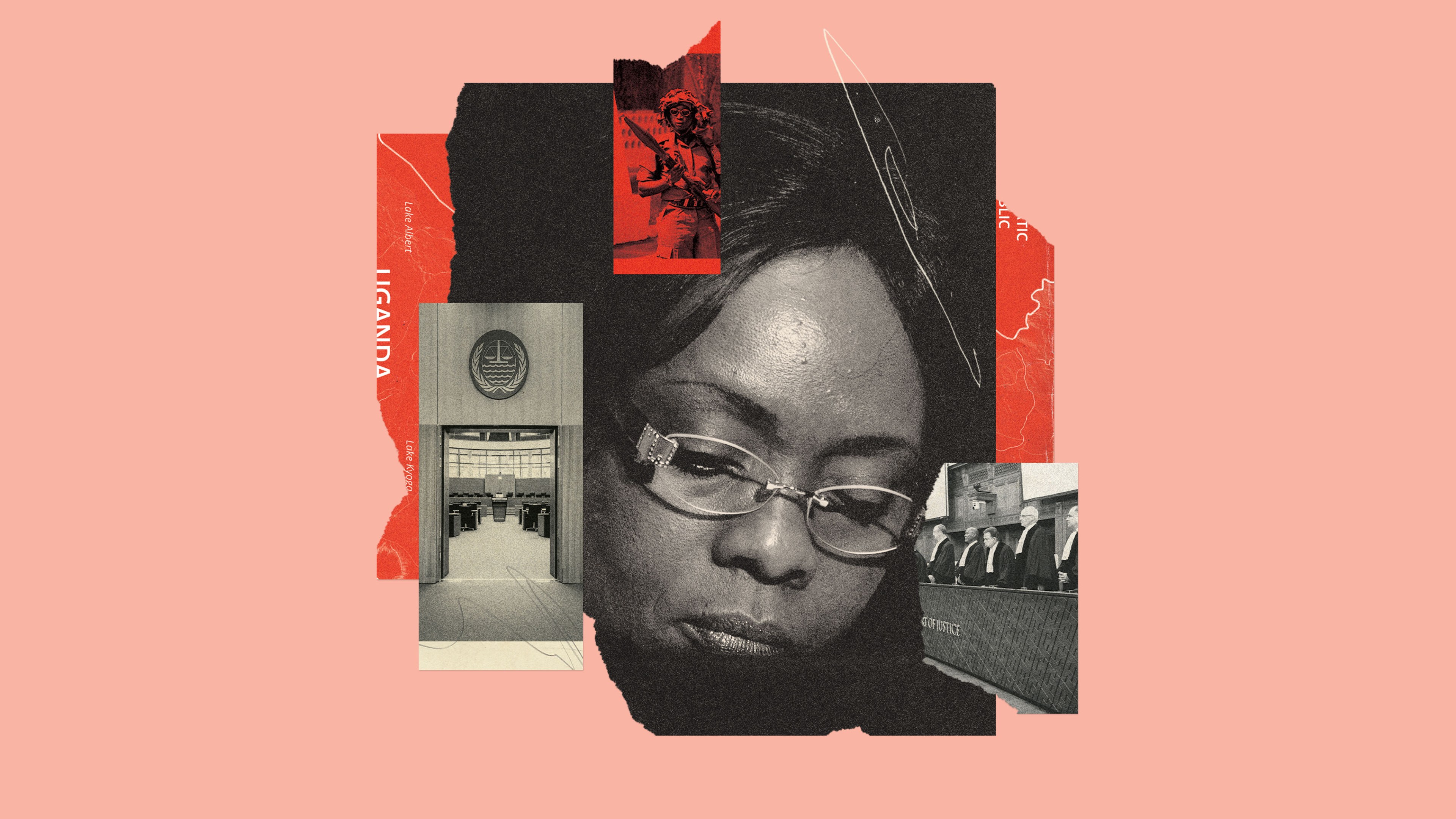
Pentecostal Woman Presides at The Hague

And other news from Christians around the world.

Illustration by Blake Cale

Julia Sebutinde became the first African woman to preside over the United Nations International Court of Justice in The Hague. She previously served on the Supreme Court in Uganda and as a judge on the international tribunal that found Liberian president Charles Taylor guilty of war crimes in Sierra Leone. Sebutinde credits a Pentecostal church founded by a Canadian minister in Uganda with her formation. “I have the chance to practice justice at the world level because of the values I picked up from Watoto Church,” she said in 2014. “The Godly values of integrity, honesty, justice, mercy, empathy, and hard work… account for who I am today and have immensely contributed to my incredible career.” Sebutinde drew criticism last year when she dissented from an opinion accusing Israel of genocide in Gaza. Her interim term of leadership began in January and concluded in March.

British soccer star Marc Guéhi Getty
British soccer star Marc Guéhi got in trouble for adding a Christian message to his rainbow armband.

United Kingdom: Gospel-modified uniform gets reprimand

A British soccer star from the Ivory Coast got in trouble for writing “I ♥ Jesus” on his uniform. Premier League captains were told to wear rainbow armbands as part of a 2024 campaign for LGBTQ inclusion to show that “sport should be a safe place where everyone belongs.” Marc Guéhi, a Christian player for Crystal Palace, added his message in black marker. He was reprimanded by the football association. At the next game, he wrote, “Jesus ♥ You.” No other disciplinary action was taken.

Germany: Evidence of early faith found 

Archaeologists discovered a 1.4-inch silver amulet in Germany underneath the chin of a man who died between AD 230 and 270. Researchers scanned and digitally unrolled the scroll—a process that took six years—and discovered a Latin inscription. It said, “May this means of salvation protect the man who surrenders himself to the will of the Lord Jesus Christ, Son of God, since before Jesus Christ every knee bows.” This is believed to be the oldest archaeological evidence of Christianity north of the Alps. Christianity became established in the region under Constantine in the 300s.

 Italy: Bible reading returns to schools

Education Minister Giuseppe Valditara has announced plans to reintroduce Bible-reading into schools, along with Latin and poetry memorization. Valditara, a member of the populist party Lega, told an Italian newspaper that studying the sacred text is critical to understanding Western history, art, and culture. “We must cultivate the imagination and the ability of children to be amazed, but without losing grammar and the study of the rules,” he said. Critics called the plan “retrograde.” 

Turkey: Assassination case ended

Officials have dropped the investigation of an allegation that intelligence agents recruited a nationalist party youth leader to assassinate three Protestant ministers. Youth leader Tolgahan Aban confessed to the pastor of an Association of Salvation church in 2022 that he planned his assassinations after government agents gave him money for his landscaping business and told him to “kill these people.” Aban said he abandoned the plan after speaking to the father of a nationalist who was convicted for the 2007 murder of three Christian missionaries. The pastor went to police, but the investigation didn’t go anywhere.

Iraq: UN restores church in Mosul

The United Nations has completed the restoration of a historic church, a Catholic convent, and a mosque destroyed by ISIS. The Islamic jihadist group took over Mosul, Iraq’s second largest city, following the US military’s withdrawal in 2011. The church was used for public executions. The UN spent $155 million on the seven-year project, which also provided job training for 1,300 young people. Dozens more churches in the region remain in ruins. 

Pakistan: Seminary head accused of fraud

The head of Pakistan’s oldest seminary has been removed amid allegations of financial fraud. Majid Abel, a Presbyterian minister, reportedly ran building projects without any oversight and did not maintain records of fundraising or payment. Construction was done by companies owned by his brothers and their children, according to an independent investigation commissioned by the Gujranwala Theological Seminary board. One company was paid 9.1 million Pakistani rupees (about $32,000 USD) and another 3.4 million (about $12,000 USD). Abel also got reimbursed without receipts. The seminary was founded in 1877 and serves three Presbyterian denominations.

Russia: Christian singer fined

Singer and songwriter Andrey Buyanov was convicted of 10 separate counts of criticizing Russia’s war against Ukraine. The government said his social media posts, including poems, antiwar songs, and comments on the bravery of people attending democratic activist Alexei Navalny’s funeral, were “extremist.” Buyanov was fined more than 300,000 rubles (about $3,500 USD), the largest fine to date for a critic of the war. 

South Korea: Government asks for missionary’s release

South Korea has officially demanded the release of a missionary given a life sentence of “reform through labour” in North Korea. Choi Chun-gil is believed to be one of three missionaries and more than 50,000 Christ-ians held in North Korean labor camps. Thousands of people from the camps were sent to work in Russia to support the war with Ukraine last year, according to South Korean intelligence. Choi was arrested 10 years ago and forced to confess to espionage, sabotage, and conspiracy to undermine the government, which is a dictatorship. He has had no outside contact since his arrest.

Chile: Pro-life politicians organize

Chilean politicians launched the country’s first pro-life caucus in response to a proposed bill that would loosen restrictions on abortion. Abortion was legalized in 2017, but only in cases of rape, nonviable pregnancies, and to protect the life of the mother. The new bill would allow abortion for any reason in the first 14 weeks. Stephan Schubert, a member of the populist Republican Party, organized politicians from a number of parties. “Life is a fundamental right,” he said. “A truly just society must offer different alternatives to… women who are going through very complex situations.”

United States: Deacon’s 1985 murder solved

The Georgia Bureau of Investigation arrested a man and charged him with the 40-year-old murder of a Black Baptist deacon and his wife. Harold and Thelma Swain, both in their 60s, were killed at Rising Daughter Baptist Church after a midweek Bible study in 1985. The Atlanta Journal-Constitution launched an investigation after a man convicted of the crime in 2003 was exonerated by DNA evidence in 2020. The newspaper found that another suspect, Erik Sparre, had given police an alibi that did not hold up and then told multiple people he had gotten away with the double murder. One ex-wife secretly recorded a confession. Sparre was allegedly motivated by racism.

Christian music stations sold

Salem Media Group has gotten out of the business of contemporary Christian music (CCM). The largest Christian radio company in the US sold its last “Fish” music stations and CCM Magazine. Salem has faced sharp financial challenges in recent years, seeing stock prices fall to about 20 cents per share. The company will recommit itself to Christian and conservative talk formats. The rise of streaming transformed the music industry, but Christian radio has continued to be popular. K-Love and Air1, both owned by Educational Media Foundation, broadcast on 1,000 signals across the US.

Genesis curse wording revised

Editors of the popular English Standard Version (ESV) of the Bible adjusted the wording of Genesis 3:16 in a 2025 update to the text. When the ESV was published in 2001, the text said, “Your desire shall be for your husband, and he shall rule over you.” This was changed in 2016 to read, “Your desire shall be contrary to your husband, but he shall rule over you.” The wording has now been changed back, bringing it into line with other major translations.

Church Life

Right-Size Your Fear

President & CEO

A note from CT’s president in our May/June issue.

An illustration featuring a composite of three images: the sun shining in the sky, the flickering flames of a fire, and the silhouette of three men
Source Images: Viswaprem Anbarasapandian / Unsplash / Adonyi foto / Aj Collins Artistry / Pexels / Edits by CT

We live in an age of anxiety. Family pocketbooks and calendars are stretched to the breaking point. We worry for our children, then worry our children worry too much. We fear for the integrity of the church, for the political fabric of our society; we fear wars and pestilence, climate change and social change—and then we add anxiety atop anxiety, worrying about things over which we have little or no control. 

The media landscape makes matters worse. Blazing headlines about crises scroll across our computer screens and mobile phones. Loudness is lucrative. Panic is profitable. Viciousness goes viral. We find ourselves in a public square filled with caricature artists and conflict entrepreneurs, fear peddlers and scorn merchants who flood the marketplace with counterfeits that make them rich and bankrupt the culture. 

There are genuine causes for anxiety. But Scripture provides perspective. 

For as long as I can remember, my favorite part of the biblical story of the fiery furnace has been what Shadrach, Meshach, and Abednego said before they were thrown into the flames. Hauled in front of Nebuchadnezzar for their refusal to worship him and his gods, they proclaimed, “The God we serve is able to deliver us from [the furnace], and he will deliver us from Your Majesty’s hand.” Then comes the best part: “But even if he does not, we want you to know, Your Majesty, that we will not serve your gods or worship the image of gold you have set up” (Dan. 3:17–18). 

Presumably, the three Hebrew men were afraid. They were not superheroes in capes. The Scriptures present flesh-and-blood human beings with all their flaws and frailty. While their fear was natural, they kept their fears rightly ordered. Their faith overpowered their fear. 

They trusted in the power of God. While they knew God was able to deliver them, actual deliverance was dependent on God’s will. They did not pretend to know the mind of God or precisely what the future would be. This led to their famous words: “But even if he does not” save their bodies, they will remain faithful to him. 

The Book of Hebrews speaks similarly about the faith of Abraham. The call to sacrifice Isaac made little sense, as Isaac was key to God’s covenant promise. Abraham did not know what God would do. Would God rescue Isaac before the sacrifice or after? “Abraham reasoned that God could even raise the dead,” the author says, “and so in a manner of speaking he did receive Isaac back from death” (11:19). Even when he did not understand God’s will, Abraham rested in God’s power and character. Or as Paul says of Abraham in Romans 4:18, “Against all hope, Abraham in hope believed.” Faith does not obliterate fear but can overcome it, giving hope even in the darkest of circumstances. 

That brings us to today. Will the church preserve its integrity and its mission? Will the gospel spread and the kingdom prevail? Will the foundations of our societies founder? Will new technologies save the world or destroy it? Will nations invade nations, asteroids strike the planet, and the climate come unmoored? Will our children endure and flourish, break under the pressures of the modern age, or inherit a world already broken? 

The path before us is uncertain. We trust God delivers his people but do not know whether that deliverance will come in this world or the next. We resolve that whatever happens, even if God does not deliver us in this life, we will remain faithful and true to our convictions. Against all hope, in hope we believe. We trust. We endure. 

Of course, we know the end of the narrative for Shadrach, Meshach, and Abednego. God made himself present in the blazing furnace and delivered them from destruction. Their faithfulness, and God’s deliverance, changed the heart of the king and the story of God’s people in exile. 

Christianity Today is more than a magazine. It’s a community of people in exile who are striving to be faithful even in the face of the fiery furnace. May we be the presence of God to one another. May we remind one another how God delivers his people. And may we encourage one another to hold fast. Whatever it costs us, even if God does not spare us hardship, we will remain faithful to Jesus Christ. 

As we proceed through our One Kingdom Campaign, we invite you to stand with us. In Babylon long ago, where one may have faltered, three stood together, and a fourth appeared among them who shone “like a son of the gods” (Dan. 3:25). There is power in fellowship. When we gather in his name, our Savior is among us. With him, let’s press on and seek the kingdom together.

This article appeared in print in the May/June issue on p. 4 as “Panic is Profitable.”

Timothy Dalrymple is President and CEO of Christianity Today.

Theology

Hear Our Prayer Amid Violence

We ask God to bring justice in Congo and around the world.

prayer hands
Illustration by Rick Szuecs / Source Images: Envato


This article appeared as a response to Mindy Belz’s article “Inside the Crowded Hospital Full of Congo’s Rape Victims” and petitions God for justice regarding rape victims in the Democratic Republic of the Congo.

Loving and righteous God,
we cry out to you.
Have mercy upon your children.

You say, “Do not fear, for I am with you; 
Do not be dismayed, for I am your God. 
I will strengthen you and help you; 
I will uphold you with my righteous right hand.” 
May those who suffer at the hands of evil be
strengthened, helped, and upheld by you. 

We pray for survivors of abuse, the “walking wounded,”
in the aftermath of the unthinkable. 
Make clear the way for healing of mind, body, and soul. 
Just as you raised Lazarus from the dead, resurrect the “living dead”
in the Democratic Republic of the Congo and, by the power
of the Holy Spirit, create in them new life. 

Bless your servant Denis Mukwege and others
working at Panzi Hospital.
We give you thanks for their faithful service
and loving-kindness.
Grant them a peace that surpasses all understanding.
In the moments of “My God, tell us what we are seeing
isn’t true,” when all hope seems lost,
strengthen them and draw them near to you. 
Turn the eyes of the world to the atrocities
in the DRC. 

May we never grow comfortable hearing stories of evil
and suffering, for it is in the faces of those suffering that we see
your face. Grant us wisdom in how to respond, O God. 
Liberator God, by your mighty power, execute justice for the
oppressed throughout the world, and may we live in the
knowledge that darkness and evil will not prevail;
it is you who will have the last word. 
Come soon, Lord Jesus. Amen.


Kimberly Deckel is a priest in the Anglican Church of North America. She lives in Pflugerville, Texas, with her family and serves at Church of the Cross Austin.

Books
Review

Has Faith Gone Out of Fashion?

A symposium on Christian Smith’s book Why Religion Went Obsolete.

Rocks and buildings crumbling
Illustration by Micha Huigen

In this series

On its face, the term obsolete can sound like an insult. We apply it to technologies, ideas, and institutions that fall out of fashion, often with a mocking air (“Okay, boomer”) or a snarl of disgust (“Good riddance”).

Christian Smith means nothing pejorative with the title of his latest book, Why Religion Went Obsolete: The Demise of Traditional Faith in America. Popular ridicule of religious belief (and believers) certainly factors into the story he tells. But Smith, a distinguished sociologist best known for studying spirituality among teenagers and young adults, has more in mind than atheist attacks and secular sneers.

Why Religion Went Obsolete looks for explanations beneath recent portraits of religious decline. Why have rates of belief and affiliation plummeted among younger Americans? Smith’s answer lies in the development, over decades, of a “Millennial zeitgeist,” his term for the fierce cultural winds whipped up by a perfect storm of social, technological, economic, and political disruptions, all compounded by the failures and misdeeds of religious leaders and organizations. Even if those winds are weakening, Smith suggests, they’ve succeeded in conditioning younger generations to view religion the way digital natives might view a landline phone.

As Smith stresses, obsolete isn’t a synonym for theologically untrue or morally harmful. “Something becomes obsolete,” he observes more prosaically, “when most people feel it is no longer useful or needed because something else has superseded it in function, efficiency, value, or interest.” People don’t relinquish older phones in a rush of hatred or condemnation. They do so because peer groups, product lines, and communications networks nudge them toward the newer model. They flow with the cultural tide.

Smith sees similar patterns playing out among millennials and Gen Zers who reject religion. Yes, some leave in anger. Plenty can cite intellectual and moral objections. But most, perhaps, simply gravitate toward worldviews, lifestyles, and communities that better align with their cultural assumptions.

Because the book reaches into so many subjects and scholarly fields, CT invited three reviewers to assess it from different angles: a political scientist (to weigh its social science claims), a theologian (to reflect on the underlying cultural currents), and a youth ministry expert (to consider the church’s next moves). This symposium, as we’re calling it, closes with Smith’s own response to the reviews. We hope the entire package inspires fresh thoughts, fruitful debates, and fervent prayers for all who brave cultural headwinds to make disciples.

Matt Reynolds, CT senior books editor

Caleb Cambell
Testimony

The Gospel Comes for a Neo-Nazi

A couple’s weekly dinner invitations helped transform me from an embittered skinhead to a senior pastor.

Photography by Jesse Rieser for Christianity Today

One night in high school, I showed up to a house party with some classmates. In the chaos of people mingling and dancing, I spotted a group of tough-looking guys in the corner.

Many of them had their heads shaved. They wore Doc Marten boots and red or white suspenders. It was a local neo-Nazi skinhead crew.

At that time, I was an angsty teenager who didn’t have many friends. I knew the men in the corner were powerful, and they called each other brothers. What’s more, they saw me standing nearby and invited me over, saying, “Hey, bro, come here. Have a beer.” I felt a thrill at being seen and chosen and eagerly took up their offer.

Over the following weeks, they invited me to gatherings, informal hangouts, and rallies around my hometown of Phoenix. Eventually, I shaved my head and donned the uniform of laces, braces, and boots, and the skinheads became my new family.

Mostly we’d party, get drunk, and listen to heavy metal. The majority of the 30 or so members had day jobs—except for the guy with a swastika tattooed on one eye who was always wondering why no one would hire him.

Sometimes we would join or initiate street fights, fiercely defending our own. If we saw a white man walking around with a Black woman, we’d scream expletives and call him a race traitor. At our gatherings, we chanted white supremacist propaganda with references to “Heil Hitler,” proclaiming that white people were superior to all others and that nonwhites should “go back to where they came from.”

When we arrived at parties, we were respected, even feared. I sat in the corner with my group and knew that no one was going to mess with me.

In exchange for this sense of security, I joined a movement that (I know now) made itself a vile threat to others. What started as an antidote to my own insecurities led me to dehumanize others and engage in violence toward people of color and their communities.

But my desire to join this crew did not start by reading Mein Kampf. What drew me was the things the group offered: a sense of strength and inclusion in something greater than myself. The belonging, no matter how flawed, came first. Ideology followed.

Years later, a different invitation to belong led me to Jesus.


I was raised by loving Christian parents. Because of the church I attended as a kid, much of what I perceived to be Christianity was a message of “Don’t do these things or God will punish you.” This list of don’ts included dancing, smoking, drinking alcohol, and watching R-rated movies.

But as I entered junior high in the early ’90s, I noticed that many churchgoers hypocritically did the things on the list of vices. I began to suspect that Christianity was all a scam.

When I visited the house of a pastor and spotted a VHS copy of The Terminator—a forbidden R-rated film—I decided, in my adolescent mind, that this was all the proof I needed to show that Christianity was a hoax. I gave up right then on God and his church.

During my time as a neo-Nazi, however, the same feeling of disillusionment crept in. As I surveyed my skinhead peers, I saw they had no real joy, financial stability, or actual strength.

Instead, they were running from the law, ruining their careers, and destroying their families. The way they lived their lives did not match the promises of their ideology. After a few years in the movement, I grew suspicious that their pledges of safety, belonging, and purpose—which I had embraced—were in fact hollow.

In 2000, federal law officers started rounding up skinheads in the Phoenix area for selling ecstasy, throwing our group into disarray. Many members scattered and left the group. Between that and my growing dissatisfaction, I knew it was time for me to leave too. I stopped attending gatherings, got a new phone, and moved to a different part of town.

A plantPhotography by Jesse Rieser for Christianity Today

I was in my early 20s, alone and aching for something real. Not knowing how to process all of this, I buried my insecurities with a combative stance toward anyone and anything that might threaten me. I had left neo-Nazism behind, but my anger remained and became my armor.

I had a good job and spent much of my time outside of work playing the drums, which I’d picked up in high school. While I still had a sense that God existed, I was resistant to religion in general and Christianity in particular. I didn’t want anything to do with what I perceived to be a hypocritical, self-righteous movement.

At the same time, I knew I couldn’t keep going about my life in isolation. Through that tiny crack in my armor, God began to pursue me—through a phone call from some place called Desert Springs Bible Church.


The lady on the phone had seen my number in the musician section of the local classifieds. She asked if I could fill in as a drummer for the worship team the upcoming Sunday. I thought, Why not? I guess I should do something good.

I expected it to feel unbearably awkward to step back inside a church after all those years, but I was surprised at how the worship team welcomed me without judgment or pretense and how natural it felt to be there. One Sunday became two, then three, and soon I was a part of the regular rotation.

After a time, one of the guys, Seth, invited me over for dinner at his house. I accepted, half expecting him to back out. But when I showed up, he and his wife, Jayme, served me a meal and even had a cold beer ready. That was not what I was expecting. We spent the evening talking and laughing.

They invited me back the next week and the week after that, until these dinners became a weekly ritual. There was no agenda, no pressure—just warm hospitality.

One evening, Seth said, “How about after dinner we talk about what makes you angry about Christianity?”

Oh, I was all in on this. I had a lot of rage and was ready to share it.

He patiently listened as I vented all my frustrations—the hypocrisy of Christians, the failures of pastors, and the shallow faith I’d seen in others. To my surprise, he wasn’t defensive. He nodded and said, “I share some of your concerns. I think Jesus does too.”

Sometimes he’d pull out his Bible and ask me to read a section of the Gospels, asking, “What do you think Jesus would say about this?”

I didn’t know it at the time, but he was discipling me—connecting me to the living Jesus. Gradually, I found that my heart had softened to the message of the gospel.

My anger and resentment lingered, but they began to fade in the light of something new dawning in my life. I found myself liking this Jesus, and I wanted to know more. And the more I knew him, the more I wanted to follow him and be a part of what he was doing in the world.

That was more than 20 years ago. Much to my surprise, four years after that first dinner with Seth, I was asked to join the church staff. I went to seminary, became ordained, and now serve as the lead pastor of the church that welcomed me when I was lost.

I, who was once a skinhead, now lead a congregation committed to the biblical vision of a church made up of people from all races and walks of life. Importantly, at the Spirit’s leading, I have wrestled with the bigotry in my own heart, confessing and repenting both publicly and privately of the ways I took part in racist acts.

God in his mercy has also given me deep friendships with men and women of color, who have extended forgiveness to me, mentored me, and convicted me of sin that I could not (or would not) see without their perspectives.

This transformation—slow but real—began unexpectedly at a table. Seth and Jayme embraced me and modeled Jesus’ love week after week. They honored me by treating me as a friend and showing me how safe it could be to reconsider long-held beliefs and explore who Jesus really was. At their table, I put down my armor and began to take up my cross.

Jesus set exponentially more tables than he flipped. At the tables set by his people, even the broken neo-Nazi can experience God’s grace. And I am grateful to God that I did.

Caleb Campbell is pastor of Desert Springs Bible Church in Phoenix and the author of Disarming Leviathan: Loving Your Christian Nationalist Neighbor.

Theology

The Problem of Panic

Columnist

Where Peter once stood in the place of Pan, we can hear the voice that changes everything.

Pan following a woman on her phone
Illustration by James Walton

Over 40 years ago, filmmaker Steven Spielberg terrified theatergoers with a movie that quickly embedded itself in the American cultural imagination. Like most scary stories, Poltergeist first lulled the audience with the familiar—a suburban home in a newly built housing development. It then disrupted that familiarity by injecting ghosts who are not content to occasionally moan or rattle a chain but create havoc and terror.

The malevolent spirits in Poltergeist upend the entire household and drive the family to the point of insanity. In the end, it’s revealed that the placid neighborhood is built on top of desecrated graves. The poltergeists’ goal is to cause panic, to overload the inhabitants’ limbic systems in order to revert the house to a place of deadness.

As I listened recently to a young Christian describe the way he saw the world around him, I wondered whether the Poltergeist story was a generation too soon, and whether that haunted house could be a metaphor for our present moment.

Discussing the statistics around the mental health crises among his age cohort, this man said that he was less concerned about the medical situations of anxiety and depression among people he knew—because those could be treated—than about the fact that the “whole world seems to be going through a panic attack.” He stopped himself and wondered if panic was the right word.

“It’s like everything is in a crazy cycle,” he continued. “We seem to be bouncing back and forth between panic and boredom.” He stopped again, pondering whether cycle was the right word. “I mean, it makes no sense,” he said. “Everything seems out of control and scary—and boring and dead—at the same time.”

This young man is hardly alone in sensing a kind of bored panic and panicked boredom in the world today. But he is wrong in thinking of boredom and panic as two contradictory realities. In fact, they’re closely related.

In his book Superbloom: How Technologies of Connection Tear Us Apart, Nicholas Carr cites studies demonstrating that the neural pathways of the brain crave dopamine so much that it is “the most insatiable of all drives, outstripping even lust.” A rodent in front of a lever wired to send a pulse through that part of its brain will press that lever to the point of exhaustion and collapse.

Social media algorithms, Carr argues, remove the kind of “friction” that humanity has relied upon to keep this “seeking instinct” in check. The algorithms are programmed to learn what a person is looking for and deliver more and more of it, seemingly world without end, regardless of whether the sensations sought are arousal, fear, disgust, loathing, anger, or plain distraction.

“The real world can’t compete,” Carr writes. “Compared with the programmed delights of the virtual, it feels dull, slow, and, poignantly enough, lifeless.” Thus, the end result of a limbic system that’s always “on” is boredom.

Cistercian monk Thomas Merton scouted out this cultural trend in 1948 when he wrote:

We live in a society whose whole policy is to excite every nerve in the human body and keep it at the highest pitch of artificial tension, to strain every human desire to the limit and to create as many new desires and synthetic passions as possible, in order to cater to them with the products of our factories and printing presses and movie studios and all the rest.

The end result of this artificial tension is the same as what comes after any kind of prolonged panic: paralysis and apathy. The boredom then seeks some semblance of life by stimulating the libido to the point of frenzy, which leads to more boredom, and the process starts again.

A person sitting next to pan looking boredIllustration by James Walton

Panic is exactly the right word to describe our times. And like most words, panic is a kind of fossil record, embedded with meanings that most of us never investigate but that have shaped our use and understanding of the term. The word is haunted by a poltergeist of significance, and to get at it, we must ask whose grave is beneath our feet.


The word panic comes from the ancient Greek god Pan, the deity of shepherds, herds, and wild places. He was known for his libido, seeking to sexually violate nymphs and to inflame the erotic passions of those in contact with him. He represented wild power, the sort of violence that we see in the scarier aspects of nature. He could also soothe and hypnotize by playing his pipes, freezing listeners in place in ecstasy. And maybe most importantly of all, he could induce mind-scrambling fear. He was, in other words, the god of panic.

“Pan’s military weapon is quite unique: it is his loud voice, his panicked scream, carried on the wind,” wrote Jungian psychologist Sharon L. Coggan in 2020.

In the military encampments or on the battlefield, when the whole company is thrown into panicked flight, this is the telltale sign of Pan’s effect. It is “his eerie, disembodied haunting cries” that constitute his arsenal. His weapons are essentially psychological: panic acts to dissolve social bonds and turn members of a mob to savagery.

Another mark of Pan was his “instinct for self-preservation,” notes another Jungian, Sukey Fontelieu. Pan used confusion and surprise attacks to get what he wanted, Fontelieu adds, and “both his enemies and the nymphs typically reacted to his advances with panicky retreats. These two themes, panic and self-preservation, are connected.”

The ancient historian Plutarch recounted how, around the time of Jesus’ birth, sailors heard a voice announcing, “The great Pan is dead!” Ever since, those seeking to describe the disenchantment of a world no longer teeming with gods have repeated Plutarch’s words in lament. If Pan is the god of panic and passion, modernization has been linked to the death of Pan and the beginning of boredom.

For instance, Scottish literary genius Robert Louis Stevenson said in 1881 that modern science “writes of the world as if with the cold finger of a starfish.” The answer to this boredom, he continued, was to reclaim the spirit of Pan, to return “to the old myth, and hear the goat-footed piper making the music which is itself the charm and terror of things.”

Likewise, English novelist D. H. Lawrence argued a century ago that the death of Pan is synonymous with technological progress. We have set out to conquer the universe around us, Lawrence stated, and to a large extent we have succeeded through our efforts.

But “a conquered world is no good to man,” he wrote. “He sits stupefied with boredom upon his conquest.” The answer, Lawrence proposed, was to return to what the ancient pagans meant when they invoked Pan: the idea that everything—all the wildness of the cosmos and of our own natures—is very much alive and active, unpredictable and unconquerable.

Well, if Pan was ever gone, he’s back. Despite the fact that we live in more economic affluence and technological advancement than any generation before us, we also live in a time of generalized anxiety and resentment and fear—seen in our divided politics, our discredited churches, and our angry social media fights.

In our day, the wildness of uncontrolled human impulses and the deadness that comes with technological mastery are not the answers to each other. They are both part of our problem. We are panicking ourselves to boredom and boring ourselves to panic. But why?

Contemporary sociologist Hartmut Rosa argues that much of our problem is that we now expect the world around us—including our own lives—to be predictable, directable, engineerable, and useful. Our smartphones reinforce that. We have access to virtually everything, or at least to everything virtual.

The irony, he explains, is that this expectation of controllability is driving us crazy with “monstrous, frightening forms of uncontrollability.” What we are missing, he says, is what he calls “resonance”—the ability to be spoken to, affected, and changed by what we cannot control.

Pan sneaking up behind a woman on her computerIllustration by James Walton

Think of the sort of delight a child feels, Rosa says, when waking up to the first snow of winter. One could engineer that. The parents could buy snow cannons and blast icy flakes outside the window. But that’s not the same experience. The experiences of looking out onto a mountain range or standing at the foot of a massive waterfall or staring into the eyes of a newborn baby for the first time all find their meaning because they are not predictable, producible, or controllable.

We can now find groups of people online who think exactly as we do or who have interests completely aligned with ours—but we are lonelier than ever. We can converse with an artificially intelligent program and feel as though we’ve found a friend who completely “gets” us or a partner who is deliriously “in love” with us, without the risk and unpredictability of real relationships that can break our hearts. But even the most self-deluded person knows there’s nothing real or alive about it.

Our dual expectations of controllability and resonance leave us with neither, cut off from what could actually give meaning and purpose. We become cold, unaffected by anything and thus numb to wonder, joy, and love. Or we become hot, driven by our libidos and then angry or terrified when the world, our institutions, our culture, our families, our politics, and our religion fail our expectations.

What we expect to control—and can’t—now becomes what Rosa calls a “point of aggression.” And like those who imbibe a little more whiskey to cure their alcoholism or take one more hit of cocaine to end their drug addiction, we think that the way of Pan is our way out of panic.

Bored panic and panicked boredom help clarify why the entire world seems to be throbbing with resentful culture wars—what philosopher Mark Lilla recently called “political nostalgia”: a longing for a supposedly lost golden age that results in raging against those who have supposedly stolen it. Some people with political nostalgia, Lilla writes,

become paralyzed, incapable of taking nourishment from what life still offers, and begin to waste away. Or they feel the coffin closing and panic; adrenaline races to their hearts, and they become capable of anything. The original philosophical question—how should I live?—has little meaning for them. When to live?—that is the question. And Now is not an acceptable answer.


A decade ago, I led a van full of American Christians on a tour of the biblical sites in Israel and Palestine. I couldn’t wait to show them one of my favorite places there: the mountains of what was once known as Caesarea Philippi. There, Jesus said to Peter, “On this rock I will build my church, and the gates of hell shall not prevail against it” (Matt. 16:18, ESV throughout).

Pan wearing a sign saying the the end is nighIllustration by James Walton

As I walked with my tour, I noticed a small group of Europeans dressed in all black, huddled together and murmuring as they looked at the ground. “Are they praying?” I asked our Israeli tour guide.

He laughed and rolled his eyes. “Well, kind of,” he said. “Sometimes Neopagans want to come here because, you know, this used to be a special place for that kind of thing. This is where they once worshiped the god Pan.”

Secularization isn’t evaporating spirituality but rather is rechanneling it, as cultural observers such as Tara Isabella Burton have documented. People, like the Pan worshipers, are finding new spiritual tribes and self-styled rituals and practices, with some seeking to reclaim the “old gods” of ancient paganism.

Part of the attraction is that these spiritualities appear ancient but are also free from any traceable organizational history. Much of the disillusionment with institutions today is due to those organizations’ failures to live up to their own ideals. These spiritualities, on the other hand, have ideals without having to show historically how they impacted structures and communities.

The tour guide made fun of the modern-day Pan worshipers. “It’s all just made up, you know,” he said. “There are no real pagans left. Pan has been dead a long time, and he isn’t coming back.”

The European pop-pagans may have been piecing together a “made-up” spirituality, but they weren’t wrong about part of the meaning of that location. The place is known to Christians as Caesarea Philippi, but its modern name is Banias, an Arabic version of Panias, after the god Pan. The significance of the varied meanings of this place was highlighted in 2020 when an archaeological dig uncovered an ancient Christian church beneath the site dating to the AD 400s.

This is not surprising. After all, it would make sense to build a church where Jesus promised to do so—upon the rock. But the archaeologists found underneath that church yet another structure of worship, this one dating back to about 20 BC: a temple to the god Pan. A scholar explained to the press that the worship of Pan had happened in that place since at least 300 years before Christ.

When Jesus spoke to Peter in Matthew 16, he did so over this ancient site of Pan. Perhaps no chapter in the Bible is more evocative of our current crisis—and not for the reasons many Christians think.

Pan on a swingIllustration by James Walton

Handwringing believers will cap off some expression of panic with the words from verse 18, saying, “But we know that Jesus said the gates of hell will not prevail against the church.” This is usually spoken as a kind of forced hopefulness, similar to telling a grieving widow at a funeral, “Well, at least your husband’s not in pain anymore.” But in so doing, we do to these words what we have too often done to other majestic passages: turn them into decontextualized slogans and thus empty the words of their power.

The truth is that what Jesus said matters as much as where he said it. When Jesus stood in Caesarea Philippi and spoke in Matthew 16:13–28, he knew this was a place of panic, of devotion to the god of the pulsing libido and the raging fist. He also knew that this place now belonged to the house of Herod, whose son Philip named it after himself and the Roman emperor. The place represented what again seem to be opposite poles—the chaos of natural wildness and the control of political power, the panic of nature and the panic of history.

But Jesus recognized that human power and natural wildness are not separate things. They are one. The power of Caesar that crucified Christ is represented later throughout the Book of Revelation as humanity aspiring to ultimate, godlike power and control. But in so doing, the truth of Caesar is revealed to be wild and animalistic—in fact, a beast.

Jesus revealed his own power at Caesarea Philippi. But his power is starkly different from both the way of Caesar and the way of Pan.

Matthew situates the encounter of Jesus with Peter in between two important revelations in Jesus’ ministry: the feeding of the 4,000 and the Transfiguration. It’s a series of tests that reveal a fundamental aspect of the panic-boredom matrix we all now face. In each case, Jesus breaks the power of the panic cycles.

Chapter 16 begins with the Pharisees and Sadducees demanding to see a sign (v. 1). They wanted the question of ultimate meaning to be confirmed and deemed engineerable. But Jesus told them, “An evil and adulterous generation seeks for a sign, but no sign will be given to it except the sign of Jonah” (v. 4).

Similarly, Jesus caught his disciples worried about their lack of bread (v. 7)—a controllable fulfillment for their unmet appetites. But Jesus told them they’d missed the point: “How is it that you fail to understand that I did not speak about bread?” (v. 11).

Then, at the place of Pan, Jesus marked Peter with his new identity as a “rock.” Yet the stability of this rock was immediately thrown into question. Peter responded to the idea of the Cross with the throbbing impulse of self-protection, threatening to fight off anyone who would attempt an arrest of Christ (v. 22). Peter revealed not only that he didn’t really understand what Christ meant but also that he didn’t know himself well enough to know how he would respond in the ultimate crisis.

Peter would have fought anyone who suggested he was a worshiper of Pan or a sycophant of Caesar. In fact, he had been the first disciple to announce—there at Caesarea Philippi—that Jesus is “the Christ, the Son of the living God” (v. 16). But within a paragraph of this profession, Jesus said to him, “Get behind me, Satan!” (v. 23). This was because, Jesus said, Peter was not setting his mind “on the things of God, but on the things of man.”

More specifically, what Peter wanted was to save his life and the life of Jesus—he wanted a defeat of their enemies and for his life to follow the blueprint outlined in his affections, appetites, and intellect. He emanated the hypervigilance of the panicked, relying on a firing limbic system to assert dominance in the face of threat. Jesus, however, said the answer was not in engineering the future or in defeating enemies or even in guarding one’s own life.

Instead, he said this: “Whoever would save his life will lose it, but whoever loses his life for my sake will find it” (v. 25).


At that place of panic at Caesarea Philippi, Jesus was unnervingly tranquil. We might think panic purveyors would suggest that Jesus didn’t know what was coming. But the outside world is too familiar with panic to think that. It can recognize the kind of “confidence” that is really the frantic bravado of Peter and distinguish it from the strange calmness of Jesus.

When the world of Pan and Caesar sees a frenzied, angry, resentful, vengeful movement bearing the name of Jesus, they recognize it for what it is. They can identify it as the same varied-but-empty answer they would give to the question “Who do you say that I am?” (Matt. 16:15). They can see that movement setting its mind on the things of man and not on the things of God.

Unlike Peter and his proposed show of force, Jesus overcame the place of panic with his voice. He spoke, and he was heard. The question “Who do you say that I am?” could not be answered by crowdsourcing or cunning or feats of strength. Answered meaning, fulfilled appetites, overcoming danger, even saving one’s own life, all relied on Jesus’ promise alone—an intangible word that cannot be conjured up or revealed by “flesh and blood” (v. 17).

What Hartmut Rosa and other observers of this age call “resonance” speaks to what the Bible tells us about the reality of the world, like deep calling unto deep (Ps. 42:7). We need a voice like Jesus’ in the midst of our panic, someone outside of our control to break in and awe us like a first snow.

In describing the way of discipleship, Jesus used the imagery of sheep with a shepherd—the very sort of nomadic herds that were supposed to respond to Pan. The voice of the shepherd Jesus, though, does not create panic. It destroys it. And the sheep respond to—resonate with—the shepherd’s voice, following him into an undiscernible and uncontrollable future (John 10:3–5). That can also be scary in its own way, but it’s the kind of scariness that leads us out of, not toward, panic.

Pan hiding in bedIllustration by James Walton

We cannot do much about the panic all around us. We cannot undo the kind of hot panic that manifests itself as political aggression, seeking to divide the world into friends to be rewarded and enemies to be defeated, powering the libido until we see other people as objects to be sexually or economically exploited. We also cannot do much about the cold kind of panic that prompts people to numb themselves to life with substances, achievements, or the burnout of detached cynics who have yielded to despair.

What we can do, though, is make ourselves reachable. We can pray for what Jesus called ears to hear and eyes to see (Matt. 13:15–16). We can cultivate true meaning through worship, prayer, community, and immersion in the Bible.

Such things cannot engineer meaning or holiness by their own power. But they can place us beside Peter where he once stood in the place of Pan. And there, we can hear the voice that changes everything.

That is itself distressing, just as it was for Peter. We want control and reassurance and predictability, even if such things would only leave us with more deadness. Yet the voice is always just ahead of us, calling us onward not by activating our limbic systems but by renewing our minds.

The story is what it always has been. It’s Peter versus Pan. We can choose to save our lives or to lose them, to indulge our appetites or to cultivate longings for something better, to plan our futures or to entrust ourselves to the unknown. We can choose fleeting wins or eternal salvation.

In this whirlwind of our own Caesarea Philippi, we should deafen our ears to the pipes that are playing all around us and listen for a different voice. The question posed to us is neither how to read the signs of the future nor how to defend ourselves from danger. The query before us is “Who do you say that I am?”

Only when we keep that question in mind can we look down and see the solid rock on which we stand—and recognize that this is no place for panic.

Russell Moore is editor in chief at CT.

Ideas

Love Bids Our Anxious Fears Subside

Staff Editor

A note from CT’s editorial director for print in our May/June issue.

illustration of a heart over a pink background
Illustration by Rick Szuecs / Source image: Raw Pixel

There’s a scene in the Pixar movie Inside Out 2 that had me nodding while holding my popcorn. As the character Anxiety tries to protect her human, Riley, from “scary stuff,” she takes the switchboard controls representing Riley’s mind and becomes both a whirling dervish of frantic activity and paralyzed in place. That’s how anxiety often feels—both frenetic and stuck. 

In 2025, the sheer glut of information can overwhelm our nervous systems so we feel stuck and frantic, just like Anxiety. 

Systems can be anxious too. We’ve all seen groups gather around the most anxious person in an organization and, being unsure of the future, follow that person down the drain of fretting, endless social media shouting, or self-protection. Behind our anxious hearts and systems, fear lurks. 

The question then is, will we allow Jesus to break up what Edwin Friedman called “an imaginatively gridlocked relationship system” in our lives and the systems we’re part of? Or will we succumb to panic?

Panic may be a natural response, but Christ offers a better way.

In this issue, we acknowledge panic and point to Christian ways through it. Editor in chief Russell Moore brings us to the place of panic in Caesarea Philippi with Jesus and Peter (p. 29). We also feature Moore’s interview with former vice president Mike Pence (p. 21). 

Skyler R. Flowers and Michael Graham provide language for our fractured evangelical landscape and offer direction for faithfulness (p. 36). And from her work at the Bonhoeffer-Haus in Berlin, Laura M. Fabrycky writes about how we’ve made Dietrich Bonhoeffer a hero, flattening out his complex web of social belonging to our detriment (p. 46). 

In addition, we give you a glimpse of the evil of rape in the Democratic Republic of the Congo and how our human thirst for technology can perpetuate violent systems (p. 72). It’s a hard read, as those of us who edited and gave art direction for Mindy Belz’s reporting in “To Make the Wounded Whole” know. But even in this landscape of evil, there is healing for victims, pictured in the work of Panzi Hospital and the hands of Dr. Denis Mukwege. 

We are not without hope that Jesus will ultimately swallow evil. To aid us in our response to him, Kimberly Deckel has written a prayer (p. 82). 

We’re also proud to bring you results from the Global Flourishing Study, a multiyear scientific survey of participants in 22 countries shedding light on what makes a “good life”(p. 84). As the Christian researchers note, wealthier countries may not excel at overall life flourishing.

Whatever causes our panic, the way through our own imaginatively gridlocked systems is by naming evil and fear and bringing them to God in lament. He sees evil. He will perfectly mete out justice, and he promises to cover us with his mercy. One day he will make all things right. Only love can bid our anxious fears subside.

This article appeared in the May/June print issue on p. 14 as “Editor’s Note.”

Ashley Hales is editorial director for print at Christianity Today.

Ideas

What Do We Want from Dietrich Bonhoeffer?

A former tour guide at Bonhoeffer’s historic house wrestles with the implications of mythologizing his story for our own ends.

Bonhoeffer's desk

Illustration by Peter Oumanski

One autumn morning in 2016, during a season shot through with loneliness, I learned that my family and I lived only a 10-minute drive from the Bonhoeffer-Haus, the memorialized home of Dietrich Bonhoeffer.

We had just moved from the Washington, DC, area to Berlin for my husband’s work, spending those summer months awkwardly trying to settle ourselves in a new country. I was homesick, but not just for home—for another time altogether. From across the Atlantic, I was disillusioned by the rancorous partisan discourse unfolding in American public life and felt especially grieved that there was coarse disrespect even among those who claimed to follow Jesus. These ruptures left me feeling raw, alone, and fearful.

A visit to Bonhoeffer’s house would do us good, I figured. He was a hero lauded for the faith and theology that animated his opposition to Nazism—a Christian good guy in a time of Nazi bad guys. We could be inspired, I thought, hopeful again that maybe good people like him would rise to the occasion in our present messy world.

So we packed our three kids into the car for the house’s Saturday morning English-language tour. Upon arrival, I took in the black-and-white photographs hanging on the walls of the conference room where we gathered. Some were of Bonhoeffer. A few, like those of Karl Barth, were familiar—but most of the images featured people I didn’t know at all. Sometime during the guide’s talk, in that room full of strangers’ photographs, I realized I was not getting the story I’d expected or even wanted to hear.

Rather than training a bright spotlight on the lone hero Dietrich, the guide gave a careful historical overview of the house and the many people connected to it. The context was harder to follow than my good-guy-versus-bad-guys framing and demanded a different form of attention than I expected. It involved a wider group of characters, dates, places, and complicating elements about the Confessing Church (which rose in opposition to the pro-Nazi German Protestant church) and about Bonhoeffer’s role in a 1944 military conspiracy—far more nuanced than the American retellings I had previously encountered.

At the end of the talk, the guide invited us to visit Bonhoeffer’s upstairs bedroom, ringed with bookshelves, and to sit at his desk, with its signature teal lamp and a small cigarette burn on the matching velvet blotter. It was in that room that the Gestapo arrested him in 1943; he was executed two years later at the age of 39 in the Flossenbürg concentration camp.

I too was 39 that morning in his room, and I found my attention turning to a tangle of existential questions. What would I have done? Was I doing anything significant now with my life like he did? What had I really wanted from this tour of Bonhoeffer’s house?

Following that first visit, I scheduled another tour for myself, and then another, intrigued and terrified by the silent witness of that ordinary house. It held the mingled memories of joyful family times and gatherings with neighbors but also conspiratorial conversations and jagged emotions of fear, anxiety, and immense grief. Behind its doors was a world of people—a few recognized, many now forgotten—who struggled to make sense of the time and its demands as best they could.

Rather than being superhuman, as I had secretly hoped, the Bonhoeffers and their friends were ordinary people who had no desire to be heroes, much less Christian ones. They were an elite Prussian family with a strong sense of civic obligation, prizing sound thinking and moral courage at a time when such things were in scant and diminishing supply.

From my historical vantage point, the house and its people appeared disadvantaged against the noisy bombast of the Nazis and the social pressure to comply. Yet the Bonhoeffers and their friends still sought to live responsibly, decently, and faithfully. That witness terrified me but also compelled me to learn more. As I listened, their lives issued a quiet, persistent call—not to their world but to my own.

After making more visits over the next six months, I became a volunteer guide myself, warmly issued a key for the door as if I were a trusted neighbor. But nearly nine years since that first visit, as Bonhoeffer’s story continues to be cited, celebrated, and sometimes misconstrued by the American church, we need to ask ourselves: What are we doing with Bonhoeffer, and why?


“Laura! The bed is IKEA!”

The comment, typed in the margin of my book draft, made me laugh and cringe. As painful as it was, I had grown accustomed to having my romanticized notions about Bonhoeffer punctured by Gottfried Brezger, a retired pastor and longtime Haus guide.

My two years as a guide had grown into a book, in which I distilled lessons I learned from my time at Bonhoeffer’s house. The memoir was in its infant stages then, and Brezger was direct in his feedback, repeatedly melting away my propensity to wax imaginative. In the case of the bed, I had written with pathos about the objects in Bonhoeffer’s room—his books, his desk, his clavichord—and then added some treacly foolishness about “the human-sized bed that once held a sleeping moral giant.” Nonsense. The desk was Bonhoeffer’s, Brezger averred, but the bed was a Hemnes.

Par for the course. In my interactions with Brezger, I routinely experienced the difference between my American and his German view of Bonhoeffer. I veered toward a mythologized picture of the man, while Brezger saw him firmly embedded in the rich fabric of history.

Our interpretations and interactions mirror our larger cultures. In the aftermath of World War II, American Christians hungered for stories of moral heroes and exemplary Christians. That appetite was first satisfied in the eulogies that theologian Reinhold Niebuhr and bishop George Bell gave of Bonhoeffer shortly after his death (even if his theology and prison writings later complicated the picture they initially painted).

More recently, Americans have repeatedly encountered the phrase “Bonhoeffer moment,” which fashions an abstract ethical principle out of the actual person. The phrase has come to mean that a tipping point has been reached in society and that violent action is now permissible. But those who use it this way fail to understand that Bonhoeffer never claimed his decision to support the plotters was morally justified or insisted others were ethically bound to follow him in it. Invoking his name and image like this may be an effective marketing technique, but it is not a serious engagement with his life or times.

I’ve observed Germans show respect for Bonhoeffer, but it is always tempered with caution toward any thinking that revolves too much around a charismatic figure, which is understandable given their country’s history with the Führer. Unlike in the United States, Bonhoeffer isn’t treated as a brand name or a celebrity. Instead, he is honored for the complex humanity of his life: for being a brilliant, evocative thinker and writer who lived life fully, intensely, and creatively, even in prison. As one of my former Bonhoeffer-Haus colleagues noted, some in Germany even refer to him as “the man with the song”; his beloved poem “By Gentle Powers” (“Von guten Mächten”) has been set to music by a variety of composers. But this creative, joyful person is rarely the Bonhoeffer we in the US hear about.

During my time as a guide, it was important for my American imagination as much as my Christian one to reframe how I told Bonhoeffer’s story. My fellow volunteers’ personally distinct tours were helpful in this respect, presenting a fuller picture of life in that era.

Martin focused on the house itself, pointing out that its location at the end of a dead-end street was more secluded and thus perfect for conspiring. He also explained recent historiography about women in the Confessing Church movement and Nazi resistance, including those largely forgotten, such as Elisabeth Schmitz and Gertrud Staewen.

High school teacher Martina drilled deep into the history of former students who died in Nazi resistance efforts—students who once attended the school where she herself teaches.

Other guides, like Brezger, concentrated on Bonhoeffer’s theology and its continued relevance. To this day, all of the guides invite visitors into conversation about these and other subjects, careful not to tend to a cult of Bonhoeffer but to remember him and others in their historical context.

While learning from these volunteers, I had to shed my desire—in my guiding and writing—to tell a merely inspiring story about his life that might satisfy visitors’ or readers’ appetites. Mimicking my fellow guides, I reminded people that his upstairs bedroom was often blue with cigarette smoke.

While giving a tour one day, I found myself flooded with pity and compassion for Bonhoeffer: Despite his intellectual gifts and credentials, he had a potholed timeline of halting life experiences. As the only adult Bonhoeffer child who still had a room upstairs, he leaned on his parents financially. Even when he lived elsewhere, he mailed his dirty laundry home to be washed, biographer Charles Marsh notes. At times, during my guiding years, I wondered whether I would have even liked Bonhoeffer if I had met him.

But these insights were a severe mercy for me and for him. I was starting to see that God loves and is served by real human beings: faulty, frail, fearful, and dependent, infinitely more varied than the successful leaders I was tempted to look to and lift up.

Increasingly, I came to see that my tangled emotional attachments to Bonhoeffer’s narrative were fed, in part, by restlessness in my own life. I was complicit in a larger Christian culture that cultivates a sincere but problematic, even sentimental, attachment to him—and to other Christian celebrity figures—as a kind of holy warrior. Their humanity cannot stand under the weight of deification we are tempted to load upon them.

The Bonhoeffer I’d wanted to hear about was an idealized figure who led a resistance movement with clarity and self-confidence, a bold operator in a bewildering world who I could follow in the dark. My neighbor Bonhoeffer, however, was as human as I was.


The danger of sentimentalizing our heroes is that such mythmaking can be exploited for our own ends. We cannot afford to be naïve about this. Portraying Bonhoeffer as an assassin, with a gun clutched in his hand, fails to demonstrate even a basic understanding of his life or thought. In a culture primed for violence through contemptuous polarization and radicalizing isolation, the temptation lurks to invoke Bonhoeffer’s name as justification for the moral worthiness of one’s cause and tactics, no matter how different they may be from his own.

This kind of causal instrumentalization hurts real people, including his living relatives. Tobias Korenke, a great-nephew of Bonhoeffer, told me by email that he and his family have been “deeply hurt by the abuse committed against Dietrich” for nationalist ends and political purposes—causes that Bonhoeffer would not have supported and against which he issued strong dissent.

But I came to realize that it’s not only Bonhoeffer’s life we sentimentalize. It’s also the Confessing Church he was a part of. To understand this better, I turned to my mentor Victoria Barnett, one of the general editors of the 17-volume works of Bonhoeffer in English and a theologically trained historian specializing in the German Confessing Church movement.

In the 1980s, Barnett conducted 60 interviews with surviving Confessing Church members, including Bonhoeffer’s sister-in-law, Emmi Delbruck Bonhoeffer. Her husband, Klaus, was one of Dietrich’s older brothers and was executed by the Nazis for his role in the 1944 military conspiracy, along with Dietrich’s brothers-in-law Hans von Dohnanyi and Rüdiger Schleicher. In her book For the Soul of the People, Barnett’s interviews unveil the depth of moral murkiness and the complicated circumstances that individuals in the Confessing Church faced.

Barnett also points out that the German Confessing Church cannot be understood as a resistance organization to the Nazis. The Confessing Church emerged in opposition to attempts by the Deutsche Christen, or German Christians, to Nazify the church. But as a movement, it sought primarily to preserve the church, not to resist or overthrow the Nazis. In fact, some in the Confessing Church were even members of Hitler’s party.

Here and there, a few individuals in the Confessing Church sought to help those who found themselves crushed by Nazi propaganda and increasing levels of state-sanctioned terror aimed at genocide. But in terms of offering resistance, I realized I was not free to imagine the movement as one that primarily helped Jews or other persecuted groups. As Barnett said to me recently, “The Confessing Church’s leadership record is pretty poor in that regard.”

German society writ large hardly fared better. There was no national effort to resist National Socialism—only individuals and small groups from various sectors: artists and intellectuals, the workers movement and labor unions, and individual Christians. To varying degrees, as the German Resistance Memorial Center puts it, each of these “made use of what freedom of action they had” in defiance of the Nazi regime.

Amid the tensions of myth and history, there remains the man. As Barnett writes in The Christian Century, Bonhoeffer was “one decent human being who understood better than any of us that in evil times, we must remain faithful—if only for the sake of future generations.”

That is the harder task for us all. It is easier to turn to mythologized heroes than to begin to follow in their uneven steps of obedience to Christ. It is easier to write off faithfulness as extraordinary than to shoulder responsibility for our times. It is easier to let someone else speak up for our suffering and fearful neighbors than to do it ourselves.

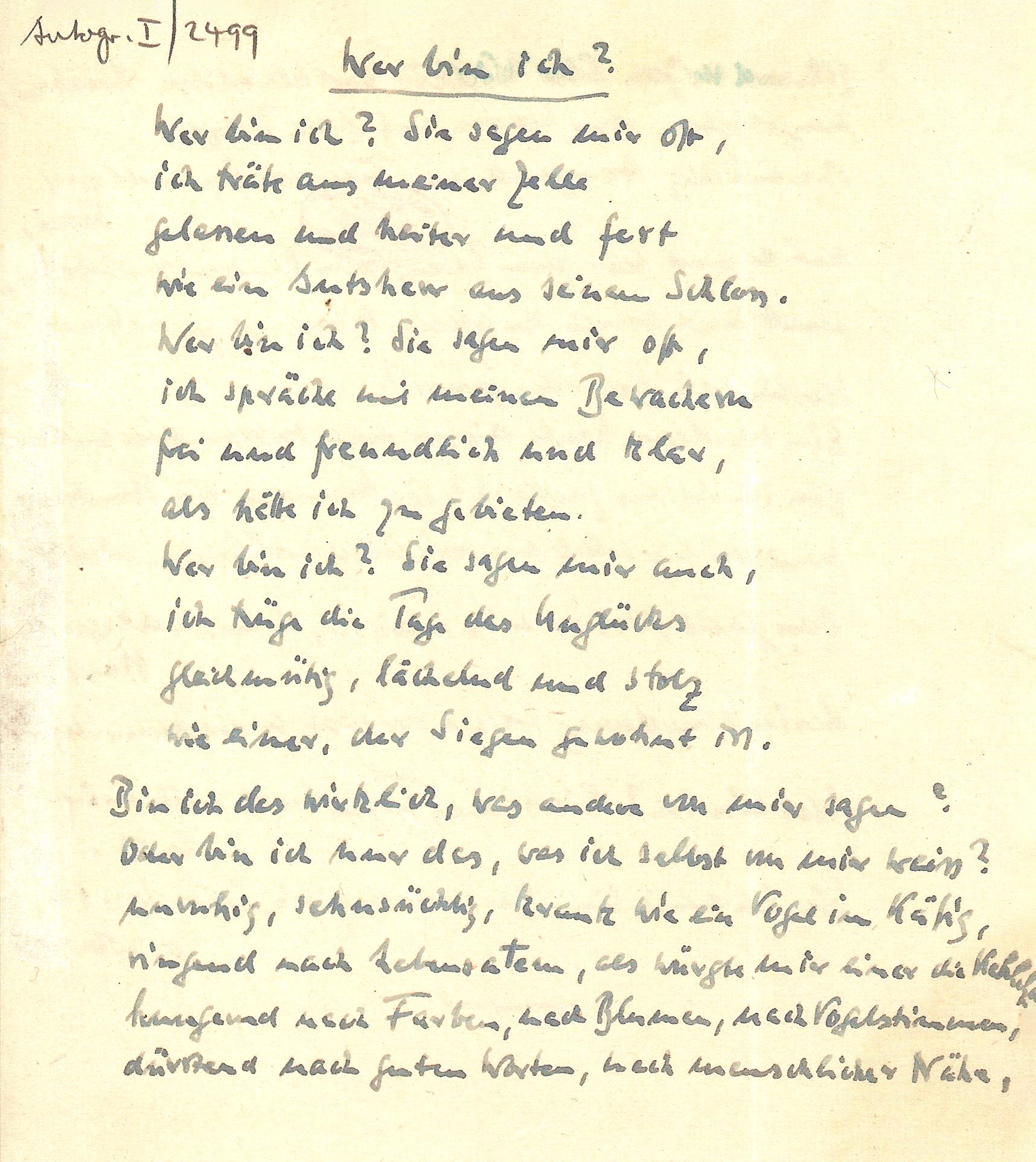
A handwritten copy of Dietrich Bonhoeffer’s poem “Who Am I?” written in 1944, during his time in prison.WikiMedia Commons
A handwritten copy of Dietrich Bonhoeffer’s poem “Who Am I?” written in 1944, during his time in prison.

Whether in my pocket or my purse, the key to the Bonhoeffer family’s house jangled next to my own keys during those Berlin days.

My efforts to master the basic facts of Dietrich Bonhoeffer’s life—as critical as these were—gave way to the gift of seeing him as a fellow human being. He was no longer a lone superhero but a member of a family, inextricably bound within larger communities and relationships.

To better see Bonhoeffer, I had to learn the names of the other people in the photographs on the wall. And I did this not by myself but with Brezger and Barnett, Martin and Martina, and all those who tended to the loving task of remembrance at the Bonhoeffer-Haus. To this day, I am still learning new names from that era.

During his time in prison, Bonhoeffer wrote a poem that peels back the mythical man’s mask to show the genuine human, trembling at the questions, fears, and longings within himself. In “Who Am I?” we see him struggle to know how to answer:

Am I really what others say of me?
Or am I only what I know of myself?
Restless, yearning, sick, like a caged bird …
starving for colors, for flowers, for birdsong,
thirsting for kind words, human closeness,
shaking with rage at power lust and pettiest insult,
tossed about, waiting for great things to happen,
helplessly fearing for friends so far away,
too tired and empty to pray, to think, to work,
weary and ready to take my leave of it all? …

Who am I? They mock me, these lonely questions of mine.
Whoever I am, thou knowest me; O God, I am thine!

This human Bonhoeffer remains an important figure of respect—not because he was perfect in his thoughts or actions or because he was singularly heroic, but precisely because he was not. He was on the losing side of the war, geographically, in a movement that also lost. But all the while, he dared to do the good, to keep wrestling for the gift of ordinary human life even as his world seemed bent on reveling in gross indifference and inhumanity.

As fear and complicity grew and morally preferable options narrowed, he continued to press into the bewildering pain of life’s questions before God. He was careful not to insist that others imitate him on the path he felt responsible to take. The arc of his life witnesses to the costly reality that even in failure, “God can and will let good come out of everything,” as he wrote in 1942. His life can nourish future generations’ moral imagining. In that respect, I think it is right to call him a saint—living history evidence of what God can do in a person’s life.

Bonhoeffer’s poetic questions might also illuminate traces of answers to life’s questions for us. They certainly gestured toward my own trembling questions on that first visit in 2016. To find the answers, I needed a sheltering place and hearts capable of housing my uncertainties and doubts. I found both at the Bonhoeffer-Haus, where slowly, answers began to emerge, tuned to my own life.

These answers touched on the basics of civic housekeeping as well as wholehearted obedience to Jesus: Feed the hungry; house the homeless. Give fellowship to the lonely and justice to the disposed, for, in Bonhoeffer’s words, “what is nearest to God is precisely the need of one’s neighbor.”

Knowing this, seek reconciliation with someone from whom you have grown alienated. Pray for a real enemy to the risen Christ who calls us to love, and use the Psalms to help you do it. Look at the lilies, listen for the voices of birds, and consider—as Jesus said we should.

Muddled desires, fear, anxiety, and myth-based emotional attachments had sent me to search mindlessly for a great man of history, a hero of the Christian faith at a time when heroes were nearly absent.

I did not find what I was looking for at the Bonhoeffer-Haus. What I found instead was a human being among other human beings—a man who, above all, belonged to God. And that remains, even now, a good and difficult gift.

Laura M. Fabrycky is the author of Keys to Bonhoeffer’s Haus: Exploring the World and Wisdom of Dietrich Bonhoeffer.

Church Life

Should I Talk to My Kids’ School About the Pledge of Allegiance?

CT advice columnists also weigh in on cultivating lifelong friendships and ending a dating relationship in a godly way.

Two children standing at school for the pledge of allegiance with one student sitting
Illustration by Jack Richardson

Got a question for CT’s advice columnists? Email advice@christianitytoday.com. Queries may be edited for brevity and clarity.


Q: As a newlywed, I’m eager to cultivate deep, lasting friendships with other couples, but that feels like it’s complicated by living in a very transient city in an increasingly low-commitment culture. Long-term friendship seems like it requires a dance between intentional commitment and genuine enjoyment. Should we just be frank with new friends about the commitment we want? Will it scare them off? —Wondering in Washington, DC

Beth Moore: Lasting, life-giving friendships make life so much richer, but boy, do we have to fight for them in this culture. It sounds like you’re willing to try, and that alone makes a real difference. 

Good friendships develop organically, but they require opportunity and availability to grow. If opportunities come, take them! Make yourself available even if it takes extra effort. Think companionship over convenience, but also think about how to make it easier to routinely see  each other. Do you live close, share a commute, or participate in the same small group?

If not, think about whether that could change. If organic opportunities don’t come, might God want you to facilitate some? Your friends (or even prospective friends) might have the same desire for a long-term commitment, but perhaps they’re nervous to mention it. Whatever the situation, you can always pray for good friends, put yourselves out there, and stay open to the unexpected. 

And sometimes friendship can be very unexpected. When my husband, Keith, and I attended our first newlyweds’ class at church, I was appalled to see a woman there who’d made fun of me in high school. But 46 years later, she and her husband are our best friends. God can work wonders with proximity and an open heart. 

Beth MooreIllustration by Jack Richardson

Beth Moore and her husband, Keith, reside outside Houston. She has two daughters and an armful of grandchildren. Beth leads Living Proof Ministries, helping women know and love Jesus through Scripture.


Q: My kids go to a Christian school where students routinely say the Pledge of Allegiance. I don’t like the practice from a theological perspective, but it doesn’t outweigh all the good things about this school. One of my children doesn’t like to say the Pledge, and I’ve told him he has my permission to be respectfully silent. My question: Should I proactively tell the school administration or just explain if they happen to notice? —Parenting in Pennsylvania

Kevin Antlitz: In first grade, I had a friend whose parents forbade him to recite the Pledge. I asked why and vaguely recall him saying it was for “religious reasons.” At six years old, not coming from a devout family, I had no idea what that could possibly mean and didn’t think to ask.

Reconsidering it now, I can see why a serious Christian—or a committed atheist, for that matter—would have qualms about the Pledge. The idea of pledging alliance to “one nation under God” could be problematic for both, albeit for very different reasons. 

For some Christians, pledging allegiance to any person or thing other than God alone may be scandalous. I can understand why someone would hold to that conviction, drawing on verses like Matthew 5:34, Luke 16:13, or John 18:36, which is why I think this is one of those things reasonable Christians should be able to agree to disagree about graciously, including in this school setting.

In your case, I do think it’s worth taking the initiative to speak with the school. It’s not unusual for leaders of institutions to continue to do things simply because they’ve always done them that way. Perhaps a conversation will lead administrators to reconsider the liturgy of the Pledge. 

Or perhaps not. Either way, this would offer a great educational opportunity for your child to think seriously about the import of his words and how to hold to his convictions in a gracious way.

Kevin AntlitzIllustration by Jack Richardson

Kevin Antlitz is an Anglican priest at a Pittsburgh church positively overflowing with kids. He and his wife have three young children who they pray will never know a day apart from Jesus.


Q: I’ve decided to end my eight-month-long dating relationship for a variety of reasons, and a lot of people in my life support this decision. But how do I end the relationship in a godly way? I don’t want to cause unnecessary hurt or anxiety, and we will likely see each other around our university campus. Maybe I’m overthinking it, but I’ve seen a lot of breakups go very poorly and I want to do better. —Rattled in Rhode Island

Kiara John-Charles: Ending a relationship isn’t easy. Hurt feelings may be inevitable, yet seeking to handle it in a godly way shows you’re on the right path.

Our culture gives plenty of attention to recognizing red flags early in a relationship, but there’s less focus on how to end things well. Ghosting and “situationships” are increasingly common, but being honest and direct will help you set clear boundaries and avoid unnecessary hurt.

When communicating your decision, I encourage you to speak the truth in love (Eph. 4:15). While the Bible doesn’t provide specific instructions on how to end a dating relationship, it does offer guidance on honoring others with our words. Verses like Ephesians 4:25 call us to “put off falsehood,” and Colossians 4:6 reminds us to let our speech be gracious.

Before having the conversation, take time to pray, ensuring that your desire to be loving outweighs any hurt feelings you may have. Arrange to meet in person. Be mindful of the other person’s feelings, and remember that while honesty is important, it’s also essential to be kind. 

You don’t need to be brutally honest—sometimes less is more. Keep your words simple and clear, and give the other person space to process, with or without you present. Last, trust the Holy Spirit to guide your words toward love, even though you’re no longer in love.

Kiara John-CharlesIllustration by Jack Richardson

Kiara John-Charles is an LA native with Caribbean roots and a love for travel and food. She works as a pediatric occupational therapist and serves at her local church in Long Beach, California.


Ideas

A Splintered Generation

Evangelicalism’s fracturing is chronic, but not terminal. Here’s how we can move forward.

A church pew ripped in half

Art by Derek Brahney

One day in the middle of the pandemic, I was working a typical pastoral day patching some drywall at our Orlando, Florida, church building, when a church member dropped by to catch up. The week before, we’d had a conversation about joy. I had asked him, “What is stealing your joy right now?” He thought long and hard about that question and wanted to follow up.

“Hey, Mike, your question about joy the other day was really hard, but I had an epiphany,” he said. “I realized that having Fox News on 24/7 at home was the number one thing stealing my joy and making me angry. So this week I decided to turn it off, and it has really made a difference.”

I told him that I was proud of him for his honesty and for taking a significant action step to safeguard his joy in Christ. But then he added, “Except for Tucker Carlson. I watch him every night.” 

I’ve heard similar stories from the other side of the political aisle. Our current reality is no different from this story. What are pastors to do when their church members consume narratives throughout the week tenfold more than their Sunday sermons? What do we do when members who helped found our churches now threaten to leave due to these narratives? What do we do when evangelicalism feels irrevocably fractured? 

The evangelical movement has long been a tapestry of diverse convictions and traditions, united by shared doctrinal and cultural factors rather than formal structures. The term evangelical implies an overarching unity that allows and accounts for diversity without imposing uniformity. This both gives the movement its force and makes it hard to discern its exact contours.

Today, that visage has grown even less clear. Four years ago, we observed in an essay for Mere Orthodoxy that evangelicalism had fractured. The response to American political events that drove media attention and cultural conversation revealed an underlying rending of the evangelical fabric. 

As we saw it, the fracturing of evangelicalism revealed that the historic bonds holding the movement together were less intellectual than they appeared but were rather socioeconomic, political, and cultural. Dividing lines lurked beneath the surface for some time, but in the wake of a series of flash points, the comfortable order of allegiances was disrupted, fractured by unspoken yet deeply held commitments. We categorized the splintering into what we saw as six groups (and added one more borrowing from Mere Orthodoxy editor in chief Jake Meador’s observations):

0 – Right-Leaning Exvangelicals have left the church but identify as Christian or promote the merit of Christianity for the preservation of conservative cultural values and institutions. 

1 – Neo-Fundamentalists focus on biblical fidelity and conservative values. This group is deeply concerned about liberalism and growing cultural hostility toward Christianity.

2 – Mainstream Evangelicals prioritize the Great Commission, so while they are concerned by extreme fundamentalism, they are more worried about the secular left’s influence.

3 – Neo-Evangelicals emphasize the global nature of the movement and the need to engage with the culture. This group critiques conservative political allegiances and failures on social issues while addressing liberal Christianity’s theological compromises.

4 – Post-Evangelicals center on justice and accountability. They challenge hypocrisy and abuses in the church while distancing themselves from evangelical identity, though they hold to core doctrinal beliefs.

5 – Left-Leaning Exvangelicals have dechurched due to disenfranchisement with evangelicalism’s failures but retain some orthodox Christian beliefs.

6 – Dechurched have left both the church and Christian faith entirely, abandoning all vestiges of belief.

Four years ago, we predicted a number of possible scenarios and futures for evangelicalism in the wake of such a fracturing. Most importantly, we recognized that the fracturing was likely irrevocable. This has proven to be true; we are no longer in the era of fracturing. We have transitioned into a new era within a fractured evangelicalism. 

But this need not lead to discouragement or despair; rather, the fractures of evangelicalism have given way to a certain clarity that allows Christian churches to reconceive and renew their commitment to the gospel. A fractured evangelicalism is not a terminal diagnosis. This is not the movement’s first fracturing, and as historical precedent shows, such a moment can give way to new faithfulness for individuals, movements, and institutions that fall under the “evangelical” label. There is a way forward for the movement that remains committed to evangelical distinctives and the spread of the gospel internally and externally, locally and globally. 


Through the early years of the fracturing (circa 2014–2019), the average American evangelical church might have been largely populated by people with differing cultural sensitivities. A church might see a combination of groups 1–4 sharing a pew in worship, serving in the children’s ministry, and communing in small groups. In fact, proximity is what gave rise to the seemingly ever-present tension of those years. 

But as the cultural waves crashed over these communities and receded, they exposed that, often, the individuals gathered in these churches had many things in common—such as core theological beliefs, preferences in preaching and worship styles, aesthetics, and more—but related to the cultural climate in radically different ways.

Plus, social media offered us more of people’s live, unfiltered reactions to events. A Facebook post by a neo-evangelical small group leader could leave the neo-fundamentalist evangelical church member stunned at the former’s opinion of presidential politics. A post-evangelical might feel that their pastor, who is a mainstream evangelical, is not engaging culture or calling for societal change in a way that is sensitive or helpful.

These dynamics initially led to the fractured groupings, but over time a new reality formed. People began to reconsider their ecclesial affiliation based on these cultural factors. No longer could a neo-fundamentalist sit comfortably with a neo-evangelical. Nor could a post-evangelical serve next to a mainstream evangelical. Suspicion, anxiety, and frustration sent people scattering for new group solidarity and prompted movement into like-minded churches. The power of wedge issues created enough tension to ensure that some evangelicals could no longer attend the same church as each other. This was largely solidified by two factors: positions (doctrine) and posture. 

Two evangelical Christians might agree on the sanctity of life, the biblical sexual ethic, and the sinfulness of racism. Likewise, these two evangelicals might have voted similarly in previous presidential elections. However, as the social media age matured, these two Christians began to diverge in their responses. The one person might carry an abrasive, “truth-telling” posture in face-to-face conversations and digital interactions. The other might attempt to carry a nuanced, “winsome” posture.

These two people hold identical positions but have differing postures. Positions are the fundamental ideas that we hold. Posture is the affect with which we hold those positions. How one arrives at belief will determine how one embodies the belief. Thus, though theological differences may prevail in a church, the sorting between churches occurred as differing paths to beliefs led to different postures. The net effect is a significant impact on overall comfort in a church and a space. 

As the fracturing settled, it became obvious that new solidarities were not based strictly on ideological grounds. In part, this is because the way that we arrive at a doctrinal position often determines solidarity more than the position itself. Humans are not hermetically sealed brains that arrive at propositions through pure, brute-force reading of the Bible. Cultural, emotional, behavioral, psychological, relational, and experiential factors often pave the way to our doctrinal destinations. Even those in denominations with antiseptic doctrinal statements have struggled to find solidarity in a fractured evangelicalism because they came to their convictions through different pathways. 

The explosion of social media, videos, and podcasts serves as one of the most powerful factors in doctrinal and cultural discipleship and significantly shapes how individuals come to positions. 

But our newfound solidarity within these church types is driven by shared posture rather than shared positions. If you were to move to a new city and visit all the churches in town, you might find the ways they self-describe and self-identify loaded with all sorts of subtleties that communicate what types of churches they are. The term Baptist, Presbyterian, or Methodist would no longer be the defining difference between a church and its neighbor church down the street. Instead of denominational labels, you may be looking for the ways they discuss politics—and their political enemies. 

The question “What voices do you most trust in evangelicalism today?” once might have turned up a wide array of answers in any given church. This is less likely now and reveals a more settled fracturing. Position matters, but posture is how you find your tribe. 

Today, it is more likely people have found themselves in spaces with compatible postures, prioritizing these over doctrinal compatibility. Many Christians in everyday experience choose a church based on “vibes.” Gone are solidarities forged in the debates over the charismatic movement, worship wars, and the emergent church. One need only look at Southern Baptist presidential politics to see men who once questioned others’ Baptist credentials over Calvinism today nominating those same people for leadership positions. It is common, too, for non-Christians to speak at Christian conferences if they share the same posture on specific issues. This is part of the new world of settled fracturing within evangelicalism. 


So what is the personality of evangelicalism today? We see three main characteristics that define today’s fractured evangelicalism: church centers, new movements, and the gender divide.

Mid-20th-century missiologist Paul Hiebert borrowed terms from set theory in mathematics—bounded set and center set—to describe ways of thinking. According to Hiebert, bounded sets have essential characteristics, have clear boundaries, are uniform in essential characteristics, and are static. Center sets have a defined center, and people judge things by the distance from their location to that center. 

Some have created a metaphor for this of two livestock ranchers. The bounded-set rancher builds a fence to keep sheep within the field so they don’t stray. The center-set rancher builds a well, knowing the sheep won’t stray far from their source of nourishment. Churches today often define their centers and boundaries through primary theological commitments, secondary theological commitments, and cultural matters. 

We see three new types of churches emerging from the fracturing, all of whom define their boundaries differently. 

The first type is a combination of neo-fundamentalists and mainstream evangelicals. These churches see the culture as the problem facing the church and posture themselves in opposition to it while promoting a vision of a renewed Christian society. They tend to place fence posts around primary theology, secondary theology, and cultural matters. While a positive vision of biblical faithfulness is usually at the center, these churches often define their identity by who is in and who is out. Gospel proclamation is the hope of moving people from without to within while condemning churches and individuals who are squarely outside their boundaries. 

Another group of churches, a combination of mainstream evangelicals and neo-evangelicals, is more likely to see the world’s fallenness inside and outside the church as the problem and to see themselves as salt and light in the world. They tend to be bounded set on primary theological commitments and a mixture of bounded and center set on secondary and cultural issues.

While there is certainly an idea of orthodoxy that defines the boundary, their pursuit of the center rises higher, often within discussions of the Great Commission and the kingdom of God. 

Finally, churches composed of a combination of neo-evangelicals and post-evangelicals see Christian hypocrisy and sin inside the church as the most pressing issue. They tend to be center set on primary and secondary theology but draw firm boundaries on cultural matters. Only those who agree with a certain ethical vision in the modern world are within the boundary to pursue that vision with them. 

No church is boundaryless or purely center-driven. Furthermore, postures are often the unstated embodiment of a church’s boundaries and centers and are extremely revealing. Ironically, the first and third groups of churches often end up being like photo negatives of each other on issues such as gender, sexuality, politics, and race. As cultural flash points occur, boundaries intensify and can lead to flared tempers and anxiety. 

Art by Derek Brahney

The middle group of churches does not minimize cultural issues, but due to its center focus, the heat in these moments is turned down. The focal point rises higher in terms of importance. Nevertheless, these churches and peoples are not separated from the world and will often feel the intense tug of war on any given issue pulling toward the churches on their left and right.

In the past two years, the defining cultural values for evangelicals have cooled due to a larger shared agreement around the tragic events in Israel on October 7, 2023; flash points around gender; and renewed cultural conversations around the benefits of Christianity for self and society. Still, these boundaries and centers exist and will fluctuate.

Much of the fracturing we’ve beheld itself derives from a mistrust of the institutions that have defined the shared life of evangelicalism. Our publications, seminaries, denominations, pastors, and churches that once were viewed as the banners of the movement are now under suspicion. The net effect leaves institutions still standing but not necessarily thriving. In a setting of such chaos, two notable movements have arisen that are not obviously associated but do derive from this context. 

The first movement might be called New Pietism, the school of thought commonly known as “Rule of Life” or “Comerism,” after the popular writer and pastor John Mark Comer. This movement emphasizes the cultivation of one’s spiritual life, with a heavy focus on spiritual practices that inspire the individual to holistic commitment to Jesus Christ. 

While there are many factors in this movement’s explosion in the past decade, it is notable that its mainstream attention grew most significantly as the fracturing settled. It might be said that New Pietism arose out of a desire to leave behind the chaos and clamor that defined the fracturing period. As with its spiritual predecessor in the 17th century that reacted against institutional failure in its time, the emphasis of New Pietism largely rests on the individual, though it is not in opposition to communal cultivation of piety. With historically reliable institutions under suspicion, the turn inward serves as a great call to take account for oneself. 

This movement will likely transcend the fracturing through an otherworldly pursuit. Its development doctrinally and communally will define its contours.

The second movement is what we call New Transformationalism. If New Pietism is the extreme inward, individual response to the fracturing, hoping to rise above it, New Transformationalism is the extreme outward, communal response. This movement desires to engage culture and society in the hopes of bringing them into alignment with Christian principles. It is incumbent on the Christian community, then, to take up the task of cultural transformation. 

Christian nationalism is the form of this movement that has dominated the popular conversation on both sides of the spectrum. But opposite it, other groups want to see American society and the church reckon with failures to uphold biblical justice. Both turn outward to the world in hopes of Christian renewal. 

The New Transformationalists differ from those who emphasize cultural renewal, because they believe the institutions that have structured American society and evangelicalism are complicit in the miscarriage of justice—the specifics depending on how one defines that. These institutions must be dismantled finally and totally, in their view, so that new institutions may arise to resurrect the movement upon a better foundation. This is the calling of the Christian community in today’s age. Those who bear the name “Christian” and do not join in this vision are complicit with these failed institutions. 

Both New Pietism and New Transformationalism look at the turbulence of fracturing and long to move forward in faithfulness. The former seeks faithfulness internally and individually. The latter seeks faithfulness externally through the community. 

But as the fracturing settles and institutions remain weary, we can expect these movements to grow and appeal to many across the fracturing spectrum. We may also expect that many, notably mainstream evangelicals, will feel threated by these movements that they see as distractions to the Great Commission.

A pew that's been ripped and then reconstructed together

Perhaps the most culturally significant reaction during the period of the fracturing is the gender divide. Large numbers of women are moving out of the church, and men are moving in (or at least are leaving at slower rates). In 2008, 34 percent of college-graduated men and 36 percent of college-graduated women in the US attended church at least once a week. By 2023, men had dropped off by 2 percent (down to 32%) and women by 9 percent (down to 27%). The results are similar over the same time period for those who have only some college education.

Notably, for the first time since religious data has been recorded, there are now more younger men than younger women in church. And there are now more women over the age of 32 who never attend church versus their male counterparts. In my (Michael’s) book, The Great Dechurching, I found that 65 percent of dechurched exvangelicals are women. Men and women are entering this new era of evangelicalism in very different ways.

It is perhaps too early to answer why the fracturing has been received in such vastly different ways by men and women from otherwise similar racial, socioeconomic, and geographic backgrounds. While there are many possible reasons, we see social media, Western civilization, and the last three election cycles as major influences.

With the atomization of media, men and women are often not listening to the same voices and perspectives. This does not necessarily mean that women are more likely to engage with personas pushing them out of the church, but it does in part explain the radical divergence in cultural attitudes and engagement.

Some have also had concerns over the health and well-being of Western civilization. From newly converted Christians (such as Ayaan Hirsi Ali) to avowed atheists (such as Richard Dawkins), there seems to be a large, influential sect of cultural conversation promoting Christianity as foundational to a thriving society. But this conversation tends to code more male than female, such as apologist Wesley Huff’s appearance on Joe Rogan’s podcast, a show with an overwhelmingly male audience.

And of course, men and women have responded to the presidencies of Donald Trump in divergent ways. His popularity since his first campaign has grown, and his strength with evangelical men solidified, while many women are still wary. These varied reactions might offer insight into women’s faster rate of disillusionment with evangelicalism than men’s.

Regardless of the underlying causes, the widening gaps between young men and young women in politics, religious belief, and religious attendance will play a significant role in the contours of the fracturing of evangelicalism. 


Life within a fractured evangelicalism is still taking shape. But there is a way forward. What should we do? The church needs to prioritize the goodness of the gospel, holistic discipleship, and prayer for institutional revival. 

First, given that cultural flash points will continually change but never subside, evangelical churches must commit to firm doctrinal boundaries and champion the center. To use the rancher analogy, churches must draw people to drink from the well of life. Boundaries must be established by upholding the standard of historic, biblical orthodoxy. This is no cold, dead orthodoxy but one that speaks powerfully and compellingly to and in the language of the world today. Firm boundaries should always point to the center.

At that center must be the gospel of our Lord Jesus Christ and the expansive hope it offers for the transformation of all people. Applying and proclaiming the gospel to the world has always been the defining feature of evangelicalism. With this gospel at the center, all cultural and theological matters will relate to it organically and be set in their proper relationship to one another. The evangelical church should never be ashamed of its boundaries but rather should stand on them as the foundations from which we invite the world into the gospel’s glories at our center. 

Second, churches can pursue holistic discipleship. Discipleship cannot be thought of as an information transfer from one brain to another, as if only positions matter, but as the shaping of doctrine and postures along paths established by the gospel. Competing allegiances and compelling alternatives continue to strip the church of millions of disillusioned individuals. 

For the church to recover its effectiveness in passing on the faith, it must embrace the whole gospel within the whole church for the whole person through discipleship of children, integration of faith and work, cultural apologetics, and more. 

Third, we also believe there can and must be institutional revival. Evangelicalism has been blessed by an abundance of resources devoted to and developed by institutions sharing the Great Commission. Embracing the spirit of Nehemiah, we should devote ourselves to building and rebuilding the institutions that have defined the movement. 

This call is not in the spirit of a baptized nostalgia saying, “Make evangelicalism great again.” The call is to recognize the unique stewardship of gifts and resources that institutions offer when they serve the local church. The movement needs Christian media, missions organizations, seminaries, and others to coordinate, train, resource, and commission men and women to bring the gospel to their neighbors, coworkers, foreign powers, remote tribes, and the ends of the earth. Coupled with this, the movement needs multidirectional leaders—who embody the fruit of the Spirit rather than grasping for personal glory—guiding these institutions. These will strengthen the church—God’s primary plan for caring for his flock and reaching the lost. 

Fourth, churches can solidify a geographical commitment. In the pre-fracturing world, like-minded churches could pull from a wide range of sources to support church planting, ministerial training, mercy ministries, and more. But the past decade of fracturing has doomed many such national and global networks.

Now, many evangelicals have started to recognize the power of geographical commitment from a diverse web of churches within a local area. A friend of ours in rural Texas recently described a theological library, church plants, and pastoral fellowships that have developed across denominational and cultural lines through this sort of commitment. While diverse in theology and posture, they share a passion to see the gospel flourish in one region. As others have noted, large churches are especially equipped to serve this vision if they steward their resources for the benefit of local ministries, organizations, and other churches rather than brand multiplication. 

Cultural clashes between Christians will continue in the post-fracturing era—but so will concern for one’s locale. Partnership on this foundation will serve as a steadying force for the movement.

In many ways, all that we have described here is the application of “evangelical catholicity.” It is an idea, first raised by Kevin Vanhoozer, that the evangelical movement and its individual churches are united to the whole church of Jesus Christ across space and time and embrace all human life and experience. The subsequent ethic entails constructive service through a united and diverse church.

A fractured evangelicalism is not a wholly negative proposition. As we have seen, some of the churches that experienced the most painful ruptures have also experienced the most hopeful reforms in their wake. The fracturing and sorting was a period of pain, but from the pain came new life.

The church where we both worked in Orlando felt like a constant war zone for the better part of a decade. Today it feels vibrant, exploding with zeal and love for one another and the mission. Our renewed life arose not from some new program or method devised to rehabilitate a past vigor. Rather, it was built slowly as our church committed itself to allowing God’s Word to shape us holistically in our lives and our relationship to the city, institutions, and other churches. 

This is not only our story but also the story of many churches that, in the wake of a visceral fracturing, returned to the life-giving power of God’s Word. Pastors who previously felt isolated and under siege are now passionately connecting with others in their areas to seek the good of their given cities. This is evangelical catholicity flowering out of the fracture in the lives of churches.

For the evangelical movement to remain a movement motivated by the spread of the gospel and the glory of God, it must embrace an evangelical catholicity. We must center the gospel and hold to orthodoxy, equip the saints for pious living and societal engagement, build institutions, and invest locally with new and surprising partners. If we embrace this life, the church will be prepared to enter faithfully into an unpredictable future, a rapidly changing world, and the fracturing that defines our present.

Skyler R. Flowers is an associate pastor at Grace Bible Church in Oxford, Mississippi, and associate program director at The Keller Center.

Michael Graham is coauthor of The Great Dechurching and program director at The Keller Center. 

addApple PodcastsDown ArrowDown ArrowDown Arrowarrow_left_altLeft ArrowLeft ArrowRight ArrowRight ArrowRight Arrowarrow_up_altUp ArrowUp ArrowAvailable at Amazoncaret-downCloseCloseellipseEmailEmailExpandExpandExternalExternalFacebookfacebook-squarefolderGiftGiftGooglegoogleGoogle KeephamburgerInstagraminstagram-squareLinkLinklinkedin-squareListenListenListenChristianity TodayCT Creative Studio Logologo_orgMegaphoneMenuMenupausePinterestPlayPlayPocketPodcastprintremoveRSSRSSSaveSavesaveSearchSearchsearchSpotifyStitcherTelegramTable of ContentsTable of Contentstwitter-squareWhatsAppXYouTubeYouTube