Theology

Christmas Doesn’t Need Saving

Holiday specials remind us of a salvation we already have.

Christianity Today December 19, 2023
Illustration by Christianity Today / Source Images: Unsplash / Getty

In our family, holiday movies and TV specials feature in our living room throughout the month of December. And after all these years, nestled on the couch with our four kids in front of the screen, we have observed a common theme: Christmas needs to be saved.

The “Saving Christmas” trope can take on many iterations, but its familiar pattern often begins with a crisis, sometimes dire enough to raise that most unthinkable of prospects: the cancellation of Christmas festivities.

Usually, the cause or condition of inevitable holiday disaster is some form of doubt, unbelief, or seasonal cynicism: Christmas skepticism is on the rise as the general populace is distracted and disillusioned! Belief in Santa has reached an alarming low, and his sleigh needs more Christmas spirit and holiday cheer for its propulsion!

With the joy of the season often in danger and under threat, the Christmas of holiday movies is a fragile, vulnerable thing: embattled, cancellable, and in need of rescue. The basic plot of these films and shows is born out of the fundamental conviction that Christmas needs a savior.

As a result, their main characters must rise to this very challenge. The job of saving Christmas is up to us. We can do it! And all this is done primarily through an exercise of faith. That is, a belief in magic and seasonal ideals like hope and kindness—as well as in Santa and the certainty that good ole’ St. Nick will arrive just in time and against all odds.

But equally threatening to the Christmas of holidays films and specials is self-doubt in our own abilities and personal resources. Protagonists must look within themselves and rediscover their inner strength and a renewed capacity for holiday joy and good cheer. We just need to dig deep into our hearts and believe—in Christmas magic, in Santa, and especially in ourselves. And by the time the credits roll to festive music, the holidays will have been saved!

These films and holiday specials engage with grand theological themes like salvation, faith, hope, and love. Yet the screenwriters seem bound to some unspoken contractual agreement with secularism to uncouple these ideals from the divine, anchoring them instead within human capacity and ability. Though some assistance from magic is clearly allowable under the terms and conditions, where else would secular folks look first except within?

For Christian audiences, there’s a distinct irony to the “saving Christmas” theme. Christmas is indeed about salvation, but not its own. Christmas is about our salvation, the rescue of its would-be heroes. Christmas is not in crisis; it solves the crisis of our human condition.

To be clear, I am not calling for Christians to be theological Grinches—sitting in front of the TV with our arms crossed, grumbling over Hollywood’s misappropriation of a Christian celebration. Convictions may vary, of course, but I still think we can have fun with pop culture’s seasonal productions even if we cringe a bit while we laugh.

It is also true that the first Christmas seemed imperiled and fragile in those biblical accounts of Jesus’ birth. Matthew, in particular, draws us to the edge of our seats with its close calls and near misses, beginning with the surprising scandal of a pregnant virgin and the serious threat of early Advent antagonists. The unspeakable violence of Herod the Great—a foe far darker than Scrooge and more powerful than today’s panoply of “bad Santas”—is enough to remind us that the original screenplay is not family friendly.

Our present experience of Christmas might also need to be rescued. Cynics like C.S. Lewis remind us of the ways our culture has distracted us from the more sacred things of the season. And while we can strive to push back against empty sentimentalism and rabid consumerism of the holiday, we still choose to celebrate and participate in the vicarious joy of others.

This is also a time of year when many of us find our griefs sharpened, our anxieties heightened, and our loneliness more dismal. Yet whether we have lost loved ones or we are feeling estranged from our family or faith, we are reminded, as Tim Challies writes for CT, that “Christmas is a happy day for broken hearts,” because we do not grieve without hope.

That said, Christmas itself does not need a savior. ’Tis not the season for humans rescuing Christmas but of celebrating God’s rescue of humans through Christ his Son. Christmas does not need saving—we do.

I have looked deep within myself, and what I have found is not enough. Amid all the darkness and deficits, I may still strive to persevere and rise to some challenges. But I lack the necessary and sufficient resources for the kind of self-rescue that counts. I am not equipped for self-salvation. I need someone from outside my failing capacities and limited abilities.

This holiday—holy day—recognizes that unto us has been born “in the city of David a Savior, who is Christ the Lord” (Luke 2:11, ESV), one whose return we await in a forthcoming sequel: “This same Jesus, who has been taken from you into heaven, will come back in the same way you have seen him go into heaven” (Acts 1:11).

The Incarnation of Christ was an interruption, an intrusion. That interruption was gentle—the Word became newborn flesh, arriving in helplessness and vulnerability. And the intrusion was loving—“for God so loved the world that he gave his one and only Son” (John 3:16).

Christmas celebrates an eternal God crossing the threshold of a temporal world. It announces the arrival of a heavenly outsider—of Someone “other” and divine who appeared on an ugly scene to save a fallen humanity. Christ’s Incarnation is a divine immigration, of God coming ashore to knock on our door.

Christmas was the stage entrance of the only Savior who could address the real crises at hand of our human failure, disordered creation, and dysfunctional societies. And we did not write his script, nor did we cue his entrance.

Christmas does not need saving. But when we open that door, we find our own salvation. Then the weary world rejoices—even while eagerly awaiting its eternal conclusion.

Andrew Byers is lecturer in New Testament at Ridley Hall, University of Cambridge.

Books
Review

‘A Charlie Brown Christmas’ Evokes the Sacred Worth of Underdogs

Charles Schulz’s improbable holiday special echoed his own acquaintance with lowliness.

Christianity Today December 19, 2023
Illustration by Christianity Today / Source Images: WikiMedia Commons / Unsplash

Tragedy plus time equals comedy.” It’s an oft-repeated, tongue-in-cheek axiom quipped by comedic figures like Steve Allen, Lenny Bruce, and Alan Alda (in Woody Allen’s film Crimes and Misdemeanors).

Charlie Brown's Christmas Miracle: The Inspiring, Untold Story of the Making of a Holiday Classic

The inherent cynicism in this remark is both jarring and comical. But in the art of Charles M. Schulz, the cartoonist and creator of the Peanuts comic strip, there is some truth to it. In one portion of his fascinating new book, Charlie Brown’s Christmas Miracle: The Inspiring, Untold Story of the Making of a Holiday Classic, author Michael Keane narrates the sad story of Schulz’s failed relationship with Donna Johnson Wold, a young woman with “violent red hair.”

Donna was Charles’s first love, but she was torn in her devotions between Schulz and another man. In the end, as Keane explains, Donna left Charles and chose the other man, adding to a long string of childhood humiliations that he collected “the way other people might collect stamps or seashells.”

But this rejection bred creativity. As Keane observes, “The day his affections were spurned by the woman he loved was the day that forged the character of Charlie Brown.” The relatable, sad-sack little boy would always suffer unrequited love for a little red-haired girl, and this suffering fueled the kind of comedy that leads most viewers to laugh endearingly, perhaps even sharing what Keane calls a “wince of recognition.”

Humor in sadness

The most effective moments of Keane’s book come from the pervasive underdog stories of those closest to the making of A Charlie Brown Christmas, including producer Lee Mendelson, director Bill Melendez, musician Vince Guaraldi, and Schulz himself, the heart and originator of all things Peanuts.

Before the creation of the Christmas special, Mendelson’s underdog status had already been solidified for Schulz based on a project that they had partnered on the previous year. Mendelson had reached out to Schulz about making a documentary on his life and work. Schulz promptly refused—until he learned that Mendelson had produced a film about one of Schulz’s longtime heroes, the baseball star Willie Mays. Schulz finally agreed to the documentary, titled A Boy Named Charlie Brown. But the project, on all counts, was a major flop. It was never picked up by a network and has never been aired.

After introducing Mendelson, Keane spends a good amount of time on the against-all-odds life of Melendez, a Mexican immigrant who found success as an animator, voice actor, and director. Another chapter is devoted to the unlikely collaboration of Schulz (a classical music afficionado) with Guaraldi (a jazz pianist). Most of the creative pairings involved in bringing Charlie Brown to the small screen were unlikely, atypical, and perhaps even miraculous.

A Charlie Brown Christmas first aired in December 1965, becoming only the second animated Christmas special shown on American television. Its 1964 predecessor, Rudolph the Red-Nosed Reindeer, was much glossier and more commercial, with well-known adult actors (including Burl Ives), brightly colored stop-motion animation, a laugh track, a comfortably secular story, and jolly Christmas music.

In almost every respect, A Charlie Brown Christmas offered a sharp contrast to the Rudolph special. It employed child actors (Schulz insisted on this for authenticity); contained imperfect, minimalistic animation (Keane provides a list of the mistakes); featured no laugh track; included atypical Christmas music (jazz); and paused midstory for a lengthy reading from the Gospel of Luke. When the completed special was previewed for three CBS executives, one of them warned the producer, Mendelson, that “the Bible thing scares us.”

Not only was the special deemed dangerously “religious,” but it also dealt with difficult adult topics like depression. In the opening lines of A Charlie Brown Christmas, an Eeyore-like little round-headed boy shares his complicated feelings about the “most wonderful time of the year”:

I just don’t understand Christmas, I guess. I like getting presents and sending Christmas cards and decorating trees and all that, but I’m still not happy. I always end up feeling depressed.

Charlie Brown’s feelings of alienation and sadness still strike a chord with many. Although Schulz often treated mental health issues in a gently humorous way—such as Lucy’s psychiatry booth—he deserves credit for giving them real attention. As Keane notes, the children in the story—especially Linus—are both adult and childlike, innocent and intelligent at the same time. Somewhat like Mister Rogers’ Neighborhood, the Peanuts cartoons in general, and A Charlie Brown Christmas in particular, made the invisible, unspoken topics of isolation, loneliness, and depression both visible and spoken.

Schulz’s own lifelong struggle with anxiety and depression provided a consistent backdrop to Charlie Brown’s story. Emphasizing this, Keane begins his chapter on Schulz’s life with a poignant quote from a commemorative collection of his comic strips, You Don’t Look 35, Charlie Brown! “Happiness does not create humor,” wrote the cartoonist. “There’s nothing funny about being happy. Sadness creates humor. … It’s funny because it’s not happening to us.” Yet in the case of the Charlie Brown story, Schulz illustrated what he had known and experienced.

This real-world, emotionally authentic focus is what makes A Charlie Brown Christmas arguably the best children’s Christmas special. Through his satirically relatable cast of off-kilter characters, Schulz emphasized the true need for Christmas. Rejecting the consumerist promises of manufactured, faux-heavenly Christmas cheer so prevalent in other Christmas specials and advertisements, A Charlie Brown Christmas reminds us that our fallen lives are painful and that we need a savior. As Linus affirms after reciting Luke’s account of Christ’s birth, “That’s what Christmas is all about, Charlie Brown.” Just as Charlie Brown and his little Christmas tree are misunderstood, mocked, and rejected, so was the Savior of the world—a Savior who came to save the very people who rejected him.

In Keane’s insightful discussion of those sacred, still moments when Linus quotes from Scripture, he notes that Linus drops his much-loved “security blanket” (a term popularized by Linus’s character) when he recites the words “Fear not.” Words like these or “be not afraid,” Keane writes, “are rich with biblical import.” He quotes a remark from Andrew Stanton, director of Finding Nemo and Finding Dory, who linked Linus’s newfound bravery to Schulz’s own bravery in daring to place God’s Word at the center of the story. As Stanton explained to animation historian Charles Solomon, “They stopped everything: just a single spotlight on a kid standing onstage, saying this long passage. It was very moving because of the stillness, because of everything stopping for the simplicity of it.”

Scrappy sincerity

These and other highlights from the book reflect Keane’s warm and engaging storytelling. Although each chapter focuses on a different “player” in the story—including the Coca-Cola Company, Marion Harper Jr. of the McCann Erickson advertising agency, and Neil Reagan of CBS (and brother of Ronald Reagan)—the nonlinear narrative eventually ties together in a very satisfying way.

In each chapter, Keane dives deep into the backgrounds of each “player,” and much of the information does not relate directly to the Christmas special and its making. Nevertheless, Keane is a masterful storyteller, and the details are often captivating. (For instance, Neil and Ronald Reagan’s father, Jack, refused to allow his sons to attend the debut screening of D. W. Griffith’s racist propaganda film, The Birth of a Nation—even if they were the only two boys in town who didn’t go.) While reading, I frequently found myself searching Google for images of (and further information about) these fascinating individuals who lived during an equally fascinating period of history. On occasion, I was frustrated by the amount of extraneous detail, which can feel tedious. But the profoundly human and against-all-odds nature of the production of A Charlie Brown Christmas was enough to win me over, leaving me wanting to know more.

At its best , Charlie Brown’s Christmas Miracle reminds us that Jesus’ birth is a story that speaks to the sacred worth of the underdog. The scrappy sincerity of A Charlie Brown Christmas combines gentle reminders of childhood wounds with enough subversive snark to remind us that Christmas is a time of both joy and lament. Keane’s work also speaks to how creating and engaging with art can be both therapeutic and spiritually formative. We might even call it incarnational.

Mary McCampbell writes and teaches on contemporary fiction, film, and popular culture. She is the author of Imagining Our Neighbors as Ourselves: How Art Shapes Empathy.

Theology

Filthy Night, Fetid Night

Contributor

I picture a clean, sweet Nativity scene. But Jesus chose to come to a dirty, broken world.

Christianity Today December 19, 2023
Illustration by Christianity Today / Source Images: WikiMedia Commons / Getty

When I think about the night of Jesus’ birth, the first picture that comes to mind is straight from my childhood. It’s like I’m peering into a snow globe manger scene. Hallmark Channel perfect, it’s clean and serene. Everyone is in the correct place. Snow falls softly, blanketing the hillside in a carpet of quiet. All is calm. All is bright. Give it a good shake, and nothing falls out of place. The snow gently swirls, then settles over the pristine couple and silent baby once again.

But that image is quickly crowded by another. Nearly 15 years ago, my husband and I lived in a dusty Chinese village on the outskirts of Beijing. We volunteered for four years at New Day Foster Home, a private, Christian nonprofit organization that—in those days, before the Chinese government limited the work of NGOs across the country—helped fund surgeries and provided long-term foster care for medically fragile orphans. We lived in an apartment complex about a mile from the organization’s campus, and most mornings we walked behind a flock of sheep and their shepherd on our way to work.

I recently reread what I wrote in my journal at the time, a description of that shepherd’s stable. You could smell it before you saw it. Fetid and filthy, the sheep crowded in at the end of a day of foraging for food. In the summer, flies buzzed. In the winter, sludge froze solid. I didn’t want to go near; it was too dirty.

I would pass the sheep and their shepherd, pitying him a little, silently thankful that my own job didn’t require me to mess around in muck. Around Christmas, I pictured my Savior born amid fresh, sweet hay in an inexplicably warm and comforting stable. The snow globe in my mind was just how I wanted to imagine Jesus’ entrance into the world. But the stable I walked past told the truth: Stables smell like dirty sheep.

With eyes then freshly opened to all that is broken and fallen in the world, I could not stop thinking of that contrast. My arms were full of children who had no parents and were diagnosed with life-threatening conditions. In that light, the snow globe Nativity scene no longer looked precious and pristine; it looked irrelevant and irreverent—a tawdry plastic approximation, likely made by forced laborers in China, no less, for the mass market of American Christian kitsch.

I wanted to throw a snow globe against a brick wall. That clean Nativity was fraudulent and fake and unable to hold the pain I saw. And without room for that, what was the point? I felt angry at myself for all the ways I’d cheapened and tamed the gospel. My own faith felt fake and plastic too.

The world I saw outside my window—indeed, the world I knew within my own heart—needed a God-become-flesh in circumstances far messier than those perfect little snow globes. And here was this shepherd and his sheep, upending my picture of the Incarnation and revealing that the lack was in my seeing, not in Christ’s coming.

In the years since, I’ve kept my eyes open for better pictures of the Incarnation. Like this migrant baby tucked into a suitcase, napping on the banks of the Rio Grande River—a sleeping baby born to a family running away from a past that offers no future.

Or this image of a baby being passed over barbed wire and barricades in the middle of the chaotic US evacuation from Afghanistan. (This child was reunited with his family after he received medical care from the American soldiers.)

US Marine grabbing an infant over a fence of barbed wire during an evacuation at Hamid Karzai International Airport in Kabul.Courtesy of Omar Haidiri / AFP / Getty
US Marine grabbing an infant over a fence of barbed wire during an evacuation at Hamid Karzai International Airport in Kabul.

Jesus entered the world as the son of a Middle Eastern father who would take his family on the run to save his son’s life from King Herod’s murderous plans to preserve his own power (Matt. 2:13). And today Jesus enters a world where refugees still flee murderous tyrants.

Jesus entered the world with a mother who didn’t have the comforts of home or the care of her family upon his arrival. And today Jesus enters a world where some mothers still raise their kids on the streets.

There’s no way around the fact that incarnation means coming to a filthy and fetid world, just like that stable in China. Jesus came into a world where some babies are beloved and nurtured, while some babies are left on street corners or next to dumpsters and, if they survive at all, end up in places like the orphanage where we worked. He came into a world where young girls and boys are sold into prostitution and refugees spend their lives waiting in squalid camps. It’s a world where white picket fences hold together falling-apart marriages.

It’s a world with disease and mental illness. A fallen creation groans with earthquakes, floods, and fires. We’ve made a mess of our lives and our families and this world. And we live with the fallout of other people’s messes too. Drugs. Death. Destruction. Sorrow, unending sorrow. Flies and vultures buzz over little ones with swollen bellies. Sludge freezes solid and becomes a playground for barefoot children.

It is all too dirty, and yet he came near.

He came near to mess around in our muck. Jesus is God-made-flesh who doesn’t ask us to clean up the mess before he comes. He enters into our messes, always, always with us. He put on human skin, turning seemingly God-forsaken places into his holy temple (1 Cor. 6:19). He willingly emptied himself (Phil. 2:7), becoming a shepherd for you and me, a bunch of dirty sheep (John 10:11).

He lived and moved among people whose troubles he embraced. He wept when his friend died (John 11:35). He turned over tables when he saw vulnerable people being conned in the temple courts (Matt. 21:12–17). He looked with compassion on the widow whose son had died (Luke 7:13), on two blind beggars (Matt. 20:34), and on harassed and helpless crowds—the shepherdless sheep (Matt. 9:36). He didn’t leave us in our squalor but led us to green pastures—to healing, rescue, and restoration of our souls (Ps. 23).

I still remember the conviction I felt all those years ago as I tried to sidestep that Chinese man and his bedraggled flock. I saw the dirty sheep and pitied the shepherd. But I love a God who sees dirty sheep and tends them himself.

Carrie McKean is a West Texas-based writer whose work has appeared in The New York Times, The Atlantic, and Texas Monthly Magazine.

Theology

Why Joseph Is Known as the Silent Saint

How to listen for God’s leading when things seem to go wrong

Phil Schorr

This is how the birth of Jesus the Messiah came about: His mother Mary was pledged to be married to Joseph, but before they came together, she was found to be pregnant through the Holy Spirit.Because Joseph her husband was faithful to the law, and yet did not want to expose her to public disgrace, he had in mind to divorce her quietly.

But after he had considered this, an angel of the Lord appeared to him in a dream and said, “Joseph son of David, do not be afraid to take Mary home as your wife, because what is conceived in her is from the Holy Spirit. She will give birth to a son, and you are to give him the name Jesus, because he will save his people from their sins.”

— Matthew 1:18-21

Joseph is known as the silent saint. Though his part in the story of Christ is not small—his is the royal line Jesus claims, his the profession Jesus adopts—he does not say a single word in any of the Gospels. This is something of a theme in the stories surrounding Jesus’ birth: Zechariah struck silent in the temple and Joseph quietly considering how to proceed, while Mary and Elizabeth burst forth in prophetic utterance, early proclamations of the gospel.

But just because Joseph does not speak should not lead us to think that he is passive. Indeed, Joseph is presented to us as a man of decisive action emerging from a rich inner life. We are told that upon learning his wife-to-be is pregnant, he does not immediately break their engagement, subjecting her to public embarrassment and possibly much worse. Despite what any wounded fiancé in the fresh pain of apparent unfaithfulness might be tempted to do, Joseph instead forms a merciful and wise plan.

The only character description we are given of Joseph is that he is “faithful to the law” (v. 19). So, without publicizing Mary’s situation to anyone (as far as we are told), he decides on a plan that is both faithful to the law and gracious to Mary. All this he comes to privately, and we can only assume painfully, and all his pain and his generosity remain beneath the surface. The silent saint has a virtue that simmers beneath the surface, where his self-control in the face of being wronged restrains him and allows him not only to forbear but also protect Mary, the source of his pain.

And as with many people who have made fraught decisions within themselves, something bubbles up for Joseph from even deeper beneath the surface: a dream, and with it an angel. This dream must have come as a comfort, an assurance, and with a good deal of confusion. All this is not recorded. Only that Joseph, who was faithful to the law, the Word of the Lord, was faithful to this word from the angel. Within himself once again he resolves to act, without any outpouring of prophetic speech. He let people think that he, a thoughtful and self-controlled man, had gotten her pregnant with child in a moment of lapsed self-control. He took Mary’s shame onto himself, perhaps foreshadowing what Jesus would do for all humankind. And all this he did without saying a word.

Ours is a world drowning in words. In Joseph, the silent saint, I see a different way of being—a way of silence and action, where sometimes the most important words are the ones we don’t speak.

Reflection Questions:


1. Reflecting on Joseph's silent but decisive actions, what can we learn about the power of silent strength and self-control in our own lives? How can we cultivate a similar posture of silence and action in the midst of challenging situations?

2. Consider the role of dreams and divine guidance in Joseph's story. How can we be attuned to God's voice and guidance in our own lives? How can we discern his will and trust his leading, even when it may be confusing or challenging?

Joy Clarkson is a writer, editor and doctoral candidate in theology. She is the Books and Culture editor at Plough.

This article is part of The Eternal King Arrives, a 4-week devotional to help individuals, small groups, and families journey through the 2023 Advent season . Learn more about this special issue that can be used Advent, or any time of year at http://orderct.com/advent.

News

United Methodists Down 7,659 Churches As Exit Window Ends

1 in 4 UMC congregations have now disaffiliated in the largest US denominational schism since the Civil War. Will African Methodists leave next?

Christianity Today December 18, 2023
bjones27 / Getty Images

The rupture of the United Methodist Church (UMC) is nearly complete. As the window closes on a temporary plan allowing disaffiliations, nearly 1 out of 4 of the denomination’s 30,000 congregations decided to split over issues of sexuality and authority.

This month marked the final push to exit before the December 31 deadline. In that time, another 74 churches in Florida voted to leave, plus 51 more in Illinois, 152 in Mississippi, 8 in New Mexico, and 36 across three regions in Texas. When regional conferences ratified the last batch of disaffiliations, the tally came to 5,642 congregations departing in 2023 and a total of 7,659 over the past four years, according to United Methodist News.

The thousands of disaffiliations represent the conclusion of decades of UMC debates, proposals, and gatherings focused on sexuality.

This is also the largest denominational divide in the United States since the Civil War. While there have been several notable church schisms in the 20th century—including those that gave birth to the Presbyterian Church in America, the Cooperative Baptist Fellowship, the North American Lutheran Church, and the Anglican Church in North America—none involve more than 600 or 700 separating congregations. The UMC split is more than 10 times as large.

The division likely paves the way for the UMC—which still does not affirm gay marriage on paper—to adopt more progressive policies at its General Conference in the spring of 2024. The gathering had been postponed four years due to the pandemic.

The split also resulted in a new Methodist denomination. The Global Methodist Church (GMC) launched in May 2022 and has since added more than 4,000 congregations from all 50 states. GMC plans to hold its first annual meeting in September. The transitional leadership has promised the GMC will maintain traditional Christian views of sexuality and limit the power of bishops in the new denomination.

“Bishops will be term-limited to ensure that once a person is elected bishop, they no longer have a lifetime warranty on the office,” wrote Jay Therrell, a leader in the Wesleyan Covenant Association and an elder in a GMC congregation. “One of the mainstays of our current denominational drama is the extreme lack of accountability for bishops, clergy, and churches. Christians are called to live in accountable communities.”

Though United Methodists have not voted to drop their traditional marriage stance—they shot down proposals for change as recently as 2019—the denomination did not enforce the policy when bishops and churches continued ordaining non-celibate gay clergy and celebrating same-sex marriage. As the push for LGBT inclusion in the UMC persisted, conservatives opted to leave.

In 2019, the UMC’s Special General Conference in St. Louis changed its book of discipline to give churches until December 31, 2023, to exit the denomination while keeping their property. The provision, called Paragraph 2553, detailed a process for voting, coordinating with regional conferences, and paying apportionments and pension liabilities.

Some churches that voted to leave met resistance along the way, having to fight their conferences in court to complete the process or being asked to pay more than they could afford to leave.

In the South and Midwest, the UMC lost hundreds of churches this year. Nearly 500 exited the denomination in Tennessee, along with 750 in Texas, 672 in North Carolina, 623 in Georgia, 598 in Ohio, 452 in Pennsylvania, and 345 in Virginia. In some conferences, more than half of churches are no longer part of the UMC.

Smaller numbers split in New England and the West. There were only 2 disaffiliations each in Vermont and New Hampshire, 6 in Massachusetts, and 7 in Maine. There were 4 in Idaho, 8 in California, 9 in Nevada, and 14 in Washington.

https://datawrapper.dwcdn.net/L4x0C

A Wesley Theological Seminary study found notable differences between departing and remaining congregations. After the split, the UMC will be “smaller, less Southern, probably more diverse.”

The departing churches are more likely to be led by men and more likely to be majority white. Of the first 2,000 churches to exit, 84 percent were led by men, compared to 71 percent of UMC churches overall, the study found. And 98 percent of the exiting churches were majority white, compared to 90 percent across the denomination, according to the Wesleyan Theological Seminary.

The UMC had been “easily the most geographically dispersed denomination,” with churches in 95 percent of US counties, according to researcher Ryan Burge.

https://twitter.com/ryanburge/status/1592527472310255616

In some ways, the UMC had a very big tent. Both former president George W. Bush and former secretary of state Hillary Clinton are members. GOP presidential candidate Nikki Haley belonged to South Carolina’s largest UMC congregation, which disaffiliated this year. A 2019 survey of regular attenders found that about 44 percent identified as traditionalists, 28 percent as centrists, and 20 percent as progressives.

And yet the denomination was also united on many big issues. Large majorities of all three groups believed Jesus was born of a virgin, died on a cross to reconcile humanity with God, resurrected from the dead in bodily form, and today calls people to “make disciples … for the transformation of the world.”

Divisions over LGBT inclusion could not be resolved, however. A plan to allow differences between congregations failed in 2018.

“It comes down to a theological crisis, with conservatives increasingly alienated from the theological liberals who constantly pushed for LGBT inclusion,” Methodist Mark Tooley, president of the Institute on Religion and Democracy, wrote earlier this year.

According to Tooley, the ultimate division of the UMC has long been clear. What that division will mean for America, however, remains to be seen.

“As old United Methodism fractures, it is an open question whether Methodism can again be a major force in America,” Tooley wrote in World magazine. “Global Methodism and other Wesleyan networks might remain small and insular, left behind by the continued growth of nondenominational Christianity. … United Methodism’s demise might unleash a revived Methodism as a restored evangelistic movement in America.”

https://datawrapper.dwcdn.net/RW2Or

In addition, the vast majority of UMC congregations have felt the effects of the split in their own pews. In addition to churches exiting the denomination, thousands of churchgoers who disagreed with their congregation’s vote to stay or go switched memberships this year as a result.

Erik Hoeke, a United Methodist pastor at Pittsburgh Theological Seminary, described it as “reshuffling the deck.” Tensions, however, persist.

“I don’t think the conflict will go away entirely,” Hoeke said, “but I do think that as people sort themselves into spaces where they feel comfortable living out their theological commitments, whatever they are, I think some of the anxiety will fade, it will dissipate. It’s just one of those things that we have to be patient about.”

While the split in the US reaches a conclusion this year, disaffiliations are still being worked out internationally. The UMC has twice as many members abroad as it does in the US. Scott Field, president of the Wesleyan Covenant Association, told the Associated Press he predicted an upcoming “African wave,” with conservative bishops deciding to leave.

At its General Conference in the coming spring, the denomination is proposing a new structure for organizing across continents to allow for “regionalization” and contextualization of the church.

“We reject the proposed regionalization plan, aimed at silencing the voice of the church in Africa,” wrote Jerry P. Kulah, a United Methodist leader in Liberia and general coordinator of the UMC Africa Initiative. “The effect of that plan would be to compartmentalize sin within the UMC and make the African church complicit in allowing the US church to adopt unscriptural teachings and standards.”

Kulah and dozens of African UMC leaders met in September to pray and strategize for the upcoming General Conference. The group of 40 stated that they continue to reject “the progressive views of the largely white, relatively rich, and declining church in the US” and plan to call for an opportunity to disaffiliate as American churches were able to under Paragraph 2553.

A dozen UMC bishops in Africa, on the other hand, reiterated their intent to “not forsake the fellowship” despite their theological disagreements around sexuality and marriage.

Back in the US, both those who have departed and those who have remained are talking about ways to move forward without acrimony.

When the North Georgia Conference approved the disaffiliations of 262 churches last month, losing a third of its conference, Bishop Robin Dease likened it to the diverging paths of Peter and Paul and Paul and Barnabas. “As we scatter to spread the good news, in different places, heal the scars of our division,” she prayed.

The transitional leadership of the GMC, meanwhile, talked about the need to be cautious and humble. Cara Nicklas, chair of the transitional leadership council, said the new denomination should be “deliberate and methodical” and “leave space for those we know will be joining us in the not-too-distant future.”

Keith Boyette, the church’s connectional officer, acknowledged that the division has not always been neat and tidy. But it’s time, he said, to move forward.

“To be sure, it can be messy sometimes because we are frail and fallible, but thanks be to God,” he said, “we are redeemed and called forth to proclaim the gospel of Jesus Christ!”

Theology

Can We Consume Character? How to Learn Justice by Feasting

Deuteronomy offers a surprising method for becoming just disciples.

Christianity Today December 18, 2023
Illustration by Mallory Rentsch / Source Images: Getty / Unsplash

In the Old Testament, Israel found herself surrounded by monarchies and empires with powerful rulers and highly stratified societies, and she eventually sought to emulate that kind of system. Such political economies were filled with bureaucrats, professional soldiers, priestly classes, and—down at the bottom of the social pyramid—peasants. The peasants, of course, were expected to provide food for everyone.

Yet Israel was called to become a countercultural community that embodied God’s character and participated in God’s missional purposes—through faithful obedience to God’s just and righteous law. But this would require the formation of a just community made up of just persons. Where do such just communities and individuals come from? How can people gain and grow in the virtue of justice?

To address this question, the Book of Deuteronomy offers a breathtaking vision of what it means to become just—particularly in class-segregated contexts like those that dominated the ancient world and many societies today. Yet its answer is a surprising one: just discipleship begins at a feast.

In Deuteronomy 14:22–27, we read God’s explicit instructions for tithing: Israelite households must bring the first fruits of their harvest and the firstborn of their livestock to the sanctuary. Why? So that they might feast on them together before the Lord.

The explicit goal of this feast was that the Israelites would “learn to fear Yahweh” always (Deut. 14:23, author’s translation). But how did the tithe feast teach the fear of God? The passage makes no mention of teaching, reading, or instruction. Instead, it entails a learning by doing or to be more precise, a learning by eating, emphasizing the repetitive and bodily nature of the meal. In this way, feasting is seen as a formative practice that cultivates the virtuous character and disposition God requires of his covenant partners.

Every citizen in the ancient world would have been prepared for the powerful to demand they bring tithe-taxes to the central sanctuary (Deut. 14:22), but they would not have been prepared for these tithe-taxes to be returned to them in the form of a community-wide festival (Deut. 14:23)! In the ancient world, feasts—like tithes—were tools the elite used to consolidate power. They served to display the ruler’s power, put attendees in his debt, and even gather tribute. Far from fostering justice, big meals might well have been tools for the powerful to enact injustice.

Deuteronomy’s feast, by contrast, invites Israel to encounter a divine king who generously gives back to his people a tax which belongs to him by rights and calls them to a party of royal proportions—a joyful festival hosted and presided over by Yahweh alone.

Yahweh’s innovative tithe funded a formative feast that, quite literally, invited God’s people to taste, see, and smell the generosity of their divine king. That’s why the text highlights the feast’s lavish portions—10 percent of a household’s total crop harvest and the firstborn of all their herds—and offers a mouthwatering description of the menu: grain, new wine, olive oil, cattle, sheep, wine, “strong drink,” and the twice-repeated catchall, “whatever your heart desires” (Deut. 14:26).

But the feast served another purpose: to foster a virtuous disposition of generous mutuality with one’s fellow Israelites and solidarity toward the marginalized in their midst.

In ancient Near Eastern festivals, where you sat at the feast, what you wore, when you entered, and what portions of food you received solidified where you belonged within a complex social hierarchy. Since such feasts were often used to generate social stratification rather than solve it, God called Israel to reform and reorient existing feast practices—to simultaneously collaborate and subvert existing political and economic practices on offer in the broader culture.

Yahweh’s tax-tithe program invited and welcomed people from every level of the social stratosphere to attend the nation’s most over-the-top and extravagant destination festival of the year. The entire household was commanded to celebrate at the feast together as equals: “You shall eat there before Yahweh your God and you will rejoice, you and your household” (Deut. 14:26, author’s translation).

This emphasis on feasting by household is morally significant.

In the ancient world, a household included both extended family and non-relatives—including marginalized groups like Levites, orphans and widows, hired workers, debt servants, dependent strangers, and others who became attached to them as fictive kin (see Deut. 12:7–12; 16:11, 14; 26:11). The dining table was meant for families, for, as Georg Braulik puts it, “to be able to eat together, one must be kin or one becomes kin.” At the table, marginalized people received far more than food, drink, and a break from work: They had the unique chance to become family.

But the tithe feast also served as a reminder of the Israelites’ interdependence on one another in the economic ecosystem that determined their livelihood.

Large feasts required a great deal of work—including planting, harvesting, storing, and preparing the food—which the entire household and village would have been engaged in for months beforehand. So, while the tithe meal was hosted by the divine king, the people would experience it as a highly participatory potluck to which everyone contributed. Yahweh is the ultimate provider of the ingredients for the feast, but the meal is the result of the collective labor of the households celebrating it.

There’s also something surprising about Deuteronomy’s prescription of indulgent feasting as a morally formative practice for economic justice—elsewhere, the book evokes a deep suspicion of indulgent eating (see Deut. 8:1–20). In fact, throughout the Bible, the enjoyment of economic prosperity is often bound up together with warnings about greed, idolatrous self-aggrandizement, and the neglect or outright oppression of one’s impoverished neighbors.

Yet Deuteronomy’s solution to this danger is not fasting but feasting . Instead of seeking to squash selfish economic desire through deprivation, the book instructs Israelites to reorient their desires toward God and neighbor through an indulgent, joyful celebration. The only safe way to pursue and experience economic abundance, Deuteronomy suggests, is in the context of a community that ensures all eat their fill together (14:29), including the vulnerable among them.

At Yahweh’s table, just generosity flows through communal ties, and the shared cup of wine and passed plate are meant to solidify existing relationships and create new ones that transcend social divides.

Just formation begins at the feast, but it doesn’t stay there. Learning to fear Yahweh through feasting was part and parcel of developing the individual and corporate virtue of justice meant to help the Israelites obey the just legislation outlined elsewhere in the book. This included commands for debt forgiveness, liberation of enslaved people, and a triennial tithe—which required they sacrifice a tenth of their harvest every three years to fund a social safety net for the vulnerable among them (see Deut. 14:28–15:18).

Such laws depended on the Israelites possessing the economic virtues of generosity and solidarity, which they were meant to acquire through the joyful, indulgent feast together in Yahweh’s presence. In a world where both political systems and communal feasts could contribute to injustice, Israel’s feasts served as a central practice that enabled the people of God to become just.

Deuteronomy demonstrates God’s ultimate desire to create a community characterized by just laws and made up of just people. At the feast, the Israelites learned to fear Yahweh by joyfully fostering a habituated disposition toward him as the generous king who is present among his people, and by a disposition of generous solidarity toward the vulnerable.

But how can this lesson serve as God’s address to us today? How might these texts inspire us to learn how to pursue just discipleship in our own communities that face economic injustice and segregation? What might it look like for our churches to pursue a justice inspired by Deuteronomy’s feasts, both corporately in the context of our social structures and individually in terms of our moral character?

In line with Deuteronomy’s vision of the feast, everyone can find ways to practice greater proximity with the economically poor and marginalized among us. We can resist racial and economic segregation in our social spaces—not least by changing where and how we work, play, worship, or educate our children. We can develop rich partnerships with churches and organizations embedded in poor communities. We can look for ways to feast with God’s people across the lines that so often separate us in our society.

As in Deuteronomy, so also today: Seeking to create just structures and foster just character are two sides of the same coin.

The good news is that the path to such just discipleship is paved with joy. We become just disciples by learning the fear of Yahweh through practices of communal celebration and solidarity before God and alongside all our neighbors. Communities and people who pursue just discipleship will inevitably find themselves engaged in the hard work of seeking just politics, both within the church and beyond.

Of course, when it comes to building solidarity and seeking justice in community, food is almost always involved. As activist Ed Loring put it, “justice is important, but supper is essential.” Let us all likewise find ourselves feasting on the road to justice. For until we learn to feast in fear of the Lord—to eat in ways that cultivate a just and generous character that knows how to give and receive in community—we will fail to join God in bringing justice to victory.

Michael J. Rhodes is an Old Testament lecturer at Carey Baptist College and author of Just Discipleship: Biblical Justice in an Unjust World.

Theology

This Christmas, Let’s ‘Lie Flat’ and Rest

Chinese churches need to be aware of the spiritual cost of busyness for celebrating Jesus’ birthday.

Christianity Today December 18, 2023
Edits by Christianity Today / Source Image: Getty

In recent years, Chinese internet has invented the term tang ping (躺平), which means “lying flat.” While the expression reflects a negative mindset of giving up because you can’t get what you want, I’ve been thinking about this mentality from a Christian perspective as we enter the busiest part of the calendar year.

What if, this Christmas, we released ourselves from the pressure of trying to do too much for the sake of holiday activities? What if we understood that part of living out our faith in a harried season might be to “lie flat,” that is, to accept our limits and embrace the freedom of our own inadequacies at the very time the most is being demanded from us?

Busyness hurts spiritual health

Our days are full with singing Christmas carols, rehearsing dramas and skits, and preparing sermons. We clean and decorate our homes for church gatherings, buy gifts, and get together with friends and family, all for the sake of celebrating Christmas.

Further, for many Christians in China—where I live—evangelism is heavily emphasized during this time of year. Especially as the holiday becomes increasingly commercialized, many churches want to redeem the spiritual significance of the season and are therefore eager to evangelize, invite more people to church, and lead seekers to faith in Christ.

These are all good ideas. However, the problem is that we often invest so much time and energy in these activities that our daily lives and spiritual wellbeing are affected. For example, many brothers and sisters take time off from work or sacrifice time away from their families to rehearse for Christmas programs. Many churches give tasks directly to small groups, resulting in the group’s normal Bible study and prayer time being taken up by evangelistic activities and disrupting the group’s regular pastoral care.

When I served at a fellowship in my college years, during Christmastime the number of people attending prayer meetings often decreased sharply, as did the willingness to participate in regular services, small groups, and church life. When campus ministry leaders expressed concern about this, students would explain they were preparing for their final exams. But this was not unrelated to the fact that they were spending too much energy on holiday activities. And immediately after winter vacation, when the school year started again, many of them stopped coming to the fellowship.

Younger students in our fellowship told me that they were under a lot of pressure with the Christmas preparations. They were already heavily involved in their studies, and on top of that, music or drama rehearsals took up a lot of time. But they felt they shouldn’t complain, because they were all doing it for the gospel and for God.

When I asked them if they had ever thought of celebrating Christmas differently, one of the students said no; at the church he grew up in, Christmas was all about performances and programs. When he left his hometown to attend school in a different city, his new church also celebrated Christmas in the same way. It had never occurred to him that there were other ways to celebrate Christmas, and he even felt guilty if he didn’t celebrate Christmas in this program-oriented way.

For years, growing up in a Christian family, I also believed Christmas was just a big church party. When I was a child, other Christians took great pains to prepare for the festivities, and I was only responsible for eating, drinking (non-alcoholic beverages), and having fun. However, when I later found myself in charge of the event, I became physically and mentally spent. At its conclusion, I felt an emptiness in my heart.

Ultimately, these (often thoughtfully organized and well-produced) programs and activities have nothing to do with the true meaning of Christmas.

Jesus gives us peace

Where I come from, an area still animated by many local folk religions, there are all sorts of idols whose birthdays are celebrated. People kill pigs, slaughter goats, and enjoy feasts to celebrate the birthdays of their gods. Judging by these celebrations and our Christmas chaos, if this holiday is only about celebrating our God’s birthday, we may give people the wrong impression that we not different from those who worship idols.

Christmas is more than celebrating the birthday of Jesus Christ. We’re not just celebrating the arrival of Jesus but also attempting to acknowledge the ramifications of his incarnation, contemplating his birth but also his death and resurrection. That is why in Chinese we call Christmas Eve “the Night of Peace” (ping an ye, 平安夜). The significance of baby Jesus’ arrival on this planet was totally different from the birthdays of others (including idols) because he brought salvation to a sinful world and shalom to a suffering humanity.

Therefore, dear brothers and sisters in Christ, when we are busy organizing sermons or evangelistic conferences on Christmas Day, and when we sing in earshot of the seekers at our church that “Yesu ci ni ping an” (Jesus gives you peace), have we received peace ourselves first?

If we have dark circles under our eyes and are tired and flustered, will people see peace in us when we tell them about this great message of peace? When we call out, “Come to Jesus, all you who labor and are heavy laden, and you will find rest,” do we ourselves still carry many burdens that prevent us from resting?

Are we so busy during this season that we have no time for devotions, that our regular small group pastoral care is disrupted, to the point that we fall into a prolonged spiritual slump?

I’m not trying to dismiss the significance of Christmas events in the church. I want us to understand that before all the actions and activities, we need to come back to the grace of Jesus and the peace that he gives. Jesus Christ became incarnate, died for us, and rose again for us—he paid the full price to give us this peace. What we need is to receive this peace and live it out in our lives so that it can be felt by others. We might even say that we need to practice a kind of spiritual tang ping.

As believers, we can reclaim tang ping as a call for us to “lie flat” in our hearts and rest in the peace brought by the incarnation of Jesus. It is not passive indulgence or inactivity. Rather, it is the unloading of our insecurities, of our thoughts that we can earn God’s blessing, and of our fear of being punished by God for not doing enough things. We can unload all these and instead take up the grace of Christ.

Traditional Christmas programming does not bind our hearts, and year-end evangelism KPIs should not fill us with guilt. When we have peace in our hearts, we will not easily get caught up in busyness and anxiety no matter what we do. When we have freedom in our hearts, we have a way out of our exhaustion.

As the writer of Psalm 4:8 says, “In peace I will lie down and sleep, for you alone, Lord, make me dwell in safety.”

Sayah Tu is a church leader who lives on the east coast of China.

Translation by Sean Cheng

Church Life

How Nine Lessons and Carols Brought a Century of Christmas Comfort

Written in the wake of world war, the poignant service stills us during a season of extravagance.

King’s College, Cambridge

King’s College, Cambridge

Christianity Today December 18, 2023
Oli Scarff / Staff / Getty

Hundreds of names are carved on the walls of a small memorial chapel at King’s College, Cambridge. All died between 1914 and 1919, all of them students who fought in World War I. Between the dates are the words Quasi morientes et ecce vivimus, taken from 2 Corinthians 6:9, “dying, and yet we live on.”

While studying at Lincoln College, Oxford, I noticed a similar list. More than 50 names were ornately inscribed onto a wooden panel under the college crest in the common room. I marveled that a smaller college had lost this many students to the Great War and wondered about the scale of loss across England.

Before there were names on memorials, though, there was the aching absence, agonized waiting, dread, and then, for many, heartbreak of war. Armistice came in a bleak November. And it was out of this somber history that the Western church got one of its most widespread and beloved Christmas traditions: the Service of Nine Lessons and Carols.

In the midst of holiday pomp and celebration, this observance—often held on Christmas Eve in Anglican, Presbyterian, Catholic, and other denominational churches—rehearses the story of redemption with methodic yet beautiful simplicity. As the name suggests, the liturgy alternates “lessons” or passages from Scripture with “carols,” a mix of congregational carols and anthems offered by a choir or other musicians. These services can be the pinnacle of a church music program’s liturgical year, held in sanctuaries glittered with candlelight.

The narrative arc of the lessons places the familiar Christmas story in the context of the broader redemption story, and like the very candles flickering throughout a darkened sanctuary, the hope and joy that headline much of the Christmas season shine brighter against the acknowledgement of brokenness, pain, and waiting.

The Service of Nine Lessons and Carols is a beloved tradition rooted in healing, because it was forged in the fires of grief and suffering. Just months before the end of the war, it was King’s College, Cambridge, dean Eric Milner-White who faced the daunting task of planning a Christmas Eve service. In the safety of Cambridge, the echoes of war still rung in his own memory.

When the war broke out, the 30-year-old left his position at the school to serve, trading “the stillness and beauty of King’s Chapel for the noise, brutality and squalor of the French front line—the life of an army chaplain,” writes author Alexandra Coghlan in Carols From King’s.

Along with a generation of young men, Milner-White witnessed horrors in battle. Coghlan quotes the chaplain writing about the fireworks and noise from the German trenches: “We felt so powerless against those splitting cracks and roars, and dreamt of the metal tearing its way into the bodies of poor men.”

Milner-White returned to King’s College as dean in 1918 and had to consider how to tend to the emotional and spiritual wounds soldiers brought home. He began to formulate a service with the suffering and trauma of the last four years in mind, a service marked by beauty, simplicity, and truth.

“He didn’t doubt, I don’t think, the love of God or the presence of God. What he wanted to know was how to communicate it to people who had been brutalized and traumatized by this kind of experience,” said chapel dean Stephen Cherry in the BBC documentary 100 Years of King’s Carols.

An early version of the lessons and carols liturgy dates back to 1880, when Bishop Edward White Benson created the structure at Truro Cathedral and called it “Festal Service for Christmas Eve.” Milner-White’s adaptation shaped the service into the form most known today.

Over a century-plus of lessons and carols services, one of the most beloved elements is the opening hymn. The twinkling glow of candles and the mosaic of color from stained-glass windows illuminate the chapel. Out of the silence an angelic treble voice will sing unaccompanied the first verse of “Once in Royal David’s City”:

Once in royal David’s city
Stood a lowly cattle shed,
Where a mother laid her baby
In a manger for his bed:
Mary was that mother mild,
Jesus Christ her little child.

The arrangement is the same one composed for the lessons and carols service in 1919. In the verses that follow, the rest of the choristers join in a simple hymnic harmonization. The congregation joins them for the third verse, their voices filling the candlelit space. The fourth and fifth verses grow as the organ music swells beneath the voices.

The sixth verse crescendoes gloriously with the addition of a descant soaring above the choir, congregation, and organ. This final verse looks to the culmination of the redemption story: “Not in that poor lowly stable, / With the oxen standing by, / We shall see him; but in heaven, / Set at God’s right hand on high.”

This carol draws listeners into the service and the story that follows with a simplicity that is both tender and profound. The hymn introduces a Savior who is meek and mild, sympathetic to the world of grief in which he entered. “He was little, weak and helpless, / Tears and smiles like us he knew; / And he feeleth for our sadness, / And he shareth in our gladness.”

The hymn also dedicates two verses to heaven.
And our eyes at last shall see him,
Through his own redeeming love,
For that child so dear and gentle
Is our Lord in heaven above,
And he leads his children on
To the place where he is gone.

For a generation that had lost their sons, brothers, and husbands, these words and the tender beauty in which they were delivered must have brought profound comfort.

The traditional service at King’s begins with its first lesson in Genesis 3, where “God tells sinful Adam that he has lost the life of Paradise and that his seed will bruise the serpent’s head.” Each lesson is followed by a song related in some way to the text. “Their liturgical order and pattern is the strength of the service,” Milner-White wrote, “and prevents it becoming a recital of carols rather than an act of worship.”

The lessons go on to include God’s promise to Abraham in Genesis 22, two passages from Isaiah foretelling the coming Messiah, passages from Luke and Matthew telling the Christmas story, and finally John’s glorious account of the Incarnation, the Word made flesh. Then come two congregational hymns: “O Come, All Ye Faithful” and “Hark! The Herald Angels Sing.”

Another fixture in the service is Milner-White’s bidding prayer, which poignantly acknowledges loss and at the same time offers hope:

Let us remember before God all those who rejoice with us, but upon another shore and in a greater light, that multitude which no man can number, whose hope was in the Word made flesh, and with whom, in this Lord Jesus, we for evermore are one.

King’s College’s inaugural Festival of Nine Lessons and Carols was held shortly after World War I—still called “the Great War,” with the assumption that it was, in the words of H. G. Wells, the “war to end all wars.” Yet two decades later would bring another that would leave King’s College, as well as war memorials around the country, with another list of names.

By World War II, the service was broadcast on the radio, broadening its reach beyond the confines of Cambridge as a source of national comfort. The service proceeded, even though the stained-glass windows were temporarily removed to be kept safe from bombings. The radio broadcast reached not only the country but also the troops. Radio Times even records lessons and carols services taking place in German prisoner-of-war camps.

As the service’s popularity has grown globally, many churches and choral communities have added it to their repertoire. Some closely follow traditions from King’s, and others use the structure as a loose skeleton from which to build their own.

Why does this service hold up so well in times of grief? Rather than leading with the holly-jolly razzle-dazzle that can crush a bruised spirit during this season, it tenderly invites the congregant into stillness. Consider Psalm 46 with its descriptions of mountains falling into the heart of the sea, an image that resonates with anyone who has faced tragedy. The conclusion to this is “Be still, and know that I am God.”

The stillness of Nine Lessons and Carols brings with it a meticulous and systematic meditation on the ultimate source of hope. Familiar Advent passages take on fresh meaning when we’re given the chance to respond in singing or find ourselves transported in the beauty of a choral anthem.

When set in the context of the entire biblical narrative, they become even more poignant. Rather than skip to the “glad tidings of great joy,” we are forced to behold the tragedy of the Fall, the glimmers of hope in the promises of God, the majesty of the Incarnation, and the miracle of the Christmas story.

The Christmas story is not merely the stuff of Christmas pageants. Linger in its pages, and the hurting soul will find the agony of mothers who have lost children, the pain of barrenness, the shame of false accusation, the oppression of a people group, the plight of the refugee.

Linger further and discover, lying in a dusty manger, the incarnate God, who has taken on human flesh and human sorrow. Linger further still and behold him as he is now, “risen with healing in his wings.”

Mild he lays his glory by,
Born that man no more may die,
Born to raise the sons of earth,
Born to give them second birth.
Hark! The herald angels sing,
“Glory to the newborn king!”

Erin Jones is a freelance writer and founder of Galvanize and Grow Copywriting from Maryland. More of her writing can be found on erinjoneswriter.com.

Theology

How Asian Artists Picture Jesus’ Birth From 1240 to Today

Through Nativity art, the Word takes on flesh across diverse Eastern cultures.

In Bethlehem, I Wayan Turun, Collection of Stichting Zendingserfgoed, Zuidland, Netherlands, 1958.

In Bethlehem, I Wayan Turun, Collection of Stichting Zendingserfgoed, Zuidland, Netherlands, 1958.

Christianity Today December 18, 2023

Jesus was born in Asia. He was Asian. Yet the preponderance of Christian art that shows him at home in Europe has meant that he is embedded deeply in the popular imagination as Western.

The artists in this photo essay bring him back to Asia—but not to ancient Israel. They make the birth a local event, translating the story into their own cultural contexts. And so we see Jesus wearing, for example, the bone necklace of an Igorot chief (the Indigenous people of northern Luzon, Philippines) or greeted by water buffalo at a roadside pavilion in Thailand.

Some may object to depicting Jesus as anything other than a brown male born into a Jewish family in Bethlehem of Judea in the first century, believing that doing so undermines his historicity. But Christian artists who tackle the subject of the Incarnation are often aiming not at historical realism but at theological meaning.

By representing Jesus as Japanese, Indonesian, or Indian, they convey a sense of God’s immanence, his “with-us–ness,” for their own communities—and for everyone else, the universality of Christ’s birth.

However, it should be noted that not all Asians prefer Asian-specific representations of Christ. In fact, Christians in Asia tend to prefer the traditional European-style art with which many were introduced to the faith; they consider it the most authentically Christian. Part of this preference has to do with how closely tied certain Asian art styles and forms are to other religions, which most Christian converts want to distance themselves from.

That means that the Asian Christian artist who feels called to depict biblical themes, and to do so in an indigenized way, often does not find widespread support in their own country. Perhaps counterintuitively, the largest demand for such art is in the West.

But Christians aren’t the only source of Asian Nativity imagery. Muslims produced many fine examples in the medieval and early modern periods—whether for economic reasons, as an outworking of their own faith tradition’s reverence for Jesus, or simply out of curiosity and attraction. And in the 20th century, Hindu and Buddhist artists were also significant contributors. Whatever the motive or religious background of the artist, visual interpretations of this sacred story offer a gift of beauty to the global church.

Coupled with Asian Christian artists of the past 50 years, vibrant new imaginings of the Nativity abound. These nine artworks proclaim the expansiveness of Christ’s kingdom.

Iraq or Syria: Freer Canteen Nativity

Canteen with Adoration of the Christ Child, Syria or Northern Iraq, 1240-50, Collection of the Freer Gallery of Art, Smithsonian Institution.

From the Islamic Middle East of the 13th century comes an inlaid metalwork image of the Nativity, on the front face of an extraordinary object known as the Freer Canteen (named after the Washington, DC, museum collection it’s in). The canteen was likely made for a Christian layperson in northern Iraq or Syria, and though its form resembles a pilgrim flask, it is too large to have been portable. The identity of the artist is not known.

(Detail) Canteen with Adoration of the Christ Child, Collection of the Freer Gallery of Art, Smithsonian Institution.

Appearing under the spout, the Nativity is one of three scenes from the life of Christ surrounding a central image of the Virgin and child, the other two being the presentation in the temple and the entry into Jerusalem. These are meant to be read counterclockwise, just like the Arabic inscriptions that form a band above and below them, wishing the canteen’s owner health and prosperity.

The representation of the Nativity shows Mary reclining over the crib where her son lies, and below, the Christ child appears again, being washed by two midwives. Joseph sits at the right on a stool. What is unique about this scene is that one of the Magi in the upper left wears a sharbush, the furry, triangular headgear of a Mamluk emir from Cairo!

Persia (Iran) or the Ottoman Empire (Turkey): Nativity in the Desert

Nativity in the Desert, from a Falnama, Turkey (Ottoman period) or Iran (Safavid period), painted ca. 1580–90, Collection of the Topkapi Palace Museum.

The Qur’an has its own account of the birth of Jesus, whom Muslims revere as a prophet but not as the Son of God. According to Surah 19:22–26, Maryam (Mary) gave birth to Isa (Jesus) alone in the desert under a palm tree.

This miniature shows Mary breastfeeding her newborn in a remote landscape teeming with color and life. The blue she wears is a convention established in Europe, but her garb is otherwise thoroughly Persianate. So is her posture—crouching on the ground with one knee up—as well as her facial features and the overall style of the composition. Unlike the disk-like halos of European Christian art, the halos of Islamic art are rendered as dynamic golden flames.

The anonymous artist has captured an intimate moment between mother and son, as an angel peeks at them over the purple hills. While Mary offers Jesus her breast milk for food, Jesus offers her a pomegranate—one of the fruits of heaven according to the Qur’an.

The image is from an early seventeenth-century Falnama (Book of Omens) originally owned by Sultan Ahmed I, a compilation of tales of prophets, saints, and rulers that would have been consulted for moral guidance and to explore the unknown.

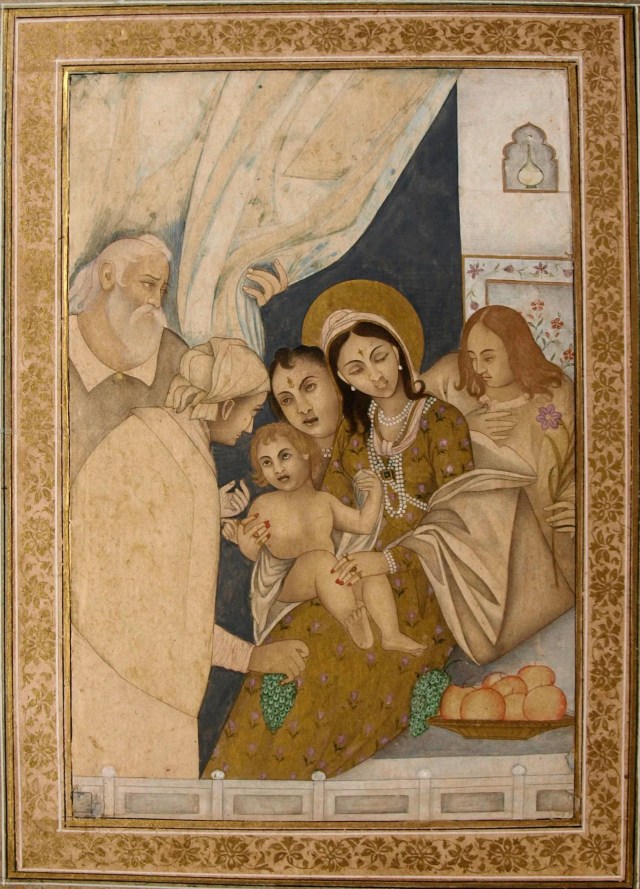
India: Mughal Nativity

Adoration of the Christ Child, from the Muraqqa of Nana Phadnis, Mughal India, 1620–30, Collection of Chhatrapati Shivaji Maharaj Vastu Sangrahalaya.

This painting is from the era of Emperor Jahangir (r. 1605–1627) of the Mughal dynasty, a Muslim Persianate dynasty of Turco-Mongol origin that ruled much of the Indian subcontinent from the 16th to 18th centuries. Like his father, Akbar, Jahangir was interested in Christian art and dialogue. He invited Jesuits into his court and instructed his artists to paint Christian themes after the European prints the Jesuits shared. This one is adapted from a Flemish engraving by Aegidius Sadeler II.

Mary sits with her naked son on her lap inside a refined Mughal interior, wearing a brocaded dress, multiple rings on her fingers, and a tilaka mark on her forehead. The identity of the three figures other than the at the center is indeterminate (unlike in the engraving). They may be visitors seeking to pay homage, attendants, relatives, or some mix thereof. The elderly woman with the headscarf and grapes, whom Jesus looks at curiously, may be a midwife or nurse. The flower-bearing person at the back may be an angel.

China: The Nativity by Luke Hua Xiaoxian

The Nativity, Luke Hua Xiaoxian, Collection of the Ricci Institute for Chinese-Western Cultural History, 1948.

In 1930, Catholic bishop Celso Costantini, the first apostolic delegate to China, was involved in establishing an art department at the new Catholic University of Peking (Beiping Furen Daxue). Its professors and students produced a beautiful crop of Chinese Christian watercolors on silk over the next two decades, until the Chinese government forcibly closed the university in 1952.

One preeminent example of an indigenized Nativity from Furen is by Luke Hua Xiaoxian. Situated at the mouth of a cave in a snowy, mountainous landscape, Mary and Joseph care for the infant Jesus while an angel kneels before him in adoration. Standing above them atop wisps of cloud are seven angels, portrayed in the style of Daoist (Taoist) immortal maidens, playing traditional Chinese instruments, including a pipa (lute), guqin (seven-stringed zither), and qinqin (banjo). Mounted as a hanging scroll, the painting has a starkly vertical orientation that is typical of classical Chinese art.

Korea: The Birth of Jesus Christ by Kim Ki-chang

The Birth of Jesus Christ, Kim Ki-chang, 1952–53.

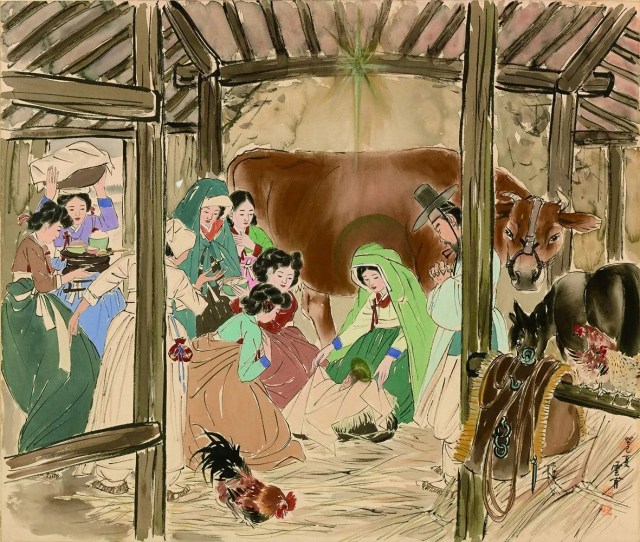
Born in Seoul to a Christian family, Kim Ki-chang (1914–2001), also known by the artist name Unbo (or Woonbo), came to fame with his traditional ink and brush paintings. During the Korean War, while he was taking refuge at his mother-in-law’s house in Gunsan, he had a series of visions that led him to execute 30 paintings on the life of Christ in this medium.

The scenes are set in Joseon-era Korea, which lasted from 1392 to 1910. In The Birth of Jesus Christ, Mary wears a hanbok—traditional Korean dress—while Joseph wears a wide-brimmed horsehair hat called a gat.

In addition to this reimagined ethnic context, Kim’s painting is unique in its heavy inclusion of women, who bring food for the new parents and blankets for the baby. It’s rare to find such a strong female presence at Jesus’ birth, as most Nativities, drawing on the Gospel accounts, feature wise men and the shepherds (whom artists have assumed to be male) as the main guests.

Indonesia: In Bethlehem by I Wayan Turun

In Bethlehem, I Wayan Turun, Collection of Stichting Zendingserfgoed, Zuidland, Netherlands, 1958.

Though titled In Bethlehem, the place depicted in this painting is decidedly not that ancient Near Eastern village! Balinese artist I Wayan Turun (1935–1986) relocates the event to the jungles of Ubud, where the infant Christ is laid down for a nap under a bamboo lean-to. Joseph wears a kamen (sarong) with a selendang (belt) and an udeng (headcloth), while Mary wears a kemben (chest wrap). Four agricultural laborers, wearing hats of woven straw or coconut leaves, have come to see the baby, and the animal witnesses include bats, a monkey, and cattle—taking a break from plowing the rice fields.

While Turun was Hindu, he was happy to oblige Western patrons who requested biblical scenes—like the Rev. Henk Visch and his wife, the Rev. Cor Tonsbeek, who worked for the Christian Church of Bali in the 1950s and 1960s and commissioned this painting from him.

Thailand: The Nativity by Sawai Chinnawong

The Nativity, Sawai Chinnawong, Collection of the Overseas Ministries Study Center, 2004.

Raised in a Theravada Buddhist household in rural Thailand, Sawai Chinnawong (b. 1959) is an ethnic Mon whose ancestors migrated from Myanmar. His childhood fascination with the local Buddhist temple murals eventually led him to art school in Bangkok, where he was drawn to a nearby Church of Christ community and became a Christian at age 23.

The pastor who baptized him told him his art was too Buddhist and that he had to forsake it. He did—until the next year, in seminary, when he received affirmation from Sri Lankan Christian artist Nalini Jayasuriya that Asian artistic modes can still be compatible with Christian belief. From then on, he has committed himself to painting the gospel in a Thai idiom.

“I believe Jesus Christ is present in every culture, and I have chosen to celebrate his presence in our lives through Thai traditional cultural forms,” Chinnawong said. “My belief is that Jesus did not choose just one people to hear his Word but chose to make his home in every human heart. And just as his Word may be spoken in every language, so the visual message can be shared in the beauty of the many styles of artistry around the world.”

Chinnawong’s 2004 Nativity shows the holy family camped out under a village sala, an open pavilion found on Thai roadsides for strangers to rest or spend the night. Men, women, and children ride in on water buffalo, a traditional form of transportation, to greet the babe. The children sport traditional Thai hairstyles—shaved heads with a Jook (top knot) or a Klae (two ponytails)—as does Joseph. A zigzag line called a sinthao runs across the top of the scene, demarcating heaven and earth, except a star interpenetrates the two realms, suggesting their union.

Japan: Nativity by Sadao Watanabe

Nativity, Sadao Watanabe, Collection of the Art Institute of Chicago, 1963.

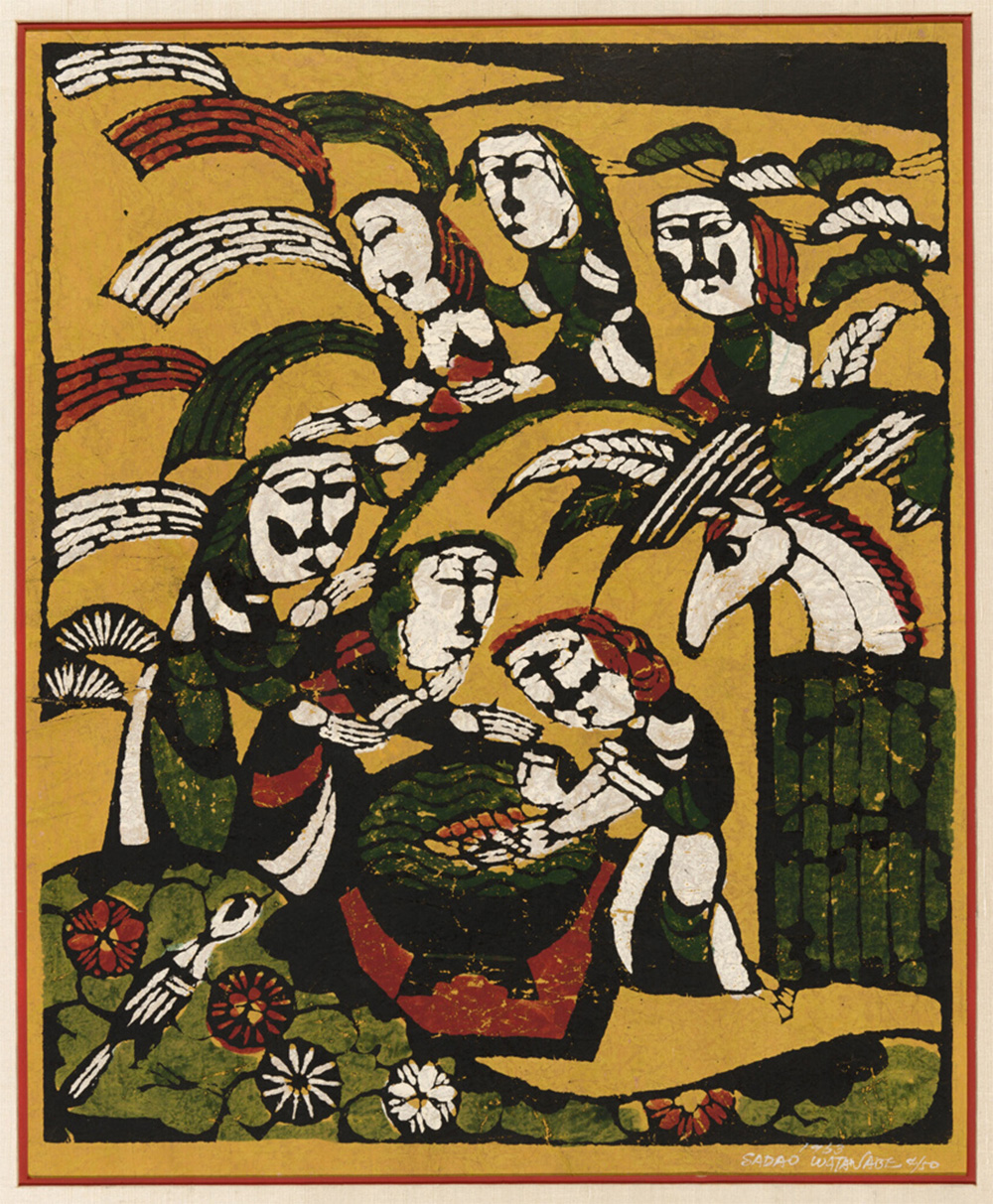
The most prolific Asian artist of the 20th century working on biblical themes was Sadao Watanabe (1913–1996) of Japan, who converted from Buddhism to Christianity at age 17. Originally trained as a textile dyer, he pursued a career in printmaking and used a technique called katazome, which entails cut-paper stenciling and dyeing with a variety of natural mineral and organic pigments.

To help correct the common misconception among Japanese people that Christianity is irreconcilable with their culture, Watanabe sought to retell the entire narrative of Scripture using a Japanese aesthetic. “I owe my life to Christ and the gospel,” he said. “My way of expressing my gratitude is to witness to my faith through the medium of biblical scenes.”

In Watanabe’s 1963 Nativity, a procession of eager visitors winds its way over the undulating hills to the Christ child, whom Mary props up in the manger. A bird perched on a lily pad in a lotus pond inclines its head toward the infant, wanting to get a closer look—mirroring the horse, who does the same. Even the sago palm bends its leaves down, as if it too is worshipping.

The Philippines: Ang Kahulugan ng Pasko (The Meaning of Christmas) by Kristoffer Ardeña

Ang Kahulugan ng Pasko (The Meaning of Christmas), Kristoffer Ardeña, 1995.

In this aerial-perspective Filipino Nativity by Kristoffer Ardeña (b. 1976), villagers with candles gather round the newborn Christ on a handwoven mat. They stand under a parol, a traditional star-shaped lantern made of bamboo sticks and rice paper, meant to symbolize the star of Bethlehem. Flanking the star are a northern tribesman of Luzon (left) and a street sweeper (right), representing how people came from both far and near.

At the bottom, the tastes and flavors of the street market come to the crib as vendors approach with eggplant and calabaza (squash), fish, and balut (steamed duck eggs). Ardeña substituted these three figures for the Magi who brought gold, frankincense, and myrrh because he wanted to emphasize that Jesus’ birth is for the poor as well, and that simple gifts given in love are just as dear to Jesus as any other, according to his artist’s statement in the December 1996 issue of Image: Christ and Art in Asia.

In the center is the holy family, embraced by the wings of a dove with multicolored feathers. Jesus is wrapped in cloth distinctive to the Igorot tribe of Luzon. He wears a necklace of animal bones, a characteristic ornament of an Igorot chief.

Beneath them, on either side of the fish, are two house lizards. The artist said this is a reference to the folk belief that every evening at six, the lizards come down from the ceiling to kiss the floor in reverence to God. If even the lizards honor Christ, he says, then why don’t we?

Victoria Emily Jones blogs at ArtandTheology.org, curates art for the Daily Prayer Project, and serves as a creative director of the Eliot Society.

Books

My Top 5 Books for Christians on Islam in Europe

A British missiologist gives his recommendations for reading up on the world’s second largest religion

Christianity Today December 18, 2023
Illustration by Christianity Today / Source Images: Wikimedia Commons

In this series

Touching the Soul of Islam, by Bill Musk

When talking about Muslim-Christian engagement, I always start with this sensitive and eye-opening book. Islam is seen as “a way of life” that touches all aspects of a Muslim’s life. Bill Musk, a retired Anglican bishop for North Africa, focuses on helping Westerners understand a Muslim’s worldview, including dynamics like honor and shame and the family and the individual. His aim is to help us understand how our Muslim neighbors think and react, so that we can present the gospel to them in a way that they can hear. Together with the follow-up companion book The Unseen Face of Islam, this work is an excellent entry into exploring these important areas with Musk as a trustworthy guide.

Holy Books Have a History, by Keith Small

When talking with our Muslim friends about faith, very quickly the topic of trustworthiness of the scriptures will come up. Typically the Quran is presented as perfectly preserved and the Bible will be perceived as changed and corrupted. Keith Small’s work on texts and manuscripts is a helpful input into this discussion. The Bible has been subject to intense scrutiny of textual criticism for more than 100 years, but this process has only just begun for the Quran. Indeed, Dr Small’s own work is one of the ground-breaking approaches in this area.

Holy Books Have a History is both accessible and enjoyable, with helpful reproductions of key early Quranic manuscripts, clearly showing that it too has a textual history. This is not to say it’s full of errors but rather to illustrate that both the New Testament and the Quran have textual problems and strengths. The key point here is that the Quran and New Testament are similar in textual reliability and that we can’t reject this in one and accept it in the other.

Thinking Biblically About Islam, by Ida Glaser and Hannah Kay

Many of us have a number of Muslims as friends, work colleagues, neighbors, and family. To help us engage well in the midst of this major change, Ida Glaser and Hannah Kay provide a framework for thinking and for taking to the Bible questions raised by our interactions with Muslims.

The authors encourage us to read the Bible looking at the world in which the text was written, the composition of the text, and then the significance of this for today, modeling this approach on Genesis and the Transfiguration. They maintain that the takeaways from examining these two sections in this way can then be used to illuminate discussions of faith with Muslim friends.

It is a wonderfully sensitive book. Although it is particularly helpful for church leaders and those engaging with Muslims, it’s also a very good model for how to think biblically on any subject in our modern, changing world.

Last Resort: Migration and the Middle East, by Jonathan Andrews

Immigration is one of those hot topics that people vehemently disagree about and that has been part of the downfall of more than one politician. It’s also a key part of how Europe is being shaped.

Religious freedom advocate Jonathan Andrews’s book looks at immigration’s impact on religious communities, as well as the forces upon the mass movement of people from the Middle East, especially its historic Christian communities. This book offers a thought-provoking argument about why we should want these communities to stay in their homelands while also helping us better understand the Middle Eastern context and our refugee and migrant neighbors.

Seeking Allah, Finding Jesus, by Nabeel Qureshi

One of the best guides for Christians looking to see how to present Jesus to their Muslim friends, Nabeel Qureshi’s book is not only a personal journey of his encounter with and faith in Jesus but also an incredibly insightful exploration of key questions that Muslims face as they get to know Jesus better. Qureshi relates his struggles with issues like Jesus being the Son of God, comprehending the Trinity, and what happened at the Crucifixion (and therefore the nature of salvation) in a way that engages the reader both intellectually and emotionally. His chapter on understanding the Trinity alone is worth reading by any Christian wanting to know how to grasp the concept and stand firm on it.

One note of caution is that Qureshi was Ahmadiyya, an offshoot of Islam that other Muslims often despise, and if brought directly into a conversation with a Muslim colleague, that fact may shut the conversation down. That being said, this is the one book I would recommend to any who want to engage in matters of faith with their Muslim friends.

Read our authors’ bio in the series’ lead article, The Best Books for Understanding Islam and Connecting with Your Muslim Neighbors. (Other articles in this special series are listed to the right on desktop or below on mobile.)

Editor’s note: Curated lists in this religious literacy series for Christians include the best books for better understanding Islam (in five regions), Hinduism, Buddhism, Sikhism, the Druze, Daoism, Confucianism, and the sinicization of Christianity in China.

CT also offers a top 5 books list on Orthodox Christianity, among scores of subjects.

Apple PodcastsDown ArrowDown ArrowDown Arrowarrow_left_altLeft ArrowLeft ArrowRight ArrowRight ArrowRight Arrowarrow_up_altUp ArrowUp ArrowAvailable at Amazoncaret-downCloseCloseEmailEmailExpandExpandExternalExternalFacebookfacebook-squareGiftGiftGooglegoogleGoogle KeephamburgerInstagraminstagram-squareLinkLinklinkedin-squareListenListenListenChristianity TodayCT Creative Studio Logologo_orgMegaphoneMenuMenupausePinterestPlayPlayPocketPodcastRSSRSSSaveSaveSaveSearchSearchsearchSpotifyStitcherTelegramTable of ContentsTable of Contentstwitter-squareWhatsAppXYouTubeYouTube