Books

Five Books to Encourage Single Parents

Chosen by Anna Meade Harris, author of ‘God’s Grace for Every Family: Biblical Encouragement for Single Parent Families and the Churches That Seek to Love Them Well.’

Illustration by Elizabeth Kaye / Source Images: Getty / Pexels

Prayer in the Night: For Those Who Work or Watch or Weep

Tish Harrison Warren

Overwhelmed single moms and dads will identify with Warren’s struggle to pray after multiple losses in her life. She found the words she needed in Compline, an ancient prayer that lifts our human vulnerability up to God. Single parents work, watch, and weep alone, standing guard over their defenseless children, often without much support. Warren offers a way back into prayerful conversation with the God who neither slumbers nor sleeps.

Everything Sad Is Untrue: (a true story)

Daniel Nayeri

Nayeri relates his experience in a sixth-grade classroom in Oklahoma after fleeing Iran when his mom becomes a Christian. His father stays behind, his absence as formidable as his presence had been. The agonizing long-distance phone calls between father and son will be familiar to parents and children in the wake of divorce. Part memoir, part fiction, all masterful storytelling, this book attests to the enduring hope Daniel finds in his mother’s faith.

The Mockingbird Devotional: Good News for Today (and Every Day)

Edited by Ethan Richardson and Sean Norris

Single parents generally have little bandwidth for reading dense theology, but this 365-day devotional offers ample theological bang for the harried single parent’s quiet-time buck. Exploring key biblical doctrines through Scripture, plus story, music, and movie references, multiple contributors proclaim the gospel with clear-eyed realism about our brokenness, our need for a Savior, and the grace we have in Jesus.

The Ragamuffin Gospel: Good News for the Bedraggled, Beat-Up, and Burnt Out

Brennan Manning

For weary single parents who feel they never have enough time, energy, money, or patience, Manning shows that Jesus’ love for broken humanity depends not on what we do or fail to do but on who Jesus is. No matter how far we are falling short, Jesus loves us because he loves us, and oh, how he loves us.

Surrender: 40 Songs, One Story

Bono

Raised by his father after his mother’s sudden death, U2 frontman Bono narrates the audiobook version of his memoir with the humor, pathos, and style of a consummate performer. This one’s mainly for fun (something single parents don’t get much of), but Bono shares honestly about lingering grief for his mother and complicated attempts to connect with his father who won’t discuss her death.

Books

New & Noteworthy Fiction

Chosen by Jamie Lapeyrolerie, writer and editor for WaterBrook and Multomah.

I Must Betray You

Ruta Sepetys

Following a lesser-known, or I should say, lesser-told story of Communist Romania in 1989, I Must Betray You takes readers through the horrific living environments and everyday terror faced by the Romanian people. Through the eyes of those who resisted Nicolae Ceaușescu, we see the tyranny of his totalitarian regime but also the bravery of the many people who stood up and finally took it down. A gut-wrenching tale that awakens readers to the reality of what millions endured, the novel also gives hope in depicting a courageous willingness to stand against evil, even at great cost.

When the Day Comes

Gabrielle Meyer

Born with the supernatural ability to live in both colonial Williamsburg on the brink of the American Revolution and in New York City before World War I, Libby alternates between these lives each day. The Libby of 1774 supports the American patriots and the man she loves, while 1914 Libby, passionate about women’s suffrage, longs for more than Gilded Age privilege and being married off to a man of her mother’s choosing. As her 21st birthday inches closer, she must decide which path to follow and which to give up. This creative, inspirational novel will entertain readers and keep them guessing.

Pride

Ibi Zoboi

Going beyond a traditional enemies-to-lovers retelling of Jane Austen’s Pride and Prejudice, Ibi Zoboi’s Pride brings timely depth to a beloved story. Zuri Benitez takes pride in Brooklyn, her family, and her Afro-Latino roots. But as her neighborhood gentrifies, she no longer recognizes her beloved community. When the wealthy Darcy family moves in across the street, Zuri’s sister falls for the older brother, but Zuri wants nothing to do with Darius, the younger brother. As they get to know one another, however, the walls between them break down. Pride speaks naturally to issues like gentrification, racism, and sexism while staying true to Austen’s original story.

Books
Review

The Surprising Practicality of Christian Philosophy

For believers, pursuing a philosophical life is the opposite of having your head in the clouds.

Illustration by Elizabeth Kaye / Source Images: Unsplash

Philosophy sometimes gets a bad reputation, even in Christian circles. As some critics might put it: Philosophy is an impractical and worthless way to spend your time. It might even undermine your faith.

Christian Philosophy as a Way of Life: An Invitation to Wonder

Christian Philosophy as a Way of Life: An Invitation to Wonder

Baker Academic

208 pages

In contrast, Ross Inman argues, “It’s hard to see what could be more practical than living philosophically as a Christian.” Inman is associate professor of philosophy at Southeastern Baptist Theological Seminary. His book Christian Philosophy as a Way of Life: An Invitation to Wonder makes a clear, convincing case for the value of philosophy.

Inman’s approach presupposes a Christian worldview. His target audience, as he explains, is “Christians who are philosophical novices, those who are coming to the study of philosophy for the very first time.” He does not have in mind someone who is studying philosophy merely as a graduation requirement or for a GPA boost. Rather, he has in mind someone approaching philosophy as a fruitful way of life.

There is a long history of thinking of philosophy in this way going back to the ancient Greeks, among others. But Inman takes a distinctly Christian approach, spelling out three conditions. The first, he says, is committing to an existential map shaped by the Christian story. This means viewing Christian faith as the central resource for answering questions lying at the heart of philosophy, such as: What is real? What is a truly good life? And how does one become a good person?

Second, says Inman, practitioners of a Christian philosophical way of life should orient their lives around a Christian existential map. Their everyday practices should align with a vision of reality and the good life shaped by the Christian story.

And third, they should engage in grace-empowered, truth-directed practices. Inman notes that there were spiritual exercises, like self-examination and memorization, that characterized the life of philosophy in ancient Greece. But Christian philosophers of antiquity stressed that only God’s grace would enable the spiritual exercises to do their work.

Perhaps more than anything, the Christian philosophical way of life, when carried out well, is closely bound up with wonder. For Inman, wonder has two central features. The first is a “perceived vastness”—the experience of something larger than ourselves or the confines of our limited perspectives. The other feature is a “need for accommodation” of this new perspective. As Inman writes, “We are summoned to enlarge the narrow confines of our soul to make room for the new experience and perhaps even to correct the mistaken way that we once viewed the world.”

Tying this back to Christian philosophy, he says, “We might summarize the Christian philosophical life as a life that is devoted to cultivating a deep sense of the wonder of it all, ultimately in light of the true meaning and purpose of all created things in Christ.” This leads him to make the bold claim that “only within a Christian conception of reality is the wonder-filled philosophical life possible.”

What about the practicality of philosophy? The practicality of something depends on its purpose. On this subject, Inman cites Tom Morris’s Philosophy for Dummies, where Morris argues:

Something is practical if it helps you realize your goals. If your goals include knowing who you really are, what life in this world is all about, and what’s ultimately important, then philosophy is eminently practical. If these things are not among your goals, well, then you need new goals.

Believers’ ultimate goals include being properly oriented toward God and neighbor, both cognitively (in truth) and affectively (in love). Philosophy can be greatly instrumental in achieving those goals. Thus for Christians, according to Inman, philosophy is perhaps the most practical way to live of all.

Inman’s discussion is compelling, but I want to offer two minor suggestions for improvement. First, I might have suggested that Inman do more to answer the question What do philosophers actually do? For instance, the first few chapters might have benefited from more detailed examples of common philosophical arguments or discussions, with elements of wonder and practicality highlighted.

Additionally, Inman tends to focus on philosophical questions about reality (metaphysics), knowledge (epistemology), and value (ethics). But philosophy, as practiced today, is extremely diverse in both the topics it considers and in its methodology.

So my second suggestion would have been to tackle questions like these: Would Inman’s arguments hold for the Christian philosopher who primarily works on logic and abstract proofs? What about the historian of philosophy, the philosopher of science, or the philosopher of language? In general, are some areas of philosophy better geared toward Inman’s discussion of wonder and practicality than others?

On the whole, however, Inman’s book helps open up an exciting philosophical world to explore. From there, readers can go in a number of different directions in learning more about a Christian philosophical way of life. More historically, two good starting points are Augustine’s Confessions and Boethius’s On the Consolation of Philosophy. From the 20th century, C. S. Lewis’s Mere Christianity would be a great option. Among more recent choices, I would recommend C. Stephen Layman’s Letters to Doubting Thomas and Michael Murray’s essay collection Reason for the Hope Within.

Christian Philosophy as a Way of Life is excellent. As someone who has been doing philosophy professionally for over 30 years, I am not the intended reader. But I still learned a great deal. And it is very reassuring to see, in such a clear and compelling way, the case being made for what I have devoted my life to doing.

Christian B. Miller is the A. C. Reid Professor of Philosophy at Wake Forest University. His books include The Character Gap: How Good Are We? and Honesty: The Philosophy and Psychology of a Neglected Virtue.

Books
Review

The Bible Was Written to Be Heard and Spoken to Be Read

God’s Word has oral and textual dimensions, and we shouldn’t pit them against one another.

Illustration by Michael Hirshon

The work of popularizers is honorable and necessary. But it isn’t always successful.

Hear Ye the Word of the Lord: What We Miss If We Only Read the Bible

Hear Ye the Word of the Lord: What We Miss If We Only Read the Bible

IVP Academic

216 pages

Sometimes popularizers fail because they’re poor exponents of good ideas. This does not describe biblical scholar D. Brent Sandy, author of Hear Ye the Word of the Lord: What We Miss If We Only Read the Bible.

No, Sandy has failed because he is a good exponent of poor ideas. I’ve rarely read such a graciously written but ultimately unpersuasive book.

Sandy’s thesis is announced early, and it is based on a contrast between the ancient biblical world of hearing and our modern world of reading. As he argues, “The farther apart … the worlds of hearing and reading are, the less those in one world will understand the other.”

Sandy is careful, at least at the beginning, not to draw too sharp a distinction between these means of receiving Scripture. “The challenge we face in this book,” he writes, is not “orality versus literacy, as if one is better than the other. … [It’s] not hearing versus reading; there is room for both. [It’s] not that oral and written communication are opposites.”

By the time Sandy ends his thesis statement, he is sounding far more tentative than his bold book title might suggest. He offers a gentle question rather than a stirring declaration: “Being twenty-first century readers born and groomed in modern textual culture, can we sufficiently understand the meaning of documents originating in ancient oral culture simply by reading them?”

Sandy never hectors the reader, but he gets progressively less tentative as his book moves through 17 propositions about what he sees as the oral nature of God’s original revelation. He believes orality is essential—“vital”—to understanding the Bible.

Let me summarize Sandy’s propositions. “God,” he writes, “reached across great distances—so must we.” And a hallmark of that distance is the gap between text-based cultures (ours) and oral ones (like those the biblical writers inhabited). God’s revelation was originally for the latter; it was “intended for hearers.” Thankfully, “research provides important insights into ancient oral culture.” If we simply “include their hearing in our reading,” remembering that “stories were performed and heard in ancient oral culture,” then “we can become better hearers and speakers” of God’s Word.

In advancing these arguments, Sandy is popularizing the work of scholars like Walter Ong, who shows up often in his footnotes. As Sandy notes, “Over the past several decades scholars have produced a cascade of studies, articles and books [on the orality of Scripture] encompassing thousands of pages, too vast to synthesize and include in this brief book.”

I confess I have yet to wade into this particular cascade, even though my own work (for a Bible software company) revolves around Scripture and those who study it. I was hoping Sandy would help reveal what I have been missing in my Bible throughout my highly textual modern life.

By my Kindle’s count, I had finished 40 percent of the book before reaching Sandy’s first real, concrete attempt to provide insight into Scripture through the concept of orality. Commenting on the prologue to the Gospel of Luke, he writes, “Most people today read the prologue from a textual perspective. But hearing it from an oral framework clarifies what Luke intended to communicate.”

I don’t see, however, how anything Sandy observes in the prologue is discernible only through an oral framework. I’ve known for some time, through reading Luke 1:1–4 in print, that, to quote Sandy, “various accounts of Jesus’ deeds preceded the text [Luke] was writing,” that “eyewitnesses and others were involved in the transmission process,” and that “what had been passed along [to Luke] was reliable information.” I had never assumed that Luke collected only written accounts or that he never talked to anyone.

I was, frankly, disappointed at this point in the book. I was open to finding more of a place for Scripture’s original orality. I wanted Sandy to persuade me that I had an empty slot in my hermeneutical tool belt. It’s exciting to gain a new perspective on God’s Word.

The book certainly has moments of acute perception, like Sandy’s discussion of orality in Hebrews 1, for example. And it offers some helpful suggestions, several of which—like reading the Bible out loud with feeling, reading it in group settings, or putting portions of it into verse—I’ve practiced for years. (I did appreciate Sandy’s suggestion that seminaries should “offer courses in the oral performance of Scripture.”)

On the whole, however, the book failed to deliver on its promise. There are few insights into actual Bible passages that are clearly traceable to Sandy’s thesis.

In fact, I would argue that careful analysis of the Scriptures suggests that they weren’t all originally—or somehow fundamentally or primarily—oral in nature.

Take the Psalms, for instance. Were they originally oral? Many include superscriptions suggesting strongly that they weren’t. When David addressed various psalms “to the choirmaster,” how did the choirmaster receive them? Almost certainly on the ancient equivalent of a steno pad.

Think of the superscription above Psalm 18, the second-longest superscription in all the Psalms:

For the director of music. Of David the servant of the Lord. He sang to the Lord the words of this song when the Lord delivered him from the hand of all his enemies and from the hand of Saul. He said:

But what David goes on to “say” takes the form of highly structured and lengthy Hebrew poetry. The most plausible explanation is that it was originally composed in writing.

Moreover, in Scripture (as in daily speech), “saying” is used as a natural metaphor for writing. Think of Paul’s words in Romans 9:17: “Scripture says to Pharaoh: ‘I raised you up for this very purpose.’” Scripture, by definition, means writing—but writings speak. Or consider James, who in his famous hearing-and-doing passage (1:19–27) freely mixes ear metaphors (“do not merely listen”) and eye metaphors (“whoever looks intently into the perfect law”).

Sandy’s attempt to highlight the oral dimension of Scripture works best in the prophetic books and in the life of Jesus. It is indeed interesting that Jesus never wrote anything down, and Sandy was thought-provoking on this topic. I can see the likelihood of oral traditions lying at the foundation of the Gospels, and I think the orality of ancient culture is useful to New Testament interpreters studying the reliability of the Gospels.

But I do not see the Bible as fundamentally oral rather than written. Unfortunately, as the book progresses, Sandy seems to rely on a dichotomy his thesis had earlier rejected. “Our focus,” he writes, “should be listening for the voice of God, rather than only analyzing the printed words on a page.”

This seems to pit hearing and reading against each other. But shouldn’t they work in concert? What about listening for the voice of God precisely by means of studying printed words—with all the analytical tools furnished by one’s tradition, one’s training, and one’s gifts?

And some of Sandy’s comments about orality almost sound like a critique of what some biblical writers in fact did—and did under the inspiration of the Spirit of God. As he writes, “Reducing spoken words to written or printed form is actually an act of decontextualization, resulting in a written account not containing a full sense of the original content, and therefore has inherent limitations.” Yes, written words can come with less context than spoken ones, or at least different context. But this is true for every act of communication that lasts beyond the immediate circumstances of its origin.

Sandy insists that his goal “is not to devalue the written Word but to reorient our thinking to the original and proper place of oral revelation.” But I came away from his book more unsettled than helped. Personally, at least, I have most often encountered appeals to the originally oral character of the Bible’s words as a means of evading what the written words say.

I do not believe that Sandy does this in his book. Even so, it’s worth remembering an observation from the theologian Albert Schweitzer in his 1906 book The Quest of the Historical Jesus: Often enough, when we look back into the well of the past, we find our own reflection staring back. It stands to reason, then, that when we overturn traditional readings of the Bible by appeals to its historical and cultural backgrounds, we risk arriving at readings more amenable to our contemporary cultural foregrounds.

According to Sandy, “research demonstrates [that] ‘we were never born to read.’” But the authorities he cites are non-Christians, including Harvard psychologist Steven Pinker. How, without reference to a Creator God, do they know what we were “born” to do?

I side instead with former CT editor Andy Crouch, whose excellent book Culture Making reminds us that we were originally born to uncoil the potentialities of God’s creation. God blessed us with a cultural mandate: “Be fruitful and increase in number; fill the earth and subdue it” (Gen. 1:28). For a Christian to say that “we were never born to read” is to ascribe an intentionality to God beyond anything he has spoken or written.

A mild irony here is that much of my current Bible “reading” happens through audio Bibles. I tend to listen to the Bible in daily doses but then do deep dives with my digital tools. Over the last 15 years, I’ve made attempts to discern a difference between my encounters with the Bible through different media. But if a difference is there, I have yet to perceive it.

Mark Ward is senior editor for digital content at Logos Bible Study and host of a YouTube channel dedicated to Bible translation (@markwardonwords). He is the author of several books and textbooks, including Authorized: The Use and Misuse of the King James Bible.

Books

Can Christian Colleges Make the Grade?

An experienced evangelical educator sees challenges ahead—but opportunities too.

Illustration by Elizabeth Kaye / Source Images: Getty / Wikimedia Commons

Of the approximately 900 religiously affiliated colleges in the United States, over 200 maintain some sort of evangelical identity. In his memoir Academically Speaking: Lessons from a Life in Christian Higher Education, seasoned educator Rick Ostrander recounts his vocational journey while offering reflections on evangelical higher education. Nathan Finn, executive director of the Institute for Transformational Leadership at North Greenville University, spoke with Ostrander about the challenges and opportunities facing evangelical colleges.

Academically Speaking: Lessons from a Life in Christian Higher Education

Academically Speaking: Lessons from a Life in Christian Higher Education

Wm. B. Eerdmans

216 pages

You are still in the middle of your career in Christian higher education. Why write this memoir now?

I wanted to write about two topics. One is the world of Christian higher education, which I want both insiders and outsiders to better understand. The other is the importance of trusting God amid uncertainty. I have spent my entire adult life in Christian higher education, working in a variety of contexts. But there have also been some unexpected and even unwanted twists and turns. I’ve learned throughout that God is faithful and I can trust him.

Mark Noll published his seminal book The Scandal of the Evangelical Mind 30 years ago. What, in your view, is the current state of the evangelical mind?

There were two fronts Noll and others wanted to address. One was advancing Christian voices within the academy. We have seen progress in the number of Christian academics, including tenured professors in non-Christian institutions.

I see less progress, though, on the second front: cultivating an evangelical mind in local churches. Evangelicalism is marked by an inherent populism, which can work against scholarly voices. And political polarization seems to have magnified these anti-intellectual tendencies.

Another challenge for many Christian colleges is the need to focus on pragmatic matters like enrollment and budgets. Schools struggle to create the space for Christian scholars to pursue high-level thinking and scholarship.

In Christian higher education circles, one hears a great deal about integrating faith and learning. How would you explain this concept to someone outside these circles?

This phrase means different things to different academics. For me, it suggests an ideal of faculty integrating faith into their sense of vocation, their teaching, and their scholarship. When I attended Moody Bible Institute in the 1980s, there was an implied hierarchy that treated academia and other professions as less spiritual than full-time ministry work. But God calls some people to become academics who glorify him with excellent teaching and scholarship rooted in a Christian worldview.

Integration looks different depending on one’s discipline, but our beliefs should influence our teaching and scholarship. Integration also means helping students understand how their studies make a difference in the world.

What are some of the challenges and opportunities currently facing Christian higher education?

One challenge, at Christian schools and elsewhere, is what higher education experts call the upcoming demographic cliff. Declining birth rates eventually lead to shrinking applicant pools, which is the situation unfolding today. When schools struggle to attract students, they can also struggle to support the work of their faculty. Another set of challenges relates to cultural and political tensions in American society. Christians seem to be increasingly polarized, and some evangelical schools struggle to span the divide rather than simply reflect one constituency in the culture wars.

When it comes to opportunities, Christian institutions are ideally positioned to offer a deep level of community that students are looking for. Whether they are Christian or not, students want to be part of something bigger than themselves and to feel like they are really known by professors, staff, and other students. Cultivating a strong sense of community is profoundly Christian, besides making good business sense.

What advice do you have for graduate students who want to teach at a Christian college or university?

First, I would stress the importance of being realistic. It’s a tough job market, especially in the liberal arts, and finding full-time positions will only get harder. But if you feel that God is calling you to Christian higher education, then pursue that path. In the book, I recount how my own vocation has changed over time, from that of a professor to a host of other interesting roles. Remain open to other ways of using your graduate education, try not to look too far down the road, and trust that God will place you where he wants you to serve for each season of life.

What is the future of online education?

Online education will never equal undergraduate education in a residential setting. Too much is lost in terms of community. But online and hybrid courses offer greater flexibility to educate current students and reach new audiences, even at traditional institutions. Online courses can also help more students study abroad while still taking courses at their home institution.

Online programs will become an increasingly important source of revenue for schools, but they are not the financial gravy train that many would have forecasted 20 years ago. Still, they do provide other benefits. For example, I continue to work with Acadeum, a company that provides an online course-sharing consortium for independent colleges and universities. This is a creative way for schools to lower costs by accessing online courses from other schools with similar missions.

Why, in your view, should Christian schools emphasize study abroad programs?

I think these programs are crucial, but some worry that they can draw needed resources away from campus. One useful approach in financially challenging times is connecting study abroad opportunities with curricula that students are already committed to by virtue of their majors. Most study abroad programs are currently in the humanities, so another opportunity is creating similar pathways for the growing number of students majoring in STEM disciplines and professional fields. If our goal is producing well-educated Christian students for a global society, there is no substitute for giving them embodied cross-cultural experiences.

You recently became the founding director of the Michigan Christian Study Center. What role do these study centers play in Christian higher education?

I first became aware of this movement when I was working in Washington, DC, for the Council for Christian Colleges and Universities and was introduced to the Center for Christian Study at the University of Virginia. I appreciate how this model embeds many of the best features of Christian colleges within the nation’s leading research universities, with their considerable resources and cultural influence.

Christian study centers cultivate vibrant Christian learning communities that can nurture and support students and professors in pluralistic educational contexts. There will always be a place for private Christian colleges and universities like the ones where I’ve worked. But as a devoted Michigan alum, I’m excited to see this new form of Christian higher education planted there, and I hope something similar will take root at more institutions across the country.

Theology

Empty Streets to the Empty Grave

While reporting in Israel, photographer Michael Winters captures an unusually vacant experience at the Church of the Holy Sepulcher.

Old City, Jerusalem

Old City, Jerusalem

Photograph by Michael Winters

Inside the Church of the Holy Sepulcher in Jerusalem is a carved stone in the shape of a goblet. Carved into the cup of the goblet is a circle within a cross within a circle. It’s called the Omphalos, and it represents the center or “navel” of the world. According to tradition going back to at least the fourth century, the Church of the Holy Sepulcher stands in the place where Jesus was crucified, buried, and resurrected. For Christians, there is a centrality to this place. Strangely though, while Israel is at war, the streets surrounding it are quite empty.

In November 2023, shortly after war broke out between Hamas and Israel, I traveled to Israel with Mike Cosper to assist with audio and photography for The Bulletin podcast. Our hotel in Jerusalem was within walking distance of the Old City, and between scheduled interviews and day trips, we visited the walled city and the Church of the Holy Sepulcher.

Without people filling the narrow, winding streets of old Jerusalem, the monotony of stone is overwhelming. Stones are underfoot and in all directions. Occasional signs point toward the Holy Sepulcher, and suddenly the maze of streets leads to a courtyard, also made of stone. From across the courtyard, the conglomeration of buildings that make up the church don’t form an impressive façade, but up close the graffiti of centuries is carved into its pillars: hundreds of crosses scratched here and there, large and small. It makes you wonder who carved these crosses—and when?

Pillars outside the entrance of the Church of the Holy Sepulcher.Photograph by Michael Winters
Pillars outside the entrance of the Church of the Holy Sepulcher.
A bench just inside the church.Photograph by Michael Winters
A bench just inside the church.

Upon entering through an ancient wooden door with very few people around, the thick quiet and the dim light are calming. It’s strange how the inside of a place can be so different from the outside. You can no longer hear fighter jets or car horns. With no tour guides and not a single sign to describe anything, visitors are forced to take it in without being sure of what they are seeing.

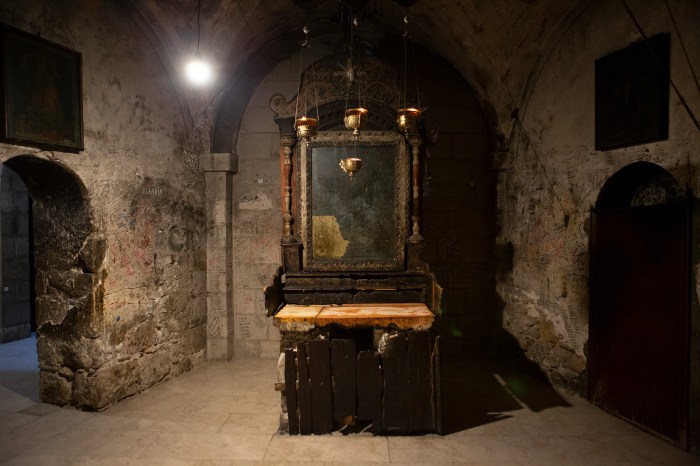
Wandering around, I find many doors closed, but one open doorway leads me down to a room unlike the others. Glowing from a bare light bulb that is both too bright and not bright enough, a strange mix of reverence and neglect swirls in the air. Soot darkens a crucifixion painting hanging on the wall, rendering it barely visible. A blackened, cracked painting sits on a broken-down altarlike structure. Painted directly on the walls are remnants of ancient decorative murals, along with thousands of recent notes and names drawn in paint marker. Tucked away in a corner, two first-century tombs are cut into the bedrock. Some traditions believe one of these tombs belonged to Joseph of Arimathea. Of all the areas I see during my visit, this easy-to-miss room has the most obvious connection to death, giving it a certain resonance as I think of the war going on a couple hours south of here.

Additional tomb sites in the Church of the Holy Sepulcher.Photograph by Michael Winters
Additional tomb sites in the Church of the Holy Sepulcher.

Back in a main room, the tomb of Jesus rests inside the Aedicule, a one-person chapel under a large, gorgeous dome. There’s usually a long line, but today, there’s no one else around.

It’s embarrassing to admit, but now back home in Kentucky reflecting on all this, I recall wondering which part of the church was dedicated to Christ’s resurrection. At the time, I was only thinking of the tomb in relation to Christ’s death. Of course, the tomb is also the site of his resurrection! The whole reason the Church of the Holy Sepulcher exists is because this tomb was found empty.

The dome above the tomb chapel.Photograph by Michael Winters
The dome above the tomb chapel.
The chapel built around the traditional site of Jesus’ tomb. Photograph by Michael Winters
The chapel built around the traditional site of Jesus’ tomb.

It’s easy to focus on problems, on death. I’m still thinking about the rocks stacked up and torn down over centuries. I’m thinking of the destruction I saw from Hamas’s attack. I’m thinking of the rubble in Gaza. But while we mourn that the streets of Jerusalem are empty, we can celebrate that the tomb is empty too. The tomb of death is also the site of the Resurrection. May we keep the Resurrection front of mind and heart. God, have mercy—and make wars cease to the ends of the earth (Ps. 46:9).

Michael Winters is a photographer and the curator for Sojourn Midtown’s art gallery in Louisville, Kentucky.

News

An Orphan Took Over an Orphanage. Its Mission Changed.

Emanuel Nabieu was taken in by the Child Rescue Center 16 years ago. Now he is taking the organization in a different direction.

Illustration by Christian Blaza

When Emmanuel Nabieu started working at the Child Rescue Centre in Sierra Leone, he was, in a way, coming home.

Sixteen years earlier—July 4, 2000—the orphanage had taken him in.

At nine years old, his life was upended by civil war. His father was killed during an attack on his village, and he was separated from his mother in the chaos that followed. The stability of his extended family structure was shattered. The last living relative he knew of, an uncle, couldn’t afford to care for him.

An orphanage seemed like the only option. He was brought to the Child Rescue Centre. And from that point on, that was his home.

“I lived in a nice children’s home with all the facilities,” Nabieu, or Nabs, as he is now known by everyone, told CT. “But I really longed to be loved.”

When Nabieu grew up and went to school at Njala University in Sierra Leone and then the University of South Wales, he learned that 80 to 90 percent of orphans—like him—had a living family member who could care for them with the right resources and support. Looking at the files at the Child Rescue Centre in 2016, he was shocked to discover that 98 percent of the children cared for by the ministry had had a living family member.

“The orphanages … were not really serving orphans,” said Nabieu, who wrote about his experience and his vision for caring for children in My Long Journey Back Home. “They were just serving children from poor families.”

Nabieu proposed a radical change. He said the Child Rescue Centre didn’t need to give children new homes. It needed to figure out how to help families care well for their own children.

Today, the center has transformed. It is now called the Child Reintegration Centre, and its programs focus on helping families become financially self-sufficient. This includes classes, financial loans, and mentoring to give people the skills to succeed.

“We needed to be able to help those children build a better future—a happier future that included their families, included the communities they belonged to,” Nabieu said.

The 21st century has seen a shift within institutions and government organizations away from institutional care for children. In 2019, the United Nations passed a resolution prioritizing family-based care and calling for the eventual elimination of all orphanages, or “institutional homes.” Every member state signed on to the resolution, and organizations around the world have been making changes.

Elli Oswald, executive director of Faith to Action, a group committed to rethinking orphan care, said there is also a “growing movement of Christians who are moving away from the overuse of residential care and turning towards preventing children from entering residential care at all.”

This is motivated in part, she said, by research showing that institutional care leads to higher rates of poverty and relationship problems into adult years.

“Most children who spend a significant amount of time in orphanages are really struggling,” she said. “What we know is that children grow best in the love and care of families.”

That’s not to say institutions are never the answer.

According to Oswald, there are situations where it is unsafe for a child to go home. And there are cases when a child is truly, completely alone. A short-term stay in residential care, followed by a more permanent placement with a family, may be in the best interest of a child.

But most of the time, orphanages have solved a symptom of a problem instead of addressing the problem itself.

“Poverty is the underlying reason why children end up in orphanages,” Oswald said, “and if we can come around families to support them, they most often are able to care for these children.”

Jedd Medefind, president of the Christian Alliance for Orphans, a nonprofit that works with more than 250 organizations addressing the needs of vulnerable children, said that historically, orphanages were established quickly to respond to an overwhelming emergency. Well-meaning people felt compelled to act immediately in response to war, plagues, or other catastrophes, even if they were aware of potential drawbacks.

But people are rethinking the balance between efficiency and ideal care.

“We need to point to the ideal while also acknowledging we’re working in a very broken world,” Medefind said. “We need to embrace workable solutions.”

Even in the US, which has many more resources than developing countries, institutional care hasn’t been eliminated, Medefind noted. More than 10 percent of children in the foster system are in group homes. Some cannot be put with family members because of addiction or abuse issues. There’s a shortage of foster families, and some children with intensive needs are difficult or sometimes impossible to find placements for.

Medefind supports “a full continuum of care in every place that prioritizes family.”

This starts with family-strengthening services to prevent separation in the first place, he said. Then there should be a foster care and adoption system. And in the rare cases where placing a child in a home isn’t possible, Medefind supports family-like residential care, where children are kept in group homes with a small ratio of children to adults. Those adults would ideally remain involved in the children’s lives even into adulthood.

“The reality is, when it comes to the development of the heart and body and soul of children, the very best place for a child is the family. You simply cannot replace that on a mass scale,” Medefind said. “At all stages of development, but especially in those early formative years of infancy and early childhood, there is a deep need to feel love.”

According to Nabieu, the change needs to start with holistic thinking. Reflecting on his own experience, he realizes now that he was not just one kid in need. He was an acute symptom of a larger problem—a problem the Child Rescue Centre could address.

One of the first people Nabieu told about his vision for transforming the center into something else was Laura Horvath, a Christian who had cared for him in the orphanage. She said that, in a way, she wasn’t surprised at his vision. Nabieu had always been a leader, and Horvath and others in the ministry had also been thinking about better ways to care for children, so they were receptive to his ideas.

Horvath was nervous about big transitions. But she was soon swept up into Nabieu’s vision.

“We quickly moved into this space of just big dreaming,” she said. “What would it look like?

The adjusted approach was more successful than those who worked with the renamed Child Reintegration Centre could have hoped. The new programs were more cost-effective—and allowed them to help far more children. The organization went from helping about 300 orphans to helping nearly 2,000 children in more than 400 families.

Nabieu believes this holistic approach is not only practical but also biblical, since God puts the solitary in families (Ps. 68:6). He believes the place that was home for him can become a powerful tool for restoration.

“These facilities can become effective sources of hope and stability for vulnerable children and families,” he said. “It’s not only about one child. It’s about a whole family as a unit. It’s about the community.”

Adam MacInnis is a reporter in Canada.

News

Medical Cost Sharing Ministry Stole Millions

And other brief news from Christians around the world.

Jennifer Uppendahl / Unsplash

Craig Reynolds, the founder of a company offering a Christian alternative to health insurance, has pleaded guilty to fraud. Medical Cost Sharing spent only about 3 percent of its $8 million revenue on covering medical expenses, according to the FBI, while Reynolds and business partner James McGinnis spent $5 million on themselves.

Roughly 1.5 million Americans use health share ministries, which are not federally regulated nor required to pay members’ medical expenses.

Nicaragua: President suppresses evangelical groups

At least 250 evangelical organizations have been shut down by the Nicaraguan government as president Daniel Ortega has increased his control over the country. The former Sandinista leader won Christian support for his political comeback in the early 2000 but since 2018 has suppressed political opponents, media, and religious groups.

United Kingdom: Compromise on same-sex blessing won’t settle dispute

The Church of England’s House of Bishops voted 24-11 to approve a prayer to bless same-sex couples. After eight years of debate, the Prayers of Love and Faith are offered as a compromise between progressives who want the church to fully affirm same-sex marriage and conservatives who say marriage is between a man and a woman. The vote seems unlikely to end the debate, however.

“We are in for very stormy times,” Peter Ould, an evangelical Anglican priest, told Premier Christian News. “I think you’ll see a whole series of churches across the traditional spectrum begin to look for alternative Episcopal sort of structures.”

The same-sex blessing may be used in regularly scheduled services, but church leaders are also considering a separate proposal for same-sex wedding services.

Ghana: Witchcraft accusation bill not signed into law

Ghana’s president, Nana Akufo-Addo, has refused to sign a bill criminalizing witchcraft accusations. Christian leaders, including the Ghana Pentecostal and Charismatic Council, advocated for the new law, which would protect widowed women from the cultural practice of expelling them from their communities rather than caring for them. Currently, around 2,000 older women live in “witch camps.”

“We are a people who do not take responsibility for our actions,” Emmanuel Anukun-Dabson, executive director of Christian Outreach Fellowship, told CT. “Rather, we find scapegoats, and women are the targets.”

Parliament passed the bill unanimously in July, but the president said it did not follow proper procedure.

Algeria: Pastor sentenced for meeting

Youssef Ourahmane, vice president of Église Protestante d’Algérie (the Algerian Protestant Church), has been sentenced to one year in prison for holding a religious service without government permission. Nearly 50 other churches have been threatened with closure, and 10 pastors are facing charges.

China: Zoom use quietly restricted

Chinese Christians report that their Zoom use has been restricted, though the company’s website states it is operational in the country. Nine church leaders and ministry workers told CT that the service, which is considered to be relatively safe from government surveillance, stopped working in the fall. The company was also blocked in 2019, but service resumed after the CEO pledged to do more to monitor “anti-government speech.” Some unregistered churches are trying to find ways around restrictions to continue to meet online. Others have switched back to entirely in-person services.

Australia: Wesleyans call for ban on gambling ads

Wesleyans are calling for a ban on TV ads for online sports betting. According to the most recent figures available, Australians bet $724.1 million (about $485 million USD) on the Melbourne Cup horse races in November.

“There’ll be many hundreds of people for whom this is their first foray into gambling,” said Jim Wackett, head of the Wesley Mission, “and it’s a foray that will set them on a trajectory that will be life-destroying.”

News

Hackers Try to Take AI to Church

Colorado “hackathon” inspires search for algorithms to help Christian congregations.

Screenshot from Vimeo / Gloo

Nick Skytland likes to ask pastors a question.

“Have you ever considered that the biggest mission field in the world is nowhere in the physical world?” he will say.

“It’s actually the digital world.”

Usually when he asks that, the NASA chief technologist, whose day job is focused on getting astronauts back to the moon, just gets blank stares.

For a few days in October, though, Skytland was surrounded by people who do know the scope and scale of the digital world. And if they didn’t respond to him, it was because they were busy working with artificial intelligence programs to develop real-life solutions to take faith to the digital mission field.

About 200 people gathered at the tech company Gloo’s headquarters in Boulder, Colorado, for the first-ever “AI and the Church” hackathon. Gloo, which is dedicated to connecting and equipping the faith community, invited 41 teams to compete for $250,000 in prizes and $750,000 in additional funding. Skytland and a NASA colleague, Ali Llewellyn, cohosted the event.

The “hackers” worked on one of four challenges: streamlining church administration, equipping the church, deepening intimacy with God, and pushing “beyond boundaries.”

They lounged on couches and hunched over laptops at tables across the headquarters’ open workspace, part of an old building Gloo renovated and modernized. Some wore noise-canceling headphones, blocking out any distractions from their work. Others chatted and made new friends. Still others worked together on problems with their projects.

Basil Technologies’ team wrestled with the limitations of AI-generated illustrations.

The faith-based tech nonprofit, with offices in San Francisco and Seattle, was working on a “kidechism”—an algorithm that would take complicated religious texts, such as the Westminster Catechism, and make them easier for kids to understand. The program they were using generated friendly, movable animal stickers to make the learning experience appealing and interactive.

The AI produced great-looking sheep. Each had a distinct face with a different expression. But for some reason, the program had problems with monkeys. They just looked weird. They ran into other limitations with the AI, too.

“If you try to generate an AI storybook just blindly, it can look really terrible,” Basil Tech’s chief technology officer Sang Tian told CT. “We distilled it to background and stickers because we realize simpler stuff like this, AI is more apt to do.”

Testing the limits is part of the point of a hackathon, according to Gloo cofounder and CEO Scott Beck.

“A hackathon allows the responsible utilization of AI to solve some very practical problems,” he said, “and the advance of things like human flourishing and growth journeys.”

Not everyone is excited about the possibilities of AI. A recent survey conducted by Gloo and Barna found that only 8 percent of Christians are interested in using the tech to study the Bible. And more than two-thirds say they wouldn’t trust AI to teach them about Christianity. Few are ready to invite the algorithms to take over spiritual discipleship at their church.

But the hackathon organizers and contestants are taking the “If you build it, they will come” approach.

A team from BibleMate, for example, worked on a Bible study chatbot. Hope Media Group, which started in 1982 as a Christian radio station in Houston, worked on an AI-powered prayer guide. Dream City Church, a multisite Assemblies of God church based in Phoenix, developed tech that can produce customized spiritual growth plans.

Others worked on tracking volunteer teams or transforming an online sermon into social media posts. One project was designed to coach people in evangelism.

“Technologists are the frontline to help our churches,” Llewellyn said.

One participant, Liz B. Baker, used her experience in corporate consulting and ministry to survey 52 churches, with an eye toward growth and discipleship. She found that a common concern among pastors was whether or not their sermons had any tangible impact.

“Many of the pastors are frustrated that people leave church on a Sunday [and] go right back in the world and forget what they’ve learned,” Baker said. “I’ve heard so many pastors really wanting their congregants to apply what they’re hearing on a Sunday morning versus just hearing it and moving on with their lives.”

Baker said creating large amounts of customized content every week is taxing for a large church and nearly impossible for a small one. Maybe AI could help? She joined a team working on a program to produce content that encourages additional learning throughout the week.

Another team produced a program with a similar idea, seeking to extend a pastor’s work into the digital space. Pastors.ai developed a tool that can answer theological questions from a specific pastor’s viewpoint by synthesizing that person’s body of work. It won the hackathon’s award for “best generative AI tool.”

BibleMate won best product design, while Alpha UK took home another award for a tool to train small group leaders.

“Our hope is twofold,” Skytland said. “One, that we raise up a generation of technologists that want to serve and walk alongside the church. And number two, that we raise up churches that are using technology to reach the world.”

Five other tech teams also won awards, including Basil Tech, which took home the top prize of $100,000 for “best overall value to the ecosystem.”

Kidechisms has the potential to teach spiritual lessons to many Christian kids, according to Basil Tech CEO Kevin Kim. He said it also shows the possibilities for AI—if Christians learn to embrace it.

“We took something that was inaccessible,” he told CT, “and then through AI made it accessible.”

Rachel Pfeiffer is a senior associate editor at Focus on the Family. She reported this piece from Boulder, Colorado.

News

Is the Pope Catholic? Then These Christians Say Don’t Pray with Him.

In Europe, evangelicals are divided over the right relationship with Rome.

Illustration by Mallory Rentsch Tlapek / Source Images: Unsplash / Getty

Leonardo De Chirico is in an ongoing argument with the Italian government about the “intrinsic characteristics” of religious buildings.

The evangelical pastor insists that Breccia di Roma (Breach of Rome), which is located in a simple storefront about a kilometer from the Colosseum, is a church. Christians meet there regularly to pray, praise God, and listen to the preaching of the Word. The national tax authority has noted, though, that the multifunctional space, which also houses a theological library and a missions training center, does not have the vaulted ceilings, stained glass, raised altar, candles, or saint statues commonly associated with churches in the majority-Catholic country and therefore doesn’t qualify for religious tax exemptions.

“The arguments are silly and poor,” De Chirico told CT. “The pictures they showed were of impressive buildings, but we showed that Muslim prayer rooms are simple and some Catholic churches meet in shops. Synagogues look like our space. They are all tax-exempt. We are not asking for privilege. We are not asking for something that others don’t have.”

This conflict has been going on since 2016. A lower court sided with the Reformed Baptist church, but the tax authority filed an appeal. The case is now going to Italy’s Supreme Court.

But tax-exempt status is not the most serious disagreement De Chirico has with Italians about what a church is. In 2014, he wrote a pamphlet critiquing the papacy. In 2021, the Reformed pastor and theology chair of the Italian Evangelical Alliance wrote a book arguing that the “theological framework of Roman Catholicism is not faithful to the biblical gospel.”

So it frustrated him, to say the least, when Thomas Schirrmacher, the head of the World Evangelical Alliance (WEA), joined an ecumenical prayer vigil in St. Peter’s Square, Vatican City, in September. It seemed to him that the secretary general of the global evangelical association was embracing the spiritual leadership of Pope Francis and endorsing a vision of unity not grounded in the gospel.

“When you pray with someone in public, you are saying that the differences between our theologies are mere footnotes,” De Chirico said. “Dialogue is welcome, but there are core differences we cannot forget or ignore.”

In October, the Italian Evangelical Alliance publicly criticized Schirrmacher, saying the evangelical leader had “crossed a line.” The Spanish Evangelical Alliance issued a similar statement the following month.

“It is not easy to defend that we, evangelicals, do not bow our heads before the pope when the secretary general of the WEA does,” the Spanish evangelical statement said. “We consider it necessary that we publicly express our resounding rejection of his participation in that event and the way in which he acted.”

For most of evangelicals’ history, the relationship with Catholics in Europe has been defined by rejection, distinction, antagonism, and harassment. Go back far enough, and that history involves martyrs, heresy trials, and public executions.

The first Evangelical Alliance, in fact, was organized in the 1800s to stand against state establishment of religion and Catholic suppression of conversions. The group mounted its first public campaign in 1851—to free two Protestants imprisoned in Italy. A couple was found guilty of impiety after clashing with authorities in Florence over the intrinsic characteristics of Christian faith.

In recent decades, however, that relationship has substantively changed. Concerns about communism during the Cold War and secularism and religious pluralization in the 21st century—along with the reforms of Vatican II—have led many European evangelicals to see the Roman Catholic Church as a friend and ally.

Italy, Spain, and other majority-Catholic countries no longer have state establishments of religion. The Catholic Church often still enjoys legal privileges, though. And it sets the norms for what officials recognize as religious, making life difficult for the evangelical minority.

WEA leadership acknowledges that evangelical-Catholic relations can be a highly sensitive issue. But the organization has also insisted that ongoing intrafaith dialogue and collaboration on issues like religious freedom have not “changed, betrayed, or compromised the WEA’s theological principles.”

In majority-Catholic countries, however, many European evangelicals still find themselves needing to distinguish points of difference—in part because they can still struggle for basic recognition. Sometimes that looks like a conflict with an official who has a very specific idea of what a church looks like. Other times, the struggle is against broad cultural assumptions about what even counts as “religion.”

In places like Ireland, “evangelicals aren’t even in the picture,” said Bob Wilson, a church planter in Dublin supported by Communitas International. “In the past, when everyone went to church, everyone went to the Roman Catholic Church. Now, when nobody goes to church, nobody goes to any church.”

Ireland has been officially secular since a 1972 amendment to its constitution passed with overwhelming support.

But the Roman Catholic Church’s influence over the culture is quite pronounced. Social expectations and norms—from what a family looks like to what a minister looks like—are set by the Catholic church.

That can make life difficult for evangelicals, especially church planters, pastors, and missionaries. Wilson sometimes struggles to convince people he is really a minister.

A few years ago, he recalls, he ended up in a pub in Dublin trying to explain what it meant to be a church planter. He remembers really hoping he could create a safe space in the pub to talk about Jesus.

It didn’t go as he’d hoped.

Politely, a man tilted a pint of beer in Wilson’s direction and said, “You know, the average person in Ireland would think you are out of your f—ing mind.”

Not everyone has responded like that, though. Wilson has been encouraged to see some disaffected Catholics find their way to the church and discover a different way to have faith in Christ. But it’s slow going.

“It’s all about building relationships,” Wilson said, “and that’s just something you have to do one person at a time.”

Felipe Lobo Arranz, an evangelical Lutheran pastor, said it’s similar in Spain. According to demographic data, the country is two-thirds Catholic. But the reality is that many of them are lapsed. They don’t take their Catholicism seriously, he said, though it still informs their strong opinions about what Christianity should look like.

Arranz finds ways to use that, though. He often finds himself appealing to the ideals of disaffected and disillusioned Spaniards in his evangelistic work in the coastal city of Alicante.

“This is a country that knows when something is good and true,” he said. “The Spanish admire the humble: people who do good and relate to others as true friends.”

As a missionary, Arranz spends most of his time talking with others over “good food and good drink.” He forms relationships, gets involved in people’s lives, and sees people slowly open up to discussions about the gospel.

“After a long time, you are welcomed into the Spanish sancta sanctorum to talk about the divine,” he said, “but it’s necessary to heat the furnace of true friendship for a long time to get there.”

That’s how it goes in Italy, too. Though De Chirico has found himself embattled in the courts and thinks it’s important to publicly critique Catholic theology, that’s not his main work as an evangelical pastor.

He preaches to and cares for his congregation of about 60 as he has since 2009—and as he did for 12 years before that in the northern city of Ferrara. He connects with local people—priests, professors at the nearby Catholic seminaries, international students, and people who live in Rome.

The church also serves as a training center for pastors and church planters and as a kind of hub for evangelicals across the country.

“There’s no physical threat, no fierce opposition in the sense of shutting down churches or anything,” De Chirico said. “It’s just making our lives difficult.”

And while ministry is harder than it has to be, evangelicals in majority-Catholic countries just have to be faithful to their calling, he said.

“In a minority context like Italy it’s always step by step, or piano, piano, as we say.”

Ken Chitwood is a scholar of global religion who lives and works in Germany.

addApple PodcastsDown ArrowDown ArrowDown Arrowarrow_left_altLeft ArrowLeft ArrowRight ArrowRight ArrowRight Arrowarrow_up_altUp ArrowUp ArrowAvailable at Amazoncaret-downCloseCloseellipseEmailEmailExpandExpandExternalExternalFacebookfacebook-squarefolderGiftGiftGooglegoogleGoogle KeephamburgerInstagraminstagram-squareLinkLinklinkedin-squareListenListenListenChristianity TodayCT Creative Studio Logologo_orgMegaphoneMenuMenupausePinterestPlayPlayPocketPodcastprintremoveRSSRSSSaveSavesaveSearchSearchsearchSpotifyStitcherTelegramTable of ContentsTable of Contentstwitter-squareWhatsAppXYouTubeYouTube