Church Life

Big Trouble in Small Groups

A pastor offers practical advice for the top three hurdles of church small groups: childcare, commitment, and over-talkers.

Christianity Today February 12, 2024
Illustration by Christianity Today / Source Images: Pexels

Let’s take a few minutes to pray together.” [SCREAMS. CRYING. YELLING.] “On second thought, we gotta go. It’s Mia’s nap time.”

The idea of a church small group sounds great in theory. But week by week, it can be frustrating. Maybe in your small group, the kids outnumber the adults. Or you never know who is going to show up. Or you squirm in your seat every time John gets on a soapbox.

I’ve been a pastor for 14 years, and for 6 of those years, I’ve been directly involved in small group ministry, where I hear about the same practical obstacles time and time again. Below are the three most frequent questions I’m asked and some options for addressing these challenges in your church.

Childcare

This is the biggest hurdle that small group leaders and members face: What do we do with our young kids? There’s no easy answer, but here are several workable ideas.

Pitch in for a sitter. If every family fronts $8 to $10 per meeting and shares their babysitter lists, usually a group can find someone who will come watch all the kids for an hour.

Swap men and women meeting. Some groups choose to meet three times per month: once as men, once as women, and once as a whole group. When only the women meet, the men stay home with the kids, and vice versa. Then the third meeting is mostly bonding time, and the kids can be part of the action.

Swap sitting duties. If a group has several families involved (five or more), a good alternative is to rotate couples who do the sitting. Each week, one couple watches all the kids while the other adults meet and talk. This can happen in different houses, or in the same house, using different rooms. In this model, there is no need to pay or depend on a sitter.

Include the kids. If kids in the group are in elementary school or older, I suggest involving them in the group, at least occasionally. It is important for kids to grow up viewing the church as a family and seeing themselves as part of the present church, not just the “future of the church.” Adolescents can learn to dialogue with adults, and younger kids can be asked to share their fears, successes, or excitement about things happening at school or church.

Commitment and attendance

After childcare, this is the most common issue I’ve heard from group leaders: “How do I get people to show up consistently?” I have four suggestions.

Decide on the highest value of your group. If your group wants to be outwardly focused—meaning you wish to invite new people to join, utilize the group for community outreach, and multiply groups—then you will need to have a critical mass of consistent, mature people. If your priority is deeper relationships—meaning you want this group of people to become closer friends and wrestle through the practicalities of following Jesus together—you’ll need to be upfront about your expectations for depth of relationship.

Complete a group covenant. I urge all new groups to agree on their values and commitment expectations shortly after the group forms. Among other things you might want in a group covenant, one should be attendance.

Revisit attendance and commitment once or twice per year. I recommend all groups extend an off-ramp once per year, preferably at the end of summer. Simply say, “Next month I think we should revisit our group covenant. Think it over and consider if you want to commit to another year with this group, or if you need to try something different in this season.”

Schedule meetings in advance. The two best ways to do this are: (1) agree on a regular rotation so it’s never a mystery when the group will meet next, or (2) at the end of every meeting, confirm your next two gathering times.

Conversation dominators

Many groups have at least one “over-talker.” Perhaps it’s the person who wants to give good advice but speaks too soon and too simplistically. Or the person who takes on the role of therapist when someone shares a struggle. Maybe someone in your group is prone to interjecting or talking more than listening. Here are some quick tips to help in these situations.

Choose. Instead of asking the whole group a question, call someone out: “Suzanne, what do you think?” You can also start a question like this: “Let’s go around the room and each take 60 seconds to answer this question.”

Interrupt. “I know I’m interrupting, but I want to hear what Suzanne has to say.” It is counterintuitive, but letting people know you are interrupting is more polite than covertly cutting them off.

Thank them. If you feel too intimidated to interrupt, wait for a subtle pause and say, “I liked what you said about ___. Who else has a comment?” Many over-talkers are simply verbal processors who have a habit of never ending a sentence. When they come to the end of a thought, they’ll cue everyone that they are still talking—maybe by raising their voice inflection so it doesn’t sound like they are concluding a thought, or by adding a filler word (“so…”) to keep the next person from jumping in. Take advantage of those subtle pauses!

Non-verbal cues. Leaning in and using your hands or facial expressions can hint that you want to say something. I often look around the room for someone visibly waiting for a chance to talk, and I’ll point that way. Everyone turns to look, and the conversation naturally shifts.

Confront offline. This is never fun, and it must be done gently. Nevertheless, if the whole group dynamic is suffering, it may be necessary for you to speak with the conversation dominator privately.

If these suggestions fail to resolve a tension in your group, consult your pastor or whoever oversees small groups in your congregation, who will likely be personally acquainted with the people in your group and may have other practical suggestions specific to your circumstances.

Nik Schatz serves as the executive pastor at Hershey Free Church in Hershey, Pennsylvania. He holds a ThM from Dallas Theological Seminary and a DMin from Gordon-Conwell Theological Seminary.

Ideas

What the Asbury Revival Taught Me About Gen Z

A year ago, I saw the cure for casual Christianity.

Illustration by Kyle Smart

On February 8, 2023, a routine 50-minute chapel at Asbury University turned into a 16-day event that captured attention around the world.

I streamed the service from my office that morning. After a message from the speaker, a student gospel choir closed in song. I left my computer and proceeded to my next meeting. Later, as I was preparing for lunch, my wife texted me that some students were still praying and worshiping in Hughes Auditorium.

More students came. Then more.

Over the next few weeks, what the university’s leadership described as an “outpouring” grew exponentially to an estimated 50,000 visitors who descended upon our two-stoplight town in central Kentucky. They overflowed into simulcast sites hosted at the neighboring seminary and local churches. They knelt and prayed and sang on the cold ground of our wide campus green.

Asbury has identified over 250 podcasts, 1,000 articles, and dozens of sermons and conference sessions addressing what happened. More than 100 local, national, and international media outlets visited our campus. There have been approximately 250 million social media posts related to #AsburyRevival or #AsburyRevival2023. I have never seen such a collection of men and women from all ages, backgrounds, and nationalities stirred, seeking, repentant, and unified.

Throughout it all, the internet swirled with debate over what defined a revival and whether the events at Asbury qualified as one. Comparisons were inevitably made to prior revivals at Asbury, most notably the one in 1970. These are fair discussions. Words like revival, renewal, and awakening carry nuanced theological and historical significance.

It may ultimately fall to historians to catalog the long-term consequences of the events of last February and to determine whether they were a revival or something else. For now, looking back after only a year, I believe outpouring is capacious enough to hold a variety of understandings and avoid prematurely defining what unfolded before us.

There is one thing, however, that I have come to see very clearly in the wake of those 16 days: Gen Z is emerging as a corrective to the casual Christianity that has marked our religious landscape and characterized our dechurching movement.

To understand why that is, you have to first understand some of what Gen Z has been through. In media interviews last year, I often suggested that the social, economic, and emotional burdens of our country—and the moral failures within the church itself—have been acutely felt by younger generations. “There is a hunger for something more,” I told one journalist.

I have asked students what they thought of my comments. While agreeing in spirit, one student told me he would state it differently. “We don’t want something more,” he said. “We want something less.” He was speaking to his generation’s desire for something distilled and real—an anchor amid the disorientation and dynamism of this moment.

Students are less interested in “beliefs” than in a faith that works. There is a trenchant meaning vacuum in our country fostering a sweeping spiritual hunger.

A former Iraq War medic—a nontraditional Asbury student who participated in the outpouring five times—described to me the harrowing look of desperation on a soldier’s face prior to death. “I saw a similar look on the faces of visitors,” he said.

Baylor University’s Jason Vickers writes in his book Outpouring (coauthored with Asbury Seminary theologian Tom McCall) that the long lines of people trying to enter Hughes Auditorium were reminiscent of soup lines during the Great Depression. “The connection was obvious and overwhelming,” Vickers writes. “They were hungry and thirsty for God. And they genuinely believed that God was there.”

The existence of spiritual hunger in America is perhaps obvious. But what struck me about our students was how they met that hunger. Those lines of visitors reflected an orderliness that marked the entire event. Its leaders sought order but not orchestration—and some of the most visible leaders were students, who could be found testifying, serving, and leading worship.

We have documented student visitors from 285 colleges or universities who came over the 16 days. An estimated 100 worship teams took the stage. Without being directed, they played from the side of the stage, outside the spotlight. This was consistent with a broader and unspoken sensibility to get out of the way. Prior to leading worship, teams would spend an hour in a “consecration room” that we had set aside, to pray and be prayed over. While this nonvisible space has been given scant attention, one person described it as the “nuclear reactor” of the outpouring.

I do not believe there is anything special about Asbury University or even the year 2023, in the sense that God can use any place and time to pour out his Spirit. Indeed, similar spiritual outpourings have since occurred at Samford University, Lee University, Baylor University, Texas A&M, and Auburn University.

There is, however, something special about the people. A year ago, I witnessed the best of our student community and the faculty and staff who guide them—faithful men and women with a high spiritual temperature, a holy imagination, and a willingness to exercise radical selflessness.

“Asbury is like a riverbed,” art professor Chris Segre-Lewis said during a community panel after the outpouring. “When water comes, it knows where to flow.”

This radical selflessness, together with Gen Z’s evident hunger for something unvarnished and genuine, is a sign of hope for the future of Christianity, its institutions, and the church.

Commentators have been abuzz with data from Jim Davis and Michael Graham’s 2023 book, The Great Dechurching. In the past quarter century, approximately 40 million Americans have gone from attending church regularly to attending less than once a year—a number greater than all conversions from the First Great Awakening, the Second Great Awakening, and every Billy Graham crusade combined.

Of those who have dechurched, approximately 10 million have done so under the banner of “church hurt,” departing due to things like spiritual abuse or loss of trust. Michael Graham calls these “casualty” exits. But the remaining three-quarters are “casual” exits. These are men and women who stopped attending because they moved and did not find a new congregation or because busy schedules or lifestyle changes crowded out weekly worship.

A casual exit from church is a function of a casual faith. As theologian and author Stanley Hauerwas has suggested, pockets of contemporary Christianity have become domesticated into a set of propositions that we mentally carry but that have little bearing on our day-to-day life. Casual faith produces a belief system that demands little and utters pale statements like “I believe Jesus is Lord, but that is just my personal opinion.”

I believe Gen Z is different. I am surrounded by young adults and teens with an unsated hunger, ready to “count the cost” in their commitment to Christ. There is a seriousness to Gen Z Christians, and they are dissatisfied with the institutional status quo.

Research from the Barna Group shows that Gen Z sees spiritual growth as a top priority. In general, they reject hollow words and hypocrisy and want values embodied in action. They prioritize behavior over words as a strategy for sharing faith.

This is little surprise for a generation that elevates authenticity as a core value.

In a podcast, journalist Olivia Reingold, who described herself as “not a very spiritually inclined person” and said she had never set foot in a church, closed with this remarkable statement about what happened last year at Asbury: “Regardless of what you believe, you cannot deny that there are young people out there who earnestly believe in God—and now, I think, you can say have kicked off a movement of sorts.”

I hope Reingold is on to something.

I hope a remnant will emerge out of this cohort whose steadfast commitment will radically restore a nondomesticated, exilic, and fundamentally demanding spirit of historical Christianity.

I hope they want pictures of serious and devoted saints like Sophie Scholl, Simone Weil, Dietrich Bonhoeffer, Óscar Romero, or Martin Luther King Jr.—instead of hype priests, prosperity gospel theology, celebrity culture churches, or an individualistic, therapeutic god who underwhelms and exists only to affirm our preferences.

There is ample evidence to suggest Gen Z is producing precisely these kinds of believers. Our students shaped the outpouring in small but radically countercultural ways for today’s church. They had no interest in platforming celebrity entertainers or media personalities on campus. They did not offer bios when they testified or worshiped. During prayer, many students placed their phones upon the altar. They prayed over faculty, staff, and administration—including me.

Gen Z is often described as a highly pathologized cohort. They are less religious. They are leaving the church. They are wary of institutions. They are anxious and depressed and malformed by technology and social media. You would have good reason to be skeptical that such a group holds the answer to what plagues evangelicalism today. Them?

But that question bears a striking resemblance to exchanges with Christ in Scripture. Jesus, do you know who is washing your feet? Do you know whose house you are eating at? Them?

The outpouring raised a great deal of questions for me, many of which cannot be answered now. But it has helped me see this generation in fresh ways. What if, instead of the Anxious Generation or the iGeneration, we are witnessing the rise of the Corrective Generation?

I know that some in Gen Z are weary of outsized expectations that they will clean up every mess left by their forebears (leading to another moniker, Generation Fix-It). Still, I cannot help but wonder if they will embody resilient, committed, costly faith in Jesus Christ as an antidote to the casual Christianity that has emptied church pews in recent decades.

I wonder because I have already seen it.

“Revival,” said one Asbury student, Charlie Cox, “is when dead things come to life.”

Kevin Brown is president of Asbury University in Wilmore, Kentucky.

News
Wire Story

Died: Henry Blackaby, Author of ‘Experiencing God’

The Canadian pastor’s influential Bible study sold 8 million copies and pointed readers to trust God’s plan.

Henry Blackaby

Henry Blackaby

Christianity Today February 11, 2024
Blackaby Ministries International

Henry Blackaby, author of Experiencing God, passed away Saturday. He was 88.

Considered a spiritual statesman by many, the quiet pastor from Canada had a ministry that reached from pastors, missionaries, and lay people, to CEOs, US presidents, and world leaders.

Blackaby’s famous summary of how to know and do the will of God—“watch to see where God is working and join him”—has guided numerous people, churches, and ministries to join God’s work. Blackaby’s teaching and influence crossed denominational lines as well as cultural and geographic boundaries.

“We are deeply saddened to hear the news of the passing of Henry Blackaby,” said Lifeway President and CEO Ben Mandrell. “He was a great man of God and minister to the body of Christ, beginning with his time as a local church pastor and continuing through his ministry as an author and Bible teacher.

“Millions of people around the globe have been impacted by his Bible study Experiencing God. He loved his Lord, his family, and his local church. Lifeway sends the Blackaby family our sincere condolences as they remember the life and ministry of this godly man.”

Blackaby served as founder and president emeritus of Blackaby Ministries International, an organization built to help people experience God. He coauthored the modern classic Experiencing God: Knowing and Doing the Will of God. His other acclaimed works include Spiritual Leadership, Fresh Encounter, and A God Centered Church.

“Only eternity will reveal the extent of Henry’s impact on the church. I know of no published material that has impacted more churches in more ways than Experiencing God,” said Lifeway President Emeritus Jimmy Draper.

“Though Henry wrote more materials after Experiencing God, that book became the foundation upon which his entire ministry was built. It was obviously the hand of God upon Henry and his message. He will be forever remembered for his passion for spiritual awakening and for the practical working of the Holy Spirit in believers’ lives. The impact on the church will continue until the Lord returns!”

Blackaby, a native Canadian, was pastoring a church in southern California when a Canadian pastor approached him and asked him to consider returning to Canada and becoming pastor of a small, dying church in Saskatoon, Saskatchewan.

Blackaby was struck when he said, “The only hope for Canada is if Canadian pastors come back home.”

He and his wife Marilynn answered the call to serve Faith Baptist Church in Saskatoon. Over the next 12 years, the once-dying church grew from 10 members to a thriving congregation that launched 38 mission churches as well as the Canadian Southern Baptist Seminary and College.

There, in those years of local church ministry, the principles of Experiencing God took shape into what would become the resource that has led to millions of changed lives.

Experiencing God is my life’s message,” the noted author often said. “It’s how I had always understood and walked with God. This is how I pastored and led God’s people.”

Experiencing God has touched and changed millions of lives and thousands of churches around the world. Since 1990, the study has sold more than 8 million copies in English and is available in more than 75 languages. The study, published by Lifeway and co-authored by Claude King, promotes a God-centered way of life that helps people know God intimately, recognize his voice and understand his will for their lives.

“Our human tendency is to think and act from a human-centered perspective. We often make plans and ask God to bless them, but God is the One who has the plan,” said King. “Henry taught me to find where God is working and join him. God has a plan, and he’s working in places we wouldn’t know. When we recognize where he’s working and join him, he does amazing things.”

Countless pastors, denominational and ministry leaders, church planters, and missionaries identify Experiencing God as an influential tool God used in calling them to vocational ministry, according to King.

“Only heaven would have an accounting,” King said. “There are thousands and thousands who have sensed God’s call to ministry because of Experiencing God. Through Henry, God has revealed what he can do through one ordinary man who is a humble servant and full of faith.”

Blackaby’s son Richard now leads Blackaby Ministries International and writes and speaks on spiritual awakening, experiencing God, and the Christian life. In 2022, Lifeway re-released the Bible study with new video content that includes Richard and Mike Blackaby, the son and grandson of Henry Blackaby.

Reflecting on the legacy of his father’s work on the original Experiencing God study, Richard Blackaby said there was no way to know how dramatically the study’s message would be received or how it would spawn a multigenerational movement of people seeking to recognize God’s voice.

“My dad always said there is a deep longing in people’s hearts to know and experience God,” he said. “Many people knew there had to be more to the Christian life than what they were experiencing.”

Describing what it was like to grow up the son of Henry Blackaby and watching his parents, Richard Blackaby said: “I knew you didn’t have to be a superhero to be a man of God or a woman of God. You just had to be willing to follow wherever Jesus leads you.”

After pastoring Faith Baptist Church, Henry Blackaby served as director of missions in Vancouver for two years before moving to the United States to become the director of prayer and spiritual awakening at the North American Mission Board.

He later served as special assistant to the presidents of the Southern Baptist International and North American mission boards and Lifeway.

Blackaby was born April 15, 1935, in British Columbia. He is preceded in death by his wife Marilynn and survived by their five children and 14 grandchildren.

Inkwell

A Call for Weird Christian Art

Ways for outliers to be sincere followers of Christ

Inkwell February 11, 2024
Hieronymous Bosch’s The Garden of Earthly Delights (1503-1515)

I DESCEND FROM a holy heritage of Christian martyrs, pastors, and missionaries who dedicated their lives to serving the Lord and ministering to people. I was born in Moscow, Russia to Canadian parents who taught at a Christian university, training young pastors for ministry in a country healing from the brutality of atheistic communism. From as young as I can remember, I believed in God and wrestled with the big questions of life. As I grew older my faith matured, and I sought to follow the way of Jesus with faithfulness.

I developed an artistic flair from the time I could hold a fat crayon in my little hand, spending long hours as a preschooler doing crafts with my Russian nanny. I requested stylish clothes and unusual haircuts—from the colored spiky-do of the early 2000s to the emo side-sweep of the 2010s. While friends bragged about their latest video game conquests on Halo, I quietly studied under a pet portrait artist who helped me stage my first fine art exhibition at the age of eleven. That Easter, instead of a chocolate bunny, I asked for The Passion of the Christ. I guess you could say I was an odd little duck.

My parents were not artists, but I was fortunate to fall down the rabbit hole into the art world by way of the wildlife art scene in Canada. By invitation, I was mentored at fifteen under the world’s most well-known wildlife artist, Robert Bateman. During this mentorship, I studied alongside a few Christian artists, who were some of the kindest and most supportive people I knew. In the following years, I frequently met Jesus-followers at regional art festivals. Throughout the United States at juried gallery shows I met accomplished artists of faith exhibiting traditional representational art.

By my late teens, I had found my own artistic voice and transitioned away from naturalistic wildlife art. I began juxtaposing animals in abandoned ruins, lacing my paintings with stories and symbolism. I called my style “narrative hyper-surrealism.” While my new work was accepted into contemporary avant-garde galleries in New York City, Los Angeles, and Portland, a new observation dawned on me: all the Christians had disappeared.


I HAVE OFTEN been perplexed by the reality that though the Bible is chock-full of strange tales of talking snakes, seraphim covered in eyes from wing-to-wing, and dead men coming to life, most of the last century of Christian art is tame, predictable, and palatable. As for music, I wonder if anyone else has grown weary from the proliferation of worship songs with clichés about breaking chains, or the never-ending references to water. It’s easy to poke fun at kitsch-y Thomas Kinkade cottage landscapes and Greg Olsen biblical prints found in your local Christian bookstore. But in a different way, this is also present in the millennial Christian culture, where the creative output is kinfolk-style minimalism with Bible verses overlaying pastel tones. We merely replaced the sentimental with the slick.

I get it. In the hopes of making Christianity ‘seeker sensitive’ we want to present our faith in an accessible way—so we draw on safe themes for art and music, like purpose, freedom, and comfort, which resonate with the largely suburban culture in which our churches are located. The nagging question is: are we being dishonest and doing society a disservice by covering up the “holy weirdness” of our faith?

While many churches in the West have attempted to make the ancient religion of Christianity more normal and relevant in order to appease a secular audience, trends now indicate that our culture is actually doing the reverse. The cool logic of naturalistic materialism is giving way to a tsunami of interest in the esoteric world of New Age. I have seen this most evidently in my artist colleagues who regularly incorporate Indigenous spirituality, psychedelic, and shamanist themes into their art. Maybe it’s time for us to rediscover and embrace the “holy weirdness” of Christianity.


IN MY ESCAPADES through art history, I’ve found many artists of faith who have integrated the wild and wonderful in their work. Perhaps we can look to them as guides, or at least conversational partners as we aim to reconcile an ancient faith with a postmodern world.

What I find fascinating is the kind of art that my non-Christian artist friends are attracted to—whether that be mysterious Byzantine icons or the organic whimsy of Antoni Gaudí’s Sagrada Família cathedral.

One of the most popular works, especially among surrealist painters, is Hieronymous Bosch’s The Garden of Earthly Delights (1495-1505). If you have not done so already, take a moment to gaze at this iconic triptych and notice your visceral reaction. Are you intrigued, repulsed, confused?

At first glance, you might think this eccentric artist must have indulged in magic mushrooms, with all his bizarre and fantastical creatures. However, Bosch descended from a family of painters who were members of the Illustrious Brotherhood of our Blessed Lady, a conservative religious group that held to Christian belief and overtly critiqued the lavishness of the Catholic Church. According to historian Terry Glaspey, in his book 75 Masterpieces Every Christian Should Know, Bosch himself had a great familiarity with the Bible and wished to convey the reality of sin, judgment, and hell.

The meaning of The Garden of Earthly Delights is debated, but with the artist’s Christian context in mind it is not so challenging to decipher. The first panel presents the Garden of Eden, in which the Lord is communing with Adam and Eve (Gen. 3:8) showing the initial harmony enjoyed between nature, humans, and their Creator. The second panel depicts The Fall—humans multiply and fill the earth (Gen. 1:28), sin enters the world (Gen. 3), then humanity devolves into wickedness and indulgence (Gen. 6:5). The third panel projects the theme of apocalyptic judgment—sinful humanity left to its own devices turns chaotic and leads to self-destruction. While God’s holy judgement will be for the unredeemed who have followed their sinful nature, for the godly it will be a joyous occasion of God laying bare the earth in order to purify it for the New Creation (2 Peter 3:10-13).


A COUPLE YEARS AGO, I was sitting in a friend’s living room surrounded by a pleasant group of Christian artists sipping tea and nibbling on biscuits. I thought it was the perfect time to express my appreciation for Bosch and his faith-filled work. To my dismay, I was met with disdain and apathy for this Early Netherlandish master.

What Christians fail to recognize is that Bosch created his own vocabulary of symbols, which many years later inspired fantasy and surrealist artists attracted to his aesthetic, inventing ghoulish creatures and imaginative worlds. However, unlike the fantasy genre which is often purely for entertainment value, Bosch used vivid metaphors for holy purposes to warn of the easy path toward self-indulgence.

Perhaps even more undervalued by Christians are the mystical saints of the Church, such as the 12th-century benedictine abbess and polymath Hildegard of Bingen. With a deep respect for the Creator and creation, she was the first to study natural science in Germany with her work Physica and Causae et Curae. Like the mystical female artisan of Proverbs 8 delighting in creation, Hildegard loved music and pioneered the first musical, allowing nuns under her care to perform moral plays, even letting down their hair and wearing colorful dresses. She experienced multiple visions throughout her life, recording them in her theological volume, Scivias. She also directed artistic illuminations to bring her unusual visions to life, depicting themes of creation, incarnation, the new heavens and the new earth, combining these with eastern mandala motifs in vibrant hues.

While Hildegard was almost lost to the sands of time, her life and work has been re-discovered. What made her weird in her day, namely being a female theologian and nature mystic, is now intriguing. Through her writings, she has helped contemporary Christians reconnect to the feminine aspects of embodied living and the sacredness of nature. Yet, Hildegard was far from a fourth-wave feminist or syncretistic nature-worshiper, showing that outliers can be sincere followers of Christ and remain theologically orthodox.


ALONGSIDE MY full-time work as a professional artist from the time I was sixteen, I studied very part-time toward a Bachelor of Religious Education in Arts and Biblical Studies, taking me nine years to complete. While I cherished the time with my professors and was thoroughly enriched by the high-quality education I received, I struggled most with classes on the Bible.

I was troubled by the 19th-20th century form critics who sought to “demythologize” Scripture. They claimed that anything supernatural was simply a later addition, and that when you looked “behind the text” only the natural remained. For a season I experienced great consternation when reading the Bible. Were the critics right? Was the Bible just a work of legend from a pre-scientific age?

Around that time, I discovered The Bible Project, a series of animated videos on YouTube explaining biblical books and key themes. They approach Scripture on its own terms, as both fine literary art and divine inspiration. They admit it’s weird, in fact “holy weird” (I recommend their trippy “Spiritual Beings” video series, a careful and imaginative exegesis of the ancient supernatural worldview that inspired Scripture). The co-founder, Dr. Tim Mackie, is the only Ph.D. I know of who skateboards to work. Curiously, the Bible Project is based in Portland, Oregon, known for its idiosyncratic blend of weirdness and post-Christian culture. The Bible Project spoke to me as an artist and intellectual, and helped rehabilitate my love for the Bible. I am heartened that “holy weirdness” is being embraced by some Christian artists and thinkers of our day.


I RECENTLY ATTENDED a megachurch for a few years, where I experienced a sub-culture in which sharing doubts and grappling with questions was discouraged, prefering cookie-cutter Christians who give pat answers and pray predictable prayers. Not surprisingly, I found few artists there. Great art doesn’t flourish in a culture of creative and theological homogeneity. Embracing the weirdness of our faith through art can be disarming for people who generally think religious art (not to mention evangelism) is about selling something that comprises propositional truths which cannot be questioned.

As I alluded to earlier, in my subject matter as a hyper-surrealist oil painter, I often juxtapose animals into abandoned remnants of human civilizations, highlighting irony and parody, the hallmarks of postmodern art. This is best seen in my thematic body of work Streams in the Wasteland (2015-2021), inspired by nature’s reclamation in the book of Isaiah. I write about why my work has been accepted in the mainstream art world in spite of the fact that it draws upon biblical and theological themes.

In my recently published art monograph Streams in the Wasteland, the final painting in the series, Agnus Dei, was inspired by the Lamb of God symbolism in Isaiah 53, echoed in Revelation 5, where all the creatures on earth and in the sea encircle the throne, praising the Lamb who was slain. Curiously, animals seldom appear in Western (Christian) art, despite a plethora of biblical references. I suspect it is because an interest in animals has been seen as childish, reminiscent of children’s storybooks, and antithetical to grown-up, sanitized Christianity. However, as Balaam’s donkey did, could creation itself jolt us to turn to our mysterious Creator? (Numbers 22:21-39).


THE VALUE OF HUMOR and irony in the current cultural ethos finds its roots in the writings of the Christian existentialist philosopher Søren Kierkegaard, who recognized that faith is filled with paradox and the “virtue of the absurd.” Our culture has become wary of confrontational truth claims because of their associations with abuses of power at the hands of traditional religious institutions and political ideologues. As Mark Shaw writes in Work, Play, Love, “In the postmodern world the best way to subvert the pretensions of power is to mix and match form and content. The “trivial” is freed to serve the truth, and the truth is liberated from the hands of the powerful or learned to partner with the playful to accomplish a common purpose.”

In an age skeptical of objective universal truths, might an approach through art that infuses the strange, ironic, and humorous provide some levity for generally taboo subjects like the meaning of life and opposing belief systems? What might Christian communities miss if we sanitize the Bible, making it less weird? To me that seems dishonest, especially as I strive toward authenticity in my own work. Granted, there are risks in embracing a “holy weirdness”—we could be mocked or misunderstood, or we may be tempted to compromise theologically, trying to blend Christianity with Hindu, Buddhist, or the New Age iconography currently in vogue.

In order for “holy weirdness” to flourish, we need to be shaped by the totality of Scripture. According to The New Bible Dictionary, holiness refers to the consecration of a person, day, or place for a divine purpose. While God is the paragon of holiness, as the perfect embodiment of ethical purity he “disciplines us for our good, that we may share in his holiness” (Hebrews 12:10 NIV, emphasis added).

In his teaching series “Future Church” John Mark Comer asserts that while the word holy sounds outdated, accruing shameful baggage for many people, it’s too important a word to abandon. He goes on to say that in the New Testament the word for holy, hagios, means unique, special, or different, but can also be translated “weird.”

We must submit to living differently, in order that the art we make be likewise a participation in God’s holiness. In addition to Scripture, we can look to mystical artists throughout church history like Hieronymous Bosch and Hildegard of Bingen, to guide us on our artistic journey. For accountability, it is important to be part of a local community of believers who not only affirm our gifting but are there to “reel us in” if needed.

While my proposal of “holy weirdness” may be risky, we are called to engage our generation in their native tongue of doubt and dialogue—prioritizing the dialectic over the dogmatic. The days of “easy Christianity” that blends into the culture are quickly passing by, and we are already perceived as weirdos in our society. The arts need not be the Church’s public relations arm presenting a predictably sanitized faith. Rather, as artists press into the mystery of our ancient faith we can trust God to use what the world may deem as ‘foolishness’ to further his mission of redeeming culture for his glory (1 Corinthians 1:21).

Admittedly, I struggle on the lonely road of non-conformity to the monolithic Christian arts culture, and I puzzle as to why there are so few Christians in the contemporary art world. But I have come to realize that I am called to take the path less traveled, not unlike some of the historical artists mentioned above. To be sure, it is a solitary path and I often feel equally out of place in the Christian culture and the contemporary art world, with very little overlap in between. Perhaps “holy weirdness” is a bridge where both communities could meet. Contemporary artists of our day are already hanging out on the fringes, waiting for the Church to embrace an ancient-future aesthetic.

Josh Tiessen is a professional fine artist, speaker, and writer based in Ontario, Canada. He has had solo exhibitions in galleries from New York to LA. His latest art monograph book, Streams in the Wasteland, released in fall 2021. www.joshtiessen.com

News

Chilean Church Seeks ‘Spiritual Reconstruction’ After Deadly Fires

Multiple blazes torched at least eight evangelical churches, as pastors grieve and bury the dead.

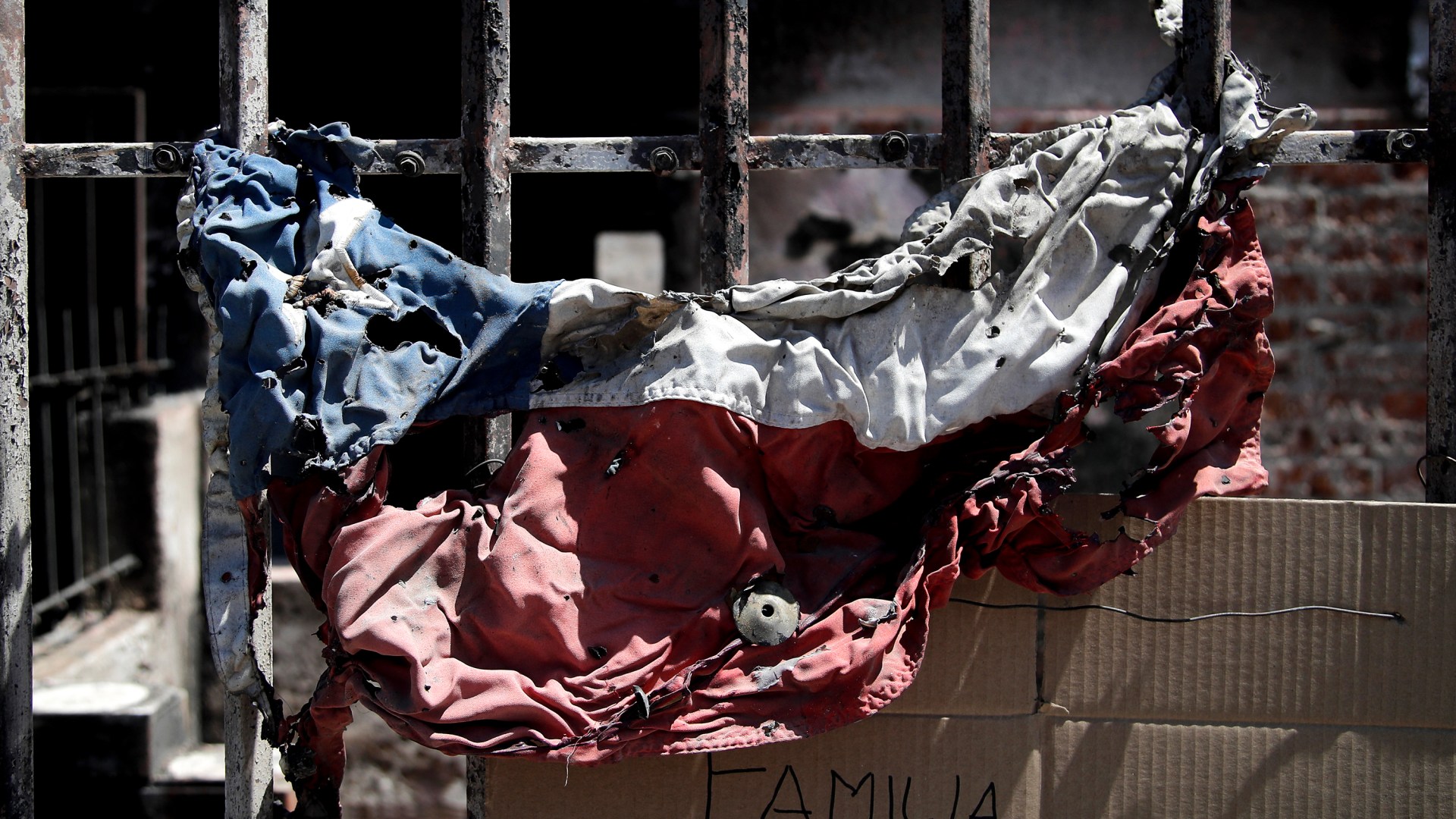
A burned Chilean flag is seen outside a burned house after a forest fire.

A burned Chilean flag is seen outside a burned house after a forest fire.

Christianity Today February 9, 2024
Javier Torres / Contributor / Getty

This January marked Chilean pastor Alex Ugarte’s 24th anniversary at Iglesia Evangélica Bautista Esperanza Viva (Living Hope Evangelical Baptist Church) in Viña del Mar, a milestone that prompted him to ask himself if he should transition to something new.

His moment of reflection was short-lived. Last Friday, wildfires started in at least four places across the Valparaíso region. Within hours, they had reached Ugarte’s neighborhood. They soon torched his home and church and claimed the life of his father-in-law, a tragedy that prompted the church leader to reconsider his vocational plan.

“God showing me this tragedy and the needs of His people helped me understand that it’s time to start all over again,” he told CT.

Summer wildfires are not uncommon in this Pacific coastal South American country. This year, however, a particularly intense heatwave has coincided with prolonged drought. Strong winds caused the blaze to spread quickly toward some of Chile’s most heavily populated areas, including historic cities like Valparaíso and the country’s tourism capital, Viña del Mar.

As of February 9, the fires have killed 131 people and damaged or destroyed more than 5,000 homes.

Among the casualties were eight Esperanza Viva congregants, who lost their lives when the blaze reached their residential neighborhood of Villa Independencia. On Friday, Ugarte preached at two funerals, one for an elderly couple and another for two siblings, who were 5 and 7.

“There’s so much pain,” he said. “Many people are desperate because their families are now homeless. But our hearts remain steadfast, looking forward to seeing what God will do.”

Close to home

Esperanza Viva is one of eight churches that experienced significant damages, the National Office of Religious Affairs of Chile told CT. But church leaders in the area estimate the real number could be twice that. Furthermore, at least nine pastors lost their homes, according to a group of leaders from various churches trying to organize a disaster response.

Pastor Magno Rodriguez and his wife, María Angélica Cubillos Álvarez, are among them. They lead the Corporación Internacional de Restauración, an independent Pentecostal church in Quilpué, a more inland city in the Valparaíso region, where they live.

“We could see the wildfire far off,” said Cubillos. “But then a neighbor came to me yelling, saying, ‘Your house is on fire.’”

Magno and one of his sons tried to put it out, but gave up when the flames intensified. The family fled in a pickup truck as flames and smoke surrounded them.

“It was like driving with your eyes closed,” he said.

Cubillos has burns in her neck, and her husband and one of her sons both injured their arm fighting the blaze.

“It is a miracle that nobody in the congregation died,” she said.

But the tragedy still hit too close to home. While the fire spared the house next door, their neighbors perished from smoke inhalation, trying to escape.

“They died of suffocation in our backyard.”

‘Looks like we were bombed’

A week after the fires first began, the government has continued to issue emergency alerts for new fires in Valparaíso, Viña del Mar and Quilpué. (Though most fires are now under control, the hot weather and other factors continue to spark new blazes.)

“Our focus is now on helping people,” said pastor Dionicio Viana, director of the Youth With a Mission (YWAM) base in Viña del Mar. His headquarters were spared by the fire because a nearby avenue created a kind of wind corridor between two hills, which redirected the flames away from the building.

In neighborhoods like Villa Independencia, Achupallas (in Viña del Mar) and Pompeya (in Quilpué), few homes remain.

“When you look at our neighborhood [of Achupallas], it looks like we were bombed, like a war,” said Viana.

For the past week, residents have been without water and electricity. There are rumors that at least some of the fires were set intentionally.

“A collective psychosis has arisen and now everyone is afraid of new outbreaks,” Viana said.

“People are stealing the little that we have,” said Cubillos. He explained that looters are searching for valuables among the rubble. To protect against additional looting, residents are building fences around the houses, “but there isn't even a hammer or boards, nor lighting to do the work when it gets dark. We have to use our cell phones for light.”

In the past week, volunteers from churches around the country have gathered in Viña del Mar to help. With funding from Operation Blessing, four YWAM bases have sent people to join Viana in removing debris from the streets and houses. In some instances, they have begun to rebuild.

“This week we started to build a house for a brother here. We have already repaired the floor,” he said.

Although the wildfire victims have received significant attention from the media and government, this won’t last longer than two or three weeks, says Viana. But then the expensive work of reconstruction will begin.

Struck down, but not destroyed

In 1982, a group of Swedish missionaries opened an Independent Assemblies of God church in Villa Dulce, a neighborhood in Viña del Mar. Last week, the fire burned it down.

But assistant pastor Gonzalo Ramírez’s heart feels heaviest when it comes to the impact the disaster will have on the faith of congregants.

“Before the reconstruction of the walls of the church, we will need a spiritual reconstruction,” he said. “You can rebuild the church. But the history of it, of the missions that began in that place, the souls that got saved there … How many miracles have we seen in that place?”

With all this emotional baggage, he had to preach at the first service after the disaster, two days after the church was turned into ashes.

Ramírez first came to Villa Dulce to study at the church’s Bible institute (which now operates only online), where he met his future wife.

“My daughter, who is now 15, was practically born in those pews,” he said.

Usually, between 80 and 100 people attend Villa Dulce on Sunday. But with many roads closed and people displaced, only about half of that number turned out. The group met in a church building that the fire left mostly unscathed.

Ramírez preached on 2 Corinthians 4:7-18, reminding his church that as followers of Christ, they had “this treasure in jars of clay to show that this all-surpassing power is from God and not from [themselves],” and that they were called to persevere in the midst of turbulent times.

Because power was still off, the service was not livestreamed. But several days later, he preached a similar message on Facebook.

“With much respect and much humility I invite you, my beloved brothers and sisters, to look into the eternal things that go beyond what is evident … to keep our hope in God, because those are the things that will remain,” he said.

At Esperanza Viva, Ugarte says his congregation will meet this Sunday on the grounds of the church building for an open-air service, for the first time since the fire. (The location was inaccessible last week.)

“For 24 years, God blessed us with a beautiful building, with classrooms for [Christian] education, training rooms, and a kitchen that prepared 8,500 meals during the pandemic,” he said. “Now our neighbors say we are going to build a church even more beautiful than the old one.”

News

The Baptist Pastor Turned Senator Behind This Week’s Failed Border Bill

After Republicans greenlit—then spiked—a bipartisan deal, evangelicals are still waiting for a solution to address the migrant crisis.

Senator James Lankford, a Republican from Oklahoma

Senator James Lankford, a Republican from Oklahoma

Christianity Today February 9, 2024
Drew Angerer / Getty Images

Senator Jim Lankford didn’t sign up to lead the charge on one of the most contentious issues before Congress.

But after Senate Majority Leader Mitch McConnell appointed him to develop a deal to address the migrant crisis—a contingency for the House passing emergency aid to Ukraine and Israel—the Oklahoma Republican got to work. He spent four months meeting with Democrat Sen. Chris Murphy and Independent Sen. Kyrsten Sinema to put together a deal.

Those careful efforts came crashing down this week when his own party and former president Donald Trump dismissed the package. The sound bites were harsh: “a very bad bill,” “even worse than we expected,” “worse than bad negotiation,” and “betrayal.”

While his role as the lead Republican negotiator represents one of his biggest moments in the political spotlight, evangelicals may recognize Lankford. The 55-year-old conservative is a churchgoing Baptist, a former pastor, and an outspoken advocate for religious freedom.

He’s known for putting faith and service before political grandstanding. Some hoped he’d be successful at negotiating a deal on an issue that’s becoming a bigger concern for evangelicals, most of whom want to see improved border security and a path to citizenship for immigrants.

“Lankford is just a really good man. He’s solid. He’s a devoted Christian,” said Dan Darling, director of the Land Center for Cultural Engagement at Southwestern Baptist Theological Seminary. “He has a real sense of calling. … I think he literally felt like he was going to Washington to try and do what he can to solve problems.”

The National Association of Evangelicals came out in support of the bill before the failed vote. In a statement on Monday, the association encouraged lawmakers to “carefully study the Lankford-Murphy-Sinema text. While some aspects of the bill raise concerns, and there are some missing pieces (notably a permanent solution for Dreamers), that is not a reason to dismiss the proposal out of hand.”

“As people of faith we pray for all our leaders as they fulfill their God-given responsibilities,” the statement continued. “The nation is watching.”

Prior to Lankford’s entrance to public office, the 55-year-old Oklahoman served for two decades as a youth minister. He felt called into ministry while he was still in high school. He spent the better part of 20 years working at the youth program at Falls Creek, a Christian youth camp.

His foray into politics came when he read that his local congresswoman was leaving office. He told the Christian Broadcasting Network, “It’s as if it jumped off the page and I heard God say, ‘That’s what I want you to do.’” He was elected to the House in 2011 and to the Senate in 2015. His most recent reelection was in 2022.

“He rolls up his sleeves,” Warren Cole Smith, author and president of the evangelical watchdog organization MinistryWatch, told CT. “He understands that if you want to get something done, you are going to have to convince people who don’t agree with you.”

Smith, who has interviewed Lankford a few times over the years, said Lankford tends to avoid “a lot of the bombastic, God-and-country rhetoric that we’ve since become all too familiar with among, you know, sort of a populist wing of the Republican Party. And I was impressed by that. This was a guy that was going to do his best to live according to Christian principles. But he was not going to be a showboat or be pretentious.”

In the pulpit, he was never the fire-and-brimstone type. In Washington too, he’s avoided rhetorical bomb-throwing, instead earning a reputation as a workhorse that has gained respect from his colleagues across the aisle as well.

“We agree on almost exactly nothing. [Lankford’s] a very conservative man,” Sen. Chris Coons, a Delaware Democrat, told CT. “But he’s a really good guy.”

Coons chairs the Senate Ethics Committee, of which Lankford is the highest-ranking Republican. The two served as honorary co-chairs of the National Prayer Breakfast in 2019 (Coons is Presbyterian).

“it's gotta be disappointing to put in this much work, and to now have been [censured] by the Oklahoma Republican Party,” Coons added. “This place doesn't work without compromise and consensus. And there are demonstrably members now who only want to blow things up. And who don't really want a result on anything.”

But congeniality hasn’t inculcated Lankford from being singed by the nation’s increasingly heated partisan politics. On Wednesday, when a procedural vote on the border deal came up, Lankford said in a floor speech that a well-known right-wing commentator told him, “If you try to move a bill that solves the border crisis during this presidential year, I will do whatever I can to destroy you, because I do not want you to solve this during the presidential election.”

Senators rejected the measure by a 49 to 50 vote. The chamber’s rule requires 60 votes for overcoming a filibuster. And the conservative commentator who threatened to try and “destroy him”? Lankford refused to name names but said that the person has “been faithful to their promise and have done everything they can to destroy me in the past several weeks.”

The immigration issue has been a political hang-up for a long time: laws haven’t been updated in almost 40 years, leaving presidents to rely on executive orders to wrangle surges at the southern border; an overburdened immigration court system; burgeoning waitlists of asylum claims; and the unresolved question of how to handle millions of undocumented immigrants.

Previous bipartisan attempts at congressional action have crumbled, often due to political pressure. In the recent attempt, the immigration-related provisions were more of a border crackdown than a comprehensive reform.

The text didn’t include a pathway to citizenship for immigrants in the country illegally. Previously, Democrats had refused to consider legislation that didn’t address protections for recipients of the Deferred Action for Childhood Arrivals (DACA) policy, also known as Dreamers.

Among other provisions, the legislation would have put a higher bar in place for migrants to request asylum and would have sped up the deportation process for migrants who don’t qualify. It also would have required adjudications on asylum cases to be issued within six months. (The process currently can take as long as ten years.) It also allocated funds to hire more border patrol agents.

The deal drew criticism from progressive lawmakers and immigration advocacy groups. Despite pressure from the Left, the Biden White House signaled that the president would sign it, releasing a statement saying it represented “the toughest and fairest set of border reforms in decades.” Meanwhile, conservative critics of the bill said it didn’t do enough to stop border crossings.

In defending the bill, Lankford said he believes it was subject to “a remarkable amount of misinformation”; “either people did not read the bill, didn’t follow it, or they … saw some posting on Facebook and believe that.”

While immigration reform is always a challenge, an attempt to tackle the topic was bound to face tough political winds during an election year. “Let’s say time-out and let the American people decide how we want to deal with this in November, when we have President Trump—who actually had control of our border—against President Biden,” Rep. Jim Jordan said on Fox Business. “Let the country decide.”

Republicans have made clear that they don’t want to give Biden a political win: RealClearPolling shows that he has a 63 percent disapproval rating on the issue of immigration. In his campaign, Trump pledges to be tough on enforcement.

Meanwhile, Democrats blamed partisanship for the effort imploding.

“We now have a definitive answer as to whether the Republican Party really wants to fix the border. They don’t. They have become addicted to just using the issue of immigration as a political wedge and an election year issue,” Murphy, the lead Democrat negotiator, told The Washington Post after the vote.

On Sunday, there were 20 to 25 Senate Republicans who would potentially support the bill, according to Murphy. But on Wednesday, only four Republicans voted to advance the measure.

“What would they do on their weekends if they couldn’t drag cameras down to the border to show off how disastrous it is? What would they give speeches about if we actually fixed the border?” Murphy asked rhetorically.

Some Republicans also expressed frustration with the party politics. “I followed the instructions of my conference, who were insisting that we tackle this in October,” McConnell told reporters Tuesday. “I mean, it’s actually our side that wanted to tackle the border issue. We started it.”

Even as Congress remains stalled on immigration, polls show that growing numbers of American evangelicals want something to be done to address the country’s broken immigration system.

In a 2015 Lifeway survey, 61 percent of self-identified evangelicals responded that they were in favor of a pathway to citizenship for immigrants; by 2022, the number had ticked up to 77 percent. Among evangelicals who said they attended church at least once a week, it was 82 percent in favor.

Evangelicals reported favoring a bipartisan immigration deal that would pair border security with allowing undocumented immigrants to seek citizenship if they met certain requirements, such as paying a fine and passing a criminal background check.

Some evangelicals said they hope this most recent stalemate doesn’t prevent people of faith from continuing to engage on the tough issue.

“Immigration is an issue that should strike very close to the heart of any Christian in this country,” Smith said. “If we care for the least and the lost, that has got to include the immigrant. And for Christians not to be actively involved in trying to solve this problem is cowardly.”

Darling argued that the week shows the need for more Christians to get involved in politics, following Lankford’s example.

“It seems, right now, that the most extreme and shrill voices are the ones that have their voices heard because a lot of other folks just don’t get involved,” he said. “I actually think this means Christians should be involved. … I think when we leave the arena, it cedes it to the most extreme voices on both sides.”

As of the time of publication, Lankford’s office had not returned a request for comment.

Theology

Family, Dumplings, and Jesus? Christians Navigate Mongolian New Year

Believers are learning how to celebrate and evangelize amid Tsagaan Sar’s Buddhism-infused rituals.

Mongolian woman preparing buuz, or meat dumplings, traditionally eaten during the Lunar New Year.

Mongolian woman preparing buuz, or meat dumplings, traditionally eaten during the Lunar New Year.

Christianity Today February 9, 2024
Edwin Tan / Getty

Before college students travel home to celebrate Tsagaan Sar, Mongolia’s Lunar New Year, Dagdansengee Delgersaikhan, the general secretary of the student ministry IFES in Mongolia, discusses with the students how to approach the country’s biggest holiday with their new Christian faith.

It’s good to respect your parents, Delgersaikhan tells them, but there are certain rituals steeped in Buddhism and shamanism that they can no longer take part in, such as bowing to family idols or walking in a certain direction for good luck. She guides them on how to keep good relationships with their family while kindly explaining that, because they are Christians, they can no longer join in on some of the traditions.

Delgersaikhan speaks from experience. She remembers 20 years ago when she approached her father nervously on the morning of Tsagaan Sar and told him that she wouldn’t be joining the rest of the family as they went out to perform prayers. Instead, she would stay home and make them a hot pot of milk tea for when they returned home. He agreed.

For Christians in the majority Buddhist country, celebrating Tsagaan Sar—which begins Saturday—looks different from before they came to faith. Some Christians do not engage in the holiday at all because of its spiritual roots, while others find ways to embrace the positive aspects of spending time with family and respecting elders while refraining from practices that conflict with their faith.

The gathering of so many people also makes it “a good time to testify about Jesus,” Delgersaikhan said. Conversations about faith can pop up over preparing buuz, steamed meat dumplings, or during visits to the homes of relatives.

“We encourage them that this is a good time to testify about ourselves, about Jesus,” she said. “Go home and serve them and show them good hospitality, shock them and they will say, ‘Why is he so hospitable?’ And after that share the gospel.”

Gathering with family and seeking good luck

Tsagaan Sar, which means “white moon,” is the biggest holiday in Mongolia, marking the end of Mongolia’s long winter—which can reach −20 degrees F (−28 degrees C)—and the beginning of spring. While Genghis Khan decreed the holiday in the 13th century, it wasn’t until the 17th century that Buddhist leaders began to incorporate Buddhist elements into Tsagaan Sar. When Communism took over Mongolia in 1924, leaders prohibited the holiday as it was viewed as religious. Yet many Mongolians continued to celebrate it quietly, said Bolortuya Damdinjav of the Mongolian Evangelical Alliance. When democracy came in the 1990s, Mongolians began to celebrate Lunar New Year widely again.

“Most Christians view it as a cultural or traditional holiday,” said Damdinjav, “We eliminated the religious parts but we still see it as a time to meet our family and show respect for that.”

Families start preparing for Tsagaan Sar weeks in advance, cleaning the house, buying ingredients, and making and freezing hundreds of buuz for the guests who will visit during the three days of Tsagaan Sar. The day before the New Year is known as Bituun, meaning “to close down,” when people clean the house, repay debts, and feast to end the year with a full belly. They light candles to represent Buddha’s enlightenment and leave ice on the door of their homes, as they believe the local diety Baldanlkham visits every family on a mule, and the ice gives the mule something to drink.

https://www.instagram.com/reel/C28vNoAyVUo/

The next day, families dress up in traditional Mongolian clothes, known as a deel (which resembles a tunic), and the matriarch brews milk tea. The first cup is offered to the gods. They use their zodiac sign to determine which direction they should step out of their homes on the morning of New Year’s day in order to bring good fortune. Some Mongolians climb to the mountaintop to view the first sunrise of the year and wish for good luck.

Mongolian families then visit their grandparents or oldest living relatives. At each home, the younger people greet their elders by grasping their elbows and asking, “Are you living peacefully?” and the elders kiss both their cheeks. They give gifts of money while children receive toys and play games. They eat buuz and ul boov pastries stacked in an odd number of tiers to signify good luck, as well as cooked lamb hide, dairy products, and candies. Conversations focus on happy topics to bring more good things in the new year.

Families then move on to visit other relatives and neighbors for the next three days. People also visit the temple and ask for a fortune from the lama, set out food for household idols, and perform prayers.

Celebrating Tsagaan Sar as Christians

When Amaraa Jargalsaikhan became a Christian, friends and family asked, How could you become a Christian? If you’re a Christian you will lose all your identity … you cannot celebrate Tsagaan Sar! Yet Jargalsaikhan sees Tsagaan Sar as a unique time to share the gospel.

Formerly one of the pastors at Amid Ug (Living Water) Christian Church in Ulaanbaatar, the largest church in Mongolia, he noted that sometimes non-Christians didn’t want a visit from a pastor. Yet on Tsagaan Sar, everyone was welcomed into the home. When he sat in the homes of relatives and neighbors and they caught up on their lives, he talked about his “reason for becoming a Christian and the differences [between Christianity from Buddhism] and the good things about it.” From these conversations on Tsagaan Sar, several family members ended up visiting Jargalsaikhan’s church.

“I think it’s a good time to share the gospel,” Jargalsaikhan said. “We [tried] not to ruin the mood, because some people get offended if you say something about a different religion.”

When Tsagaan Sar fell on a Sunday, Jargalsaikhan’s church continued to hold services even as they found that attendance—which typically numbered 1,000 across three services—dropped significantly. The pastors took turns leading different services so that they all had an opportunity to visit relatives. Often from the pulpit, Jargalsaikhan would preach about how Tsagaan Sar was an opportunity to share the gospel and would tell others how God had worked in their lives.

Today, Jargalsaikhan and his family live in Chicago, where he is ministering at Antioch Mongolian Christian Church. While he and his family don’t have relatives to visit, they’ll still put on the traditional deel, cook buuz and ul boov, and video chat with his parents back in Mongolia. Then they visit the members of their church, especially the older congregants—though in America they have to ask to come over, unlike in Mongolia, where people show up unannounced.

Standing firm while respecting parents

Delgersaikhan of IFES also noted that Tsagaan Sar is a prime opportunity for Christians to speak about their faith, because people are often respectful toward one another during the holiday and because they see so many friends and family. Some Christian families will give their guests small Bibles or stationary sets with Bible verses. There’s also an opportunity to do “hospitality for them very well and to be kind … to share personal testimonies.” She noted that, nowadays, some people no longer see the holiday as a way to serve one another, or they only use Tsagaan Sar as a way to show off their wealth. Christians can be different by being humble.

Before students leave for the holidays, IFES also holds a Tsagaan Sar celebration on campus. Christian students invite their friends to come dressed in deels to eat, drink, play games, and learn about the Christian faith. She reminds the IFES students that there will be many rituals they should no longer participate in. For instance, they shouldn’t go with their families to climb the mountain to see the sun rising and pray for blessings. “Our God, we can pray to him anywhere, anytime, not just New Year morning,” she reminds them.

Some of the Christian students who return home to the countryside for the New Year—especially in areas where Buddhism still has a very strong hold—find themselves facing stronger pressures to join in on the religious rituals. She noted that when they come back from break, some are glad because they were able to refuse to participate, but others are sad because they could not. If parents are very insistent that they must join them in some of the religious rituals, Delgersaikhan tells them they can pray to God silently.

Yet in most cases, she’s found that young Christians these days face less backlash than those a generation before. She said that students today are more honest and open in sharing with their parents about their conversion and their spiritual journey, and many parents are not upset that their children don’t want to partake in the rituals. Sometimes parents also see positive changes in their children’s behavior—such as giving up smoking, drinking, or cursing—so they have a more positive view of Christianity.

“In my time, we were very scared [of] our parents, but now students are very open to share what they believe in,” Delgersaikhan said. “Some countryside people say it’s a really good thing.”

Talking about Jesus while wrapping buuz

Bolortuya Damdinjav of the Mongolian Evangelical Alliance said her favorite memory of Tsagaan Sar while growing up was all the time spent with her family members, whether it was preparing for the holiday by cleaning and making buuz or visiting older relatives and meeting with extended family that she rarely sees.

Damdinjav, along with her mother and sister, became Christians in 1993 a few months before Tsagaan Sar, and she remembers that holiday being a big step of courage. The day before the New Year, her grandma, who was staying with them, fell very ill, so the family started praying for her. At the time, they still had some idols in their home, yet Damdinjav felt God telling her to get rid of the idols and the other religious items in the house. She told her mother, and the two of them threw the items into the fire. The next day, her grandmother started feeling better. When her other grandmother and relatives came to visit, they immediately went to where the idols had stood to show respect, but were shocked to find nothing there. Damdinjav feared that they would be angry, but instead they didn’t say anything about it; they sat and ate with them, and then they left. They never brought it up again.

“In some families, [the removal of idols] can be a big debate, and people could argue with each other,” she noted. “But somehow, I think God protected us, and since then, our house has been clean, free [of idols].”

Damdinjav has found that the best time to talk about the gospel with family is while wrapping buuz. Everybody is relaxed and chatting to pass the time as they make hundreds of tasty dumplings. During those conversations, she’s had the opportunity to tell her relatives why she believes in Jesus, why she reads the Bible, and what Christianity is all about.

“So I believe we’re just planting seeds whenever we have an opportunity to share about our faith.”

Theology

What Toby Keith Taught Us About the Songs We Need

Angry Christians require angry songs—or better yet, angry psalms.

Toby Keith performs during a concert in Oklahoma.

Toby Keith performs during a concert in Oklahoma.

Christianity Today February 9, 2024
Rick Diamond / Staff / Getty

This piece was adapted from Russell Moore’s newsletter. Subscribe here.

He should’ve been a cowboy. He should’ve learned to rope and ride. But he didn’t. Toby Keith learned instead how to sing and to write and to perform.

He was so good at it that when he sang “How Do You Like Me Now?!” (about how an old girlfriend who never thought he would make it gets to hear him every morning on the radio), one couldn’t help but feel there might be a real story behind it. After decades of playing on country stations around the nation, Keith died this week of cancer. Lots could be said about his life and craft, but what strikes me is that he just might remind us of why we need the Psalms.

When people think of Toby Keith—especially those who don’t actually listen to his kind of music—they typically think of one song: “Courtesy of the Red, White and Blue (The Angry American),” which went to the top of the charts after the jihadist terrorist attacks on the US on September 11, 2001. Keith sang:

Now this nation that I love has fallen under attack
A mighty sucker punch came flyin’ in from somewhere in the back
Soon as we could see clearly through our big black eye
Man, we lit up your world like the Fourth of July.

The song builds in defiance:

Hey, Uncle Sam, put your name at the top of his list
And the Statue of Liberty started shakin’ her fist
And the eagle will fly, man, it’s gonna be hell
When you hear Mother Freedom start ringin’ her bell
And it feels like the whole wide world is raining down on you
Oh, brought to you courtesy of the Red, White and Blue.

I was embarrassed by how much I loved that song. After all, though I was as hawkish as one could get on an American response to al-Qaeda (and I haven’t changed my mind on that at all), the song does not fit easily—if at all—with a Christian vision of reality.

Even those of us who believe in the just-war circumstances under which war is permissible recognize that war is always awful. Even in circumstances in which one believes that a state is justified to take a human life, no one can or should rejoice in that.

But I’ll bet I played the song a thousand times, and I couldn’t help but sing it out loud, at least when I was in the car by myself.

I realized this when that song found itself once again on my personal playlist. I never stopped listening to Toby Keith, and his songs filled my playlist in the years following 9/11: “Old School,” “New Orleans,” “My List.” Even though I was the chief policy lobbyist for the Southern Baptist Convention, I couldn’t help but sing along with “I Love This Bar” (also alone in my car). When I left the SBC, I told friends, quoting Toby, “I wish I didn’t know now what I didn’t know then.”

But “The Angry American” didn’t make my list. Even so, I heard myself humming it—almost reflexively, and to the surprise of my conscious mind—on January 6, 2021, watching the US Capitol being attacked by a lawless mob. I realized then that the song wasn’t really about foreign policy or counterterrorism. It was about anger.

By anger, I mean a specific kind—the kind that is mixed with a sense of powerlessness but also with a confidence that this is still the country that gave us Washington and Lincoln and Eisenhower, the country that could give the world words from We hold these truths to be self-evident to We have nothing to fear but fear itself to Mr. Gorbachev, tear down this wall. Uncle Sam—black eye or not—always gets up.

One of the things a new Christian encounters in reading through the Bible for the first time is how comforting and reassuring the Psalms can be. There’s a reason, the new Christian might think, that people want Psalm 23 recited to them on their deathbeds. There’s a reason, she might realize, that so many of these words are sung in celebrative praise and worship songs. But then that new Christian might come upon other Psalms that never show up in the songs, songs that seem disturbingly angry.

C. S. Lewis, I feel quite confident in saying, would have hated Toby Keith songs had he ever heard one. But he did know the Psalms, and in the middle of the last century he tried to explain those angry psalms of cursing enemies and calling down the judgment of God.

I don’t agree with all of Lewis’s thoughts on the Psalms, but there’s one thought in particular we need to consider right now.

Lewis gave the example of some British soldiers he knew in World War II, all of whom had fallen for conspiracy theories that the government was making up the atrocities reported from Nazi Germany to “pep up” the troops. The conspiracy theories were bunk, of course, and the soldiers Lewis knew were dutifully serving their country—fighting on the right side of morality or justice. But they thought they were being lied to, and they felt not the slightest bit of anger.

“If they had perceived, and felt as a man should feel, the diabolical wickedness which they believed our rulers to be committing, and then forgiven them, they would have been saints,” Lewis wrote. “But not to perceive it at all—not even to be tempted to resentment—to accept it as the most ordinary thing in the world—argues a terrifying insensibility.”

Sometimes, Lewis wrote, we think we are not tempted by something because we are above the temptation when we are, in fact, below it. We do not have to wrestle with our passions—to channel them in the direction God intends—because we have no passions at all. We don’t feel the pull to wrath or lust or greed not for the reasons a wise old desert monk might no longer feel them, but for the reasons a refrigerated corpse in a hospital morgue would not feel them.

The Psalms are not merely reassurance or celebration (though many Psalms are that). They also include the full range of human emotions—not just displaying them and putting them in the context of redemptive history but also calling the expression of a right form of them from us. “Deep calls to deep,” the Psalms say (42:7), and the depths of the Word of God do just that to us.

Jesus commands us to love our enemies, to bless those who persecute us (Matt. 5:44). He does not do this the way a Zen Buddhist might—with a word that our “enemies” are just an illusion or that our anger should be replaced with passionless tranquility. Instead, the Bible calls out the sense of injustice and wrongness that we perceive and feel, and directs us instead to the judgment of God as expressed at the Cross. “If possible, so far as it depends on you, live peaceably with all,” the apostle Paul wrote. “Beloved, never avenge yourselves, but leave it to the wrath of God, for it is written, ‘Vengeance is mine, I will repay, says the Lord’” (Rom. 12:18–19).

The way of Jesus does not dismiss anger but transfigures it by the way of the Cross. In conforming us to Christ, God is not making us less human but more. We are hidden in a Lord who is not un-angry or un-sad or un-happy but who is angry in the right way, sad in the right way, happy in the right way.

Could reading only the line My God, my God, why have you forsaken me? (Ps. 22:1) without the rest of the psalm it starts, much less the rest of the canon, lead to an ungodly despair? Of course (the devil quotes Psalms, remember). But these are holy words, words of life, not just because the Spirit sang them through David but because Jesus repeated them as he went—physically, spiritually, mentally, and emotionally—through the valley of the shadow of death, for us.

Songs like “Courtesy of the Red, White and Blue” or Merle Haggard’s “The Fightin’ Side of Me” can evoke some of the worst impulses. They can be jingoistic, vindictive, prideful—all that’s true. But the fact that we seem to need, from time to time, songs like that might remind us of something.

We have better songs—psalms of anger and of awe, of lament and of elation, of disappointment and of gratitude. We shouldn’t be embarrassed of them. We need them.

Most of the rage we see all around us isn’t really anger. It’s not alive enough to be anger. The adrenaline jolt of hating somebody can give a little jolt to the limbic system, but it’s as distant from genuine anger as pornography addiction is from intimacy. When you step into a different world—the one you enter through the Psalms, all of them—you might be surprised by anger. But it’s real, and it’s not the last word. That other kind of rage? That ain’t worth missing.

Russell Moore is the editor in chief at Christianity Today and leads its Public Theology Project.

News

Died: Joel Belz, Founder of World Magazine

A “newspaper man at heart,” he believed Christians needed “sound journalism, grounded in facts and biblical truth.”

Christianity Today February 9, 2024
Courtesy of World / edits by Rick Szeucs

Joel Belz answered the angry phone calls himself.

When 10, then 20, and then 30 and 40 irate readers called the offices of World magazine to complain about a cover story on a Republican presidential candidate—questioning the man’s commitment to conservatism and raising questions about his character, his multiple marriages, and how he’d earned his money—Belz took the calls.

He asked each one the same question.

Could they point to any facts that were wrong?

He understood they didn’t want the Christian newsmagazine to criticize a Republican, and that if the candidate lost and Democrats won the White House, that would be bad for conservatives. But could they point to anything in the article that was actually incorrect? If they could show him an error, he said, he would give them a free year’s subscription.

“So far,” Belz told the Asheville Citizen-Times in 2000, as John McCain’s insurgent campaign started to falter, “not a single subscriber has challenged a phrase of our report.”

Belz always believed that Christians needed the news. In an increasingly liberal and secular society that said everything is relative, he thought conservative evangelicals and orthodox Bible-believers, in particular, needed “sound journalism, grounded in facts and biblical truth.” Even—especially—if it was challenging.

“We wouldn’t pretend there are clear biblical directives on every issue,” Belz said in 2000. “But there are facts that [have] to be stated publicly. In that sense, we believe the Bible calls for the demonstration of truth.”

Belz died at home in Asheville, North Carolina, on February 4. He was 82.

Belz founded It’s God’s World, a Christian newsmagazine for middle school students, in 1981, and expanded the idea to other age groups with Exploring God’s World, Sharing God’s World, God’s Big World, and God’s World Today.

He launched World, for adults, in 1986. The motto of the magazine was taken from Psalm 24: “The earth is the Lord’s and the fullness thereof, the world and those who dwell therein.”

Belz described World as a magazine for “the 5 percent of the people in a typical evangelical church who are serious about applying their faith to the rest of their lives.” The mission, he said, was simply “to help readers see the world and everything in it from a God-centered perspective.”

Belz also helped start the World Journalism Institute in 1999 to cultivate Christian journalists committed to factual reporting. The institute has trained more than 700 people, to date. Some have worked for national media organizations including The New York Times, The Washington Post, The Wall Street Journal, Los Angeles Times, and USA Today, as well as many state and local papers, politically conservative publications, and religious outlets including Baptist News and Christianity Today.

“He leaves behind decades of service to Christ’s church, a trusted institution, a lengthy body of work, and a new generation of journalists and writers who stand on his shoulders,” the Colson Center said in a statement.

Andrew Walker, a World editor and a theology professor at The Southern Baptist Theological Seminary, called Belz a “titan of his times” and “a legend of Christian journalism.”

“Evangelicals owe him a tremendous debt of gratitude for the legacy he has left,” Walker said, “one of professionalism, conviction, and excellence.”

Belz was born on August 10, 1941, in Marshalltown, Iowa. His father and mother, Max Victor Belz and Jean Franzenburg Belz, were part of the Bible Presbyterian Church, a conservative Calvinist denomination led by Carl McIntire and others who split from the mainline Presbyterian church during the modernist-fundamentalist controversies. The Belzes helped start a Presbyterian school and plant a church a few miles outside of Walker, Iowa, then a town of about 460 people.

The family had eight kids—raised to read the Bible, sing hymns, recite the Westminster Catechism at breakfast, and love church.

The family also ran a printing operation in their basement. Belz learned to operate the linotype press at age 11 and loved it.

He tried to go into the printing business for himself as a freshman in college, but the enterprise quickly ended in disaster. He borrowed money from his grandfather to buy a linotype and took it with him to Covenant College, a Presbyterian school then located in St. Louis. As Belz attempted to move the printing press into the school basement, there was an accident, and it fell down a flight of stairs.

“It may have been worth thousands at the top of the stairs,” he would later say, “but by the time it reached the bottom it was worth $20 in scrap metal.”

The disaster didn’t dampen Belz’s passion for printing, though. Before he graduated, he spent a semester working on a prototype for a Christian newspaper.

“It was always his ambition,” his sister Julie Lutz told World.

After graduation in 1962, Belz went to work for Covenant College and helped scout out a new location in Lookout Mountain, Georgia. He went back to school to earn an MA in communications and then returned to Covenant to work in public relations and to teach classes in media, English, and logic. He discovered he wasn’t good at teaching, though, and quit after two years.

An opportunity to return to publishing arose in 1977 with The Presbyterian Journal in Asheville, North Carolina. Belz took the job. The journal was founded in 1942 by Billy Graham’s father-in-law, L. Nelson Bell (who later went on to found Christianity Today). The journal was supposed to fight theological liberalism in the Presbyterian church, but with the separation of conservatives and the founding of the Presbyterian Church in America, it lost a lot of relevance. By the late ’70s, the journal was in decline and fast losing subscribers.

The Presbyterian Journal was also going through a crisis of leadership.

“The staff became so divided,” former World editor Marvin Olasky recalled, “that writers and editors began working in two separate buildings.”

Belz proposed and launched his first children’s magazine in 1981. It was popular at Christian schools and drew bulk subscriptions. In the next few years, Belz added four more publications for different age groups. Together, the children’s newsmagazines brought in about 250,000 weekly paid subscriptions—more than 10 times the number of subscriptions for The Presbyterian Journal.

The board decided to put Belz in charge, and he proposed an ambitious new project: an alternative Christian newsmagazine for adults.

“Huge gaps existed in the effort to help Christians think biblically,” Belz later explained. “No one was picking up each week’s political news, international happenings, media developments, advances in science, changes in the welfare system, matters of health and medicine—no one was regularly (and rigorously) reflecting on all these aspects of life from a pointedly and conservatively biblical point of view.”

Christianity Today, then a biweekly magazine, focused its news reporting on the church and what evangelicals were doing in the world. World, in contrast, wanted to cover everything—from a uniquely Christian perspective.

World, however, almost failed as fast as Belz’s college printing business. The first issue was put out in March 1986. It was 16 pages, printed on glossy paper, with congressmen Phil Gramm and Warren Rudman in color on the cover. Inside, theologian R. C. Sproul offered analysis of proposed legislation, and there was reporting on the violent political struggle in Nicaragua.

Subscriptions did not flood in.

After 13 issues, the magazine was about $300,000 in debt. It only had about 5,000 readers and many of them didn’t seem too happy with what they were reading.

“Christian adults disagree on a lot more issues than Christian kids,” Belz said.

The board of The Presbyterian Journal decided to cancel the publication. Belz, however, had a counterproposal. He suggested that The Presbyterian Journal should shut down and its resources be invested, instead, in World, which he calculated he could produce at a reduced cost of less than 10 cents per copy.

The board agreed, put $300,000 into the fledgling magazine, and Belz relaunched World in 1987.

“For the next five years,” he later recalled, “the goal was survival. Could we publish one more edition? Could we pay one more week’s postage bills? Could we meet salaries one more time? … After the first five years, we still had fewer than 20,000 subscribers and were hemorrhaging red ink faster than we wanted anybody to know.”

The newsmagazine survived, however, and achieved some stability by the early 1990s. By the time World celebrated its tenth anniversary, more than 85,000 subscribers were receiving the 32-page magazine 50 times per year.

The magazine’s profile was boosted by conservative political leaders, including William Bennett and Newt Gingrich, who praised it publicly. But World really set itself apart by its commitment to news reporting.

“We had a sense that this was a void,” Belz said in 1996.

He criticized the many successful Christian publications that didn’t put any resources into reporting: “It’s kind of scary that people who are supposed to be so committed to the truth and to the Word have so easily accepted a communications model that’s based so much on feelings and experiences. Everything’s about how people feel. It’s getting harder for people to focus on what’s true and what’s false.”

As part of that commitment to focus on facts, World also did investigative work, reporting on the misconduct of Christians and the scandals and cover-ups troubling many evangelical institutions.

Olasky, who joined World in the early 1990s, said it bothered Belz that Christian media organizations hadn’t broken the story of the scandal that brought down televangelists Jim and Tammy Faye Bakker.

“Joel said, ‘Gee, I wish we had done that,’” Olasky said. “We don’t want to leave it to the secular press to expose wrongdoing within the church.”

World went on to report on numerous evangelical scandals, including sexual abuse at a missionary boarding school in West Africa, megachurch pastor Mark Driscoll’s plagiarism and manipulation of bestseller lists, megachurch pastor James MacDonald’s bullying and spiritual abuse, Christian college president Dinesh D’Souza’s apparent marital infidelity, and more.

Any one of World’s near-weekly issues had the potential to set off a bomb in American evangelicalism. It gave the magazine enough of an edge that Christian media commentator Terry Mattingly called it “Rolling Stone for cultural conservative evangelicals.”

If some readers were occasionally angry about the critical coverage of Republicans, that didn’t hurt either, according to Belz. He claimed conservative attacks on World’s reporting on John McCain only “put us on the map.”

And no one ever did get that free year’s subscription.

“As much as Joel’s vision gave everyday vibrancy to timeless truths found in Scripture, he was also the son of a pastor who ran a print shop in the basement,” wrote Belz’s sister-in-law Mindy Belz, who reported for World for 35 years. “He came from small beginnings in rural Iowa, the second-oldest of eight children. And he was a mid-century newspaperman at heart.”

Belz stepped back from the magazine amid health concerns but continued writing columns up to January 2024. One month before his death, he wrote about the dangers of deception.

“Our culture has learned how to play fast and loose with the truth,” Belz told World readers. “And we Christian believers aren’t immune to the infection that saturates the culture we live in.”

Belz is survived by his wife of 49 years, Carol Esther; daughters Jenny Gienapp, Katrina Costello, Alice Tucker, Elizabeth Odegard, and Esther Morrison; their children and grandchildren; and a large extended family.

His funeral will be held at Arden Presbyterian Church near Asheville and streamed online on Saturday, February 10. He will be buried in Black Mountain, North Carolina, in a coffin built by family members.

News

Mike Bickle Accused of Abusing a 14-Year-Old Before IHOPKC’s Founding

The Kansas City–based prayer ministry extended an apology and called for repentance after another victim came forward.

IHOPKC founder Mike Bickle

IHOPKC founder Mike Bickle

Christianity Today February 9, 2024
Shane Keyser / Kansas City Star / Tribune News Service via Getty Images

In the wake of additional allegations against its founder Mike Bickle, the International House of Prayer Kansas City (IHOPKC) cut off the livestream feed for the 24-7 prayer room that has defined its movement.

On Thursday night, the display read, “IHOPKC is entering a season of prayer and repentance.” The day before, the Kansas City Star ran a story on a woman who said Bickle abused her as a 14-year-old in the ’80s, when she was his family’s babysitter and he was a pastor in St. Louis.

IHOPKC released a statement condemning Bickle’s “predatory and abusive” actions, standing by his victims, and apologizing for its initial response of allowing him to defend himself when accusations surfaced last fall.

The ministry cut ties with Bickle in December, but that hasn’t stopped further revelations and concerns from emerging around IHOPKC and its leadership.

In a seven-page report released last week, the investigative firm hired by IHOPKC to look into the abuse allegations against Bickle concluded:

Based on all the credible evidence, including his own acknowledgements of contact with the two Jane Does over twenty years ago, it is more likely than not that [Bickle] engaged in inappropriate behavior including sexual contact and clergy misconduct, in an abuse of power for a person in a position of trust and leadership.

https://twitter.com/ihopkc/status/1755780539984781776

The two cases that Bickle acknowledges—one with “inappropriate behavior” including two instances of kissing and another he describes as a “consensual sexual contact that involved her touching me but not me touching her”—took place in 1999 and 2002–2003.

The report is not comprehensive; at least two of Bickle’s alleged victims did not participate over the terms of the investigation and are calling for a “truly independent third party” inquiry.

The report also didn’t include the latest account from the former babysitter, Tammy Woods, who just broke her 43-year silence to report the abuse to her family, her pastor, and the police.

Woods told the Kansas City Star that she met Bickle at church, and their relationship grew from friendly mentorship and spiritual encouragement to expressing feelings for one another. Wood’s childhood friend and younger sister also recounted that the pastor had a strangely close bond with her as a high school freshman.

Woods said that starting when she was 14 and Bickle was 25, they kissed in secret and progressed to fondling and sexual touch. She told the paper, “He moved my hand to touch him sexually. And he did touch me in return.”

Woods, now 57, recounted a detail other victims have also shared: Bickle told her he believed his wife would die and that they could be together.

According to Woods, Bickle would “anguish over failure” and apologize after crossing a line with her physically, and she promised to keep his secret to the grave when he moved from St. Louis to Kansas City in 1983.

They stayed in touch on and off over the years, seeing each other a couple times in ministry settings, she said. Woods, who lives in Michigan, texted with Bickle after the accusations came forward in October and as he made a statement in December. She said he told her, “I know you said this over the years that you’ve forgiven me, but I just want to say it again. Please forgive me. I was clueless. I could have gone to jail.”

Bickle has not responded publicly to Woods’s account.

The advocate group—former IHOPKC leaders who came to Bickle and his ministry with the allegations last fall—has stood by their concerns after a few women calling themselves “not ever Jane Does” spoke out against their inclusion in the initial group of allegations and said they were not victims of Bickle.

In one video from the advocate group, members Dean Briggs and John Chisholm explained that they resigned from IHOPKC leadership in September over another incident: the ministry’s mishandling of an alleged affair between Mike Bickle’s son and the wife of a IHOPKC staffer. They cited a 50-page testimony from the woman’s husband, which they said was submitted to top leaders.

Others have left amid the ongoing revelations around Bickle, including former IHOPKC executive director Stuart Greaves and former IHOP University president David Silker.

Eric Volz, the crisis communicator who was managing IHOPKC’s public response, concluded his work for the ministry last week. On Wednesday, he said he was not aware of Woods’s allegations “and neither was IHOPKC.”

Abuse attorney and advocate Boz Tchividjian, who is representing at least one of Bickle’s victims, has criticized the ministry’s response.

“IHOPKC leaders should write a book about steps toxic Christian communities can take to fail miserably in protecting those with less power while also marginalizing & vilifying others who bring darkness to light,” he wrote on Threads. “It all begins with a leadership that embraces arrogance & ignorance.”

The scandal has frustrated former IHOPKC members who say they experienced an unhealthy culture at the ministry and who are praying for greater transparency and accountability. In recent weeks, charismatic leaders who have been close to the movement have also spoken up to address the scandal.

Lou Engle, the founder of TheCall prayer ministry, had spent five years at IHOPKC and began Justice House of Prayer in DC. He released a statement on Tuesday saying he believes the advocates and “Jane Doe,” that he is praying for a full confession from Bickle, and wants to see a mutually agreed-upon independent investigation.

https://twitter.com/LouEngle/status/1755047702914605342/

Calling for “extreme contrition,” Engle wrote that God has his eyes out “for toleration of moral laxity and of sexual immorality—especially clergy abuse in the church” and that leaders need to hear the cries of “many thousands of woman … who have been wounded by leaders in the body of Christ.”

Two weeks ago, self-described prophet Jeremiah Johnson shared a dream where he told Bickle he was being exposed and that the movement would shift from Kansas City to the nations. He called on his followers to pray for the situation at IHOPKC, for the future of the prayer movement, and for truth and repentance.

Evangelist Matt Brown, who was among the many who have tuned into IHOP’s prayer livestream, said that he was sickened by the claims against Bickle and his partial confession.

“I don’t have any idea how to explain how someone who was so dedicated to a prayer movement can secretly manipulate and abuse those under their ministry care. It’s absolutely wrong and evil,” said Brown, founder of the ministry Think Eternity.

“I have a feeling there will be many ‘orphans’ in the prayer movement. I pray for healing and comfort for those he abused, exposure of anything that was done, and mercy for many prayer people left confused and crushed as well.”

addApple PodcastsDown ArrowDown ArrowDown Arrowarrow_left_altLeft ArrowLeft ArrowRight ArrowRight ArrowRight Arrowarrow_up_altUp ArrowUp ArrowAvailable at Amazoncaret-downCloseCloseellipseEmailEmailExpandExpandExternalExternalFacebookfacebook-squarefolderGiftGiftGooglegoogleGoogle KeephamburgerInstagraminstagram-squareLinkLinklinkedin-squareListenListenListenChristianity TodayCT Creative Studio Logologo_orgMegaphoneMenuMenupausePinterestPlayPlayPocketPodcastprintremoveRSSRSSSaveSavesaveSearchSearchsearchSpotifyStitcherTelegramTable of ContentsTable of Contentstwitter-squareWhatsAppXYouTubeYouTube