Books

New & Noteworthy Fiction

Chosen by Karen Barnett, author of “When Stone Wings Fly” and the Vintage National Parks novels.

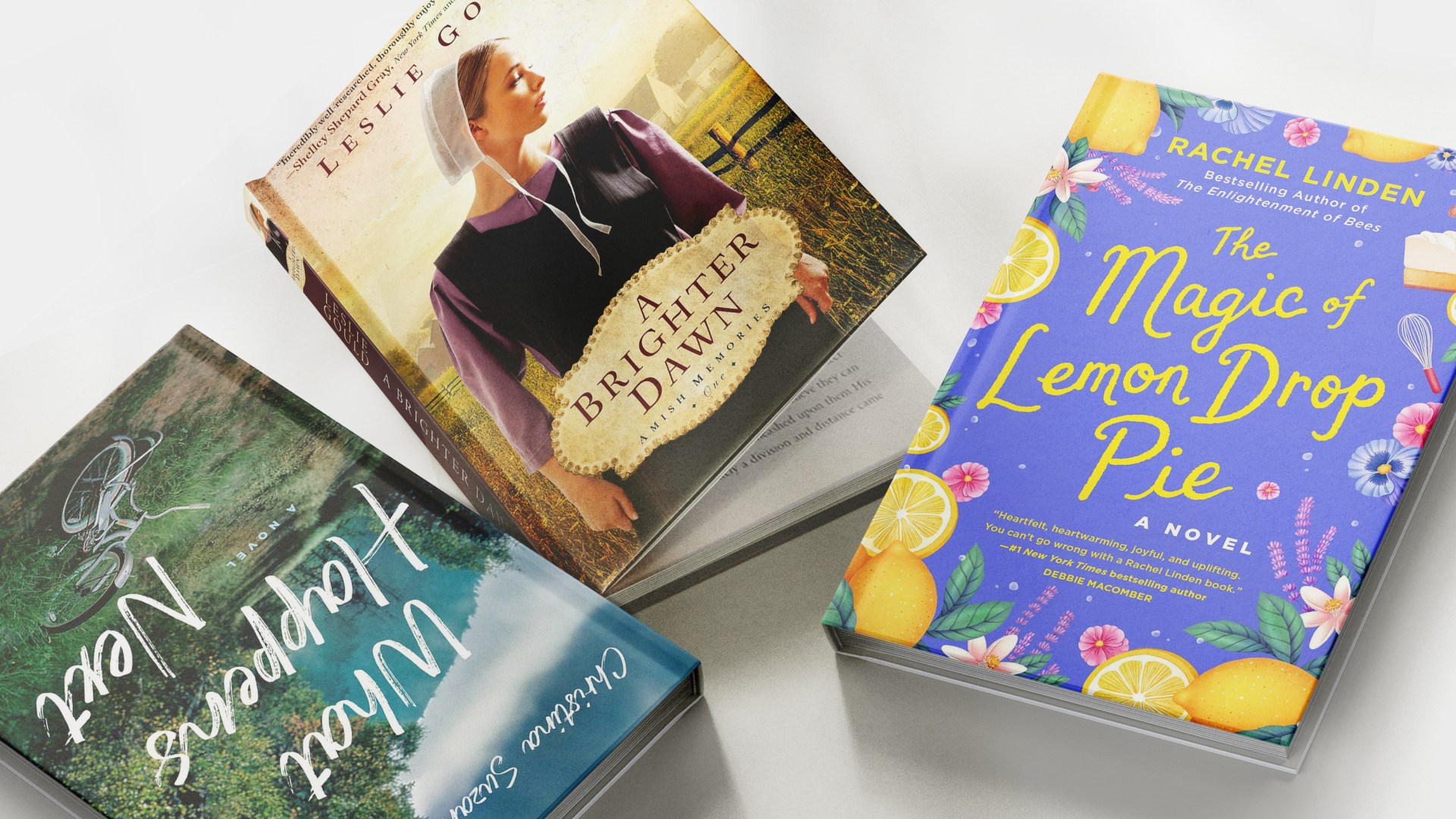
A Brighter Dawn

Leslie Gould (Bethany House)

As Ivy Zimmerman, a young Mennonite woman, is grieving the sudden loss of her parents in a mysterious traffic accident, she and her two younger sisters travel to Pennsylvania to spend time with their Amish grandparents. When Ivy learns the story of her great-grandmother, who lived in Germany during the 1930s, she gets a glimpse of what happens when people’s fears lead to deadly compromises. Lingering questions from her parents’ deaths spur Ivy to search for answers, even if they come at a cost. In this challenging story of grief and self-discovery, Gould explores faith, society, and difficult choices.

What Happens Next

Christina Suzann Nelson (Bethany House)

Successful podcaster Faith Byrne has made a career of finding inspiration in tragedy, but she’s unable to see anything redeeming in the dissolution of her own marriage and her ex-husband’s impending nuptials. When she’s asked to investigate a notorious cold case—the disappearance of her childhood best friend, Heather—Faith takes advantage of the distraction, embarking on a nostalgic walk through the summer of 1987. Will sifting through dark secrets from the past help her and Heather’s mother find ways to move forward? Nelson will challenge you to consider how events in your own life might be holding you back.

The Magic of Lemon Drop Pie

Rachel Linden (Berkley)

Lolly Blanchard has given up on so many dreams to keep her family together and prevent the failure of their Seattle diner. But on her 33rd birthday, as she prepares once more to bake her late mother’s famous pie, Lolly takes stock of her life and sees only regrets. So when her great-aunt presents her with three magic lemon drops that allow her to explore roads not taken, she jumps at the opportunity. This move might backfire, or it could open a pathway to a brighter future. This beautiful and whimsical story echoes It’s a Wonderful Life, albeit with a modern twist.

Books
Review

The Faith and Work Movement Is Leaving Blue-Collar Workers Behind

Can it speak to evangelicals outside high-status professions?

Illustration by Eleanor Shakespeare

Say it’s Thursday evening, and you sit down on your couch after dinner. Just before flipping on the TV, you pause, breathe, close your eyes, and reflect for a moment about your workday.

Saving the Protestant Ethic: Creative Class Evangelicalism and the Crisis of Work

What do you feel? Do you have a sense of being anxious and overwhelmed? Of satisfaction and accomplishment? Of exhaustion or frustration from interacting with a coworker? Or does your mind blank out, avoiding thoughts of work altogether?

For some, perhaps, the wheel of ambition is still turning, and instead of watching Netflix you decide to flip open your laptop and keep working until bed. If that description fits, you might be what Andrew Lynn calls a “creative class evangelical.”

Lynn, a University of Virginia sociologist, is the author of Saving the Protestant Ethic: Creative Class Evangelicalism and the Crisis of Work. In the book, he surveys both the history and the current state of what some call the “faith and work movement,” which he describes as a “highly organized and well-resourced effort to renegotiate creative-class evangelicalism’s place and relation to power within the institutions and social structures that make up American society today.”

Lynn argues that the contemporary faith and work movement arose principally to meet the needs of a narrow niche of Christians: highly educated evangelicals seeking meaning in their work and a place within an increasingly secular culture. Beginning in the 1980s, as evangelicals attained college degrees and entered the knowledge economy in greater numbers than ever before, there was increasing talk of closing the “Sunday to Monday gap.” Rejecting the notion that work is merely a moneymaking necessity, a rising cohort of evangelical professionals wanted to make theological sense of their newfound success.

How we got here is its own interesting tale, which begins with fundamentalism after the Civil War. When the Scofield Reference Bible was published in 1909, a frantic concern for eschatology and saving souls took hold. Funding soul-saving ministries became a top priority, and work was simply a way to supply these funds, which, in the words of one writer, needed to be “exchanged” into the “current coin of heaven.”

Later evangelical leaders like Billy Graham abandoned many elements of this earlier fundamentalism. But the remaining network of Bible institutes, summer camps, media outlets, and parachurch ministries still focused on spiritual rather than earthly labors. Echoes of this mindset can be heard in Rick Warren’s 2002 book The Purpose Driven Life, which states, “The consequences of your mission will last forever; the consequences of your job will not.”

Along the way, however, several prominent Christian business leaders began wondering whether their actual work mattered to God, not just the money they made from it. As the inventor and engineer R. G. LeTourneau said at a Christian Laymen’s Crusade in 1941, “We are going to sell laymen the idea that they are going to work for Jesus Christ seven days of the week or not call themselves Christians.” Subsequent decades saw the advent of organizations like the Full Gospel Business Men’s Fellowship International (1952), Laity Lodge (1961), and Fellowship of Companies for Christ International (1977). By the 1980s and 1990s, dozens more had been founded.

And from the mid-1980s to the mid-2010s, an explosion of books, conferences, and funders fueled a wave of Christians claiming that work itself—not just soul-saving—was important to God. Out of this movement arose four frameworks for understanding how Christianity ought to influence our work.

As Lynn describes them, each was embodied in a distinct group. The first was the evangelists, for whom faith at work principally meant workplace evangelism. Second were the achievers. Prominent business figures like J. C. Penney and Henry Parsons Crowell, the owner of Quaker Oats, popularized the idea that business itself was endowed with spiritual value. Notions of “stewardship” and God’s “ownership” reframed work as an arena of holy influence.

The third group, which represents the most common framework within evangelicalism today, consisted of the integrators of faith and work. Thinkers like Dorothy Sayers and lesser-known figures like Marquette University professor David Moberg reminded evangelicals that being made in God’s image means being made in the image of a maker. Work is valuable simply because God works—and calls us to do likewise.

Lynn also identifies a final group of activists, who called for Christians to pursue the common good through their jobs. Their ranks were smaller than those of the integrators, in part because some evangelicals were skeptical of calls to view work as an engine of advocacy or social change.

But the integrators mainly benefited from larger trends in demographics. As more evangelicals earned college degrees and entered the knowledge economy during the 1970s and early 1980s, they were receptive to messages that affirmed their work as a form of service to God and neighbor.

And yet, whose work were we talking about?

Lynn notes that two groups were often overlooked in faith-and-work conversations: women and blue-collar laborers. It was business leaders, on the whole, who were credited with breaking down the sacred-secular divide, and attendees at faith and work conferences tended to be male, white, and college educated. Over time, the language of “calling” and “vocation” became attached to entrepreneurs, lawyers, and other “creative” or high-status professionals.

Lynn also faults the faith and work movement for being too susceptible to influence from the political Right. He argues that organizations like the Acton Institute, the Kern Foundation, and the Institute for Faith, Work & Economics baptized laissez-faire capitalism, channeled evangelicals away from progressive causes, and even lowered the ethical standard for work that honors God’s image in all people.

But the movement largely succeeded in shifting evangelicals from postures of cultural separatism and embattlement toward a spirit of stewardship and production. Buttressed by Dutch theologian and statesmen Abraham Kuyper’s theology of public engagement, leaders like the late Tim Keller and his ministry’s Center for Faith & Work promoted this shift. D. Michael Lindsay’s 2007 book Faith in the Halls of Power highlighted evangelical involvement in the upper reaches of media, business, government, entertainment, and higher education.

Lynn acknowledges that faith-and-work conversations face an uphill climb in an era of growing distrust for institutions. In such a climate, he writes, “inner-worldly asceticism mobilizing zealous participation in secular institutions appears to be a tough sell.” The problem is especially acute for Christians who work at the lower levels of these institutions and have little power to change them.

Alongside the risks of resistance or indifference goes perhaps an even greater risk: the lure of cultural accommodation. Lynn wonders whether the faith and work movement might serve as its own “gravedigger” as it “shuttles evangelicals from subcultural institutions centered on evangelical distinctives into full admission within mainstream societal institutions.” There’s a historical warning here: In the latter half of the 20th century, mainline churches were full of educated elites who enjoyed leadership roles across society, but this didn’t spur revival within those churches. It would be a shame to watch the faith and work movement launch believers into positions of leadership, only to see them changed by the world rather than changing it for Christ.
Despite these warnings, however, I remain hopeful for the faith and work movement. Christians will keep working, and they’ll keep asking what their faith means for their work. And yet, as someone deeply involved in this movement, I have three suggestions.

First, knowledge-class evangelicals should commit to using their power for the vulnerable, not only in society at large but also within their own workplaces. And they should give greater weight to the concerns of organized labor. Evangelicals could work to rediscover Catholic social teaching on this topic, or at least remember the days when Wesleyans, Free Methodists, and Salvation Army groups championed the rights of workers.

Second, while continuing to affirm that work matters to God, we should recognize the extent to which workers are feeling anxious, stressed, and burdened. The faith and work movement has been geared toward power and cultural influence, but the future of the movement, I believe, will be rooted in spiritual formation. Work is not only about success, influence, or even gospel impact—it’s about who we’re becoming as followers of Christ. Indeed, Puritans like John Cotton, who helped shape the Protestant work ethic, warned that making one’s labor “the chiefest good” would only lead to selfish materialism. Lynn (and others) are right to regard a spiritual vibrancy as the foundation not just for work but for all of life.

Finally, the future of the faith and work movement depends on deeper rootedness in local church communities. Lynn helpfully points out that non-Anglo churches have excelled at creating communal bonds and “collective identities that resist some of the excessive pulls of capitalism and careerism.” Indeed, one historic distinctive of the Protestant ethic is congregations that provide refuge and solidarity to workers facing dangerous conditions, punishing demands, or economic volatility. At its best, Lynn remarks, the church draws people “toward forms of social relations not determined by status, wealth, or achievement.” What would it look like to center our identities on our local congregations rather than our professional titles?

In sum, building a faith and work movement that appeals to a broader swath of Christians means a renewed emphasis on justice, spiritual formation, and the church. Perhaps more of us can look forward to resting after a long day and breathing in the lasting peace of knowing we have spent that day simply working with God.

Jeff Haanen is the founder of the Denver Institute for Faith & Work. He is the author of Working from the Inside Out: A Brief Guide to Inner Work That Transforms Our Outer World.

Books

Mary Was More Than a Mother

Treating her as a static figure obscures a lifetime of gospel witness.

Annunciation by El Greco

Annunciation by El Greco

WikiMedia Commons

In recent years, our news feeds have been filled with examples of leaders and public figures abusing their power. Amid all the pain and confusion, author and apologist Amy Orr-Ewing finds encouragement in the stories of Advent, which speak to questions of suffering and injustice more than we sometimes notice. In her new devotional, Mary’s Voice: Advent Reflections to Contemplate the Coming of Christ, she offers a dynamic portrait of the woman at the center of the Incarnation, highlighting her boldness in proclaiming the truths of Scripture in a dark world. Author and Bible teacher Taylor Turkington spoke with Orr-Ewing about Mary’s humble faith and the significance of God choosing a teenage girl in an occupied country to bear his Son.

Mary's Voice: Advent Reflections to Contemplate the Coming of Christ

What compelled you to write a book on Mary?

I’ve devoted much of my ministry to speaking on and writing about apologetics and suffering. And in more recent times, I’ve taken up questions of power and injustice.

The Mary theme came by surprise. Recently, I was struck by hearing her words in the Magnificat in a dark time in my own life. I had been supporting a victim of sexual abuse who was giving testimony in the criminal trial of the abuser. After a day in court, I went to a nearby cathedral for Evensong, an Anglican service of evening prayer and worship. When the choir sang the Magnificat, it absolutely hit me between the eyes. “He will bring the mighty down from their thrones,” they sang, as this perpetrator who’d once exercised enormous power sat on trial. It moved me deeply to hear Mary’s words speaking so powerfully into the situation and pointing us to Jesus.

What would you say has kept us from hearing Mary’s voice well?

The rush of the Christmas season often loads a lot of pressure onto us. Especially if you’re working in ministry, there’s a huge amount of emotional labor and social output involved, all of which can present distraction.

And culturally, the retelling of the Christmas story often happens with Nativity plays. In these settings, Mary is a static figure. In much of the art that depicts her, Mary is caught in this perpetual moment of being a new mother holding a new child. And of course, in the Protestant tradition, there are fears of overdoing Mary and we end up laying her to one side for fear of getting it wrong theologically.

As I studied Mary, I realized that I’d failed to really hear her voice and her words in Scripture. And as I began to listen, I discovered this deep resonance, both theological and apologetic, in what she brought to the table.

Mary, as you remind us, was a young, vulnerable woman living in an occupied country. What can we learn about power, humility, and oppressed people from her story?

In writing the book, one of the things I found most moving was asking, Who does God interact with? Who does God involve in the redemption story? Apart from the Lord Jesus, the most significant character involved in the Incarnation account is Mary.

In our society, women experience various levels of inequality, although that’s getting better all the time. But in that cultural moment, centering a woman in the way the Bible does is just extraordinary. And it really speaks of who our God is, that she plays this role.

In my family, we welcomed two refugee women from Ukraine this year. Hearing their stories reminded me of Mary’s experience living under political oppression and occupation. That’s the person to whom God reveals the Incarnation. It gives us a beautiful picture of what the Christian faith is going to mean, and who it’s going to be for.

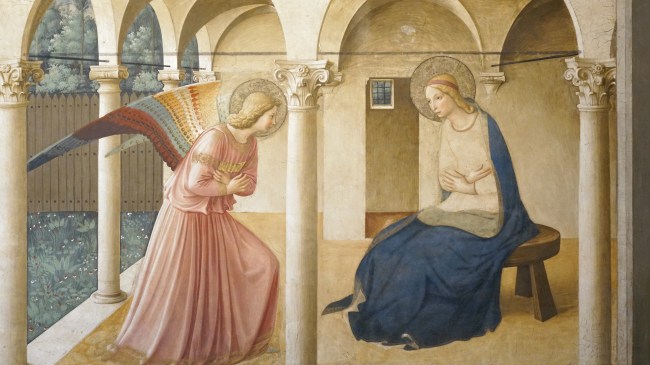
Annunciation by Fra AngelicoWikiMedia Commons
Annunciation by Fra Angelico

In the book, you show how Mary draws on Old Testament passages and themes that we often skim over. How would you hope Mary’s Voice equips people as they read the Bible?

The book takes us through the days of Advent, and each day there’s a reading and a reflection that really draws out the biblical resonances. Something that surprised me while working on it was how steeped in the Old Testament Mary was. In sections on the Magnificat, you see how she refers to 1 Samuel, to the story of Hannah. She also refers to different psalms and to the experience of the children of Israel in the wilderness.

I hope, as readers take this journey, that they will see the rich fabric being woven together by God with great intention. I hope they see the details of prophecies in the Old Testament and how they’re fulfilled in Jesus.

You provide images of art and examples of historical prayers in the daily readings. What role do these serve?

We have been made in the image of God to know him and grow in our relationship with him in multiple dimensions. That includes the intellect, of course. But we’ve also been given gifts of creativity, and many people find the visual arts helpful for deepening reflection.

Some images in the book come from old, prepaper manuscripts like the Book of Hours or the Vaux Psalter, a book of psalms owned by a woman in 13th-century England. Those manuscripts contain beautiful depictions of stories from the life of Mary. I’ve also included examples of medieval art, like a beautiful Annunciation painting from the Italian artist Fra Angelico. There is Renaissance art as well, and even some contemporary pieces, including a previously unseen picture of Mary from Charlie Mackesy, a contemporary artist who won an Oscar for the animation of his book The Boy, the Mole, the Fox, and the Horse.

Mary’s Voice is hopefully rich for the senses. There’s also a prayer every day, drawn from the liturgies of the church. These may be especially helpful when we’re lamenting or going through a difficult time. Praying words written by other Christians can be a meaningful way of connecting with God.

You call Mary a prophet, a writer of Scripture, a teacher, and a leader. What are some lessons and principles we can draw from her life?

Rather than seeing Mary as stuck in that perpetual role of early motherhood, I began to see how amazing it is that her words are included in the Bible. Luke obviously wrote them down, but Mary remembered them. We also see the unfolding significance of Mary as a historic witness to central aspects of the Christian faith. Luke obviously drew on other eyewitnesses for his gospel, but according to the earliest tradition, she was his key source. There were events he recalled that only Mary knew of.

This tells us something of what it means to be a witness, to be someone who speaks of and records the truths of God. And we see Mary engaging in that teaching role by passing on these truths to us. Of course, Mary is one of the key witnesses to the Crucifixion. She’s also there in the early church, leading others in worship. There are early depictions of her with two hands raised in blessing, an indicator of a much older woman leading God’s people in prayer.

Finally, we should pay attention not only to Mary’s humility but also to her confidence. Imagine having the confidence to proclaim what Jesus has come to do, to proclaim that your soul magnifies the Lord (Luke 1:46), and to say all this in defiance of all the oppression and darkness around you. It’s encouraging to know that, whatever our qualifications or status, we can have this deep theological confidence in the reality that Jesus is Lord of all.

Intelligent Responses to AI Concerns

And other replies to our October issue.

Abigail Erickson

In our October issue cover story, “AI Will Shape Your Soul,” I wrote about how generative artificial-intelligence advances—especially chatbots—force us to think deeply about personhood and what it means to “love thy neighbor.” For some readers, this exploration of how robot interactions will shape our human souls was “timely and thought-provoking.” Others wanted more critical analysis—not just of our engagement with AI bots but of how those bots are created in the first place.

“Many of us are concerned that companies pushing this technology are ignoring their ethical obligations to develop their programs without violating privacy and copyright,” wrote Sam George in Mundelein, Illinois. “By talking about this technology as inevitable and only addressing the most fanciful objections around AI, Christians can fail to pursue justice in the short, realistic term.”

I agree: There are many more pressing ethical questions around AI than my article could address, and I’m grateful CT will continue the discussion in the months ahead. If you’d like to read more now, check out an op-ed by Kaitlyn Schiess arguing that AI fuels a much older desire to see the Bible as data points. And our own art director Jared Boggess proposes a theology of art-making that prioritizes humanity’s reflection of its creator.

Kate Lucky senior editor, audience engagement

See a full list of CT’s articles about AI, including about whether pastors should (or shouldn’t) use it to prep sermons, what Bible resources it pulls from to answer questions, and what ethical use of it in warfare looks like.

In the academic realm, teaching—like pastoral care—generally requires human interaction that cannot be automated. The cost of human interaction has risen so rapidly because it cannot be automated. Think of the innovation of online teaching. One professor can lecture to the entire universe of students and automate testing so that teaching assistants can be kept to a minimum. What if every church were a megachurch—how many people would actually get pastoral care from the pastor? I do not fear AI, but I see where the game of musical chairs created by it could lower living standards for the majority of people. The alienation created makes it imperative that the church continue to be the church.

Stephen W. Hiemstra Centreville, VA

Christians Seek to Expand Holy Land Tours to Include Christians

I very much appreciated the article by Adam MacInnis. I wish all “Christian” and “Holy Land” tour planners and leaders would read the article and take it seriously. We miss a great opportunity if we do not connect to our Palestinian brothers and sisters, get to know them, and hear their stories. Visiting Bethlehem Bible College might be a good place to start.

Irma Janzen Winnipeg, Manitoba

New Yorkers Watch as Their Only Evangelical Colleges Close

I began reading Christianity Today back in 1963, and this is my first letter to the editor. I am passionate about Christian higher education. I am grateful for the recent article on Alliance University/Nyack and The King’s College. As senior class president of Nyack (’67) and former pastor to president Rajan Mathews, I too mourn this loss. A personal loss, but a greater loss to the urban population and this next generation. I do hope that going forward, CT can “strengthen what remains.”

Wayne Dyer Newark, NJ

Honor Thy Church Mothers—with Wages

Jen Wilkin’s opening caught my attention, and I hope the attention of many, as she described an unpaid man working full time for a church. Then she said, “Except he’s not a he—but a she.” It reminded me of John Grisham’s closing in A Time to Kill. The jury couldn’t see the injustice done to a little black girl who’d been brutally raped and left to die. “Now imagine she’s white.” Suddenly they saw. May it be.

Dee Brestin Ephraim, WI

Culture War Is Not Spiritual Warfare

Moore vaguely hints that spiritual warfare is an internal affair, not an external battle. But his timid dancing around the question is unfortunate because many readers will miss this essential point. If the kingdom of God lies within, then its critical battles must also take place within.

Stafford Smith Poulsbo, WA

I Hadn’t Committed Suicide. But I Was Spiritually Dead.

I am a witness to the goodness of God in Hector’s life and my own. He and I traveled parts of this journey together, and God has indeed been merciful and his resurrection power is evident in our lives. Reading this brought tears to my eyes because I know the challenge it takes to watch God move. It’s like Hector said: You must submit, and many times God uses prison to prepare many of his best servants. Love you, Hec. Keep going. Grateful to God for you and proud of you every day.

Eddie Bright Montclair, NJ

Behind the Scenes: New York City

I’ve lived in New York City for 11 years. I’ve met a lot of graduates of The King’s College and Nyack, both of which closed this year. Journalism students from both schools have worked with me as interns and freelancers over the years. In my story, I mention pastor Gil Monrose, a Nyack graduate I met in the course of reporting on crime in Brooklyn. We were at the site of a shooting where a man had been killed. There on the street, he prayed with family members of the victim. The loss of such graduates in a city like New York is intangible, but I know we in the city will feel it for years to come.

Emily Belz news reporter

Testimony

I Studied Christianity with the Hope of Debunking It

A decade later, I became a Christian.

Eileen Laubscher

My upbringing and education were secular, with no serious consideration of religion. Although my family was nominally Anglican and my parents felt obliged to take us to Sunday school and have us christened, my mother told us she did not believe in God’s existence. Stories about arks and miracles seemed like fables for children.

As a teenager with a minimal understanding of Scripture, I decided that Christianity was a superstitious and limited worldview, and that a miracle-working god-man could only be nonsense. (It is easy to reject teachings when you know them only at a trivial, superficial level.)

As a young adult, I became interested in philosophies like existentialism, Stoicism, and nihilism, viewing them as possible avenues of finding meaning in life. I was driven to answer the fundamental question of whether our lives have meaning, as opposed to being merely random events that end in death. And for roughly 10 years, I searched for answers in the findings of modern science as well as in a wide range of humankind’s belief systems, both philosophical and religious. Both paths would ultimately converge, leading me to an unlikely faith in Christ.

My study of religious traditions brought me into contact with Daoism, Buddhism, Islam, Hinduism, forms of mysticism and meditation, and various Eastern gurus. Each system offered glimmers of insight, but none felt intellectually satisfying. I wondered whether I would ever find one unified truth about life and the cosmos.

At various points in my research, I encountered references to the “cosmic Christ.” And I decided that a truly objective study would involve familiarizing myself with Christian Scripture, just as I’d done with texts like the Quran. While commuting to teach mathematics at the University of Witwatersrand in Johannesburg, I would listen to recordings of the New Testament, hoping they would validate my quest to discredit the Christian message.

The outcome, however, was rather different. Through the four Gospels, I encountered a voice that was strikingly different from anything I had read before. In Jesus’ debates with the Jewish leaders of his time, I saw a credible and incisive intellect. His parables and metaphors struck me as cleverly constructed and consistent in revealing that Jesus is God’s only Son and the true Shepherd of his people. He claimed to speak with absolute authority and embody the fulfillment of ancient prophecies, but he also wept with compassion, expressed frustration at his disciples, and otherwise manifested a range of regular human emotions.

I had expected to find a simplistic hero figure spouting empty spiritual platitudes, but instead I found a realistic, coherent, and inspiring portrayal that didn’t come across like a random fabrication. And I found myself nodding along with Albert Einstein’s remark in a 1929 interview with The Saturday Evening Post: “No one can read the Gospels without feeling the actual presence of Jesus. His personality pulsates in every word. No myth is filled with such life.”

For the next few years, I undertook extensive research into Christianity. I studied the Old and New Testaments. I read theological views and rabbinic writings about messianic prophecy. I searched for references to Jesus in nonbiblical sources. And I explored the history of the early church as it interacted with first-century Judaism.

Over time, I came to distrust the popular atheist claim of a Jesus mythology that had spiraled out of control. In part, this was because I could appreciate the links and consistencies between the Old and New Testaments, which are extensive and truly remarkable. Reading from Genesis through Revelation, we see Jesus’ life and death as part of a holistic picture of God’s promises being fulfilled. If Jesus never said or did the bulk of what is recorded in the New Testament, then the biblical writers would have had to invent a vast amount of detail that somehow harmonizes with various Old Testament images, themes, prophecies, festival dates, and rituals. This would have been the most sophisticated fraud ever perpetrated.

The claims of the Bible were more trustworthy than I had supposed. They were also surprisingly compelling. I found the core Christian message of sin, atonement, and redemption to be increasingly coherent and persuasive. Modern minds usually reject notions of innate sinfulness, but for me, they made sense of the world’s most intractable problems.

Alongside investigating world religions, I was researching what science says about the development of our universe and conscious life. Could purely materialistic processes account for the world we know? I read widely in the areas of cosmology, quantum physics, relativity, abiogenesis, and evolution. I discovered that many highly regarded scientists believe some form of guiding intelligence is necessary to explain a universe capable of sustaining human life. “It seems as though somebody has fine-tuned nature’s numbers to make the universe work properly,” physicist Paul Davies said. “The impression of design is overwhelming.” An award-winning chemist, Marcos Eberlin, has concluded that the available evidence “seems to point beyond any blind evolutionary process to the workings of an attribute unique to minds—foresight.”

These are not simply “God of the gaps” arguments, which replace our ignorance with some imagined creator. These are informed, professional evaluations of statistical and scientific evidence. Simply put, many scientists are proposing that there is more to our universe than materialistic processes can explain.

Top: Julie Hannah’s personal Bible. Bottom: Hannah’s church in Johannesburg.Top: Eileen Laubscher, Bottom: Ilan Godfrey
Top: Julie Hannah’s personal Bible. Bottom: Hannah’s church in Johannesburg.

While God was working on my mind, I believe the Holy Spirit was also working on my heart. There were moments in my rational journey toward faith in Christ where I sensed a higher guiding presence in my life. At one point quite early in my investigation, when I was still unconvinced by Christian teachings, I was immersing myself in Sufism, which is known for being peaceful and contemplative. I earnestly tried living by its precepts, which included developing patience and love toward others, but this did not come easily.

One day I lost my temper with a neighbor over her screaming children. After a heated confrontation, I stormed back into my house, fuming with frustration at my failure to master my emotions. Throwing my hands up in exhaustion, I said aloud, “I give up! I can’t do it.” At which point, a clear voice in my consciousness, quite distinct from my own thoughts, said quietly, Of course you can’t.

It’s difficult to describe the profound effect of those surprising words. Laughing, I felt an instantaneous and joyous sense of release from a burden. I realized with absolute clarity that I didn’t have to strive to perfect myself. I knew there must be some other way to live a better life, even if I couldn’t yet identify the alternative.

Much later in my investigation, when I was seriously pondering the Christian concept of sin, I experienced a stark, painful realization of my own sinfulness. It wasn’t any one moral failing that awakened this voice of conscience—only a broad awareness that all my plans and actions had been aimed primarily at satisfying my own needs. Suddenly, biblical claims that all have sinned and fallen short of God’s glory were more than intellectual abstractions. Sobbing, I fell to my knees in shame.

But mercifully, my despair didn’t last for long. I confessed wholeheartedly that I was indeed sinful in nature, and I asked for God’s forgiveness. Immediately, I was blessed with a profound sense of peace. After years of denial and deep reluctance, I was finally ready to submit to the truth of the Christian message. In due course, I would commit myself to Christ and be baptized into the church.

In John’s gospel, Jesus says, “No one can come to me unless the Father who sent me draws them” (6:44). Every day, I thank God for his grace in drawing this arrogant skeptic to him.

Julie Hannah is a mathematics lecturer and the author of A Skeptic’s Investigation into Jesus.

Joseph Was Jesus’ ‘Real Dad’

I don’t need a biological bond to be the father of the embryos my wife and I adopted.

Illustration by Giovanni Da Re

When a friend recently asked about the genetic parents of our children, I said something about their “real dad.” I caught myself as the words came out, but it was too late.

I can explain embryo adoption on autopilot. I’ve recited the story so many times that it surprises me when I slip up. Whether because of the marvels of science or the sheer novelty of it, most people are curious to learn more when they hear both of our children were adopted as embryos.

“How does that work?” is the most common response. My wife and I welcome the questions because we’ve both become passionate about embryo adoption.

After hoping, praying, and trying to have kids for a few years without success, we knew something was wrong. When we decided against more invasive fertility treatments like in vitro fertilization (IVF), we were left with few options. Either we could keep going down a path that had led to relentless frustration and heartbreak, or we could pivot to adoption. Then, when a worldwide pandemic hit and effectively delayed further infertility treatments, we made the call: It was time to move on.

This wasn’t an easy decision—we had to take the time to grieve. When you’re young, you assume having kids will just work. You assume your kids will look like you. And although missing out on that is a real loss, as we turned our focus to adoption, we began to hope again for the first time in a while.

My wife and I are both planners. We like to look at problems from various angles and dissect details. But when we came across embryo adoption early on in our research, it immediately felt right for us. Less than a year later, my wife was pregnant. Now we have a two-year-old son and a daughter who was born in October.

Talking about any form of adoption can be awkward. People want to use the “right” words and avoid a faux pas. Like eluding a land mine in a war zone, they generally watch their step. But even then, slip-ups happen. And sometimes, people ask about our kids’ genetic parents.

This doesn’t bother me. I know my fatherhood isn’t a hoax and I’m their real dad. But like any adoptive parent, I’m occasionally struck by the odd dynamics of my son having a different genetic paternity than the norm.

A struggle with parental identity is usually part of the deal for adoptive parents. The common language of birth/biological parents and adoptive parents helps keep things straight when clarity is needed. But embryo adoption has an interesting wrinkle.

My wife is our kids’ adoptive parent and their birth parent. She is not their genetic parent, but she carried each of our babies in her womb as in a typical pregnancy. In doing so, she was able to forge not only an emotional bond but a biological bond with our children. I find this wonderful—beautiful—and I would not have it any other way. But unlike my spouse, I share no genetic, biological, or birth connection with our kids.

In most adoptions, both father and mother can share the same sense of insecurity with one another when asked about their child’s “real parents.” But embryo adoptive fathers like me can struggle with parental identity in unique and potentially isolating ways.

I wonder if Joseph faced a similar struggle.

Shortly after my son was born, I was struck by a line in the Apostles’ Creed. I’d read the creed a hundred times, but this time, one line grew legs and leaped off the page: Jesus was “conceived by the Holy Spirit, born of the Virgin Mary.”

My experience with embryo adoption no doubt primed me to hear words like conceived and born in fresh ways. Read rigidly, the creed seemed to suggest Jesus was conceived by the Spirit (alone), was transferred into the womb of Mary, and then was born of Mary. If that’s true, was Jesus the first example of embryo adoption? Not exactly.

In Women and the Gender of God, Bible scholar and pastor theologian Amy Peeler points to a long Christian tradition supporting the belief that Mary did supply the genetic material for Jesus—a miraculous feat accomplished by the power and presence of God. In the words of the Nicene Creed, Jesus “became incarnate from the Holy Spirit and the Virgin Mary.” So there are good theological reasons for thinking Mary was Jesus’ birth and genetic mother.

But for the first time, I made a connection between Jesus’ birth story and my own experience: Mary shares a rich biological bond with Jesus, but Joseph does not. And this is something I have in common with Joseph.

So how did Joseph think of himself? Did he wonder if he was Jesus’ “real dad”? Did he think about it at all?

As Matthew records, we know Joseph stuck it out with Mary despite his initial misgivings (1:18–24). We can hardly blame him for his suspicion, but we get a hint of his character when we’re told he wanted to keep the separation quiet. Then, thanks to a divine nudge, he ended up marrying Mary.

After that, however, his story recedes into relative obscurity. In Scripture and Christian tradition, the figure of Joseph is overshadowed by that of his wife.

Mary’s faith shines through her famous psalm-like prayer, the Magnificat (Luke 1:46–55). She is forever enshrined as the mother of Jesus in the great creeds of the church. A later theological tradition conferred upon her the glorious title of “God-Bearer” for the honor of carrying Jesus in her womb. Christians across the denominational spectrum from all generations have since called her blessed and held her in high esteem. And rightly so.

Yet we hear comparatively little about Joseph.

Unfortunately, the Bible doesn’t explicitly address how Joseph conceived of his parental identity—there’s no hint as to what he thought about the whole situation beyond the events in Matthew 1. But there are a few clues as to how the New Testament writers viewed Joseph’s paternal role.

Early in his gospel, Luke writes that Jesus “was the son, so it was thought, of Joseph” (3:23)—stressing the fact that Joseph played no biological role in Jesus’ miraculous birth. Yet the Gospels do not shy away from Joseph’s parental role.

In Matthew, Joseph is introduced as the “husband of Mary” (1:16)—an honor that itself secures his position in Jesus’ life. Elsewhere, Luke plainly calls Joseph the “father” of Jesus and jointly names Mary and Joseph as Jesus’ “parents” (2:33, 41). Mary also referred to Joseph as “your father” when speaking to Jesus (v. 48). Likewise, John calls Jesus the “son of Joseph” (1:45). Thus, while Joseph played no biological or genetic role in his son’s birth, he was in all other respects his father.

There are even stronger indications in Jesus’ genealogy. While some (like Augustine) thought Mary is also a descendent of David, both Matthew and Luke choose to trace Jesus’ heredity from Joseph’s lineage when drawing up their genealogies. It was, of course, customary to track heritage along the male line, but this decision is still significant given the circumstances.

Matthew begins his gospel calling Jesus “the Messiah the son of David, the son of Abraham” (1:1) before showing that he is so through Joseph’s lineage. And when the angel appears to Joseph, encouraging him to stay with Mary, he calls him “Joseph son of David” (v. 20). This language isn’t merely genealogical. When applied to Jesus, the title son of David takes on messianic meaning. That is, Jesus was the fulfillment of God’s promise regarding David’s offspring, the royal agent who brings God’s rule on earth as it is in heaven (2 Sam. 7:12–16).

The angel who appears to Joseph also bestows on him the honor typically granted to the father: to name his son (Matt. 1:21, 25). The importance of this paternal act was not lost on the early church preacher John Chrysostom, who wrote these words as if the angel were speaking them to Joseph:

Do not imagine that, because he is conceived of the Holy Spirit, that you have no part in the ministry of this new dispensation. In the conception you had no part. You never touched the virgin. Nevertheless I am giving you what pertains to a father. I give you the honor of giving a name to the One who is to be born. For you, Joseph, shall name him. For though the offspring is not your own, yet you are called to exhibit a father’s care toward him. So on this occasion, at this moment of giving him a name, you stand in significant relation with the one who is born.

Scripture doesn’t say much about Jesus’ upbringing, so we know relatively little about Joseph’s role in Jesus’ life beyond his birth. But we can make a reasonable guess that Joseph was around long enough to help raise Jesus throughout his life.

At one point in Jesus’ ministry, a crowd says among themselves, “Is this not Jesus, the son of Joseph, whose father and mother we know?” (John 6:42). This suggests Joseph is likely still alive at that time or at least lived long enough for Jesus to grow into manhood. All this points to the fact that Joseph’s role in Jesus’ life was not trivial or ceremonial. He was indeed Jesus’ “real dad.”

Like Joseph, I had no part in the conception of my children. Nevertheless, I have been given what pertains to a father. I am called to “exhibit a father’s care” toward my children and to “stand in significant relation” to them.

But something else often gets lost in our conversations about parental identity. Before he is anything else, Jesus is God’s Son. And while Christ’s relationship to the Father is unique, it’s a relationship we are all created to mirror. Before we belong to any human parents, we belong to God first and foremost. He created us and has the ultimate claim on our lives and our being.

I wonder if one reason adoptive parents struggle with parental identity is that we have a deficient theology of parenting—one in which God’s role is conspicuously absent. We reflect this in our everyday language when we speak of “my” or “your” kids.

While this language isn’t wrong and is often a practical necessity, it can smuggle the unhelpful notion of ownership into our mindsets on parenting, which can sometimes go awry. Think, for instance, of overbearing parents who try to control their children or those who live vicariously through them. For a more extreme example, think of the haunting image of the mother in C. S. Lewis’s The Great Divorce who insists on dragging her son to hell with her because he is “mine.”

Philosopher Michael W. Austin points out the inadequacies of a parenting model centered on a sense of ownership. He proposes stewardship in his book Wise Stewards as a better way to conceive of our relationship to our kids. We don’t own our children—our kids are not really “ours.” Rather, they are, in Austin’s words, “temporarily on loan to us from God.”

Embracing this subtle, perhaps imperceptible shift in thinking could affect the way we parent. But it should at least reframe our sense of parental identity. Father and mother are associations not of ownership but of relationship. To borrow Chrysostom’s language, to be a parent is to stand in a significant relationship with a child.

The roles of genetic parents are not, of course, unimportant—they’re essential. But since father and mother are, above all, profoundly relational terms, the extent to which you supply genetic material says nothing about the extent to which you can be a parent.

My wife and I sometimes forget our children aren’t biologically ours, in fact. It all feels so natural. The truth is, we couldn’t imagine it any other way.

As an academic, I can’t help but view our journey with infertility and embryo adoption through a theological lens. The concept of felix culpa—Latin for “fortunate fault”—keeps coming to mind. This is the old theory that humanity’s original sin was ultimately a good thing because it led to our redemption. God’s story of becoming a man, dying for us, and defeating death through his resurrection is the most beautiful story ever told, after all.

To be candid, I’ve never cared for this idea. Yes, the story of our redemption is beautiful, but I reckon the story God could have told without the Fall would have been beautiful, too. In other words, God doesn’t need our mistakes to tell a beautiful story.

Our infertility, saturated with suffering, reflects the physical brokenness of our world. Every new birth announcement from a friend, every failed attempt at pregnancy, every flip to a new calendar year childless felt like a fresh twist of the knife. But as I reflect on our painful journey to our children, I can’t help but think of felix culpa. Our story isn’t the story we had planned. But I thank God our original plans fell through, because I can’t imagine our lives any other way.

Likewise, when Joseph imagined a life with Mary before learning of her pregnancy, I’m sure he didn’t have the biblical story in mind. But by embracing his divinely ordained fatherhood, he helped raise the Savior of the world. It’s quite the legacy.

The good news for all parents is this: Our love for our children is ultimately rooted in God’s love for us—which is far stronger than any biological bond.

Derek King is the scholar in residence at Lewis House, a Christian study center on the University of Kentucky campus.

Ideas

Why Do We Want AI to Interpret Scripture?

Contributor

The history of American Bible interpretation can give us some answers.

Illustration by Matthieu Bourel

Engineers using AI to translate the Bible into new languages. Large language models simulating the language of Scripture to answer modern theological questions. A Reddit user who asked ChatGPT to write a Bible story about Jesus accepting transgender people. New apps that allow people to chat with biblical figures like Moses, Jesus, and even Judas Iscariot.

Along with workers worried about their jobs and conspiratorial types worried about a robot takeover, many scholars and pastors are worried about what AI will mean for biblical interpretation. As people increasingly turn to AI to answer their theological questions, how will these technologies shape our Bible reading?

Before we weigh the pros and cons of AI tools for Bible study, we should consider a deeper question: Why do we want AI to help us interpret the Bible? We apply tools to the Bible because we think they fit the task of biblical interpretation. What does AI provide a solution to? What need does it meet?

The history of American Bible interpretation can give us some answers.

Long before modern computing, the American Bible-publishing industry was flush with extrabiblical reference materials: concordances, commentaries, and charts. New printing methods made publishing increasingly efficient as literacy rates were rising, so more Bibles and Bible reading guides were printed.

According to historian Seth Perry in his book Bible Culture and Authority in the Early United States, the proliferation of concordances uniquely shaped American religious history. They fit the American ethos: Rather than listening to a religious authority interpret the text, concordances allowed the average reader to let Scripture interpret itself. The notes were not from a church tradition or a biblical scholar but simply referenced other parts of Scripture. The ideal for Bible reading was aptly described in the title of one popular Bible published in 1792: Brown’s Self-Interpreting Bible.

The proliferation of Bible reading aids encouraged a particular kind of reading. Concordances shaped habits toward what Perry calls “indexical,” “discontinuous,” and “citational” Bible reading. Rather than reading larger chunks of Scripture in their literary contexts, people were formed to think of Scripture as isolated data points.

Our interest in the Bible as data popped up again in the middle of the 20th century. In the midst of the Cold War, a particular way of reading the Bible—dispensationalism—became increasingly popular. This theology was spread not only through theological works but through fiction like the successful Left Behind franchise, and these fictional accounts of the Rapture and end times shaped the theological imagination of American Christians.

The Bible plays a significant role in these stories, as the people “left behind” struggle to understand the unfolding events. Historian Crawford Gribben’s account of Rapture fiction, Writing the Rapture, notes that many of these novels describe dispensational theology as obvious, even axiomatic. Characters in the novels read the Bible without any aids or guides and come to dispensational conclusions by reading the text alone.

One novel from the period, The Omega Project by Pentecostal evangelist Morris Cerullo, takes this approach and applies it to the new technology of the 1980s. In the story, the prime minister of Israel recruits a group of computer programmers to build a “data bank of unfulfilled Bible prophecies” in order to respond to the recent Rapture. It’s a fictional account of Bible interpretation, but it depicts an approach to Scripture shared by many Americans. “We’re computer programmers, not philosophers,” one character says.

Even before the average Christian could use computers to interpret biblical prophecies, these stories subconsciously communicated that the Bible could be organized and processed as discrete data points apart from theological knowledge or the guidance of the Holy Spirit. Especially in the 1980s, a period of international instability and fear of nuclear war, many Christians were drawn to methods of biblical interpretation that gave them great certainty about their immediate future. They were drawn to the idea that the strangest parts of the Bible were understandable if only we applied the right tools—like plugging data into a computer.

Today, the dream of a computer-programmed “self-interpreting” Bible seems to be a reality. Even prior to the newest AI Bible tools, online concordances and Bible study software appealed to our desire to have the Bible interpret itself. Now, we don’t even need to flip to the concordance in the back of our Bibles. We can simply click on a hyperlinked word to see every time the word is used in Scripture or to read relevant cross-references.

Theologian John Dyer, in his book People of the Screen, examines the way digital resources shape evangelical reading habits. Many of the participants in Dyer’s study talk about using digital tools to easily find “keywords,” do word studies, or search for passages. These “quick hits” are only possible because of relatively new technology, but the underlying approach to Scripture is as old as America.

Bible-reading habits have always been shaped by technology—from the scroll to the codex to the printing press. But this surprisingly consistent history illuminates a deeper origin of our reading habits than merely the available technology. Our consistent desire to see the Bible as “data” reveals a theological challenge for American evangelicals. Where other traditions have relied on liturgy and creeds to understand Scripture, American evangelicals prefer to “stick to the text.” We tend to prize personal Bible reading and often characteristically resist the imposition of religious authorities or church tradition.

But our reliance on supposedly neutral and objective tools for interpreting the Bible (from printed concordances to computers), which we often use in isolation, can overshadow the work of the Holy Spirit, the guidance of our communities, and the wisdom of tradition.

This habit of treating the Bible as a list of facts gives us the illusion of objectivity—of an interpretation free from bias or theological tradition. But it is an illusion. Even concordances and cross-references come with theological judgments.

Perry notes one important example: the “curse of Ham” justification for slavery. The strange story of Noah’s nakedness and his son’s curse in Genesis 9 took on special importance in the antebellum South. Concordances and cross-references in study Bibles would pair this passage with 1 Kings 9:20–21 and Joshua 9:23 to articulate the curse as continuing into the modern era, strengthening the association between the Canaanite tribes and Africans.

The seemingly neutral practice of presenting the text with cross-references reinforced a theology of subjugation based on racial prejudice. The choice to associate some verses with others is always a theological judgment.

As we think about appropriate ways to use new technology for biblical interpretation, we should examine not only the technology we use but also the desires we bring to the text.

Are we turning to technological tools to avoid the difficult work of turning to our communities for help understanding challenging passages? Are we seeking a seemingly objective way to interpret the Bible while neglecting to reflect on the gifts of Christian tradition and theology to guide our interpretations? Are we substituting prolonged study of the whole Bible for quick hits that piece together isolated verses?

One of the participants in Dyer’s study talked about switching back to print resources after using digital tools and finding himself frustrated when he looked for “commentary or clarification for certain words out of habit, and it wasn’t there.” We are turning to AI tools for our Bible questions out of a good desire to understand God’s Word, but our use of such tools often trains us to expect easy and immediately accessible answers to questions that might require longer, messier, and more collaborative work. Our desire for objectivity is often a desire to be freed from the constraints of community.

Could it be that we like asking ChatGPT questions about the Bible because there’s no relationship required? With AI, there’s no accountability if our interpretation demands something we aren’t willing to sacrifice, and no challenge of navigating disagreements and differences in interpretation. When it comes to reading Scripture, AI tools do not guarantee that we will sidestep the gift of the Spirit-indwelt family of God, but they can make it easier to do so.

Some perspective or tradition is always informing our reading, whether it’s a 19th-century Bible publisher, a Rapture-novel author, or a computer-program developer. There is no avoiding the reality that God revealed himself in the form of stories, letters, prophecies, and poems that cannot be reduced to data points. And there is no avoiding the reality that we finite and fallen creatures need guidance to hear God’s Word rightly.

Rather than seeking some way to interpret the Bible free from guidance, we should choose such guidance wisely, turning to the wisdom of Christians around the world and across history—and of those who gather with us weekly to hear the Word of the Lord.

Jesus himself noted that we can apply all the right tools yet miss the whole story: “You study the Scriptures diligently because you think that in them you have eternal life,” he tells the Jewish leaders. “These are the very Scriptures that testify about me, yet you refuse to come to me to have life” (John 5:39–40).

We too can ask ChatGPT all the right questions, apply all the right digital tools, and still miss the whole picture of the gospel—a radical and compelling message that has been preserved and handed down through generations of the people of God.

We should carefully and faithfully consider the gifts and challenges of using AI tools for reading and interpreting the Bible. But if we fail to ask why we want AI to answer our Bible questions, we’ll keep uncritically repeating our same flawed reading habits—with AI’s help or not.

Kaitlyn Schiess is the author of The Ballot and the Bible: How Scripture Has Been Used and Abused in American Politics and Where We Go from Here. Speaking Out is Christianity Today’s guest opinion column.

Ideas

How AI Short-Circuits Art

When we cut out creative processes, we diminish what gives art its true value.

Illustration by Matthieu Bourel

This year, the ad agency Design Army created an entire campaign using only generative AI. In it, models seem to stand in surreal sci-fi landscapes. A world of impossible buildings, floating hats, and gigantic eyeballs announces the opening of a high-end eyewear retailer.

As Design Army cofounder Pum Lefebure explained to Fast Company, “in a typical project like this, she would hire models, makeup artists, and wardrobe specialists, scout and secure shoot locations, and ultimately it would take at least three months to execute.” But the budget was tight and time was short, so they turned to AI. Though there’s a touch of uncanny valley in the resulting imagery, the visuals are impressive. The campaign appears as if it took a long list of artists to create it.

Always aiming for faster output and grander scale, leaders across industries are excited about the potential for this new tech. But AI technology raises real concerns for the creatives whose original work could be replaced or copied by these tools. Books are being used to train text generators to write like modern authors. Illustrators and photographers are filing lawsuits over copyright infringement as AI-generated images appropriate artists’ unique styles. Songs are being released that synthesize the likenesses of musicians without their consent. This growing threat of replacement is one reason why screenwriters and actors went on strike this fall.

As an art director and illustrator, I am quick to point out (and relish) the current shortcomings of generative AI. But I know that, as with all technology, its performance will improve. What it does poorly now it will do brilliantly in the future—and people are already losing their livelihoods because of it. Yet I believe the disruption caused by AI sheds a new light on the intrinsic value of human creativity and, in a way, will serve only to validate artists and other creatives. To me, it already has.

In his essay “On Fairy-Stories,” J. R. R. Tolkien emphasized that not only have we humans been made, but we are “made in the image and likeness of a Maker.” Creativity is an essential part of who we are as human beings. In the creation narrative, when the first human is tasked with cultivating the Garden (Gen. 2:5–8, 15), we see that making is a God-given privilege and responsibility. It’s a calling generative AI threatens to undermine. We are robbing ourselves of this gift of toil—the creative process of ideating, developing, and producing—when we take too many shortcuts or automate our work.

As the opening lines of Genesis make clear, God has the power to instantaneously speak anything into existence. Right after God completes the aspects of creation that he alone is capable of, he invites humankind to pick up where he left off. For example, God doesn’t create all of humanity in an instant; he makes only two humans and then tasks them with making more of themselves through bearing children and forming families. In addition, the naming of creatures and the working of land are given to humankind to do.

To accomplish these tasks, God didn’t give humans his unique power to generate new things simply by speaking them into existence. He gave humans the purpose of joining in the ongoing work of creation. We see this again and again throughout the biblical story line: God displays his infinite capability to bend reality to his will, but he tasks humankind with making things themselves (Ex. 31:1–11; 1 Sam. 16:16–18). It is in God’s generosity that we are handed the paintbrush and invited to join the process.

In his theologically charged cookbook The Supper of the Lamb, Robert Farrar Capon argues that any recipe involving shortcuts inevitably diminishes the flavors and textures of a dish. Think of canned potatoes versus fresh potatoes peeled by hand and boiled at home. Capon says, “Technique must be acquired, and, with technique, a love for the very processes of cooking. No artist can work simply for results; he must also like the work of getting them.”

It is not simply the end result that gives a meal or an image or a song its form; the care and technique that go into making it are part of the final result. When we use AI to skip or shortcut the processes that carry work to completion, we diminish the qualities of what has been produced. This is what happens, for example, when goods like food, clothing, and housing shift toward industrialized mass-production. Quantity increases, but quality suffers.

When quality suffers, or when shortcut alternatives are introduced, the value of traditional methods is made apparent and sometimes even experiences a resurgence. This is what fuels the craft business movement. By introducing automated alternatives to songwriting, painting, or even acting, the ultimate value of physically going through those processes increases. The unique qualities achieved through slow, intentional making become more evident, and we can better appreciate the mastery and skill poured into a unique created work.

Yet this often isn’t the immediate reaction. In 1840, when French painter Paul Delaroche saw the first photograph, he famously declared, “From today, painting is dead.” But painting did not come to an end. After the dust settled, both painting and photography went on to exist alongside one another. Both are now recognized for what they each uniquely offer.

We are at a similar moment today with generative AI. It may seem as if the work and livelihoods of artists and creatives are becoming obsolete. How can we steward generative AI well while also honoring the value of making and makers?

Those who aren’t trained as artists might not see much difference between AI-generated images and human-made paintings. They see painters emerge from their studios suddenly revealing their next masterpieces. Likewise, after a user types a few words into Mid-Journey, an image appears that bears a striking resemblance to a painting. To many, both seem to happen by magic.

But if we recall the works of artists like Vincent van Gogh, Henry Ossawa Tanner, Mary Cassatt, or others that we might see hanging in a museum, we can consider what it took to create those paintings. We can imagine all the traveling, sketching, and studying. We can picture how, layer upon layer, the images build up through millions of brushstrokes. An infinite number of decisions were made to form the images in front of us. This process of time, of choices, of skill, of making, brings inestimable value to the final works.

And though our omnipotent God can create instantaneously and ex nihilo—as he did when he said, “Let there be light”—we also see, in God’s story of redemption, the beauty of gradual, unfolding work. Our Maker could have “fixed” humankind and the problem of sin in an instant. Scripture could have skipped straight from the Fall to the Cross.

Yet in God’s wisdom, sovereignty, and, dare I say, artistry, he knew that Jesus’ sacrifice would carry its full weight for us if God crafted a long history that slowly but certainly led to that moment. It is in this beautiful climax of the story of God—in Christ’s birth, death, and resurrection—that Tolkien proclaims, “Art has been verified.”

There may be a place for AI to assist in creating new kinds of art. And, sadly, AI will inevitably absorb many tasks once reserved for creatives. But generative AI tools ultimately serve to validate the intrinsic beauty of a thing carefully and thoughtfully made by human hands—or voices or minds or bodies.

Now more than ever before, artists choose to go through their painstaking processes, infusing value through their labor and technique. No shortcuts or counterfeits will ever be a substitute for the work humanity was created to do—the true art of making.

Jared Boggess is CT’s print art director. Speaking Out is Christianity Today’s guest opinion column.

Theology

The Unusual Epistle that Helps Me Counsel on Sexuality

Jude has strong words for immorality in the church. Yet he advocates for mercy for those who doubt.

Illustration by Duncan Robertson

In this Close Reading series, biblical scholars reflect on a passage in their area of expertise that has been formational in their own discipleship and continues to speak to them today.

I had just finished a class lecture on the theology of sin in the New Testament, and a student wanted to continue the conversation after class. Her pensive expression gave me some alarm. My mind began to race through all of the possible comments that may have offended her. After everyone had departed from the lecture hall, she confessed, “My brother is gay. He told my family last week, and I want to know what you think.”

My heart is filled with compassion in situations like these. Conversations about human sexuality are not simple. You do not just give people a few Bible verses and send them on their way, expecting all their problems to be solved. You have to patiently talk through their questions, concerns, and doubts. These sorts of dialogues are often laced with heavy emotions such as fear, guilt, pain, or shame.

As a New Testament scholar, I often find myself in off-the-record conversations about human sexuality. Whether it is in a discussion with a student, a former colleague whose son is dealing with gender dysphoria, or a pastor who is attempting to balance leading a welcoming church while upholding the teachings of Scripture, human sexuality increasingly comes up in conversations.

I am asked questions as if I know of something new or different from what has been understood and affirmed throughout Christian history and tradition: that God created male and female, and that sex outside of the confines of marriage between a man and a woman is contrary to biblical values.

Some gently start by testing me with hypothetical questions. “What do you think about …” is an innocuous way to gauge how I would react. Others may bring up the sexual sins of Sodom and Gomorrah, and when they do, my mind does not rush to Genesis 19:1–28. Instead, I think first of Jude 1:7, where these cities are also mentioned.

Jude is one of my favorite letters in the New Testament. I was initially drawn to it as a student because it is a short book but is filled with passages that provoked my curiosity. It compelled me to think about the literary world of Judaism—books outside of the New Testament canon that were quoted and treated as Scripture.

Jude cites the Book of Enoch, talks about dream divination, mentions a story about the angel Michael fighting with the Devil, and inspires me to “contend for the faith” that was entrusted to me from my first day of being a Christian (vv. 3, 8, 9, 14–15). Prophets, angels, dreams … it cannot get more supernatural!

But today I read Jude in a new manner as a result of our contemporary challenges with human sexuality. Why? Jude is firm in his convictions. There is no middle ground. He addresses a church that had become lax in its spirituality and morality. It had lost sight of the teachings of Scripture and failed to apply the stories of the Bible to its present life. This led the church to misuse the grace of God and deny the lordship of Christ.

But although Jude is resolute and exhorts the recipients of his letter to contend for the faith, at the same time he also urges them to extend mercy to those who are struggling, including those dealing with sexual sin. This is why now, more than ever, this letter resonates with me as I navigate conversations about human sexuality and gender identity.

Discussions about sexuality and identity are complicated, especially as we walk in relationship with loved ones, friends, and church members for whom the topic is personal. For me, this is not simply a topic of abstract ethics or hypothetical situations. It is a conversation about real life. My church brothers, sisters, friends, and fellow ministers have earnest questions and struggles about their sexuality or how to address this topic.

And as Christians, it is our duty to passionately love all people, desire for everyone to know Jesus, and tirelessly preach and preserve the truth of the gospel that has been entrusted to us since the days of the apostles.

I believe Jude would resonate with our challenges if he lived during our time. In fact, the letter was motivated in part by Jude’s concern about people who were creating confusion in the community over the role of human sexuality.

Illustration by Duncan Robertson

In recent years, the Book of Jude has received much attention in some academic circles. Its sharp rhetoric, on a literal level, could be taken to an extreme and harm our witness as a gospel community of truth, grace, and love. As a result, some scholars are questioning how seriously (or literally) we should take the portrayals and problems he describes, such as calling the ungodly among his audience “blemishes” and “wandering stars, for whom blackest darkness has been reserved forever” (vv. 12–13).

Is Jude really describing a situation that was occurring in that community? Or is this letter an example of “vilification rhetoric” that was also common during his time? For some, the letter’s language is too harsh and best ignored.

But as a person of faith who trusts and believes in the inspiration of all Scripture, I cannot ignore this letter. I keep coming back to it, and I know that it must have a place in our Christian formation and theological imagination.

Let’s imagine for a minute Jude’s pastoral situation. The recipients of his letter were Christians living in a context in which public expressions, legal protections, and opinions of human sexuality were very different from our society.

There were a variety of common and accepted sexual relationships and activities that included pederasty (men with young boys), effeminacy, self-mutilation, and legalized sexual slavery. Even when laws were passed prohibiting adultery, they applied only to Roman citizens. A Roman male could legally do what he wished to his servants because they were his property. The wider Roman and Greek culture did not consider sexual activity outside of the boundaries of marriage as a sinful act in the Judeo-Christian sense.

Additionally, there was no normalized sexuality in their society as we presume today. Differences existed among Greeks, Ethiopians, Scythians, Germans, and Jews. Every culture had its own views of sexual boundaries and taboos.

For instance, Plato’s Symposium describes Greek men who marry and have children not because they believe it is morally right or natural, but because they are compelled to do so. In fact, in ancient Athenian society, love between two males was considered the highest form of “heavenly love.”

Plutarch’s Lycurgus notes that Spartan men were known for having multiple wives because they believed that having many children would benefit the state. Monogamous relationships were not the norm. The Roman poet Tibullus wrote poems that expressed his desire for young boys. Catullus, another Roman poet, echoed similar sentiments and explored the realities of men who become women. And the men who engaged in what we would today define as homosexuality did not believe that their actions would impugn their identity or were wrong in themselves.

In their culture, these activities were part of their masculine identity, as scholar David Halperin describes. For the Greeks and Romans, many sexual desires or behaviors that we’d consider immoral today were presumed to be a normal part of human nature.

Though the culture is different, in some ways the situation of the church Jude addresses is similar to ours as we too discern how to obey God and be set apart as Christ’s church amid changing sexual norms (Lev. 20:26). But I am drawn to another aspect in the letter of Jude that causes me to rethink its place and importance for the Christian life today.

At the end of the letter, Jude seems to recognize that not all will agree with the assessment he gives for the community. He had already offered clear directions for the believers, including an exhortation to contend for the faith (v. 3) and to remember the words of the apostles (v. 17), as well as instructions on how to maintain a vibrant spirituality in the triune God. “By building yourselves up in your most holy faith and praying in the Holy Spirit,” he writes, “keep yourselves in God’s love as you wait for the mercy of our Lord Jesus Christ to bring you to eternal life” (vv. 20–21).

Jude anticipates that some would be uncertain about whom to believe and follow. And those who were uncertain were also persuadable. Simply because they had not fully made up their minds did not mean they would never decide. So Jude exhorts his readers to have mercy toward these people who are doubting. “Be merciful to those who doubt; save others by snatching them from the fire; to others show mercy, mixed with fear,” he writes (vv. 22–23). The focus here is on what Jude’s hearers must do for those who are not fully persuaded of faith in Jesus.

While he does not compromise on truth, Jude does not compel the readers of his letter to force those caught in the middle to agree with him. He does not authorize the community to punish those who are still wavering in their faith. Instead, they are to have mercy and do whatever they can to help those who are doubting to escape their situation.

What does it mean to have mercy? In the Old Testament, God’s mercy is an expression of divine loving-kindness. It moves God to act toward humanity with salvation and love. It is the reason why God established a covenant with the Hebrew people (Ex. 33:19; Hos. 2:19). In fact, God describes himself as “merciful and gracious, slow to anger, and abounding in steadfast love and faithfulness” (Ex. 34:6, ESV).

This understanding of God as being merciful reverberates throughout the Bible. Mercy explains why God is so good to us (Isa. 63:7). It helps us understand why God does not immediately react toward us with judgment when we sin (Jonah 4:2; Zech. 1:12–16).

In Jewish literature and the New Testament, mercy is a divine posture and a response to a humanity that is in dire need. Most certainly, God is just and invites us to live holy lives. But even when God disciplines his people, he always includes mercy. God is the merciful one (Ps. 145:8). God saves us, not because of our actions, “but because of his mercy” (Titus 3:5). As the apostle Paul states, “because of his great love for us, God, who is rich in mercy, made us alive with Christ even when we were dead in transgressions” (Eph. 2:4–5).

Yet mercy is not simply a divine activity. Mercy is also the response of the righteous. It is the righteous who are expected to be merciful to all people (Prov. 14:31; 21:26). Jesus teaches us, “Blessed are the merciful, for they will be shown mercy” (Matt. 5:7). And in Jude’s letter, being merciful is the most suitable response to those who are struggling.

This letter teaches me that mercy is to be my response to those who are not yet convinced. It is the reaction we need to display, because it is how God treats us in our struggles and doubts.

Throughout the entire letter, even amid Jude’s quite strong denunciation of immorality (v. 4), he also talks about mercy. He hopes that the readers would experience “mercy, peace and love … in abundance” (v. 2); encourages them to “wait for the mercy of our Lord Jesus Christ” that would bring them to eternal life (v. 21); and instructs them to be “merciful to those who doubt” (v. 22).

Although conversations about gender identity and human sexuality may signal a new cultural shift today, this would not have been a strange conversation for the community that Jude addresses. Jude’s final exhortation to be merciful echoes within my soul every time pastors, students, and friends approach me with questions about what the Bible says about human sexuality. Jude teaches us that our responses to those who have sincere questions, struggles, and doubts should flow with both truth and mercy.

To be clear, in conversations with those who are struggling, mercy does not ask us to neglect truth or to condone sexual behaviors or gender ideologies that are contrary to the teachings of Scripture. That is not the mercy Jude describes. Instead, mercy means that we provide space and time for people to have another opportunity to turn their lives around, to seek the Lord Jesus, and to experience the grace of God.

Mercy means that we do not neglect Scripture’s teachings or forget the moral behavior required of us. Mercy provides the chance to acknowledge our failures. It gives us the opportunity to experience the salvation of God.

Without mercy, how would we ever experience the grace of God? How can others also experience God’s grace and healing if we do not respond to them with mercy?

Jude’s exhortation to be merciful reminds me to be patient and kind toward those who are questioning their identity or struggling with their sexuality. We already have the truth. Jude provides us with a plethora of Scriptures that support our convictions and understanding of human sexuality. But what good is the truth if we fail to also dialogue with and disciple people with mercy?

Rodolfo Galvan Estrada III is assistant professor of New Testament at Vanguard University.

Church Life

Frozen Embryos Are the New Orphan Crisis

More than a million unused IVF embryos are in cryostorage. Are they the next pro-life frontier?

IVF embryos viewed under a microscope.

IVF embryos viewed under a microscope.

Illustration by Christianity Today

Evangelicals and other pro-life advocates saw the 2022 Supreme Court’s decision on Dobbs v. Jackson Women’s Health Organization as a turning point in the fight against abortion in the United States. After the court overturned Roe v. Wade and removed federal protection for the procedure, some conservative states began introducing fetal personhood laws, granting the unborn the same rights as full-born children.

But Hannah Strege watched it all unfold with another vulnerable group in mind: frozen embryos. In this new era, would they have rights? If they did, would anyone respect them?

Strege, 24, was conceived through in vitro fertilization (IVF) in 1996 and frozen for two years. In 1997, she and 19 of her siblings were adopted in embryo form by John and Marlene Strege. They were shipped by FedEx to a local fertility clinic. Hannah was the only embryo to survive thawing and to successfully implant in Marlene’s uterus. She was born in December 1998.

“The baby is created in a laboratory and transferred to a uterus. The baby contains all the components of a separate life to become fully developed, at the time of fertilization. The frozen embryo lives outside his or her mother’s womb, ‘albeit with artificial aid,’” wrote the authors of an amicus brief submitted in July 2021 for the Dobbs case to highlight personhood at the earliest stages of development. “Hannah’s life is proof-positive of this fact.”

Hannah was not the first human born from a donated embryo—that is thought to have happened in 1984. But Hannah was born at the height of the debate over embryonic stem cell research in the late ’90s and early 2000s and is known as the first “snowflake baby” to be formally adopted in a frozen state.

The Strege family’s advocacy for embryo adoption elevated the concept in the US at a time when evangelicals were uncertain about many artificial reproductive technologies. At five months old, Hannah appeared on James Dobson’s national Focus on the Family radio show. She appeared before Congress at age two and met President George W. Bush at age seven.

“We were at the fore of an embryo adoption movement that began to allow countless other embryos in frozen storage to be given the same opportunities that Hannah had,” John Strege wrote in his memoir, A Snowflake Named Hannah. “We were obligated to make a stand on behalf of those who cannot speak for themselves, as the Bible instructs us to do, and we agreed to do so.”

Now Hannah has grown up. And so has the fertility industry.

Since Hannah was born, the number of frozen embryos sitting in storage in the United States has risen from roughly 100,000 to an estimated 1.5 million. British couples are freezing 100,000 embryos per year. Western Australia alone reported 30,000 frozen embryos in 2022. Many of these embryos—fertilized eggs in their first stages of development—remain from IVF treatments, indefinitely chilled in canisters of liquid nitrogen with no plans for their future.

There are technical complexities surrounding the storage of embryos; it’s expensive and requires office space and oversight. And there are legal complexities—frozen embryos are generally considered personal property, so destroying or mismanaging them invites serious liability.

But Christians who believe that life begins at fertilization also see serious moral complexities with this storage process. Some frozen embryos will be birthed by their genetic mothers, but thousands of others belong to parents who are done having kids. Some embryos have been stored for decades or abandoned, even as more are frozen every day.

The Streges keep a picture of Hannah, her mother, and President George W. Bush from a visit to the White House in 2006.Photography by Austin Keith for Christianity Today
The Streges keep a picture of Hannah, her mother, and President George W. Bush from a visit to the White House in 2006.

Increasingly, evangelicals are adopting these embryos and giving birth to them as their own children. In December 2022, the Snowflakes embryo adoption program, a division of Nightlight Christian Adoptions, logged its 1,000th birth since its founding in 1997. Director Kimberly Tyson said the program is growing 20 percent year over year and in 2023 they served more than a hundred new adoptive families. Another faith-based nonprofit, the National Embryo Donation Center (NEDC) in Knoxville, Tennessee, marked its 1,400th birth from embryo adoption this year.

Nationwide, the Centers for Disease Control and Prevention (CDC) estimates that from 2004 to 2019, more than 21,000 donated embryos were transferred to wombs and nearly 8,500 of them were born. The federal government since 2002 has annually earmarked funds, most recently $1 million, for embryo adoption awareness.

Occasionally, these “snowflakes,” as Nightlight calls them, make headlines: “The embryo is just a year younger than the mother who birthed her.” “Twins born from embryos frozen nearly 30 years ago.” “They donated their embryos … and 20 years later, met the triplets that resulted.”

But these nature-defying news articles often miss the gravity of the broader situation: Globally, as many as a million or more frozen embryos are at risk of being abandoned.

I

n October, Hannah and her mom met me at the Focus on the Family headquarters in Colorado Springs. The ministry was a staple of Hannah’s childhood and a formational part of her story. Dobson addressed John and Marlene’s ethical quandary in 1997 and later hosted their family on his radio program several times, dubbing himself Hannah’s godfather.

During a break in our conversations, I meandered with the two women through a local farmer’s market. At one booth, Marlene Strege pointed out a candleholder decorated with snowflakes. Their family has received many snowflake-themed gifts in Hannah’s honor. Marlene often wears a snowflake necklace.

Hannah initially comes across as quiet and serious. But when she’s with her friends, she said, her extrovert side comes out. She reads avidly and is newly consumed with walking and training her golden retriever puppy, Aspen.

She is also continuing the mission her parents began. She has her work cut out for her: She graduated this summer with a master’s degree in social work from Baylor University, which she plans to use to promote embryo adoption and raise awareness around ethical fertility practices. She’s studying for her social work license and thinks someday she might pursue a PhD.

“If I wasn’t doing the [advocacy] work, it wouldn’t get done,” she said. “God gave me a unique story to share. To not be open about my story would be a disservice.”

Since she was young, Hannah has connected with others like her, thanks to Nightlight and her family’s awareness-raising efforts. She’s attended adoptee meetups, traveled several times to Washington, DC, and agreed to dozens of media interviews. She runs an Instagram page for embryo adoptees over the age of 14 (most embryo adoptees are teenagers or younger), since their numbers are still small enough that it can be difficult to find people with a similar story.

“I took it on as my own to be a spokesperson, because most snowflakes are younger than me,” Hannah told me.

Hannah Strege, now 24, was born in 1998.Photography by Austin Keith for Christianity Today
Hannah Strege, now 24, was born in 1998.

But spokesperson is also a role history has chosen for her. The Strege family has been a go-to source for many other families that have adopted or plan to adopt embryos. In graduate school, where Hannah focused on adoption, she read case studies written about her. “It’s been 24 years [of advocacy], and I don’t know why it’s not widely known,” Hannah said.

Although she’s tired, in many ways she’s also just beginning her advocacy career. In addition to supporting adoptees, Hannah dreams of starting a nonprofit that facilitates adoptions and also educates fertility clinics and supports adoptive parents.

Put simply, her goal is “to see more babies born.”

One year ago in Birmingham, Rodney and Mary Leah Miller delivered twins. Dalton and Mary Elizabeth were babies No. 1,000 and 1,001 born through the Snowflakes program.

After 10 years of infertility, including several failed rounds of IVF, the Millers’ doctor suggested egg donation. Uncomfortable with that option, the Millers heard about embryo adoption from a friend and began to research the possibility.

“I think it was the first time we had a renewed sense of hope,” Mary Leah said. Prayerfully, and with counsel from their pastor, they moved forward, and the twins were born following one failed transfer and one miscarriage. They have three more embryos from that adoption and plan to continue growing their family.

“These children are everything we always hoped and dreamed for,” Rodney Miller said.

Most women exploring embryo adoption have already tried IVF, Kimberly Tyson said. Around one in six adults deals with infertility, which can affect both men and women, according to the World Health Organization. A recent Pew Research Center study found that around 1 percent of American women have received IVF or artificial insemination.

But fertility treatments are becoming more common. The Pew study also found that 42 percent of adults in the US either have personally undergone some form of fertility treatment or know someone who has, compared to one-third of adults who did five years ago.

In vitro fertilization is costly, ranging from $10,000 to $25,000 per cycle, during which a woman is injected with hormones and her eggs are withdrawn and fertilized. And couples are not always fully informed about its downsides: While IVF has come a long way in terms of safety and efficiency, most treatment cycles are still unsuccessful.

Left: After going into early menopause, Roslyn Cheatham of Mooresville, North Carolina, and her husband, Joe (holding their elder daughter Joslyn), found the NEDC online and pursued embryo adoption. Roslyn is passionate about adopting since she was adopted herself. Right: The Cheathams’ embryo-adopted daughters, Marissa and Joslyn, are now 12 and 15.Courtesy of the Cheatham Family
Left: After going into early menopause, Roslyn Cheatham of Mooresville, North Carolina, and her husband, Joe (holding their elder daughter Joslyn), found the NEDC online and pursued embryo adoption. Roslyn is passionate about adopting since she was adopted herself. Right: The Cheathams’ embryo-adopted daughters, Marissa and Joslyn, are now 12 and 15.

“The 770,000 IVF babies born in 2018 required some 3 [million] cycles,” an editorial in The Economist reported. “In America and Britain roughly half go home with a baby in their arms, even after several years and as many as eight cycles of treatment.”

Those daunting statistics are one reason fertility centers encourage women to retrieve many eggs and create multiple embryos on the front end of treatments. It increases the chances of conceiving—and frequently creates more embryos than a couple can actually birth.

Chris and Rebecca Henderson were married in 1992. After 12 years of trying to have children, they were advised to explore IVF. Uncertain but prayerful, they moved forward and created 13 embryos, and two were born as fraternal twins.

When the twins were six months old, the Hendersons’ fertility clinic began to ask about next steps for their 11 remaining embryos. Rebecca was advised not to have more children, so the Hendersons faced a difficult decision.

Most people with remaining embryos in storage have a few options. They can discard them. They can donate the embryos for scientific research—though few labs take embryos from IVF due to limited government funding. Following Dobbs, the “volume of embryos donated to research has been reduced significantly,” an IVF laboratory director for Stanford Medicine Fertility and Reproductive Health told The Washington Post.

Alternatively, embryos can be frozen in storage for a monthly fee ranging from $500 to $1,000. Or embryos can be given to another family that wants to raise them as their own.

“The longer the embryos are stored, the more likely [the families] are to walk away,” Tyson said.

Some clinics feel overwhelmed by the growing volume of embryos sitting in storage, as the nitrogen canisters take up space and doctors may create dozens of embryos per patient. One doctor told NBC News in 2019 that some patients have 40–60 eggs retrieved in a cycle, and “the embryologist gets the orders from her doctor to inseminate all of them—and the question isn’t asked if the patient even wants that many inseminated. … Nobody’s going to have 30 kids.”

“We were not prepared for any of this,” a Florida reproductive endocrinologist told NBC News. “Twenty-one percent of our embryos have been abandoned.”

Left: The Gassmans in 2022 Center: The Gassman and Henderson children together in 2016 Right: The Hendersons in 2022Courtesy of the Henderson and Gassman Families
Left: The Gassmans in 2022 Center: The Gassman and Henderson children together in 2016 Right: The Hendersons in 2022

The Hendersons, though, found Snowflakes and were matched with Dan and Kelli Gassman.

“It’s a roller-coaster ride of emotions in deciding to sign over, even when you step outside of yourself and think of it rationally,” Rebecca said. “We loved this option, but it took us a while emotionally to get to that point.”

Kelli married in her early 40s. After several years of trying to conceive, the Gassmans turned to embryo adoption and ultimately adopted the Hendersons’ 11 embryos. At age 46, Kelli gave birth to Trevor, who is now 10. A year later, she gave birth to Aubrey.

“It’s the most selfless gift anyone has ever given me,” Kelli said.

The Henderson-Gassman adoption was initially a partially open adoption, where all communication was mediated by the adoption agency. But soon the families decided to meet, and then they continued meeting. Now they vacation together annually, and the children are like cousins. Their story is unique, but the families say that it’s “bigger than us.”

“It’s a very emotional journey,” Rebecca said. “But if you can put yourself on the back burner and see that it’s a great path for parenthood … it can be a great path to help others have children who cannot.”

Many Christian couples who struggle with infertility feel uncomfortable using donated eggs or sperm. And if they don’t pursue IVF because of cost, low success rates, or moral objections, they generally turn to adoption to grow their families.

But not all adoption is equal.

There are at least 369 fertility clinics in the United States that have performed donated embryo transfers, a CDC study found. They rarely function like traditional adoption agencies, since embryo donation involves far less red tape than adopting a child. Embryo recipients generally arrive at a fertility clinic having already found an embryo donor—through networking groups or even on social media.

On the plus side, this informality helps make embryo adoption relatively affordable. Implanting a donated embryo costs half the price of IVF and a third of the price of a private adoption.

But while some fertility clinics require patients to participate in some level of counseling, new parents often receive little support beyond that, compared to parents who adopt traditionally.

Hannah Strege thinks embryo-adopting families should participate in every part of an adoption process, including home studies and interviews, which most fertility clinics don’t offer. She also wants to see standards raised across the embryo donation industry. If embryos are people, after all, they should not simply be traded on social media without some additional layers of protection.

“Embryo adoption is in the best interest of the child, versus the interest of the [placing] family,” Hannah said. “God knows where he has your child.”

Only a few embryo organizations facilitate embryo transfers as adoptions, matching potential adoptive families with “donor” families who want to place their embryos up for adoption. Most of them are faith based, and the two largest are Nightlight, an adoption agency which has locations across the US, and the NEDC in Knoxville.

The NEDC launched in 2003 as a nonprofit facilitating embryo donations and adoptions. Donor families from across North America sign their rights over to the NEDC, and the adoptive family can browse through a digital catalog of the thousands of embryos stored on site. The organization does not require families to be religious, but it does require adoptive couples to be heterosexual and married.

“There’s no empirical data, but anecdotally, the vast majority of people who come through are Christian, and most of those are evangelicals—and a significant amount of Catholics as well,” said spokesperson Mark Mellinger. Embryo adoption “tends to resonate with evangelical believers.” He estimates that the NEDC performs about 10 percent of all US embryo adoption transfers per year.

Most donated embryos are Caucasian, Asian, or Hispanic. Very few are African American, Mellinger said, and they are saved for Black adoptive families. “We generally reserve minority embryos to be matched with recipients of the same ethnic background,” he added.

The NEDC facilitates both donations and transfers to families who want to adopt. It works closely with an onsite clinic in Knoxville and outsources some of the adoption process, such as home studies, to accredited providers like Nightlight. The NEDC offers both open and closed adoptions.

Unlike the NEDC, Nightlight’s Snowflakes program has no affiliation with fertility clinics. It works as a liaison for families who want to surrender their embryos, adoptive families, and fertility clinics nationwide that can perform the transfer procedure. Tyson and her team match adopting and donating families based on mutual requirements, which means that many of their families are evangelical, two-parent households. They encourage families to communicate early on, with both families choosing the kind of relationship they will hold in the future. The number one reason that families adopt via embryo adoption is that the woman wants to experience pregnancy and childbirth,” Tyson said. “They want to give birth to a baby.”

Tyson estimates that maybe 20 percent of embryo adopters are driven by altruism, people eager to give embryos a chance at a life instead of pursuing a child who has already been born.

But there are also outspoken critics of embryo adoption. They argue that to participate in the industry is to participate in an unethical system and promote the overproduction of embryos. Some say adopted children will struggle with their origin stories the way traditional adoptees do. Others are parents who struggle with the idea of surrendering their embryos to other families.

Jennifer Lahl, a bioethics advocate and founder of The Center for Bioethics and Culture Network, believes that “our obligation is first to the orphan among us and the needs of children here now who are without a loving home to be raised in.”

Matthew Lee Anderson, a Christian ethicist and professor at Baylor University, believes adoption can’t ultimately solve the surplus embryo problem. He argues that evangelicals, on the whole, don’t have the capacity to adopt every child needing a family and every embryo deserving to be born.

“It’s not a problem; it’s a grave moral crisis,” he said. “If embryo adoption, as a practice, extends the manner of thinking that brought [embryos] there in the first place, then I think we ought to look on it with a wary eye.” He believes that embryos who cannot be born should be allowed to “go back to God” with contrition and lament.

Most other critics, however, agree that if an embryo can’t be born to the genetic parents, adoption—ideally, open adoption—is the only positive outcome for these tiny lives caught in a global fertility crisis.

Embryos are not leftover or unused, “as though they were things or tools,” wrote Russell Moore (now CT’s editor in chief) in 2012. “These are image-bearing persons who are endowed by their Creator, not by their ‘usefulness’ with certain inalienable rights. Opening our hearts, and our homes, and sometimes our wombs, to the least of these is a Christ-like thing to do.”

Aaron and Jennifer Wilson agree. Quintessential US evangelicals, they live in Nashville, where Aaron works for Lifeway and Jennifer works for Union University, both homeschooling their 12-year-old twins. As newlyweds, they had stumbled upon a Baptist Press article about embryo adoption and were immediately excited at the possibility. But they put the idea on hold.

Three years later, still childless, they were encouraged to try IVF—a process they were uncomfortable pursuing.

“We made a call in the parking lot at the doctor’s office the day we got the diagnosis,” Aaron, 42, said. Two weeks after talking to the NEDC on the phone, they applied for embryo adoption. After two failed transfers, they welcomed their twins into the world via C-section. “Embryo adoption resonated with us, because we are also very passionate about pro-life options. …Embryos are invisible to the naked eye, but they are microscopic souls.”

God called Jesus a person when he was still in Mary’s womb, Aaron pointed out. “God humbled himself into the form of an embryo … as only a few cells, the size of a pixel,” he said. “Embryo adoption really just opened my eyes to the wonder of the Incarnation.”

For many Christians like Hannah who believe that life begins at fertilization, it’s not enough to see stored embryos be born into the world. They want to see the number of frozen embryos stop growing.

“Embryo adoption is trying to solve a problem of excess embryos,” said John Strege, Hannah’s dad. The problem, and its solution, is twofold, advocates say: Too many embryos are being created, and too many are being abandoned. (Some studies have also suggested that prolonged freezing can harm embryos.)

Advocates agree that in an ideal world, the first solution is to prevent the proliferation of frozen embryos, through regulations or simply awareness and education. Some see the solution being in laws and regulations in the fertility industry. In Germany, for example, freezing embryos is banned except under rare circumstances.

“I don’t believe embryo adoption should be needed—what is needed is a federal law like Germany’s,” said Lahl.

Fertility doctors and clinics should also educate patients on the long-term implications of creating and storing embryos, advocates like Hannah say.

“I would highly recommend [families] create the number of embryos that would be immediately implanted each cycle,” said Jeffrey Barrows, a former ob-gyn and senior vice president of bioethics and public policy at the Christian Medical and Dental Association.

He acknowledges that this is more expensive and physically demanding—removing and fertilizing one egg at a time is less efficient than creating whole batches of embryos. But Barrows thinks such personal choices are a better solution than legislation, because laws can backfire on Christian organizations (governments might impose requirements that go against a group’s convictions). “You’re saving human lives—it’s worth the money and extra cycles.”

Many families who donate or place their embryos for adoption say they weren’t properly educated or didn’t think through the long-term results of creating more embryos than they could give birth to.

Some, like Lahl and Barrows, say families, as able, should bring their remaining embryos into the world as the best possible solution for the children. And Aaron Wilson observed that if parents die without surrendering their embryos, legal responsibility could potentially pass to their children—the embryos’ siblings.

“The child’s perspective is often missed,” Barrows said. “It is ideal for the child to grow up with genetic parents.”

In addition to wanting to see fewer excess embryos formed, Hannah just wants more families to consider embryo adoption, whether they are able to conceive naturally or not. “People are so in love with their own egg and sperm and not considering adoption,” she said. “I want to see more lives saved through embryo adoption.”

The Strege family has heard many stories of families who ultimately pursued embryo adoption after hearing Hannah’s story on the radio, in a news article, or through word of mouth.

As Hannah and her mom talked with me over steaming cups of chili from Focus on the Family’s cafeteria, Whit’s End, a young Canadian woman from an nearby table interrupted us.

“I felt God told me to talk to you, because I’ve been listening to your conversation,” she said, holding back tears and stumbling over her words. “My husband and I have been struggling with infertility for several years and have been talking about next steps. I’ve heard about embryo adoption and have been waiting for confirmation that it is the right direction for us.” Meeting Hannah and Marlene on a random afternoon seemed like divine confirmation, she said.

It’s these little conversations, day after day, that are just as important for the work of adoption awareness as the trips to Washington and the radio interviews, Hannah said.

The work can feel exhausting—explaining for the thousandth time what an embryo is, or why someone should use adoption language to recognize embryos’ humanity. But it’s these conversations that are slowly making embryo adoption more commonplace among evangelicals.

The numbers may seem impossible, but they’re not hopeless. If Hannah’s aspirations come true, every snowflake could one day have a chance at growing up.

Kara Bettis Carvalho is an associate editor at Christianity Today.

Apple PodcastsDown ArrowDown ArrowDown Arrowarrow_left_altLeft ArrowLeft ArrowRight ArrowRight ArrowRight Arrowarrow_up_altUp ArrowUp ArrowAvailable at Amazoncaret-downCloseCloseEmailEmailExpandExpandExternalExternalFacebookfacebook-squareGiftGiftGooglegoogleGoogle KeephamburgerInstagraminstagram-squareLinkLinklinkedin-squareListenListenListenChristianity TodayCT Creative Studio Logologo_orgMegaphoneMenuMenupausePinterestPlayPlayPocketPodcastRSSRSSSaveSaveSaveSearchSearchsearchSpotifyStitcherTelegramTable of ContentsTable of Contentstwitter-squareWhatsAppXYouTubeYouTube