Theology

Maybe Your Women’s Ministry Needs More Crafts, Not Less

Many biblical characters, including Jesus himself, worked with their hands. Why shouldn’t we?

Christianity Today November 17, 2023
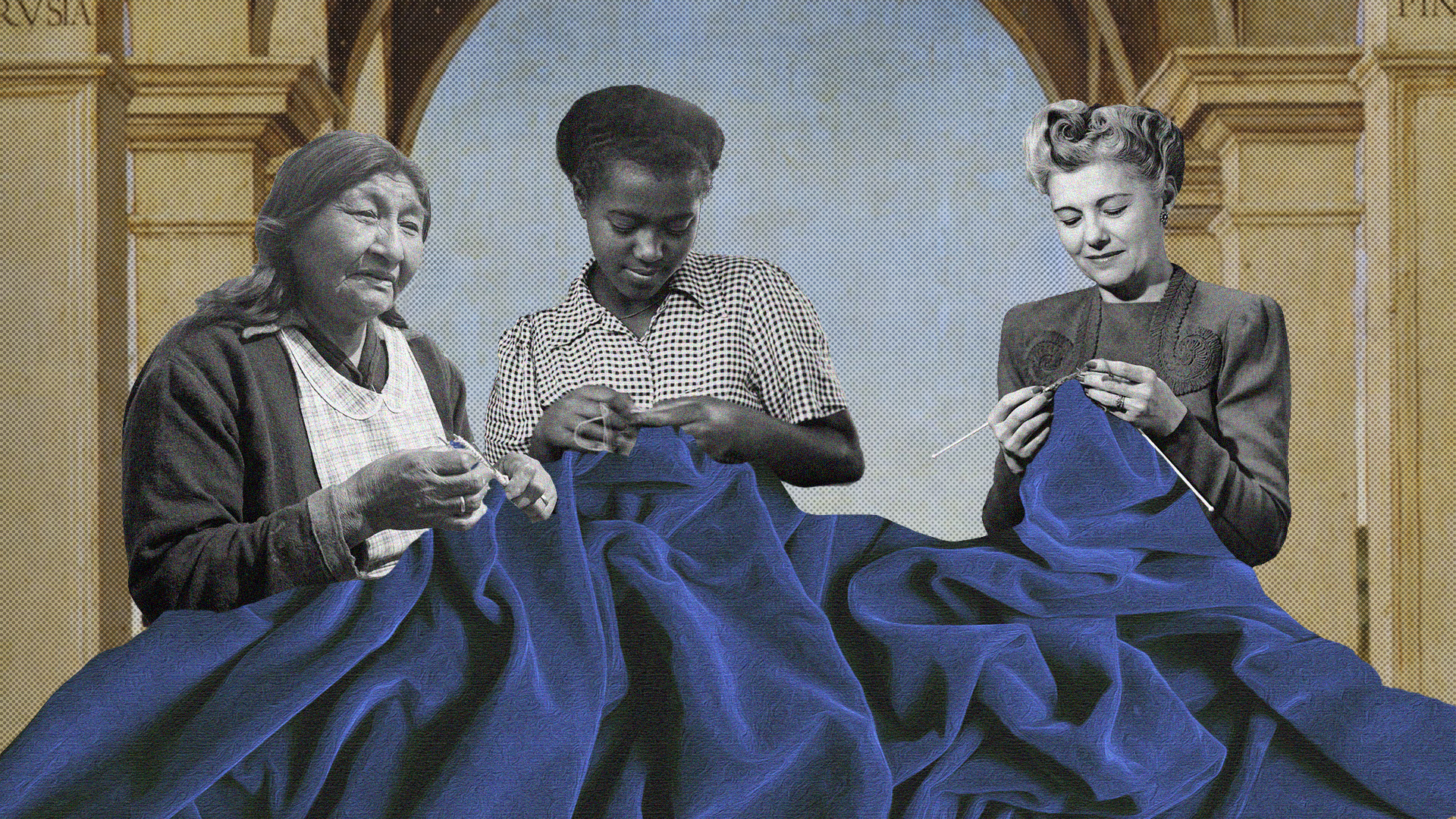
Illustration by Abigail Erickson / Source Images: Getty, Wikimedia Commons

As an angsty young adult and an inexperienced young mother in my 20s and 30s, I used to mock when women’s ministry events featured crafting activities. But now I want to apologize to all the church mothers for poking fun at the knitting, painting, and scrapbooking they wisely incorporated into the community calendar.

If you had asked me a decade ago to consider using an adult coloring book, I would have rolled my eyes. Is this what we think of women? Are we bred to sit still and color prettily? I used to think something like cross-stitching was a waste of time, a slight to women’s mental capabilities, and maybe even an attempt to keep us in our place.

But after several years as a Bible teacher, ministry leader, author, and pastor’s wife, I can now see the value of “crafting for Christ.” While it would be a problem if crafting were the sole activity a church offered for its female disciples, I have come to find that it is a valid way (one of many) for women to connect with God and each other.

I still may not choose a watercolor breakout session at a retreat, but I’m beginning to understand that crafts are not silly; they’re soothing. They’re not solutions to trauma, but they can be opportunities to pursue healing.

In fact, trauma and licensed professional counselors often recommend these kinds of grounding activities for their benefits to our mental health. Even First Lady Michelle Obama has taken up knitting to work through her anxieties. Why? Because they all know the benefits of artistic expression.

On this side of my 40s—after losing my dad to death by suicide, living through a global pandemic, and seeing our polarized country split at the seams—I am ready to embrace all the coloring and calligraphy.

Crafting can be a healthy method of coping with life—which is part of spiritual formation. Working with our hands and doing so in community can lower our anxiety, quiet our minds, open our hearts, and give us calming peace. And bonus: It’s fun.

This got me thinking about several biblical examples of God-fearing people who used their hands in similar ways.

I wonder if Noah’s ark building helped him process the consuming corruption of his generation—along with the justified yet terrifying judgment of God to destroy the wicked by flooding the earth. Did it help Noah to have something to work on every day as he anticipated God’s consequences for sin? Was it gratifying to see his three-story ark take shape as the culture around him was falling apart because of its evil (Gen. 6)?

Maybe Moses’ mother’s basket coating helped her process the fear and grief of having to send away her three-month-old baby to save his life. I imagine making his mini ark would have been a welcome opportunity to “do something” in a time of profound helplessness. Did she pray to Yahweh with every dip into the tar? I wonder if she ever weaved or repaired other baskets and if she thought of Moses and his miraculous rescue every time (Ex. 2:1–10).

Moses’ mom is not the only skilled craftsman in the Book of Exodus. Much of the rest of the book details the Lord’s instructions for God’s people to be all-hands-on-deck for the building of the tabernacle. The Scriptures make a point to say the Lord gave the skilled workers the ability to create all the items required for the tabernacle, tent of meeting, and ark of the covenant, as well as the sacred garments for the priests (Ex. 25–31). It must have been tedious but gratifying work to fulfill the Lord’s requests and create the place to commune with God and his people.

Bezalel was one of the skilled craftsmen from the tribe of Judah that was filled with the Spirit of God, granting him the ability to create intricate designs using materials like gold, silver, bronze, stones, and wood. Did Bezalel feel more connected to God as he looked around to observe his own handiwork (Ex. 31)?

Perhaps the physically demanding labor of piling up heavy stones of remembrance helped Joshua and his people tangibly celebrate God’s faithfulness toward them. Like Stonehenge, these memorial works of art were built to last for hundreds of years—so that future generations of Israelites could testify to God’s powerful help in times of trouble (Josh. 4).

While it might be a bit of a stretch to call building an ark, stacking rocks, and coating a basket crafting, Scripture is full of examples of God’s people involving their hands in their spiritual formation. Their tactile participation shaped their faith as much as their projects.

Our church mothers knew we wouldn’t be the only ones to benefit when we craft—the recipients of our creations gain too. Crafting isn’t just for the person creating; it almost always involves supporting others.

My friend Andrea Gibson, a women’s minister and crafting educator, always creates a purpose behind each craft. Whether the members of her church are bagging baking ingredients to support working moms, knitting blankets for cancer patients, or quilting for the homeless shelter, their crafts serve a godly purpose.

Rebecca Carrell, another friend of mine, is a professor at Dallas Seminary and an exceptional communicator. She took up knitting during the leadership team meetings at church and intentionally used that time to pray over the recipients of her work.

These modern women remind me of Dorcas or Tabitha in the New Testament, a resurrected disciple of Christ, who made robes and clothes for widows (Acts 9:36–41). Dorcas’s textile craftsmanship blessed so many needy women in her community, but I wonder if it also served another purpose: Did it quiet her overstimulated mind or help her focus her attention instead of letting her mind race?

One of the most accurate descriptions of Jesus’ vocation is that of a “constructive craftsman,” like his father before him. For most of his life, he supported himself and his family financially by working with materials like wood and stone to build, shape, and construct.

But I wonder if he continued his craft in some way during his three years of preaching and healing. Did Jesus ever turn to a physical project during stressful times of ministry? Was there ever a time when he busied himself grinding stone or nailing wood as he prepared for the Cross?

We can’t know for sure, but it is worth remembering that Jesus spent much of his time on earth as a humble craftsman who worked with his hands.

If crafting was good enough for Jesus, it’s good enough for us. Church mothers, knit on.

Kat Armstrong is a Bible teacher and the author of No More Holding Back, The In-Between Place, and a six-book Bible study series, the Storyline Project. She will also be the host of a new CT Media podcast entitled Holy Curiosity, which launches in January 2024.


Theology

American Christians and the Anti-American Temptation

Christians can love America—with all of its flaws and failures—precisely because we don’t expect it to be the kingdom of God.

Christianity Today November 17, 2023
Illustration by Mallory Rentsch / Source Images: Getty / Unsplash

This piece was adapted from Russell Moore’s newsletter. Subscribe here.

If any political idea in American life has proven itself over the past several years, I can’t think of a better candidate than the “horseshoe theory”—the notion that, at their extremes, Left and Right bend toward each other, sometimes as to be almost indistinguishable.

One of the ways we can see this is in a bleak and darkening view of the United States of America. The question is not so much whether extremists of the Right or Left seem to hate America these days as much as it is the question of why.

Over 15 years ago, then-candidate for president Barack Obama’s campaign was rocked by a videotape of sermons from Obama’s pastor, Chicago preacher Jeremiah Wright, in which Wright spoke of the September 11 attacks in language reminiscent of that of Malcolm X after the John F. Kennedy assassination, as “chickens coming home to roost.”

Wright denounced the idea of “God bless America,” replacing it with instead a call of “God damn America.” The controversy proved to have no staying power—not because most Americans would agree with Wright but because almost no one really believed that Obama himself held to such views. In fact, Obama repudiated his pastor and left the church.

Wright’s bleak view of America was not unusual for a specific strand of the further reaches of the American Left, at least since the Vietnam era. Counter-culture protesters, after all, once burned American flags and referred to the country as “Amerika,” equating the United States with an imperialist dictatorship.

In more recent years, some initiatives such as the 1619 Project have gone beyond the well-established truth that slavery and systemic racial injustice were the original sin and ongoing struggle of the United States. They argue that slavery is, in fact, what the founding was actually about in the first place—therefore making American racism unaccountable to the ideals of the Declaration of Independence and rendering it irredeemable.

If this is a “culture war,” then one would expect the Right to defend such traditional values as patriotism of the “America: Love It or Leave It” variety. And yet, we see, if anything, an even bleaker view of America from the more radicalized sectors of the populist Right.

Damon Linker detailed the dark worldview articulated by the “illiberal” intellectuals of the Right, prompting New York Times columnist Paul Krugman to ask, “Why Does the Right Hate America?” The concept of a “Flight 93” view of an American project that should have its cockpit charged and plummeted to the earth is indeed quite a bit of a change from “It’s Morning Again in America.”

Indeed, the sort of Christian language of the United States as slouching toward Gomorrah or as a new Babylon sounds more fitting for a leftist critique of American “imperialism” than for those who once heralded a kind of civil religion that seemed to confuse, if not merge, piety with Americanism.

I found myself asking not long ago, “How did the ‘God and country’ Christians become so unpatriotic? Why do so many self-proclaimed ‘Christian nationalists’ seem to hate their own nation? Why do many progressives seem dismissive of any progress?”

This actually should not perplex us. Psychologists have a category for disordered personalities that idealize and then discard. The person whose spouse is expected to meet all spiritual, emotional, and physical needs—to be the perfect “soulmate”—is usually headed for divorce. The parents who build their entire lives around their children’s accomplishments usually end up estranged from them, or even hating them. We cannot love that which is important but not ultimate if we expect it to be ultimate.

That’s what idolatry always does. We expect our idols to fulfill meanings and purposes they never can. When they disappoint us, we tend to reject and rage against them before seeking some other idol where we repeat the process.

A progressive with a view of an upwardly moving and utopian future will ultimately resent anything short of utopia—even if it is an engine so uniquely conducive to justice and human flourishing as liberal democracy. And a conservative with an idealized view of a golden age of the past will soon come to resent an era that doesn’t live up to the illusion.

The Messiahs who don’t live up to our expectations of them are quickly tossed aside for the Barabbases whom we believe will.

The American founders were not the Christian models that some forms of Christian propaganda (otherwise known as “lies”) have told us. These same founders were not the cartoon supervillains that other forms of propaganda would characterize them to be either. They were sinners who aspired to something they never lived up to—and that we don’t live up to either. The genius was that they didn’t seek to wipe away those tensions.

E. B. White—author of Charlotte’s Web and Stuart Little—taught an entire generation of Americans grammar and the craft of writing. Many of us had our high-school term papers marked up for deviating from the Strunk and White Elements of Style.

In 1936 White argued that not only was the United States Constitution not a sacred document but that it isn’t even a grammatical one. White noted that “We, the people of the United States, in order to form a more perfect union” is language meant to turn “many a grammarian’s stomach, perfection being a state which does not admit of degree.” Something is either perfect or imperfect. It can’t be “more perfect” or “less perfect.”

In this one case, though, White was willing to sacrifice the rules. “A meticulous draughtsman would have written simply ‘in order to form a perfect union’—a thing our forefathers didn’t dare predict, even for the sake of grammar.”

A Christian view of humanity should free us to differentiate between a claim to perfection and an aspiration to that which is “more perfect.”

Every era is shot through with grace, and every era since Eden falls short of the glory of God. We can love our parents or our children or our spouses not in spite of the fact that they are flawed but precisely because they are not intended to be our gods.

We can, those of us who are Americans, love America—with all of its flaws and failures—precisely because we don’t expect it to be the kingdom of God.

Christian nationalism can never end in patriotism because it confuses the ultimate and the proximate. Progressive utopianism can never result in patriotism because it does the same.

Genuinely kingdom-first Christianity, though, can and should free us from nationalism, nativism, and perfectionism to truly love God and country, because we know the difference between the two.

Russell Moore is the editor in chief at Christianity Today and leads its Public Theology Project.

As Philippines’ Drug War Rolls On, Christians Continue Their Work

Duterte tried a hardline policy. Marcos is prioritizing rehab. Christians point to Jesus.

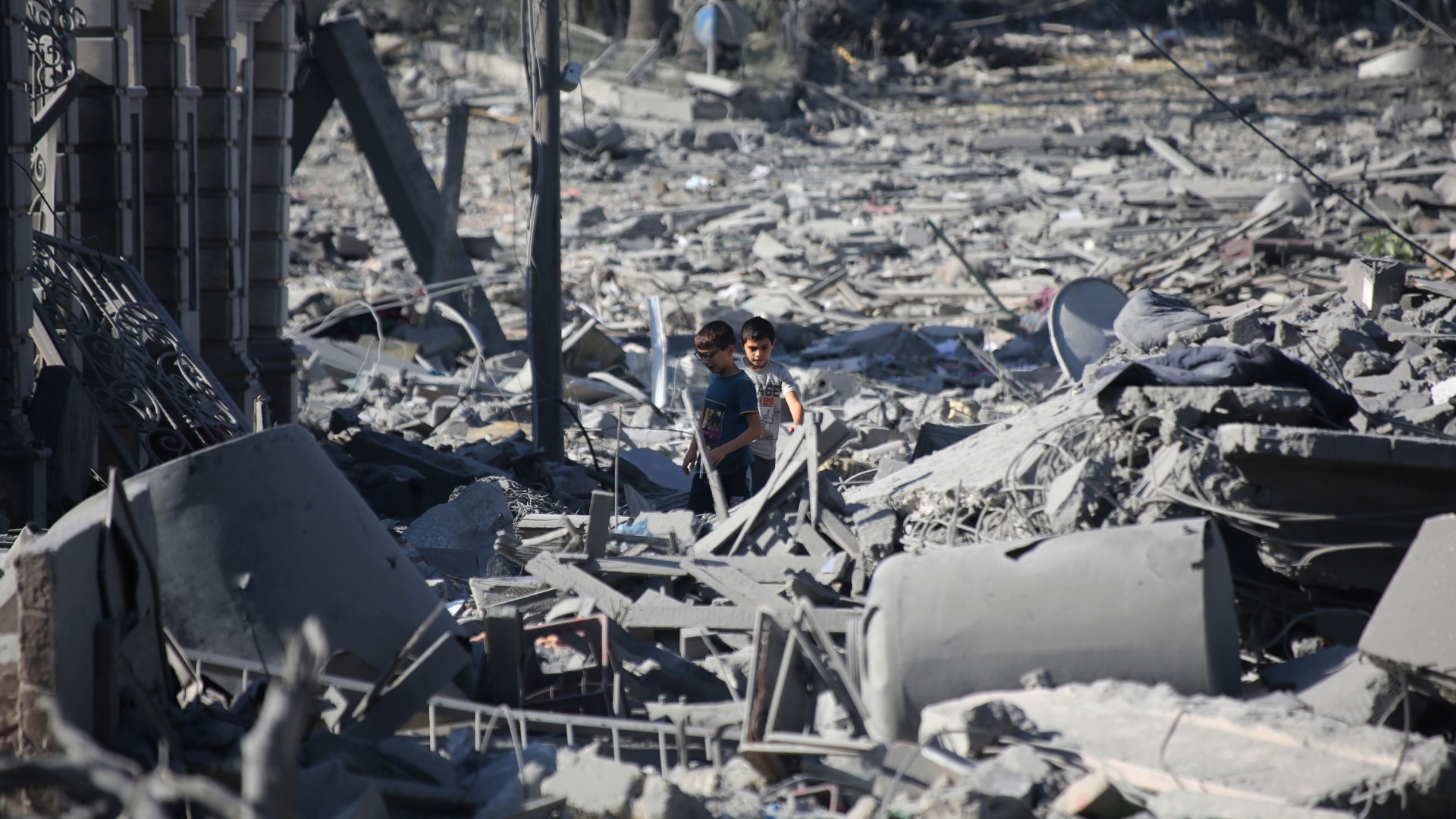
Family members of drug war victims take part in a demonstration.

Family members of drug war victims take part in a demonstration.

Christianity Today November 17, 2023
Ezra Acayan / Stringer / Getty Images

While running for office last year, Philippines president Ferdinand “Bong Bong” Marcos Jr. promised to seek a new path to curb illegal drugs: Catch the “big fish” and rehabilitate drug users.

“Let’s educate the younger ones,” Marcos said in a Taglish interview. “And those who are already involved [or already addicted], we should treat them. … We’re trying to formulate … the best way for the rehabilitation.”

It’s a starkly different approach from his predecessor, Rodrigo Duterte, who outraged Filipinos and the international community with his brutal war on drugs, giving police blanket authority to kill anyone found using or dealing drugs.

During Duterte’s six-year presidential term, government data reported around 6,000 drug-related killings. Human rights groups, however, peg the number much higher, estimating that up to 30,000 people were killed.

“I will never, never apologize for the deaths,” Duterte said in January 2022. “Kill me, jail me, I will never apologize.”

Since taking office, Marcos has established more than 100 community-based drug rehab centers that provide drug users with temporary shelter and reintegrate them into society. Today there are nearly 500 of these centers, called Balay Silangan Reformation Centers, in the Philippines.

However, during the first year of Marcos’s presidency, the number of drug-related killings actually increased from the last year of Duterte’s term, according to a recent report by the Dahas Project at the University of the Philippines’ Third World Studies Center. They counted 342 killings from Marcos’s inauguration in July 2022 until June 2023, 40 more than the previous year. Of that number, state agents killed a total of 146 people.

The study’s researcher Joel Ariate Jr. told Rappler that while Marcos touts a different approach, the policy hasn’t changed because the officials who implemented Duterte’s war on drugs are still in power.

“No one is being held accountable for those killed before,” Ariate told Rappler. “There’s no sense of justice, no sense of punishment. What will stop those who killed and who continue to kill?”

As the government attempts different approaches to tackle the Philippines’ drug problems, Christians engaged in drug prevention and rehabilitation ministries continue their work quietly and faithfully. While government policies may impact who shows up at their doors, through it all, they continue to see God rescuing men and women from their addictions.

Two ways to wage a war on drugs

The Philippines has long faced a drug abuse problem as its geographic location allows international drug syndicates to use it as a major market and transit hub for illegal drug trade in Southeast Asia. Approximately 1.67 million Filipinos used drugs in 2019, according to the government’s drug bureau.

Citizens fed up with corruption and crime elected hard-liner Duterte in 2016. A former mayor of Davao City, Duterte ruled the city for more than 22 years with an iron fist. “If elected president, give me about three to six months, I will get rid of corruption, drugs, and criminality,” Duterte declared during his presidential campaign.

Duterte granted police immunity in the drug war, which in some cases led corrupt police officers to kill people with no connection to drugs. For instance, a 2017 police raid operation in Caloocan City left 17-year-old Kian Loyd delos Santos dead. On him were two small sachets of shabu (slang for methamphetamine) and a .45-caliber gun.

The policemen claimed that he was a suspected drug runner who resisted arrest and shot at them, forcing them to fire back. But witnesses and CCTV footage revealed the young man begged for his life. Gunpowder tests confirmed Delos Santos’s innocence, while reporters found the drugs and gun had been planted on him.

Delos Santos’ death caused an uproar. Authorities tried the three policemen involved in the killing and found them guilty of murder.

An investigation by the International Criminal Court found that only 507 of the 42,286 anti-illegal drug operations conducted in the first year and a half of Duterte’s rule were based on an arrest warrant.

Marcos has worked to differentiate his approach from that of his predecessor. “The campaign against illegal drugs continues—but it has taken on a new face,” Marcos said in his second State of the Nation Address in July. “It is now geared towards community-based treatment, rehabilitation, education, and reintegration to curb drug dependence among our affected citizenry.”

Mainstay Christian drug ministries have witnessed the repercussions of the whiplash in government policy. Since Marcos came into power, “illegal drugs have again proliferated, [even] in our maximum prisons, with inmates as packers,” said Ariston Lee, executive director of Philippine Teen Challenge, a Christian drug addiction treatment center that has operated in the country for 35 years. (Packers refers to dealers who repack drugs into smaller bags for sale.)

Ginno Amodia, director of House of Hope (HOH) on Cebu Island, said that fewer residents now come to the Christian rehab—and that’s not necessarily because there are fewer drug users. Rather, “fly-by-night drug rehabilitation centers sprouted” during Duterte’s presidency as some people saw the strict drug laws as a business opportunity.

“Every barangay [neighborhood] would have an outpatient program,” Amodia said. “A person with a drug dependence problem only needs to visit the barangay once a week and go through a two-hour Narcotics Anonymous session. They aren’t required by the government to go to a full rehab center like ours anymore.”

As a result of this and factors like the pandemic, today House of Hope has 10 residents, down from the usual 20 to 30 residents. House of Hope does not receive government funding, rather sponsors—including churches, companies, and individuals—financially help drug addicts who can’t pay the center’s monthly fee.

Showing the gospel to at-risk youth

Christian groups are also working to prevent young people from getting into drugs in the first place. Abegail Mesa-Raymundo, founder of Rescue Kabataan (which means Rescue Youth), runs an eight-month mental health program at partner schools. This school year, Rescue Kabataan is helping students in General Santos City in Mindanao and Taytay, Rizal, in Luzon.

Volunteers from local churches regularly visit the schools to create a safe space to help high school students deal with issues such as drugs, sexual abuse, pornography, suicide, relationship issues, and teen pregnancy. Rescue Kabataan has held the program at 31 schools in 16 cities and municipalities.

“God can use Rescue Kabataan to show his love,” she said. “We do not share the gospel but we show the gospel.”

Each program starts with Mesa-Raymundo telling her story. In her teens, the pastor’s daughter started to smoke, drink, engage in promiscuous activities, and use drugs after her father died. Initially she sniffed “rugby” (a type of glue), then moved on to ecstasy and other party drugs. At 19, she was gang-raped. In her early 20s, she engaged in prostitution.

Mesa-Raymundo then lost her job as a teacher after having inappropriate relationships with her students. Burdened by all she had been through, she tried to commit suicide three times. But it wasn’t until she overdosed at age 23 in 2011 that she begged God for another chance.

With the help of a group of Christians, she was able to not only stop using drugs but find spiritual and emotional rehabilitation. During a two-week prayer and fasting retreat, God gave her a vision for helping other troubled young people. It was at that moment that Rescue Kabataan was born.

In 2015 Mesa-Raymundo told her story to a crowd of 700 students at a school for the first time, encouraging the students to also bare their hearts. This was followed by many more invitations to speak at other schools and the creation of the holistic mental health program.

Rescue Kabataan’s volunteers range from young professionals to full-time moms, businessmen to retirees. They serve as accountability partners for the students, sharing God’s love with them.

One success story involves a ninth-grade student who started to use drugs at age seven, due to the influence of his drug-addicted parents. “I am ready to be rescued,” he told a Rescue Kabataan volunteer. The group then referred him to the social welfare department, where a social worker helped him recover from his addiction as he continued attending Rescue Kabataan sessions. His grades, his outlook, and his life drastically improved.

Seeing gospel changes at House of Hope

Over in Cebu, Amodia is busy with the daily rhythms of House of Hope. Founded by a Singaporean ex-addict in 1997, the center has been completely run by Filipinos since 2007. Amodia noted the importance of the four components of their one-year, live-in program: spiritual therapy, work therapy, physical therapy, and social therapy.

Every day at House of Hope starts and ends with the Word of God. Residents participate in morning quiet time, daily Bible study, and evening quiet time. Residents are assigned to different duties such as gardening, preparing food, and filling five-gallon water bottles for delivery using their water purification system.

Every afternoon, they spend time playing sports, while on Sundays, residents go to their assigned churches. Doing so helps them meet friends outside of the House of Hope community, Amodia said. After the residents graduate from the program, they continue attending the churches.

All of the staff at House of Hope are ex-drug addicts themselves. Amodia entered the program in 2001 as a 24-year-old on his last hope. Two months prior, he had finished a government-sponsored rehab program that pushed its residents to perform military-style exercises. Yet once he left, he went back to his old ways.

“My family gave up on me,” he recalled. Upon the recommendation of another former drug addict, he applied for residency at House of Hope. There, Amodia came to know Jesus, who he said delivered him from the demons of addiction. After completing the program, he joined the staff.

Amodia sees Jesus doing what government policies can’t: “The gospel really changes people.”

News

Displaced from Israel Border, Lebanese Christians Wrestle with Whom to Blame

As limited clashes with Hezbollah threaten to expand Israel’s war against Hamas, local Presbyterians and Baptists suffer a battle not of their making.

Smoke rises from an Israeli army position which was attacked by Hezbollah fighters near the Lebanese border with Israel.

Smoke rises from an Israeli army position which was attacked by Hezbollah fighters near the Lebanese border with Israel.

Christianity Today November 16, 2023
Hussein Malla / AP Images

Rabih Taleb looked out from the pulpit at the 30 nervous believers gathered at the Evangelical Presbyterian Church of Alma al-Shaab in southern Lebanon, located less than one mile from northwest Israel. One day earlier, Hamas terrorists had killed 1,200 mostly civilian Israelis 125 miles south on the Gaza border.

That Sunday morning, Hezbollah, the Lebanese Shiite militia designated as a terrorist entity by the United States government, fired rockets into the disputed Sheba Farms enclave occupied by Israel but claimed by Lebanon. And as Israel began its massive bombing campaign against Hamas in Gaza, it also shelled Hezbollah positions 35 miles east of Alma al-Shaab.

A few families immediately fled, including the elder who leads worship, forcing the hymns into a cappella. The rest of the congregation pressed Taleb for a shortened service, all eager to return home and prepare for the worst. But the sermon topic—the second in a series on distinctives of Reformed faith—appeared divinely appointed. Little adjustment was needed to discuss original sin, suffering, and pain.

“They ask me: Why are we always facing these difficulties?” Taleb said. “We are believers. Why is there always war, war, war?”

Sources said this was their seventh displacement in the last 50 years.

Alma al-Shaab, one of about a dozen entirely Christian villages near the Israeli border, has a year-round population of about 700 people, Taleb said. Today only about 20 remain, including the Maronite Catholic priest who conducts services—now welcoming all sects—when there are lulls in the fighting.

Taleb and his family left Alma al-Shaab on October 9 when a bomb fell in a field only a three-minute drive from his church, rattling his parsonage home. Most of its 40 Presbyterian families relocated to stay with relatives in Beirut, with others fleeing within Lebanon to the biblical cities of Sidon or Tyre. The local synod, serving seven Presbyterian churches near the border with Israel, opened its retreat center in Zahle in case of further escalation.

So far, only three families have stayed behind.

Taleb has returned to his home village in Minyara, 115 miles north near the border with Syria. But every day he consults with elders about the condition of his scattered flock, and every 7–10 days he returns to visit Alma al-Shaab, violence permitting.

While the war rages in Gaza, Israel and Hezbollah have maintained a lower-intensity conflict, each mindful to avoid escalation. Analysis suggests that Israel does not want to open a second front, while Hezbollah is wary of Israel’s pre-war pledge to “bomb Lebanon back to the stone age” in any confrontation.

Israel has already evacuated 42 northern villages near the Lebanese border, limiting Israeli casualties to seven soldiers and three civilians. Meanwhile, at least 70 Hezbollah fighters have been killed alongside at least 10 Lebanese civilians. Nearly 30,000 Lebanese have been displaced.

“We are in the middle of a fight we have nothing to do with,” Taleb said. “We can speak out that Palestinians have the right to live freely, but it is not our role to support them through war.”

The sentiment aligns with most Lebanese citizens. A recent survey found that 74 percent reject the statement that “Hamas initiated the war and targeted civilians, so it’s legitimate for Israel to retaliate appropriately,” as many extend the timeline of grievances far before October 7. Yet 61 percent reject Hezbollah’s participation in the war, and 74 percent agree that their nation should stay neutral.

The fighting has already caused “significant damage” to local agriculture, stated the United Nations humanitarian coordinator in Lebanon. Satellite data tallied 400 fires in the farmland surrounding Alma al-Shaab, while a Lebanese professor from Balamand University stated about 1.7 square miles of southern forests have been burned. The agriculture minister counted 40,000 olive trees ruined during the height of harvest season, while the environment minister estimated $20 million in damages.

One Presbyterian is staying in Alma al-Shaab to help fight the fires.

“I can manage to live, but not to rebuild what was destroyed,” said another Presbyterian, a church elder, requesting anonymity due to the sensitivity of his Hezbollah-controlled area. “I don’t blame anyone—I am not a politician—only a victim.”

The elder said that his farmhouse was destroyed along with about 10 other homes in the village. One blast, he said, was from a Hamas-aligned Palestinian rocket. Now displaced in Beirut, he is not sure how many of his approximately 100 olive trees were damaged, but as an Israeli missile has destroyed the village water tank, he knows the trees will soon wither along with his 200 avocado trees.

Alma al-Shaab Presbyterian Church

An American University of Beirut (AUB) professor stated environmental recovery of the land could take decades.

A second anonymous Presbyterian elder blames Hezbollah, Israel, and—above all—himself for remaining on his generational land. His home was destroyed in the prior border war in 2006, when a Hezbollah fighter fired rockets from the roof, he said, and an Israeli helicopter destroyed both.

He managed to rebuild on his meager salary and install cameras, so he knows his house, at least, is still standing. But after recording two young men trying to break in—presumably to hide from Israeli attention—he briefly returned home and reinforced the locks.

“What profit does this give Palestine?” he asked. “We just want peace with Jews, with Muslims, with everybody.”

Expressing desire for peace with the State of Israel, however, is a controversial stance in Lebanon. The Mediterranean nation remains in a technical state of war with what it often calls “the Zionist entity,” which invaded in 1978 and 1982 during Lebanon’s civil war. The second elder, also displaced to Beirut, lives in a home he purchased at that time to distance his sons from Israel’s recruitment of Christian young men into its aligned Lebanese militia.

Israel’s occupation of the southern regions did not end until 2000, when Israel withdrew under pressure from a nascent Hezbollah-led resistance. Its general secretary Hassan Nasrallah praised the border villages for “embracing” its “jihadist fighters” and bearing the burden of displacement and loss.

But beside Presbyterians, other evangelicals are also suffering—and helping.

The small Christian village of Deir Mimas, 25 miles northeast of Alma al-Shaab, once had a population of around 1,000 people. The 2006 war reduced it to about 350; now only about 100 people remain. In the last conflict, the home of Baptist pastor Maroun Shammas was one of the few to be hit by Israeli bombing. This time there have been a handful of strikes in the surrounding farmland, but he and 9 of the 12 church families have relocated elsewhere.

He said he has no issues with his Muslim neighbors. A former teacher in the nearby Shiite village of Kafr Killa, Shammas said he and other Christians maintain interfaith friendships and interact freely with all Lebanese sects.

“Shiites are villagers, normal people like us,” Shammas said. “But no one asked us about war in the south, and we blame Satan.”

Damage to a home in Alma al-Shaab

Deir Mimas Baptist Church has already been partnering with local evangelical ministries to provide 40 village families with food boxes and another 20 families with school fees. Coordinating with the municipal government, Horizons has now increased its local nutritional support to nearly all who remain, while Thimar is assisting the families who have been displaced.

“This is not the first time that we have left, and every time, we come back to continue our ministry,” said Shammas. “God wants us to help people know him.”

Sources said that evangelicals have a good reputation in the Shiite-dominated south, due to the humanitarian response of serving the displaced during the 2006 war. Heart for Lebanon (HFL) was created at that time and continues assisting area Christians and Muslims alike.

In October it distributed food boxes and detergent to 340 families in eight locations in the south, including Alma al-Shaab, Deir Mimas, and neighboring Sunni and Shiite villages. In November it expanded to 15 locations—including homes with Muslim-background believers in Jesus.

Lebanon permits freedom of religion, and cross-faith service prevents undue controversy. But so does HFL’s strict ministry-only messaging.

“We pray for peace, and for God’s glory to shine among all peoples,” said Milad Nassar, HFL field manager for the south. “We don’t talk politics.”

But many other Lebanese do, and many suspect Israel has bad intentions beyond Hezbollah.

Missile attacks have now reached nearly 30 miles inland. Strikes near Haifa, Acre, and other Israeli cities beyond the border have been claimed by Hamas units in Lebanon, not Hezbollah. Nonetheless, many posit that no units can act independently of the Shiite militia.

“In the chain of actions and reactions,” stated an AUB analyst, “it is becoming difficult to know who initiates the escalation.”

But other analysts wonder if Israel is looking to provoke Hezbollah to justify a full-scale attack against it—and perhaps draw in the United States. Two US naval carrier groups are positioned in the eastern Mediterranean to deter Iran-sponsored aggression. Reportedly, secretary of defense Lloyd Austin warned his Israeli counterpart about such a scenario. Israel denies this intention.

For his part, Taleb chooses to blame no one—but follow instead his “role model,” Jesus.

“It is a cycle, neither side can destroy the other,” he said. “We need them to find a way to live in peace, so that we can live in peace.”

He tells his confused parishioners that this suffering is not God’s punishment for their sins. The Cross assures them of God’s love, the experience of which they must not keep for themselves. If the writers of the Bible had done so—most of whom also suffered—we would not have the Bible today.

Now it is their turn to communicate, he said, building bridges of love and service.

But it is not easy. On every trip to Alma al-Shaab, Taleb questions the wisdom of returning to a dangerous area. It is not the provision of food boxes that drives him, however—it is the experience of God, which he longs for others to enjoy.

He prays with the Maronite priest and the resilient Christians, drinks tea, and if not for his own family of three young children, he might have remained in the village. After all, its Presbyterian church dates back to 1859.

Instead, he travels north and south across Lebanon, visiting the scattered flock.

“This is living what we believe—a working faith,” Taleb said. “It is to show people that God loves them, through us, for his glory.”

Editor’s note: CT is translating select articles about the Israel-Hamas war into Arabic.

News

Skeptical of Politicians and Parties, Gen Z Isn’t Pumped for the 2024 Race

But on Christian campuses, first-time voters are still trying to find their own ways to engage the issues.

Christianity Today November 16, 2023
Illustration by Christianity Today / Source Images: Getty

Gen Z Christians are creating their own playbook when it comes to the intersection of faith and politics.

Whether they’re growing more cynical of partisan politics or finding hope in the power of political change, this generation sees itself branching out beyond the issues that have long driven the Christian Right.

Younger believers are quicker to name creation care, prison reform, and immigration as the political causes most influenced by their faith, rather than abortion or sexuality. But even those who seek to get involved in politics don’t align as closely with the two major parties in the US and aren’t excited at the prospects for 2024.

At Calvin University, Micah J. Watson has noticed a shift amongst college students.

“I do think there has been a weariness among Gen Z in some of the ways their parents and grandparents did politics in the 1970s, ’80s, and ’90s,” said Watson, associate professor and director of the politics, philosophy, and economics program. “Some of the culture war practices have been seen as problematic.”

For young Christians who have the chance to vote in their first presidential election next year, the milestone comes with trepidation, knowing the political polarization that surrounded the races in 2016 and 2020.

“Having gone through COVID and Trump and Biden elections, students have seen parents’ relationships going down the tube,” Watson said, “and there’s a fear of expressing one’s views and being canceled.”

Growing up, Rachel Smith remembers her mother adorning the family car with political bumper stickers to reflect both their party affiliation and their Christian values. But Smith, now a sophomore at Wheaton College, isn’t eager to cover her car with candidate names and slogans.

She hasn’t voted before, but, looking at the political landscape today, she doesn’t believe that just one party or person represents the principles of her faith.

“While I always saw how the Democrats were wrong—and I still think they are wrong about a lot of things—as I got older and did more research, I’ve seen how Republicans have done a lot of harm as well,” said Smith, a psychology major and cabinet member of the campus chapter of International Justice Mission. “I’ve felt closer to God in that my views are not indicated by what is important to a party, but what is important to God.”

Smith is among around half of Gen Z adults who don’t identify with either party in a new American Enterprise Institute (AEI) survey.

Gen Z and millennials grew up with the most skepticism toward politicians; more than six in ten said they didn’t see political leaders as trustworthy during their formative years, while the vast majority of Baby Boomers and the Silent Generation looked to politicians to do the right thing.

Daniel Cox, director of the AEI’s Survey Center on American Life, says members of Gen Z—born between 1997 and 2012—have been surrounded with high levels of cynicism and low levels of trust in America’s political leaders.

“People came to age when they didn’t believe there were adults in the room handling these big issues and considerable threats in ways that were effective,” he said.

https://datawrapper.dwcdn.net/qTaJP

For many in Gen Z, their adolescence was riddled with active shooter drills in high school and seismic political events such as the #MeToo and Black Lives Matter movements. They saw the former president go through two impeachment inquiries in office, one on charges of inciting an insurrection.

The political landscape during Gen Z’s youth has led many to wonder whether politics are a meaningful arena for change or a “necessary evil.”

Looking ahead to the 2024 race, Jasmine Chan, a junior political science major at Pepperdine University, has already realized that her first vote for president won’t go to a candidate that she’s excited about or meets her expectations for the high office.

“I think Gen Z does a good job at pointing out that we should not just focus on two political parties, but … that’s the reality we’re living in,” she said. “It’s hard to be hopeful in times like these, but there’s not much we can do about it now.”

According to AEI, even as pessimism in politics has become ubiquitous, young people remain optimistic about their own lives: 70 percent of Gen Z adults say their best days are ahead of them.

While constant exposure to political content on social media and increasing polarization has proven overwhelming for some Gen Z Christians, others have felt ignited with a passion for politics.

“Governments are arguably the most powerful institutions that we have, and being a good steward of them is important,” said Rosalind Niemeier, a senior at Calvin. “We can help people through politics and international relations. We can leave net positives in people’s lives.”

Niemeier majored in international relations and Spanish, and she’s the president of the school’s Political Dialogue and Action Club. She sees an “aversion to politics” on campus and wants people to get involved with the club for the sake of advancing civil dialogue and ethics.

But even she has to fight off her own cynicism or frustration with the state of politics.

“We’re always waiting for the other shoe to drop,” said Niemeier, while following the recent congressional fights to avoid another government shutdown. “Particularly people in political science classes believe the way things are framed is never the way things are.”

Karie Riddle, assistant professor of political science at Pepperdine, notes that, while many of her students are fearful for the future, the political science major at Seaver College in Pepperdine University has been growing.

“There is a lot of loss of trust in democratic institutions,” Riddle said. “But I think that fear and uncertainty has prompted students to be excited to be involved.”

Chan sees the layered influences that led her to her own political stances and inspired her interest in studying politics. After an internship in Washington, DC, last summer, she plans to apply to law school and work as an advocate for women experiencing domestic violence, a calling inspired in part by the Christian call to love and protect the vulnerable.

“I find myself torn or not fully understanding how I can depict the relationship between my religious and political values in one sentence, because it’s more complicated,” said Chan. “You have to consider the intersectionality of everyone and their experiences, and it’s not a cookie cutter thing.”

She was raised in California by a Mexican Catholic mother and Burmese Buddhist father, then came to faith as a Protestant Christian in high school. She believes the opportunity her parents gave her to choose what she believes instilled an open-mindedness that permeates her politics.

Chan remembers sitting on the couch with her parents at age 16 and watching footage of the protests in Los Angeles after the death of George Floyd in 2020. “There were people fighting for their lives and rights, and they looked like us,” Chan said. “Even thinking about that now, it’s still shocking because not only did I experience that, but so many young Americans, or Gen Z in general, had to explain [to their parents] what that meant.”

Members of Gen Z are more racially and ethnically diverse than any previous generation, which also complicates their place in a two-party political system. AEI found that younger generational cohorts have more varied identities and experiences than previous generations.

Gen Z is also unique when it comes to how women and men engage with politics. According to AEI, when it comes to views on gender-related issues, there is a clear gender gap among Gen Z adults that is more pronounced than among older generational cohorts.

Political touchstones such as the #MeToo movement, Trump’s election, and the overturning of Roe v. Wade were uniquely influential for young women but not for young men.

“We did in-depth interviews with a number of young men and women,” Cox of AEI said. “For young men, when you ask them about the #MeToo movement, it wasn't as resonant.”

“There’s a lot more apathy among young men,” Cox said. “There’s no particular issue that we see young men care about. If anything, it’s loneliness and depression.”

Wheaton sophomore Bram Rawlings said his male friends seem just as politically aware and interested as his female friends, however. He admitted he hasn’t voted in a US election yet but still follows international politics.

“Maybe that does reveal some apathy on my part, or a certain apathy toward US politics,” Rawlings said.

While Rawlings is more hopeful about politics on the local level, he’s become increasingly cynical of any human-designed system’s ability to work for those most vulnerable. Instead, he’ll ask, “How can the church address the problem, or address the fact that there are people who are economically and financially vulnerable?”

Campus ministries like InterVarsity Christian Fellowship see potential for their discipleship programs to help support and sustain the next generation of Christian activists, advocates, and voters.

“If [we] don’t want to, other people will,” said Jonathan Walton, a senior resource specialist in InterVarsity’s multi-ethnic initiatives department and author of Twelve Lies That Hold America Captive: And the Truth That Sets Us Free.

Walton believes Christian institutions need to turn their focus from protecting their own longevity to becoming assets that “people actually need.” “That’s a fundamental problem to how we are approaching Gen Z,” Walton said. “They are looking for relationships, not membership.”

Walton believes campus ministries can help students who feel passionate about activism to “slow down and follow Jesus.”

“Communities are falling apart,” Walton said. “People are falling apart, and instead of falling apart together, we need to fall together. And land together. We need community as we do that.”

Theology

Christians Can’t Fix the Israel-Hamas War

Jesus could end this crisis. His followers almost certainly can’t.

Palestinian children inspect damage to their homes caused by Israeli airstrikes.

Palestinian children inspect damage to their homes caused by Israeli airstrikes.

Christianity Today November 16, 2023
Ahmad Hasaballah / Stringer / Getty Images

The way to resolve the Israel-Hamas war is very simple, journalist Matt Yglesias recently explained. We could do it in just five steps:

https://twitter.com/mattyglesias/status/1718704393376137440

It’s great, right? I love it! Only—well, that third step seems a little tricky.

And that’s the point, as Yglesias wrote at greater length on Substack. Obviously, the five-step plan is a joke. But it gets at something that so much commentary on this subject seems to miss—certainly in America, and probably elsewhere—which is that Israeli political leaders (to say nothing of the murderers in Hamas) are not ignorant of what we outside observers believe is the right and prudent way forward.

“They just disagree,” Yglesias notes, and they are unlikely to stop disagreeing, and we are unlikely to shift their thinking much, if at all. By “we,” I partly mean the US government, which, for all its power, is objectively limited in its capacity to shift the behavior of combatants who believe, quite rightly, they are in an existential fight. But I also mean you and me specifically—as well as our fellow Christians in America and around the world.

We cannot fix this crisis, no matter how faithful, factual, and fervent we are.

This bears saying, I think, for two reasons. One is our modern habit of “awareness,” as in, I am posting this article on Facebook because I want to raise awareness.

On many issues of great import, the reality is most of us can do very little to effect significant change. Sometimes we can give money to a relevant cause. Always we can pray (1 Thess. 5:17) and take care we do not sin in our hearts or our speech as we react to the news (Matt. 5:21–30). But most of us are not scientists who can find a cure for cancer, or politicians who can rewrite American immigration law, or generals who can decide on whom bombs will fall. Our duties to God and neighbor are usually more imminent and mundane, and if God answers our prayers, that is far more God’s work than ours.

Still, we find ourselves with so much information about problems near and far. It is the background noise of every digital conversation. We feel a pull to respond—but how? What tangible good can we do? Often, as finite people in a fallen world, the frustrating answer is: nothing. Often the only visible action we can take is what we call “awareness,” and often this amounts to a fun run or a social media post.

Awareness isn’t bad, but buzz is not change. Awareness—and the opinionating that attends it—is not by itself a solution. Having ideas and information in our heads will not resolve a crisis halfway around the world and wholly outside our influence. “Can any one of you by worrying add a single hour to your life”—or subtract a single hour from some distant conflict? (Matt. 6:27).

Not only that, but this kind of worrying may also sap our attention and energy from other, better uses. Is it better for me to raise awareness about cancer or to make dinner for a member of my church undergoing chemo? This is not difficult to answer.

The other reason is that, as Christians, we rightly have a high opinion of faithfulness and its effects. By faith, God’s people have “administered justice,” “shut the mouths of lions,” and “received back their dead, raised to life again” (Heb. 11). We can be “co-workers in God’s service,” as Paul wrote to the Corinthians, whose faith rests “on God’s power” (1 Cor. 3:9, 2:5). The “prayer of a righteous person is powerful and effective,” James taught, reminding us of the story of Elijah—“a human being, even as we are”—whose earnest prayer led to both famine and plenty (5:16­­–18).

But faith is not magic, nor is it a guarantee of a happy ending on this side of eternity. It does not always succeed in protecting us or turning others away from evil.

The heroes of the faith in Hebrews 11 did not reliably triumph over adversity in any immediate sense: “Some faced jeers and flogging, and even chains and imprisonment. They were put to death by stoning; they were sawed in two; they were killed by the sword. They went about in sheepskins and goatskins, destitute, persecuted, and mistreated” (vv. 36­–38). They “were tortured, refusing to be released so that they might gain an even better resurrection”—and though they will gain it, they were still tortured (v. 35).

Christian faithfulness also can’t have effect where it does not exist. A recent essay about the Israel-Hamas war at Red Letter Christians ends with an exhortation from a Palestinian Christian peacemaker, who, “when asked what he thinks will contribute most to ending this violence,” said, “When we follow the Jesus we talk about, this crisis will be over.”

The part of me that’s convinced Jesus calls his followers to peacemaking and nonviolence wants to agree, but the realist in me says this simply is not true.

Yes, Christians should follow Jesus, in war as in every circumstance. But Christian faithfulness will not end this crisis, in large part because the people at war here overwhelmingly are not Christians. There are some Messianic Jewish Christians in the Israeli Defense Forces and among Israeli civilians, and some Arab believers are part of the civilian population of Gaza, where they and their churches have not been spared attack. But by and large—especially in the upper echelons, where strategy decisions are made, and entirely among Hamas—this is a conflict between non-Christian combatants.

We can’t expect them to follow Jesus if they haven’t made him their Lord. We shouldn’t expect them to value a Christian perspective about what to do (1 Cor. 2:14, 5:12–13a). That’s the Christian version of Yglesias’ third step—which is just as much a joke as the secular variant.

That’s not to say our faith is of no import here. It is beyond our power to end this crisis, but it is not beyond God’s power.

We often say Elijah’s famous prayer brought plenty, and in a sense it did, but when “the heavens gave rain, and the earth produced its crops,” that didn’t happen by Elijah’s hand. It was the work of God. And we can be “co-workers in God’s service” whose faith rests “on God’s power,” but it is still God’s service and God’s power. When God’s people “administered justice,” “shut the mouths of lions,” and “received back their dead, raised to life again,” it was not really them, but God working through them.

What would it look like for God to end this crisis? I don’t know. The practical difficulties seem insurmountable to me. I have no good ideas and no power to enact them, anyway. I can only put my “hope in the Lord both now and forevermore” (Psalm 131:3), refrain from concerning myself with “things too difficult for me” (131:1, NASB), and pray for peace. Maybe God could get on with the Second Coming. “Wouldn’t this be a good time for him to come?

Bonnie Kristian is the editorial director of books and ideas for Christianity Today.

Theology

Chinese House Churches Find Hope for Gospel Growth Amid Post-Pandemic Turmoil

As China deals with economic woes, religious restrictions, and mass exodus, ministries see an opportunity.

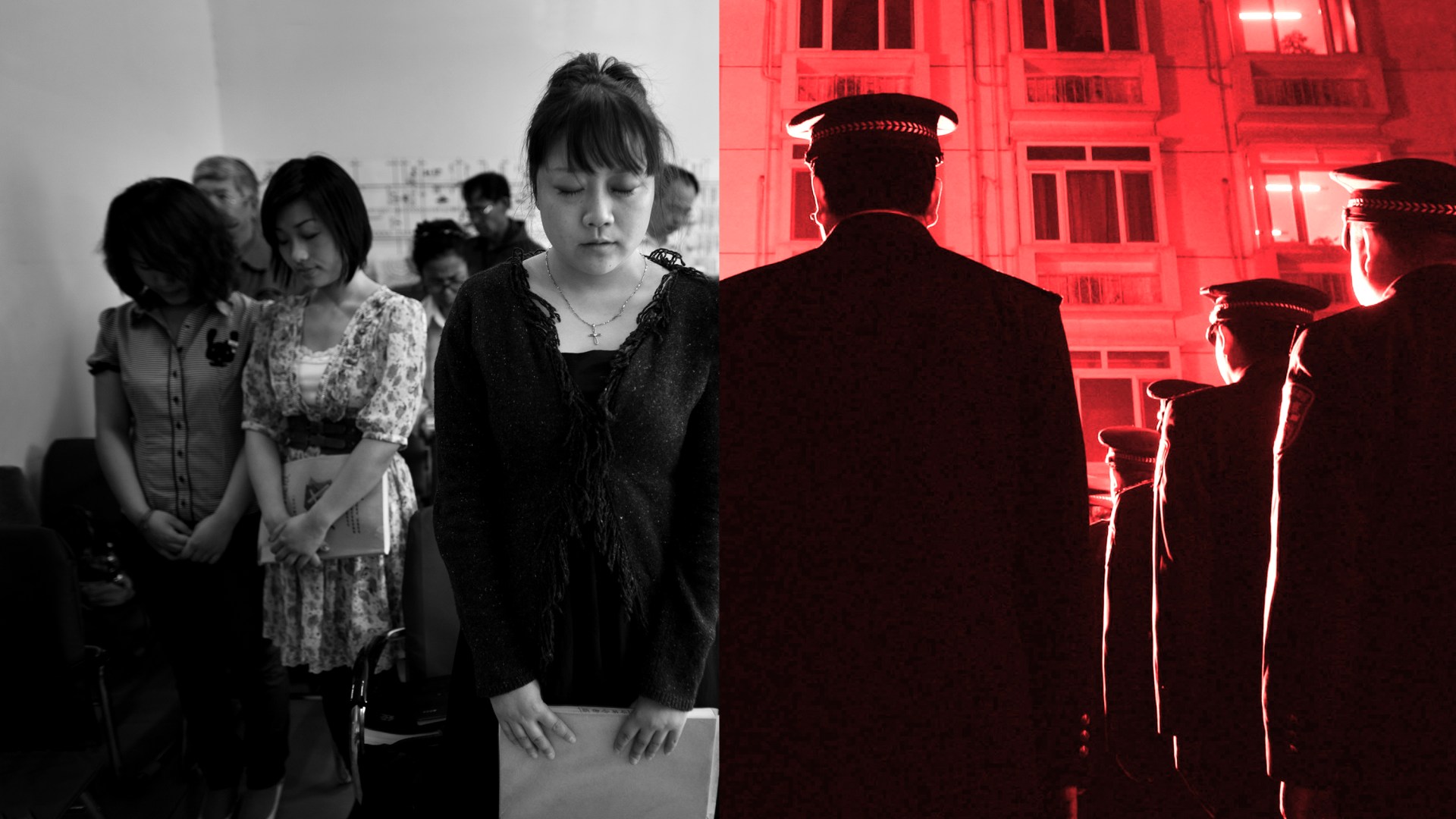
Left: A house church in China. Right: Chinese police preparing to raid a venue.

Left: A house church in China. Right: Chinese police preparing to raid a venue.

Christianity Today November 16, 2023
Illustration by Christianity Today / Source Images: Getty

Christians in China have had a difficult several years. The Chinese government kicked missionaries out of the country, tightened restrictions on religion, and cut off access to the world with its aggressive “zero COVID” policies. After a growing discontentment prompted unprecedented protests last year, the government finally dropped its pandemic restrictions.

Solomon Li, an overseas ministry leader who has served the Chinese church for the past 30 years, finally had a chance to return to China this year for the first time since the pandemic began in 2020. (Li’s name has been changed due to security risks.)

He met with 150 pastors within one urban house church network and shared with CT about the new challenges and opportunities that Christians face in this post-pandemic era. The interview has been shortened and edited for clarity.

China’s “zero COVID” policy, which aimed to keep cases as close to zero as possible with strict lockdowns and mass testing, only ended last December. How did the pandemic impact the house church leaders that you met with?

In general, it became more difficult for them to hold Sunday services, but many of them still tried to meet in person as much as they could. It also made things more difficult for fellowships and house visitations. People feared that they were spreading germs by gathering together. These were some really tough years.

One reason these churches wanted to continue meeting offline is that they were concerned about intentional ecclesiology: What is the doctrine of the church? Can online or Zoom services be acceptable in the long term? Their answer, based on the Bible, was no. Online church is the exception to the rule. If we can go out shopping, then maybe we can provide the opportunity to have Sunday worship in person.

The COVID-19 pandemic also happened in parallel to new religious policies. While “zero COVID” affected everyone, the intentional tightening up and targeting of house churches added another layer of difficulty to Christians. If the government is closely watching your church, it is hard to resume in-person church. Even online church is difficult.

Yet because there are so many churches in China, it would be very costly for the government to monitor everybody. So while some large churches were targeted, a lot of other churches just continued meeting with minor difficulties.

What encouraging stories did you hear about how God worked in house churches during the pandemic?

I found that some churches met throughout the entire pandemic—they never stopped meeting in person for even one Sunday worship. I don’t know how they managed to do that, but it just shows that there is room for that. I think that how a church fared during the pandemic is not based on external factors but internal ones: How ready were church leaders to deal with crisis? How do they comprehend what churches are? How are they adjusting themselves to reach out to the flock and provide leadership and pastoral care? One church in a major city started gathering in February 2020 at the beginning of COVID-19 with 17 people. When I visited in July, they had grown to three congregations with 150 people at the largest congregation (the smaller congregations had 40–80 congregants). One reason the church grew so much was because people’s hearts were still seeking the Lord and seeking worship. If a church was healthy and continued to hold worship services, people would come. A lot of the growth came from church transfers, yet about 20 to 25 percent of the attendees were non-Christians.

At times the church couldn’t meet together, especially during outbreaks, but they were creative in building up community. They asked different families to film themselves reciting a children’s catechism. Then they edited it together and played the video during the virtual Sunday service to provide a sense of togetherness.

Some churches didn’t have the ability to provide good care or didn’t have the strong theological structure to move forward. So Beijing Zion Church, which is a relatively mature church, supported these churches, bringing them into the Zion family. They formed a huge online church with nearly 10,000 people from all over China. At the same time, they still wanted their members to gather in local churches.

Every church tried to do things in different ways. It was a time of consolidation. Some churches grew bigger and bigger, while other churches disappeared.

News reports often mentioned that China’s “zero COVID” policy hit universities especially hard. At the same time, campus ministries have historically played a large role in introducing young people to Jesus. How have these ministries fared during the pandemic?

Colleges were one of the most tightly controlled places because COVID-19 can spread very quickly on campus and impact the whole city. The students were sort of jailed on campus and no one could access them. Some pastors encouraged their students to come out every week for church.

In general, COVID-19 and the government’s tight control over education made campus ministry a very different reality from the past. A lot of the fruit of churches today come from the effort of campus ministries in the 1990s and early 2000s by missionaries from Korea and the West.

But today there is such tight control on campuses. They use facial recognition to determine who can access the door and they teach students to reject any approaches from religious groups. This is making campus ministry very difficult. We are losing the next generation, and I fear the momentum of church growth will be stopped.

Still, there are some very creative leaders doing campus ministry. For instance, one urban church sent 60 college students to five cities around China for short-term mission trips last summer. They shared the gospel with a total of an estimated 10,000 people. It’s a means to train the younger generation. I still see these very courageous and creative ministries going on, and we need more of them.

What was the most surprising thing you found when you returned to China after several years away?

Chinese people are so resilient. With the pandemic and the political change, a lot of people are realizing that China is not moving in the right direction. But in the midst of all that, they are still living their everyday lives.

From the outside, we think China has become so political, but in everyday life, many people don’t care about that. Sometimes people even joke about it. I really admire Chinese people’s resiliency. Yet on the other hand, if they don’t care about what’s going on, it makes gospel sharing more difficult.

I’m also surprised by the emergence of some great Christian leaders. Even though a lot of things are hard, God has raised up leaders with great vision, great passion, and godly character. They try to share the gospel and take care of their flock. Their leadership has led the church to grow. It moved me to see that the Resurrection is real, and the Holy Spirit’s work is real.

This makes me really hopeful. I think a lot of people are pessimistic about China, but I think this is the most hopeful time for China in the past 30 years. I asked Chinese pastors: Would you want to be in a fully modernized, well-developed society that has little room for the gospel? Or in China where everything is uncertain, fluid, and challenging, but through the last 150 years, God has been creating larger room for the gospel? So many people are eager to learn and to hear the good news.

As society in China is changing, how should Christians change their approach to evangelism?

I think we need to speak “different languages” to different people. There are some people who just keep moving no matter what is happening around them. However, another group is leaving China because they can’t live with China’s current situation. They want to protect their wealth and their children’s futures. Some of them are leaving for idealistic reasons. [Last year 10,800 millionaires left China, and 13,500 more are expected to leave in 2023, according to Henley and Partners.]

So, the first group of people we can reach are the idealistic people whose hope in the country is broken and who are seeking answers. The second group are those who are not the idealistic type but who are so worried about their safety. Both of these are people that diaspora Chinese churches should be prepared to reach out to.

When we speak to them, we really need to be down-to-earth and realistic rather than sprouting high and lofty theology. We need to have heart-to-heart discussions. Otherwise, people will say, “What does this have to do with my everyday life?”

What impact does this exodus from China have on house churches?

A lot of Christians are leaving the country, especially the more educated and more resourced ones. One pastor told me that eight families in his church left China last year. Another pastor was discouraged because three key leaders left China—people who had committed to die together in the same church in the same city. That will have a huge impact on these church leaders. They need to rethink: What is the essence of church and what are you building upon?

At the same time, how does this exodus provide an opportunity for diaspora Chinese churches in the US and around the world?

The challenge is that there are so many Christians coming. You don’t need to share the gospel, you don’t need to do evangelism, people will just come into your church.

Imagine your church has 100 people and in one year it grows to 180 people. That entirely changes your demographic landscape. How does that impact the culture of your church? This is a large challenge for existing churches.

Then, when pastors in China try to start new churches overseas, they assume they can do the same things they did back home. Yet in a new country and culture, the dynamic changes. Your authoritarian way of starting a church doesn’t work anymore in Thailand as it did in China. There are a lot of changes that they need to adjust to as they learn about a new culture.

Chinese church leaders in the US need to understand the current mainland Chinese culture and why these Chinese people immigrated to the US. Just because you speak the same language doesn’t mean you really understand them. There’s a huge opportunity, but a lot of work needs to be done.

I’m still very hopeful. China has been through all these national disasters in the past 150 years, yet through it all, the gospel has never stopped and the church has never stopped. Hopefully the current shake-up of Chinese culture will open doors for the gospel to enter through.

Theology of Provocation: Portuguese Pastor Explains Why ‘Everything I Do Is Clickbait’

Tiago Cavaco insists he has a greater purpose than entertaining, amusing, or trolling Christians.

Tiago Cavaco

Tiago Cavaco

Christianity Today November 15, 2023
Illustration by CT / Source Images: Courtesy of Tiago Cavaco

Tiago Cavaco loves pushing the envelope.

No need to look further than the titles of the Portuguese evangelical pastor’s books: Férias de fornicação e outras murmurações de um moralista (A Vacation of Fornication and Other Murmurings of a Moralist) and Seis sermões contra a preguiça (Six Sermons Against Laziness).

Or the names of his biggest hits as a punk rock musician: “Ó Judas Aperta o Laço” (“Oh Judas Tighten the Noose”) and “A Isabel é Intelectual (Porque Perdeu a Virgindade na Feira do Livro)” (“Isabel Is Intellectual (Because She Lost Her Virginity at the Book Fair)”).

“Everything I do is clickbait,” says Cavaco, who previously worked in television for a decade before he became a pastor at Segunda Igreja Evangélica Batista de Lisboa, better known as Igreja da Lapa. But he insists he’s not just trying to entertain, amuse, or troll people.

“The provocation should be read with a sense of humor, something that evangelical Christians often lack. There is no room for surprise.”

Cavaco imbues everything he creates—whether sermons, works, songs, or newspaper articles—with a Christian worldview.

“I’ve almost built a theology of provocation,” he said. “Jesus often tries to provoke his audience through his teachings. He often gives as an example things that people consider to be bad … so that those who think they are very holy don’t count on their own benevolence and [instead] open their eyes to what, at first glance, seems wrong, but could perhaps teach us something.”

Cavaco recently spoke with Christianity Today’s Portuguese editorial director Marisa Lopes about the difficulties of being an evangelical in a traditionally Catholic country, how to hold Christian convictions without rejecting culture, and why Portuguese people are so pessimistic. This interview has been translated from Portuguese and edited for length and clarity.

What is the evangelical church like in Portugal?

In a country with a Catholic tradition like ours, evangelical churches are viewed with some suspicion. Historically, evangelical churches have been seen as the daughters of the Protestant Reformation. With the arrival of neo-Pentecostalism, this perception has changed.

Today, when someone introduces themselves as an evangelical, people think of something more Latin American or even African. The evangelical movement is associated with something typical of poor countries and there is a certain social prejudice toward evangelicals here. Portuguese evangelicals struggle both to be part of a culture that does not fully accept them and also to differentiate themselves from whatever images people have of Brazilian evangelical churches.

Like other evangelicals in Europe, Portuguese evangelicals are creatures of resistance. The European evangelical is used to feeling that the world is against them. At the same time, because we are a minority, we are more united amongst each other and there are good relationships between evangelicals of different denominations.

Portuguese evangelicals are also a bit fatalistic. They want to see good things happen, but they are doubtful they will.

I picked up on this fatalism reading your memoir, A Vacation of Fornication.

I find the strangeness with which Brazilians still react to Portuguese skepticism very natural.

I’m not surprised that Brazilians find Portuguese skepticism strange, though I find it a little funny.

We can never change what is part of our culture. When I interact with other Europeans, I realize that this weight of destiny is a very Latin thing. Due to the greater influence of Catholicism and the few traces of Protestantism in our history, we think that life only happens when it is tragic. If everything goes well, Portuguese people think, “This won’t last long.”

If someone with a more optimistic view arrives, our people look at that person with suspicion. As a pastor and believer, it’s always a struggle to abandon these feelings.

How do you reconcile your Christian convictions—for example, the certainty that one day God will wipe away all tears and there will be no more death or pain—with your pessimism?

This conviction is for an eternal future, which is yet to come. Pessimism makes us focus more on the “not yet” than on the “already.”

In 2 Timothy 4:9–11, Paul says that he has been abandoned by many people. Because this was the last letter the apostle wrote, some people might say, “Come on, Paul; don’t write something so discouraging in your final message.”

The thing is, we need space to express sadness. At times, evangelical culture seems to have no space for this. Therefore, it is true that the Portuguese people need to free themselves from excessive sadness and pessimism, but I would also say, for a culture like Brazil, which often obsesses over joy, this can also result in idolatry.

This is the good thing about the multiculturalism of the body of Christ. When we get to know other cultures, we realize that they understand some things better than us, and vice versa.

In your most recent book, you wrote: “When we believe in causes that don’t threaten anything or anyone, we do not really believe in causes.” How can we realize that we are living a too-comfortable Christianity?

In the story where Jesus calms the storm, first, the disciples are afraid of the storm; then, they become more afraid of the man that calmed the storm.

The presence of Jesus does not necessarily guarantee peace. When God acts in people’s lives, often the first emotions felt are fear, panic, and pain because, in the same way that demons recognize Jesus, our fears recognize the presence of a higher power.

We tend to think that the expression of our faith has to be a kind of calming, an anxiolytic, but it is not always like this, because the conquest of the kingdom of God is a mutiny against darkness.

There is a blessedly aggressive power in holiness. It is not aggression in an evil sense, and those who retreat are not the believers. Believers have lost this destabilizing dynamic in affirming their faith. It is obvious that Christians are in favor of peace—after all, we follow the gospel of peace. But often, stating the truth destabilizes, scares.

We are so eager to bring peace that we forget that the light offers a contrast when Christians suffer, when they are sincere in the face of darkness. To reach those who are in darkness, the Christian does not need something beautiful but something true, which is truly combative in relation to the power of evil, sin, and darkness.

Many claim that Portuguese society is a mix between conservative Catholic tradition and modern secularism. How do you see it? Do you see some bridges to the gospel in it?

Since the pope is a Jesuit, associating conservatism with Catholicism is still possible. However, it is no longer so linear. Today Catholicism seeks to be at peace with the world. In Portuguese society there is a certain conservative Catholicism, but there is also an ongoing process of secularization.

All this confusion makes the place of the evangelical believer very unique. One of the advantages they have is they do not fear their own strangeness.

At the beginning of my ministry, I tried to escape this. Then I realized that I had to take this strangeness as an opportunity for witness. This very resistance can help create bridges. Sometimes being an outsider can be the ministry God has given us.

Do you think this strangeness works as a bridge to the gospel for a younger, more countercultural Portuguese audience?

I hope so. It is a temptation to want to be a pastor who is intellectually respected by the Portuguese media. In the past, this attracted young people to the church more due to an intellectual emphasis than due to the gospel itself. Some ended up returning to Catholicism.

The pastor who seeks public recognition will attract people not because of the gospel he or she preaches, but because of the approval he or she generates in the culture. In the past, I distanced myself from evangelicals considered less respected; I wanted to be an intellectually enlightened evangelical. Then I realized that this was vanity. Today I look at this crazy diversity of the evangelical movement not as a problem to be solved but as a virtue.

Several things contributed to my change of perspective, especially during a more difficult period in my ministry when I felt exhausted. Today I prefer the freedom of being strange and faithful to the Word, rather than the prison of being respected and the slavery of being accepted.

You have previously noted that before some people become Christians, they use their talents in music and theater, they love reading, and so on. But after, they’re only interested in church activities and criticize everything that is part of culture at large. Is it possible to be evangelical and open to culture?

I used to have a pretty negative perspective on evangelicals. Today I’m a little less pessimistic, having talked through this with my pastor friends in Brazil.

People are so serious; they always say everything so correctly, they are so holy that it seems like they don’t even need a Savior. It looks as if they were born saved.

I’m sorry that so many evangelical preachers and writers in Brazil are so serious in this way. I think they need a little madness—in the sense of sincerity—a little holy chaos, a dose of humanity. Sometimes mediocrity sets in like a kind of false holiness, something that edifies by inertia.

I am not encouraging immorality or misconduct. This mediocrity is a fear of existing, of being sincere. When we fail, the best thing to do is to repent, not to live some kind of precocious perfection. There is an excess of precocious perfection and that is why there is so much mediocrity among evangelicals.

As Christians on social media, sometimes we may be tempted to say one thing or another to gain followers or fame. How do we deal with the temptation to people please?

This is a big struggle for me. The internet offers us Christians the promise that we might attract a number of people to Christianity through our posts and content but also the possibility that we might become attached to the medium and not to the Creator. The internet can be both a blessing and a curse if a Christian influencer becomes more a slave to the impact they have through it than a servant to the message they bring.

How do you explain your statement, “If in the past the saint was afraid of the profane, in the present the profane has taken what is holy as a blasphemy?”

Today true holiness goes in the opposite direction of the world, and that’s why it’s frightening. For example, apologies on social media have become mandatory if your posts displease certain groups of people, but these apologies are not motivated by true repentance. They are just the devil imitating God.

There is a good and crucial repentance for salvation, given by the Holy Spirit. And then there is this imitation by Satan, which is this new kind of need for apologies that is not related to truth or repentance, but rather to the person’s need to submit to the crowds in order not to be canceled.

New holiness spreads the false idea that says, “Either I apologize or I’m canceled.” But true holiness may actually seem wrong according to these standards and may also mean that Christians will have to resist and not apologize if they haven’t done anything wrong. This strange dynamic turns things upside down. And that is why today, our profane culture takes what is holy—that is, apologizing—and turns it into blasphemy.

Marisa Lopes is editorial director of Christianity Today em português.

Theology

The Imprudence of ‘Dump Them’

Online pop psychology has a simple solution to every relationship problem. Love and prudence call us to something messier—and better.

Christianity Today November 15, 2023
Illustration by Abigail Erickson / Source Images: Getty, Unsplash

Everyone on social media is asserting their boundaries. Everyone is cutting toxicity out of their life. Everyone is prioritizing their own healing journey and giving up on one-sided relationships. Everyone is disarming the narcissist, protecting their space, deleting that number, going no-contact. Or at least, it feels that way.

There is a mode of self-help, overwhelmingly generated and reinforced online, that I call the “dump them” school of thought. It solves every problem with an elegant, unified simplicity of which physicists can only dream: Just dump them. Whether it’s your mother failing to respect your child-rearing rules, your boyfriend who said something hurtful, or your friend who flaked on you twice in a row, you know what you need to do: Dump them. Cut them off.

“Dump them” conversations online are rarely about the church, but the church—universal, if not always a specific local congregation—is a highly dump-able target. The universal church is filled with sinners, and particular churches bring otherwise disparate people together in the work of governing a community and discussing profoundly sensitive and important topics; they often comprise a complex emotional landscape where quotidian frustrations mingle with histories of power abuses (or worse). It would be surprising if the “dump them” school of emotional hygiene had not made its way to the church.

It’s not difficult to see why this school of advice has gained traction. For one thing, it’s extremely well-suited to the internet, where we encounter the interpersonal problems of others at a far remove. Without being deeply embedded in the real-life context of the problem at hand—without knowing the people involved and all their relational history and every complicating and mitigating factor—it’s difficult to give concrete advice.

You could probe for details and produce a long, involved, branching decision tree with innumerable qualifications and ethical qualms, but that tends not to make for good copy (or fit in a tweet). But the one thing you can always give people is permission to leave.

And that brings us to the second reason “dump them” is popular: Leaving works.

Leaving a friendship, a romantic relationship, or even a vaguely defined social scene is one of the most fool-proof ways to regain and preserve your peace of mind. Leaving is obviously a tonic for abusive situations; but it works for non-abusive ones too. You can simply depart, without rancor but with firmness, and get on with your life.

There are plenty of interpersonal dramas in which no one is uniquely and unilaterally at fault, but in which the ugly patterns and complicated muddles that have become ingrained would take a strong, sustained, perhaps unending effort to put right. And sometimes that effort comes at too high a cost. Sometimes the effort is simply not proportional to the importance of the relationship. Sometimes it requires more than you can give. In that sense, leaving works.

But—and this is the part you don’t see on Instagram or in the weeds of Reddit’s advice forums—leaving always has a cost: the future you might have had together, the friendship that could have been, your own connection with your past, your social circle. Sometimes the cost of leaving is borne by someone else, someone who would have fought to give the relationship a chance, someone who misses you and doesn’t know where you went. The fact that it will hurt someone is not, by itself, necessarily a reason not to do something. But leaving always has a cost.

And if you take “dump them” as the cure-all our culture increasingly assumes it to be, you will soon run into a problem: There are people worth staying for. There are relationships worth working to preserve, even when it is very costly to us.

It’s not a bad thing to simplify, to cull the people to whom you give your finite time. Sometimes, for reasons as disparate as overcommitment and abuse, it is appropriate for relationships to end. But as you dig through the layers of extraneous associates, you will eventually hit a bedrock layer of people you do not, or should not, want to leave.

These people will not necessarily be the easiest in your acquaintance. They may not be the least prone to conflict. But they will be the people for whom it is actually worthwhile to swallow your pride, to own your part, to sit in your hurt, to accept their apology, to come back once more and try again, to treasure a broken and repaired relationship.

The “dump them” school of self-help cannot prepare you for this, because “dump them” does not treat leaving as a decision you first make, then own with all its consequences. “Dump them” is an automatic protocol triggered by any given set of bad behaviors. When it turns out that the friend you loved can hurt you just as much as—or more than—the casual acquaintance you barely knew, this school has nothing to offer but destructive consistency—at best, the “eye for an eye” defensiveness that Jesus commands us to transcend (Matt. 5:38–42).

A philosophy of interpersonal life focused on boundaries is, by nature, a rules-based philosophy. And rules are good. They have their place. They help guide our actions with big, explicit guardrails around the things we must not do and the things we must do.

But they are insufficient to practical decision-making in human life (Matt. 23:23). Humans are not robots enacting a pre-programmed plan for our lives. Genesis tells us that we rule in God’s name, in his image and likeness (1:26–28, 2:15), but we also rule with real authority to shape our lives and our world within the parameters given to us.

Decision-making—in the many cases where the choice is not between good and evil, but between good and better, or good and a different kind of good, or between a safe and assured good and a good whose contours and payoffs are still unknown—is a participation in God’s creative action. And we are ultimately answerable to God for what we create.

It is not rules, as important as they are, that allow us to exercise this power well. It is the virtue of prudence, which is, in Augustine’s deceptively simple terms, “love choosing wisely between what hinders it and what helps it.”

Prudence—or practical wisdom—is a bit of a dowdy virtue these days. It does not capture the immediate and universal admiration and respect that virtues like courage and generosity do. But it should. Prudence is the virtue that commands from the heights of human freedom. It is the knowledge of the good, the ability to recognize its many forms and permutations, and to effectively adjudicate between them in the complex specifics of our own lives.

As prudence has fallen out of favor as an aspiration, it’s hard not to see the hole it has left. On social media, we try to fill that hole with an endless proliferation of abstract rules to govern human decisions. We try to outsource the basis of individual judgment to overly simplistic moral equations, and more often than not, we find the math works out to “dump them.”

These would all be very useful precepts, doubtless, in a world neatly divided between the toxic and the wholesome, a world where the only decision you ever have to make is when to leave. But the world doesn’t work that way. And Christians, especially, have been offered something better than all this dreary arithmetic. We have been offered love that counts no costs and mercy that cannot be exhausted, and the power to share it with others (Col. 3:12–15).

Prudence steps in here to remind us that rightly ordered love doesn’t mean passivity. It doesn’t mean letting everyone walk all over us. But prudence also directs us toward the truth: that it is love, not emotional tallying, that must be the defining virtue of our lives.

Clare Coffey is a writer from Pennsylvania.

Theology

The Dangers of a Psychedelic Gospel

Psychotropic drugs are often marketed as a gateway to spiritual encounters. But what are the risks to believers?

Christianity Today November 15, 2023
Illustration by Abigail Erickson / Source Images: Getty, Wikimedia Commons, Unsplash

We have now had years of headlines talking about new research into using psychedelic drugs for therapy and, along with it, an increase in spiritual seekers.

Studies about the use of psychedelic drugs for therapy have been growing for years, with increased institutional involvement from universities, Congress, and the US Department of Defense to name just a few.

Outside of clinical trials, psychedelic use among young adults has nearly tripled in the past decade. Religious leaders—including hospital chaplains and religious psychotherapists—are also exploring the use of these drugs, as recently reported by NPR and Esquire. Ordained clergy are even conducting underground retreats that blend psychedelics with Christian worship with an emphasis on “healing.”

While I believe there are likely legitimate-use cases for psychedelic therapy that will bear out in time, I want to raise awareness of the many psychological risks of psychedelics that are often underemphasized in the research. And as a pastor, I feel an urgency to inform Christians of the serious spiritual risks of psychedelics—including the idolatry of spiritual experience.

I’m not speaking about this as an outsider. More than a decade ago, psychedelic experiences felt more real to me as a young ex-Christian than God did. For years, I was a recreational psychedelics user who became involved in the movement to medicalize psychedelics, also working for their use in non-Christian religious contexts. I promoted the healing potential of psychedelics, but I was even more interested in their spiritual power.

Over time, however, I grew deeply disenchanted and ultimately left the movement behind.

The psychedelic industry is plagued with many of the same problems rife in other institutional science such as research biases, funding pressures, and blatant corruption. The primary goal of recent research has been to manufacture cultural consent and build societal legitimacy, trafficking in hope to produce enough positive press to keep the funding pipeline growing.

What it hasn’t seemed to care much about is researching and raising awareness of the risks of psychedelic use—some of which are unavoidable even in a therapeutic environment—until they threaten public perception, such as the headlining case of an off-duty pilot who tried to take down an Alaska Airlines flight.

Yet one recent study showed that beyond immediate effects, these compounds can cause prolonged debilitations that can sometimes last months or years.

Just like in the 1960s, the psychedelic research of the 2020s is permeated with a religious fervor that is whitewashed with the language of secular therapy. This does not tend to lend itself to trustworthy science. As one bioethicist described it, sometimes psychedelic research is akin to the Catholic church studying the efficacy of holy water. There are certainly psychedelic researchers who do not share these motivations—those who pursue rigorous research and who do seriously care about harms—but their careers are often made much more difficult by this environment.

Yet I specifically became disturbed about the way psychedelics can make people highly vulnerable to suggestion and cult-like power dynamics, which has led to numerous abuses of psychedelic trial participants. I’ve spoken out about these issues and other serious potential ethical violations during a trial conducted by Johns Hopkins University, perhaps the world’s most famous and pioneering academic psychedelic research center.

In one case, a psychedelic guide allegedly told the clergy research subject, “You’re about to meet God.” According to the subject, the guide then laid hands on the subject’s head like an ordination while the subject was under the influence. Afterward, the guide allegedly said the subject had experienced the Holy Spirit, and with funding from a Hopkins researcher, the subject later changed careers to promote psychedelics for religious use with continued influence from multiple Hopkins researchers.

This is just one episode pointing to the psychedelic industry’s overarching mission. I believe researchers are advancing their spiritual beliefs in what amounts to a kind of psychedelic theology through a Trojan horse of scientific research over 30 years in the making. Often, these beliefs are tied up in utopian visions of a “spiritualized humanity” “ in a world free from trauma.

The field of psychedelics has been dominated by non-Christian worldviews centered on exploring consciousness, which often reduce all religion into a universal oneness. But some leaders’ interests go even further in their efforts to “liberate” Christianity from its fundamentalism. They believe traditional religious people do not have rich spiritual lives—at least not compared to the so-called “mysticism” of psychedelic experiences.

Several Johns Hopkins researchers have claimed that psychedelics can produce legitimate and meaningful spiritual encounters—indeed, many regular psychedelic users would say the same from their anecdotal evidence. Many users have reported their psychedelic trips as among the most meaningful experiences of their lives, often rivaling the birth of a child or death of a parent. And while this is touted as a spiritual proof-of-concept, I believe this is also a significant underappreciated risk.

One question that is not asked enough is whether such an experience should be considered meaningful. Is the meaning and profundity genuine or simply simulated? How can we even trust our meaning-making system under the influence of psychedelics?

As Protestant Reformer John Calvin noted, humans are idol-making machines—and psychedelic experiences can create fertile ground for our idolatrous tendencies. Because a psychedelic trip can feel so profound, there’s a tremendous risk of making idols out of our own spiritual experiences. This is a particular danger in engineered environments, such as an underground psychedelic religious ceremony—where some clergy regularly administer the Eucharist while under the influence, believing they are saving Christianity from itself in the process.

Fashioning God based on our own experience is part of what Catholic monk Thomas Merton called “illuminism,” a phenomenon he witnessed in abundance in the psychedelic ’60s:

[There is a] danger of attaching an exclusive importance to what we ourselves experience and of believing that every intuition comes to us from God. The worst errors can be taken for truth when a man has forgotten how to criticize the movements that arise in his heart dressed in the light of inspiration. … [The popularization of psychedelics] would run the risk of organized and large-scale illuminism. This would mean that an easily available spiritual experience would be sought for its own sake. But this kind of attachment is just as dangerous, if not more dangerous, than any other. … What matters is not what one feels, but what really takes place beyond the level of feeling or experience. … The experience, the vision, the intuition, is only a sign and is, furthermore, capable of being dissociated from any reality and being a mere empty figure. The illuminist is one who attaches himself to the sign, the experience, without regard for the invisible substance of a contact which transcends experience.

And as Merton once wrote to psychedelic proponent Aldous Huxley, to say psychedelics can invoke an experience of God takes away God’s freedom, for a true mystical experience “depends on the liberty of that Person [of God].” He continues:

And lacking the element of a free gift, a free act of love on the part of Him Who comes, the experience would lose its specifically mystical quality. … From the moment that [a mystical] experience can be conceived of as dependent on and inevitably following from the casual use of a material instrument, it loses the quality of spontaneity and freedom and transcendence which makes it truly mystical.

What Merton is saying is that the notion that we can reliably produce an encounter with God implies that we have some kind of power over God. To create any kind of transactional equation with God’s grace is to remove God’s authority in the matter.

Scripture also gives us plenty of reason to be suspicious of anything that presupposes we can control God or that he has granted us a power that was meant only for him.

The most obvious scriptural overtures against psychedelics are the negative associations with pharmakeia—the Greek root word of our modern English word “pharmacy”—which is often translated as witchcraft or sorcery. The biblical issue here seems to be combining the use of drugs with magic—that is, a manipulation of spiritual power often associated with other idolatrous practices and abuses of power (see Gal. 5:20; Rev. 9:21; 18:23; Isa. 47:9–12, just to name a few).

Author Lewis Ungit further notes that in many instances, the biblical authors seem to associate pharmakeia with human sacrifice. He also points to early Christian sources like the teachings of St. Ignatius and the Didache—one of the earliest Christian documents we have, containing liturgical practices, catechism, and other doctrine used by church fathers—that prohibited the practice.

Some Christians remain unconvinced of the pharmakeia argument, believing there must be some missing context behind biblical prohibitions against such “sorcery.” Such believers insist their psychedelic experiences have truly connected them with God and continue to advocate for the spiritual power of psychedelics alongside their healing potential.

I believe it is wholly compatible with our faith to acknowledge potential legitimate medical usage of psychedelics. I personally know many people who have found healing from treatment-resistant ailments by using such drugs. I also believe in the value of religious freedom, for I am grateful that God found me in a non-Christian setting and that a group of non-Christian psychonauts supported me in my return to Christ.

But in our Christian discernment, and before we place our trust in psychedelics’ medical efficacy, we should wait and call for higher-quality research—which I believe could take decades to better weigh their value and risks. As of now, I do not trust the psychedelic industrial complex, which remains overly concerned with public relations and utopian spiritual missions.

I would not want to deny anyone who might find physical healing in psychedelics. Yet it’s important to note that the Bible teaches that healing can itself be made into an idol.

For instance, the bronze serpent (Nehushtan) erected by Moses at God’s command was a divinely ordained method of healing Israelites who were afflicted with sickness (Num. 21:4–9). But as we see later, King Hezekiah does what is right in the Lord’s eyes by smashing the serpent into pieces (2 Kings 18:3–4). Why? Because the Israelites began burning incense before it—worshiping it rather than the God who provided it. They made an idol out of their healing.

Many people today are hungry for hope and healing, desperate for a solution to impossible situations. Even more are seeking spiritual meaning wherever they can. Psychedelics seem like a tempting path to both. Yet believers promoting psychedelics as a Christian practice are advocating for an idol. Humans often worship idols because they give us something we want at first. But the idol eventually demands greater sacrifice in our service to it, which can include harming other people.

Like Merton, I am sympathetic to anyone who feels alienated from God, as I felt for many years. I also know of many younger people who gained a renewed interest in Christianity after a psychedelic experience, as I once did. In some ways, this phenomenon echoes the Jesus People movement recently portrayed in the movie Jesus Revolution.

I believe our society is longing to see and be closer to God—which is, of course, a holy desire. But this yearning can open us up to unholy temptations and lead us to surrender ourselves to dangerous spiritual forces. Such misguided attempts to pursue God can lead to all manner of evil.

When they are guided by the Holy Spirit who dwells in us, contemplative practices play an important role in a Christian’s spiritual life. But as important as the inner experience is in a person’s walk of faith, trying to manufacture a divine encounter through such experiences can easily remake God into our own narcissistic images.

Humans are experiential creatures, but Jesus did not preach a gospel of consciousness exploration. Christ warns us not to sacrifice others for the sake of our own ecstasy but to take up our crosses out of selfless love for one another—learning to trust him as the Way, the Truth, and the Life more day by day.

Rev. Joe Welker is the pastor of East Craftsbury Presbyterian Church in Craftsbury, Vermont. He is the author of the newsletters Indwelling and Psychedelic Candor.

Apple PodcastsDown ArrowDown ArrowDown Arrowarrow_left_altLeft ArrowLeft ArrowRight ArrowRight ArrowRight Arrowarrow_up_altUp ArrowUp ArrowAvailable at Amazoncaret-downCloseCloseEmailEmailExpandExpandExternalExternalFacebookfacebook-squareGiftGiftGooglegoogleGoogle KeephamburgerInstagraminstagram-squareLinkLinklinkedin-squareListenListenListenChristianity TodayCT Creative Studio Logologo_orgMegaphoneMenuMenupausePinterestPlayPlayPocketPodcastRSSRSSSaveSaveSaveSearchSearchsearchSpotifyStitcherTelegramTable of ContentsTable of Contentstwitter-squareWhatsAppXYouTubeYouTube