Theology

C.S. Lewis Warned Us About Close Encounters of the Evangelical Kind

If UFOs are real, exercise some humility before sharing the gospel.

C. S. Lewis had some questions for Christians to ask in case of first contact.

C. S. Lewis had some questions for Christians to ask in case of first contact.

Christianity Today June 16, 2023
Illustration by Mallory Rentsch / Source Images: WikiMedia Commons / Getty

A Las Vegas family called 911 in April to report a disturbance in their backyard. The city has its share of crime so that couldn’t have surprised the emergency dispatcher too much, but then the man on the phone said, “They’re not human.”

The beings, he said, were 8 feet or maybe 9 or 10 feet tall, with big, shiny eyes.

“They look like aliens to us. Big eyes. They have big eyes. Like, I can’t explain it, and big mouth,” he said. “They’re 100 percent not human.”

Police responded but they didn’t find aliens or spaceship—just one freaked-out family. Leaving the house, one of the officers said, “If those 9-foot beings come back, don’t call us alright?”

Stories of close encounters have been lent some credence in recent days by official reports that the Pentagon and NASA are both studying “unidentified anomalous phenomena,” the fancy alternative title for undefined flying objects. Recently a whistleblower came out with claims the US government has secretly recovered and hidden “craft of unknown origin.”

If there are aliens in our collective backyard, I want to know: Where are they from? How did they get here? Are they friendly?

And as a Christian, I have another question: Should I share the gospel with them?

That may seem like a question only a theologian from the future could address, but C. S. Lewis was wrestling with the idea decades before the United States and the Soviet Union began to compete to send people into space.

Lewis’s investigation of the theological questions that would be raised by an alien encounter began when he was a child. He was captivated by H. G. Wells and science fiction space adventures.

“The idea of other planets exercised upon me a peculiar, heady attraction, which was quite different from any other of my literary interests,” Lewis writes in Surprised by Joy, his spiritual autobiography. “This was something coarser and stronger.”

After his Christian conversion as an adult, he maintained a fascination with outer space. In 1937, he and J. R. R. Tolkien lamented the lack of good science fiction stories, so they pledged to address the issue themselves. Tolkien would write a time-travel book, while Lewis tackled space. That same year, Lewis had a conversation with an atheist student who said the significance of humanity would be tied to our evolution during the next phase of “planet-jumping.”

That made him think back to Wells’s conception of human goodness in War of the Worlds. He realized neither the student nor Wells understood how humanity was fallen.

While Tolkien never finished his part of the agreement, Lewis wrote a space trilogy, starting with Out of the Silent Planet. Earth is called the “silent planet” because in the story it is cut off from the rest of the unfallen planets in the solar system.

In Lewis’s mind, we should not assume any moral supremacy to life from other planets. He explained this more during a presentation to Anglican leaders in 1945.

“If Earth has been specially sought by God (which we don’t know) that may not imply that it is the most important thing in the universe,” he said, “but only that it has strayed.”

A year after the Soviet Union sent Sputnik 1 into orbit around the Earth in 1957, Lewis argued that discovery of life on other planets wouldn’t challenge Christian theology very much. He admitted the discovery of extraterrestrials could, however, raise questions about the Incarnation. The idea that God became human to redeem the world might not make sense if there was intelligent life on many other worlds as well.

He set out five questions to help us think through problem.

1. Is there animal life somewhere other than Earth?

Finding algae or plants growing on Mars or across the galaxy wouldn’t have significant theological ramifications related to the Incarnation.

2. Do these creatures possess a “rational soul”?

If the discovered creatures had no moral capacity, then we wouldn’t have to worry too much about whether Jesus’ incarnation would be efficacious for them.

“There would be no sense in offering to a creature … a gift which that creature was by its nature incapable either of desiring or of receiving,” he wrote. “We teach our sons to read but not our dogs. The dogs prefer bones.”

3. Are aliens, like humanity, fallen?

It could be that humans are the only “lost sheep” that the Good Shepherd needed to go save. Lewis noted that non-Christians “seem to think that the Incarnation implies some particular merit or excellence in humanity. But of course it implies just the reverse: a particular demerit and depravity.” Christ came to save sinners. If aliens aren’t sinners, then they would not need Jesus like we do.

4. If they are fallen, did Christ die for them?

It’s possible to imagine that Jesus died on Calvary to save sinners on other planets as well. That might stretch our ideas of the Incarnation too far, though, since Christ become incarnate specifically as a human. Perhaps, instead, Jesus has “been incarnate in other worlds than earth and so saved other races than ours,” Lewis said. We know the love of God stretched as far as our lost souls and shouldn’t assume it would go no further.

5. Is the mode of redemption we know the only possible way for Christ to redeem?

At the same time, Lewis argued, our view of salvation is shaped by our limited experience. Could there not be other redemptive plans for other planets? “Spiritual as well as physical conditions might differ widely in different worlds,” he said.

This question, according to Lewis, moves from “what is not merely unknown but, unless God should reveal it, wholly unknowable.” The theoretical question could become real, though, with the discovery of UFOs in Las Vegas or elsewhere.

If the answer to all five of Lewis’s questions is “yes,” then we are left with the conclusion that cosmic redemption comes through the Incarnation of Jesus, which means it comes through humanity.

“This would no doubt give man a pivotal position,” Lewis writes. “But such a position does not imply any superiority in ours or any favoritism in God.”

Nor does it grant us the responsibility for intergalactic evangelization. Lewis warned that we should not immediately take upon ourselves the responsibility for converting creatures from other worlds, because we have demonstrated ourselves untrustworthy on the only planet we’ve known. In our fallen nightmare state, we, as humanity, inevitably mistreat strangers.

“Man destroys or enslaves every species he can,” Lewis wrote. “Civilized man murders, enslaves, cheats, and corrupts savage man.”

Not everyone, of course, immediately tries to subjugate every stranger they meet. But history has taught us, Lewis said, that those who will venture into space and in contact with the theoretical aliens “will be the needy and greedy adventurer or the ruthless technical expert.”

We might band together as Christians and send missionaries first, as better emissaries of the gospel message, to make first contact. But let’s not be so confident in that approach, either.

“‘Guns and gospel’ have been horribly combined in the past,” Lewis said. “The missionary’s holy desire to save souls has not always been kept quite distinct from the arrogant desire … to (as he calls it) ‘civilize’ the (as he calls them) ‘natives.’”

As Lewis’s health faded, the idea that we might reach other planets became increasingly tangible for humanity. Both the US and the Soviet Union launched crafts to venture to Venus, and five months before Lewis died, the Soviet Union sent its first spaceship slingshotting around Mars.

Those encounters with other worlds were exciting. As are the potential encounters in our day, from the 911 call in Las Vegas to testimony before Congress to the astronauts figuring out how to establish an outpost on the moon.

But Lewis, thinking as a theologian of this future, reminds us to be concerned first about our own moral limitations, recognizing our capacity for exploration is never separable from our capacity for exploitation.

If the Great Commission takes us into the great cosmos, Lewis would remind us to walk humbly on the surface of other planets.

Aaron Earls writes about faith, culture, and C. S. Lewis at The Wardrobe Door. He is also the senior writer at Lifeway Research.

News

On a Wing and a Prayer: Mike Pence Hitches Presidential Hopes on Fellow Evangelicals

However, convincing faithful voters to choose him over Trump or DeSantis will not be easy.

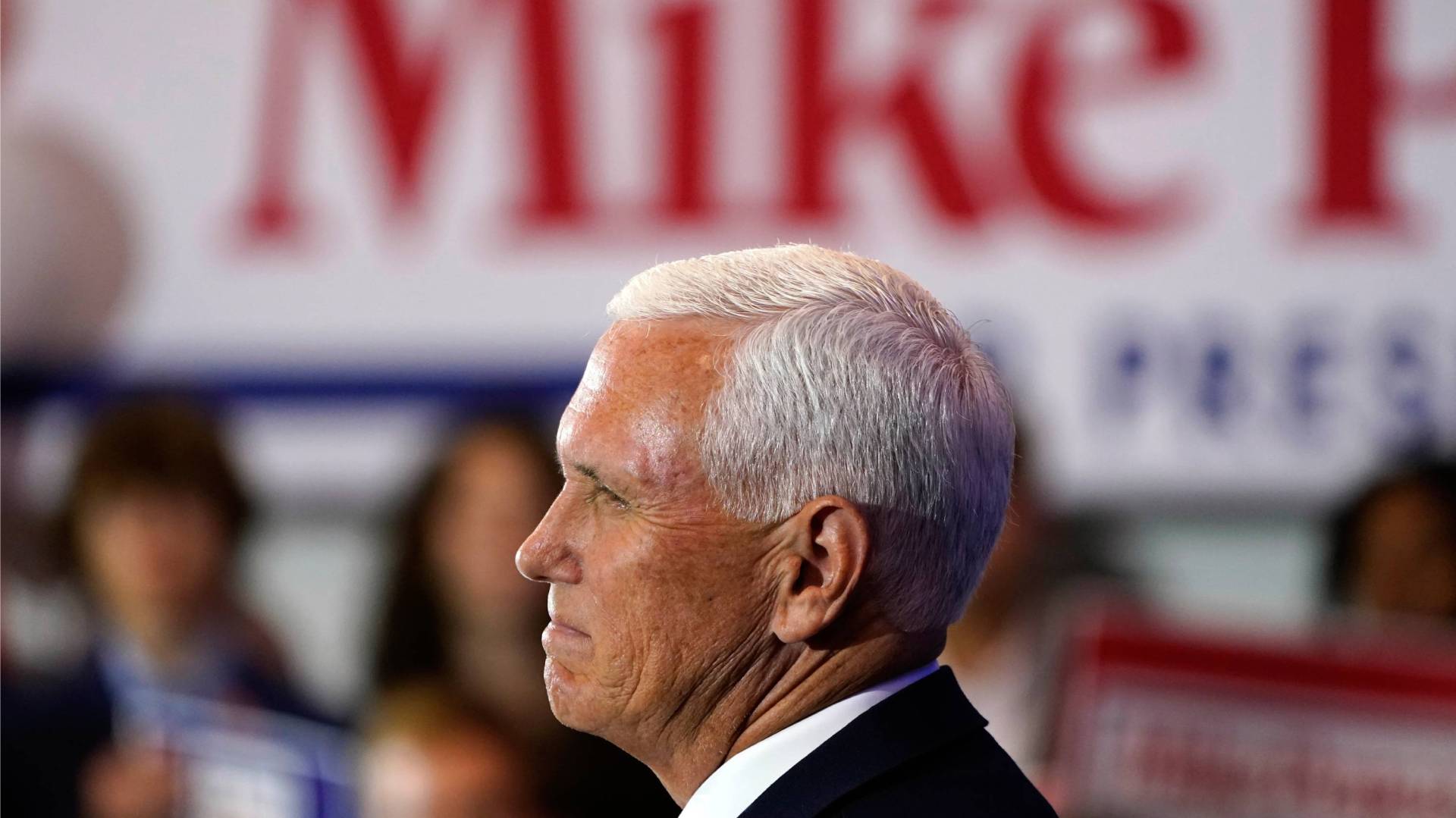
Mike Pence in Iowa

Mike Pence in Iowa

Christianity Today June 16, 2023
Charlie Neibergall / AP Photo

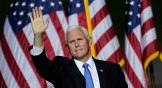
Around Mike Pence’s 40th birthday, his wife Karen booked a trip to a ranch near the Roosevelt National Forest in Colorado. Pence was mulling over a second run for Congress after a failed bid years earlier. As the Pences sat atop a bluff in the park, they noticed two red-tailed hawks riding a hot-air current, rising higher and higher.

“We should step off this cliff and make ourselves available to God,” Karen Pence remembers telling her husband. “And this time instead of ambition driving us, we should allow God to lift us up to wherever he wants to use us, with no flapping.”

Last Wednesday, on his 64th birthday, Pence stepped off that metaphorical cliff once again when he announced his candidacy for the Republican presidential nomination. In a speech peppered with biblical references at the Future Farmers of America Enrichment Center in Ankeny, Iowa, he vowed to fight “the radical Left,” defend the Constitution, and oppose abortion, among a laundry list of other conservative promises.

Iowa’s caucus is seen as a bellwether for the GOP’s primary race. It is also a litmus test for a candidate’s popularity with evangelical Christians: Nearly two-thirds of caucus participants in 2016 were evangelicals, according to an entrance poll.

Pence, who will appear at the Family Leadership Summit, a gathering of conservative Christians in Des Moines next month, is hoping his evangelical credentials will garner the support of his fellow believers in the state. And if he wins the caucus, he could find himself at the top of a crowded field of Republican hopefuls led by former President Donald Trump and Florida Gov. Ron DeSantis.

On paper Pence would seem like the ideal choice for evangelical voters: a faithfully married born-again Christian running what may be the most conservative campaign thus far. Pence ticks the box on every major issue evangelicals list as important—from abortion to Second Amendment rights, LGBT issues and religious freedom. There’s no questioning that the former vice president sees his faith as deeply intertwined with his political journey.

“I came to faith in Jesus Christ as a man in college, and I started a lifelong love affair with the Constitution of the United States for all of my adult life,” he said in Iowa.

But Pence is badly trailing Trump and DeSantis. The two lead the former vice president by double digits in national polls. As a result pollsters and political commentators have written his campaign off. Does Pence have a chance against them, especially among evangelical voters?

Ralph Reed, founder of the conservative advocacy group Faith and Freedom Coalition, thinks so.

“Mike is as effective a messenger in reaching voters of faith as anyone I’ve ever seen in my career. And I think he’s going to get a very fair hearing, from not just evangelical voters but all primary voters,” said Reed, who describes Pence as a “dear friend.”

Reed highlighted that Pence can claim credit for Trump administration policies popular among evangelicals, such as moving the US embassy in Israel to Jerusalem and appointing three conservative justices to the Supreme Court who helped overturn Roe v. Wade.

According to at least one poll evangelicals in Iowa seem inclined to give Pence a fair hearing. About 58 percent view him favorably, a similar share enjoyed by Trump, though the former running mates were both edged by DeSantis.

Mike Demastus, pastor of the Fort Des Moines Church of Christ, says evangelicals in Iowa are not yet sold on a candidate. Demastus has helped organize meetings between pastors and some of the candidates, including a recent one with Trump. In his view, the front runners are Trump and DeSantis, who is Catholic, but even then he says they cannot assume they have clinched evangelical support.

Consider Trump. In a meeting with about 50 pastors from Iowa, Demastus says Trump gave “lackluster answers” to questions about abortion and same-sex marriage. Trump’s refusal to commit to a federal ban on abortion has invited criticism from some evangelicals.

“Even though after the meeting Trump said that he has evangelical support, that’s not the case from that room,” Demastus said, speculating that it was unlikely a majority of the pastors gathered supported him.

Bob Vander Plaats, an evangelical leader whom media often refer to as the “kingmaker” for his role in organizing support for GOP nominees in Iowa, also has found Trump’s stance on abortion lackluster. Last month he tweeted, “The #IowaCaucuses are wide open” after Trump said a six-weeks abortion ban signed by DeSantis in Florida was “too harsh.”

On the other hand, Pence has said he supports a federal ban on abortion and, in his speech in Iowa, criticized Trump for not committing to the same.

“Sanctity of life has been our party’s calling for a half a century long before Donald Trump was a part of it, but now he treats it as an inconvenience, even blaming our election losses in 2022 on overturning Roe v. Wade,” Pence said.

This is another sore spot for evangelicals with Trump. After the 2022 midterm elections Trump pinned blame on lack of evangelical support, even accusing some of his former faith advisers of “disloyalty” for not backing his presidential campaign.

Yet that may not be enough to convince someone like Demastus to choose Pence over Trump or DeSantis. The pastor remembers when Pence was governor of nearby Indiana.

“I remember when he had the power to hold the line with the strongest piece of religious freedom legislation ever put together in our nation, and as soon as he received some backlash from the corporate community, he caved,” Demastus said, referring to Indiana’s Religious Freedom Restoration Act. While Pence signed the bill, it was later amended after critics argued the law would allow businesses to discriminate against LGBT individuals.

Terry Amann, another Iowa pastor involved with the candidate meetings, also seemed disgruntled with Trump’s position on abortion, but he is not sold on Pence either.

Pence, he said, talks “good evangelical language,” but Amann disagrees with his refusal to pardon people who participated in the January 6 attack on the US Capitol. Some of the insurrectionists called for Pence’s execution after he rejected Trump’s unfounded calls to not certify the election results. A modest majority of evangelicals agreed with Pence’s decision, according to a poll from January 2021.

Among Hispanic evangelicals, Pence’s chances seem slimmer still. Samuel Rodriguez, president of the National Hispanic Christian Leadership Conference, an association of Latino evangelicals, admires Pence’s faith but sees the vice president struggling to resonate with Hispanic evangelicals.

“I can’t deny that his faith is beautiful, and it’s inspiring, and the public expression of his faith is something that is admirable and something to be emulated,” Rodriguez said. “With that being said, Mike Pence will not be on top of the list as pertains to a viable candidate for the Hispanic community.”

For Hispanic evangelicals, Rodriguez says the top choices are Trump, DeSantis, and South Carolina Sen. Tim Scott. (Rodriguez previously served as a faith advisor for the George W. Bush, Barack Obama, and Trump administrations. He prayed at Trump’s inauguration.)

Perhaps Pence understands the odds he faces. In Iowa he ended his announcement with an entreaty for prayers.

“I ask for your prayers, for me, for my family, and for all of the American people,” Pence said. “We don’t know what the future holds, but we know who holds the future.”

News

Supreme Court Upholds Law on Native Adoptions

Native American Christians, involved in both their tribes and in child placement situations, know the complexity of these cases better than most.

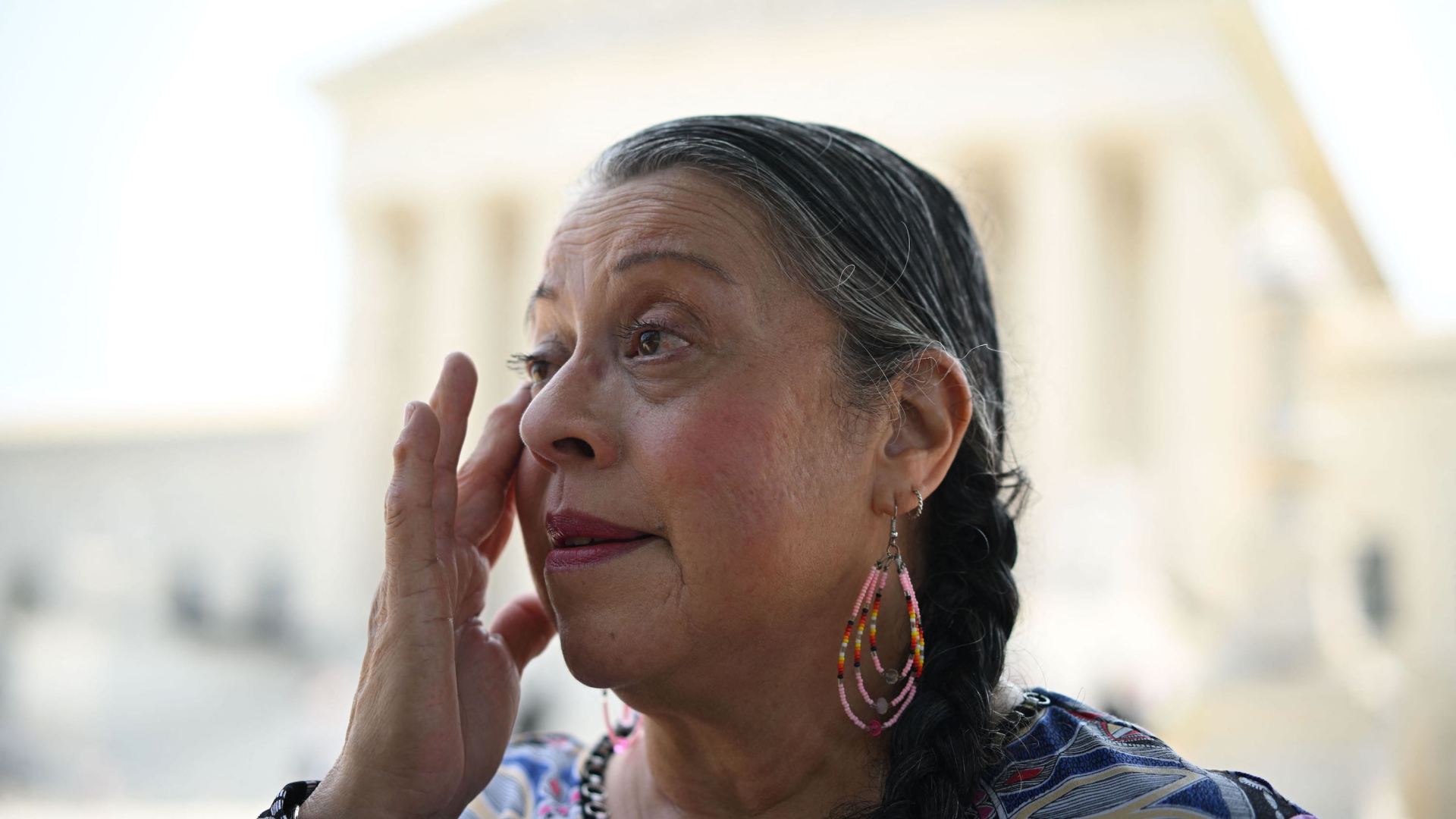
Alabama-Coushatta Tribe of Texas, Tribal Council Vice Chairperson, Nita Battise, wipes away tears outside the US Supreme Court after it upheld the Indian Child Welfare Act.

Alabama-Coushatta Tribe of Texas, Tribal Council Vice Chairperson, Nita Battise, wipes away tears outside the US Supreme Court after it upheld the Indian Child Welfare Act.

Christianity Today June 15, 2023
Mandel Ngan / AFP via Getty Images

Native American tribes will retain priority for placement in the adoption of Native American children after a US Supreme Court ruling on Thursday.

The high court rejected all challenges to the federal Indian Child Welfare Act (ICWA) in a 7–2 ruling by Justice Amy Coney Barrett. Justices Clarence Thomas and Samuel Alito dissented.

An evangelical couple, along with two other adoptive couples, had challenged the law on multiple grounds, one being that it hinders non-Native families from fostering and adopting Native American children.

The court rejected every argument and defended the fundamental constitutional principles behind ICWA.

“This case is about children who are among the most vulnerable: those in the child welfare system,” wrote Barrett in the decision. She shared a comment from a Choctaw chief who testified in Congress in 1978, when ICWA became a federal law: “Culturally, the chances of Indian survival are significantly reduced if our children, the only real means for the transmission of the tribal heritage, are to be raised in non-Indian homes and denied exposure to the ways of their people.”

Justice Neil Gorsuch, who handled many cases involving Native American affairs out West before coming to the high court, wrote a concurring opinion that detailed the history of the federal government forcing child removal from Native American families through boarding school initiatives, including through some missionary-run schools. He noted that surveys showed “approximately 25–35 percent of all Indian children [were] separated from their families” by 1974.

The court avoided the thorniest issue in its ruling: whether ICWA’s rules for child placement were unconstitutionally race-based. The challengers argued that ICWA ignores all other issues of children’s best interest in favor of placing them with a tribe member.

The court ruled that the plaintiffs did not have standing to bring that challenge. Justice Brett Kavanaugh, in a concurring opinion, said he hoped the court would consider that “serious” issue in the future.

It was an unexpected victory for the tribes. Even liberal justice Elena Kagan at oral arguments had expressed some skepticism about whether the law put the interests of the tribe over the “welfare” of children. Some states had passed state versions of ICWA in anticipation of it being overturned.

Christian adoption agencies did not file briefs in the case. One brief from the Christian Alliance for Indian Child Welfare gathered stories from Native children who said they were shuttled between foster homes or returned to abusive parents instead of going to a non-Native adoptive family because of ICWA.

Native American Christians have seen on the ground how messy and sensitive these foster and adoption cases can be. They say ICWA isn’t perfect, but in general they have supported the law. Adoption agency staffers say that all cases of child removal are painful and messy, not just ones involving ICWA.

“I celebrate the decision of the SCOTUS, as it recognizes the sovereignty of the indigenous nations located within the United States,” said Carol Bremer-Bennett, the head of World Renew, the relief arm of the Christian Reformed Church, in an email. Bremer-Bennett is herself Navajo and was adopted into a Dutch Reformed family. “Each child placement into a forever home is unique and often complicated. The goal should always be made with the best interest of providing a loving and stable home to nourish the whole child, including their ethnic and cultural identity. I know how cherished children are by every tribe and that we can and should trust those indigenous nations to make these placements with the best interest of each child at the heart.”

Bremer-Bennett’s adoption took place before ICWA, and it was a closed adoption, so she did not have paperwork to become an enrolled member of the Navajo nation. She struggled with grief over the disconnection from her tribe and not knowing her clan.

That also meant that under ICWA, she, a Navajo woman, would have a harder time adopting Native American children, something she and her husband felt called to do. They knew a Navajo birth mother who wanted them to adopt her child after the girl had been in a children’s home for years.

Bremer-Bennett wrote an article about her struggles, and Ted Charles, a Navajo from the Christian Reformed Church, contacted her.

“He said, ‘No Navajo should be without your clan. I’m going to adopt you as my sister,’” she recalled. “It wasn't a legal adoption. It was a ceremonial adoption.”

Now, thanks to that ceremonial adoption, when she introduces herself, she can say her clan. As she and her husband worked through the court process to adopt her daughter, she prayed with Charles constantly for seven days. A judge approved the adoption. Their daughter still has a relationship with her biological mother who is Navajo. Bremer-Bennett and her husband have also another adopted Navajo daughter.

“I have peace,” said Bremer-Bennett. “I know whose child I am. I know the Creator as my Savior, Redeemer, and parent and friend.”

Other Native American Christians working in adoption have emphasized serving vulnerable children through tribes and trying to keep children connected to their culture when possible.

Different cultures have different understandings of “what is best for the child,” said Charles Robinson, who is Choctaw and leads a Christian ministry to Native communities called The Red Road.

He and his wife have worked alongside families in the adoption process. If a child is adopted outside the tribe, he said, “it’s been very, very important to us and to the non-Native families adopting that the kids maintain and have an understanding of their tribal culture and families.”

Theology

On Building ‘Deeply Christian’ Racial Justice Movements

The NYC founders of Pray March Act want church-led activism to outlive news cycles and divisive politics.

Christianity Today June 15, 2023
Duané Viljoen / Pexels

James Roberson III scaled a ladder in downtown Brooklyn on June 2, 2020, with a megaphone in his hand, as protestors converged below him. He had expected a few hundred; thousands showed up.

One week earlier, Roberson—a married father of three and pastor of Bridge Church NYC—had watched the infamous video of George Floyd dying. He couldn’t believe the “total disregard for humanity.”

As a Christian, a pastor, and a Black man in America, he felt compelled to say something. Beyond the crowd in New York, his remarks have been viewed more than 19,000 times on Facebook Live.

“Anyone whose heart doesn’t break when you see that video, don’t ask me to explain why my heart breaks,” Roberson says, crying. “If your heart doesn’t break when you see something like that, please … don’t make me explain my rage.”

Roberson had spent decades explaining—particularly to his white evangelical friends—why the killings of Black men and women at the hands of law enforcement officers or white vigilantes were so painful and so personal.

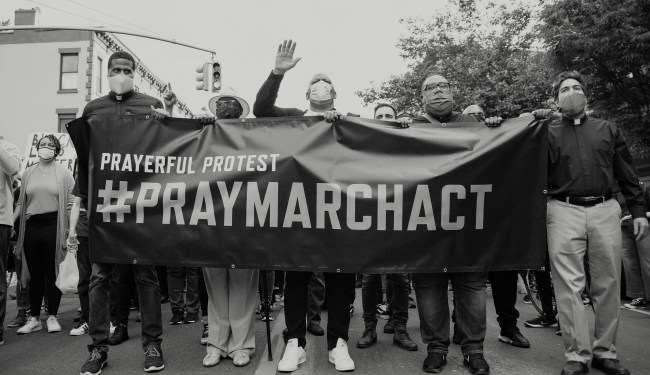
He and a group of fellow local pastors and believers soon grew their grief and activism into a movement: Pray March Act (PMA). Their marches in Brooklyn, Long Island, and Minneapolis drew media attention in the aftermath of George Floyd’s death.

Their language was not filled with violent or hateful rhetoric but aimed at advocating for police and other enforcers of the law to regard and treat Black citizens with the same dignity and respect as their white counterparts.

“We wanted the protest to be deeply Christian,” Roberson said. “The cops are made in the image of God, just like George Floyd was made in the image of God. But we are against the practice of civic authorities seeing Black people as lesser than. And we need to speak truth to power.”

Three years in, they still pray, and they still march. But they realized the “act” part of the mission couldn’t be centered on chasing headlines. Their time would be better spent advocating for racial justice and equality on a local level.

Today, PMA’s small, core group of NYC churches holds online and in-person events that draw believers from across the city. Their key goals are to educate the public, pray for racial justice, and work to end racism.

This year, PMA held a large rally in Harlem on Martin Luther King Jr. Day. Since then, PMA leaders have been studying the city’s proposed 2024 budget and advocating for projects that prioritize racial justice. On June 16, the group will screen a Juneteenth documentary in Brooklyn. Juneteenth: Faith & Freedom was produced by one of PMA’s founding members and director of communications, Rasool Berry.

Last year, after gathering input from public school teachers, community activists and government leaders, PMA identified three areas with some of the most glaring racial disparities in New York City: housing, education, and criminal justice. And like the city’s aging, labyrinthine subway system, everything is interconnected.

Safe, affordable housing is out of reach for huge swaths of the population. As a result, hundreds of thousands of New Yorkers live in public housing. And New York City is consistently ranked—by its own public advocate—as the worst landlord in the five boroughs.

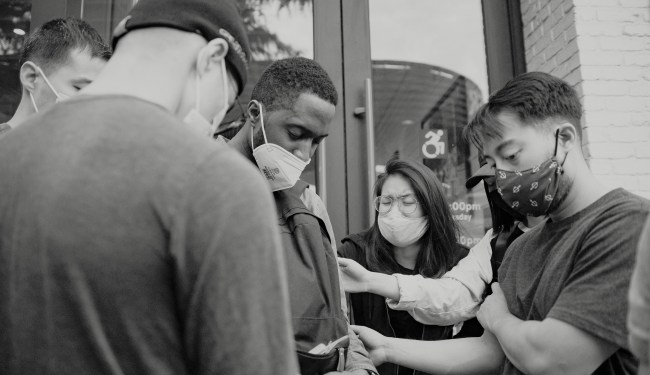
Members of PMA make prayer a big part of their march against racial injustice.Courtesy of Pray March Act (PMA)
Members of PMA make prayer a big part of their march against racial injustice.

Housing, in turn, impacts the quality of schools in the area.

“Communities of wealth will always have an advantage towards education,” Roberson said. “And communities of poverty will always have a disadvantage. If the real estate's a certain price, the education's going to be a certain level.”

Wherever they moved, the Robersons got involved with their local public school’s Parent-Teacher Association (PTA). The PTA in Park Slope (one of the wealthiest, whitest neighborhoods in Brooklyn) generated over a million dollars, while the PTA in Flatbush (a majority-Black neighborhood) had $40. These two Brooklyn communities are on opposite sides of Prospect Park, just a mile apart.

George Sarkissian, an elder at Uptown Community Church in northern Manhattan, serves as PMA’s executive director. He has a unique vantage point as a city employee at NYC’s Department of Housing Preservation and Development. As chief of staff and deputy commissioner for external affairs, Sarkissian has an up-close view of the nation’s biggest city.

Sarkissian points to communities like Brownsville, Brooklyn, where 66% of the population is Black and the median household income is $40,000. Just 28% of fourth graders in Brownsville are performing at grade level in language arts. Fewer than one in five are proficient in math.

Across the East River in Lower Manhattan’s Financial District, 66% of the population is white, and the median household income is $151,000. About 83% of fourth graders are performing at grade level in English. Four in five are proficient in math.

“Those are just huge disparities,” Sarkissian said. “There’s a brokenness that’s really clear.’”

Just as a family’s ZIP code tends to determine the quality of education their children receive, success in school predicts the likelihood of a student going to prison later—and thus, the cycles of incarceration and poverty go around and around.

“There are plenty of neighborhoods that are doing just fine in New York City,” Sarkissian said. “I’ve always been interested in the neighborhoods that are struggling. … Those are the neighborhoods that the Lord has given me a heart to serve.”

Sarkissian invokes the Old Testament as inspiration for making the city a better place to live, pointing to Jeremiah 29—where “God's people are in Babylon, and God instructs them to seek the peace and prosperity of the city,” Sarkissian said.

He believes public policy is a tool the church can use to help cities thrive today. “The church has worked with government in the past to essentially accomplish kingdom goals,” Sarkissian said, “and there's no reason the church shouldn’t do it now.”

Cidra Sebastien is another PMA leader who believes prayer and public policy can work in tandem. Sebastien has been a New Yorker since the early 80s and is part of Renaissance Church NYC in Harlem. She serves as PMA’s director of organizing and leads the education group.

Sebastien wants to see NYC’s 1 million public school students have equal access to a great education. One of her passions is advocating for quality mental health care, particularly after three disruptive pandemic years that disproportionately affected Black and brown families.

“Students are bringing what they’re experiencing at home to their neighborhood school,” Sebastien said. “And yet, there are not enough trained, caring, culturally competent guidance counselors at schools.”

It’s not because great guidance counselors aren’t out there, Sebastien said. “It’s because the city has decided that’s not where they want to put their priority.” The ratio of guidance counselors to NYC public school students is 1:272. Even the very best counselor, Sebastien said, can’t effectively serve that many students at once. “It’s impossible, right? And so that’s something the members of PMA want to see us address,” Sebastien said. And that’s where one of PMA’s core tenets comes in: “We pray … because the task is bigger than us.”

“The only way we stay hopeful is because we’re the church,” Sarkissian said. “There’s a kingdom effort that we’re participating in, and that’s the big Jesus project to renew all things.”

With kingdom goals in mind, PMA members recently stood before government leaders to advocate for racial justice in NYC. They shared their vision at the city council’s budget hearing on May 24.

“It was the first time we publicly advocated for policy changes,” Sarkissian said, “addressing legislators who are negotiating the NYC budget, and identifying ourselves as members of PMA.”

James Roberson (middle), the president of PMA, helps lead a march against racial injustice.Courtesy of Pray March Act (PMA)
James Roberson (middle), the president of PMA, helps lead a march against racial injustice.

Three years after George Floyd’s death, Roberson prays more evangelical believers will incorporate racial justice into their theology. “You’ll find churches where their theology is about reaching people and seeing them go to heaven,” Roberson said. “But what about the conditions they’re in now?”

In the parable of the Good Samaritan, a man is attacked on the road to Jericho and left for dead. What if, Roberson asks, believers took a closer look at the road? “We take care of the guy. We help him out, but we don’t really evaluate the road to Jericho,” Roberson said. “We don’t really ask, ‘Why does that keep happening?’ And that’s what justice is about. Justice looks at the systems that are causing the poverty. And I believe the racial tension in our country is deeply spiritual.”

This Juneteenth, he sees an opportunity for white Christians to think about the privileges they enjoy and the ways their own families, churches, and communities contribute to inequality. He hopes more believers will examine America’s “road to Jericho.” That’s how efforts like Pray March Act can become sustainable movements; that’s how the church can become a “city on a hill.”

“I think what comes before evangelism is God’s glory,” Roberson said. “You have to be able to glorify God by loving your neighbor. “Certainly, I want my neighbor to experience God personally, but my first job is to have them experience God through my love and character. And the way I think we love the city is through the way we respond to the brokenness.”

Kristy Etheridge is a freelance writer and editor and a former TV news journalist. Originally from southeastern Pennsylvania, Kristy lives in Brooklyn, New York, with her husband, Dustin, and two young children.

News

Court Hears Closing Arguments in Brian Houston Case

Was the Hillsong founder covering up sexual abuse or trying to care for a survivor?

Brian Houston

Brian Houston

Christianity Today June 15, 2023
Marcus Ingram / Contributor / Getty / Edits by Christianity Today

Update: The court will rule on Brian Houston’s guilt on August 16.

Sydney court magistrate Gareth Christofi has been presented with two very different portraits of Hillsong megachurch founder Brian Houston.

According to the Crown prosecutor, making his final argument in court on Thursday, Houston is a liar. He did everything he could to conceal his father’s sexual abuse and protect his own reputation and power.

The defense, on the other hand, depicts Houston as an imperfect human doing his best in a difficult situation. Among other things, he sincerely believed that the survivor of his father’s abuse, by then a grown man, did not want him to go to police.

The survivor, Brett Sengstock, was present in the tiny courtroom in Downing Centre Courthouse in downtown Sydney for the closing arguments in Brian Houston’s trial. He sat just a few meters from Houston as two attorneys debated what the megachurch pastor should have done in 1999 when Sengstock told him what Frank Houston did to him when he was a boy in the 1970s.

Crown prosecutor Gareth Harrison said Brian Houston had “no reasonable excuse” for not reporting his father to the police.

“The Crown submits that the reason was that the accused was trying to protect the reputation of the church and his father,” Harrison said.

Harrison argued there was a culture of cover-up in Hillsong. The church insisted on dealing with everything in-house—including scandals. Houston was so confident in this protective culture, the prosecution argued, he told several people at his two churches explicit details about what his father did to a 7-year-old boy, knowing they wouldn’t report it to the police either.

At the same time, the prosecutor argued, Houston worked hard to control information about his father’s sexual abuse. He gave the board selective details and made sure that he was the only conduit between them and the victim. He told them the victim did not want to go to police and didn’t mention that Sengstock was actually wavering on that point.

Even if Sengstock had been adamant about not filing a report, though, that didn’t change Houston’s responsibility—or his motivation in concealing information, the prosecution argued.

Houston eventually spoke publicly about his father’s sexual abuse, but according to the prosecution, that was part of the cover-up too. He didn’t use the phrase sexual abuse or anything that would communicate a child had been raped. Instead, Houston spoke of a “serious moral failure” and a “very serious moral accusation.”

“These phrases have the intent of concealing the true extent of Frank Houston’s behavior,” Harrison said. The megachurch pastor wasn’t really being forthcoming, but was trying to squelch rumors.

“But why say anything in the sermon?” the magistrate asked.

“The cat was coming out of the bag,” Harrison said.

“But why help it out of the bag?”

“The rumors were building.”

The prosecution pointed out several specific instances where Houston’s account of what he told other ministers differed sharply from their recollections. He said he told one pastor “the full details,” but she testified she didn’t remember him giving specifics.

“It is beyond belief that she would have forgotten that graphic detail,” Harrison said. “He limited [the description] because he had to conceal what Frank Houston had done, and that theme runs through all the sermons and public announcements. He was restricting the information because that was what he had to do.”

The Crown concluded its case by declaring Brian Houston a liar, repeating the accusation several times: “He was not being honest.”

The core of the defense’s case is contained in the words reasonable excuse. Australian law says sexual crimes must be reported unless there is a reasonable excuse. In recent years, that has been amended to specify that if an adult survivor of sexual abuse asks that it not be reported, that is a reasonable excuse not to report it.

“You know if it happened now, there is a specific carve-out my client would be acquitted like this,” said attorney Phillip Boulten, snapping his fingers. “That is translatable back into when this happened, is my submission.”

Boulten argued the prosecution was overreaching, calling every difference of memory after decades a “lie.” He called the evidence that Houston was leading a four-year, church-wide coverup “so flimsy.”

He pointed out that much of the testimony against Houston involved people trying to remember or reconstruct what happened more than 20 years ago. Other evidence, like the victim’s mother’s diary from the late 1990s, left large gaps in the narrative.

“A lot of what my friend [the Crown prosecutor] says is assumption building or speculation,” Boulten told the court.

But his most important argument was that there is reasonable doubt over whether Houston was trying to care for a survivor. While some witnesses testified that Sengstock actually didn’t tell Houston not to go to the police or that he might have changed his mind if given the chance, that’s not how it appeared to Houston in 1999. Sengstock was deeply upset when his mother told a revivalist that he was abused as a child and was adamant, the defense argued, that Houston not tell anyone any details.

“There can be absolutely no doubt that in [that] period Brett Sengstock did not wish a word of this to be published,” Boulten said. “He was concerned that the church might rake through things. … He was concerned that he might be portrayed as someone with inappropriate sexual attitudes.”

Boulten conceded that not going to the police also allowed Houston to protect his father’s reputation and the reputation of the church. That didn’t change the fact that he was also doing what the adult victim asked him to do.

“You can have more than one reason,” he said.

“An excuse can be reasonable and convenient?” the magistrate asked.

“Yes,” Boulten said. “Just because it was convenient for it not to be prosecuted, my client is not without reasonable excuse. Brett Sengstock said he did not want it to be reported.”

On Friday, the defense continued to argue that Houston had a reasonable excuse not to report to police. Boulten argued that Houston’s behavior, in the days after he learned about his father’s crimes, could not really be characterized as a cover-up.

“The evidence is that when Brian Houston found out about this, he began to talk about it,” he said. “First to his family, then to the elders or board members of the … congregations. Right from the beginning, he began to tell people.”

Eventually, he talked about his father’s “moral failings” at a 2002 Hillsong conference attended by 18,000 people, including the police commissioner, who also did not immediately file a legal report.

“People talk about controversy,” Boulten said. “They may talk in hushed tones, but they still talk.”

The judge will issue a verdict in the case on August 16. He faces a possible sentence of five years in prison.

Theology

God Called Him to Thailand 60 Years Ago. He Still Hasn’t Left.

Missionary Henry Breidenthal taught generations of Thai pastors as a doctor, Bible college founder, and evangelist.

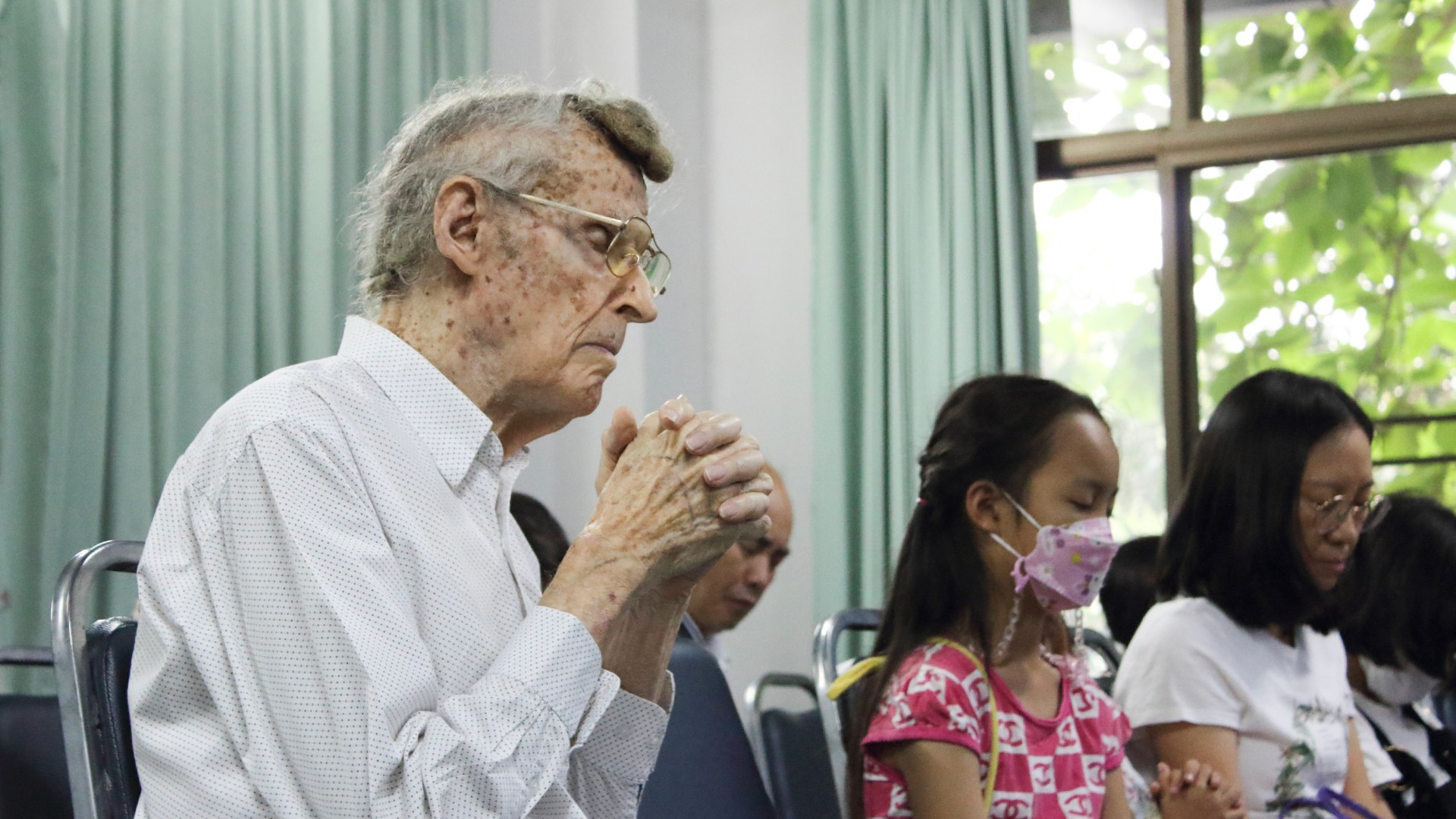
Retired missionary Henry Breidenthal praying at Grace New Life church in Chiang Mai, Thailand.

Retired missionary Henry Breidenthal praying at Grace New Life church in Chiang Mai, Thailand.

Christianity Today June 15, 2023
Photo by James Thompson

On a warm Sunday morning in March, about a dozen Thai Christians sit quietly in Grace New Life Church in Chiang Mai and wait for the service to begin. As the worship leader warms up on his guitar and the pastor makes last-minute adjustments to his slides, a frail 91-year-old Caucasian man with bifocals shuffles to a chair and sits down.

The worship leader stands and asks maw (Thai for “doctor”) to lead a prayer. Retired missionary Henry Breidenthal slowly rises from his chair and walks to the front of the room. There, with his gray head bowed and sunken eyes closed, he addresses God softly, his Thai mumbled with age. His prayer complete, he returns to his seat as the music begins.

When the worship set is finished, Breidenthal and the other congregants listen to the day’s message on tithing from Pastor Patompon Kong. Kong was once Breidenthal’s student at the Bible college he founded. Now, in the twilight of the older man’s life, Kong is his pastor.

For the past 60 years, Breidenthal has called Thailand home. His longevity calls to mind an earlier era of overseas service. Today, many missionary recruits hope to see quick, tangible results before returning home just a few months or years later. Breidenthal’s ministry shows the potential for the compound growth of a missionary’s impact over the long term.

That type of ministry comes at a cost. Breidenthal had to forgo the doctor’s salary he could have earned back in the United States, perhaps the chance to marry and start a family (Breidenthal has remained single), and definitely a “normal” life of comfort and ease.

Yet as he spoke with me in his home about his life in Thailand—treating leprosy patients, ministering in the tribal areas, planting churches, and teaching generations of Thai pastors—he didn’t dwell on what he gave up.

Kong noted about his former teacher, “He’s really committed to what he desired from the beginning: to finish the race well.”

From Kansas City to Bangkok

As a young man growing up in Kansas City, Missouri, mission work was already on Breidenthal’s mind. His family members had varying degrees of religious commitment, but he was spiritually precocious and thought that becoming a missionary could help ensure that he made it to heaven.

In his teenage years, he started attending Youth for Christ’s packed meetings on Saturday nights. There, he heard that salvation was by grace, not attendance. The message stuck and changed his entire outlook on faith. It did not, however, change his plans to become a missionary. “Once I learned that salvation is by grace, what else could I do?” he asked.

But he took some detours along the way. At his parent’s suggestion, he followed in the footsteps of an older brother and attended medical school. After graduating from the University of Missouri School of Medicine, he did his residency in Dallas, where he was heavily involved in a local church. Still determined to become a missionary, he enrolled at Dallas Theological Seminary where he earned a master’s degree in theology in 1962.

After a few years of practicing medicine, Breidenthal joined the Overseas Missionary Fellowship (OMF) and left by boat for Asia in 1964. He first trained in Singapore before heading to Thailand, where he spent a year learning the language and adjusting to the culture.

OMF then sent Breidenthal to work at its hospital for leprosy patients in central Thailand. He spent most of the next few years doing medical work, but his heart longed to evangelize to the unreached hill tribe people of northern Thailand. OMF’s leadership wanted him to concentrate on medicine for his first four-year term. After that, they said, he could shift his focus from meeting physical needs to spiritual ones.

Left: Henry Breidenthal sharing photos from his missionary work. Right: Breidenthal leading prayer at Grace New Life Church in Thailand. Photos by James Thompson
Left: Henry Breidenthal sharing photos from his missionary work. Right: Breidenthal leading prayer at Grace New Life Church in Thailand.

Reaching the unreached Mien tribe

“In mission, everything is pictures,” Breidenthal says as he gets up slowly from the kitchen table where we’ve been talking and walks with a stiff gait toward another room. “You have to have pictures.”

He’s decided that I, like the churches he used to visit while on furlough back in the States, need to see the people and places he has encountered. We’re talking about his two-year ministry in the early 1970s along the border of Thailand and Laos, mostly among people of the Mien tribe. He lived in huts in the mountains, staying in each village for days or weeks or months, depending on the reception of his hosts. He tried to treat villagers’ health problems with limited equipment, but his primary objective was to introduce the gospel.

He returns with several large binders full of small slides, now a half-century old. They show small huts with dirt floors and colorfully dressed villagers. This chapter of Breidenthal’s life had its share of successes, such as when he helped save a Mien woman’s life by carrying her on his back from her village toward the nearest medical clinic. At the halfway point, he flagged down a pickup that carried her the rest of the journey. The woman reached the clinic in time. She had been in a coma for over a week, but the medical staff were able to revive her. Eventually, as Breidenthal learned later, she became a Christian.

There were plenty of disappointments as well. Some villages were unreceptive and forced him to move on. Others welcomed him as a physician but not as a preacher. Despite these setbacks, his two years living among the Mien led to friendships and connections in which he would continue to invest over the ensuing decades. Years later, he helped Mien believers start a church in Chiang Mai.

The creation of Bangkok’s first Bible college

In the mid-20th century, Thailand’s small Christian population faced a dilemma. Churches were suffering from a dearth of preachers, and many who did enter the ministry had few opportunities to pursue formal theological training. Some moved to other countries to study, but this solution had serious disadvantages: it was expensive, and many Thais who went abroad for school found work there after graduating.

Before the early 1970s, Bangkok did not have a degree-granting seminary or Bible college. Several missions agencies and denominations had started small theological schools, but local believers and missionaries felt the need for a flagship evangelical institution in the capital. In 1970, they turned the vision into a reality: Thai believers donated needed resources such as a building and funds. OMF and the Christian and Missionary Alliance decided to work together on the project, ensuring that the school would be interdenominational. Now the nascent school just needed a director.

The board of the newly founded Bangkok Bible College (BBC) asked Breidenthal to serve as its first leader—and its only full-time teacher. He accepted. After returning to Bangkok from his work with the Mien, he moved into the dilapidated two-story house that would be the school’s first dormitory, classroom, and office.

Breidenthal (far left) standing with BBC's first cohort of students in 1971, including Chumsaeng Reong (fourth from left).Courtesy of Bangkok Bible Seminary
Breidenthal (far left) standing with BBC’s first cohort of students in 1971, including Chumsaeng Reong (fourth from left).

Training generations of Thai pastors

The next batch of photographs includes a shot of Breidenthal in his late 30s standing next to five young Thai men in white dress shirts and ties. This was BBC’s first cohort of students in 1971. Among them is Chumsaeng Reong, a Thai believer who had grown up in a nominally Christian home (his grandfather who immigrated from China was a Christian) and was interested in learning more about the Bible. An elder at his church suggested he study with an impressive American doctor who was starting a Bible college. The elder promised that the doctor was like a “Bible encyclopedia.”

When Reong arrived for the beginning of the semester, he was the second student to move in. He soon learned that only three other students would be joining them. “If [this doctor] is so great, why are there so few students?” he remembers thinking. “And why is the building so shabby?”

Despite that initial disillusionment, Reong, now 72, remembers his time at BBC as “a special formation.” Since Breidenthal lived with the students in the ramshackle house, spiritual discussions often extended well past the official end of class time. “[We discussed] questions after questions after questions at the dining table,” Reong recollects. After five years of study at BBC, he went on to become a pastor, seminary instructor, and founding director of the Wycliffe Thai Foundation.

Today, BBC is Bangkok Bible Seminary. The old house is gone, replaced by several buildings featuring well-equipped classrooms, an impressive library, and a large assembly hall. A robust faculty has replaced the single full-time position from the early years, and the current director, Manoch Chaengmook, is another of Breidenthal’s former students. The seminary offers in-person and online instruction and currently serves almost 1,000 Thais.

Left: The photo of Breidenthal at Bangkok Bible College (BBC). Right: A class taking place at BBC.Photos by James Thompson
Left: The photo of Breidenthal at Bangkok Bible College (BBC). Right: A class taking place at BBC.

After retiring from BBC in 1995, Breidenthal moved from Bangkok to Chiang Mai, where he helped establish the Chiang Mai Bible Center. At first, students came to his house for classes. The center continued to develop and eventually became Chiang Mai Theological Seminary, where he continued to teach until 2018. Today the school has about 150 students.

Both in Bangkok and Chiang Mai, Breidenthal made sure that his students put what they learned into action. They joined him in planting churches, including Makkasan New Life Church in Bangkok, which he started with another missionary. The church grew, and soon several other New Life churches sprung up around the city and beyond. Thai Christians, including some of Breidenthal’s students, took on leadership rolls, quickly developing the churches’ independence.

‘The best one piece of literature’

The good doctor is not holding photographs now. He’s picked up a small booklet that features Thai writing and a drawing of Jesus on the front. “I don’t want to preach to you,” he says, as he flips it open.

It’s a small, unintentional fib, meant to set me at ease. It’s clear he does want to preach to me, just like he’s preached to countless people over the decades, tract in hand. I assure him that I don’t mind, and he launches into a detailed exposition of God’s plan for salvation.

When Thai Christians think of Breidenthal, they often think of these tracts. From early on, he’s always had them, often stashed in his doctor’s bag along with a stethoscope and thermometer. During his tenure at BBC, he and a troupe of Thai seminarians would spend every Sunday afternoon in Bangkok’s Lumpini Park, handing out tracts, singing, and engaging anyone who would stop and talk. He would later distribute them in Chiang Mai as well as on trips to neighboring countries. One time, authorities in Vietnam detained him for three days for passing out tracts.

He points to several verses in the booklet from 1 John 5, focusing on verse 10: “Whoever believes in the Son of God accepts this testimony.”

“In Thailand, they’re slow to get the concept of ‘believe in,’” Breidenthal says. “Believe in means trust.” He explains that believing about Jesus comes more naturally to many Thais. Adding one more supernatural being to an already complex pantheon is usually not a challenge. Resting solely in Christ’s sacrifice often is.

Former students who accompanied Breidenthal to hand out tracts in downtown Bangkok remember feeling very uncomfortable at first. One recalls being so embarrassed that he tried to blend in with the joggers circling the park’s running path. But many also say that they gradually learned not to be ashamed of the gospel. And while positive responses were rare, a few people they talked to did eventually become Christians.

This method of evangelism has its critics, and Breidenthal himself admits that it has disadvantages. For example, he’s aware that the small text is sometimes difficult for older people to read, and he knows that some tracts explain the gospel using a Western framework that Thais will not easily understand. But he also believes that some tracts give a culturally appropriate witness, and that getting these into people’s hands can make a difference.

“This is the best one piece of literature you can give to anybody in the world,” he says, holding up the small booklet.

‘He doesn’t have any agenda except you’

When Thai clergy reflect on Breidenthal’s ministry, they marvel at his commitment. “He doesn’t long to go back to America,” Kong says. “He never counts the days, months, and years until a furlough.” He attributes this to a “deep, heartfelt love for the Thai people.”

When prompted, they admit that he has weaknesses. He was often so caught up in his many ministry responsibilities that he did not take sufficient care of himself. Friends tried to make sure that he was eating enough and setting time aside to rest. As a teacher and mentor, he could sometimes be overly strict, and he would occasionally communicate in a very direct manner that is off-putting to Thais.

But they also say he is humble enough to admit mistakes and has intentionally tried to adapt to Thai culture in a way that many missionaries do not. Perhaps even more important is his ability to focus on and invest in each individual student or companion.

“He’s [one of the few people] that I discuss my problems and have prayer with,” said one longtime Thai friend. “Because he doesn’t have any agenda except you.”

As our time together came to a close, I saw evidence of another of Breidenthal’s defining characteristics: spiritual discipline. He is famous in Thai churches for living by the motto “No Bible, No Breakfast,” making sure he’s spiritually fed each morning before being physically fed, and for almost always ending conversations with prayer. When our interview was over and I stood to go, he quickly called me back. “Let me pray,” he said, bowing his head and folding his hands as he has countless times before.

News

Southern Baptists Committed to Abuse Reform. What Happened?

With the female-pastor debate getting the most attention, the slow work to address abuse plods on.

SBC Abuse Reform Implementation Task Force

SBC Abuse Reform Implementation Task Force

Christianity Today June 14, 2023
Sonys Singh / Baptist Press

The issue that once dominated Southern Baptist Convention (SBC) annual meetings—sexual abuse in churches—almost receded into the background at this year’s gathering, which was overrun by debates around women serving as pastors.

Only a year after they voted to move forward with initial steps to address abuse in the wake of a major investigation, the SBC’s reforms have been slow, complicated, and not without controversy.

A task force overseeing its abuse response—including a new website to track known abusers—asked for more time to complete their task, and the convention overwhelmingly approved the extension. They’re still waiting for permanent funding and permanent staffing to oversee the process. Ahead of the meeting, some Southern Baptists spoke up with critiques over cost and legal ramifications.

“They’ve acknowledged it and kind of want to move on,” said Jules Woodson, who came forward with her story of abuse by her youth pastor in 2019. “I want them to know I’m still fighting … I’m not walking away.”

Sexual abuse survivors including Woodson had rallied around the annual meetings, holding posters and press conferences in 2019, wearing T-shirts in 2021, passing out teal sexual-abuse-survivor ribbons in 2022. Last year, the topic of abuse came up in prayers, sermons, and resolutions, with leaders going as far as thanking survivors by name and applauding them from the stage.

In New Orleans this week, Woodson and a few other SBC abuse survivors met in a room in the convention center set aside for them to decompress. They quietly celebrated the progress the denomination had made, shedding tears together as the shell of the Ministry Check website went live on Tuesday afternoon at sbcabuseprevention.com. In the weeks ahead, it will host a database of pastors who have confessed, been convicted, or agreed to civil settlement in abuse cases.

But among the rows of messengers in the convention, they didn’t sense the change of heart that leaders called for after the Southern Baptist “reckoning” or “Kairos moment” that came last year. The topic that came up most often, and garnered the most enthusiastic arguments, was the disfellowshipping of Saddleback Church and the desire to restate a commitment to male eldership.

Colorado pastor Bob Bender asked from the floor what many onlookers wondered about the denomination’s priorities: “What does it say when we’re slow on the take on sexual abuse of women but quick on the draw to disqualify them from non-lead pastor roles?”

Georgia pastor Griffin Gulledge recalled last year’s “great moments and tears and chill bumps” but said that the initial recognition of abuse was not enough without a commitment to keep going.

“To fail to see the [task force] through, and let them continue their work, would be the greatest failure of moral responsibility of this convention in half a century,” he said. “There is no replacement plan. This task force is our abuse response. Will we quit now?”

Abuse remained the key issue for the members of the Abuse Reform Implementation Task Force, which met every other week to since September to discuss the issue and celebrated the chance to continue their work.

“I know there are plenty of survivors who are saying this should have happened faster, and I don’t disagree,” said task force chair and South Carolina pastor Marshall Blalock. “We have learned a lot.”

“This whole thing will break your heart. You can’t be the same after hearing some of the things that happened [to survivors],” he said. “You come to God and say, ‘Help us make it right.’ It’s a holy challenge.”

As they took on the challenge of launching the website, task force members and Southern Baptists at large raised concerns about contracting with a division of Guidepost Solutions for the project, since the company celebrates the LGBT community. Last month, the task force announced they pivoted to partner with multiple providers to develop and manage the site instead.

They also faced scrutiny from some Southern Baptists who disagreed with the decision to allocate funds (the SBC’s Send Relief pledged $4 million to abuse reform) and who challenged the scope of the project.

Critics focused on the category of pastors who could be listed on the Ministry Check website for being “credibly accused” of abuse through an independent investigation. In the end, the task force opted to have Christian legal advisors continue to develop standards for vetting that criterion before including it on the site.

Even without the same level of urgency and attention from messengers at large, the work around SBC abuse remains a massive undertaking. A sexual abuse hotline, monitored by Guidepost, has fielded 600 phone calls, half of which involve open cases of abuse in SBC churches, according Jarrett Stephens, a Houston pastor and abuse survivor who serves on the task force.

“There is a lot of work to do, and we are just beginning,” he said at the Baptist21 lunch on Tuesday.

A “trauma-informed” team takes those calls, maintaining survivor confidentiality while referring cases of credibly accused pastors to the database system for vetting and sending reports of churches that failed to uphold the SBC’s abuse response standards to the credentials committee for their review, said Rachael Denhollander, an advocate and legal consultant.

And week after week, more accounts of abuse by pastors arise. Earlier this month, a Southern Baptist youth pastor was arrested in South Carolina for filming girls in the church bathroom.

“Every time I see one of those stories, it’s heartbreaking … they grieve us,” said David Sons, outgoing SBC Executive Committee chair. “But churches now know the steps to take. That wasn’t always the case.”

Southern Baptists want to see abuse prevented, but if it does take place, it’s better to have perpetrators uncovered and prosecuted for their crimes than for abuse to persist or be covered up.

Tiffany Thigpen, another survivor at the meeting, agreed; she celebrated a recent report of an abuser in Texas who turned himself in rather than be caught in an investigation. “This is why we do what we do,” she tweeted. “Put these #abusers on notice that they can no longer count on the cover of churches who may be willing to let them walk to prevent scandal.”

Thigpen and Woodson, who runs the nonprofit Help; Hear; Heal, see themselves as “standing in the gap” for survivors who can’t be at the meeting or have given up hope for meaningful change.

“This whole sex abuse reform thing in the SBC is a collective commitment,” said Heather Evans, a licensed social worker with an expertise in clergy abuse. “That’s what survivors are looking for in their pursuit of justice: those around them and how they respond.”

Evans, an advisor to the Abuse Reform Implementation Task Force, spoke Tuesday during an after-hours session hosted by the website SBC Voices on the topic of grooming and abuse by pastors toward adult victims, cases that can be misunderstood or labeled as affairs in some church contexts. About 50 pastors, survivors, and advocates attended, including Chellee Taylor, who shared the story of her abuse by her “boss, campus pastor, and counselor” at an SBC church in Florida.

“This is something that happens to real people, and it happens in your churches,” her husband, Peter Taylor, told the breakout session, lamenting the spiritual toll it took on both of them.

The task force has also worked with state conventions and associations to improve resources and training and shared a toolkit of materials now available online.

The four task force members who spoke before the convention Wednesday morning took a somber tone, recounting how the extent of abuse is churches often remains hidden, as with a case made public just days ago in Louisiana that has spurred investigations across three states.

“As hard and difficult as this past year has been for us, it pales in comparison to what it’s been like for survivors and their families for well over the past year,” said task force member and Oklahoma pastor Mike Keahbone, who choked up on the stage.

“I’m thankful, Lord, for another step toward healing,” he prayed. “We know it’s tiny, but it’s a step.”

Theology

Trump’s Indictment Demands a Distinctly Christian Response

It’s easy to celebrate or critique based on partisanship, but Christians can model a better way.

Former U.S. President Donald Trump arrives for his arraignment at Manhattan Criminal Court.

Former U.S. President Donald Trump arrives for his arraignment at Manhattan Criminal Court.

Christianity Today June 14, 2023
Michael M. Santiago / Staff / Getty

Donald Trump has always been a bit of a history maker.

In 2016, he was the first person elected US president without prior government or military service. His three Supreme Court appointments in four years were the most in half a century. He was the third president to be impeached, and the first to be impeached twice. And this month, Trump became the first president to be indicted on federal criminal charges.

To be clear, these charges are different from those announced in March by New York prosecutor Alvin Bragg. That state indictment centered on Trump allegedly paying an adult film star to keep their relationship secret during the 2016 presidential campaign, and then effectively laundering the payment as a business expense.

The New York Times’s David French—hardly a Trump apologist—cast doubt on the wisdom of Bragg’s prosecution, describing that legal process as “one that [Bragg’s] predecessor didn’t choose to seek and that relies on federal criminal claims that the Department of Justice declined to prosecute.”

The federal indictment, on the other hand, is based on Trump’s handling of classified documents after leaving the White House. Specifically, federal prosecutors allege Trump took a trove of documents with him from the White House to his estate in Florida.

Some of these documents, they charge, contained classified and sensitive information—including about military readiness and possible attack plans. When asked to secure and return these documents, the indictment says, Trump refused and obstructed government officials’ efforts to reclaim them.

Make no mistake: These charges are serious.

Compared to the New York indictment, these federal charges are not just better documented; they highlight far more serious legal infractions. Yes, if the charges in the New York case are true, then Trump broke the law to conceal immoral activity. But if the charges in the federal indictment are true, then not only did Trump break the law, but he did so in a way that may have exposed America and its allies to serious harm.

William Barr, who served as attorney general in the Trump administration, admitted as much in an interview on Fox News: “He is not a victim here. … Those documents are among the most sensitive secrets the country has.”

The response to this indictment was swift. Trump’s critics praised the Department of Justice as taking a necessary step to check lawless behavior from a former (and potentially future) president. Mitt Romney stated Trump “brought these charges on himself” and claimed his actions were “offensive to the national interest.”

Erick Erickson at World magazine connected the indictment to Trump’s “poor judgment” and “regular lack of impulse.” And CT editor in chief Russell Moore issued what has become his familiar two-word response: “Character matters.”

Trump’s defenders, meanwhile, blasted the indictment as politically motivated and dangerous. Senator Josh Hawley complained that the indictment was an effort by the Biden administration to “take out” Trump, the presumptive Republican nominee for president.

Senator J. D. Vance said the indictment amounted to illegal election interference and was further evidence of America’s transformation into a “banana republic.” And House speaker Kevin McCarthy predicted the indictment would “disrupt this nation because it goes to the core of equal justice for all, which is not being seen today.”

But if the reaction to Trump’s indictment was swift, it was also unsurprising.

Research on political polarization has routinely shown that most of us do not react to political developments in a vacuum. Instead, we tend to treat our preferred candidate or party with the utmost charity while casting our opponents in the harshest of lights. We are prone to judge the motives and actions of political elites through the lenses of ideology and partisanship, with truth and objectivity too frequently taking a back seat to whatever framing helps us beat our opponents.

This approach to politics may be the norm for our society, but that doesn’t mean it should be acceptable. This is especially true for Christians. Followers of Jesus should not be counted on to respond in predictable and scripted ways to the political and legal developments of our day. Just as we are called to bring salt and light to a flavorless and dark world (Matt. 5:13–16), we should also adopt a political presence markedly different from what is expected by the broader culture.

What does this mean considering the charges brought against Donald Trump? Among other things, it means confronting the seriousness of the indictment without pivoting to the misdeeds and failings of other political actors. It means distinguishing between what Trump is charged with and Joe Biden’s careless handling of classified materials—and, crucially, how both men acted following these revelations. And it means treating the evidence from this indictment objectively and dispassionately, letting the facts of this case lead where they may.

A distinctly Christian response to this indictment implicates both of our major political parties. For Republicans, it means admitting that even if Trump is preferable to Biden (or any Democratic candidate), he is far from the martyr he so often paints himself to be. And for Democrats, it means refusing to celebrate or revel in the indictment of a former president and instead treating it as the lamentable development it is.

As Christians, we must adopt a posture of humility and consistency when reacting to the failings—legal, moral, or otherwise—of our political leaders, along with the recognition that people on “our team” can be as flawed as those on the “other side.” Just as Trump voters should be honest about the ways in which Trump’s actions are to blame for his current predicament, Biden voters must pair their criticism of Trump with honesty about the ways in which Biden’s presidency has fallen short, particularly concerning the unborn and human sexuality.

We are less than 18 months away from our country’s next presidential election. And while it’s clichéd to say that this will be unlike any presidential election in history, it does feel particularly true now. How could it not be? In the likeliest scenario, one candidate will be nearly 82 years old on Election Day—with another four years of the most demanding job on earth in front of him—while the other could be engaged in not one but two criminal trials, with jail time a very real possibility.

The year ahead will likely be a stress test for American political institutions and the guardrails of our representative democracy. The loudest voices among us will be selling scripts of hyperbole, fear, and anger to a population increasingly hungry for this reactionary rhetoric. It will be tempting for Christians to fall in line with the prevailing partisan sentiments.

Yet we should confidently reject this temptation—choosing instead to approach the political sphere with consistency, discernment, and a humility not of the world, but from the mind of Christ.

Daniel Bennett is an associate professor of political science at John Brown University and assistant director at the Center for Faith and Flourishing. His forthcoming book is Uneasy Citizenship: Embracing the Tension in Faith and Politics.

Speaking Out is Christianity Today’s guest opinion column and (unlike an editorial) does not necessarily represent the opinion of the publication.

Theology

‘Conscious Uncoupling’ from Church Is the New Temptation

Dones and “umms” are leaving the sanctuary or loitering outside the door. But when have they actually left?

Christianity Today June 14, 2023
Illustration by Mallory Rentsch / Source Images: Unsplash

I have a friend who faded away from church during his undergraduate years. First, his church involvement became sporadic. Then he stopped attending events that featured worship or fostered Christian community. For a while, he continued to claim he was a Christian. A year later, he dropped the label.

Some may think he’s still a Christian because he once “got saved” and was baptized. He doesn’t. I don’t either. Regardless of one’s theory of salvation, it’s clear that, although God hasn’t given up on him, he has quit church.

My friend is not alone. He’s among the many convinced there may be something to this whole Jesus business but who’ve disconnected from Christian community.

“People who say they don’t have a religious identity—though many still embrace some Christian beliefs and engage in various spiritual practices—are projected to rise from about 30 percent today to as much as 52 percent in 50 years,” writes CT reporter Daniel Silliman in response to recent Pew Research Center data.

The pandemic is also part of the faith picture in America. In “Rise of the Umms,” CT writer Mike Moore suggests that, just as COVID-19 exposed weaknesses in our systems and relationships, “this same accelerated unveiling has descended on the church, revealing a major decline in congregational involvement.”

“Recent data shows a majority of churches are below their pre-pandemic attendance,” he writes. “A study released early this year reveals that church attendance is down by 6 percent, from 34 percent in 2019 to 28 percent in 2021.”

For whatever reason—busyness, laziness, fatigue, deconstruction, or trauma—many have abandoned ship. For now. Some say they want to stay involved in Christian activities but never quite make it happen, or they intend to reengage once they get fresh bearings, but the future hasn’t arrived. Perhaps it never will.

These downward trends point to big questions: How do we know when someone has decisively quit church? When have they officially left the fold? And perhaps more importantly, is Christian community necessary for salvation, so that it forms part of the essential definition of what it means to be Christian? These aren’t new questions, per se, but they carry new urgency.

Scripture gives us absolutes on what it means to enter Christian community. It also gives us guidelines that help us discern our spiritual condition in relationship to that community.

According to Jesus, the church began when he asked Peter, “Who do you say I am?” After Peter confessed, “You are the Christ” (Matt. 16:15–16; Mark 8:29), Jesus replied by saying, “On this rock I will build my church” (Matt. 16:18).

Christians might disagree about how the church should be administered, but they should agree that it started with Peter’s profession and grows when others declare the same. To respond to the gospel in a saving fashion is to pledge pistis (“faith” or “allegiance”) to Jesus as the Christ, the forgiving and restoring King.

The standard way to make an oath of fealty to King Jesus in the New Testament was by calling upon his name as part of the baptismal process (such as in Acts 22:16). It should be no different today. When a person expresses “faith” (loyalty) in him as Lord or King, that person becomes part of the one true church—the community where the Holy Spirit is present.

Praying a certain prayer, studying Scripture, or attending a worship service is not sufficient by itself. A person must pledge fealty to King Jesus and persist in that profession. The church, then, is a group of people that authentically declares “Jesus is the Christ” in such a way that the Holy Spirit is sovereign in their midst.

It’s a common truism to say the church isn’t equivalent to the building. But we need to add that it is not synonymous with official Christian fellowships, ministries, or organizations. “Church” happens whenever two meet, provided they are gathering under Jesus’ banner: “For where two or three gather in my name, there am I with them” (Matt. 18:20).

No matter the size or nature of the gathering, if Jesus is given authority to rule, then he is present and “church” is occurring right there.

To quit the church, then, is to cease being part of the people that collectively proclaim Jesus is the King. When a person no longer gathers with others under that banner, they miss out on the Holy Spirit’s sovereign direction over the corporate body, as well as the Spirit’s gifts and special rescuing benefits.

Apart from these basics, there is no definitive way to measure whether a person has left the church. To add absolutes beyond pledging fidelity to King Jesus is to risk falling afoul of God’s grace. (This is the problem Paul was combating in Galatia; see Galatians 5:1–6.) Those who add requirements fail to see that God, through the gracious gift of Jesus the rescuing Christ, has created one and only one righteous family—and that family is uniquely defined by allegiance to Jesus as the Christ-King.

So in weighing what it means for a person to leave the church, consider what follows a helpful gauge rather than a rigid yardstick:

First, is the Holy Spirit urging reconnection?

While comparing the church to a body with many different parts, Paul says, “we were all baptized by one Spirit so as to form one body” (1 Cor. 12:13). That is, common immersion in the Holy Spirit brings diverse Christians into unity. Moreover, “we were all given the one Spirit to drink.” That means the Holy Spirit courses through the body to maintain our unity: “The eye cannot say to the hand, ‘I don’t need you!’ And the head cannot say to the feet, ‘I don’t need you!’” (v. 21).

In other words, if a person is convinced they can be a Christian all by their lonesome and have no need for other parts of the King’s body, then in all likelihood, they’ve quit church. Those who have completely numbed the desire to gather with others under Jesus’ lordship are those who have likely left.

By contrast, if they’re still under the authority of Jesus’ kingship, then his sovereign Spirit will not permit an “I don’t need you” mindset. If they still yearn to reconnect, it’s safe to say that person is still allowing the Holy Spirit some space to sovereignly direct.

Second, is a person using their body to serve others and obey Jesus?

It’s easy to play mind games, and when it comes to sinful choices, most of us are Jedi-level masters. I can personally attest to this fact. Selfish delusion and sinful rationalizations are never far away: “Yes. I do deserve …” (Fill in your own non-cross-shaped blank.) Yet Scripture points us to bodily obedience in the midst of community.

The Bible is replete with warnings to pay the utmost attention to our physical actions. Scripture reminds us that our behavior reliably tracks whether we are really united to King Jesus: “Anyone who loves me will obey my teaching. My Father will love them, and we will come to them and make our home with them” (John 14:23). In context, Jesus is speaking about the coming of the Advocate and Teacher, the Holy Spirit (v. 26).

Likewise, the apostle John exhorts us to scrutinize our behavior: “We know that we have come to know him if we keep his commands” (1 John 2:3). “Anyone who claims to be in the light but hates a brother or sister is still in the darkness” (2:9). “No one who lives in him keeps on sinning” (3:6, 9). We need to study our actions, because they reveal whether we’re truly attached to King Jesus and his body.

In other words, we must not be fooled by our own mind games. If what we identify as saving “belief” or “faith” is disembodied, it’s not only useless—it’s not faith at all. It’s a corpse (James 2:20, 26).

Our obedience will never be perfect, of course. But if a person claims to have faith and makes no real attempt to offer bodily loyalty to King Jesus, then it’s safe to say that person has quit church.

Third, is a person participating in Christian mission?

The gospel is about how King Jesus is bringing about restoration from rebellion through his incarnation, death, resurrection, enthronement, kingship, and return. His victory has created a people that he’s in the process of rescuing—namely, the church. If we are not responding to the good news that Father, Son, and Holy Spirit are in the process of creating a restored people, then we remain in rebellion against the King’s authority.

If we are trying to be less selfish, that’s good but beside the point. If we’re seeking to serve others, that’s great but still not the point. We need to seek virtues not for their own sake but for the Messiah’s sake and his gospel’s sake (Mark 9:35). The cross-carrying life is specific to Jesus’ kingdom purposes.

When we’re on mission with Jesus, there is no war-free zone where we can “opt out” of the church to pursue our own moralities, values, and agendas. If we are not gathering with King Jesus, then we are scattering (Matt. 12:30). There is no neutral, insulated space where we can deconstruct, take a break from Christian community, and figure things out for ourselves. Even while tearing down in order to rebuild, we have to remain under Jesus’ authority through Scripture and the Holy Spirit, for our own sake and the sake of others.

Our mission is to cultivate allegiance to King Jesus by being obedient disciples who teach others how to be disciples. As part of King Jesus’s restorative gospel, the Holy Spirit guides those disciples together into ever greater levels of obedience.

I teach undergraduates. Although the picture is partial, the future face of the world—and Christianity within it—stares at me when I stand at my lectern.

I see emerging trends amid my students that frighten me—eyes fixed on screens, apathy, lack of concern for God’s moral standards, and dwindling church attendance. But one thing scares me above all else: When they first enter my classroom, most of my students seem to believe that even if Christianity happens to be fully true, it doesn’t really matter.

In response, I encourage students to see that Jesus is reigning right now—socially, politically, morally—and that genuine, this-world harm follows when we ignore his directives. (Check back in a few years, and I’ll tell you if I’m making any headway.)

I also see heartening trends. In comparison with a decade prior, my current students show a deep concern for the social well-being of others. They are more welcoming to outcasts, loners, and misfits. That sounds a lot like King Jesus, right?

They also yearn to connect with others authentically, even as they struggle to learn how to do that through a thousand intervening screens. They are primed not simply to hear a Billy Graham–style gospel invitation in a stadium but to connect with fellow Christians who want to help them grow in loyalty.

It is safe to say the church’s future depends on making allegiant disciples in the name of King Jesus. It always has.

Jesus has won the victory and will bring his rescuing intentions to a climax. Jesus is King now and forever more. That can never change. But when we wonder if we or others are in or out of the church, only one question matters: Is Jesus permitted to rule?

Matthew Bates is associate professor of theology at Quincy University and the author, most recently, of Why the Gospel?: Living the Good News of King Jesus with Purpose.

News

Southern Baptists Reject Rick Warren’s Saddleback Appeal

The move to disfellowship churches with female pastors in top positions has spurred a larger debate.

Rick Warren at the 2023 SBC annual meeting

Rick Warren at the 2023 SBC annual meeting

Christianity Today June 14, 2023
Sonya Singh / Baptist Press

Nobody expected Rick Warren’s appeal to be successful—not even Rick Warren. But he still stood up in front of 13,000 Southern Baptists gathered in New Orleans to make his case.

“No one is asking any Southern Baptist to change their theology! I’m not asking you to agree with my church,” he insisted, reading from a printout at a microphone on the floor of the convention hall during a three-minute speech. “I am asking you to act like a Southern Baptist, who have historically agreed to disagree on dozens of doctrines, in order to act on a common mission.”

For messengers at the SBC annual meeting, employing women pastors was not an agree-to-disagree issue. A vast majority—88 percent—voted to uphold the decision made back in February to disfellowship Saddleback.

The vote concludes two years of scrutiny and criticism toward the California megachurch for ordaining female pastors from its stage, welcoming a female teaching pastor to preach on Sundays, and naming a female campus pastor. This was the only chance to appeal.

After the vote, Warren said he wasn’t counting the appeal to succeed. Instead, “I wanted to push the conversation that’s been stagnant for years.”

Warren, who founded Saddleback and led the church for 43 years until his retirement last September, did not leave quietly. In the weeks before the meeting, the fourth-generation pastor launched a campaign in his church’s defense, with dozens of tweets, a website, three videos, an open letter, and a four-page messenger’s guide arguing that removing Saddleback violates the fellowship’s belief in church autonomy.

“I wanted to speak up for millions of Southern Baptist women … I believe their spiritual gifts, their leadership gifts and talents, are being wasted,” said Warren, who considered himself well-positioned to make the case given his prominence, “tender heart, and thick skin.”

But the messengers were largely unified against the appeal. As Warren offered up arguments for Saddleback, Southern Baptists online and at events ahead of the meeting countered with their own defense of the SBC’s historic stance and their own complementarian convictions.

“Southern Baptists decided this is not just a matter of church polity, this is not just a matter of hermeneutics, it’s a matter of biblical commitment—to a Scripture we believe unequivocally limits the office of pastor to men,” said Southern Seminary president Albert Mohler, who offered a rebuttal to Warren’s appeal.

The messengers also voted to uphold decisions to disfellowship Fern Creek Baptist, another church removed for having a female pastor, and Freedom Church, which was found to have mishandled abuse allegations.

At the direction of SBC president Bart Barber, the messengers were largely silent as the results of the appeals were announced on Wednesday morning. A small smattering of applause broke out from the back of the giant hall when the Saddleback results were read.

This year was the first time Southern Baptists have removed churches over female pastors, declaring Saddleback and four others “no longer in friendly cooperation” with the convention.

The move fueled a much bigger debate over how the SBC handles churches with women pastors.

Some saw the Saddleback decision as evidence that the process was working; the credentials committee was able to identify a church as out of alignment with the denomination’s Baptist Faith and Message’s position against female pastors and disfellowship it. Others saw a bigger issue looming, saying that far more churches in the SBC employed women as pastors, and a change needed to be made.

The SBC voted to amend its constitution to list male pastors as a requirement for cooperating SBC churches, a stance already included in its statement of faith. It states that churches must appoint “only men” as “any kind of pastor or elder as qualified by Scripture.”

The constitutional amendment follows similar additions in 2019 and 2021 to explicitly name ethnic discrimination and disregard for abuse as grounds for removal from the SBC. It will have to be passed again next year to go into effect.

“Of everything we do at this convention this year, I think dealing with Saddleback correctly is the top thing,” said Denny Burk, a professor at Southern Seminary’s Boyce College, during a 9Marks discussion of the issue on Monday night. “If we don’t get that right, that’s really bad … but the amendment is really important too.”

The vast majority of Southern Baptist leaders believe Scripture restricts lead and preaching pastor roles—the pastor-elder-overseer designation in the New Testament—to men. And many also believe that women using the title of “pastor” in other positions (think “children’s pastor”) is confusing at best.

The discussion continued around the convention, in meetings of the Executive Committee, and in proposals from the floor. Among a group who share convictions about what Scripture says about male pastors, is this a debate about titles? About ministry roles? About the function of a confessional fellowship?

The messengers also approved a change to the statement of faith wording to add “elder/overseer” to pastor—an attempt to clarify the biblical office being referenced.

And they authorized a task force studying terms of “friendly cooperation,” how closely a church must comply with the SBC’s statement of faith. The task force, which will report back at next year’s convetion, was proposed by Georgia pastor James Merritt, surrounded by a group of fellow former SBC presidents, including Ed Litton and J. D. Greear.

Almost all of the debates have been among male leaders. During a Baptist21 panel on Tuesday, Greear brought up the position of women—especially women serving on church staffs—while this issue takes center stage.

“As tragic as getting complementarian wrong and going egalitarian would be,” Greear says he also sees a failure to “recognize the role, integrity, dignity, and calling” of women in the convention.

“There’s a lot of discouragement there because they’ve been turned into a battleground,” he said.

Apple PodcastsDown ArrowDown ArrowDown Arrowarrow_left_altLeft ArrowLeft ArrowRight ArrowRight ArrowRight Arrowarrow_up_altUp ArrowUp ArrowAvailable at Amazoncaret-downCloseCloseEmailEmailExpandExpandExternalExternalFacebookfacebook-squareGiftGiftGooglegoogleGoogle KeephamburgerInstagraminstagram-squareLinkLinklinkedin-squareListenListenListenChristianity TodayCT Creative Studio Logologo_orgMegaphoneMenuMenupausePinterestPlayPlayPocketPodcastRSSRSSSaveSaveSaveSearchSearchsearchSpotifyStitcherTelegramTable of ContentsTable of Contentstwitter-squareWhatsAppXYouTubeYouTube