News

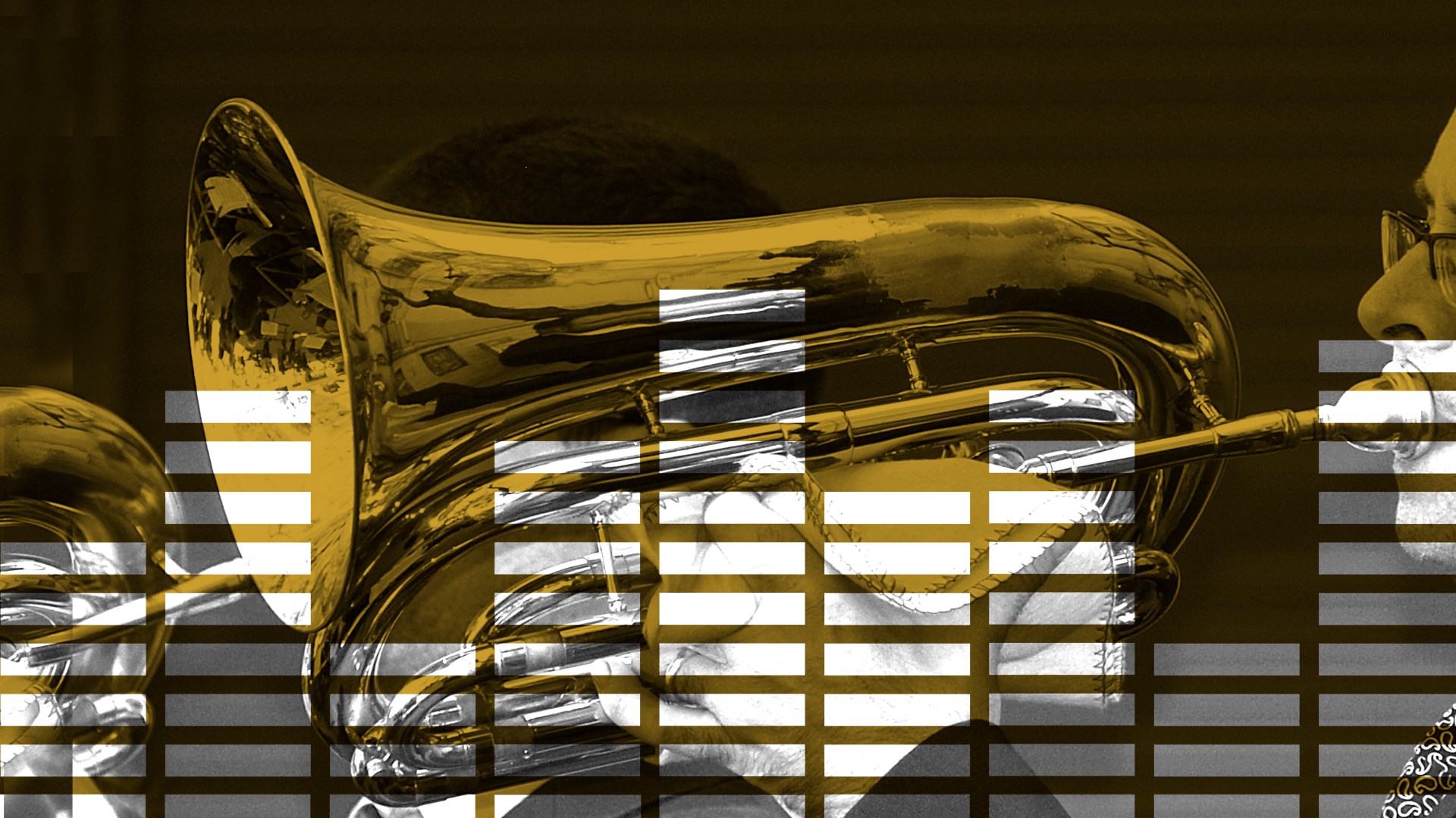
Praise Him with Harp and Tuba?

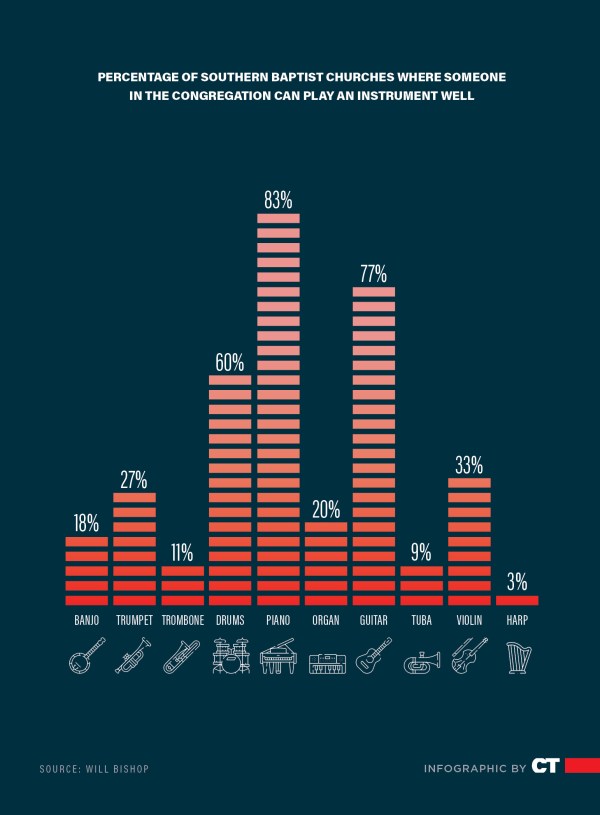
When SBC worship leaders look to their congregations for musical talent, this is what they find.

Illustration by Christianity Today / Source Images: Pexels

One out of every five Southern Baptist Convention (SBC) churches has struggled, in recent years, to find someone who could play the piano.

Most evangelical church music is played by unpaid volunteers. That means the options for instruments on Sunday morning are limited by the skill and knowledge in a given congregation. While “worship wars” have sometimes raged over particular styles or theological evaluations of this or that instrument, the actual available choices are limited by what people know how to play—and, hopefully, play well.

Will Bishop, associate professor of church music and worship at Southern Baptist Theological Seminary, asked about congregational musical ability in the first large-scale survey of SBC music in almost 100 years. He found a few harps. A few trombones. And not as many drums or guitars as you might think.
News

Stowaway Pastor Survives Atlantic Crossing

And other brief news stories from Christians around the world.

Luoman / Getty

A 38-year-old Pentecostal minister named Thankgod Opemipo Matthew Yeye survived a 3,500-mile Atlantic crossing hidden above the rudder of a cargo ship. He and three other Nigerian stowaways ran out of food after 10 days and survived four more on seawater alone before being rescued and detained by Brazilian authorities. Yeye said he was forced to leave Nigeria because his farm was destroyed by floods, leaving him and his family homeless. More than 50,000 Christians in Nigeria have been killed by Islamic militants since 2009. Yeye has applied for asylum in Brazil.

Jamaica: Man convicted of missionary murders

A jury of five women and two men found Andre Thomas, a 22-year-old laborer, guilty of murdering two American missionaries. He and his cousin Dwight Henry killed Randy Hentzel and Harold Nichols, both with Pennsylvania-based Teams for Medical Missions, in 2016. Henry previously pleaded guilty, telling police in interrogation that they killed the men because of the stories their grandfather used to tell them about the horrible things white people did. Henry was sentenced to life in prison. Thomas will be sentenced in October.

United States: PEPFAR opposed by pro-life groups

Congressional reauthorization of the President’s Emergency Plan for Aids Relief (PEPFAR) has been imperiled by pro-life opposition. Susan B. Anthony Pro-Life America, Heritage Action, and the Family Research Council say the program is a “slush fund” for abortion providers because it pays contractors to deliver the antiretroviral drugs necessary for fighting HIV/AIDS and some of those contractors also provide abortions. Pro-life groups who have worked with PEPFAR say it is a proven program—saving as many as 25 million lives in the past 20 years—and does not, in fact, fund abortions.

Kenya: Bishop’s election raises hopes for unity

The Methodist Church in Kenya elected Isaiah Deye as presiding bishop three months after Joseph Ntombura was removed from office. Ntombura caused a tremendous uproar when he changed the church constitution, defrocked more than 100 ministers, and sold some church-owned property. He was accused of misusing funds from the sale and money intended for a national university and church-affiliated hospital. The controversy prompted some of Ntombura’s critics to move toward a schism. Leaders in the church are hopeful Deye’s election will quell the turmoil and bring the denomination back together. Deye won 76 percent of the vote at the church’s annual conference in Nairobi. The ballots were counted in public, breaking from tradition, to mitigate claims of fraud. “Moving forward,” said Paul Matumbi Muthuri, a former bishop, “we see a church that is one … in mission.”

United Kingdom: Soul Survivor founder resigns

The founder of Soul Survivor, a popular church and summer festival that drew as many as 30,000 young people, has stepped down amid an investigation into allegations of “inappropriate intimate relationships” with interns. Mike Pilavachi is accused of giving full-body oil massages to young men stripped down to their underwear and engaging in vigorous wrestling matches that would end with him pinning and straddling 18-to-21-year-olds who were taking a gap year to learn about ministry. More than 100 people have come forward with information, including worship leader Matt Redman, who says he was abused by Pilavachi.

Germany: Almost no one reads the Bible

A University of Leipzig study found that a majority of Germans have a Bible in their homes but only 1.6 percent read Scripture daily. That percentage has fallen by about half in the last decade. About 3 percent say they read the Bible weekly, and 10 percent about once a year. Two new translations have not increased reading rates.

The Netherlands: Christian party rejects compromise on refugee families

A Dutch coalition government fell apart because a Christian political party that traces its history back to Reformed theologian Abraham Kuyper would not compromise on asylum seekers. ChristenUnie, the smallest member of the four-party coalition, was unwilling to accept a limit to family reunifications. Prime minister Mark Rutte, leader of the People’s Party for Freedom and Democracy, said the differences were irreconcilable and resigned. The Netherlands expects to receive 70,000 asylum applications in 2023, and a surging populist party has called for sharp limits on immigration. An election is planned for November.

Israel: Taxi test asks drivers about Christ’s return

The Israeli Health Ministry is asking would-be taxi drivers about their views on the end times. One of the questions on a psychological exam necessary for a license is “True or False: I believe in the second coming of Christ.” The test also has questions about church attendance, playing with dolls, and “unusual” sex. “I’m not sure why it’s relevant for driving,” said Nadav Davidovitch, director of the School of Public Health at Ben-Gurion University. “I think these are very inappropriate questions.” The deputy director of the Health Ministry said the test is outdated.

Turkey: Nicene Creed site considered for UN preservation

The city of İznik is being considered for the UNESCO World Heritage List. İznik contains the ancient city of Nicaea, where a council of church leaders approved a definitive statement of orthodox Christian belief in A.D. 325. It is also home to the Green Mosque, one of the earliest examples of Ottoman architecture. Inclusion on the list would mark İznik as a protected zone and ensure conservation for future generations. UNESCO officials will make a decision in 2024.

A Spirit-Filled Southern BaptistThe Wonderful Spirit-Filled Life,by Charles Stanley (Thomas Nelson, 239 pp.; .99, hardcover). Reviewed by Edith L. Blumhofer, project director for the Institute of American Evangelicals at Wheaton College in Illinois.For many years, the Southern Baptist Convention has been America’s largest Protestant denomination and Charles Stanley one of its best-known members. Longtime pastor of Atlanta’s First Baptist Church and two-time president of the SBC, Stanley is known to millions through his books and his popular nationwide television and radio programs, “In Touch.” Educated at the University of Richmond, Southwestern Theological Seminary, and Luther Rice Seminary, Stanley qualifies as a true Baptist stalwart.Thus it is noteworthy that he has written a book that probes the heart of a spirituality more often associated with Wesleyans and Pentecostals than with Southern Baptists. Stanley introduces The Wonderful Spirit-Filled Life as “a lesson in theology presented in the form of narrative.” As narrative it reads well. The theology builds on a concept that shaped the “higher life” and Keswick movements more than a century ago. The counterpoint to higher is the observation that the vast majority of Christians live far beneath their privileges as God’s children; unrealized by many Christians is that the Holy Spirit is God’s provision for “higher” and “victorious” Christian living. Charles Stanley has found the victory.As hinted above, Stanley’s book is the most recent addition to a literature that has a long history in American religion and so should be read in this context. For more than a century, presses have churned out a steady stream of publications that reveal a persistent fascination of American evangelicals with the person and work of the Holy Spirit. During the nineteenth century, much of this literature came from the pens of women and men associated with the sprawling Wesleyan Holiness movement. They gave expressions to the bliss of the Spirit-filled life in hundreds of enduring gospel songs, in thousands of tracts, in periodicals devoted to nurturing the believer’s “walk in the Spirit,” and in hundreds of books, some of which still sell well today.Toward the end of the nineteenth century, many evangelicals became convinced that the return of Christ was imminent. The urgency of the twin objectives of preparing the world and readying one’s self for Christ’s any-moment advent prompted widespread consideration of the role of the Holy Spirit in and among the faithful.The pursuit of this “higher” or “deeper” Christian life absorbed the energies of increasing numbers of American and British Protestants and found expression in such classics as Hannah Whitall Smith’s The Christian’s Secret of a Happy Life. Biographies of numerous stalwarts who were perceived by others to have grasped more fully than most the promise of the Spirit’s activity in their lives thrilled and challenged generations to similar devotion. Geraldine Guiness Taylor’s (Mrs. Howard Taylor’s) portrait of her father-in-law, Hudson Taylor’s Spiritual Secret; her biography of martyred China missionaries John and Betty Stam, The Triumph of John and Betty Stam; and her widely known Borden of Yale: The Life That Counts have by any measure been stunningly successful devotional classics loved by generations of evangelicals. Equally important in molding expectations about the texture of the Spirit-filled life have been autobiographies like Charles Finney’s Memoirs and Amanda Smith’s life story.Pentecostal appropriationFrom their beginning, Pentecostals enthusiastically adopted the gospel songs and devotional classics that had long expressed evangelical teaching on the “wonderful Spirit-filled life.” This led some evangelicals to change the terms of the topic in order to distance themselves from this “tongues movement.” Some qualified their use of the most troublesome terms, like “baptism with the Holy Spirit”; some, like John R. Rice or Harry Ironside, devoted considerable energy to attacking Pentecostal error while maintaining an alternative approach to life in the Spirit; still others ignored the fray and moved along in the time-honored quest for personal and ecclesial renewal.Despite these attempts, the language of being “Spirit filled” retained a powerful, broad appeal. In the same years that Pentecostals formed their own denominations and publishing enterprises, non-Pentecostals such as A. W. Tozer, Mrs. Howard Taylor, and V. Raymond Edman compellingly described the Spirit-filled life and challenged one and all to enjoy it. While Pentecostals and other conservative Protestants are often described as antagonists in the years between the world wars, even a cursory look at the devotional literature available during this period suggests that both groups hungered for experiential knowledge of the Holy Spirit’s indwelling.After World War II, the charismatic renewal both expressed and stimulated yet another wave of interest in the relationship between believers and the Holy Spirit. Books such as Merlin Carothers’s Power in Praise, Dennis Bennet’s Nine O’clock in the Morning, and John and Elizabeth Sherrill’s They Speak with Other Tongues spoke to another generation’s longing for spiritual renewal. What distinguished these books from those of an earlier generation was that speaking in tongues came to be seen as the entryway into the higher Christian life.The charismatic renewal’s relentless penetration of the church, especially in the two-thirds world, established it as a force with which to reckon. In response, and in an effort to provide responsible guidance, by the 1970s, major players on the American evangelical scene were writing books on the Holy Spirit. Stanley cites Billy Graham’s The Holy Spirit: Activating God’s Power in Your Life (1978) several times. Campus Crusade for Christ founder Bill Bright published The Holy Spirit: The Key to Supernatural Living in 1980. John R. W. Stott, a London preacher with a large American following, contributed as well, with Baptism and Fullness appearing in 1975. These dealt candidly with the concepts and language that divided Pentecostals from others while strongly advocating the Spirit-filled life. Stanley also cites R. C. Sproul’s recent The Mystery of the Holy Spirit (1990). Perhaps most forthright in addressing the issues that evangelicals find most troubling is Tony Campolo’s How to Be Pentecostal Without Speaking in Tongues, published in 1991.Life from aboveCharles Stanley’s views, then, stand in a distinguished succession. Like his predecessors in each generation, Stanley observes glaring discrepancies between what Christians affirm in song and creed on Sundays and what they do on Mondays. He views with dismay the tendency to confuse natural talent with spiritual giftedness. He also frets over how many Christians are ignorant of the resources he is convinced the Holy Spirit offers for spiritual growth and victorious living.In Stanley’s hands, the Spirit’s work does not resemble the startling forms of spiritual warfare that Frank Peretti’s novels call to mind; it is better described as a moment-by-moment yielding, issuing in piety best described by the list of the Spirit’s fruits in Galatians 5. Those evangelicals who have resisted the modern urge to abandon the hymnal may recognize its affinities with the words evangelist Daniel W. Whittle penned in 1893: “Moment by moment I’m kept in his love, / Moment by moment I’ve life from above.”In the book, Stanley intertwines his personal discovery of the Spirit-filled life with considerations of trends within contemporary evangelicalism. He is careful to distinguish what he advocates from what he has seen in Pentecostal churches. Having grown up in a Pentecostal-Holiness congregation gives him a perspective on classical Pentecostalism that other evangelical writers on the Spirit-filled life have usually lacked.Although one must not push the point too far, his book can be viewed as a commentary on the lack of teaching among classical Pentecostals on the role of the Spirit in the life of believers, since Stanley claims that he was a 32-year-old Baptist seminary student before he encountered the concept of the Spirit-filled life.Pentecostals will object to Stanley’s view that at some undetermined time shortly after the day of Pentecost, the Holy Spirit began filling all believers. Sometime in the period covered in the first chapters of the Book of Acts, he believes, the Holy Spirit “swept through the world, filling those who had put their faith in Christ.” Since then, all believers are Spirit filled, but not all believers have embraced the lifestyle of “abiding” and fruit bearing. Otherwise, traditional Pentecostals will agree with the basic principles the book describes.Stanley’s representation of the Spirit-filled life is winsome and appealing. Coming from a former president of the Southern Baptist Convention, it is surprising as well. But most important of all, it is a sign of the church’s persistent yearning for something “more” from God.Can The Tube Be Redeemed?Redeeming Television,by Quentin J. Schultze (InterVarsity, 198 pp.: .99, paper);All That Glitters: A News-Person Explores the World of Television,by Coleen Cook (Moody, 267 pp.: .99, hardcover). Reviewed by Robert Bittner, an editor and free-lance writer living in the Chicago area.“Any communication that furthers God’s interests in this world is Christian,” writes Quentin Schultze, Calvin College professor of communication arts and sciences, and the author of Redeeming Television. From the first page, he strikes the hopeful note that television can be a vehicle for God’s work in the world.But Schultze is not recommending placing satellite dishes across the globe to broadcast a new generation of televangelists. In fact, he questions the popular belief that television is God’s chosen tool for worldwide evangelism—an idea that can be stretched to make God seem shortsighted for sending his Son into a pre-TV world. But he also steers clear of the opposite camp that sees TV as the Devil’s tool, a medium by nature incapable of good. His middle-ground position will no doubt disappoint TV’s critics on either end of the ideological spectrum; nevertheless, it offers Christian viewers a thoughtful and balanced critique of the medium.The philosophical underpinning of Schultze’s views can be found in Reformed theology’s “cultural mandate,” which emphasizes humanity’s responsibility to care for all creation (Gen. 1:28). For Schultze, then, television is worthy of redemption simply because it is part of God’s creation.According to Schultze, a responsible Christian approach to TV requires an informed viewer. To this purpose he presents an overview of the way TV shows are produced, the not-so-hidden agendas of the producers, and the reasons why so few consumers of TV bother to think about it.Near the end of the book he outlines a number of practical steps that will turn passive “watchers” into critical “viewers” and thus, he claims, increase the medium’s power for presenting truth. Some of the simpler suggestions include the following: support public television; write letters of praise and protest to the networks; always watch a show before you criticize it; pray for those producing the shows; encourage gifted Christians to work in TV.For television’s friends and foes alike, the book makes provocative reading.The amoral tubeOne of those foes is former broadcast journalist Coleen Cook, author of All That Glitters. She has little good to say about television, especially about the type of television she was most involved with, TV news. Although her book shares many of the same resources as Schultze’s (both quoting frequently from critics such as Neil Postman and Malcolm Muggeridge), she uses them to highlight TV’s “weaknesses and dangers.” As a result, the book pays scant attention to TV’s even potential strengths and successes.The book opens with Cook’s dramatic story of her nerve-wracking first on-air assignment at a new station—a live “newsbreak” plagued by misinformation, faulty technology, and an unexpected question from her “partner” via satellite, Ted Koppel. In the succeeding chapters, she reveals the questionable decisions behind much of what we see on TV and explains how television’s technology, 30-minute time slots, commercial breaks, and the consuming hunger for high ratings make the medium myopic, amoral, and inherently incapable of accurately presenting truth.It is not until the last two chapters that Cook broaches the issue of how Christian families can respond to the tube. She encourages activities that will help viewers to “unravel the illusion of television” and, thus, free themselves from its tyranny: evaluate your viewing habits (a handy checklist is provided); put limits on your viewing; watch programs, not television; watch critically; become independent of TV.All That Glitters will disappoint those seeking an insightful, firsthand critique of the industry from a Christian perspective. By limiting her scope to the “weaknesses and dangers” of network news, Cook ignores the more positive roles of public television and CNN, not to mention such cable purveyors of quality family entertainment as the Disney Channel, Nickelodeon, and the Family Channel. In fact, there is little discussion of TV’S “entertainment” programming at all.Given Cook’s indictment of the television news industry, it is no wonder that she left. Even so, it would be hard to read her book without getting the impression that she wishes the situation could be changed. Redeeming Television may be the answer she has been looking for.InterviewDobson’S New DareBook publishers dream about the rare book that fills a need so well it keeps selling year after profitable year. Such was James Dobson’s Dare to Discipline, published in 1970 by Tyndale House. Over the next two decades, the volume, which encouraged parents to exercise authority and use corporal punishment when other experts were sounding a permissive note, sold more than 1,800,000 copies.Although the book continued to sell well, psychologist Dobson knew that the cultural context had changed. Thus he wrote The New Dare to Discipline (Tyndale) for today’s parents.What sets Dobson’s writing apart from other how-to authors is his broader vision. In the early seventies, Dobson realized that the American family was disintegrating and so focused his energies on restoring the well-regulated family as a foundation for a well-ordered society. That crusade led him to leave his university post and launch his own fledgling ministry, which, Dobson recently told managing editor David Neff, was “one of the most terrifying things I have ever done.” Now established in a downtown Colorado Springs office complex and supported by a ministry with about 900 full-time employees, Dobson’s crusade continues.In the early seventies, “I believed that we didn’t have much time, that the pressure was going to intensify, and that we were going to have to get excited about the family or lose it,” Dobson told CT. “I believe that even more today.”What key societal shifts prompted you to write The New Dare to Discipline?The original Dare to Discipline was written in the context of the Vietnam War. And so the book had the flavor of the 1970s. But the principles in the book are eternal. I feel that they can be traced directly to biblical concepts.The book was still selling, but when people—especially those under 30—opened it up, they read of things they didn’t know about, such as Students for a Democratic Society. Furthermore, I had 20 more years of experience with families, which gave me a lot that I wanted to say.Finally, there has been a concerted effort by the press and by the more humanistic community to make all corporal punishment, even when done with great care and judiciousness, look like child abuse. That is a change since 1970, and because child abuse is such an incredible problem, I wanted to explain the limitations of corporal punishment and who should not use it.What advice would you give parents who are worried their spankings may be crossing the line into child abuse?My advice is, don’t lay a hand on the child. Anyone who has ever abused a child, or has ever felt themselves losing control during a spanking, should not expose the child or themselves to that tragedy. Anyone who has had a violent temper that at times becomes unmanageable should not use that approach.But that’s the minority of parents, and I think we should not eliminate a biblically sanctioned approach to raising children because it is abused in some cases.You write that the pain of spanking is not the crucial factor but the meaning associated with the event. What can parents do to make sure that the child understands a spanking?The key to raising healthy, responsible children is to be able to get behind the eyes of the child and see what he sees, think what he thinks, and feel what he feels. If you know how to do that, then you know how to respond appropriately for him. For example, if a three-year-old screams when you put him into bed, it is the obligation of the parent to know whether that child is genuinely afraid of the dark—perhaps suspecting that he has had nightmares, and the isolation is a fearfully strange one—or the child is using tears as a way of getting what he wants—that is, to stay up. You behave oppositely, depending on your interpretation of the behavior. If you don’t know what he’s thinking and feeling, you don’t have a clue as to how to respond. On the one hand, you comfort him and let him get up. On the other hand, you don’t. For the tact and the wisdom required for good parenting, you need prayer and a little understanding of child development.Do you counsel parents to talk to children in connection with a spanking?Absolutely. But the conversation usually occurs after the confrontation. It’s very difficult to communicate when a rebellious, stiff-necked little child is clenching his fist and taking you on. After the confrontation—especially if it involved tears—has occurred, the child usually wants to hug you and get reassurance that you really care for him. Many parents say they feel uncomfortable responding to requests for affection at that moment because they’ve been upset with the child. I think they are completely wrong. At that moment you can talk to the child about why he got in trouble, and how he can avoid it next time, and how much you love him.Before we leave the issue of corporal punishment, it is important to understand I’m talking about a narrow age range of about 18 months to eight or nine years as an outside limit. I do not believe in spanking teenagers. It doesn’t work; it makes them angry. But there is a window in early child development when that tool can be very useful.Today there are a lot more single parents than there were in 1970. Can the principles in your book help those who may have never had an intact family?The beauty of implementing the principles given to us in Scripture is that they were provided by the Creator of families, and they work in all situations. The single mother needs the principles of discipline even more than parents in intact families because she’s got to do the job alone. The principle of the worth of the child and our need to sacrifice for him or her applies in all families. The principles are more important, not less, in a time of social chaos.Do you think we will be able to restore the nuclear family as the basic unit of American society?I really believe that the pressures on the family today from those who want to see it disintegrate are going to intensify. The only thing that will send us back in the direction of our roots is for large numbers of people to have a personal encounter with Jesus Christ, for a revival to sweep our land. I pray for that, I long for it, and I see it as the only hope. No philosophical discussion is going to bring that about. The only thing that will, in my view, is hardship. It might be that America is heading into a twilight period of immorality and wickedness that will have such painful consequences that we’ll begin to remember again where we came from.You talk about the need for the church to take part in sex education. What resources do pastors and Sunday-school teachers have to keep them from feeling just as at sea as parents do?There is a sizable quantity of material available that is compatible with the Christian ethic. Some has been done by Christians and has a Christian philosophy throughout. But there are other programs, like Sex Respect, that most Christians would be comfortable with. If parents are uncomfortable doing the job and they’re not going to get it done, my second choice by far would be those who understand what immorality is.If a teenager is sleeping around, he is not merely sexually active, he’s immoral. And the church needs to say that. In any congregation, there are teenagers who are doing exactly the same things that those who are not in a church are doing. And yet it is often not mentioned from the pulpit. That’s a mistake. It needs to be handled compassionately and sensitively. But teenagers need to know what the church stands for because, heaven knows, they sure hear the other side all day long if they’re in a secular school.The word dare in the book’s title suggests it takes courage to raise children. How would you encourage parents that they can do the job?What requires the courage are the disruptive adolescent years. Parents are terrified when their kids are three or four years of age that they are going to do something that’s going to lead to rebellion during the teen years. They know about the drug problem. They know about promiscuity. They know about rejection of the faith. And they don’t want to do anything that will wound the child in such a way that when they’re older they will throw the authority back in their faces.The truth of the matter is, you are more likely to create those problems when you are afraid to lead than if you take charge. God put parents in a position of authority over children. He’s the author of that leadership, and they must take it. Children will respect them for it, and they will receive their love more readily if they have the courage and the confidence to lead, while also caring for and protecting the child.It does take courage. You simply have to know: this is right. God said it. His Word established it. He said, children obey your parents, and therefore parents need to be benevolent bosses in their own home.Doesn’t the same situation obtain in the adult world? Very few of us grow up to be bosses. Most of us are followers.The principles in Dare to Discipline apply to employee/employer relationships. They apply to the relationships between nations—wherever human interests collide. The principle, in one word, that underlies the philosophy of each of my books is respect. Dare to Discipline says children respect your parents. Hide or Seek says parents respect your children. What Wives Wish Their Husbands Knew About Women says husbands respect your wives. The issue of respect is fundamental in human relationships, and The New Dare to Discipline, like the earlier version, just deals with how it plays out between parent and child.
Ideas

Culture War Is Not Spiritual Warfare

Columnist

Our ideological opponents are not the enemy.

Illustration by Abigail Erickson / Source Images: Getty

Someone who grew up in a more liberal religious tradition than mine once told me the sermons in his church were always boring, especially on Easter Sunday. “That was the day the pastor had to deal with the Resurrection,” a doctrine about which he was at best squeamish and at worst skeptical. “We would have to wait to see what metaphor the Resurrection turned out to be—one year it was restarting one’s life afresh, another would be the importance of recycling, or whatever.” A secularized account of the Resurrection does indeed lack the punch of the real thing (and that’s the least of its problems).

We evangelical Christians aren’t likely to secularize our beliefs about the Resurrection, but we are well on our way to secularizing something else: spiritual warfare.

Some outside the church incorrectly see spiritual warfare as a recent innovation, traced back to C. Peter Wagner and the Fuller Seminary church growth classes of the 1970s (thus tying it to the New Apostolic Reformation) or to Frank Peretti’s This Present Darkness and other novels of the 1980s.

But the concept of spiritual warfare has been firmly established in every era and wing of the Christian church, back even earlier than Saint Anthony wrestling demons in the desert, all the way to the New Testament itself.

There’s no absence of spiritual warfare talk from Christians these days. But listen closely to it and you’ll notice something: Rarely is this language of warfare directed toward evil spirits. Instead, it’s usually employed to describe ideological opposition toward fellow human beings. “This is spiritual warfare!” we hear as the lead-in to a call to arms about some political or social stance. But this way of thinking about spiritual warfare reveals a significant disenchantment with the world of the Bible.

Moreover, our conflation of spiritual war with culture war communicates the exact opposite of the message of the Bible, both in terms of who our enemies are and how to wage the battle. The apostle Paul told us that “we do not wrestle against flesh and blood, but against the rulers, against the authorities, against the cosmic powers over this present darkness, against the spiritual forces of evil in the heavenly places” (Eph. 6:12, ESV throughout).

According to the apostles—and Jesus himself—there are indeed malevolent spiritual beings in the universe, usually imperceptible to us. These beings mean us harm. They are not our fellow image bearers. Even the human being most hostile to the gospel or to the church or to the moral order could one day be our brother or sister in Christ (2 Cor. 5:11–6:2). Knowing that frees us to rage against the old reptile of Eden but constrains us to be gentle toward his prey (2 Tim. 2:23–26).

The way we do spiritual battle with the Devil is to realize how he works: through deception (Gen. 3:1–5) and accusation (Rev. 12:10). We do not combat that with the sound and fury of tribal conflict but with the same weapons our ancestors did: “by the blood of the Lamb and by the word of their testimony” (Rev. 12:11). It is the gospel that undoes the work of the forces of evil.

We aren’t to view spiritual warfare the way we do the pseudo-warfare of our fractured age. And we aren’t firing salvos “out there” against our enemies; instead we focus in here. For one can only engage the Devil, Paul wrote, by putting on the “full armor of God.” He defined that armor not as arguments meant to humiliate, isolate, or exile one’s opponents but as the cultivation of oneself by God’s Spirit, through the means of the gospel, the Bible, prayer, and the church (Eph. 6:10–20).

Maybe our secular neighbors will find it strangely medieval that we actually believe the old stories of a “world with devils filled.” But we believe far stranger things than that. We believe the words Martin Luther taught us to sing:

The prince of darkness grim, we tremble not for him; his rage we can endure, for lo! his doom is sure; one little word shall fell him.

To hell with the Devil. Let’s remember the good news that the foot on the old snake’s head has nail prints on it. That’s spiritual warfare for real. That’s a battle worth fighting—a battle, really, that’s already been won.

Russell Moore is editor in chief of Christianity Today.

Testimony

I Hadn’t Committed Suicide. But I Was Spiritually Dead.

The prison ID’ed the wrong man. But the mistake was powerfully revealing.

Margaret Ferrec

I was awakened by the hurried sounds of correction officers rushing into the cell block, with their key rings clanging together, their handheld radios blaring, and their loud voices interrogating the inmates. They were trying to determine whether one or more of us had taunted or terrorized José in a way that had caused him to commit suicide, which was a common enough occurrence at Rikers Island prison in New York City.

I hadn’t really known too much about José. In fact, I’m not even certain that was his real first name. I did know, however, that he shared my last name (Vega) and that he slept in the cell in front of mine.

I couldn’t stop thinking about how he might have taken his own life. One inmate said he had hung himself from the ceiling. Another speculated that he was able to tie his sheets to the bed while using his weight to choke himself as he lowered himself toward the floor. Either way, the deed was done and final.

As tragic as José’s death was, in some ways it launched me on the path to becoming a Christian. Oddly enough, this happened largely because of a mix-up on the part of the prison staff, who misidentified me as the prisoner named Vega who had committed suicide. The prison sent a chaplain to my family’s home to deliver the bad news. Amid the confusion that prevailed while Rikers Island was on lockdown following the incident, they didn’t learn the truth until several days later. For all they knew, I was dead.

There’s something powerfully symbolic in how I was “dead” but not yet buried. Looking back on this moment in my life, I believe God was beginning to show me that although I was physically alive, I was spiritually lifeless. And he was beginning to show me that true life would only be found in dying to self.

I was born into a humble family and raised in the gritty midtown New York City neighborhood known as Hell’s Kitchen. The oldest of four siblings, I had a love and a talent for baseball, and my family envisioned me playing for the New York Yankees one day.

But my upbringing lacked structure and discipline, and I had too much freedom for someone so young. I also struggled with low self-esteem and a need for acceptance. Compared to other kids in my neighborhood, I was small in stature and physically nonthreatening, which led to gnawing feelings of inadequacy and insecurity. To overcome these emotions and secure my place in the “in crowd,” I made a series of destructive choices—involving alcohol, drugs, and promiscuity—that dashed my dreams of playing professional baseball.

I started drinking alcohol at age 11. At 13, I began smoking marijuana and eventually graduated to hardcore drugs like cocaine and heroin, which quickly escalated into full-blown addiction. I enjoyed the thrill I received in the moment, but I hated the way I felt after the effects wore off. The only way to escape the pain, shame, and guilt the drugs created was turning to them for relief, which trapped me in a vicious cycle.

Selling drugs to support my habit became a revolving door in and out of prison. Each time I landed there, I would busy myself making plans to successfully stay out. But as the boxer Mike Tyson once said, “Everyone has a plan until they get punched in the mouth.” I wasn’t doing the necessary work of honest reflection that might have changed my course.

Once free, I would find sporadic employment in retail stores, as a messenger or delivery person, in telemarketing, or working other odd jobs. At one point, I even had a good, steady income working at a hospital in Syracuse. But I always ended up quitting or getting fired. Material things couldn’t change a wayward heart.

After several stints in prison, a glimmer of hope arrived in the form of Michelle, who strolled into my neighborhood with a style and grace all her own. I sensed she was different from the other girls. I said to myself, “She has to be mine.” We became friends, and eventually became intimate.

But Michelle grew frustrated with my persistently destructive actions and addictions. She was pregnant with my child, but we both knew I was ill-equipped for the responsibilities of fatherhood. In her hopelessness, she turned to God and started attending a church. She had been raised in a strict religious family that encouraged good behavior but not a relationship with a loving, merciful God. Finding encouragement from fellow believers, she prayed for my salvation, for deliverance from the degrading life I was leading. And she suggested that I go to a Christian recovery program for help.

Looking back, I can see that God was pursuing me even before my encounter with Michelle. There was the prison chaplain who would often encourage me to read the Bible. There was the inmate who spoke to me about God and invited me to attend services at The Brooklyn Tabernacle, a church he had attended.

I also started feeling deep remorse and shame over the pain I had caused people in my family, especially my mom and dad. I felt like I had to pay them back somehow. So I started attending prison chapel services. At first, it was just something to break the monotony of prison life, but before long, I actually started looking forward to it. I was always deeply moved, even to the point of tears, when we sang the song “Lord Prepare Me to Be a Sanctuary.”

From there I started reading the Word of God, and gradually it got a tight hold on my heart. Some of the passages I clung to during this time were Psalms 27 and 91, as well as Galatians 5:1–13, which speaks of freedom in Christ and liberation from a “yoke of slavery” (v. 1). My seminary was the Holy Spirit meeting me in the prison cell, where I could spend hours reading and praying without boredom.

All the while, God’s love and mercy for me were evident. He placed mentors along my path who taught me how to walk with God and obey his Word. This included a group of men who gathered regularly to study the Bible and strengthen their relationship with God. Following their example, I decided to surrender my life to Christ.

It took some time to see Jesus not just as my Savior, but also as my Lord. As a new Christian, I needed to better absorb the wisdom of Proverbs 3:5–7, which compels us to submit to God “in all your ways,” to “lean not on your own understanding,” and to “not be wise in your own eyes.” But when I left prison for good in 1996, I knew Christ had remade me from the inside out.

Top: Hector Vega’s personal Bible. Bottom: The building in New York City where Vega’s church meetsMargaret Ferrec
Top: Hector Vega’s personal Bible. Bottom: The building in New York City where Vega’s church meets

Since then, God has opened doors I never would have thought possible. I’ve enjoyed a successful career as an insurance executive. I’ve served as executive director and CEO of Goodwill Rescue Mission, a homeless shelter and addiction-recovery program based in Newark, New Jersey. And since 2009, I’ve pastored East Harlem Fellowship in New York City.

Meanwhile, I’ve been married to Michelle for 30 years, during which we’ve raised four children. And I’ve traveled to five of the seven continents on mission trips, preaching the message that in Christ, there is hope for overcoming every crisis we face in this life.

Nothing is impossible for God Almighty! When the world had labeled me an addict and a career criminal, his love and mercy overwhelmed me, testifying that I was made in his image and worthy of being presented as a trophy of his grace.

Hector Vega is the author of Arrested by Grace: The True Story of Death and Resurrection from the Streets of New York City, which he has sent to hundreds of prisons across the United States.

The Bots and the Bees

Following Jesus in our AI era.

Illustration by Abigail Erickson / Source Images: Getty

This year I turned our family vegetable-garden plots into pollinator gardens—in part because of the ease of caring for native flowering plants, but also as a small means of helping dwindling bee and butterfly populations. I care about those buzzy and beautiful creatures.

And apparently so does AI—or at least, so do the humans behind the multiple AI programs now contributing to the strategic monitoring of bee populations to support bee conservation.

“When we think of AI, we often think of its most public-facing applications: chatbots, facial-recognition software, and so on,” Kate Lucky, the writer of our cover story and CT’s senior editor of audience engagement, told me. But the fellow Silicon Valley Christians she interviewed “emphasized again and again that AI’s uses are so varied across industries—medical diagnosis, creation care, human resources, industrial manufacturing, and so on.”

While some applications of AI immediately raise ethical questions (even triggering anxiety about a Terminator-like dystopian future), others are tremendously beneficial, like AI-enhanced cancer screening, large-scale data analysis to combat world hunger, or wildlife-conservation tools helping at-risk populations of whales, koalas, and, yes, bees.

“We need to equip believers for the many ways they will—and already are!—encountering AI at school, work, and home,” Lucky said. As AI becomes increasingly ubiquitous, the Christians in tech fields Lucky spoke with see this moment as a critical opportunity for churches to disciple their members on how faith provides a framework for interaction with AI by “teaching prudence, restraint, and wisdom.”

What might this prudence look like on a practical level? How can we steward AI tools well and navigate AI’s ethical complexities with wisdom? What does it look like to approach AI via the lens of theology or epistemology? Both Lucky and Bonnie Kristian (in her column in this issue) explore facets of this conversation in our current issue. In the coming months, we’ll explore additional questions and concerns catalyzed by this new era of artificial intelligence.

As I’ve sat writing this, I’ve watched multiple ruby-throated hummingbirds and various bees and wasps visit our pollinator gardens. They bring to mind Jesus’ invitation in Matthew 6: Consider the birds of the air, the flowers of the field. Our call in this new AI era, with all its uncertainty, is the same as it was 2,000 years ago: “Seek first his kingdom and his righteousness.”

Kelli B. Trujillo is CT’s print managing editor.

Church Life

Colombian Christians Preached Social Justice. Practicing It Is Harder.

The birthplace of “integral mission” is also the epicenter of a migration crisis. It’s difficult to get local churches to care.

Photo-illustration by Mitchell McCleary / Source: Getty / Rogelio Figueroa / John Moore / Joe Raedle

Mauricio Miranda was comfortable. For 10 years, he had served as pastor of a Pentecostal church in downtown Cúcuta, Colombia. His church was modest but established, and so was his life. Every Monday, he woke up knowing what to expect: Wednesday night service, Sunday service, discipleship groups, sermon prep in between.

“It was a pretty normal, typical church,” Miranda said. “People came to services, I preached, we said goodbye, and people went back home.”

But after 10 years, Miranda was restless. “I felt that we were not doing enough,” he recalled. He just couldn’t articulate exactly what “enough” was.

Cúcuta is Colombia’s sixth-largest municipality and sits on the country’s border with Venezuela. Miranda’s church was about a 20-minute drive from the Simón Bolívar International Bridge, a 315-meter structure that’s one of the busiest border crossings in South America, generating up to $8 billion a year in trade.

At the time, people on both sides crisscrossed the border bridge as breezily as if they were visiting a neighbor. Those who’d grown up in Cúcuta remember sauntering to the other side to get Popsicles on hot afternoons. Children in school uniforms scampered over the bridge to attend classes. Families from Venezuela attended church services in Colombia.

And then in 2015—after a series of violent disputes between the two countries—the border closed. A year later, when the bridge briefly reopened to pedestrians, traffic no longer flowed both ways. By then, Venezuela had collapsed into a full-scale humanitarian crisis. Nearly 200,000 Venezuelans crossed the bridge into Colombia in just a few days. Many of them traveled back and forth to stock up on essential supplies, but as the crisis worsened, more and more Venezuelans stayed in Colombia. In 2015, 31,000 Venezuelans lived there. By 2019, that number was almost 1.8 million.

Mauricio MirandaPhotograph by Ferley Ospina for Christianity Today
Mauricio Miranda

In August 2016, Miranda decided to hit the reset button on his church. Every morning, he shut himself in his son’s bedroom, played some worship music, and prayed, “Lord, what can we do? Where do you want us to go?”

In September, Miranda received his answer. The Colombian and Venezuelan governments had just negotiated a more permanent reopening of the border to foot traffic. A lot of people are going to cross the bridge into Colombia, Miranda heard God tell him. Go, take some bread and beverages to the border, because people are hungry and thirsty. Rent a bus and bring them to church, because they need to hear the Word.

When Miranda told his wife, Isabelina, what he had heard, she balked. “Where’s the money to buy bread?” she said. “Where’s the money to rent a bus?”

Miranda asked God the same question: “Lord, there are other churches with lots more money and people. Why not send them? Why us?”

They were a small congregation of just 60 people, several months behind on rent. In fact, Miranda was about six months behind on the rent for his own home. The church’s tithes were barely enough to cover the bus rental to the bridge.

But like the widow of Zarephath, who cooked for the prophet Elijah with her last flour and oil during a drought, Miranda prepared a meal. Every Saturday afternoon, he and several church members went to the Simón Bolívar bridge with arms full of pan cascarita (soft bread rolls), bottled water, and packets of Frutiño (a powdered soft drink).

Today, that downtown Cúcuta church no longer exists. Instead, the congregation has moved to a warehouse that’s a five-minute walk from the bridge. They have a new name reflecting their new mission: Iglesia para la Frontera—Church for the Border.

For thousands of migrants who have staggered across the border—some after walking hundreds of miles, their feet bloodied, their cheeks gaunt, their children limp from exhaustion and malnutrition—one of the first sounds greeting them in Colombia has been loud, booming worship music. The warehouse church has a giant roll-up steel door. When the door is open, passersby can see and hear everything. It’s impossible for the migrants to avoid the church—and impossible for the church to avoid them.

A neighborhood street outside of Iglesia para la Frontera in Cúcuta, Colombia.Photograph by Ferley Ospina for Christianity Today
A neighborhood street outside of Iglesia para la Frontera in Cúcuta, Colombia.

Miranda remembers hollow eyes that looked up at him as he preached. “I felt like I was a pastor to a valley of dry bones,” he said. “They were so hopeless, so full of pain and sadness. It was like they were dead. More than preaching, I felt I needed to physically help them.”

Before they moved closer to the border crossing, Miranda’s church had been insulated from the situation there. Now they interact with about 300 Venezuelan migrants a week, passing out food and water, cutting hair, and baptizing them in an inflatable pool.

In this valley of dry bones, Miranda has seen the gospel take on flesh. His church would be unrecognizable to someone who knew it only before 2016. If the first 10 years of his pastoring were like B-roll, the past seven years of ministry at the border were like “an action film,” Miranda said. “Before, we had a small vision. Now we have a great vision.”

Since the 1970s, a paradigm shift has been taking place in the evangelical concept of mission. In general, evangelicals—even if they disagree on the particulars—have largely embraced the idea that because God reigns over all of creation, mission should also be holistic, addressing both soul and body.

This idea of holistic mission, often called “integral mission,” is the raison d’être of well-known mission and aid relief organizations such as the Lausanne Movement, World Vision, Tearfund, and Compassion International. “These ideas have tremendous influence on how evangelicals today think about themselves, think about their neighbors, and think about their role in the world,” said David Kirkpatrick, a historian who wrote about the legacy of integral mission in his book A Gospel for the Poor.

Less known is that much of this thinking originated in Latin America. The term integral mission, or misión integral, employs the Spanish word for “comprehensive” or “whole” and was coined by Ecuadorian theologian C. René Padilla. He argued that evangelism and social responsibility are “inseparable” and “essential” to the Christian mission, like “the right wing and left wing of a plane”—a phrase he coined that’s often attributed to John Stott.

The goal of misión integral, in Padilla’s words, is not numbers or wealth or power: “Its purpose is to incarnate the values of the Kingdom of God and to witness to the love and the justice revealed in Jesus Christ, by the power of the Spirit, for the transformation of human life in all its dimensions, both on the individual level and the community level.”

Padilla, who died in 2021, came of age as a migrant in Colombia. In 1935, when he was two, his family moved there seeking work. As evangelicals in a majority-Catholic region, Padilla and his family became part of a persecuted religious minority, escaping fire bombings and assassination attempts as his parents tried to evangelize and plant churches in Colombia. That upbringing shaped Padilla’s theology as a student at Wheaton College and when he returned to Cold War Latin America, which had become a cyclone of civil unrest and poverty. People were crying out for justice. What guidance did the church have for them?

At the time, a revolutionary spirit was sweeping across Latin America—Fidel Castro overthrew the Cuban government in 1959, just as Padilla was finishing a master’s degree. Out of this context emerged liberation theology, largely from Catholic circles. Left-wing activism and literature proliferated after bishops at the 1968 Latin American Bishops’ Conference in Medellín, Colombia, issued a document proclaiming the church’s “preferential option for the poor.”

While college students around him searched for justice and purpose in Marxism and liberation theology, Padilla searched Christian bookstores and libraries in Latin America for biblical answers. But he could find only poorly translated, irrelevant pieces from mostly North American sources.

“The only theology we are acquainted with is that which we have inherited from a reflection foreign to our own situation—a collection of concepts little related to the questions that our own world poses to the Christian life,” Padilla wrote in a 1974 essay for CT. In a 1972 letter to theologian and CT founding editor Carl Henry, Padilla wrote, “Young people [ask] questions regarding the Christian attitude towards a Marxist regime, while the pastors [discuss] the length of the skirts that girls are wearing in church. A social ethic—we have none.”

Padilla warned that despite reports of the phenomenal growth of Protestantism in Latin America, second- and third-generation Christians might leave the church when “they begin to consider their responsibility in the face of social injustice, find themselves unable to answer the arguments of their Marxist friends and either compromise with Marxism, or take flight into an individualistic Christianity marked by political conservatism.”

His warnings from nearly 50 years ago were prescient, and not just for Latin America. Church attendance among younger generations is declining worldwide, from the United States to South Korea to Kenya, accompanied by heightened awareness of the world’s injustices. Padilla insisted that a practical, theological response to the “concrete situation” of society is “an essential part of the life and mission of the Church.”

Without it, the church would falter and crash, like a plane with one wing.

Migration and displacement are perhaps the most universal concrete situations testing societies today. For the first time in recorded history, more than 100 million people have been displaced by conflict and economic crises. Immigration is fracturing politics across North America and Europe. And nations are being warned to prepare for a “century of upheaval,” in the words of British journalist Gaia Vince, as climate change triggers new mass migrations.

Colombia is the epicenter of what the United Nations calls “an unprecedented movement through the Americas.” The UN refugee agency’s operating budget for Colombia is its largest in the region, at $124.8 million. The Americas host 20 percent of the world’s displaced people, and about half of those are in Colombia.

Colombia has received more than 2.4 million migrants from neighboring Venezuela and has granted temporary protection status to about 1.8 million of them. With its porous borders, Colombia is also a channel for hundreds of thousands of people from as far away as China and Nepal, who pass through on their way to attempt the Darién Gap, a thick jungle barrier between Colombia and Panama. Roughly 250,000 migrants crossed into Panama through the Darién Gap in 2022 alone—double the previous year’s figure. The UN expects as many as 400,000 this year.

All this is happening in a country that’s confounded by its own domestic migration crisis. Colombia has the second largest number of internally displaced people (IDPs) in the world—more than 6.7 million since 1985. Last year alone, almost 69,000 people were displaced, mostly due to violence and threats from armed groups.

For many Christians in Colombia, migration and displacement are not distant humanitarian problems. They define ministry there.

Photo-illustration by Mitchell McCleary / Source: Getty / Joe Raedle

“We remember that we have suffered, and that helps in the way we respond,” said Daniel Bravo, director of Fundación Doulos, a nonprofit that connects churches doing grassroots holistic work among migrants in Colombia and Latin America.

Bravo grew up as a pastor’s kid watching his parents serve IDPs. Holistic mission was a natural part of his parents’ ministry; it wasn’t until high school that Bravo read about misión integral. Padilla’s writings gave him the language to define a theology that he already lived and breathed. He has found the same in most churches he works with: “Many people are doing integral mission without even knowing about the term.”

By and large, those churches are also small, underresourced, and rural.

In San Juan de Urabá, a rural coastal town by the Caribbean Sea, I visited a church that’s currently helping the 2,000 Venezuelan migrants who have settled there. Centro de Restauración Príncipe de Paz is a congregation of about two dozen people who are mostly IDPs. People call it “the church with no walls,” for its open-air building and wide-open arms for sojourners.

Pastor Jose Higinio Licona said helping migrants is instinctive, “Claro que sí.” How could they not? “We are all IDPs,” Licona said. “It’s just a natural thing from our heart. We know what it’s like to be displaced.”

In 1992, a group of about 50 Christian IDPs were trapped in a war zone between guerilla and paramilitary fighters near Licona’s town. Licona begged his municipal authorities for help, but “they said bringing a lot of people to our town would cause a sanitary problem,” Licona recalled. So he and his father used their own money to hire a truck to pick up the group and bring them to San Juan de Urabá—and that’s how he began his ministry as a pastor. “I didn’t start by preaching, but by helping others.”

Licona himself fled violent guerilla groups in his hometown of Mulatico, in northwestern Colombia, in 1984. Forty years later, he still weeps when he talks about the mutilated bodies that dogs and birds picked apart and the gnawing hunger that kept him up at night.

Licona’s family owned more than six acres of farmland, where they milked cows and grew yucca and corn. When strangers in green uniforms started appearing around town, people shut themselves in their houses. One evening, when Licona returned home from church, dozens of uniformed men with guns were waiting at his house, sipping his wife’s lemonade. They invited him to join their forces.

He decided it was time to leave. Licona and his family fled with little but a few cows, which they later sold. Licona remembers climbing a guava tree and throwing fruit to his wife—their only food for the day. They never got their land back.

Almost everyone in Licona’s church has similar stories of loss and grief. So when Venezuelan migrants started showing up in their small town about three years ago, congregants rolled up their sleeves. They butchered two cows and harvested 1,000 pounds of yucca. They helped migrants pay rent and apply for temporary protection status. They hosted special dinners with home-cooked Venezuelan dishes. They offered counseling and a shoulder to cry on. They gave from what little they had.

For some Venezuelan migrants, this church was their only source of help. Marialejandra Perez told me she was pregnant and had a two-year-old when she arrived in San Juan. When the pandemic hit, her husband lost his job. They might have starved, she said, if the church hadn’t helped her family lease a small plot of land to farm.

Magrey Vielma told me she was displaced twice—first from Venezuela, then from a small town in Colombia where armed groups were fighting. When she came to San Juan, the church helped her get diapers, hot meals, and blankets.

While many Venezuelan migrants travel to other countries such as the United States for better opportunities, one woman told me she never considered that option: “Colombia has been good to us.”

Yuleimar del Carmen Peña, a Venezuelan migrant who has lived in San Juan for two years, told me Licona’s church helped pay for her bus ticket to San Juan. The pastor greeted her at the bus station with a smile. “I am the testimony of what God is doing here,” Peña said as she quoted Matthew 25 word for word. “We can see God through people like the pastor…. They are proof that God has not abandoned us.”

Not every church in Colombia has felt compelled to do migrant ministry. Licona said he tried to convince other pastors in San Juan to help, but so far he feels like his church is working alone. “Sadly, I have to say that other churches have not understood the true gospel,” he said. “They only worry about the spiritual needs of people, not their physical needs.”

In Necoclí, a remote resort town by the Gulf of Urabá, I saw the same lethargy among churches. Necoclí is one of the last stops for migrants passing north through Colombia before reaching the Darién Gap. In 2021, at the peak of the migration crisis, about 10,000 migrants—half the town’s usual population of 20,000—crowded beaches and hostels and slept under coconut trees, waiting to cross the gulf by boat and begin the 60-mile trek through the treacherous jungle that separates Colombia and Panama. The town’s power and water systems crashed, and local authorities declared the situation a “public calamity.” A few NGOs, such as the Red Cross, offered medical assistance. But otherwise, the migrants were on their own.

Necoclí has 17 evangelical churches, according to Euder Argumedo, pastor of Iglesia Cristiana Catedral de la Fe. He says his is one of only three congregations that has been helping migrants. “The local churches are apathetic. They think [the crisis] has nothing to do with them,” he said.

Some Christians in Colombia are trying to change that mentality.

The Seminario Bíblico de Colombia, in Medellín, launched its Faith and Displacement Project in 1996 to mobilize local evangelical churches to minister to IDPs in particular. Drawing on the ideas of integral mission, the program encourages local churches to utilize their own untapped resources to help IDPs thrive spiritually, socially, psychologically, politically, educationally, and economically. Six communities across the country are test-piloting the program’s curriculum.

Project director Christopher Hays said he had expected churches in the capital city of Bogotá—the ones with the best-educated congregations and proximity to resources and power—to be the most effective. Instead, these congregations were more likely to quit the program than small, poor, rural churches. Hays suspects that people in urban areas, accustomed to easier access to government resources, “expect the government to fix things,” whereas people in rural areas have learned not to wait around for outside intervention.

Migrants camp before trekking through the Darién Gap.Getty / John Moore
Migrants camp before trekking through the Darién Gap.

One immediate challenge the Faith and Displacement Project faced was getting churches to care. Despite being the birthplace of integral mission, the Latin American church has been slower to embrace it than other parts of the world, Hays said. Most evangelicals in Latin America are Pentecostals, with an American-influenced dispensational theology that emphasizes saving souls.

“The challenge is less about helping them see it is a problem,” Hays said. “It’s more about helping them to see that it is a problem the church should care about, because they have a pretty strong evangelical dualistic tendency”—that is, they downplay earthly needs. What these churches need first is a total “paradigm shift” in theology, Hays said.

But theology only goes so far. Integral mission is more than an intellectual framework. It is an incarnation of the gospel that, as modeled in Christ’s life, ministry, and death on the cross, comes at a cost.

For 10 years, Deiner Espitia pastored a church in a settlement of mostly IDPs on the outskirts of Puerto Libertador, a town in northern Colombia. Through a partnership with Compassion International, his church ran a community center that provided food, health services, and activities for 350 children about three times a week. But he saw resentment and hopelessness in the children’s parents, and he wondered what the church could do for them.

“Forced displacement generates silent mourning,” Espitia said. He would know: He was twice displaced himself when he began the church. IDPs struggle against discrimination, unemployment, cyclical poverty, family dysfunction, and deep trauma, Espitia said. Many pin their hopes on government-promised reparations. If those don’t materialize, IDPs often seem to give up on life.

“You really lose everything. You lose any desire to continue. Hope is dissipated,” Espitia said. IDPs come to church and sing worship songs and even serve, “but they serve while expecting something in exchange. They’re angry. Though they don’t really speak much about it, the first resentment is against God. And the question is always Why? Where were you?

Espitia prayed for God to reveal what the church could do for them. Then he heard about the Faith and Displacement Project. His church began offering classes in 2016.

At first, dozens of families in the community showed up, expecting handouts. But there weren’t any handouts, and many disappeared. Only about 15 families remained and followed through the entire program.

Part of the curriculum is a game called “We Can,” in which participants list their individual skills, experiences, and abilities. The game helps people identify areas where they can serve and ways they could generate income. The goal is to lift them from a spirit of defeat to one of confidence and gratitude. Participants also study the narratives of displacement in the Bible, so they can identify with characters such as Naomi and Ruth, who also faced loss and displacement.

The transformation was astonishing, Espitia said. Within eight months, families in the program had started their own businesses. Some who knew how to fish opened a fish farm. Some who once owned farms procured land and planted rice, yams, and yucca. One family started beekeeping. Another opened a small store.

“It was very speedy change,” Espitia said. “Their houses changed from plastic to bricks. It was clear that these IDPs had enormous potential. Even as their pastor, I didn’t know what they were capable of.” And they weren’t just freed from physical poverty, Espitia said. In the midst of hostility and loneliness, families found “hope that yes, we can flourish.”

Then, in 2019, Espitia was displaced for the third time.

The first time, he was 10. Guerilla groups murdered his grandparents, uncles, and cousins and kidnapped his father.

The second time he was displaced, Espitia was a 24-year-old store owner. Paramilitary groups tried to extort his business. A neighboring business owner refused to pay them, and they shot him at Espitia’s doorstep. So Espitia fled with his wife and three children.

The third time, however, was the most agonizing.

Espitia’s ministry with IDPs was finally blooming. His wife had found a job as an auxiliary nurse. They were building their dream house. And then he reported a man in the community for sexually abusing a minor. Espitia received death threats. The accused man’s brother, a member of a paramilitary group, sent someone on a motorcycle to threaten Espitia’s children at school with a gun. Espitia could not, in good conscience, withdraw the charge. So, once again, his family fled, leaving behind their church, a half-finished home, and his wife’s new job.

Friends invited the family to stay at the seminary in Medellín. There, for the first time, Espitia was forced to take a break—one that has lasted years. He had been counseling other IDPs through their grief and resentment. Finally he realized he hadn’t fully processed his own. “My heart was full of anger against God,” he said.

After four years, he and his wife are still wrestling with God to find meaning in their struggle. “We were doing so many things for the Lord, for his kingdom,” Espitia said. “Just as we were starting to sing, God closed our mouths.” His three children, now ages 18, 21, and 23, have also struggled to make sense of their faith.

When I met Espitia at the seminary, he was a student there, one semester away from graduating. At the time, he was working on his dissertation about what churches can do for IDPs—not just for those who have settled into communities, but for those who have recently been displaced. What would it look like for these people, too, to truly flourish?

This time, he was asking not just as a pastor. He was asking as himself.

He’s no longer a hero saving others in the relative comfort of his own ministry. Espitia’s relationship with God has changed. So have his relationships with his wife and children.

So has his mission. It’s more rooted now in his vulnerability and in the person of Christ. Espitia is living out his own subject matter—incarnating it. He has a more holistic understanding of what it means to let the gospel transform human life in all its dimensions and what it looks like to, as he describes it, “flourish in the midst of the desert.”

If Mauricio Miranda, the pastor of the border church in Cúcuta, was comfortable seven years ago, nobody in his church is comfortable now.

Everywhere around Iglesia para la Frontera is chaos. At the front door, people curl up on cardboard mattresses. A block away, motorcycles honk and taxis screech as they cross the bridge—now reopened to vehicle traffic—while young men and women rap on car windows offering manual labor and sex for cash. Armed guerillas and other criminal groups patrol the border and watch the church (it has been robbed multiple times).

When the pandemic hit, the Colombian economy tanked and many Colombians lost their jobs. It was the worst time for a nation to be dealing with millions of migrants streaming across the border.

Miranda used his own money to purchase food and drinks when the church first began handing them out in October 2016. Then church members began chipping in. Then a bakery donated bread, and another store added one box of beverages for every box Miranda bought. A couple from San Antonio helped raise funds to buy the warehouse that became Iglesia para la Frontera.

But Iglesia para la Frontera is more than just a church building—it is a food distribution center, a microenterprise, a school, a medical clinic, and a party hall for quinceañeras. American dollars helped purchase sewing machines to start a sewing and shoemaking enterprise for Venezuelan women. A church in Houston sponsors an education and food program for 80 Venezuelan children who are unable to attend school.

Operation Blessing brought medical teams to treat sick Venezuelan migrants and, after the teams sweated buckets in the poorly ventilated warehouse, the organization helped install air conditioning.

“They installed it within two weeks of us opening the border church,” Miranda said, laughing. “When we were in downtown Cúcuta, it took us 10 years to install an AC unit there. And at this church, it took us two weeks!”

At first, Miranda kept both the downtown and the border buildings open. But in 2019, the downtown church permanently relocated to the border. Five families—almost half the congregation—left the church in protest. (They eventually came back.)

In the past seven years, Miranda estimates, his church has served more than 70,000 Venezuelan migrants.

Photo-illustration by Mitchell McCleary / Source: Ferley Ospina for Christianity Today

One of them is Emily, an 18-year-old whom Mauricio and Isabelina Miranda met when she was homeless and sleeping under a tree. Emily was 14 then, thin from malnutrition and caked with dirt. Her mother sold drugs in Venezuela, and an older sister worked as a prostitute in Colombia. The church took her in. When Emily turned 15, Isabelina organized a quinceañera for her, dressing her in a new gown and shoes.

That was the church’s first quinceañera for a migrant girl. Since then, it has celebrated 25 more.

Now Emily is a teacher at the church’s school and the lead singer on the church worship team. You would never know she is painfully shy if you only saw her on stage. She raises her hands and pounds her chest as she worships. She hops and dances and shouts, and her thick curls bounce around her face. If you hear loud, joyful singing at the Simón Bolívar bridge, it’s most likely Emily.

And the young people at Iglesia para la Frontera—the type René Padilla feared the church could lose when he was forging his ideas about misión integral half a century ago—are witness to it all. Diana Martínez, an 18-year-old college student, remembers those early years at the downtown Cúcuta church. She was only about 10 when her father joined Miranda in lugging bread and water to the border crossing.

Over the years, she’s watched people enter the church looking like life has spit them out. She remembers one Venezuelan woman coming to church dirty, disheveled, and downtrodden. The woman collected garbage for a living. Over months and years, Martínez saw the woman transform. She started wearing makeup. She had clean clothes. She no longer needed to rummage through garbage bins to survive. Her countenance changed, too: There was hope. And joy.

“That impacts my faith,” Martínez said. “You see people transform here. I see with my own eyes how God can transform lives when we open our hearts to him, and so I can certainly say that, yes, God does transform lives.”

Her pastor doesn’t need to worry about this college student abandoning her faith or her church, this place where she sees miracles.

“Why would I?” Martínez said. “I want to stay in this church until Jesus comes back.”

Sophia Lee is global staff writer for CT.

Looking for a Detox for Unhealthy Masculinity

And other responses to our July/August issue.

Abigail Erickson

It’s time to change the way we talk and think about male sexuality,” writes Zachary Wagner in the Speaking Out section of our July/August issue. The church, Wagner argues, hasn’t done its part to set boys up for success. Purity culture has too often cast men as “sexual animals,” rather than offering Jesus as an example of gentle self-control and godly maturity.

Wagner’s reflection—based on his book Non-Toxic Masculinity: Recovering Healthy Male Sexuality—joins a conversation that’s been taking place inside and outside Christian circles this year. Richard Reeves’s book Of Boys and Men and Christine Emba’s Washington Post column “Men are lost. Here’s a map out of the wilderness” are among the attempts to diagnose why men are struggling—in school, in the workplace, in families—and what can be done to help. Commenters on CT’s social media pages found Wagner’s vision of Christ-centered masculinity encouraging. “Thank you for putting Jesus as the highest example instead of politics or helpful debate,” wrote one woman.

Though a few said the article either went too far in support of “the feminist movement” or didn’t go far enough in “deconstructing the patriarchy,” and others wished Wagner had offered more concrete advice, many of those who commented found his take, in their words, “refreshing,” “timely,” and deserving of an “AMEN.”

Kate Lucky senior editor, audience engagement

Nondenominational Churches Are Growing and Multiplying in DC

Very few persons under the age of 60 or 65 are interested in or even know of anything related to a “denomination.” There’s a majority of youth that have no clue what a “church” is or even care. So these writings appear to be more of a traditional understanding of Christianity, even if they call themselves “nondenominational.”

David Traverzo Houston, TX

I was taken aback by comments in the article by Daniel Silliman. He states conservative nondenominational churches “teach that the gospel is political, but not partisan.” And a little further he quotes pastor Tonetta Landis-Aina as saying the same thing. To me, those statements are treading on dangerous ground and possibly giving tacit approval for actions and motivations that can easily cross the line into partisanship, whether one is liberal or conservative. Of course Jesus cares that we look out for the disadvantaged, but I would never characterize the gospel as being political!

Carol Ball Encinitas, CA

A denominational Christian like me (Presbyterian Church in Ireland) needs to consider carefully the blessings of not carrying denominational baggage. But what about accountability? There are structures in denominations to call to account a leader who goes rogue. I am disappointed that the article did not address this crucial issue.

John Faris Bangor, Ireland

Is God Pleased by Our Worship?

M. Daniel Carroll R. gets much right about the hollowed-out worship I believe many believers feel today. This is a well-timed article that names and brings to light a serious problem in the body of Christ. Sometimes our worship can and has led us further from God himself, and this article does get to the heart of our need to be confronted by the idea that we must be careful not to worship false gods.

At the same time, I felt uneasiness with his message about social justice being the center of our worship. My wife and I have led life-giving, Christ-centered drug and alcohol programs as Salvation Army officers that left men and families changed and engaged in Spirit-led churches. The writer is careful to distinguish between politicized social justice and godless humanist programs. However, I have run up against social justice advocates around the world and in our own country that hated Christ-centered programs and made it difficult in their spheres of influence.

John Greholver Hastings, MN

The church has gone so far from practices of humility, service, and truth that my soul has suffered. I feel sickened when attending church services that are not worshiping with humility. It is not easy to gather together without the distractions of entertainment and politics of government. CT really helps me be encouraged that God’s people are interspersed in the population and glad to serve by calling out the sin that seems to be destroying the calling of the church.

Sharon Hilderbrant Littleton, CO

I Loved Studying Math. I Needed God to Show Me Why.

I too was a physics and math major and came to the same conclusions as he did about the reality and influence of mathematical truths. I like the variety among the people highlighted in the testimony column each month. A testimony need not be dramatic to be valid and to bring glory to God.

Bill Dean Carmichael, CA

Behind the Scenes

Generations After Slavery, Georgia Neighbors Find Freedom and Repair in Christ

Our July/August cover story actually started as an online movie review. I learned that some Berry College professors were involved in a documentary called Her Name Was Hester. Journalist Melissa Morgan Kelley couldn’t make it to the movie showing, but she drove from her home in Atlanta to northeast Georgia to meet the subjects for herself. As soon as she recounted the conversations from her visit with these neighbors brought together by their shared faith and surprising history, I knew we had to make it a bigger feature story.

Kate Shellnutt editorial director, news

News

Christians Seek to Expand Holy Land Tours to Include Christians

Arab believers want American visitors to see the “living stones” in Israel.

Illustration by Tara Anand

Jack Sara sees buses of American Christians pass by his house as they tour around his homeland. He sees them stop, get out for a few minutes to take photos, and then get back on their buses and leave.

He wonders why they never come talk to him.

“The land of Christ is not just a museum,” said Sara, an evangelical pastor and the president of Bethlehem Bible College. “There is still a church they could meet and pray and fellowship with and get encouraged from.”

As many as 400,000 Americans visit religious sites in Israel each year. They go to walk where Jesus walked and see the land of the Bible: from the river Jordan to the Sea of Galilee to the traditional site of the Nativity, with stops at Mount Carmel, King David’s tomb, and the Mount of Olives, where Christ is said to have ascended. Yet few of these religious pilgrims connect with modern-day Christians in the Holy Land.

About 180,000 Christians live in Israel—just under 2 percent of the population. Three out of four of them are Arab. They include Byzantine, Roman, and Maronite Catholics; Eastern Orthodox; Coptic Orthodox; Armenian Christians; and a small number of Protestants like Sara.

Sara is a Palestinian who grew up in a nominal Christian home in Jerusalem’s Old City. He made a personal profession of faith and committed his life to Christ at Jerusalem Alliance Church in the early 1990s. Now—as president of the school he attended to grow deeper in his Christian faith—he hopes to connect more Christians from around the globe with the vibrant evangelical churches in Israel.

The Bible college is offering online classes to allow people to “Discover Jerusalem,” “Discover Bethlehem,” and “Discover Galilee.” The school also trains local Christians as tour guides and is working with an American ministry to facilitate different kinds of trips to the Holy Land.

Others also want to broaden people’s experiences in Israel. The Christian HolyLand Foundation is an Independent Christian Church–affiliated nonprofit ministry that supports church leaders in Israel and helps fund church and community projects. They are also organizing trips.

The Christian HolyLand Foundation wants to invite believers to think a little differently about the idea of “walking where Jesus walked,” said executive director Matt Nance. As a Palestinian Christian once pointed out to him, Jesus promised to be with those who gather in his name. He didn’t care about the dead stones at his feet. But he cared a lot about those whom one of his disciples would later call “living stones” (1 Pet. 2:5).

People are “totally missing where Jesus is walking today,” Nance recalled the Arab Christian telling him. “He’s not walking with dead stones. He’s walking among the people, and he’s experiencing our trials and our pain and our opportunities to participate in the mission of the kingdom.”

Nance, who is based in Knoxville, Tennessee, personally knows how powerful a trip to the Holy Land can be. When he was a university student, he studied for a year in Germany and during a break went to Israel and Jordan—backpacking, hitchhiking, sightseeing, eating a lot of street-food falafel, and absorbing as much about life and the culture as he could.

“I fell in love with that part of the world,” Nance told CT, “and decided I wanted to go live there if I could.”

In 2012, he moved to Jordan with his wife, Susan, and they made their home there for the next eight years. They immersed themselves in a local Christian community, and Nance worked under a local church.

That time in Jordan gave him another perspective on Holy Land tours, which often include extension packages that take Christians to Jordan and Egypt. Nance, like Sara, saw all these buses of believers that never stopped to connect with a local congregation. He felt kind of sorry for them.

“They just are not experiencing what life is like in this place today,” Nance said. “If you are only on your tour bus, tourist restaurants, and tourist hotels, you are missing a beautiful culture and you’re also missing getting to learn about the challenges and trials of what it means to live in this part of the world.”

Moneymaking Holy Land tours, of course, are constrained by the need to turn a profit. And they cater to consumers, responding to demand, not telling tourists what they should want to do on their trips to Israel. Nance wondered if a nonprofit that emphasized the spiritual value of connecting with Christians could draw believers to a different kind of experience.

Now back in the US, he is working with the Christian HolyLand Foundation, arranging trips that place a high value on these Christian connections.

As travel has opened up after the pandemic, the Christian HolyLand Foundation is organizing trips for churches that will allow them to worship with fellow believers in Israel. They will share a meal and perhaps even help with an olive harvest.

Ken Nelson, a retired TV news anchor in Indianapolis who went to Israel with the Christian HolyLand Foundation before COVID-19, said participating in an olive harvest was an especially memorable part of the trip. He beat the branches of the trees with a stick, as he was taught, to knock down ripe olives.

“It wasn’t just walking in the footsteps of Christ,” he said. “We met Arab Christians. Real, real people who have dedicated their lives, right here in the Holy Land, to Jesus Christ. We attended a local church service with their local pastors. We clapped our hands with them. We sang with them. … And you know what was there in the room with us? The Spirit of Christ.”

Each trip includes about 10 to 15 people, typically all from one congregation. The groups see some of the famous religious sites, as they would with other tour packages. They are led around by Christian tour guides—including those trained at Bethlehem Bible College—and interact with historical, theological, and archaeological experts, as well as local Christians.

Dave Mullins, pastor of Colonial Heights Christian Church in Kingsport, Tennessee, went on one trip and came back valuing the personal connections.

“Seeing their hearts for the kingdom has been really impactful,” he said. “All of the people I have interacted with have just been extremely warm, loving people.”

The experience also added to the complexity of his understanding of the Israeli-Palestinian conflict. He doesn’t think he has an answer to the ongoing crisis, but the trip made him pause and think, “Oh, wait a minute, these are my brothers and sisters in Christ who go through an awful lot in a land where they were born,” Mullins said.

He especially loved hearing about the ways Christians have helped facilitate reconciliation between Arabs and Jews. He’s hoping to bring a group from his church to the Holy Land next year.

Sara said he loves how many American Christians are praying for peace in Jerusalem, his city. But when he sees those buses come and go, he worries they are not praying for all the residents.

“You see them sympathizing with a certain group of people against another—taking a stand on the Israeli or Jewish side and opposed to the Palestinians,” he said.

If he can connect them to the lived experience of Christians in Jerusalem and the rest of Israel, they will meet Palestinians who are not enemies of peace but in fact love Jesus and have preached the good news of the Prince of Peace for many years.

“When you talk about Palestinian Christians, you’re talking about Christians who have been here for 2,000 years,” Sara said. “Christianity never left this country.”

Adam MacInnis is a reporter in Canada.

Books
Review

In a World of Speed and Power, Cormac McCarthy Wasn’t Afraid of Depth

The late novelist’s final books are ambitious portraits of the Western world and the human soul.

Christianity Today September 8, 2023
Illustration by Mallory Rentsch / Source Images: Unsplash

In the Middle Ages, there was a popular group of texts that made up the so-called contemptus mundi genre (which, loosely translated, could mean “how to develop a visceral disdain for the world”). One of the genre’s most famous works is Thomas à Kempis’s Imitation of Christ. These rather “Platonic” works, in the sense of being in the vein of the philosopher Plato, were intended to coach Christians toward holiness, teaching them how to pry their fingers loose from the throat of life and begin longing for heavenly, immaterial realities.

The Passenger (Vintage International)

The Passenger (Vintage International)

Vintage

448 pages

This was done through contemplating things that now seem off-putting to us: how treacherous people in the world are, how you were born in woe and will die in suffering, and all of the icky things about the human body. The goal was to drag those things we try to forget (mainly the “Four Last Things”: death, judgment, heaven, and hell) out from the hiding places of our consciousness, lest we forget how fleeting, disappointing, and volatile this world ultimately is.

Just a couple of years ago, I would have considered the contempus mundi genre dead, with the possible exception of a brief revival in T. S. Eliot’s late religious poetry. But the late novelist Cormac McCarthy resurrected the genre in his final books, The Passenger and Stella Maris, which were released as a pair late last year.

Although the two books are less violent than The Road or Blood Meridian, they partly compensate for that with their raw language, crude jokes, suicidal longings, and graphic descriptions of incestuous sexual desire. McCarthy was no plaster angel, even in his later years. But even though McCarthy’s novels do deal frankly with these strong and off-putting realities, they do so in a way that is not prurient. The effect, on my read, is purgative and cathartic.

A legacy of death and power

If you thought McCarthy couldn’t get bleaker after his previous novel, The Road (2006), you’d be wrong. Each of his final books is devoted to one of the (tellingly named) Western siblings: Bobby and Alice, later named Alicia. (Western is their literal surname, though their narrative arcs do invite reflection on the civilization that the surname evokes.)

The siblings are incestuously in love with one another, something which Alice confesses to her therapist in disturbingly graphic detail in Stella Maris. But they never consummate their desire. It is too unthinkable, too illicit, almost too troubling to mention even to your psychologist. In a world in which almost any love is permitted and celebrated, McCarthy manages to find one that is still forbidden. In this way, he creates a moral dilemma of tragic tension, worthy of Greek mythology or Athenian theater.

Unlike The Passenger, which is a kind of psychological spy thriller about a salvage diver (Bobby Western), Stella Maris is a brainy, punctuation-less dialogue between mathematician and child prodigy Alice Western and her psychiatrist, tasked with keeping his ward from committing suicide. “Stella Maris” is the name of a mental asylum in Wisconsin, or what frankly-speaking Alice (who is allergic to euphemisms) prefers to call a “crazy house.” It is also, ominously, the place where Alice will hang herself, leaving her frozen body to be found by a hunter in the surrounding winter woods. The cinematically-described discovery of her body in these woods makes up the opening scene of The Passenger. The books, thus, come full circle.

There’s a lot of overlapping plot detail between them, especially because in The Passenger, the narration jumps back and forth, relating scenes from Alice’s teenage, schizoid hallucinations at her ancestral home in Tennessee and then skipping back over to describe Bobby’s post-injury career as a salvage diver. But in essence, the bones of the plot are centered around Bobby and Alice’s parents, who were both involved in the development of the atomic bomb.

The inheritance of the siblings, then, is a joint legacy of death and power. Their father, now dead from the cancer he contracted from radiation exposure, was a colleague of J. Robert Oppenheimer, the subject of Christopher Nolan’s recent film. Their father worked at Los Alamos (where Alice was born and spent her earliest years), as well as at a top-secret uranium enrichment facility in rural Tennessee, where Alice’s maternal family came from.

As a schizophrenic, Alice is haunted by a bizarre menagerie led by “The Kid,” a four-foot tall, dirty-mouthed, abusive small person who has flippers instead of hands. The Kid shows up in Alice’s room while she is trying to study, and has his companions perform unwelcome, old vaudeville acts to entertain her.

In her therapy sessions, Alice will speculate that they were trying to distract her from her studies and some deeper truth. Although brilliant and well-funded through fellowships, Alice loses faith in academia and begins to long for death, especially after Bobby, also a grad school dropout, is injured in a devastating racecar accident that seemingly leaves him brain-dead in a coma in Europe. Stella Maris is the “log” of the therapeutic counseling sessions that take place not long after this injury.

The events concerning Bobby in The Passenger take place after he unexpectedly wakes up from this coma, as well as after Alice’s Juliet-like death by suicide upon discovering that her Romeo lies forever in a swoon. Haunted by loss and regret, and a deep sense of meaninglessness, Bobby becomes a salvage diver, who wanders the face of the earth and the depths of the various bays and river channels of the southern United States, thus becoming one of the great American literary antiheros, worthy of Salinger or Hemingway.

Evoking the masters

On a stylistic level, all of Cormac McCarthy’s trademark features are here. You could read the prose in The Passenger as McCarthy’s homage to (and recycling of) the great American stylists before him. In fact, McCarthy, a former auto mechanic, has moments in which he out-Hemingways Hemingway.

For instance, when Bobby fetches his car from its storage shed, McCarthy writes:

The car had a cloth cover over it and he made his way along the wall to the front and undid the tie-straps and folded the cloth back … and carried it outside and shook it out. Then he folded it up and carried it back in and put it on the shelf at the front of the locker alongside the trickle-charger. He lifted the scuttle and disconnected the clips from the charger and the timer and pulled the wire out through the wheel-well and he checked the oil and the water. Then he dropped the scuttle and came around and wedged himself through the door and put the key in the ignition and pushed the starter button.

The prose—stripped even of punctuation—is broken down into something quite literally made up of the nuts and bolts of composition.

At other points, McCarthy gives us the iconic macho American male (it’s still 1980 in the novel, you see), who obliterates his own self-consciousness through the exercise of the pure power of physics. Take, for instance, when Bobby drives 600 miles from New Orleans to Wartburg, Tennessee, in a single evening:

It was dark by the time he reached Hattiesburg. He had turned on the lights at dusk and he drove to the Alabama State line just east of Meridian in one hour flat. One hundred and ten miles. It was seventy miles to Tuscaloosa and the highway was straight and empty except for an occasion semi and he opened the Maserati up and drove the forty miles to Clinton Alabama in eighteen minutes redlining the engine twice at what the speedometer logged as a hundred and sixty-five miles an hour. By then he thought he’d probably used up most of his luck with the state police and the small town speedtraps he’d blown through and he motored leisurely through Tuscaloosa and Birmingham and crossed the Tennessee State line just outside of Chattanooga five hours and forty minutes after leaving New Orleans.

And yet, when memories are recalled of, say, Bobby’s boyhood home, or the destruction of Hiroshima and Nagasaki, or the eviction of the poor by the Tennessee Valley Authority to make the dam, his prose becomes dreamlike and “floats,” feeling like something written by T. S. Eliot. Old things, like New Orleans, are slow and liquid, and in McCarthy’s attempts to capture them in language, the verbs melt away:

He walked up the street. The old paving stones wet with damp. New Orleans. November 29th 1980. He stood waiting to cross. The headlights of the car coming down the street double on the wet black stones. A ship’s horn in the river. The measured trip of the piledriver. He was cold standing there in fine rain. … When he got to the cathedral he went up the stairs and went in. Old women lighting candles. The dead remembered here who had no other being and who would soon have none at all.

In still other passages from The Passenger, like when Bobby drives out West to Idaho, fleeing the agents who are chasing him to live alone in an abandoned house, McCarthy evokes Thoreau:

There was a bed in one of the downstairs rooms and he pulled the mattress off and dragged it into the kitchen and he set an old Eagle oil lamp on the linoleum floor and filled it with kerosene from a can of it he’d found in the mudroom and he lit the lamp and set the glass chimney back and turned down the wick and sat. … He found an axe in the woodshed but he’d no way to sharpen it and when he came from town again he had a chainsaw and two boxes of paperback books. Victorian novels that he hadn’t read and wouldn’t but also a good collection of poetry and a Shakespeare and a Homer and a Bible.

These hallmark stylistic features—this flipping back and forth from quick to slow—might be better suited to The Passenger than any of McCarthy’s other works.

At one point, Alice tells her counselor that her brother was never afraid of speed, but he was afraid of depth. In this way, the mechanically-inclined, racecar-driving Bobby is the inheritor of his father’s intellectual mindset. His father, a clever physicist, was also one of the few who worked on the Manhattan Project and proudly had no regrets for what he had done. Alice tells her counselor that he was having too much fun to ask whether it should be done.

The father had stripped reality down to its nuts and bolts, to its atoms and fundamental forces. And his pragmatic ethics followed suit: If we hadn’t developed it, someone else would have. No sentimentalism here, but also no conscience, no sense of guilt, no ability to recognize anything real other than the forces of physics. There’s nothing between the atoms for him.

In contrast, Alice is the brilliant child prodigy who, had she not quit mathematics, would have graduated from the University of Chicago with her PhD while yet a teenager. Alice is not afraid of depth. In fact, she’s the Wittgenstein-quoting, Gödel-reading mathematician who chose the field because physics was too easy, too limited by the limitation of actual matter.

As a side note, while I was reading the brilliant dialogue between Alice and her counselor, it became completely evident to me why we had to wait 15 years after The Road for McCarthy’s next novels to appear: McCarthy’s reading is dazzling. In essence, Alice gives her counselor a vernacular history of 20th-century mathematics, physics, and philosophy: Kantor, Poincaré, Riemann, Russell, Frege, Whitehead, Dirac, Wittgenstein, Gödel, and Oppenheimer are all here. And it’s really exciting. You can feel the metaphysical ambition of McCarthy throughout, as he attempts to evoke and create sympathy for the last great age of mathematical Platonism.

This is in part achieved through Alice relating her many strange dreams. In the middle of her therapeutic sessions, in addition to the deviant details regarding her incestuous desires, she tells the psychiatrist something she had never told anyone else.

Once, when a girl, she had a fabulous dream, or rather, a waking vision (she is Alice, after all), in which she saw through a portal into the deep structure of the world. There, she saw “sentinels standing at a gate and I knew beyond the gate was something terrible … and that it had power over me. … A being, A presence. And that the search for shelter and for a covenant among us was simply to elude this baleful thing of which we were in endless fear and yet of which we had no knowledge.” Alice called this thing the Archatron, “the presence beyond the gate.”

In Alice’s mind, it follows that if such a thing of depth exists—and she does not think she is crazy; she thinks she is preternaturally in tune with the deep parts of reality—then most of what really matters about the world is beyond representation. Our subconscious can fabricate screens to interpret these depths, just like scientists building models to help us imagine the natural world. But in the end, for Alice, language itself is a kind of disease; or using Alice’s metaphor, a parasite that takes over the brain. Language makes us think we know what is at the bottom of all this.

And it is for this reason that Alice—now baptized and born again as Alicia—pursues mathematics for its power to destroy the pretentions of the human mind. For Alice, mathematics ends in Wittgenstein’s silence: “Whereof one cannot speak, thereof one must be silent.”

Immortal longings

The psychological drama of The Passenger, then, comes from seeing that Bobby, whose brain is made up of his paternal inheritance as a “Westerner”—with a “reductivist” and “mechanized” mindset—is yet haunted by immortal longings for the depths, even in a world of physics where they seem out of place. His own heart and mind are the stage upon which the great drama of the modern world is re-enacted.

Bobby is tempted to bury his immortal longings through the exercise of pure speed and the operation of the raw forces of physics. If he cannot kill the secret whisperings of the soul, then perhaps at 165 mph he could outrun them.

It’s no accident that his best friend is a Shakespeare-quoting, bombastic, hyper-rhetorical drug runner from Knoxville, Tennessee, named John Sheddan. The long, ornate speeches of the dilettantish Sheddan ramble over history, literature, and the world of ancient myth and dreams and the afterlife: the world of quality. But it’s also not accidental that in this world of physics, the man of language and quality is also an outlaw. Such people have no place in this world of speed and force and momentum and acceleration.

Although I don’t think The Passenger and Stella Maris are perfect in every possible way, I admire them as McCarthy at his metaphysical best, his most epistemologically ambitious. These books are at once a threnody for the victims of Hiroshima, a recapitulation of modern psychology, a history of modern mathematics and physics, and a bizarre Greek tragedy—but also the most Platonic thing since Plato, a great circling back to the beginning of the West. Exhausted by our addiction to the covetous desire to manipulate physical reality to make ourselves into gods, the spiritually battered Western children recover a sense of the impossibility of ignoring spiritual longing.

In a way, with these novels, we inheritors of the Western philosophical and religious tradition have come full circle. McCarthy gives us a portrait of Western civilization, once proud of its language, logic, and science, now exhausted, willfully indifferent to precipitating self-destruction, and collapsing into personal despair. And yet McCarthy’s vision, though bracing, is weirdly hopeful. Although he scatters few crumbs of this-worldly consolation, he does provide a kind of existential hope that there is something beyond this world.

Listening to Alicia’s final dream-like, poetic speech at the end of Stella Maris, we feel we are with Socrates, about to drink the cup, talking about what Hamlet calls that “undiscovered country from whose bourn no traveler returns.” Speaking to her therapist, she dreamily meditates on a life that could have been:

I thought that I would go to Romania and when I got there I would go to some small town and buy secondhand clothes in the market. Shoes. A blanket. I’d burn everything I owned. My passport. … Then I’d hike up into the mountains. Stay off the road. Take no chances. … I’d wrap myself in the blanket at night against the cold and watch the bones take shape beneath my skin and I would pray that I might see the truth of the world before I died. Sometimes at night the animals would come to the edge of the fire and move about … and I would understand that when at last the fire was ashes they would come and carry me away and I would be their eucharist. And that would be my life. And I would be happy.

Thus does McCarthy end his 200-page Socratic dialogue with a Platonic myth, one that treats death as the most desirable thing for those who live in a world whose DNA is made up of injustice and suffering. In such a myth, the circle from Plato to McCarthy is complete. And yet, there are hints that the Western twins, despite their suffering, find peace in the end. McCarthy is not one to leave his readers with tidy Christian endings, but at the beginning of The Passenger, when the hunter finds Alice, he writes: “That the deep foundation of the world be considered where it has its being in the sorrow of her creatures. The hunter knelt. … He thought he should pray. … He bowed his head. Tower of Ivory, he said. House of Gold.”

Jason M. Baxter is a visiting associate researcher at the University of Notre Dame. He is the author of five books, including The Medieval Mind of C. S. Lewis: How Great Books Shaped a Great Mind. His website is JasonMBaxter.com.

Books

It’s Eden Somewhere

The late Jimmy Buffett’s songs and the writings of J.R.R. Tolkien both long for a home just beyond reach.

Christianity Today September 8, 2023
Illustration by Christianity Today / Source Images: WikiMedia Commons / Getty

This piece was adapted from Russell Moore’s newsletter. Subscribe here.

One cannot imagine Jimmy Buffett and J. R. R. Tolkien in a room together, sharing a “cheeseburger in paradise” at The Eagle and Child. Tolkien was drawn to “northernness,” to Icelandic myths and elvish languages. Buffett captured the breezy exuberance of Caribbean rum. And yet both merged without rancor into my life from childhood on, somewhere between Middle-earth and Margaritaville.

And then last week, Jimmy Buffett died—on the 50th anniversary of the death of Tolkien. Both of them, I think, have something to remind us about the meaning of mortality.

As I’ve written here before, my wife often tells people that if they really want to know me, they should know that my most listened-to artist is not who they think it is (Johnny Cash); it’s Jimmy Buffett.

That makes sense, of course. Buffett was from Pascagoula, Mississippi, a couple of towns over from my hometown of Biloxi, Mississippi. Buffett and I both went, a generation apart, to the University of Southern Mississippi. Though, his biographer Ryan White notes that he spent more time where the action was: in New Orleans “and its scrappier Gulf Coast neighbor—Biloxi,” a city that White describes as having “scars and a temper and ill-considered tattoos.”

I don’t have much of a temper, and have no tattoos, but the description isn’t really wrong. When Buffett sings “Biloxi,” I feel like I’m home.

My wife says what’s really telling is that the songs I listen to over and over again aren’t the “Don’t Chu-Know” type of cruise-ship party songs. What resonates with me is the melancholy, moody Jimmy Buffett. The songs that have made up my life include “He Went to Paris,” “A Pirate Looks at Forty,” and “Death of an Unpopular Poet,” all of which deal with the fragility of life and the inevitability of death, along with “One Particular Harbour,” “When the Coast Is Clear,” and “Son of a Son of a Sailor,” all of which capture a kind of longing for a just-out-of-reach home.

On a superficial level, Jimmy Buffett music can seem like the opposite of a counting of one’s days. Instead, it can seem like a perpetual adolescence that uses fun to pretend that death will never come—what Blaise Pascal called the kind of “diversions” we employ to divert our consciences from judgment.

That might be an accurate reading of many Jimmy Buffett fans, but not an accurate reading of Jimmy Buffett himself. In “A Pirate Looks at Forty,” for example, Buffett showed the dark side of the aftermath of a life of diversion—of feeling “drowned” and out of place in life. In fact, as White points out, “Margaritaville” only sounds light and fun because Buffett’s the one singing it; the lyrics themselves are less a lifestyle celebration than the kind of cautionary tale one might hear in Kris Kristofferson’s “Sunday Mornin’ Comin’ Down” or George Jones’s “Still Doing Time.”

For someone born on Christmas Day, Buffett had complicated feelings about Jesus. Reacting against what he saw as a cold, judgmental, hypocritical Bible Belt religion, Buffett described his beliefs as a California-like Zen Buddhist pluralism. That doesn’t mean, though, that he escaped any sense of sin and judgment. In fact, “He Went to Paris” is a kind of secularized Judgment Day—the accounting of a human life from youth to death, of someone who was “looking for answers / To questions that bothered him so.”

The same is true with a song he wrote about a life lived on the road, “Stories We Could Tell”:

All the stories we could tell
If it all blows up and goes to hell
I wish that we could sit upon the bed in some motel
Listen to the stories we could tell

Stories only last a little longer than the storyteller, though—unless there’s a bigger Story behind it all. Perhaps that’s why we can see shadows of Eden lurking in Buffett’s lyrics, along with a realization that the shadow of death is still there, that there must be, in some way, a Fall (some people claim that there’s a woman to blame, but I know it’s humanity’s own fault).

Buffett sings in “Son of a Son of a Sailor”:

Where it all ends I can’t fathom my friends
If I knew I might toss out my anchor
So I cruise along always searchin’ for songs
Not a lawyer a thief or a banker
But a son of a son, son of a son,
Son of a son of a sailor

Now, again, I would hardly expect Tolkien to have been anything but horrified by Jimmy Buffett. He was irritated enough when the Daily Telegraph described C. S. Lewis as “ascetic.” “He put away three pints in a very short session we had this morning, and he said he was ‘going short for Lent,’” Tolkien wrote to his son Christopher.

I think Tolkien would have recognized nonetheless how Buffett’s songs are shot through with a kind of longing for Eden. Again to Christopher, Tolkien wrote that, while he saw Genesis as a different type of history than other accounts, he nonetheless believed that Eden did, in fact, exist. “We all long for it, and we are constantly glimpsing it: our whole nature at its best and least corrupted, its gentlest and most humane, is still soaked with the sense of ‘exile,” Tolkien wrote.

In his “happier” songs, Buffett sang about his own kind of Shire—of islands, not highlands. But even so, his fuller work seems to recognize the truth of what Frodo said, when he headed home after all that had happened: “There is no real going back. Though I may come to the Shire, it will not seem the same; for I shall not be the same. I am wounded with knife, sting, and tooth, and a long burden. Where shall I find rest?” In other words, “A Hobbit Looks at Eleventy.”

Those wounds are, in fact, unhealable, but only within the confines of the story. What Tolkien knew, and what Buffett seemed to want to be true, is that the longings themselves point beyond what we can find—whether sailing under the Southern Cross or dancing under fireworks in Hobbiton. Changes in latitudes can force changes in attitudes, but only when the latitudes give way to something beyond what we can find on a map.

Like Buffett, I’ve read lots of books about heroes and crooks, and learned much from both of their styles. One never knows what happens in the last moments of a man’s life, but I hope that Jimmy Buffett found the answers to the questions that bothered him so. I hope that he could see, even from southeast of disorder, that there’s a Father who welcomes home his children—even a prodigal son of a son of a sailor. That Father is preparing a party beyond the imaginations of this life.

I don’t know if Jimmy Buffett ever found that, but I know that you can.

Can you hear the call to a wedding feast, an invitation to walk down the road to the party at the Father’s house? Maybe the time to seek out that eternal party is now. Life is fragile and short, but, well, it’s five o’clock Somewhere.

Russell Moore is the editor in chief at Christianity Today and leads its Public Theology Project.

addApple PodcastsDown ArrowDown ArrowDown Arrowarrow_left_altLeft ArrowLeft ArrowRight ArrowRight ArrowRight Arrowarrow_up_altUp ArrowUp ArrowAvailable at Amazoncaret-downCloseCloseellipseEmailEmailExpandExpandExternalExternalFacebookfacebook-squarefolderGiftGiftGooglegoogleGoogle KeephamburgerInstagraminstagram-squareLinkLinklinkedin-squareListenListenListenChristianity TodayCT Creative Studio Logologo_orgMegaphoneMenuMenupausePinterestPlayPlayPocketPodcastprintremoveRSSRSSSaveSavesaveSearchSearchsearchSpotifyStitcherTelegramTable of ContentsTable of Contentstwitter-squareWhatsAppXYouTubeYouTube